MARIUPOL, Ukraine (BP)—A Baptist pastor and his wife remain missing after being kidnapped Sept. 21 from their church in Russian-occupied Mariupol, Forum 18 News Service reported Oct. 6.
Armed masked men in Russian military uniforms took Pastor Leonid Ponomaryov and his wife Tatyana from their home in the Kalmiusky District of northern Mariupol, neighbors told Forum 18. Officials reportedly searched the home for about two and a half hours.
The Russian military also searched and sealed Ponomaryov’s church—identified as Kurchatov Street Baptist Church with the Council of Churches Baptists group—and seized religious literature there, Forum 18 said, attributing reports to Mariupol Baptists.
“The neighbors distinctly heard groans and cries” as the Ponomaryovs were taken “in an unknown direction,” Mariupol Baptists told Forum 18. Church members began seeking answers the following day. “But neither then nor on subsequent days could they get any answers,” local Baptists told Forum 18.
Russian officials initially claimed the couple were involved in “extremist activities,” but it is unclear whether they have been charged with any crime. The Ponomaryovs’ children, friends and fellow pastors have been unable to determine the reason for the abduction or the couple’s whereabouts.
History of persecution in occupied territories
“Since 2014, Baptists in occupied territory have been targeted and persecuted. Forty-six Baptist churches have been damaged or completely destroyed by war since February,” said Elijah Brown, general secretary of the Baptist World Alliance.
“Even as we continue to hear of people of faith who have been harassed, kidnapped, or face intentional violence, we have a responsibility to pray and stand together with gospel generosity as Baptists in Ukraine and across the region remain at the forefront of peace building and providing care in the love of Christ for all who are being traumatized by this ongoing war.”
Brown noted he did not have direct confirmation about the details of the incident involving Leonid and Tatyana Ponomaryov.
The Baptist Standard sought independent verification of the report but did not receive a response from sources in Ukraine.
The Ponomaryovs’ children issued a statement Oct. 1 thanking the Baptist community for their prayers, as several churches were praying and fasting for the couple’s return.
“For 10 days already, we know nothing about them,” Forum 18 quoted the statement. “A group of church members from Mariupol and Rostov went (around) all the agencies and institutions, not only in Mariupol but in the regional center [Donetsk], and were told nothing about our parents anywhere.”
While Russian officials have not responded to Forum 18’s requests for information, reportedly an officer of the Russian Interior Ministry told relatives the couple would be released after the Sept. 27 Russian-controlled referendums to annex Donetsk and three other Russian-occupied regions in Ukraine. The Sept. 27 referendums were illegal under Ukrainian and international law and have not been officially recognized by the United States and the international community.
Russia has officially occupied Mariupol since May in the war Russia launched on Ukraine in February. Russia has sealed many churches and confiscated equipment.
But despite the referendum and the forced closure of some Christian churches, other congregations, including at least two Council of Churches Baptists congregations, are still able to hold Sunday worship services. Forum 18 described the Council of Churches Baptists as unregistered churches in Ukraine that meet in property owned by one or two church members.
With additional reporting by Managing Editor Ken Camp.
Programs, research, congregations key to fighting hunger
October 11, 2022
Food insecurity is a widespread problem that demands evidence-based, on-the-ground solutions, panelists told a Christian community development conference.
“You can’t solve a problem from a distance,” said Jeremy Everett, founder and executive director of the Baylor Collaborative on Hunger and Poverty, in introducing the panel for the No Need Among You Conference at First Baptist Church in Waco.
First Baptist Church in Waco hosted the No Need Among You Conference. (Photo / Lauren Turner)
The panel, featuring Kathy Krey and Stephanie Boddie of Baylor University, focused on food insecurity and how organizations can more effectively move forward.
Boddie defined food insecurity as the “lack of consistent physical and economic access to food that is food for a healthy and active life.”
“We also want to think about it not just on an individual level, but also on a community level,” Boddie said.
Although food insecurity typically is thought of as a constant state of life, Krey explained that it more often occurs according to a pattern.
“[It’s] episodic,” she stated. “We think of more chronic conditions. It’s really driven by economic realities.”
Krey also explained that in communities that frequently experience food insecurity, households feel the weight of economic upsets with their dietary needs first.
For example, a home that has a consistent source of food but a tight budget may lose access to healthy foods if the price of a bus pass goes up.
‘Basically taxed for being poor’
In food deserts—areas that lack access to healthy foods and grocery stores—transportation usually is limited, and people are forced to rely on convenience stores for their day-to-day needs, Boddie explained.
“You’re basically being taxed for being poor,” she stated, explaining the cost of unhealthy food is higher at these locations than the cost of healthy foods at unattainable stores. “The dollar doesn’t go as far.”
As staff members and affiliates of the Baylor Collaborative on Hunger and Poverty, the panelists and moderator all have spent a significant amount of time researching programs that seek to end food insecurity through food justice—equitable access to healthy, nutritious, affordable food.
“No one sector or one organization can end hunger by themselves,” Everett said. “These problems … are too intertwined with each other and with society. The only pathway forward for us to sustainably change our communities … is if we get the public sector, the government, to work with business … and faith communities.”
Everett, who attended the White House Conference on Hunger, Nutrition and Health in September, explained organizations need to be working toward collaboration when putting down their roots.
“Here’s what we’ve learned from the USDA,” he said. “If you believe you have a best practice, an intervention that is successful and worthy of replication … you have to have research. You have to have a program evaluation done of this implementation … so that it can become an evidence-based intervention.”
Krey reemphasized that evidence-backed research is the only way programs can gain federal support, and also explained it is just as valuable to organization leaders.
“One thing that is one of our goals is to understand what’s working and what’s not working,” Krey said. “It’s not something that is really easy to do, but it’s worth it.”
‘Go beyond the walls’
Boddie explained how churches can actively participate in the fight against hunger.
“The role of the church in addressing food insecurity really goes back to how churches serve the least of these,” Boddie said.
She then went on to challenge churchgoers and leaders to look within their home congregations for people who may be unknown resources for action.
“Who’s in your congregation? What are some of the skills that they have,” Boddie asked. “Most of us have at least two gifts in us that we can develop, and how can those gifts meet the needs? As a church we need to go beyond the walls. … How can we go beyond the walls?”
One way churches traditionally have served the hungry is through food pantries, but in recent years, it has become increasingly difficult to sustain pantry operations.
“We need to look at the problems or challenges we have and not expect one solution,” Krey explained.
When it comes to making widespread change, Everett agreed.
“Food pantries are not our solution to hunger in America,” he said. “They’re an important role, [but] you want that food pantry to be supplemental.”
Programs like the Supplemental Nutrition Assistance Program, Meals-to-You and Breakfast After the Bell were all examples given during the panel of programs that work well. Breakfast After the Bell has been known to triple children’s participation in food security services provided in schools.
“There are meaningful things we can do that piggyback off of [child nutrition] programs. Could we close the gap even more? Could it do even more,” Krey asked. “Instead of thinking we have one solution to the out-of-school hunger program … how can we supplement it?”
The panel concluded by emphasizing the power of research when looking to expand the reach of program efforts.
“When you pair proximity with research … we’re better able to identify what the causes of hunger and poverty are. We’re more likely to get it right,” Everett said.
“It’s going to take all of us working together,” Krey added.
As Boddie noted, in Christian institutions, fighting poverty is about serving others. And in the end, Christians can only best serve others when they recognize the gifts and the God-given skills of those around them.
“There are gifts that you have that God wants you to grow,” Boddie said. “What are the ways that God has gifted your local congregation, and how are you able to grow in those gifts?”
Church responses to white flight have consequences
October 11, 2022
WACO—The ways churches respond to white flight can have “unfortunate, unintended consequences” both for congregations and the communities they serve, a Baylor University sociologist told a Christian community development conference.
Many Protestant churches adopted the language and strategy of corporate America by seeking to appeal to “niche markets” and “target audiences” based on shared interests, Kevin Dougherty of Baylor University observed.
“Change is constant. How we respond to change is highly variable,” Kevin Dougherty, professor of sociology at Baylor, told the No Need Among You Conference at First Baptist Church in Waco.
“Demographic churning” and “residential segregation by race” are realities congregations must address, Dougherty said.
In the first round of white flight after World War II, Anglos relocated from racially mixed urban centers to largely white suburbs, and they often started churches that reflected the community’s homogeneity.
In more recent decades, upwardly mobile non-Anglos have moved to suburbs, and whites have left the older inner suburbs to more distant suburban or rural areas, Dougherty explained.
In the process, the ethnic and racial composition of neighborhoods surrounding existing churches has changed.
Catholic churches continued to hold to the parish model, in which a congregation serves a specific geographic area within a larger diocese. Meanwhile, many Protestant churches specialized, adopting the language and strategy of corporate America by seeking to appeal to “niche markets” and “target audiences” based on shared interests, Dougherty observed.
“They cater to narrow interests, resulting in congregations where worshippers tend to look and think a lot alike,” he said.
In many instances, these congregations not only become racially and ethnically segregated, but also function as “political echo chambers,” he noted.
How churches deal with changing demographics
Dougherty cited groundbreaking research by sociologist Nancy Ammerman in the 1990s, as well as his own more recent studies of congregations and how they deal with demographic change.
One approach many congregations take is to persist in doing what they always have done. Dougherty sees denial and failure to change as recipes for congregational decline and death.
“They may limp along for a while, but that is a doomed strategy,” he said.
Another approach some congregations have adopted is relocation—moving from the church’s old neighborhood to rebuild in a new location removed from the area it originally served.
“This often has accelerated white flight and worked against the stability of the neighborhoods they left,” Dougherty said.
A third approach involves remaining in the neighborhood where a church originally was planted and adapting to change in the community. In many cases, this has involved new programming, new leadership and even a new identity for the congregation.
Some encouraging data
Dougherty cited an encouraging study of 20,000 United Methodist congregations from 1990 to 2010. While the United Methodist Church as a whole suffered losses in attendance, research revealed racial diversity within a congregation is associated with higher average attendance over time.
If a church seeks to adapt to meet the needs of its changing neighborhood, those who seek to facilitate and lead the adaptation can expect resistance, he acknowledged.
“Adaptation is harder for older congregations,” he acknowledged. “But to do nothing is a guaranteed path to decline.”
Dougherty encouraged congregations in demographically changing neighborhoods to consider how they might have a continuing relevant presence in those areas.
“God planted your church in a particular neighborhood,” Dougherty said. “Become more a community of place.”
SBC president fields questions on CBS 60 Minutes
October 11, 2022
FARMERSVILLE (BP)—Southern Baptist Convention President Bart Barber responded to questions about sexual abuse in the SBC and the insurrection at the U.S. Capitol during an interview on the CBS 60 Minutes news program.
Barber fielded questions raised by Anderson Cooper during the 13-minute segment that aired Oct. 9. In addition to sex abuse and issues surrounding the 2020 presidential election, Barber also voiced his opinion on Christian nationalism, abortion, immigration and same-sex marriage.
Barber was elected as president of the convention at the 2022 SBC Annual Meeting in June in Anaheim, Calif.
“I believe that the Southern Baptist Convention faces some unique challenges right now. I felt like God was calling me to try to give leadership at this moment to help Southern Baptists move forward,” Barber told Cooper.
Cooper asked Barber about claims that abuse allegations were called into the SBC Executive Committee and were ignored by leaders.
“We didn’t just ignore them. Sometimes we impugned their motives. Sometimes we attacked them. The reason why I’m president of the Southern Baptist Convention is because our churches do not agree with that and have taken action to correct those things,” Barber said.
Cooperating with Department of Justice investigation
Cooper reported Barber told him about the attempts of the SBC to drive out sexual abuse.
“Bart Barber says he’s cooperating with the Justice Department’s investigation and appointed a new nine-member sexual abuse task force that’s building a registry for credible reports of abuse to help churches track predators,” Cooper said.
“I have strong feelings about this. … It’s not just anger, although I’m angry about it. God called me to be a pastor when I was 11. I believe in this. For people to sully this hurts me. I’m not doing this to try to accomplish some [public relations] objective for us. I’m doing this because I want to serve God well,” Barber told Cooper.
60 Minutes turned to Eastern Illinois University professor Ryan Burge for commentary on the actions of the SBC Executive Committee in the years leading up to the investigation of the alleged mishandling of sexual abuse claims.
“They actually kept a list of over 700 names of people who had been credibly accused. What they said though, is we couldn’t give that to the churches because local churches have autonomy in who they hire and fire for pastors. We can’t tell them they can’t hire this person,” Burge said.
Cooper asked Burge about the actions of the Executive Committee: “Were they calling law enforcement and letting police know that there was a predator at this church in this state?”
“The Executive Committee had the list, put it in a drawer and didn’t tell anyone about it for over 10 years,” said Burge, who is also an American Baptist pastor.
Gene Besen, Executive Committee interim counsel, pledged last May to release the list of alleged and convicted abusers collected under former SBC Executive Vice President and General Counsel Augie Boto’s direction. The list was released May 26. As of August 2018, there were 585 names on the list, Guidepost Solutions revealed in its report.
Election and insurrection
When asked if Barber believes Joe Biden is the legitimate president of the United States, he replied: “I do. Absolutely. I pray for him consistently as the president of the United States. I believe he was legitimately elected.”
“That’s a big deal,” Burge said, pointing to research he said reveals 60 percent of white evangelicals believe the election was stolen.
“And many, many Southern Baptists go to church every Sunday believing that. Southern Baptist pastors have been afraid to speak about that from the pulpit, because they know lots of people oppose that in the pews,” Burge said.
Cooper questioned Barber about how he said he had voted in the 2016 and 2020 elections.
Barber said he did not vote for Trump in 2016 but did in 2020.
He pointed to the “documented” way Trump treated women and his rhetoric concerning immigration that Barber called “wrongful’ as reasons he did not vote for Trump in 2016.
Barber said Trump’s consistent pro-life support and work on sentencing reform compelled him to change his mind in 2020.
When pressed on how the events surrounding Jan. 6, 2021, would affect his future decision at the poll, Barber said, “I think a lot of Southern Baptists would be thrilled to have the opportunity to support someone for leadership in our country who’s strong on the values that matter to us—who can do that without putting the vice president’s life in danger.”
Cooper asked about Christian nationalism, citing a clip from Congresswoman Lauren Boebert (R-CO) who, in the clip, said: “The church is supposed to direct the government. The government is not supposed to direct the church.”
Barber responded: “It stands contrary to 400 years of Baptist history and everything I believe about religious liberty. I’m opposed to the idea of Christian dominion—churchly dominion over the operations of government.”
Sanctity of life affirmed
On the topic of abortion, Cooper noted the shift in the SBC’s position from 1971 to 1980, to allowing exceptions only for “cases where pregnancy threatened the life of the mother.”
Barber told Cooper: “Our interest with abortion is not to police everybody’s sex life. Our interest with abortion is that we believe that’s a human person who deserves to live.”
Cooper pressed Barber on the implications of a recent case of a 10-year-old Ohio girl who became pregnant after she was raped. According to reports, she was unable to obtain a legal abortion in Ohio due to strict laws, so she traveled to Indiana for the procedure.
Cooper asked if Barber believed the girl should be forced to carry the baby to term.
“I don’t want that to sound like I don’t have tremendous compassion for her and her circumstance,” Barber said. “I wish we could put an end to 10-year-olds being raped. I’m trying to work against child sexual abuse because I think that’s atrocious.”
Cooper asked, “But you don’t see forcing a 10-year-old child to go to term with a baby from rape as abuse of a child?”
He replied: “I see it as horrible. I see it as preferable to killing someone else.”
Same-sex marriage opposition
Barber was also asked about his stance on same-sex marriage.
“We’re committed to the idea of gender as a gift from God. We’re committed to the idea that men and women ought to be united with one another in marriage,” he said.
When Cooper asked if he believed gay people “should be converted out of being gay,” Barber responded, “I believe sinners should be converted out of being sinners, and that applies to all of us.”
Cooper pressed, asking, “Can somebody be a good Christian, a member of the Southern Baptist Convention and be gay or lesbian and married to a person of the same sex?”
Barber replied, “No.”
The interview with Barber took place at First Baptist Church in Farmersville, where Barber has served 23 years as pastor.
Culture wars changing how students choose colleges?
October 11, 2022
WASHINGTON (RNS)—These days, politics can influence everything from the dairy products you consume (Ben & Jerry’s or Chick-fil-A milkshake?) to whether you drink Pepsi or Coke.
For some Christian families, politics are revamping the college decision process, swaying them away from colleges marked “too liberal” or “too conservative.”
Although there are Protestant colleges that welcome political labels, others strive to remain as apolitical as possible. For the latter, it’s an increasing challenge to preserve their religious identity—which invariably has political implications in today’s supercharged environment—while welcoming students of all political backgrounds.
Discipled by politics or by Christ?
“I think Christians are discipled by political debates sometimes more than they are really discipled by Christ or Christianity,” said Ruth Curran Neild, whose son recently withdrew from Grove City College in Grove City, Penn., over concerns about the school’s politics.
Last year, the college was mired in a culture war debate over whether the conservative school had promoted critical race theory. A highly contentious board-approved report ruled it had.
“I saw the report come back from sub-committee, and I was gob smacked” said Neild, whose son had committed to the college in early November 2021. In her view, the board had taken the bait and engaged what she saw as a manufactured crisis over an ultra-conservative boogeyman.
“I thought they failed to want to listen to genuine cries of pain from marginalized communities,” said Neild. “It wasn’t grounded in shared Christian beliefs. It was at the level of politics.”
Neild, who lives in New Jersey and belongs to a Presbyterian Church in America congregation, said Grove City’s location, Christian identity and strong computer science program initially made it seem like an easy fit.
But the board’s decision led to a family conversation in May. After much thought, Neild said her son opted for Messiah College, a school in Mechanicsburg, Penn., the family perceived as more politically neutral.
Some see liberal values at church-related schools
While several parents who spoke to RNS said they’d tried to steer students away from Christian schools that “embrace MAGA,” as one mother put it, other parents voiced an opposing concern: They worried about what they saw as an encroachment of liberal values on traditional religious beliefs.
Amy Miller, who lives near Philadelphia and also attends a PCA church, said her son transferred to Liberty University in Lynchburg, Va., this year from Muhlenberg College, a liberal arts college in Allentown, Penn.
Miller said the switch was related to Liberty’s reserve officers’ training corps program and its “conservative, Bible-believing” Christian culture. She described Liberty as “refreshing” and as an “oasis,” where students can be bolstered in their Christ-centered beliefs before being daily bombarded by opposing worldviews.
“That’s why I would definitely push all the rest of my kids to Christian colleges,” said Miller, who expressed concern for how the broader culture approached questions related to gender and sexuality.
Miller also noted not all Christian colleges would be a good fit for her family, pointing to Wheaton College, an evangelical school in the Chicago suburbs.
“My husband would say our kids cannot go there, because he thinks that they’re a little bit more liberal,” she said.
Gap widening
John Fea, professor of American history at Messiah College, believes there’s a widening rift in the Christian college landscape between evangelical colleges open to political and, in some cases, theological diversity and those that embrace a uniformly conservative identity.
“You see really conservative evangelicals who would have supported Trump, who questioned vaccine and mask mandates, who are worried about critical race theory, gravitating toward your Liberties, Hillsdales and Cedarvilles in some respect. I think it’s going to create a split.”
It’s not surprising that politics have become a factor in some Christians’ college calculations, given their growing influence on social interactions.
An August NBC survey of over 1,000 rising college sophomores found that 62 percent of Democrats and 28 percent of Republicans said they would not room with someone who supported the opposite 2020 presidential candidate.
More than half of all students said they either definitely or probably would not go on a date with a person who supported the opposing candidate.
In the spotlight
Political issues can also earn Christian colleges national media attention. Just this last year, Seattle Pacific University, Calvin University and Samford University made headlines for internal clashes over LGBTQ rights, while Grove City and Cornerstone University drew attention for their approach to race and racism.
Protestors gather for the third day of a sit-in at Seattle Pacific University in May after the board of trustees decided to retain a policy that prohibits the hiring of LGBTQ individuals. (Photo via Twitter/@SPUisGay/ Distributed via RNS)
At Seattle Pacific University in Seattle, Wash., students staged sit-ins outside the president’s office this spring in response to a board vote that upheld the school’s hiring policy requiring employees to “reflect a traditional view on Biblical marriage and sexuality.”
“We have lost a number of students over that,” said Michelle McFarland, director of enrollment services at Seattle Pacific. “There are lots of welcoming spaces here for students, but it was the representation of faculty and staff where they were hoping to see the lived experience of being gay and being a follower of Jesus.”
McFarland added that this year, prospective students and their families were more likely to ask about the school’s policies around LGBTQ rights.
According to Brianna Deters, a freshman nursing major at Calvin University in Grand Rapids, Mich., politics are sometimes one of the first things students consider.
“It’s definitely a factor you look at in the college-decision process. You see it’s a Christian college, and then immediately ask, what kind of Christian college is it?” said Deters.
Though she’s only been at Calvin a short while, she said she already appreciates how Calvin engages with “hot topics” from both sides in chapels and other events.
Some scholars argue that while political divisions feel new, older iterations have always embellished the Christian college landscape—rifts over evolution and biblical inerrancy, for example, rather than over vaccines or critical race theory.
How much does politics really matter?
Moreover, admissions counselors from most of the seven Christian colleges RNS connected with for this story maintained that affordability remains prospective students’ top priority, not politics.
And while some admissions representatives said they’d seen an increase in political questions from prospective students, others, like Mary Herridge at Baylor University, said politics still don’t seem to be a major factor.
At Wheaton College, Chief Enrollment Management Officer Silvio Vazquez says he does often encounter folks who assume Wheaton is liberal or conservative. But he hopes students won’t draw too many conclusions without experiencing the school firsthand.
Amanda Staggenborg, chief communications officer for the Council for Christian Colleges and Universities, a global association of more than 180 Christian higher education institutions, said when students and their families make snap decisions based on a school’s perceived political identity, they miss the big picture.
“A university is made of so many different things, not just a label of conservative or progressive. You have many different layers of academics, social clubs and student life. You can’t label an entire university in that respect, because everyone’s experience could be different.”
Isaac Willour, a junior political science major at Grove City, told RNS that students and parents have a right to find colleges that mirror their values. The problem arises, Willour said, when colleges allow political ideology to guide academic inquiry and become “citadels” and “training camps” for creating “good little conservatives and good little liberals to go out and fight the culture wars.”
“That’s not what college is supposed to be.”
John Hawthorne, a retired sociologist who studies religion, politics and higher education, predicts that as younger generations become less religious, prospective students will be more likely to avoid Christian colleges due to perceived political conservatism rather than perceived liberalism.
“There are not enough conservative parents out there to support all the conservative schools who want to show how conservative they are,” Hawthorne said. “Especially among Gen Z, smaller and smaller percentages every year are into those harder, more narrow, right-wing stances.”
Mary Elizabeth Parker, a junior international relations major at Samford University in Birmingham, Ala., originally wanted to attend a progressive, nonreligious school anywhere but her home state.
“Especially growing up being far more left leaning than the rest of my peers, I thought the only way to escape the evils I heard about the Republican Party and the red states was to go out of state for school and never come back.”
When financial challenges landed her at the Baptist university two hours away from the conservative community she was raised in, she cried for weeks. Years later, Parker says she’s the happiest she’s ever been.
Now a campus tour guide and vice president of Samford Democrats, Parker says she loves engaging in honest academic dialogue about subjects that matter, even—and perhaps especially—when she disagrees with her peers.
“I would say, if you do identify as a Christian, pray about it,” Parker said about the college decision process. “Wherever God is telling you, whatever God is putting on your heart, listen to that, whether it aligns with your political beliefs or not.”
Wayland otorgó casi $3 millones para mejorar el apoyo a los estudiantes hispanos
October 11, 2022
PLAINVIEW—Wayland Baptist University recibirá casi $3 millones del Departamento de Educación de los Estados Unidos durante los próximos cinco años para garantizar el éxito académico de los estudiantes hispanos y de bajos ingresos, de primera generación.
La subvención del Título V financiará “Mayor acceso pionero para estudiantes hispanos a través de un mayor apoyo estudiantil”, el esfuerzo coordinado de Wayland para mejorar el apoyo a los estudiantes hispanos y expandir los sistemas de información para mejorar el éxito de los estudiantes. Este esfuerzo también está diseñado para aumentar la retención de otoño a otoño y mejorar las tasas de graduación de cuatro años.
La subvención es parte del Programa de Desarrollo de Instituciones de Servicio a los Hispanos (DHSI, por sus siglas en inglés) del DOE, y permite a Wayland expandir y mejorar las ofertas académicas, la calidad del programa y la estabilidad institucional.
“Me complace que hayamos podido asegurar esta subvención con nuestra primera propuesta porque el programa DHSI ayuda a Wayland a expandir las oportunidades educativas y mejorar el logro de los estudiantes hispanos. Es algo que Wayland ya ha estado haciendo, pero estamos interesados en expandirlo”, dijo el Dr. Bobby Hall, presidente.
La subvención del Título V financia la contratación de personal suplementario para el éxito estudiantil, así como ofrece software adicional y apoyo de becas, según la Dra. Cindy McClenagan, Vicepresidenta de Asuntos Académicos y coordinadora del proyecto.
“Desde 2020. cuando comenzamos nuestra iniciativa de propuesta de subvención, Wayland ha obtenido varias subvenciones federales considerables, pero estoy muy emocionado por esta debido a sus implicaciones de amplio alcance y a largo plazo”, dijo McClenagan. “Wayland ahora puede brindar atención integral a las poblaciones estudiantiles actuales y futuras, especialmente aquellas de origen hispano/latino, de bajos ingresos o de primera generación”.
El Dr. Joshua Mora, profesor de español de la Dotación Joachim, describió la subvención de casi $ 3 millones como “una bendición para Wayland”.
“Nos ayudará a mejorar algunos programas que ya tenemos y nos dará la capacidad de crear nuevas oportunidades para nuestros estudiantes hispanos/latinos”, dijo Mora, quien formó parte del equipo de redacción de subvenciones y trabaja en estrecha colaboración con estudiantes hispanos/latinos. “También nos ayuda en nuestros esfuerzos de retención y reclutamiento”.
Rosemary Peggram, Directora de Éxito Estudiantil, dijo que la subvención es “monumental para Wayland”.
“¡Qué oportunidad tan increíble para nosotros de ampliar y mejorar nuestros servicios de éxito estudiantil y de brindar más apoyo a los estudiantes hispanos nuevos y que regresan!”, dijo Peggram, quien también formó parte del equipo de redacción de subvenciones. “Estoy emocionada porque esto permitirá que la oficina de Éxito Estudiantil y otros departamentos amplíen el personal y los servicios existentes, y proporcionen nuevos programas durante los próximos años”.
Con un total de $ 2,992,545 en cinco años, la subvención proporciona fondos para seis puestos de apoyo estudiantil nuevos o adicionales, incluido un Director de Proyecto de Título V, un Coordinador de servicios de éxito estudiantil y discapacidad, un entrenador académico bilingüe y especialistas en inscripción/Alcance de LaFamilia, ayuda financiera y datos de retención. También se incluyen computadoras y tecnología para el personal del proyecto, así como software. Las actividades del Programa Puente de Verano, eventos y suministros de instrucción también están incluidos.
Obituary: Nathan J. Porter
October 11, 2022
Nathan Johnson Porter of Waco, former home missionary, pastor and advocate for the poor, died Oct. 3. He was 90. He was born July 22, 1932, in Campinas, Brazil, to missionaries Paul and Margaret Porter. He graduated from Baylor University and later completed a master’s degree and doctorate at the Southern Baptist Theological Seminary. In 1965, Porter helped found the Southern Baptist Convention’s US-2 program, in which students and young adults served alongside career missionaries in the United States for two years. He worked for decades with the SBC Home Mission Board in its Christian Social Ministries Department. He also was pastor of a mission congregation in Tulsa, Okla., pastor of First Baptist Church in Arkadelphia, Ark., and a consultant with the Baptist General Convention of Texas and its Christian Life Commission. Porter was a strong voice for the poor and vulnerable. He was known for his commitment to social justice and spent his life as an advocate for equality for all people. He married Francis Booth on Aug. 23, 1952. She preceded him in death in 2006. He is survived by son Joel Porter and wife Janet of Waco; daughter Leslie Porter Smith of Waco; daughter Becca Hollaway and husband Steven of Baltimore, Md.; five grandchildren; and four great-grandchildren. The family also includes adopted grandchildren Andrea McQuistion Han and Suzi McQuistion Mao. Memorial gifts may be made to Calvary Baptist Church, 1001 N 18th-A Street, Waco TX 76707.
Greed and profit at heart of racism, lynching expert says
October 11, 2022
WACO—Systemic racism has more to do with greed and profit than with race-based hatred, a Baylor University authority on lynching told a Christian community development conference.
“Racism is not fundamentally about identity but about political economy,” said Malcolm Foley, director of Black church studies at Baylor’s Truett Theological Seminary.
Foley, special adviser to the university president for equity and campus engagement, addressed the No Need Among You Conference at First Baptist Church in Waco.
“Christian anti-racism risks a descent into sentimentalism” when it focuses on changing hearts and attitudes toward individuals without looking at the economic and political systems that lie behind racism, Foley asserted.
The Christian confession of faith—Jesus is Lord—is “profoundly political” because it means mammon—“the god of profit”—is not Lord, he said.
For centuries, racism has provided the justification and rationale for economically exploitative practices, from chattel slavery to the extermination of indigenous people, Foley insisted.
“Racism is not historically about hate. It’s historically about greed,” he said.
‘Demonic feedback loop’
Foley described a “demonic feedback loop” of exploitation, enforcement through violence and justification. The justification—the idea of white supremacy and the inherent inferiority of people of color—arose to provide a rationale for exploitation of non-whites, he explained.
Foley, whose doctoral dissertation focused on African American Protestant responses to lynching in the late 19th century and early 20th century, said the proper question to ask when encountering racism is, “Who benefits?”
Between 1883 and 1941, 3,000 Black men were lynched in the United States, he said. Lynching lost its social acceptance not when America became more enlightened and benevolent but when lynching became “bad for business,” Foley observed.
Rather than focusing solely on individual racist attitudes and actions, he encouraged Christians to consider systems involving policies, practices and processes, as well as people.
Theologically, he referred to the Apostle Paul’s writing in Ephesians 6 about wrestling “not against flesh and blood, but against principalities, against powers, against the rulers of the darkness of this world, against spiritual wickedness in high places.”
“We must be a repenting and a resisting people” who not only repent of complicity with sinful value systems, but also resist economic exploitation, Foley said.
Rather than simply accepting unfettered capitalism in an unquestioning fashion, he encouraged Christians to adopt a “counter-economy that sees need and exploitation as evil.”
Even so, he warned, some will feel threatened by that message. He pointed to the example of Martin Luther King, whose public approval ratings plummeted when he began to focus not just on racial justice, but also on economic justice.
However, Christ’s followers are called to “walk in the way of the cross” and stand for all manner of justice, he insisted,
“Seek to build communities with no need,” he urged. “Make your churches agents of the just redistribution of resources.”
Analysis: Some Christian Democrats abandoning the Social Gospel
October 11, 2022
(RNS)—About a decade ago, the conservative commentator and radio show host Glenn Beck told listeners to “look for the words ‘social justice’ or ‘economic justice’ on your church website. If you find it, run as fast as you can.”
In essence, Beck was telling his followers to reject a strain of Christian theology that dates back at least 100 years in the United States: the Social Gospel.
Popularized by Walter Rauschenbusch, a Baptist pastor, in the early 20th century, this theology focuses on issues such as poverty, exploitation, disease and hunger as the primary action items for the church.
Instead of focusing on the individual problem of sin, Rauschenbusch and other advocates of the Social Gospel believed Christians should focus on reforming institutions in the United States to make the country more equitable and fairer for all people.
Do American Christians still embrace the core principles of that doctrine? Or do they agree with Beck?
Acceptance of Social Gospel
Certain aspects of the Social Gospel still enjoy widespread approval. For instance, about 80 percent of Christians believe “God instructs us to protect the poor,” and only 15 percent believe “addressing social issues distracts people from achieving salvation.”
Other facets of the Social Gospel provoke more disagreement. While 61 percent of nonwhite evangelicals agree “social justice is at the heart of the Gospel,” that sentiment is only shared by 36 percent of white evangelicals. About 3 in 5 white evangelicals—twice the rate of other Christian groups—agree with the statement “God is more concerned about individual morality than social inequalities.”
Given that white evangelicals are outliers on a number of questions related to the Social Gospel, and white evangelicals’ tendency to vote for Republicans, it seems probable their divergence from nonevangelicals’ views on social justice is more about political partisanship than about theological tradition. The data confirms that suspicion.
For instance, a Christian who is Republican is twice as likely as a Christian Democrat to believe “building the kingdom of God on earth is only about bringing people to Christ, not changing social structures.”
Two thirds of Democrats who are Christians believe “social justice is at the heart of the Gospel,” while just 36 percent of independents and 35 percent of Republicans of the faith share that belief.
Social Gospel at church
Given that Democrats are more likely to embrace tenets of the Social Gospel, it would be fair to believe they are hearing these beliefs amplified in their churches, while Republicans are hearing more discussion of personal salvation and individual responsibility.
To test that theory, I put together a data model to determine how religion interacts with political partisanship to shape people’s beliefs about the Social Gospel. This model only included respondents who identified with a religious tradition. The religiously unaffiliated “nones” were excluded. I controlled for age, income, education, gender, race and other basic demographic factors.
Clearly, Republican Christians, regardless of church attendance, are more likely to believe individual morality is more important than societal inequalities. Church attendance only accelerates this belief, with more than half of Republicans who are weekly attenders agreeing on personal morality, compared with less than 40 percent of those who never attend.
Not much of a surprise. But for Democrats, the data gets more interesting. The more they attend church, the more likely they are to embrace a message of individual responsibility as opposed to societal sin.
If those on the left side of the political spectrum are attending churches that preach a strong version of the Social Gospel, those messages are not finding their way into the hearts and minds of the average liberal churchgoer. In fact, the data says just the opposite: The more Democrats go to church, the more they hold views on individual responsibility in common with Republicans.
That may come as a surprise to many progressive Christian communities and organizations that focus squarely on Social Gospel concerns like the Poor People’s Campaign, but there is no evidence to be found here that religious Democrats are more likely to focus on the problems preachers like Rauschenbusch focused on during the Progressive Era.
Instead, American Christianity is being seen more and more as a vertical relationship with God as opposed to a horizontal relationship with those in the community.
Ryan Burge is an assistant professor of political science at Eastern Illinois University, a pastor in the American Baptist Church and author of The Nones: Where They Came From, Who They Are, and Where They Are Going. He can be reached on Twitter at @ryanburge. The views expressed are those of the author.
Ahead of the Trend is a collaborative effort between Religion News Service and the Association of Religion Data Archives made possible through the support of the John Templeton Foundation.
Barr: God sees women even when Christian patriarchy does not
October 11, 2022
The Bible tells the stories of women whom God used and who exercised spiritual leadership, but they are all-but-invisible when Scripture is viewed through patriarchal lenses, best-selling author Beth Allison Barr told a Christian community development gathering.
Views about what the Bible teaches regarding women influence how Christians read familiar narratives such as the story of Hagar—the mother of Ishmael who had been enslaved by Abram and Sarai—recorded in Genesis 16.
Drastically different ways of reading the same Scripture passage illustrate “the impact of Christian patriarchy on not only women in our churches, but also how it trickles out to women in our communities,” Barr said.
Two contrasting approaches
She contrasted two approaches to interpreting the text based on the work of Wil Gafney and John Piper.
Gafney, professor of Hebrew Bible at Texas Christian University’s Brite Divinity School, reads Genesis 16 from the perspective of a Black woman theologian. Piper, an influential Reformed pastor-theologian and founder of the popular Desiring God online resource, views it from a complementarian viewpoint that promote the subordination of women.
Gafney “describes Hagar as a powerless enslaved child—raped, abused, afraid and alone,” Barr noted. “This shocking sequence of events is made even more shocking by the identity of the perpetrators—the man and woman chosen by God to become the parents of his chosen people.”
At the same time, Gafney also notes Sarai herself was a survivor of sexual violence and domestic abuse who was “pimped out” to Pharaoh in Egypt by her husband Abram “because he was afraid for his life.”
At the darkest point in the story of Hagar, Gafney notes, everything changes “because God sees her—an abused, friendless, enslaved child.”
“God sees her, and God acts, making her a promise that she will bear a son, and her descendants—just like the children of Abraham—will be too numerous to count,” Barr said.
In contrast, Piper focuses almost exclusively on the sin of Sarai, the impatience of Abram and the need to wait on God rather than follow human plans, she observed.
“Most of the resources—a combination of sermons, articles and blogs—don’t actually focus on Hagar,” she said.
In one resource, Piper uses “Sarai as an example of what happens when husbands’ and wives’ roles are reversed and the husband listens to the wife,” Barr said. “So that’s how he tells the story of Hagar. It’s because of the sin of Sarai in not submitting to her husband.”
While Gafney sees Hagar as a traumatized victim of abuse caught in a situation not of her own making, Piper barely sees Hagar, except as representative of what happens when people reject God’s plan, Barr observed.
‘Not seeing women’
“As a historian, one of the things I know is that a hallmark of patriarchy is centering men and not seeing women,” she said.
When men control the narrative, women often are minimized or ignored altogether, she noted.
“Not seeing women hurts women. It also hurts the church,” Barr said.
Patriarchal presuppositions blind readers to scriptural examples of women exercising leadership in churches, she noted, For instance, the Apostle Paul clearly did not intend to issue a blanket prohibition against women leading in churches, because he commended women like Phoebe, Junia and Priscilla.
“This is not revisionist history. No one is adding anything to the text. We’re just showing you what you haven’t seen because you have been looking through the lens of white masculinity,” Barr said.
One tragically high cost of not seeing women in Scripture and not allowing women’s voices to be heard is that women in churches are ignored when they report abuse, she said.
When men control the power structures and women are taught to submit to their authority without question, it allows abuse to continue, she asserted.
“God sees women,” Barr said. “Isn’t it about time the white evangelical world does, too?”
TBM disaster relief meets needs in Florida after Hurricane Ian
October 11, 2022
NAPLES, Fla.—Hurricane Ian is gone, and its floodwaters have receded. But devastating evidence of its presence remains throughout Naples, Fla., where Texas Baptist Men disaster relief volunteers are serving.
TBM disaster relief volunteers work in Naples, Fla., to prepare meals after Hurricane Ian. (TBM Photo)
Random boats float in backyard swimming pools. Kitchen islands have floated away. Walls and flooring in many places remain soaked.
Rain and a 9-foot storm surge flooded entire neighborhoods in Naples and temporarily knocked out power to many in the area.
In all, the strongest storm to hit Western Florida in history has killed at least 105 people in the United States, in addition to lives claimed in Cuba.
TBM volunteers are making sure Naples survivors have the food they need to push forward and a path forward for recovery, even if the Texans have to clear it themselves.
The day begins no later than 5 a.m. for TBM disaster relief volunteers serving in Naples, Fla. (TBM Photo)
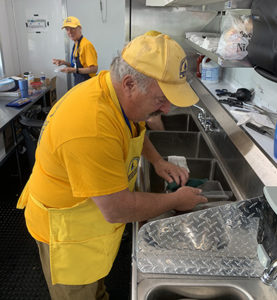
Working alongside Louisiana Baptists, TBM volunteers begin work at 5 a.m. each day, cooking 5,000 to 6,000 meals that are distributed across the area.
Each meal gives people strength to rebuild and “gives them hope that someone out there cares—and that ‘someone’ is Jesus,” said veteran TBM volunteer Joe Crutchfield.
Veteran TBM disaster relief volunteer Joe Crutchfield works in the field kitchen in Naples, Fla. (TBM Photo)
In the affected communities, a TBM flood recovery team from Southeast Texas is removing wet sheetrock, flooring, furniture and appliances. Team members then disinfect each home and let it dry out so it can be rebuilt. In one day, the team accomplishes what would take homeowners weeks or months to do.
Two more TBM flood recovery teams are headed to Naples to multiply TBM’s impact after the storm.
“These are extremely difficult days in Naples,” said TBM Executive Director/CEO Mickey Lenamon. “People are coming to grips with significant damage. The situation is overwhelming.
“In the midst of it all, TBM volunteers are living out their faith and meeting needs. Please continue to pray for Florida, as well as those who are serving.”
To support TBM disaster relief ministries financially, send a check designated for disaster relief to Texas Baptist Men, 5351 Catron Dr., Dallas, TX 75227 or click here to give online.
Sociologist says white Christians are ‘stuck’ regarding race


 Nathan Johnson Porter of Waco, former home missionary, pastor and advocate for the poor, died Oct. 3. He was 90. He was born July 22, 1932, in Campinas, Brazil, to missionaries Paul and Margaret Porter. He graduated from Baylor University and later completed a master’s degree and doctorate at the Southern Baptist Theological Seminary. In 1965, Porter helped found the Southern Baptist Convention’s US-2 program, in which students and young adults served alongside career missionaries in the United States for two years. He worked for decades with the SBC Home Mission Board in its Christian Social Ministries Department. He also was pastor of a mission congregation in Tulsa, Okla., pastor of First Baptist Church in Arkadelphia, Ark., and a consultant with the Baptist General Convention of Texas and its Christian Life Commission. Porter was a strong voice for the poor and vulnerable. He was known for his commitment to social justice and spent his life as an advocate for equality for all people. He married Francis Booth on Aug. 23, 1952. She preceded him in death in 2006. He is survived by son Joel Porter and wife Janet of Waco; daughter Leslie Porter Smith of Waco; daughter Becca Hollaway and husband Steven of Baltimore, Md.; five grandchildren; and four great-grandchildren. The family also includes adopted grandchildren Andrea McQuistion Han and Suzi McQuistion Mao. Memorial gifts may be made to Calvary Baptist Church, 1001 N 18th-A Street, Waco TX 76707.
 Barr, professor of history at Baylor University and author of