Greed and profit at heart of racism, lynching expert says

WACO—Systemic racism has more to do with greed and profit than with race-based hatred, a Baylor University authority on lynching told a Christian community development conference.

“Racism is not fundamentally about identity but about political economy,” said Malcolm Foley, director of Black church studies at Baylor’s Truett Theological Seminary.

Foley, special adviser to the university president for equity and campus engagement, addressed the No Need Among You Conference at First Baptist Church in Waco.

“Christian anti-racism risks a descent into sentimentalism” when it focuses on changing hearts and attitudes toward individuals without looking at the economic and political systems that lie behind racism, Foley asserted.

The Christian confession of faith—Jesus is Lord—is “profoundly political” because it means mammon—“the god of profit”—is not Lord, he said.

For centuries, racism has provided the justification and rationale for economically exploitative practices, from chattel slavery to the extermination of indigenous people, Foley insisted.

“Racism is not historically about hate. It’s historically about greed,” he said.

‘Demonic feedback loop’

Foley described a “demonic feedback loop” of exploitation, enforcement through violence and justification. The justification—the idea of white supremacy and the inherent inferiority of people of color—arose to provide a rationale for exploitation of non-whites, he explained.

Foley, whose doctoral dissertation focused on African American Protestant responses to lynching in the late 19th century and early 20th century, said the proper question to ask when encountering racism is, “Who benefits?”

Between 1883 and 1941, 3,000 Black men were lynched in the United States, he said. Lynching lost its social acceptance not when America became more enlightened and benevolent but when lynching became “bad for business,” Foley observed.

Rather than focusing solely on individual racist attitudes and actions, he encouraged Christians to consider systems involving policies, practices and processes, as well as people.

Theologically, he referred to the Apostle Paul’s writing in Ephesians 6 about wrestling “not against flesh and blood, but against principalities, against powers, against the rulers of the darkness of this world, against spiritual wickedness in high places.”

“We must be a repenting and a resisting people” who not only repent of complicity with sinful value systems, but also resist economic exploitation, Foley said.

Rather than simply accepting unfettered capitalism in an unquestioning fashion, he encouraged Christians to adopt a “counter-economy that sees need and exploitation as evil.”

Even so, he warned, some will feel threatened by that message. He pointed to the example of Martin Luther King, whose public approval ratings plummeted when he began to focus not just on racial justice, but also on economic justice.

However, Christ’s followers are called to “walk in the way of the cross” and stand for all manner of justice, he insisted,

“Seek to build communities with no need,” he urged. “Make your churches agents of the just redistribution of resources.”


Analysis: Some Christian Democrats abandoning the Social Gospel

(RNS)—About a decade ago, the conservative commentator and radio show host Glenn Beck told listeners to “look for the words ‘social justice’ or ‘economic justice’ on your church website. If you find it, run as fast as you can.”

In essence, Beck was telling his followers to reject a strain of Christian theology that dates back at least 100 years in the United States: the Social Gospel.

Popularized by Walter Rauschenbusch, a Baptist pastor, in the early 20th century, this theology focuses on issues such as poverty, exploitation, disease and hunger as the primary action items for the church.

Instead of focusing on the individual problem of sin, Rauschenbusch and other advocates of the Social Gospel believed Christians should focus on reforming institutions in the United States to make the country more equitable and fairer for all people.

Do American Christians still embrace the core principles of that doctrine? Or do they agree with Beck?

Acceptance of Social Gospel

Certain aspects of the Social Gospel still enjoy widespread approval. For instance, about 80 percent of Christians believe “God instructs us to protect the poor,” and only 15 percent believe “addressing social issues distracts people from achieving salvation.”

Other facets of the Social Gospel provoke more disagreement. While 61 percent of nonwhite evangelicals agree “social justice is at the heart of the Gospel,” that sentiment is only shared by 36 percent of white evangelicals. About 3 in 5 white evangelicals—twice the rate of other Christian groups—agree with the statement “God is more concerned about individual morality than social inequalities.”

Given that white evangelicals are outliers on a number of questions related to the Social Gospel, and white evangelicals’ tendency to vote for Republicans, it seems probable their divergence from nonevangelicals’ views on social justice is more about political partisanship than about theological tradition. The data confirms that suspicion.

For instance, a Christian who is Republican is twice as likely as a Christian Democrat to believe “building the kingdom of God on earth is only about bringing people to Christ, not changing social structures.”

Two thirds of Democrats who are Christians believe “social justice is at the heart of the Gospel,” while just 36 percent of independents and 35 percent of Republicans of the faith share that belief.

Social Gospel at church

Given that Democrats are more likely to embrace tenets of the Social Gospel, it would be fair to believe they are hearing these beliefs amplified in their churches, while Republicans are hearing more discussion of personal salvation and individual responsibility.

To test that theory, I put together a data model to determine how religion interacts with political partisanship to shape people’s beliefs about the Social Gospel. This model only included respondents who identified with a religious tradition. The religiously unaffiliated “nones” were excluded. I controlled for age, income, education, gender, race and other basic demographic factors.

Clearly, Republican Christians, regardless of church attendance, are more likely to believe individual morality is more important than societal inequalities. Church attendance only accelerates this belief, with more than half of Republicans who are weekly attenders agreeing on personal morality, compared with less than 40 percent of those who never attend.

Not much of a surprise. But for Democrats, the data gets more interesting. The more they attend church, the more likely they are to embrace a message of individual responsibility as opposed to societal sin.

If those on the left side of the political spectrum are attending churches that preach a strong version of the Social Gospel, those messages are not finding their way into the hearts and minds of the average liberal churchgoer. In fact, the data says just the opposite: The more Democrats go to church, the more they hold views on individual responsibility in common with Republicans.

That may come as a surprise to many progressive Christian communities and organizations that focus squarely on Social Gospel concerns like the Poor People’s Campaign, but there is no evidence to be found here that religious Democrats are more likely to focus on the problems preachers like Rauschenbusch focused on during the Progressive Era.

Instead, American Christianity is being seen more and more as a vertical relationship with God as opposed to a horizontal relationship with those in the community.

Ryan Burge is an assistant professor of political science at Eastern Illinois University, a pastor in the American Baptist Church and author of The Nones: Where They Came From, Who They Are, and Where They Are Going. He can be reached on Twitter at @ryanburge. The views expressed are those of the author.

Ahead of the Trend is a collaborative effort between Religion News Service and the Association of Religion Data Archives made possible through the support of the John Templeton Foundation.


Barr: God sees women even when Christian patriarchy does not

The Bible tells the stories of women whom God used and who exercised spiritual leadership, but they are all-but-invisible when Scripture is viewed through patriarchal lenses, best-selling author Beth Allison Barr told a Christian community development gathering.

Barr, professor of history at Baylor University and author of The Making of Biblical Womanhood: How the Subjugation of Women Became Gospel Truth, spoke to the No Need Among You Conference at First Baptist Church in Waco.
Views about what the Bible teaches regarding women influence how Christians read familiar narratives such as the story of Hagar—the mother of Ishmael who had been enslaved by Abram and Sarai—recorded in Genesis 16.

Drastically different ways of reading the same Scripture passage illustrate “the impact of Christian patriarchy on not only women in our churches, but also how it trickles out to women in our communities,” Barr said.

Two contrasting approaches

She contrasted two approaches to interpreting the text based on the work of Wil Gafney and John Piper.

Gafney, professor of Hebrew Bible at Texas Christian University’s Brite Divinity School, reads Genesis 16 from the perspective of a Black woman theologian. Piper, an influential Reformed pastor-theologian and founder of the popular Desiring God online resource, views it from a complementarian viewpoint that promote the subordination of women.

Gafney “describes Hagar as a powerless enslaved child—raped, abused, afraid and alone,” Barr noted. “This shocking sequence of events is made even more shocking by the identity of the perpetrators—the man and woman chosen by God to become the parents of his chosen people.”

At the same time, Gafney also notes Sarai herself was a survivor of sexual violence and domestic abuse who was “pimped out” to Pharaoh in Egypt by her husband Abram “because he was afraid for his life.”

At the darkest point in the story of Hagar, Gafney notes, everything changes “because God sees her—an abused, friendless, enslaved child.”

“God sees her, and God acts, making her a promise that she will bear a son, and her descendants—just like the children of Abraham­—will be too numerous to count,” Barr said.

In contrast, Piper focuses almost exclusively on the sin of Sarai, the impatience of Abram and the need to wait on God rather than follow human plans, she observed.

“Most of the resources—a combination of sermons, articles and blogs—don’t actually focus on Hagar,” she said.

In one resource, Piper uses “Sarai as an example of what happens when husbands’ and wives’ roles are reversed and the husband listens to the wife,” Barr said. “So that’s how he tells the story of Hagar. It’s because of the sin of Sarai in not submitting to her husband.”

While Gafney sees Hagar as a traumatized victim of abuse caught in a situation not of her own making, Piper barely sees Hagar, except as representative of what happens when people reject God’s plan, Barr observed.

‘Not seeing women’

“As a historian, one of the things I know is that a hallmark of patriarchy is centering men and not seeing women,” she said.

When men control the narrative, women often are minimized or ignored altogether, she noted.

“Not seeing women hurts women. It also hurts the church,” Barr said.

Patriarchal presuppositions blind readers to scriptural examples of women exercising leadership in churches, she noted, For instance, the Apostle Paul clearly did not intend to issue a blanket prohibition against women leading in churches, because he commended women like Phoebe, Junia and Priscilla.

“This is not revisionist history. No one is adding anything to the text. We’re just showing you what you haven’t seen because you have been looking through the lens of white masculinity,” Barr said.

One tragically high cost of not seeing women in Scripture and not allowing women’s voices to be heard is that women in churches are ignored when they report abuse, she said.

When men control the power structures and women are taught to submit to their authority without question, it allows abuse to continue, she asserted.

“God sees women,” Barr said. “Isn’t it about time the white evangelical world does, too?”


TBM disaster relief meets needs in Florida after Hurricane Ian

NAPLES, Fla.—Hurricane Ian is gone, and its floodwaters have receded. But devastating evidence of its presence remains throughout Naples, Fla., where Texas Baptist Men disaster relief volunteers are serving.

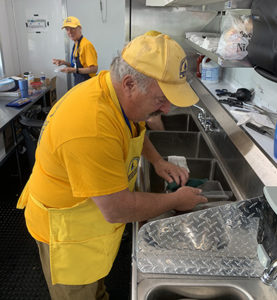
TBM disaster relief volunteers work in Naples, Fla., to prepare meals after Hurricane Ian. (TBM Photo)

Random boats float in backyard swimming pools. Kitchen islands have floated away. Walls and flooring in many places remain soaked.

Rain and a 9-foot storm surge flooded entire neighborhoods in Naples and temporarily knocked out power to many in the area.

In all, the strongest storm to hit Western Florida in history has killed at least 105 people in the United States, in addition to lives claimed in Cuba.

TBM volunteers are making sure Naples survivors have the food they need to push forward and a path forward for recovery, even if the Texans have to clear it themselves.

The day begins no later than 5 a.m. for TBM disaster relief volunteers serving in Naples, Fla. (TBM Photo)

Working alongside Louisiana Baptists, TBM volunteers begin work at 5 a.m. each day, cooking 5,000 to 6,000 meals that are distributed across the area.

Each meal gives people strength to rebuild and “gives them hope that someone out there cares—and that ‘someone’ is Jesus,” said veteran TBM volunteer Joe Crutchfield.

Veteran TBM disaster relief volunteer Joe Crutchfield works in the field kitchen in Naples, Fla. (TBM Photo)

In the affected communities, a TBM flood recovery team from Southeast Texas is removing wet sheetrock, flooring, furniture and appliances. Team members then disinfect each home and let it dry out so it can be rebuilt. In one day, the team accomplishes what would take homeowners weeks or months to do.

Two more TBM flood recovery teams are headed to Naples to multiply TBM’s impact after the storm.

“These are extremely difficult days in Naples,” said TBM Executive Director/CEO Mickey Lenamon. “People are coming to grips with significant damage. The situation is overwhelming.

“In the midst of it all, TBM volunteers are living out their faith and meeting needs. Please continue to pray for Florida, as well as those who are serving.”

To support TBM disaster relief ministries financially, send a check designated for disaster relief to Texas Baptist Men, 5351 Catron Dr., Dallas, TX 75227 or click here to give online.


Sociologist says white Christians are ‘stuck’ regarding race


Herschel Walker attends closed-door prayer event

ATLANTA (RNS)—Georgia Republican candidate for U.S. Senate Herschel Walker attended a closed-door prayer event at a prominent evangelical church in Atlanta on Oct. 4, huddling with religious supporters a day after he denied allegations he paid for an abortion in 2009.

The event, a “Herschel Walker Prayer Luncheon,” was convened at First Baptist Atlanta, which was once led by former Southern Baptist Convention President Charles Stanley. Press reportedly was barred from the event, with an official saying the decision was made by the church and Walker’s campaign.

Kelly Stewart, First Baptist’s director of business operations, told Religion News Service the event was not preplanned and came together because Walker’s campaign “was looking for a place to bring the prayer warriors to gather for Mr. Walker.”

Stewart said the event drew around 240 people and largely consisted of the church’s current pastor, Anthony George, asking Walker questions about his faith and “religious liberties.” She said Walker also offered his personal testimony, after which the group prayed over him.

“Everyone gathered around him and prayed for him and prayed for our country,” Stewart said.

‘Did not get into personal things with him’

However, Stewart said the pastor did not ask Walker about a new report published by the Daily Beast on Monday alleging the candidate paid for the abortion of a woman he impregnated in 2009.

“We did not get into personal things with him,” Stewart said.

According to the Daily Beast report, the woman, who remained anonymous, shared with the outlet a $575 abortion clinic receipt, an image of a signed $700 personal check from Walker and a “get well” card featuring what appears to be his signature.

Walker denied the allegations on Monday, calling it a “flat-out lie” and threatening to sue the Daily Beast over the article. The outlet has since said it stands by its reporting.

“I can tell you right now, I never asked anyone to get an abortion,” Walker told Fox News host Sean Hannity Monday evening. “I never paid for an abortion. It’s a lie.”

Walker’s campaign did not immediately respond to requests for comment about the event.

‘Taking Jesus with me’

First Baptist is one of several churches to have hosted Walker during his campaign this year, including when George appeared with the candidate during worship for a question-and-answer session in front of the congregation.

After Walker told George, “I’m not just going to Washington, I’m taking Jesus with me,” the pastor asked the former NFL star about his “pro-life” stance.

“When somebody asks me that question, I say it’s strange, it’s so strange, because I’m a Christian,” Walker replied.

He later added: “Did I not say I’m a Christian? That means you’re supposed to be pro-life.”

As a candidate, Walker has also said he would support a national ban on abortions, including a version with no exceptions for cases involving rape, incest or a woman’s health.

‘Everything has been a lie’

Walker’s son, Christian Walker, published a series of tweets and videos Monday and Tuesday arguing his father—not the Daily Beast—was lying.

“The abortion card drops yesterday. It’s literally his handwriting on the card. They say they have receipts,” the younger Walker said in one of his videos. “He gets on Twitter. He lies about it. OK, I’m done. Done. Everything has been a lie.”

Christian Walker, who participated in a campaign event for his father late last year, went on to criticize fellow conservatives who voice support for “family values” but overlook elements of the Georgia candidate’s past, such as reports regarding Herschel Walker’s children.

Walker’s son said his father “wasn’t in the house” raising four children conceived with “four different women,” but was instead “out having sex with other women.”

“I don’t care about someone who has a bad past and takes accountability. But how DARE YOU LIE and act as though you’re some ‘moral, Christian, upright man,’” Christian Walker tweeted. “You’ve lived a life of DESTROYING other people’s lives. How dare you.”

Herschel Walker appeared to respond to his son on Twitter Monday night, saying, “I LOVE my son no matter what.”

Prominent conservatives stand by their man

Despite the criticism, many prominent Republicans and conservative groups are standing by Walker’s candidacy, according to NBC.

In the wake of the Supreme Court decision earlier this year overturning Roe v. Wade, effectively returning the question of abortion access to the states, abortion has proven to be one of several issues motivating voters across the country in the lead-up to the midterm elections next month—including in Georgia.

According to a poll conducted by the Atlanta Journal Constitution in September, 48 percent of respondents said they are more likely to back a candidate who would support abortion rights. Meanwhile, only 25 percent of likely voters said they’re more likely to vote for a candidate who wants to limit abortion, although that number was nearly half among Republicans (47 percent).

Walker’s Democratic opponent, pastor and current U.S. Sen. Raphael Warnock, has publicly expressed support for abortion rights and identified as a “pro-choice pastor.”


On the Move: Crosby, Harris, Porter, Prudhome and Roe

Sam Crosby to Trinity Baptist in Gatesville as pastor from First Baptist Church in San Saba, where he was pastor.

Jim Harris to Tilden Baptist Church as pastor.

Melanie Porter to Kenefick Southern Baptist Church in Dayton as youth minister.

Dale Prudhome to First Baptist Church in Nederland as worship pastor, effective Oct. 23. He previously was minister of music at Pine Forest Baptist Church in Vidor.

Kevin Roe to Community North Baptist Church in McKinney as pastor from The Life Church in Arlington, where he was campus pastor.


Around the State: Student Athlete Mental Health Endowment at Baylor

Baylor University announced a gift from Jarred and Kay Nan Sloan of Houston supporting Baylor Athletics and resourcing Athletics Mental Health Services, which ensures access for Baylor’s student-athletes to mental health services. The Sloans’ gift provides seed funding to establish the Student Athlete Mental Health Endowment, as well as immediate-use funds to provide critical, upfront support for the Athletics Mental Health Services program. “Baylor Athletics is committed to fostering a caring community, free of stigma, where our student-athletes’ mental health is given the same care as their physical wellbeing,” said Mack B. Rhoades IV, Baylor vice president and director of intercollegiate athletics. “We celebrate the generosity of the Sloans, and we hope other members of our Baylor Family will follow their lead in giving to the Baylor Student Athlete Mental Health Endowment.” Jarred Sloan is the president and a trustee with Clayton Foundation for Research, a nonprofit medical research organization. Kay Nan Wilkerson Sloan is a former speech therapist within the Houston Independent School District.

East Texas Baptist University students, faculty and staff gathered Sept. 28 for the annual See You at the Pole event, a global day of student-led prayer. (ETBU Photo)

East Texas Baptist University students, faculty and staff gathered Sept. 28 for the annual See You at the Pole event, a global day of student-led prayer. The tradition that started in 1990 at a high school in Burleson has since grown to see about 3 million students in the United States and more than 20 countries gather to pray at their school’s flagpole. The Baptist Student Ministry coordinates the event at ETBU. This year, the BSM focused on adoration of God, confessing sin to God, being thankful to God, and offering prayers of supplication to God.

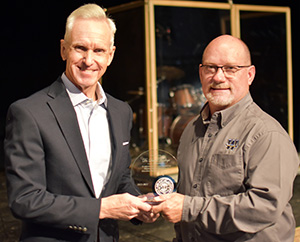
Donnie Brown, director of spiritual life at Wayland Baptist University, presents an award to David Hardage, who retires at the end of the year as executive director of the Baptist General Convention of Texas. (WBU Photo)

During a recent chapel service, Wayland Baptist University recognized David Hardage, who will retire at the end of the year as executive director of the Baptist General Convention of Texas. Donnie Brown, director of spiritual life at WBU, presented Hardage with an award in appreciation for his support of Wayland. “During Dr. Hardage’s decade of service, Texas Baptists have created greater opportunities of service for Wayland, most recently bringing Super Summer back to our campus. For that we are thankful,” Brown said.

Irene Gallegos

Dallas Baptist University hosted a Sept. 18 commissioning service for Irene Gallegos as specialist with the Christian Life Commission to oversee the Texas Baptist Hunger Offering and Community Care grants. Guest speaker was Sergio Ramos, church engagement officer at Buckner International and president-elect of the Convención Bautista Hispana de Texas. Gallegos earned her undergraduate degree from DBU. She holds a Master of Public Health degree from the University of North Texas Health Science Center and a Ph.D. in health studies from Texas Woman’s University. She and her husband Estaban have one son, Caleb, and are members of Iglesia Bautista Getsemini in Fort Worth.

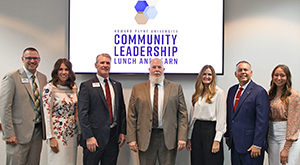
Participants at Howard Payne University’s Community Leadership Lunch and Learn event included (left to right) Nate Penland, vice president for student experience; Shannon Sims, assistant professor of kinesiology and director of the SWELL program; Dale Meinecke, vice president for development; James Wunderle Jr., assistant professor of psychology; Jill Heupel, associate vice president for academic affairs; HPU President Cory Hines; and Megan Froese, HPU student. (HPU Photo)

“Wellness in the Workplace” was the theme of the third Community Leadership Lunch and Learn event at Howard Payne University. The program included presentations by Jill Heupel, associate vice president for academic affairs, and James Wunderle Jr., assistant professor of psychology. Hendrick Medical Center Brownwood was the title sponsor for the event.

The Hardin-Simmons University board of trustees voted not to increase tuition costs for the upcoming 2023-2024 academic year. The HSU administration also agreed to increase academic scholarships by an additional $2,000 per student for 2023-2024 first-time freshmen. HSU continues to provide an affordable and excellent education enlightened by Christian faith and values. “Hardin-Simmons University recognizes folks’ desire to receive an excellent value in education. Not increasing its tuition and fees while increasing scholarship opportunities is one-way HSU is working to provide that desired value,” said Jodie McGaughey, vice president for finance at Hardin-Simmons.

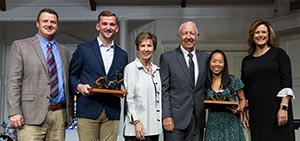
East Texas Baptist University seniors Colton Berryhill from Bullard and Annie Walker from Montgomerywere honored on Oct. 3 with the Bob and Gayle Riley Servant Leadership Award for consistently displaying Christian servant leadership on campus and in the community. (ETBU Photo)

East Texas Baptist University seniors Colton Berryhill from Bullard and Annie Walker from Montgomery received the Bob and Gayle Riley Servant Leadership Award on Oct. 3 for consistently displaying Christian servant leadership on campus and in the community. ETBU President Emeritus Bob Riley and former ETBU First Lady Gayle Rileypresented the honorees with a miniature replication of the “Divine Servant” statue, created by Max Greiner, which can also be found on campus at the entrance to the Rogers Spiritual Life Center. Two students are selected each year for the award. Fellow students, professors, and other members of the ETBU campus community submit nominations recognizing their dedication to pursuing a Christ-like practice of servanthood. Berryhill, a Christian ministry major, has served as a Tiger Camp leader, a Thrive mentor, resident assistant, Baptist Student Ministry leadership team member and Leadership Fellow who worships and volunteers at Mobberly Baptist Church in Longview. Walker, an elementary education major, is a member of the Boys and Girls Club ministry, Baptist Student Ministry leadership, Leadership Fellow and Student Foundation participant who worships and volunteers at New Beginnings Baptist Church in Longview.

Retirement

Frank Pomeroy as senior pastor of First Baptist Church in Sutherland Springs, where he has served 20 years.

Anniversaries

150th for Pleasant Grove Missionary Baptist Church in Gholson, where Darrick W. Ervin is pastor, and First Baptist Church in Gholson, where James Stevens is pastor. The neighboring congregations—one historically Black and the other predominantly Anglo—celebrated their sesquicentennials together. Members of Pleasant Grove Missionary Baptist Church worshipped at First Baptist Church on Sept. 11. A group from First Baptist joined Pleasant Grove for an afternoon celebration service on Sept. 18, where Pastor Melvin Petty of Greater Mount Olive Baptist Church in Waco was guest preacher.


Christians murdered, thousands displaced in Nigeria

BENUE, Nigeria (BP)—Dozens of Christians were murdered and 6,000 displaced in terrorist attacks in Nigeria’s middle belt in September.

International advocates are urging the U.S. State Department to cite Nigeria for religious liberty violations.

“Armed herdsmen and terrorists have not stopped their unprovoked attacks on Christians in Benue state,” Akpen Leva, chairman of the Benue State Chapter of the Christian Association of Nigeria, said Sept. 24 in a press statement. “These attacks are aimed at killing defenseless Christians and to force them out of their communities.”

Multiple attacks

Those killed in a series of September attacks in Benue included “dozens” murdered in eight majority-Christian villages Sept. 23 and 21, 13 killed in two additional villages Sept. 9-10, and nine killed Sept. 1-3 in the same two villages, Morning Star News reported, quoting law enforcement and religious leaders. Fifteen villagers were killed Sept. 15 in Logo Local Government Area of Benue, the Daily Post reported.

Others were killed in smaller attacks, including three killed Sept. 18 in a Christian village in Guma County, Benue; two on Sept. 25 in Plateau State, two on Sept. 24 in Kano state, and a woman working on her farm Sept. 19 in Plateau State, Morning Star reported. Others were injured, kidnapped or displaced in the attacks. Homes, farms and churches were destroyed, and food was stolen.

Attackers displaced more than 6,000 from three Benue counties in September, according to Emmanuel Shior, executive secretary of the Benue State Emergency Management Agency.

“Recent attacks by herders on some Christian communities in Benue state have left 6,000 Christians displaced in Logo, Guma and Gwer West local government areas of the state,” Morning Star quoted Shior.

“These continuous attacks by herdsmen on Christian communities in the state have also resulted in the destruction of facilities like churches, schools, markets and health care establishments.”

Militant herdsmen, the Islamic State West Africa Province and bandits have been blamed for the murders and attacks, with animist worshipers also blamed for church attacks.

“These attacks by the herdsmen have left dozens of Christians dead and several more with gunshot injuries and machete attack wounds,” Morning Star quoted a text message from resident Ukan Kurugh after the Sept. 23 attack.

“Survivors of these herdsmen attacks have been taken to some hospitals, and they need urgent medical attention but lack the funds to pay for their medical bills. Some of them need urgent surgeries but they can’t afford to pay for the charges.

“Our people have suffered immensely in the hands of these marauding herdsmen.”

More than 100 worshipers were kidnapped in September from churches in northwest Nigeria, the Southern Kaduna Peoples Union reported in a press release, citing attacks Sept. 12 and 13 at two separate sites of the Cherubim and Seraphim Church in Niger and Kaduna states.

“There is still no breathing space for Christian communities in southern Kaduna, as terrorists, jihadists, bandits and armed herdsmen have continued to plunder and wreck Christian communities in the southern part of Kaduna state,” Morning Star quoted National President Awemi Maisamari Sept 22.

Calls to return Nigeria to CPC status

The U.S. State Department dropped Nigeria from its 2021 list of Countries of Particular Concern or egregious violators of religious freedoms. The Southern Baptist Ethics & Religious Liberty Commission and 21 Wilberforce are among the groups urging the return of Nigeria to the list released annually in November.

Nigeria, which has led countries in deaths of Christians by terrorists, was first included on the State Department’s list of Countries of Particular Concern in 2020, but was not retained the next year.

“As religious minorities face increasingly intense persecution for their faith in Nigeria, it is imperative that Secretary (Antony) Blinken re-designate Nigeria as a country of particular concern. Over the past year, we’ve continued to see deteriorating conditions in Nigeria as thousands of Christians have been martyred for their faith,” ERLC policy manager Hannah Daniel said.

The U.S. government “must do more to pressure the Nigerian government to take action and protect its people from these heinous acts of violence against people of faith, and the CPC designation is an essential piece of such a strategy.”

More than 2,500 Christians were killed in the first six months of 2022 in Nigeria, the advocates said in their letter, referencing a report by the International Society of Civil Liberties and Rule of Law.

The Observatory of Religious Freedom in Africa counted more than 4,300 Christians and 2,200 Muslims killed in “jihadist-related contexts” from Oct. 1, 2020, to Sept. 30, 2021, according to the Observatory of Religious Freedom in Africa.


Corpus Christi pastor plans to pray in death chamber

The State of Texas is scheduled to execute John Henry Ramirez on Oct. 5, and his pastor plans to be in the death chamber to lay a hand on him and pray for him.

Pastor Dana Moore of Second Baptist Church in Corpus Christi has served as spiritual adviser to Ramirez about five years, ministering to him in prison.

After Ramirez made a profession of faith in Christ and was baptized on Texas Death Row, Second Baptist Church allowed him to join the congregation’s membership. Ramirez is among 28 inmates who are part of the first designated faith-based units on Texas Death Row.

Barring a clemency declaration or last-minute delay, Ramirez will die by lethal injection on Wednesday about the time other members of Second Baptist Church gather for a mid-week Bible study and prayer time.

Ramirez was convicted and sentenced to die for the 2004 murder and robbery of Pablo Castro, a Corpus Christi convenience store clerk.

Supreme Court ruled

In an 8-1 decision in Ramirez v. Collier, the U.S. Supreme Court in March upheld on religious liberty grounds a request by Ramirez to have his pastor lay hands on him and pray aloud for him at the moment of his execution.

Previously, the Texas Department of Criminal Justice had denied his request, citing security concerns. Lower courts sided with the state agency, saying the TDCJ has a “compelling interest in maintaining an orderly, safe and effective process” when carrying out executions.

While the Supreme Court agreed the state has a clear interest in carrying out executions in a safe and orderly fashion, security issues do not justify denying an inmate the right to spiritual comfort.

At the time of the ruling, Moore said he was glad the court “upheld John’s religious liberty rights” by allowing his spiritual adviser to offer a “ministry of presence,” praying for him and laying a hand on him in his final moments of consciousness.

“Touch is a very meaningful and supportive way of showing compassion and love,” Moore said. “That’s why Jesus touched.”

John Henry Ramirez is part of one of the first designated faith-based units on Texas Death Row. (Photo / Ken Camp)

In a May 25 interview with the Baptist Standard at the Allen B. Polunsky Unit, Ramirez said it will be “spiritually significant” to have Moore physically present in the execution chamber to pray for him and place a hand on him.

“He’s my brother. I’ve grown to love him,” Ramirez said. “I want to have him touch me and pray over me as I transition from life to death.”

When Ramirez is transported 50 miles from the Polunsky Unit to the Huntsville Unit, home of the state’s execution chamber, it won’t be the first time he has made the trek for a scheduled execution. In fact, it marks the fourth execution date he has faced in recent years.

In September 2021, the Supreme Court granted a last-minute temporary stay of execution to consider his request to have his pastor in the death chamber with him.

In April, Nueces County District Attorney Mark Gonzalez filed a motion to withdraw the death warrant his office had issued for Ramirez’s execution, saying he “has the firm belief that the death penalty is unethical and should not be imposed on Mr. Ramirez or any other person.”

But in June, state District Judge Bobby Galvan rejected the prosecutor’s request to withdraw the warrant. Then last month, the Texas Court of Criminal Appeals denied a stay of execution, and the appeals court let stand Galvan’s order refusing to vacate the Oct. 5 execution date for Ramirez.


TBM volunteers head to Florida to help hurricane survivors

The first wave of Texas Baptist Men volunteers are headed to Florida to meet needs caused by Hurricane Ian.

The first wave of Texas Baptist Men volunteers are headed to Florida to meet needs caused by Hurricane Ian. (Photo / John Hall)

The first responding TBM Disaster Relief units include a command center, electrical support unit, electrical support generator and asset protection unit. TBM leaders are scheduling flood recovery and feeding teams to serve, as well.

Local officials still are calculating the damage inflicted by the storm, which is now lashing South Carolina. At least 21 people have died as a result of the hurricane, and large portions of Florida have been impacted by torrential rainfall.

TBM Executive Director Mickey Lenamon asked Christians to pray both for storm survivors and volunteers.

“These are tough times for the people who were in this storm’s path. So, let’s pray for the variety of needs they are facing, including their spiritual needs,” he said.

 “Pray for our TBM volunteers. They are willing and eager to serve our Lord through service to others. Pray for their safety in traveling and in working. Also pray that the love of Christ will show through in all that our people do.”

TBM is part of a multistate response that includes Southern Baptist disaster relief volunteers from about a dozen states.

To support TBM disaster relief ministries financially, send a check designated for disaster relief to Texas Baptist Men, 5351 Catron Dr., Dallas, TX 75227 or click here to give online.


Partnership brings groceries to South Dallas food desert

By working collaboratively, two Dallas-area nonprofit organizations with Texas Baptist connections will bring free groceries and other services to a South Dallas food desert.

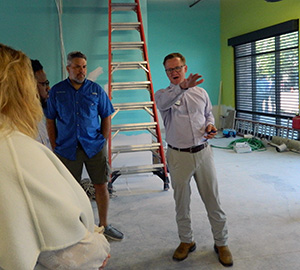
Wes Keyes, executive director of Brother Bill’s Helping Hand, shows visitors the still-under-renovation facility that will house the South Dallas Community Market. (Photo / Ken Camp)

Local dignitaries and community representatives gathered Sept. 29 to dedicate a 12,000-square-foot mixed-use facility that will house ministries sponsored by BridgeBuilders and a grocery-store-style food pantry operated by Brother Bill’s Helping Hand.

BridgeBuilders worked with the Dallas Department of Housing and Neighborhood Revitalization to secure the facility, about two-and-a-half miles south of Fair Park.

When the South Dallas Community Market opens in November, it will provide fresh vegetables and other healthy groceries to more than 350 families—about 1,100 individuals—twice a month, said Wes Keyes, executive director of Brother Bill’s Helping Hand.

Bill Harrod, a Baptist preacher who wanted to meet the needs of his West Dallas neighbors, founded the Brother Bill’s Helping Hand ministry more than 75 years ago. In recent years, it has expanded from one neighborhood to serving people in more than 90 ZIP Codes.

The ministry focuses on three key components—educational programming, health care and the essentials of life, particularly food. At the worst point in the COVID pandemic, Brother Bill’s Helping Hand provided 1.3 million meals to needy families and individuals in 2020.

‘Want to expand into areas of greatest need’

So, expanding the ministry’s footprint to launch a client-directed pantry in a South Dallas food desert was a natural step.

“We want to expand into areas of greatest need,” said Keyes, a member of Cliff Temple Baptist Church and graduate of Baylor University’s Truett Theological Seminary.

“Best of all, the North Texas Food Bank will deliver right to this location,” he added.

Churches and individuals around the state help provide support to Brother Bill’s Helping Hand through their gifts to the Texas Baptist Hunger Offering.

BridgeBuilders—a Christian nonprofit organization that has worked 26 years in South Dallas—worked with city officials to secure a facility on Bexar Street as a base for ministry in the neighborhood.

“When we did a community survey in the area to ask what was needed, 90 percent of the neighbors said they wanted a grocery store,” said Jonathan Fechner, executive director of BridgeBuilders.

Fechner knew about the grocery-store-style food pantry at Brother Bill’s, where neighbors can choose their own groceries and shop at no cost to them.

‘It’s a kingdom partnership’

Adam Wright (left), president of Dallas Baptist University, visits with Jonathan Fechner, executive director of BridgeBuilders. (Photo / Ken Camp)

“I love their model, because it respects the dignity of their neighbors, and residents select what they want,” said Fechner, who earned both his undergraduate degree and master’s degree from Dallas Baptist University and is now in the Ph.D. program there. DBU President Adam Wright serves on the BridgeBuilders board of directors.

Fechner went to talk with Keyes to learn more about the Brother Bill’s food pantry, hoping BridgeBuilders could emulate its approach.

“That’s when Wes told me they were looking to expand,” he recalled.

Fechner learned the board of directors at Brother’s Bill’s already had been discussing the possibility of starting a satellite food pantry in South Dallas.

“When they offered to operate the food pantry, it was a no-brainer. It’s a kingdom partnership,” he said.

When neighbors shop at the South Dallas Community Market, they will be introduced to other services available through BridgeBuilders, such as job training, mentorship and after-school programs.

The Bexar Street facility also includes a half-dozen upstairs apartment units BridgeBuilders will offer as part of an affordable transitional housing program to help young high school graduates enter adulthood.

At the Sept. 29 dedication, Keyes and Fechner—along with Dallas City Council Representative Adam Bazaldua and Dallas Deputy Mayor Pro Tem Omar Narvaez—praised the collaborative nature of the new South Dallas initiative.

“If you want to go fast, go alone. If you want to go far, go together,” Keyes said, quoting an African proverb. “We are able to do greater things and more long-lasting things because of partnerships. … It’s about transforming lives.”