Explainer: U.S. policy on refugees and asylum-seekers

WASHINGTON (RNS)—Responding to a tide of Venezuelans crossing the United States-Mexican border in recent months, the Biden administration announced it would send most Venezuelans who enter the country illegally back to Mexico, while allowing 24,000 Venezuelans to remain in the United States on humanitarian parole.

More than 6 million Venezuelans have fled their country and President Nicolas Maduro’s brutal regime, according to Human Rights Watch, flooding nearby Latin American countries and overwhelming an already stressed system of receiving and processing migrants at the U.S. border.

In August and September alone, nearly 60,000 Venezuelans made contact with border authorities, the Department of Homeland Security said, many of them seeking asylum.

In coordination with the Mexican government, the United States will bar entry to Venezuelans, who so far haven’t been subject to Title 42, a measure that refuses entry on public health grounds.

Refugees from Ukraine rest at a railway station in Przemysl, southeastern Poland, on March 23, 2022. (AP Photo/Sergei Grits)

The 24,000 will be admitted under a humanitarian parole program modeled on the one that has accommodated Ukrainians and Afghans fleeing the wars in their countries. To be eligible for the program, Venezuelans must have the support of a legal U.S. resident or entity who can provide for the refugee financially, the administration said. They will be allowed to work and have the opportunity to become citizens after some years.

With the new DHS process for Venezuelans, U.S. refugee resettlement agencies, most of them faith-based organizations, will be pressed to recover more quickly from the loss of funding and manpower over the last few years, when relatively low numbers of refugees have entered the country, and to advocate for those still displaced by earlier international crises.

While applauding the new avenue for Venezuelans, Krish O’Mara Vignarajah, president and CEO of Lutheran Immigration and Refugee Service, cautioned that the new program “should not be viewed as a replacement for asylum protections enshrined in both U.S. and international law.”

“It provides only temporary protection to a very limited subset of the millions of Venezuelans forced to leave their homeland,” Vignarajah said in a written statement.

So what are those asylum protections, and how does the U.S. refugee resettlement program work—and how do faith-based organizations play a role?

Who are refugees?

The United Nations, in its 1951 Refugee Convention and 1967 Protocol, defines a refugee as “someone who is unable or unwilling to return to their country of origin owing to a well-founded fear of being persecuted for reasons of race, religion, nationality, membership of a particular social group, or political opinion.”

Congress adopted this definition in the Refugee Act of 1980, which also created the current process for refugee resettlement in the U.S., a public-private partnership between the U.S. government and nine refugee resettlement agencies.

In fiscal year 2022, most refugees (7,810) came to the U.S. from Congo, followed by Syria (4,556) and Myanmar (2,156), according to State Department data.

“The United States has a strong legacy of welcoming persecuted people of diverse faith traditions,” Vignarajah said.

More than half of all refugees (64 percent) admitted in fiscal year 2021 were Christian, she pointed out. State Department data shows more than 232,000 Christians have been resettled in the United States since fiscal year 2012, followed by 174,000 Muslims.

How does the U.S. refugee resettlement program work?

Every October, with the start of the federal government’s fiscal year, the president, in consultation with Congress, sets the number of refugees who will be allowed into the country that year. This figure is known as the presidential determination.

President Joe Biden recently announced the United States will admit up to 125,000 refugees over the next year—the same number as last year.

“Up to” is a critical part of the determination. Primarily because of the pandemic and cuts made to the refugee resettlement program under the Trump administration, the United States only admitted a fraction of that number last fiscal year: 25,465.

Evacuees from Afghanistan disembark from a U.S. Air Force plane at the naval station in Rota, southern Spain, on Aug. 31, 2021. (AP Photo/ Marcos Moreno)

But there are other ways people meeting the definition of a refugee can enter the United States. Add the number of Afghans and Ukrainians admitted on humanitarian parole to the number of refugees admitted to the United States in fiscal year 2022, and the Biden administration did resettle roughly 125,000 people—it just didn’t resettle them all as refugees, according to Matthew Soerens, national coordinator of the Evangelical Immigration Table and U.S. director of church mobilization and advocacy for World Relief.

The presidential determination has been as high as 231,700 in 1980, the year the U.S. refugee resettlement program started, and as low as 15,000 in President Donald Trump’s last year in office.

Refugees admitted to the United States have been identified and vetted by the U.S. government overseas, usually in a second country after they already have fled their country of origin, according to Soerens.

Some have been living in refugee camps. Others, like most Syrians who have fled to Jordan, are living in urban environments, Soerens said. Most are never resettled to a third country, but rather return to their home country when it is safe to do so or receive permanent legal status in their second country.

If they are resettled, most of the time they don’t get to choose their new country, Soerens said.

On average, the U.N. has reported, it takes 17 years for a refugee to return home, receive permanent legal status in a new country or be resettled elsewhere. Some families spend generations in refugee camps.

Before entering the United States, all must pass health and security screenings. That vetting only gets more intense with every passing year, according to Mark Hetfield, president and CEO of HIAS, formerly the Hebrew Immigrant Aid Society.

“Nobody gets resettled here without going through this bureaucratic obstacle course of extreme vetting,” Hetfield said.

Once refugees are in the United States, resettlement agencies help them find housing and employment, learn to speak English if they don’t already and otherwise settle into their new home.

Post-Trump reboot

The Trump administration hadn’t been processing as many people overseas and had slashed the presidential determination to new lows each year of Trump’s presidency, forcing resettlement agencies to close offices and lay off staff.

Hetfield of HIAS said all nine resettlement agencies have reopened offices across the country, and the government is processing refugees more quickly.

But, he said, “It takes time to build it back.

“It’s easy to destroy something. It’s a lot harder to build it, let alone to rebuild it when you’ve had the confidence shattered the way that it was for the last four years.”

What about asylum-seekers?

Many of the Venezuelans entering the United States at its border with Mexico are seeking asylum, citing the Maduro regime’s attacks on its own people.

Asylum-seekers must meet the same criteria for a refugee: a well-founded fear of persecution in their home countries because of their race, religion, nationality, membership in a particular social group or political opinions. In late September, Biden announced changes meant to streamline the asylum granting process.
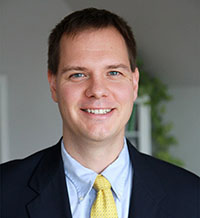
Matthew Soerens

The U.N. convention and protocol, as well as the Refugee Act of 1980, hold that people should not be returned to a country where they’re likely to face persecution—a consequence of the 1930s and ’40s, when the United States turned away Jewish people fleeing the Nazis.

“We and most other countries around the world realized that that was a terrible, grave, moral error, and we should never have done that,” said Soerens of World Relief.

Asylum-seekers must already be in the United States or at its border to claim asylum, he said. They do not count toward the number of refugees admitted to the country each year and cannot access many of the same services as people who come to the United States through the refugee resettlement system. Among other things, they are not authorized to work in the United States.

What is humanitarian parole?

Most people coming to the United States from Afghanistan and Ukraine are coming with humanitarian parole. Like asylum-seekers, people on parole follow a different process, do not count toward the number of refugees admitted to the country each year and can’t access all of the services refugees do.

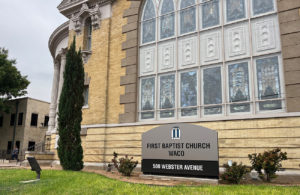
First Baptist Church in Hallsville sponsored Pavlo and Larina Romaniuk and their three children—6-year-old Emilee and 4-year-old twins Deniel and Olivia—as part of the Uniting for Ukraine humanitarian parole program. (Photo / Ken Camp)

“They’re basically undocumented immigrants who came here with permission,” said Hetfield of HIAS.

Like Vignarajah, Soerens believes the accommodation for those admitted under humanitarian parole should not impede the regular flow of refugees.

“We want the United States to welcome as many Ukrainians as need safety and as many Afghans, as well,” he said (speaking before the Venezuelan program was announced). “But we also don’t think we should be—because of these situations, which have appropriately generated a lot of media attention—pushing people who’ve already been waiting 20 years in a camp back for another 10 years for a chance to be resettled in the United States,” he said.

How did faith-based agencies get involved?

Six of the nine refugee resettlement agencies that work with the U.S. government are faith-based. They include Church World Service, Episcopal Migration Ministries, HIAS, Lutheran Immigration and Refugee Service, the U.S. Conference of Catholic Bishops and World Relief.

Each has offices in different parts of the country and draws on different networks to do its work.

“Part of the story is faith-based organizations have been the ones receiving refugees well before we had a Refugee Act of 1980—even back when there was really basically no federal immigration laws,” Soerens said.

For Christians, he said, that commitment begins with a belief that Jesus himself was a refugee who fled with his family to Egypt as a young child after King Herod’s order to murder all male children Jesus’ age in Bethlehem.

“It’s part of the experience that, for Christians, our Lord and Savior experienced as a human being, and that certainly ought to inform how we respond to those in a similar circumstance today,” he said.

For Jews, recent historical experience as well as experiences over the millennia make clear why welcoming refugees is a moral imperative, Hetfield said.

Commands to “welcome the stranger” and “treat the stranger as ourselves because we were once strangers in Egypt” are repeated 36 times—more than any other commandment—in the Torah, he said.

And the American Jewish community owes its existence to those times the United States welcomed refugees, he added.

“At HIAS, we say we used to welcome refugees because they were Jewish. Now we welcome refugees because we are Jewish,” Hetfield said.



A $100 million ad campaign wants to fix Jesus’ image

DALLAS (RNS)—Jon Lee has some words for evangelical leaders who argue that Christian ethics like kindness, honesty and loving your neighbor don’t apply to culture-war politics.

Jon Lee

“Good luck,” said Lee, a principal at Lerma, a cross-cultural advertising agency based in Dallas.

Lee is one of the chief architects of the “He Gets Us” campaign, a $100 million effort to redeem Jesus’ brand from the damage done by his followers, especially those who say one thing and then do another.

Launched earlier this year, ads featuring black-and-white online videos about Jesus as a rebel, an activist or a host of a dinner party have been viewed more than 300 million times, according to organizers.

Billboards with messages like “Jesus let his hair down, too” and “Jesus went all in, too,” have also been posted in major markets like New York City and Las Vegas.

Tell better story about Jesus, act like him

The campaign, funded by the Signatry, a Christian foundation based in Kansas, will expand in the next few months, with an updated website, an online store where people can get free gear if they forgive someone or welcome a stranger, and an outreach program for churches, all leading up to a Super Bowl ad.

Lee said organizers also want to start a movement of people who want to tell a better story about Jesus and act like him.

“Our goal is to give voice to the pent-up energy of like-minded Jesus followers, those who are in the pews and the ones that aren’t, who are ready to reclaim the name of Jesus from those who abuse it to judge, harm and divide people,” Lee said.

Jason Vanderground, president of Haven, a branding firm based in Grand Haven, Mich., said the movement hopes to bridge the gap between the story of Jesus and the public perception of his followers. The campaign has done extensive market research and found that, while many Americans like Jesus, they are skeptical of his followers.

What market research reveals

The market research split Americans into four categories: non-Christians (16 percent of the sample), people who are “spiritually open” (20 percent), “Jesus followers” (34 percent) and “engaged Christians” (30 percent). It showed a wide gap between the first three groups and the last category.

Most people in the first three categories said the behavior of Christians is a barrier to faith. More than two-thirds agreed when asked: “Followers of Jesus say one thing, but do not follow those things in practice.” Only 5 percent of the engaged Christians agreed.

Most folks in the first three categories also agreed Christians care only about stopping abortions, rather than caring for moms and their children. Only 6 percent of the engaged Christians agreed.

The recent scandal involving Herschel Walker, the former football star turned outspoken anti-abortion Senate candidate, who allegedly pressured a former girlfriend to have an abortion, seems to fit how many of those outside the church see Christians—especially after many of his supporters rallied around Walker, despite the scandal.

Ironically, the ideas that Jesus loved all people and warned about religious hypocrisy were seen as very important to engaged Christians and Jesus followers in the research but were not seen as very important to the non-Christians or spiritually open.

Image of Jesus distorted by Christians

Vanderground said Christians see their faith as the greatest love story, but those outside the faith see Christians as a hate group.

“Jesus said people are going to know my followers by the way they love each other and the way they interact with each other,” he said. “I think when we look at American Christianity now, we don’t see nearly as much of that—and that concerns a lot of people.”

Lee said past faith-based campaigns, like the famed “the family that prays together, stays together” series of television ads, were aimed at getting people to go back to church. This campaign takes a more spiritual but not religious approach.

Lee said organizers hope the ads inspire people to at least consider that Jesus might be relevant to their lives.

Those who see the ads can contact the campaign and get connected with Bible study resources to check out the story of Jesus for themselves, he said.

So far, said Vanderground, 100 million people have been exposed to the campaigns and about 30,000 have signed up for Bible reading plans. Of those, more than half have completed the reading plans. Those reading plans can help people get in touch with the real message of Jesus, he said.

“Our research shows that many people’s only exposure to Jesus is through Christians who reflect him imperfectly, and too often in ways that create a distorted or incomplete picture of his radical compassion and love for others,” said Vanderground.

“We believe it’s more important now than ever for the real, authentic Jesus to be represented in the public marketplace as he is in the Bible.”

Vanderground hopes the ideals of Jesus, as portrayed in the ads, might help change American culture if they are more broadly accepted. He also hopes more Christians will begin to live out the teachings of Jesus.

“We believe that investing in efforts to ensure more people consider his life and movement as inspiration for their own will in turn help improve the lives of those listening—and begin to create the kind of cascade of love Jesus himself sought to generate,” he said.


Supreme Court declines to hear fetal personhood case

WASHINGTON (RNS)—The U.S. Supreme Court declined Oct. 11 to hear a case involving a debate over whether a fetus is entitled to constitutional rights, rejecting an appeal spearheaded by a Catholic anti-abortion group.

The case revolved around a challenge to a 2019 Rhode Island statute that codified into state law provisions regarding abortion established by Roe v. Wade, the landmark ruling overturned by the current court in Dobbs v. Jackson Women’s Health Organization in June.

Two pregnant women, along with a group known as both Catholics for Life and Servants of Christ for Life, challenged the state law, arguing they were doing so on behalf of unborn fetuses. The state, they claimed, was violating the fetuses’ “personhood.”

The Rhode Island Supreme Court ruled in May the fetuses lacked legal standing, and by refusing to take up the case, the U.S. Supreme Court allows the lower court ruling to remain in place.

The justices’ move on Tuesday represents a setback for supporters of “fetal personhood,” a notion advanced by some anti-abortion activists that holds that an unborn fetus is entitled to the constitutional rights of any American citizen.

Enshrining the concept into law, legal experts say, could have consequences for those who plan to become pregnant through in vitro fertilization and could result in the criminalization of abortion as homicide.

Advocates for fetal personhood have pushed their cause in several states. In Georgia, fetal personhood legislation, approved in the wake of Dobbs, goes so far, according to the state’s Department of Revenue, as to allow residents to claim unborn children as a dependent.

In Texas, a pregnant woman pulled over for driving alone in a high-occupancy-vehicle lane on the highway told a police officer that her unborn fetus counted as a second person.

She reiterated the argument when contesting the ticket in court and won over a judge, who ultimately dismissed the case, although she was ticketed again for the same infraction in July.

In the Dobbs case, Justice Samuel Alito, writing for the majority, argued that those who support abortion rights “regard a fetus as lacking even the most basic right—to live.”

But elsewhere in the opinion, Alito stated, “Our opinion is not based on any view about if and when prenatal life is entitled to any of the rights enjoyed after birth.”


Food is an expression of love, Eugene Cho says

WACO—Jesus’ feeding of the multitude offers a lesson in love, Bread for the World President Eugene Cho told participants at the Together at the Table Hunger and Poverty Summit at Baylor University.

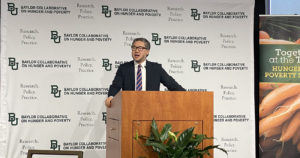
Eugene Cho, president and CEO of Bread for the World, told the Together at the Table Hunger and Poverty Summit that food is an expression of love. (Photo / Ken Camp)

“Food is love,” said Cho, formerly pastor of the multicultural Quest Church in Seattle.

To illustrate the point, Cho talked about how his parents did and did not express love when he was a child.

“Growing up, I never heard the words, ‘I love you,’” he said. In fact, he was 38 years old before his father verbally expressed love for him. At some points in his life, Cho acknowledged, he questioned whether his parents really loved him.

However, when he learned more about his parents’ early years, he gained a different perspective.

“I found out about the suffering and the abject hunger they experienced” as children in what is now North Korea.

Cho never heard the words, “I love you.” But even today when he talks to his parents, they always ask a question he often heard growing up: “Have you eaten?”

“There is no greater expression of love,” he said. “To eat means life. To eat means wellness. To eat means flourishing. … We have to ask the question of our neighbors.”

Cho offered five reflections on love and human need:

  • “Love sees the whole person.”

When Jesus saw the multitudes, he recognized their spiritual hunger, but he also recognized their physical needs and met them. Any theology that focuses exclusively on the spiritual dimension without acknowledging the physical body and its needs is “a false gospel,” Cho said.

“We have to be about the whole gospel and the flourishing of the whole person,” he said.

  • “Love makes room at the table.”

The Gospel writers spoke of Jesus feeding the 5,000, but that number included only the men—not the women and children who were present. But Jesus fed them all, and he did it after accepting the humble gift of a young boy, according to the account in John’s Gospel.

“God sees everyone and desires to make room for them at the table,” Cho said. Throughout his ministry, Jesus saw people others ignored or rejected—women, children, lepers, the marginalized and the oppressed.

  • “Love pursues dignity.”

In biblical times, most people carried a pouch inside their clothing with a small quantity of food in it, Cho noted. But while others focused on scarcity and preserving what little they had, one poor boy was willing to share the little he had with Jesus, who honored the boy’s humble gift.

In effect, Cho said, the boy told Jesus, “My supper is your supper.”

  • “Love builds relationships.”

Jesus saw the hungry multitude as individuals with needs, rather than viewing the feeding of them as a project to be accomplished. Likewise, Christians today should build loving relationships with people in their communities, not just see community action as a project to be completed.

“America needs a revival in the art of neighboring,” Cho said.

  • “Love speaks up.”

When Jesus saw the crowds, he voiced concern about their physical needs.

Christ’s followers today have a responsibility to recognize needs around them and make their voices heard.

“Love advocates,” Cho said. “Love leads with empathy. Love acknowledges wrongdoing and inequity.”

At the most basic level, he said, love shows concern by asking a hungry person a simple question: “Have you eaten?”


Hunger fighters focus on lessons learned from pandemic

WACO—Together at the Table Hunger and Poverty Summit speakers focused on lessons learned about food insecurity and nutrition from the COVID-19 pandemic.

The United States mitigated a “hunger disaster” during the pandemic primarily through public and private partnerships, said Jeremy Everett, founding executive director of the Baylor Collaborative on Hunger and Poverty. (Photo / Ken Camp)

In spite of record economic instability, the United States mitigated a “hunger disaster” during the pandemic primarily through public and private partnerships, said Jeremy Everett, founding executive director of the Baylor Collaborative on Hunger and Poverty.

For example, the Emergency Meals to You program—which began as a pilot program of the Texas Hunger Initiative in summer 2019 to deliver food boxes to the homes of students in rural Texas—provided 40 million meals to low-income schoolchildren in 43 states during the pandemic.

The program—which at one point served 5 million meals a week—involved the U.S. Department of Agriculture, the Baylor Collaborative on Hunger and Poverty, McLane Global and PepsiCo.

“No one organization or sector can end hunger by itself,” Everett told participants at the summit, held on the Baylor University campus. “It takes government, industry, nonprofits, the faith communities and even universities working together.”

‘Leverage the lessons learned’

Stacy Dean, deputy undersecretary for food, nutrition and consumer services at the U.S. Department of Agriculture, said the pandemic proved Americans can rise to the challenge of meeting urgent needs during an emergency.

Now, she said, the nation must “leverage the lessons learned from the pandemic.”

“Lessons learned from the pandemic can be the springboard for a better tomorrow,” Dean said.

USDA investments in the Pandemic Assistance Program helped mitigate food insecurity during the pandemic, but the global health emergency—as well as supply chain disruptions caused by Russia’s war on Ukraine—made clear the “economic fragility” of the system in place prior to COVID-19 shutdowns, she noted.

Echoing President Joe Biden’s call to “build back better,” USDA pledged to commit more than $4 billion to strengthen the supply chain and create new market opportunities.

She said USDA has adopted a food system transformation framework focused on:

  • Building a more resilient food supply chain that is more geographically diverse and locally based and that provides better market options both for consumers and producers.
  • Creating a fairer and more diversified food system that helps empower food producers and consumers by creating better local market options rather than a market dominated by a handful of multinational companies.
  • Making nutritious food more accessible and affordable to consumers.
  • Emphasizing equity by creating more economic opportunities for underserved communities.

Goal: End hunger in the U.S. by 2030

The recent White House Conference on Hunger, Nutrition and Health made clear the systemic issues that must be addressed moving forward—particularly the link between access to nutritious food and diet-related health issues such as diabetes, hypertension and obesity, Dean said.

She affirmed Biden’s announced goal “to end hunger in America and increase healthy eating and physical activity by 2030, so fewer Americans experience diet-related diseases.”

She highlighted the “five pillars” of the White House National Strategy on Hunger, Nutrition and Health:

  • Improve food access and affordability.
  • Integrate nutrition and health, prioritizing the role of nutrition and food security in overall health.
  • Empower all consumers to make and have access to healthy food choices.
  • Support physical activity for all and ensuring that everyone has access to safe places to exercise.
  • Enhance nutrition and food security research, particularly gathering data on issues related to equity, access and disparities in food security.

While the goal of eliminating hunger in the United States by 2030 may seem overwhelming and too big to tackle, Dean insisted, “It’s a problem too big not to take on.”

Did food assistance mitigate learning loss?

In a breakout session at the hunger and poverty summit in Waco, Baylor economics professor Pham Hoang Van presented early findings on research examining the impact the Emergency Meals to You program had on student performance during the pandemic.

Test scores in math and reading dropped during the pandemic both nationally and in Texas schools, and the learning loss was greater in low-income schools.

However, the drop in test scores was more pronounced in low-income schools whose students did not receive Emergency Meals to You as compared to those whose students did benefit from the program, Pham noted.

Furthermore, the research indicates positive effects of the Emergency Meals to You program appear most pronounced among elementary school and middle school children.

Pham emphasized the research only points to a correlation and cannot prove Emergency Meals to You caused better test scores among young students who were part of the program.

“However, the evidence does seem to indicate food assistance mitigated some of the learning loss in the first year of the pandemic,” he said.


Around the State: Wayland receives $2.99 million grant

The U.S. Department of Education awarded Wayland Baptist University a $2.99 million grant  over the next five years to ensure the academic success of Hispanic and low-income, first-generation students. The Title V grant will fund “Pioneering Greater Access for Hispanic Students through Enhanced Student Support,” Wayland’s coordinated effort to improve support for Hispanic students and expand information systems to improve student success. The effort also is designed to increase fall-to-fall retention and improve four-year graduation rates. The grant is part of the Department of Education’s Developing Hispanic-Serving Institutions Program, and it enables Wayland to expand and enhance academic offerings, program quality and institutional stability. “I am pleased that we have been able to secure this grant with our first proposal, because the DHSI program helps Wayland to expand educational opportunities for, and improve the attainment of, Hispanic students. That’s something Wayland has been doing but is keenly interested in expanding,” President Bobby Hall said. The grant provides funding for six new or additional student support positions, including a Title V project director, student success and disability service coordinator, bilingual academic coach, and specialists in enrollment/LaFamilia Outreach, financial aid, and retention data. Computers and technology for project staff also are included, as well as project software. Summer Bridge Program Activities, events and instructional supplies also are included.

ETBU student-athletes spent time teaching an average of 60 children per week the fundamentals of baseball and sharing their faith. (ETBU Photo)

The East Texas Baptist University Tiger baseball team concluded a six-week series of free baseball skills camps for Marshall-area children. ETBU student-athletes spent each Thursday evening teaching an average of 60 children per week the fundamentals of baseball and sharing their faith through personal relationship development, gospel testimonies and prayer. More than 120 local children participated in the baseball camps over the span of six weeks. In addition, campers each received their own Bible donated by Robert Bardin of the East Texas Chapter of Fellowship of Christian Athletes. “We are called to make disciples, and I believe we can use baseball to do that. It is important to serve the community as a team, because it keeps our guys grounded in this community and invested in the youth of Marshall,” ETBU Head Baseball Coach Jared Hood said. “It makes the purpose for our being here greater than baseball, takes the focus off the scoreboard, and on to a greater mission and goal.”

Baylor University was recognized on the Dave Thomas Foundation’s 2022 Best Adoption-Friendly Workplaces list, which recognizes the top 100 national organizations with the most robust adoption benefit programs. Among the breakout categories, Baylor ranked No. 2 nationally among U.S. education institutions, behind only Yale and ahead of New York University, Emory University and Northwestern College, that offer the best overall adoption benefits, including paid parental leave and financial assistance for adoption-related expenses. Baylor also is featured on the foster care benefits list for offering paid parental leave to foster parents. In 2017, Baylor implemented expansive new policies that provide paid parental leave for staff and an adoption assistance program that helps defray expenses associated with the adoption process and affirms the choice by staff and faculty to grow their families through adoption. Baylor’s parental leave policy provides up to six weeks of paid leave for full-time staff who become parents through birth, adoption or foster care. The policy, which is available to staff immediately upon employment, gives parents time and flexibility to bond with their new child/children. The adoption assistance program reimburses full-time Baylor faculty and staff up to $10,000 of qualifying adoption-related expenses per adoption, up to two children per calendar year. Faculty and staff are eligible to participate in the program following one year of full-time employment with the University. “Baylor’s parental leave and adoption assistance benefits, including for foster care, align with the University’s Christian mission and reflect our deep commitment to supporting and strengthening families,” said President Linda A. Livingstone. “We have made it a priority to provide a supportive work environment that enriches the lives of our staff and faculty and fosters the work-life balance vital to families’ capacity to flourish.”

Several East Texas Baptist University nursing students were presented the Polly Cargill Nursing Scholarship on behalf of the Jerry Cargill and Jack Cargill family and East Texas Baptist University. ETBU’s Cameron Anderson, Reagan Creed, Trinity Griffith, Ta’Lena Johnson, Hailey Maloy, Megan McCarthy, Bailey Munch, Meagan Parker, Brittan Price, Laura Staley, Emma Stelzer and Jaidakiss Younger received the scholarship during a reception held at the Marshall Grand. The ETBU nursing students were 12 of 17 local students receiving scholarships who seek to impact the medical industry through a future career in nursing.


On the Move: DePoe, Hickman, Lowry and Yates

Jeannie DePoe to Broadview Baptist Church in Lubbock as children’s minister. She already was a member of the church.

Jody Hickman to First Baptist Church in Newark as pastor, effective Nov. 6. He previously was pastor at First Baptist Church in Rosebud.

Keith Lowry to Park Cities Baptist Church in Dallas as discipleship pastor from First Baptist Church in Richardson, where he was discipleship pastor.

Dannielle Yates to First Baptist Church in Grandview as children’s minister, effective Nov. 7.


TBM multiplies impact by involving Florida volunteers

NAPLES, Fla.—By utilizing a large turnout of local volunteers, Texas Baptist Men is multiplying the ministry’s impact in the aftermath of Hurricane Ian.

About 150 employees of Arthrex stepped up Oct. 7 to help their neighbors, and TBM put them to work. (Photo / Ferrell Foster)

Extensive flood damage and the availability of local volunteers increased the disaster relief response coordinated by TBM. TBM feeding volunteers and flood recovery teams arrived in Naples shortly after the storm. At the same time, hundreds of local volunteers offered to help.

About 150 employees of Arthrex stepped up Oct. 7 to help their neighbors. Arthrex gave employees the option of volunteering instead of coming to their normal work day.

Volunteers from the U.S. Air Force followed three days later, and a steady flow of volunteers from the community has bolstered TBM’s ministry after Hurricane Ian.

“When disasters strike, especially in our own hometown, everyone wants to help,” said Mickey Lenamon. “By providing a structured way for people in Naples to do that, do it effectively and do it safely, TBM has been able to deliver more help, hope and healing faster than ever before. This is a model we will continue to use as we respond to this hurricane and future disasters.”

TBM disaster relief volunteers shared their faith and distributed Bibles. (Photo / Ferrell Foster)

Experienced TBM and Louisiana Baptist flood recovery volunteers took the lead. Teams of 12 Arthrex workers went out with two experienced leaders, fanning out across hard hit portions of the city. The homes were identified previously as needing help with removing furniture, ripping out sheetrock and preparing the damaged portions of homes to be rebuilt.

“These Arthrex volunteers are amazing,” said Sabrina Pinales, TBM ministry advancement coordinator. “They responded so well to the TBM Disaster Relief experts and provided much-needed hands for this work.”

TBM volunteer Sid Riley and other trained disaster relief workers served as trainers and supervisors for local volunteers in Florida. (Photo / Ferrell Foster)

Sid Riley, a veteran of TBM Disaster Relief ministry, said: “Our trained TBM volunteers became teachers and supervisors today, showing these new volunteers how to safely do this work. Many of the Arthrex workers were young adults, and this created an opportunity for our experienced people to teach them. Plus, they were strong and motivated and stayed hard at work all day.”

Reports to the TBM command center in Naples indicated businesses offered to provide similar cleanout services for up to $45,000, which is beyond the means of many homeowners. Homeowners often expressed shock when TBM volunteers offered to do the work for free.

Virtually anything not made of metal or certain plastics will be ruined by extended exposure to water, as occurred in Naples. The long-term damage is not always evident initially, but mold and rot continue to advance.

“Situations like this are really hard on people,” Pinales said. “They’ve gone through the trauma of the storm and flood, and now they have to part with items that often have great sentimental value.”

Riley said the care that TBM volunteers bring to homeowners is something money can’t buy.

“We really do care about them,” he said. “We show the love of Jesus and share why we are doing this, as well.”

To support TBM disaster relief ministries financially, send a check designated for disaster relief to Texas Baptist Men, 5351 Catron Dr., Dallas, TX 75227 or click here to give online.


Protestant pastors say economy is hurting their churches

WASHINGTON (RNS)—A new survey of 1,000 Protestant pastors finds that half are concerned the economy is hurting their churches.

The survey from Lifeway Research, an agency of the Southern Baptist Convention, also found most pastors say congregational giving is in line with the previous year.

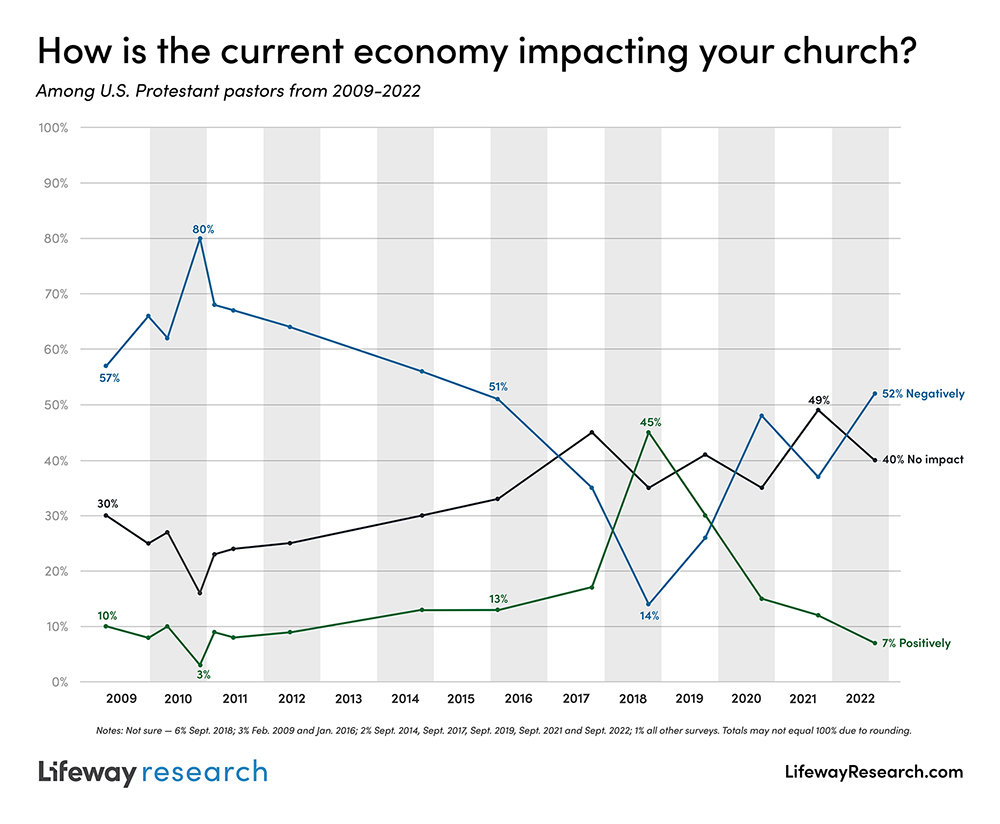
In the survey, 52 percent said the economy was having a negative impact on their churches, up 15 percentage points from 2021. Overall, 40 percent said the economy wasn’t having any effect, and 7 percent said the economy is a positive factor for their churches.

The survey, taken in September, marks the first time since 2016 more than half of pastors feel the economy is having a negative impact on their churches and the first time since 2012 fewer than 10 percent of pastors see the economy as having a positive effect.

However, 46 percent of pastors said giving has been about what was budgeted and 23 percent said it’s higher.

“The souring of pastor attitudes towards the economy is more about rising expenses than declining income,” said Scott McConnell, executive director of Lifeway Research. “Declining year-over-year giving is a factor for almost a quarter of churches, but this is a similar rate to what churches have averaged for over a decade.”

Small-church pastors, those with congregations of fewer than 50 attendees, were the most likely to say the economy was negatively impacting their churches.

Pastors at the largest churches, those with 250 or more, are the most likely to say offerings so far this year are above last year’s levels.

The survey had a margin of error of plus or minus 3.2 percentage points.


Baptist pastor and wife kidnapped in Ukraine

MARIUPOL, Ukraine (BP)—A Baptist pastor and his wife remain missing after being kidnapped Sept. 21 from their church in Russian-occupied Mariupol, Forum 18 News Service reported Oct. 6.

Armed masked men in Russian military uniforms took Pastor Leonid Ponomaryov and his wife Tatyana from their home in the Kalmiusky District of northern Mariupol, neighbors told Forum 18. Officials reportedly searched the home for about two and a half hours.

The Russian military also searched and sealed Ponomaryov’s church—identified as Kurchatov Street Baptist Church with the Council of Churches Baptists group—and seized religious literature there, Forum 18 said, attributing reports to Mariupol Baptists.

“The neighbors distinctly heard groans and cries” as the Ponomaryovs were taken “in an unknown direction,” Mariupol Baptists told Forum 18. Church members began seeking answers the following day. “But neither then nor on subsequent days could they get any answers,” local Baptists told Forum 18.

Russian officials initially claimed the couple were involved in “extremist activities,” but it is unclear whether they have been charged with any crime. The Ponomaryovs’ children, friends and fellow pastors have been unable to determine the reason for the abduction or the couple’s whereabouts.

History of persecution in occupied territories

“Since 2014, Baptists in occupied territory have been targeted and persecuted. Forty-six Baptist churches have been damaged or completely destroyed by war since February,” said Elijah Brown, general secretary of the Baptist World Alliance.

“Even as we continue to hear of people of faith who have been harassed, kidnapped, or face intentional violence, we have a responsibility to pray and stand together with gospel generosity as Baptists in Ukraine and across the region remain at the forefront of peace building and providing care in the love of Christ for all who are being traumatized by this ongoing war.”

Brown noted he did not have direct confirmation about the details of the incident involving Leonid and Tatyana Ponomaryov.

The Baptist Standard sought independent verification of the report but did not receive a response from sources in Ukraine.

The Ponomaryovs’ children issued a statement Oct. 1 thanking the Baptist community for their prayers, as several churches were praying and fasting for the couple’s return.

“For 10 days already, we know nothing about them,” Forum 18 quoted the statement. “A group of church members from Mariupol and Rostov went (around) all the agencies and institutions, not only in Mariupol but in the regional center [Donetsk], and were told nothing about our parents anywhere.”

While Russian officials have not responded to Forum 18’s requests for information, reportedly an officer of the Russian Interior Ministry told relatives the couple would be released after the Sept. 27 Russian-controlled referendums to annex Donetsk and three other Russian-occupied regions in Ukraine. The Sept. 27 referendums were illegal under Ukrainian and international law and have not been officially recognized by the United States and the international community.

Russia has officially occupied Mariupol since May in the war Russia launched on Ukraine in February. Russia has sealed many churches and confiscated equipment.

But despite the referendum and the forced closure of some Christian churches, other congregations, including at least two Council of Churches Baptists congregations, are still able to hold Sunday worship services. Forum 18 described the Council of Churches Baptists as unregistered churches in Ukraine that meet in property owned by one or two church members.

With additional reporting by Managing Editor Ken Camp.


Programs, research, congregations key to fighting hunger

Food insecurity is a widespread problem that demands evidence-based, on-the-ground solutions, panelists told a Christian community development conference.

“You can’t solve a problem from a distance,” said Jeremy Everett, founder and executive director of the Baylor Collaborative on Hunger and Poverty, in introducing the panel for the No Need Among You Conference at First Baptist Church in Waco.

First Baptist Church in Waco hosted the No Need Among You Conference. (Photo / Lauren Turner)

The panel, featuring Kathy Krey and Stephanie Boddie of Baylor University, focused on food insecurity and how organizations can more effectively move forward.

Boddie defined food insecurity as the “lack of consistent physical and economic access to food that is food for a healthy and active life.”

“We also want to think about it not just on an individual level, but also on a community level,” Boddie said.

Although food insecurity typically is thought of as a constant state of life, Krey explained that it more often occurs according to a pattern.

“[It’s] episodic,” she stated. “We think of more chronic conditions. It’s really driven by economic realities.”

Krey also explained that in communities that frequently experience food insecurity, households feel the weight of economic upsets with their dietary needs first.

For example, a home that has a consistent source of food but a tight budget may lose access to healthy foods if the price of a bus pass goes up.

‘Basically taxed for being poor’

In food deserts—areas that lack access to healthy foods and grocery stores—transportation usually is limited, and people are forced to rely on convenience stores for their day-to-day needs, Boddie explained.

 “You’re basically being taxed for being poor,” she stated, explaining the cost of unhealthy food is higher at these locations than the cost of healthy foods at unattainable stores. “The dollar doesn’t go as far.”

As staff members and affiliates of the Baylor Collaborative on Hunger and Poverty, the panelists and moderator all have spent a significant amount of time researching programs that seek to end food insecurity through food justice—equitable access to healthy, nutritious, affordable food.

“No one sector or one organization can end hunger by themselves,” Everett said. “These problems … are too intertwined with each other and with society. The only pathway forward for us to sustainably change our communities … is if we get the public sector, the government, to work with business … and faith communities.”

Everett, who attended the White House Conference on Hunger, Nutrition and Health in September, explained organizations need to be working toward collaboration when putting down their roots.

“Here’s what we’ve learned from the USDA,” he said. “If you believe you have a best practice, an intervention that is successful and worthy of replication … you have to have research. You have to have a program evaluation done of this implementation … so that it can become an evidence-based intervention.”

Krey reemphasized that evidence-backed research is the only way programs can gain federal support, and also explained it is just as valuable to organization leaders.

“One thing that is one of our goals is to understand what’s working and what’s not working,” Krey said. “It’s not something that is really easy to do, but it’s worth it.”

‘Go beyond the walls’

Boddie explained how churches can actively participate in the fight against hunger.

“The role of the church in addressing food insecurity really goes back to how churches serve the least of these,” Boddie said.

She then went on to challenge churchgoers and leaders to look within their home congregations for people who may be unknown resources for action.

“Who’s in your congregation? What are some of the skills that they have,” Boddie asked. “Most of us have at least two gifts in us that we can develop, and how can those gifts meet the needs? As a church we need to go beyond the walls.  … How can we go beyond the walls?”

One way churches traditionally have served the hungry is through food pantries, but in recent years, it has become increasingly difficult to sustain pantry operations.

“We need to look at the problems or challenges we have and not expect one solution,” Krey explained.

When it comes to making widespread change, Everett agreed.

“Food pantries are not our solution to hunger in America,” he said. “They’re an important role, [but] you want that food pantry to be supplemental.”

Programs like the Supplemental Nutrition Assistance Program, Meals-to-You and Breakfast After the Bell were all examples given during the panel of programs that work well. Breakfast After the Bell has been known to triple children’s participation in food security services provided in schools.

“There are meaningful things we can do that piggyback off of [child nutrition] programs. Could we close the gap even more? Could it do even more,” Krey asked. “Instead of thinking we have one solution to the out-of-school hunger program … how can we supplement it?”

The panel concluded by emphasizing the power of research when looking to expand the reach of program efforts.

“When you pair proximity with research … we’re better able to identify what the causes of hunger and poverty are. We’re more likely to get it right,” Everett said.

“It’s going to take all of us working together,” Krey added.

As Boddie noted, in Christian institutions, fighting poverty is about serving others. And in the end, Christians can only best serve others when they recognize the gifts and the God-given skills of those around them.

 “There are gifts that you have that God wants you to grow,” Boddie said. “What are the ways that God has gifted your local congregation, and how are you able to grow in those gifts?”


Church responses to white flight have consequences

WACO—The ways churches respond to white flight can have “unfortunate, unintended consequences” both for congregations and the communities they serve, a Baylor University sociologist told a Christian community development conference.

Many Protestant churches adopted the language and strategy of corporate America by seeking to appeal to “niche markets” and “target audiences” based on shared interests, Kevin Dougherty of Baylor University observed.

“Change is constant. How we respond to change is highly variable,” Kevin Dougherty, professor of sociology at Baylor, told the No Need Among You Conference at First Baptist Church in Waco.

“Demographic churning” and “residential segregation by race” are realities congregations must address, Dougherty said.

In the first round of white flight after World War II, Anglos relocated from racially mixed urban centers to largely white suburbs, and they often started churches that reflected the community’s homogeneity.

In more recent decades, upwardly mobile non-Anglos have moved to suburbs, and whites have left the older inner suburbs to more distant suburban or rural areas, Dougherty explained.

In the process, the ethnic and racial composition of neighborhoods surrounding existing churches has changed.

Catholic churches continued to hold to the parish model, in which a congregation serves a specific geographic area within a larger diocese. Meanwhile, many Protestant churches specialized, adopting the language and strategy of corporate America by seeking to appeal to “niche markets” and “target audiences” based on shared interests, Dougherty observed.

“They cater to narrow interests, resulting in congregations where worshippers tend to look and think a lot alike,” he said.

In many instances, these congregations not only become racially and ethnically segregated, but also function as “political echo chambers,” he noted.

How churches deal with changing demographics

Dougherty cited groundbreaking research by sociologist Nancy Ammerman in the 1990s, as well as his own more recent studies of congregations and how they deal with demographic change.

One approach many congregations take is to persist in doing what they always have done. Dougherty sees denial and failure to change as recipes for congregational decline and death.

“They may limp along for a while, but that is a doomed strategy,” he said.

Another approach some congregations have adopted is relocation—moving from the church’s old neighborhood to rebuild in a new location removed from the area it originally served.

“This often has accelerated white flight and worked against the stability of the neighborhoods they left,” Dougherty said.

A third approach involves remaining in the neighborhood where a church originally was planted and adapting to change in the community. In many cases, this has involved new programming, new leadership and even a new identity for the congregation.

Some encouraging data

Dougherty cited an encouraging study of 20,000 United Methodist congregations from 1990 to 2010. While the United Methodist Church as a whole suffered losses in attendance, research revealed racial diversity within a congregation is associated with higher average attendance over time.

If a church seeks to adapt to meet the needs of its changing neighborhood, those who seek to facilitate and lead the adaptation can expect resistance, he acknowledged.

“Adaptation is harder for older congregations,” he acknowledged. “But to do nothing is a guaranteed path to decline.”

Dougherty encouraged congregations in demographically changing neighborhoods to consider how they might have a continuing relevant presence in those areas.

“God planted your church in a particular neighborhood,” Dougherty said. “Become more a community of place.”