Group hopes court will overturn same-sex marriage ruling
August 1, 2025
(RNS)—A conservative Christian legal group asked the U.S. Supreme Court to review a decade-old case involving a former Kentucky county clerk who cited her faith when she refused to issue marriage licenses to same-sex couples.
Activists hope the a long-shot effort will result in justices ending nationwide legalization of same-sex marriage.
Liberty Counsel, a legal nonprofit that also describes itself as a Christian ministry, has long been involved in the case of Kim Davis. In 2015, the Kentucky clerk gained international attention after she wouldn’t issue marriage licenses to same-sex couples despite the Obergefell v. Hodges Supreme Court decision, which legalized same-sex marriage nationwide that same year.
Davis’ refusal—which she said was rooted in her evangelical Christian faith—led to a series of legal battles she lost, resulting in a brief prison sentence as well as being ordered to pay $100,000 in damages as well as additional legal fees.
Liberty Counsel filed a petition with the court on July 24, requesting an appeal to Davis’ case and asking the court to overturn Obergefell.
“If ever a case deserved review, the first individual who was thrown in jail post-Obergefell for seeking accommodation for her religious beliefs should be it,” reads the petition.
Justices express frustration with decision
Legal analysts have cast doubt on the likelihood of the court reviewing Davis’ case, noting justices already declined to take up an earlier version of her case in 2020.
But in an interview with Religion News Service last month, Liberty Counsel founder Mathew Staver said multiple justices have voiced frustration with the Obergefell decision over the years.
When the court passed over Davis’ case in 2020, Justice Clarence Thomas wrote a statement joined by Justice Samuel Alito that blasted the same-sex marriage ruling, saying, “Davis may have been one of the first victims of this court’s cavalier treatment of religion in its Obergefell decision.”
“We think that it’s not a matter of if, but just a matter of when, the Supreme Court will overrule Obergefell,” Staver said.
The court has grown more conservative since the 2020 ruling, with Justice Amy Coney Barrett—who has voiced criticism of Obergefell in the past—filling the slot on the bench left open after the death of liberal jurist Ruth Bader Ginsburg.
Court already overturned one landmark ruling
Thomas explicitly called for Obergefell to be reconsidered in his concurring opinion for Dobbs v. Jackson Women’s Health Organization, the 2022 ruling that overturned Roe v. Wade, the landmark 1973 decision that legalized abortion nationwide.
Staver argued the Dobbs decision left Obergefell in a “weak” position, and he noted a case only needs support from four justices to be reviewed.
“With all of these things—the overruling of Roe, the composition of the court the way it is now … I have a good feeling about the possibility that the court would take this case,” he said.
Staver also suggested justices may be more willing to take up the case given the passage of the 2022 Respect for Marriage Act, which, among other things, requires states to recognize same-sex marriages if they were performed in places where it is legal.
The result, Staver argued, would reduce the nationwide impact if the court once again made same-sex marriage a state-level decision.
“It has taken one of the policy reasons for not overruling Obergefell off the table,” he said.
Activists fear rights would be lost
Even so, LGBTQ rights activists have long insisted that, even with the Respect for Marriage Act, rights would be lost if Obergefell were overturned.
Their supporters include a broad swath of religious Americans. A 2024 Public Religion Research Institute report found majorities of white mainline Protestants, white Catholics, Hispanic Catholics, Jews and Buddhists all support keeping same-sex marriage legal, and many denominations now perform same-sex marriages. In the past, clergy even filed suit to help legalize same-sex marriage at the state level.
But Staver said support for his cause is growing—or at least becoming more organized. He pointed to state resolutions passed by lawmakers in Idaho and elsewhere asking the court to reconsider Obergefell.
He also noted a resolution passed by the Southern Baptist Convention in June that called for “the overturning of laws and court rulings, including Obergefell v. Hodges, that defy God’s design for marriage and family.”
Leatherwood resigns as president of the ERLC
August 1, 2025
Brent Leatherwood, who spent nearly four years dealing with critics from the most conservative wing of the Southern Baptist Convention, resigned as head of the SBC’s Ethics and Religious Liberty Commission.
The commission’s board announced Leatherwood’s resignation July 31. Miles Mullin, vice president and chief of staff, will serve as acting president.
Leatherwood—a former executive director of the Tennessee Republican Party—played a key role in advocating for the federal defunding of Planned Parenthood.
The ERLC under his direction also placed 40 ultrasound machines in pregnancy resource centers around the country through its Psalm 139 Project.
However, Leatherwood resisted the efforts of some abortion abolitionists to seek criminal penalties for women who pursue abortions. That position proved unpopular with a vocal segment of Southern Baptists.
Other Southern Baptists criticized the ERLC under Leatherwood’s direction for participating in the Evangelical Immigration Roundtable.
Agency survived vote at SBC in Dallas
At the SBC annual meeting in Dallas in June, Southern Baptists voted to reject a motion to do away with the ERLC.
However, the motion to abolish the agency received support from about 43 percent of the voting messengers at the annual meeting. It marked the fourth attempt in recent years to disband or defund the ERLC.
Seven weeks after the ERLC survived the floor vote at the SBC, its board issued a statement from Leatherwood announcing his departure from the moral concerns and public policy agency.
“After nearly four years leading this institution, it is time to close this chapter of my life,” he stated. “It has been an honor to guide this Baptist organization in a way that has honored the Lord, served the churches of our convention, and made this fallen world a little better.”
He applauded the ERLC and its staff, saying the commission “never wavered in serving as a light on Capitol Hill, before the courts, and in the culture.”
‘A balance between conviction and kindness’
“In all of our advocacy work, we have sought to strike a balance of conviction and kindness, one that is rooted in Scripture and reflective of our Baptist beliefs,” Leatherwood stated. “That has meant standing for truth, without equivocation, yet never failing to honor the God-given dignity of each person we engage.”
The ERLC “has helped the world clearly understand that Jesus Christ reveals a better way to live rather than the angry, self-absorbed, and cruel model that is so often served up by our modern culture, and, more importantly, he freely offers the gift of eternal salvation—selflessly purchased with his own blood,” Leatherwood continued.
“That hope has powered our work these last several years, and has shaped my own conscience. It will continue to do so as I move forward to render service where the Lord is calling me next.”
Led in the face of ‘polarizing culture’
Scott Foshie, chair of the ERLC board of trustees, expressed gratitude to Leatherwood for his leadership and service.
“Brent has led the commission well and demonstrated loving courage in the face of a divisive and increasingly polarizing culture in America,” Foshie said. “While biblical values have been under attack, Brent has been a consistent and faithful missionary to the public square. We are thankful for his commitment to the Lord and to this commission.”
That “polarizing culture in America” plagued Leatherwood for much of his tenure since the time he was elected president in 2022, after serving one year as acting president. Previously, he served the ERLC as chief of staff and director of strategic partnerships.
Leatherwood, the father of three children who survived the shooting at Covenant School in Nashville, angered some in the SBC when he supported a proposal by Tennessee Gov. Bill Lee to allow authorities temporarily to keep guns out of the hands of people at risk of hurting themselves or others.
He also alienated some supporters of President Donald Trump when he praised President Joe Biden’s decision to withdraw from the 2024 presidential race, calling it a “selfless act.”
Kevin Smith, who was chair of the ERLC board at that time, initially announced Leatherwood was fired as ERLC president. Less than 12 hours later, the ERLC executive committee issued a statement saying Leatherwood was not fired, Smith acted without board approval, and Leatherwood had the board’s support “moving forward.”
Academic freedom topic of latest public letter to Baylor
August 1, 2025
A public letter focused on academic freedom marked the latest development in an ongoing controversy surrounding Baylor University’s decision to accept and later rescind a research grant.
“The University’s handling of this matter raises grave concerns regarding the University’s commitment to academic freedom, rigorous inquiry, and publication—concerns that drive at the heart of the character and nature of what it means to be a university, in general, and what it means to be Baylor University, in particular,” the online letter states.
As of 1 p.m. on July 29, 250 members of the “Baylor Family” had signed the letter, including former faculty and staff, along with Baylor alumni and others.
The controversy surrounds Baylor’s decision to accept and later rescind a grant from the Eula Mae and John Baugh Foundation to study “disenfranchisement and exclusion of LGBTQIA+ individuals and women” in churches.
‘Apply an ideological litmus test’
Unlike previous public letters that center on issues of LGBTQ inclusion, the latest letter voices opposition to Baylor’s “decision to apply an ideological litmus test to the types of inquiry, ideas, teaching, research, and publication that Baylor University and its faculty pursue.”
“We believe the University’s handling of this matter is contrary to the University’s long-held policy on academic freedom and, if not corrected promptly, represents a dangerous development for the present and future of Baylor University,” the letter states.
The letter specifically called on Baylor University to make public statements:
Reaffirming its commitment to the “unfettered study, research, inquiry, and publication” of research “without regard to ideological bent.”
Offering assurance “that no faculty or administrator will be prohibited from conducting research, inquiry, teaching, or publication on any subject, including subjects regarding the experience of women and LGBTQIA+ people in church settings.”
“Baylor University’s response to pressure from external groups and certain internal factions criticizing the University for a research project—Courage at the Margins—is at odds with the University’s stated commitment to academic freedom, including Baylor’s Academic Freedom Policy that affirms the value of liberty and dissenting perspectives,” the letter states.
Activities inconsistent with institutional policies
When contacted for reaction to the latest online letter, a Baylor spokesperson directed attention to a July 9 public statement from university President Linda Livingstone that said Baylor’s “concerns did not center on the research itself, but rather on the activities that followed as part of the grant.”
“Specifically, the work extended into advocacy for perspectives on human sexuality that are inconsistent with Baylor’s institutional policies, including our Statement on Human Sexuality,” the earlier statement from Baylor said.
“We will continue to support our faculty and researchers in pursuing meaningful scholarship, while ensuring that such work aligns with our institutional processes.”
The latest online letter specifically took issue with the July 9 statement from the university.
“The fact that the University’s message to the Baylor community suggests that research and publication activities at Baylor University must ‘align’ with the institution’s views and beliefs, if true, would be a stark new restriction on academic freedom prohibited by existing University policy and protections for academic freedom,” the letter states.
One in a series of public letters
The latest public letter marks at least the fourth such correspondence centered on Baylor’s response to the Baugh Foundation grant.
The first letter—endorsed by more than 60 church leaders—voiced support for Baylor’s decision to rescind the grant.
That letter commended Baylor for its “commitment to hold together theological conviction and compassionate presence,” and it applauded President Linda Livingstone for speaking “with clarity and conviction, rooted in love and guided by wisdom.”
“In a polarized culture, Baylor’s decision demonstrates moral courage, affirming biblical orthodoxy while cultivating a campus environment where every student is treated with dignity, care and grace,” the letter stated.
Less than a week later, a group of 25 pastors sent their own letter to the Baptist Standard, similarly expressing support for “the wise return of the Baugh grant.”
“We fully agree that any grant that advocates for perspectives on human sexuality that are counter to biblical sexual ethics should be declined or returned,” the letter stated.
A third letter—posted online—opposed Baylor’s decision to return the grant, asserting the denial of funding for research “exhibits indifference and disregard for the well-being of LGBTQ+ individuals and women in our churches.”
“When the Church becomes complicit in the very systems that cause trauma, we cease to be the Body of Christ and become instead an instrument of harm,” the “public pastoral letter” to Baylor stated.
When asked to comment on the “public pastoral letter,” Baylor University provided the following statement: “It is Baylor’s longstanding practice not to respond to online petitions or open letters. We always appreciate the different viewpoints represented across the 150,000-plus members of the Baylor Family—students, faculty, staff and alumni—as well as from others on issues of importance.”
Military chaplaincy marks 250 years of service
August 1, 2025
(RNS)—In 1775, a year before there was a United States and six weeks after the Continental Army was formed, George Washington made a declaration that has shaped the military ever since.
“We need chaplains,” he reportedly remarked, prompting action by the Continental Congress near the start of the Revolutionary War.
The U.S. military chaplaincy marks 250 years on July 29, as the national military marked its own 250th anniversary in June. A week of celebrations includes a golf tournament at Fort Jackson in South Carolina, hosted by an organization raising funds for scholarships for family members of chaplains, and a sold-out ball nearby in Columbia.
Meanwhile, across the globe, thousands of clergy in uniform continue to provide counsel and care to military members of a range of faiths or no faith.
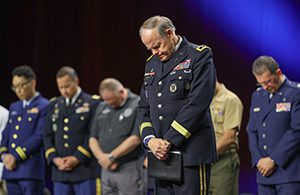
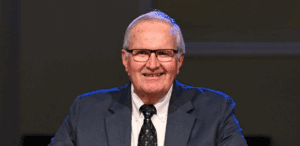
Clothed in his decorated, dress blue uniform, Major General (retired) Doug Carver led a host of chaplains to the platform June 10 during the opening ceremony of the 2025 SBC annual meeting. Messengers celebrated the 250th anniversary of the U.S. Army. (BP Photo by Sonya Singh)
“In times of peace and war, our chaplains have held fast as beacons of hope and resilience for our troops, whether enduring the brutal winter of Valley Forge, comforting the wounded and dying on the battlefields during the Civil War, braving trench warfare in World War I, storming the beaches of Normandy during World War II, marching the frozen mountains during the Korean War, slogging through the rice paddies and jungle battlefields of Vietnam or traveling the bomb-filled roads of Iraq and Afghanistan,” said retired Chaplain (Major General) Doug Carver, a former Army chief of chaplains in charge of the Southern Baptist Convention’s chaplaincy ministries, at the SBC’s June annual meeting in Dallas.
A month later at the annual session of the Progressive National Baptist Convention in Chicago, Navy Chaplain J.M. Smith, the grandson of a former convention president, stood before the group and described his just-completed tour as a Marine Corps command chaplain in Okinawa, Japan, and his plans to report to a ship in Norfolk, Va., to begin a tour of Europe and the Middle East and be promoted to lieutenant commander.
“My team and I have ministered to thousands of Marines, sailors, civilians and Japanese,” he said. “We increased our chapel’s membership from eight to 100. We incorporated spiritual readiness into our base’s core curriculum.’’
Chaplains serve in hospitals, hospices and manufacturing plants, and while chaplaincy researchers see commonalities among them, there are also key differences in the military. All are involved in gaining the trust of people who are in their particular milieu, enabling them to think and sometimes pray through their times of greatest need and day-to-day struggles.
‘A real defining moment’
An example of both the danger and the dedication of military service chaplaincy is the 1943 death of four chaplains—two Protestant, one Catholic and one Jewish—who helped save some of those aboard a World War II ship, turning over their life jackets and praying and singing hymns before it sank. All four were trained at Harvard University, then the site of the Army’s chaplain training school, during a two-year wartime period.
“It was a real defining moment,” said retired Gen. Steve Schaick, who served as Air Force chief of chaplains from 2018 to 2021, and in the same role for the Space Force from 2019 to 2021. “The stories that came from that really kind of highlighted chaplains at their best.”
The Army’s chaplaincy corps also includes religious affairs specialists and religious education directors. Some service members provide armed protection to unarmed chaplains and set up worship spaces in on-base chapels or makeshift altars on truck hoods in the field.
For example, Berry Gordy, who later founded Motown Records, served as a private in the Korean War and played a portable organ and was known as a chaplain assistant, notes Sacred Duty, a new comic book posted on the Army’s website to mark the anniversary.
While 218 chaplains served in the Revolutionary War, 9,117 chaplains served in World War II, according to the Army.
Currently, the Army has 1,500 chaplains on active duty. The Navy Chaplain Corps, which began on Nov. 18, 1775, had 24 chaplains during the Civil War; 203 by the end of World War I; 1,158 at its height in 1990; and currently has 898 on active duty, according to the Navy.
“Today’s Chaplain Corps includes Chaplains representing a multitude of faith groups, and the Chaplain Corps recruiting team is actively working to increase the Corps’ diversity, with a special focus on increasing the number of women Chaplains in the Corps and the number of Chaplains representing low-density faith groups,” reads an Army historical booklet marking the Chaplain Corps’ 250 years.
Broadly ecumenical
Initially, U.S. military chaplains were Protestants. The first Catholic chaplains served in the Mexican-American War in 1846, and the first rabbi was commissioned in 1862 and served in the Civil War. The first Muslim chaplains were commissioned in the Army in 1993. The first Buddhist Army chaplain was named in 2008, followed by the first Hindu chaplain in 2011.
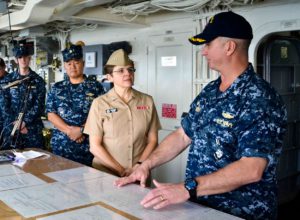
Capt. Mark Benjamin, commanding officer of the submarine tender USS Frank Cable (AS 40), speaks with Rear Adm. Margaret Kibben, chief of Navy chaplains, about the ship’s capabilities. Kibben toured the ship and met the ship’s religious ministries team. Frank Cable conducts maintenance and support of submarines and surface vessels deployed to the U.S. 7th Fleet area of responsibility. (U.S. Navy photo by Mass Communication Specialist 2nd Class Jonathan T. Erickson/Released)
Chaplain Margaret Kibben, acting chaplain of the House of Representatives and former chief of chaplains of the Navy—the first woman in that role—said the isolation and the immediacy of ethical decisions faced by military members, as well as a high level of confidentially, can make the work of military chaplaincy teams different from other settings where chaplains work.
“It’s the one place that people can go where there’s essentially a sanctuary around them, wherever they find themselves, a safe place to have somebody to talk to about a whole host of issues,” she said, adding that topics can include anything from supporting their families to handling combat responsibilities.
“How do you deal with those issues in a place where you’re not going to look stupid, you’re not going to look weak or unreliable because you have these doubts and you have these concerns—to have a place that you can go to ensure that you can get that off your chest?”
Those private conversations often are not faith-filled, added Kibben, reflecting on her military career that began in 1986.
“What I realized later, 20, 30 years later, was that many service members have never learned the language of faith,” she said, citing terms like confession and forgiveness.
“So, as a chaplain, we had to figure out our way around the lack of a lexicon of faith. How do you speak about grace to someone who doesn’t have a clue how powerful grace is?”
Another change, sparked by the efforts of Julie Moore, the wife of a military officer who served in the Vietnam War, was the Army’s method for notifying the next of kin when a soldier died.
Soon after a 1960s battle in that war, a chaplain and a uniformed officer began teaming up to knock on families’ doors; prior to that time, the news arrived in a telegram delivered by a cab driver.
Providing for the free exercise rights of service members
The work of chaplains has sometimes been the source of church-state debates. For example, Michael “Mikey” Weinstein of the Military Religious Freedom Foundation, a nonprofit that advocates for strict separation of church and state in the U.S. military, has questioned what he viewed as proselytism in the chaplains’ ranks. Meanwhile, conservative Christian organizations have voiced concerns about an antipathy against some Christians in military ranks.
Karen Diefendorf, a two-time Army chaplain and a board member of the U.S. Army Chaplain Corps Regimental Association, which supports chaplains and their families, said the primary goal for chaplains is “to provide for the free exercise rights of every soldier, sailor, airman, Marine, Coast Guardsman.”
She currently is an interim minister of an independent Methodist church in South Carolina, after serving as a chaplain at Tysons Foods and in hospice care.
“I had soldiers who were practitioners of Wiccan faith, and my job is not to say to them, ‘Hey, wouldn’t you like to love Jesus?’” she said, recalling how she assisted a Wiccan Army member serving in Korea. “My job was to help that young soldier find where his particular group of folks met and where he could practice his faith.”
Also during her service in Korea in the late 1990s and early 2000s, Diefendorf said she provided cassette tapes of sermons to soldiers and entrusted one with Communion elements because she knew she wouldn’t be able to reach their location often.
“So far, the courts have upheld that you certainly have two competing clauses within the First Amendment, establishment and free exercise,” she said. “And at this point, certainly chaplains have to walk that fine line not to create establishment in the midst of trying to also enable people to practice their beliefs.”
Schaick recalled being deployed overseas in the Air Force when a new rabbi joined his staff. On arrival, the rabbi described himself as “first and foremost a chaplain and secondarily a rabbi”—an order of priorities Schaick said applies to chaplains to this day, regardless of their faith perspective.
“The longer you serve in the chaplaincy, I think the closer you get to really believing that—and therefore, religious affiliation becomes secondary,” he said.
“It’s ‘How’re you doing today?’ and ‘I’d love to hear what’s on your heart’ and ‘How can I be able to help you today?’ Those kind of questions, quite frankly, are impervious to religious distinctions.”
Hunt residents literally keep eyes on the cross
August 1, 2025
HUNT—Weeks after the deadly July 4 Guadalupe River flood, its survivors still live with memories of danger, fear, confusion, loss—and faith. Will and Ann Britt awoke that morning just in time.
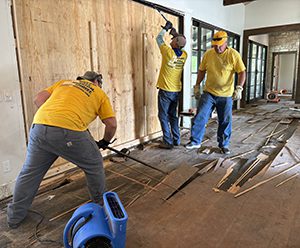
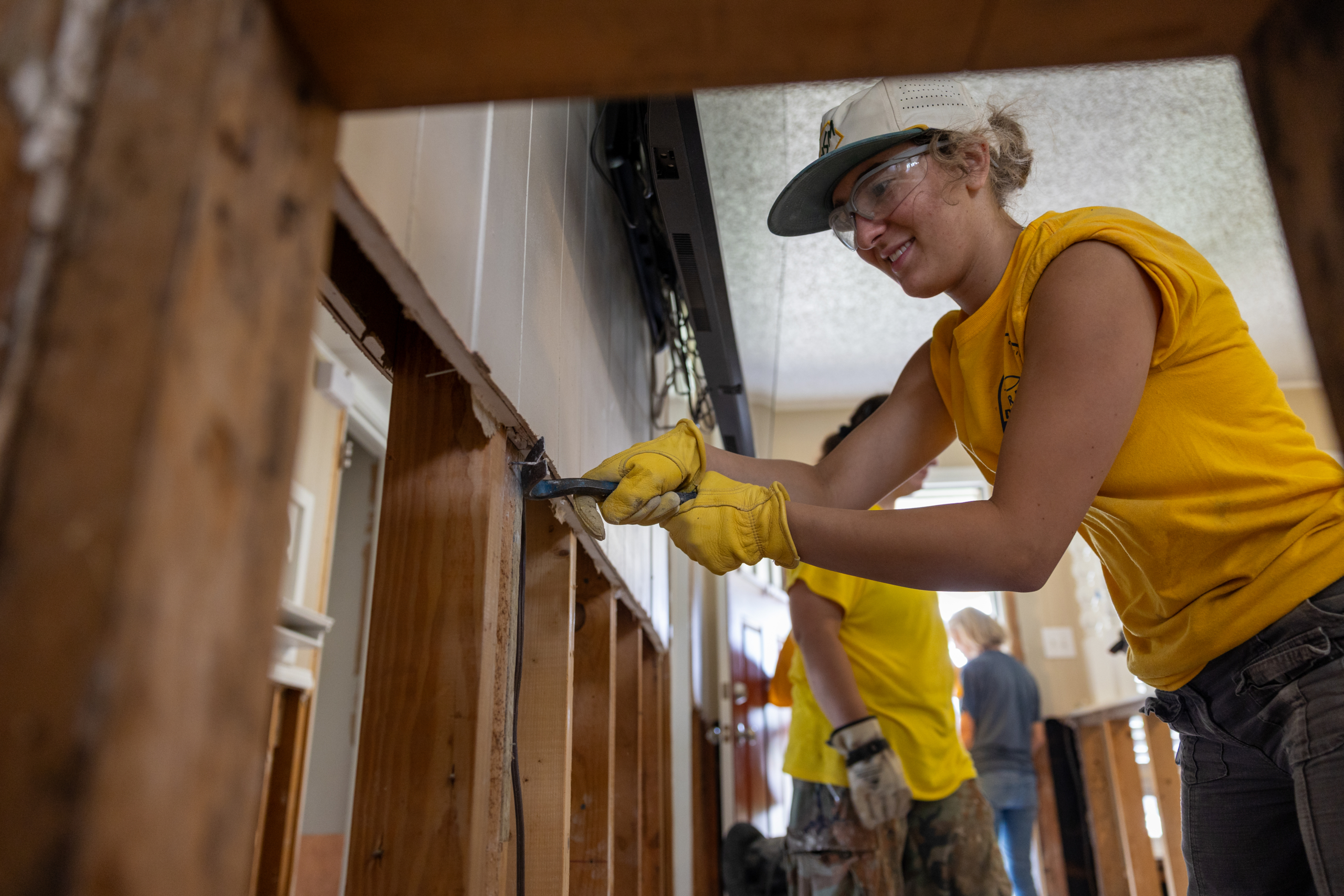
Texans on Mission volunteers arrived to rip out ruined wooden flooring, remove appliances and cut away sheetrock in preparation for Will and Ann Britt to rebuild their home. (Photo / Ferrell Foster)
Two weeks later, Texans on Mission volunteers arrived to rip out ruined wooden flooring, remove appliances and cut away sheetrock in preparation for the Britts to rebuild their home. The Britts told what happened.
While darkness still reigned outside, Will got out of bed in their first-floor bedroom and walked to the living room, checking the weather app on his phone. When he looked at the glass front door, he saw flood waters already head-high beyond the door.
He turned to run and get his wife when the front door exploded open, and water rushed through and smashed out of the broad, glass back door.
If he had not acted so quickly, Will would have been swept out of his home and into the raging river.
“We were awake all night, because the storm was so loud,” Ann said. But she didn’t make it to the front door that morning, as Will grabbed her in retreat from the water and up the nearby stairs.
“I just had my puppy dog and had Will’s hand, and we just ran around the corner and came up here,” she said, standing in the room that became their waiting room in the midst of the flood.
‘OK, Lord, you’ve got us … in your arms’
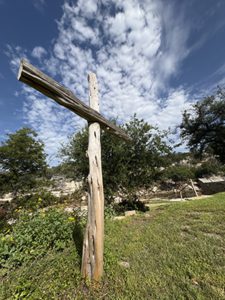
From upstairs, they watched the waters outside rise. A 10-feet tall cross stood outside their window, and by the time the Britts got to the second floor, water had risen to just below the horizontal bar of the cross.
Raging floodwaters knocked down trees, but a 10-foot tall cross remained standing on the property of Will and Ann Britt. (Photo / Ferrell Foster)
In the darkness punctuated by lightning, they continued to watch, pacing from one window to another and praying.
“I mean, literally, I hit those steps (to the second floor), and I just started praising [God],” Ann said. Once upstairs, she made “a little warpath” in prayer back and forth across the room
The cross outside the window held up while the water swept away trees. Just as the water neared the top of the cross, it stopped rising.
“When we saw the arms [of the cross], we thought: ‘OK, Lord, you’ve got us. … You’ve got us in your arms.’”
Thankfulness overtook the Britts, because 18 people from their family usually spent July 4 at the house. They had delayed the family get-together awaiting the birth of the newest family member.
“They all were going to be here, so every bed would have been full,” Ann said. “We were here by ourselves, thank the Lord.”
‘Grief is just overwhelming’
As she spoke two weeks later in front of the window above the cross, Ann’s thoughts turned to Camp Mystic. The Britts’ home is just up river from the camp, and the cross is planted at the edge of their property line with Camp Mystic.
The loss of so many girls’ lives has “affected all of us at home here,” she said. “The grief is just overwhelming. … And the Eastlands are very good friends of ours.”
Camp Director Rick Eastland died in the flood.
The Britts thankfulness their family did not come for the holiday and they made it upstairs in time is mixed with the grief that so many people in Kerr County are grappling with in the aftermath.
A testament to God’s love and mercy
Day after day, funerals, often multiple funerals in one day, became part of the community experience. But the Britts, literally and spiritually, kept their eyes on the cross.
A large cedar tree on their property had fallen, and “a good friend made a cross out of it and just put it in the ground without a lot of direction from us, because we didn’t really know where to put it,” Ann said.
“So, it landed right there,” she said, pointing out the window. “It is the most perfect place. because the sun rises over here, over the bluffs,” Ann said, pivoting to the east. “And it’s the first thing that the sun shines on. You can see it from every room in our downstairs.”
In the evening, the cross is “the last thing that the sun shines on” as it sets behind another bluff. “So, it was the perfect, perfect placement of that cross.”
And during the storm, it seemed to be in the perfect place, as well.
“The cross stayed standing, and it’s just such a testament to [God’s] love and his grace and mercy for us and his protection.”
There is another testament to God on their property. The sign at the property’s entrance gives its name, “Rock House.”
Underneath is a portion of Psalm 18:2, “The Lord is my rock.”
Gaza Baptists show love amid starvation and death
August 1, 2025
GAZA STRIP (BP)—“A love offering from the Baptist Church in Gaza” proclaims the sign as Christian Mission to Gaza serves hot meals to both Christians and Muslims in the Gaza Strip, where people are starving to death.
Christian Mission to Gaza served about 2,000 hot meals July 24-26 in the name of Gaza Baptists, said Hanna Massad, who served as the church’s first Palestinian pastor before founding the nonprofit organization. But the meals only touch a small fraction of those in need.
Massad continues to hold online prayer services each Sunday with about 30 online connections, including members of Gaza Baptist Church and other Gazans, he told Baptist Press as he prepared to preach and teach at two Baptist churches in Texas July 27-29.
At least 63 people died of starvation in the Gaza Strip this month, the World Health Organization reported July 27, including 25 children and 38 adults, with 24 of the children under age 5. The bodies of the dead bore “clear signs of severe wasting,” the organization stated.
Malnutrition is spiraling out of control in Gaza, WHO reported, with more than 5,000 children under five seeking outpatient treatment for malnutrition in the first two weeks of July alone, about 20 percent suffering Severe Acute Malnutrition, the most life-threatening form.
In June, 6,500 children were admitted for treatment, the highest number recorded since October 2023, WHO reported.
The Christian Mission to Gaza meal distributions have managed to avoid the Israeli attacks WHO said killed 1,060 people and injured 7,200 others at food distribution sites in Gaza since May 27, including friends of the church community.
Massad tells of a friend whose 40-year-old nephew died while trying to retrieve food.
“I have a friend, my neighbor, he lost his nephew,” Massad said. “He went to get a bag of flour to feed his family, and he’d been shot, killed.”
The Israeli government, which had accused Hamas of fabricating news of a hunger crisis and starvation deaths, began food airdrops July 27 and announced tactical pauses in attacks on three highly populated areas of Gaza for 10 hours daily to allow food distributions, the Associated Press and other news outlets reported.
‘We continue to minister to the Christian community’
Gaza Baptist Church, heavily damaged in the Israel-Hamas War, was occupied by Israel Defense Forces, Pastor Hanna Massad said. (Photo distributed via BP)
Two families are living in what remains of Gaza Baptist, Massad said of the church that had dwindled to 60 members because of persecution before the Israel-Hamas War. Its building was heavily damaged by Israeli bombs in late 2023.
“We’ll need to see after the war what to do,” Massad said of the church. “But we continue to minister to the Christian community.”
Massad preached the morning sermon July 27 at PaulAnn Baptist Church in San Angelo, updating worshipers on the war’s impact on Gaza and the work of Christian Mission to Gaza.
He is scheduled to speak to adults at Vacation Bible School July 28 and 29 at First Baptist Church in Garland.
President Donald Trump recognized the starvation crisis July 28, pledging U.S. food aid and urging Israel to secure its distribution.
Israeli attacks continue to strike the Christian community, Massad said, with airstrikes hitting the Latin Church in Gaza July 18, killing three Christians and injuring 10 others, including a priest.
Religious organizations sue over ICE raids at churches
August 1, 2025
(RNS)—A group of Christian denominations and organizations—including American Baptist Churches USA and the Alliance of Baptists—filed a lawsuit on July 28 against Secretary of Homeland Security Kristi Noem over immigration enforcement in houses of worship.
The litigation sparked by the Trump administration’s decision to rescind a policy discouraging immigration raids at houses of worship is the fourth such lawsuit brought on the question of arrests made at “sensitive locations.”
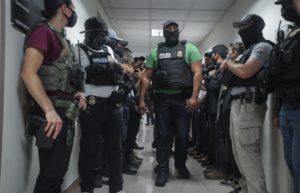
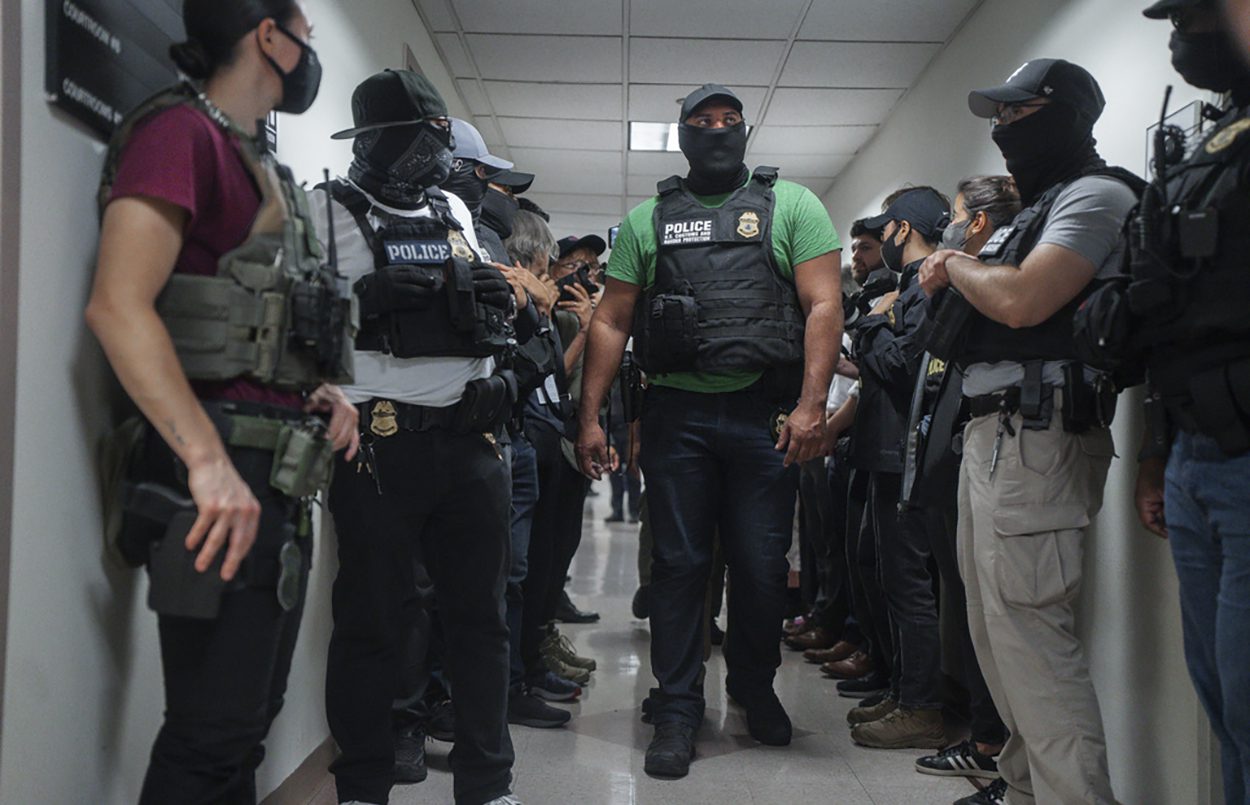
Masked federal agents wait outside an immigration courtroom on Tuesday, July 8, 2025, in New York. (AP Photo/Olga Fedorova)
In the past, immigration enforcement actions at churches were discouraged by a 2011 internal government memo that advised against raids at sensitive locations, such as houses of worship, schools and hospitals.
But Trump did away with the policy shortly after taking office, which faith groups argue in their suit “is not just harmful and un-American,” but also “violates federal law.” The groups cite both freedom of assembly guaranteed under the First Amendment, as well as rights outlined by the Religious Freedom Restoration Act and the Administrative Procedure Act.
“For Plaintiffs and their members, the present threat of surveillance, interrogation, or arrest at their houses of worship means, among other things, fewer congregants participating in communal worship; a diminished ability to provide or participate in religious ministries; and interference with their ability to fulfill their religious mandates, including their obligations to welcome all comers to worship and not to put any person in harm’s way,” the complaint reads.
In addition to the American Baptists and Alliance of Baptists, the plaintiffs include five regional synods of the Evangelical Lutheran Church in America; three regional Quaker groups; and Community Churches.
They are represented by Democracy Forward, Washington Lawyers’ Committee for Civil Rights and Urban Affairs and the Washington law firm Gilbert LLP.
‘Our call is to love our neighbor’
“As people of faith, we cannot abide losing the basic right to provide care and compassion,” Bishop Brenda Bos of the ELCA’s Southwest California Synod said in a statement.
“Not only are our spaces no longer guaranteed safety, but our worship services, educational events and social services have all been harmed by the rescission of sensitive space protection. Our call is love our neighbor, and we have been denied the ability to live out that call.”
Asked about the lawsuit, Assistant Homeland Security Secretary Tricia McLaughlin told Religion News Service, “We are protecting our schools, places of worship by preventing criminal aliens and gang members from exploiting these locations and taking safe haven there because these criminals knew law enforcement couldn’t go inside under the Biden Administration.”
The Department of Homeland Security did not immediately respond to a follow-up question asking to specify an example of a gang member taking refuge in a church under the previous administration, but the initial statement insisted raids on sensitive locations require special protocols before being carried out.
“Officers would need secondary supervisor approval before any action can be taken in locations such as a church or a school,” McLaughlin said, adding, “We expect these to be extremely rare.”
‘Painting everybody with a criminal brush’
In an interview with RNS, Bos rejected McLaughlin’s characterization of those targeted by recent immigration enforcement actions, which the government’s own data has indicated are often—and in some cases, mostly—people without criminal convictions.
“What we’re looking at is folks that have been deeply embedded in the communities and in their congregations, real people of faith and service who are being harmed,” Bos said. “I don’t have a lot of patience for this administration painting everybody with a criminal brush.”
Even acknowledging enforcement actions at churches is a shift for the Trump administration, which has repeatedly insisted immigration raids haven’t taken place at any houses of worship.
McLaughlin told the Washington Post earlier this month, “Immigration enforcement operations haven’t been conducted at churches or places of worship.”
In addition, conservative outlet Daily Wire quoted Trump border czar Tom Homan on July 9 saying he did “not know of a single incident of a church arrest.”
Arrests near churches have chilling effect
A month earlier, according to the complaint, federal agents detained a man in the parking lot of a Disciples of Christ church in Downey, Calif., a scene filmed as the agents were confronted by a pastor. Asked about the incident by RNS, Department of Homeland Security officials responded with a statement that instead referred to a separate incident near a different church.
U.S. Immigration and Customs Enforcement Baltimore Field Officer director Matt Elliston listens during a briefing, Monday, Jan. 27, 2025, in Silver Spring, Md. (AP Photo/Alex Brandon)
The complaint also describes officers detaining parishioners at two churches in the Catholic Diocese of San Bernardino, including a man who was doing landscaping for one of the churches.
San Bernardino Bishop Alberto Rojas formally lifted the obligation to attend Mass for Catholics who are concerned about ICE raids, following a similar statement by the Diocese of Nashville issued in May that concluded, “no Catholic is obligated to attend Mass on Sunday if doing so puts their safety at risk.”
Monday’s filing also detailed incidents that occurred near churches, including at least one incident on a sidewalk outside a Catholic church in Downey the same day the video was made at the Disciples of Christ church.
Arrests near a church, the suit said, can have a chilling effect on attendance. The Los Angeles Catholic Archdiocese has disputed that the person apprehended was connected to the church or the parish school, as was initially reported.
The new complaint joins at least three other separate lawsuits filed by faith groups alone or with other plaintiffs on roughly the same grounds since Trump took office. The plaintiffs in the cases include a broad spectrum of religious organizations, from entire denominations, such as the African Methodist Episcopal Zion Church, the Episcopal Church USA and the Union for Reform Judaism, to an individual Catholic parish and a Sikh temple in California.
The Evangelical Lutheran Church in America, which has several representatives in the new filing, was not a party in the previous sensitive location lawsuits, an omission that frustrated some members of the denomination.
The ELCA’s presiding bishop, Elizabeth Eaton, said in a video statement in February the group’s absence was due to the belief that the denomination’s polity wouldn’t allow it to have standing as a collective and urged individual congregations and bodies to join if they could prove standing.
The administration also faces at least two other lawsuits related to its almost complete ban on refugees and its cancellation of contracts with faith-based groups that resettle refugees for the federal government.
One suit was filed by the U.S. Conference of Catholic Bishops and another by a trio of religious organizations that work with refugees, HIAS, Church World Service and Lutheran Community Services Northwest.
Aleja Hertzler-McCain contributed to this report.
Around the State: Howard Payne students surf and serve
August 1, 2025
At the end of the spring semester at Howard Payne University, Kim Rosato, adjunct professor of kinesiology, took her surfing class on a road trip to Encinitas, Calif. In addition to surfing lessons and surfing, the class also went on hiking trips around the area and participated in a service project. During the trip, the class camped at San Elijo State Beach, visited Swami’s Botanical Meditation Garden, La Jolla and Pirates Cove in Newport, as well as hiked Annie’s Canyon Trail and Torrey Pines. The service project this year was picking up trash on the beach. The surfing class has been offered each spring semester for more than 15 consecutive years, except in 2020 due to COVID-19. Classes like surfing are offered through the HPU kinesiology department to fulfill the general education activity course requirements.
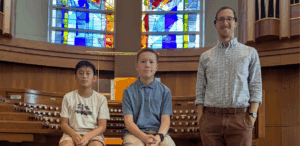
The Smith Organ in Belin Chapel at Houston Christian University served as a featured teaching venue for Houston’s Pipe Organ Encounter, a national program that welcomed 18 middle and high school piano and organ students from across the country. Hosted by the Houston Chapter of the American Guild of Organists, the weeklong event took place July 20-25, offering students lessons, education and performances on many of Houston’s finest pipe organs. Designed for students ages 13 to 18—whether beginners or more advanced
Organist John Kirk with pipe organ students. (Houston Christian University Photo)
players—the Pipe Organ Encounter provided hands-on opportunities to play a variety of instruments, attend organ concerts, and learn about the history, design, construction, and maintenance of pipe organs. University Organist John Kirk joined distinguished faculty from Rice University, the University of Houston and the University of St. Thomas, along with other area organists, to instruct these talented young musicians. Several students received their first organ lessons in Belin Chapel.
Will Klotz has been named president of Miracle Farm Boys Ranch, an affiliate of Children at Heart Ministries, effective Aug. 4. Klotz spent his mid-teen years at a boys’ ranch ministry similar to Miracle Farm that his parents founded. After receiving a bachelor’s degree in biblical studies from Christian Leadership University in New York, he later obtained a Master of Divinity from Reformed Theological Seminary in Washington, D.C. He was founding pastor of New City Fellowship in Manassas, Va.
Dallas Baptist University announced a $5 million gift from The Nation Foundation and longtime friends and supporters, Jim and Sally Nation of Dallas, to the Don and Linda Carter School of Business. Their donation is part of DBU’s “Stand Firm—Stand Out” campaign for the Carter School of Business, an initiative to advance the mission of Christ-centered education and prepare students to lead with faith and integrity in business.
Retirement
Pastor Dan Wooldridge retires after 30 years of pastoral service. (Crestview Baptist Church Photo)
Dan Wooldridge retires after 30 years as pastor of Crestview Baptist Church in Georgetown and more than five decades in ministry. Wooldridge will deliver a special message of reflection and encouragement to the congregation on Aug. 3. Following the services, the celebration will continue with a community block party in Manor, marking both his retirement and the launch of Crestview Manor, a new campus of Crestview Baptist Church located at 11805 Johnson Road, Manor.
Camp Fusion cultivates culture of connection, service
August 1, 2025
While many teenagers struggle to fit in and find their place in the world, adolescent immigrants or refugees face particular challenges.
Each summer, hundreds of those teens make their way to Latham Springs Camp & Retreat Center in Aquilla not only to have fun and fellowship at Camp Fusion, but also to address those issues.
“What makes Camp Fusion different is the cultures that are present,” said Lauren De La Calzada, who began attending Camp Fusion in 2012, soon after she finished the 6th grade. Since 2018, she has worked at the camp’s recreation team.
“This camp is specifically created for these youth who are coming from first- and second-generation families who have a very specific childhood where they bridge the gap between parents’ ways, adjusting to American culture and discovering what God has to say about my culture.”
Laruen’s sister-in-law Rachel has attended Camp Fusion since 2010 and started serving in 2015.
“I did a couple of years as a counselor and moved on to rec team,” Rachel said. “I think it is something so beautiful. These kids have come from church backgrounds where it is primarily their own cultures. I think it’s important to share these cultures.”
A day at Camp Fusion
In its 15th year, Camp Fusion, a Texas Baptists camp, gives Asian, African, Haitian and Brazilian teenagers from 6th through 12th grade a chance to embrace their unique cultural experience and the truth about what God has to say about them. The teens who share similar challenges can connect with others just like them.
The days are filled with devotionals, evening worship, three meals a day, and the true camp experience of swimming in the lake, playing sports and participating in competitions.
Teens spending time together near the snack shop at Camp Fusion. (Photo / Kendall Lyons)
Evening worship this year featured “The Agape Youth Band,” a group of seven young people who are part of the music and youth ministry at Agape Community Fellowship Church in Fort Worth.
Voltaire Cacal, a Filipino-American pastor and dean of international students and senior director of formal language programs at Dallas Theological Seminary, spoke each evening.
Preaching from Ephesians 2:11-22, Cacan reminded the teens: “You are not a stranger to God. You are family.”
“The gospel does not flatten your culture. It redeems it. In Christ, your background becomes a bridge, not a barrier,” Cacal said.
Danny Aguinaldo, assistant director, attended Camp Fusion in 2010, and committed his life to Christ there two years later. He took on a leadership role in 2014 with the rec team and later was promoted to his current post.
“Going to Camp Fusion created this community where I got to be around more Asians and Africans and it really helped me in my walk and in figuring out who I am and what I label myself with. In 2012, I came to Christ at Camp Fusion. I was 19,” Aguinaldo said.
From a vision to a mission
Since 2008, Mark Heavener has served in the office of Intercultural Ministries at Texas Baptists. His work involves connecting with churches with roots from Asia, Africa and the Middle East, covering 80 different language groups and more than 350 congregations among Texas Baptists.
“I worked under the founder of the office, Patty Lane. We knew each other beforehand while I completed my seminary degree in cross-cultural ministries. I had a focus and a heart for intercultural America during seminary,” Heavener said.
In 2003, intercultural pastors requested something for the youth in their churches.
“Before that, two different camps … Asian camp and African youth camp … were rolled out from that need in 2003. So, the two camps were developed. In 2009, I worked to see if we can bring the two camps together. And after doing a few events … in 2010, we moved towards fusing the two camps together, hence the name Camp Fusion,” Heavener said.
Training the next generation
“This camp is not for camp’s sake. One of the larger needs among intercultural churches is leadership development for the second gen, the ones born here—needing a space and place to grow in spiritual formation as well as leadership gifts.”
Heavener and his team work with a variety of campers who deal with a generational gap within their home and life and ongoing tension between their cultural identity and American life.
“There is a generational gap between those who came as immigrants, the first gen and those born here, and then the intersection with American culture. Then there’s a convergence of all that, and in the middle is the chaos that these kids are living in bicultural lives,” Heavener said.
Camp Fusion offers Asian and African teens an opportunity to learn how to embrace their identity and find out Jesus welcomes them. Throughout the camp experience, kids see leaders who look like them, striving to serve the Lord and one another.
Training starts with teens who are interested in leading workshops and groups, followed by the development of other kids who are interested in following their footsteps.
The goal is to create the next generation of church leaders
“In the broader American culture, they are pushed to the fringes because of being immigrants or refugees or just different. And identity is always a big issue, predominant issue,” Heavener added.
“So, spiritual formation with a leadership development component is then funneled into the development of the camp. Every year, the cycle repeats.”
When the teens return to their homes and their churches, parents and pastors take notice. The kids appear more confident, get involved in their church, and share their Camp Fusion experience.
Testimony from teens
Lily, who’s on her way to 11th grade at the end of summer, chose to spend a few days at Camp Fusion. The time she has spent with other teens in workshops covering topics like dating has impacted her.
“In the workshop I was in, ‘dating isn’t that deep,’ I learned that if you jump into dating without knowing yourself, then you leave others to define who you are,” Lily said.
Nathan just graduated from high school and started his third year in camp. This was his first year serving in leadership.
“It is a different point of view. I love to see all the kids happy and energetic,” Nathan said. “Throughout training and preparing for my volunteering, it brought me closer to God … the opportunity to pray and ask God what his plan is for me.”
The diversity of Camp Fusion
Linda Howell, intercultural specialist for Texas Baptists, works with Heavener to make sure Camp Fusion maintains strong representation from the many intercultural churches within the BGCT.
“We have a very diverse population. This (Camp Fusion) is the place where they get to be themselves,” Howell said. “They talk through deep issues within the church and what they are going through and get to meet new kids who have similar struggles.”
This year, 525 people attended, with teens from 35 churches representing 17 cultures.
Camp Fusion included kids who are Brazilian, Burmese, Cambodian, Central African, Filipino, Ghanaian, Haitian, Ivorian, Kachin, Karen, Kenyan, Korena, Lao, Lisu, Nigerian and Vietnamese.
As deportation fears mount, churches feel financial strain
August 1, 2025
(RNS)—At Celebration Church, a Portuguese- and English-speaking Baptist congregation in the Boston area, the benevolence fund is supposed to be there to help church families meet basic needs, such as food, clothing and heat, throughout the year.
But in April, three months into President Donald Trump’s campaign to deport undocumented immigrants, the money already had been almost completely spent.
“If a family member has been detained, the church tries to mobilize to help the families in need,” said Celebration’s pastor, Josias Souza, adding that many other immigrant congregants are afraid to show up to work.
“If a person doesn’t work, they don’t get paid,” Souza said.
Masked federal agents wait outside an immigration courtroom on Tuesday, July 8, 2025, in New York. (AP Photo/Olga Fedorova)
Lecio Dornas, lead pastor to the Brazilian members of Our Family, a multilingual church in the Orlando, Fla., area, said fear of raids at workplaces or of being stopped while commuting has been the biggest impact of the crackdown on his community, too.
The resulting hit on members’ incomes on one hand lowers offerings, Dornas said, and on the other, it creates greater need for assistance.
As their congregants live in fear of being detained and deported, pastors of churches serving immigrant populations across the country not only are searching for ways to reassure their congregations, but also how to care for them and sustain their churches financially.
Fundraiser takes a hit
At the oldest standing house of worship in Texas, San Antonio’s Catholic San Fernando Cathedral, rector Carlos Velázquez said the tension over potential detention or deportation is thought to have caused lower attendance at Fiesta San Fernando—part of an annual citywide festival, Fiesta San Antonio, that dates back to 1891.
“ We’re attributing (that to) the fact that people don’t want to go out right now,” Velázquez said. “They’re scared.”
The people who attended spent less, which Velázquez attributes to their economic uncertainty.
The 287-year-old cathedral stands about three blocks from the U.S. Justice Department’s San Antonio Immigration Court. Immigrants’ deportation cases increasingly are being dismissed at the behest of government lawyers, allowing them to be detained by Immigration and Customs Enforcement for expedited removal outside the courtroom. The archdiocese is working to inform immigrants of their right to request a virtual hearing to remove the risk of an ICE arrest at court.
Normally one of the year’s biggest fundraisers, Fiesta San Fernando came up short, and Velázquez said he probably will defer maintenance on the 22-year-old building he lives in, where moisture is creating cracks in the roofline.
“ It’s pretty major, but it’s something that we’re going to have to put aside,” he said.
At St. Thomas the Apostle, one of the largest Catholic parishes in Los Angeles, Pastor Mario Torres decided to postpone the parish’s early July St. Thomas fiesta to early September, because about half of those he spoke to said they were scared to attend.
Mario Torres. (Courtesy photo via RNS)
Torres preaches to nearly 10,000 families at Mass most weekends.
“Even though it’s a difficult time, let’s not allow the fear to control us,” he tells them during homilies, where he has drawn on Jesus’ words, “peace be with you.”
But he told RNS the festival is different from Mass.
“ Here in the church, I could protect you,” Torres said. “For example, if ICE shows up at the church, I could close the doors, and I don’t think they’ll come in.”
Amid the carnival rides, “outside, I can’t really protect you,” he said, imagining ICE could carry out detentions without him even being aware.
Torres said he isn’t worried about the church’s finances because “poor people are the ones that are the most generous.” The priest said he is telling families to “pray for those who have more fear than you” and help those they know in need.
“Don’t be selfish,” he said he has instructed, citing Jesus’ teachings. “Somebody else is being affected. You have to support that person, help that person.”
The heavy emotional strain
Pastor Sergio Elias of the Brazilian Free Methodist Church in Connecticut said the emotional strain on congregations is a major issue, even as leaders provide pastoral care.
“We have people who are locked in their homes out of fear, or only leaving to go to work. No leisure, no outings with their families, no vacations—sometimes not even coming to church. … They are terrified,” he said.
The immigrant experience, especially as immigrants seek legal status, never has been easy, he added.
“The fear of deportation has always been part of the undocumented immigrant experience, even under other administrations,” Elias said.
“But what makes the current moment unique is how openly and aggressively the Trump administration has approached the issue as an explicit political platform.
“Before, deportations happened, but without this tone of declared targeting. This posture has quietly legitimized hostile attitudes among people who already held anti-immigrant views, making everyday discrimination more common.”
Pastor Manoel Oliveira of New Life Church in Massachusetts pointed out even immigrants with legal status are affected.
“It’s not just undocumented immigrants who are being impacted emotionally. Those who have documents often have a friend or family member who doesn’t, and they share in that suffering,” he said.
Gabriel Salguero, president of the National Latino Evangelical Coalition, said pastors in Florida have reported cases of longtime members of their congregations who have no criminal records and deep ties to their communities being detained and deported.
They include a small-group leader in her 60s, a worship team guitarist, the wife of a pastor, parents of young children and many others.
These are people who attend immigration hearings to regularize their status, Salguero said.
“While we support due process and the deportation of violent criminals, we oppose this indiscriminate approach that targets mothers, elders and faith leaders. We are concerned that there are still some apologists who continue to say that’s not happening when we know it is happening, and we’ve seen it.”
Agustín Quiles, president of Mission Talk and board member of the Fraternidad de Concilios y Entidades Evangélicas, based in Florida, said many pastors themselves “are going to need counseling on how to deal with so many broken families and even with the law.”
He adds: “It’s real pain. Some pastors are describing heartbreaking scenes of children screaming scared, and homemaker mothers left to care for their children alone, without a source of income or community stability.”
Growing frustration among Latino evangelicals
Amid the crisis, there is growing frustration among Latinos with the broader evangelical establishment.
“There’s a sense of abandonment from the white evangelical community,” said Quiles.
“The councils and denominations are growing because of the membership numbers that come from the Latino church, yet they are silent, turning their backs to their Latino Christian sisters and brothers. We need to find a bridge there. There should not be two different gospels.”
Quiles said the moment demands unity. “There are a lot of heroes on the ground,” said Quiles. “The Latino church is vibrant and rising, and these leaders and communities are at the forefront, thinking creatively on how to protect their immigrants, how to serve their immigrants despite the threats that are coming from this administration.”
What has been helping Dornas get through this situation, said the Florida pastor, is the strong sense of solidarity in his Brazilian community. His congregants are raising funds to help pay bills and buy medication for those in need—even buying plane tickets for those who, out of fear, choose to return to their countries of origin.
“Solidarity requires effort and sacrifice,” Dornas said. “Either we do it, or no one will.”
Pastor marks 60 years at his one and only church
August 1, 2025
HICO (BP)—It was 1965, and Carroll Shelby introduced the Mustang GT 350. President Johnson signed Medicare and the Voting Rights Acts into law. And Bob Ray became the pastor of Fairy Baptist Church in Hamilton County, a role he still holds today.
The church will celebrate its pastor’s 60th anniversary Aug. 31.
Ray, 84, originally from Lawrence, Kan., credits his wife Rosalind for helping him recognize his call to ministry.
Bob Ray, pictured with his late wife Rosalind, has served Fairy Baptist Church since 1965. (Photo / Ken Camp)
“Rosalind was an absolutely wonderful partner who felt called to be a pastor’s wife,” he said. “She surrendered to the call before I did, and she used to get a little aggravated with me because I didn’t see it yet.”
Rosalind died last year from pancreatic cancer.
When they agreed on God’s call on his life, Bob Ray announced it to First Southern Baptist Church of Lawrence when he was 24.
He and Rosalind soon moved to Fort Worth where he enrolled at Southwestern Baptist Theological Seminary.
The young ministry student put his bachelor’s degree in business administration to use, finding work as a production control manager at a local manufacturing facility while tending to his seminary studies.
The plant employed several seminary students who made Ray aware of supply preaching opportunities at nearby churches. A classmate recommended the young preacher to a church about 90 miles away that was without a pastor.
“They weren’t looking for much, and they didn’t get much,” Ray said.
Generations of people in the Fairy congregation would disagree.
Serving bivocationally before the term was coined
Ray had no intention of filling the role for 60 years, and serving bivocationally for his entire ministry was certainly not part of the plan.
“I’d never even heard the word,” he said. “People talked about part-time pastors, but the term ‘bivocational’ was not coined until after I started, and people began to realize there is no such thing as ‘part-time ministry.’”
God’s desire was different than Ray’s, however. Churches called with offers throughout the years, but he and Rosalind never had peace with accepting any of them.
As they prayed about opportunities to serve elsewhere, they came to experience a deep peace and contentment in a call to plant roots in Fairy, an unincorporated community near Hico.
Ray continued to work in manufacturing until making a move to the Baptist General Convention of Texas from 2001 until his retirement at the end of 2007. As the director of BGCT’s Bivocational and Small Church Department, he was able to serve pastors like himself.
Having a job he loved and working with people “who needed Jesus really bad” led him to appreciate the opportunity to work in two careers.
“I got to minister a lot in my secular work,” he said.
Challenges and rewards
Of course, he also experienced the challenges of working multiple jobs. Managing time and ensuring family is not neglected are the two biggest challenges Ray identifies. He worked hard to learn to manage time well, and he again credits Rosalind for making sure the family did not resent time devoted to ministry.
“The Lord blessed me with Rosalind. I couldn’t have had a better partner. All three of our boys are saved. All of our grandchildren know the Lord. And the great-grandchildren old enough to understand the gospel have trusted Jesus,” Ray said.
While their community has changed greatly over the last 60 years, Ray and the church have worked tirelessly to reach out.
“People are more isolated now. They shut themselves in,” he said.
He and the church have used direct mail, social media, livestreaming and presence in the community to overcome the isolation.
Advice for other pastors
Ray offers two pieces of advice for pastors.
First, he explains that pastors who serve bivocationally must not believe they have to land a fully funded position to be fulfilled in ministry.
“Rejoice where the Lord has put you until he moves you somewhere else,” he said.
Next, he shares a bit of advice he learned years ago about love and leadership.
“Pastors must learn their people by spending time with them. Pastors must love their people,” he said. “Only after they have loved and learned their people will pastors be able to lead their people.”
“If you’re always looking for the next church, you’re never going to fall in love with your people,” he said. “Rosalind and I just fell in love with our folks. If you love them, they’ll let you lead.”
Sixty years in, he says he has no plans to retire, because he likes preaching but loves pastoring.
William Dooley is a teacher, campus ministry leader and pastor. He is the chairman of the board of directors of the national Bivocational and Small Church Leadership Network.
Granddaughter joins grandmother in providing flood relief
August 1, 2025
Sometimes, people just need a little reminder to go. For Danielle Cisco of Fort Worth, that reminder came when her grandparents stopped by unexpectedly with a graduation gift.
What began as a quick visit became an invitation to a life-changing week of disaster relief work alongside her grandmother, Debby Cisco, in flood-impacted San Angelo.
Debby and her husband, longtime volunteers with Texans on Mission, hadn’t planned on recruiting anyone that day. But as they chatted with Danielle, the words on the T-shirt Debby wore sparked something in Danielle. They read, “Here I am, send me.”
“I was just sitting on my couch doing nothing,” recalled Danielle, who graduated from Trinity Christian Academy in Willow Park.
“I tried hard to find a job (this summer) but couldn’t find a thing,” Danielle noted. “If I had found a job, though, I would not have spontaneously left on this deployment.”
Danielle said “yes” immediately.
“It’s a dream for a grandmother to take her granddaughter on a mission trip,” Debby said. “Watching others pour into her this week has made my heart swell.”
‘Not afraid to get her hands dirty’
Danielle Cisco helps with tear out in a San Angelo home struck by recent flooding. (Texans on Mission Photo / Tim Miller)
It was Danielle’s first deployment with Texans on Mission. Over the course of their time in San Angelo, someone handed Danielle a saw. She quickly—and proudly—became known as “the cutter girl,” tackling deconstruction work like sawing through walls and tearing up moldy flooring.
“I never thought learning how to use a circular saw would be part of my work as a disciple, but here we are,” Danielle said.
More importantly, she connected with residents—praying, listening and bringing light to people facing devastation.
One woman, Carla, was especially moved, Danielle said. “She kept calling us angels, but really, we’re just normal, dirty people trying to do God’s work.”
Debby watched her granddaughter with pride: “She’s not afraid to get her hands dirty. I’m just proud of her for her heart for Jesus.”