PHILADELPHIA (BP)—Scripture-engaged Americans give more to churches and charities than others, reaping more hope and purpose through the process, the American Bible Society said in its 2022 State of the Bible report.
Americans considered Scripture-engaged gave $145 billion to charity in 2021, including church tithes and offering, or $2,907 per household, the report said, compared to $924 per household among those described as Bible disengaged.
“People who give the most to charity flourish more and have more hope and purpose,” the American Bible Society stated Nov. 10 in releasing the latest chapter of the 2022 State of the Bible.
“Our data reveal a substantial correlation between charitable giving and our measures of human flourishing and hope. One of the six aspects of the Human Flourishing Index, ‘Meaning and Purpose,’ has an especially strong connection.”
The American Bible Society determines Scripture engagement based on a set of questions gauging how often a person reads the Bible and how Scripture impacts their choices.
“These people seem to follow the guidance of James 1:22 (NIV): ‘Do not merely listen to the word.… Do what it says,’” the report stated.
“The Bible teaches us to give, so it’s no surprise to find high levels of giving among people who read and follow Scripture. But there’s more to it than simple obedience. Transformation is at the heart of the biblical message. We receive grace, and so we show grace. We love because God first loved us.
“When we encounter a loving and giving God in the Bible on a regular basis, it only makes sense that we become more loving and giving in response.”
Does giving reap hope and flourishing, or do hope and flourishing spur generosity?
“Perhaps both are true,” the report states. “These findings might suggest that people find a sense of meaning by giving to a worthy cause. Or perhaps people give to support causes that fit the purpose they already have. Taken together, these correlations indicate that people live well when they give well, and vice versa.”
Generational trends
Scripture-engaged people give most of their charity to churches, giving 13 times as much as the Bible disengaged, but also outpace the Bible disengaged in giving to non-church charities. The Scripture engaged gave 62 percent more than the Bible disengaged to non-church charities, the report found.
The elderly, those 76 and older, gave to charity more often than younger generations in 2021. Half the members of Generation Z, ages 18-25, contribute to charity, compared to 84 percent of the elderly.
“We can attribute this pattern partly to economics. Many Gen Z adults aren’t earning their own money yet, or they’re at the bottom of the pay scale,” the report stated.
“But Gen X currently has the highest income of any group, and yet they are less likely to give than the two older generations. Is this a matter of disposable income, or is there a cultural commitment to philanthropy that’s stronger in the older groups?”
Those who were ages 42-57 in 2021 were included in Gen X.
Among other findings, people tend to give more to charities in their local communities than internationally, the report said.
American Bible Society researchers collaborated with the University of Chicago’s National Opinion Research Center to survey a nationally representative group of American adults on topics related to the Bible, faith and the church. The study conducted online via telephone produced 2,598 responses from a representative sample of adults 18 and older in all 50 states and Washington D.C.
College ministry moves into a post-pandemic world
November 11, 2022
When COVID-19 caused global shutdowns in spring 2020, Baptist Student Ministries on university campuses had to adapt quickly to discipling students remotely. And they still are discovering what campus ministry looks like as society emerges from a global pandemic.
“At that point [in the middle of the spring 2020 semester], they all became online students,” said David Griffin, BSM director at East Texas Baptist University.
“It was a difficult road to navigate, and they were really preoccupied with being back at home and trying to finish their coursework. … But at the same time, we knew God was in control.”
In many cases, students left for spring break and didn’t return to school until the fall semester.
“Being able to go ahead and do our spring break mission trips was a real blessing, not just getting to do the trip, but also the community it fostered, and it helped us move into the next year,” said Joel Bratcher, BSM director at Texas A&M University.
“Had COVID started in September or October it would have really been rough,” he continued. “But because the groups had already formed, we were able to pretty much maintain them, and then we were able to select leadership for the next year. We had to do it all on Zoom, but because of the relationships being there, that really helped us a lot.”
BSM serves both at state universities and private schools, including universities affiliated with the Baptist General Convention of Texas. The way BSM is incorporated into the university varies by location. At private universities, the organization typically relates to the spiritual life or student life office.
“Different Baptist schools are very different contexts. … Each has its own way of doing things—the way they’ve structured their student life areas [and] incorporated the BSM. There’s a lot of contextualization to BSM ministry, no matter where you are,” said Daniel McAfee, BSM director at the University of Mary Hardin-Baylor.
Adapting to maintain contact
Across the board, COVID changed the way students interacted with one another. Despite the efforts of campus and ministry leadership, student engagement levels reflected that change.
“Their schedule had completely changed. So, when they used to be free on Tuesday nights … they were no longer free on Tuesday nights when they went home. The pace of life changed for them,” Griffin said.
To ensure public safety, everyday life became dramatically different, and that included the varied ways students connected with others. BSM groups had to adapt expectations and methods to maintain contact with students.
“The numbers did go down, but I would still say there was a fair amount of engagement,” McAfee said. “We just kept going. … I think [students] enjoyed the connection point to be able to participate weekly.”
When universities reopened in fall 2020, BSM was able to reconnect with students in new ways. Griffin described how ETBU approached the new semester.
“When we came back, we really tried to carry on quite normally, and we offered a lot of the same sorts of things that we were doing before the lockdown, but at limited capacity,” Griffin said. “Masks, of course, changed our interactions. … And I do think it was harder to connect with freshmen in that year.”
‘We needed to engage more intentionally’
As restrictions gradually lifted in the spring and the following semester, BSM leaders recognized the importance of reaching students who had not connected as much as others due to the lockdown.
Like their peers around the state, BSM participants at East Texas Baptist University have found ways to reconnect with the general student population after the COVID pandemic. (ETBU Photo)
“Coming back, we needed to engage more intentionally” and reintroduce BSM, Griffin explained.
Some students “may not have heard of BSM and what we do, because we may not have had as much interaction as we would have wanted in the COVID year,” he said.
At Texas A&M, leaders and small groups of BSM student volunteers responded to the changes brought on by COVID by addressing the issues they saw in their peers, Bratcher said.
“Some of our students have had to deal with personal health issues directly related to COVID or their family members have, too,” he said.
“I think that the pandemic helped us realize how much people really do need each other and that real relationships and community is huge for all people, and that’s especially true for students.”
Lessons learned
When McAfee reflected on the lessons his BSM learned from the pandemic, he mentioned community, but he also emphasized a shift in perspective and a need to surrender to God.
“I would say that the pandemic served as a reminder that we do not control nearly as much as we think we control, or even that we would want to control in this life,” McAfee said.
At Texas A&M, Bratcher said, the chaos brought about by COVID reminded him why it’s important for students to have a well-established faith.
“It reinforced my commitment to trying to do good discipleship with our students and teaching them to be servants and to be willing to put their needs second to other people,” he said.
Griffin also stressed the importance of establishing a faith foundation, and he reemphasized the mission of BSM.
“We are trying to reach anyone and everyone,” he said.
In a world still recovering from such a dramatic shift, it’s impossible to know where anything is headed next, BSM leaders acknowledged. However, the flexibility and resiliency of campus ministry organizations offers a light as they move forward.
“Yes, we’re coming out of the pandemic, but because we’re still so close to it in a historical way … we don’t know where society is, where college students really are,” McAfee said.
But he sees hope for the future.
“We’ve started noticing some differences … even if we can’t quite put our fingers exactly on what they are. We’re just seeing some positive things this semester, and that has been encouraging,” McAfree said.
Ministry among university students is more than offering “right inputs” to produce “right outputs,” he observed.
“That’s just not the way God works,” McAfee said. “It’s really up to him to capture people’s hearts, imaginations … to help them to know that they’re loved and that he has a plan and purpose for them.”
On the Move: Bahlmann
November 11, 2022
Clarence Bahlmann to Leesville Baptist Church, southwest of Gonzales, as bivocational pastor, effective Nov. 13. He and his wife Kathy are employed by the Nixon-Smiley Consolidated Independent School District, where he is a vocational agriculture teacher.
Around the State: HPU observes Stinger Spectacular
November 11, 2022
Members of Howard Payne University’s 2022 Homecoming Court are (from left) Homecoming Princess Megan Froese, Homecoming Prince Cyah Daniel, Homecoming Queen Zoe Sprayberry and Homecoming King Jessie Paris. (HPU Photo)
The Stinger Spectacular at Howard Payne University, Oct. 14-15, combined homecoming festivities, a family weekend and Yellow Jacket Preview. About 800 participants joined in the HPU family picnic, which featured music by Stephen Cox, Stacy Nash and Cody Hutcheson. The Golden Graduate Luncheon celebrated the class of 1972. During halftime at the Yellow Jacket football team’s 48-17 victory over Southwestern University, the 2022 homecoming court was announced. Jessie Paris, a history major and education minor from Splendora, was named homecoming king, and Zoe Sprayberry, a math education and Christian education major from Bonham, was named homecoming queen. Homecoming Prince and Princess honors went to Cyah Daniel, a political/global studies and Guy D. Newman Honors Academy major from Doha, Qatar, and Megan Froese, a middle school education major from Rising Star. Alumni honored at halftime were Mede Nix, distinguished alumna; Elizabeth (Santos) Garcia, coming home queen; Stephen Cox, outstanding young graduate; Bobbie Price, grand marshal; Pat Hardy, Medal of Service; and Pastor Roland Johnson, José Rivas Distinguished Service Award. Bertha (Rey) Valley was honored posthumously with a Medal of Service. The next HPU Stinger Spectacular is scheduled Oct. 13-14, 2023.
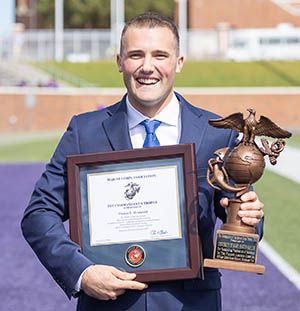
Thomas Henderson of Keller, a senior Christian studies major at the University of Mary Hardin-Baylor, received the U.S. Marine Corps Commandant Trophy for outstanding leadership and superior accomplishments.
Thomas Henderson of Keller, a senior Christian studies major at the University of Mary Hardin-Baylor, received the U.S. Marine Corps Commandant Trophy for outstanding leadership and superior accomplishments. Henderson, the son of Jerry and Penny Henderson, is Student Foundation president and serves in various ministry roles in the community. Last year, Henderson was selected for the Platoon Leaders Class Program, an undergraduate commissioning program that allows full-time enrolled college students to pursue a commission in the U.S. Marine Corps without interrupting the academic school year. He attended Officer Candidates School the past two summers in Quantico, Va., where he finished first among 224 graduating candidates from Lima Company and was selected as the honor graduate. Out of the hundreds of candidates from across the country trained at OCS this summer, Henderson is one of seven recognized with The Commandant’s Trophy.
East Texas Baptist University’s Kinesiology Department hosted its annual Field Day for more than 300 Pre-K students from Marshall Early Childhood Center on Oct. 31. ETBU Kinesiology students led the attendees in various physical activities, ranging from parachute play and tricycle riding to obstacle course running. (ETBU Photo)
East Texas Baptist University’s kinesiology department hosted its annual field day Oct. 31 for more than 300 pre-K students from Marshall Early Childhood Center. Kinesiology students led various physical activities, ranging from parachute play and tricycle riding to obstacle course running. Students in ETBU’s “Teaching Elementary Physical Education” course were provided an opportunity to apply course content, practice their learned content in practical situations, strengthen their servant leadership skills, and build relationships with children and families in the local community. Students spent time building lesson plans specifically for the age range of children that attend the event.
During Dallas Baptist University homecoming on Nov. 19, Gus Reyes will be named as 2022 Honorary Alumnus. The status is awarded to individuals who demonstrate a commitment to Christian servant leadership and values reflective of the mission and vision of DBU. Reyes is director of Hispanic partnerships at DBU. Previously, Reyes led the National Hispanic Leadership Conference’s annual education summit involving more than 20 Christian colleges, and he served the Baptist General Convention of Texas as director of the Christian Life Commission. He also worked in other roles with the BGCT, including service with the Hispanic Education Initiative, affinity ministries, congregational relationships, the service center and in ethnic evangelism. For three years, he was bivocational pastor of First Mexican Baptist Church in Dallas. He serves on the board of directors of the Baptist Spanish Publishing House. He holds degrees from the University of Texas, Angelo State University and Southwestern Baptist Theological Seminary.
At their quarterly meeting, Baylor University regents heard a year-end financial report highlighted by total assets growing to $3.9 billion, operating revenues totaling $925.1 million and operating expenses reported at $836.5 million. Regents learned Fitch Ratings, a global leader in credit ratings and research, upgraded Baylor’s long-term bond ratings. The ratings agency attributed the upgrade to “Baylor’s strong financial and liquidity position, via solid cash flow trends and better-than-budget results in recent fiscal years through fiscal 2022.” The ratings agency also noted the impact of the university’s strong student demand profile, successful fund-raising with Baylor surpassing its initial $1.1 billion Give Light campaign goal last February, and its positive endowment performance. At their meeting, regents approved $78.6 million for Phase 2 construction of the Fudge Football Development Center. The facility will house the day-to-day operations for Baylor football coaches and support staff. The total project budget, including Phase 1 design and early construction work that began over the summer, is $89.6 million. The facility is expected to be completed during spring 2024.
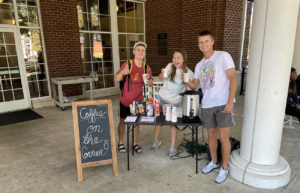
A four-member group from Howard Payne University participated in a poverty simulation in Waco. From left to right are Aidan Oplotnik, son of Professor Shantel Oplotnik; Shantel Oplotnik, assistant professor of social work and director of field education at HPU; Stephanie Russell, a sophomore from San Saba; and Jessica Phariss, a junior from Brownwood.
Shantel Oplotnik, assistant professor of social work and director of field education at Howard Payne University, led a group who participated in a poverty simulation sponsored by Mission Waco. Joining in the poverty simulation were her son, Aidan Oplotnik; Stephanie Russell, an HPU sophomore from San Saba; and Jessica Phariss, an HPU junior from Brownwood. The three-day experience offered participants the opportunity to see the world through a different lens, by walking in the shoes of the impoverished. It marked Howard Payne University’s 11th year participating in Mission Waco’s poverty simulation. Oplotnik first participated in the simulation in 2019 when she was a student at HPU.
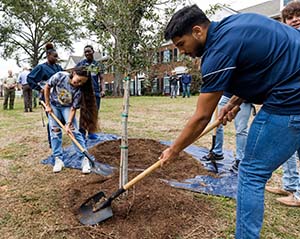
East Texas Baptist University faculty, staff and students gathered on the campus to plant trees and contribute to the beautification of campus on the official Texas State Arbor Day. ETBU utilizes Arbor Day to provide a unique opportunity for students to get involved in the tree planting process each year. (ETBU Photo)
East Texas Baptist University faculty, staff and students gathered on the university grounds to plant trees and contribute to the beautification of campus on Texas Arbor Day. Students planted three live oak trees in front of University Park Row Houses on ETBU’s campus. While National Arbor Day occurs in late April, Texas Arbor Day occurs on the first Friday in November due to the cooler temperatures.
The McLane College of Business at the University of Mary Hardin-Baylor hosted its second graduate residency day Oct. 22. The event gave online degree candidates a chance to experience campus life and in-person learning. During the event, students engaged in academic breakout sessions and networking and received updates from faculty. Participants also heard from guest speaker Randy’L Teton, a Shoshone-Bannock tribal member who was the model for the Sacagawea dollar coin. She talked about lessons she learned as a motivational speaker, educator, tribal spokesperson and mother.
Churches open but still recovering from pandemic losses
November 11, 2022
NASHVILLE, Tenn.—Almost all churches in the United States are holding in-person services again, but some pre-pandemic churchgoers still haven’t returned.
In August 2022, about 100 percent of surveyed U.S. Protestant pastors say their churches met in person, according to a Lifeway Research study.
This continues the increases from the past two years of churches holding physical gatherings. In August 2021, 98 percent of churches gathered in person, after 75 percent reported the same in July 2020.
“While there are a handful of exceptions, we can definitively say that churches in the U.S. have reopened,” said Scott McConnell, executive director of Lifeway Research. “While masks began to rapidly disappear in many settings in 2022, churchgoers have not reappeared quite as fast.”
Attendance adjustment
Despite churches returning to pre-pandemic levels of holding in-person services, not all churchgoers have followed suit. On average, U.S. Protestant churches report current attendance at 85 percent of their typical Sunday morning crowds in January 2020, prior to the COVID-19 outbreak.
Despite falling below a full return, this marks the highest attendance levels in more than two years. In September 2020, the average church reported 63 percent of their pre-pandemic in-person attendance. Last August, the percentage climbed to 73 percent, before rising another 12 percentage points this year.
In February 2021, 91 percent of U.S. Protestant churchgoers told Lifeway Research that once COVID-19 was no longer an active threat, they planned to attend worship services at their church at least as much as they did prior to the pandemic.
Earlier this year, 34 percent of Christians said they attended a worship service four times a month or more before COVID, according to an additional Lifeway Research study. In April 2022, 26 percent said they currently attend that often. Slightly more than a third of Christians (36 percent) said they attended less than once a month before the pandemic. This year, that jumped to 43 percent.
“While some pre-COVID churchgoers have not returned to church at all, much of the decline in attendance is from people who are attending less often,” McConnell said.
Areas of growth
While most U.S. Protestant churches still haven’t fully recovered pre-pandemic attendance levels, more congregations than before have now reached those numbers or even grown.
In September 2020, almost twice as many congregations reported being below 50 percent of their January 2020 attendance as said they were at least at 90 percent (29 percent vs. 15 percent).
Now, less than 1 in 10 congregations (8 percent) is still below half of their pre-COVID attendance numbers. Today, more than a third (35 percent) report at least 90 percent attendance, including almost 1 in 6 pastors (17 percent) who say their congregation has grown since January 2020.
Most churches continue to be in the middle range—above 50 percent of their pre-pandemic attendance but below 90 percent. A quarter of churches (26 percent) say their attendance is more than 50 percent but less than 70 percent, while 31 percent report a congregation of 70 percent to less than 90 percent what it was prior to COVID-19.
“As has been the case since COVID began, different churches are having different experiences,” McConnell said. “More than a third are at 90 percent or more of pre-pandemic attendance. More than a third are stuck with less than 70 percent of their people back on a typical Sunday. And just under a third are in between 70 percent and less than 90 percent attending.”
Older pastors are less likely to report their church growing in attendance since the pandemic began. Around 1 in 6 pastors 65 and older (16 percent) say their congregations increased attendance since January 2020 compared to 25 percent of pastors aged 45-55 and 33 percent of pastors 18-44.
Those in the Midwest (26 percent) and South (25 percent) are more likely to say they’ve grown compared to those in the Northeast (14 percent).
Evangelical pastors (29 percent) are almost twice as likely as mainline pastors (16 percent) to report pandemic attendance growth.
Pentecostal (33 percent) and Baptist (28 percent) pastors are more likely to say they’ve grown since January 2020 than those at Presbyterian/Reformed (14 percent), Lutheran (13 percent), Restorationist Movement (10 percent) or Methodist (8 percent) churches.
Non-denominational pastors are among the most likely to report growth (30 percent) but also the most likely to say their church is still less than 30 percent of pre-COVID attendance (14 percent).
Fewer churches reach 100 in attendance
The failure of churches to recapture all their pre-COVID churchgoers means even fewer churches reach 100 in attendance on a typical weekend. Now, 2 in 3 U.S. Protestant churches (68 percent) have congregations of fewer than 100 people, including 31 percent who have fewer than 50. A quarter of churches (24 percent) fall into the 100-249 range, while 8 percent of congregations host 250 people or more each week.
Almost half of the oldest pastors are leading the smallest congregations. Pastors 65 and older (47 percent) are most likely to be leading churches with fewer than 50 on a typical weekend. Mainline pastors (38 percent) are more likely than evangelical pastors (26 percent) to be leading congregations of fewer than 50.
Denominationally, the smallest churches are more likely to be Presbyterian/Reformed (50 percent) or Methodist (42 percent) than Pentecostal (27 percent) or Baptist (22 percent). The smallest congregations are also most likely to be in the Northeast (45 percent).
Still, the smallest congregations are among those most likely to have recovered to pre-COVID levels. Those who reported attendance of fewer than 50 in January 2020 (49 percent) are more likely to currently say they are at 90 percent or greater of those pre-pandemic levels than those with 50 to 99 (34 percent) and 100 to 249 (28 percent) in pre-pandemic attendance.
The phone survey was conducted Sept. 6-30, 2022. The calling list was a stratified random sample, drawn from a list of all Protestant churches. Each interview was conducted with the senior pastor, minister or priest at the church. Responses were weighted by region and church size to reflect the population more accurately. The completed sample is 1,000 surveys, providing 95 percent confidence the sampling error does not exceed plus or minus 3.2 percent. Margins of error are higher in sub-groups.
New Billy Graham archive opens in North Carolina
November 11, 2022
WASHINGTON (RNS)—In the twilight of his 99 years, Billy Graham met with Duke Divinity School historian Grant Wacker, who was writing a biography of the famous evangelist.
Graham leaned over at one point and, according to Wacker, asked him, “‘Do you think the archives at Wheaton are well run?’”
I said: ‘Yeah. They are,’” Wacker told RNS. “He said, ‘That’s good.’”
History was on Graham’s mind. Conscious that his legacy after his death would depend on how future generations saw his work, he saw the need to preserve and maintain the record of it.
On Nov. 7, the birthday of the late evangelist, a new archive opened nearly 800 miles south of Wheaton College, in Charlotte, N.C., Graham’s birthplace.
The Billy Graham Archive and Research Center opened in Charlotte, N.C. (Photo courtesy of the Billy Graham Evangelistic Association)
The 30,000-square-foot state-of-the-art research center brings together videos, cassettes, films, newspaper clippings, sermon notes, correspondence and a lifetime of memorabilia from Graham’s career, which began with a sermon at a Florida Baptist church in 1937.
A year after Graham’s death in 2018, the Billy Graham Evangelistic Association announced it was moving the archive from the highly regarded Billy Graham Center Archives at Wheaton, Graham’s alma mater. For the intervening three years the archival materials have not been available to researchers.
The new two-story building, constructed with the latest preservation standards and environmental controls, cost $13 million. It unites all of Graham’s records—not only from the Wheaton archive but from Minneapolis, where he started his formal ministry, and from Montreat, N.C., where Graham and his wife lived for decades in a log-cabin-like home.
The archive houses audio-visual records on the first floor and papers, including sermons, correspondence and memorabilia, on the second. The building is located across the road from the Billy Graham Library, the barn-shaped museum on 20 landscaped acres where visitors can trace Graham’s journey through multimedia presentations and interactive kiosks.
‘Robust and well-organized’ archive
“Franklin Graham committed resources to make sure it’s a robust and well-organized authentic archive center,” said David Bruce, executive director of the archive, speaking of Graham’s son and successor, who is now president and CEO of the Billy Graham Evangelistic Association.
Bruce, who spent 25 years at Billy Graham’s side as his executive assistant, is joined at the archive by 13 others hired to staff the archive, among them eight full-time employees.
Unlike the library, the archive is not open to the public. Researchers must schedule a visit through the website.
When the BGEA announced it was moving the archive from Wheaton to Charlotte, many scholars feared the move was a bid by Franklin Graham to control his father’s legacy and possibly deny access to the archival materials to scholars and others who don’t share his views on conservative political and theological agendas.
Bruce denied that and said all researchers were welcome.
“Dusty records don’t serve any purpose,” he said.
Encourage evangelism
But he also said the main purpose of the archives is to further Graham’s ministry.
“While we’re open to everybody, our key market is people wanting to learn what God has done and can do in the future that might encourage a young man or woman to take up the same task: a proclamation of evangelism,” he said.
Graham’s archive in Wheaton was visited by more than 19,000 scholars, journalists and other researchers during its nearly 40 years there.
The Charlotte archive also will be a crucial stop for many academics.
Graham is important not only to future evangelists but to scholars of all fields, including scholars of American politics, said Heath Carter, professor of American Christianity at Princeton Theological Seminary.
“There’s wider interest in evangelicalism and an acknowledgment that the trajectory of white evangelicalism in the mid- to late-20th century had really significant implications for American politics,” Carter said. “He was a key figure in a movement that would become a strong base of support for the likes of Donald Trump.”
Graham’s views on race and gender and his international reach are also being reexamined.
The first researcher to visit the archives will be a Ph.D. student at Southwestern Baptist Theological Seminary in Fort Worth, who is studying Graham’s reach to the former Soviet bloc, Bruce said.
Ad portrays DeSantis as divinely anointed candidate
November 11, 2022
WASHINGTON (RNS)—In a new advertisement, black-and-white images of Gov. Ron DeSantis and his family fade in and out as a narrator declares that “on the eighth day, God looked down on his planned paradise and said, ‘I need a protector.’ So God made a fighter.”
The ad, unveiled Nov. 4 on the Twitter feed of Casey DeSantis, the Florida governor’s wife, is the latest sign he may be making a play to become the anointed candidate of conservative religious voters.
Doing so would likely challenge the electoral ambitions of former-President Donald Trump, who may end up facing off against DeSantis in the Republican presidential primaries.
Perhaps feeling a threat to his status as the vanguard of conservative Christian politics, Trump dubbed DeSantis “Ron DeSanctimonious” at a rally in Florida over the weekend.
‘Trying to position himself as God’s chosen’
Anthea Butler, chair of religious studies at the University of Pennsylvania, said the ad appears to target the framework for Trump’s political success with conservative Christians, in which God was thought to have chosen Trump for a special purpose.
Some compared the former president to biblical figures such as Cyrus, a Persian king who liberated the Israelites from Babylonian captivity. Still others invoked prophecy to insist leaders of Trump’s administration were agents of God tasked with instilling the government with “kingdom values.”
Now DeSantis is “trying to position himself as God’s chosen man,” Butler said. “That’s really coming up to challenge Trump on one of the things that makes him palatable to the QAnon people and all his loyal followers. They feel like God picked Donald Trump.”
Marie Griffith, head of the John C. Danforth Center on Religion and Politics at Washington University in St. Louis, agreed. “If it worked for Trump, maybe it’ll work for him—to be seen as almost a prophet and someone sent by God,” Griffith said.
Griffith said the ad hints at other critiques of Trump that DeSantis may use to appeal to conservative religious voters. While Trump has expressed support for COVID-19 vaccines developed while he was in office, DeSantis has repeatedly cast doubt on the effectiveness of the lifesaving shots and pandemic restrictions in general, a view shared by many of the most conservative parts of Trump’s base.
“It’s reminding people of how he handled the pandemic,” said Griffith.
And while DeSantis is Catholic and the “fighter” advertisement appears to be a riff on broadcaster Paul Harvey’s 1978 speech “So God Made a Farmer”—substituting “fighter” for Harvey’s encomiums about farmers—Griffith said the narrator’s voice has the overtones of a mid-20th century Protestant preacher.
Conservative religious support
Several prominent conservative religious voices have begun to line up for DeSantis and used both the ad and Trump’s jibes against the Florida governor to speak out.
Matt Walsh, a conservative Christian commentator, came to DeSantis’ defense after the Florida rally, writing on Twitter: “DeSantis is an extremely effective conservative governor who has had real policy wins and real cultural wins. Trump isn’t going to be able to take this one down with a dumb nickname.”
Pastor Tom Ascol—a leader among the most conservative faction of the Southern Baptist Convention, who forced a runoff for the SBC presidency earlier this year—offered the invocation at a DeSantis event over the weekend and later characterized DeSantis similar to how Trump was framed by some during his time in Washington.
“I’m grateful for the privilege to pray for my governor (DeSantis) & his family,” Ascol said in a tweet. “God has blessed the state of Florida by placing him in this office as His servant for our good.”
Meanwhile, other conservative figures have begun to outline support for DeSantis. Conservative Christian writer Rod Dreher, who recently moved to Hungary, responded to Trump’s name-calling by referring to the former president as an “idiot.”
Tony Suarez, the COO of the National Hispanic Christian Leadership Conference who was among Trump’s evangelical advisers and now also counts himself a “huge Ron DeSantis fan,” said he was impressed by the ad.
“My first reaction was: someone on the media team needs a raise, because it’s impacting,” he said. “Wow, it’s strong.”
Reservations about timing
But Suarez questioned the timing of the ad. Describing it as a possible “teaser” for DeSantis’ presidential bid, Suarez expressed ambivalence about anyone running against Trump in 2024. Rumors have already begun to swirl the former president may announce a third White House bid soon.
“This is not the moment to divide the party, and the support behind Trump—and I have no reason to believe he won’t run again—is so incredibly strong,” Suarez said.
Instead, Suarez outlined a scenario where Trump runs and wins the White House in 2024, with DeSantis running the next cycle.
“I fully expect to one day vote for DeSantis to be president. I just don’t know if it’s in 2024,” he said. “I do think DeSantis has the potential to be the president of the United States, biblically speaking, ‘in due season.’”
But Butler and Griffith agreed Trump may have reasons to be concerned if DeSantis decides to jump in earlier.
“What DeSantis has that Trump doesn’t have is an appeal to ‘positive family values,’” Griffith said, referring to a phrase long common in conservative Christian politics. “He’s a family man, he doesn’t have all this divorce in his past, he doesn’t have women, to my knowledge, suing him for sexual harassment and rape.”
Ukrainian Baptist leader sees God-ordained role
November 11, 2022
NASHVILLE (BP)—Ukrainian Baptist Theological Seminary President Yaroslav “Slavik” Pyzh and his wife Nadia don’t stay in airport hotels when traveling outside their war-torn country. Jets signal danger.
“The first four days, as soon as we hear the sound of a jet, we will be looking for cover, instinctively. I mean it’s not like a logical thing,’’ he said Nov. 5 during their latest trip to the United States. “Because in Ukraine if you hear the sound of jet, you’re looking for cover. And here you have jets all the time, planes flying back and forth.
“In Ukraine, the only plane that we have is military jets.”
Biggest thing? ‘To show up’
Pyzh is in the U.S. thanking Southern Baptists and others for support that has allowed the seminary to provide humanitarian aid alongside tuition-free education during Russia’s war on Ukraine. Tuition has been waived for the 2,000 students currently enrolled in the seminary in Lviv on Ukraine’s western border.
Preaching the Nov. 6 sermon at First Baptist Church in Nashville alongside interim pastor Darrell Gwaltney, Pyzh expressed confidence God positioned him to serve as the seminary’s president during Russia’s attack on Ukraine.
“I never thought, in all my dreams, that I live through war. I never thought that God is preparing me for what I’m going through right now,” Pyzh said at Nashville First Baptist in the sermon taken from I Kings 18:20-39, which tells of Elijah’s battle with the prophets of Baal.
“If you had told me, I wouldn’t have totally believed you. But the biggest thing I have done for my people in the last eight months was to actually show up on Feb. 24 when the war started.
“Was I afraid? Yes. A lot of people have left Ukraine, but I think that was the moment that God was preparing me for. And not only me,” Pyzh said. “Elijah thought he was the only one; there were a few more.”
Pyzh, who has since February asked Christians to pray for a miracle to end the war, focused on God’s miracle in defeating the idol prophets at Mount Carmel.
Gwaltney chose the sermon text long before he knew of Pyzh’s visit.
“I chose that text and topic maybe two to three months ago, and then when I learned he could be in Nashville this weekend, it seemed like the perfect text for our time together,” Gwaltney said.
“The imagery is so appropriate when you think of him, leading his seminary, equipping leaders, when it looks like they are all alone against a world superpower.
“I so appreciated his focus on leadership development. In my conversations with him, I knew he is passionate about developing the next generation of leaders. It is a good word for us to hear as that should be our purpose as well.”
‘Seize the opportunities’
Ukrainian Baptist Theological Seminary served as a refugee center during the first months of the war. The seminary is strengthening internally displaced people through humanitarian We Care Centers across Ukraine, and it is helping restore pastoral leadership at perhaps 450 churches that have closed as a result of the war.
“Slavik continues to give exemplary prophetic leadership for the Ukrainian Baptist Theological Seminary, and I thought it a great opportunity for the church to hear from his heart about the work he is doing,” Gwaltney said. “I thought it would encourage us to be faithful in the small ways God calls us to serve.
“Since we have been supporting his leadership, I wanted the church to hear him in person so they could be more engaged and more supportive in the future.”
Elijah exemplifies the opportunity all believers have to serve in critical roles God has designed, Pyzh preached.
“I think what Elijah is doing here is living that life that God gave him. He came in that time. He came to do that,” Pyzh said. “The thing that I really, really want to emphasize (is) we all have an opportunity to live. We have different opportunities, and all these opportunities are as unique as our lives (are).
“But the question is: Do we seize these opportunities? Do we seize these specific times? Do we use them, or do we miss them?” Pyzh said.
As others sought to kill Elijah, “he was not afraid to show up among those 850 prophets, because that was his opportunity. That was his time. That was his life.”
In addition to the sermon, Pyzh updated individual small groups on Ukrainian Baptist Theological Seminary, thanked members for their support and received prayers for continued success.
About 6,400 killed in Ukraine
Nashville First is among numerous Southern Baptist churches supporting the seminary through direct donations and gifts through Southern Baptist Send Relief, Woman’s Missionary Union and the Ukraine Partnership Foundation.
About 6,400 civilians have been killed in Ukraine since the war began February 22, including 403 children, the United Nations High Commissioner for Human Rights said in its Nov. 7 update. Just under 10,000 have been injured, and millions have fled the country.
The U.N. High Commissioner for Human Rights “believes that the actual figures are considerably higher, as the receipt of information from some locations where intense hostilities have been going on has been delayed and many reports are still pending corroboration,” the U.N. reported in its update.
“This concerns, for example, Mariupol (Donetsk region), Izium (Kharkiv region), Lysychansk, Popasna, and Sievierodonetsk (Luhansk region), where there are allegations of numerous civilian casualties.”
In addition to God’s miracle of ending the war, Pyzh asks Southern Baptists to pray God would restore leadership to churches that have suffered during the war, and that he would offer provision and safety to residents during Ukraine’s freezing winter temperatures.
Russia has destroyed 40 percent of Ukraine’s electrical power plants, Pyzh said.
“Thank you for praying for us and helping us,” Pyzh said. “Pray for God’s miracle, because it will take God’s miracle to stop the war.”
American Renewal Project mobilizes pastors for GOP
November 11, 2022
WINSTON-SALEM, N.C. (RNS)—North Carolina Lt. Gov. Mark Robinson has a message for the state’s evangelical pastors: Run for office.
Robinson has repeated his message at least eight times over the past few months at church luncheons across North Carolina hosted by the American Renewal Project, a group dedicated to mobilizing evangelical pastors to run for school boards, city councils, county commissions, the state legislature and beyond.
The project, which has hosted similar events in Iowa, Missouri, South Carolina and Texas, takes the now decades-long effort to get evangelicals engaged in electoral politics one step further. It seeks to bring pastors into elected office.
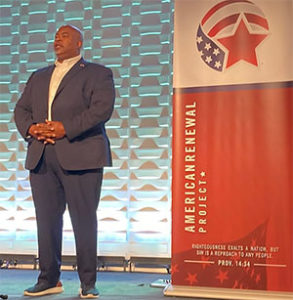
North Carolina Lt. Gov. Mark Robinson addresses an American Renewal Project pastor luncheon on Oct. 31 in Jamestown, N.C. (RNS photo by Yonat Shimron)
Robinson, a 54-year-old Republican and a first-time officeholder himself, said the nation needs pastors willing to fight a spiritual war in the halls of power.
“Step up,” he thundered to some 200 pastors and their wives munching on boxed lunches of Chick-fil-A chicken sandwiches in Winston-Salem last month.
“Join the fight. Don’t join the fight under man’s power. Join the fight under God’s power. Bring the principles of God, not the principles of politics. Bring his words with you.”
If Jerry Falwell Sr. founded the Moral Majority to get evangelicals to lobby Congress on issues of morality, and if the Christian Coalition mobilized Christians to cast ballots, then the American Renewal Project wants pastors to run as candidates on the Republican Party ticket up and down the ballot.
Now in its 17th year, the project reorganized two years ago to focus on regional pastor luncheons in a handful of states. This year, eight of its 19 luncheons were held in North Carolina, drawing more than 1,500 pastors and their wives. The events were free, and no offerings were taken.
In addition to the lieutenant governor, each luncheon featured North Carolina Republican Party Chairman Michael Whatley, who promised the pastors that if they run, the party will provide them the logistical support they need.
“You’re really good at public speaking,” Whatley told the pastors at each meeting. “You’re great herding cats. God knows, you can raise money. You’re perfect.”
Asserts departure from ‘biblically based culture’
Driving the project is the Christian nationalist notion that America has strayed from its origins and needs to be restored to its Christian foundations.
“America was founded on the Judeo-Christian heritage and established a biblically based culture,” said David Lane, a Dallas political operative who founded American Renewal Project. “We no longer have that. Secularism was officially crowned in the mid-20th century.”
Lane said evangelical donors have given him nearly $50 million since 2005 to support his project and convince pastors to take up the cause.
Those invited to recent luncheons come from various denominations. Most are Southern Baptist, charismatic or Pentecostal. The men—there are few women pastors—are overwhelmingly white. And despite the commonly used term Judeo-Christian, there are hardly any Catholics and certainly no Jews.
Among those who spoke at most of the eight events across the state were two Baptist pastors on the Nov. 8 ballot. One is running, unopposed, for commissioner in Bladen County; the other is running for the North Carolina House in heavily Republican-leaning Randolph County. Barring a disaster, both will win.
The two pastors peppered their on-stage appeals with biblical references. One cited Peter, Jesus’ disciple, finding the courage to get out of the boat during the storm. The other paraphrased the Book of Esther so beloved by evangelicals: “You’ve been brought into the kingdom for such a time as this.”
Project claims strategy is working
A common refrain at the American Renewal Project is that Jesus’ saying, “Upon this rock I will build my church,” is commonly misconstrued. The Greek word “ecclesia,” often translated as “church,” actually means “assembly.” American Renewal’s supporters take this as a sign that Jesus wanted Christians to have influence in the public square, not just inside the walls of a church.
Project leaders think the strategy is working. They claim 50 pastors ran for various North Carolina offices in this year’s primaries, and 25 won their nominations and will appear on this November’s ballots.
The Renewal Project did not, however, provide a list of those vying for public office, and only a handful could be independently verified. The group does not fund any of the pastors’ campaigns.
One reason, for the middling response? Pastors haven’t seen public office as part of their call.
Religious broadcaster Pat Robertson campaigned to become the Republican Party’s nominee for president in 1988. Mike Huckabee, formerly a Baptist pastor and also former governor of Arkansas, also ran for president in 2008 and 2016. Neither came close to clinching the nomination.
It wasn’t until 1978 that it was even possible for pastors in all states to run. Historically, some states had clauses in their constitutions prohibiting clergy from running for office, a holdover from English common law.
In McDaniel v. Paty, the Supreme Court struck down the last of those clauses, ruling a Tennessee law prohibiting clergy members from serving as political delegates violated the free exercise clause of the First Amendment.
“For much of the 19th and 20th centuries there was a general idea that ministerial service was a separate profession from politics, and it was incompatible with running for office,” said Daniel K. Williams, professor of history at the University of West Georgia.
Black pastors have, at times, been the exception, and almost exclusively on the Democratic ticket. Adam Clayton Powell Jr., onetime pastor of Harlem’s Abyssinian Baptist Church, served as a Democratic U.S. congressman from 1945 until 1971. Jesse Jackson ran unsuccessfully for president in 1984 and 1988. Raphael Warnock, pastor of Atlanta’s Ebenezer Baptist Church, is now running for reelection to the U.S. Senate. In local races there have undoubtedly been many more.
Culture warriors welcome
Robinson, North Carolina’s lieutenant governor, who is Black, is an exception. He captured the state’s second-highest elected office after a 2018 video that captured him admonishing the Greensboro City Council for attempting to cancel a biannual gun show went viral.
Since winning office in 2020, he has defined himself as a culture warrior, decrying “transgenderism and homosexuality” as “filth,” calling for eliminating the state Board of Education and opposing abortion (though he acknowledged that he and his future wife terminated a pregnancy in 1989).
Most recently, Robinson mocked a brutal attack on U.S. House Speaker Nancy Pelosi’s husband in a Facebook post. “I’m sorry Paul I don’t believe you or the press!!!!” he wrote underneath an image of a Halloween costume for an “attacker” featuring a shirtless, grinning, hammer-wielding man wearing underwear.
Robinson, who is not a pastor, shares the same vision of America’s founders as the American Renewal Project. At a pastor’s luncheon at a church in Jamestown, near Greensboro, he rhapsodized about the faith of the Mayflower Puritans and the pioneers who traveled west in covered wagons in search of land. There was no mention of the displacement of Native people or the enslavement of Blacks.
“Those people were made of something different,” Robinson bellowed. “Look at us now. You got people that can’t get around the corner of Walmart without GPS. We have literally forgotten how to do anything.”
At the end of Robinson’s 15-minute testimony, Gary Miller, the project’s director, asks pastors to get up and lay hands on the lieutenant governor and pray for him. For about two minutes, the pastors crowd around the stout, broad-chested Robinson. They lay hands on his back or lift their arms up in the air and pray out loud.
Renewal Project leaders do not take a public stand for former President Trump or unfounded claims that the 2020 election was stolen. Lane, the group’s founder, said he is not involved in helping reelect Trump and does not believe the election was stolen.
His fight, as he wrote in his weekly email, which he says is emailed to 80,000 pastors, is against “profane secularists and cultural Marxism.”
“If North Carolina Christians stay home on election day, then those in active rebellion against God will get the chance to elect their representatives,” he wrote in a recent email to followers, in which he also castigated the Baptist State Convention of North Carolina for holding its annual meeting on Election Day.
The last of this year’s luncheons were held this week. But Lane’s work is not done. Immediately after Election Day, Lane is headed for Israel with a delegation of pastors he wants to convince to run for office. A frequent traveler to Israel, Lane has taken Huckabee and Kentucky Sen. Rand Paul along on these trips.
Cameron McGill, the Baptist pastor and Bladen County commissioner who traveled to Israel with Lane in 2019, is returning this year to help convince a new crop of pastors to step up and run for office.
“God has called us not just to build our church but to impact the culture,” McGill said. The trip to Israel, he said, may help U.S. pastors see how Jesus himself did so.
This story was produced with a grant from the Stiefel Freethought Foundation.
Burmese army attacks Baptist seminary in Myanmar
November 11, 2022
The Burmese military attacked a Kachin Baptist seminary in northern Myanmar on Nov. 3, injuring four young men in a dormitory, International Christian Concern reported.
The military—known as the Tatmadaw—reportedly launched three attacks on the seminary in Kutkai, Shan State, founded by the Kachin Baptist Convention. At the time, no active fighting between junta forces and armed local ethnic group was occurring, ICC stated.
The four individuals who were hit by shrapnel, sustaining non-life-threatening injuries, were identified as Myitung Doi La, 24; Ndau Awng San, 27; Nhkum Sut Ring Awng, 21; and Sumlut Brang San, 22.
Marip La Hkwang, a Kachin Christian, posted a Facebook video showing damage caused by the shelling, and another video showed an injured student being helped out of the dormitory to receive medical attention.
‘Deliberately targeted a Christian facility’
“The attack against this Kachin Bible school was certainly not an accident,” said Gina Goh, International Christian Concern’s regional manager for Southeast Asia.
“Instead, the Tatmadaw deliberately targeted a Christian facility, knowing how important the faith is to Kachin people. This despicable junta regime should not be tolerated any further by the international community and needs to be removed at once.”
The attack on the school occurred four days after shelling partially destroyed a Baptist church and hall in Momauk township, Kachin State.
Since the Tatmadaw staged a coup in February 2021, more than 2,400 people in Myanmar have been killed and at least 16,000 have been jailed by the junta, including many who have been tortured.
BWA condemns ‘campaign of terror and violence’
At its annual gathering in Birmingham, Ala., the Baptist World Alliance general council adopted a resolution condemning the military coup that led to “a campaign of terror and violence” in Myanmar. The resolution called for “the establishment of a true democracy that respects the rights of religious and ethnic minorities in Myanmar.
“Since the coup, the military has terrorized communities in Kachin, Karen, Kayah State, Chin State and Sagaing Region by burning villages, destroying churches, and detaining pastors and religious leaders,” the resolution stated.
More than a year ago, the Tatmadaw shot and killed Cung Biak Hum, a Baptist minister in Thantlang who was helping a member of his church extinguish a fire after the man’s home was set ablaze during military attacks.
EDITOR’S NOTE: Nov. 6 is the International Day of Prayer for the Persecuted Church.
Freedom Church focuses on breaking the huddle
November 11, 2022
On fifth Sundays, expect to find the pews and hallways of Freedom Church in Bedford empty.
Instead, look in the grocery stores and gas stations around the church to see the congregation serving neighbors running their Sunday errands. Find members sharing the love of Christ and being the hands and feet of Jesus.
This is Freedom Church’s No Huddle Sunday, a chance for the congregation to “break the huddle” and serve their neighbors.
Robert White, pastor of Freedom Church, explained the idea developed from the realization that on Sunday mornings, Christians are gathered in churches, while nonbelievers are out in the community running errands.
“We kind of preemptively rapture ourselves out of the world on Sunday mornings, and the rest of the world is still working,” White explained.
“One of the best times to reach nonbelievers is on Sunday when all the other believers are in church. These are the people who are at the grocery store [and] getting gas on Sundays, because they don’t go to church.”
Break the huddle and ‘run the plays’
The No Huddle Sunday name came from a football analogy White often used.
“When we get into the huddle, we learn the plays. We call the plays. But you have to actually get out and run the plays,” he said.
Likewise, the church uses Sunday gatherings to learn and study the gospel and discuss how to share it with others. But beyond that, Christians must then go out and put into action the teachings they learn each Sunday.
No Huddle Sundays started as a one-off event in 2019. As the church came back together following going online due to COVID-19, White realized the need for connectedness within the church.
He saw many members of the church were attending the services but not investing in the church’s community. This led the church to refocus and prioritize service and fellowship. They decided to restart No Huddle Sundays, this time making them a quarterly event falling on each month with a 5th Sunday.
The event begins at the church with a short rally featuring music and prayer. This provides a time to center the church for the day and also ensures that any visitors do not show up to an empty building.
Then, the group is broken up into serve sites, which are led by a site captain who makes sure people know what they are doing and the reason behind it.
Freedom Church members assemble care baskets to distribute during No Huddle Sundays.
White said between 70 and 100 people serve each No Huddle Sunday at about a half-dozen locations around their community. He explained that this is not a “day off” from church, but instead a different expression of church, and he encouraged the congregation to see it with that mindset.
Each event looks a little different, with the congregation going out to put on free car washes, give out gas gift cards and pay for people’s groceries.
The neighbors they serve always are surprised and full of questions, White said. They are shocked when people give up part of their weekend to serve them.
That curiosity gives church members a chance to share their faith and explain why they want to bless people in their community. Freedom Church has seen some of the recipients of these gifts attend the church.
For many church members, the event is a time for them to build their confidence in sharing the gospel. It gives them practical experience so that, outside of the event, they feel comfortable and prepared to be a witness.
“We figured the best way for us to equip our church to share the gospel was for us to get out and do it together. Then people can see how it is done practically, versus just imagining what it would look like if I did a better job reaching people,” White said.
The Sundays have been a chance for the church to look beyond its four walls and engage in a new and unusual way, White said.
“It’s engaged our congregation. It gives us pride in our church. And we invite more people because they know it’s not just talking; we are doers,” White said. “We get out and run the play, which is to be the hands and feet of Jesus and show people the love of Christ.”
Tim Keller: Many Christians afraid to admit they’re wrong
November 11, 2022
WASHINGTON (RNS)—Author and pastor Tim Keller begins his new book with a warning about forgiveness gone wrong.
Keller cites a famous parable found in the Gospel of Matthew, where a king forgives one of his servants, who owes a fortune and can’t repay. Rather than be grateful, the servant turns around and has one of his co-workers, who owed him a pittance, tossed in jail.
When the king finds out, he is furious and revokes his initial forgiveness.
“We should not miss the confrontational nature of this parable,” Keller writes in Forgive: Why Should I and How Can I? “Jesus’ parable about forgiveness is not a feel-good story about people receiving God’s forgiveness and then eagerly spreading the love to others. Rather, it is a story about a man asking for forgiveness and then being utterly unchanged when he got it.”
Experiencing a forgiveness crisis
The new book comes at a time when Americans are experiencing a forgiveness crisis, Keller argues, in part because the idea of forgiveness has often been misused, especially in religious circles. At times, he writes, survivors of abuse have been pressured to forgive those abusers and just move on. Or forgiveness is used to cover up the truth about the harm people have done to others.
“People have used forgiveness as a way of destroying the truth,” Keller said.
The longtime pastor in New York City, whose books have sold more than 3 million copies, believes forgiveness is not possible without truth. He links the term forgiveness with the idea of “repentance,” which he says has fallen out of fashion.
That term, he told Religion News Service in an interview, means being truthful about our shortcomings and misconduct.
“The word repent means asking for forgiveness,” he said. “If you don’t think you’ve done anything wrong, you have not repented.”
Keller, who retired as pastor of Redeemer Presbyterian Church in 2017, has remained active in recent years despite being treated for pancreatic cancer. He is currently undergoing immunotherapy, which he said has shrunk some of his tumors.
“It has given me more time,” he said.
Known for his conservative but nonconfrontational approach to ministry, Keller has come under fire in recent months by those who say his “winsome” approach to engaging with culture no longer works in such a polarized time.
Keller told Religion News Service he finds such criticism puzzling. As an evangelical pastor in New York, he said, his views were often in conflict with the broader culture. But that was not going to stop him from acting like a Christian.
“This was never the neutral territory,” he said. “We always had opposition.”
In 2017, Princeton Theological Seminary announced plans to give Keller the Kuyper Prize for Excellence in Reformed Theology and Public Witness but later reversed course due to concerns about Keller’s views on women in ministry and LGBT rights.
Early on in the book, Keller quotes the late Desmond Tutu, the South African cleric; the late author bell hooks; and former New York Times columnist, now Atlantic columnist Elizabeth Bruenig about the importance of forgiveness and the need to balance justice with recognizing the humanity of those who do harm.
Forgiveness and compassion linked
The quote from hooks, taken from a conversation with poet Maya Angelou, makes that point in a forceful way.
“For me,” hooks said, “forgiveness and compassion are always linked: How do we hold people accountable for their wrongdoing and yet at the same time remain in touch with their humanity enough to believe in the capacity to be transformed?”
In the book, Keller lays out why forgiveness is needed and outlines a step-by-step approach to how forgiveness can be granted in a healthy way—both on a societal level and in the mundane, day-to-day conflicts most people experience.
In an interview, Keller admitted that in the past, he’s struggled with granting forgiveness.
Early in his marriage, Keller said, he at times withheld forgiveness from his wife, even if she said she was sorry for doing something. Doing that, he said, gave him a sense of superiority but also allowed him to hold on to the sense he had been wronged. That led to struggles in their marriage—something they had to work through.
Withholding forgiveness can give people a sense of power over others, he argues.
“If you are out to punish someone,” he said, “you make it really hard for them to ask for forgiveness.”
‘Willing the good of the wrongdoer’
For Keller, one of the key aspects of forgiveness is what he calls “willing the good of the wrongdoer.” The idea is drawn from the command of Jesus that his followers love their enemies.
“A secret to overcoming evil is to see it as something distinct from the evildoer,” he writes. “Our true enemy is the evil in the person and we want it defeated in him or her.”
Keller worries that in our polarized and highly litigious society, forgiveness is seen as weak or unwise. He also wonders if the fear of being canceled has made people unwilling to admit when they have done something wrong.
“People are just afraid to come right out and say, I really need you to forgive me,” he said. “They’re just afraid to do it.”
As a pastor, Keller argues reconciliation is the long-term goal of forgiveness. Forgiveness can open the door to restored relationships if those who have done harm are willing to make amends for their actions.
He also warns that forgiveness does not mean there are no consequences for misconduct. In particular, he said, a pastor or church leader who is guilty of misconduct can be forgiven, but may lose the right to ever be placed in spiritual authority again.
Keller also stressed that after forgiveness, trust has to be earned.
“I actually don’t think that if somebody has forgiven me, that means they have to trust me,” he said. “Forgiven people are not necessarily automatically restored exactly where they were. You have to have time to rebuild trust in people. And you need to recognize that and not resent it if they don’t trust you right away.”


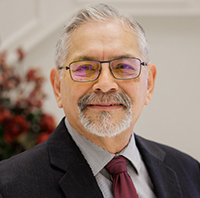 During Dallas Baptist University homecoming on Nov. 19, Gus Reyes will be named as 2022 Honorary Alumnus. The status is awarded to individuals who demonstrate a commitment to Christian servant leadership and values reflective of the mission and vision of DBU. Reyes is director of Hispanic partnerships at DBU. Previously, Reyes led the National Hispanic Leadership Conference’s annual education summit involving more than 20 Christian colleges, and he served the Baptist General Convention of Texas as director of the Christian Life Commission. He also worked in other roles with the BGCT, including service with the Hispanic Education Initiative, affinity ministries, congregational relationships, the service center and in ethnic evangelism. For three years, he was bivocational pastor of First Mexican Baptist Church in Dallas. He serves on the board of directors of the Baptist Spanish Publishing House. He holds degrees from the University of Texas, Angelo State University and Southwestern Baptist Theological Seminary.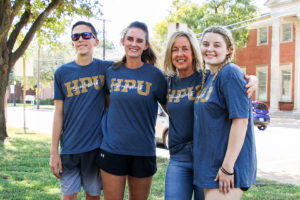



 “We should not miss the confrontational nature of this parable,” Keller writes in Forgive: Why Should I and How Can I? “Jesus’ parable about forgiveness is not a feel-good story about people receiving God’s forgiveness and then eagerly spreading the love to others. Rather, it is a story about a man asking for forgiveness and then being utterly unchanged when he got it.”