Sex abuse expert says churches not following Christ

IRVING—Psychologist Diane Langberg learned a valuable lesson from her father long before she became an expert on trauma and sexual abuse—a painful lesson with profound spiritual implications.

Her father, a World War II bomber pilot, stayed in the military after the war. However, an undiagnosed neurological condition eventually forced his retirement.

He soon needed around-the-clock care and couldn’t stand on his own. His head was directing his body, but his body wasn’t listening and eventually wasn’t able to support life.

She watched the illness unfold and drew a lesson from it.

A woman holds signs about abuse during a rally outside the annual meeting of the Southern Baptist Convention at the Birmingham-Jefferson Convention Complex on June 11, 2019, in Birmingham, Ala. (RNS photo by Butch Dill)

“A body that doesn’t follow its head is a very sick body,” said Langberg, author of Redeeming Power: Understanding Authority and Abuse in the Church and clinical professor at the Global Trauma Recovery Institute of Biblical Theological Seminary in Hatfield, Penn.

After controversies over sexual abuse in the Christian community—from the Roman Catholic Church, to the Southern Baptist Convention, to Ravi Zacharias International Ministries—Langberg now sees the same sickness at work in the church, the body of Christ.

“The church of Jesus Christ has a head. Our head has called for us to follow him. We are not doing that,” Langberg told the B.H. Carroll Theological Institute’s fall colloquy in Fort Worth Nov. 14-15. “Sexual abuse in Christian organizations is the king of oxymorons.”

Sexual trauma deep and widespread

The problem of sexual trauma is deep and worldwide, Langberg said. One of three females will be beaten or coerced into sex in their lifetime, many times by someone they know. According to the United Nations, nearly three quarters of women in some areas of the world will be raped.

Sexual trauma also affects men. Alcohol and drug abuse by male sexual abuse victims is 25 times higher than normal. The rate of suicide is 12 times higher.

The church’s goal, she said, should be to bring those hurting from silence to speaking, from isolation to community, and from a place of no hope to hope. That takes “talking, tears and time,” Langberg said.

Victims need to speak to heal, even if they cannot fully articulate their experience, she said. Their stories may come out in pieces without a beginning, a middle and an end. They may not make sense to those who are hearing them at first. They may also seem to the larger public unbelievable, especially when the one accused is a prominent and church leader.

But accusations rarely are false, Langberg said. In her 50-year-long career, she has uncovered only two false complaints of sexual abuse.

“No one wants to come to you to tell you they have been sexually abused,” she said. “If they do, you should listen. We cannot rely on what we hope to be true.”

Silenced by the system

Unfortunately, when a victim does come forward, they are most often met with the power of a system that feels threatened. The system unites to remove the threat by silencing the accuser, who is made to believe speaking about the abuse will destroy the work of God.

Likewise, the religious system remains silent about an abuser.

“Silence is a double vice,” she said. “It shows indifference to the victims, and it is complicity with the destroyers.”

Sexual abuse requires deception and produces coercion by the system. The deception begins on the part of the one who has committed the abuse. He or she has not only deceived the victim and others. There is self-deception involved in the failure to recognize a heart so deeply infected with sin, Langberg said.

Then the system gathers it forces and begins to make the victim feel responsible. Questions about how an accusation will affect the church make the victim carry both the burden of abuse and the weight of the church’s reputation.

“One of the most powerful weapons of deception is the use of spiritual language,” Langberg said.

When sexual abuse has been exposed, the response of the Christian community often has been naïve, she said.

“The exposure of something true is not going to destroy what God is doing,” she said. “If you lose the capacity to tell the truth, you become a slave to the sin.”

Slavery to sin has produced in the church a poor understanding of grace and a corrupted pathway of repentance. Many churches, Langberg said, accept tears and a simple plea for forgiveness when an abuser is confronted and confesses. They seek to move on, often with the abuser and abused only pews apart.

True repentance is a process

Instead of confessions and promises to “never do it again,” the church should understand repentance as a lifelong process—a slow, consistent change over time. Its genuineness cannot be discerned for a long time.

“To remove someone from a pulpit is a grace. It is a keen awareness that their sensibility to sin is so damaged they cannot recognize it,” she said. Removing the abuser from that position is a protection for him, as well as for the flock.

Churches can avoid many of the problems associated with sexual abuse by learning key lessons. First, the abuse of minors and sexual abuse is always, everywhere an illegal act, in all 50 states, Langberg said.

Second, discerning the truth and accuracy of an accusation is not the function of the church. It is the function of law enforcement. The first step church leaders must take when confronted with abuse, Langberg said, is the call to the police.

Third, while “clergy sexual abuse” is not a crime in all 50 states, it is important to recognize the phrase “it was an affair” should carry no weight with the church. A pastor having a sexual relationship with a congregant is abuse, because he is in a position of authority. Likewise, the church should reject excuses such as the pastor being enticed by the dress or appearance of a congregant.

God doesn’t desire ‘form over substance’

Another lesson the church must learn is God’s kingdom is not an institutional structure.

“He doesn’t desire form over substance,” Langberg said. “I believe God would rather see these things fall down flat than continue hiding these sins.”

Finally, the church needs to recognize that hurting the sheep breaks the heart of the Shepherd. The church’s allegiance is not to a system. Its allegiance is to its head—Christ.

“I fear we have revered the system more than God. …Our thinking is whatever we do to preserve what we love in our life is good, blind to the fact it looks nothing like him.”

Langberg urged churches to keep a watchful eye over the sheep, and to avoid selecting leaders based on talent and gifting rather than integrity. The ability of a minister to eloquently articulate theological truth does not mean that person is an obedient servant of Christ, she said.

“Many have fed off the vulnerable sheep under their care. But sheep do not eat sheep,” she said. “Wolves eat sheep.”

New Beginnings partners for the sake of the gospel

LEWISVILLE—Pastor Joseph Fields and New Beginnings Baptist Church in Lewisville have a vision—to touch their community and show love by meeting basic needs.

Pastor Joseph Fields of New Beginnings Church in Lewisville believes he and his congregation are blessed by God in order to be a blessing to their community. (Photo / Ken Camp)

“It’s all God,” Fields said. “God is the one who gave the vision, and God is the one who gives the provision.”

The vision prompted New Beginnings Church to open its facility on Mondays, Wednesdays and Saturdays so families in need can receive nutritious food, and to make clothing available two Saturdays each month.

God’s provision came in the form of partner organizations that work alongside the church to make the ministries possible.

‘Blessed us to bless the community’

“God has blessed us to bless the community,” Fields said.

Heart of the City, a nonprofit formed by Rob Veal, executive pastor of Northview Baptist Church in Lewisville, operates the food pantry, serving an average of 165 families each week.

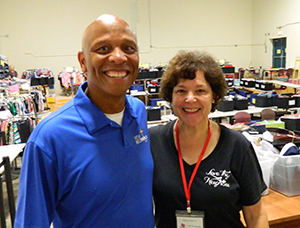
Love Thy Neighbor, another local nonprofit organization, operates the clothing assistance program at New Beginnings Church two Saturdays each month.

“I just want to partner for the sake of the gospel,” Fields said.

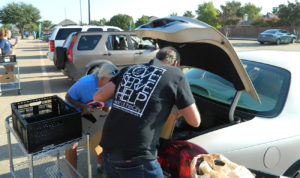
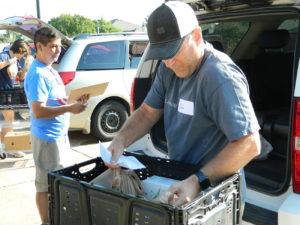
Volunteers with Heart of the City’s Farmers Market Food Pantry provide a drive-through grocery distribution each Saturday morning at New Beginnings Church in Lewisville. (Photo / Ken Camp)

Heart of the City’s Farmers Market Food Pantry provides drive-through grocery distribution each Saturday morning. The food pantry is open by appointment on Monday and Wednesday afternoons, giving individuals the opportunity to shop for their own groceries—at no cost—and to interact on a deeper level with volunteers.

‘We want people to feel love’

“We want people to feel love. We want to treat them with dignity,” Fields said.

While volunteers engage in brief conversation and offer a word of blessing to neighbors during the Saturday morning food distribution events, the two weekday afternoons provide greater opportunities to build relationships, said Luis Matos, a Heart of the City worker.

Volunteers with Heart of the City load groceries into cars during a drive-through food distribution on a Saturday morning at New Beginnings Baptist Church in Lewisville. (Photo / Ken Camp)

“We offer to pray for them,” Matos said. “We try to establish a rapport with them and offer them a listening ear.”

In addition to the elderly, disabled veterans and the underemployed, the food pantry has served recent immigrants and refugees from Venezuela, Honduras and Cuba, along with a significant number of the Chin ethnic group from Myanmar. The New Beginnings Church campus is adjacent to Chin Baptist Church, which it helped launch.

Any perishable produce left over after a Saturday distribution is made available to worshippers at New Beginnings Church the next morning.

“We tell people to take whatever they can use. We let them know: ‘This is the overflow. You’re not depriving anybody in need,’” Fields said.

The North Texas Food Bank provides the bulk of the groceries for the food pantry. Local grocery stores and discount centers also donate some food. New Beginnings includes both the food pantry and clothing closet in its church budget.

‘A dream come true’

Pastor Joseph Fields of New Beginnings Church in Lewisville appreciates the opportunity to work with ministry partners such as Mary Ann Saxton, program manager for Love Thy Neighbor’s clothing assistance program. (Photo / Ken Camp)

A group of concerned women in the Lewisville-Flower Mound area started Love Thy Neighbor about 12 years ago to help meet basic needs of families and individuals. For more than a decade, Love Thy Neighbor worked with a well-established local agency to provide clothing.

When that agency narrowed its focus to concentrate exclusively on serving the unhoused, Love Thy Neighbor needed another partner. About that same time, New Beginnings Church wanted to expand its ministry to neighbors in need by providing clothing.

“It was a dream come true for both” the nonprofit agency and the church, said Mary Ann Saxton, program manager for Love Thy Neighbor’s clothing assistance program.

A volunteer with Love Thy Neighbor helps with the clothing assistance program at New Beginnings Baptist Church in Lewisville. (Photo / Ken Camp)

“A family from Venezuela arrived fresh in this country with only the clothes on their backs,” Fields recalled. “We were able to outfit them in time for their children to start school.”

As volunteers set up early on the Saturday morning of Labor Day weekend, some wondered aloud if they would have many guests to serve on a holiday weekend.

Both ministries exceeded expectations. The food pantry served 107 families on Saturday, after already serving 62 on Monday and Wednesday, providing food for a total of 169 families for the week. The clothing closet served 65 guests, compared to 60 on an average Saturday.

Field hopes the ministries will continue to expand. New Beginnings Church’s long-range plans for facility expansion include designated areas for the food pantry and clothes closet.

“God didn’t just give us this facility to meet on Sunday morning,” Fields said. “We want to touch the community.”

This article originally appeared in the fall 2022 issue of CommonCall magazine.


Church attendance major factor in student faith maturity

WACO—While peer influence is the top factor that leads Baylor University students to attain higher levels of faith maturity, attending a local place of worship also is a powerful predictor.

Those are key research findings from Baylor’s ongoing Faith and Character Study, which tracks the long-term impact of a Baylor education on a person’s faith and character.

The Baylor seal is seen at the quadrangle on campus. (Photo / Baylor Marketing and Communication)

The study—“Factors Associated with Vertical and Horizontal Faith Maturity at a Christian University” in the Journal of Research on Christian Higher Education—investigated the influence of peers, programs and professors on students’ faith maturity using data from the Baylor Faith and Character Study, which began in 2018.

Each year, surveys on religion and character are administered to new students, seniors and alumni. The current research focused on the Senior Religion Survey administered online to graduating seniors in March 2020 to April 2020.

The latest findings measured faith maturity with survey items distinguishing between vertical faith maturity—centered on engagement with God—and horizontal faith maturity—the application of faith in service to others.

Survey items measuring vertical faith maturity included “I have a real sense that God is guiding me,” and “I am spiritually moved by the beauty of God’s creation.”

Sample items measuring horizontal faith maturity included “I give significant portions of my time and money to help other people,” and “I care a great deal about reducing poverty in the United States and throughout the world.”

“Our study points out the common and contrasting ways that students can cultivate commitment to God and commitment to others,” said lead author J. J. Burtt, who earned his doctorate in sociology from Baylor in 2022 and now is an assistant professor at Trinity Western University in Langley, British Columbia. “Both of these expressions of faith are important outcomes for Christian colleges and universities.”

The researchers found Christian colleges can promote faith maturity most effectively through peer relationships and intentional programs.

Predictors for faith maturity

The study showed significant predictors for students’ vertical faith maturity are:

  • Discussions with peers about religious/spiritual matters.
  • Spending time with people who share one’s religious views.
  • Attending a class, workshop or retreat on matters of religion/spirituality.
  • Participation in community food or clothing drives.
  • Attending a racial/cultural awareness workshop.

Significant findings measuring students’ horizontal faith maturity are: discussions with peers about the purpose and meaning of life; attending a class, workshop or retreat on matters of religion/spirituality; participation in community food or clothing drives; performing other volunteer work; and attending a racial/cultural awareness workshop.

Although faculty can serve as facilitators and role models for students’ faith maturity, the study found peer influence on faith maturity is stronger, matching findings from prior research on religiosity in college.

Since contact with professors largely is limited to classes, students spend much more time with their peers—in myriad ways—than with professors.

One of the most powerful predictors of both the vertical and horizontal faith maturity of students is attending a local place of worship, the research revealed.

“In every model, religious service attendance was positive and statistically significant. Seniors who attended religious services more often expressed higher vertical faith maturity and higher horizontal faith maturity, net of other influences,” the researchers wrote.

“Like on-campus student organizations, congregations are a context for relationships and service. Students develop bonds with others in a way that deepens their faith and encourages them to act on their faith to serve others.”

Kevin Dougherty

“This is important news for parents,” said study co-author Kevin D. Dougherty, professor of sociology in the College of Arts & Sciences at Baylor. “To help your college daughter or son have a vibrant faith, encourage them to find a local place of worship and attend regularly.”

The implications of these findings extend beyond religious universities.

At colleges and universities where faith is not an explicit part of curricular and co-curricular programs, the researchers suggest they can offer classes on meaning and purpose, support the formation of student-led religious organizations, promote acts of community service and offer racial/cultural awareness workshops, all associated with increased faith maturity.


Carrollton kids on wheels raise TBM disaster relief funds

CARROLLTON—Almost 30 years ago, kids at First Baptist Church at The Fields began riding in circles once a year to raise money for Christian missions through Texas Baptist Men. A new generation is keeping the practice alive, recently raising $2,801 for TBM disaster relief in one evening.

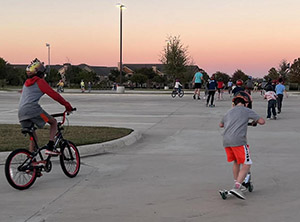
The annual Wheel-a-Thon in Carrollton involves children obtaining pledges for laps they make around a church parking lot. Eight laps equal one mile. Participants can ride anything with wheels—bicycles, in-line skates, scooters—or they can walk.

Children involved in missions programs at First Baptist Church at The Fields in Carrollton participate in the Wheel-a-Thon on the church parking lot.

More than 35 children participated this year, with one boy riding 62 laps on a bicycle in 50 minutes, said Mark Forester, church Royal Ambassadors director.

RAs is a mission discipleship organization for boys in grades 1-6. It promotes growth by developing biblical character in all aspects of life. RA leaders use activities to help boys learn about God’s mission and understand how they are part of it.

The Wheel-a-Thon was not just about raising money, Forester said.

“It gets the kids thinking about something else outside of themselves, … about helping other people in Jesus’ name,” he said.

Savion Lee, TBM state RA coordinator, said the Carrollton event is ”special because it connects the RAs with their local church body.” It helps church members learn about RAs and the group’s missions involvement.

Lee and Ryan Lenamon, TBM director of donor relations, spoke to the children the following week about TBM’s varied ministries to help people in need and to share the good news of hope through Christ.

“Discipleship events such as these are critical to our youth,” Lenamon said. “These are the future leaders of our country and our world. Discipleship matters. If discipleship doesn’t come from the church, it will come from somewhere else.”

Long history of missions support

In 1993, Mark Forrester (right) presents a replica check to TBM Executive Director Bob Dixon indicating the $477 raised for TBM disaster relief.

Forester started the Wheel-a-Thon in 1993 when one of the RA leaders, the son-in-law of then TBM Executive Director Bob Dixon, recommended the money raised be given to TBM disaster relief.

After the event, Dixon attended a RA chapter meeting to receive a cardboard check representing the amount raised. The church has held the event every year since, except for 2020 during the COVID pandemic.

The Wheel-a-Thon used to be exclusively for boys in RAs. Since moving to a new church location in 2019, Girls in Action members joined in, and the younger boys and girls in Mission Friends joined in this year. One of the Mission Friends boys raised $500 for the cause, Forester said.

The RA and GA leaders also added some competition to the mix this year. Lainie Applegate, the GA director, got a pie in the face Nov. 9 because the boys out-raised the girls by $100.

 “I am so thankful that our boys and girls had the opportunity to learn about TBM and how to support their mission efforts,” Applegate said. “I love teaching children that hard work and serving others can be fun.”

As for the RAs, a team of several men lead the Carrollton group, Forester said. He noted “things have changed with RAs” through the years.

“You have to adapt, he said. The boys are “no longer into the book work, because they do book work all day.”

Instead, the RAs focus on activities such as campcraft and archery.

“There is a spiritual application with anything we do, and that is what the boys remember”—application linked to activities, he said.


Global Baptist leaders condemn attack on Myanmar school

Leaders of the Baptist World Alliance and the Asia Pacific Baptist Federation condemned the shelling of Kachin Bible School by the Burmese military.

Elijah Brown, BWA general secretary and CEO, and Vesekhoyi Tetseo, general secretary of the Asia Pacific Baptist Federation, expressed their concern in a letter to leaders of the Myanmar Baptist Convention and the Kachin Baptist Convention.

International Christian Concern first reported  the Nov. 3 attack on the Kachin school in northern Myanmar by the military junta, known as the Tatmadaw.

Four young men in a dormitory were injured by shrapnel, but none of the injuries were life-threatening.

In the letter to Myanmar and Kachin Baptist leaders—dated Nov. 9 and released publicly Nov. 14—Brown and Tetseo express support for the families of the injured students and for Baptists in the region.

“We condemn the attack while we thank God that the students only suffered minor injuries,” they wrote. “The BWA and APBF families remain committed to religious freedom for all and lament with the many who remain impacted in Myanmar.”

‘Campaign of terror and violence’

The letter quotes a resolution the BWA general council approved at its July meeting in Birmingham, Ala., condemning the February 2021 military coup in Myanmar.

It particularly singled out the Tatmadaw for waging “a campaign of terror and violence, particularly against minority religions.”

The resolution called for “the establishment of a true democracy that respects the rights of religious and ethnic minorities,” and it pledged prayer for Christians ministering “in persecuted communities and among displaced persons.”

“We grieve for all who are suffering even as we note our special concern for those impacted by this bombing, call for the full restoration of the Kachin Bible School, urge the Tatmadaw to respect all churches, houses of worship and places of religious training, and pray for the establishment of true democracy and human rights for all,” the letter states.

The attack on the Kachin school occurred four days after shelling partially destroyed a Baptist church and hall in Momauk township, Kachin State.

Since the Tatmadaw staged a coup in February 2021, more than 2,400 people in Myanmar have been killed and at least 16,000 have been jailed by the junta, including many who have been tortured.


Former faith supporters tepid toward candidate Trump

WASHINGTON (RNS)—When Donald Trump launched his 2020 reelection bid in Orlando, Fla., three years ago, the event was riddled with faith-speak.

Both Trump and then-Vice President Mike Pence repeatedly referenced God, arguing the Almighty had blessed America.

Trump’s closest evangelical adviser, Florida pastor Paula White-Cain, opened up the event with a passionate invocation in which she insisted the “hand of God” would work for Trump.

But when Trump announced yet another White House bid from his Mar-a-Lago resort in Florida on Nov. 15, he did so with a speech devoid of overt religious references.

It was unclear if the event included an invocation, and while some of Trump’s stalwart evangelical supporters were seen milling about the resort’s carpeted floors—namely conservative commentator Eric Metaxas, pastor Mark Burns and MyPillow CEO Mike Lindell—many of the former president’s longtime religious defenders were nowhere to be seen.

Sound of silence

Instead, most have remained silent about his new campaign, while others have hinted at allegiances to other potential 2024 presidential contenders such as Pence and Florida Gov. Ron DeSantis.

Dallas pastor says God gives Trump authority to ‘take out’ Korean leader
President Donald Trump (left) is greeted by Pastor Robert Jeffress at the Celebrate Freedom Rally in Washington, D.C. (Photo by Yuri Gripas/REUTERS via RNS)

Pastor Robert Jeffress from First Baptist Church in Dallas, one of Trump’s most stalwart religious supporters, who preached a sermon to Trump on his Inauguration Day titled “When God Chooses a Leader,” signaled the former president may not be his candidate in the primary.

“Donald Trump was a great president, and if he becomes the GOP nominee in 2024 I will happily support him,” Jeffress told Religion News Service in a statement.

But hours before Trump’s speech on Tuesday, Jeffress encouraged his Twitter followers to buy Pence’s new book, So Help Me God, and described the former vice president as “a great friend, a committed Christian, and a true American hero.”

In his daily podcast “The Briefing,” Al Mohler, president of Southern Baptist Theological Seminary and a Trump critic in 2016 turned Trump supporter in 2020, briefly mused on Trump’s reelection bid. But Mohler said, with the late hour of the announcement, “it is sufficient to say he made the announcement in what was described as a rambling one-hour speech.”

“By the way, the last candidate to have served as president, lost an election and come back to win another election was Grover Cleveland. Well over a century ago,” Mohler added.

Another of Trump’s former evangelical advisers, Tony Suarez, chief operating officer of the National Hispanic Christian Leadership Conference, encouraged fellow conservatives to rally around Trump but stopped short of declaring his ascendancy inevitable.

“Tonight’s announcement was the worst kept secret in recent memory. If recent history had taught us anything it’s that there’s no such thing as a ‘sure thing,’” Suarez, who recently praised DeSantis, said in a text message.

“That said, I expect President Trump to be our nominee. Now is not the time for conservatives to be divided. We need a unified front to take back the White House and Senate.”

Burns, a South Carolina pastor and an early devotee of Trump, posted a video of himself in the Mar-a-Lago crowd.

“I believe that we will bring God back to the center of American politics and American culture,” he said. “We’re about to continue to Make America Great Again. … All of America who loves freedom, who loves smaller government, who loves God, who wants to make sure faith is at the center of our nation, they are here tonight in Mar-a-Lago.”

It was unclear whether White-Cain attended Trump’s announcement. She was silent about his announcement on Twitter, despite running a national faith advisory board seen as an effort to reinvigorate Trump’s conservative Christian base.

Meanwhile, influential conservative voices such as Princeton University professor and legal scholar Robert George have declared their support for DeSantis.

“This seems like just the right moment to announce my endorsement of Ron DeSantis of Florida for President,” George tweeted on Tuesday evening.


Around the State: BGCT annual meeting draws 1,800-plus

The 2022 Baptist General Convention of Texas annual meeting drew 1,261 messengers from churches and 563 guests to Waco on Nov. 13-15. They gave more than $5,100 to the Texas Hunger Offering during an offering collected at a Monday evening worship service.

Hardin-Simmons University is the first school in Texas to receive accreditation for its exercise science program. Housed in the Jesse C. and Dorothy J. Fletcher Fitness Center on the HSU campus, the program prepares students for careers in physical therapy, occupational therapy, sports medicine, chiropractic, personal training and other disciplines.

Wayland Baptist University students deliver donated food to the Faith in Sharing House. (WBU Photo)

Students in Wayland Baptist University’s “Better Achievement Strategies for College” entry-level course collected more than 2,600 non-perishable food items for FISH, Plainview’s Faith in Sharing House. Julia Nelson, a freshman from Canyon City, Colo., promoted the class service project by giving an alternate meaning to the BASC acronym—“Blessing and Serving the Community.” Kassie Lane, associate dean of undergraduate programs and assistant professor of business, teaches BASC and helped with the delivery to FISH.

Michael Torres (left), keynote speaker for the Herbert Robbins Research Symposium at Dallas Baptist University, is pictured with Jonathan Cooper, chair of DBU’s biology department. (DBU Photo)

Biotech entrepreneur Michael Torres was keynote speaker at the annual Herbert Robbins Research Symposium on Nov. 4-5 at Dallas Baptist University. The DBU College of Natural Science and Mathematics and Beta Beta Beta Biological Society sponsored the symposium. Torres spoke on “My Journey from the Bench to Biotech Entrepreneur” and “ReCode Therapeutics: Delivering Genetic Medicines for the Treatment of Respiratory Diseases and Beyond.” Torres earned his Bachelor of Science degree in biology from DBU in 2006. He went on to conduct a year-long research project at the National Cancer Institute prior to earning a Ph.D. in cancer biology from the University of Texas Southwestern Medical Center. He currently serves as entrepreneur-in-residence at Texas Medical Center Innovation in Houston.

East Texas Baptist University Head Football Coach Brian Mayper announced his retirement from collegiate coaching after five seasons at ETBU. Mayper’s career has included 31 years of coaching football and 24 years at the collegiate level, finishing with an overall record of 63-29 as a head coach. ETBU has named Calvin Ruzicka as the seventh head coach for Tiger football. Ruzicka has served as defensive coordinator and assistant head coach at ETBU since 2018. Previously, Ruzicka spent 17 years at Cedar Hill High School, where he won Texas state championships in 2006, 2013 and 2014 and was state runner-up in 2012.

South Garland Baptist Church in Garland honored two charter members, Perry and Thelma Kite, for their decades of service by naming the facility that houses its preschool and children’s ministries for them Nov. 13. The Perry and Thelma Kite Children’s Center recognizes the contributions of Thelma Kite, who taught in the church’s Mother’s Day Out program more than three and a half decades, well into her 90s, and her late husband Perry, longtime deacon and chair of numerous church committees.

San Gabriel Baptist Church in Thorndale has been granted a historical marker from the Texas Historical Commission. A dedication ceremony is scheduled at 2:30 p.m. on Nov. 27. Speakers at the event will include former and current church members, along with representatives from the Milam County Historical Commission and Milam County governmental officials. Tim Cheatham is pastor.

Anniversary

120th for Truevine Missionary Baptist Church in Spring. Darrin Moore is senior pastor.

Retirement

Joseph Tillery after seven years as pastor at First Baptist Church in Lockney and 51 years in the gospel ministry, serving as a pastor and director of missions in Texas, New Mexico and Arkansas.


HSU and McMurry reach agreement on nursing school

ABILENE—Hardin-Simmons University and McMurry University reached an agreement regarding the Patty Hanks Shelton School of Nursing, which has operated as an intercollegiate consortium of the two Abilene universities.

In a joint statement, HSU and McMurry formally announced Nov. 16 HSU will establish its own nursing program by 2025—a move already alluded to in an earlier statement by Rick Strange, chair of the HSU board of trustees, concerning the board granting a three-year contract extension to President Eric Bruntmyer.

McMurry will retain the Patty Hanks Shelton School of Nursing and will acquire its assets for its own nursing program.

Both nursing programs are contingent upon approval by the Texas Board of Nursing and the Southern Association of Colleges and Schools Commission on Colleges.

Lawsuit dismissed

This summer, McMurry filed a $1 million lawsuit against HSU, claiming a breach of contract regarding the Patty Hanks Shelton School of Nursing. McMurry asserted HSU failed to honor a contract to sell its interests in the nursing school to McMurry.

The Nov. 16 public statement said the universities had resolved “prior misunderstandings,” and McMurry confirmed HSU had fulfilled all duties owed.

“As a result of this agreement, both institutions released each other of all claims asserted in the Taylor County District Court litigation and submitted a joint notice of dismissal of claims to terminate the litigation,” the public statement read.

In an email to HSU faculty, staff and students, Bruntmyer wrote: “HSU paid nothing in settlement to McMurry, nor damages of any kind, and admitted no wrongdoing whatsoever. We are gratified that McMurry was willing to confirm that HSU fulfilled all of its duties to both McMurry and to the Patty Hanks consortium, which HSU has been administering for many decades. HSU’s administrations, past and present, have always fulfilled our duties, legal and otherwise, to both entities.

“We are truly pleased with the ultimate outcome which gives us what we wanted all along, to either purchase McMurry’s interests in PHSSN and move it to our campus or, as has now been accomplished, sell our interest to McMurry in a fair deal and begin our own on-campus nursing program. Thank you for your patience and understanding in this process. The future of nursing education at HSU is bright, and we are excited for this next phase in our school’s history!”

In the public announcement, Bruntmyer said the agreement allows HSU and McMurry to “move forward with independent programs that will increase the number of nurses in the Big Country and beyond,” Bruntmyer said.

“HSU is excited to create a new nursing program delivered on campus and integrated with the rest of the university,” he added.

Sandra Harper, president of McMurry, called the agreement “a win for Abilene” and a move that “will impact the region positively by helping to fill vacant nursing positions.”

“All of us at McMurry are excited to continue our commitment to enhance nursing education by ensuring that Patty Hanks graduates are prepared to meet diverse patients’ needs and deliver safe, quality patient care,” Harper said.

Transition begins

More than 40 years ago, HSU, McMurry and Abilene Christian University created the Abilene Intercollegiate School of Nursing as a nonprofit corporation. Nearly 20 years ago, the nursing school became an unincorporated association, and the three universities entered into a consortium agreement, with HSU acting as the coordinating institution. ACU withdrew from the consortium in 2012.

During the transition to independent nursing education programs, HSU and McMurry will continue as members of the consortium, but McMurry becomes the coordinating institution effective Dec. 1. The transition is expected to be complete by January 2025, according to the Nov. 16 public statement.

In his email to the “HSU Community,” Bruntmyer provided additional details. Between now and January 2025, HSU will seek a founding program director “who will play a key role” in developing the Hardin-Simmons nursing education program, which will be housed in the Holland Health Sciences Building.

Students who enter the Patty Hanks Shelton School of Nursing beginning in fall 2023 “are expected to complete their education and training through HSU’s new nursing program,” he wrote. Currently enrolled HSU students who are scheduled for spring 2025 graduation will graduate from the Patty Hanks Shelton School of Nursing.

Bruntmyer outlined three benefits to HSU operating its own nursing education program:

  • Nursing continues to be the top program of interest indicated by prospective students.“By starting our own nursing program on campus, we can attract and accommodate more of these prospective students to grow enrollment and improve student completion rates.”
  • Nursing shortages continue to be critical. “The potential for enrollment of aspiring nursing students at HSU makes this the right time to bring this program onto campus and contribute directly to our community by addressing and solving a need.”
  • HSU already has a solid foundation of healthcare and science programs, plus facilities and community partnerships. “Operating an independent nursing program is a natural step in our university’s evolution as a health care education leader in the Big Country region.”


Protect and treasure unity, Hardage tells BGCT

WACO—In his final executive director’s report to the Baptist General Convention of Texas, David Hardage spoke from the heart to messengers, celebrating milestones and encouraging steadfastness.

Hardage first recognized three entities celebrating anniversaries—75 years at Baptist University of the Américas, 40 years of African American ministries and 20 years of Texas Baptists’ Chaplaincy Relations—before mentioning a few highlights of the state convention’s strategic mission partnerships.

“We are not a missions-minded convention. We are a missions-centered convention,” Hardage said. “That’s the heartbeat of Texas Baptists.”

Hardage mentioned the expansion of the Missionary Adoption Program, which connects Texas Baptist congregations with churches in other parts of the world to support ministry work in those areas.

Birthed by a request from the Brazilian Baptist Convention seven years ago, the partnership has grown to support nearly 50 missionaries in Brazil and another 90 in other nations.

He noted two other strategic missions partnerships. Texas Baptists, working in partnership with the International Mission Board, are involved in South Asia. In Laredo, a new partnership with the North American Mission Board’s Send Relief is making an impact. The new ministry center will connect with and equip local churches to impact a largely unchurched city. Hardage also noted the long-time impact River Ministry has had along the Texas/Mexico border.

Hardage offered parting thoughts on the future of Texas Baptists. Quoting Psalm 106:35, he noted that while there is a responsibility to influence the nations, there is also a warning not to let them influence the church negatively.

“We have been called to be a separate kind of people who love God and love others,” Hardage said.

Finally, Hardage shared his hope that Texas Baptists protect the unity and harmony they enjoy. Calling it rare and a treasure, Hardage passionately urged churches to take up the responsibility to guard that unity.

“I’ve worked for 11 years to build bridges, make peace and be kingdom-focused. Not everyone wants peace, but we do. Never be divisive, but be a unifying voice every time you have an opportunity. There is too much at stake for us not to be,” he said.

“It has to be the gospel above all else, and around that we build our harmony, around that we build our unity, around that we stay together, and around that our best days are yet to come.”


Texas Baptists reject government coercion in religion

WACO—Without mentioning Christian nationalism by name, Texas Baptists approved a resolution rejecting any government attempt to coerce worship of Christ or favoring one religion over another.

At the Baptist General Convention of Texas annual meeting in Waco, messengers also approved resolutions calling for gracious cultural engagement and expressing gratitude for David Hardage, who retires at the end of next month as BGCT executive director.

The resolution on religious liberty affirmed the “God-ordained purpose” of government but asserted “God has not authorized government to coerce the worship of Christ.”

It acknowledged the presence of “state-sanctioned persecution of Christians and other religious groups across the world.” It also noted “Baptists historically have been committed to religious liberty and the separation of church and state.”

Consequently, Texas Baptists at the Waco meeting resolved to “affirm the historic tenets of religious liberty and will not seek to use government to coerce the worship of Christ.”

They further resolved to deny support to “any attempt by government to commandeer the church for political ends or any attempt by government to favor one religion over another.”

Engage culture with grace, truth, love

The resolution on cultural engagement acknowledged a prevalent tendency “to focus more on divisive, condemning rhetoric at the expense of the grace, truth and love that characterizes the gospel.”

So, Texas Baptists at the annual meeting resolved to “seek to follow the way of Jesus in how we engage with culture with God’s grace, truth and love.” They also resolved to “avoid cruel jokes, mockery and belittling language as we articulate our biblical convictions.”

The resolution regarding Hardage noted his service of more than four decades in ministry and more than a decade as BGCT executive director, pointing out his wife Kathleen served alongside him “prayerfully and faithfully.”

In addition to expressing appreciation to the Hardages, the resolution also affirmed his commitment to “the GC2 movement”—an emphasis on the Great Commission and Great Commandment of Christ.

A final resolution expressed appreciation to the host city, its churches and everyone involved in hosting the annual meeting.


Tyler pastor calls Texas Baptists to ‘holy discontent’

WACO—Michael Gossett, pastor of Green Acres Baptist Church in Tyler, called Texas Baptists to experience “holy discontent” until God brings revival.

“Revival requires a heart that longs for the presence of God. It requires a divine and holy discontent,” Gossett told messengers and guests at the Baptist General Convention of Texas annual meeting in Waco.

 “Are you willing to live without revival? Contentment and complacency are very close, but you and I must never be content about others’ salvation. We must long to tell others that there is a Savior.”

Preaching from Psalm 85, Gossett encouraged Texas Baptists to “stand firm” in their commitment to sharing the gospel and seeing spiritually lost people come to faith in Christ.

 “You know what I love about Texas Baptists? It’s a convention that believes in evangelism. It’s a convention that understands the power of the gospel and God’s word. You and I have to continue that direction, we have to stand firm in our faith and stand firm in the mission that God has called us to,” he said.

Also during the Nov. 14 evening session, Texas Baptists expressed gratitude to David Hardage, who retires at the end of the year as BGCT Executive Director after more than 10 years in that role, and his wife Kathleen.

“David and Kathleen, you have made Texas Baptists proud. And most importantly, you have made God proud,” said Jason Burden, who ended his second term as BGCT president at the close of the 2022 annual meeting.

Clint Davis, chair of the BGCT Executive Board, likewise praised Hardage and offered thanks for his service.

“Dr. Hardage, I want to thank you, because you’ve led us with integrity, a sense of conviction and with purpose. You’ve loved us with that Christ-like love,” Davis said.

Associate Executive Director Craig Christina shared some of Texas Baptists’ accomplishments under Hardage’s leadership, including the reorganization of the convention into five ministry centers and casting the GC2 vision of sharing Christ and showing love.

“Thank you, Dr. Hardage, for leading us from viability to vitality,” he said.

Christina also announced the inaugural David W. Hardage Run With It 5K, which will benefit the David and Kathleen Hardage Endowment Fund at the Baylor University Baptist Student Ministry.


Jason Burden shares love of Texas, vision for future

WACO—In his final address as president of the Baptist General Convention of Texas, Jason Burden spoke of his deep love for Texas and Baptist ministry within the state.

“I love Texas. It’s dear to me. It has nurtured me, provided me and my family opportunities. It has been our primary mission field,” Burden told messengers and guests at the BGCT annual meeting in Waco.

“Everything is bigger and better in the state of Texas, and we’ve enjoyed great ministry here.”

Burden emphasized changes are on the horizon—and already taking place—within the state. The Texas population is projected to grow to 50 million people by the year 2050, he said.

He traced the history of Texas from cattle barons to oil barons to the emerging tech barons who are bringing waves of change in present-day Texas.

“Texas is changing. We could yearn after the ways of yesteryear, but we’d be wasting our time. God’s not going to stand still. God’s going forward, and God is looking for people to keep up with him,” Burden said.

“The kind of Texas that will be in the future is going to be largely determined by what God does through Texans in this room today.”

Burden read from Hebrews 11, offering his hope Texas Baptists exhibit the character of those heroes of the faith found in the New Testament passage.

“Aspects of the new Texas we can’t control. But we can control how we use our resources and how we commit our lives together to a greater cause. … Our reach is being extended, and the reason for that is because our God still reigns,” he said.

Burden encouraged Texas Baptists to greet incoming residents with love and the gospel message.

“We must make sure that every new Texan is welcomed to our great state with an invitation to know Jesus the Savior,” he said.

“A Texas without Jesus is not a Texas worth bragging about.”