Study reports oppressive pandemic religious restrictions

About one-fourth of nearly 200 nations studied by the Pew Research Center used force to prevent religious gatherings during the COVID pandemic.

A newly released Pew study of restrictions on religion around the world examined 198 countries and territories.

Authorities in 46 of those areas (23 percent) used physical means—including assault, detention, property damage or confiscation, displacement or death—to enforce pandemic-related restrictions on worship services and other religious gatherings. The total does not include countries that used less-stringent means of enforcement, such as fines for violations.

“In 40 of the 46 countries where force was reported to have been used, governments arrested and held worshippers or religious figures for gatherings that violated public health measures, or for other actions by religious groups relating to the pandemic,” the report states.

Authorities in at least 11 countries physically assaulted individuals who gathered for worship.

More than 300 Christians in China were arrested in February and March 2020 during pandemic-related home inspection and identification checks. Some were beaten and subjected to electric shocks, according to the U.S. State Department’s Report on International Religious Freedom.

Two Christians in India’s Tamil Nadu State died after they were beaten while in police custody for allegedly violating COVID curfews.

In 74 countries and territories (37 percent), the study found governments used force to limit religious gatherings, religious groups were blamed for the spread of the virus, or private actors engaged in pandemic-triggered violence or vandalism against religious groups.

They included 12 countries in the Americas, 20 in the Asia-Pacific region, 20 in Europe, seven in the Middle East and North Africa, and 15 in sub-Saharan Africa.

‘Used the pandemic to further existing discrimination’

Randel Everett, founding president of the 21Wilberforce human rights organization, pointed to a factsheet published in March 2020 by the U.S. Commission on International Religious Freedom.

The commission document called on governments to develop public health responses to the pandemic that avoided measures placing an undue burden on religious observance or stigmatizing religious groups.

“Pew’s latest research report brings to light many examples of governments and government officials that did just that,” Everett said. “They used the pandemic to further existing discrimination, marginalization and persecution of people of faith. A draconian example is the total lockdown in China.”

China—initially criticized for its early failure to address the spread of the coronavirus—instituted strict “zero-COVID” restrictions. In recent days, thousands have taken to the streets to protest oppressive lockdowns instituted by President Xi Jinping.

In 45 countries (23 percent), some religious groups asserted pandemic-related restrictions unfairly targeted them when compared to businesses and nonreligious institutions or when compared to other religious groups.

Religious groups in 18 countries said restaurants, other businesses and nonreligious gatherings were treated with more leniency than religious institutions. In the remaining 27 countries, the study noted reports that enforcement of restrictions favored some religious groups over others.

In Myanmar, leaders of religious minority groups asserted authorities enforced COVID-related health restrictions much more stringently against Christians and Muslims than against Buddhists.

For example, 12 Muslim men in Myanmar received three-month prison sentences for holding a religious gathering in a house, and a Christian pastor was sentenced to three months in prison for holding a prayer meeting. However, none of the 200 individuals who attended a Buddhist monk’s funeral were arrested, and organizers received fines.

Resistance, defiance or cooperation

In 54 countries (27 percent), religious groups either filed lawsuits or spoke out against restrictions—typically complaints against unequal treatment.

The study identified 69 countries (33 percent) where at least one religious group defied COVID-related public health restrictions.

On the other hand, researchers noted religious leaders or groups in 94 countries (47 percent) encouraged their followers to worship at home, promoted online alternatives or encouraged efforts to stop the spread of the virus, such as wearing masks and practicing social distancing.

In at least 55 countries (28 percent), government officials and religious leaders worked collaboratively to promote public safety and stem the spread of the COVID virus, including half of the countries in sub-Saharan Africa.

“I don’t find it surprising that religious leaders and communities helped to shape the attitudes of people toward public health recommendations aimed to combat the COVID-19 pandemic, whether it was relying on religious laws and theological views to support restrictions, placing value on human life and caring for the community,” Everett said.

For 13 years, the Pew Research Center has studied religious restrictions globally, analyzing changes in the Social Hostilities Index and Government Restrictions Index scores at global and regional levels.

The 10-point Social Hostilities Index measures hostile acts against religious groups by private individuals or organizations, while the 10-point Government Restrictions Index looks at law, policies and actions by the state to limit religious freedom.

The median score on the Government Restrictions Index showed a slight decrease, from 2.9 in 2019 to 2.8 in 2020, while the Social Hostilities Index rose from 1.7 in 2019 to 1.8 in 2020.

Looking at overall restrictions—not just those related to public health—the Pew Research Center found 77 countries (39 percent) with “high” or “very high” levels of government restrictions, social hostility or both. That is a slight increase from 75 countries (38 percent) the previous year, but it is below the peak of 85 countries (43 percent) in 2012.



Senate approves measure to codify same-sex marriage

The U.S. Senate voted 61-36 to approve the Respect for Marriage Act, a bill to codify same-sex marriage as law, but faith groups differed on whether the amended bill includes adequate religious liberty protections.

The bipartisan bill drew the support of all Democrats present to vote on Nov. 29, along with 12 Republicans and two independents. Sen. John Cornyn and Sen. Ted Cruz of Texas both voted against the bill.

The amended bill now goes back to the U.S. House of Representatives for approval. The House already had approved an earlier version in July by a 267-157 vote.

The Respect for Marriage Act—a legislative version of the U.S. Supreme Court’s Obergefell v. Hodges decision that legalized same-sex marriage—repeals the Defense of Marriage Act. That 1996 law defined marriage as the union of one man and one woman, and also allowed individual states to refuse to recognize same-sex marriage granted under the laws of other states.

As amended, the Senate version of the Respect for Marriage Act—which also protects interracial marriage—states nothing in the bill “shall be construed to diminish or abrogate a religious liberty or conscience protection” available under the U.S. Constitution or federal law.

It specifically states:

  • Churches and other religious entities will not be required to provide services, facilities or goods for a same-sex marriage.
  • The bill does not allow the federal government to recognize polygamous marriages.
  • The bill cannot be used to deny or alter benefits or tax-exempt status to an otherwise eligible person or entity.

In a mid-November tweet, Amanda Tyler, executive director of the Baptist Joint Committee for Religious Liberty, affirmed bipartisan efforts by lawmakers to “advance civil rights protections for same-sex and interracial couples, while reaffirming existing religious freedom protections.”

“Lawmakers are right to recognize a diverse range of views on marriage among religious traditions as they work to pass legislation to ensure every American is equal in rights and dignity,” Tyler tweeted. “We believe marriage equality and religious freedom are compatible.”

The Center for Public Justice issued a statement Nov. 29 commending the Senate “for adding vital religious freedom protections before passing the Respect for Marriage Act.”

“We salute the Senate for providing multiple protections for organizations that are committed to one man-one woman marriage, including security for their tax-exempt status and their eligibility for government funding, accreditation and licensure,” the statement read.

However, other faith-based organizations voiced continued opposition to the Respect for Marriage Act, saying the religious liberty protections were inadequate.

In written comments to Baptist Press, Hannah Daniel, policy manager for the Southern Baptist Convention’s Ethics and Religious Liberty Commission, expressed disappointment the Senate failed to “amend this bill further to bolster religious liberty protections for people and institutions of faith.”

“In the lead-up to this vote, we expressed our opposition to the bill to senators, and now that it moves back to the House, we will continue doing so,” Daniel stated.

Catholic News Service reported the U.S. Conference of Catholic Bishops said even as amended, “religious objectors are likelier to be denied exemptions under the First Amendment and [the Religious Freedom Restoration Act] in cases where they would have prevailed but for the passage” of the Respect for Marriage Act.

“The amended act will put the ministries of the Catholic Church, people of faith and other Americans who uphold a traditional meaning of marriage at greater risk of government discrimination,” Cardinal Timothy M. Dolan and Bishop Robert E. Barron of the U.S. Conference of Catholic Bishops wrote in a Nov. 23 letter to all members of Congress.


On the Move: Haynes

Jason Haynes to First Baptist Church in Richmond as minister of music and worship from First Baptist Church in Baton Rouge, La., where he was music minister. He begins Dec. 11.


Around the State: Jeremy Everett named Waco Today Person of the Year

Waco Today magazine—a publication of the Waco Tribune-Herald—named Jeremy Everett, founding executive director of the Baylor Collaborative on Hunger and Poverty, as its Person of the Year. In September, Everett participated in the White House Conference on Hunger, Nutrition and Health. Under his leadership, the Baylor Collaborative worked in partnership with the U.S. Department of Agriculture, McLane Global and PepsiCo to provide 40 million meals to low-income schoolchildren in 43 states during the COVID pandemic through the Emergency Meals to You program. The program grew out of a pilot program of the Texas Hunger Initiative in summer 2019 to deliver food boxes to the homes of students in rural Texas. In 2014, Everett was appointed by the U.S. Congress to serve on the National Commission on Hunger.

Wayland Baptist University received a three-year $120,000 grant from the Robert Welch Foundation, a renewal and expansion of the Welch Summer Research Program. The grant provides $40,000 per year to fund undergraduate chemistry research, said Robert Moore, professor of chemistry and program director. A program of the Kenneth L. Maddox School of Mathematics and Sciences, 59 Wayland students have participated in the Welch Summer Research Program for one to three years since 2005. “Almost 90 percent of those who have participated and graduated have continued into science or related careers,” Moore said. “More than half have already earned advanced degrees.”

East Texas Baptist University participated in its seventh annual Operation Christmas Child, an outreach program organized by Samaritan’s Purse. All 23 of ETBU’s athletic teams gathered to assemble boxes together this year. (ETBU Photo)

East Texas Baptist University participated in its seventh annual Operation Christmas Child, an outreach program organized by Samaritan’s Purse. Students, staff and faculty filled more than 300 shoeboxes with small toys, school supplies and other items sent to children ages 2 to 14 around the world as a Christmas gift and a tangible reminder of God’s love for them. During national collection week, all of ETBU’s 23 athletic teams gathered to fill boxes and pray for the children who will receive them. “Operation Christmas Child is a very easy way to bless a child from another country with a gift that not only brightens their day but gives them the good news of Jesus Christ,” said Lisa Seeley, director of the Great Commission Program and director of global education at ETBU.

A $1 million continuation gift from Holly Frost and Kathaleen Wall for the Grace Hopper Scholarship will benefit students pursuing STEM-related degrees at Houston Christian University, formerly known as Houston Baptist University. In 2019, Frost and Wall donated $2 million to enable the university to provide $500,000 annually to be disbursed for scholarships for students pursuing degrees in the STEM field in honor of Rear Admiral Grace M. Hopper. Recipients who are awarded the scholarship must demonstrate persistence, technical knowledge, and selfless service in pursuit of STEM-related degrees.

Dallas Baptist University presented both the Russell H. Perry Free Enterprise Award and the Tom Landry Leadership Award to David B. Walls, president and CEO of Austin Industries.

Dallas Baptist University presented both the Russell H. Perry Free Enterprise Award and the Tom Landry Leadership Award to David B. Walls, president and CEO of Austin Industries. Walls serves as a trustee of Baylor Scott & White Health Care System, as well as in leadership roles on other professional and civic organizations. Walls, who earned his undergraduate degree in construction technology from the University of Houston and a master’s degree in building construction from Texas A&M University, holds a Ph.D. in leadership from DBU. He and his wife Jana are members of First Baptist Church in Rockwall. “Dr. Walls is an incredible businessman, generous philanthropist, and civic leader, but most importantly, he is a Christ-centered servant leader who puts God first,” DBU President Adam C. Wrightsaid. “He loves his family and has been a wonderful blessing to us at DBU.”

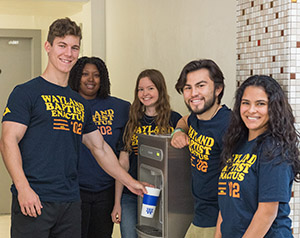
President Jackson Kent (left) and other members of the Enactus team at Wayland Baptist University celebrate the installation of another water bottle filling station on campus as part an ongoing “go green” initiative. (WBU Photo)

The multi-year “go green” initiative of the Wayland Baptist University Enactus student team continues to grow with the recent installation of a sixth water bottle filling station. The Enactus group has been instrumental in installing five stations on campus and one off-campus at the local YMCA. They collect data on the number of plastic bottles they help save from entry into the waste cycle, as well as how many gallons of clean water are provided to the students. “The goal is to help provide clean drinking water without increasing plastic waste. In doing our research we found that Plainview has a higher-than-average amount of plastic waste,” said Jackson Kent, a student from Houston and president of the Wayland Enactus chapter. Enactus is an international organization that fosters entrepreneurial action among college students. “We are geared toward helping students gain experience with entrepreneurship, but also with serving and giving back to the community,” Kent said.

Vic Shealy has resigned after nine seasons as head football coach and 10 years at Houston Christian University, formerly Houston Baptist University. Shealy was the longest-tenured head coach in the Southland Conference, after being named the Huskies first-ever football coach in April of 2012. He led the team through a developmental season in 2013 and then nine official seasons from 2014 to 2022. “We will always be grateful to Vic Shealy for his historic contributions to HCU athletics and especially to our football program,” President Robert Sloan said. “He will forever be known as the founding coach of HCU football. Vic is a man of great integrity, and we wish God’s blessings on him and his wife Holly. He has been not only a good colleague, but a great friend.” The university immediately will begin a search for Shealy’s successor. Long-time assistant coach, Roger Hinshaw, the only remaining member of the original coaching staff, will serve as interim head coach.


Johnny Hunt plans return to ministry

WASHINGTON (RNS)—Former Southern Baptist Convention President Johnny Hunt—who was accused of sexual abuse—plans a return to ministry after completing a restoration process overseen by four pastors, according to a video released last week.

Hunt, a longtime megachurch pastor in Georgia, was named earlier this year in the Guidepost Solutions report on sexual abuse in the SBC, which alleged that Hunt had sexually assaulted another pastor’s wife in 2010. Guidepost, a third-party investigation firm, found the claims credible.

Pastors (from left) Mark Hoover, Mike Whitson, Steven Kyle and Benny Tate appear in a video to talk about their restoration work with Johnny Hunt. (RNS video screen grab)

“We believe the greatest days of ministry for Johnny Hunt are the days ahead,” said Steven Kyle, pastor of Hiland Park Baptist Church in Panama City, Fla., in the video.

Kyle—along with pastors Mark Hoover of NewSpring Church in Wichita, Kan.; Benny Tate of Rock Springs Church in Milner, Ga.; and Mike Whitson of First Baptist Church in Indian Trail, N.C.—said they had worked with Hunt and his wife on an “intentional and an intense season of transparency, reflection and restoration” in recent months.

In that process, Kyle said he and other pastors had observed Hunt’s “genuine brokenness and humility before God” and deemed him fit for ministry in the future.

The allegations against Hunt caught his many admirers by surprise. At the time of the Guidepost report, Hunt was a popular speaker and a vice president at the SBC North American Mission Board and was beloved by many SBC leaders.

“I’m heartbroken and grieving,” Daniel Akin, president of Southeastern Baptist Theological Seminary in Wake Forest, N.C., told Religion News Service in May, after news of the allegations against Hunt was made public.

Four pastors ‘do not speak for the SBC’

Hunt denied the allegations at first, then claimed the incident, which was said to have taken place at a vacation condo, was a consensual encounter.

“I confess that I sinned,” Hunt said in a letter in May to First Baptist Church in Woodstock, Ga., where he was the pastor for three decades. “I crossed a line.”

Neither Hunt nor Kyle responded to a request for comment.

As part of a series of actions meant to deal with sexual abuse, Southern Baptists passed a resolution in 2021 saying any pastors guilty of abuse should be banned from the ministry.

Current SBC President Bart Barber, pastor of First Baptist Church in Farmersville, served on that resolutions committee.

“I would permanently ‘defrock’ Johnny Hunt if I had the authority to do so. In a fellowship of autonomous churches, I do not have the authority to do so,” Barber wrote in a Nov. 30 blog.

“Yet it must be said that neither do these four pastors have the authority to declare Johnny Hunt to be restored. They do not speak for the Southern Baptist Convention. Indeed, it is not clear that they even speak for their own churches,”

Barber wrote it would be best to regard the statement from the pastors as “the individual opinions of four of Johnny Hunt’s loyal friends.”

“The idea that a council of pastors, assembled with the consent of the abusive pastor, possesses some authority to declare a pastor fit for resumed ministry is a conceit that is altogether absent from Baptist polity and from the witness of the New Testament. Indeed, it is repugnant to all that those sources extol and represent.”

In the recent video, the pastors paid tribute to Hunt, saying he had done more to help pastors than anyone they knew. Serving on his spiritual care team, they said, was a way of repaying Hunt for all he had done in the past, noting that for years Hunt had run a program that restored more than 400 fallen pastors to ministry.

Tate cited the well-known New Testament parable of the good Samaritan, in which a man traveling from Jerusalem to Jericho is beset by robbers and left injured by the side of the road. In the parable, religious leaders pass the man by, but a good Samaritan rescues him.

“When I heard about this situation with Johnny Hunt, what rolled in my mind is, I want to be a good Samaritan,” he said. “I sure don’t want to run away from him. I want to run to him. I want to help him.”

No mention of assault victim

The video made no mention of the victim of Hunt’s assault or any efforts he had made to make amends for his actions. The pastors did mention Hunt had gone through a similar process of counseling in 2010 after the alleged assault occurred, which involved “confession to those involved.”

Barber took exception to the use of the Good Samaritan parable as a reason to restore Hunt to ministry.

“The wounded person on the side of the road is the abuse survivor, not Johnny Hunt, and she received no mention at all by this panel—she was passed by, in a way, by this quintet,” Barber wrote. “I do not know her, but I don’t want to be guilty of leaving her on the side of the road. I am praying for her, I have heard her, and I believe her.”

After serving as SBC president from 2008 to 2010, Hunt took a leave of absence due to health concerns. The alleged assault and his initial counseling process are said to have happened during that leave but no details were made public.

First Baptist Church in Woodstock, where Hunt is no longer a member, had no involvement in the restoration process, current pastor Jeremy Morton told RNS.

In the past, First Baptist had hosted an annual men’s conference led by Hunt, but the church will not host that conference in 2023.

Hunt, who now attends Hiland Baptist, was recently featured on the church’s “Unchangeable Truth” podcast, where Hunt, Kyle and another pastor talked about the lessons Hunt had learned.

In the video, Hunt mentioned his work in restoring pastors who had made “terrible mistakes” and thanked Kyle and the other pastors for being kind to his family.

“We are all broken people,” he said. “We all need Jesus.”

Hunt also said he would remain accountable to Kyle and other pastors in the future but did not specifically address the alleged assault or make any apologies. Hunt did say that there were “many things I would have done differently.”

“I can’t change the past,” he said. “If I could, believe me, I would. But I can only learn from it and move into the future better for it, thanks to the hope of the gospel.”

EDITOR’S NOTE: This article was originally posted on Wednesday morning, Nov. 30.  It was edited online later that afternoon to include statements from SBC President Bart Barber.


Pastors say Christmas Eve most-attended holiday service

NASHVILLE, Tenn.—The closer it gets to Christmas, the more likely church pews will be filled, pastors say.

Half of U.S. Protestant pastors (48 percent) say a Christmas Eve service is their churches’ largest event during the holiday season, according to a Lifeway Research study. The frequency of the highest attendance events builds up to Christmas Eve and then tapers off into January.

“Christians have many different Christmas traditions, and so do their churches,” said Scott McConnell, executive director of Lifeway Research. “Family and church traditions are most likely to coincide for Christmas Eve services, but many evangelical churches see the highest holiday attendance earlier in December.”

Few pastors point to an event the first week of December or earlier (6 percent) or a service during the second week (10 percent) as their most well-attended. Around a quarter (26 percent) say an event during the third week of the month is top.

While it may not be true for most congregations, early December is the high-water mark for Christmas season attendance at Harrisburg Baptist Church in Tupelo, Miss. Senior pastor Rob Armstrong said attendance starts off strong in December, with their Sunday services the first two weeks of the month being their most attended events.

“Excitement about the Christmas season feeds into the higher attendance in the first few weeks of the month,” he said.

The church’s Christmas Eve service also is well attended, but he said the Sunday closest to Christmas and the Sunday closest to New Year’s Day have the fewest people show up.

In that regard, the Tupelo congregation is in line with most other churches. Few U.S. Protestant pastors see the largest crowds on Christmas Day (7 percent) or an event during the first week of January (5 percent).

The Christmas season is a prime season for church attendance. Traditionally, Christmas is the second-highest attendance time of the year behind only Easter, according to a 2012 Lifeway Research study.

In 2014, more than 3 in 5 Americans (63 percent) said Christmas activities should include a visit to a church service, according to Lifeway Research. In 2015, Lifeway Research found a similar percentage (61 percent) said they typically attend church during Christmastime.

Even among those who don’t attend church this time of the year, 57 percent said they would be likely to attend if someone they knew asked them.

Seasonal differences

High-attendance events during the Christmas season vary from church to church. Pastors in the South (39 percent) are least likely to say Christmas Eve. Pastors at congregations of fewer than 50 (19 percent) are the least likely to say they have the most people attend an event during the third week of December.

Mainline pastors are more likely than their evangelical counterparts to say their most attended service is on Christmas Eve (60 percent v. 44 percent), while evangelical pastors are more likely than mainline ministers to say their highest attendance event is during the third week of December (30 percent v. 17 percent).

Denominationally, some churches fare better earlier in the month, while others see their crowds grow as the season wears on.

Pentecostal (18 percent) and Baptist (15 percent) pastors are more likely than Methodist (3 percent), Restorationist Movement (2 percent) and Lutheran (1 percent) pastors to have their highest attendance during the second week of December.

For the third week, Pentecostals (45 percent), Restorationist Movement pastors (37 percent) and Baptists (35 percent) are more likely than Presbyterian/Reformed (20 percent), non-denominational (17 percent), Methodist (13 percent) and Lutheran (7 percent) pastors to have the largest crowd of the season.

Lutherans (84 percent) are the most likely to say their high-attendance event this season happens on Christmas Eve.

Restorationist Movement churches are unique in that 21 percent say their most popular service is an event the first week of January.

Some traditions have aversion to holiday

John Dobbs, pastor of Forsythe Church of Christ in Monroe, La., said there is a resistance to celebrating Christmas among the autonomous Christian and Church of Christ congregations. “That is based on the truth that we are never actually told in Scripture to celebrate the birth of Christ,” he said.

Dobbs also noted pastors and members at Church of Christ congregations have diverse opinions on how to approach the Christmas holiday.

While many Orthodox Christians celebrate Christmas in January, the first part of the year also provides a natural time of reflection and focus.

“Given the aversion to holidays among many traditional and conservative churches, a day of renewal and beginning again becomes a day of emphasis and engagement,” Dobbs said.

At Harrisburg Baptist, attendance on the Sundays closest to Christmas and New Year’s Day are some of the lowest attended of the season, according to Armstrong, as many are out of town visiting family. Despite what may be smaller crowds, he still believes churches should gather on those days.

“Churches should have worship on Christmas Day or any Sunday close to it,” he said. “It’s OK to have low attendance on those days because people travel.”

Religious traditions specific to varied Christian denominations make a difference in when attendance peaks, McConnell observed.

“Pastors are always eager to see people attending church services, and the Christmas season is one time of year they get to see most of their congregation as well as visitors,” he said. “But the nature of those traditions varies by church with some seeing attendance culminating in a special Christmas Eve service, others a Sunday morning service and others a special musical experience.”

Lifeway Research conducted the phone survey of Protestant pastors Sept. 6-30, 2022. The calling list was a stratified random sample, and researchers used quotas for church size. Analysts weighted responses by region and church size to reflect the population more accurately. The completed sample is 1,000 surveys, providing 95 percent confidence the sampling error does not exceed plus or minus 3.2 percent. Margins of error are higher in sub-groups.


State attorneys general warn VA about abortion rule

WASHINGTON (BP)—An alliance of 15 attorneys general have warned Secretary Denis McDonough they will “act decisively” if the Department of Veterans Affairs uses a new rule to violate their states’ restrictions on abortion.

Led by Mississippi Attorney General Lynn Fitch, the coalition wrote McDonough Nov. 17 to object to a V.A. interim final rule that provides abortions in certain cases for military veterans and family members.

The attorneys general told the secretary they will not permit him to use the rule, which was issued by the V.A. in September, “to erect a regime of elective abortions that defy state laws.”

The Southern Baptist Ethics & Religious Liberty Commission filed public comments Oct. 11 that called for the V.A. to revoke the rule, which explicitly lifts a 30-year-old restriction on abortions by the department.

The ERLC said the interim final rule forces taxpayers to fund the taking of preborn human lives, disregards a congressional ban on abortions by the V.A. and violates the religious freedom of health-care workers.

“These state attorneys general are right to push back on this unconstitutional move from the Biden administration that circumvents pro-life state laws,” ERLC Policy Manager Hannah Daniel told Baptist Press.

“As the ERLC’s October public comments argued, this [interim final rule] is antithetical to our nation’s principles and forces pro-life Americans to fund the horrific practice of abortion,” she said by email. “It is our continued hope that this rule will be repealed or stopped in the courts.”

The interim final rule permits the V.A. to provide abortions in its medical benefits package under specific conditions, as well as abortion counseling, for pregnant veterans and V.A. beneficiaries. Under the rule, the V.A. will perform abortions when the life or health of the mother is threatened and when the pregnancy is the result of rape or incest.

The rule’s guidelines, however, can be interpreted to grant a right to abortion that is more extensive than it appears at first glance, opponents assert.

Thirteen states have “total/near total limits on abortion” in effect as of Nov. 16, Susan B. Anthony Pro-life America reported. In addition, Florida has a ban in effect on abortion beginning at 15 weeks’ gestation. “Total/near total” restrictions on abortion in nine states await a final ruling in the courts, according to the report.

With the exception of Nebraska, the 15 attorneys general who wrote McDonough represent states that already have enacted some form of abortion prohibition.

In their letter, Fitch and the attorneys general described the new V.A. rule as “unlawful” and “deeply flawed.” The interim final rule “rests on a claim of legal authority that the VA does not have and it purports to override duly enacted state laws on matters within traditional state authority,” the letter said.

The attorneys general asserted:

  • The V.A. lacks authority to provide abortions because the 1992 Veterans Health Care Act does not authorize abortions and the department’s assertion a 1996 law “effectively overtook” the earlier law is without merit.
  • The interim final rule “would not simply displace the many state laws regulating and restricting abortion” even if the V.A. has the authority it alleges.
  • They “will be watching closely the VA’s use of this rule and we will be ready to act if the VA defies the law.” The attorneys general also emphasized the rule must be administered in a way that is consistent with a health-care worker’s right to refuse to participate in an abortion on the basis of “conscience or religious belief.”

Joining Fitch on the letter were Mark Brnovich of Arizona, Leslie Rutledge of Arkansas, Ashley Moody of Florida, Christopher Carr of Georgia, Todd Rokita of Indiana, Daniel Cameron of Kentucky, Douglas Peterson of Nebraska, Drew Wrigley of North Dakota, Dave Yost of Ohio, Alan Wilson of South Carolina, Jonathan Skrmetti of Tennessee, Ken Paxton of Texas, Sean Reyes of Utah and Patrick Morrisey of West Virginia.

According to the interim final rule, decisions regarding what constitutes endangerment of life and health will be made case by case through consultation between a V.A. medical professional and a woman. The V.A. will accept a report by a veteran or beneficiary as satisfactory proof of rape or incest, the department said.

The rule’s language regarding the “health” of the mother is open to a potentially expansive understanding, opponents asserted. In the past, “health” has been interpreted to include not only physical well-being but such factors as the emotional and psychological condition of the mother.


Accused former missions prof sues SBC and Guidepost

MOBILE, Ala. (RNS)—A former seminary professor and missionary who admitted sexual misconduct has sued a group of Southern Baptist Convention leaders and entities, claiming they conspired with an abuse survivor to ruin his reputation.

David Sills

In a complaint filed Nov. 21 in the Circuit Court of Mobile, Ala,, David Sills, a former professor of missions and cultural anthropology at Southern Baptist Theological Seminary, admits he lost his job in 2018 due to what he called “morally inappropriate consensual intimate” conduct with a student.

Sills claims the situation was consensual and alleges that SBC leaders, including Southern Seminary President Al Mohler, turned his confession against him, labeling him as an abuser.

They did so, according to the complaint, as a public relations stunt, aimed at improving the SBC’s reputation during a national sexual abuse scandal. That public relations effort, according to the suit, included an investigation by Guidepost Solutions into SBC leaders’ handling of alleged abuse cases, which was made public earlier this year.

“David Sills was repentant and obedient to the rules of the SBC,” the complaint alleges. “Defendants saw him as an easy target; a bona fide scapegoat.”

The offices of the SBC Executive Committee are in Nashville, Tenn. (BP Photo / Eric Brown)

The complaint names Southern Seminary and Mohler, as well as the SBC’s Executive Committee, SBC President Bart Barber and his predecessor Ed Litton as defendants, along with several other leaders. Also named as a defendant is Lifeway Christian Resources, publishing arm of the SBC, and Guidepost Solutions.

It also names Jennifer Lyell, a former seminarian and vice president for Lifeway, who repeatedly alleged Sills was abusive, an allegation Mohler has also made on social media and in an interview for a documentary about the denomination’s response to its sexual abuse crisis.

Guidepost “perpetuated a false narrative in a report, in exchange for payment and in concert with defendants,” all of which ruined Sill’s reputation and labeled him as an abuser, according to the complaint.

Guidepost declined to comment, as did Lyell. The SBC Executive Committee and several other SBC leaders did not immediately respond to requests for comment.

“Lifeway was made aware of the lawsuit last week. Our legal team is in the process of reviewing the complaint and we do not have any further comment at this time,” said Carol Pipes, director of corporate communications.

Mohler also released a statement defending its handling of allegations against Sills.

“The Southern Baptist Theological Seminary has followed best practices in this matter and has nothing to hide,” he said. “We will make this truth clear in any forum necessary and we will do so vigorously.”

Sills’ lawsuit reinterprets a widespread understanding that, rather than bolster the SBC’s credibility in preventing sexual abuse, the denomination’s treatment of Lyell has been a public relations disaster. The case has long been used by critics to show the SBC’s tendency to mishandle such allegations.

Abuse allegations first raised in 2018

Lyell first came forward with allegations of abuse against Sills in 2018, reporting them to her then-supervisor Geiger and to Mohler and other seminary leaders. Mohler told Carolyn McCulley, the director and writer of the documentary “Out of Darkness,” that Lyell from the start had alleged Sills had been sexually abusive.

Al Mohler, president of Southern Baptist Theological Seminary in Louisville, Ky., speaks with the press. (Photo / Emil Handke, courtesy of Southern Baptist Theological Seminary / Via RNS)

This past summer, Mohler issued a statement, saying that the abuse allegations had been investigated and confirmed. “Statements made by Sills in the course of our confrontation clearly confirmed the allegations of abuse,” he wrote in a statement posted on Twitter.

Sills resigned in 2018 after being confronted with the allegations, but the reason for his resignation was not initially made public. Sills, considered an expert at training pastors in the developing world, also lost his job as president of a missionary group called Reaching and Teaching, and was disciplined by his Louisville, Ky., church.

When he was hired by a different mission group, Lyell informed Baptist Press he had been abusive and offered to write a first-person account of the abuse. Instead, Baptist Press wrote its own article about her experience.

At the last minute, the story was changed to say Lyell had had an “inappropriate relationship” with Sills. Though Lyell asked that the article be changed, Baptist Press officials and leaders at the SBC Executive Committee initially refused. Lyell eventually resigned from Lifeway, citing backlash from the article and harassment.

Baptist Press eventually retracted the article. The SBC Executive Committee apologized repeatedly to Lyell and reached a settlement with her.

The subsequent criticism from abuse advocates eventually led to calls for an independent investigation into how SBC leaders had treated abuse survivors. Leaders at the SBC Executive Committee tried to head off the investigation and, when they could not do that, tried to derail it.

Those attempts failed. The resulting Guidepost investigation and report found that SBC leaders had mistreated abuse survivors for years and downplayed abuse in the nation’s largest Protestant denomination.

“In service of this goal, survivors and others who reported abuse were ignored, disbelieved, or met with the constant refrain that the SBC could take no action due to its polity regarding church autonomy—even if it meant that convicted molesters continued in ministry with no notice or warning to their current church or congregation,” investigators wrote.

Attorneys for Sills claim Guidepost never contacted their client, who is mentioned repeatedly in the Guidepost report. They also claim that allegations by Lyell, Mohler and others were part of a campaign to “falsely attack the honesty and the character of David Sills and Mary Sills, casting them as violent criminals.”

The complaint also alleges that Lyell wrote to Religion News Service, asking to review an article being written about the SBC abuse crisis, saying she “intended to advance her false narrative by taking a hand in the actual writing of an article by RNS.”

However, attorneys misidentified an email from Lyell, which was sent to a pair of ministers, not to RNS. Mississippi lawyer Don Barrett, one of the attorneys representing David Sills and his wife, Mary Sills, said that part of the complaint was in error.

Sills declined to speak to RNS.

Barrett declined to discuss the specifics of the lawsuit. However, he said that false allegations of abuse are harmful to efforts to protect women.

“The truth will come out in this litigation,” he said.


Ukrainian Baptists minister in midst of ‘extreme crisis’

Ukrainian Baptists in areas previously occupied by Russian troops report “unbelievable” atrocities and “extreme crisis,” the European Baptist Federation stated in a Nov. 22 update.

Even so, Baptists in Ukraine continue to minister to their neighbors and to give thanks for God’s sustaining grace while they prepare for a hard winter ahead, European Baptist Communications reported.

“As areas have been liberated, aid organizations, including the Baptists, have rushed in desperately needed supplies for those neglected and reeling from Russian occupation. The atrocities reported in these areas are unbelievable. Winter in these regions will be particularly difficult,” the EBF update stated.

Russian authorities seized “multiple churches” in recent weeks to use as barracks, the update continued.

“Numerous pastors have gone missing. Churches that used to stand as centers of refuge and ministry in their towns have been destroyed, left hollow by fire or missiles,” the report stated.

Leaders of the Baptist Union in Mykolaiv report “tragic news” from the city in southern Ukraine.

“People are pulled out from under the rubble, industrial and civilian objects are attacked, and the lives and livelihoods of our citizens are destroyed,” European Baptist Communications quoted Ukrainian Baptist Union leaders.

“Broken lives,” damaged infrastructure and “uncertainty about the future” are reality for Mykolaiv’s residents, the EBF report stated.

“Many people at this time found themselves in an extreme crisis,” the EBF update continued. “Those who had to fight for survival even before the war suffered the most. These are people with disabilities, families in difficult life circumstances and elderly people.”

‘This new normal’

Even beyond regions previously occupied by Russian military, Ukrainians in recent weeks have experienced “sporadic shelling across the country, with Russian troops increasingly targeting civilian areas and critical infrastructure,” the update stated.

“Baptists across the country are trying to adjust and live through this new normal, which includes frequent visits to bomb shelters and limited or restricted access to power.”

The EBF noted Igor Bandura, vice president of the Ukrainian Baptist Union, told a recent prayer gathering, “Over time comes the understanding that you should not wait for life to return to a peaceful course but live the life we have today.”

In the midst of turmoil, Ukrainian Baptists report giving thanks for new believers baptized, new pastors ordained, new churches started and “more than 20,000 new people attending church regularly.”

To a large degree, the growth has resulted from the care Ukrainian Baptists have demonstrated to neighbors over the past nine months.

“Since February, our churches have turned from meeting halls into dorms, canteens, train stations, heating points and places of spiritual renewal,” the EBF update quotes Baptist leaders. “Often, Christians responded to challenges faster than local administration and local governments. Now, hundreds of new people respect, love and join the church.”

Impact on Baptists in surrounding nations

In a YouTube video, EBF General Secretary Alan Donaldson said as the war in Ukraine continues, European Baptist churches in neighboring nations seek to balance longstanding ministries to their own communities with new ministries to Ukrainian refugees who are sheltered in their countries.

“The churches are undergoing an existential change that will last,” he said, noting there now may be more Ukrainian Baptists in Poland than Polish Baptists.

Donaldson also pointed to the unique challenges facing Russian Baptists. They suffer under the weight of sanctions from without and pressure from within their country, as well as the loss of young families who are migrating to Turkey, Georgia, Serbia, Armenia and other areas, he noted.

“They suffer financial loss, as well as the loss of relationships. They have chosen to be very cautious about what they are condemning publicly. But they have—in their latest public statement—restated their pacifist views in an act of resistance related to possible forced conscription,” he said.

As more nations are drawn into the Russian/Ukrainian conflict, the search for an appropriate response is on the agenda of nearly every Baptist union and convention, Donaldson said.

Pointing to the societal transformation taking place in Europe due to the influx of immigrants and refugees, the EBF and its member unions prayerfully are asking “what the Lord requires of us” in challenging days, he said.

EDITOR’S NOTE:The European Baptist Federation is the lead agency from the Baptist Forum for Aid and Development responding to the war in Ukraine. For more information about EBF and the ways Baptists in and around Ukraine are serving go to ebf.org.


La única iglesia hispana de Alaska ve frutos espirituales en “tierra fértil”

JUNEAU, Alaska (BP) – Los miembros de la Iglesia Rescate, la única iglesia hispana bautista del sur en Alaska, han visto grandes frutos espirituales en los últimos dos años y desean seguir creciendo en su ministerio plantando más iglesias hispanas en todo el estado.

Mario Morales, pastor de la Iglesia Rescate, dijo a Baptist Press que, a pesar de que la iglesia tuvo que empezar de nuevo después de la pandemia del COVID-19, la congregación ha crecido a 25 miembros y ha bautizado a siete personas en el último año.

Más allá de su familia, Morales dijo que la mayoría de los miembros de Rescate han venido de un alcance muy peculiar – su trabajo en Home Depot.

Morales es el único hispanohablante que trabaja en la tienda, por lo que cualquier cliente hispano que necesite ayuda es enviado a él. Muchos de los miembros de la iglesia han llegado a través de estas conversaciones y conexiones.

Su trabajo en Home Depot no es sólo una vía para financiar su ministerio, es una parte de su ministerio, dijo Morales a BP.

“En septiembre de 2020, el Señor me bendijo para poder empezar a trabajar en Home Depot, y eso se convirtió en la mejor estrategia de evangelización”, dijo.

“La gente puede darse cuenta que soy un pastor mientras tenemos conversaciones. Ese es mi enfoque evangelístico. Si mañana me quitaran mi trabajo en Home Depot, seguiría yendo a Home Depot cada semana a comprar un clavo o algo para poder interactuar con la gente y hablarles de Dios.”

El viaje de transición a Juneau de Morales y su familia comenzó cuando él era pastor de una iglesia en Wichita Falls, Texas. Morales ha sido pastor durante casi 30 años.

Un día, un amigo pastor le mostró un artículo sobre la necesidad de pastores en Alaska, y comenzó a investigar la demografía del estado, y a aprender por qué la necesidad era tan grande.

“Una de las cosas que me llamó la atención fue lo difícil que es encontrar pastores que estén dispuestos a dar un paso adelante en este ministerio cuando hay varios obstáculos, sobre todo financieros”, dijo Morales.

“Descubrí que la población hispana era un campo misionero. Ver la necesidad me hizo empezar a orar para que Dios me confirmara que tenía que ir”.

Según los datos del censo de Estados Unidos, algo más del 7 por ciento de la población de Alaska es hispana, un porcentaje mayor que el de estados del sur como Kentucky y Tennessee.

Después de un período de oración y contemplación, Morales y su esposa Migdalia se pusieron en contacto con la Junta de Misiones Norteamericanas para iniciar una iglesia en el estado de Alaska.

La JMN se puso en contacto con la Red de Recursos Bautistas de Alaska, y Morales completó unos meses de capacitación. Después de ésta, se trasladó a Alaska a finales de 2018 y lanzó Rescate en 2019.

Morales pronto descubrió que la escena social es muy diferente en Alaska que en Texas. Hay menos cosas que hacer. La mayoría de la gente vive allí para centrarse en su trabajo.

Esto hizo que Morales se replanteara su estrategia ministerial y comenzara a hacer conexiones en tiendas que sabía que la gente frecuentaba. Esto eventualmente lo llevó a su trabajo en Home Depot, que comenzó en 2020.

Rescate se reúne en el edificio de otra iglesia bautista del sur, Glacier Valley, que se asocia con ellos y proporciona el almuerzo a la congregación cada semana.

La JMN sigue apoyando financieramente a la iglesia mientras ésta experimenta un crecimiento espiritual.

Aunque está muy agradecido por los bautismos y el crecimiento de la membresía, Morales dijo que su visión final es que Rescate ya no sea la única iglesia hispana en el estado.

La iglesia desea discipular a las personas y capacitarlas para plantar otras iglesias que puedan alcanzar a la creciente población hispana. Morales incluso dijo que quiere encontrar y equipar eventualmente al próximo líder de Rescate, para que él pueda alejarse del puesto de pastor y centrarse en la multiplicación de otras iglesias.

“Mi deseo es plantar iglesias”, dijo. “Esperamos expandirnos a otras ciudades como Anchorage, Fairbanks, Petersburg y otras ciudades donde hay un buen número de hispanos”.

“La pasión por ver que las almas son llevadas a Cristo es lo que me anima y me hace seguir adelante. Alimento la visión a través de la oración y la intimidad con Dios, eso me mantiene enfocado en lo que Dios me ha dicho que haga.”

Luis López, director ejecutivo de relaciones hispanas y movilización del Comité Ejecutivo de la CBS, conoció a Morales mientras asistía a la reunión anual de la Red de Recursos Bautistas de Alaska hace unas semanas.

López dijo que Morales le dio las gracias por venir y le dijo que se sentía menos solo como hispano porque él estaba allí. Sin embargo, López dijo que fue él quien se sintió inspirado al escuchar sobre el gran trabajo que Dios está haciendo a través de Morales y Rescate.

“Es alentador ver que una nueva iglesia no sólo piensa en alcanzar a la gente de su propia comunidad, sino que es capaz de alcanzar a la gente con el propósito de capacitarla y enviarla a otros lugares del estado”, dijo López. “Creo que es refrescante ver su pasión por multiplicarse y ser muy intencionales”.

Morales insta a otros hispanos a considerar unirse al ministerio de Rescate en Alaska, y a las iglesias anglosajonas a compartir su pasión por los perdidos en el estado.

“Le diría a la gente que tiene que venir a Alaska porque es un campo misionero donde hay tierra fértil, especialmente en el contexto hispano”, dijo Morales. “Oraría para que la iglesia anglo abra los ojos ante la necesidad y capte la visión de la creciente población hispana en Alaska”.

Publicado el 18 de Noviembre, 2022 en https://www.baptistpress.com/resource-library/espanol/la-unica-iglesia-hispana-de-alaska-ve-frutos-espirituales-en-tierra-fertil/


Healing from trauma can take ‘years of showing up’

ALPHARETTA, Ga. (BP)—About five years ago, Lynnette Ezell and a friend walked into a north Georgia Department of Family Services office bearing diapers.

“I made an appointment and said, ‘How can we help?’” Ezell said, recalling the moment she sat down across the desk from a social worker.

“I decided before I went in there that whatever she said, we were going to do,” Ezell said. “She leaned forward, and she said: ‘You know that God and Jesus and all that that you all talk about at your church? The only time our children hear the name of God is when someone’s swearing at them.’”

That forthright statement from an overworked social worker went right along with the lessons Ezell had learned in her journey as an adoptive mother—many times physical needs must come before spiritual ones.

“We couldn’t just go in slinging churchy words,” Ezell said. People first need care and dignity.

‘Had to learn along the way’

When Ezell and her husband Kevin—then a pastor and now president of the Southern Baptist Convention’s North American Mission Board—first adopted, they could have been better prepared.

“I’ve had to learn along the way,” she said. “I think our adoption agency at that time handed me one book that was super old. I read it, but it didn’t really hit home to me. I wasn’t prepared at all.”

She now rattles off the latest statistics and research in child development like an expert.

“I started educating myself, started digging,” she said. “And nose-in-the-carpet praying. I’d pray beside my children’s bed at night. ‘Lord we’re struggling here.’ The Lord was so kind to teach us early that no matter the behavior—look beyond it. The behavior is just a symptom of what’s going on in a child’s life. Allow no behavior to sabotage a relationship.”

The Ezells had three biological children and then adopted three children internationally—children Lynette calls “special gifts” that “God grafted into our lives.” The children were different ages upon their adoptions, but even babies can have internalized trauma.

“Trauma can happen in utero,” Ezell said. “The brain doesn’t develop properly if there’s substance abuse or abuse. … That little infant in the womb is waiting to put a face to that voice they’ve been hearing the whole time. That’s a disruption in a relationship. That’s how God wired us—to attach to our birthing parent, and when that doesn’t happen, it is traumatic.”

Developmentally, children who have endured trauma may be years behind their chronological age. And pushing them to learn and behave the way they “should” for their age is “setting them up to fail,” Ezell said.

Recognize impact of trauma on children

Churches should keep this in mind when placing children who’ve suffered trauma in Sunday school classes or other age-specific activities, she noted. Many children haven’t had an early attachment to a safe caregiver to help the brain heal.

“The brain heals,” she said. “The brain can rewire. It does that through healthy relationships.”

And no matter the starting place, the goal is reachable, she said. It may just take longer to get there. For adoptive families, the key is consistency and longevity.

“You have to realize that adoption is missional, but it’s also very hands-on. It takes the attention of the entire family,” Ezell said, adding that those considering adoption should keep the right perspective.

“I want the church to realize: We are not getting a child for our family. We are giving our family for a child. We’re saying: ‘No matter what it looks like, no matter what you go through, … it may take you 20 years, but we’re here. And we’re not going anywhere. … [God has] moved the world to make us a family.’”

The Ezells’ journey with adoption opened up a new world for Lynette. She now speaks on the topic regularly and even hosts a podcast about it—“The Adopting and Fostering Home.” She also regularly trains foster families via Zoom. And she is helping NAMB with its Family Advocacy Ministry—a “step-by-step ministry strategy that helps churches serve and advocate for vulnerable children and families as well as those called to foster and adopt.”

Ministry to child services personnel

But her ministry goes well beyond a microphone or a computer screen. Since that first visit to her local child services office five years ago, she’s become a regular there. And she usually has a box of diapers with her. She’s on a first-name basis with the social workers, and they often call her when there’s a specific need.

Helping families stay together and out of “the system” is her primary focus these days.

She recently helped with the purchase of a bed for a foster family so they could take three kids instead of two, so siblings could stay together.

She told of one man who bought new tires for a single mom with seven kids so she could keep going to work to support them, thus keeping them together and out of the system.

“I’m waiting on a call back from a mom right now, trying to keep them out of the shelter and her daughter out of foster care and helping the family stay together,” she said. “And that’s what I’d really like to see the church do more of here in the U.S., because the need is becoming dire.”

So what can churches do? How can they get involved?

“You go to your local [child services] office,” Ezell said. “They do not have time to talk with you. That’s OK. You are going to respond with kindness at every turn. Take them a box of donuts and your phone number on the top of the box and say, ‘I’m happy to help.’

“… It’s taken me about five years to make strong relationships. They now trust me and know that I’m going to stay within their guidelines.”

Meet physical needs

In Ezell’s area, churches help with the many physical needs foster children and families have. Recently, the 60 or so members of the church plant the Ezells attend helped purchase $50 Chick-fil-A gift cards for 200 foster families that had had no outside help or support in two years.

Restoring Dignity is a ministry that provides children transition to or from foster care with a duffel bag filled with needed items — a week’s worth of clothes, socks and underwear, toiletries, a toy and an age-appropriate Bible. (Photo courtesy of BP)

Local churches also supply materials for a ministry called Restoring Dignity, which fills duffel bags with one week’s worth of new clothes, underwear, socks and toiletries as well as an age-appropriate Bible. The bags are gender- and age-specific and ready to give to a child entering the foster system. Often, children are placed in foster care with only the clothes they’re wearing.

“They can live out of that bag for a week,” she said. “All brand-new things, no ‘junk for Jesus.’”

Meeting these practical needs is something any church can do, Ezell said. And so is educating people about ministering to children who have endured trauma.

“You have a couple who volunteers, and they’re keeping 4-year-olds on a Sunday,” she said, by way of example. “They don’t know a lot about foster care and adoption. They do the traditional forms of parenting.

“They’ve got 16 4-year-olds that morning. They’ve got one in the corner that’s low verbal. Rocking in the corner in the fetal position, weeping. Maybe the child can just say one thing over and over. There’s some trauma in that child’s life.”

Forcing the child to rejoin the group and behave like the other children is going to backfire, she said.

“We need to learn to love and to realize that we are the adult in the room that God’s put with that child for that one hour to be the hands and face of Jesus and bring his love and compassion to that child.”

Anyone who works with children would benefit from some trauma-informed training, Ezell said.

Reading articles or even watching TED Talks about TBRI (trust-based relational intervention) or ACEs (adverse childhood experiences) scores are helpful ways to learn how to minister to a troubled child.

Ezell uses a story from John chapter 21—one of Jesus’ last visits with his disciples—as an example.

“Peter’s denied Christ,” she said, recounting the story. “They’ve been through horrific trauma. They kind of think it’s over. They’re in deep brokenness. What do they do? They go fishing.”

After fishing all night, they’ve caught nothing. When John recognizes Jesus on the shore, Peter jumps out of the boat and runs toward him.

“When [Peter] gets up there, he’s denied Christ three times. He feels like the relationship’s over and it’s broken,” she said. “But when he gets to shore, all [Jesus is] doing is cooking fish. He’s having a meal with them. He’s connecting with them before he instructs them again. He’s doing it through a warm meal. He’s connecting with them before correcting them. [He’s] meeting their physical needs.”

Ezell has used that example in her own journey as an adoptive mother and now as an advocate for troubled children throughout her community.

“Most of it we’re not equal to carry,” she said. “But the Lord does equip us to keep showing up, to keep loving. To keep connecting with the heart of a child so children can move forward in their healing. It takes years of showing up.”


Sandy Wisdom-Martin shares family testimony

NASHVILLE, III. (BP)—When Sandy Wisdom-Martin, national Woman’s Missionary Union executive director-treasurer, watched her brother Doug’s baptism last year, it represented a story of God’s faithfulness and Southern Baptist cooperation.

After her mother shared the good news about the upcoming baptism, Wisdom-Martin rearranged her travel schedule to be there. It took place at Lake Sallateeska near her family’s childhood home in rural southern Illinois.

A childhood photo of Sandy Wisdom-Martin and her brother Doug. (Submitted photo)

Wisdom-Martin, former executive director-treasurer of Texas WMU, said her family attended a small Southern Baptist church growing up. Her brother Doug had walked the aisle there as a child, but by his own admission, never made a true profession of faith in Christ.

But during the COVID-19 pandemic, Doug and his wife began attending a campus of Lighthouse Community Church in Nashville, Ill. There he professed faith in Christ and sought baptism.

Wisdom-Martin said it was an “overwhelming” experience seeing her brother’s baptism take place at the same lake where she attended camp and surrendered to a call to ministry.

“It’s such a special place in my life, as it’s where I heard God’s call on my life and I responded,” Wisdom-Martin said.

“Just the place itself is special, but nothing could have prepared me for my mother calling to say my brother was getting baptized. It was so incredible. It was a story six decades in the making.

Not in isolation

“The story of my brother doesn’t happen in isolation; it happens because of the community of Southern Baptists. I’ve always been a strong advocate of what we do as Southern Baptists, but that day it was even more personal because it was my brother. I was amazed at the connections, but also the timespan of everything that had to happen for decades for that moment in time to happen.”

Doug’s salvation is laced with Southern Baptist connections, which begin with Danny Donato, former pastor of Lighthouse Community Church.

Donato was attending a small college in Lexington, Ky., in the late 1990s but it closed and he transferred to Boyce College in Louisville.

While there he started attending Highview Baptist Church. At that time, the youth pastor was Jimmy Scroggins, and the senior pastor was Kevin Ezell, now president of the SBC North American Mission Board.

He interned with Scroggins. Scroggins currently serves as lead pastor of Family Church, a network of neighborhood churches in South Florida.

This gave Donato the opportunity to grow not only under Scroggins, but under Ezell as well.

“I had an opportunity, while under Jimmy’s leadership, to get to know Kevin and just watch him,” Donato said.

“He was the first younger pastor that I got to sit under. I got to see Highview launch their second campus, and to see what went into that before church planting was really a ‘cool’ thing to do.

“I was ordained by Kevin and the deacons, and I really learned how to be bold and courageous in leadership from him. He’s had that mindset all throughout his ministry from his time as a pastor to now with NAMB. It’s been a unique experience to be that close to guys who have been so impactful for the Kingdom and been such visionary leaders.”

Years later, as the pastor of Lighthouse Community Church, Donato continued this philosophy of church planting.

‘God was gripping Doug’s heart’

Lighthouse receives some financial support from NAMB, and a few years ago, the congregation started its second campus in Okawville, Ill.

That is where Doug Wisdom and his wife, Becky, met Donato. They were invited to visit the church by folks who already were attending.

When the couple went through the new members’ class, Donato said he talked with them about the gospel and what it meant to be saved.

“You could tell God was gripping Doug’s heart, and it was very evident that God was doing something,” Donato said.

Pastor Danny Donato prepares to baptize Doug Wisdom in 2021. (Submitted photo)

It wasn’t until Doug’s baptism sometime later at Lake Sallateeska that Donato made the connection about Doug’s relation to Sandy of the WMU.

He was amazed at the connection and how the story progressed over time.

“It’s the beautiful mosaic of the kingdom,” Donato said. “God is constantly working and doing things that will bring Him glory.”

Wisdom-Martin said it is amazing that her support of NAMB was actually going to the church where her brother would come to faith and be baptized.

“For as long as I can remember I have supported the Annie Armstrong Easter Offering,” Wisdom-Martin said. “Everything that I’ve given over the last 50 years has been worth it, and I would give it all over again, because it helped lead to my brother’s faith.

“I want that for all of us and our friends and family members. I think that’s the power of what we do together.”