Churchgoers value time with God but practices vary
NASHVILLE, Tenn.—Most Protestant churchgoers say they spend time alone with God at least daily, but there’s a range in what they do in that time and what resources they use.
A Lifeway Research study reveals nearly 2 in 3 Protestant churchgoers (65 percent) report they intentionally spend time alone with God at least daily, with 44 percent saying daily and 21 percent saying more than once a day.
Meanwhile, 17 percent of churchgoers say they are alone with God several times a week, and 7 percent say once a week. Others say they are alone with God a few times a month (5 percent), once a month (2 percent), less than once a month (3 percent) or never (1 percent).
This time looks different for different churchgoers, but they are more likely to talk to God through prayer than to listen to him through Scripture. Churchgoers say they most often pray in their own words (83 percent), thank God (80 percent), praise God (62 percent) or confess sins (49 percent).
Fewer than 2 in 5 read from the Bible or a devotional (39 percent). Fewer repeat a set prayer (20 percent), consider God’s characteristics (18 percent) or something else (1 percent).
But if churchgoers were to read something during their time alone with God, most would read from a physical Bible (63 percent). Others would read the Bible in a different format such as a Bible that includes additional commentary or devotional thoughts (25 percent) or Scripture from an app (20 percent).
Fewer than 1 in 3 say they would read from a devotional book that prints some Scripture (32 percent), and even fewer say they would read from a devotional book that doesn’t print Scripture (8 percent). Still, others say they would read a devotional from an app (7 percent) or read something else (3 percent).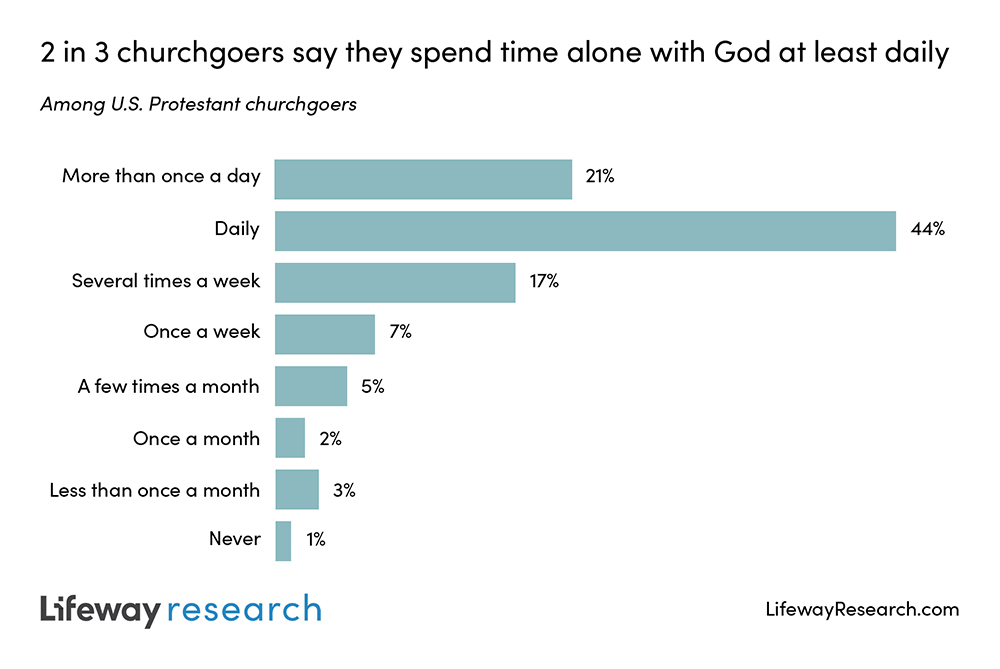
When it comes to spending time alone with God, females (48 percent) are more likely than males (38 percent) to say this is a daily habit for them. Those in the South (49 percent) are also among the most likely to say they spend time alone with God on a daily basis.
One in 4 Baptists (25 percent) say they have alone time with God more than once a day. And those with evangelical beliefs (30 percent) are more likely than those without evangelical beliefs (15 percent) to say the same.
Church attendance is also an indicator of quiet time frequency. Those attending worship services at least four times a month (26 percent) are more likely than those who attend one to three times a month (13 percent) to say they spend time alone with God more than once a day.
“We see a pattern in Scripture of followers of God withdrawing to spend time alone with him. Jesus Christ himself also did this,” said Scott McConnell, executive director of Lifeway Research. “Most Protestant churchgoers continue this relational interaction with God and use a variety of resources as they do.”
Prayer practices differ
When spending time alone with God, some prefer to pray in their own words, while others would rather repeat a set prayer.
Younger churchgoers—ages 18-34 (31 percent) and 35-49 (26 percent)—are more likely than those 50-64 (16 percent) and over 65 (11 percent) to say they repeat a set prayer during their alone time with God.
And those ages 50-64 (85 percent) and over 65 (89 percent) are more likely than those 18-34 (77 percent) and 35-49 (77 percent) to say they pray in their own words.
“There are many reasons to pray a set prayer. Whether someone is praying the model prayer Jesus gave or repeating the same request to God each day, these can be meaningful,” McConnell said. “At the same time, Scripture also records Psalms and prayers within its narrative accounts that show how personal and forthright we can be when talking to God in our own words.”
Females (86 percent) are more likely than males (79 percent) to pray in their own words. And those in the South (86 percent) are more likely to pray in their own words than those in the Northeast (77 percent).
Evangelical beliefs and the frequency of church attendance also are factors in how a person prefers to pray. Those who attend worship services at least four times a month are more likely than those who attend less frequently to pray in their own words (85 percent vs. 79 percent). But those who attend a worship service one to three times a month are more likely than those who attend more frequently to repeat a set prayer (24 percent vs.16 percent).
Those with evangelical beliefs are more likely than those without such beliefs to pray in their own words (92 percent vs.76 percent), while those without evangelical beliefs are more likely than those who hold those beliefs to repeat a set prayer (22 percent vs.16 percent).
What does ‘time alone with God’ mean?
What it means to spend time alone with God varies from person to person. But there are some indicators of which practices are most important to different demographics.
While females are more likely than males to say they praise God (66 percent vs.57 percent) or read from the Bible or a devotional (42 percent vs.36 percent), men are more likely than women to say they consider God’s characteristics (21 percent vs.16 percent) when spending time alone with him.
Older churchgoers—those 50-64 (45 percent) and older than 65 (42 percent)—are more likely than those 18-34 (32 percent) and 35-49 (34 percent) to say they read from the Bible or a devotional when spending time alone with God. And those over the age of 65 are the least likely to say they consider God’s characteristics (10 percent).
Evangelical beliefs and church attendance frequencies are also indicators of a person’s preferences in spending time alone with God.
Those who attend worship services the most (four or more times a month) are more likely than those who attend one to three times a month to praise God (67 percent vs.53 percent), confess sins (55 percent vs.38 percent) or read from a Bible or devotional (46 percent vs.28 percent).
And those who hold evangelical beliefs are more likely than those who do not hold evangelical beliefs to thank God (87 percent vs.74 percent), praise God (76 percent vs.51 percent), confess sin (64 percent vs.38 percent) or read from the Bible or a devotional (52 percent vs.29 percent).
But those without evangelical beliefs are more likely than those with evangelical beliefs to consider God’s characteristics (20 percent vs.15 percent).
“An earlier discipleship study from Lifeway Research showed that praising and thanking God is one of the top five predictors of high spiritual maturity,” McConnell said. “This is a widespread practice among churchgoers when they are alone with God.”
What do churchgoers read in quiet times?
Several factors play into what a churchgoer wants to read when spending time alone with God. The youngest adult churchgoers (ages 18-34) are the most likely to read Scripture from an app (40 percent) and the least likely to read from a devotional book that prints some Scripture (21 percent). And females are more likely than males to say they would prefer to read a devotional from an app (9 percent vs.4 percent).
Those with evangelical beliefs are more likely than those without evangelical beliefs to say they would read from a Bible (78 percent vs.52 percent) if they were reading something in their time alone with God. And those without evangelical beliefs are more likely than those with evangelical beliefs to say they would read from a devotional book that doesn’t print Scripture (11 percent vs.3 percent) or Scripture from an app (22 percent vs.17 percent).
While those who attend a worship service at least four times a month are more likely than those who attend one to three times a month to say they would read the Bible in their quiet time (70 percent vs.52 percent), those who attend one to three times a month are more likely than those who attend more often to say they would read a devotional from an app (9 percent vs.5 percent).
Lifeway Research conducted the online survey Sept. 19-29, 2022, using a national pre-recruited panel. Researchers used quotas and slight weights to balance gender, age, region, ethnicity, education and religion to reflect the population more accurately. The completed sample is 1,002 surveys, providing 95 percent confidence that the sampling error does not exceed plus or minus 3.3 percent. Margins of error are higher in sub-groups.




 “Too often,” it reads, “people have not believed that we are all equally valuable creations of God. Therefore, sometimes people treat people who are different from themselves—in skin color, in nationality, in political party, in the amount of money they have—as less valuable.
 Joe Vernon, a Texas Baptist pastor more than four decades, died Dec. 20 in Beeville. He was 91. He was born March 22, 1931, in Petersburg to William Morris Vernon and Vera Lucile (Truitt) Vernon. After graduating from Brownfield High School, where he was the salutatorian and participated in all sports, he went to Hardin-Simmons University to earn an undergraduate degree in English and religion. While a student at HSU, he met Emma Jo Goodson. They married Aug. 16, 1952, in Midway, near Lamesa. After he graduated from Southwestern Baptist Theological Seminary in 1953, the Vernons moved to Midway where he became pastor of his wife’s home church. Over the course of 43 years, he was pastor of Texas Baptist churches in Midway, Menard, Canadian, Post, White Settlement, Earth and Rotan, as well as Lovington, N.M. Vernon was preceded in death in November 2019 by his wife of 67 years, Emma Jo Vernon, as well as by his sisters, Hazel Zorns and Ruth Scarborough. He is survived by daughter Sarah McKinney and husband Ellis of Beeville; son David Vernon and wife Susanna of Round Rock; daughter Rachel Hoff and husband Ronnie of Three Rivers; eight grandchildren; and two great-grandchildren, with two more expected in the near future. Visitation with the family is scheduled at 1 p.m. on Dec. 22 at First Baptist Church in Beeville. The memorial service follows at the same location at 2 p.m.

 Craig Bird, Baptist journalist and educator, died Dec. 12 due to complications from a fall the week before. He was 73. Bird was born Oct. 4, 1949, in Arkansas to Clyde and C.W. Bird. He earned an undergraduate degree in journalism from the University of Texas and a master’s degree in English from Hardin-Simmons University, and he also studied at Southwestern Baptist Theological Seminary. He worked for the Corpus Christi Caller-Times and the Lawton (Okla.) Constitution-Press before becoming features editor at Baptist Press in Nashville. From 1985 to 1996, he and his wife Melissa served with the Southern Baptist Convention’s Foreign Mission Board in Africa. While he was based in Nairobi, Kenya, Bird traveled to 26 African nations to report on missions as part of the first wave of SBC foreign correspondents. During his long career, he served on staff at Hardin-Simmons University, Southwestern Baptist Theological Seminary, South Texas Children’s Home, Baptist Children’s Home of North Carolina and Baptist Child & Family Services. He most recently served 17 years at Baptist University of the Américas, where he taught cross-cultural communications and theology. He is survived by his wife of 52 years, Melissa; sons Brant and Coby; five grandchildren; and a brother, David Bird.