Religious minorities in Burma forced from homes

Since the February 2021 military coup in Myanmar, about 1 million people—most of them members of religious and ethnic minorities—have been internally displaced, in addition to those seeking refuge in neighboring countries, a recent report revealed.

Continued violence by the Burmese military—known as the Tatmadaw—also has resulted in about 2,500 noncombatant deaths, according to a policy update on Burma from the U.S. Commission on International Religious Freedom.

As of September, the military junta’s State Administrative Council directly has overseen the arrest of 14,000 citizens, torched more than 19,000 homes, internally displaced 700,000 people, and forced 60,000 refugees to flee to neighboring India and Thailand, the commission reported.

Hkalam Samson, past president and former general secretary of the Kachin Baptist Convention in Myanmar was detained by the Burmese military junta. (CSW Photo)

Those arrested include Hkalam Samson, past president and general secretary of the Kachin Baptist Convention in Myanmar, who was detained earlier this month by the Burmese military and continues to be held in an undisclosed location in Kachin State.

“The unjust arrest of Dr. Samson, his detention in an unknown location, and the denial of his rights as a citizen both prior to his arrest and since his arrest jeopardize his life and are of grave concern,” Baptist World Alliance General Secretary Elijah Brown and Asia Pacific Baptist Federation General Secretary Vesekhoyi Tetseo wrote in a Dec. 8 letter.

“At a time when faith leaders can play an indispensable role in building just and lasting peace, far too many individuals continue to be imprisoned and communities of faith targeted and destroyed.”

Conditions deteriorate for Rohingya

Conditions for the country’s Rohingya Muslims—already targeted for at least a decade prior to the coup by the nation’s Buddhist majority—continued to deteriorate since the Tatmadaw seized control of the government, the U.S. Commission for International Religious Freedom report stated.

About 950,000 registered Rohingya refugees from Myanmar live in Bangladesh, where their freedom of movement is limited, hampering their ability to find legal employment.

After the commission sent a delegation to visit Rohingya refugees in the region last month, it called on the U.S. government to work with Bagladeshi authorities to support the Rohingya community and also engage with international organizations to provide for refugees.

The commission report also called on the U.S. to “prioritize religious freedom, including justice for Rohingya and voluntary repatriation, as core criteria for recognition of any pro-democracy opposition group within Burma.”

In Myanmar, the report noted, “ongoing clashes between the SAC, ethnic armies and pro-democracy forces have sparked new fears of another Rohingya exodus.”

In March, U.S. Secretary of State Anthony Blinken announced atrocities committed by the Burmese military against the Rohingya constituted “crimes against humanity and genocide.”

Christians suffer ‘violence and discrimination’

However, the Rohingya are not the only victims of systematic persecution by the Burmese military.

“Since the 2021 coup, Burma’s various Christian communities have suffered violence and discrimination in a magnitude that some have compared to what the Rohingya community has historically faced,” the commission report stated.

The United Nations High Commissioner for Refugees documented an increase in more than 33,000 internally displaced individuals in Chin State and 4,100 in Kachin State, both areas where Christians constitute a majority. The U.N. documented 76,000 in Kayah State, where Christians are a significant minority.

Civil groups estimate the number of internally displaced people in Kayah State could be as many as 170,000, the report noted.

“Many Christian and other communities have fled to neighboring countries, including over 40,000 to Mizoram, India,” the report stated.

A commission delegation met last month with Christian refugees in Malaysia “who reported on dire conditions for their compatriots still within Burma,” the report continued.

Burmese military shelled Thantland township in Myanmar’s Chin State. (Facebook Photo / Asia Pacific Baptists)

“They also reported that their forced flight from Burma, which was in part a result of their religious identity, has deprived them of other rights—such as access to education and employment—due to an absence of laws in Malaysia that provide these rights for refugees and asylum seekers.

“Houses of worship remain particularly vulnerable targets of SAC violence within Burma as the military has bombed, mined and burned Catholic, Baptist and other Christian churches.”

Early last month, the Tatmadaw shelled the Kachin Bible School in northern Myanmar.

At its July meeting in Birmingham, Ala., the Baptist World Alliance general council approved a resolution condemning the coup in Myanmar and the Burmese military for waging “a campaign of terror and violence, particularly against minority religions.”


Obituary: Craig Bird

Craig Bird, Baptist journalist and educator, died Dec. 12 due to complications from a fall the week before. He was 73. Bird was born Oct. 4, 1949, in Arkansas to Clyde and C.W. Bird. He earned an undergraduate degree in journalism from the University of Texas and a master’s degree in English from Hardin-Simmons University, and he also studied at Southwestern Baptist Theological Seminary. He worked for the Corpus Christi Caller-Times and the Lawton (Okla.) Constitution-Press before becoming features editor at Baptist Press in Nashville. From 1985 to 1996, he and his wife Melissa served with the Southern Baptist Convention’s Foreign Mission Board in Africa. While he was based in Nairobi, Kenya, Bird traveled to 26 African nations to report on missions as part of the first wave of SBC foreign correspondents. During his long career, he served on staff at Hardin-Simmons University, Southwestern Baptist Theological Seminary, South Texas Children’s Home, Baptist Children’s Home of North Carolina and Baptist Child & Family Services. He most recently served 17 years at Baptist University of the Américas, where he taught cross-cultural communications and theology. He is survived by his wife of 52 years, Melissa; sons Brant and Coby; five grandchildren; and a brother, David Bird.


Live animals bring spectacle, humor to Nativity scenes

WASHINGTON (RNS)—David Baum has a warning for any church doing a live Nativity: Watch out for the sheep.

“They’re like little tanks, said Baum, recounting the time some sheep bolted, dragged a bale of hay behind them and “ran down some little old ladies singing Christmas carols.”

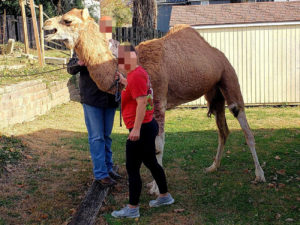
For the past few decades, Baum, owner of the Texas Camel Corps, has spent the Christmas season traipsing all over Texas, supplying camels—as well as donkeys, ox and sheep—for live Nativity sets at churches around the state.

“We have got it all,” he said. “I tell people we bring everything but the baby Jesus.”

A live Nativity at the Seaside Chapel in Carolina Beach, N.C., made headlines recently when a pair of cows staged a jailbreak from the manger and dove into a river—leading to an overnight search and a viral video rescue by local police.

The cows were sent home, Dana Vess, the wife of Seaside pastor Jerry Vess, told the Port City Daily newspaper. But the live Nativity—interrupted two years ago after a storm destroyed the church’s set—went on as planned.

“We don’t let anything stop us from sharing the meaning of Christmas,” Vess told the Port City Daily.

Long tradition of animals in Nativity scenes

While the Bible doesn’t specifically mention animals being present at the birth of Jesus, the non-canonical Infancy Gospel of Matthew, which dates to the 7th century, added them to the story, according to medieval historian Vanessa Corcoran.

“And on the third day after the birth of our Lord Jesus Christ, the most blessed Mary went forth out of the cave, and entering a stable, placed the child in the stall, and the ox and the ass adored him,” the Infancy Gospel recounts.

Corcoran said the tradition of staging reenactments of the birth of Jesus, with live animals as part of the cast, dates back to 1223 A.D., when St. Francis of Assisi set up a live Nativity in the town of Greccio, Italy, with a doll in the manger and live animals, according to a biography of Francis written by St. Bonaventure.

Then in 1291, Pope Nicholas VI, the first Franciscan pope, had a Nativity set up in Santa Maria Maggiore in Rome.

“Within a century, virtually every church in Italy started to take up the practice, first with statues but then getting live Nativities as well,” said Corcoran.

More recent retellings of the birth of Jesus include the 2017 film The Star, which depicts the animals, including some camels brought by the wise men, as humorous sidekicks who save the Baby Jesus from Herod.

A 2014 short story by science fiction author John Scalzi, “Script Notes on the Birth of Jesus,” also features the animals as sidekicks, as well as reimagining the wise men as time-traveling “ninjas for Christ.”

Animals not always well-behaved

A camel used for a Nativity scene in Bonner Springs, Kansas, spent several days on the run before being captured. (Photo courtesy of Bonner Springs Police Dept.)

While the animals might have been on their best behavior for St. Francis, they don’t always cooperate with modern-day live Nativity scenes.

Last Christmas, a camel featured in a drive-thru Nativity scene at the National Agricultural Center and Hall of Fame in Bonner Springs, Kan., made a break for it and spent a day eluding capture by police, who chased the camel in golf carts. In 2010, a video of a reluctant camel toppling into the crowd at a church pageant went viral.

Live animals also played an unexpected role in the downfall of Southern California’s Crystal Cathedral. For decades, Robert Schuller’s now-shuttered megachurch staged a “Glory of Christmas” pageant featuring camels, horses and sheep, along with flying angels. The pageant ended when the church no longer could pay vendors for the pageant, a sign of a larger fiscal crisis at the church.

For years, Damascus Road Community Church in Mount Airy, Md., held a “Walk Through Bethlehem” event, complete with sheep, llamas and donkeys, on a set built on the church’s property. The animals behaved well when they were outside, said Michelle Rader, the church’s lead elder, but there was an adventure when one of the boys in the church tried to ride a donkey and got bucked off.

Things got tricky when a church leader brought a llama inside the church during the announcements to promote the event—and it promptly left an unexpected offering on the stage, Rader said.

“You never know with llamas,” she said.

The church, which put its Christmas reenactment on hold in 2020 due to the pandemic, has also used live animals during reenactments for Palm Sunday and Easter, which could be tricky. While the Bible recounts Jesus riding a donkey into Jerusalem on Palm Sunday, bringing that to life is a challenge, said Rader.

“You have to find a very small man to be Jesus,” she said.

The church also has had wild animals take part in its event, though that was unplanned. One year, said Rader, a group of wild turkeys invaded the church’s property over the Easter weekend and would not go away. The group’s male leader decided to preen for the crowd while Jesus was dying on the cross—and would not leave, despite the best efforts of church members.

“They had absolutely no fear of the crowd,” said Rader.

Live animals ‘a great draw’

Despite some of the challenges, Rader said having animals at reenactments helps bring the Bible’s stories to life.

“They are a great draw,” she said.

The animals at the first live Nativity run by Kenosha Bible Church were mostly well-behaved, though the cow was too big to fit in the stable and had to remain in a trailer. The sheep and other animals provided a great soundtrack for the event run by the Wisconsin church, said worship pastor Mike Middleton, who helped organize the event.

A video from the event, held Dec. 11, catches the sheep baaing in the middle of a pastor’s welcome.

“Yep, thank you. I’ll take that as an ‘Amen,’” the pastor responded.

Middleton said the church had built an outdoor structure during the pandemic for worship services that resembles a stable. That inspired them to launch a live Nativity to retell the Christmas story. Church leaders also wanted to fill the gap left when another popular Nativity in Kenosha, a city about 40 miles south of Milwaukee, shut down.

The event featured live actors and a recorded narration taken from the New Testament accounts and drew more than 1,000 people.

“A lot of times, Bible stories feel like fairy tales,” Middleton said. “When you see the real people, there is more of an impact.”

Bringing the ‘wow’ factor

Having animals—especially larger ones—also brings a “wow” factor to Christmas events, said Baum, whose camels will take part in 36 performances over 28 days during the holiday season.

At some events, he said, the camels are part of the scenery, while at others, Baum and his animals serve as “chauffeurs for the Magi,” with the wise men from the biblical story riding through the crowd.

Along with helping tell the story, the camels add “a bit of spectacle,” Baum said.

“That’s the case whether we are at a small church where Joseph is a kid with a painted-on beard—or we are at a megachurch with lights and smoke machines,” he said.

Despite their reputation for being stubborn, Baum said his camels are “boringly gentle” and love being around people. They are the predictable part of a live Nativity, he said.

The public, however, is another story.

“A hundred years ago,” he said, “most people would have known not to do something goofy behind a horse or other large animal.”

Now that’s not the case. These days he spends much of his time trying to anticipate how people might react around the animals—and take steps to prevent any mishaps.

“The camels are the least of my concerns,” he said.


BGCT reopens Inflation Relief Grant program

The Baptist General Convention of Texas is reopening its Inflation Relief Grant program, thanks to a gift from First Baptist Church in Midland.

The grant aims to help pastors impacted by the recent increase in costs of gas, utilities, groceries and other necessities.

“We are humbled and overjoyed by FBC Midland’s generosity towards pastors and ministers,” said Tammy Tervooren of the Texas Baptists’ financial health team. “Many pastors and ministers have seen increased needs due to inflation, and the generosity of FBC Midland and its congregation will provide some of these pastors with much-needed financial relief.”

First Baptist Church in Midland first heard about the grant when it was launched in July 2022. Following a year of generous giving, the church realized it had excess funds and began discussing ways to use them.

Pastor Darin Wood suggested helping to fund another BGCT Inflation Relief Grant, remembering his own days as a struggling bivocational pastor.

The church’s finance committee agreed and pledged $140,000 to the grant. Wood said the church hopes this grant will be an encouragement to the pastors who receive it.

“Our hope is that it will serve pastors and their families, and they’ll be able to stay in the church they’re serving in and breathe easier,” he said.

Wood, who has served at First Baptist in Midland almost seven years, said he hopes the grant serves as a reminder to ministers that their work is important and celebrated.

“Know you’re not forgotten—that the Lord has not forgotten you,” he said. “There are other people besides your church that see you and see the importance of the work that you are doing.”

Matching gift from Lilly Endowment

The gift from First Baptist in Midland gift was matched by the Lilly Endowment as part of its national Economic Challenges Facing Pastoral Leaders Initiative, bringing the total available funds to $280,000.

Funds from First Baptist in Midland will go toward supporting senior pastors, while the matching funds will be open to all full-time pastors and ministers.

To be eligible, pastors and ministers must be serving at a BGCT-affiliated church that has contributed to the Texas Baptists’ Cooperative Program within the last year. Pastors and ministers must have served in their current church for at least one year. Pastors who have received the grant previously are welcome to reapply.

Recipients will receive up to $500 in a one-time grant. The grant will be open to applicants on Jan. 3, 2023. Those who meet the eligibility requirements can find more grant information and apply here.

First Baptist in Midland has a generous heart, Wood said, and he celebrated the fact his congregation can look outward toward blessing people around the state.

“It’s a generous place, and people have a heart of giving,” he said.

He encouraged other churches to consider how they can be a part of blessing pastors, churches or ministries across Texas.

“It’s not our money. The Lord loaned it to us, and it’s our job to give it back,” he said.

Churches interested in helping others this Christmas season and beyond through the BGCT’s current or new ministry opportunities are encouraged to contact Texas Baptists’ CFO/Treasurer Ward Hayes at ward.hayes@txb.org to learn more about the large-scale impact they can make. 

Individuals interested in making a gift that will bless ministries for a lifetime and beyond can contact the Texas Baptist Missions Foundation to learn more.  

To learn more about the Inflation Relief Grant, click here


Death penalty diminishing in Texas but disparities remain

Texas’ use of the death penalty remained at a historically low level this year, but four of the five individuals executed in 2022 suffered from mental or physical impairments or from childhood trauma, a new report reveals.

 “Despite their low number, the executions set and carried out in 2022 raise troubling issues about the fairness and utility of the death penalty,” the report from the Texas Coalition to Abolish the Death Penalty states.

A separate report from the Death Penalty Information Center revealed national support for the death penalty continued a more than 20-year decline. Nationally, 18 inmates were executed in 2022, and the 20 death sentences pronounced in 2022 were the fewest of any year in half a century.

The national center’s report pointed out seven of the 20 attempted executions were “botched”—either highly problematic or taking an inordinate amount of time.

Only six states carried out executions in 2022—Texas, Oklahoma, Arizona, Alabama, Missouri and Mississippi.

Declining death sentences in Texas

In 2022, only two Texas juries sentenced an accused killer to death—the eighth consecutive year death sentences in the state numbered in single digits. The number of Texas death sentences have declined 96 percent since peaking at 48 in 1999, the Texas Coalition to Abolish the Death Penalty report noted.

Just under 200 of the inmates at the Allan B. Polunsky Unit—a maximum security prison near Livingston—are housed on Texas Death Row. (Photo / Ken Camp)

Juries in only 14 of Texas’ 254 counties have imposed death penalties in the last five years.

As of mid-December, 192 Texas inmates were on Death Row—the smallest death row population since 1985.

Stephen Reeves, executive director of Fellowship Southwest, an organizational member of the Texas Coalition to Abolish the Death Penalty, noted the report reveals “even Texas is walking away from imposing the death penalty.”

“The death penalty is fundamentally flawed, and there is no defensible rationale for its continued use,” Reeves said.

While fewer Texas juries are imposing a death sentence and fewer Death Row inmates are being executed than in recent decades, capital punishment remains a “lethal lottery,” according to the report.

“Individuals who are set for execution were convicted years ago during an era of prosecutorial excess, putting the rampant flaws and failures in their cases on stark display. State and federal courts have allowed egregious constitutional violations to stand without review, and many death penalty cases remain frozen in time until the eleventh hour,” the coalition report states.

Childhood trauma, racial disparity

Death Row inmates executed in 2022 included John Henry Ramirez, who suffered from mental health issues stemming from childhood trauma, according to the coalition report.

When John Henry Ramirez was executed Oct. 5, his pastor, Dana Moore, stood beside him in the death chamber, praying and laying one hand upon him. (Photo / Ken Camp)

When Ramirez was executed Oct. 5, Pastor Dana Moore of Second Baptist Church in Corpus Christi stood beside him in the Texas Death Chamber. Ramirez secured the right to have his pastor lay hands on him and pray audibly at the moment of his execution when the U.S. Supreme Court ruled 8-1 the state should accommodate his request.

Moore served as spiritual adviser to Ramirez about five years. After Ramirez made a profession of faith in Christ and was baptized on Texas Death Row, Second Baptist Church allowed him to join the congregation’s membership.

Of the five inmates executed this year, three were white, one was Hispanic and one was of Southeast Asian heritage.

However, in the past five years, more than 70 percent of death sentences were imposed on people of color, with about 40 percent imposed on Black defendants.

Harris County and Smith County accounted for one-third of the death sentences imposed in the past five years. In Harris County, only one of the 22 most recent defendants sentenced to death was white, while 16 were Black.

Black inmates constitute 46.6 percent of the incarcerated individuals on Texas Death Row, while African Americans are only 11.8 percent of the total Texas population.

Some executions stayed by court

The Texas Court of Criminal Appeals stayed three executions. Melissa Lucio—one of only a handful of women on Texas Death Row and the only Latina—was within two days of her scheduled execution when she was granted a stay of execution.

Jesse Rincones, executive director of the Hispanic Baptist Convention of Texas and lead pastor of Alliance Church in Lubbock, joined more than 100 other faith leaders in calling for clemency for Death Row inmate Melissa Lucio. The Texas Court of Criminal Appeals on April 25 granted a stay of execution and ordered a county district court to consider new evidence. (Screen capture image)

The Court of Criminal Appeals ordered a Cameron County trial court to consider new evidence regarding the death of her 2-year-old daughter Mariah. Evidence included declarations of seven scientific and forensic experts who concluded false evidence misled the jury into believing the child was killed by physical abuse rather than medical complications after a fall.

More than 100 faith leaders—including Jesse Rincones, executive director of the Hispanic Baptist Convention of Texas—had requested clemency for Lucio.

The coalition report noted a significant number of cases of Texas Death Row inmates involved false or misleading testimony, poor legal representation and faulty forensic evidence.

“The individuals set for execution likely would meet a different fate if they were charged and tried today,” said Kristin Houlé Cuellar, executive director of the Texas Coalition to Abolish the Death Penalty.

“Yet, because of the high hurdles that state and federal courts have erected for review and relief, these older cases from a bygone era of zealous use of the death penalty in Texas remain frozen in time, allowing their executions to proceed despite egregious constitutional violations.”

Reeves voiced the same concerns. Capital punishment’s “random and sporadic imposition only adds to the cruelty for those unlucky enough to be killed by the state,” he asserted.

“We are not safer, and justice is not served by the state killing a handful of individuals every year who are almost uniformly poor, mentally ill, developmentally impaired, or themselves the victims of childhood abuse and trauma. Not to mention the numbers of those sentenced to death who are later found to be innocent or the high number of those subject to botched executions,” Reeves said.

“It is inhumane and unworthy of public support, especially from Christians who follow a Savior who stopped a public execution and was himself unjustly executed.”


Abbott probes NGOs accused of assisting border crossings

In response to a sharp increase in migrants crossing the Texas-Mexico border in the El Paso area, Gov. Greg Abbott is seeking an investigation of nongovernmental organizations he believes may have assisted with illegal border crossings.

Nongovernmental organizations also “may be engaged in unlawfully orchestrating other border crossings through activities on both sides of the border, including in sectors other than El Paso,” Abbott wrote in a letter to Attorney General Ken Paxton.

In the Dec. 14 letter, Abbott called on the attorney general and his office to “initiate an investigation into the role of NGOs in planning and facilitating the illegal transportation of illegal immigrants across our borders.”

He also pledged to work with the attorney general’s office to “craft any sensible legislative solutions … aimed at solving the ongoing border crisis and the role that NGOs may play in encouraging it.”

Abbott sent the letter one week before the scheduled expiration of Title 42, which allows the United States to expel migrants rapidly from the border without giving them the opportunity to seek asylum. Title 42 first was enacted as part of the Public Health Service Act of 1944 to prevent the spread of communicable disease.

President Donald Trump invoked Title 42 in March 2020 with the expressed intent to stop the spread of COVID-19, and the Biden administration continued it until Dec. 21.

El Paso has experienced a dramatic surge in the number of border crossings prior to the Dec. 21 deadline. On Dec. 17, Mayor Oscar Leeser declared a state of disaster to deal with a humanitarian crisis.

NGOs working with Border Patrol

Stephen Reeves, executive director of Fellowship Southwest, called Abbott’s directive to investigate NGOs “an offensive attack on the faith of pastors and churches following the biblical commands to love their neighbor and welcome the stranger.”

“While the governor is engaged in political stunts like shipping migrants off to northern cities, and Congress can’t get its act together to provide the resources and policy changes necessary to adequately address this humanitarian crisis, it is churches who are taking responsibility to care for the desperate,” Reeves said.

Reeves said he does not know of any pastors in the Fellowship Southwest border network—or any other nonprofit—who are “unlawfully orchestrating border crossings.”

“What they are doing is feeding and protecting the desperate and vulnerable, many of whom are children, who are forced by our policies to languish in some of the most dangerous cartel-controlled cities in North America,” he said.

“Most nonprofits are working with Customs and Border Patrol to try and better control the flow of migrants. I implore the governor to work with the federal government and local officials to coordinate the care of migrants and join us in urging Congress to pass legislation now to address the situation.”

Director of Missions Larry Floyd said El Paso Baptist Association’s migrant ministry center operates within the law, working with migrants who have proper documentation. The center works closely with local government, as well as U.S. Border Patrol and U.S. Immigration and Customs Enforcement.

John Litzler, director of public policy for the Texas Baptist Christian Life Commission, noted the Baptist General Convention of Texas “is blessed with incredible churches, partners, missionaries and staff who engage in longstanding ministry efforts to meet the spiritual, physical and educational needs of those along the Texas and Mexico border.”

“This ministry is both in harmony with the biblical command to care for the foreigner and love the sojourner, while also within the parameters of and in compliance with local, state and federal law,” Litzler said.

“While we continue to pray for wise and compassionate immigration reform at the federal level, we are also eager to work with Texas legislators to address the border crisis in a way that affirms the God-given value and dignity of migrants to the United States.”

For more information about Texas Baptists’ ministries along the Texas/Mexico border, contact Mario Gonzales with River Ministry/Mexico Missions at (214) 828-5389 or mario.gonzalez@txb.org, or visit txb.org/riverministry.


El Paso churches respond to surge of migrants

EL PASO, Texas (BP)—Baptists in El Paso are joining other groups to respond to large numbers of migrants that can quickly and easily spiral into a humanitarian crisis.

“We’re averaging 2,500 crossings a day,” said Larry Floyd, executive director of the El Paso Baptist Association. “Shelters are full. I’ve never seen it like this.”

The recent crowds at the border can be linked to the scheduled Dec. 21 deadline of Title 42. Originally enacted as part of the Public Health Service Act of 1944, Title 42 regards the “suspension of entries and imports … to prevent the spread of communicable diseases.”

President Donald Trump cited the COVID-19 pandemic when he enacted Title 42 in March 2020, thus leading to the rapid expulsion of migrants at the border.

Floyd and others braced for a flood of immigrants last year as Title 42’s anticipated deadline neared, but the Biden administration ultimately decided to continue the policy.

At that time, El Paso Baptist Association had just opened its migrant ministry center. Since then, the center has worked with the local government as well as the U.S. Border Patrol and the U.S. Immigration and Customs Enforcement in helping 60 to100 migrants each week.

The current crisis happens, though, as the association’s migrant center is closed for the rest of the month. Primarily, the closure is due to a lack of the center’s regular volunteers, who will be serving at their respective churches during Christmas.

“There are churches going out on their own and handing out items like blankets,” Floyd said. “Pastor Ariel Martinez and Del Sol Church have been active in this.”

The migrant center will reopen in January.

“I’m hoping this surge creates a bigger sense of the need for volunteers year-round,” said Floyd, who added that the center remains “spiritually based” and meets those needs alongside humanitarian ones. Families and individuals typically spend 24 to 36 hours there before being processed out.

Brent Moore, pastor of Life Church in El Paso, is one of those churches active at the migrant center.

“About a third of my church works with the government, so we’re ministering to them during this as well as those crossing the border,” he said.

Moore said government officials need to act.

“There’s a way to be compassionate while calling your local officials to uphold the law.” Moore said. “We’re ministering to our people who are putting in the overtime, as well as migrants.”

Coverage of the border situation and talk among lawmakers on both sides of the aisle have picked up considerable steam. Senate Majority Leader Chuck Schumer, D-NY, called President Biden’s chief of staff over the matter, according to reports.

On Dec. 13, Sen. John Cornyn joined others in calling on Biden to extend Title 42 beyond its Dec. 21 deadline.

In addition to full homeless shelters, Moore has observed “shantytowns” of migrants springing up around gas stations. He has spoken to air marshals who have been pulled into border patrol duty. There are valid concerns of migrants being trapped into human trafficking.

The situation is an unprecedented one for Floyd, an El Paso native.

“Normal migration in El Paso is pretty substantial, but well-maintained,” he said. “When the border patrol is dropping off migrants in the streets, like now, something is seriously wrong.”


Faith leaders call for expanded child tax credit

WASHINGTON (RNS)—Faith leaders joined members of Congress on Capitol Hill Dec. 15 to voice support for the expansion of the child tax credit, urging lawmakers to reinstate a broader version of the anti-poverty benefit before the end of the year.

“For many of us, this is a season of miracles—the miracle of Jesus’ birth, the miracle of Hanukkah,” said Abibat Rahman-Davies of the Friends Committee on National Legislation, a Quaker group. “But expanding the [child tax credit]? That shouldn’t take a miracle.”

The event was part of a sustained advocacy push by a group of faith leaders from across the theological spectrum who joined forces to push for lawmakers to embrace an expanded version of the credit that helps combat child poverty.

Earlier this year, the group published an advertisement in Politico Magazine and sent a letter to all 535 members of Congress and to the White House asking them to make the child tax credit “fully refundable and available to low-income families on a permanent basis.”

Lawmakers allowed the expanded version of the credit, which was created as part of the American Rescue Plan, to expire last year, sparking frustration among anti-poverty advocates. Members are currently wrangling over competing last-minute proposals put forward by both parties in hopes of passing something as part of an omnibus bill before the end of the year.

Rep. Rosa Luisa DeLauro of Connecticut, who has often invoked her Catholic faith in policy discussions, voiced passionate support for an expanded version during Thursday’s event.

“I’m so proud of being a part of a living Catholic tradition,” DeLauro said. “A tradition that unfailingly promotes the common good, expresses a consistent model framework for life and highlights the need to provide a collective safety net for our community’s most vulnerable—and that includes our children.”

DeLauro appeared to reference proposals floated by some Democrats that include tax breaks for businesses in an attempt to accrue Republican support.

“If we can provide tax cuts for America’s corporations, we can certainly provide a tax cut for America’s kids,” she said.

Sen. Sherrod Brown, a Lutheran, tied his support for the credit to Matthew 25, a Bible passage in which Jesus says when his followers care for the sick and feed the hungry, they are caring for him.

Brown said he was once given a Poverty and Justice Bible, and noted how its translation of the passage’s final line—“What you did for those who seem less important, you did for me”—resonated with his faith.

“It’s so clear that that’s our calling,” said Brown, an Ohio Democrat.

People impacted by the child tax credit also addressed the gathering, explaining how the credit benefited their families. Rabbi Jonah Pesner offered a prayer, asking God to forgive the United States for a “year of suffering of our children” because of the expired credit.

The expanded version of the credit allowed families to receive as much as $3,600 per child in 2021, a marked increase over the previous $2,000-per-child payments. Advocates argue the increase made a significant difference to struggling families, and that its disappearance resulted in dire consequences. Researchers at Columbia University found that child poverty increased 41 percent a month after the credit expired.

The event included the voices of theologically conservative evangelicals.

“It is an important time to speak up,” said Eugene Cho, an evangelical pastor and head of the anti-poverty group Bread for the World. “If you ask us why we should speak up, I can think of 12 million reasons,” he added, referring to the millions of children who struggle with poverty.

Galen Carey, vice president of government relations for the National Association of Evangelicals, also addressed the gathering. He argued the credit resonates with his group’s religious commitments, such as “safeguarding the sanctity of human life.”

“For those who are concerned about the sanctity of human life and protecting the unborn child, the child tax credit provides welcome reassurance to expectant moms and dads who wonder if they could afford to raise a child,” Carey said.

“It tells them that they’re not alone. And that if they choose life, they will not have to shoulder the costs and burdens of parenting on their own.”

He was echoed by Steffani Thomas of the Mormon Women for Ethical Government.

“As a woman of faith, I am guided by the scripture that I consider which policies will allow the largest number of God’s children to thrive, have self-determination and opportunities,” she said.

In addition to the Network Lobby for Catholic Social Justice—whose executive director, Mary Novak, offered the closing prayer—other groups that sponsored the event included the National Council of Jewish Women, Presbyterian Church (USA), United Church of Christ, Episcopal Church, Jewish Federations of North America, National Council of Churches, Evangelical Lutheran Church in America and the Samuel DeWitt Proctor Conference.

Before she left, DeLauro repeatedly urged faith leaders to mobilize their networks, calling on them to “overwhelm the Senate and overwhelm the White House” with calls from supporters.

“Congress is an institution that responds to internal pressure,” she said.


Ukraine women crochet angel ornaments to thank donors

ODESSA, Ukraine (BP)—Light is scarce during scheduled electrical outages as Ukraine suffers a bombed-out power grid. Yet, women there are using their light this Christmas to crochet angel ornaments to send churches and other supporters in the United States.

“Now it’s difficult because cities stay without light sometimes 24 hours, sometimes more,” said Tanya Pyzh, daughter-in-law of Ukrainian Baptist Theological Seminary President Yaroslav “Slavik” Pyzh.

“It’s before Christmas, a really special time, and now they don’t have light. It’s like two or three hours a day they have light. And they’re working in those two or three hours because they need to see those small details,” Tanya said. “It’s precious. All of them were really ready and thankful to do this, because it means a lot. Right now, it means a lot.”

As many as 20 women near Odessa, in Lviv and a few other Ukrainian cities are paid a small fee to make the ornaments through a partnership of the Baptist seminary in Lviv and the Ukrainian Partnership Foundation in Chesterfield, Mo., said Penny Iannacone, donor engagement director of the partnership foundation.

The small fee supplements the income of women in Ukraine struggling to provide for their families during the war’s high inflation rate, with some of the women donating their earnings to the Ukrainian war effort, Iannacone said.

“The war’s probably been the hardest on the family, and because a man can be called to war if they’re between the ages of 18 to 60, a lot of the women have been left without the man in the home,” Iannacone said.

“I’m sure this has been a blessing for those ladies to not only have a little project to work on, but also to be able to earn a little money for however they used it, whether for their personal need or whether they donated it back to the war effort.”

Ukrainian Baptist Theological Seminary ships the ornaments to the foundation, which in turn distributes them with thank you cards to top givers among U.S. churches, individuals and groups. The Ukrainian Partnership Foundation will display and distribute ornaments at a Woman’s Missionary Union conference in January.

Send Relief, the Southern Baptist humanitarian program, has supported the Ukrainian Partnership Foundation through grants. Additionally, Send Relief’s humanitarian aid to Ukraine topped $10 million in the first three months of the war.

“They’re very popular. I’ve had several people ask if they could purchase them to give as Christmas gifts. We don’t have an endless supply,” Iannacone said of the ornaments. “We’ve asked (the women in Ukraine) to produce as many as possible during the next month, and they told us they thought they could get us 1,600 more.”

Each ornament is crafted with yarn in Ukraine’s national colors of blue and yellow and takes about two hours to crochet. The Ukrainian Partnership Foundation is not charging recipients for the ornaments, Iannacone said.

First Baptist Church in Nashville, Tenn., is among a handful of congregations that each received about 50 of the ornaments, Iannacone said.

‘Will be a treasured keepsake’

For Nashville First’s children, the ornaments are a reminder of the angel’s encouragement in Luke 2:10 to “fear not,” Nashville First Minister to Children Shannon Meadors said.

“Our children were overwhelmed that the women of Ukraine would send them a gift. With wide eyes, they held onto their angel ornaments so carefully, commenting on their beauty,” Meadors said.

“As parents arrived, the kids were so excited to show and tell all about their special gift.

“These handmade angel ornaments will be a treasured keepsake on their Christmas trees for years to come reminding our families of the strong people of Ukraine.”

The Ukrainian Partnership Foundation decided to ask the women of Ukraine to make the ornaments after Tanya’s mother purchased a couple at a humanitarian fundraising event near Odessa in August. Tanya lives in Missouri with her husband “Slavik,” the son of Ukrainian Baptist Theological Seminary President Slavik Pyzh.

“At this gathering, they had one lady who was doing those ornaments,” Tanya said. “And my mom bought some as a present to me and to give money to the army.”

Tanya in turn gifted an angel to Ukrainian Partnership Foundation President W. Joseph Privott, who gave Tanya and her husband a place to stay as they transitioned to St. Louis, Mo.

Privott conceived the continuing exchange to not only thank donors, but also help support Ukrainian families during the war. The nonprofit Ukrainian Partnership Foundation has supported Christian education in Ukraine, mainly through the Baptist seminary, since 2006.

Tanya’s mother recruited additional women to crochet the ornaments, creating a community among strangers now unified in the effort. Ukrainian Baptist Theological Seminary collects the ornaments and pays the women from donations the Ukrainian Partnership Foundation sends from donors.

The women appreciate the help, Tanya said.

“They’re just really excited about it, that somebody’s caring about them, and somebody wants to help them so they can help somebody else,” Tanya said. “It’s kind of like a win-win for everybody.”


African American leadership institute launches in 2023

COLUMBIA, Md. (BP)—Formerly enslaved African American pastor George Liele planted churches in Jamaica nearly a century before beloved missionaries Annie Armstrong and Lottie Moon spread the gospel abroad.

Two years after the Southern Baptist Convention added a George Liele Church Planting, Evangelism and Missions Sunday to the official SBC calendar, plans are underway to found a leadership institute in the name of the trailblazer who began his international ministry in Jamaica in 1783.

“In Southern Baptist history, we have a lot of role models, but we don’t have a lot of African American role models we have embraced historically that have had international impact,” said Bernard Fuller, a pastor in Lanham, Md. “If we’re going to get the Black church involved, we have to show them examples of individuals who look like them.

“And one of those individuals is George Liele, whom we’ve overlooked many years and haven’t brought to the forefront. George Liele is a great example because he fulfills everything we exist for.”

Fuller, pastor of New Song Church and Ministries, is a planning committee member of the George Liele Leadership Institute that the African American Fellowship of the Baptist Convention of Maryland/Delaware plans to launch in January 2023 with a Martin Luther King prayer and worship service. Classes are scheduled to begin in September. The regional convention is an institute co-sponsor.

“Image is important,” Fuller said. “Not that Lottie Moon or Annie Armstrong were not great missionaries. Our desire is to continue the legacy of his life. It’s something we believe not just African American churches can rally around, but this brings other Black churches, churches of color, (to be) engaged in this, because he went to Jamaica.”

The institute will be designed as an affordable training option for Maryland and Delaware churches of all ethnicities, but will especially focus on equipping African American congregations in the areas of church strengthening, planting and international missions. In addition to pastors, congregational leaders including deacons, trustees, associate ministers and women’s leaders will benefit from institute, Fuller said.

“This is multicultural. Anybody can come,” Fuller said.

“The goal of the institute is to equip disciples to make disciples. It’s an equipping institute in every area,” he continued. “Our passion is discipleship, and we believe that a great commitment to the Great Commander who gave us the Great Commandments and the Great Commission will result in great results.”

Charles Grant, associate vice president for African American relations for the Southern Baptist Convention Executive Committee, expressed “joyful anticipation” in advance of the institute.

“The African American Fellowship’s emphasis on connecting George Liele’s life and legacy to leadership training is a win for both African American churches and for Southern Baptists in Maryland/Delaware,” Grant said.

“With focus and intentionality, leaders will be developed and educated about George Liele. The prayerful results will be healthy church growth, an increased pool of potential church planters and international missionaries from African American churches.”

The African American Fellowship and the Baptist Convention of Maryland/Delaware appointed a planning committee for the institute in the summer of 2022. It will not be an accredited Bible college, but that option might be explored in coming years, Fuller said.

Joining Fuller on the George Liele Leadership Institute Committee are African American Fellowship Vice President Victor Kirk, pastor of Sharon Bible Fellowship Church, Lanham; and Mark Roy, senior pastor of Good Shepherd Ministries, Capitol Heights, Md.

The committee also includes several members of the African American Fellowship’s board: Vernon Lattimore, senior pastor of First Baptist Church of Mount Rainier, Md.; Michael Mattar, senior pastor of Hope Fellowship Church in Ashburn, Va.; Byron Day, senior pastor of Emmanuel Baptist Church, Laurel, Md.; Nathaniel Thomas, senior pastor of Forestville New Redeemer Baptist Church, Forestville, Md.; and Monroe Weeks, Hope Fellowship worship leader.

A survey of Baptist Convention of Maryland/Delaware pastors found the need for a financially affordable training center for lay ministers that emphasizes the teaching of core theology and Bible literacy, Fuller said. Surveyors also encountered young bivocational pastors who had not been able to receive formal training in ministry.

The logistics of the institute still are being planned, with the goal of a hybrid online and in-person format also utilizing webinars from Southern Baptist educators. The fee will be nominal, Fuller said.

In addition to the January Martin Luther King prayer and worship service, activities preceding the September launch of classes include a February George Liele Missionary Breakfast, an African American Fellowship Awareness Conference and a planning retreat.


TBM volunteers help bring special Christmas to family

WEIR—Christmas came a little early this year for a family in rural Weir, northeast of Georgetown. But, like the first Christmas, it is a celebration that was months in the making and involved a large cast of characters.

The first Christmas story began with an event that affected many people—a Roman census. This Weir Christmas story began with a massive ice storm that affected much of Texas in February 2021.

Most people in Texas bounced back within days or weeks after the big freeze in February 2021. One family finally returned to their home Nov. 19 this year—a year and a half later, just in time for Thanksgiving and Christmas.

The home had been in need of repair before the storm. But afterward, it became unlivable. The community responded to the needs of their longtime neighbors, and area Texas Baptist Men Disaster Relief volunteers joined the effort.

TBM Cabinet Builders from beyond the area also pitched in.

‘We couldn’t walk away’

Chris Hamilton (right) headed the community-wide effort that enabled David Black and his family to return to their renovated home. (Courtesy photo via Facebook)

Chris and Emily Hamilton spearheaded the community effort. And they had no prior experience with TBM other than knowing it was an “organization that helped people,” Chris said.

Five adults lived in the devastated home—Bill and Lillian Black and three adult special-needs sons. The Blacks had for years made their home a place for caring. They raised four sons and then adopted eight special-needs children through the years.

The Hamiltons learned about the Blacks’ situation through Emily’s parents, who were providing showers for one of the sons in a wheelchair. The Blacks had no water. Time passed, and still no water.

“Emily and I were like, ‘That’s not OK,’” Chris said.

For years, the couple has been involved in performing country music, even though they had “retired” from regular performing in 2019. They can, however, still play and sing. Their March 2021 fundraiser brought in $4,000 for the Blacks, and it was channeled through a local nonprofit, the Georgetown Beard Club.

“We were going to fix the plumbing and a hole in the roof,” Emily said, but it ended up going way beyond that. “We couldn’t walk away.”

In the meantime, the Blacks needed a place to live. More fundraisers occurred, including proceeds from the nearby Walburg BBQ Cookoff.

The funds made it possible to buy a “toy hauler” RV. Workers closed in the back of the RV, added a regular door and converted the back ramp into a wheelchair ramp.

As for the original house, a group called Water Mission helped replace all of the Blacks’ plumbing, but the extent of the damage became more clear as work progressed. The entire house needed to be rebuilt, Emily said.

TBM and Crestview Baptist became involved

So, the Hamiltons went through options with the Blacks—tearing it down, building a modular house, even selling the house and land. Like many people who have lived in one place a long time and raised children there, the Blacks preferred to fix what they had.

Charles Baker coordinates Texas Baptist Men volunteers at Crestview Baptist Church in Georgetown. (Photo / Ferrell Foster)

Rusty Ruby, a member of Crestview Baptist Church in Georgetown, got involved and he took Charles Baker to the site. Baker coordinates TBM volunteers at Crestview.

Baker had a history of coordinating volunteers, first as an International Mission Board missionary and then as a TBM “blue cap” volunteer leader.

The Hamiltons remembered when Baker first came to the Blacks’ house. He was just what the project needed—someone to organize all of the people and businesses who wanted to help. And Baker also brought TBM to the effort.

“TBM was really instrumental throughout the whole project,” Emily said. “Without their help, it wouldn’t have been done.”

Chris ticked off specifics of the TBM and Crestview contribution—mold remediation, reframing the house with headers and doors, exterior and interior insulation, painting the entire interior of the 2,900-square-feet house.

Texas Baptist Men volunteers from Crestview Baptist Church in Georgetown—(left to right) Rick Fedelem, Mike Lovelace, Jerry Michaels and Don Denton—installed cabinets in the Black home. (Courtesy photo via Facebook)

TBM Cabinet Builders constructed all of the kitchen cabinets offsite, and Crestview TBM volunteers installed them. TBM Disaster Relief bought all 14 windows the house needed.

Plus, Emily noted, the TBM volunteers did various “odds and ends, and whatever we needed at the time.”

“When the storm happened, it just totaled everything,” Baker said. “Water pipes burst in the house. The septic system crashed. Everything was just ruined.”

A refuge for people in need

The home had been a refuge through the years for people in need as the family adopted and fostered various children. Members of the Black family also now serve as IMB missionaries, Baker said.

Bill Black once had been a machinist, but when his eyesight gave way, his work did as well, Baker said. The house, over time, had become neglected.

“Basically the house was gutted completely,” Baker said.

John Black (Courtesy photo via Facebook)

Local businesses provided expert labor for the project, plus some materials.

“Fortunately,” Baker said, “there were some funds TBM had available to help with the project.” Crestview also provided funds.

Volunteers provided the key TBM/Crestview contribution. Most of the more than 20 volunteers are trained TBM disaster relief volunteers.

Terri Hurlbut is one of those who responded to the need.

“It was amazing to see the project progress,” she said. “I only did whatever I could to help.”

Baker “would contact us to inform us of the work needed, and he was there faithfully with the trailer and tools.”

Then something interesting happened.

“Charles was reviewing our work plans after we had all been tearing out walls and insulation, and I noticed a couple going from their car to the trailer next to the house. I waited until everyone had left and asked Charles if the last name of the family whose house we were working on was Black,” Hurlbut said.

“I didn’t realize I knew the family until then. I admire Bill and Lillian, and I was blessed by Jonathan, Jeffrey, David and Robbie when they were little ones in Sunday school and VBS. They were such happy, loving little ones.”

Hurlbut had known the Blacks when both families were part of Main Street Baptist Church in Georgetown 25 or 30 years ago.

“Isn’t it amazing how you see folks you haven’t seen for a long time, and it’s just like you were never separated? A foretaste of heaven, when we see those who were precious to us during our lifetime,” she said.

The first Christmas involved, of course, Mary and Joseph, but there was also Elizabeth and Zechariah, an innkeeper who provided a stable, shepherds and wise men, and countless others who would have encountered the young couple on their journey.

So many Texans played a part in this newer story. Some of them may not even worship the Christ of Christmas, but at least one group of TBM volunteers came along because of that Christ and brought new hope to a family in need.


On the Move: Kinnin and Ross

Thomas Kinnin to First Baptist Church in Comanche as minister of youth from First Baptist Church in Holland, where he was associate pastor of students and technology.

Kelly Ross to Dell Dale Avenue Baptist Church in Channelview as music minister from First Baptist Church of North Houston, effective Jan. 1