Around the State: T.B. Maston Foundation sponsors student retreat
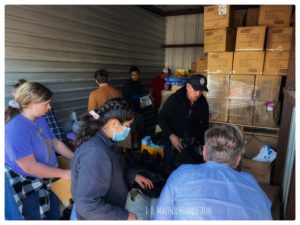
Students participating in the Young Maston Scholar retreat sponsored by the T. B. Maston Foundation for Christian Ethics help sort supplies for El Buen Samaritano Migrante ministry in Eagle Pass. (T.B. Maston Foundation Photo)

Students from Baptist University of the Américas, Baylor University’s Truett Theological Seminary, Hardin-Simmons University, the University of Mary Hardin-Baylor, Wayland Baptist University, Stark College and Seminary, and the Baptist Studies Center at Abilene Christian University participated in a Young Maston Scholar retreat sponsored by the T.B. Maston Foundation for Christian Ethics. M. Daniel Carroll (Rodas) from Wheaton University and Graduate School led the students in examining what the Bible says about immigration. Students learned about ministries of San Antonio Mennonite Church to immigrants and refugees, and they talked with Jesús Romero about Fellowship Southwest’s Educational and Legal Immigration Ministries program. Lorenzo Ortiz, director of El Buen Samaritano Migrante, told students about ministry to migrants, and the Young Maston Scholars helped sort supplies for the ministry. They also served dinner to homeless individuals at Communities Under the Bridge in San Antonio.

David Hardage

David Hardage, who retired recently after 11 years as executive director of the Baptist General Convention of Texas, received the Pro Ecclesia Medal of Service from Baylor University. Baylor presents the award annually to individuals who have made an immeasurable impact through their broad contributions to Christian ministry. Before he was BGCT executive director, he was director of Waco Baptist Regional Association, director of development for Baylor’s Truett Theological Seminary, and pastor of several churches in Texas and Oklahoma. Alan and Vicki Keister of Amarillo received the Pro Texana Medal of Service from Baylor, which recognizes individuals whose contributions in the public or nonprofit sector further Baylor’s mission. He is an internal medicine physician with Amarillo Medical Services, and she worked as a physical therapist before taking a leave from practice to focus on raising the couple’s four daughters. His volunteer service in providing free health screenings at Amarillo schools made community leaders more aware of the lack of health care in the area. That led to creation of the Heal the City free clinic.

Dallas Baptist University students volunteered at Cornerstone Baptist Church in Dallas for a Day of Service on Jan. 16 to honor the legacy of Martin Luther King Jr. Volunteer coordinator Barbara Biddle and Pastor Chris Simmonsdirected the service project, as students sorted and organized items for the church pantry and served lunch to the community. Following the Day of Service, students, staff and faculty participated in the annual Martin Luther King Jr. Unity Walk and prayer service on the DBU campus. Pastor Bertrain Bailey of St. John Baptist Church in Dallas recited King’s “I Have a Dream” speech.

The East Texas Baptist University athletic department received a community service award from the National Association of Division III Athletic Administrators. ETBU was named the One-Time Project award winner for a clean-up effort in the Gilmer area after a spring 2022 tornado. The service project involved the ETBU football team, as well as the men’s and women’s basketball, soccer and tennis teams. “For our student-athletes to sacrifice their time and energy to serve and love others during a difficult time is exactly what Tiger Athletics is about,” said Ryan Erwin, vice president for student engagement and athletics. “ETBU continually strives for excellence within all of our programs and this award highlights that commitment from our coaches and student-athletes, while highlighting our Christ-centered program in the community.” The national association will make a $1,000 contribution to the general scholarship fund at ETBU.

The Program for the Future Church at Baylor University’s Truett Theological Seminary awarded subgrants to three projects designed to engage and empower the future church. The subgrants are made possible by a major grant to Baylor from the Lilly Endowment. “The landscape that surrounds ministry and theological education is changing rapidly,” said Dustin Benac, director of the Program for the Future Church. “We are grateful for the opportunity to support three catalytic projects that are helping us imagine and resource a hopeful future for the church.” Stephanie Boddie from the Diana R. Garland School of Social Work and Truett Seminary and Kevin Magill with the School of Education received a grant to redesign and redefine the “Education from a Gardener’s Perspective” course at Truett Seminary. John White and Brian Gamel with the Faith and Sports Institute at Truett Seminary, along with Andrea Ettekal at Texas A&M University, received a grant for a project on “Measuring Love as a Virtue in Adolescent Christian Athletes.” David Wilhite of Truett Seminary received a grant for his project on “Re-imagining Diversity and Belonging in Christian Communities.”

Ordinations

Ken Ferguson, Blayne Alaniz, Josh LaMotte, Luther Frobish, Matt Meece, Charlie Moehlenbrock, Danny Webband Michael Jereb as deacons at First Baptist Church in Belton.

Retirement

Benny Mayo after 63 years in a variety of ministry roles. He served most recently as minister to senior adults at Hillcrest Baptist Church in Cedar Hill.
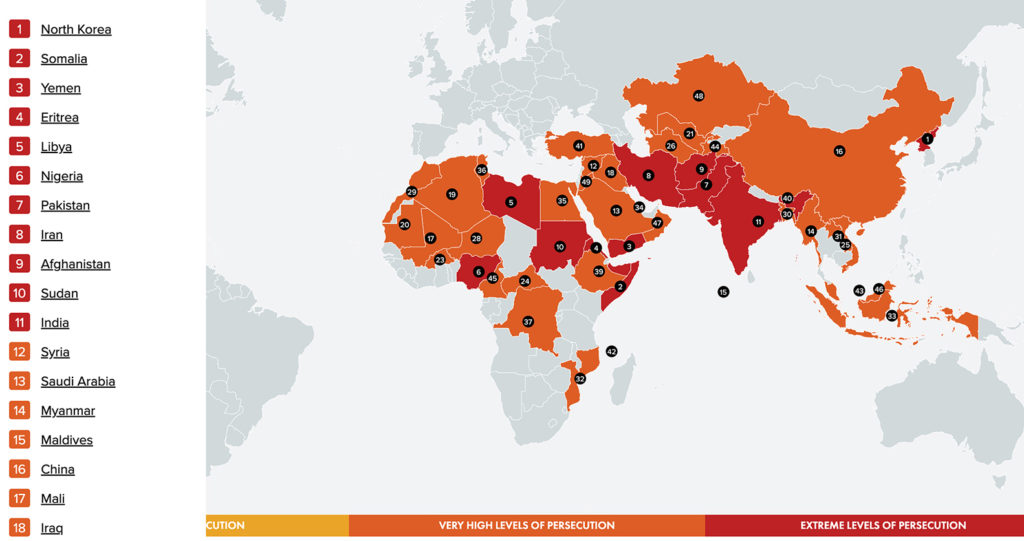


North Korea again tops World Watch List of persecutors

WASHINGTON (RNS)—In the three decades since the religious liberty organization Open Doors has been compiling its World Watch List of the 50 countries where Christians face the most persecution for their faith, that persecution has never been worse.

That’s according to the 2023 World Watch List released Jan. 17, which showed North Korea returning to the top spot after scoring its highest level of persecution ever, following an increase in arrests of Christians under its “anti-reactionary thought” law.

Last year, Afghanistan toppled North Korea from the top of the list for the first and only time since 2002, as the Taliban takeover of the country forced many Afghan Christians into hiding.

Afghanistan dropped to No. 9 in this year’s ranking, as the organization says the Taliban has shifted its focus from searching out Christians to searching out those with links to the country’s former government.

Wybo Nicolai, a former Open Doors global field director who first created the World Watch List, said that since 2010, the number of countries on the World Watch List reporting “high” levels of persecution has increased, nearly doubling since the first list was compiled in 1993. So has the intensity of that persecution.

The “extreme high levels” of 2022—when more than 360 million Christians around the world reported at least high levels of discrimination and persecution—have remained roughly the same, Nicolai said.

How the World Watch List originated

Nicolai joined Open Doors in 1985 as a researcher for the Soviet Union. After the fall of the Berlin Wall, Nicolai said, the organization began to look beyond Eastern Europe, where it had been founded by “Brother Andrew” van der Bijl in 1955.

Nicolai was tasked with mapping the world, finding where Christians were being persecuted and where Open Doors should be active. As he began collecting data in 1991, he developed a method to measure Christian persecution “as objectively, maybe even as scientifically as possible,” he said.

The World Watch List was born.

The list scores the levels of pressure Christians and church communities suffer in private life, family life, community life and national life, along with violence levels.

At first, Nicolai’s list was used internally to inform Open Doors’ work, he said, as Open Doors became a global organization, opening field offices in Nigeria, Bangladesh, Indonesia, countries in East Asia and beyond.

Today, more than 4,000 people, including teams of researchers and lawyers, contribute data to the list, and academics and politicians interested in religious freedom have come to rely on it, as have Christians who are motivated to pray and support their co-religionists facing persecution around the world.

“It’s been a tremendous tool and very much welcomed, generally, by governments in the countries where we are mobilizing prayer support and advocacy because of that recognition that there’s an in-depth, deep dive, underground church, village-level picture and lens of what is happening in countries,” said Lisa Pearce, interim CEO of Open Doors U.S.

Increased violence by Islamist extremists

The list of 10 countries where Open Doors reports Christians currently face the most persecution has changed little since 2022.

On this year’s list, North Korea is followed by Somalia, Yemen, Eritrea, Libya, Nigeria, Pakistan, Iran, Afghanistan and Sudan. Sudan, at No. 13 last year, is new to the Top 10.

The organization also noted a troubling trend: an “alarming” increase in violence against Christians by Islamist extremists in sub-Saharan Africa. In Nigeria, the number of religiously motivated killings jumped from 4,650 last year to 5,014 in 2022—making up 89 percent of all religiously motivated killings worldwide.

“What we noticed is not just an increase of persecution, but also an increase in the size and the strength of the body of Christ. Yes, a lot of atrocities, a lot of drama; at the same time, a lot of church growth, as well,” Nicolai said.

Pearce agreed that church growth despite persecution gives her reason to hope.

“Partly, it’s extraordinary—but incredibly encouraging and challenging—that in a number of countries in the world where it is hardest to live as a Christian, where the consequences are most grave, the church is continuing to grow,” she said.

The 2023 World Watch List covers the period between Oct. 1, 2021, and Sept. 30, 2022.

The United States, notably, is not on the list, though some U.S. Christians have expressed concern about discrimination.

The United States has become more secular over the past 30 years since the World Watch List began, Nicolai said. But there’s a “vast difference” between the experiences of Christians in the U.S. and the countries on the World Watch List.

Wherever freedom of religion is being threatened, Christians must pay attention, said Pearce, who is heading Open Doors’ continued presence in the United States after its previous U.S. arm parted ways with Open Doors International and relaunched this month as Global Christian Relief.

The U.S. office’s commitment to connecting Christians around the world hasn’t changed, though she noted longtime supporters do need to register again on the new website of Open Doors U.S.

Not only should Christians support those who are persecuted, Pearce said, but also they should learn from them.

“I would say to American Christians that relative to many, many, many places in the world, you have extraordinary freedom,” she said. “Use it well.”

A map of the 2023 World Watch List by Open Doors. Screen grab


Barber says sexual abuse hotline worth the cost

NEW ORLEANS (BP)—“The cost of doing nothing” to combat sexual abuse far outweighs “the cost of doing something,” Southern Baptist Convention President Bart Barber said in a video posted to his Twitter account Jan. 17.

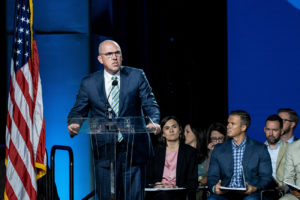
Bart Barber, pastor of First Baptist Church in Farmersville, speaks during the Southern Baptist Convention annual meeting at the Anaheim Convention Center in Anaheim, Calif. Barber was elected president. (Photo by Justin L. Stewart/Religion News Service)

Responding to multiple requests to reveal the monthly costs associated with a hotline to report incidents of sexual abuse that occur within Southern Baptist churches, Barber noted, “There’s not a flat monthly cost for the hotline.”

He explained the costs of the hotline vary based on call volume but did not share any specific expenditures.

“And of course, the first few months of the hotline came when we’d never had anything like that before. And because we’d never had anything like that before, there’s a backlog of people waiting to call in,” said Barber, pastor of First Baptist Church in Farmersville.

The hotline was established May 25, 2022, in response to a report released by Guidepost Solutions outlining alleged mishandling of sexual abuse claims by the SBC Executive Committee over two decades.

It is managed by Guidepost and was in the news earlier this month when accusations were made that the information shared to the hotline was not being kept confidential.

Barber readily acknowledged the hotline is expensive but countered the high costs by suggesting it would cost more in the long run if Southern Baptists do nothing to address sexual abuse.

“For all of my adult lifetime there have been occasions where sexual abuse took place, and the (Southern Baptist) Convention was sued, and we’ve been paying that expense,” Barber said in the video.

“The only way to make the expense go away is to make the abuse go away. And I firmly believe that anything that we can do to prevent sexual abuse in our churches, anything that we can do to aid survivors and help them is money well spent and reduces our expenses in the long run.”

‘The human cost of abuse’

He added there is more to the cost than just dollars.

North Carolina pastor Bruce Frank, chair of the Sexual Abuse Task Force, told messengers to the 2022 SBC annual meeting that June 14 was a day for Southern Baptists to “choose between humility or hubris.” (BP Photo by Sonya Singh)

Referring to the actions of messengers at the 2021 and 2022 SBC annual meetings, he said: “I think the main thing that has motivated us is the human cost. If we don’t care about the human cost of abuse, then we’re in the wrong business, and we’re serving the wrong master.”

Barber recorded the video, which runs for almost seven minutes, at the New Orleans Ernest N. Morial Convention Center, where the 2023 SBC annual meeting will be held in June.

In it, he also discussed an abuse-related court case in Houston he has been attending over the past few weeks, representing the SBC. A civil suit against Paul Pressler is being heard in the Harris County District Court. The charges in the case date back to the 1980s.

Pressler, a former SBC Executive Committee member, former SBC first vice president in 2002 and 2003, and former Texas legislator and judge, is being sued by Gerald Duane Rollins.

In the suit originally filed in October 2017, Rollins alleges Pressler raped him in 1980, when Rollins was 14 years old and attending a Bible study at Pressler’s church. According to the affidavit, Pressler continued to rape Rollins, “over the course of the next 24 years or so” as Rollins progressed into his 30s.

Barber said despite the high costs, he believes having the hotline is the right thing to do.

“I think according to God’s economy and according to the way that accountants look at the economy, it’s a good investment for Southern Baptists to do everything that we can, even if it costs some money to do it, everything that we can to assist our local churches to prevent abuse and to comfort those and provide support for those who are survivors of abuse,” Barber said.


Trump chides former evangelical supporters for ‘disloyalty’

WASHINGTON (RNS)—Former President Donald Trump is chiding evangelical Christian pastors who previously supported him but haven’t endorsed his new presidential campaign, accusing the faith leaders of “disloyalty.”

Dallas pastor says God gives Trump authority to ‘take out’ Korean leader
President Donald Trump (left) is greeted by Pastor Robert Jeffress at the Celebrate Freedom Rally in Washington, D.C. (Photo by Yuri Gripas/REUTERS via RNS)

During an appearance on the Real America’s Voice show “The Water Cooler” Jan. 16, host David Brody asked Trump about evangelical leaders such as Robert Jeffress, the pastor of First Baptist Church in Dallas. Jeffress was one of the former president’s most stalwart supporters during his presidency but recently announced he would not endorse Trump unless he wins the GOP primary race.

Despite initially saying he didn’t “really care” about the lack of endorsement from pastors such as Jeffress, who preached a sermon to Trump the day he was inaugurated titled “When God Chooses a Leader,” the former president went on to voice palpable frustration.

“It’s a sign of disloyalty,” Trump said. “There’s great disloyalty in the world of politics, and that’s a sign of disloyalty.”

Trump touts record on abortion

Trump then touted his record on abortion, noting his administration appointed three conservative Supreme Court justices—a move that ultimately resulted in the overturning of Roe v. Wade, ending nearly 50 years of the nationwide right to an abortion.

Nobody “has ever done more for right to life than Donald Trump,” the former president insisted.

Trump appeared to blame evangelical leaders for the Republican Party’s meager showing in the 2022 midterm elections, saying he was “a little disappointed. because I thought they could have fought much harder” on the issue of abortion.

“A lot of them didn’t fight or weren’t really around to fight,” he said. “It did energize the Democrats. … I don’t know, they weren’t there protesting and doing what they could have done.”

Asked about Trump’s remarks, Jeffress lauded the former president but maintained his plans to refrain from endorsing until after the primary, and he noted Trump has not asked for his endorsement.

“Recently, I said to President Trump privately and on Fox News publicly that President Trump was our greatest president since Reagan and had done more for evangelicals than any president in history,” Jeffress told Religion News Service in a statement.

“Furthermore, I predicted that evangelicals would ultimately coalesce around him as the GOP nominee for 2024 and I would happily and enthusiastically support him. Hopefully, President Trump doesn’t think of me as being disloyal for not volunteering a primary endorsement he has not requested from me.”

Asked if he would endorse Trump if requested, Jeffress said that because he doesn’t identify as a Republican he sees “no need to insert myself at this point into a possible Republican primary fight.” He added that he expects Trump to be the 2024 nominee regardless.

Trump’s venting session highlights the former president’s ongoing struggle to amass the same level of fervent support from a subset of evangelical leaders he enjoyed in 2016 and throughout his presidency.

Despite a “Pastors for Trump” initiative launched in December after Trump’s 2024 campaign announcement, conservative Christian leaders who championed his cause for years, such as Jeffress and evangelist Franklin Graham, have yet to throw their support behind Trump’s new White House bid.

Pence speaks at Dallas church

Meanwhile, Jeffress hosted former Vice President Mike Pence—who is expected to be a potential 2024 presidential contender—at First Baptist in Dallas over the weekend, although Jeffress pointed out to RNS he did not endorse Pence.

According to Axios, Pence told the crowd he “couldn’t be more proud of the Trump-Pence administration” but added: “Obviously the administration did not end well. It ended in controversy.”

Pence also appeared to endorse the idea of Christian nationalism, an ideology embraced by Jeffress and championed by Trump throughout his political tenure. The former vice president, who was at the church promoting his new book, So Help Me God, called the term Christian nationalism “something of a pejorative … among the left-wing media.”

“This nation has ever been sustained by Christian patriots who believe in America,” Pence said, later adding, “America is a nation of faith.”


Disaster relief crews respond to deadly tornado outbreak

NASHVILLE (BP)—Mark Wakefield took cover with coworkers at the Alabama State Board of Missions facility, about 10 miles from a deadly Autauga County tornado, before stepping into action.

Many have stepped up alongside the state’s disaster relief director, not just in Alabama but Georgia and Kentucky as well, to respond to a series of Jan. 12 tornadoes that left at least nine dead.

The line of storms brought multiple tornadoes in the northern and central areas of Alabama, including EF-2 damage in Selma and a confirmed EF-3 further east in Autauga County that resulted in at least seven deaths. It is unclear if the same tornado hit both areas.

In Georgia, a 5-year-old died when a tree fell on the car in which he was riding. A state employee was also killed. Four tornadoes were confirmed in the state.

Four tornadoes also touched down in Kentucky, causing no deaths but damaging some barns and homes. A fifth tornado, an EF-1 like the others, moved across Ballard and McCracken counties as well as into Massac County, Ill.

Kentucky Baptist Disaster Relief chainsaw teams are responding to damage in Pleasureville—not that the events of the day brought a lack of options.

“Rain, hail, snow, tornadoes and an earthquake,” Kentucky Baptist disaster relief director Ron Crowe said on Jan. 13. “That was yesterday.”

The U.S. Geological Survey reported a 2.6 magnitude earthquake Thursday morning, Jan. 12, in central Kentucky.

Churches ‘wanting to reach out to others’

Georgia Baptist disaster relief teams set up at Union Baptist Church to deploy to damaged areas in Griffin for chainsaw work, chaplaincy and further assessment, said state director Dwain Carter.

Chris Reynolds, regional catalyst for the Georgia Baptist Mission Board’s Pastor Wellness Department, accompanied Carter and Troup Baptist Association mission strategist Andy Buchanan to assess damage and meet pastors around LaGrange. A disaster relief base was established for that area at Calloway Baptist Church.

“I’m encouraged by all of our churches calling and expressing their desire to help,” Buchanan said. “They’re wanting to reach out to others.”

Reynolds said: “Pastors are looking beyond their needs to step in to their communities and serve with the love and compassion of Christ.”

A chainsaw team from Hephzibah/Kilpatrick Association responded to reported damage in Warren County, Ga., on the eastern side of the state, but the damage was contained to a rural area.

Alabama Baptists’ early response included two teams from West Central Association in Selma; several associational teams from Tuskegee-Lee and East Liberty associations, alongside those in Tallapoosa Association; teams from Autauga and Chilton Associations in Autauga County; and volunteers from Elmore Association.

Teams will be rotating in and out, with the focus on chainsaw work and tarping, he said.

“At this point there hasn’t been a request for mass feeding, but we’re ready to answer the call if needed,” Wakefield told BP. Conversations have also taken place for potential partnerships with The Salvation Army.

Fairview Baptist Church in Selma received moderate damage, he reported. Another church not affiliated with the SBC suffered heavy damage.

“I’ve met with that pastor and offered assistance to him,” Wakefield said.


BGCT search committee accepting nominations

DALLAS—The search committee is accepting nominations for the next executive director of the Baptist General Convention of Texas through Jan. 31.

As noted in the search prospectus and job description posted on the Texas Baptists’ website, the next executive director will provide the comprehensive spiritual, visionary, relational and organizational leadership necessary to ensure the effective implementation of the BGCT’s mission.

The search committee is seeking an individual who is an active member in good standing of a Baptist church uniquely aligned with the BGCT and who is capable of serving ably as the Christ-centered spiritual leader of the BGCT.

Nominators will need to provide information about themselves and the nominee, including church membership and affiliation status, as well as a description of why they believe their candidate would be fit for the role.

Following the Jan. 31 deadline, the committee will begin a confidential review of the candidates. Nominees will be informed of their nomination and asked to provide additional information about themselves, including verifying their contact information, completing a formal application for the position and submitting their current professional resume.

Search committee updates can be found by clicking here. Nominations may be sent to search@texasbaptists.org.

The search committee was formed in July 2022 following former Executive Director David Hardage’s retirement announcement. David Mahfouz, pastor of First Baptist Church in Warren, serves as committee chair.


Abuse expert says church leaders have ‘utterly failed God’

WASHINGTON (RNS)—Not long after Diane Langberg began working as a clinical psychologist in the 1970s, a client told her that she had been a victim of sexual abuse at the hands of her father. Not sure of what to do, Langberg went to talk to her supervisor.

The supervisor, Langberg recalled, dismissed the allegations.

“He told me that women make these things up,” Langberg said. “My job was to not be taken in by them.”

The supervisor’s response left Langberg in a dilemma. Did she believe her client? Or did she trust her supervisor’s advice?

“The choice I made is pretty obvious at this point,” the 74-year-old Langberg said in a recent interview.

For the last five decades, Langberg has been a leading expert in caring for survivors of abuse and trauma. When she began, few believed sexual abuse existed, let alone in the church. Churches were seen as a refuge for the weary and some of the safest places in the world.

Today, she said, there’s much more awareness of the reality of sexual abuse and of other kinds of misconduct, especially the abuse of spiritual power.

Still, many congregations and church leaders have yet to reckon with the damage that has been done to abuse survivors where churches turned a blind eye to the suffering in their midst.

“We have utterly failed God,” she said. “We protected our own institutions and status more than his name or his people. What we have taught people is that the institution is what God loves, not the sheep.”

The daughter of an Air Force colonel, who grew up attending services in a variety of denominations, Langberg still has faith in God. And she remains a churchgoer, despite the failings of Christian leaders and institutions. Still, she said, those churches and institutions have a great deal to repent of and make amends for.

Langberg, author of Redeeming Power: Understanding Authority and Abuse in the Church, spoke with Religion News Service about the sex abuse crisis in the Southern Baptist Convention, what lessons she’s learned over the past five decades and why she keeps the faith despite the church’s flaws.

This interview has been edited for clarity and length.

When it comes to sexual abuse, there are a growing number of church leaders who say, “We get this now and we can fix it.” But are they aware of the long-term consequences that come with mishandling abuse allegations over a long period of time?

Perhaps it would be helpful to first think about not the church but marriage. If somebody has an affair, they cry and say they are sorry. Then a year later, they have an affair with somebody else. How many affairs are going to be OK before you leave?

That is the kind of thing that has happened regarding the Southern Baptists. This has gone on for a really, really long time. And now they want to say they get it. It’s too soon. Even if they were doing absolutely everything they could to get it, it’s too soon.

How can church leaders start to regain trust?

The first step is not asking for it. The first step is to say: “I want to know what this has done to you. I want to know the ways that it’s been hurtful, I want to really understand the depths of what we did, and how it affects you, not just in terms of church, but in terms of understanding God himself.”

To realize that this person whom God loves has been damaged by us who represent God. And we can’t fix that.

We have utterly failed God. We protected our own institutions and status more than his name or his people. What we have taught people is that the institution is what God loves, not the sheep.

What have you learned in 50 years of this work?

I don’t think we really understand the level of deception that occurs in people who abuse. We think that if they cry and say they are sorry, that’s a good thing. But it doesn’t touch the practice of deception that runs their lives and that runs their organizations. We’re very naive about that. You can’t marinate yourself in the lies and deception that are needed to keep abusing—and then say, “I’m sorry,” and have that change who you are.

There’s been a growing awareness about the dangers of the abuse of children and a willingness to address that issue on the part of churches. But many churches have a difficult time with the idea that adults can be abused. There’s an idea that if you are an adult, then a pastor can’t abuse you.

I find that outrageous, to put it mildly. The word “abuse” means to use wrong. I don’t think we understand the power that comes with the position of being a pastor. I mean, do we really think pastors can’t abuse that power? That they’re above this?

That’s a ridiculous thought about any human being. We’re all sinners. We’re all deceptive. We all deceive. To say just because somebody is a pastor means they can’t be abusive is naive.

If you had a group of Southern Baptist leaders right now in front of you, what would you tell them?

I would tell them that the first thing they need to find is humility. You can’t do something wrong for decades and then say, “Oh, we’re sorry, we did it wrong,” and think that now you understand it. It’s not possible for any human.

You can’t cry and say you are sorry and ask for forgiveness and then it’s all fixed. My reading of the Scriptures and how sin gets ahold of us, and blindness gets ahold of us, would suggest that’s way off the mark.

What have you learned from survivors of abuse?

We don’t realize the level of courage that has been displayed right in front of us. Particularly in Christendom, if you tell the story of surviving abuse, you’re not only going against the person who did it, you’re going against God’s people, you’re going against his church, which adds up to going against God.

And survivors often lose their place in the church. They lose any status they had. They lose honor. They lose trust. All because of the things that were done to them.

Have you ever thought of giving up?

I cut my teeth working with Vietnam vets and with women who told me about abuse that nobody believed. The diagnosis of post-traumatic stress disorder hadn’t come out yet. So, people thought vets were making it up because they were weak, and the women were making it up because they wanted attention. It was a very lonely road.

And somewhere along the way, I told God I was quitting. He obviously convinced me not to do that. Then when I began to realize how much of this was in the church, I wanted to walk away. He convinced me to stay. And I’m very glad I did.


Fellowship Southwest launches immigration service

Fellowship Southwest has launched a program to help immigrants to the United States gain legal status.

As of this month, the U.S. Department of Justice recognizes ELIM—Educational and Legal Immigration Ministries—as a U.S. Department of Justice-accredited immigration provider under the umbrella of Fellowship Southwest.

In addition to providing free or low-cost basic legal services to immigrants, ELIM also will offer a continuum of educational opportunities for churches and individuals, including training accredited representatives to offer legal services related to immigration.

Baptists must do more to help immigrants, advocate says
Jesus Romero, then director of Texas Baptists’ Immigration Service and Aid Center (ISAAC), addresses a Baptist Peace Fellowship of North America meeting. He and his wife Elisa now are leading the Educational and Legal Immigration Ministries program of Fellowship Southwest. (CBF File Photo)

Jesús and Elisa Romero, who have led ISAAC—the Baptist General Convention of Texas-affiliated Immigration Service and Aid Center—since 2010, will continue to serve immigrants through ELIM, working primarily from an office on the campus of Trinity Baptist Church in San Antonio.

ELIM also will serve clients from the campus of Woodland Baptist Church in San Antonio, which should gain federal recognition as an immigration services center later this year.

The organization’s name refers to an oasis mentioned in Exodus 15:27, where the people of Israel camped beside 12 springs and 70 date palms after they began their journey from Egypt to the Promised Land.

“Elim was not the final destination, but a life-giving stop between where they had left and where God was leading. The Romeros and Fellowship Southwest resonate with the imagery of respite expressed in this verse and hope that ELIM will provide the same sense of relief to many immigrants in the future,” a public statement from Fellowship Southwest read.

The BGCT Christian Life Commission and Buckner International launched ISAAC in 2007, expanding the Baptist Immigration Services Network begun about a year earlier. Richard Muñoz initially directed the ISAAC project, with financial support provided through the Mary Hill Davis Offering for Texas Missions.

In 2010, Baptist University of the Américas replaced Buckner as the lead partner for ISAAC with the BGCT, and Jesús Romero became director.

CLC remains committed to immigrant ministry

Katie Frugé, director of the Christian Life Commission and Texas Baptists’ Center for Cultural Engagement, expressed appreciation to Jesús and Elsa Romero for their years of service to ISAAC.

Katie Frugé, director of Texas Baptists’ Center for Cultural Engagement and the Christian Life Commission.

The Romeros “have made a remarkable impact through this ministry, blessing the lives of countless immigrants and those who seek to serve them,” Frugé said.

“While I was saddened when Dr. Romero notified me at the end of the year that he sensed a calling to pursue another ministry opportunity, I was so pleased to learn that he and Elsa made plans to continue their fruitful ministry, serving the immigrant population of Texas.

“Since its inception, the ISAAC project has grown into a legacy ministry of Texas Baptists, providing critical services to members of the immigrant community. The Texas Baptist Christian Life Commission remains committed to continuing this vital ministry as we seek to meet the needs of the foreigner among us. We look forward to beginning the search for the next director of the ISAAC project in the days ahead.”

The Romeros likewise expressed gratitude for the opportunity to serve with Texas Baptists’ ISAAC program, saying: “We are grateful to the BGCT for trusting us with pioneering an immigration ministry more than a decade ago. The seeds of love and care for the strangers among us that were planted then have grown immensely. We are excited about those seeds growing exponentially in Texas and beyond through our partnership with Fellowship Southwest.”

Stephen Reeves

Stephen Reeves, executive director of Fellowship Southwest, said he had known and admired the Romeros since his days as a public policy director with the CLC.

“Their ministry fits perfectly with Fellowship Southwest’s mission and I believe will help expand our immigration work to communities and churches far from the border,” he said. “The needs are great, but I’m confident that through ELIM, [Fellowship Southwest] will help churches respond in creative and faithful ways.”

Cameron Mason Vickrey of Fellowship Southwest contributed to this article.


Scholar applies King’s philosophy of truth in post-truth age

WASHINGTON (RNS)—Martin Luther King Jr. is known as a civil rights activist, a minister and a world leader who gained the Nobel Peace Prize.

Martin Luther King Jr. makes his last public appearance at Mason Temple in Memphis, Tenn., on April 3, 1968. The civil rights leader was standing on the balcony of the Lorraine Motel when he was killed by a rifle bullet on April 4, 1968. (AP Photo via RNS/Charles Kelly)

In a recent book, longtime King scholar Lewis V. Baldwin adds other titles to the man whose birthday is marked with a federal holiday, including ethicist, theologian and philosopher.

In a thick volume, The Arc of Truth: The Thinking of Martin Luther King Jr., Baldwin continues his study of King. After previously concentrating on King’s cultural roots and his prayer life, the emeritus professor of religious studies at Vanderbilt University focuses on what the leader had to say about truth.

“We’re living in an age of lies and conspiracy theories and alternative truths, disinformation,” he told Religion News Service in an interview. “I wanted to write a book that would speak to that and since I am a King scholar, I thought King would be a great case study for getting at these kinds of challenges, because King had a lot to say about the power of truth, of truth telling and of truth sharing.”

Baldwin, 73, spoke to RNS about how King defined truth, how his legacy has been distorted and how 20th-century civil rights activists compare to 21st-century protesters.

The interview has been edited for length and clarity.

Since your book is titled The Arc of Truth, perhaps we should start with how you think the Rev. Martin Luther King Jr. defined truth.

Dr. King defined truth in some of his speeches as the legitimate extension of facts. He saw the relationship between facts, truth and reality. At other points, he speaks of truth as coming to terms with reality. He used that kind of terminology especially when he spoke in terms of objective truth, objective truth being those truths that are universally accepted and those truths that are verifiable.

You say that King “who sought, spoke, and acted on truth” in the 20th century has become “the target of so much untruth” in this current century. What are some of the examples of this that concern you most?

The man and his legacy are being distorted. His legacy is being hijacked, misinterpreted. For an example, on the extreme right of the political spectrum, there are those who argue that Dr. King was opposed to affirmative action, and they make that argument without any proof at all.

There are also those on the right who make the argument that Dr. King, if he were alive, would be opposed to critical race theory. Some have argued that he would be a Republican if he were alive. So, all of these claims are made without any foundation whatsoever.

Because the people who make the claims obviously have not read Dr. King. They don’t understand his message. So, in a sense, Dr. King has become a victim of this post-truth age, because right-wing extremists have made him a convenient and useful symbol in an orchestrated and coordinated effort to promote their own conservative social, cultural and political agenda for this nation.

Are there concerns that you have about people on the left and how they have depicted King in these days?

Not really. I think King, for the most part, has been depicted in a proper way. The only problem I have with the left is that there has not been enough of a pushback on what is happening on the right, in terms of their distortion of Dr. King’s message, his ideals.

You write of King’s kitchen vision after he received a phone call from a white supremacist in 1956, threatening his life. What difference did it make for his ministry and activism to have that moment?

Dr. King actually came to a clearer sense of himself as an ethical prophet through that vision in the kitchen, because the voice that spoke to him that night, around midnight, said: “Stand up for justice; stand up for truth. And lo, I will be with you, even until the end of the world.”

Those are the words of Jesus from the New Testament. So, he found through religious experience what he had not been able to find in philosophy and theology.

You note that King wrote: “There is some element of truth in all religions.” How did his connection with leaders like Mohandas Gandhi, Rabbi Abraham Joshua Heschel and Thích Nhất Hạnh enhance his interest in religious diversity and distaste for religious bigotry?

Dr. King came up with a new and creative approach to interreligious dialogue, rooted in a Christian-Jewish-Hindu-Buddhist-Islamic solidarity against structures of oppression and exclusion and injustice. He tried to intersect people of different religions in his struggle for both civil and human rights.

I think it speaks not only to his universal concern for humankind. It also speaks to his theological and philosophical liberalism, because you don’t have fundamentalists talking about respecting other religions. But Dr. King argued that no religion has a monopoly on truth.

How do you analyze what you call “the truth-telling about who and what King was as a human being,” specifically that he fought against racism so much and less so about sexism, and he was described in some reports as an adulterer?

I explain that in terms that Dr. King used himself. Dr. King argued that we’re all paradoxical creatures. We have a capacity for good and a capacity for evil. And the struggle in life for him, he said, was always to keep that good self in control of that evil self.

We have both, and at times we all fall, and that’s just a fact of life. And he admitted over and over that he was not a saint, that at times he had fallen short.

But the important thing was that he was always interested in doing the will of God, even if he failed. Interestingly enough, when it came to the philandering, the adultery issue, Dr. King ultimately admitted to his own wife that this had occurred. I think that speaks to his capacity as a truth-teller.

Dr. King argued that truth grows. I think, if he were alive today, he would be very supportive of women’s liberation. But it was not a major issue in that time, and he did make statements, of course, against this idea of women being subservient to men.

You also said that marching along Southern highways and in the streets was for King a “visual message about not surrendering to the machinations of evil and untruth.” Do you think more recent protests, including by supporters of the Black Lives Matter movement, and maybe others, are accomplishing the same goal, or are they different in some ways?

This is how Dr. King understood the civil rights movement: When you go out and march, boycott and hold prayer vigils in the street, demonstrations in the street, all of that is designed to expose evil in society and to force people to confront and deal with that evil.

So, I would say, in that sense, Black Lives Matter demonstrations, the MeToo movement demonstrations, demonstrations held by students in the March for our Lives against guns, they are all the same in that regard.


Panelists see public schools as key to the soul of democracy

Protecting public schools that serve all children is a fight for “the soul of democracy,” panelists told a crowd of activists and public education advocates in Southlake.

Charles Foster Johnson, executive director of Pastors for Texas Children, participated in the Jan. 6 forum.

“You are at the front lines of this moral, spiritual battle … for the soul of democracy. You are at the fiercest, most pitched place in that national struggle,” Johnson told participants at the event.

Southlake targeted by ‘takeover’ initiative

Southlake is home to the Carroll Independent School District, which also serves parts of neighboring Grapevine, Colleyville and Westlake. Carroll’s school board was one of four—along with boards in the Grapevine-Colleyville, Keller and Mansfield districts—targeted for “takeover” last year by a well-financed Grapevine-based political action committee, Patriot Mobile Action.

The political action committee opposes the teaching of critical race theory, seeks to remove “troubling resources” from school libraries, and supports teaching “the values of American exceptionalism.”

At the Conservative Political Action Conference in Dallas last August, Glenn Story, president of the Patriot Mobile cellphone corporation, boasted his company funded campaigns to elect like-minded candidates to school boards.

“We went out and found 11 candidates last cycle, and we supported them,” Story said. “And we won every seat. We took over four school boards.”

Political analyst Chris Tackett, a former school board trustee for the Granbury Independent School District, encouraged supporters of public education to “follow the money” to see how a few extremely wealthy individuals influence public policy.

However, that can be difficult when it comes to school board elections, he noted. Donor contributions to campaigns for the Texas Legislature and statewide office are filed with the Texas Ethics Commission, but that same level of transparency is not required in school board races, he said.

“So those who have—we’ll say—nefarious aims really like the way the system works today, and they don’t want to change it,” Tackett said.

Beverly Powell, who served in the Texas Senate until being unseated in the last election after redistricting, likewise criticized how an “oligarchy” of wealthy individuals often influences public policy.

A voucher by any other name

She particularly urged supporters of public education to watch out for politicians promoting private school vouchers without using that term. Instead, she said, they talk about “education savings accounts,” “payments to families of students in special populations,” “tax credit scholarships” and “school choice.”

“It’s not about choice. It’s about stealing your money to send it to high-dollar private schools for wealthy kids who attend there,” Powell said.

She also warned against state funding for charter schools that are “more focused on profit than they are on children.”

Sherrie Mattula, a veteran schoolteacher and former school board trustee with the Clear Creek district who now leads the Sisters United Alliance, encouraged forum participants to learn local school board policies and use them to hold trustees accountable.

She urged local activists to organize groups of five to 10 people who attend every school board meeting to ensure the rights of students and teachers are protected.

Johnson likewise encouraged supporters of public education to attend school board meetings.

“The seat of democracy is the school board meeting. That meeting is where it happens,” he said.

‘Learn who your neighbor is’

Charles Foster Johnson

However, rather than engaging in bitter political battles, Johnson encouraged public education advocates—particularly in growing suburban areas populated by people who moved there from “somewhere else”—to get to know their neighbors and find common ground with them.

“Learn who your neighbor is and start there. That’s where we have to begin,” he said.

Rather than talking only with like-minded political allies in small groups, Johnson urged supporters of public schools to get involved in broad-based community groups with people of different backgrounds.

“Share a meal. Drink a cup of coffee. And get to know the person who is different from you,” he said. “And she is going to see she has more in common with you than in conflict.”

Citing the late Baptist ethicist Glen Stassen, Johnson called on politically oriented advocates of public education to participate in “transforming initiatives” based on Jesus’ Sermon on the Mount.

Retaliation—responding to political opponents with harsh rhetoric and verbal attacks—takes its toll, Johnson said, confessing his own short-comings in that area.

“We have it on good authority. It’s a 2,000-year-old moral teaching,” he said.

“What doesn’t work … is to whack somebody back who whacks you. It just increases the whacking.”


On the Move: Hudson

Brandon Hudson to First Baptist Church in Abilene as senior pastor from Crosscreek Baptist Church in Pelham, Ala., where he was senior pastor since 2013.


Around the State: ETBU softball team serves in Australia

The ETBU softball team partnered with Mission Australia and SecondBites, a Christian ministry in Sydney that seeks to minimize food waste and provide groceries to alleviate hunger and food insecurity. (ETBU Photo)

East Texas Baptist University’s Tiger softball team traveled to Australia in December for the university’s 14th Tiger Athletic Mission Experience trip. Led by Lisa Seeley, director of global education and Great Commission Center, Vice President for Athletics Ryan Erwin and Head Softball Coach Janae Shirley, 41 athletes and staff partnered with the International Sports Federation. The team participated in a 23-and-under tournament in Adelaide hosted by Softball Australia, finishing the tournament with six wins. Players also led a softball clinic at Hills Christian Church and Community School, where they taught softball skills and shared their faith with more than 30 children. The ETBU group also partnered with Mission Australia and SecondBites, a Christian ministry in Sydney that seeks to minimize food waste and provide groceries to alleviate hunger and food insecurity. The team packed more than 950 meal bags for the Christmas holiday weekend. The team also served in Sydney at the Living Hope Church at Camperdown. Half of the student athletes helped wrap Christmas gifts for church members, while the others canvassed neighborhoods, inviting people to the church’s food pantry and other outreach activities. Since 2016, ETBU has sponsored Tiger Athletic Mission Experience trips to Costa Rica, Nicaragua, Dominican Republic, Brazil, Serbia, Israel, Jamaica, Slovakia, France, Japan, Greece and Scotland.

diana garland 150
Diana Garland

The National Association of Social Work posthumously awarded its Pioneer Award to Diana R. Garland, founding dean of the School of Social Work at Baylor University that now bears her name. Although the award initially was announced in 2021, the ceremony was postponed until last October due to the COVID pandemic. Laine Scales, who chaired the committee from the Garland School of Social Work who submitted Garland’s nomination for the award, accepted the award on behalf of the school. “Dean Garland was exactly the kind of social worker the NASW Foundation seeks to honor,” Scales said. “She was a true pioneer in social work, particularly in the area of church social work, and when we first learned of the award, we knew she would be an excellent candidate.”

Former Secretary of State Mike Pompeo will speak at 6:30 p.m. on Jan. 26 at Dallas Baptist University at an event sponsored by the World Affairs Council of Dallas/Fort Worth and DBU’s Institute for Global Engagement. Pompeo will deliver the lecture in the Hillcrest Great Hall of the John G. Mahler Student Center. Ticketed attendees will receive a copy of Pompeo’s most recent book, Never Give an Inch: Fighting for the America I Love. Before he became secretary of state in 2018, Pompeo was director of the Central Intelligence Agency. Previously, he served in the U.S. House of Representatives. He was the founder of Thayer Aerospace, where he served as CEO more than a decade. He later became president of Sentry International, an oilfield equipment manufacturing, distribution and service company. For more information on this special evening event and to purchase tickets, click here.

The University of Mary Hardin-Baylor’s College of Visual and Performing Arts has several events planned throughout January. The art department is showcasing the Deb Barnes memorial art exhibit Monday through Friday through Feb. 9, with a reception and gallery talk at the Baugh Center for the Visual Arts at 5 p.m. on Jan. 12. The music department will host the Meehan/Perkins Percussion Duo for a guest artist concert at 7:30 p.m. on Jan. 17 at the Sue and Frank Mayborn Performing Arts Center. Tickets are required for the show and are available at the box office. Call (254) 295-5999 for information.

Hardin-Simmons University named Bob Brooks as senior development officer. Brooks most recently was director of choral activities and ensemble arts in the College of Fine Arts at Dallas Baptist University. Brooks was founding dean of the Graduate School of Ministry at DBU. He previously served as dean of the College of Fine Arts at HSU from 2011 to 2013, and he was an assistant professor of church music at HSU from 1998 to 2001.

Dallas Baptist University named Sue Kavil as 2022 Piper Outstanding Professor of the Year. The university presents the award to a professor who displays the mind of a scholar and the heart of a servant, both inside and outside the classroom. Kavil teaches doctoral-level research and leadership classes and serves as associate dean and director of research in DBU’s Cook Graduate School of Leadership. She and her husband Steve served previously as Southern Baptist missionaries in Thailand. In addition to working with a women’s prison ministry, she helped develop Thai Country Trim, a business that enables Thai women to help provide income for their families by selling handcrafted ornaments to suppliers overseas. The Kavils are members of Matthew Road Baptist Church in Grand Prairie and volunteer with Mission Arlington.

Baylor University named Daniel J. Pack as dean of its School of Engineering and Computer Science, effective June 1. Since 2015, Pack has served as dean of the College of Engineering and Computer Science at the University of Tennessee at Chattanooga, and he is a 2005 Carnegie U.S. Professor of the Year. Previously, he was professor and the Mary Lou Clarke Endowed Chair of the Department of Electrical and Computer Engineering at The University of Texas at San Antonio and of electrical and computer engineering at the U.S. Air Force Academy. Pack received his Bachelor of Science degree in electrical engineering from Arizona State University, a Master of Science degree in engineering sciences from Harvard University and his Ph.D. in electrical engineering from Purdue University. He also spent a year as a visiting scholar at the Massachusetts Institute of Technology-Lincoln Laboratory.