Education savings account bill carries $1 billion cost

AUSTIN—A program that would direct public money to private schools by establishing state-funded education savings accounts could cost Texas about $1 billion by 2028, the state’s Legislative Budget Board projected.

Gov. Greg Abbott and Lt. Gov. Dan Patrick both have made “parental choice” in education a priority for the current legislative session.

The Legislative Budget Board issued a fiscal note March 22 for SB8 by Sen. Brandon Creighton, R-Conroe, who chairs the Senate Committee on Education.

Creighton’s bill—dubbed “The Texas Parental Bill of Rights”—would grant $8,000 in state funds to any participating family who pulls their children out of public schools. The funds would go into an education savings account where they could be applied to private school tuition and approved educational costs such as uniforms and school supplies.

SB8 also would prohibit public schools from teaching content regarding sexual orientation or gender identity at all grade levels.

Violates separation of church and state

Some opponents of voucher-style bills that would channel state funds to private religious schools insisted the greatest cost would be to religious liberty in Texas.
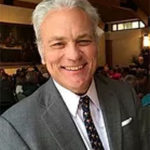
Charles Foster Johnson

Charles Foster Johnson, executive director of Pastors for Texas Children, said the education savings account proposal would violate the separation of church and state by taking public money to fund religious schools.

“Since when do Christians need Caesar’s help to do the will of Almighty God?” Johnson asked.

John Litzler, public policy director for Texas Baptists’ Christian Life Commission, likewise pointed to religious liberty concerns.

In his testimony before the Senate Committee on Education, Litzler pointed out education savings account funds can be applied toward the purchase of books and other instructional materials for private religious schools.

“We will literally be purchasing Qurans and Bibles with state money,” Litzler said.

Details of proposal questioned

For decades, small rural school districts consistently have opposed school voucher proposals. SB8 seeks to make the education savings account proposal more palatable to districts with an enrollment of less than 20,000 by giving a $10,000 grant for the first two school years a child in the district participates in the program.

Sen. José Menéndez, D-San Antonio, questioned why only districts with small student enrollments should benefit.

“If that is a good policy, why does it only apply to small districts?” he asked.

Creighton pointed to limited funds and emphasized his proposal is “not designed to harm public schools.”

SB8 empowers the state comptroller to establish and administer the education savings grant program, disbursing funds on a quarterly basis.

The Legislative Budget Board estimate assumes 25,000 students would leave public schools in 2025, with that number rising incrementally to about 42,000 in 2028.

Total estimated cost for providing grants is $512 million in 2025, but it would increase to $755 million in 2026 and grow to about $1 billion two years later.

‘Focus on fulfilling constitutional duty’

Litzler provided historical context, noting Texas has continued to lag behind other states in terms of what it spends per student in public schools.

“In 2015, Texas ranked 36th out of the 50 states in per pupil spending. We spent around $2,300 less per student than the national average,” he said. “By 2019, Texas dropped to 42nd out of the 50 states in per pupil spending. We now spend $4,000 less per student than the national average.

“I can’t help but think about these statistics when I see the fiscal note for SB8. The Texas Legislature should focus on fulfilling its constitutional duty to adequately fund public education prior to considering diverting any public funds to private education.”

Hearing lasts late into the night

The Legislative Budget Board issued the fiscal note the same day the Senate Education Committee conducted public hearings that lasted late into the night.

At one point in the mid-afternoon, Vice Chair Donna Campbell, R-New Braunfels, asked invited witnesses to make their testimony as brief as possible, because 388 citizens had signed up to testify in the public hearing.

Invited witnesses included representatives from the Texas Conference of Catholic Bishops and other supporters of parochial and private schools.

“Parental choice programs provide hope for the thousands of families who need better access to personalized educational options and are currently denied access to their tax dollars for exercising this natural right,” said Bishop Michael Olson from the Catholic Diocese of Fort Worth.

Some senators on the Committee on Education questioned whether private schools receiving funds through education savings accounts would be able to continue to exclude certain students—including those with special needs.

“Private schools will set their criteria, and parents will make the decision as to whether those criteria are fair or not,” Creighton said.

Cannot get around religious freedom concerns

Litzler finally was able to testify against SB8 at about 11 p.m. on March 22. He commended Creighton for including some commendable language about parental rights in his bill and for making changes to an earlier version of the legislation to limit somewhat the negative impact of education savings accounts on public schools.

“But there are just some problems ESAs can’t get around, and the largest one is religious liberty concerns,” he said.

Litzler noted his daughter will be eligible to enter kindergarten next year. State money made available through SB8 might help enable his family “to send her to a private Christian school,” he said.

But Muslim, Jewish and atheist Texans should not be compelled to provide those funds, he insisted.

“Those neighbors should not have to pay for my daughter to go learn about Jesus,” Litzler said.

Pastor: ‘Testimony I didn’t get to give’

Pastor Natalie Webb of University Baptist Church in Austin waited nine hours before she left the committee hearing without having the opportunity to testify against SB8.

However, she posted on Twitter what she called “the testimony I didn’t get to give.”

Webb, a graduate of Baylor University and its Truett Theological Seminary, tweeted SB8 “leaves most TX kids high and dry by diverting funds away from their education to subsidize the education of a small group of privileged students.”

Small rural communities that lack access to private schools, students with disabilities, students whose parents cannot provide transportation to a private school and urban students whose parents cannot afford private school tuition that exceeds what the education savings accounts would provide will “pay the price,” she tweeted.

“All of those children—whose classes will get even larger and whose school resources will get even smaller—are beloved children of God. They have the God-given right to a quality, free, public education, and SB8 would leave them behind,” Webb tweeted.

‘Tramples on religious liberty’

The education savings account proposal would threaten religious liberty by “funding doctrinal teaching” in religious schools—“whether Christian or Buddhist or Wiccan,” she tweeted.

At the same time, religious private schools that accept state funds run the risk of losing “their distinctiveness and values,” she continued.

“Instead of creating more ‘choice,’ vouchers create LESS by turning private religious schools into watered down, unaccountable arms of the state, and by taking funding away from our already under-funded public schools,” Webb tweeted.

“This legislation tramples on religious liberty and on the vast majority of our Texas children, families and communities, any way you slice it.”

While most testimony focused on SB8, the Senate Committee on Education also heard testimony of several other bills related to “parental choice” and voucher-style programs, including SB2483 by Sen. Angela Paxton, R-McKinney.

The Legislative Budget Board issued a fiscal note estimating her proposal for education savings accounts would cost $4.58 billion from the general revenue fund in 2025, rising incrementally to almost $6.2 billion in 2028.



Global Methodist Church recommends Truett Seminary

WASHINGTON (RNS)—How does one become a pastor in the new Global Methodist Church?

The fledgling Methodist denomination, a home for congregations and clergy that have broken away from the United Methodist Church amid ongoing debate over LGBTQ issues, announced a list of recommended educational institutions for candidates seeking ordination as a deacon or elder.

They include Baylor University’s Truett Theological Seminary in Waco and Beeson Divinity School at Samford University in Birmingham, Ala.

“None of these schools are Global Methodist schools,” said Keith Boyette, who heads the denomination as its transitional connectional officer. “They serve diverse constituencies, diverse student bodies.

“We don’t expect them to be exclusively for the Global Methodist Church, but we’re looking at are they as an institution aligned with who we are and our mission and our doctrine and our practices as a church?”

In addition to Truett Seminary and Beeson Divinity School, the first six schools approved as recommended educational institutions of the Global Methodist Church are:

  • Asbury Theological Seminary in Wilmore, Ky.
  • Ashland Theological Seminary in Ashland, Ohio.
  • United Theological Seminary in Dayton, Ohio.
  • Wesley Biblical Seminary in Ridgeland, Miss.

All of the institutions applied for the recommended status with the Global Methodist Church.

United is the only school on the list owned and operated by the United Methodist Church. The others turn out clergy of various Protestant denominations, though Wesley focuses on small, historic Methodist denominations such as Congregational Methodists.

On March 22, the Global Methodist Church added a second alternative pathway toward completing the educational requirements for ordained ministry outlined in its Transitional Book of Doctrines and Disciplines.

Those pathways include online, hybrid and in-person courses, as well as a certificate program, providing flexibility for students who are unable to take the more traditional route of going to seminary and earning a Master of Divinity degree.

The alternative pathways will be offered through Wesley and United.

Boyette said he can relate, having pursued ordination in his late 30s with a wife, three children and a career as an attorney.

“This is especially important for persons who may not have as much economic means to pursue theological education, or whose life circumstances don’t permit them to agree to move to a physical site or a seminary and be there for an extended period of time completing their degree,” he said.

Only accredited schools accepted

The Global Methodist Church only accepted schools accredited by the Association of Theological Schools in the United States or comparable groups in other countries, he said. The schools also were asked about alignment with the theological and ethical principles of the Global Methodist Church, according to the denomination.

Candidates seeking ordination in the new denomination, which launched last May, still can meet its educational requirements at any accredited seminary, Boyette said, but those who attend a recommended institution can be confident “they’re going to have a greater likelihood that they’ll be adequately prepared.”

Wesley’s program includes a course of study for Global Methodist ordination tailored to the new denomination, according to Matt Ayars, president of Wesley Biblical Seminary. It’s focused on what makes Methodism unique as a historical movement, including topics such as church polity, John Wesley’s theology and the history of Methodism.

“This is a first for us, having a specific course of study for a specific denomination,” Ayars said.

That’s not unusual for many seminaries, he said, but Wesley is a relatively small school serving historic Methodist denominations.

Last month, Bishop Scott Jones, one of two active bishops in the Global Methodist Church, joined Truett’s Wesley House of Studies as an affiliate professor and pastor-theologian in residence.

Ashland, too, has a number of faculty and staff who are United Methodist and may become Global Methodist, according to John Byron, dean of its seminary and professor of New Testament.

Ashland is approved to train United Methodist candidates for ordination and counts as many as 32 different denominations among its students and faculty, Byron said. The school applied for recommended status last summer because, he said, “with the coming schism in the church” it recognized Global Methodist students would be looking for a seminary education, too.

“While everybody’s focusing on this particular schism in the United Methodist Church … the church is just going through a tremendous time of change, and that’s impacting not just the congregations, but it’s impacting us as seminaries, how we deliver and what we deliver,” Byron said.

He added, “The truth is, what we’re doing now probably will not look the same way in 10 years or even less.”

Asked whether the Global Methodist Church planned to launch any educational institutions of its own or attract United Methodist schools to join alongside clergy and congregations disaffiliating from the older, mainline denomination, Boyette said “probably not,” but noted those were decisions for others to make in the future.

“Part of our DNA is we believe that we can work cooperatively with other institutions to advance the mission of the Global Methodist Church, so we don’t have to duplicate what others are doing in order to achieve it,” he said.


Sharp rise in mental health struggles among young women

NASHVILLE (BP)—Young people’s mental health is in trouble, especially young women’s.

Research from the Centers for Disease Control and Prevention’s Youth Risk Behavior Survey shows 57 percent of young women said they felt “persistent feelings of sadness or hopelessness” during 2021. That’s up from 36 percent just 10 years ago.

Identifying depressionThe report notes 30 percent of women surveyed said they seriously considered attempting suicide in the last year, with 24 percent making a plan.

Social media is a key factor, according to Kathy Steele, a licensed professional counselor, former missionary and longtime counseling professor at New Orleans Baptist Theological Seminary.

“I have been watching the research on teenage mental health, especially women, for some time,” Steele told Baptist Press. “I’m not surprised by this. … There are a number of elements, but the primary one does seem to be social media.

“The data is just pretty clear that social media and the access to smartphones all the time is playing a part in this. It takes a toll on them. Teenage girls, their anxiety levels are much higher, their depression seems to be a lot greater, and the biggest explanation has to do with cell phones and social media.

“I’ve also found that the anxiety levels have been somewhat impacted by just the instability of our world right now—politically, in Europe and even here in the United States, everything that’s happened across the last few years. That tends to make parents more anxious, and that then in turn makes teenagers more anxious, because they pick up on all of that anxiety.”

Young women face identity crisis

Steele said beyond contributing factors to a decline in mental health, the true cause comes from a lack of biblical identity.

“I think our society as a whole, especially adolescent and young adults, are definitely in an identity crisis,” Steele said.

“Whether it has to do with sexual identity, or their identity as what is it that means I’m successful, or the way that they look at their identity in terms of their value or worth. We have all grown up in a set belief that I must perform. If I’m going to be acceptable, if I’m going to be loved, if I’m going to be of value I have to perform. And that raises anxiety.”

Katie McCoy, director of women’s ministry with Texas Baptists

Katie McCoy, director of women’s ministry for the Baptist General Convention of Texas, echoed Steele’s sentiment.

“Perhaps the most important topics in discipleship for young women are identity, purpose and worth,” McCoy said. “Nearly every issue plaguing adolescent and young adult girls can be traced back to those three issues.”

In addition to Christian counseling, the local church can play a crucial role in improving the holistic health of women, she said.

“God knows our struggles, our weaknesses and our natures,” McCoy said. “His redemption includes every aspect of our humanity. Through his Spirit, his word and his church, God has given us spiritual tools to overcome ways of thinking that habitually defeat us.

“The Body of Christ gives all the ‘ingredients’ to help a woman become spiritually, emotionally and mentally healthy. It provides a place to belong and to contribute, both significant needs in a culture marked by widespread loneliness. It provides a framework to value the whole person and recognize the complexity of internal and external factors in mental health.

“It provides perspective that corrects the pursuits and priorities of a social media obsessed world. And, it provides the opportunities for meaningful relationships that allow women to talk about mental health challenges before they become crises.”

Steele acknowledges this research can be deeply concerning for parents of young girls.

She said the most important things parents and family members can do are look for signs an adolescent may need professional help, but also listen intently to what they’re going through simply out of love.

“Pay attention to regular life patterns, and when you see drastic changes, that’s something always to check into and be concerned about,” Steele said.

“Parents can really talk with their kids about the impact, about what’s going on.”


Wright elected executive director search committee chair

DALLAS—The Baptist General Convention of Texas Executive Board elected Wendell Wright as chair of the executive director search committee.

Wright, the director of church and denominational relations at Dallas Baptist University and a member of Park Cities Baptist Church in Dallas, has served as a member of the executive director search committee since its formation last July.

As the new chair of the committee, he replaces David Mahfouz, pastor of First Baptist Church in Warren, who relinquished his role as chair and committee member in early March.

“The Texas Baptists executive director search committee expresses our heartfelt gratitude for the foundational leadership our previous chair, Dr. David Mahfouz, has provided these past seven months,” Wright said.

“As a committee tasked with an awesome responsibility, our confidence remains in the Lord who upholds, strengthens and guides our steps. We call upon Texas Baptists, and friends far and wide, to remain vigilant in prayer efforts as we seek the Lord’s direction to lead us to God’s choice for this critical role.”

Wright has served DBU in various roles, including director of DBU North, director of graduate recruitment, director of ministry engagement and director of recruitment and strategic partnerships.

Prior to his time at DBU, he was minister of music and education at Grace Temple Baptist Church in Dallas.

Additionally, Suzanne Liner, member of First Baptist Church in Lubbock, was elected as vice-chair of the search committee and Heath Kirkwood, pastor of First Baptist Church in Lorena, was elected to fill the vacancy created when Mahfouz stepped down.

“The task of finding our next Texas Baptists executive director is of paramount significance, and having the right leadership during the search is vital moving forward,” said Bobby Contreras, pastor of Alamo Heights Baptist Church in San Antonio and chair of the BGCT Executive Board.

“I am thrilled Mr. Wendell Wright will be orchestrating the strong search committee team we have assembled. Mr. Wendell Wright is humble, skilled, wise and sensitive to God’s leading. I have full confidence in him and the search team as we all excitedly anticipate the individual God has chosen to lead Texas Baptists.”

The executive director search committee was formed after David Hardage announced his retirement following more than 10 years of service. The committee is comprised of seven Executive Board members and eight at-large members. An advisory group also provides advice to the committee at its request but does not vote to nominate.

The committee’s next scheduled meeting is scheduled for later this week. Committee updates may be found online at txb.org/edsc.


Former Russian Baptist leader prays for Ukrainian resolve

NASHVILLE (BP)—A former Russian Baptist union leader, speaking from Moscow, voiced an apology for his countrymen who are “participants in this crime against Ukraine.”

“Ukrainians, we’re with you,” pastor Yuri Sipko, president of the Union of Evangelical Christians-Baptists in Russia from 2002-2010, said through a translator in an online prayer forum at the one-year mark of Russia’s invasion of Ukraine on Feb. 24.

‘We believe in your victory’

“We pray for you. And we believe in your victory,” said Sipko, one of several speakers during the conference organized by Mission Eurasia, an evangelical ministry in 13 former Soviet republics and in Israel.

The ministry’s Ukrainian offices near Kyiv were destroyed in a tank battle during the early weeks of the war.

“365 days and 365 nights, there are bombs exploding,” Sipko lamented. “Buildings collapsing. Electricity going out. No water. No heat. This is what millions of Ukrainians are going through today.

“We continue to pray constantly for the Lord to stop this bloodbath. We pray for God to protect Ukraine and the Ukrainian people,” said Sipko, who also was a Baptist World Alliance vice president from 2005 to 2010. Before his election as the Russian union’s president, he had been its vice president eight years.

“You have shown, my brothers, how much courage, how much strength you have, how much belief in freedom, and the ability you have to resist this transgression. This is an incredible example of courageous Christianity,” Sipko said during the Feb. 23 gathering, posted online by Mission Eurasia on March 9.

Prayer for an end to killing

Sipko prayed: “We call upon you, the God of love, from this suffering earth. Lord, please stop this horrible, hateful operation. Please give wisdom to the military commanders—to soldiers and officers. Give them the fear to stop killing. With the hands of your angels, please stop the tanks, stop the rockets and cannons so that not a single more human life is being taken.”

He interceded for “all the people who have to flee from Ukraine. All the elderly, all the women, please protect them with your hand.”

He prayed for “the strength and courage to continue to resist” for the Ukrainian people “and all the people of good will around the world.”

“Please continue to bless the Ukrainian churches to let them continue spreading and preaching the word of your gospel.”

Points to ‘lies’ by Russian government

Sipko, in his comments, noted, “For over 10 years, the Russian government has been slandering people with lies, calling the Ukrainian people ‘Nazis’ and enemies.

“This poisonous hatred has spread in our society and poisoned the minds of people. And as a result, the military force—tanks and rockets—have descended upon the Ukrainian people.

“Inside our country the government persecutes any attempts to express free thought,” Sipko said. “Over 6,000 criminal cases have been opened for slandering the military in Russia. Today, you can be criminally prosecuted and go to prison for saying such words as ‘peace’ or speaking out against the war.”

He added that “special classes” are being taught in schools and universities “where people are being taught how to hate.”

Sipko’s outspokenness is not surprising. He was described as “a gifted, charismatic preacher and communicator … noted for his often temperamental and courageous statements on government and society” in a news report by the Moscow-based Christian Inter-Confessional Advisory Committee upon the election of his successor in 2010. The committee encompasses 22 member bodies ranging from Baptists, Roman Catholics and Lutherans to Seventh-day Adventists.

‘A year of God’s presence’

Also addressing Mission Eurasia’s online conference was Igor Bandura, senior vice president of Ukraine’s Union of Evangelical Christians-Baptists.

Participants at the Baptist World Alliance annual gathering in Birmingham, Ala., lay hands on Vernette Mint Mint San of Myanmar and Igor Bandura of Ukraine to pray for their homelands. (Photo / Ken Camp)

“This year was a year of pain, loss, uncertainty, fears, but at the same time it was a year of God’s presence (and) his blessings in a very unique and special way during the turmoil of the war,” Bandura said.

The Holy Spirit has been “working powerfully and giving us strength and courage, leading us, and making us able to make quick and important decisions during the war,” he said.

Churches have been “key agents of God’s work,” Bandura continued. “From the very beginning of the war, the local churches became the most organized groups of people when the entire country was in chaos and no one knew what to do.

“Churches helped people to evacuate, churches met people on the way and (sought to) accommodate them and help them. Churches helped people to cross the border and churches were the first group of people who met people on the other side of the border,” Bandura said.

The Baptist union envisions every church as “a center of ‘heat and hope,’” he said, “where people can come during the winter and find heat (and) warmth, but they can also find fellowship, find prayer, encouragement, and listen about God (and) the Gospel.”

In most every church, Bandura noted, “at least half of the church members are not there. They left. But the church buildings are filled with people. People are coming and it changed the way we preach the gospel, it changed our strategy of pastoral care, it changed our approach to midweek meetings and services. Our churches are different. What is good—they are faithful to God. They stay faithful to their calling and they serve people where they are.”

Fifty-plus Baptist union churches have been destroyed or damaged in Ukrainian territory, he said. Yet, they have found new places to meet and nearly 70 new pastors have been ordained.

Overall, 3,000 people have been baptized during the last six months, with the Baptist union’s churches drawing about 25,000 visitors every Sunday.

“Sharing with you our troubles but even more our blessings, we invite you to stay with Ukraine in your prayers and practical support and plan your participation (in Ukraine’s recovery),” Bandura told the online participants.

Oleksandr Zaiets, president of the Institute for Religious Freedom in Kiev, reported nearly 500 churches of various religious bodies have been destroyed or damaged by Russian shelling across Ukraine. And hundreds of churches are in the territories occupied by Russian forces.

“The enemy expected that the people in Ukraine and the people in the United States and the free world would get tired and surrender,” Zaiets said.

But Zaiets recalled the biblical admonition to “pray without ceasing” and “not give up in your spirit.”

Mission Eurasia, with offices in Franklin, Tenn., and Wheaton, Ill., was founded in 1991 after the fall of the Soviet Union. It engages in training for emerging Christian leaders across the region, along with children’s ministry, literature distribution and humanitarian aid.

Art Toalston is a Nashville-based writer and a former editor of Baptist Press.


Barna: Pastors’ satisfaction and certainty of call in decline

VENTURA, Calif. (BP)—Protestant pastors are less satisfied with their jobs and church assignments and less confident in their spiritual callings, Barna Group research said in its latest study on pastoral resilience.

Only 52 percent of pastors are “very satisfied” with their jobs, only 50 percent are just as confident of their calling as they were when they began, and only 38 percent are very satisfied with their current church assignment, Barna said.

“This research underscores the need for major interventions to support and sustain pastors in their work,” Barna Group CEO David Kinnaman said March 15 in releasing the findings. “This drop in vocational satisfaction may cause significant problems for churches in the future.”

The numbers show categorical declines as high as 20 percentage points from seven years ago when Barna last studied pastoral resilience.

“Pastors have been frontline workers of a sort the last three years, and the toll of stress, isolation, resentment and division continues to impact pastors negatively,” Kinnaman said. “It is alarming that the number of pastors experiencing satisfaction in their work continues to decline.”

The highest decline was seen in job satisfaction. In Barna’s previous study conducted in 2015, 72 percent of pastors—a full 20 points higher than now—said they were “very satisfied” with their jobs.

Pastors expressed a decrease in confidence in their calling, with only 35 percent saying they are “more confident” than they were at the beginning of their tenure, a drop from 66 percent who said they were more confident in the previous study.

Overall, 55 percent of pastors in the latest study said they have “gone through a period when they significantly doubted their calling for ministry,” Barna said, compared to 24 percent who said so seven years earlier.

The 38 percent of pastors “very satisfied” with their current church is a drop from 53 percent who said so in 2015, Barna said.

“As pastors feel less satisfied in their jobs and more doubtful of their call to ministry, it seems that the role is now taking a greater toll on church leaders than it used to,” Barna Vice President of Church Engagement Joe Jensen said.

“Looking forward, it is important for church congregations to gain a deeper understanding of the challenges their leaders are facing, and then to encourage, support, and care for them more deeply.”

Barna conducted its online study Sept. 6-16, 2022, including 585 pastors and including quotas ensuring Protestant denominational inclusion.

It was the first data release from Barna’s Resilient Pastor Initiative that will include periodic releases March through May, and is augmented with additional resources.

Barna described the findings as “grim,” but said its aim in the Resilient Pastor series is to offer support and solutions for churches and their leaders.

Researchers acknowledged the continuing impact of the COVID-19 pandemic on the lives of pastors and others internationally.

“The full impact of a crisis of its size probably won’t be truly understood for years or even decades, but we are starting to wrap our heads around some of the ways COVID has shaped new norms,” researchers wrote.

“For instance, many people came out of COVID with very different feelings about their jobs than they had going into it. And pastors are no exception.”


Fewer churches face small cash reserves, survey says

NASHVILLE, Tenn.—After enduring difficult economic seasons recently, churches are better prepared for financial rainy days than they were prior to the COVID-19 pandemic.

A Lifeway Research study on the financial health of U.S. Protestants found fewer congregations have less than two months of cash reserves compared to a previous study in 2016.

Additionally, most churches have undergone a financial audit in the past two years, and fewer than 1 in 10 have had someone embezzle funds from the congregation.

“When hardships impact an organization, financial leaders carefully watch how much cash is on hand and how quickly they are spending it,” said Scott McConnell, executive director of Lifeway Research.

“Very rarely does cash stop coming in completely, though some churches experienced that for a few weeks in 2020. But hardships such as a financial recession can impact church receipts and force the use of cash reserves to get by. While improved, there are still too many churches with too little money in the bank given the uncertainties of 2023.”

Prior to 2022, 2016 was the last year a majority of pastors said the economy was having a negative impact on their congregation, according to an annual Lifeway Research study. This time, however, churches seem more equipped to handle the storm.

Around 3 in 10 U.S. Protestant pastors (31 percent) are not sure how many weeks of cash reserves their church has. Among those who know, the percentage of churches with less than 16 weeks of reserves has fallen from 50 percent in 2016 to 44 percent.

Specifically, 20 percent of pastors say their cash reserves are seven weeks or less, down from 26 percent in 2016.

Slightly more churches today have reserves ranging from 16 to 51 weeks. In 2016, 27 percent said that was the case. Today, 32 percent have that amount on hand.

The percentage of pastors today who say their congregation has more than a year’s worth is similar to 2016 (23 percent in 2016, compared to 24 percent in 2022).

Some churches are more likely to have less in the bank than others. African American (52 percent) and Hispanic pastors (35 percent) are more likely than white pastors (17 percent) to say they have less than eight weeks of cash reserves.

Pastors at small and normative sized congregations are also among the most likely to have little to no reserves. Those at churches with worship service attendance of fewer than 50 (24 percent) and between 50 and 99 (21 percent) say they have seven weeks or less in reserves.

Additionally, 1 in 5 pastors at the largest churches, those with 250 or more in attendance, say they have less than two months of cash reserves.

Most pastors (58 percent) say they have had a complete audit of their church’s finances within the past two years, including 47 percent who say the audit occurred within the past year.

Fewer say the audit took place three to four years ago (7 percent) or five or more years ago (12 percent). One in 10 pastors say their church has never undergone a financial audit, while 12 percent are not sure. These are similar to the percentages in 2016.

“Some state laws require that nonprofit organizations of a certain size file audited financial statements, but most churches have an option,” McConnell said. “Many congregations prefer to have this review to ensure that financial processes are being followed and that trust is maintained.”

Pastors 65 and older (54 percent) are more likely than their youngest counterparts, pastors 18 to 44, (42 percent) to say their church had an audit within the last year. Additionally, those younger pastors are also the most likely to say they are not sure the last time their church underwent a complete financial audit (16 percent).

Mainline pastors are more likely than evangelical ones to say their church conducted an audit within the past year (55 percent, compared to 45 percent). Methodists (75 percent) are the most likely to say their last audit was that recent.

Relatively few pastors say their congregations have had someone embezzle money from them, but still around 1 in 13 churches (8 percent) have experienced this. More than 9 in 10 pastors (92 percent) say they are not aware of any past instances.

The rate is statistically unchanged from 2016 when 9 percent reported previous embezzlement and 91 percent were unaware of any.

“The misappropriation of funds is more likely when an organization lacks necessary processes so that multiple people are aware of every expenditure before it is made,” McConnell said. “Skipping some of those safeguards and streamlining financial accountability for the sake of ministry may sound easy to justify, but it can be a costly choice for a church.”

Restorationist movement pastors (16 percent) and those at Presbyterian/Reformed churches (14 percent) are among the most likely to know of an instance of someone embezzling funds from their church. Baptists (7 percent) and Pentecostals (4 percent) are among the least likely.

The phone survey of Protestant pastors was conducted Sept. 6-30, 2022. Researchers weighted responses by region and church size to reflect the population more accurately. The completed sample is 1,000 surveys, providing 95 percent confidence that the sampling error does not exceed plus or minus 3.2 percent. Margins of error are higher in subgroups.


Buckner Family Pathways boasts record-high success rate

More than nine out of 10 single parents enrolled in Buckner Family Pathways complete the program—an achievement that not only improves their lives but also helps break the cycle of generational poverty, Buckner officials assert.

Buckner Family Pathways seeks to help single parents set and reach educational goals and achieve financial self-sufficiency.

In Texas, more than one-third of all children—about 1.9 million—live in single-parent households, and 42 percent of Texas families living in poverty are headed by single mothers.

Krystal Smith says that coming to Buckner Family Pathways was an answer to prayer. Raising two children on her own, she evaluated her budget and realized she had enough money to either rent a home or eat – there wasn’t enough to do both. The stability and safety of the Family Pathways program supported Smith to achieve a degree in applied behavioral science. (Buckner Photo)

Buckner Family Pathways provides participants and their children stability and security by offering reduced-rate housing in a safe place and child-care assistance.

Single parents—almost always single mothers—in Buckner Family Pathways receive access to counseling services, spiritual enrichment and mentorship, along with training in parenting skills, money management, communication and conflict resolution.

The program helps protect vulnerable families from domestic abuse, financial uncertainty and the risk of homelessness while helping them learn to set and achieve goals.

Last year, Buckner Family Pathways posted a 93.9 percent success rate as measured by program completion, Buckner Children and Family Services announced March 20.

‘We consider it a ministry’

“That’s a new record for us,” said Marisa Phillips, senior director for Buckner Family Pathways.

Marisa Phillips

While “apple-to-apple” comparisons with similar programs for single parents are difficult because most are more limited in scope than Buckner Family Pathways, Phillips said, an informal study several years ago showed the national success rate was closer to 20 percent.

“One thing that sets Buckner Family Pathways apart is that we are a faith-based program,” said Phillips, who has worked with the program 22 years. “We consider it a ministry.”

Participants are encouraged—but not required—to attend church services, and members of local churches are provided opportunities to interact meaningfully with clients, she noted.

Graduates of the Buckner Family Pathways program in Dallas last year included (left to right) Wilena “Lena” Duri, Marty Jackson and Khadija Young. (Buckner Photo)

Mentors, family coaches and case workers encourage single mothers and help them take each step on the path toward achieving self-sufficiency, she added.

“For first-time college students, enrollment can be a daunting process,” Phillips said. “We try to set them up for success, letting them know there is someone walking alongside them.”

Buckner Family Pathways participants are considered to have completed the program when they earn a degree or certificate from an educational institution, transfer to a higher education program, or achieve sustainable employment and financial self-sufficiency.

For some single mothers, self-defined success means completing a college degree or vocational training certificate they previously considered unattainable. For others, it means setting and achieving goals in terms of savings, salary or home ownership.

‘Breaking the generational cycles’

Last year, participants also reported a 94 percent satisfaction rate with the program in meeting Buckner Family Pathways’ self-defined standards of quality for strengthening and supporting families.

Cyndi Russell faced a challenging road with little to no family surrounding her. After spending time in jail and being separated from her son, she was able to learn foundational skills to transform both their lives through the Family Pathways program. (Buckner Photo)

In addition to tracking program completion and participants’ satisfaction, Buckner also monitors graduates to see how many maintain self-sufficiency 90 days after graduation.

“It’s too early to report on our sustained self-sufficiency rates for last year, but we are all extremely proud of our graduates from 2021 who were able to achieve a 92 percent sustained self-sufficiency rating,” said Kandyce Ormes-Ripley, associate vice president of data analytics and strategy for Buckner International.

“This number is evidence that the single-parent graduates of Buckner Family Pathways are truly breaking the generational cycles of poverty for themselves and their children.”

Mothers who were survivors of abuse and neglect, who experienced homelessness or who grew up in the foster care system not only find jobs, but also achieve career goals they previously considered unattainable, she said.

“Now these mothers are doctors, teachers, counselors and social workers,” Ormes Ripley said.

Track record of generational impact

Buckner Family Pathways began in 1997 at a single site in Lufkin. Last year, it served 166 Texas families in Amarillo, Dallas, Houston, Longview, Lubbock, Lufkin and Midland. A single parent typically is enrolled in Buckner Family Pathways two to four years, and 31 graduated last year.

On the 20th anniversary of Buckner Family Pathways in Lufkin, the agency reached out to graduates to see how they—and their now-adult children—were doing, Phillips noted.

Of those who responded, more than 90 percent of the individuals whose mothers had completed Buckner Family Pathways also went straight from high school to attend either an institution of higher education or entered vocational training, she said.

“There were no reports of substance abuse, homelessness or criminal activity,” Phillips said.

Children who grow up in Buckner Family Pathways households see their mothers setting goals and working hard to achieving them, she noted.

“They grow up seeing that mom does her homework,” she said.

They also grow up in households where mom expects her children to complete their school work, she added.

“The biggest thing about the program is the generational impact,” Phillips said. “For every one family that is affected directly, the impact is multiplied as the children in those households grow up and influence the next generation. It’s exponential. There’s no better investment.”


Russian religious persecution grows during war on Ukraine

WASHINGTON (BP)—Russia has amplified its persecution of Christians, Muslims and Jews in its war on Ukraine, destroying churches and murdering, torturing and imprisoning many pastors and advocates, participants in a U.S. government hearing said March 15.

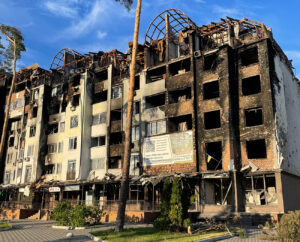
Leonid Regheta witnessed this war-damaged building in Irpin during a summer 2022 trip to Ukraine. (Photo courtesy of Leonid Regheta)

Panelists decried and called for punishment of Russia’s war crimes explored in “Russia’s Invasion of Ukraine: Implications for Religious Freedom,” a virtual hearing hosted by the U.S. Commission on International Religious Freedom.

Russia murdered at least 26 religious leaders, tortured others and imprisoned many, and it heavily damaged or destroyed at least 500 churches and other religious places of worship, said panelist Dmytro Vovk, an expert on religious freedom with the Organization for Security and Cooperation in Europe Office for Democratic Institutions and Human Rights.

The Russian Orthodox Church has suffered persecution while widely cooperating with and supporting Russia in the war, Vovk said. He described about a third of church buildings decimated as Russian Orthodox congregations. The Russian Orthodox Church is comprised of thousands of congregations in Ukraine that describe themselves as independent of Russia.

Before the war, Ukraine and Russia operated with polarly opposite religious landscapes. While Ukraine’s religious freedom protections are among the most liberal in the region, “Russia has managed to create a very restrictive religious framework,” Vovk said, “with one religion, the Russian Orthodox Church, being strongly endorsed and mainly just religious minorities being severely discriminated against and oppressed.”

But the war has even increased religious persecution within Russia that was already rampant, panelist Rachel Denber of Human Rights Watch said, with efforts to annihilate civil society related to religious persecution.

“At home, the Kremlin has been trying to decimate what had been a robust and civil society and laid to waste key fundamental freedoms,” said Denber, deputy director of the Human Rights Watch Europe and Central Asia Division.

“The muzzling of Russian citizens did not emerge in a vacuum, but it is the result of a decade of step-by-step repression that started in 2012 and that accelerated in critical moments—in 2014 when Russia’s war against Ukraine actually started (the annexation of the Crimean Peninsula from Ukraine), in 2018 and in 2020 this repression at home escalated … and then, of course, with the full-scale invasion in 2022.

“Russian public life is unrecognizable as compared to even 18 months ago, when authoritarian autocracy was already deeply entrenched.”

Repression forced many to flee Russia

Russia’s homeland repression has forced many to flee, including foreign media outlets and public rights groups. About 74 foreign groups have been blacklisted as undesirable through Russian law and about a third of the American donor groups and think tanks, including the National Democratic Institute and the International Republican Institute.

Panelist Pinchas Goldschmidt, chief rabbi and president of the Conference of European Rabbis and exiled chief rabbi of Moscow, has urged the Jewish community to flee Russia.

At least 11 rabbis have been expelled from Russia, leaving synagogues and communities without leaders, and about 30 percent of the Jewish population of Russia has fled, Goldschmidt said.

Russian President Vladimir Putin’s government is increasingly authoritarian and nearly totalitarian, Goldschmidt said, describing the climate as more and more dangerous.

Dennis Christensen, a Jehovah’s Witness leader who was imprisoned six years for his faith in Russia, said the country makes a mockery of justice. When it was widely reported he was paroled in 2019, he said, he remained imprisoned for the remainder of his term.

Russia’s penal system works on “breaking a person down,” he said. “You were no longer a human being. You were a prisoner.”

Hundreds of Tatar Muslims have been imprisoned since Russia gained control of Crimea in 2014, according to the written testimony of a Crimean Tatar activist who was unable to attend the hearing. About 96 remained imprisoned, many have been tortured, and one has died in incarceration, according to the written testimony.

Russian victory equals less religious freedom

If Russia wins its war against Ukraine, it will continue to erode religious liberty in Ukraine and establish there the near authoritarian control Putin demands in Russia, panelists said.

USCIRF members on the panel included Chair Nury Turkel; vice chair Abraham Cooper, Commissioners Sharon Kleinbaum, David Curry and Frederick Davie.

U.S. Sen. Roger Wicker of Mississippi called Russia one of the world’s worst violators of religious freedom and said Russia wants to return to the previous empire of the USSR.

“Allowing these actions to go unchallenged would give this dictator a green light to escalate his repression,” Wicker said in pre-recorded remarks. “The Kremlin’s renewed all-out assault on Ukraine reveals Putin’s goals. He wants to go back to the old Soviet empire by any means necessary.

“He has framed the war in religious terms,” Wicker said of Putin, “and set his own people against Ukraine. … Despite the Kremlin’s claims, it is Russia’s forces who have kidnapped, tortured and killed religious leaders and destroyed places of worship.”


Johnny Hunt sues Southern Baptist Convention

WASHINGTON (RNS)—A disgraced former Southern Baptist president is suing the denomination he once led, saying he was defamed by allegations he assaulted another pastor’s wife.

In a complaint filed in the federal court for the Middle District of Tennessee, lawyers for Johnny Hunt, a long-time Georgia megachurch pastor, admit Hunt “had a brief, inappropriate, extramarital encounter with a married woman” in 2012. But Hunt claims the incident was consensual and was a private matter that should not have been made public in a major 2022 report.

“Some of the precise details are disputed, but at most, the encounter lasted only a few minutes, and it involved only kissing and some awkward fondling,” according to the complaint.

The complaint said Hunt sought counseling and forgiveness for the incident, which the complaint said was “a sin.” However, Hunt never disclosed the incident to First Baptist Church of Woodstock, Ga., where he was the pastor for three decades, or to the SBC’s North American Mission Board, where he was a vice president until resigning in 2022.

The incident became public in May 2022, after it was discovered by investigators at Guidepost Solutions, a consulting firm that had been hired to investigate how SBC leaders had dealt with the issue of abuse.

Guidepost’s investigators included the incident as part of their report and described it as a sexual assault. Those investigators said they found the allegations against Hunt credible. The former SBC president at first denied the allegations, then claimed the incident was consensual.

Claims Hunt made a ‘scapegoat’ for SBC

The complaint alleges the SBC and Guidepost engaged in defamation and libel, that they invaded Hunt’s privacy and intentionally caused emotional harm.

“The decision to smear Pastor Johnny’s reputation with these accusations has led him to suffer substantial economic and other damages,” according to the complaint.

“He has lost (his) job and income; he has lost current and future book deals; and he has lost the opportunity to generate income through speaking engagements.”

Hunt also claims he was made a scapegoat to pay for the SBC’s past sins. He said current SBC leaders and Guidepost were engaged in damage control to repair the 13-million-member denomination’s reputation.

“By focusing on the allegation against Pastor Johnny—an allegation by an adult woman that involved noncriminal conduct—and by then taking aggressive action against Pastor Johnny, the Defendants sought to create the appearance that the SBC has learned from its previous mistakes and is now working to protect victims of sex crimes,” the complaint claims.

Alleges Hunt named to ‘deflect attention’

The complaint accused current SBC leaders and Guidepost of intentionally causing him “personal anguish and harm.”

“Defendants’ decision to feature the allegation against Pastor Johnny in their public report was a strategic decision to deflect attention from the SBC’s historical failure to take aggressive steps to respond to reports of child sex abuse and other sex crimes in its past,” the complaint claims.

A spokesperson for the SBC’s Nashville-based Executive Committee said SBC leaders are aware of the suit.

“We are reviewing the complaint and will not be commenting on active litigation at this time,” the spokesman said in a statement.

Guidepost Solutions declined to comment.

Return to the pulpit

Hunt made a defiant return to the public in January at a Florida megachurch, after a group of pastors announced that Hunt had been through a restoration process and was fit to return to ministry after a brief hiatus.

Pastor Johnny Hunt preaches at Hiland Park Baptist Church on Jan. 15, 2023, in Panama City, Florida. (Video screen grab via RNS)

During that sermon, Hunt said “false allegations” had ruined his life. But he told the congregation that if God calls someone to do something, that calling can’t be undone—and God called that person, knowing the person might sin and fail.

“Anybody can quit,” he said. “That’s why so many do. It’s easy. I mean, it hardly takes any energy whatsoever.”

Hiland Park Baptist Church in Panama City, Fla., which hosted Hunt and whose pastor oversaw Hunt’s restoration, could face consequences at the upcoming SBC annual meeting in June.

The church has been reported to the SBC’s credentials committee for hosting “an individual who has been credibly accused of sexual abuse, according to the standards adopted by the convention.”


Preemptive Love and Search for Common Ground merge

WASHINGTON (RNS)—A year after ousting its founders, the Preemptive Love Coalition announced March 16 that it has merged with the international peace-building nonprofit Search for Common Ground.

Search for Common Ground CEO Shamil Idriss called the merger a “strategic leap forward” that allows the work of Preemptive Love to continue while expanding the broader goals of the joint organizations.

“Preemptive Love’s rapid response capabilities and community development experience, paired with the established history and experience of Search, will greatly expand the ability of both organizations to serve the communities with whom we work,” he said.

Year of turmoil at Preemptive Love

The merger brings an end to a year of uncertainty for Preemptive Love.

Founded in 2007 by a pair of ex-missionaries living in Iraq, the group grew rapidly by rallying young supporters to provide funding, first for heart surgeries and then expanding to broader relief work in the Middle East and beyond.

Jeremy Courtney, founder of Preemptive Love

Founders Jeremy and Jessica Courtney had a knack for convincing supporters they could play an active role in responding on the ground and were especially gifted at video storytelling and the use of social media.

Jeremy Courtney grew up in Leander as the grandson of a Baptist minister. He attended Howard Payne University and earned his Master of Divinity degree from Baylor University’s Truett Theological Seminary.

Even though Preemptive Love is a secular organization, its work proved particularly attractive to Christian influencers and young Christians who were disillusioned with politicized religion and wanted to change the world. The founders saw delivering aid as a form of making peace, inspired by the teachings of Jesus.

In 2021, the founders were placed on leave due to concerns about an unhealthy, abusive culture at the organization and allegations they had misled donors. The board cut ties with the Courtneys in early 2022.

Need for organizational changes

Their departure led to a year of self-evaluation and the realization Preemptive Love needed to make significant organizational changes in order to survive. That led its leaders to seek a merger with a more established organization, according to Jen Meyerson, the chief program officer for Preemptive Love.

“We are a peacemaking organization, but we are so young,” said Meyerson. “To be able to partner with an organization that has more than 40 years of experience in this space brings a real sense of excitement and anticipation.”

Founded in 1982, Search for Common Ground works on defusing conflict and peacemaking in 31 countries across Africa, Asia, Europe, the Middle East and North America.

The newly merged organization will have a combined budget of $76.5 million and about 800 staff.

Not all the staff of Preemptive Love will join the new organization, Meyerson said. Preemptive Love is working on transition plans for anyone let go due to the merger. The current board of Preemptive Love has dissolved, though at least one former Preemptive Love board member will join the Search for Common Ground board.

For now, Preemptive Love will still operate under its original name and most of its programs will remain intact, even though the two groups are now legally merged.

Importance of trust

Idriss said it will take time to communicate the changes in the organization to donors and the communities that Search for Common Ground serves.

“Trust is going to be No. 1 for us on all fronts,” he said. “Trust with the PLC staff who are coming over as well as those who will be transitioning. Trust with the donor base. Trust with the communities we work with on the ground.”

Idriss said that Search for Common Ground has been involved in direct aid in the past, though mostly working with partners. Adding the Preemptive Love staff will give the group added expertise.

He also hopes Search for Common Ground will benefit from Preemptive Love’s ability to engage with donors. Most of Search’s past funding has come from larger donors, such as governments, rather than individuals.

“On average, Search for Common Ground leverages every dollar we get from individuals to about $20 of funding from larger institutions,” he said. “But to be frank with you, it is a lot harder for us to raise that single dollar than it is to raise the institutional funding.

“For the PLC community of supporters, I think it’d be really exciting for them to know that not only is their contribution, financial and otherwise, going to go toward building peace, but we actually have a system for leveraging that into much more significant support.”

He said the two groups also have programs that complement each other. Preemptive Love has the ability to respond quickly in a crisis. Search for Common Ground has a long-term plan for community impact.

“PLC has this brilliant and motivating and inspiring way of coming in at the front end. And we have a very well-established way of continuing that sustained change across entire societies,” he said. “I don’t know any organization that brings both these things together right now in the peace-building sector.”


Saddleback ‘prayerfully considering’ next steps, says pastor

LAKE FOREST, Calif. (BP)—Saddleback Church is considering whether to appeal a vote of being found not in friendly cooperation with the Southern Baptist Convention, but regardless plans to “continue our 43-year partnership with our local association and state convention,” Lead Pastor Andy Wood told Baptist Press.

“If we choose to appeal this decision it will be based on a desire to help serve other SBC churches,” he wrote in an email.

Saddleback recently released a video featuring Wood explaining the church’s position on women in ministry.

He explained that while the church believes women can be empowered with spiritual gifts, including preaching, those gifts are exercised under the authority of the elders of the church, a role he says is limited to men at Saddleback.

At their February meeting, the SBC Executive Committee affirmed a recommendation by the SBC Credentials Committee to deem Saddleback “not in friendly cooperation with the Southern Baptist Convention.” The Credentials Committee cited the role and function of Stacie Wood, the pastor’s wife, as teaching pastor at Saddleback for its recommendation.

Saddleback was one of six churches voted for disfellowship. Action was taken against five of the churches because they have women in the role of senior pastor or teaching pastor.

SBC Bylaw 8 states that a church may submit a written appeal “at least 30 days prior to the Convention’s annual meeting.” Such an appeal this year would need to be submitted before May 14.

Saddleback’s approach to women in ministry

In the recent video, Wood pointed to the church’s interpretation of Scripture as the basis for Saddleback’s approach to women in ministry.

However, the word “complement” or a variation thereof isn’t used in the video. When asked by email if that was intentional, Wood said: “The intended audience for my recent video is the Saddleback Church family. In the video, I stated our beliefs without using terms that could be unnecessarily confusing or divisive.”

In the video, Wood said it is important to look at God’s original design versus the dangers of sliding into a “trajectory hermeneutic” that places Scripture in a secondary role to culture’s influence.

“We’re trying to go back to God’s intended design of what he teaches in Scripture and his intention for the local church,” said Wood.

The Saddleback pastor cited their interpretation of Bible passages such as:

Romans 16, which mentions Phoebe, a deaconess, and Priscilla and Aquilla, who were influential leaders in the early Church, and
Romans 16:6-7, he said, notes a woman named Junia as among the early apostles.

The passage 1 Timothy 2:12 often comes up in these discussions, said Wood, and he believes it is helpful for discerning between the office of the elder and the gift of teaching.

“An elder can empower women and mobilize women to use their spiritual gifts in the local church. And we see this from a descriptive angle all throughout the course of the New Testament,” he said.

“Conservative, Bible-believing theologians” interpret the passage differently, Wood said. He believes the text is about the authority elders have in authorizing who can use gifts, such as teaching, in the local church.

“Just like Paul gives order in a home with a husband being the head of a household, he’s saying, ‘I don’t permit a woman to come in and seize that role.’ So, when a woman teaches in a local church, she’s teaching in conjunction with the authority of the church … [and] uses that spiritual gift under the authority of the eldership or the leadership of the local church.”

Saddleback ordained three women in May 2021 to various ministry positions with the title of “pastor.” A little over a year later, founding pastor Rick Warren announced his plans to retire by that September and named Wood his successor.

On Oct. 9, 2022, Stacie Wood preached a message at Saddleback titled “The Courage to Slow Down.” In comments to BP at that time, Andy Wood clarified he and his wife are not co-pastors, but he serves as lead pastor while she is one of the church’s teaching pastors.