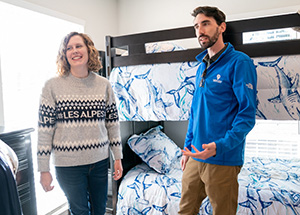
Pastors enter public service to ‘be a light’ in communities

MANSFIELD (BP)—Michael Evans developed a heart for public service when he was 8 years old.

Early each morning, after his mother and great-grandmother boarded the bus to work, he had to prepare breakfast, get his 3-year-old sister Michelle on the bus to preschool and walk himself the two miles to class without getting in trouble along the way, he said.

“My mother depended on me. I saw her cry too many times because of what we didn’t have,” said Evans, mayor of Mansfield and senior pastor of Bethlehem Baptist Church there.

‘Be the solution’

Paducah, Ky., City Commissioner Raynarldo Henderson (left) was sworn in by Judge Christopher Shea Nickell.

Raynarldo Henderson, city commissioner in Paducah, Ky., and pastor of Washington Street Missionary Baptist Church there more than 30 years, was inspired for public service during his early adulthood in Chicago when the late Harold Washington was mayor.

“There were fights on the (city council) floor. I remember one alderman … standing up on the table,” Henderson said. “Those first four years for Harold Washington were rough. They gave him a hard time. And it was watching those city council meetings that it was like: ‘Wow. I can be a solution. I can make a difference.’

“I was taught that if you see a problem, you be the solution.”

Both Evans and Henderson are fulltime pastors who concurrently serve in elected office in the public square. Both see their pastorates and their elected governmental posts as godly callings. Both express the ability to uphold the laws of the land while also exhibiting godly behavior as the Lord’s ambassadors.

“There are some people who think pastors shouldn’t be in politics,” Henderson said. “But obviously, I think the exact opposite, because we do get an opportunity to impact” communities.

Longtime involvement in community

Evans, a Houston native elected to his second mayoral term in November 2022, came to the office after holding various public posts as early as 2007, including terms on the Mansfield Independent School District Board and the Tarrant County College District. He was a commissioned officer and reserve chaplain in the U.S. Navy, and he is a former president of the Baptist General Convention of Texas.

Michael Evans is mayor of Mansfield and senior pastor of Bethlehem Baptist Church in Mansfield. He is a former president of the Baptist General Convention of Texas.

Evans, who eventually became the oldest of six children when his mother remarried, experienced both provision and lack during his childhood, he said. His birth parents divorced after his father returned from the Vietnam War.

“When you see people hurting and you encounter people who are hurting, and I was blessed to have grandparents on the maternal and paternal side that held us up while our parents were going through,” Evans said.

“So, when you have those experiences, you say: ‘Lord, help me to pay back, because I know that it’s been given to me. So, so help me to give it back.’”

Bethlehem Baptist Church elected him pastor when he was 24 years old, when Mansfield was a rural community of just 15,000 residents.

“They helped me grow up here as a young man,” he said of the congregation that averaged 1,200 in worship before the COVID-19 pandemic and draws 600 in worship today.

‘Love and serve’ all

Evans sees himself as exposed to a diversity of public opinion as a mayor, but covered by God as his servant.

“Character counts. I believe people will read you before they read the Bible. I’ve got to love and serve even those that don’t like me. I learned that in the pastorate,” he said. “Bethlehem got me ready for that. I praise God for giving me a covering, and it is here at Bethlehem.”

Evans doesn’t compromise God’s word, he said, but upholds the constitutions of Texas and the United States, as he is sworn to do as mayor.

“My job (as mayor) is to not allow you to be mistreated or discriminated against because of the way you think. That’s just right to do. I cannot stand by and allow any person to be mistreated,” Evans said. “I believe that the best way to save a person is for the people to see Christ in the (other) person. And they can’t see that with me hating them. …

“[I]n regard to society, you’ve got to know that I’m going to respect your position. I don’t have to accept your position, but I have to respect it and I have to protect it and protect you, because I made a vow to do just that. To do otherwise would be dishonest. I shouldn’t even take the oath if I didn’t mean to be right.”

Integrity essential

He sees integrity as a way of sharing the gospel.

“You share it by being fair to the parties that come before you,” Evans said. “You share it by loving those who you know hate your guts because you’re Black. You share it by demonstrating condolence when bad things happen in the city. It’s lifestyle evangelism.”

Henderson’s road to elected office included three campaigns before his winning run as city commissioner in November 2020.

“I’m just not a quitter. You don’t stop, my mom always taught us, you don’t stop because you come to a wall,” he said. “You go over the wall, under the wall, around the wall.

“I kept on going because I knew that was what God had for me. Because I believe that in my heart, I kept pressing. If God has called you to it, he’ll bring you through it.”

Today, Henderson is known affectionately as “Pastor Commish.”

Make an impact

Henderson enjoys his public office, particularly frequent opportunities to offer the invocation at public meetings.

“I get an opportunity through my prayer to set the tone or the atmosphere of meetings. If a meeting goes well, I feel like it has had something to do with what I prayed and how I asked God’s presence to be in our meetings,” he said. “I get an opportunity to say to our other commissioners or mayor, I feel God is leading me to do this.

“I have an opportunity to be a witness or to be a light in our community. Obviously, I don’t stand on a street corner with a megaphone, but just my presence. People know that I’m a pastor. People know that I’m a preacher. And therefore, they call upon me on many cases.”

Henderson leads Washington Street Baptist Church to be active and present in the community. Among its ministries are feeding ministries, outreaches to the elderly, and a warming center with resources for the homeless on cold nights, offering showers, a bed, food and clothing.

“I ask our church often: ‘If Washington Street Church were no longer here, would this community know the difference and would they even care?’

“I believe that the church has a responsibility to be in the community. We have a responsibility to impact the community. And just being the commissioner gives me an added opportunity to make an impact.”


Hispanic Protestant landscape full of vibrant churches

NASHVILLE, Tenn.—Hispanic churches in the United States face unique challenges but are finding success in building community within their congregations and reaching those outside their walls.

Lifeway Research partnered with two dozen denominations and church networks to include what is likely the largest number of Protestant Hispanic congregations in the U.S. ever invited to a single research study.

Sponsored by Lifeway Recursos, the Billy Graham Evangelistic Association and Samaritan’s Purse, the study surveyed 692 pastors of congregations that are at least 50 percent Hispanic.

“For decades, the Hispanic population in the U.S. has been growing exponentially, and it is imperative for churches to be informed about the specific needs of this community,” said Giancarlo Montemayor, director of global publishing for Lifeway Recursos.

“This study will help us to continue the ongoing conversation of how to serve our brothers and sisters in a more strategic way.”

Congregational snapshot

The study reveals a picture of Hispanic churches that are newer, younger and more effectively evangelistic than the average U.S. Protestant church.

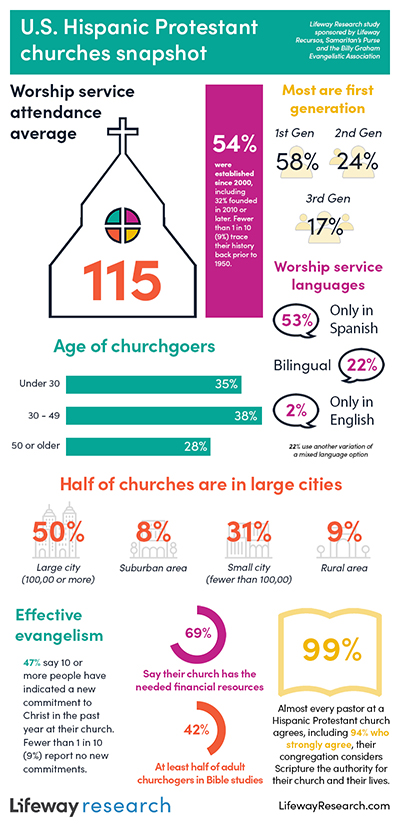
Most Hispanic Protestant churches (54 percent) have been established since 2000, including 32 percent founded in 2010 or later. Fewer than 1 in 10 (9 percent) trace their history prior to 1950.
Not only are the churches relatively new, but most people in the congregations are also new to the United States. The majority are first generation Americans (58 percent), born outside of the country. A quarter are second generation (24 percent), with parents who were born outside of the U.S. And 17 percent were born in the U.S. to parents who were also born in the U.S.

A majority conduct their services only in Spanish (53 percent), while 22 percent are bilingual.

Half of the churches (50 percent) are in a large metropolitan area with a population of 100,000 or more. Around 3 in 10 (31 percent) are located in small cities, 9 percent are in rural areas and 8 percent are in suburbs.

In the average Hispanic Protestant church, a full third of the congregation (35 percent) is under age 30, including 18 percent under 18. Another 38 percent are aged 30 to 49, and 28 percent are 50 and older.

“The growth in the number of Hispanic churches in the U.S. has been remarkable,” said Scott McConnell, executive director of Lifeway Research.

“While some of these congregations were started within Anglo churches—14 percent of Hispanic congregations in this study currently are conducting services within a church that is predominantly non-Hispanic—the missional impetus has clearly come from within the Hispanic community itself as two-thirds of these congregations are led by first-generation immigrant pastors.”

In U.S. Hispanic Protestant churches, the average worship service attendance is 115. Like most other churches, they’ve not yet fully recovered from the pandemic. In January 2020, prior to the COVID-19 pandemic, the average attendance was 136. Still, 13 percent of churches are around their pre-pandemic levels. And 32 percent say they’ve grown in the past three years, despite the pandemic.

Almost every Hispanic Protestant pastor (99 percent) agrees, including 94 percent who strongly agree, their congregation considers Scripture the authority for their church and their lives.

Around 7 in 10 (69 percent) say their church has the financial resources it needs to support their ministry, which include some aspects that are common among most other Protestant congregations.

Most Hispanic Protestant churches say they regularly offer weekly adult small groups or Bible studies (74 percent), weekly prayer meetings (66 percent) and weekly children’s small groups (52 percent).

Fewer have weekly youth small groups (45 percent), weekly young adult small groups (40 percent), one-on-one discipleship or mentoring (34 percent), evening large group Bible study (25 percent) or evening praise and worship (24 percent). Just 3 percent say they offer none of these.

When asked about moving weekend worship service participants to small groups, 42 percent of pastors say at least half of their adult churchgoers are involved in group Bible studies, including 15 percent who say at least 75 percent are connected to a small group.

Around a third (34 percent) say fewer than 1 in 4 churchgoers also are members of small-group Bible studies, including 9 percent of pastors who say none of those attending worship services are involved in groups.

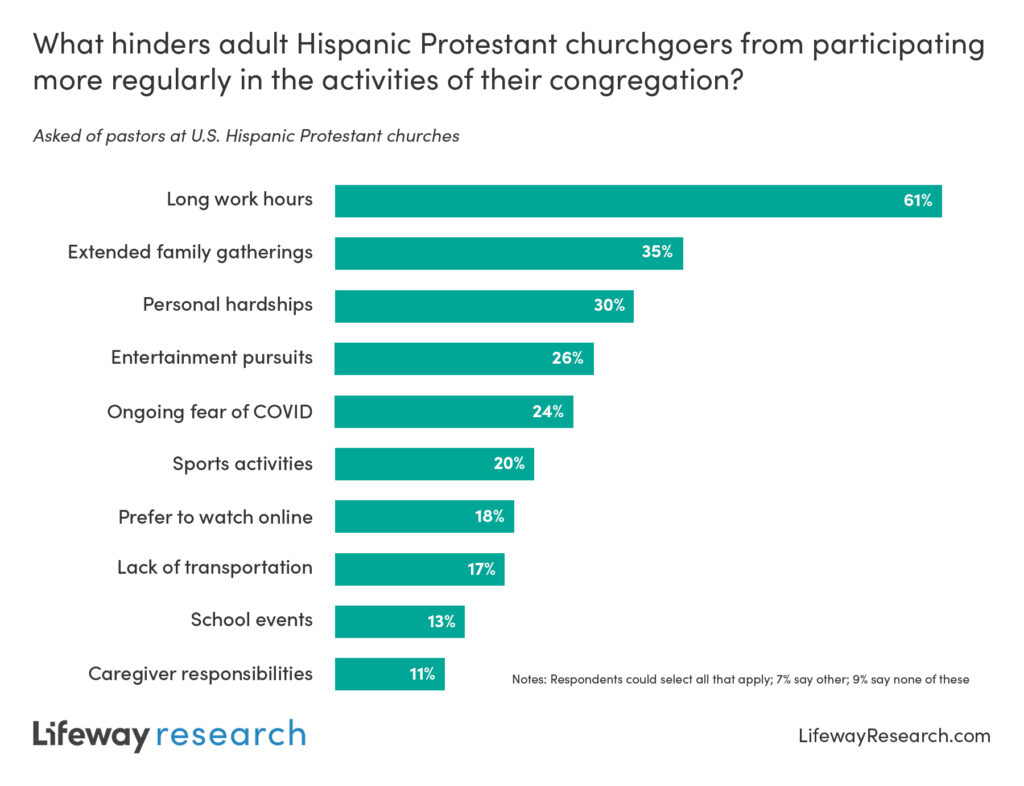
As to what hinders their congregation from participating more regularly in church activities, most pastors point to long work hours for their churchgoers (61 percent). Others say extended family gatherings (35 percent) and personal hardships or crises (30 percent).

Around a quarter point to recreational or entertainment pursuits (26 percent) and lingering fear of COVID (24 percent). Fewer say sports activities (20 percent), a preference to watch online (18 percent), lack of transportation (17 percent), school events (13 percent) or caregiver responsibilities (11 percent).

“Many of the activities within Hispanic Protestant churches look similar to those in non-Hispanic churches in the U.S. with worship services, prayer meetings, Bible studies and Sunday School classes being common,” McConnell said.

“But pastors of Hispanic congregations are quick to point out immigrant families often have less time for church, as many are working long hours, have family traditions and are impacted by American cultural distractions.”

Evangelistic outreach

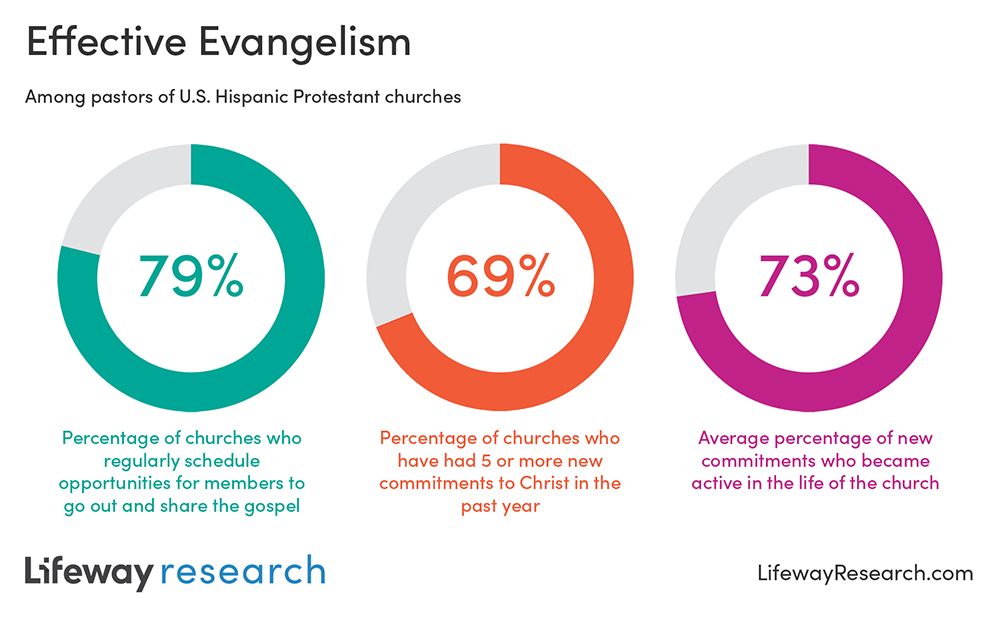
About 4 in 5 pastors at U.S. Hispanic Protestant churches (79 percent) say they regularly schedule opportunities for members to go out and share the gospel.

Specifically, most pastors say their outreach activities in the past year included church members inviting people to church (86 percent), using social media to share church activities (74 percent), children’s special events like VBS, Easter egg hunts or Fall festivals (59 percent), community programs like food distribution, toy giveaways or providing clothing (58 percent), and church members sharing the gospel in conversations (56 percent).

Additionally, some congregations did door-to-door evangelism (30 percent), evangelism training (24 percent) and provided financial support for a new church start (12 percent). Hardly any churches (1 percent) say they have not been able to do any of those recently.

Their outreach seems to be effective, as close to half (47 percent) say 10 or more people have indicated a new commitment to Christ in the past year, including 24 percent who have seen 20 or more such commitments. Fewer than 1 in 10 (9 percent) report no new commitments.

As they’ve reached these new individuals, pastors say most are sticking around. Almost 3 in 4 (73 percent) of those new commitments have become active participants in the life of the church, according to pastors. As a result, 88 percent of Hispanic Protestant pastors say they consistently hear reports of changed lives at their churches.

“Hispanic congregations are very active in engaging new people,” McConnell said. “Not only is there much evangelistic activity in Hispanic churches, but God is also blessing them with new people who commit to following Jesus Christ.”

Building community

As new members join Hispanic Protestant churches, they become part of congregations that are actively trying to grow together, according to their pastors. Almost 9 in 10 (88 percent) say their church has a plan to foster community in their church, including 53 percent who strongly agree.

Pastors point to numerous activities as vital to building a strong sense of community within their congregations.

At least 9 in 10 say praying together (96 percent), studying the Bible together (95 percent), choosing to get along and promoting unity (93 percent), welcoming those from different cultures and backgrounds (93 percent), choosing to be transparent and accountable with one another (89 percent) and checking-in or noticing when others are absent (90 percent) are very or extremely important aspects of unity in their churches.

Additionally, most say the same about members working together to serve people in the community (79 percent), socializing outside of church (81 percent) and sharing resources with each other (74 percent).

Most pastors say they’ve heard about their church members engaging in each of those actions at least a few times in the past month.

“Fellowship among believers in a local congregation is something the Bible communicates should be taking place,” McConnell said. “Hispanic churches take this seriously and invest in these relationships.”

Among pastors of U.S. Hispanic Protestant congregations, 93 percent are Hispanic themselves. Almost all (95 percent) are the senior or only pastor of a congregation, while 5 percent are Hispanic campus pastors with a multi-site church.

More than half (56 percent) serve as a full-time pastor, 27 percent are bivocational, 10 percent are part-time, 6 percent are volunteer and 1 percent are in interim positions.

Almost half of pastors in Hispanic Protestant churches (48 percent) are between the ages of 50 and 64. Pastors are more than twice as likely to be under 50 (37 percent), including 4 percent under 30, than 65 or older (16 percent).

Almost 8 in 9 pastors (85 percent) are male. Two in 3 (66 percent) are first generation Americans, while 15 percent are second generation and 19 percent are third. Close to 3 in 4 are college graduates, including 44 percent who have a graduate degree, while 17 percent have some college and 10 percent have a high school education or less.

Theologically, 4 in 5 (79 percent) pastors at U.S. Hispanic Protestant churches self-identified as evangelical. Around 1 in 6 (16 percent) say they’re mainline.

The online survey of pastors of Hispanic congregations in the United States was conducted Sept. 6  to Nov. 1, 2022. Slight weights were used to adjust for varying response rates across denominations. The completed sample is 692 surveys, providing 95 percent confidence the sampling error does not exceed plus or minus 5.0 percent. This margin of error accounts for the effect of weighting. Margins of error are higher in sub-groups.


Conference offers training and equipping in evangelism

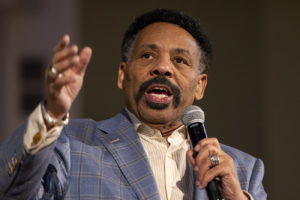
SAN ANTONIO—Saying the church’s “evangelism has fallen short of our calling,” Pastor Tony Evans urged attendees at Texas Baptists’ Statewide Evangelism Conference to go and make disciples.

The Jan. 23 conference saw 1,125 pastors, lay leaders and other attendees registered for a time of equipping and training at First Baptist Church of San Antonio.

Pastor Tony Evans of Oak Cliff Bible Fellowship in Dallas challenges attendees at Texas Baptists’ Statewide Evangelism Conference to share the gospel. (Texas Baptists Photo)

Likening the gathering to a huddle in a football game, Evans reminded congregants that the conference was not the main objective, but rather a time to come together and strategize.

What’s important is “what difference the huddle makes,” Evans said. “Having huddled, can you now score?”

Evans, the senior pastor of Oak Cliff Bible Fellowship in Dallas, exhorted Christians not to join in the “chaotic conflict” of the culture by joining a team, but to be more like referees— representatives of God, with his authority.

He urged attendees to make disciples—which he defined as “visible, verbal” followers of Jesus who “replicate the Master”—and to take what they had learned in the evangelism conference and spread the gospel.

“The church is good at huddling,” Evans said. “But (Jesus) said, ‘I want you to go!’”

The Jan. 23 event—with the theme “Can I Ask You a Question?”—was Texas Baptists’ first statewide evangelism conference following a 15-year hiatus.

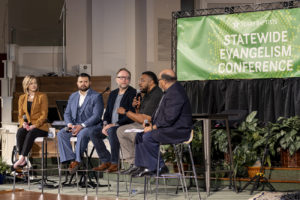
A panel (left to right: Katie McCoy, Eric Hernandez, Steve Bezner, Robert White, Victor Rodriguez) answers audience questions about evangelism. (Texas Baptists Photo)

Large crowds filled the worship center for each of the seven sessions. Along with sermons and presentations, the conference included a question-and-answer panel with speakers.

“That’s what this conference is about,” Leighton Flowers, director of evangelism for Texas Baptists, told attendees. “To equip you and train you, to give you tools, so you can go back to your churches and to your homes and spread the gospel to your friends and neighbors.”

The evangelism conference’s theme is shared by a five-book curriculum bundle, published by GC2Press, with the same name: “Can I Ask You a Question?”

The curriculum teaches Christians the basics of sharing the gospel and engaging nonbelievers, noting Jesus often asked questions to further spiritual conversations.

‘The desire of every generation’

Katie McCoy, director of Women’s Ministry for Texas Baptists, outlined the post-Christian environment in which Texas Baptists now bear witness. Today’s culture resembles that of first-century Roman culture, McCoy said. That creates undeniable challenges but provides tremendous opportunity for Christ followers, she added.

 McCoy said the prevailing cultural way of life inevitably leaves people isolated, searching for significance and hungering for wholeness.

 “The message of Jesus and the community of his people are the desire of every generation,” she said.

But McCoy also warned conference-goers to focus on what is important—proclaiming the gospel. The early church, even as it was still developing, “kept the main things the main thing,” she said.

Be the ‘salt of the earth’

Eric Hernandez, apologetics lead and millennial specialist for Texas Baptists, emphasized the need to couple the ability to defend the faith with the practice of sharing one’s faith.

Beginning with Jesus’ words from Matthew 5:13—“You are the salt of the earth”—he asked attendees: “Why are you a Christian? Why should someone else be a Christian?”

In 2 Corinthians 10:3-5, the Apostle Paul teaches Christians are to “refute arguments and reasonings and every proud and lofty thing that sets itself up against the knowledge of God.” Hernandez posited that “the biggest threat to Christianity” is not atheists or other external opponents, but instead Christians “who cannot effectively engage in spiritual warfare by recognizing, rationally responding to and tearing down strongholds.”

Hernandez encouraged attendees to participate in the [un]Apologetic Conference, scheduled Feb. 25 in San Marcos.

“Let us not just learn to present the gospel, but defend it, because, ‘You are the salt of the earth.’ God has not just given us the truth but given us the evidence to show why it is true,” he said.

Issue a ‘broader invitation’

Robert White, lead pastor of Freedom Church in Bedford, implored attendees to issue a “broader invitation.” While Christians must proclaim the gospel, the invitation to Christ is “broader than just the words presented,” because it includes the example of their lives, he said.

“Before we can invite others to respond to the invitation, we need to accept the invitation that has been given to us to live like Jesus,” White said.

Preaching from Philippians 1:27-30, he exhorted Christians to gospel conduct—living lives worthy of the gospel—and to live in “gospel community” with each other.

He also called Christians to gospel confidence, noting there is no reason for fear, and to gospel commitment, recognizing that following Christ will mean suffering for the sake of Christ (Philippians 1:29).

Focus on those ‘on the outside’

Steve Bezner, senior pastor of Houston Northwest Church, called pastors to emphasize evangelism and to break out of a “chaplain” mindset, believing “our primary job is simply to care for those who are inside our churches.”

“We can easily forget that there are so many on the outside who do not have life in Christ,” he said. “Let’s be honest. If we don’t think about it, who will?”

Houston Northwest Church has experienced a surge in baptisms, he said, as the church has emphasized corporate prayer in recent years. Noting Gallup research projects fewer than 50 percent of Americans will identify as Christian by 2050, he exhorted pastors not to forget the power of the gospel.

“The world may be falling apart, the culture may be confused, things may be terrible in your neighborhood right now, but guess what?” Bezner said. “Jesus still saves. The cross still forgives. The empty tomb still promises eternal life. And Jesus is still pouring out his Holy Spirit on the most heathen among us.”

Next generation looking for authenticity

Shane Pruitt, National Next Gen Director for the North American Mission Board, urged attendees to focus on reaching Gen Z and then send them to reach their peers.

Despite statistics that show Gen Z identifies less with religion than previous generations, Pruitt said, he has seen more conversions among young people in the last three years than in his previous 15 years of ministry. The pandemic, he said, brought them “to the end of themselves” more rapidly than those in previous generations.

“You don’t have to be young. You don’t have to be cool,” he said. “Young people are not looking for cool leaders. They’re looking for real and authentic leaders. If you have the gospel, you have what it takes.”

Pruitt encouraged leaders not to refer to young people as the “future of the church.”

“They are the church now, and they can handle” the responsibility of fulfilling the Great Commission, he asserted.


Obituary: Tom Ruane

Thomas Martin Ruane, longtime leader in Texas Baptist collegiate ministries, died Jan. 18. He was 77. He was born July 21, 1945, in San Antonio to Ary and Francis Ruane. He earned his undergraduate degree from Howard Payne University and a Master of Divinity degree from Southwestern Seminary. He later received a Doctor of Ministry degree from New Orleans Baptist Seminary. He served 36 years with the Baptist General Convention of Texas in student ministries and institutional ministries. He was campus minister and Bible teacher at Tarleton State University, Howard Payne University and the University of Texas at Arlington. He worked in the BGCT student division from 1979 until 2000, and he later served as associate director of institutional ministries and director of church relations consultants. After retiring from the Baptist Building, he worked as development director for the Baptist Standard. Ruane served as an interim pastor and visiting preacher in many congregations in the Dallas-Fort Worth area, where he helped start and was pastor of several cowboy churches. In his final days, Ruane pointed out to his family the Bible has more than 7,000 promises, but tomorrow is not one of them. He reminded them God does not take our loved ones; rather, God receives them. He is survived by his wife of 56 years, Mary Alice; son Richard; daughter Kristen and her husband Jeff; son Jason and his wife Rachael, and five grandchildren; brother Jim Ruane; and sister Delia Rawlinson. Visitation with the family is scheduled from 6 p.m. to 8 p.m. on Jan. 27 at Wayne Boze Funeral Home in Waxahachie. A memorial service will be held at 1 p.m. on Jan. 28 at Wayne Boze Funeral Home. Memorial donations can be made to the Baptist General Convention of Texas church starting here or Texas Baptist student ministry here.


Ministry after Lunar New Year massacre family-focused

MONTEREY PARK, Calif. (BP)—Pastor Victor Chayasirisobhon likens the Asian Lunar New Year to the traditional American Thanksgiving, complete with “extremely important” family gatherings of love and prayer.

A mass shooter’s choice of Lunar New Year’s Eve to kill 11 and injure nine others is a wound particularly painful for East Asian communities—Christians and nonbelievers, Chayasirisobhon told Baptist Press.

Churches seeking to comfort the community would benefit from knowing the communities’ cultural customs, said Chayasirisobhon, Southern Baptist Convention first vice president and senior pastor of First Southern Baptist Church in Anaheim, about 30 miles south of the crime.

“I think that it’s always good for churches as a whole in the current climate to reach out and express their condolences and their care whenever anything like this happens,” he said.

“Sometimes, in Asian communities, (we’ve) not always felt like we’re seen. So, when people of many different cultures, particularly of church culture, reach out and express their sympathy and their condolences in times like these, it is well received and appreciated.

“Typically at times when something happens in our community, depending on which culture of Asia you’re dealing with, it’s typically handled within that particular community; but it’s handled as a community.”

‘A very sensitive time’

Chayasirisobhon has reached out to Southern Baptist pastors in Monterey Park but said typically the community will craft a response by first learning the names of the victims and their immediate families.

 “I think this is a very sensitive time, and I think that helping in the appropriate moment is more important than just jumping in without knowing what’s really happening,” he said. “Typically, the way we would help is (by asking) does anyone know anyone who’s related to any of those people that were murdered, and we would try to reach out through those networks first.

“We’re a quieter culture. But that’s where food will show up. We’ll send food. We’ll send money. If these people went to church and are part of the church community, all of those services and resources and care will be given through that way.

“Finding a church or a ministry that’s connected to some of the victims of the shooting is typically how we would do that, rather than some sort of big, visible campaign.”

Peter Yanes, associate vice president of Asian American relations for the Southern Baptist Convention Executive Committee, expressed condolences.

“This tragic and senseless killing shouldn’t be happening to anyone. My heart goes with the families of the innocent victims and everyone affected—those grieving losses and healing as a community,” Yanes said.

“As churches lock arms together to pray for the Monterey Park community, the assurance of comfort, peace and hope may be found in Jesus Christ in these troubling times.”

Los Angeles County Sheriff Robert Luna released the names of two of the people killed in the rampage, 65-year-old My Nhan and 63-year-old Lilan Li. All victims, including those killed and injured survivors, are in their 50s, 60s and 70s, police said. The death count rose to 11 Jan. 23, with six survivors still hospitalized.

The alleged shooter, identified as 72-year-old Huu Can Tran of Vietnamese descent, was found dead on Lunar New Year’s Day of an apparently self-inflicted gunshot wound in a white van about 25 miles from the scene of the crime, Luna reported.

Tran also is accused of attempting a shooting the same night at Lai Ballroom & Studio in nearby Alhambra, but patrons there tackled him and took the gun before he fled. No injuries were reported in Alhambra.

Police are searching for a motive, but early reports described it as a domestic dispute.

In secular culture, the Lunar New Year is celebrated as long as several weeks and is seen as an important forecaster of luck for the new year.

While many Asian Christians celebrate certain customs such as family meals and gifting younger generations with red envelopes containing cash, Chayasirisobhon said, he also encourages celebrants with the gospel.

“You actually have a new year every day when you have Jesus,” he said. “We pick these days that mean something to our culture, but [in] our Christian culture, we can start every day new in Christ Jesus.”


Faith-based groups urge Biden not to enact asylum ban

WASHINGTON (RNS)—Numerous faith-based organizations and congregations are pleading with the Biden administration, in a letter sent Jan. 23 to President Joe Biden and other leaders, not to enact new immigration restrictions.

The letter—signed by 165 faith-based local, national and international organizations and congregations—expresses “grave concern” with policies Biden announced earlier this month.

While those policies expand a program offering humanitarian parole to Venezuelans to include individuals from Nicaragua, Haiti and Cuba, they also include a proposal to bar people from seeking asylum if they enter the United States without inspection or do not seek protection in other countries along the way, the letter said.

The administration has said it plans to launch an app that individuals can use to schedule an appointment for inspection instead of coming directly to a U.S. port of entry in order to reduce wait times and crowds at the border.

The letter urges the Biden administration not to move forward with what it calls an “asylum ban,” calling it “harmful, inhumane and deadly for the most vulnerable.”

“Across faith traditions and practices, the message is clear: We are called by our sacred texts and faith principles to approach one another with love—not fear,” the letter reads.

“Our diverse faith traditions compel us to love our neighbor, accompany the vulnerable, and welcome the sojourner—regardless of place of birth, religion or ethnicity. Importantly, our faiths also urge us to boldly resist and dismantle systems of oppression.”

Parole is no substitute for access to asylum, according to the letter.

Signers include three of the six faith-based agencies that partner with the U.S. government to resettle refugees: Church World Service, HIAS (formerly the Hebrew Immigrant Aid Society) and Lutheran Immigration and Refugee Service.

Several denominations also signed on to the letter, including the Evangelical Lutheran Church in America, Presbyterian Church (USA) and United Church of Christ. Other signers are the American Friends Service Committee; General Board of Global Ministries and General Board of Church and Society of the United Methodist Church; Hindus for Human Rights; Anti-Defamation League; Christian Reformed Church Office of Social Justice; Mennonite Central Committee U.S.; National Council of Churches; NETWORK Lobby for Catholic Social Justice; Union for Reform Judaism; and Unitarian Universalists for Social Justice.

On a call hosted Monday morning by the Interfaith Immigration Coalition and #WelcomeWithDignity Campaign, Krish O’Mara Vignarajah, president and CEO of LIRS, shared a number of misconceptions people have about those seeking humanitarian aid.

Not all have valid passports, access to a cell phone, reliable Wi-Fi or a willing sponsor in the United States in order to take advantage of pathways to enter the country, Vignarajah said. For many, their best option is to make an often dangerous journey to the U.S. border to seek asylum.

“That is a high hurdle to clear—one that borders on a wealth test for some of the most vulnerable children and families facing immediate danger,” she said.

Mark Hetfield, president and CEO of HIAS, said his organization is old enough to remember a time before the U.S. had laws allowing people to seek asylum in the country. Hetfield pointed to 1939, when he said the Franklin D. Roosevelt administration refused to allow a ship carrying 900 Jewish passengers who were fleeing Nazi Germany to dock in Florida. It returned to Europe, where 254 of those passengers perished in the Holocaust.

That’s why the United Nations established and the United States adopted the Refugee Convention, he said, “asserting that never again, would people be trapped inside of their country of persecution.”

The Biden administration’s proposal would place the asylum laws the United States now has “out of reach” for many, Hetfield said, which he called “illegal” and “immoral.”

And that “hits home” for many faith-based organizations, “who’ve been serving some of the most vulnerable for decades,” Vignarajah added.

“This isn’t charity for us. This is how our supporters live out their faith and answer that higher call to welcome the stranger in need.”


Theology lab tackles complex topics with humility

WASHINGTON (RNS)—The word “evangelical” is a bit like the word “apocalypse.”

Dennis Edwards. (Photo courtesy of North Park Theological Seminary)

Both have theological meanings understood by pastors and church insiders. But the general public has other ideas.

“For the specialists, apocalypse means ‘revelation’ or ‘unveiling,’” said Dennis Edwards, dean of North Park Theological Seminary in Chicago. “But for the masses, apocalypse means disaster.”

The same is true for the word “evangelical.” While that word has a set of theological connotations about the Bible and Jesus, for most Americans today it’s synonymous with conservative Republican Christians.

“I don’t think we’re ever going to recapture the real meaning of apocalypse,” Edwards said. “I sometimes wonder if we can ever recapture the sense of evangelical—meaning something that comes from the ‘evangel’ or good news, the message that Jesus has come to rescue humanity.”

Edwards was one of the featured speakers in an online theology lab run by Highrock Church, a multiethnic congregation that’s part of a network of churches in the Boston area that bear the same name.

Provide a broader understanding of faith

The lab, a series of online discussions that began in the fall of 2022 and run through this spring, is designed as an exercise in theological formation for laypeople, said Scott Rice, a theologian in residence at Highrock.

The idea is to give church members—and other interested Christians—a broader understanding of their faith and the way Christianity is lived out in the world.

The church has held past discussions about Black theology and Asian American theology. For the current series, Rice said, group members wanted to talk about American evangelicalism, in part because Highrock belongs to a denomination—the Evangelical Covenant Church—with the word right there in its name.

It’s a reality that has become more complicated as the term “evangelical” has become more politicized and identified with conservative politics, especially under former President Donald Trump.

While not all church members identify with that term, he said, the church has been influenced by the broader evangelical movement.

“We are a community where some identify as evangelical and some do not,” he said. “Some want to keep using the word and some do not.”

Creating an online learning community

The discussions are held online so people from different congregations in the network can take part in what he called a learning community. Rice and Meghan DeJong, a pastor at Highrock, help lead the discussion with speakers and moderate the follow-up question and answer sessions. Then participants break up into small groups to discuss what they have learned.

“Folks have a chance to process together,” Rice said. “There is no one saying this is exactly what you have to believe to be part of the community.”

Rice and other Highrock leaders have stressed the need for humility and curiosity during the conversations, urging participants to listen carefully to the speaker, even if they disagree with what’s being said. And not everyone has to agree in order to be part of the community, Rice said.

“We want our people to see thoughtful conversations happening with people who have different points of view,” he said.

The theology lab began with speakers from Highrock’s denomination, including Edwards and North Park church history professor Hauna Ondrey, as well as author and speaker Dominique DuBois Gilliard.

Former Southern Baptist ethicist Russell Moore, now editor of Christianity Today magazine, and Walter Kim, president of the National Association of Evangelicals, spoke at a session just before Thanksgiving.

Beth Allison Barr

Upcoming speakers include Calvin University historian and bestselling author Kristin Kobes Du Mez, Sojourners founder Jim Wallis, author and Baylor University professor Beth Allison Barr and New York Times columnist David Brooks.

During their conversation in November, Kim and Moore talked about the growing polarization in the United States, the threat of Christian nationalism and the way evangelicalism has become closely tied to conservative politics.

Moore also talked about the role of “conflict entrepreneurs,” a term coined by author Amanda Ripley. Those entrepreneurs, Moore said, benefit from driving up conflict in polarized times. He also called Christian nationalism a form of the prosperity gospel that operates on a national level, rather than a personal one.

Moore told participants that many of the old alliances among evangelicals fell apart during the Trump era, and new ones have started to form. Even so, many in the movement are still dealing with “disillusionment, frustration, instability and fear.”

“I don’t know a church that’s not either tense or divided—or aware that they are not and on guard, because they are just waiting for (conflict) to happen,” Moore said.

Although Highrock and its home denomination are not part of the NAE, the church has ties with Kim from his time as a pastor in the area. The NAE leader said he was thankful for the charitable nature of the conversations during the theology lab, which he said could be a model for the broader church.

Complex times, complicated discussions

Complex times, he said, require complicated discussions characterized by curiosity and an openness to listen. Christians can have those discussions without compromising their convictions.

“I am really grateful there is a local church modeling this kind of discussion,” he said.

DeJong said Moore and Kim, like other speakers in the series, spoke with both honesty and humility.

“Those are values that we hold in our relationships at Highrock, and so to have people who carry gravitas in Christian circles just enter into our conversations with that same posture is encouraging,” she said. “It shows that Christians all over the theological and geographical map are wrestling with similar questions, and that they’re not alone.”

Joe Marcucci, a pastor at Highrock who works with a prison ministry and other community outreach, facilitated one of the discussion groups. A former church planter and senior pastor at another church, Marcucci said he has mixed feelings about the term “evangelical” and its ties to politics.

“I feel like we’ve lost the evangelism part of evangelicalism,” he said.

The discussions in the theology lab are a good first step, Marcucci said. There’s a balance between listening with respect and still acknowledging that people disagree, he added.

No one wants open conflict during the discussions, he said. But moving the conversation forward may be uncomfortable.

“To do that, there has got to be some messiness to it,” he said. “I don’t know if we have gotten to that point yet.”

That idea of listening to different points of view reflects their denomination’s ethos, said Rice, which makes room for diverse perspectives. That ethos has been tested in recent years as the Covenant church, like other denominations, has faced conflict over issues of sexuality and how to adapt to the challenges of a diverse and polarized nation.

Edwards said people in churches don’t often know how to listen to each other, because they are so concerned about being on the right side of issues. So, they don’t have the patience to listen or consider that they might be wrong, or that someone else, with a different point of view, might be worth hearing.

“For a lot of people, it’s about being right, not being gracious,” he said. “The idea is I need to get this right. And you’re telling me something I haven’t heard before, so you must be wrong. It makes those kinds of conversations very difficult.”


Jubilant March for Life crowd prepares for state-level fights

WASHINGTON (RNS)—Thousands assembled Jan. 20 to participate in this year’s edition of the anti-abortion March for Life on the National Mall, where throngs celebrated the fall of Roe v. Wade while voicing concern as the abortion debate moves to the states.

Thousands participated in the 2023 March for Life Jan. 20, 2023. (Photo by Eric Brown)

Jeanne Mancini, president of the March for Life, opened up the 50th iteration of the rally by noting it was the “first march in post-Roe America,” prompting cheers from the crowd. But she was quick to dispel any notion that the anti-abortion movement has slowed following the Supreme Court’s decision to end nearly five decades of nationwide abortion access.

“We will march until abortion is unthinkable,” Mancini said, sparking another roar of approval from attendees.

The event, which appeared roughly the same size as past versions, was framed as something of a pivot point for the broader anti-abortion movement. It was present in the day’s theme,“Next Steps: Marching into a Post-Roe America.” Mancini made a point of promoting smaller versions of the march scheduled to take place in certain states later this year.

“Boy, did we get a huge victory just a few months ago when Roe was overturned,” said Republican Majority Leader Rep. Steve Scalise of Louisiana, one of several lawmakers to address the demonstration. “But as you all know, that’s only the end of the first phase of this battle. The next phase now begins.”

The sentiment was similar in the crowd, where faith was a constant as in years past. Bryson Nesbitt, from North Carolina, explained the need for further action while holding a large Christian flag.

“I believe God will bless the nation for making that change,” he said, referring to the overturning of Roe, “but I think there’s more work that needs to be done.”

Move to the local level

Precise definitions of the movement’s new phase were hard to find at the demonstration, however. Not that there weren’t suggestions: March for Life organizers urged supporters to lobby Congress on legislation such as the “No Taxpayer Funding for Abortion Act.” And the march route symbolically was changed to funnel participants past the western face of the Capitol instead of near the Supreme Court, as in years past.

Yet the legislation, which would make permanent the restrictions on federal funding for abortion, is unlikely to pass a Democratically controlled U.S. Senate, and much of the ongoing debate over abortion is happening at the state level—not in Congress.

The shift wasn’t lost on Dave Pivonka, the president of Franciscan University of Steubenville in Ohio, who stood near the back of the crowd. One of many Catholics in attendance, he said students from his school were not only present in Washington for the march, but also in Columbus, Ohio, where they were urging politicians to pass anti-abortion legislation.

“It’s really going to move more towards a local level,” he said. “The thought was, ‘Let’s overturn Roe v. Wade.’ Well, that was great, but the goal is that more babies are saved. The goal is for an end of abortion.”

Recognizing obstacles ahead

Many march participants were realistic about the obstacles their movement still faces. Despite the festive mood at the rally, public opinion polls continue to show widespread support for making abortion legal in all or most cases, and the 2022 midterm elections resulted in a slew of victories for abortion rights advocates.

Pushback to the anti-abortion movement is growing louder among people of faith as well, with liberal-leaning activists often stressing that support for sweeping abortion restrictions is a minority position in many religious traditions—including among Catholics.

The day before the march, advocates affiliated with the group Catholics for Choice surprised anti-abortion activists protesting in front of a Washington Planned Parenthood by unfurling banners behind them that read “Most people of faith support legal abortion.” Catholics for Choice also put up posters along the March for Life’s route emblazoned with similar messages.

Religious groups have filed lawsuits in several states challenging new abortion bans as well, with many arguing the prohibitions conflict with their own faiths.

There was little mention of such religious opponents at the March for Life, although one demonstrator held a sign that read “Excommunicate Pro-Choice Catholics.”

Two sisters and longtime attenders of the march—Sara Sullivan and Megan Kinsella, both Catholic and from Virginia—characterized the event as an unusually boisterous affair. The pair grew up attending the March for Life, and their children, now in high school, were somewhere in the crowd.

“I’ve been (to) a lot,” Sullivan said. “This is definitely a more cheerful, lighthearted feel, like a celebration.”

But even as they celebrated, Sullivan and Kinsella eventually circled back to the message of the day: steeling themselves for clashes over abortion that will be waged far from Washington’s halls of power.

“The follow-up story is going to be to go into the state,” Kinsella said, pointing out that one of the March for Life’s state-level events is scheduled to take place in Richmond next month.

“That’s where we have to concentrate our efforts, because it’s not over. It’s just going back to the states.”


FBI offers reward for info on pregnancy center attacks

NASHVILLE (BP)—The FBI is offering a $25,000 reward for information related to attacks on pregnancy support centers.

“As part of a national effort to bring awareness to a series of attacks and threats targeting reproductive health service facilities across the country, the FBI is offering a reward of up to $25,000 for information leading to the identification, arrest, and conviction of the suspect(s) responsible for these crimes,” the FBI’s statement said.

In Washington, D.C., FBI Director Christopher Wray said, “Today’s announcement reflects the FBI’s commitment to vigorously pursue investigations into crimes against pregnancy resource centers, faith-based organizations and reproductive health clinics across the country.”

Three centers in Portland, Ore., were either vandalized or fire-bombed.

Messages such as “IF ABORTION AINT SAFE NEITHER RU JR” were spray-painted on the Mother and Child Education Center in Portland, the FBI said.

The attacks, which occurred on May 8, June 10, July 4 and July 6 of last year, are all referenced in the release.

The Gresham Pregnancy Resource Center and the Oregon Right to Life building in Portland were included in the attacks. Molotov cocktails were thrown into the facilities, causing significant fire damage in Gresham.

The FBI said video surveillance at the Right to Life building shows a possible suspect driving a white 2017-2018 Hyundai Elantra.

Dozens of other attacks were carried out across the country last spring and summer.

“It is good to see the FBI finally taking steps toward justice for these centers and their personnel who do so much to serve the vulnerable in our communities,” said Hannah Daniel, a policy associate for the Ethics & Religious Liberty Commission, in written comments.

“In the wake of the historic Dobbs decision, we witnessed unprecedented and grotesque levels of violence against pregnancy resource centers. These centers are on the front lines doing the important and often overlooked work of caring for women and their children. “

In Nashville, the Hope Clinic for Women was vandalized last June 30.

“We are grateful for all the support we’ve received from law enforcement,” Hope Clinic CEO Kailey Cornett wrote in an email to Baptist Press. “News of this development reminds me of my initial thoughts when security camera footage was found for our incident—my heart goes out to the woman (or man) whose anger and pain brought them to the point of causing damage like that. We are continuing to pray they find hope and healing.”

The FBI says perpetrators could face up to 20 years in prison for the attacks.

Anyone with information is asked to call 1-800-CALL-FBI or to submit their tip at tips.fbi.gov.


Mary’s House provides home for stateside missionaries

When Mary’s House recently opened its doors to provide a fully furnished residence for a missionary family, it marked a dream come true for Woman’s Missionary Union of Texas and the World Missions Center at Southwestern Baptist Theological Seminary.

In 2019, Brent Ray—then director of the World Missions Center—contacted Texas WMU to discuss his idea of providing an on-campus home for international missionary families on temporary stateside assignment.

He envisioned a cozy home where missionaries-in-residence could find rest and renewal, while also inspiring seminary students with their testimonies of service on international mission fields.

Representatives from Texas WMU met with Ray and saw a proposed site for missionary housing—an old duplex on the corner of West Broadus Street and Stanley Avenue.

‘It was in pretty bad shape’

At one point, the building housed the library of the late E. Earl Ellis, emeritus research professor of theology. After the Ellis collection was moved to the A. Webb Roberts Library, the house sat vacant for years.

Marisol Sandoval (left) and Freddie Martinka with the Woman’s Missionary of Texas staff help put sheets on a bunk bed at Mary’s House. (Southwestern Seminary Photo)

“Honestly, it was in pretty bad shape,” said Teri Ussery of Texas WMU. “But Dr. Ray could see the vision.”

Ray and Tamiko Jones, executive director-treasurer of Texas WMU, agreed the house should be named for Mary Hill Davis, who was president of Texas WMU from 1906 to 1931.

Funds from the offering for Texas missions that bears her name and money raised by Texas WMU financed the total renovation of the old house at 1721 W. Broadus.

The COVID-19 pandemic delayed progress on the renovation, but it also made possible an unexpected blessing. Since Texas WMU did not use all its operating budget in 2020, it was able to invest the funds in Mary’s House.

The architecture team at the Baptist General Convention of Texas developed plans for the remodeling project.

“Workers took it down to the studs, completely remodeling it,” Ussery said.

They discovered hardwood floors hidden beneath well-worn and soiled carpet, and they installed up-to-date appliances for two residences—one downstairs and the other upstairs.

Wanting missionaries to ‘feel that love’

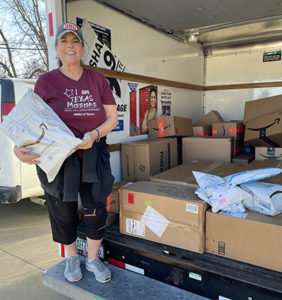
Teri Ussery from Woman’s Missionary Union of Texas helps unload packages from an Amazon gift registry that WMU groups and individuals bought for Mary’s House. (Southwestern Seminary Photo)

Texas WMU provided all the furnishings, and Baptist Women around the state purchased household goods, selecting from among more than 100 items on an Amazon registry.

“The dream was for a missionary family to be able to walk into Mary’s House with suitcases in hand and immediately move in,” Ussery said.

Jones and Ussery, along with Texas WMU President Earl Ann Bumpus and Beth Campbell, project manager for the Mary Hill Davis Offering, participated in a Jan. 13 ribbon-cutting ceremony for Mary’s House.

Jones emphasized the desire of Texas WMU to show love and support to missionaries.

“We want to care for them, so that whenever God does send them back out, or while they’re just serving here, they feel that love and they’re able to then pour that back out to continue to do what [God] called them to do. So, we’re excited to be a part of this,” Jones said.

Joining the Texas WMU representatives for the dedication service were Ian Buntain, current director of the World Mission Center; John Massey, dean of the Roy J. Fish School of Evangelism and Missions; and Matt Queen, interim provost at Southwestern Seminary.

“I’m so grateful that in Texas, these women are dreaming dreams about a place like this where missionaries can not only have sanctuary, but where this place can be a sanctuary for students who will have exposure to normal missionaries,” Buntain said.

First family moves into Mary’s House

Holley and Thomas Sieberhagen, missionaries to Belgium, moved into Mary’s House with their two children. (Southwestern Seminary Photo)

The first family to move into Mary’s House were Thomas and Holley Sieberhagen and their two children. The Sieberhagens serve with the International Mission Board as church planters among the French-speaking population in Belgium.

“When you’re on stateside [assignment], you don’t just need time to kind of detox and rest from a busy term the year is coming to. You also need a place where you can really recharge and spiritually get ready for the coming term and to go back,” Thomas Sieberhagen said. “Having a place like this is just the perfect place to be able to do both those things.”

A second family—who serve overseas in an undisclosed location and whose identities are protected for security reasons—moved in soon after the Sieberhagens.

Ray—the World Mission Center director and missionary to South America who first envisioned the on-campus home for missionary families—died unexpectedly in 2020 before having the opportunity to see the project completed.

But Ussery is not so sure about that.

“It all began with Brent Ray. His vision started the process,” she said. “I have to believe he is a part of that great cloud of witnesses, looking at what has been done and smiling at the fulfillment of that vision.”

With additional reporting by Ashley Allen of Southwestern Baptist Theological Seminary.


Texas plane crash kills four from Tennessee church

YOAKUM (BP)—A plane crash in Lavaca County killed four members of Harvest Church in Germantown, Tenn., and left one person hospitalized.

Bill Garner, the church’s executive pastor, was among those killed. Lead pastor Kennon Vaughn was reported in stable condition in a Victoria hospital after surgery.

Tyler Springer, a native of Denton, also was among the fatalities. He is the eldest son of Brad Springer, executive director of Camp Copass.

A notice on the Camp Copass Facebook page requested prayer for Brad and Denise Springer.

“We are all mourning the loss of their oldest son. … While our hearts are heavy, we do not grieve like those who have no hope, because Tyler trusted Jesus Christ as his Savior.”

According to a statement Harvest Church posted on social media, other church members killed in the crash were Steve Tucker and Tyler Patterson.

According to the Memphis Commercial Appeal, Tucker was pilot of the fixed-wing, single-engine plane when it crashed around 11 a.m. on Jan. 17 about a mile from Yoakum Municipal Airport, about 40 miles north of Victoria.

The cause of the crash is under investigation.

Harvest Church, a Southern Baptist congregation, released a statement on social media saying the four individuals who were killed “were beloved members of Harvest Church, and their loss currently leaves us without the proper words to articulate our grief. … We ask for your prayers and kindly request that the families of all involved are given the proper space to grieve at this time.”

Camp Copass provided an online platform where individuals can express condolences and offer words of comfort to the Springer family. To access the site, click here.

Compiled by Lonnie Wilkey, editor of the Baptist and Reflector in Tennessee, with additional reporting by Baptist Standard Managing Editor Ken Camp.


Hunt defiantly returns to the pulpit after abuse allegations

PANAMA CITY, Fla. (RNS)—Claiming “false allegations” had ruined his life, former Southern Baptist Convention President Johnny Hunt returned to the pulpit Jan. 15, eight months after allegations that he had sexually assaulted another pastor’s wife became public.

Pastors (from left) Mark Hoover, Mike Whitson, Steven Kyle and Benny Tate appear in a video to talk about their restoration work with Johnny Hunt. (RNS video screen grab)

Hunt was the guest preacher at Hiland Park Baptist Church in Panama City, Fla., where his friend Steven L. Kyle is pastor. Kyle was part of a small group of pastors who deemed Hunt fit to return to the ministry, despite the allegations against him.

Kyle introduced Hunt, who joined Hiland Park as a member in 2022, calling him “one of the greatest pulpiteers in our generation.”

“Today we are honored,” Kyle said. “Today I am thankful to have my good friend Dr. Johnny Hunt preach at Hiland Park.”

Guidepost report cites credible allegations

The former SBC leader, who was also a longtime pastor of a Georgia megachurch, was named in the Guidepost Solutions report on abuse in the SBC, which was released in May 2022. According to the report, Hunt allegedly assaulted a woman at a vacation condo in 2010.

Investigators found the allegations against him credible. Hunt denied the allegations at first, then claimed the incident was a consensual encounter.

During his sermon, Hunt said some of the allegations against him were true, but they would have been easier to survive than the “false allegations,” and he claimed he’d been pressured to quit the ministry.

Psalm 119, the biblical text he drew from, also talked about what happens when people face persecution and their enemies set up traps to snare them.

“When will you punish my persecutors?” the text says in the New International Version. “The arrogant dig pits to trap me, contrary to your law. All your commands are trustworthy; help me, for I am being persecuted without cause.”

Hunt says calling cannot be undone

Hunt also talked about the power of forgiveness and what happens when people make “bad choices.”

“And by the way, have you ever made a choice that you wish you could undo, but you can’t undo it?” he asked the congregation. “What do you do with stuff you can’t undo? You give it to Jesus.”

He also told the congregation that if God calls someone to do something, that calling can’t be undone. And God called that person, knowing the person might sin and fail, he added.

Hunt said he could retire and no longer had to preach for a living.

“Anybody can quit,” he said. “That’s why so many do. It’s easy. I mean, it hardly takes any energy whatsoever.”

During his sermon, Hunt also detailed some of his future plans for ministry, including leading a tour group to the Holy Land and traveling to Uganda to train pastors.

Hunt failed to disclose incident

The allegations against Hunt had stunned many of his friends and supporters, especially since Hunt had hidden the incident for so long. After finishing up his time as SBC president in 2010, he took an extended leave of absence, which he has said was due to physical exhaustion and depression.

But according to the Guidepost report and a video from Kyle and the other pastors who restored the former megachurch pastor, Hunt went through an extended counseling and restoration process after the incident at the condo.

Hunt hid that process from his congregation and from the SBC’s North American Mission Board, which hired him as a vice president in 2018. He resigned from that role after the Guidepost report was made public. 

Hunt’s return to ministry highlights the difficulty the nation’s largest Protestant denomination has in dealing with pastoral misconduct and abuse. While delegates to the SBC’s annual meeting have condemned abusive pastors and said they are unfit for the ministry, the denomination has no authority to discipline pastors or ban them from preaching.

Current SBC President Bart Barber has called Hunt’s return to ministry a “repugnant act.”

“I would permanently ‘defrock’ Johnny Hunt if I had the authority to do so,” Barber, pastor of First Baptist Church in Farmersville, said in November.

Tiffany Thigpen, an abuse survivor and longtime advocate of abuse victims, told Religion News Service in November 2022 Hunt’s return to ministry was a sign that Southern Baptist culture has yet to change.

“We are always going to have this network of powerful men who can do whatever they want and think they can get away with it,” she said. “And they are right.”