Pakistan moves toward more stringent blasphemy law

ISLAMABAD, Pakistan (BP)—Pakistan’s lower house of parliament passed a bill strengthening punishment for blasphemy despite international outcry and security concerns among Christians and other religious minorities there.

Blasphemy already carries punishment as severe as death in the majority-Muslim country, but the Criminal Laws Bill amendment passed Jan. 17 in the National Assembly would increase jail terms from three years to 10 years for insulting the prophet Mohammad’s companions, wives and family members, Christian Solidarity Worldwide reported. Fines of more than $4,343 (1 million Pakistani rupees) would accompany prison time.

The unanimous passage of the Criminal Laws Bill on Jan. 17 makes it likely the bill will gain final passage and the president’s signature within months, Christian Solidarity Worldwide said.

“The ease with which it passed the lower house does not bode well,” a Christian Solidarity Worldwide spokesperson said. “It is likely to pass again.”

Mervyn Thomas, founder and president of Christian Solidarity Worldwide, is among many international religious freedom advocates expressing concern.

“Existing blasphemy legislation has resulted in extra-judicial killings and countless incidents of mob violence based on false accusations,” Thomas said. “Policymakers have ignored the long-standing demands of civil society organizations and minority community leaders for the repeal of the blasphemy laws or, at the very least, the introduction of procedural amendments to curb the misuse of these laws.”

Blasphemy laws feed mob violence

At least 16 individuals received the death penalty for blasphemy in 2021, the U.S. State Department said in its 2021 International Religious Freedom Report, but added the country has never carried out its death sentences in such cases. Instead, those suspected or convicted of blasphemy, as well as attorneys representing those accused and leaders advocating for the repeal of blasphemy laws, face repercussion and death by angry mobs.

After Salman Taseer, the governor of Punjab Province and a prominent critic, tried to reform blasphemy laws, his bodyguard killed him in 2011.

Asia Bibi, a Pakistani Christian sentenced to death by hanging in 2010, was released from death row in 2018 after the Pakistan Supreme Court reversed her conviction. She was safely transported out of the country under cover of secrecy.

Pakistan is widely noted for religious persecution despite religious freedom stipulations in its national constitution. Religious freedom advocates cite Pakistan’s blasphemy laws and its inability to protect religious minorities from societal persecution and violence.

In its Freedom of Religion or Belief Victims List, the U.S. Commission on International Religious Freedom highlights 55 individuals detained or imprisoned for blasphemy charges in Pakistan.

Among those named are Tabitha Gill, a Christian nurse accused of blasphemy in January 2021 by her colleagues and beaten and tortured by hospital staff. In December 2021, a violent mob killed and burned the body of Sri Lankan national Priyantha Kumara over blasphemy allegations, the commission said.

Used for personal revenge

Pakistan’s blasphemy laws are poorly defined and require low standards of evidence, CSW said. The statutes criminalize anyone who insults Islam, including by “outraging religious feeling,” and are often used as a weapon of personal revenge against religious minorities including Christians.

“Pakistan must do more to protect its most vulnerable minority communities by upholding its international obligations and guarantees enshrined within the country’s constitution,” Thomas said. “And the international community must hold the government to account for where it fails or refuses to do so.”

The U.S. State Department deems Pakistan a Country of Particular Concern under the International Religious Freedom Act of 1998, a designation USCIRF also recommended.

The Open Doors U.S. 2023 World Watch List of Christian persecution deems Pakistan the seventh most dangerous country for Christians.

In its 2023 Global Prayer Guide, Voice of the Martyrs describes Pakistan as a “restricted” country where all “Christians face difficulties, discrimination and persecution because of their Christian identity.” Voice of the Martyrs encourages widespread prayer for the repeal of blasphemy laws there, and for the “courage, wisdom and protection” of Christians there.


Around the State: Leadership changes at Buckner agency

Samela Macon

Buckner International announced two leadership promotions with Buckner Children and Family Services. Effective Jan. 1, Henry Jackson was named president, and Samela Macon was promoted to vice president of operations. Jackson has worked for Buckner since 1989, most recently as senior vice president of Buckner Children and Family Services. His additional roles included area vice president of international operations, administrator, director of residential services and human resources manager. Prior to Buckner, he was a free agent contract with the Chicago Bears in the National Football League. He earned an undergraduate degree from Angelo State University and a Master of Science degree from Amberton University. He is a licensed child care administrator and an ordained minister. Macon has about 25 years of child welfare experience, including 21 years with Buckner. Her most recent role was vice president of domestic programs and support services for Buckner Children and Family Services. She also served as foster home developer, foster home development supervisor, and program director of foster care and adoption. She earned her undergraduate degree from Lamar University and a Master of Science in leadership and human resource development from Louisiana State University in Baton Rouge. Macon is a licensed Child Placing Agency Administrator, and she received the Buckner Leadership Award in 2014.

Within 24 hours after an outbreak of tornadoes in the Houston area and Southeast Texas, two Texas Baptist Men disaster relief crews already were serving, and multiple assessors were working throughout the region. A regional chainsaw team was removing limbs and fallen trees from structures in the Orange area. A box unit was distributing containers to help homeowners in Deer Park gather and contain their possessions. TBM anticipated deploying additional crews to the area.

In partnership with the Baptist General Convention of Texas, two Texas Baptist universities are hosting Congreso Experiences in early February. An event is scheduled Feb. 4 at Wayland Baptist University in Plainview and Feb. 18 at East Texas Baptist University in Marshall. Specifically designed for Hispanic students grade six and older, the Congreso Experience will encourage students to live out the call of God in and through their lives now and in the future. Activities include workshops, group activities and worship. There is no cost to participate. To learn more and register, click here.

The University of Mary Hardin-Baylor entered a partnership with the Anne Burnett Marion School of Medicine at Texas Christian University. The collaborative initiative allows medical students to earn a Master of Public Health degree from UMHB while completing their Doctor of Medicine degree requirements at TCU’s medical school. “We could not be more excited about partnering with the Burnett School of Medicine to assist in training future physicians who value a preventative, proactive approach to medicine necessary in a world plagued by chronic disease,” said Ariane Secrest, director of the UMHB public health program. UMHB’s Master of Public Health degree is a 42-credit hour program.


On the Move: Atchley

Jason Atchley to Hunters Glen Baptist Church in Plano as senior pastor from Greenwood Baptist Church in Midland, where he was pastor.


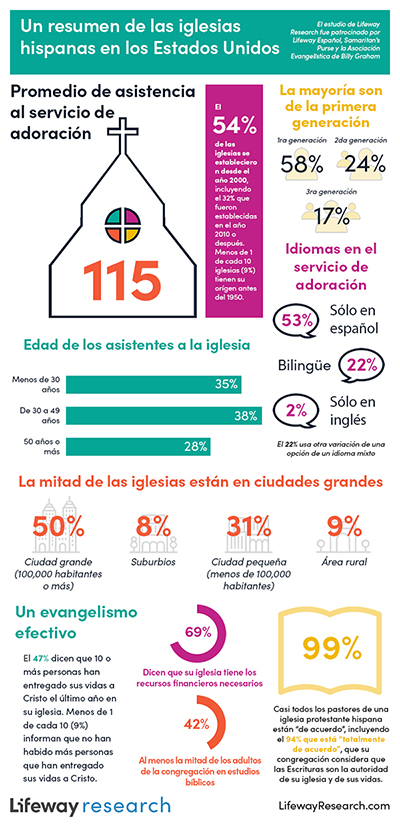
El panorama protestante hispano en los Estados Unidos está lleno de iglesias vibrantes y en crecimiento

NASHVILLE, Tennessee. — Las iglesias hispanas en los Estados Unidos están enfrentando desafíos únicos, pero están teniendo éxito en la construcción de una comunidad dentro de sus congregaciones y alcanzando a personas fuera de sus iglesias.

Lifeway Research se asoció con dos docenas de denominaciones y redes de iglesias para incluir lo que probablemente sea el mayor número de congregaciones hispanas protestantes en los Estados Unidos que han sido invitadas a un solo estudio de investigación. Patrocinado por Lifeway Recursos, La Asociación Evangelística de Billy Graham y Samaritan’s Purse, el estudio encuestó a 692 pastores de congregaciones que son por lo menos 50% hispanas.

“Durante décadas, la población hispana en los Estados Unidos ha estado creciendo exponencialmente y es imperativo que las iglesias estén informadas sobre las necesidades específicas de esta comunidad”, dijo Giancarlo Montemayor, director de las publicaciones mundiales de Lifeway Recursos. “Este estudio nos ayudará a continuar la conversación sobre cómo servir a nuestros hermanos y hermanas de una manera más estratégica”

Un resumen rápido de las congregaciones hispanas

El estudio revela una imagen de las iglesias hispanas que muestra que son más nuevas, más jóvenes y que evangelizan de una manera más eficaz que una iglesia protestante típica en os Estados Unidos.

La mayoría de las iglesias protestantes hispanas (54%) se establecieron desde el año 2000, incluyendo 32% que fueron establecidas en el año 2010 o después. Menos de 1 de cada 10 (9%) trazan su historia antes del año 1950.

Las iglesias no solo son relativamente nuevas, sino que la mayoría de las personas en las congregaciones también son nuevas en los Estados Unidos. La mayoría son estadounidenses de la primera generación (58%), que nacieron fuera del país. Una cuarta parte de ellos son de la segunda generación (24%), con padres que nacieron fuera de los Estados Unidos. Y el 17% de ellos nacieron en los Estados Unidos de padres que también nacieron en los Estados Unidos. Como resultado, la mayoría realizan sus servicios solo en español (53%), mientras que el 22% de los servicios son bilingües.

La mitad de las iglesias (50%) se encuentran en un área metropolitana grande con una población de 100,000 habitantes o más. Alrededor de 3 de cada 10 (31%) están ubicadas en ciudades pequeñas, el 9% están en áreas rurales y el 8% están en los suburbios.

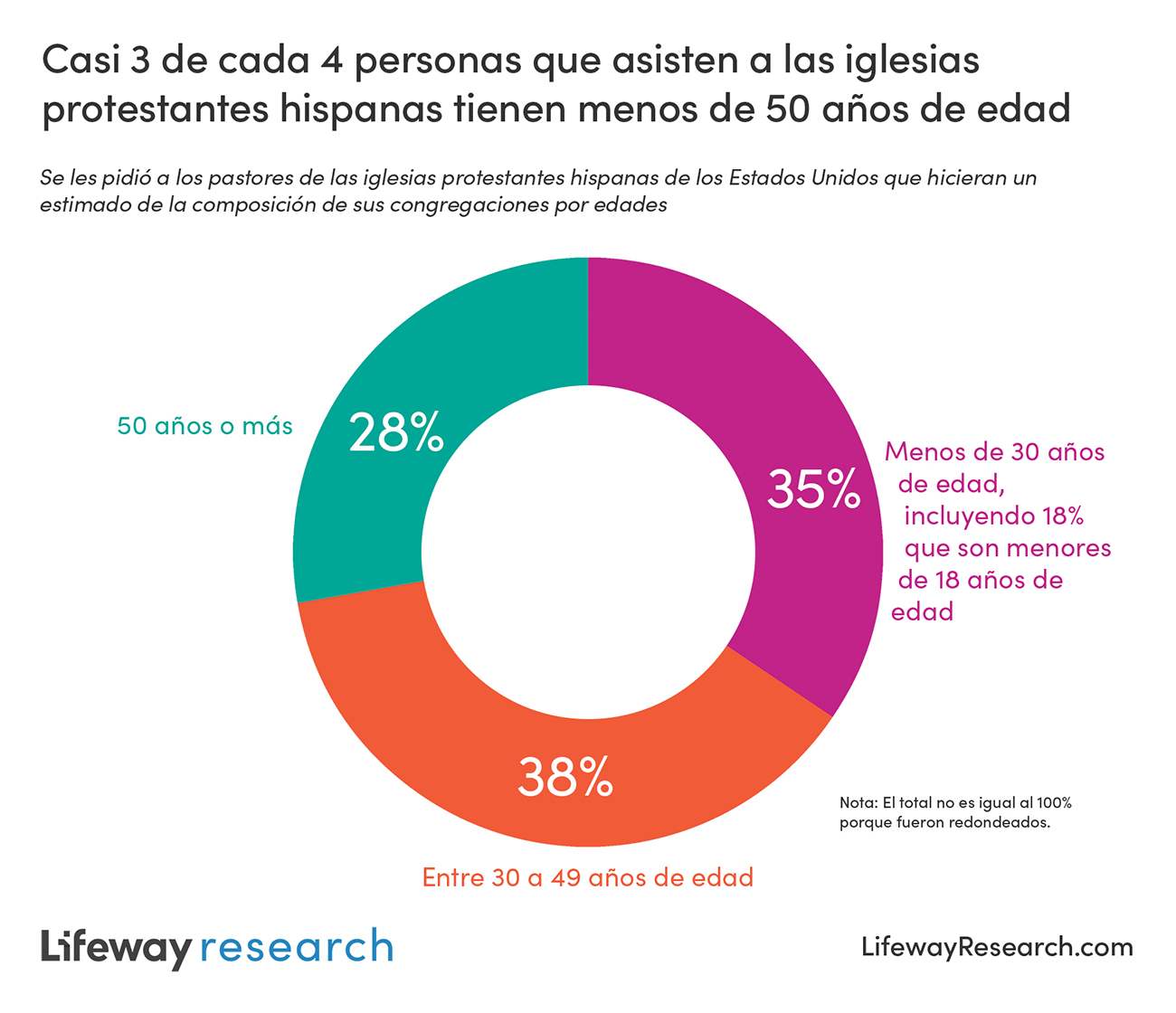
En una iglesia protestante hispana típica, un tercio de la congregación (35%) tiene menos de 30 años, incluyendo un 18% que son menor de 18 años de edad. Otro 38% tiene entre 30 y 49 años de edad y el 28% tiene 50 años de edad o más.

“El crecimiento en el número de iglesias hispanas en los Estados Unidos ha sido extraordinario”, dijo Scott McConnell, director ejecutivo de Lifeway Research. “Mientras que algunas de estas congregaciones se iniciaron dentro de iglesias angloamericanas – El 14% de las congregaciones hispanas en este estudio actualmente están realizando servicios dentro de una iglesia que predominantemente no es hispana – el ímpetu misional claramente ha venido desde dentro de la misma comunidad hispana ya que dos tercios de estas congregaciones están dirigidas por un pastor inmigrante de la primera generación”

En las iglesias protestantes hispanas en los Estados Unidos, el promedio de asistencia al servicio de adoración es 115 personas. Al igual que la mayoría de las otras iglesias, aún no se han recuperado por completo de la pandemia. En enero de 2020, antes de la pandemia de COVID-19, el promedio de asistencia era de 136. Aun así, el 13% de las iglesias se encuentran actualmente en sus niveles de asistencia antes de la pandemia. Y el 32 % dice que sus iglesias han crecido en los últimos tres años, a pesar de la pandemia.

Casi todos los pastores protestantes hispanos (99%) están de acuerdo, incluyendo el 94% que están totalmente de acuerdo, que su congregación considera que las Escrituras son la autoridad para su iglesia y para sus vidas.

Alrededor de 7 de cada 10 pastores (69%) dicen que su iglesia tiene los recursos financieros necesarios para apoyar su ministerio, que incluyen algunos aspectos que son comunes entre la mayoría de las demás congregaciones protestantes. La mayoría de las iglesias protestantes hispanas dicen que ofrecen estudios bíblicos o grupos pequeños semanales para los adultos (74%), reuniones de oración semanales (66%) y grupos pequeños semanales para los niños (52%). Menos iglesias tienen grupos pequeños semanales para los jóvenes (45%), grupos pequeños semanales para los jóvenes adultos (40%), discipulado o tutoría individual / 1 a 1 (34%), estudios bíblicos en grupos grandes por la noche (25%) o servicios de adoración por la noche (24%). Solo el 3% dice que no ofrece ninguno de estos ministerios.

Cuando se les preguntó acerca de trasladar a los participantes del servicio de adoración de fin de semana a grupos pequeños, el 42% de los pastores dijeron que por lo menos la mitad de sus asistentes adultos están involucrados en grupos de estudios bíblicos, incluyendo el 15% que dice que por lo menos el 75% está participando en un grupo pequeño. Alrededor de un tercio de los pastores (34%) dicen que menos de 1 de cada 4 asistentes son miembros de grupos pequeños de estudios bíblicos, incluyendo el 9% de los pastores que dicen que ninguno de los que asisten a los servicios de adoración están involucrados en un grupo.

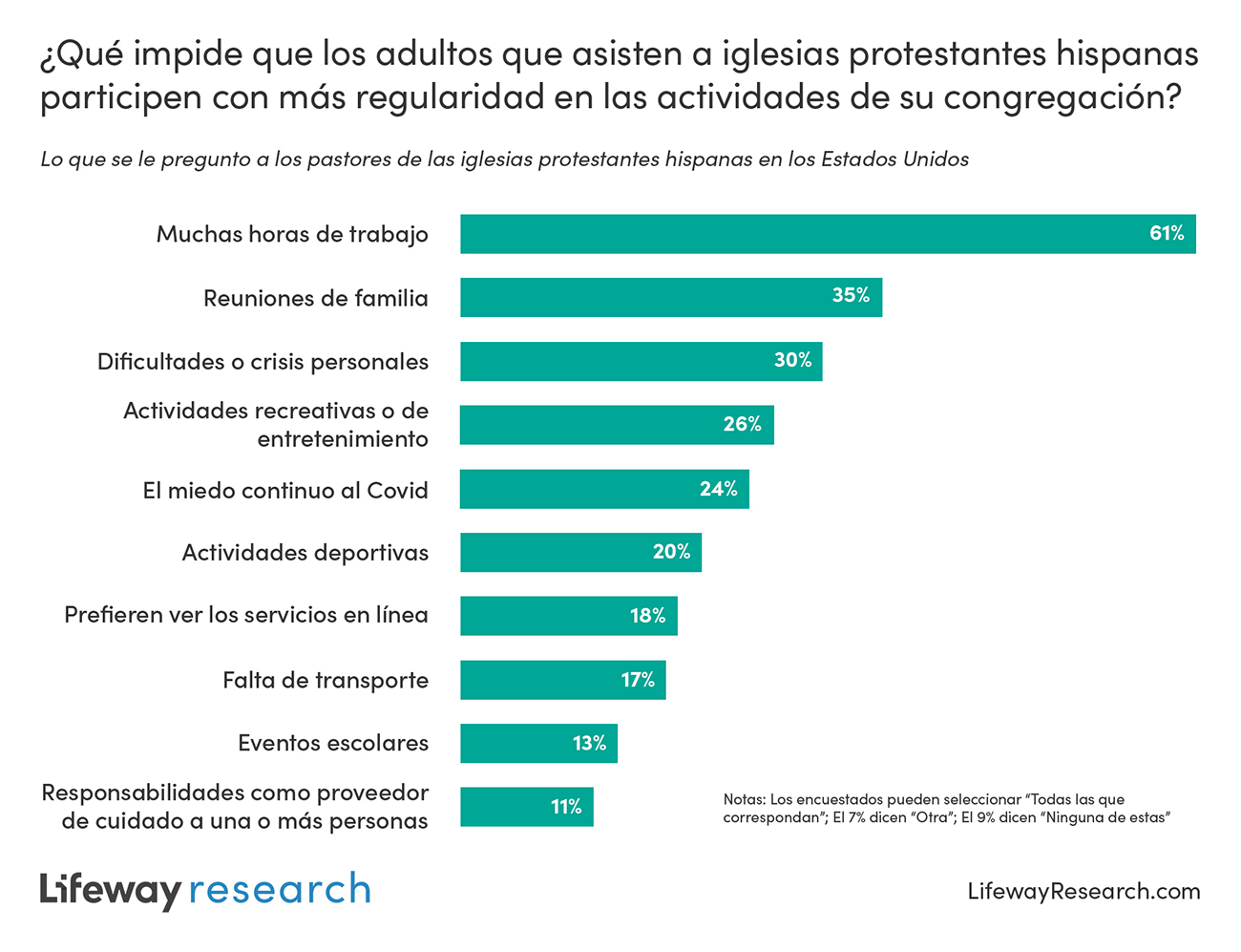
Con respecto a lo que impide que su congregación participe con más regularidad en las actividades de la iglesia, la mayoría de los pastores señalan las largas horas de trabajo de sus miembros (61%). Otros dicen que son las reuniones familiares (35%) y las dificultades o crisis personales (30%). Alrededor de una cuarta parte de los pastores indican que son las actividades recreativas o de entretenimiento (26%) y el miedo que persiste a COVID (24%). Una menor parte de los pastores dicen que son las actividades deportivas (20%), la preferencia de ver los servicios en línea (18%), la falta de transporte (17%), eventos escolares (13%) o responsabilidades como proveedor de cuidado a una o mas personas (11%).

“Muchas de las actividades dentro de las iglesias protestantes hispanas son muy parecidas a las de las iglesias que no son hispanas en los Estados Unidos, con los servicios de adoración, las reuniones de oración, los estudios bíblicos y clases de la escuela dominical siendo las más comunes”, dijo McConnell. “Pero los pastores de las congregaciones hispanas señalan que las familias inmigrantes tienen menos tiempo para la iglesia ya que muchas familias trabajan largas horas, tienen tradiciones familiares y se ven afectadas por las distracciones culturales en los Estados Unidos”.

Alcance evangelístico / compartiendo el evangelio

Casi 4 de cada 5 pastores en las iglesias protestantes hispanas en los Estados Unidos (79%) dicen que regularmente programan y organizan oportunidades para que los miembros puedan salir y compartir el evangelio.

Específicamente, la mayoría de los pastores dicen que sus actividades para compartir el evangelio en el último año incluyeron a miembros de la iglesia invitando a personas a asistir a la iglesia (86%), usando las redes sociales para compartir las actividades de la iglesia (74%), eventos especiales para los niños como la Escuela Bíblica de Vacaciones, actividades de la Semana Santa o festivales de otoño (59%), programas comunitarios como la distribución de alimentos, entrega de juguetes o  ropa (58%) y miembros de la iglesia que comparten el evangelio en sus conversaciones con otros (56%). Además, algunas congregaciones compartieron el evangelio en persona puerta a puerta (30%), enseñaron como compartir el evangelio con otros (24%) y apoyaron económicamente el inicio de una nueva iglesia (12%). Casi ninguna iglesia (1%) dijo que no han podido hacer ninguna de estas actividades recientemente.

Su manera de compartir el evangelio y alcanzar a las personas parece ser efectivo, ya que cerca de la mitad (47%) dicen que 10 o más personas han indicado que han entregado sus vidas a Cristo en el último año, incluyendo el 24% que han visto 20 o más personas entregar sus vidas a Cristo. Menos de 1 de cada 10 (9 %) informan que nadie ha entregado su vida a Cristo.

A medida que han alcanzado a estas nuevas personas, los pastores dicen que la mayoría se han quedado en la iglesia. Según los pastores, casi 3 de cada 4 (73%) de estos nuevos creyentes son participantes activos en la vida de la iglesia. Como resultado, el 88% de los pastores protestantes hispanos dicen que constantemente escuchan informes de vidas transformadas en sus iglesias.

“Las congregaciones hispanas son muy activas en involucrar y atraer a nuevas personas”, dijo McConnell. “No solo hay mucha actividad de evangelización en las iglesias hispanas, sino que Dios también las está bendiciendo con nuevas personas que se comprometen a seguir a Jesucristo”

Construyendo una comunidad

Según sus pastores, a medida que los nuevos miembros se unen a las iglesias protestantes hispanas, ellos forman parte de congregaciones que están activas en tratar de crecer juntas. Casi 9 de cada 10 pastores (88%) dicen que su iglesia tiene un plan para fomentar la comunidad en su iglesia, incluyendo el 53% que están totalmente de acuerdo.

Los pastores señalan muchas actividades que son esenciales para construir un fuerte sentido de comunidad dentro de sus congregaciones. Por lo menos 9 de cada 10 pastores dicen que orar juntos (96%), estudiar la Biblia juntos (95%), elegir llevarse bien y promover la unidad (93%), dar la bienvenida a personas de diferentes culturas y orígenes (93%), elegir ser transparentes y ser responsable unos con otros (89%) y verificar o darse cuenta cuando otros están ausentes (90%) son aspectos muy importantes o extremadamente importantes en la unidad en sus iglesias. Además, la mayoría de los pastores dicen lo mismo acerca de los miembros de su iglesia que trabajan juntos para servir a las personas de la comunidad (79%), socializan fuera de la iglesia (81%) y comparten recursos entre ellos (74%).

La mayoría de los pastores dicen que han escuchado que los miembros de su iglesia están participando en cada una de esas acciones por lo menos varias veces en el último mes.

“El compañerismo entre los creyentes en una congregación local es algo que la Biblia comunica que debe ocurrir”, dijo McConnell. “Las iglesias hispanas toman esto en serio e invierten en estas relaciones”.

Los pastores hispanos

Entre los pastores de las congregaciones protestantes hispanas de los Estados Unidos, el 93% son hispanos. Casi todos (95%) son pastores principales o los únicos pastores de una congregación hispana, mientras que el 5% son pastores de un campus hispano con una iglesia de varios sitios. El estado de empleo en la iglesia de más de la mitad de los pastores (56%) es a tiempo completo, el 27% son bi-vocacionales, el 10% están empleados a medio tiempo, el 6% son voluntarios y el 1% están en puestos interinos.

Casi la mitad de los pastores en las iglesias protestantes hispanas (48%) tienen entre 50 y 64 años de edad. Los pastores tienen más que el doble la probabilidad de tener menos de 50 años (37%), incluyendo un 4% que son menor de 30 años, que de tener 65 años de edad o más (16 %).

Casi 8 de cada 9 pastores (85%) son hombres. Dos de cada 3 pastores (66%) son estadounidenses de la primera generación, mientras que el 15% son de la segunda generación y el 19% son de la tercera generación. Cerca de 3 de cada 4 pastores se han graduado de una universidad, incluyendo el 44% que tienen un título de posgrado, mientras que el 17% tiene alguna educación universitaria y el 10% tiene una educación secundaria o tiene menos educación.

Teológicamente, 4 de cada 5 pastores (79%) de iglesias protestantes hispanas en los Estados Unidos se identificaron como evangélicos. Alrededor de 1 de cada 6 pastores (16%) dicen que son protestantes convencionales.

Para obtener más información, vea el informe completo y visite a LifewayResearch.com.

Patrocinado por Lifeway Recursos, La Asociación Evangelística de Billy Graham (BGEA), y Samaritan’s Purse, la encuesta en línea de 692 pastores de congregaciones hispanas en los Estados Unidos se llevó a cabo desde el 6 de septiembre al 1 de noviembre de 2022. Los encuestados fueron invitados por denominaciones y redes individuales. Las invitaciones se hicieron principalmente por correo electrónico y se les proporcionó a los pastores un enlace a la encuesta en línea. Cada encuestado fue evaluado para estar seguro de que ellos funcionaban como el pastor principal o el pastor de un campus hispano o de una congregación de habla hispana. Los encuestados fueron evaluados para estar seguro de que la congregación era una iglesia hispana o multiétnica o un servicio de adoración o campus de habla hispana dentro de una iglesia que no es hispana. Los pastores de un campus o servicio de adoración de habla hispana recibieron instrucciones de responder solo por ese campus / servicio de adoración. Solo se incluyeron las congregaciones que su membresía estaba compuesta por lo menos de un 50% de hispanos.

Se uso pesos ligeros / ponderación para ajustar los valores de las respuestas variables entre las denominaciones. La muestra completa fue de 692 encuestas. La muestra proporciona un nivel de confianza de 95 % de que el error de muestreo no exceda más o menos 5.0%. Este margen de error tiene en cuenta el efecto de la ponderación / peso. Los márgenes de error son más altos en los subgrupos, incluyendo 11 preguntas que fueron hechas intencionalmente a la mitad de los encuestados para poder mantener la duración de la encuesta razonable para cada encuestado.


No lives lost when façade collapsed at Stephenville church

First Baptist Church in Stephenville gathered for worship on Jan. 22, four days after the façade on the exterior of one of its buildings collapsed, injuring two construction workers.

A portion of the arched façade on the north side of the church’s education building collapsed at 1:58 p.m. on Jan. 18. The century-old building—part of the city’s historic district—is undergoing renovation and restoration.

Pastor Ken May was in his office at the south end of the church campus when he and others heard the crash.

“By the time I walked around the building, first responders were already there,” he said in a phone interview.

One of the workers injured in the accident was discharged from the hospital the same day he was treated. The other was transported to a hospital in Fort Worth, where he is “stable and improving,” May said.

“Buildings are valuable resources, but human lives are what are really precious,” he said.

‘God is with us’

During the Jan. 22 morning worship service, May encouraged his congregation to praise God for his presence in difficult times and thank God for the protection he provides.

Pastor Ken May speaks to his congregation during a Sunday worship service four days after a portion of the facade collapsed at the entrance to its educational building. (Video screen grab)

“God is good. All the time, God is good,” he said. “It has been a tough week. … Even when the façade on the church crumbles, God is with us.”

The church’s Kinderbridge Preschool meets in the education building, but no children or staff were injured. The collapse occurred after the time when the children were outdoors on a playground and prior to dismissal, when they would have been exiting the building with their parents, May noted.

“They were inside taking naps,” he said. Child care workers immediately followed emergency protocols, relocating the children to a safe location away from the affected part of the building.

“The engineer has inspected the building and concluded that most can be occupied,” a social media post on the church’s Facebook page stated, prior to the Sunday worship service.

While some preschool classes were moved to the church’s fellowship hall and a couple of adult Bible study classes relocated to the sanctuary on Jan. 22, most were able to meet in their usual areas. All classes were expected to be in their normal locations on Jan. 29.

“In life, you have to be flexible. … You just don’t know what’s going to happen. We’ve had to do that in the last few years with the pandemic,” May said.

While individuals are asked to stay clear of the area near the collapsed façade until it can be cleared, an engineer who examined the facility and compiled a 10-page report said it remains structurally sound, May told the congregation.

 “Thank you so much for your prayers,” he said. “Prayer is powerful.”

In a social media update posted Jan. 24, May called on the church to praise God.

“This week, we have become mindful of how quickly life can change. We have been confronted with the frailty of our nature and aware of our dependence upon God. Without him, we have no hope, no power and no future. Today is a day of praise,” he wrote.

“Praise him for being a God who is always in control, and One who is never caught by surprise. … Praise him for being a loving and kind God who watches over us, protects us and provides.”


Pastors enter public service to ‘be a light’ in communities

MANSFIELD (BP)—Michael Evans developed a heart for public service when he was 8 years old.

Early each morning, after his mother and great-grandmother boarded the bus to work, he had to prepare breakfast, get his 3-year-old sister Michelle on the bus to preschool and walk himself the two miles to class without getting in trouble along the way, he said.

“My mother depended on me. I saw her cry too many times because of what we didn’t have,” said Evans, mayor of Mansfield and senior pastor of Bethlehem Baptist Church there.

‘Be the solution’

Paducah, Ky., City Commissioner Raynarldo Henderson (left) was sworn in by Judge Christopher Shea Nickell.

Raynarldo Henderson, city commissioner in Paducah, Ky., and pastor of Washington Street Missionary Baptist Church there more than 30 years, was inspired for public service during his early adulthood in Chicago when the late Harold Washington was mayor.

“There were fights on the (city council) floor. I remember one alderman … standing up on the table,” Henderson said. “Those first four years for Harold Washington were rough. They gave him a hard time. And it was watching those city council meetings that it was like: ‘Wow. I can be a solution. I can make a difference.’

“I was taught that if you see a problem, you be the solution.”

Both Evans and Henderson are fulltime pastors who concurrently serve in elected office in the public square. Both see their pastorates and their elected governmental posts as godly callings. Both express the ability to uphold the laws of the land while also exhibiting godly behavior as the Lord’s ambassadors.

“There are some people who think pastors shouldn’t be in politics,” Henderson said. “But obviously, I think the exact opposite, because we do get an opportunity to impact” communities.

Longtime involvement in community

Evans, a Houston native elected to his second mayoral term in November 2022, came to the office after holding various public posts as early as 2007, including terms on the Mansfield Independent School District Board and the Tarrant County College District. He was a commissioned officer and reserve chaplain in the U.S. Navy, and he is a former president of the Baptist General Convention of Texas.

Michael Evans is mayor of Mansfield and senior pastor of Bethlehem Baptist Church in Mansfield. He is a former president of the Baptist General Convention of Texas.

Evans, who eventually became the oldest of six children when his mother remarried, experienced both provision and lack during his childhood, he said. His birth parents divorced after his father returned from the Vietnam War.

“When you see people hurting and you encounter people who are hurting, and I was blessed to have grandparents on the maternal and paternal side that held us up while our parents were going through,” Evans said.

“So, when you have those experiences, you say: ‘Lord, help me to pay back, because I know that it’s been given to me. So, so help me to give it back.’”

Bethlehem Baptist Church elected him pastor when he was 24 years old, when Mansfield was a rural community of just 15,000 residents.

“They helped me grow up here as a young man,” he said of the congregation that averaged 1,200 in worship before the COVID-19 pandemic and draws 600 in worship today.

‘Love and serve’ all

Evans sees himself as exposed to a diversity of public opinion as a mayor, but covered by God as his servant.

“Character counts. I believe people will read you before they read the Bible. I’ve got to love and serve even those that don’t like me. I learned that in the pastorate,” he said. “Bethlehem got me ready for that. I praise God for giving me a covering, and it is here at Bethlehem.”

Evans doesn’t compromise God’s word, he said, but upholds the constitutions of Texas and the United States, as he is sworn to do as mayor.

“My job (as mayor) is to not allow you to be mistreated or discriminated against because of the way you think. That’s just right to do. I cannot stand by and allow any person to be mistreated,” Evans said. “I believe that the best way to save a person is for the people to see Christ in the (other) person. And they can’t see that with me hating them. …

“[I]n regard to society, you’ve got to know that I’m going to respect your position. I don’t have to accept your position, but I have to respect it and I have to protect it and protect you, because I made a vow to do just that. To do otherwise would be dishonest. I shouldn’t even take the oath if I didn’t mean to be right.”

Integrity essential

He sees integrity as a way of sharing the gospel.

“You share it by being fair to the parties that come before you,” Evans said. “You share it by loving those who you know hate your guts because you’re Black. You share it by demonstrating condolence when bad things happen in the city. It’s lifestyle evangelism.”

Henderson’s road to elected office included three campaigns before his winning run as city commissioner in November 2020.

“I’m just not a quitter. You don’t stop, my mom always taught us, you don’t stop because you come to a wall,” he said. “You go over the wall, under the wall, around the wall.

“I kept on going because I knew that was what God had for me. Because I believe that in my heart, I kept pressing. If God has called you to it, he’ll bring you through it.”

Today, Henderson is known affectionately as “Pastor Commish.”

Make an impact

Henderson enjoys his public office, particularly frequent opportunities to offer the invocation at public meetings.

“I get an opportunity through my prayer to set the tone or the atmosphere of meetings. If a meeting goes well, I feel like it has had something to do with what I prayed and how I asked God’s presence to be in our meetings,” he said. “I get an opportunity to say to our other commissioners or mayor, I feel God is leading me to do this.

“I have an opportunity to be a witness or to be a light in our community. Obviously, I don’t stand on a street corner with a megaphone, but just my presence. People know that I’m a pastor. People know that I’m a preacher. And therefore, they call upon me on many cases.”

Henderson leads Washington Street Baptist Church to be active and present in the community. Among its ministries are feeding ministries, outreaches to the elderly, and a warming center with resources for the homeless on cold nights, offering showers, a bed, food and clothing.

“I ask our church often: ‘If Washington Street Church were no longer here, would this community know the difference and would they even care?’

“I believe that the church has a responsibility to be in the community. We have a responsibility to impact the community. And just being the commissioner gives me an added opportunity to make an impact.”


Hispanic Protestant landscape full of vibrant churches

NASHVILLE, Tenn.—Hispanic churches in the United States face unique challenges but are finding success in building community within their congregations and reaching those outside their walls.

Lifeway Research partnered with two dozen denominations and church networks to include what is likely the largest number of Protestant Hispanic congregations in the U.S. ever invited to a single research study.

Sponsored by Lifeway Recursos, the Billy Graham Evangelistic Association and Samaritan’s Purse, the study surveyed 692 pastors of congregations that are at least 50 percent Hispanic.

“For decades, the Hispanic population in the U.S. has been growing exponentially, and it is imperative for churches to be informed about the specific needs of this community,” said Giancarlo Montemayor, director of global publishing for Lifeway Recursos.

“This study will help us to continue the ongoing conversation of how to serve our brothers and sisters in a more strategic way.”

Congregational snapshot

The study reveals a picture of Hispanic churches that are newer, younger and more effectively evangelistic than the average U.S. Protestant church.
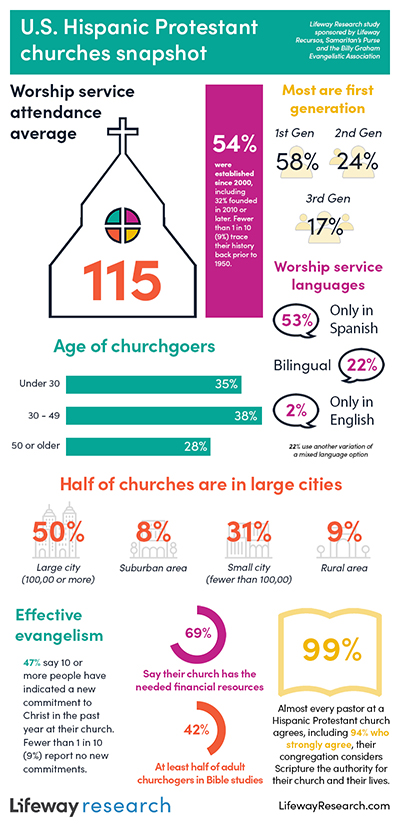
Most Hispanic Protestant churches (54 percent) have been established since 2000, including 32 percent founded in 2010 or later. Fewer than 1 in 10 (9 percent) trace their history prior to 1950.

Not only are the churches relatively new, but most people in the congregations are also new to the United States. The majority are first generation Americans (58 percent), born outside of the country. A quarter are second generation (24 percent), with parents who were born outside of the U.S. And 17 percent were born in the U.S. to parents who were also born in the U.S.

A majority conduct their services only in Spanish (53 percent), while 22 percent are bilingual.

Half of the churches (50 percent) are in a large metropolitan area with a population of 100,000 or more. Around 3 in 10 (31 percent) are located in small cities, 9 percent are in rural areas and 8 percent are in suburbs.

In the average Hispanic Protestant church, a full third of the congregation (35 percent) is under age 30, including 18 percent under 18. Another 38 percent are aged 30 to 49, and 28 percent are 50 and older.

“The growth in the number of Hispanic churches in the U.S. has been remarkable,” said Scott McConnell, executive director of Lifeway Research.

“While some of these congregations were started within Anglo churches—14 percent of Hispanic congregations in this study currently are conducting services within a church that is predominantly non-Hispanic—the missional impetus has clearly come from within the Hispanic community itself as two-thirds of these congregations are led by first-generation immigrant pastors.”

In U.S. Hispanic Protestant churches, the average worship service attendance is 115. Like most other churches, they’ve not yet fully recovered from the pandemic. In January 2020, prior to the COVID-19 pandemic, the average attendance was 136. Still, 13 percent of churches are around their pre-pandemic levels. And 32 percent say they’ve grown in the past three years, despite the pandemic.

Almost every Hispanic Protestant pastor (99 percent) agrees, including 94 percent who strongly agree, their congregation considers Scripture the authority for their church and their lives.

Around 7 in 10 (69 percent) say their church has the financial resources it needs to support their ministry, which include some aspects that are common among most other Protestant congregations.

Most Hispanic Protestant churches say they regularly offer weekly adult small groups or Bible studies (74 percent), weekly prayer meetings (66 percent) and weekly children’s small groups (52 percent).

Fewer have weekly youth small groups (45 percent), weekly young adult small groups (40 percent), one-on-one discipleship or mentoring (34 percent), evening large group Bible study (25 percent) or evening praise and worship (24 percent). Just 3 percent say they offer none of these.

When asked about moving weekend worship service participants to small groups, 42 percent of pastors say at least half of their adult churchgoers are involved in group Bible studies, including 15 percent who say at least 75 percent are connected to a small group.

Around a third (34 percent) say fewer than 1 in 4 churchgoers also are members of small-group Bible studies, including 9 percent of pastors who say none of those attending worship services are involved in groups.

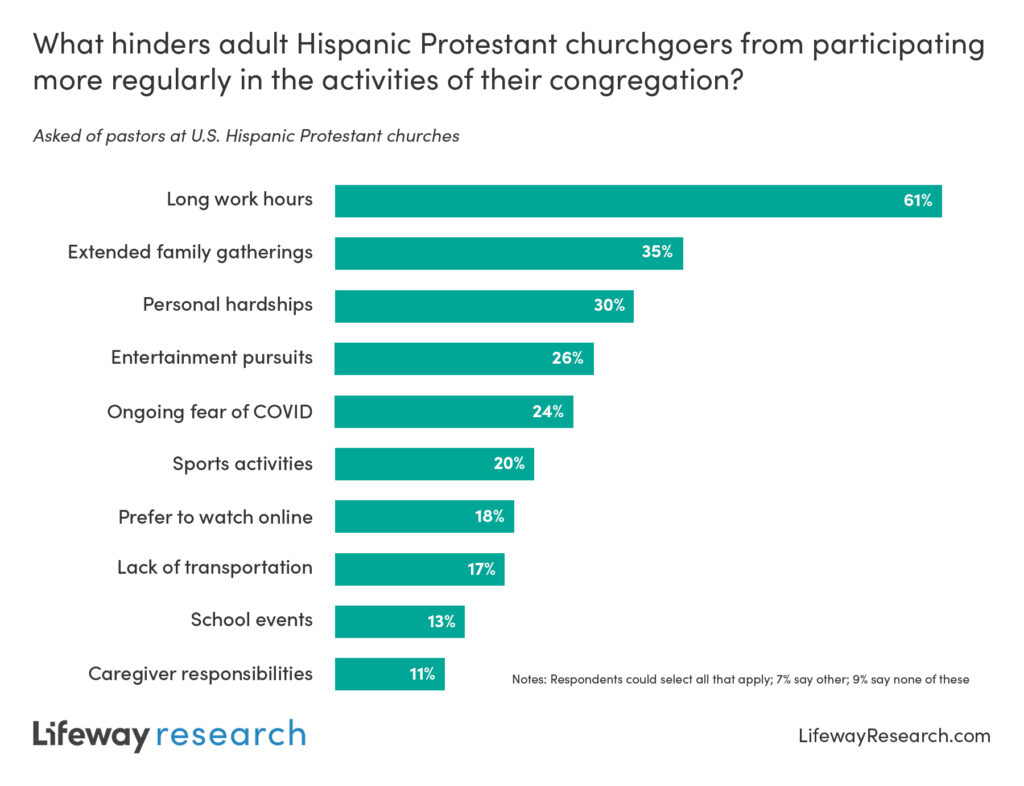
As to what hinders their congregation from participating more regularly in church activities, most pastors point to long work hours for their churchgoers (61 percent). Others say extended family gatherings (35 percent) and personal hardships or crises (30 percent).

Around a quarter point to recreational or entertainment pursuits (26 percent) and lingering fear of COVID (24 percent). Fewer say sports activities (20 percent), a preference to watch online (18 percent), lack of transportation (17 percent), school events (13 percent) or caregiver responsibilities (11 percent).
“Many of the activities within Hispanic Protestant churches look similar to those in non-Hispanic churches in the U.S. with worship services, prayer meetings, Bible studies and Sunday School classes being common,” McConnell said.

“But pastors of Hispanic congregations are quick to point out immigrant families often have less time for church, as many are working long hours, have family traditions and are impacted by American cultural distractions.”

Evangelistic outreach

About 4 in 5 pastors at U.S. Hispanic Protestant churches (79 percent) say they regularly schedule opportunities for members to go out and share the gospel.

Specifically, most pastors say their outreach activities in the past year included church members inviting people to church (86 percent), using social media to share church activities (74 percent), children’s special events like VBS, Easter egg hunts or Fall festivals (59 percent), community programs like food distribution, toy giveaways or providing clothing (58 percent), and church members sharing the gospel in conversations (56 percent).

Additionally, some congregations did door-to-door evangelism (30 percent), evangelism training (24 percent) and provided financial support for a new church start (12 percent). Hardly any churches (1 percent) say they have not been able to do any of those recently.

Their outreach seems to be effective, as close to half (47 percent) say 10 or more people have indicated a new commitment to Christ in the past year, including 24 percent who have seen 20 or more such commitments. Fewer than 1 in 10 (9 percent) report no new commitments.
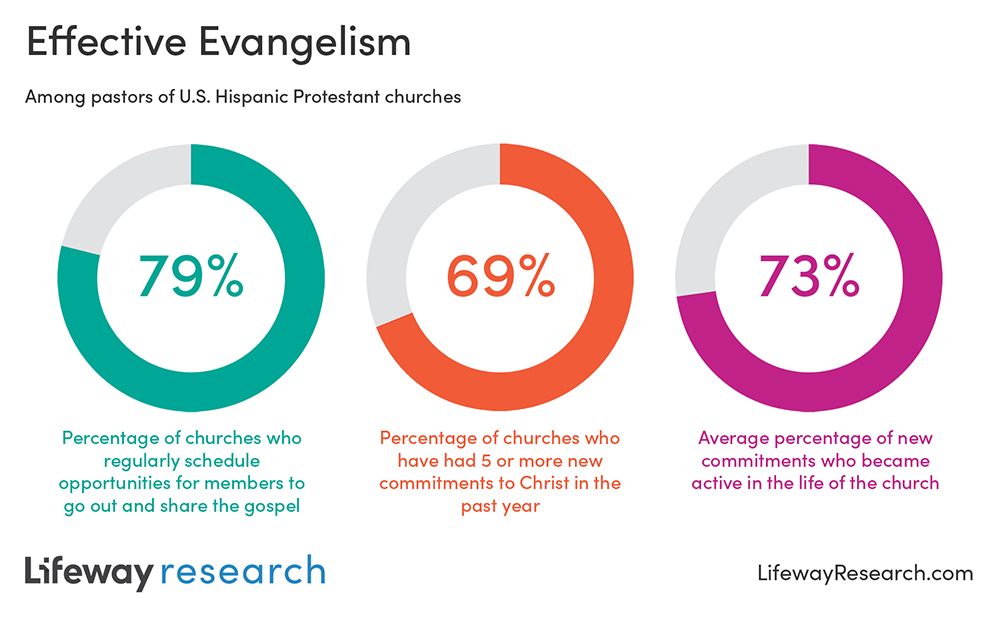
As they’ve reached these new individuals, pastors say most are sticking around. Almost 3 in 4 (73 percent) of those new commitments have become active participants in the life of the church, according to pastors. As a result, 88 percent of Hispanic Protestant pastors say they consistently hear reports of changed lives at their churches.

“Hispanic congregations are very active in engaging new people,” McConnell said. “Not only is there much evangelistic activity in Hispanic churches, but God is also blessing them with new people who commit to following Jesus Christ.”

Building community

As new members join Hispanic Protestant churches, they become part of congregations that are actively trying to grow together, according to their pastors. Almost 9 in 10 (88 percent) say their church has a plan to foster community in their church, including 53 percent who strongly agree.

Pastors point to numerous activities as vital to building a strong sense of community within their congregations.

At least 9 in 10 say praying together (96 percent), studying the Bible together (95 percent), choosing to get along and promoting unity (93 percent), welcoming those from different cultures and backgrounds (93 percent), choosing to be transparent and accountable with one another (89 percent) and checking-in or noticing when others are absent (90 percent) are very or extremely important aspects of unity in their churches.

Additionally, most say the same about members working together to serve people in the community (79 percent), socializing outside of church (81 percent) and sharing resources with each other (74 percent).

Most pastors say they’ve heard about their church members engaging in each of those actions at least a few times in the past month.

“Fellowship among believers in a local congregation is something the Bible communicates should be taking place,” McConnell said. “Hispanic churches take this seriously and invest in these relationships.”

Among pastors of U.S. Hispanic Protestant congregations, 93 percent are Hispanic themselves. Almost all (95 percent) are the senior or only pastor of a congregation, while 5 percent are Hispanic campus pastors with a multi-site church.

More than half (56 percent) serve as a full-time pastor, 27 percent are bivocational, 10 percent are part-time, 6 percent are volunteer and 1 percent are in interim positions.

Almost half of pastors in Hispanic Protestant churches (48 percent) are between the ages of 50 and 64. Pastors are more than twice as likely to be under 50 (37 percent), including 4 percent under 30, than 65 or older (16 percent).

Almost 8 in 9 pastors (85 percent) are male. Two in 3 (66 percent) are first generation Americans, while 15 percent are second generation and 19 percent are third. Close to 3 in 4 are college graduates, including 44 percent who have a graduate degree, while 17 percent have some college and 10 percent have a high school education or less.

Theologically, 4 in 5 (79 percent) pastors at U.S. Hispanic Protestant churches self-identified as evangelical. Around 1 in 6 (16 percent) say they’re mainline.

The online survey of pastors of Hispanic congregations in the United States was conducted Sept. 6  to Nov. 1, 2022. Slight weights were used to adjust for varying response rates across denominations. The completed sample is 692 surveys, providing 95 percent confidence the sampling error does not exceed plus or minus 5.0 percent. This margin of error accounts for the effect of weighting. Margins of error are higher in sub-groups.



Conference offers training and equipping in evangelism

SAN ANTONIO—Saying the church’s “evangelism has fallen short of our calling,” Pastor Tony Evans urged attendees at Texas Baptists’ Statewide Evangelism Conference to go and make disciples.

The Jan. 23 conference saw 1,125 pastors, lay leaders and other attendees registered for a time of equipping and training at First Baptist Church of San Antonio.

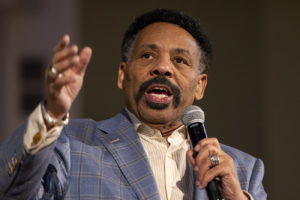
Pastor Tony Evans of Oak Cliff Bible Fellowship in Dallas challenges attendees at Texas Baptists’ Statewide Evangelism Conference to share the gospel. (Texas Baptists Photo)

Likening the gathering to a huddle in a football game, Evans reminded congregants that the conference was not the main objective, but rather a time to come together and strategize.

What’s important is “what difference the huddle makes,” Evans said. “Having huddled, can you now score?”

Evans, the senior pastor of Oak Cliff Bible Fellowship in Dallas, exhorted Christians not to join in the “chaotic conflict” of the culture by joining a team, but to be more like referees— representatives of God, with his authority.

He urged attendees to make disciples—which he defined as “visible, verbal” followers of Jesus who “replicate the Master”—and to take what they had learned in the evangelism conference and spread the gospel.

“The church is good at huddling,” Evans said. “But (Jesus) said, ‘I want you to go!’”

The Jan. 23 event—with the theme “Can I Ask You a Question?”—was Texas Baptists’ first statewide evangelism conference following a 15-year hiatus.

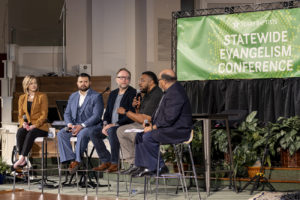
A panel (left to right: Katie McCoy, Eric Hernandez, Steve Bezner, Robert White, Victor Rodriguez) answers audience questions about evangelism. (Texas Baptists Photo)

Large crowds filled the worship center for each of the seven sessions. Along with sermons and presentations, the conference included a question-and-answer panel with speakers.

“That’s what this conference is about,” Leighton Flowers, director of evangelism for Texas Baptists, told attendees. “To equip you and train you, to give you tools, so you can go back to your churches and to your homes and spread the gospel to your friends and neighbors.”

The evangelism conference’s theme is shared by a five-book curriculum bundle, published by GC2Press, with the same name: “Can I Ask You a Question?”

The curriculum teaches Christians the basics of sharing the gospel and engaging nonbelievers, noting Jesus often asked questions to further spiritual conversations.

‘The desire of every generation’

Katie McCoy, director of Women’s Ministry for Texas Baptists, outlined the post-Christian environment in which Texas Baptists now bear witness. Today’s culture resembles that of first-century Roman culture, McCoy said. That creates undeniable challenges but provides tremendous opportunity for Christ followers, she added.

 McCoy said the prevailing cultural way of life inevitably leaves people isolated, searching for significance and hungering for wholeness.

 “The message of Jesus and the community of his people are the desire of every generation,” she said.

But McCoy also warned conference-goers to focus on what is important—proclaiming the gospel. The early church, even as it was still developing, “kept the main things the main thing,” she said.

Be the ‘salt of the earth’

Eric Hernandez, apologetics lead and millennial specialist for Texas Baptists, emphasized the need to couple the ability to defend the faith with the practice of sharing one’s faith.

Beginning with Jesus’ words from Matthew 5:13—“You are the salt of the earth”—he asked attendees: “Why are you a Christian? Why should someone else be a Christian?”

In 2 Corinthians 10:3-5, the Apostle Paul teaches Christians are to “refute arguments and reasonings and every proud and lofty thing that sets itself up against the knowledge of God.” Hernandez posited that “the biggest threat to Christianity” is not atheists or other external opponents, but instead Christians “who cannot effectively engage in spiritual warfare by recognizing, rationally responding to and tearing down strongholds.”

Hernandez encouraged attendees to participate in the [un]Apologetic Conference, scheduled Feb. 25 in San Marcos.

“Let us not just learn to present the gospel, but defend it, because, ‘You are the salt of the earth.’ God has not just given us the truth but given us the evidence to show why it is true,” he said.

Issue a ‘broader invitation’

Robert White, lead pastor of Freedom Church in Bedford, implored attendees to issue a “broader invitation.” While Christians must proclaim the gospel, the invitation to Christ is “broader than just the words presented,” because it includes the example of their lives, he said.

“Before we can invite others to respond to the invitation, we need to accept the invitation that has been given to us to live like Jesus,” White said.

Preaching from Philippians 1:27-30, he exhorted Christians to gospel conduct—living lives worthy of the gospel—and to live in “gospel community” with each other.

He also called Christians to gospel confidence, noting there is no reason for fear, and to gospel commitment, recognizing that following Christ will mean suffering for the sake of Christ (Philippians 1:29).

Focus on those ‘on the outside’

Steve Bezner, senior pastor of Houston Northwest Church, called pastors to emphasize evangelism and to break out of a “chaplain” mindset, believing “our primary job is simply to care for those who are inside our churches.”

“We can easily forget that there are so many on the outside who do not have life in Christ,” he said. “Let’s be honest. If we don’t think about it, who will?”

Houston Northwest Church has experienced a surge in baptisms, he said, as the church has emphasized corporate prayer in recent years. Noting Gallup research projects fewer than 50 percent of Americans will identify as Christian by 2050, he exhorted pastors not to forget the power of the gospel.

“The world may be falling apart, the culture may be confused, things may be terrible in your neighborhood right now, but guess what?” Bezner said. “Jesus still saves. The cross still forgives. The empty tomb still promises eternal life. And Jesus is still pouring out his Holy Spirit on the most heathen among us.”

Next generation looking for authenticity

Shane Pruitt, National Next Gen Director for the North American Mission Board, urged attendees to focus on reaching Gen Z and then send them to reach their peers.

Despite statistics that show Gen Z identifies less with religion than previous generations, Pruitt said, he has seen more conversions among young people in the last three years than in his previous 15 years of ministry. The pandemic, he said, brought them “to the end of themselves” more rapidly than those in previous generations.

“You don’t have to be young. You don’t have to be cool,” he said. “Young people are not looking for cool leaders. They’re looking for real and authentic leaders. If you have the gospel, you have what it takes.”

Pruitt encouraged leaders not to refer to young people as the “future of the church.”

“They are the church now, and they can handle” the responsibility of fulfilling the Great Commission, he asserted.


Obituary: Tom Ruane

Thomas Martin Ruane, longtime leader in Texas Baptist collegiate ministries, died Jan. 18. He was 77. He was born July 21, 1945, in San Antonio to Ary and Francis Ruane. He earned his undergraduate degree from Howard Payne University and a Master of Divinity degree from Southwestern Seminary. He later received a Doctor of Ministry degree from New Orleans Baptist Seminary. He served 36 years with the Baptist General Convention of Texas in student ministries and institutional ministries. He was campus minister and Bible teacher at Tarleton State University, Howard Payne University and the University of Texas at Arlington. He worked in the BGCT student division from 1979 until 2000, and he later served as associate director of institutional ministries and director of church relations consultants. After retiring from the Baptist Building, he worked as development director for the Baptist Standard. Ruane served as an interim pastor and visiting preacher in many congregations in the Dallas-Fort Worth area, where he helped start and was pastor of several cowboy churches. In his final days, Ruane pointed out to his family the Bible has more than 7,000 promises, but tomorrow is not one of them. He reminded them God does not take our loved ones; rather, God receives them. He is survived by his wife of 56 years, Mary Alice; son Richard; daughter Kristen and her husband Jeff; son Jason and his wife Rachael, and five grandchildren; brother Jim Ruane; and sister Delia Rawlinson. Visitation with the family is scheduled from 6 p.m. to 8 p.m. on Jan. 27 at Wayne Boze Funeral Home in Waxahachie. A memorial service will be held at 1 p.m. on Jan. 28 at Wayne Boze Funeral Home. Memorial donations can be made to the Baptist General Convention of Texas church starting here or Texas Baptist student ministry here.


Ministry after Lunar New Year massacre family-focused

MONTEREY PARK, Calif. (BP)—Pastor Victor Chayasirisobhon likens the Asian Lunar New Year to the traditional American Thanksgiving, complete with “extremely important” family gatherings of love and prayer.

A mass shooter’s choice of Lunar New Year’s Eve to kill 11 and injure nine others is a wound particularly painful for East Asian communities—Christians and nonbelievers, Chayasirisobhon told Baptist Press.

Churches seeking to comfort the community would benefit from knowing the communities’ cultural customs, said Chayasirisobhon, Southern Baptist Convention first vice president and senior pastor of First Southern Baptist Church in Anaheim, about 30 miles south of the crime.

“I think that it’s always good for churches as a whole in the current climate to reach out and express their condolences and their care whenever anything like this happens,” he said.

“Sometimes, in Asian communities, (we’ve) not always felt like we’re seen. So, when people of many different cultures, particularly of church culture, reach out and express their sympathy and their condolences in times like these, it is well received and appreciated.

“Typically at times when something happens in our community, depending on which culture of Asia you’re dealing with, it’s typically handled within that particular community; but it’s handled as a community.”

‘A very sensitive time’

Chayasirisobhon has reached out to Southern Baptist pastors in Monterey Park but said typically the community will craft a response by first learning the names of the victims and their immediate families.

 “I think this is a very sensitive time, and I think that helping in the appropriate moment is more important than just jumping in without knowing what’s really happening,” he said. “Typically, the way we would help is (by asking) does anyone know anyone who’s related to any of those people that were murdered, and we would try to reach out through those networks first.

“We’re a quieter culture. But that’s where food will show up. We’ll send food. We’ll send money. If these people went to church and are part of the church community, all of those services and resources and care will be given through that way.

“Finding a church or a ministry that’s connected to some of the victims of the shooting is typically how we would do that, rather than some sort of big, visible campaign.”

Peter Yanes, associate vice president of Asian American relations for the Southern Baptist Convention Executive Committee, expressed condolences.

“This tragic and senseless killing shouldn’t be happening to anyone. My heart goes with the families of the innocent victims and everyone affected—those grieving losses and healing as a community,” Yanes said.

“As churches lock arms together to pray for the Monterey Park community, the assurance of comfort, peace and hope may be found in Jesus Christ in these troubling times.”

Los Angeles County Sheriff Robert Luna released the names of two of the people killed in the rampage, 65-year-old My Nhan and 63-year-old Lilan Li. All victims, including those killed and injured survivors, are in their 50s, 60s and 70s, police said. The death count rose to 11 Jan. 23, with six survivors still hospitalized.

The alleged shooter, identified as 72-year-old Huu Can Tran of Vietnamese descent, was found dead on Lunar New Year’s Day of an apparently self-inflicted gunshot wound in a white van about 25 miles from the scene of the crime, Luna reported.

Tran also is accused of attempting a shooting the same night at Lai Ballroom & Studio in nearby Alhambra, but patrons there tackled him and took the gun before he fled. No injuries were reported in Alhambra.

Police are searching for a motive, but early reports described it as a domestic dispute.

In secular culture, the Lunar New Year is celebrated as long as several weeks and is seen as an important forecaster of luck for the new year.

While many Asian Christians celebrate certain customs such as family meals and gifting younger generations with red envelopes containing cash, Chayasirisobhon said, he also encourages celebrants with the gospel.

“You actually have a new year every day when you have Jesus,” he said. “We pick these days that mean something to our culture, but [in] our Christian culture, we can start every day new in Christ Jesus.”


Faith-based groups urge Biden not to enact asylum ban

WASHINGTON (RNS)—Numerous faith-based organizations and congregations are pleading with the Biden administration, in a letter sent Jan. 23 to President Joe Biden and other leaders, not to enact new immigration restrictions.

The letter—signed by 165 faith-based local, national and international organizations and congregations—expresses “grave concern” with policies Biden announced earlier this month.

While those policies expand a program offering humanitarian parole to Venezuelans to include individuals from Nicaragua, Haiti and Cuba, they also include a proposal to bar people from seeking asylum if they enter the United States without inspection or do not seek protection in other countries along the way, the letter said.

The administration has said it plans to launch an app that individuals can use to schedule an appointment for inspection instead of coming directly to a U.S. port of entry in order to reduce wait times and crowds at the border.

The letter urges the Biden administration not to move forward with what it calls an “asylum ban,” calling it “harmful, inhumane and deadly for the most vulnerable.”

“Across faith traditions and practices, the message is clear: We are called by our sacred texts and faith principles to approach one another with love—not fear,” the letter reads.

“Our diverse faith traditions compel us to love our neighbor, accompany the vulnerable, and welcome the sojourner—regardless of place of birth, religion or ethnicity. Importantly, our faiths also urge us to boldly resist and dismantle systems of oppression.”

Parole is no substitute for access to asylum, according to the letter.

Signers include three of the six faith-based agencies that partner with the U.S. government to resettle refugees: Church World Service, HIAS (formerly the Hebrew Immigrant Aid Society) and Lutheran Immigration and Refugee Service.

Several denominations also signed on to the letter, including the Evangelical Lutheran Church in America, Presbyterian Church (USA) and United Church of Christ. Other signers are the American Friends Service Committee; General Board of Global Ministries and General Board of Church and Society of the United Methodist Church; Hindus for Human Rights; Anti-Defamation League; Christian Reformed Church Office of Social Justice; Mennonite Central Committee U.S.; National Council of Churches; NETWORK Lobby for Catholic Social Justice; Union for Reform Judaism; and Unitarian Universalists for Social Justice.

On a call hosted Monday morning by the Interfaith Immigration Coalition and #WelcomeWithDignity Campaign, Krish O’Mara Vignarajah, president and CEO of LIRS, shared a number of misconceptions people have about those seeking humanitarian aid.

Not all have valid passports, access to a cell phone, reliable Wi-Fi or a willing sponsor in the United States in order to take advantage of pathways to enter the country, Vignarajah said. For many, their best option is to make an often dangerous journey to the U.S. border to seek asylum.

“That is a high hurdle to clear—one that borders on a wealth test for some of the most vulnerable children and families facing immediate danger,” she said.

Mark Hetfield, president and CEO of HIAS, said his organization is old enough to remember a time before the U.S. had laws allowing people to seek asylum in the country. Hetfield pointed to 1939, when he said the Franklin D. Roosevelt administration refused to allow a ship carrying 900 Jewish passengers who were fleeing Nazi Germany to dock in Florida. It returned to Europe, where 254 of those passengers perished in the Holocaust.

That’s why the United Nations established and the United States adopted the Refugee Convention, he said, “asserting that never again, would people be trapped inside of their country of persecution.”

The Biden administration’s proposal would place the asylum laws the United States now has “out of reach” for many, Hetfield said, which he called “illegal” and “immoral.”

And that “hits home” for many faith-based organizations, “who’ve been serving some of the most vulnerable for decades,” Vignarajah added.

“This isn’t charity for us. This is how our supporters live out their faith and answer that higher call to welcome the stranger in need.”


Theology lab tackles complex topics with humility

WASHINGTON (RNS)—The word “evangelical” is a bit like the word “apocalypse.”

Dennis Edwards. (Photo courtesy of North Park Theological Seminary)

Both have theological meanings understood by pastors and church insiders. But the general public has other ideas.

“For the specialists, apocalypse means ‘revelation’ or ‘unveiling,’” said Dennis Edwards, dean of North Park Theological Seminary in Chicago. “But for the masses, apocalypse means disaster.”

The same is true for the word “evangelical.” While that word has a set of theological connotations about the Bible and Jesus, for most Americans today it’s synonymous with conservative Republican Christians.

“I don’t think we’re ever going to recapture the real meaning of apocalypse,” Edwards said. “I sometimes wonder if we can ever recapture the sense of evangelical—meaning something that comes from the ‘evangel’ or good news, the message that Jesus has come to rescue humanity.”

Edwards was one of the featured speakers in an online theology lab run by Highrock Church, a multiethnic congregation that’s part of a network of churches in the Boston area that bear the same name.

Provide a broader understanding of faith

The lab, a series of online discussions that began in the fall of 2022 and run through this spring, is designed as an exercise in theological formation for laypeople, said Scott Rice, a theologian in residence at Highrock.

The idea is to give church members—and other interested Christians—a broader understanding of their faith and the way Christianity is lived out in the world.

The church has held past discussions about Black theology and Asian American theology. For the current series, Rice said, group members wanted to talk about American evangelicalism, in part because Highrock belongs to a denomination—the Evangelical Covenant Church—with the word right there in its name.

It’s a reality that has become more complicated as the term “evangelical” has become more politicized and identified with conservative politics, especially under former President Donald Trump.

While not all church members identify with that term, he said, the church has been influenced by the broader evangelical movement.

“We are a community where some identify as evangelical and some do not,” he said. “Some want to keep using the word and some do not.”

Creating an online learning community

The discussions are held online so people from different congregations in the network can take part in what he called a learning community. Rice and Meghan DeJong, a pastor at Highrock, help lead the discussion with speakers and moderate the follow-up question and answer sessions. Then participants break up into small groups to discuss what they have learned.

“Folks have a chance to process together,” Rice said. “There is no one saying this is exactly what you have to believe to be part of the community.”

Rice and other Highrock leaders have stressed the need for humility and curiosity during the conversations, urging participants to listen carefully to the speaker, even if they disagree with what’s being said. And not everyone has to agree in order to be part of the community, Rice said.

“We want our people to see thoughtful conversations happening with people who have different points of view,” he said.

The theology lab began with speakers from Highrock’s denomination, including Edwards and North Park church history professor Hauna Ondrey, as well as author and speaker Dominique DuBois Gilliard.

Former Southern Baptist ethicist Russell Moore, now editor of Christianity Today magazine, and Walter Kim, president of the National Association of Evangelicals, spoke at a session just before Thanksgiving.

Beth Allison Barr

Upcoming speakers include Calvin University historian and bestselling author Kristin Kobes Du Mez, Sojourners founder Jim Wallis, author and Baylor University professor Beth Allison Barr and New York Times columnist David Brooks.

During their conversation in November, Kim and Moore talked about the growing polarization in the United States, the threat of Christian nationalism and the way evangelicalism has become closely tied to conservative politics.

Moore also talked about the role of “conflict entrepreneurs,” a term coined by author Amanda Ripley. Those entrepreneurs, Moore said, benefit from driving up conflict in polarized times. He also called Christian nationalism a form of the prosperity gospel that operates on a national level, rather than a personal one.

Moore told participants that many of the old alliances among evangelicals fell apart during the Trump era, and new ones have started to form. Even so, many in the movement are still dealing with “disillusionment, frustration, instability and fear.”

“I don’t know a church that’s not either tense or divided—or aware that they are not and on guard, because they are just waiting for (conflict) to happen,” Moore said.

Although Highrock and its home denomination are not part of the NAE, the church has ties with Kim from his time as a pastor in the area. The NAE leader said he was thankful for the charitable nature of the conversations during the theology lab, which he said could be a model for the broader church.

Complex times, complicated discussions

Complex times, he said, require complicated discussions characterized by curiosity and an openness to listen. Christians can have those discussions without compromising their convictions.

“I am really grateful there is a local church modeling this kind of discussion,” he said.

DeJong said Moore and Kim, like other speakers in the series, spoke with both honesty and humility.

“Those are values that we hold in our relationships at Highrock, and so to have people who carry gravitas in Christian circles just enter into our conversations with that same posture is encouraging,” she said. “It shows that Christians all over the theological and geographical map are wrestling with similar questions, and that they’re not alone.”

Joe Marcucci, a pastor at Highrock who works with a prison ministry and other community outreach, facilitated one of the discussion groups. A former church planter and senior pastor at another church, Marcucci said he has mixed feelings about the term “evangelical” and its ties to politics.

“I feel like we’ve lost the evangelism part of evangelicalism,” he said.

The discussions in the theology lab are a good first step, Marcucci said. There’s a balance between listening with respect and still acknowledging that people disagree, he added.

No one wants open conflict during the discussions, he said. But moving the conversation forward may be uncomfortable.

“To do that, there has got to be some messiness to it,” he said. “I don’t know if we have gotten to that point yet.”

That idea of listening to different points of view reflects their denomination’s ethos, said Rice, which makes room for diverse perspectives. That ethos has been tested in recent years as the Covenant church, like other denominations, has faced conflict over issues of sexuality and how to adapt to the challenges of a diverse and polarized nation.

Edwards said people in churches don’t often know how to listen to each other, because they are so concerned about being on the right side of issues. So, they don’t have the patience to listen or consider that they might be wrong, or that someone else, with a different point of view, might be worth hearing.

“For a lot of people, it’s about being right, not being gracious,” he said. “The idea is I need to get this right. And you’re telling me something I haven’t heard before, so you must be wrong. It makes those kinds of conversations very difficult.”