On the Move: Gaston
Eric Gaston to Chapel of the Hills at Buchanan Dam as associate pastor for worship and youth.
Eric Gaston to Chapel of the Hills at Buchanan Dam as associate pastor for worship and youth.
Former U.S. Secretary of State Mike Pompeo, who also served as director of the Central Intelligence Agency, spoke at Dallas Baptist University Jan. 26 as part of the Leadership Lecture Series. The event was sponsored by DBU’s Institute for Global Engagement, in partnership with the World Affairs Council of DFW. Liz Brailsford, president and CEO of the World Affairs Council of DFW, served as moderator for a discussion focused on Pompeo’s new book, Never Give an Inch: Fighting for the America I Love.
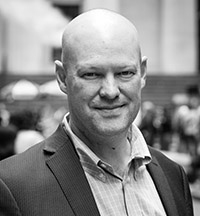
Todd von Helms, author of Before You Leave: For College, Career and Eternity, will deliver the 2023 Willson Lectures at Wayland Baptist University. The annual lecture series begins at 6 p.m. on Feb. 21 with an invitation-only dinner at the university’s Plainview campus, where von Helms will speak on “Embracing the Gift of Prayer.” It concludes with a chapel lecture at 11 a.m. on Feb. 22, in Harral Memorial Auditorium on “Made for Eternity.” The chapel lecture is open to the public. In addition to the featured addresses, von Helms is scheduled to present lectures to classes in the School of Languages and Literature and School of Christian Studies. He is a Senior Fellow at The King’s College in New York, an adjunct professor and the Presidential Scholar of Christianity and Culture at Dallas Baptist University and a Senior Fellow for the Center for Faith and Culture at Southeastern Baptist Theological Seminary in Wake Forest, N.C.

East Texas Baptist University entered a Christian education partnership agreement with Colegio Bautista de Temuco in Chile. ETBU President J. Blair Blackburn and Colegio Bautista de Temuco Rector Juan Luis Salinas Urrutia signed an agreement Jan. 26 providing students from the Latin American school a pathway to pursue an education at ETBU. Founded in 1922, Colegio Bautista de Temuco began with 20 students on a property outside of Temuco, Chile. Today, it serves 1,024 students with 100 teachers and 80 staff.
Houston Christian University—formerly Houston Baptist University—is among the first of eight universities offering mentorship opportunities to students through PartnerUp Houston. Greater Houston Partnership launched the regional initiative in collaboration with Mentor Collective, a national mentorship organization. The program pairs students one-on-one with industry professionals from companies that have agreed to help students achieve their career aspirations. “Our mission at HCU is to instill in our students a passion for academic, spiritual and professional excellence, and our conviction is that interpersonal relationships and mentoring are indispensable to that kind of holistic formation,” President Robert Sloan said.
25 years for Raymond McHenry as pastor of Westgate Memorial Baptist Church in Beaumont on Feb. 12.
Joe Bailey after 20 years as pastor of Speegleville Baptist Church in Waco and 38 years in the gospel ministry, effective Feb. 26.
A call for accountability from the U.S. Commission on International Religious Freedom and announced sanctions punishing the Burmese army marked the two-year anniversary of a military coup in Myanmar.

Since the Burmese military—known as the Tatmadaw—seized control of Myanmar’s government on Feb. 1, 2021, human rights monitors have verified about 3,000 civilian deaths, as well as the destruction of houses of worship and homes.
“The real death toll, taking into account the military’s offensives in the ethnic regions, is likely to be much, much higher,” Benedict Rogers, senior analyst for East Asia with Christian Solidarity Worldwide, wrote in a recent blog.
The Tatmadaw and the State Administration Council, which the military established to run the country, have targeted ethnic and religious minorities, the U.S. Commission on International Religious Freedom reported.
“It has been two years since the coup, and we have yet to see the SAC brought to justice for the Rohingya genocide and myriad abuses of religious freedom and human rights,” Commissioner Eric Ueland said.
“The Biden administration must be more active in support for international efforts to hold the Tatmadaw and the Burmese authorities accountable with all tools at their disposal, including coordinated sanctions against Tatmadaw leaders for particularly severe violations of religious freedom.”

Last July, the Baptist World Alliance general council at its meeting in Birmingham, Ala., approved a resolution condemning the coup in Myanmar and singling out the Burmese military for waging “a campaign of terror and violence, particularly against minority religions.”
Myanmar’s State Administrative Council has increased its sponsorship of extremist factions with the nation’s Buddhist majority, the U.S. Commission on International Religious Freedom noted.
The commission “stands in solidarity with the people of Burma who have endured great suffering in these two years since the coup,” Commissioner Mohamed Magid said.
“We urge the U.S. government to continue to coordinate with international partners to hold the SAC accountable for its human rights abuses within Burma, especially its persecution of the Buddhist majority who do not want the authoritarian government to coopt their faith, the predominately Muslim Rohingya, and various Christian communities.”

On Jan. 31, the eve of the second anniversary of the coup, the United States, Canada, Australia and the United Kingdom announced a new round of sanctions focused on the Tatmadaw. The sanctions target the supply of aviation fuel to the military, which has carried out multiple airstrikes on civilians.
“Our sanctions are meticulously targeted to deliver maximum impact, reducing the military’s access to finance, fuel, arms and equipment. The junta must be held to account for their brutal crackdown on opposition voices, terrorizing air raids and brazen human rights violations,” said U.K. Foreign Secretary James Cleverly.
Christian Solidarity Worldwide applauded the announcements of sanctions focused on the Burmese military and urged they be “implemented swiftly and fully.”
“We urge these governments to go even further and call on other members of the international community to follow suit until the military is completely unable to access the arms, aviation fuel and money that keep it afloat,” Rogers said.
“On this second anniversary of the coup, we reiterate our unwavering support for the people of Myanmar and emphasize our commitment to ensuring that this ongoing tragedy is neither ignored nor forgotten.”

Since the coup, more than 17,000 people have been arrested, and at least 13,700 remain imprisoned.
Hkalam Samson, the past president and former general secretary of the Kachin Baptist Convention, is among the religious leaders who remain imprisoned in Myanmar. Samson was taken into custody Dec. 4 before he could board a flight to Bangkok, Thailand, for medical treatment.
He currently is held in a prison in Myitkyina, where he has been charged with two offenses under the Unlawful Association Act.
“To arrest, jail and prosecute one of the country’s most prominent Christian pastors is a sign of how hostile this regime is to the church,” Rogers said.
DEER PARK—Along a several-block stretch of Hillshire Drive in Deer Park, limbs are piled along the street as neighbors seek to clean up from a tornado that swept through Jan. 24.
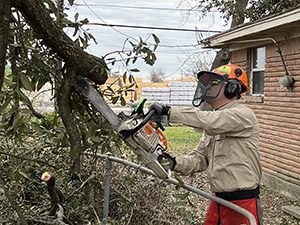
The easy cutting had been done, but a Texas Baptist Men disaster relief team from Katy swept in to clear away some of the difficult-to-handle damage.
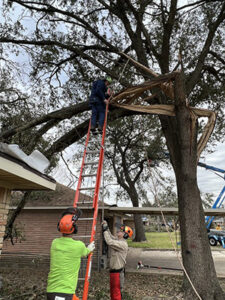
Marcell Hunt led the TBM crew from Kingsland Baptist Church. He described the work as mainly involving “hangers”—large branches broken off but still connected to the tree and dangerous. And limbs were down on roofs.
The seven-man team brought chainsaws, a man lift and a skid steer because some of the hangers were large and required multiple cuts for safe removal. The crew used the lift to reach hangers high in the trees above three homes in a row.
Their ministry comes quickly after a series of tornadoes swept across Southeast Texas from the Houston area to Orange.
One of the homeowners affected by the storms, Scott Wilkerson, said the TBM work was a blessing.

“I want to say thank you from the bottom of my heart for what you guys are doing,” he said. “God bless, ya’ll.”
Wilkerson received bids of $6,000 to $7,000 for what the TBM crew did for no charge.
To the Southeast, the TBM Deep East Texas team cut and removed trees in Orange County. They also installed a tarp on a house that was missing half its roof.
David Wells, TBM statewide disaster relief director, praised the work of the Deep East Texas team, as well as the Houston-area teams that assisted tornado survivors.
“The very first part of the Great Commission is to make disciples of the people in your Judea—the area closest to you,” he said. “That’s exactly what these teams are doing. Their neighbors are hurting, and they’re stepping up to help them out in the name of Christ.”
To donate financially to TBM disaster relief, click here or mail checks to Texas Baptist Men, 5351 Catron Drive, Dallas, TX 75227.
MEMPHIS (BP)—The swift criminal indictment of five police officers and the release of camera footage after the death of Tyre Nichols are positive steps toward transparency in policing, Pastor Bartholomew Orr said after meeting with local and federal officials.
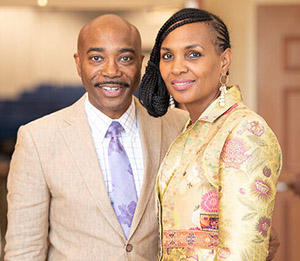
But preventing police brutality and achieving widespread reform will require a holistic approach that addresses the many facets of such evil, said Orr, senior pastor of Brown Missionary Baptist Church in the Memphis suburb of Southaven, Miss.
“I believe the consensus is that the police chief (Memphis Police Chief Cerelyn Davis) and the D.A. (Shelby County District Attorney Steve Mulroy) have acted appropriately in this situation,” Orr said.
“No one can control anyone, and unfortunately, we’re going to always have this issue because we’re dealing with human beings, and they’re flawed. Their hearts are flawed, and we just need ways that when this happens, we can be able to deal with it.”
While cases of police brutality, such as the 2020 murder of George Floyd, often center on racial disparities in policing, all of the police officers charged in the death of Nichols, a 29-year-old Black father, are also Black.
Orr has led Brown Missionary in praying for Nichols’ family.
“First of all, our hearts go out to the family,” Orr said, noting Nichols’ aunt is a member of his church.
“No one should have to bury their young person senselessly due to violence. The community has definitely rallied together, Black and white, and everyone has expressed deep hurt and remorse for the family and is lifting the family up as well in prayers. We have been praying specifically as a church and as a community for the family.”
Orr paraphrased Proverbs 11:11, “By the blessings of the upright, the city is exalted, but by the treacherous talk of the wicked it is torn apart,” in exhorting communities to pursue “the things that lead to peace.”
“The Black-on-Black crime is so apparent in many communities, even without the police element involved,” Orr said. “And so, it’s so important that we get at the root causes, and that is we have evil people in our society whose heart needs to be changed.”
Nichols was hospitalized after Memphis police officers beat and tasered him during a Jan. 7 traffic stop. Nichols died three days later while hospitalized for his injuries.
No reason for the traffic stop has been established. While police initially said Nichols was driving erratically, Davis said there’s no evidence of such.
Five police officers have been charged in Nichols’ death, and at least one police officer, two Shelby County Sheriff’s deputies and two Memphis Fire Department employees have been relieved of their duties for acts related to Nichols’ arrest.
Charged with second-degree murder and other offenses are former Memphis officers Tadarrius Bean, Demetrius Haley, Emmitt Martin III, Desmond Mills Jr. and Justin Smith, the law enforcement officials announced.
Orr met in a small group with Davis and Memphis Mayor Jim Strickland, and attended a separate meeting with U.S. Department of Justice officials as reports of the tragedy began.
“We have been involved in the past when these things have happened in Memphis, and the things that we were trying to advocate for, in this situation we do feel as if those things that we have advocated for in the past, that they actually did a great job addressing those issues,” Orr told Baptist Press. “To me it’s a matter of just trust.
“The community needs to trust the law enforcement that we have given and granted the authority to help maintain the order and peace in our community. And for that trust to take place, we do need transparency, we do need to rely on technology especially in terms of bodycam, and timing is so important as well, because in the past, oftentimes, things have been delayed.”
Orr describes the Nichols tragedy as a “crime issue,” not a “color issue.”
“I believe that as the community, we need to look at the root causes of all of this. I spoke with the chief years ago in Southaven about what could really change the crime situation that we find ourselves in. And he said, ‘Brother Orr, the bottom line is we need people with changed hearts, and the only answer to a changed heart is Jesus Christ.’”
The evil of police brutality should spur Christians in evangelism, Orr said.
“For believers, the reason our work is so important, as we evangelize, as we share the gospel, the Good News of Jesus Christ, ultimately only a changed heart is going to stop the senseless killing, the crime imbalance that’s consuming our society.”
Four years after the lawsuit was filed, a court date finally is set for the civil case involving former Southwestern Baptist Theological Seminary President Paige Patterson’s handling of a sexual abuse complaint.
U.S. District Judge Sean Jordan set the trial date for April 3 at the U.S. Courthouse in Plano, with a final pretrial conference scheduled March 31.
Jane Roe v. Leighton Paige Patterson et al initially was filed March 12, 2019. However, it faced repeated delays and failed motions to dismiss the case.

A former seminary student brought the suit against both Patterson and the seminary that removed him from the presidency in May 2018—in part over his perceived disrespect toward women. The lawsuit alleges negligence, violation of privacy and liability.
In dismissing Patterson, trustees focused on similar accusations he mishandled sexual abuse claims at Southeastern Baptist Theological Seminary in North Carolina when he was president there.
A former seminary student and student-employee at Southwestern Seminary—identified by the pseudonym “Jane Roe” in the lawsuit—alleged she was raped at gunpoint on more than one occasion by another student-employee who had a violent past and extensive criminal history.
The female student alleged she was stalked, violently assaulted and sexually abused by the male student, who was employed by the seminary as a plumber and had access to her on-campus residence.
She asserted the student who assaulted her met personally with Patterson to assure him his past conduct—including sexual molestation when he was a minor—would not preclude his service as a Baptist minister. Patterson allegedly encouraged him to “fish” the pool of unmarried female students for a prospective wife.
The male student eventually was expelled—not for the assault, but for violating the seminary policy regarding the possession of firearms on campus.
The suit states that prior to an October 2015 meeting she arranged with Patterson, John Nichols, chief of campus security, asked if the seminary president wanted him to attend that meeting. According to the suit, Patterson replied in an email, “I have to break her down and I may need no official types there, but let me see.”
The suit stated the female student was afraid to pursue charges against the male student who raped her “because he had been armed and threatened Roe and her family with violence.”
While neither Patterson nor the seminary denied sexual assaults occurred, they disputed allegations in the lawsuit regarding the student’s interactions with Patterson and other seminary officials.
In his court response, Patterson stated he “was not a cause, the cause, the sole cause, a proximate cause, the sole proximate cause, or a contributing cause of any injuries or damages claimed by Roe.”
More than five dozen Christians remain in Thailand, where they fear deportation to China unless they are granted refugee status by the United Nations or humanitarian parole by the United States.
In early January, Trent Martin from 21Wilberforce—a human rights organization focused on international religious freedom— and a colleague worshipped with members of the Shezhen Holy Reformed Church in Thailand.
“Pastor Pan Yongguang and the members of the church were there to greet us. We had the opportunity to join them for a moving Sunday morning worship service,” Martin wrote in a Jan. 30 email. “As the congregation joyfully sang Chinese hymns and recited Scripture, we saw first-hand the strong conviction to remain faithful to Christ that had brought them on this journey.
“Pastor Pan shared a sermon on maintaining our faith and joy in the midst of trials and suffering. While I had heard these verses many times before, it was exponentially more impactful to hear them in a community that really knew the meaning of suffering for their faith.”
Members of the church fled their homeland after enduring repeated threats and interrogation by the Chinese police. After being denied asylum in South Korea, they relocated to Thailand on tourist visas.
However, the Thai government has refused to renew their visas, and the Chinese Christians— nicknamed the “Mayflower Church” for their commitment to seeking religious freedom—face deportation.
After the worship service, Martin shared a meal with the church’s pastor and his family.
“We discussed what their new lives are like in Thailand and how they were currently educating all their children at home, something they could not do without government sanction in China,” he said.
“While several of the church members already speak English, many of them are looking for ways to strengthen their English skills in preparation to move to America. They also shared that while they were able to find work in South Korea, they currently haven’t been able to work in Thailand.”
Martin also learned about continued persecution the Christians have endured even after they fled China.
“It was surprising to hear firsthand the lengths to which China’s Communist Party is willing to go to silence a church that simply wants to peacefully worship God in a free land. While living in Jeju Island in South Korea, the congregants received threatening calls, messages and pressure from the CCP to return to China,” he said.
“Even while they are overseas in Thailand, they still fear the CCP will send agents to kidnap them or pressure the Thai authorities to deport them.”
In December, numerous pastors and religious leaders—including Elijah Brown, general secretary of the Baptist World Alliance, and Katie Frugé, director of Texas Baptists’ Christian Life Commission—signed a letter to congressional leaders, urging them to advocate for the persecuted Chinese Christians.
A group of Tyler-area churches have committed to sponsor their resettlement in the United States.
However, at this point, the U.S. government has not offered members of the Mayflower Church humanitarian parole or an expedited pathway to asylum.
“We are continuing to work with our congressional contacts to strongly advocate for the State Department to take action for the church,” Martin said.
He noted Christians in the United States can help members of the Mayflower Church by praying:
On Jan. 5, President Joe Biden announced the United States is expanding the humanitarian parole process already in effect for Venezuela and Ukraine to allow up to 30,000 nationals per month from Nicaragua, Haiti and Cuba. However, persecuted religious minorities in China were not included.
“We are continuing to call on the U.S. State Department to maintain our proud tradition of being a refuge for those seeking freedom to worship, just as the first Pilgrims did in 1620,” Martin said.
BELTON—When Kanishka Upreti arrived at the University of Mary Hardin-Baylor from India, she remembers not only how excited she was, but also experiencing severe culture shock.

Kanishka, who was raised as a Hindu, was stumped when her Old Testament professor instructed students to open their Bibles to a verse in Psalms. While other students flipped to the middle of the Bible, she had no idea where to start.
“I knew UMHB was a Christian university, but I didn’t know we had to study the Bible,” she said.
This year, 106 international students from 35 countries selected UMHB. For many of them, life as a teenage international student includes facing many challenges like language barriers, social and cultural differences, religious differences and academic dissimilarities.
One of the things many of them suffer from is feeling isolated—miles away from family, friends and all things familiar.
During her entire freshman year, Kanishka lived in Austin with relatives and took an Uber back and forth to campus in Belton every day. Not only was it a massive $160 daily dent in her budget, but living so far from campus made it difficult to connect and make friends.
For her sophomore year, Kanishka moved just minutes away from campus, and she quickly found herself meeting more people, making new friends, and joining in activities.
She participated in Missions Emphasis Week, the Psychology Club and Bridges International, a social group that promotes connections between international and domestic students.
Kanishka helped organize the annual multicultural program two years in a row. She cooked Indian food, dressed in traditional Indian attire, performed a Bollywood-style dance and offered henna hand drawings.
This year, she serves as international student representative for the Student Government Association at UMHB. Her platform was “helping international students build connections on campus.”
“I know that there’s a gap. A lot of our international students feel very isolated,” she said. “So, hopefully, we can find ways to help them connect.”
Elizabeth Tanaka, director of UMHB International Student Services, agrees international students often take a while to break out of their comfort zones. Some students are better at plugging in, like Kanishka, who has thrived since becoming active on campus. Others, take a little longer.
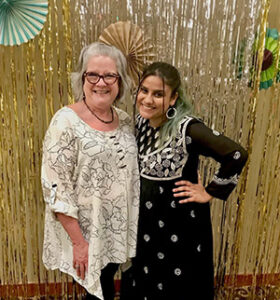
“International students tend to socialize only with those from their home country,” she said. “It’s understandable, because that is their comfort zone, and so much here is new. But this tends to isolate small groups of students who become dependent on each other rather than becoming part of UMHB as a whole.”
The international students who take an active role in becoming a member of the campus family have experienced great success, Tanaka said.
“They are happy and busy because they get invited to do many activities, even just going to H-E-B with American friends,” she said. “They also tend to be academically successful, because they are at ease with hearing English at a fast pace, and they have friends to study with.”
Tanaka and her team seek ways to help international students get involved, while acknowledging the multiple reasons they choose not to. Sometimes, they are shy about making a mistake in English and “appearing foolish,” she said.
Another reason is because in their free time, instead of joining into activities on campus, they are using Facetime or Zoom to talk with friends back home rather than trying to make new friends in the United States.
Cultural differences also come into play, Tanaka added. Many international students are not as comfortable taking initiative as their American counterparts.
“Someone has always told them what to do, when to be there, … and they are just fairly passive about anything that is not a requirement,” she said.
During her international student orientations, she stresses to students that they will have a much more fulfilling experience, both socially and academically, if they will just attend activities.
“Get a couple of people from your country to go with you,” she advises international students. “Even if you sit on the sidelines and do nothing for a while, it will get easier and easier to interact.”
She urges international students to give American students a chance to get to know them and build a friendship.
“Say ‘hello’ to someone from your class that you see outside of class. Say ‘hello’ to your professor. Go to a sporting event,” she suggests. “Everyone is there for the same purpose, and no one will ask you to do anything other than watch and applaud.”
Tanaka pointed out some of the ways UMHB encourages international students to get plugged in, including the International Orientation Day her office offers each semester before classes begin.
The Baptist Student Ministry hosts events such as Texas Night for international students to familiarize themselves with “all things Texas.” The BSM also has an international committee that hosts events such as learning to bake a cake and game night.
Bridges International publicizes regular meetings for international and American students to build friendships, and the library has hosted events specially for international students.
“We will continue to offer as much as possible in hopes of catching the elusive students who are looking for a way to plug in and take advantage of activities,” she said.
She has observed often a single student, who is the only one from his or her home country, participates more often and becomes comfortable on campus much more quickly than those who have a bigger “comfort zone” group where they can hang out.
“The single students tend to live on campus longer, too, because they don’t have a group to rent an (off-campus) apartment with, and I think that encourages more participation as well,” she said.
Tran Ho Bao “Cherry” Le of Vietnam started classes at UMHB from her laptop, sitting inside a small room she rented from a family friend in Dallas. It was fall 2020 when COVID-19 was surging, and many students opted to take classes online. She missed out on touring campus. There was no Cru Camp and no Welcome Week.
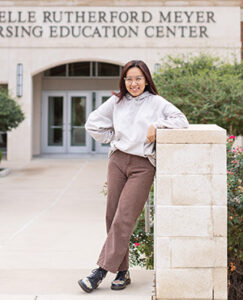
“Technically, I didn’t know anything about UMHB,” she said. “That was not what I imagined of college—not at all.”
Because she didn’t experience college the way she envisioned that first year, she considered transferring, but she decided to give it another try “in person.”
Cherry applied for a summer job as a student worker with the UMHB Center for Academic Excellence and was hired. She moved into Burt Hall, enrolled in summer classes and went to work, helping with Cru Camp. She finally got to experience all the things she missed that first year.
When she started classes in the fall, a friend who served in the Student Government Association suggested Cherry run for the international representative position.
This year, as a junior, she helped design sets for Stunt Night and is involved in Bridges International. During one of her Christmas breaks, she joined other students from around the country for the Vision Conference in Washington, D.C.
This past semester, she attended a fall retreat at Burnet with Bridges International. She’s also been involved with the college group at Taylor’s Valley Baptist Church in Temple.
Getting involved was not easy for Cherry, but she is happy she pushed herself out of her “bubble.”
“I realized that friends do not define us. I do not see them as American or international friends. I just see them as friends,” Cherry explained. “You can just go out there and make friends with people —any of them. If you’re nice to them, they will be nice back.”
Looking over the last two years on campus, Cherry is thankful she found the courage to open her mind to new experiences, and she hopes to inspire other international students to do the same.
“I feel like UMHB is my family now, and I would love to have other international students feel and experience the same things that I have.”
Adapted and republished by permission from UMHB Life Magazine, Winter 2023
WASHINGTON (RNS)—The first time she saw an ad for “He Gets Us,” a national campaign devoted to redeeming the Jesus “brand,” Jennifer Quattlebaum had one thought on her mind: Show me the money.
An ordinary mom who works in marketing, Quattlebaum loved the message of the ad, which promoted the idea Jesus understands the human condition. But she wondered who was paying for the ads and what their agenda was.

“I mean, Jesus gets us,” she said. “But what group is behind them?”
For the past 10 months, the “He Gets Us” ads have shown up on billboards, YouTube channels and television screens—most recently during NFL playoff games—across the country.
The campaign is a project of the Servant Foundation, an Overland Park, Kan., nonprofit that does business as The Signatry. But until recently, the donors backing the campaign remained anonymous.
In early 2022, organizers told Religion News Service only that funding came from “like-minded families who desire to see the Jesus of the Bible represented in today’s culture with the same relevance and impact he had 2000 years ago.”
But in November, David Green, billionaire co-founder of Hobby Lobby, told talk show host Glenn Beck his family was helping fund the ads. Green, who was on the program to discuss his new book on leadership, told Beck his family and other families would be helping fund an effort to spread the word about Jesus.
“You’re going to see it at the Super Bowl—‘He gets Us,’” said Green. “We are wanting to say—we being a lot of people—that he gets us. He understands us. He loves who we hate. I think we have to let the public know and create a movement.”
Jason Vanderground, president of Haven, a branding firm based in Grand Haven, Mich., working on the “He Gets Us” campaign, confirmed the Greens are one of the major funders, among a variety of donors and families who have gotten behind it. Donors to the project are all Christians but come from a range of denominational backgrounds, Vanderground said.
Organizers also signed up 20,000 churches to provide volunteers to follow up with anyone who sees the ads and asks for more information. Those churches are not, however, he said, funding the campaign.
The Super Bowl ads alone will cost about $20 million, according to organizers, who originally described “He Gets Us” as a $100 million effort.
“The goal is to invest about a billion dollars over the next three years,” he said. “And that is just the first phase.”
A billion-dollar, three-year campaign would be on a par with advertising budgets for major brands such as Kroger grocery stores, said Lora Harding, associate professor of marketing at Belmont University in Nashville, Tenn.
“This is a really remarkable ad spend for a religious organization or just a nonprofit in general,” said Harding, who worked on the “Open hearts, open minds, open doors” campaign for the United Methodist Church.
Despite the cost, advertising at the Super Bowl makes sense for “He Gets Us,” Harding said. Organizers want to reach a mass audience that is paying attention. Super Bowl ads have become part of the pageantry of the big game.
“There just aren’t ways to reach an attentive, engaged audience that size anymore,” she said.
She also said the anonymity of the group behind the ads plays to the group’s advantage. It would be easy for viewers to dismiss an ad coming from a faith-based organization or religious group. The “He Gets Us” ads wait until the end to mention Jesus and don’t point to any specific church or denomination.
“That makes it even more powerful and hits the message home in a really compelling way,” she said. “I think it does make Jesus more relevant to today’s audiences.”
Some viewers, including some evangelical Christians, are skeptical. Author and activist Jennifer Greenberg supports the idea of trying to reach those outside the faith and wants people to understand that Jesus gets them. But that’s not the whole message of Christianity.
“Yes, Jesus can relate to you,” she said. “But what did Jesus come primarily to do? He came to die for our sins.”
Connecting emotionally with Jesus is great, she added. But that won’t save your soul.
Michael Cooper, an author and missiologist, agrees. While Cooper is a fan of the ads, saying they powerfully communicate the human side of Jesus, they leave out his divinity.
“I began to wonder, is this the Jesus I know?” he said.
Cooper and a colleague offer what he called a “constructive critique” of the campaign in an upcoming article for the Journal of the Evangelical Missiological Society. That article calls for clearer messaging about the divine nature of Jesus.
“This wasn’t just a great teacher or preacher who was incarnated,” he said. “This was God himself.”
Ryan Beaty, a former Assemblies of God pastor and current doctoral student at the University of Oklahoma, said he’s been fascinated by the ads and wonders how the country’s political polarization may affect how the ads come across.
His conservative friends, he said, see the ads—such as one depicting Jesus as a refugee—as too political. Other folks who are more liberal see the ads as not going far enough.
Beaty also wonders if people outside the church will find the ads more compelling than true believers.
“People of no faith—or moderate leanings toward faith—will find these more compelling than people who identify with the Christian faith or strongly identify with politics,” he said.
Seth Andrews, a podcaster, author and secular activist based in Tulsa, Okla., said the campaign seems to be marketing a version of Jesus more in touch with modern American culture than earlier, more dogmatic versions.
“They are latching on to this touchy-feely, conveniently vague, designer Jesus,” he said.
Andrews poses the question of what Jesus would think of the amount of money spent on the ads. Would he prefer that the money be spent on ministering to people’s physical needs or making the world a better place?
“Or would he say, no, go ahead and spend $100 million to tell everybody how great I am?” Andrews asked.
While the ads are meant to reach what Vanderground called “spiritually open skeptics,” a secondary audience is Christians, whose reputations have fallen on hard times in recent years.
“We also have this objective of encouraging Christians to follow the example of Jesus in the way that they love and treat each other,” he said.
For her part, Quattlebaum said, in the end, she’s a fan of the ads, because they focus on the main message of Christianity.
“It all goes to Jesus,” she said. “And if it all goes back to Jesus, it all goes back to love.”
TAMPA, Florida (BP)—A Florida man and woman have been indicted in U.S. District Court on charges of attacking a pregnancy support center in the Sunshine State.
Caleb Hunter Freestone and Amber Marie Smith-Stewart face charges of violating the Freedom of Access to Clinic Entrances Act between May and July 2022 by painting threatening graffiti on pregnancy support centers in Hollywood, Fla., and Hialeah, Fla.
“I am glad to see progress made towards justice for a few of these centers and hope that other centers that faced violence will also be granted that opportunity,” Hannah Daniel said.
Daniel serves as a policy manager based in Washington, D.C., for the SBC Ethics & Religious Liberty Commission.
Dozens of pregnancy support centers reported attacks and vandalism in the days and weeks following the May 2022 leak of a draft decision in a U.S. Supreme Court case suggesting Roe v. Wade would be overturned.
The SCOTUS decision on Dobbs v. Jackson Women’s Health Organization was announced on June 24, 2022.
Freestone and Smith-Stewart are the first two to be indicted on related federal charges.
Last week, the FBI announced a reward of up to $25,000 for information that led to arrests in cases across the country.
The pair are accused of painting messages such as “YOUR TIME IS UP!!”, “WE’RE COMING FOR U.” and “We are everywhere.” and “If abortions aren’t SAFE then niether (sic) are you.”
“While some abortion activists chose violence and vandalism to express their outrage following the Dobbs decisions, pregnancy resource centers across the country rolled up their sleeves and pressed on doing the important work of serving mothers and their children that they’ve been doing for decades,” Daniel stated.
Tennessee Baptist disaster relief volunteers responded to a request from the state to provide support for first responders preparing for anticipated protests in Memphis in the aftermath of the beating and death of Tyre Nichols.

While disaster relief teams are no strangers to helping people affected by natural disasters, this was the first time for Tennessee Baptist volunteers to activate for potential civil unrest, said Wes Jones, Tennessee’s disaster relief specialist.
“It’s new for us, but it’s been done by other teams in different states,” Jones said prior to the Jan. 27 release of the videos showing Memphis police officers assaulting Nichols during a traffic stop.
“This is actually pre-planning for a possible disaster. Hopefully, nothing bad breaks out when the tapes come out, but they have to be pre-staged and ready to go. You can’t come in two days later. They want to be in the right place at the right time. So, we want to be there to help them and support them as we can.”
Nichols, a 29-year-old Memphis resident, was beaten by five Memphis police officers on Jan. 7 and died from his injuries a few days later. The officers have been charged with second-degree murder.
Once it was determined the video footage would be released publicly, local officials called in extra first responders to be prepared for the reaction. Nichols’ mother, RowVaughn Wells, called for protests but pleaded with the public to keep them peaceful.
So far, the protests taking place in Memphis and other major cities across the United States have been peaceful, and no reported rioting has taken place.
Disaster relief volunteers from Tennessee provided shower and laundry facilities in Memphis for the extra personnel brought in from other cities, while a Mississippi disaster relief team assisted by preparing and serving meals.
“This is a unique opportunity, that we’re serving the (first responders), because they don’t have the means to set up meals for themselves,” said Robert Barnett, a volunteer with the Mississippi team. “They’re here to protect the city. So, we’re providing the meals for them because the state has asked us to do so.
“To me, it’s no different. We’re just doing the job that we’re called to do—whether it’s civil unrest, whether it’s a natural disaster, whatever. That’s what we do. We’re not really concerned with the difference between the two.”
About 15 Mississippi Baptist volunteers were preparing three meals a day at a nearby Memphis-area location, loading the food into insulated containers, transporting it to the first responders, then cleaning up, returning to the kitchen and beginning the process again for the next meal.
Debbie Snyder, one of the Mississippi volunteers, was on her first disaster relief assignment. Snyder loves to cook and has her own catering business.
“It’s my heart to serve people. This is just what I do,” she said. “And I serve people with food.”
Snyder said her desire was that people would come to know Jesus as their Savior through the ministry of Disaster Relief volunteers.
“I hope their bellies are full, and I hope their hearts get full,” she said.
While the Mississippi volunteers travel back and forth from their kitchen to where the first responders are being housed, Tennessee volunteers remained onsite to oversee the shower and laundry facilities they transported in.
They also provided chaplains for emotional and spiritual support.
Butch Porch, the Tennessee team leader and a member of Woodland Baptist Church in Brownsville, Tenn., said he doesn’t recall being involved in an operation like this before.
“We were asked to help, and that’s what we’re going to do,” Porch said. “The main thing that we’re doing is providing a service to people who are actually displaced. These (first responders) came all the way from Bristol.”
While the nature of the disaster may be different, Jones said he hopes the Memphis operation helps Tennessee Baptist disaster relief build relationships with first responders.
“Because any disaster, first responders are there,” Jones said. “They work hard and long hours under sometimes very adverse conditions, and so anything we can do to support them and help them in their different tasks, that’s good with me.”
Hubert Yates, state director of disaster relief in Mississippi, said the Mississippi Baptist team responded when Tennessee disaster relief asked for their help.
“This is one of the strengths of Southern Baptist disaster relief,” Yates said. “It’s a wonderful example of the Cooperative Program, outside the flow of money. We come together to accomplish the task.”
Jones said he didn’t have an end date for the work in Memphis, but since protests were peaceful on Friday night, he didn’t expect the operation would last much longer.
Tim and Sarah Ellsworth team covered the disaster relief response in Memphis as part of a collaborative effort by Tennessee’s Baptist & Reflector, Mississippi’s Baptist Record, The Alabama Baptist and its national publication, The Baptist Paper.
PLAINVIEW—Almost 50 years after Kent Snodgrass and Jimmy Thomas stole the clothes of a kid from Indiana, one might think their gifts to a scholarship fund established in his honor represent voluntary self-punishment for wrongdoing.
But that’s not what motivated Snodgrass and Thomas to help put the Tim and Janice Powers Endowed Scholarship at Wayland Baptist University above the $100,000 mark in less than three years.
The real reason is the brotherly love these three college friends have shared through years of picking, poking, pranking and praying for each another.
“The fact that Tim Powers speaks to me today is an absolute miracle, because we absolutely played more tricks and pranks on him than anyone in the history of our lives,” Snodgrass said.
Thomas added, “It is a wonderment that Tim would even consider us to be his friends as much mess as we put on him.”
Partners in “classroom crime” since they had met in third grade in Abernathy, Snodgrass and Thomas were freshmen in the fall of 1973 when they met Powers, a kid from Muncie, Ind., who came to play basketball at Wayland.
“Tim was on a full scholarship, and he had no idea about Wayland Baptist University.” Thomas explained. “He had never been to Plainview before accepting the scholarship. It was kind of a crazy deal.”
“It certainly was a God thing,” Powers said of his decision to play for the Pioneers. “I was getting one of my ankles taped, and the assistant coach said, ‘There’s a school down in Texas that’s interested in you.’
“I said, ‘Well, send them the worst tapes that you have on me, because Texas is the last place I want to go.’”
After almost 50 years in the Lone Star State, Powers said, “God had a different plan, for which I am grateful.”
“I had another offer, which I had committed to, but I ended up dropping that offer and coming to Wayland. Eventually, I fell in love with the place.”
But it wasn’t love at first sight. Powers landed in Lubbock with one piece of luggage “stuffed with everything I could think of.” Snodgrass’s brother, a graduate assistant for the basketball team, picked him up at the airport.
“Kent’s older brother, Don, greeted me and put me in his car, which didn’t have an air conditioner, and we started driving toward Plainview,” Powers recalled. “The wind was blowing, and it was hot.
“The first question I asked him was why all the trees were growing sideways. I saw what I thought was a tornado, and he laughed and said it was a dust devil. It was all the same—flat. And I grew up in a place where there were hills and trees, rain and humidity. It was just dry and dusty.”
The assistant coach dropped Powers at McDonald Hall, one of three men’s residence halls open at that time.
“I found my room and was introduced to my roommate,” he recalled. “Shortly after that, Kent and Jimmy came down, and we went over and played some basketball. That started the friendship that has lasted for almost 50 years.”
The three became “fast friends,” Snodgrass said.
“In Plainview, there was not much to do, so we rolled up the sidewalks together, and spent a lot of time in each other’s room,” Snodgrass said.
It wasn’t long before Snodgrass and Thomas began playing pranks on Powers.
“We basically stole all of his clothes except the ones he had on,” Snodgrass said. “He had one set of clothes and had to wear those four or five days in a row. It was good clean fun for the most part. It was fun for us, but there were times when he wasn’t laughing really hard.”
But generally, Powers took the pranks in stride, Thomas said.
“You could pull a joke on Tim, and he would act like he didn’t even know it happened,” he said. “He would play dumb. We walked into his room that day, and he didn’t have anything, not even a razor or comb or a toothbrush—nothing. We stole everything, and he just walked in the room and laid down on his bed without a mattress. He was like nothing had happened. He didn’t say a word about it. He was so funny.”
Snodgrass and Thomas admit Powers was much more intentional about his studies than they were.
“That is what he has always been—intentional,” Thomas said. “He’s been intentional since he was 18 years old. He came to Wayland and worked hard.
“While we were being stupid and acting crazy and waiting until the last night to do an assignment, he would get the syllabus for the class and start on it the minute he got it. He’d go to the library the first night and be half finished with it.”
“He was very dedicated to what he was doing. And he has been intentional later in life, as far as his jobs, his family and his faith. He’s been very intentional in everything he’s done. He’s probably the hardest working person I have known in my life.”
Powers sees himself as someone who likes to solve a problem when he sees it—including problems between people.
“ If you have an issue with someone, you go to them and try to take care of it,” he said. “Being intentional means developing relationships.”
Much as he treasures his friendship with Thomas and Snodgrass, Powers points to a more important relationship he established at Wayland.
“I was grateful that God had led me there,” Powers said. “That is where I realized I could have a relationship with Christ. I eventually invited him into my life to be my Lord and Savior. It definitely was an eternity-changing decision for me to come to Wayland.”
After the trio graduated, they remained best friends.
“We just continued to stay in touch,” Snodgrass said. “Jimmy and Tim stayed out in the Panhandle, and I moved to the Dallas-Fort Worth area.”
Snodgrass enjoyed a successful career in the investment business, while Powers and Thomas became successful school administrators.
Snodgrass called Thomas and Powers “two of the finest men in the world.”
“It doesn’t get any better than to have close, wonderful friends like that,” he said.
Thomas added, “It’s just been a brotherhood.”
And brothers stick together during difficult times, like when Powers learned he had Stage 4 prostate cancer in June 2016. A local oncologist told him he had two to three years “at the most” to live.
Powers went to MD Anderson Cancer Center in Houston, and the doctors there confirmed the diagnosis. A specialist told him, “It’s not curable, but we can treat it and prolong quality of life for you.” That doctor told Powers he probably had four to six years to live.
“It has been six and a half years, so I think I’m on God’s time,” Powers said. “I truly believe it is because I have had so many people praying that God would intervene with this cancer. I don’t know if he is going to cure it. That is up to him. But I know that if it hadn’t been for people praying for me on a regular basis, I would not be here now.”
“The whole process was a blow to both Janice and me, but we realized we could get bitter, or we could get better. We both chose to do this and get better, to be a reflection of God’s love. … I’ve grown so much closer to the Lord. … I’ve grown more deeply in understanding what he wants from me. I want to take every opportunity to share that as best as I can with others. But it all starts with the idea that God led me to Wayland.”
Powers said his wife is his No. 1 encourager, but Thomas and Snodgrass have been there for him each step of his journey.
“Jimmy and Kent pray for me constantly and call and check on me,” he said. “Kent comes quite often to Lubbock from Fort Worth. He always stops by to see me. They and others support me. I am truly blessed. I have been able to see God’s love working in real life.”
Snodgrass took a lead role in launching the Tim and Janice Powers Endowed Scholarship at Wayland.
“They were going to establish the scholarship fund, and Tim called and asked me,” Snodgrass recalled. “He wanted me to come to the gala in Lubbock. I inquired about it and decided to become the core sponsor of the event.”
But that was just the beginning.
“I’ve just continued to try to support that on an annual basis or more often than that,” Snodgrass said. “It’s basically for the love of Tim that I have done that. I just know how much joy it gives him. So, I’ve been blessed and able to do that. It is just a great way to say how much I appreciate him and Janice.”
Thomas also has contributed to helping get the endowment over $100,000.
“I can’t say enough about Tim Powers. I am glad to be a part of this,” Thomas said of the endowment.
Even while undergoing regular treatments that often result in hospitalization, Powers continues to serve as a professor at Wayland’s Lubbock campus.
“With the challenges he has had over the last few years, you never hear him complain,” Snodgrass said. “He is an absolute warrior and an incredibly intentional person. You are not going to find a harder worker and a more intentional great Christian man than Tim Powers. The things he is involved in are substantial and real.”
Powers described Snodgrass and Thomas as “those two yahoos” before quoting Proverbs 18:24—“But there is a friend who sticks closer than a brother.”
“That’s really what this has turned into,” he said. “It’s a friendship that is more than just acquaintances. Just knowing that you have someone in your life like that and knowing Wayland was the central focus for having the opportunity to develop that relationship is invaluable.
“One of the many blessings of being diagnosed with Stage 4 prostate cancer is the fact that we have grown stronger. We have grown more closely together through God’s word and just kind of reinforcing each other and reminding each other of God’s promises. It’s reminders that this is not the end, it is just the stuff you go through this side of heaven. There are better things to come than this.”
Powers said one of the greatest honors of his life came last fall when the university recognized him with Trustee Emeritus status. Snodgrass and Thomas were with him as he was honored.
“As an 18-year-old, I would never have imagined that Wayland would have such an impact on my life as well as these lifelong friendships,” he said. “I truly believe that if I had not come to Wayland, I would still be a lost soul. I know I will be in heaven and greeted by the Lord when that time comes.”
“I cannot believe how blessed I am to have such friends as Kent and Jimmy in my life. I know that friendship will last for eternity. I know there will be a time when we are rejoicing and praising the Lord in heaven, and I can’t think of anything sweeter than that.”