Glenn Lackey of Temple, founding co-president of First Blessing ministry, will be nominated for second vice president of the Baptist General Convention of Texas.
Pastor Joshua Murray of Canyon Creek Baptist Church in Temple will nominate Lackey at Texas Baptists’ Family Gathering in McAllen, July 16-18.
Lackey is the second announced nominee for the position. Last month, Pastor Matt Homeyer of Trinity Baptist Church in San Antonio, announced his intention to nominate Debbie Potter, minister of children at Trinity Baptist.
‘Passion for evangelism’
Murray characterized Lackey—a retired shoe company executive who now leads a ministry that enables church volunteers to provide children in need with new shoes—as “a good fit” for a leadership role in the BGCT.
“Glenn’s passion for evangelism is contagious,” Murray said.
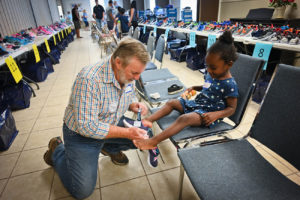
Rick Sallee helps a young First Blessing participant try on shoes during an event at Miller Heights Baptist Church in Belton. (Photo by Nan Dickson)
Lackey possesses the “qualities, dedication and vision necessary to effectively serve our convention,” Murray said, pointing particularly to First Blessing, the ministry Lackey and his wife Deborah founded.
“First Blessing provides churches across Texas with the opportunity to share the love of Christ by providing resources and facilitating shoe ministry events. These events present opportunities for members of the church to engage in meaningful conversations with families in their local communities they might not encounter otherwise,” he said.
“As a former executive in the corporate sector, he is skilled in strategic planning, organizational development and effective communication. These qualities, along with his unwavering faith and commitment to Baptist values, make him an ideal candidate for this position.”
Voice for small churches, lay leaders
At age 75, Lackey said he wants to use what he has learned to strengthen and equip Texas Baptist churches to find innovative ways to share the gospel.
“I don’t believe in Christian retirement,” he said.
Lackey said his passion is helping churches—particularly smaller churches with limited resources—discover how to be intentional about engaging members to reach the unchurched in their communities.
“I want to be a voice for small churches and bivocational pastors,” he said. “I want to be a voice for lay leaders.”
Having worked extensively with African American, Hispanic and Asian churches through First Blessing, Lackey said he also wants to strengthen the cultural, racial and ethnic diversity in the BGCT.
“Glenn will work tirelessly to encourage collaboration, implement innovative ideas and provide support to pastors, churches and individuals throughout the Texas Baptist community,” Murray said.
Lackey worked 25 years in the shoe business, retiring as an executive with experience in multi-store retail sales management.
His local church experience includes serving as life group leader, youth leader, committee chair and leader in prison ministry.
He and his wife Deborah have four adult sons.
ETBU student-athletes share faith in Northern Ireland
June 6, 2023
East Texas Baptist University women’s basketball team played games with schoolchildren, taught young people how to dribble and shoot, assisted a prison ministry, competed against local teams and shared their faith on a recent trip to Northern Ireland.
The student-athletes and coaches partnered with the International Sports Federation and served alongside the Salt Factory Sports group in Belfast as part of ETBU’s 16th Tiger Athletic Mission Experience.
ETBU student-athletes played games and led sports clinics for children and youth in Northern Ireland. (ETBU Photo)
At William Foote Memorial Primary School, the Tigers played castle ball, bucket ball and American football with the students. The ETBU team also conducted basketball clinics at Harmony Hill School and Holy Trinity School in Belfast, teaching students various skills and playing games.
“One kid said to me, ‘Once you find something you love, it becomes dangerous to stop learning,’” said Erin Berry, a senior psychology major at ETBU. “The more I have let those words sink in, the more meaningful they have become.
“As Christians, we must obey [God’s] will for our lives by taking time to connect with him through truth and his word.”
Traveling to Lisburn, the Tigers faced the Phoenix Rockets. Following the game, the two squads joined together in fellowship.
ETBU students also had opportunities for sightseeing and learning more about Northern Ireland, visiting Belfast Castle, Cave Hill Country Park and the Ulster Museum. They also toured the monastery of Saint Mo-Choi of Nendrum, the Inch Abbey and the Cathedral of the Holy Trinity, where Saint Patrick is buried.
Joining in worship and ministry
At the cathedral, ETBU junior worship studies major Abigail Taylor played the piano and led the team in worship.
“Being able to worship together in this place was an indescribable experience,” Taylor said. “It was a humbling and precious time for me to be able to worship in such a beautiful cathedral on the other side of the world. The presence of the Holy Spirit was felt like never before.”
Splitting into small groups, the ETBU student-athletes spent one day participating in various sports camps and clinics at three schools.
“In the moments we got to spend with the kids each morning, we let the joy of Christ shine through us in everything we were doing,” said Michaela James, a senior elementary education major at ETBU.
The team led a Saturday morning basketball camp for children from throughout the community. The Tigers joined campers and their families for lunch, providing the student-athletes an opportunity to interact further and share how Christ has impacted their lives.
Traveling to Dublin, the ETBU team faced the Ireland Women’s Under 20 National Team and enjoyed spending time with the team in a luncheon following the game.
“Playing against some of Ireland’s best players in our age division has been an incredible experience and is an opportunity I will never forget,” said Tiffany Bickford, a freshman psychology major.
ETBU’s women’s basketball team worshipped at Lagan Valley Vineyard Church in Northern Ireland and helped clean and organize a new facility for the church’s ministry to prisoners and their families. (ETBU Photo)
On Sunday, the team went to Lagan Valley Vineyard church to participate in morning worship, and they traveled to St. Anne’s Cathedral for evening worship and prayer.
Between worship services, they ventured to Saint George’s Market to enjoy the culture and explore food, clothing and jewelry vendors from Belfast.
The Tigers also partnered with Lagan Valley Vineyard Church to assist the church’s prison ministry, which shares the love of Christ with inmates and their families in Northern Ireland. ETBU student-athletes and coaches visited with members of the ministry, and they helped clean and organize a new facility the organization will be moving into.
In the final game of the trip, the Tigers defeated the Dublin Lions. Mollie Dittmar, a senior ETBU mathematics education major, reflected on conversations among the teams post-game.
“It was so much fun talking with the girls and comparing the similarities and differences from our lifestyles,” Dittmar said. “My prayer is that through our words and actions, the love of Christ was on full display.
“The Lord moved in my heart and the hearts of others throughout our team on this trip. This was an incredible experience, and I am so thankful for this opportunity.”
The women’s basketball team and staff expected lives in Northern Ireland to be shaped on the trip, but God also worked in the lives of the ETBU student-athletes.
“We began our trip thinking about the lives of people in Northern Ireland that would be changed but found quickly how this experience transformed us from the inside out,” ETBU Women’s Basketball Head Coach Blake Arbogast said.
“To watch our team serve and share the gospel in a country divided by hatred based on what street they live on, the school they attend, or even what side of a wall they live on, was very powerful.
“We are grateful for the work that our partner, Salt Factory Sports, does to further God’s kingdom through sports ministry in Northern Ireland. We are grateful to the individuals that worked tirelessly to make this trip possible through prayer and donations to allow our group to travel to one of the most beautiful places I have ever seen.”
Seminary board accuses trustee of violating trust
June 6, 2023
Southwestern Baptist Theological Seminary’s board of trustees accused trustee Aaron Sligar of violating the confidentiality of an executive session of the board and withholding from the full board “substantiated facts about the former president’s spending.”
The board issued a statement Friday afternoon, June 2, saying Sligar emailed a written report on March 30 to members of a task force appointed to investigate expenditures of former President Adam Greenway. However, the oral report he delivered to trustees in April was substantially different.
“In the report he gave during the April 18 trustee work session, most of the references that portrayed Dr. Greenway in a negative light were missing,” the board statement said.
The June 2 board statement also asserted Sligar provided versions of his report “before and during the April 18 [board] meeting to a staff member who was known to have a close relationship to Dr. Greenway.”
Sligar allegedly told the unnamed staff member: “I will explain what I am doing. Don’t lose hope.”
The Baptist Standard offered Sligar an opportunity to respond to the allegations made in the board statement. Sligar did not reply to a June 2 email or a June 5 voice mail message by 11 a.m. Central requesting comment.
Sequence of events outlined
The board statement said John Rayburn, chair of the board’s business administration committee, reported to trustees in their fall 2022 meeting concerns about financial stewardship under the previous administration.
“Trustees discussed a range of options and eventually agreed to hire a firm to audit the spending on the President’s home and office, as well as personal expenditures by Adam Greenway that were perceived to be inappropriate, such as first-class airfare by Dr. Greenway and his family and other spending on personal items for the former president.”
The original task force authorized by the board to investigate Greenway’s expenditures consisted of Rayburn as chairman, along with other members of the business administration committee—George West, Mike Bussey and Josh Grega.
Sligar—pastor of Living River Chapel in Sutton, W. Va., and a former federal investigator—was added to the task force in March.
“In good faith, Rayburn invited Sligar to evaluate the relevant financial records because of his belief that a forensic audit may be required, and he was given access to the spending reports 42 days before the Spring 2023 trustee meeting,” the June 2 board statement said, adding Sligar asked to be added to the business administration committee, and the chair granted his request.
“As part of the expanded task force, Sligar began to evaluate all the documents provided to him and was asked to generate a report to present to the full Board of Trustees,” the board statement said.
“As he conducted his review, he expanded the scope of his efforts and claimed that he was receiving information from various sources, none of whom were named. He reported to members of the task force that he was working on a process to verify claims to separate facts from rumors, assuring members that he would not report any information he could not verify, especially any unsubstantiated allegations that could cause reputational damage. The task force did not limit what he could report if the claims were verified.”
The report Sligar emailed to members of the task force March 30 did not include items “he admitted were unsubstantiated claims and rumors,” the board statement said. However, it described Greenway’s expenditures as “financial abuse,” “unnecessary and excessive,” “extravagant” and “out-of-control,” and asserted Greenway “demonstrated an extreme freedom in the finances of the Seminary.”
The June 2 board statement said the May 20 email from Sligar and Bunnell casted doubt over “the trustworthiness of the Executive Committee” and suggested the committee withheld important information from the full board.
“That was false,” the board statement asserted. “First, Sligar did not provide a copy of the written report he wanted to submit to the full Board of Trustees. He simply verbalized his desire to share unsubstantiated information. There were also good reasons for the Executive Committee to doubt some of his claims.
“Second, it was the right decision for the Executive Committee members to ask Sligar not to share those rumors with the full Board until the claims could be investigated and verified. If, in fact, the claims turned out to be true, they would have been shared with the full Board in cooperation with Sligar as a member of the task force and Business Administration Committee.
“The information Sligar was asked not to disclose was unverified and required further investigation to confirm. They were still just rumors and unsubstantiated claims.”
The board statement included an example of information Sligar provided to the task force but not the full board.
It asserted Sligar’s March 30 report said “the culture” of the seminary’s administration did not allow Greenway’s closest staff to approach him regarding concerns about finances.
“Fear of retaliation, removal, or even possibility of being black-balled from SBC leadership was a reality that some individuals had to deal with. This prevented the protection that the seminary needed to control the out-of-control spending,” the board statement said Sligar originally reported.
However, in his report to the trustees April 18, he reportedly said Greenway’s staff failed to approach him about finances “for undetermined reasons.”
“That statement is untrue,” the June 2 board statement said. “Dr. Greenway’s staff did approach him to make him aware that financial conditions at the seminary were deteriorating and that changes needed to be made. Those warnings to Dr. Greenway exist in written form and have been reviewed by members of the task force and the Executive Committee.”
The Baptist Standard offered Greenway an opportunity to respond. He declined comment at this time.
The board statement outlined three complaints against Sligar:
“Sligar was entrusted to work collaboratively with task force members to evaluate the relevant data within the scope of work outlined for him. However, he did not extend that same trust back to the Chairman, Executive Committee, the Chairman of the Business Administration Committee, or his fellow task force members.”
“Sligar broke privilege by sharing a report given in executive session with those not in the executive session.
“Sligar has accused the Executive Committee of a lack of transparency and withholding information from trustees, although he removed from his report substantiated facts about the former president’s spending, which was within the scope of the report.”
The board statement said the May 20 email by Sligar and trustee Andrew Bunnell, requesting a called meeting of the trustees, “raised allegations, some of which had previously been raised by the former president and found to be without merit.”
“During the May 30 meeting, detailed and lengthy presentations responding to the allegations were given by members of the task force with opportunities afforded to Sligar and Bunnell to defend their allegations,” the June 2 board statement said.
“Task force members interviewed multiple faculty and staff members, independently verifying data and information in each case, and consulting outside parties independent of staff relevant to each allegation. Each allegation was found to be without merit and in some cases demonstrably false.”
The specific allegations concerned credit cards, using designated funds for operational expenses, perceived conflict of interest with regard to a vice president’s role in the formation of the Future Fort Worth nonprofit corporation and unspecified “personal moral misconduct” by unnamed individuals.
The first item focused on a contract signed with American Express that allegedly contained a personal guarantee from an employee and negatively impacted the employee’s credit scores.
“The investigation into this allegation found that corporate credit cards issued to employees do not require a personal guarantee from the employee and do not result in any reports being made to credit bureaus,” the board statement said.
“There is no evidence of any negative impact on the credit scores of employees. It has also been confirmed by American Express that nothing is reported to credit bureaus that would impact the personal credit scores of corporate cardholders.”
In the second matter, endowment fund distributions for Revive the Nation were changed from designated funds to operational funds and were not spent in a way consistent with donor intent.
“The allegation of donor designation changes is false,” the board statement said. “Funds establishing the endowment for what is now called Revive The Nation have been used for this purpose and other instruction consistent with the donor’s intent. Further, the disclosure of the donor’s name by Sligar and Bunnell is a violation of the donor’s intent to remain anonymous.”
The third allegation focused on Colby Adams, vice president for institutional administration, who formerly served as Greenway’s chief of staff.
Adams is the registered agent for Future Fort Worth. Other directors are Fort Worth real estate developers David Motheral Jr. and John Freese.
The board statement notes Future Fort Worth is a nonprofit corporation that “has not engaged in any business activity, including any business with Southwestern Seminary.”
“Colby Adams has not realized financial gain, either directly or through Future Fort Worth, from the sale of any seminary real estate. Adams’ involvement in Future Fort Worth is personal in nature and has been fully disclosed to Board and administrative leadership,” the statement said.
Regarding the fourth allegation, the board simply stated, “Rumors of other personal moral misconduct against seminary staff are baseless, egregious, and harmful to the individuals.”
The board statement also noted that “in a few days, the officers will share findings” in response to a trustee-approved motion to publish the audited financials for fiscal years 2003 to 2022 “as one comprehensive report.”
“Finally,” the statement concluded, “in fulfillment of the instruction of the Board, the officers have begun their investigation into possible misconduct by Sligar and Bunnell, and will report back to the Board within 60 days.”
Rick Warren releases video and open letter to SBC
June 6, 2023
Author and longtime pastor Rick Warren released the first in a series of videos and an open letter to Southern Baptists in the days prior to the Southern Baptist Convention annual meeting.
At the June 11-14 meeting in New Orleans, messengers will consider whether to exclude churches—including Saddleback Church in Southern California, which Warren founded—based on whether women serving those congregations are allowed to bear the title of “pastor.”
‘Denial is dishonesty’
In the video—the first in a four-part “SBC at the Crossroads: Denial or Revival” series—Warren points to a 17-year decline in the SBC and the loss of 3 million members.
“Only by renewing the churches can we ever revive a declining denomination,” Warren says in the video. “Every denomination should exist to serve its churches—not vice versa.”
The “No. 1 topic for discussion” at the SBC annual meeting in New Orleans should be the loss of about a half-million members in one year, he insists.
“Denial is dishonesty. We should be worried about this,” Warren says.
While the convention has “shrunk to the size it was 44 years ago,” some leaders are distracting the SBC through “in-fighting over secondary issues, like what you call your staff,” he asserts.
Scandals, denials of wrongdoing, cover-ups, institutional overreach and mission drift have contributed to the decline, he says.
‘Southern Baptists have become less Baptist’
In an overview of upcoming videos, Warren says the second entry in the series will focus on seven historic Baptist distinctives “that once made the SBC a powerhouse of Great Commission growth.”
Warren links the decline in the SBC to the abandonment of historic Baptist principles.
“Southern Baptists have become less Baptist,” Warren says in the video. “We’re becoming more Presbyterian in structure and more fundamentalist in our actions and attitudes.”
He asserts the SBC has been “creeping toward a centralization where the local churches are losing their independence and autonomy, and we are increasingly controlled by our institutions and bureaucracies who have been systematically increasing their power to enforce uniformity.”
In the third video, Warren plans to present New Testament passages that support the “Great Commission ministry of women,” noting he personally was slow to recognize the biblical emphasis on the role of women in ministry and missions.
“For me, it was a difficult journey,” he acknowledges. “It was a difficult journey to have my biases and cultural traditions blown away by the word of God.”
In part four, Warren plans to explore the birth of the church at Pentecost in the first two chapters of Acts and to present a “pathway for renewal.”
United by mission, not conformity to a creed
In an open letter released to media and widely disseminated by email to pastors of SBC churches, Warren emphasizes the importance of uniting around a shared mission and the danger of imposing a creed on churches.
“From the start, our unity has always been based on a common mission, not a common confession. For the first 80 years of the SBC, we did not even have a confession, because the founders were adamantly opposed to having one,” Warren writes.
The SBC Executive Committee decision to withdraw fellowship from congregations that have women ministers on staff who carry the title “pastor,” will “open a Pandora’s box of unintended consequences unless we reject it,” Warren states.
Allowing the decision to go unchallenged will change the basis of cooperation in the SBC and the basis of Southern Baptist identity, centralize power in the SBC Executive Committee, take away local church autonomy and turn the Baptist Faith & Message confession of faith into a creed, Warren asserts.
“This should be the moment where 47,000+ autonomous, independent, freedom-loving churches say NO to turning the Executive Committee into a theological Magisterium that controls a perpetual inquisition of churches and makes the EC a centralized hierarchy that tells our congregations who to hire and what to call them,” he writes.
“This is a vote to affirm evangelism by saying NO to factionalism. This is a vote to refocus on the Great Commission and say NO to a Great Inquisition, which will waste enormous time, money & energy that we should be investing in revitalizing our churches. … This is a vote to prioritize Baptists working together to heal the hurts of the world in Jesus’ name, instead of nitpicking at each other over our many differences.”
Warren calls on messengers to the SBC annual meeting to reject the decision of the SBC Executive Committee and repeal the 2015 constitutional amendment revising the criteria for churches’ to be considered in cooperation with the convention.
If not, he predicts, “our Convention will continue to grow weaker and smaller.”
“We’ll keep having infighting and friction between tribes and factions; un-Christlike name-calling; wasted convention time, money & energy; loss of trust and credibility; continued membership decline; and the death of the basis for cooperation upon which this body was founded,” Warren writes. “That basis—a common mission, not a confession—was the founding genius that made the SBC great.”
One-fourth of Americans watch worship remotely
June 6, 2023
WASINGTON (RNS)—At the height of the pandemic, many Americans who attended in-person worship services turned to their computers and their couches instead for virtual viewing.
Now, the Pew Research Center finds a third of Americans regularly attend in-person worship services while a bit more than a quarter regularly watch religious services on TV or online.
Its new survey paints a detailed picture of which, why and how often Americans continue worshipping online or on TV:
Half of those who are regular online watchers of religious services usually do so alone.
More than half (61 percent) of those who virtually attend do not participate in worship activities as they did in person, such as singing, kneeling or praying out loud. But Black (49 percent) and Hispanic (47 percent) online worshippers are more likely to continue these practices virtually.
And while the majority (60 percent) of virtual viewers watch the worship service of one congregation, 32 percent watch those of two or three houses of worship, and 6 percent watch four or more different congregations. One-quarter of regular online worshippers say they exclusively watch services of the congregation they usually attend.
“Regular” attenders were defined as those who said they watched or attended services in the month before the survey or had attended or watched at least monthly.
The online survey of more than 11,000 Americans reports significant levels of satisfaction among those who are worshipping online.
“Broadly speaking, the survey finds that most Americans who watch religious services on screens are happy with them,” states the report on the survey, released June 2. “Two-thirds of U.S. adults who regularly stream religious services online or watch them on TV say they are either ‘extremely satisfied’ or ‘very satisfied’ with the services they see.”
A similar share of U.S. adults (68 percent) say they are extremely or very satisfied with the sermons and a bit more than half say they’re also quite satisfied with the music they hear at worship services they view online or on TV.
Still, a larger share of U.S. adults express significant satisfaction with aspects of in-person worship, with 74 percent of those who attend in person saying they are very or extremely satisfied with the sermons and 69 percent saying the same about the music.
Survey explores technology and religion
Researchers delved into the nuances of religion and technology to report on the state of virtual and in-person worship in a survey taken in November, after the pandemic had waned but before the end of the national health emergency.
The top major reason adults say they watch religious services online is because they’re convenient. While 43 percent of regular virtual viewers cite convenience, just a quarter cite safety, specifically a concern about contracting or spreading COVID-19 or other diseases.
But COVID remains a factor for some Americans who say they attend in-person services less often than they did before the pandemic. While 21 percent of less frequent attenders say they found other ways to pursue spiritual interests, an almost equal percentage (20 percent) said, “I am still worried about COVID-19.”
There also is a distinct difference in the feelings of connection depending on whether Americans worship online or in person.
About two-thirds of regular in-person attenders say they feel “quite a bit” or “a great deal” of connection with other attenders, choosing the highest two options on a five-point scale. Just 28 percent of regular virtual viewers report the same sense of connection with in-person attenders while they, the virtual participants, are watching on TV or online.
A somewhat smaller percentage—22 percent—of virtual observers say they feel a strong connection to others watching virtually.
Of the quarter or so Americans who continue to use screens to take part in worship services, three-quarters say they prefer the in-person experience, compared with 11 percent who prefer watching on TV or online and 14 percent who say they don’t have a preference.
Demographic differences noted
Among the people who are most likely to watch church services virtually are members of historically Black Protestant denominations. Nearly 6 in 10 (58 percent) say they watch online at least monthly or did so in the month before the survey, compared with 47 percent of evangelicals, 28 percent of mainline Protestants, 24 percent of Catholics and 19 percent of Jews.
Two in 10 of these Black Protestants solely watch remotely via screens, 37 percent attend virtually and in person and more than 1 in 10 (13 percent) say they are in-person attenders who don’t regularly choose to watch virtual services.
Black Protestant church members also are more likely than viewers of some other faiths to say they feel like active participants in services they’re watching virtually. They also were the group with the largest percentage—25 percent—of people who watch services of another congregation in addition to or other than their own.
Members of historically Black Protestant churches (37 percent), along with evangelical Protestants (28 percent), are the most likely to engage at least weekly in religious technology, including apps for prayer or Scripture or religious study groups. About 12 percent each of Catholics, Jews and mainline Protestants are considered heavy users of religious technology.
Other findings of the survey on religion and technology included:
30 percent of U.S. adults say they use online searches to gain religious information.
21 percent use websites or apps to help them read the Bible and other Scriptures.
15 percent listen to podcasts focused on religion.
14 percent use websites or apps as reminders to pray.
More than half of U.S. adults—54 percent—say they never use apps for prayer, Scripture study or religious information, nor do they listen to religious podcasts.
The online survey of 11,377 respondents was conducted between Nov. 16 and 27, 2022, and had a margin of error of plus or minus 1.4 percentage points. Margin of error for subgroups varied.
Children die in Sudan orphanage as fighting blocks aid
June 6, 2023
KHARTOUM, Sudan (BP)—At least 60 infants and children have died in a Khartoum orphanage since the civil conflict began in Sudan, the Associated Press reported May 31 amid an extended ceasefire to facilitate humanitarian aid.
At least 26 of the deaths at the Al-Mayqoma orphanage occurred in a single weekend May 26-27, with some victims as young as 3 months, AP reported. Starvation was cited as a common cause of death, as fighting blocked aid to the orphanage and impeded evacuation.
More than 822 civilians died in fighting through May 19, the Sudan Doctors Syndicate announced, and more than 3,200 were injured.
Empower One, an evangelistic church-planting group seeking to provide humanitarian aid to refugees of the conflict, is encouraging support for Sudanese relief efforts.
“Our desire is to provide relief for the Sudanese refugees who are arriving into South Sudan with no food or water,” said Chad Vandiver, U.S. director of Empower One Network. “Many of them need new clothes.
“We’re wanting to provide relief to them through our church planters in South Sudan. They are ready and willing to provide relief while having gospel conversations among the refugees.”
Vandiver is a former International Mission Board missionary who has worked with Empower One for a year in establishing “flagship church multiplication centers” in key locations in South Sudan. Centers are designed to include churches, pharmacies, clinics, primary and secondary schools, water kiosks and radio towers.
“We desperately need Southern Baptists to give toward the crisis in Sudan in order to meet the needs of the people on the ground,” Vandiver said, suggesting gifts to Send Relief and Empower One.
The civil fighting displaced 1.65 million Sudanese as of May 29, the U.N. International Organization for Migration reported, with more than 1.2 million displaced internally. About 85,200 had made it to South Sudan, the organization said.
‘A catastrophic situation’
More children could die as fighting continues, officials have warned, with AP reporting at least 341 children remain at Al-Mayqoma orphanage. Among them are 231 infants ranging in age from 6 months to a year, referencing interviews with a dozen doctors, health officials and others.
“It is a catastrophic situation,” AP quoted orphanage volunteer Afkar Omar Moustafa. “This was something we expected from day one” of the fighting.
More than 13.6 million children in Sudan need life-saving humanitarian support, UNICEF reported May 29.
A one-week ceasefire was extended five days May 29. But the U.S. and Saudi Arabia, monitoring the situation, said both sides have continued fighting in Khartoum, Omdurman and Bahri, Reuters reported.
Still, fighting has sufficiently decreased during the ceasefire to allow humanitarian aid to reach some of those in need, according to reports.
Fighting began April 15 between the Sudanese army and the Rapid Support Forces paramilitary group ahead of a scheduled transitional government aimed at establishing democracy. Several attempts to strengthen human rights in the nation have failed.
Sudan suffered decades of civil wars that began in the mid-20th century before the country split in 2011, establishing Sudan as a majority Muslim north and a majority (60.5 percent) Christian South Sudan.
TBM offers psychological support for families from Ukraine
June 6, 2023
As the war in Ukraine continues, those who once called the country home think about it daily, living apart from family, anxious about the future.
More than 14 months ago, Russia invaded Ukraine, tearing families apart and causing trauma. Since then, millions of women and children have been living as refugees in countries neighboring theirs but also in Germany, Italy, Canada, the United States and elsewhere.
Texas Baptist Men has ministered to thousands of people who fled their homes after the war began.
As needs continue to evolve, TBM seeks to meet them. Most recently, TBM sent a psychotherapist to a women’s conference in Warsaw, Poland. Denise Jenkins led sessions on emotional healing and overcoming post-traumatic stress.
Denise Jenkins (center, in red blouse), a psychotherapist and licensed clinical social worker from Mansfield, led sessions on emotional healing and overcoming PTSD at a women’s conference in Warsaw, Poland. (TBM Photo)
“I set up the sessions to discuss PTSD and equip the women with ways to overcome and create positive thoughts amidst the situation,” she said. “As we interacted during the conference, I realized that they also needed permission to feel the way they do, to be able to start a life, even if only temporary, where they are, and it would not negate their future ability to return home.”
Over the past year, “a strong sense of despair has set in among the Ukrainian refugees,” said Mikhail Baloha, pastor of a Russian-speaking church in Warsaw. His wife, Oksana, organized the conference for some of the thousands of women and children the church works with daily.
“Denise’s presence here, her abilities, her time with them, has been even more valuable than I thought it would have been,” Oksana Baloha said after the conference. “In Ukraine and many former Soviet countries, there are no resources for psychological support.”
Dealing with difficult emotions
Leonid Regheta, pastor of River of Life Church-Dallas, helped translate for Jenkins. The Ukrainian-born pastor still has friends and family in Ukraine and has seen the psychological needs created by war firsthand as he has ministered in Ukraine.
“As spring in Texas springs, it usually harbors tornadoes,” he said. “When the storms arise, sirens ring across communities and Texans take precautions. The same sirens ring in Ukraine. But instead of warning of tornadoes, they portend bombs. The sirens repeatedly elicit immediate fear.”
Jenkins’ breakout sessions equipped the ladies to work with their children.
“Being able to talk with these ladies and hear what they endured showcases the terrible fallout from the war and fully explains their feelings of despair, worry, and anxiety. They feel lost, forgotten and often useless in stopping the war,” she said.
Beyond the workshop sessions, Jenkins provided limited personal counseling.
“The ladies I spoke with, some dealing with PTSD, but all were dealing with difficult emotions,” she said. “Some were distraught—torn between the desire to return to ‘home’ but enjoying the new-found life in Warsaw with their children.
“Much like World War II forced women into the workforce, the Russian invasion of Ukraine has done the same: Showing a freedom, a liberty and empowerment not previously afforded,” Jenkins said.
“I simply told them and assured them the choice is theirs to make. They felt relieved just hearing that.”
Baylor prof explores ‘big issues’ through novel’s characters
June 6, 2023
Author Greg Garrett explores themes of faith, prejudice, violence, love, forgiveness and healing in his latest novel, Bastille Day, just as he does regularly in his roles as professor, preacher and cultural critic.
For more than three and a half decades, Garrett has served on the faculty of Baylor University, where he is the Carole McDaniel Hanks Professor of Literature and Culture.
Garrett has written more than two dozen books—critically acclaimed novels, spiritual memoirs, scholarly works, and reflections on the intersection of pop culture and faith.
He also serves as Canon Theologian at the American Cathedral in Paris, where he periodically preaches and teaches. The city—and the cathedral itself—provide much of the setting for Bastille Day.
Garrett was in Paris on July 14, 2016, when a terrorist drove a 19-ton cargo truck into crowds of people at the promenade in Nice, France, who gathered to celebrate Bastille Day. The attack left 86 dead and more than 400 people injured.
The tragedy prompted nationwide mourning. People in the largely secular nation who seldom attend church gathered in sanctuaries throughout the country the following Sunday, which happened to be Garrett’s turn to deliver the homily at the American Cathedral.
The event left a deep impression and became the seedbed in which the novel germinated. While Garrett said he is accustomed to writing about “big issues” in his nonfiction work, he wanted to explore terrorism, interfaith struggles and prejudice through a novel.
He chose to probe the deep questions those issues raise through the fictional characters he brought to life in Bastille Day.
Plus, he acknowledged, many of the authors he admires most used Paris as a setting, and he wanted to accept the challenge of following their lead.
“Being a storyteller is an essential part of my life. … And I’m at a stage in my life where I want to be swinging for the fences every time out,” he said.
Through the novel’s characters, Garrett examines the “hateful myths” behind prejudice—a major research topic he has explored through a three-year grant from the Eula Mae and John Baugh Foundation.
Since the novel is set in Paris, it’s also—inevitably—a tragic love story. Garrett’s narrator and protagonist is Calvin Jones, a former war correspondent who returned from Iraq to spend 10 relatively quiet years working on a local news job in Texas.
After a violent event in Dallas brings back nightmares from his time in Fallujah, a friend offers Cal a job in Paris. There he meets Nadia, a beautiful Muslim woman from Saudi Arabia who is days away from entering into an arranged marriage she dreads.
Character inspired by a Baylor student
Garrett loosely based Nadia on a Baylor student by the same name who was from Saudi Arabia and who faced a similar situation.
“She would come in, sit in my office and just weep,” he said. “The choice presented to her—like Nadia’s choice [in the novel]—seemed insoluble.”
He recalled her saying: “If I don’t go home, my family will be ruined. And if I do go home, I will disappear forever.”
In the middle of the semester, the student disappeared from the Baylor campus.
“I don’t know if she fled. She had bought a motor-scooter,” which Garrett characterized as a “radical act of defiance” for a Saudi woman in the 1990s.
“I don’t know if she got on her bad motor-scooter and rode off into the night and is out there somewhere happy and fulfilled. That is my hope. Or if she was grabbed and taken back to Saudi Arabia in the middle of the night,” he said. “Either of those things seems possible to me.
“So, one of the things that drove this book … was that I wanted to write a story about my Nadia that gave her more agency than she ever had in real life. … I wanted there to be choices all around.”
Overcoming fear, moving toward faith
Garrett also deals with a thwarted suicide attempt in the novel—a subject that hits close to home for him. In his book Crossing Myself: A Story of Spiritual Rebirth, he wrote about his own chronic depression that led to a suicide attempt, as well as how he returned to faith through the faithful witness of a historically Black Episcopal church in Austin.
He explores a similar faith journey through the characters in Bastille Day.
“When we are afraid, we make bad decisions,” Garrett said, noting Jesus’ repeated admonition to “fear not.”
Bastille Day debuted as the No. 1 “Christian novel” on Amazon—a distinction Garrett finds ironic, given the books’ mature subject matter and its often-salty dialogue.
“I’m a little ambivalent about that,” he confessed. “I look first at some of my competition. This is not an Amish romance—not to cut people who read or write Amish romances.”
Nevertheless, Bastille Day deals seriously with faith issues and gospel truth.
“The movement away from fear in spiritual terms is one of the big things this book is about,” Garrett said, noting the important impact people of faith can have in the lives of others at critical times.
“Our love and our willingness to be the hands of Christ and to manifest the peace of Christ are the only things that might keep somebody going on a day-to-day basis,” he said.
Another key theme, Garrett noted, is helping people discover how forgiveness allows them to make peace with the past and to move forward toward healing from brokenness.
“It’s not extravagant wisdom to know that if we are carrying around poison from our past, it’s hurting us and nobody else.”
Around the State: Seniors attend Hilltop University at ETBU
June 6, 2023
The Purple Hulls, a bluegrass gospel group from Kilgore featuring twins Katy Lou and Penny Lea Clark, performed at ETBU Hilltop University. (ETBU Photo)
About 200 senior adults participated in Hilltop University at East Texas Baptist University, an annual conference featuring worship, Bible teaching, fellowship and entertainment. Mike Lawson, pastor of First Baptist Church in Sherman, was the keynote speaker. The Purple Hulls, a bluegrass gospel group from Kilgore featuring twins Katy Lou and Penny Lea Clark, and Grammy Award-winning artist Sandi Patty provided music. Breakout session leaders included John Hatch, pastor of Forest Hill Baptist Church in Longview; Laurie Smith, dean of the ETBU School of Natural and Social Sciences; and Bil Barkley, minister of education and senior adults at First Baptist Church in Mount Pleasant. Don Parks, associate pastor and minister of music at Ebenezer Baptist Church in El Dorado, Ark., directed the conference choir.
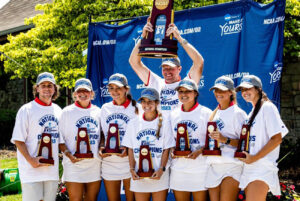
The Dallas Baptist University women’s golf team won their second NCAA Division II National Championship.
The Dallas Baptist University women’s golf team won their second NCAA Division II National Championship. The Patriots defeated No. 3 Nova Southeastern in the final round of Medal Match play at the Fox Run Golf Club in Eureka, Mo. The team held off the four-time national champions, 3-2, to finish the 2022-23 season as the top team in the nation. “I just love walking in this journey with these girls and am just so happy for everyone involved,” said Head Coach Kenny Trapp. “It truly takes a village and players that buy in, and this group exemplifies everything on and off the course that it takes to be a champion.”
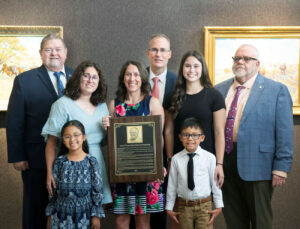
Bobby Hall (left), president of Wayland Baptist University, and Mike Davis (right) of Pampa, who established the JoAnn T. Jones Alaska Endowed Scholarship, are pictured with Christie Demetriades, daughter of the late honoree, and her family — Keith, Jordan, Peyton, Micah and Kegan. (Wayland Baptist University Photo)
Mike Davis of Pampa, who remembered the late JoAnn T. Jones as his teacher, school counselor and friend, established an endowed scholarship in her honor benefitting students attending the Alaska campuses of Wayland Baptist University in Anchorage and Fairbanks. Jones once lived in Fairbanks. The JoAnn T. Jones Alaska Endowed Scholarship is the 13th endowed scholarship Davis has established at Wayland.
LaDonna Gatlin is the featured musical artist when Hardin-Simmons University hosts its Hymn Sing at 2 p.m. on June 4 in Logsdon Chapel. Gatlin, a West Texas native, grew up onstage with her siblings, the Gatlin Brothers. In the 1970s, she performed with the Blackwood Singers and with Dallas Holm and Praise.
Houston Christian University—in partnership with Verizon and the National Association for Community College Entrepreneurship—will offer a free project-based immersive science, technology, engineering and math program, Verizon Innovative Learning STEM Achievers, for middle school students starting June 5. The program aims to empower middle school students in under-resourced communities to explore science, technology, engineering and math; learn problem-solving skills; and gain exposure to career opportunities in technology fields. Participating students will receive mentorship, access to next-generation technology and hands-on training connected to real-world challenges. The initiative provides engaging programming where students can learn design thinking, 3D printing, augmented reality and social entrepreneurship. No prior knowledge or experience is required. The program begins with a four-week in-person session this summer June 5-30, and an in-person full-day workshop at HCU in the fall and in the spring.
East Texas Baptist University will host the NCAA Division III Softball National Championship June 1-7 at Jason Bell Park at Taylor Field.
East Texas Baptist University will host the NCAA Division III Softball National Championship June 1-7 at Jason Bell Park at Taylor Field. The tournament will feature eight teams from across the country vying for the championship title. “ETBU is honored to be chosen to host the NCAA Division III Softball National Championship,” said Ryan Erwin, vice president for student engagement and athletics. “We are excited to showcase our beautiful campus, state-of-the-art facilities, and the historic city of Marshall to universities and fan bases from across the country. In addition, we are thankful for our community partners from the East Texas region who have helped us bring the event to life.”
Richard Fountain, professor of piano at Wayland Baptist University since 2008, was named dean of Wayland’s School of Creative Arts, and Yahui Zhang, professor of communication and media studies since 2008, was named associate dean. Fountain, who has served as associate dean, succeeds Ann Stutes as the top administrator for the School of Creative Arts.
Anniversary
10 years for Thomas Estes as pastor of Cottonwood Baptist Church in Cross Plains.
100 years for Wylie Baptist Church in Abilene. Mike Harkrider is pastor.
TBM Builders roll into southern Utah for major project
June 6, 2023
PANGUITCH, Utah—Mountains skirt the horizon. A river rolls wide across the valley, out of its banks from the thawing winter snow. On the edge of town, a white steeple pokes toward the sky; it is not the tallest steeple in town.
Valley Christian Fellowship is a Baptist congregation that welcomes 30 to 40 worshippers each Sunday. It is the only evangelical church within an hour’s drive of Panguitch in southern Utah.
Texas Baptist Men Builders leaders rolled into Panguitch in late April to begin a months-long project of helping Valley Christian Fellowship build a parsonage, with Sunday school space in the basement. The church provides the materials. TBM Builders provide the labor.
Tammi Newsted, church clerk at Valley Christian Fellowship, points to the plans for a new parsonage TBM Builders are constructing. (Photo / Ferrell Foster)
Valley Fellowship has no pastor; they’ve been without for three years. The church has interviewed a number of potential pastors, said Tammi Newsted, church clerk, but each has responded similarly. “I looked, and there’s nothing to rent. Where am I going to live?” And they can’t afford to buy a house in the inflated housing market, she said.
Tourism has driven up housing costs. Panguitch is in the Grand Circle of National Parks, with Bryce Canyon, Zion and Grand Staircase all nearby, not to mention state parks and other recreational opportunities.
As with many smaller towns near popular travel destinations, the short-term rental market has led to homes being bought, renovated and rented for a few days at a time.
“The AirBNB market has taken over all of the homes out here,” said Newsted, referring to a popular vacation rental website.
The “people who live out here can’t even rent, let alone someone coming into the community. And we certainly can’t expect them to come in and buy a home,” she added.
Parsonage is ‘a foundational need’
Valley Fellowship’s previous pastor rented and “had to move three times I know of because people were selling the houses,” Newsted said. “That’s just not conducive to having someone who wants to be in the area.”
As a result, a “parsonage is a foundational need that we have in order to bring in a pastor,” she said.
Dan Maruyama is director of Henry’s Place, a Christian camp and retreat center for at-risk youth. (Photo / Ferrell Foster)
Dan Maruyama is director of Henry’s Place, a nearby Christian camp and retreat center for at-risk youth. He’s been helping Valley Fellowship by preaching and securing pulpit supply for the church since their pastor left. Tourism has created a housing challenge, Maruyama said, but it also has presented an opportunity.
“There’s a huge amount of summer tourism traffic that comes through here, and we regularly have people show up that are looking for something and they end up in this church, and they hear the gospel … and are encouraged in their walk,” he said. “It’s just a great opportunity for outreach.”
But the church needs a pastor.
Fortunately, the church bought a lot next to its sanctuary five years ago before housing prices rose and “there was no place to live,” Newsted said. “God knew we needed it; we didn’t know that” at the time,
Fellowship is committed to reaching people for Christ, and it is the only evangelical church within a 60-mile radius. It has a big task in a big area.
In the town of about 2,000 people, there is one Catholic church and three congregations of the Church of Jesus Christ of Latter-day Saints, or Mormons.
The large LDS population creates an opportunity, Maruyama said.
“The Mormon church is basically bleeding people and a lot of people are coming out of it,” Maruyama said. “And they tend to come out of the Mormon church and go into atheism because they’re disenchanted with religion.
“If you’ve got someone standing there and saying, ‘Don’t give it all up. God is real; you were just taught some stuff that wasn’t quite right. There is a real Jesus, and he really does love you.’ That’s a great opportunity, and folks need to hear that.”
Church with a Great Commission mindset
Valley Fellowship has an outward-focused, Great Commission mindset, Maruyama said. “I think what’s happening here is God is providing for this church to be able to function, to call a pastor, to have the impact it needs to have on this local community. The opportunity for impact here is huge.”
Church members have not given up, even without a pastor.
“We have been operating for three years with pulpit supply,” Newsted said. “Just the fact that the doors are still open when most churches would have to close the doors because they don’t have a pastor, God has his hand on this church.
“He has something so very special, because we have never had to close the doors. And we have always had the funds we need to pay the bills. We almost always have somebody to fill the pulpit, and, if we don’t, we do a music service.”
With that sense of purpose and God’s blessings, the church decided to pursue “parallel projects”—build a parsonage and seek a pastor.
The church discovered Texas Baptist Men through a “very long process,” Newsted said. “When we decided to build the parsonage we knew that we were going to have to have volunteers to do the labor part of it.”
Newsted searched for West Coast ministries that would do the project, but “building a parsonage is not on the list of what most ministries want to do,” she said. “If we were building a church, it would be no problem.”
‘So important that we want to be part of it’
Then she connected with TBM and received a different response.
“I was very grateful when Texas Baptist Men contacted me, and they said: ‘You know what, we’re going to make an exception for you. This isn’t what we normally do, but we can see that this is so important that we want to be part of it.’ And that was one of the greatest days. I was so happy. I think I was probably smiling for a week after that because I finally had a yes.”
Wayne Pritchard, TBM Builders leader, applies sealant to the edge of the parsonage basement. (Photo / Ferrell Foster)
Wayne Pritchard leads TBM Builders, which includes church, camp and cabinet builders. He has coordinated the TBM effort working with other leaders and task experts in the three groups. Pritchard, and his wife, Annette, were also among the first TBM Builders to arrive in Panguitch and will stay until the project is completed.
“When I was first contacted by Tammi, I was thrilled, because I had a vision from God that our Builders programs could take on a start-to-finish project utilizing all of our groups,” Pritchard said. “This project was presented at the perfect time as we are basically off during the summer, and this one needed to be done during that time,
“God provided everything we needed to come and serve him in such a mighty way,” Pritchard said. “This church is in an area that is wide open to reach lost souls, and I have no doubt that [God] has something big planned for them. Our entire Builders group that is participating shares the same feeling.”
Newsted said the Panguitch project has required the expertise contained in all three TBM Builders groups, and she communicated with the various leaders, with Pritchard coordinating.
“Everybody has been just fabulous in their support of this project and everything we need. It’s just been spot on; it’s been awesome.”
TBM Builders begin framing the parsonage of Valley Christian Fellowship. (Photo / Annette Pritchard)
Prior to the arrival of TBM Builders, the church arranged for the concrete work to begin. The TBM volunteers then arrived and sealed the basement, installed floor joists and decking, constructed exterior and interior walls, hoisted the roof trusses into place, provided plumbing and electrical systems, roofed, hung sheetrock, built cabinets, and provided all of the finishing touches. They started May 1 and expect to finish in July.
“One of the best things about this is that I am grateful that there are still Christians out there that are willing to give of themselves, not just financially, but they’re willing to give of their time, willing to travel 1,400 miles across the U.S. to come out here not knowing really what to expect,” Newsted said.
“That has been amazing; it’s been awesome. And I’m really enjoying working with the team, and I’m really excited.”
‘God is doing something’
Maruyama preached at Valley Fellowship the day before TBM began its work on the parsonage. He spoke from the Old Testament book of Ezra about rebuilding the Jerusalem temple, and he saw a parallel in the two building projects—Jerusalem and Panguitch.
In Ezra, God is doing “what it takes to build whatever is necessary to make ministry possible,” Maruyama said.
“The building of the temple is what reestablishes the cultural milieu that makes it possible for Christ to show up and be recognized as the Savior,” Maruyama said.
“That’s much bigger than what’s happening here, obviously, but I think what’s happening here is God is providing for this church to be able to function, to call a pastor, to have the impact it needs to have on this local community. The opportunity for impact here is huge.”
God is blessing the Panguitch congregation, Maruyama said.
“When I see all of the massive amounts of support … and funding that goes way beyond the capabilities of this small church. I can’t conclude anything other than that God’s doing something, and that’s super exciting. I don’t know what God’s going to do with it, but he’s doing something, and it’s awesome to be a part of it.”
How Jemar Tisby became a symbol of ‘wokeness’
June 6, 2023
WASHINGTON (RNS)—Over the past decade, Jemar Tisby’s life has largely been shaped by two forces: the Bible, and the deaths of young Black men, often at the hands of law enforcement.
About a decade ago, Tisby, then a seminary student in Jackson, Miss., helped start a new group called the Reformed African American Network—an offshoot of the “Young, Restless, and Reformed” movement that had spread like wildfire among evangelical Christians in the first decade of the 21st century.
The group hoped to write about racial reconciliation from the viewpoint of Reformed theology, the ideas most closely associated with the ideas of John Calvin and popularized at the time by preachers and authors such as John Piper. But amid this resurgence of Reformed thought, there were few resources to be had on race issues.
Then, in 2012 in Florida, Trayvon Martin, a Black teen, was killed by the neighborhood watch coordinator of a gated community. All of a sudden, people in the movement were listening.
At the time, Tisby said in an interview, he and others raised their hands and said they had something to offer. The mostly white leaders of the Reformed movement, he said, welcomed them.
“I believed them,” he said. “I thought: ‘We are here. They must want us here.’”
Over the next few years, Tisby, a former pastor turned history professor, became a leading voice on race among evangelicals through his writing and as co-host of “Pass the Mic,” a popular podcast.
Jemar Tisby spoke on “How to Fight Racism” at the invitation of the Baylor Institute for Studies of Religion in 2019. (Photo/ Ken Camp)
He wrote op-eds on race and faith for The Washington Post and published the bestselling The Color of Compromise, which details the long history of racism in American Christianity.
How to Fight Racism, a 2021 follow-up, was named Faith and Culture Book of the Year by the Evangelical Christian Publishers Association.
Conservative concern about ‘wokeness’
But Tisby’s success has since collided with conservative concerns about “wokeness”—a byword that encapsulates liberal critiques of systemic racism, America’s racial history and other social justice themes.
In recent months two college English professors at Christian colleges—one in Florida, the other in Indiana—have been dismissed for allegedly talking too much about race in their classes.
In both cases, critics pointed to the appearance of Tisby’s work on class syllabuses to claim the professors were undermining their students’ Christian faith.
“I’ve become, for the far right, a symbol of everything that’s wrong with how people who they call the left are approaching race,” Tisby told Religion News Service.
The “woke war” playing out in school boards, on college campuses and in church pews has been driven by activists like Christopher Rufo and by conservative evangelical authors and preachers who warn that wokeness and academic notions such as critical race theory are heresy.
As a result, evangelical pastors who were once outspoken about the need to confront racism have gone silent, or in some cases, been driven from the movement altogether.
Black exodus from evangelical world
Some black Christians—including Tisby and his colleagues at the Witness, as the former Reformed African American Network is now known, have left the evangelical world, sometimes quietly and other times loudly.
Some, like Tisby, have found it harder to leave—finding their ties to the evangelical world difficult to unwind even when they are told they are not wanted. Last year, the board of Grove City College, a Christian school in Pennsylvania, apologized for a 2020 sermon Tisby gave at a campus chapel session after an online petition accused him of promoting critical race theory.
White evangelical institutions have recognized a need in recent years to become more diverse in order to prosper as the country’s demographics change. But their donors often bridle as schools and churches change, causing a backlash that drives away people of color.
Anthea Butler, religious studies professor at the University of Pennsylvania and author of White Evangelical Racism, a 2021 book about the racial divides of the evangelical movement, said evangelicals have a long history of welcoming Christians of color into their movement and then ousting them if they ask too many questions about race.
She said college leaders, like those behind the report at Grove City, or other Christian leaders who have denounced Tisby want to make an example of him as a warning to others.
“They want to punish him,” she said.
Tisby deeply immersed in evangelicalism
A native of Waukegan, Ill., Tisby found Christianity while in high school when a friend invited him to a church youth group meeting. Attending the University of Notre Dame, he began to think about a call to ministry.
In South Bend he also discovered Calvinist theology after a friend sent him a copy of Piper’s 1986 book Desiring God.
After graduating in 2002 and a year working for Notre Dame’s campus ministries, he joined Teach for America and was sent to teach sixth graders in impoverished Phillips County, Ark., in the Mississippi Delta.
The experience changed the direction of his life.
“This is cotton country—the land of slavery and sharecropping,” Tisby said. “You can see it in the landscape. You can see it in the generational poverty.”
The predominantly Black community was marked by a lack of jobs, poor medical care, food deserts and a struggling school system.
“The thing that struck me was that there are churches on every corner,” Tisby said. “Not only were they racially divided, it also didn’t seem like they were having much impact in the community. That’s where I started thinking about the relationship between faith and justice.”
After four years at the school, he took a year off to study at Reformed Theological Seminary in Orlando, Fla., before returning, this time as a principal.
“I just felt God wasn’t done with me in the Delta,” he said.
He finished his divinity degree at a seminary in Jackson, Miss., working part time in the school’s admissions office. He was charged with helping recruit Black students and helped to start an African American leadership initiative.
Pushback both familiar and surprising
Afterward, he enrolled at the University of Mississippi and earned a doctorate in history. He is now a professor at Simmons College of Kentucky, a historically Black school in Louisville.
The recent pushback against his work, he said, seems both familiar and surprising. As a historian, Tisby has traced the ways American Christians have tried to claim that the faith is colorblind. The love of Jesus, they maintain, should break down divides between people of different ethnicities.
But rarely, Tisby said, do Christians manage to overcome racial differences. In The Color of Compromise, Tisby recounts how English settlers in Virginia faced a dilemma. In their homeland, Tisby writes, the custom was to free slaves who converted to Christianity. In 1667, the Virginia General Assembly decided that, no matter what the Christian faith taught, baptism would not make slaves free.
Tisby recounted some of that history in his 2020 chapel sermon at Grove City College. He had first been invited to speak in 2019 but his visit had been delayed by scheduling conflicts and complications of the COVID-19 pandemic.
School leaders later said they had invited him as a Christian writer who could help the school’s students grapple with racial reconciliation. Tisby, who had spent years in white evangelical spaces, felt he had a message the students there could hear.
“What I picked up on was, we’re willing to give you a hearing, but this is not what we typically do,” he said.
A year later a group of alumni and parents from Grove City launched a petition, claiming the school had been overrun by “wokeness” and critical race theory.
The petition cited Tisby’s speech as a sign the school had lost its way, but school leaders claimed it was Tisby who had changed course.
“The Jemar Tisby that we thought we invited in 2019 is not the Jemar Tisby that we heard in 2020 or that we now read about,” they told a board committee.
Early signs of looming division
Tisby traces white evangelicals’ suspicions of their Black counterparts to the 2014 protests in Ferguson, Mo., that followed the shooting death of Michael Brown. The protests, which brought the Black Lives Matter movement to national attention, drove a wedge between Black and white Christians, he wrote in a 2019 Washington Post op-ed.
The split gained momentum in 2018 with a gathering in Memphis, Tenn., to commemorate the 50th anniversary of the death of Martin Luther King Jr.
Sponsored by the Ethics and Religious Liberty Commission of the Southern Baptist Convention and the Gospel Coalition, a prominent Reformed evangelical group, the event featured a host of prominent leaders, including Piper, Texas megachurch pastor Matt Chandler, Baptist pastor Charlie Dates, legendary Black pastor and community organizer John Perkins and Russell Moore, then president of ERLC.
These preachers urged attendees to address the scourge of racism that stained the life of the church. Moore told attendees that enduring racism was leading younger Christians to question their faith.
“Why is it the case that we have, in church after church after church, young evangelical Christians who are having a crisis of faith?” said Moore, who has since left the SBC and is editor-in-chief of Christianity Today. “It is because they are wondering if we really believe what we preach and teach and sing all the time?”
That same week, an association of Southern Baptists in Georgia kicked a church out for racist actions against another SBC church. The Georgia Baptist Convention followed suit, as did the national Southern Baptist Convention annual meeting.
Opposition to CRT as a rallying cry
But in April of 2018, Tom Ascol, an extremely conservative Southern Baptist pastor from Florida, criticized Thabiti Anyabwile, a well-known pastor in Washington, D.C., for writing about the sin of racism. Ascol, who would later run for SBC president largely on his opposition to critical race theory, produced a documentary about what he called liberal drift in the denomination.
The pushback had begun. By that fall, a group of conservative pastors, many of them Calvinists, signed “The Statement on Social Justice & the Gospel,” which responded to “questionable sociological, psychological, and political theories presently permeating our culture and making inroads into Christ’s church.”
In 2019, a resolution passed by the Southern Baptist Convention called critical race theory a “tool” to understand society and led to calls for the convention to denounce the resolution.
Those Southern Baptist debates over critical race theory long preceded debates in the general public.
Ryan Burge, a political scientist, noted that Google searches for the term critical race theory or CRT were nearly nonexistent when Baptists started debating it. Only later did the debate spill out into the mainstream to be used by politicians, including Donald Trump, to rally supporters. It has since been equated with Marxism and other ideas anathema to conservatives.
Lerone Martin, associate professor of religious studies and director of the Martin Luther King Jr. Research and Education Institute at Stanford University, said that evangelicals have long found it easier to label Black leaders as leftists or Marxists rather than to deal with the reality of racism.
“That way, anything they dislike or oppose can be dismissed wholesale,” he said.
Tisby said he’s not an apologist for CRT or any ideology. He reads the Bible and history and tries to tell the truth, he said in an interview. That is his job as a Christian and as a historian. And he doesn’t think he’s all that special.
“I don’t think there’s anything in particular about my approach that is novel or different than what a lot of people have said for a long time.”
Chair of NC Baptist Children’s Homes resigns after arrest
June 6, 2023
WASHINGTON (RNS)—A Baptist leader in North Carolina resigned last week after he and his wife were charged with three counts of felony animal cruelty and a misdemeanor offense of communicating threats.
James David “Jim” Goldston III, 71, and his wife, Agnes, 73, are accused of poisoning their neighbor’s three dogs. Two of the dogs, Labrador retrievers, died. A veterinarian confirmed all three dogs were poisoned, according to the Wake County Sheriff’s Office.
Goldston had been chairman of the board of trustees for the Baptist Children’s Homes of North Carolina, a faith-based nonprofit. He also was a board member of an animal rescue organization.
The Goldstons also are accused of threatening their neighbor. A handwritten letter tossed into their neighbor’s yard read “Your Daughter is Next. B Careful,” arrest warrants obtained by The News & Observer newspaper showed.
Goldston had served on and off the board of the Baptist Children’s Home of North Carolina since 1990, a spokesperson for the Baptist State Convention said. He resigned as chair on May 21.
In a statement, Goldston said that he and his wife had been falsely accused.
“After more than 35 years of involvement with Baptist Children’s Homes of NC, and personally investing and helping raise millions of dollars to further this great ministry, I sadly hereby resign as a BCH Trustee,” Goldston wrote in a statement to the Biblical Recorder, the Baptist State Convention media site.
“My wife and I have been falsely accused of some horrible acts and I do not want this to be a distraction or hindrance to the work done on behalf of BCH as the truth plays out within the justice system.”
The Christian children’s home, which is affiliated with the Baptist State Convention of North Carolina, operates group homes for children as well as a foster and adoption ministry.
The Goldstons attended Bay Leaf Baptist Church in Raleigh. The couple runs a family foundation that contributed $40,000 in 2019 to various Baptist churches, as well as Southeastern Baptist Theological Seminary.
The foundation’s biggest charitable gift—$10,000—was to Saving Grace Animals for Adoption in Wake Forest, N.C. The Goldston’s daughter, Molly, is the founder and owner of Saving Grace.
James Goldston also served on the animal rescue’s board since at least 2017 but has since resigned, The News & Observer reported.
The Goldstons each posted a $30,000 bond.
The couple was allegedly having a dispute with their neighbor, Philip Ridley, according to local news reporters. One of those letters, shared with WRAL News, read, “If one or both of these dogs put their paws on my property I am going to blow their brains out.”



 He chose to probe the deep questions those issues raise through the fictional characters he brought to life in Bastille Day.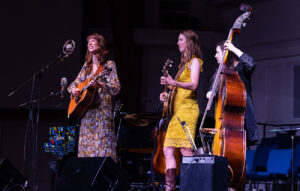
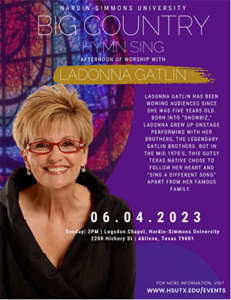 LaDonna Gatlin is the featured musical artist when Hardin-Simmons University hosts its Hymn Sing at 2 p.m. on June 4 in Logsdon Chapel. Gatlin, a West Texas native, grew up onstage with her siblings, the Gatlin Brothers. In the 1970s, she performed with the Blackwood Singers and with Dallas Holm and Praise.


 But rarely, Tisby said, do Christians manage to overcome racial differences. In The Color of Compromise, Tisby recounts how English settlers in Virginia faced a dilemma. In their homeland, Tisby writes, the custom was to free slaves who converted to Christianity. In 1667, the Virginia General Assembly decided that, no matter what the Christian faith taught, baptism would not make slaves free.