Julio Guarneri, candidato a la reelección como presidente de la BGCT

Julio Guarneri, presidente en funciones de la Convención General Bautista de Texas y pastor principal de la Calvary Baptist Church de McAllen, será nominado para un segundo mandato de un año como Presidente de los Bautistas de Texas.

Michael Evans, pastor principal de la Bethlehem Baptist Church en Mansfield y ex Presidente de la BGCT, nominará a Guarneri en la Reunión Familiar de los Bautistas de Texas, del 16 al 18 de julio en McAllen.

“En tiempos de transición, necesitamos el tipo de liderazgo firme que proporciona Julio Guarneri”, dijo Evans. “Necesitamos un hombre de Dios que ore y dirija la convención en un momento como éste”. Un comité de búsqueda está aceptando candidaturas para el próximo Director Ejecutivo de la BGCT. David Hardage se jubiló a finales del año pasado tras más de una década en el cargo.

Evans elogió a Guarneri como un hombre “honesto e íntegro” que puede aportar coherencia y estabilidad durante un periodo de cambio, señaló.

“Julio Guarneri tiene un espíritu firme y apacible que hace que la gente a su alrededor se sienta cómoda”, dijo Evans.

“No duda en decir lo que piensa y lo que siente para que sepas cuál es su postura. Al mismo tiempo, es concienzudo y respetuoso con las opiniones de los demás. Escucha bien a los demás y se deja guiar por Dios”.

Guarneri -que ejerció dos años como Primer Vicepresidente antes de su elección como Presidente de la BGCT el pasado noviembre- reconoció que la búsqueda de un nuevo Director Ejecutivo fue un factor que influyó en su decisión de permitir su candidatura para un segundo mandato presidencial.

“La continuidad es buena durante un año de transición en nuestra cúpula ejecutiva”, afirmó.

Además, dado que la reunión anual de este año se celebra a mediados de verano para adaptarse al calendario del Encuentro Familiar que tiene lugar una vez cada cinco años, el primer mandato de Guarneri como presidente durará sólo ocho meses en lugar de un año completo.

“Hay cosas que creo que es importante continuar”, dijo, señalando en particular al reto de responder a los cambios demográficos en Texas.

Destacó específicamente el enfoque de la CG2 de los Bautistas de Texas en el cumplimiento de la Gran Comisión y el Gran Mandamiento que Cristo dio a sus seguidores.

Mientras que las iglesias generalmente entienden su papel en compartir el evangelio y mostrar amor en el nombre de Cristo, dijo, los Bautistas de Texas pueden continuar creciendo en su entendimiento de cómo la Convención y las instituciones que la apoyan trabajan cooperativamente para alcanzar esas metas. Guarneri ha pedido a los Bautistas de Texas que “practiquen Pentecostés” y se unan a las siete semanas de oración. Específicamente, desde Pascua hasta el Domingo de Pentecostés el 28 de mayo, instándoles a seguir el ejemplo que Jesús estableció en la Oración Modelo, cuando pidió que “venga tu reino”.

“Cooperamos juntos como convención porque nos ocupamos de los asuntos del Reino”, dijo.

Guarneri ha servido a la Calvary Baptist Church en McAllen -una congregación multicultural en el Valle del Río Grande- desde 2010. Anteriormente, fue pastor de la Iglesia Bautista Getsemaní en Fort Worth.

También formó parte del personal de la Segunda Iglesia Bautista en Corpus Christi, fue pastor fundador de la Shalom Baptist Mission en Corpus Christi, y pastor de la Primera Iglesia Bautista en Taft.

Nació en México, pero terminó el bachillerato en el sur de Texas y se licenció en la Texas A&I University de Kingsville. También tiene una maestría en educación religiosa del Seminario Teológico Bautista Southwestern y un doctorado en estudios de liderazgo de la Dallas Baptist University.

Guarneri preside el consejo de Buckner International. Él y su esposa Monica tienen cuatro hijos -Josh, Rachel, Mia y Stevan- y dos nietos -Daniel y Antares-.

Publicado el 23 de abril, 2023 en https://www.baptistpress.com/resource-library/espanol/julio-guarneri-candidato-a-la-reeleccion-como-presidente-de-la-bgct/


Charles Stanley, presidente fundamental de la SBC y predicador televisivo, fallece a los 90 años

ATLANTA—Charles Stanley, ex presidente de la Convención Bautista del Sur y uno de los principales predicadores de radio y televisión del país, falleció en paz en su casa el martes 18 de abril, a la edad de 90 años.

Stanley presidió las dos mayores reuniones anuales de la historia de la SBC -45.531 mensajeros en 1985 en Dallas y 40.987 en 1986 en Atlanta- cuando los conservadores se enfrentaban a la oposición más aguda en contra de anclar la Convención en la autoridad bíblica.

Como pastor principal de la First Baptist Church de Atlanta, Stanley fue elegido en 1984, en el sexto año del avance conservador en las mayorías en los consejos de administración de los seminarios de la Convención y otras entidades. Los conservadores aceptaron el reto en 1985 y 1986, y Stanley recibió el 52,18% de los votos de los mensajeros en Dallas, frente a dos candidatos, y el 55,3% en Atlanta, frente a un único candidato.

Stanley pasó a ser pastor emérito en septiembre de 2020 a la edad de 87 años, después de haber dirigido First Baptist durante casi 50 años. Anthony George, pastor asociado principal desde 2012, sucedió a Stanley.

“Mi elección [en 1984 en Kansas City, Mo.] enfureció a la oposición”, escribió Stanley en su autobiografía de 2016, “Fe valiente”: “…y en última instancia reveló muchos de los problemas subyacentes que habían existido en la Convención durante mucho tiempo, pero que habían sido ignorados o negados. … Todas las fuerzas políticas liberales y moderadas de la Convención Bautista del Sur estaban en mi contra, lo que incluía a los presidentes de los seminarios y a los periódicos de las convenciones estatales”.

Aun así, “sabía que estaba en el centro de su voluntad, así que nunca me sentí ansioso o enfadado incluso cuando los conflictos estaban en su peor momento”.

Más allá de lo que se conoció como el Resurgimiento Conservador en la SBC, Stanley desarrolló una amplia audiencia televisiva y radiofónica a través de In Touch Ministries y fue incluido en el Salón de la Fama de los Locutores Religiosos Nacionales en 1988.

El ministerio de Stanley comenzó en 1972 como “The Chapel Hour” (La Hora de la Capilla) en dos cadenas de televisión y una emisora de radio de Atlanta, y posteriormente se amplió a TBS (Turner Broadcasting System) y a CBN (Christian Broadcasting Network). En 1977 rebautizó el ministerio de alcance evangelístico con el nombre de In Touch Ministries, movido por el título de un devocional que había en su despacho: “para poner en contacto al mayor número posible de personas con Jesucristo y su forma de vivir”.

En la actualidad, los mensajes In Touch de Stanley se emiten en multitud de emisoras de radio y televisión y redes por satélite, así como por onda corta, en más de 100 idiomas y en 150 países.

En 2007, el ministerio comenzó también a distribuir dispositivos de audio de bolsillo de In Touch Messenger, alimentados por energía solar, que contenían el Nuevo Testamento, Salmos, Proverbios y varias docenas de sermones de Stanley en varios idiomas. Además de distribuir cientos de miles de estas unidades a los soldados estadounidenses y a las misiones en todo el mundo, los dispositivos han sido adaptados para su colocación en campos de refugiados y en torres de agua en diversas partes del mundo para que poder ser escuchados por medio de un teléfono móvil.

Más que ningún otro presidente de la SBC, la vida personal de Stanley había estado a la vista del público, empezando cuando su esposa Anna solicitó el divorcio en 1993. Tras un período de reconciliación, se divorció en 2000, después de 44 años de matrimonio. Anna Stanley murió en 2014 de neumonía y otros problemas de salud a la edad de 83 años.

En la vida de la SBC antes de su presidencia, en 1984 Charles Stanley fue el presidente de la Conferencia de Pastores que precede a la reunión anual de la Convención, y en 1983 fue el presidente del Comité de Nominaciones (entonces llamado Comité de Juntas), que fue fundamental para el Resurgimiento Conservador en la nominación de fideicomisarios para los seminarios de la SBC, juntas misioneras y otras entidades.

Como presidente de la SBC, Stanley sirvió en el Comité de Paz de 22 miembros que fue establecido y nombrado por una moción aprobada en la reunión anual de 1985. Este Comité tenía la tarea de identificar “las fuentes de las controversias” dentro de la SBC y hacer recomendaciones para la reconciliación y la cooperación en “evangelismo, misiones, educación cristiana y otras causas… todo para la gloria de Dios”. En su informe de 6,450 palabras, publicado en 1987 tras 15 reuniones, el Comité de Paz afirmaba que “la gran mayoría de los Bautistas del Sur” creen que la Biblia “dice la verdad en todos los ámbitos de la realidad y en todos los campos del conocimiento”. La Biblia, cuando se interpreta correctamente, tiene autoridad para toda la vida”.

Además de su hijo, Stanley es sobrevivido por su hija Becky Stanley Brodersen, seis nietos, tres bisnietos y su media hermana Susie Cox.

Publicado el 23 de abril, 2023 en https://www.baptistpress.com/resource-library/espanol/charles-stanley-presidente-fundamental-de-la-sbc-y-predicador-televisivo-fallece-a-los-90-anos/


On the Move: Akins

Marty Akins to First Baptist Church in Ballinger as pastor. He has served previously as pastor of First Baptist Church in Denver City and First Baptist Church in Bedford.


Ministry comes full circle for Woodway worship leader

WOODWAY—Through his music and message, worship leader Art Wellborn hopes to help students and young adults realize the importance of connecting with a local church and being encouraged by a community of believers.

During his teenage years, Wellborn developed a love for music at an early age and was involved in various ministries at First Woodway Baptist Church, on the outskirts of Waco.

Little did he realize when he began leading worship his musical journey would come full circle as he entered vocational ministry.

“In high school, I began to really develop a passion for music,” Wellborn said. “By my junior year, I was leading our youth ministry in worship, and our youth pastor, Bob Johns, decided to hire me onto his youth staff right out of high school.

“I’m not sure how high of quality it was in those early years, but it was without a doubt where the Lord developed a deep passion within me for leading others in music.”

After graduating from Baylor University in 2015, Wellborn moved to Dallas and joined the staff of Community Life Church to begin leading worship at their campuses in Forney, Sunnyvale, Kaufman and Rockwall.

A year later, Wellborn felt God calling him back to First Baptist Woodway when an opportunity opened up to become the congregation’s worship minister.

“Serving through the years at First Woodway has been one of the biggest blessings,” Wellborn said. “The Lord has orchestrated timing, roles and so many other things perfectly according to his time.

“Maybe I’ll write a book about it someday, but in the short version, he has used the community at Woodway to walk with me through times of grief dealing with the loss of both my parents and also joyous times. They have been with me through so many situations, and my time at Woodway has shaped me more than anything into the minister I am today.”

Wellborn acknowledges his experiences at First Woodway have shaped him “in ways I probably don’t even know because of my time here and the people who have poured into me, and I am just so thankful.”

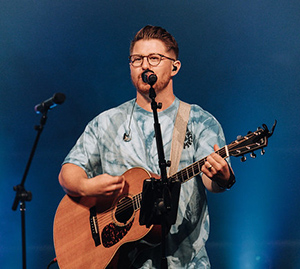
Through his music and message, worship leader Art Wellborn hopes to help students and young adults realize the importance of connecting with a local church and being encouraged by a community of believers. (Courtesy Photo)

Today, in addition to his staff role at the church, Wellborn frequently leads worship for DiscipleNow weekends, youth retreats and summer camps around the state including Sondays Camp at Mount Lebanon Baptist Encampment in Cedar Hill and PowerPlus Camp at Pineywoods Baptist Encampment in Woodlake.

He has also led worship for Vertical Ministries, a collegiate Bible study at Baylor University.

Wellborn especially enjoys ministering to youth and college students because of the critical influence these years present, he said.

“Getting to lead worship for Vertical Ministries is such a gift, because it was during my college years at Baylor where the Lord did some major work on my heart and developed me as a worship leader under guys like Jeff Johnson and Logan Walter,” Wellborn noted.

“Our God is such a loving Father who loves us more than we could imagine, and he is so kind and faithful. Life can be hard, but Christ is no stranger to it and has walked on this Earth, too. He knows every bit of our suffering and will redeem it all. I believe that with everything that is within me.”

As he leads worship at events around the state, Wellborn believes one of the most exciting things is watching people respond in worship.

“I love seeing people genuinely and freely worship,” Wellborn said. “I tell our team all the time that while we prepare to lead excellently, there is no power unless the Holy Spirit shows up to move.

“Our prayer is that Christ would use whatever aspect of the event to touch someone. Our job is just to be obedient in our role and let the Lord do the eternal work.”


Churchgoers still tithing but outside of church

BRENTWOOD, Tenn.—Most churchgoers see tithing as a biblical command and give at least 10 percent of their income. But they have more diverse opinions on the “where” and “how” of tithing.

More than 3 in 4 American Protestant churchgoers say tithing is a biblical command that still applies today (77 percent), according to a Lifeway Research study. One in 10 (10 percent) says it is not. And 13 percent are uncertain about the matter.
Compared to 2017, fewer churchgoers today believe tithing is a biblical command that still applies (77 percent vs. 83 percent) and more are not sure (13 percent vs. 10 percent).

“Giving 10 percent of your earnings to God is still a widespread standard among churchgoers,” said Scott McConnell, executive director of Lifeway Research. “The small decline in considering tithing a command appears to be more from a lack of teaching on the subject than a rejection of such teaching.”

The youngest adult churchgoers, those age 18 to 34, are the least likely to agree tithing is a biblical command that still applies today (66 percent). Denominationally, Lutherans are least likely to agree (59 percent).

Those with evangelical beliefs are more likely than those without evangelical beliefs to say tithing is biblical and currently applicable (85 percent vs. 71 percent).

And those who attend a worship service at least four times a month are more likely than those who attend one to three times a month (80 percent vs. 72 percent) to agree.

How much do churchgoers give?

By definition, a tithe is one-tenth. And while more than 3 in 4 churchgoers believe giving a tithe is biblical, only half (51 percent) give 10 percent or more of their income to the church they attend.

Three in 10 (31 percent) say they give a tithe, and 19 percent give more. More than 1 in 5 (22 percent) say they try to give but aren’t always consistent. And 16 percent say they regularly give less than a tithe.

Another 9 percent say their finances make it difficult to give, and 2 percent say they do not give.

Although fewer give 10 percent of their income to the church today compared to 2017 (31 percent vs. 37 percent), the percentage of churchgoers who give 10 percent or more has remained relatively steady (51 percent vs. 54 percent).

Today, fewer churchgoers regularly give less than a tithe (16 percent vs. 20 percent). And more try to give but are not consistent (22 percent vs. 17 percent).

“Believing God wants you to tithe and doing it are two different things,” McConnell said. “Some who do not tithe are consistent with their giving at a lower threshold, and others give when they feel they are able. Like many exhortations in Scripture, giving your finances to God is not necessarily easy in practice.”

Several church-related factors impact a person’s likelihood of giving to the church they attend. Baptist (40 percent), Presbyterian/Reformed (34 percent) and non-denominational (34 percent) churchgoers are more likely to tithe 10 percent of their income than Lutheran (19 percent), Restorationist Movement (17 percent) and Methodist (12 percent) churchgoers.

Additionally, those who attend worship services at least four times a month (34 percent) are more likely to tithe than those who attend one to three times a month (26 percent). And those with evangelical beliefs are more likely than those without evangelical beliefs to tithe (39 percent vs. 25 percent).

Where can you tithe?

Most churchgoers who say tithing is an applicable biblical command say tithe money can be given to their church (90 percent). Most also say tithes can be given to a Christian ministry (55 percent). Fewer say tithes can be given to an individual in need (42 percent) or to another church they don’t regularly attend (34 percent). One in 4 believe tithes can be given to a secular charity (25 percent). And 1 percent are not sure.

Today, fewer churchgoers than in 2017 say tithe money can be given to their church (90 percent vs. 98 percent).

And more said tithes can be given to Christian ministries (55 percent vs. 48 percent), an individual in need (42 percent vs. 34 percent) or a secular charity (25 percent vs. 18 percent).

Denominationally, Lutheran (98 percent), Presbyterian/Reformed (96 percent), Baptist (93 percent) and non-denominational (92 percent) churchgoers are among the most likely to say tithe money can be given to their churches.

Lutheran and Presbyterian/Reformed churchgoers are also among the most likely to say tithes can be given to another church they don’t regularly attend (58 percent and 53 percent, respectively) or a Christian ministry (72 percent and 68 percent).

Lutherans are also among the most likely to say tithes can be given to a secular charity (45 percent), and Presbyterian/Reformed churchgoers are among the most likely to say they can be given to an individual in need (51 percent).

Conversely, Baptists are among the least likely to say tithes can be given to a Christian ministry (51 percent), individuals in need (37 percent), another church they don’t regularly attend (34 percent) or a secular charity (19 percent).

Those with evangelical beliefs are more likely than those without evangelical beliefs to say tithe money can be given to their churches (95 percent vs. 85 percent), while those without evangelical beliefs are more likely than those with such beliefs to say tithes can be given to a secular charity (29 percent vs. 20 percent).

Does method matter?

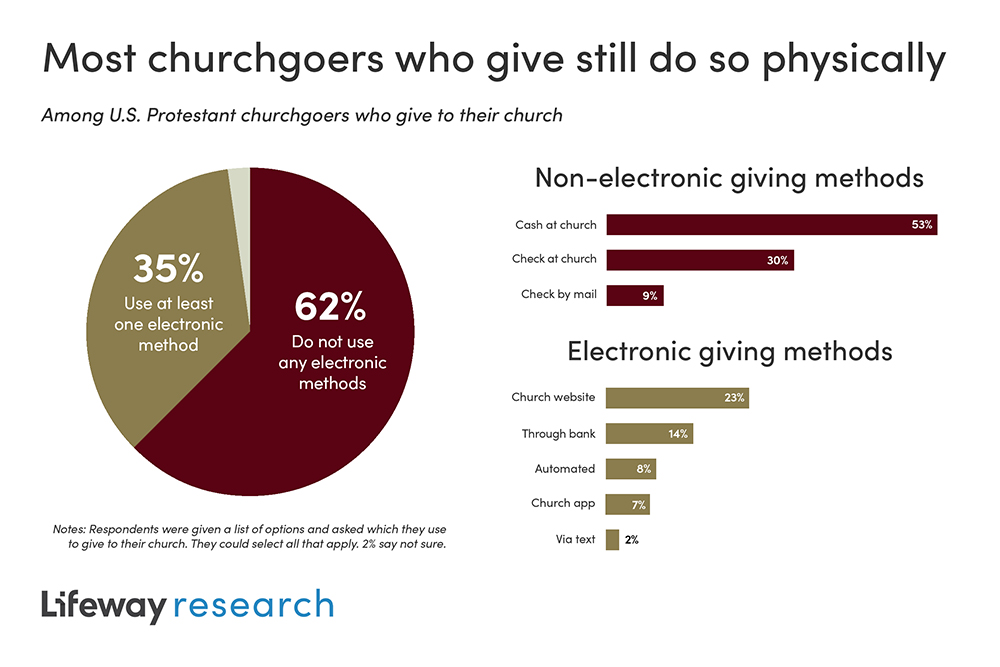
Although the past five years have seen a noticeable increase in online giving, most churchgoers still give cash at church (53 percent). Fewer give a check at church (30 percent) or mail one to the church (9 percent).

Others give electronically on the church website (23 percent), through their bank (14 percent), through an app the church provided (7 percent) or via text (2 percent). And 8 percent of churchgoers have automated payments set up for their tithes.

Nearly half as many churchgoers today compared to 2017 give a check at church (30 percent vs. 59 percent).

But more churchgoers mail checks to the church today (9 percent vs. 3 percent).

And more are giving electronically through all formats—church website (23 percent vs. 11 percent), banks (14 percent vs. 5 percent), automated payments (8 percent vs. 3 percent) or church app (7 percent vs. 3 percent).

Those 18-34 are among the most likely to give cash at church (75 percent), on the church website (28 percent), through an app the church provided (10 percent) or via text (7 percent). Churchgoers 65 or older are the most likely to give a check (47 percent).

“While electronic giving has grown significantly in the last five years, 6 in 10 (62 percent) churchgoers who give do not yet utilize electronic giving methods to give to their church,” McConnell said. “Churches would likely be better served by emphasizing the motivation to give than the mode.”

Lifeway Research conducted the online survey of American Protestant churchgoers Sept. 19-29, 2022, using a national pre-recruited panel. Quotas and slight weights were used to balance gender, age, region, ethnicity, education and religion to reflect the population more accurately. The completed sample is 1,002 surveys, providing 95 percent confidence the sampling error does not exceed plus or minus 3.3 percent. Margins of error are higher in sub-groups.


Church still feels impact of West explosion a decade later

A fertilizer plant explosion on April 17, 2013, forever changed West, a small Central Texas town just north of Waco. Its impact also is still felt by First Baptist Church in West and its pastor.

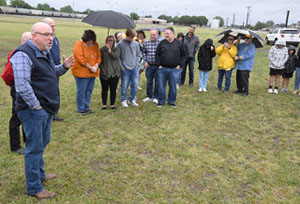
After an explosion 10 years ago made it impossible for First Baptist Church in West to meet inside its facility, the church worshipped in an open field across town, and it has returned to that field each year on the anniversary for a service of remembrance. While rain compelled the congregation to meet inside this year, Pastor John Crowder (left) and a small group gathered after the worship service in that field for a brief time of prayer. (Photo by Larry Knapek / Courtesy of The West News)

Four days after the explosion that claimed 15 lives and damaged or destroyed more than 150 buildings, First Baptist Church was unable to worship inside its building, because that area was cordoned off by law enforcement. So, the congregation worshipped outdoors in a field on the other side of town.

Each year since then, the church has continued to meet for worship in that same field on the Sunday following April 17 for a service of remembrance.

This year, rain and cold wind compelled the congregation to move the worship service to the church sanctuary. But after the benediction, Pastor John Crowder and a small group went across town to that familiar field for a brief time of prayer, even as rain fell.

“We just felt like we had to be there,” said Crowder, who has been pastor 28 years at First Baptist in West.

‘A lot of emotional healing’

Driving around town, the changes in West 10 years after the deadly explosion are readily apparent, he noted.

Nearly all of the buildings in the north part of town—the area in the blast zone—have been constructed in the past decade. West has three new schools, a new Emergency Medical System and many newly built homes.

“It’s good to see that people here wanted to stay and rebuild,” Crowder said. “And we have a lot of new people who have chosen to move here.”

Fraternal orders, service organizations, social agencies and faith communities in West that operated independently before the explosion function more cooperatively now, he noted.

“Now there’s greater communication with each other and a willingness to work together. We support each other more,” Crowder said.

Below the surface, the town’s longtime citizens who went through the trauma of the explosion also were shaped by the experience, he noted.

“A lot of emotional healing has taken place,” he said.

Church committed to community impact

First Baptist Church was transformed not only by the disaster, but also by the experience of relief and recovery, Crowder observed.

“It has brought us closer together,” he said. “A lot of times, families will say it took a tragedy to bring them closer, and that can be true of the church, also. I think we trust each other more and are more supportive of each other.”

When the explosion occurred, First Baptist Church responded rapidly, he recalled.

“We didn’t have any meetings to decide what to do. We just got busy,” Crowder said.

John Crowder (center), pastor of First Baptist Church in West, was joined by David Hardage (left) retired executive director of the Baptist General Convention of Texas and now church engagement director for Texas Baptist Men, and Tim Randolph (right), director of missions for Waco Regional Baptist Association, for a service marking the 10th anniversary of the fertilizer plant explosion that rocked West. (Courtesy Photo)

Through its partnerships with Waco Regional Baptist Association, TBM and Texas Baptists, the church was able to offer resources to neighbors in need.

First Baptist Church—which had always been seen as almost peripheral to the predominantly Catholic community—became known as a hub of activity.

From hosting TBM disaster relief volunteers to housing student missions groups who helped with recovery and rebuilding efforts, the community saw a church that opened its doors and its heart to serve its neighbors.

“It gave us a clear vision of serving our community,” Crowder said. “It kind of defined us in the community. We earned trust.”

In the process, the church gained a clearer sense of mission and purpose, he noted.

“We want to be salt and light—to make an impact on our community in a positive way, Crowder said.

In fact, community impact now is one of the “five plumblines” First Baptist Church uses to keep itself true to its vision, along with giving God their best, focusing on church health, small-group involvement and God-centered worship, he noted.

The church experienced “somewhat of a spiritual awakening” as a result of the tragedy in its community and the ministries that resulted from it, Crowder said. Individual church members gained a new perspective, he added.

“When somebody’s world is shaken, you see what is really important,” he said.

Share lessons learned

Crowder acknowledged he also gained a new sense of purpose.

“I already had a clear sense of calling to the pastoral ministry and to this particular community,” he said. “But after what we experienced, I have a real desire to help other churches in other communities benefit from what we learned.”

Crowder has written about the process of moving from disaster relief to disaster recovery. In light of the COVID-19 pandemic, he wrote about the nature of life-changing events and the importance of being truthful about the long recovery process. After a school shooting in Uvalde, he offered counsel on ways to help grieving communities.

“If you look around the typical pastor’s library, you will see books on theology, counseling, administration and leadership. You’re not likely to see books on what to do when your world falls apart,” he said. “That’s understandable. We don’t want to think about it.”

Crowder makes no claims about being an expert, but does want to help other pastors learn what they can from his experiences.

“Maybe I can just give them a little bit of a head start,” he said. “Instead of reinventing the wheel and learning from scratch, maybe we can help them start out a few steps ahead.

“Then, when they share their experiences with a pastor in the next community that has a disaster, they might even be able to start two or three more steps down the road.”


Patterson and seminary dismissed from Rollins abuse case

HOUSTON (BP)—Paige Patterson and Southwestern Baptist Theological Seminary have been dismissed from the abuse related case involving Paul Pressler.

Patterson and the seminary reportedly reached a settlement with Gerald Duane Rollins.

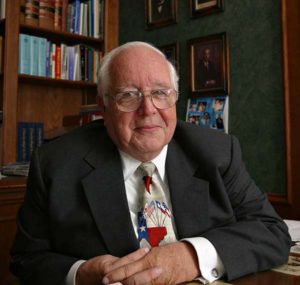
Former Judge Paul Pressler, who played a leading role in wresting control of the Southern Baptist Convention from moderates starting in 1979, poses for a photo in his home in Houston on May 30, 2004. (AP Photo /Michael Stravato / Distributed by RNS)

Pressler, a former SBC Executive Committee member, former SBC first vice president (in 2002 and 2003) and former Texas legislator and judge, is being sued by Gerald Duane Rollins.

In the suit originally filed in October 2017, Rollins alleges Pressler raped him in 1980, when Rollins was 14 years old and attending a Bible study at Pressler’s church. According to the affidavit, Pressler continued to rape Rollins, “over the course of the next 24 years or so” as Rollins progressed into his 30s.

The case had been dismissed in 2018 on grounds that the statute of limitations had expired, but the Appellate Court ruled in 2021 Rollins had suffered from post-traumatic stress disorder, thus modifying the statute of limitations for reporting the alleged abuse.

Rollins is seeking $1 million in damages.

The case also names Pressler’s wife Nancy, Jared Woodfill, Woodfill Law Firm, the Southern Baptist Convention and First Baptist Church in Houston as defendants.

The terms of the settlement were not disclosed.

“Dr. Patterson is grateful that he has been removed from a suit that he should never have been included,” J. Shelby Sharpe, Patterson’s attorney, said in a statement to The Tennessean in Nashville. “No money was paid on Dr. Patterson’s behalf or by him to have him non-suited.”

Southwestern Seminary declined to comment.

The case is scheduled to go to trial on May 15.


Texas Senate wants Ten Commandments in classrooms

The Texas Senate passed a bill that would require public schools to post the Ten Commandments prominently in every classroom.

Voting strictly along party lines, the Republican-dominated state Senate approved SB 1515 by Sen. Phil King, R-Weatherford, April 20. The bill now moves to the House of Representatives for consideration.

King told a committee hearing on the measure that displaying the Ten Commandments in public school classrooms acknowledges “the role that fundamental religious documents and principles had in American heritage and law.”

He called the legislation “a good, healthy step for Texas to bring back this tradition of recognizing America’s religious heritage.”

Amanda Tyler

But Amanda Tyler, executive director of the Baptist Joint Committee for Religious Liberty, tweeted, “Forcing public schools to display the Ten Commandments violates religious liberty. The government should not be in the position of making religious decisions. As Baptists, we reject this effort because of our theological convictions and our commitment to the First Amendment.”

SB 1515 calls for “a durable poster or framed copy of the Ten Commandments” measuring at least 16 inches wide and 20 inches tall be displayed “in a conspicuous place” in every elementary and secondary public school classroom.

The bill even dictates the wording of the Ten Commandments—an abbreviated version of Exodus 20:2-17 from the Kings James Version of the Bible, essentially following the Protestant approach to the Decalogue. Jews, Catholics and Protestants number the commandments differently, and the way they are worded varies.

The Texas Senate also approved SB 1396 by Sen. Mayes Middleton, R-Galveston, which would allow public and charter schools to provide students and employees a designated time to pray or read the Bible or other religious text.

Lt. Gov. Dan Patrick issued a statement of support for both SB 1515 and SB 1396.

“Allowing the Ten Commandments and prayer back into our public schools is one step we can take to make sure that all Texans have the right to freely express their sincerely held religious beliefs,” Patrick said.

“I believe that you cannot change the culture of the country until you change the culture of mankind. Bringing the Ten Commandments and prayer back to our public schools will enable our students to become better Texans.”

‘School chaplains’ instead of counselors

Middleton also introduced a bill, SB 763, that would allow public schools to hire chaplains to serve in place of licensed counselors.

The bill—like its companion legislation, HB 3614 by Rep. Cole Hefner, R-Mount Pleasant—stipulates a chaplain is “not required to be certified by the State Board for Educator Certification.”

The legislation does not offer a clear definition of “chaplain” or stipulate any required training, experience or ecclesiastical endorsement.

The National School Chaplain Association offers three levels of compliance to qualify as a school chaplain. At the first level, no training is required beyond whatever is mandated for ordination—only background clearance and certification by the association. The second level of compliance requires 48 hours of training, while the third level requires one year of training.

Jennifer Hawks

Jennifer Hawks, BJC associate general counsel, said the proposed school chaplain program in Texas is an “attack on everyone’s faith freedom.”

“Religious instruction for Texas students is best left to houses of worship, religious institutions and families. Allowing Texas schools to hire anyone under the label of ‘chaplain’ to perform the work of school counselors threatens religious liberty by substituting an undefined religious title for licensed counselor. The goal of public schools is not religious indoctrination,” said Hawks, a graduate of Baylor University’s Truett Theological Seminary.

Professional chaplains and counselors provide distinct services that should not be confused, she noted.

“Professional chaplains help individuals explore their own religious beliefs, especially in contexts such as military service, hospitals and prisons where one’s individual ability to engage in religious exercise may be limited. School counselors perform critical work helping students achieve academically, manage their emotions, learn interpersonal skills and plan for post-graduation options,” she said.

“We should not blur the differences in these important professions. Misusing the title of ‘chaplain’ to shortcut standards for public school counselors undermines religious freedom in public schools.

“If more counselors are needed, then the Texas legislature should give public schools the resources to hire more counselors.”


Court keeps mifepristone available during appeals process

WASHINGTON (BP)—The U.S. Supreme Court ruled April 21 mifepristone will remain on the market for the time being while its approval is legally challenged.

In a 7-2 decision, the high court granted stays to lower court opinions that suspended the U.S. Food and Drug Administration’s legalization of the abortion drug or restored previous restrictions on its use.

As a result, mifepristone—the first drug in a two-step process commonly referred to as medical or chemical abortion—will be available under the same guidelines in place before court decisions the last two weeks.

In early April, U.S. District Judge Matthew Kacsmaryk of Amarillo issued a preliminary ruling seeking to halt the prescribing of mifepristone, saying the FDA had “acquiesced on its legitimate safety concerns.”

The New Orleans-based Fifth Circuit Court of Appeals, which had restored earlier conditions on mifepristone’s use and distribution, is scheduled to hear oral arguments in the case May 17.

Response to court ruling

Abortion opponents had hoped the Supreme Court would at least permit the Fifth Circuit’s action to remain in effect during the appeals process.

“Though this case is far from over, today’s decision is deeply disappointing, as it will continue to allow preborn lives to be taken and women to be harmed by this dangerous chemical abortion drug,” said Hannah Daniel, policy manager for the Southern Baptist Ethics & Religious Liberty Commission.

“As this case moves toward a final outcome, we will continue to urge the courts and the FDA to take action that protects women and the preborn. While today’s ruling is certainly a setback, we remain hopeful and resolved as we fight for a culture of life.”

Erik Baptist, senior counsel for Alliance Defending Freedom, said it is “common practice” for the high court “to maintain the status quo” that existed before a legal challenge. “We look forward to a final outcome in this case that will hold the FDA accountable,” he said in a written statement.

ADF is representing pro-life doctors and associations in their challenge to the FDA’s approval of mifepristone.

The White House and abortion rights advocacy organizations welcomed the high court’s order.

President Biden said he would “continue to stand by FDA’s evidence-based approval” of the abortion pill.

“I will continue to fight politically-driven attacks on women’s health,” he said.

Rachel Laser, president and CEO of Americans United for Separation of Church and State, applauded the court’s decision.

“The court made the right decision to stay Judge Kacsmaryk’s unprecedented order, which ignored long-established science and medical guidance to advance the agenda of religious extremists seeking to ban all abortions and force all of us to live according to their narrow beliefs,” Laser said.

“Abortion bans violate the separation of church and state by enshrining one narrow religious viewpoint into our law. Kacsmaryk’s ideologically driven opinion was of a similar character.

“If America is to make good on its promise of religious freedom, each of us must be free to make our own decisions about our own bodies based on our own beliefs. That’s why we need a national recommitment to the separation of church and state. It’s the shield that protects freedom without favor and equality without exception for all of us.”

Mixed opinion about chemical abortion

Mifepristone, authorized by the FDA under President Clinton, causes the lining of the uterus to release the embryo, resulting in termination of the pregnancy. Misoprostol, a drug approved by the FDA to treat ulcers, is typically taken one to two days later and causes the uterus to contract, expelling the embryo.

Medical/chemical procedures constitute a majority of all abortions in the United States. Medical/chemical abortions increased between 2001 and 2020 from five percent of all such procedures to 53 percent, the Guttmacher Institute reported in December.

The case arrived at the Supreme Court on emergency applications from the FDA and Danco Laboratories, which manufactures mifepristone, following decisions by Kacsmaryk and the Fifth Circuit.

In his April 7 opinion, Kacsmaryk said the FDA failed in 2000 to address safety concerns in approving mifepristone. He delayed implementation of his suspension of the drug’s approval for seven days to permit the Biden administration time to pursue “emergency relief” from the Fifth Circuit.

A three-judge panel of the appeals court ruled April 12 the statute of limitations had expired regarding a challenge to the FDA’s approval of mifepristone, but it rejected an FDA request that it block Kacsmaryk’s prohibition on actions taken by the federal agency in 2016 and thereafter. Those FDA actions included increasing mifepristone’s use from seven weeks to 10 weeks of gestation, reducing the number of in-person visits with a doctor from three to one and allowing distribution of the drug by mail.

In an April 14 order, Associate Justice Samuel Alito, who is assigned motions that arise from the Fifth Circuit, placed a temporary hold on the earlier decisions until the Supreme Court as a whole acted.

Associate Justice Clarence Thomas joined Alito as the lone members to dissent from the court’s order.

In his dissent, Alito said the FDA and Danco “are not entitled to a stay because they have not shown that they are likely to suffer irreparable harm in the interim.” The stay issued by the Fifth Circuit would not eliminate mifepristone from distribution but only renew the conditions in place from 2000 to 2016, Alito said.

In January, the FDA announced retail pharmacies would be able to carry and dispense mifepristone for the first time.

The decision was among the actions taken by the Biden administration in an effort to minimize the effect of the Supreme Court’s reversal of the 1973 Roe v. Wade ruling. In June 2022, the high court returned abortion policy to the states by overturning Roe, which legalized abortion throughout the country.

About 32,000 fewer abortions were reported in the six months after the Supreme Court’s June opinion in contrast to the period before the decision, according to a study issued April 11 by the Society of Family Planning.

The FDA spent four years considering the application for mifepristone’s distribution in this country and says the drug is safe for women to use.

The Charlotte Lozier Institute, however, reported in 2021 a new study it conducted found “chemical abortion is consistently and progressively associated with more postabortion [emergency room] visit morbidity than surgical abortion.”

An analysis of Medicaid claims information from 17 states that pay for abortions showed the “rate of abortion related ER visits following a chemical abortion increased 507 percent” between 2002 and 2015, according to CLI, a pro-life, research organization.

Anti-abortion advocates have long opposed the legalization of mifepristone. The ERLC and other pro-life organizations worked to prevent the introduction of the abortion pill into the United States for more than a decade before the FDA gave its approval.

In 2020, then-ERLC President Russell Moore and more than 20 other pro-life advocates called for the FDA to categorize mifepristone as an “imminent hazard to the public health” and to withdraw it from the market because of its threat to women as well as preborn children.

With additional reporting by Managing Editor Ken Camp.


Christians killed in Nigeria as regional terror attacks spike

BENUE, Nigeria (BP)—More than 200 Christians have been killed in terrorist attacks in Benue and Kaduna states in Nigeria since the election season ended in March, according to news reports and statements from religious freedom advocates.

At least 74 people were killed in two separate attacks in Benue in April, including an attack on mourners at a Christian funeral that killed 46 individuals, Reuters reported April 8.

The deaths followed attacks in early March that killed 88 people, mostly women and children, in an internally displaced people camp in Benue, Christian Solidarity Worldwide stated.

In southern Kaduna, at least 33 people were killed in an April 15 attack, Channels Television reported, following two separate attacks that killed a total of 13 people in the state, CSW said.

The April Kaduna deaths followed the killing of 17 women and children in March, also in Kaduna, according to thisdaylive.com.

The villages in Benue and Kaduna are in the middle belt region of Nigeria where the majority Muslim north meets the majority Christian south, sparking violence along ethnoreligious lines.

Attacks prompt strong condemnation

The U.S. Commission on International Religious Freedom—along with CSW and the United Nations Nigeria—joined Nigerian local community groups in strongly condemning the attacks.

“All Nigerians have the right to practice their faith and mourn their loved ones in peace and safety,” Commissioner Frederick A. Davie said April 20 of the funeral attack in Benue.

“This attack on a sacred, communal religious ceremony is atrocious and reprehensible. Armed actors in this region frequently show disdain for worshipers and government officials routinely fail to provide justice to faith communities targeted with violence.”

Many have accused the government of being slow to respond, sometimes only arriving after attacks have ended.

Kiri Kankhwende, CSW public affairs team leader, called the attacks “deeply distressing” but “not at all uncommon” in the region.

“The unaddressed insecurity has now metastasized and constitutes a threat to Nigeria’s territorial integrity, with serious implications for the region, the continent and the wider international community,” Kankhwende said April 18.

“Recent statements from the UN and the presidency are important, but concerted and concrete action is essential to ensure that the Nigerian security forces are adequately resourced to combat the threats posed by these terrorist groups, and to protect vulnerable communities.

“The international community must assist in this regard wherever possible, including by holding the federal and state governments to account, should they continue failing to fulfil their duty towards citizens.”

Call for accountability

The Nigerian government, which will change hands with the May 29 inauguration of newly elected president Bola Tinubu, must be held accountable for the violence, the U.S. Commission on International Religious Freedom noted.

“These incidents serve to further escalate tensions in a region where violence exacerbates ethnoreligious divides and erodes interfaith trust, threatening Nigerians’ freedom of religion or belief,” the commission stated.

“Despite government rhetoric calling for interfaith unity, the Nigerian government has generally failed to enact meaningful policy reforms and changes to address the drivers of violence impacting religious freedom.”

Commissioner Frank Wolf urged the U.S. government “to give higher priority to religious freedom in its Nigeria policy, at the bare minimum by naming Nigeria a Country of Particular Concern and appointing a special envoy to the region.”

The commission and others have advocated for the return of Nigeria to the U.S. Department of State’s CPC list, cited for “engaging in and tolerating systematic, ongoing, and egregious violations of freedom of religion or belief.”

The Nigerian military killed at least 54 terrorists in various operations across the northeast, northcentral and northwest regions spanning two weeks in April, the Premium Times of Nigeria reported.

Several terrorist groups are active in the area, including Boko Haram, ISWAP and militant Fulani herdsmen, as well as bandits seeking ransom through kidnappings.

The military rescued 468 kidnapping victims and subdued at least 122 terrorists, bandits and other criminals in the operations. Additionally, at least 501 Boko Haram and ISWAP terrorists and their families, including 60 men and 176 women, surrendered to authorities.

Nigeria is among the deadliest countries for Christians, Open Doors has said in its annual World Watch List of the 50 countries most dangerous for Christians, based on several avenues of violence including killings. Nigeria ranks sixth on the 2023 list.

Voice of the Martyrs includes Nigeria among nations hostile to Christians in the VOM 2023 prayer guide.


Oklahoma Baptist University severely damaged by tornado

SHAWNEE, Okla.—Oklahoma Baptist University sustained severe tornado damage to its campus, but university officials reported no injuries due to the April 19 storm.

“Buildings can be rebuilt. What I’m really happy to report is we have no reported injuries and no reported fatalities,” said Heath Thomas, OBU president, noting the campus experienced the worst damage in its 113-year history.

A tornado ripped the roof off of this building on OBU’s campus. (Screen capture from KOCO News video)

Raley Chapel, Shawnee Hall, some dormitories and other buildings on the OBU campus were seriously damaged. The university cancelled classes Thursday and Friday.

“It’s going to take time to rebuild,” Thomas told media. “But we’ve got an incredible alumni base, incredible partners [and] incredible friends who already expressed a desire to help.”

The National Weather Service determined the multiple tornadoes that swept through five Oklahoma counties likely included one EF-3, two EF-2s, one EF-1 and one EF-0. The tornado that hit Shawnee was 1.3 miles wide and was on the ground 27 minutes, traveling 15.5 miles and reaching wind speeds of up to 135 mph, the weather service reported.

Oklahoma Baptist disaster relief personnel were in Shawnee the morning following the tornado to assess damage and provide help.

“Our Oklahoma Baptist [disaster relief] trained volunteers will be part of a coordinated response to this tornado devastation in Shawnee and other areas,” said Jason Yarbrough, state director for Oklahoma Baptist disaster relief.

“We are heartbroken for our OBU family—and for our friends and neighbors who were affected across Oklahoma—we will be working to provide all the help and hope people need.”

Texas Baptist Men volunteers serve in Shawnee, Okla., after a tornado ripped through the city. (TBM Photo)

Oklahoma Baptist disaster relief crews provided meals on the OBU campus, and they removed downed trees and other debris. Chainsaw crews began to help homeowners by removing felled trees from roofs and installing tarps to cover damaged houses. Volunteer chaplains prayed with affected residents and offered spiritual counsel.

A Texas Baptist Men box unit arrived in Shawnee to help residents gather and store recovered items from damaged homes. All TBM chainsaw teams across the state were placed on standby to serve as needed.

“We want to share the love of Jesus and the gospel as we serve people at their point of need,” Yarbrough said.

Compiled from reports by the Oklahoma Baptist Messenger, The Baptist Paper and Texas Baptist Men.


TBM provides bicycles for pastors in South Sudan

Thanks to friends in Texas, 39 pastors in South Sudan now have bicycles to make regular visits to their multiple congregations.

Pastor John Monyjok tries out his new bicycle in South Sudan’s Juba Metropolitan Region. (Photo courtesy of TBM)

Pastors in South Sudan often serve four to seven churches in an “expansive area and vast territory,” said Saphano Riak Chol, presiding moderator of Faith Evangelical Baptist Church in Juba.

“The Pastors Bicycle Transport Project has been concluded. All 39 bicycles have been procured, and 26 of them have been successfully delivered.”

The 13 remaining bicycles will be delivered “when the road conditions and security improve.”

Texas Baptist Men learned of the need in late 2022 and quickly responded with funds for the project. The South Sudan church purchased the bicycles in Kenya, and they are designed for the rugged roads and needs of the pastors.

“One of the most impactful actions of a pastor is to visit people,” said Rand Jenkins, senior director of advancement at TBM. “The bicycles TBM donors provided to the pastors in South Sudan will enable them to visit more people and change more lives in their communities.

“Mobility in South Sudan is difficult and expensive. Yet meeting with the communities in which a pastor serves is vital to Christian community. Giving these pastors a mode of transportation will help change lives in the region.”

Moderator Chol said the pastors are “highly grateful and are now getting to do the ministry effectively because they have the means now to reach the communities. We have many congregations with few pastors. … The bicycles have come in very handy.”

In the United States, “a bicycle is often a tool for a healthy hobby,” Jenkins said. “In South Sudan, it’s a vital means of daily life and transportation. Providing pastors in South Sudan with bicycles enables them to impact their community in greater and deeper ways.”

The project originated as a request through Baptist World Aid, one of TBM’s international partners.

“BWAid relates directly with indigenous Baptist groups around the world,” Jenkins said, “providing a connection with churches that often do not have other relationships with the United States.”

Support of the South Sudan project was an unanticipated ministry need, Jenkins said, “but when it surfaced we felt TBM supporters would like for us to step into this gap. Ongoing financial giving to TBM made this possible, and it is yet another means TBM has taken to promote the advance of Christ’s kingdom work.”

To financially support TBM, click here.

“Prayer support is also an important part of our TBM work,” Jenkins said. “I believe it is our ongoing commitment to prayer that brought this need to our awareness in the first place. It’s one of God’s great means of connecting his purposes with his resources.”