Around the State: Seniors attend Hilltop University at ETBU
May 31, 2023
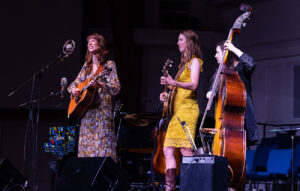
The Purple Hulls, a bluegrass gospel group from Kilgore featuring twins Katy Lou and Penny Lea Clark, performed at ETBU Hilltop University. (ETBU Photo)
About 200 senior adults participated in Hilltop University at East Texas Baptist University, an annual conference featuring worship, Bible teaching, fellowship and entertainment. Mike Lawson, pastor of First Baptist Church in Sherman, was the keynote speaker. The Purple Hulls, a bluegrass gospel group from Kilgore featuring twins Katy Lou and Penny Lea Clark, and Grammy Award-winning artist Sandi Patty provided music. Breakout session leaders included John Hatch, pastor of Forest Hill Baptist Church in Longview; Laurie Smith, dean of the ETBU School of Natural and Social Sciences; and Bil Barkley, minister of education and senior adults at First Baptist Church in Mount Pleasant. Don Parks, associate pastor and minister of music at Ebenezer Baptist Church in El Dorado, Ark., directed the conference choir.
The Dallas Baptist University women’s golf team won their second NCAA Division II National Championship.
The Dallas Baptist University women’s golf team won their second NCAA Division II National Championship. The Patriots defeated No. 3 Nova Southeastern in the final round of Medal Match play at the Fox Run Golf Club in Eureka, Mo. The team held off the four-time national champions, 3-2, to finish the 2022-23 season as the top team in the nation. “I just love walking in this journey with these girls and am just so happy for everyone involved,” said Head Coach Kenny Trapp. “It truly takes a village and players that buy in, and this group exemplifies everything on and off the course that it takes to be a champion.”
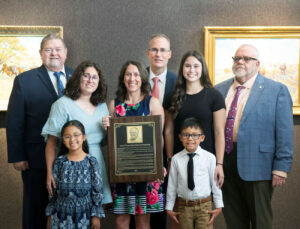
Bobby Hall (left), president of Wayland Baptist University, and Mike Davis (right) of Pampa, who established the JoAnn T. Jones Alaska Endowed Scholarship, are pictured with Christie Demetriades, daughter of the late honoree, and her family — Keith, Jordan, Peyton, Micah and Kegan. (Wayland Baptist University Photo)
Mike Davis of Pampa, who remembered the late JoAnn T. Jones as his teacher, school counselor and friend, established an endowed scholarship in her honor benefitting students attending the Alaska campuses of Wayland Baptist University in Anchorage and Fairbanks. Jones once lived in Fairbanks. The JoAnn T. Jones Alaska Endowed Scholarship is the 13th endowed scholarship Davis has established at Wayland.
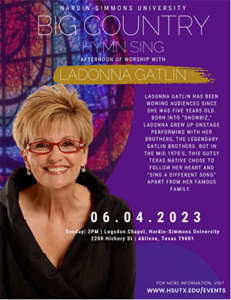
LaDonna Gatlin is the featured musical artist when Hardin-Simmons University hosts its Hymn Sing at 2 p.m. on June 4 in Logsdon Chapel. Gatlin, a West Texas native, grew up onstage with her siblings, the Gatlin Brothers. In the 1970s, she performed with the Blackwood Singers and with Dallas Holm and Praise.
Houston Christian University—in partnership with Verizon and the National Association for Community College Entrepreneurship—will offer a free project-based immersive science, technology, engineering and math program, Verizon Innovative Learning STEM Achievers, for middle school students starting June 5. The program aims to empower middle school students in under-resourced communities to explore science, technology, engineering and math; learn problem-solving skills; and gain exposure to career opportunities in technology fields. Participating students will receive mentorship, access to next-generation technology and hands-on training connected to real-world challenges. The initiative provides engaging programming where students can learn design thinking, 3D printing, augmented reality and social entrepreneurship. No prior knowledge or experience is required. The program begins with a four-week in-person session this summer June 5-30, and an in-person full-day workshop at HCU in the fall and in the spring.
East Texas Baptist University will host the NCAA Division III Softball National Championship June 1-7 at Jason Bell Park at Taylor Field.
East Texas Baptist University will host the NCAA Division III Softball National Championship June 1-7 at Jason Bell Park at Taylor Field. The tournament will feature eight teams from across the country vying for the championship title. “ETBU is honored to be chosen to host the NCAA Division III Softball National Championship,” said Ryan Erwin, vice president for student engagement and athletics. “We are excited to showcase our beautiful campus, state-of-the-art facilities, and the historic city of Marshall to universities and fan bases from across the country. In addition, we are thankful for our community partners from the East Texas region who have helped us bring the event to life.”
Richard Fountain, professor of piano at Wayland Baptist University since 2008, was named dean of Wayland’s School of Creative Arts, and Yahui Zhang, professor of communication and media studies since 2008, was named associate dean. Fountain, who has served as associate dean, succeeds Ann Stutes as the top administrator for the School of Creative Arts.
Anniversary
10 years for Thomas Estes as pastor of Cottonwood Baptist Church in Cross Plains.
100 years for Wylie Baptist Church in Abilene. Mike Harkrider is pastor.
TBM Builders roll into southern Utah for major project
May 31, 2023
PANGUITCH, Utah—Mountains skirt the horizon. A river rolls wide across the valley, out of its banks from the thawing winter snow. On the edge of town, a white steeple pokes toward the sky; it is not the tallest steeple in town.
Valley Christian Fellowship is a Baptist congregation that welcomes 30 to 40 worshippers each Sunday. It is the only evangelical church within an hour’s drive of Panguitch in southern Utah.
Texas Baptist Men Builders leaders rolled into Panguitch in late April to begin a months-long project of helping Valley Christian Fellowship build a parsonage, with Sunday school space in the basement. The church provides the materials. TBM Builders provide the labor.
Tammi Newsted, church clerk at Valley Christian Fellowship, points to the plans for a new parsonage TBM Builders are constructing. (Photo / Ferrell Foster)
Valley Fellowship has no pastor; they’ve been without for three years. The church has interviewed a number of potential pastors, said Tammi Newsted, church clerk, but each has responded similarly. “I looked, and there’s nothing to rent. Where am I going to live?” And they can’t afford to buy a house in the inflated housing market, she said.
Tourism has driven up housing costs. Panguitch is in the Grand Circle of National Parks, with Bryce Canyon, Zion and Grand Staircase all nearby, not to mention state parks and other recreational opportunities.
As with many smaller towns near popular travel destinations, the short-term rental market has led to homes being bought, renovated and rented for a few days at a time.
“The AirBNB market has taken over all of the homes out here,” said Newsted, referring to a popular vacation rental website.
The “people who live out here can’t even rent, let alone someone coming into the community. And we certainly can’t expect them to come in and buy a home,” she added.
Parsonage is ‘a foundational need’
Valley Fellowship’s previous pastor rented and “had to move three times I know of because people were selling the houses,” Newsted said. “That’s just not conducive to having someone who wants to be in the area.”
As a result, a “parsonage is a foundational need that we have in order to bring in a pastor,” she said.
Dan Maruyama is director of Henry’s Place, a Christian camp and retreat center for at-risk youth. (Photo / Ferrell Foster)
Dan Maruyama is director of Henry’s Place, a nearby Christian camp and retreat center for at-risk youth. He’s been helping Valley Fellowship by preaching and securing pulpit supply for the church since their pastor left. Tourism has created a housing challenge, Maruyama said, but it also has presented an opportunity.
“There’s a huge amount of summer tourism traffic that comes through here, and we regularly have people show up that are looking for something and they end up in this church, and they hear the gospel … and are encouraged in their walk,” he said. “It’s just a great opportunity for outreach.”
But the church needs a pastor.
Fortunately, the church bought a lot next to its sanctuary five years ago before housing prices rose and “there was no place to live,” Newsted said. “God knew we needed it; we didn’t know that” at the time,
Fellowship is committed to reaching people for Christ, and it is the only evangelical church within a 60-mile radius. It has a big task in a big area.
In the town of about 2,000 people, there is one Catholic church and three congregations of the Church of Jesus Christ of Latter-day Saints, or Mormons.
The large LDS population creates an opportunity, Maruyama said.
“The Mormon church is basically bleeding people and a lot of people are coming out of it,” Maruyama said. “And they tend to come out of the Mormon church and go into atheism because they’re disenchanted with religion.
“If you’ve got someone standing there and saying, ‘Don’t give it all up. God is real; you were just taught some stuff that wasn’t quite right. There is a real Jesus, and he really does love you.’ That’s a great opportunity, and folks need to hear that.”
Church with a Great Commission mindset
Valley Fellowship has an outward-focused, Great Commission mindset, Maruyama said. “I think what’s happening here is God is providing for this church to be able to function, to call a pastor, to have the impact it needs to have on this local community. The opportunity for impact here is huge.”
Church members have not given up, even without a pastor.
“We have been operating for three years with pulpit supply,” Newsted said. “Just the fact that the doors are still open when most churches would have to close the doors because they don’t have a pastor, God has his hand on this church.
“He has something so very special, because we have never had to close the doors. And we have always had the funds we need to pay the bills. We almost always have somebody to fill the pulpit, and, if we don’t, we do a music service.”
With that sense of purpose and God’s blessings, the church decided to pursue “parallel projects”—build a parsonage and seek a pastor.
The church discovered Texas Baptist Men through a “very long process,” Newsted said. “When we decided to build the parsonage we knew that we were going to have to have volunteers to do the labor part of it.”
Newsted searched for West Coast ministries that would do the project, but “building a parsonage is not on the list of what most ministries want to do,” she said. “If we were building a church, it would be no problem.”
‘So important that we want to be part of it’
Then she connected with TBM and received a different response.
“I was very grateful when Texas Baptist Men contacted me, and they said: ‘You know what, we’re going to make an exception for you. This isn’t what we normally do, but we can see that this is so important that we want to be part of it.’ And that was one of the greatest days. I was so happy. I think I was probably smiling for a week after that because I finally had a yes.”
Wayne Pritchard, TBM Builders leader, applies sealant to the edge of the parsonage basement. (Photo / Ferrell Foster)
Wayne Pritchard leads TBM Builders, which includes church, camp and cabinet builders. He has coordinated the TBM effort working with other leaders and task experts in the three groups. Pritchard, and his wife, Annette, were also among the first TBM Builders to arrive in Panguitch and will stay until the project is completed.
“When I was first contacted by Tammi, I was thrilled, because I had a vision from God that our Builders programs could take on a start-to-finish project utilizing all of our groups,” Pritchard said. “This project was presented at the perfect time as we are basically off during the summer, and this one needed to be done during that time,
“God provided everything we needed to come and serve him in such a mighty way,” Pritchard said. “This church is in an area that is wide open to reach lost souls, and I have no doubt that [God] has something big planned for them. Our entire Builders group that is participating shares the same feeling.”
Newsted said the Panguitch project has required the expertise contained in all three TBM Builders groups, and she communicated with the various leaders, with Pritchard coordinating.
“Everybody has been just fabulous in their support of this project and everything we need. It’s just been spot on; it’s been awesome.”
TBM Builders begin framing the parsonage of Valley Christian Fellowship. (Photo / Annette Pritchard)
Prior to the arrival of TBM Builders, the church arranged for the concrete work to begin. The TBM volunteers then arrived and sealed the basement, installed floor joists and decking, constructed exterior and interior walls, hoisted the roof trusses into place, provided plumbing and electrical systems, roofed, hung sheetrock, built cabinets, and provided all of the finishing touches. They started May 1 and expect to finish in July.
“One of the best things about this is that I am grateful that there are still Christians out there that are willing to give of themselves, not just financially, but they’re willing to give of their time, willing to travel 1,400 miles across the U.S. to come out here not knowing really what to expect,” Newsted said.
“That has been amazing; it’s been awesome. And I’m really enjoying working with the team, and I’m really excited.”
‘God is doing something’
Maruyama preached at Valley Fellowship the day before TBM began its work on the parsonage. He spoke from the Old Testament book of Ezra about rebuilding the Jerusalem temple, and he saw a parallel in the two building projects—Jerusalem and Panguitch.
In Ezra, God is doing “what it takes to build whatever is necessary to make ministry possible,” Maruyama said.
“The building of the temple is what reestablishes the cultural milieu that makes it possible for Christ to show up and be recognized as the Savior,” Maruyama said.
“That’s much bigger than what’s happening here, obviously, but I think what’s happening here is God is providing for this church to be able to function, to call a pastor, to have the impact it needs to have on this local community. The opportunity for impact here is huge.”
God is blessing the Panguitch congregation, Maruyama said.
“When I see all of the massive amounts of support … and funding that goes way beyond the capabilities of this small church. I can’t conclude anything other than that God’s doing something, and that’s super exciting. I don’t know what God’s going to do with it, but he’s doing something, and it’s awesome to be a part of it.”
How Jemar Tisby became a symbol of ‘wokeness’
May 31, 2023
WASHINGTON (RNS)—Over the past decade, Jemar Tisby’s life has largely been shaped by two forces: the Bible, and the deaths of young Black men, often at the hands of law enforcement.
About a decade ago, Tisby, then a seminary student in Jackson, Miss., helped start a new group called the Reformed African American Network—an offshoot of the “Young, Restless, and Reformed” movement that had spread like wildfire among evangelical Christians in the first decade of the 21st century.
The group hoped to write about racial reconciliation from the viewpoint of Reformed theology, the ideas most closely associated with the ideas of John Calvin and popularized at the time by preachers and authors such as John Piper. But amid this resurgence of Reformed thought, there were few resources to be had on race issues.
Then, in 2012 in Florida, Trayvon Martin, a Black teen, was killed by the neighborhood watch coordinator of a gated community. All of a sudden, people in the movement were listening.
At the time, Tisby said in an interview, he and others raised their hands and said they had something to offer. The mostly white leaders of the Reformed movement, he said, welcomed them.
“I believed them,” he said. “I thought: ‘We are here. They must want us here.’”
Over the next few years, Tisby, a former pastor turned history professor, became a leading voice on race among evangelicals through his writing and as co-host of “Pass the Mic,” a popular podcast.
Jemar Tisby spoke on “How to Fight Racism” at the invitation of the Baylor Institute for Studies of Religion in 2019. (Photo/ Ken Camp)
He wrote op-eds on race and faith for The Washington Post and published the bestselling The Color of Compromise, which details the long history of racism in American Christianity.
How to Fight Racism, a 2021 follow-up, was named Faith and Culture Book of the Year by the Evangelical Christian Publishers Association.
Conservative concern about ‘wokeness’
But Tisby’s success has since collided with conservative concerns about “wokeness”—a byword that encapsulates liberal critiques of systemic racism, America’s racial history and other social justice themes.
In recent months two college English professors at Christian colleges—one in Florida, the other in Indiana—have been dismissed for allegedly talking too much about race in their classes.
In both cases, critics pointed to the appearance of Tisby’s work on class syllabuses to claim the professors were undermining their students’ Christian faith.
“I’ve become, for the far right, a symbol of everything that’s wrong with how people who they call the left are approaching race,” Tisby told Religion News Service.
The “woke war” playing out in school boards, on college campuses and in church pews has been driven by activists like Christopher Rufo and by conservative evangelical authors and preachers who warn that wokeness and academic notions such as critical race theory are heresy.
As a result, evangelical pastors who were once outspoken about the need to confront racism have gone silent, or in some cases, been driven from the movement altogether.
Black exodus from evangelical world
Some black Christians—including Tisby and his colleagues at the Witness, as the former Reformed African American Network is now known, have left the evangelical world, sometimes quietly and other times loudly.
Some, like Tisby, have found it harder to leave—finding their ties to the evangelical world difficult to unwind even when they are told they are not wanted. Last year, the board of Grove City College, a Christian school in Pennsylvania, apologized for a 2020 sermon Tisby gave at a campus chapel session after an online petition accused him of promoting critical race theory.
White evangelical institutions have recognized a need in recent years to become more diverse in order to prosper as the country’s demographics change. But their donors often bridle as schools and churches change, causing a backlash that drives away people of color.
Anthea Butler, religious studies professor at the University of Pennsylvania and author of White Evangelical Racism, a 2021 book about the racial divides of the evangelical movement, said evangelicals have a long history of welcoming Christians of color into their movement and then ousting them if they ask too many questions about race.
She said college leaders, like those behind the report at Grove City, or other Christian leaders who have denounced Tisby want to make an example of him as a warning to others.
“They want to punish him,” she said.
Tisby deeply immersed in evangelicalism
A native of Waukegan, Ill., Tisby found Christianity while in high school when a friend invited him to a church youth group meeting. Attending the University of Notre Dame, he began to think about a call to ministry.
In South Bend he also discovered Calvinist theology after a friend sent him a copy of Piper’s 1986 book Desiring God.
After graduating in 2002 and a year working for Notre Dame’s campus ministries, he joined Teach for America and was sent to teach sixth graders in impoverished Phillips County, Ark., in the Mississippi Delta.
The experience changed the direction of his life.
“This is cotton country—the land of slavery and sharecropping,” Tisby said. “You can see it in the landscape. You can see it in the generational poverty.”
The predominantly Black community was marked by a lack of jobs, poor medical care, food deserts and a struggling school system.
“The thing that struck me was that there are churches on every corner,” Tisby said. “Not only were they racially divided, it also didn’t seem like they were having much impact in the community. That’s where I started thinking about the relationship between faith and justice.”
After four years at the school, he took a year off to study at Reformed Theological Seminary in Orlando, Fla., before returning, this time as a principal.
“I just felt God wasn’t done with me in the Delta,” he said.
He finished his divinity degree at a seminary in Jackson, Miss., working part time in the school’s admissions office. He was charged with helping recruit Black students and helped to start an African American leadership initiative.
Pushback both familiar and surprising
Afterward, he enrolled at the University of Mississippi and earned a doctorate in history. He is now a professor at Simmons College of Kentucky, a historically Black school in Louisville.
The recent pushback against his work, he said, seems both familiar and surprising. As a historian, Tisby has traced the ways American Christians have tried to claim that the faith is colorblind. The love of Jesus, they maintain, should break down divides between people of different ethnicities.
But rarely, Tisby said, do Christians manage to overcome racial differences. In The Color of Compromise, Tisby recounts how English settlers in Virginia faced a dilemma. In their homeland, Tisby writes, the custom was to free slaves who converted to Christianity. In 1667, the Virginia General Assembly decided that, no matter what the Christian faith taught, baptism would not make slaves free.
Tisby recounted some of that history in his 2020 chapel sermon at Grove City College. He had first been invited to speak in 2019 but his visit had been delayed by scheduling conflicts and complications of the COVID-19 pandemic.
School leaders later said they had invited him as a Christian writer who could help the school’s students grapple with racial reconciliation. Tisby, who had spent years in white evangelical spaces, felt he had a message the students there could hear.
“What I picked up on was, we’re willing to give you a hearing, but this is not what we typically do,” he said.
A year later a group of alumni and parents from Grove City launched a petition, claiming the school had been overrun by “wokeness” and critical race theory.
The petition cited Tisby’s speech as a sign the school had lost its way, but school leaders claimed it was Tisby who had changed course.
“The Jemar Tisby that we thought we invited in 2019 is not the Jemar Tisby that we heard in 2020 or that we now read about,” they told a board committee.
Early signs of looming division
Tisby traces white evangelicals’ suspicions of their Black counterparts to the 2014 protests in Ferguson, Mo., that followed the shooting death of Michael Brown. The protests, which brought the Black Lives Matter movement to national attention, drove a wedge between Black and white Christians, he wrote in a 2019 Washington Post op-ed.
The split gained momentum in 2018 with a gathering in Memphis, Tenn., to commemorate the 50th anniversary of the death of Martin Luther King Jr.
Sponsored by the Ethics and Religious Liberty Commission of the Southern Baptist Convention and the Gospel Coalition, a prominent Reformed evangelical group, the event featured a host of prominent leaders, including Piper, Texas megachurch pastor Matt Chandler, Baptist pastor Charlie Dates, legendary Black pastor and community organizer John Perkins and Russell Moore, then president of ERLC.
These preachers urged attendees to address the scourge of racism that stained the life of the church. Moore told attendees that enduring racism was leading younger Christians to question their faith.
“Why is it the case that we have, in church after church after church, young evangelical Christians who are having a crisis of faith?” said Moore, who has since left the SBC and is editor-in-chief of Christianity Today. “It is because they are wondering if we really believe what we preach and teach and sing all the time?”
That same week, an association of Southern Baptists in Georgia kicked a church out for racist actions against another SBC church. The Georgia Baptist Convention followed suit, as did the national Southern Baptist Convention annual meeting.
Opposition to CRT as a rallying cry
But in April of 2018, Tom Ascol, an extremely conservative Southern Baptist pastor from Florida, criticized Thabiti Anyabwile, a well-known pastor in Washington, D.C., for writing about the sin of racism. Ascol, who would later run for SBC president largely on his opposition to critical race theory, produced a documentary about what he called liberal drift in the denomination.
The pushback had begun. By that fall, a group of conservative pastors, many of them Calvinists, signed “The Statement on Social Justice & the Gospel,” which responded to “questionable sociological, psychological, and political theories presently permeating our culture and making inroads into Christ’s church.”
In 2019, a resolution passed by the Southern Baptist Convention called critical race theory a “tool” to understand society and led to calls for the convention to denounce the resolution.
Those Southern Baptist debates over critical race theory long preceded debates in the general public.
Ryan Burge, a political scientist, noted that Google searches for the term critical race theory or CRT were nearly nonexistent when Baptists started debating it. Only later did the debate spill out into the mainstream to be used by politicians, including Donald Trump, to rally supporters. It has since been equated with Marxism and other ideas anathema to conservatives.
Lerone Martin, associate professor of religious studies and director of the Martin Luther King Jr. Research and Education Institute at Stanford University, said that evangelicals have long found it easier to label Black leaders as leftists or Marxists rather than to deal with the reality of racism.
“That way, anything they dislike or oppose can be dismissed wholesale,” he said.
Tisby said he’s not an apologist for CRT or any ideology. He reads the Bible and history and tries to tell the truth, he said in an interview. That is his job as a Christian and as a historian. And he doesn’t think he’s all that special.
“I don’t think there’s anything in particular about my approach that is novel or different than what a lot of people have said for a long time.”
Chair of NC Baptist Children’s Homes resigns after arrest
May 31, 2023
WASHINGTON (RNS)—A Baptist leader in North Carolina resigned last week after he and his wife were charged with three counts of felony animal cruelty and a misdemeanor offense of communicating threats.
James David “Jim” Goldston III, 71, and his wife, Agnes, 73, are accused of poisoning their neighbor’s three dogs. Two of the dogs, Labrador retrievers, died. A veterinarian confirmed all three dogs were poisoned, according to the Wake County Sheriff’s Office.
Goldston had been chairman of the board of trustees for the Baptist Children’s Homes of North Carolina, a faith-based nonprofit. He also was a board member of an animal rescue organization.
The Goldstons also are accused of threatening their neighbor. A handwritten letter tossed into their neighbor’s yard read “Your Daughter is Next. B Careful,” arrest warrants obtained by The News & Observer newspaper showed.
Goldston had served on and off the board of the Baptist Children’s Home of North Carolina since 1990, a spokesperson for the Baptist State Convention said. He resigned as chair on May 21.
In a statement, Goldston said that he and his wife had been falsely accused.
“After more than 35 years of involvement with Baptist Children’s Homes of NC, and personally investing and helping raise millions of dollars to further this great ministry, I sadly hereby resign as a BCH Trustee,” Goldston wrote in a statement to the Biblical Recorder, the Baptist State Convention media site.
“My wife and I have been falsely accused of some horrible acts and I do not want this to be a distraction or hindrance to the work done on behalf of BCH as the truth plays out within the justice system.”
The Christian children’s home, which is affiliated with the Baptist State Convention of North Carolina, operates group homes for children as well as a foster and adoption ministry.
The Goldstons attended Bay Leaf Baptist Church in Raleigh. The couple runs a family foundation that contributed $40,000 in 2019 to various Baptist churches, as well as Southeastern Baptist Theological Seminary.
The foundation’s biggest charitable gift—$10,000—was to Saving Grace Animals for Adoption in Wake Forest, N.C. The Goldston’s daughter, Molly, is the founder and owner of Saving Grace.
James Goldston also served on the animal rescue’s board since at least 2017 but has since resigned, The News & Observer reported.
The Goldstons each posted a $30,000 bond.
The couple was allegedly having a dispute with their neighbor, Philip Ridley, according to local news reporters. One of those letters, shared with WRAL News, read, “If one or both of these dogs put their paws on my property I am going to blow their brains out.”
Southwestern Baptist Theological Seminary trustees voiced support for board leadership and castigated two trustees who had called for greater transparency and questioned leaders’ integrity.
In fact, a board-approved motion called on seminary trustee officers to “conduct an investigation of possible misconduct” by those two board members and report back to the full board within 60 days.
At nearly 9 p.m. on May 30, the seminary’s communication’s office issued a public statement from board Chair Danny Roberts, executive pastor of Cross Church, formerly North Richland Hills Baptist Church in suburban Fort Worth.
The statement followed a virtual called meeting of the board in executive session. Trustees Aaron Sligar, pastor of Living River Chapel in Sutton, W. Va., and Andrew Bunnell, a member of Prince Avenue Baptist Church in Bogart, Ga., had called for the meeting, Roberts stated.
Audited financials for 2003-2022 to be published
In his statement, Roberts noted the Zoom meeting was convened “even though the vote for a meeting was well short of the required 21 positive votes.” However, Roberts said, he called the meeting at the request of seminary President David Dockery.
“Sligar and Bunnell stated their case. Each of the matters they presented was discussed and evidence or lack thereof was vetted,” Roberts stated.
“A task force presented its findings, and two staff members whose personal morality was egregiously and baselessly questioned were able to speak and share about the harm that has resulted.”
Roberts stated the board “overwhelmingly” approved a motion to “authorize the officers to publish the audited financials as one comprehensive report for the fiscal years 2003-2022 and examples of presidential expenses as generated by the Task Force review.”
Paige Patterson was president of Southwestern Seminary from 2003 until the board fired him in 2018. Adam Greenway was president from February 2019 until last September, when he resigned under pressure from the board.
Roberts has made repeated comments calling into question Greenway’s leadership and financial oversight of the seminary, but he has offered no specific information. Greenway has asked the board to make public its review of his alleged financial mismanagement.
“I look forward to the seminary fulfilling its promise of transparency to Southern Baptists by releasing the full trustee investigative report, including all related findings, without edit or redaction,” Greenway told the Baptist Standard in April.
Alleged ‘out-of-control spending’ and impropriety
Last week, a copy of a letter to Roberts calling for a special trustee meeting—with the names of the writers redacted—was leaked to several media outlets by an anonymous source from an unfamiliar email address.
The letter calling for the special board meeting stated Sligar produced “a detailed written report” for the board regarding an investigation into financial mismanagement, but the board’s executive committee asked him not to present the full report to the board. Instead, they asked him to present an oral overview of his findings at the board’s April meeting.
A copy of a document labeled the “floor report” Sligar presented as an oral report to the full board also was leaked last week. That document accused Greenway “and others” of demonstrating “a freedom in the finances of the Seminary” and “out-of-control spending.” It stated Greenway’s “closest staff failed to approach him regarding finances.”
The “floor report” document stated the account for renovations of the president’s home was “used as a bucket to throw fixed asset additions into, not just by Dr. Greenway, but others as well.” It noted $12 million spent on a variety of renovation projects.
The document also pointed to alleged credit card fraud and possible donor designation changes, as well as recommendations for financial policy changes.
The Baptist Standard offered Greenway an opportunity to respond, but he declined to comment at this time.
When the Standard contacted Sligar last week, he said the “floor report” was “a working document” that “was never intended for the press or public.”
The letter calling for a special meeting raised questions about Future Fort Worth, a nonprofit development corporation, and its connection to a seminary administrator. Colby Adams, vice president for institutional administration at the seminary, is the corporation’s registered agent. Other directors are Fort Worth real estate developers David Motheral Jr. and John Freese. The letter stated Adams failed to disclose the business relationship to the board of trustees.
Board offers ‘support and complete confidence’
Roberts stated the board unanimously approved the following motion at its May 30 called meeting: “I move that the Board of Trustees affirms the work of the officers, executive committee, and task force empaneled to examine spending and financial practices of the previous administration as authorized by unanimous vote of the Board during its October 2022 meeting.
“That the Board further affirms the ongoing work to strengthen financial guardrails recommended by the task force to ensure greater accountability and oversight of the president and other senior administrators.
“That the Board unambiguously expresses its support and complete confidence in Michele Smith and Colby Adams and finds the allegations contained in the email from Trustees Andrew Bunnell and Aaron Sligar of financial mismanagement and misbehavior amongst those individuals to be without merit.
“Finally, that the board unreservedly repudiates as unsubstantiated and egregious other rumors trafficked by Trustees Andrew Bunnell and Aaron Sligar made against employees of the Seminary.”
Michele Smith is associate vice president for finance at Southwestern Seminary. Before Adams served as vice president for institutional administration, he was Greenway’s chief of staff.
According to the statement from Roberts, the board “overwhelmingly” approved motions authorizing “the publication of a response to allegations made” by Sligar and Bunnell, as well as asking board officers to investigate “possible misconduct” by the two trustees.
Sligar did not respond to a request for comment from the Baptist Standard, and the Standard was unable to reach Bunnell.
‘Repudiation of allegations’
Roberts expressed gratitude for “the near-total support of the trustee board” and said he wanted to “state publicly and without equivocation my personal repudiation of the allegations made against my colleagues and me, as well as against staff members of the seminary.”
“I can state confidently that the board leadership has exercised aggressively its fiduciary duties, with trustees giving collectively thousands of hours of their time in doing so. Financial guardrails have been and continue to be researched and put in place. One example is that the chairman is now examining the expense reports of the president and the Seminary Leadership Team on a quarterly basis,” Roberts stated.
Roberts insisted “the growing involvement of trustee leadership and our insistence of greater presidential accountability and resistance to our attempts to implement financial safeguards that led to Adam Greenway’s resignation.”
He confirmed the task force created to examine institutional expenditures made “oral reports to the full board in executive session.”
“Board leadership asked Sligar to not raise certain matters that he failed to give proper notice of his intent to raise, some of which were clearly untrue, with others having been inadequately researched, baseless and/or egregiously harmful,” Roberts stated.
“On May 20, Sligar and Bunnell emailed these claims, with the unsubstantiated material becoming public several days later by individuals obviously motivated to bring harm on the institution, the board, and certain staff. To send such an email was reckless, since it was inevitable that such claims would become public. In today’s meeting, the board heard all the facts and has now acted.
“I condemn in the strongest possible manner the actions of any individual who has participated in spreading these baseless allegations. Such behavior is ungodly and is contrary to the spirit of Southwestern Seminary.
“Even as they have had to endure these odious attacks, staff have served the seminary faithfully, carrying out their duties with competence and integrity. I am grateful for them, and for their families, as they have remained committed to the mission of Southwestern Seminary.”
CLC says gun violence contrasts with pro-life culture
May 31, 2023
Prior to the start of National Gun Violence Awareness Month in June, Texas Baptists’ Christian Life Commission issued a statement saying it “looks forward to working with our elected legislators on common-sense legislation that curbs gun violence.”
Pastor Paul Kim raises a question during the BGCT Executive Board meeting, held via Zoom. (Screen capture image)
The CLC staff released the public statement May 25, two days after Pastor Paul Kim, pastor of Forest Community Church in Dallas, addressed a virtual meeting of the BGCT Executive Board.
Kim noted a mass shooting at an outlet mall in Allen claimed the lives of three members of the Cho family, who were part of New Song Church in Carrollton.
In light of the attack, Kim said, members of his congregation and some other Asian American congregations wanted to know, “Can we as Texas Baptists make a statement about gun violence?”
‘Tragic reality of gun violence’
The statement from the CLC staff acknowledged the reality of gun violence and its effect both on Texans as a whole and on Texas Baptists in particular.
“We are soberly aware of how present and tragic the reality of gun violence is within our state and within our Texas Baptists family. From our schools to public malls and even inside the walls of our churches, the Texas Baptists’ family has been impacted by and victim to gun violence,” the CLC statement reads.
“The tragic reality of gun violence in Texas starkly contrasts the prolife culture we profess and celebrate. We deeply grieve with Texas Baptists churches that have lost family members, church members, loved ones, and treasured neighbors due to gun violence. At the same time, we steady our minds on the hope found in Christ Jesus, who keeps us in perfect peace.”
A dramatic increase both in gun-related suicides and murders “demonstrates the severity of this crisis,” the CLC statement reads.
“The CLC looks forward to working with our elected legislators on common-sense legislation that curbs gun violence and commits to praying with our Texas Baptists family toward that end,” the statement concludes.
The CLC statement did not offer any indication about what constitutes “common-sense legislation.”
In the 88th Texas Legislature, a few days after the Allen mall shooting, the House Select Committee on Community Safety voted 8-5 to advance a bill to raise the age limit for purchasing semi-automatic weapons from 18 to 21. However, HB 2744—promoted by victims of the 2022 Robb Elementary School shooting in Uvalde—never was considered by the full House.
Seeking support, DeSantis casts himself as spiritual warrior
May 31, 2023
WASHINGTON (RNS)—Florida Gov. Ron DeSantis strode onstage in Orlando and stood before a podium, silhouetted against a giant American flag.
The crowd, attendees at a gathering of the National Religious Broadcasters, a Christian group, leapt to their feet. Some applauded, while others held up cell phones to record the moment.
DeSantis began with a line he uses often—“Welcome to the free state of Florida!”—before launching into a stump speech recounting his proudest accomplishments as governor, such as removing books from public libraries and “waging a war on woke.”
In a nod to his audience, he sprinkled his remarks with religious references, lauding churches that refused to close during the pandemic and encouraging listeners to “put on the full armor of God.”
As he closed, DeSantis gripped the podium and leaned forward.
“We’re proud of what we’ve accomplished in Florida, but I can tell you this: I have only begun to fight,” he said.
Technically, it wasn’t a presidential campaign announcement. That happened two days later, when DeSantis joined Elon Musk for a glitch-ridden appearance on Twitter Spaces. But it was telling that DeSantis, a Catholic, chose to speak to a largely evangelical Christian audience the same week he launched his White House bid.
Gov. Ron DeSantis appears in a controversial ad titled “God Made a Fighter.” (Video Screen Grab)
With growing uncertainty surrounding evangelical support for former President Donald Trump, DeSantis is courting one of the Republican Party’s most sought-after constituencies using a message that frames himself as a sort of spiritual warrior—a move that may attract faith leaders who traffic in similar rhetoric.
DeSantis beta-tested this approach in November, when the governor’s wife, Casey, tweeted out an advertisement that framed him as a “fighter.” The ad featured images of DeSantis and his family while a narrator—who, observers noted, had the feel of a mid-20th-century Protestant preacher—declared: “On the eighth day, God looked down on his planned paradise and said, ‘I need a protector.’ So God made a fighter.”
No formal outreach effort yet
Nothing similar has been produced by DeSantis’ fledgling presidential campaign, which, only a few days old, does not appear to have launched a robust faith outreach effort as of yet. His team also has not assembled a list of religious advisers or endorsers, nor is there a sizable outside effort to drum up support among conservative Christians, such as the “Pastors for Trump” group that formed around the same time the former president announced his 2024 bid.
But as the primary season begins in earnest, DeSantis may lean on an emerging group of culture-warrior religious leaders and influencers who, while not yet endorsing him, have shown affinity for his approach to politics in the past.
Tom Ascot is president of Founders Ministries, a neo-Calvinist group in Southern Baptist life. (Screen capture)
Among the governor’s more vocal religious fans is Tom Ascol, a firebrand, media-savvy figure known for leading the most conservative wing of the Southern Baptist Convention.
In November, Ascol tweeted out footage of himself leading a prayer at a DeSantis event alongside the caption “God has blessed the state of Florida by placing him in this office as His servant for our good.”
Ascol, who pastors a church in Florida, later wrote about the prayer on his blog. He again heaped praise on DeSantis, saying he stands “against the woke crowd and the intimidation and overreach of various federal officials over the last 4 years.”
He publicly lauded DeSantis again in February, tweeting out a video of him standing in front of a podium with a placard that read “Government of laws, not woke politics.”
“We need more governmental leaders like” the Florida governor, Ascol tweeted.
The two men share a similar disdain for what they deem to be “woke.” Ascol, head of Founders Ministries, has pushed back on what he sees as liberal ideologies in the SBC, and when he launched an unsuccessful bid to become the denomination’s president last year, his supporters issued a statement in which they declared “God is not Woke.”
Religion News Service reached out to Ascol to see if he intends to formally endorse DeSantis but did not immediately receive a reply.
Voices of support and concern
Other Christian leaders, who are widely seen as conservative crusaders, have also expressed support for DeSantis’ actions as governor. Bishop Joseph Strickland, a favorite among right-wing Catholics who has railed against COVID vaccines and been personally chastised by Vatican officials, has tweeted praise for DeSantis on multiple occasions, such as when the governor signed into law a ban on instruction having to do with gender identity and sexual orientation from kindergarten through third grade.
More recently, Strickland, who oversees a diocese in East Texas, celebrated DeSantis for pushing back on pandemic restrictions such as vaccine requirements at public schools, saying, “I pray (Texas) Governor Abbott and other good governors will follow your lead.”
Not that DeSantis’ style hasn’t run afoul of some conservative-leaning faith leaders. When Florida lawmakers passed a law earlier this year making it easier to sentence someone to death—a practice condemned by the catechism of the Catholic Church—the Florida Conference of Catholic Bishops urged lawmakers and the governor to oppose it. DeSantis signed the bill into law anyway.
His immigration policies also have raised the ire of many Latino faith leaders in his home state.
It’s unclear whether DeSantis can convince evangelical surrogates to cross the rubicon between unofficial supporter to formal endorser the way Trump did in previous campaigns.
Some won’t endorse anyone in GOP primary
That may prove difficult this go-round for both men: Dallas Pastor Robert Jeffress, an evangelical leader who has long supported Trump, told Religion News Service in November he doesn’t intend to throw his support behind anyone during the Republican primary.
But other evangelical leaders have simply held back on an official endorsement, leaving open the possibility of backing DeSantis.
Samuel Rodriguez, head of the National Hispanic Christian Leadership Conference and longtime Trump adviser, told RNS on Friday he is “not endorsing yet,” although he is willing to serve as an adviser to candidates “to advance an agenda of life, religious liberty, and biblical justice for all.”
Rodriguez has praised DeSantis but also been critical of some policies. In May, Rodriguez urged the governor to oppose an immigration bill that invalidates driver’s licenses issued to undocumented immigrants in other states.
Meanwhile, evangelist Franklin Graham, who has vocally backed Trump for years, also said he plans to avoid endorsing any candidate during the primary season.
However, Graham paused for a brief photo-op with DeSantis ahead of the governor’s appearance at the NRB conference earlier this week. He later tweeted out commendations that framed DeSantis as a fighter.
“I appreciate the Governor’s clear voice and that he takes a stand against the evil that is trying to overtake our culture,” Graham tweeted.
Legislature ends but governor calls special session
May 31, 2023
The 88th Texas Legislature concluded May 29, but lawmakers almost immediately began the first in what likely will be a series of special sessions called by Gov. Greg Abbott.
“It’s too early to take any victory laps,” said John Litzler, public policy director for Texas Baptists’ Christian Life Commission. “But overall, we feel good about the session.”
Multiple bills still await the governor’s signature, and a veto of some could be possible, he noted. More likely, some legislation—particularly concerning public education and private school vouchers—could be the subject of a later special session.
The first special session is devoted specifically to property tax relief and border security. However, Abbott had indicated he will call additional special sessions. At the beginning of the regular session, he made “school choice” legislation—specifically a voucher-style education savings account program—an “emergency item.”
Public education
During the regular legislative session, the Texas House of Representatives held the line against private school vouchers. However, pay raises for public school teachers became a casualty of an ill-fated attempt to pass educational savings accounts.
Litzler said he remains “cautiously optimistic” lawmakers will find a way to fulfill their constitutional duty to provide funding for public education—including pay raises for schoolteachers—separate from any problematic education savings account proposal.
Charles Foster Johnson, founding executive director of Pastors for Texas Children, likewise expressed faith in rural Republicans and urban Democrats who remain committed to public education—and expressed deep disappointment in the governor.
At the grassroots, Texans understand “vouchers are fundamentally unjust and inequitable,” Johnson said.
“It is wrong for public tax dollars to be diverted to subsidize the private education of affluent children. To pay for religious education is an especially egregious violation of both the public trust and of God’s moral law of religious freedom,” he said.
Abbott has “tied up the entire legislature this session” to advance a national political agenda that lacks support at the local level in Texas, Johnson asserted.
“Sadly, his stated intention is to continue calling special legislative sessions until he bullies the House into submission,” he said. “There is only one way to death with a bully—a firm, patient, courageous confrontation. Precisely what our morally oak-strong caucus of pro-public education rural Republicans and urban Democratic House members can provide.”
In spite of some setbacks in public education, Litzler pointed to apparent victories in the areas of religious liberty, pro-life legislation and opposition to predatory financial practices.
Religious liberty
The CLC supported three bills related to religious holidays that passed both the House and Senate and now are on the governor’s desk.
HB 608 allows the sale of fireworks before and during Diwali, a traditional part of the “festival of lights” observed by many Hindus, Jains and Sikhs from India. HB 1212 allows a parent to verify an excused absence for a student to observe a religious holy day. HB 1883 prohibits testing on religious holy days.
The House successfully killed two Senate-approved bills opposed by organizations that support separation of church and state. SB 1396 would have created a period of prayer and Bible reading—later amended to allow for the reading of any sacred texts—in public schools.
SB 1515 would have mandated the prominent display of a Protestant version of the Ten Commandments in every public school classroom. The bill prescribed the exact wording of the Ten Commandments—an abbreviated version of Exodus 20:2-17 from the King James Version of the Bible. Jews, Catholics and Protestants number the commandments differently, and their wording varies.
“Stopping Texas from forcing public school classrooms to display the Ten Commandments is a victory for religious freedom,” Amanda Tyler, executive director of the Baptist Joint Committee for Religious Liberty, tweeted on May 24.
With mixed results, the CLC worked to try to improve SB 763, a bill with strong Senate support that allows school districts to employ chaplains.
As originally introduced, the bill would have permitted districts to hire chaplains in place of trained and certified school counselors, but that language was changed to make it clear the employment of chaplains was in addition to licensed school counselors.
The CLC also supported a House amendment defining chaplains as individuals endorsed by an endorsing body recognized by the U.S. Department of Defense, the Federal Bureau of Prisons or the Texas Department of Criminal Justice. The House also amended the bill to prohibit registered sex offenders from serving as chaplains and called for background checks.
However, the Senate ultimately stripped the amendment requiring endorsements by recognized bodies—along with the other amendments—before passing the bill and sending it to the governor.
Litzler noted both the Ten Commandments bill and the legislation creating a designated time of prayer and the reading of religious texts had the strong support of Lt. Gov. Dan Patrick, and they likely could return in a special session focused on public education.
Pro-life legislation
HB 12, which extends Medicaid for eligible women from two months to 12 months after pregnancy, passed by the House and Senate and was sent to the governor and awaits his approval.
SB 24 codifies what previously was identified in the state budget as “Alternatives to Abortion,” renaming it the “Thriving Texas Family Program” within the Department of Health and Human services. It stipulates the program provides a continuum of care, both prenatal and postpartum. The bill passed both the House and Senate and is on the governor’s desk, awaiting his signature.
SB 24 provides paid parental leave for state employees upon the birth or adoption of a child, SB 2158 creates a pilot program for adult high school education in prison, and HB 1743 allows inmates to apply for SNAP benefits early so they are available immediately upon release from prison. All three bills passed in the legislature and are on the governor’s desk.
SB 838, which requires panic alert devices in all public school and charter school classrooms, passed in the legislature and has been signed into law by Gov. Abbott.
HB 300, which would have provided a sales tax exemption for diapers, maternity clothes and certain feminine hygiene products, passed the House but not the Senate.
HB 381 and HB 7272, which would have barred capital punishment for individuals with severe intellectual disability and for individuals with severe mental illness, likewise passed the House but not the Senate.
Predatory financial practices
The Texas Senate stood firm in opposition to major expansion of legalized gambling in Texas.
HB 1942 and HJR 102 would have allowed online sports wagering. The measures passed the House but not the Senate.
SB 1820, which prohibits the sale of lottery tickets by phone, passed the Senate but not the House, but the provision was successfully attached as a rider to the state budget.
HB 2842 and HJR 155, which would have called for a constitutional amendment to allow casinos in Texas, died by procedural action.
HB 1759 would allow professional sports teams to sell charitable raffle tickets online. The bill passed, but it was amended to limit its scope. Originally, it would have permitted individuals within one mile of a professional sports venue to purchase raffle tickets by phone. The bill was amended to restrict the sale of cash raffle tickets to individuals present at a sporting event.
HB 2127 places significant limits on any city and county regulations that go further than state law. However, it exempts the existing local restrictions on payday lending adopted by 49 Texas cities. The bill passed the legislature and awaits the governor’s signature.
Other legislative matters
Litzler also noted an item outside the CLC legislative agenda he was glad to see pass. HB 53 expands the exemption from emergency vehicle registration to include nonprofit disaster relief organizations, such as Texas Baptist Men. After being approved by the legislature, the bill is now on the governor’s desk.
As lawmakers deal with the called special session on property tax relief and border security, as well as future items in additional special sessions, the Texas Senate faces an additional task—conducting a historic impeachment trial this summer.
The state House of Representatives voted 121-23 to impeach Attorney General Ken Paxton after a House committee filed 20 articles of impeachment against him including bribery, obstruction of justice and dereliction of duty.
The program began in 2019 to reach children in rural, frontier and tribal regions who often are underserved in the Summer Food Service Program.
Children participating in the Meals-to-You program receive shelf-stable meals delivered directly to their home addresses throughout the summer while school is out of session.
Jeremy Everett
Jeremy Everett, executive director of the Baylor Collaborative, said Meals-to-You has revolutionized how the United States operates summer child nutrition programs.
“Before 2019, the only summer option for children to receive free, publicly funded meals was through the USDA Summer Food Service Program requiring children to eat on site at a congregate setting,” he said.
While the Summer Food Service Program is “an excellent tool that has proven extremely effective at strengthening food security, it has limitations in regions without a high concentration of children in one place,” he noted.
Program guidelines for the Summer Food Service Program historically included a congregate requirement, meaning meals are provided to children who eat at a single, centralized location such as a summer camp or school cafeteria. Unfortunately, these aren’t always available to children in more remote areas.
In 2019, more than 32,000 boxes of food were delivered to students in selected rural counties throughout Texas who participated in the Meals-to-You pilot program, spearheaded by the Texas Hunger Initiative at Baylor University, now part of the Baylor Collaborative on Hunger and Poverty. That approach was used as part of a national effort to serve rural children in schools that have been closed in response to the spread of COVID-19. (Photo / Ken Camp)
Meals-to-You began in 2019, serving 20 East Texas and West Texas counties, to test whether meal delivery could be a successful alternative in areas with limited access to the Summer Food Service Program.
In March 2020, as schools shut down due to the COVID-19 pandemic, the Baylor Collaborative was asked to scale up the program rapidly to include 43 states and Puerto Rico in what was known as Emergency Meals-to-You.
Throughout each version of the program, the Baylor Collaborative has worked with vendors such as McLane Global, Chartwells, and PepsiCo to assemble boxes of meals that follow USDA nutrition guidelines for child meal programs.
An evaluation of Meals-to-You by the Urban Institute found the program successful in strengthening food security among participants.
The program’s success and other lessons learned during the pandemic have expanded the options for children to receive healthy meals during the summer months.
The Consolidated Appropriations Act of 2023 made noncongregate and summer meal delivery a permanent option for children beginning this summer. It also allows for summer electronic benefit transfer options beginning next summer.
Everett praises these developments.
“We have known for a long time the limitations of a ‘one-size-fits-all’ approach to childhood food security work. We are incredibly excited about the new options available next year and are humbled to have been a small part of changing the landscape of these programs,” he said.
The 2023 iteration of Meals-to-You will serve eligible children in select communities in Texas, New Mexico, Utah and Alaska.
ETBU students serve with New York church
May 31, 2023
Three East Texas Baptist University students distributed food, helped with an after-school program and prayerwalked the streets of Red Hook—a section of Brooklyn just south of Manhattan.
David Griffin, Baptist Student Ministry director at ETBU, and the students—Faith Smith, Andrea Latham and Allen O’Daniel-Diaz—worked in partnership with Pastor Edwin Pacheco at Redemption Church in Red Hook in early May.
Once considered the “Crack Capital” of the United States, Red Hook is a densely populated community with a long history of poverty, crime and brokenness. Redemption Church ministers by meeting needs, building relationships, breaking down socioeconomic barriers, discipling believers and bringing hope to the community while sharing the gospel as opportunities arise.
On their first day in Red Hook, Pacheco led the ETBU group on a tour of his community.
“He guided us through the streets of his neighborhood and gave an in-depth background and context of their vision as a church body, as believers, and as servants,” Smith said.
The students and Griffin joined Pacheco in prayer as they walked through the neighborhood.
“That was really neat to not only join in unity with others, but also just to publicly be a light where others don’t necessarily see that happen every day,” Smith said.
As a church plant, Redemption Church shares space with a local school, and Pacheco offices in a converted classroom. The school holds an after-school program—Peacemakers—designed to teach students how to resolve conflict without resorting to violence before they reach high school. Smith and Latham helped at the Peacemakers graduation ceremony.
One way the church meets the needs of the community is through a food ministry. ETBU students helped unload a shipment of food and portion the items for distribution. When the time came for food distribution, the line of community residents seeking help wrapped around the building.
After completing the food distribution, students participated in a prayerwalk around the area.
“We prayed Christ would make the spiritually hungry filled and that the city would come to know that God blesses those who are spiritually poor and broken,” O’Daniel-Diaz said.
While in the area, the ETBU students also went sightseeing in Manhattan, stopping to pray at key locations, and they visited the American Museum of Natural History.
At Redemption Church, the ETBU group also helped prepare gift bags for Mother’s Day and assisted the congregation by setting up sound equipment, moving tables and preparing the space for Sunday church service.
After they participated in the worship service, the students again moved tables and reset the cafeteria for school on Monday.
“Taking the team [to New York] provided the opportunity to help our students see the reason for home missions or church planting,” Griffin said.
“The need for workers is immense. Prayerfully, I hope that graduates of ETBU might decide to plant their lives [in New York] to help our Baptist church planting efforts. It is something any of our graduates could do, regardless of their major or future profession.”
Meet the activists behind the Texas school chaplains bill
May 31, 2023
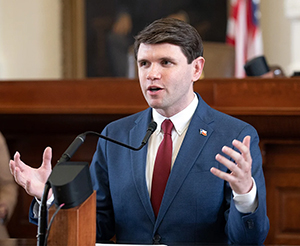
AUSTIN (RNS)—Rep. James Talarico approached the microphone on the House floor May 25 with a stack of papers in hand.
Rep. James Talarico speaks on the floor of the Texas House of Representatives in Austin. (Submitted photo)
It was time for the final vote on a bill that would allow public schools in Texas to hire their own unlicensed chaplains. It was largely ceremonial, but Talarico, a vocal critic of the bill, still had a few questions.
Looking down at his notes, he asked Rep. Cole Hefner, chief champion of the bill in the House, if the head of the National School Chaplains Association had worked on the proposal that has drawn controversy and national attention.
“They provided some input,” Hefner offered.
It was an understated acknowledgment of a coalition that shepherded the chaplains bill through the Texas Legislature.
Powerful coalition promoted chaplains bill
Whereas two other bills introduced this session that involved religion and public schools—one that dealt with school prayer and another requiring classrooms to hang donated Ten Commandments signs—never made it across the finish line, the chaplains bill was carried by an alliance of activists, Christian groups and conservative lawmakers who have aided each other’s rise while championing forms of Christian nationalism.
Their victory points to the ascendant power of the ideology in red states, where legislators are lining up behind bills involving religion, including opposition to the expansion of LGBTQ rights, that critics say only reflect a specific Christian vision for society.
The lawmaker most associated with the Texas chaplains bill is Sen. Mayes Middleton, a former Texas House member serving his first term in the state Senate in a district that includes Galveston.
As head of the Freedom Caucus during his time in the Texas House, Middleton was a vocal supporter of U.S. lawmakers from Texas who attempted to halt the certification of the 2020 presidential election on Jan. 6, 2021.
He also articulated support for Christian nationalist ideas, such as insisting that the separation of church and state is “not a real doctrine” during debate over the chaplains bill.
And in a recent interview with The Washington Post, Middleton declared, “there is absolutely no separation of God and government, and that’s what these bills are about,” referring to the chaplains bill as well as the Ten Commandments bill, which he also authored.
Julie Pickren a rising star
As head of his own oil company, Middleton has been an influential political donor in Texas, including providing a $5,000 donation to Julie Pickren, who successfully ran for the State Board of Education last year in a district that includes Galveston.
Julie Pickren
Pickren—an ardent supporter of Donald Trump—sparked outcry in March 2021 when it was revealed she was in Washington, D.C., on Jan. 6 to attend the Trump rally that preceded the attack on the U.S. Capitol.
Although Pickren, then a local school board member, did not appear to enter the Capitol herself, her presence nearby was criticized by area NAACP representatives, as were her false claims the Capitol attack was led by “antifa” members instead of Trump supporters.
Pickren lost her local school board seat two months later but remained a rising star in the Texas Republican Party.
She appeared on an education-focused panel at the Conservative Political Action Conference in 2022 and also developed connections with the prominent state-level activist group Texas Values, which champions “faith, family and freedom” and played a role in authoring the state’s controversial heartbeat bill.
Close ties to Texas Values Action
During a September 2021 appearance on the Right Side Broadcasting Network, a host asked Pickren about the Texas heartbeat bill. Instead of responding herself, Pickren simply turned her camera slightly as Jonathan M. Saenz, the head of Texas Values, leaned in to speak next to her.
The following year, the political arm of Saenz’s group, Texas Values Action, formally endorsed Pickren’s campaign for the State Board of Education.
Also among Pickren’s supporters is activist and self-declared prophet Lance Wallnau, who identifies as a Christian nationalist. Wallnau promoted Pickren during CPAC in 2021, seeking her out on the conference floor and recording a video with her while encouraging viewers to support her.
Pickren, for her part, has called on voters to elect Christians.
“It’s so important to elect conservatives and Christians to our local school board races, so that they can pass policy that will protect (the) children in each school district,” she said in an interview conducted earlier this month on the conservative Brighteon network.
In that same interview, Pickren noted during her time as a local school board trustee, she created a “Superintendent’s Pastoral Team” that invited pastors and youth pastors to volunteer at schools, which she insisted lessened violence and drug use. When she began running for the State Board of Education, she said, she prayed for a way to replicate the local program at the state level.
Mission Generation at work
According to Pickren, the answer to those prayers came via a call from a staffer who worked for U.S. Sen. Ted Cruz. The staffer put her in touch with the leaders of Mission Generation, a Christian mission organization specializing in placing school chaplains around the world.
Pickren went on to serve on the board of the National School Chaplain Association, a project of Mission Generation. The group openly has expressed a desire to “influence those in education until the saving grace of Jesus becomes well-known, and students develop a personal relationship with Him.”
Pickren, too, has spoken of the group’s religious intentions during a Mission Generation event last year. In a video posted to the group’s Instagram page, she encouraged attendees to donate to Mission Generation because “there are children who need chaplains,” explaining there is “a whole generation of children that have never stepped foot one day inside of a church.”
Six months later, when Middleton introduced the chaplains bill to the state Senate, Malloy of Mission Generation was among those who testified in support.
So, too, was Pickren, who appeared to indicate personal involvement in authoring the chaplains bill. When discussing funding aspects of the proposal, she said it drew from a subset of government funds “because I did not feel, in talking with Sen. Middleton, that we needed to affect academic counseling budget.”
Two days earlier, Pickren had tweeted a photo of herself and Malloy with Pastor Rafael Cruz, Sen. Ted Cruz’s father, saying the trio were “discussing the importance of school chaplains.”
But neither Malloy nor Pickren mentioned their group’s evangelism-minded goals during their testimonies before the Senate committee, with Malloy instead insisting chaplains “are not working to convert people to religion.”
As the bill—supported by Texas Values— progressed through the House, Mission Generation’s website vanished, with its URL redirecting to the National School Chaplain Association website. When The Texas Tribune reached out about the Instagram video of Pickren’s comments unearthed by Religion News Service, it promptly disappeared from Mission Generation’s account.
Future remains uncertain
As the bill came before the Texas House of Representatives, Democrats attached a provision introduced by Talarico that required school chaplains to be endorsed by an organization recognized by the U.S. Department of Defense, the Federal Bureau of Prisons or the Texas Department of Criminal Justice. The amendment potentially imperiled the ability of NSCA chaplains to serve in Texas schools, as the group is not currently recognized by the Department of Defense.
But as noted by The Washington Post, the amendment was stripped from the bill after passage, likely clearing a path for NSCA chaplains to begin working in the Lone Star State.
While the bill will become law, its future remains uncertain. David Donatti of the Texas American Civil Liberties Union said his group is mulling a legal challenge.
“It is truly a real-time experiment on our children,” he said of the proposal, arguing it could end up “eroding our fundamental freedom of religion and belief.”
Southwestern calls meeting to address trustee concerns
May 31, 2023
The Southwestern Baptist Theological Seminary will hold a special called meeting May 30 via Zoom to address concerns raised by trustees regarding lack of disclosure.
The called meeting apparently was in response to a formal request sent to Chairman Danny Roberts, executive pastor of Cross Church, formerly North Richland Hills Baptist Church in suburban Fort Worth, and members of the board of trustees.
In that letter, leaked to several media outlets from an unidentified email account, the writer—whose name was redacted—stated: “We have reached a point of conscience that for us to remain silent would be, in our own opinion, to fail in our fiduciary and legal responsibility to the sole member, SBC, and to leave both of us open to potential questions of personal ethical failure if we do not immediately go on the record in a good faith attempt to disclose what we know to the rest of the Board of Trustees.”
The letter asserts trustee Aaron Sligar, pastor of Living River Chapel in Sutton, W. Va., produced “a detailed written report for the Board of Trustees” regarding an investigation into the financial management of the seminary under the previous administration.
It asserts the officers of the board’s executive committee asked Sligar not to present the full written report to the board. Instead, they asked him to present an oral summary of his findings to the board at its April 17-18 meeting.
The Baptist Standard received an unsolicited document purported to be the “floor report” Sligar presented to the board. The document noted $12 million spent on renovation projects, concerns about credit card policies and possible donor designation changes.
When asked to verify assertions in the letter to Roberts and to indicate whether the “floor report” document accurately represented what he told the board, Sligar replied by email: “An anonymous source leaked the report in question, which is a working document within the Southwestern Baptist Theological Seminary Board of Trustees. While our review is ongoing, this document was never intended for the press or public; as such, it does not represent an official statement from the board.”
Sligar directed any further questions to Roberts.
The letter to Roberts also raised concerns about the formation of Future Fort Worth, a nonprofit whose agent of record is a Southwestern Seminary administrator. The other two directors of the corporation are two Fort Worth businessmen involved in real estate development.
The Standard called Roberts’ office, but the call was not returned. Subsequently, both Roberts and James Smith, vice president for communications, received an email from the Standard with a series of questions.
Rather than answer specific questions, Roberts released a statement through Smith’s office on behalf of himself and the executive committee.
“Southwestern Seminary has inherited and endured a challenging period for more than eight months following the resignation of the former president. Out of a desire to balance charity to the former president with a need to address actions and decisions that have brought us to the seminary’s current state, the board of trustees has disclosed limited information to the Southern Baptist public while it has fulfilled its fiduciary duty to carefully evaluate certain financial matters,” the statement reads.
“Unfortunately, some individuals have questioned the integrity of the board’s processes and actions. While it would be imprudent at this time to answer each claim that is now in circulation in various platforms, we assert claims of inappropriate activities of the board officers, executive committee, and/or named staff are without merit, and the board will release all relevant and appropriate information following a special-called meeting of the board of trustees to be held on May 30 to address these matters.
“Additionally, as has been previously reported, the Department of Justice is investigating the Southern Baptist Convention concerning sexual abuse. The seminary is cooperating fully in this matter.”

 LaDonna Gatlin is the featured musical artist when Hardin-Simmons University hosts its Hymn Sing at 2 p.m. on June 4 in Logsdon Chapel. Gatlin, a West Texas native, grew up onstage with her siblings, the Gatlin Brothers. In the 1970s, she performed with the Blackwood Singers and with Dallas Holm and Praise.


 But rarely, Tisby said, do Christians manage to overcome racial differences. In The Color of Compromise, Tisby recounts how English settlers in Virginia faced a dilemma. In their homeland, Tisby writes, the custom was to free slaves who converted to Christianity. In 1667, the Virginia General Assembly decided that, no matter what the Christian faith taught, baptism would not make slaves free.




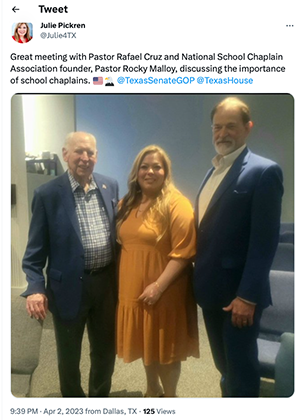 Two days earlier, Pickren had