DOE confirms Baylor University’s religious exemption

The U.S. Department of Education confirmed Baylor University’s religious exemption from a narrow range of Title IX provisions, particularly regarding LGBTQ students.

However, in an Aug. 14 letter to students, faculty and staff, Baylor President Linda Livingstone emphasized the confirmation of the university’s religious exemption does not signal any change regarding Baylor’s policies regarding sexual harassment.

Livingstone stressed the university expects “all members of the Baylor Family”—including LGBTQ students—“to be treated with respect and dignity.”

Complaints prompted request for confirmation

The exemption clarification was granted in response to a request Livingstone sent May 1 to Catherine E. Lhamon, assistant secretary for civil rights at the U.S. Department of Education.

The May 1 letter requesting confirmation of the religious exemption was prompted by several complaints filed with the Department of Education’s Office of Civil Rights in 2021.

Baylor regents reject reform group’s call for new investigation
(Photo / Baylor Marketing and Communications)

The specific complaints focused on the disposition of a charter request by the Gamma Alpha Upsilon LGBTQ student organization, claims of sexual harassment based on sexual orientation or gender identity, and alleged pressure placed on university media to not report on LGBTQ events and protests.

In the May 1 letter, Livingstone noted the Department of Education acknowledged Baylor’s religious exemption in 1985, in response to a 1976 request from the university.

She pointed to Baylor’s affiliation with the Baptist General Convention of Texas and associate membership in the Baptist World Alliance, and she stated the university is governed by a “predominantly Baptist” board of regents.

She identified Baylor as “a place where the Lordship of Jesus Christ is embraced, studied and celebrated,” and she stated Baylor operates “within Christian-oriented aims and ideals of Baptists,” including those in the 1963 Baptist Faith & Message statement of faith.

“As a religiously controlled institution of higher education, the University prescribes standards of personal conduct that are consistent with its mission and values,” Livingstone wrote in the May 1 letter.

She stated Baylor “practices nondiscrimination in employment, administration of its educational policies, admissions policies, scholarships, loan programs, and athletic and other school administered programs.”

At the same time, she asked the Department of Education to confirm that Baylor is “exempt from any Title IX requirements that are inconsistent with its religious tenets.”

“The University does not discriminate on the basis of sexual orientation or gender identity or expression per se, but it does regulate conduct that is inconsistent with the religious values and beliefs that are integral to its Christian faith and mission,” Livingstone wrote.

Quoting from Baylor’s Sexual Conduct Policy and its Statement on Human Sexuality, she wrote: “Since Baylor ‘affirms the biblical understanding of sexuality as a gift from God’ and requires ‘purity in singleness and fidelity in marriage between a man and a woman as the biblical norm,’ any asserted Title IX requirement that Baylor must allow sexual behavior outside of marital union between a man and a woman, or that contradicts the Baptist doctrine of marriage and the created distinction between men and women, is inconsistent with Baylor’s religious tenets, and the University is exempt from such requirement.”

Exempt for provisions inconsistent with religious tenets

In a July 25 letter from the DOE to Livingstone, Lhamon restated Baylor’s rationale for its religious exemption and its requested assurance of its exemption from certain Title IX “regulatory provisions.”

“The University is exempt from these provisions to the extent that they are inconsistent with the University’s religious tenets,” Lhamon wrote.

She continued: “Please note that this letter should not be construed to grant exemption from the requirements of Title IX and the regulations other than as stated above.”

If the Office of Civil Rights receives any complaint, it will be “obligated to determine initially whether the allegations fall within the exemption here recognized,” she stated.

Once the correspondence between Baylor and the Department of Education was made public, the Religious Exemption Accountability Project—which had filed a complaint on behalf of an LGBTQ student who graduated from Baylor in May—issued a public response condemning the decision.

“This unprecedented move makes Baylor unsafe for LGBTQIA+ students and is truly shocking,” said Paul Carlos Southwick, director of REAP. “Any reasonable person can see that this coddling of religious extremists has gone too far.”

‘Narrow yet complicated legal matter’

In her Aug. 14 letter to the Baylor community, Livingstone took issue with “reports and comments within traditional and social media” that she believes mischaracterized the Department of Education action.

Linda A. Livingstone (Photo / Baylor University)

“This is a narrow, yet complicated legal matter that has implications for all religious-based universities, not just Baylor,” she wrote. “Accordingly, we are responding to current considerations by the DOE to move to an expanded definition of sexual harassment, which could infringe on Baylor’s rights under the U.S. Constitution, as well as Title IX to conduct our affairs in a manner consistent with our religious beliefs.”

However, she stated, the confirmation of Baylor’s religious exemption from the DOE “has been characterized publicly by some as an indication that Baylor will not stop or modify how we provide Title IX or other protections to students, including those who identify as LGBTQ.”

“This is completely untrue,” she emphasized. “There will be NO CHANGES to Baylor’s current practices or policies related to sexual harassment or other forms of sexual and interpersonal conduct resulting from this assertion of our existing religious exemption.”

Livingstone stated the university’s Office of Equity, Civil Rights and Title IX “will continue to investigate sexual harassment allegations or related complaints and investigate these thoroughly and fairly.”

“We have taken and will continue to take meaningful steps to ensure all students—including members of the LGBTQ community—are loved, cared for and protected as a part of the Baylor Family,” she wrote.

“This institution is fully committed to promoting and maintaining an educational environment in which all students—including those who identify as LGBTQ—can learn and grow in accordance with our Christian mission and our call to love our neighbors as ourselves within a caring community.”

Arlington pastor to chair cooperation group

NASHVILLE (BP)—Southern Baptist Convention President Bart Barber announced a North Carolina pastor will chair the abuse reform implementation task force and an Arlington pastor will chair the cooperation group formed in response to the motion by James Merritt at the 2023 SBC annual meeting.

Bart Barber is pastor of First Baptist Church in Farmersville and president of the Southern Baptist Convention. (RNS Photo / Riley Farrell)

Barber announced the appointment of Josh Wester, pastor of Cornerstone Baptist Church in Greensboro, N.C., to the abuse reform implementation task force and named him as its chair. The announcement included the transition of several task force members and the addition of new members.

He also announced Jared Wellman, pastor of Tate Springs Baptist Church in Arlington, will lead the cooperation group. Wellman previously served as the chair of the SBC Executive Committee.

Barber, pastor of First Baptist Church in Farmersville, said he will announce the remaining members of the cooperation group by the end of August.

He asked “local associations and state conventions within the SBC family to press ‘pause’ on any ongoing work they may be conducting or motions they may be considering that involve the nature of what it means to be a church in friendly cooperation with sister Southern Baptist churches.”

Barber said he understands each of these groups are autonomous, but believes the cooperation group will engage in “high-quality research, dialogue, prayer and contemplation about the nature of cooperation among Southern Baptist churches and our needs going forward.”

He believes the results of their work will “prove to be very helpful information for our local associations and state conventions to consider as they make their own autonomous decisions.”

Marshall Blalock, Cyndi Lott and Jarrett Stephens have stepped down from the abuse reform implementation task force. Blalock served as the chairman of the task force following the 2022 SBC annual meeting. He previously served as vice chairman of the sexual abuse task force that oversaw the investigation into the alleged mishandling of sexual abuse claims by the SBC Executive Committee.

Barber expressed his thanks to Lott and Stephens. He said Blalock “deserves the gratitude and affection of all Southern Baptists. His leadership of the task force as chair for the past year has been exemplary.”

In addition to Webster, current members of the task force are: Melissa Bowen from First Baptist Church in Prattville, Ala.; Kris Buckman of Tri-County Baptist Church in Damascus, Md.; Stephanie Cline of First Baptist Church in Winter Garden, Fla.; Brad Eubank of First Baptist Church in Petal, Miss.; Mike Keahbone of First Baptist Church in Lawton, Okla.; Kelley Lammers of Dell Baptist Church in Dell, Ark.; Jon Nelso from Soma Community Church in Jefferson City, Mo.; and Gregory Wills of LaGrange Baptist Church in LaGrange, Ky.


Merritt says motion about seeking clarity, not judging

NASHVILLE (BP)—In an April phone call with James Merritt, Bryant Wright got right to the heart of the matter.

He was concerned over the current state of the Southern Baptist Convention, particularly the discourse over women’s roles in ministry.

Merritt, with similar concerns, already had talked about it with other Southern Baptist leaders.

There was a need for “clarity” and “consistency,” Merritt said—two words he would use later on the floor of the SBC annual meeting in New Orleans.

Calling himself “complementarian to the core” and “fully committed to every jot and tittle of the Baptist Faith and Message,” Merritt called for a task force to examine what it means for a church to be deemed in “friendly cooperation” with the SBC.

He was joined at the microphone by former SBC presidents Steve Gaines, J.D. Greear, Ed Litton and Wright.

The motion, approved by messengers, asks that a broadly based task force be named by SBC President Bart Barber for that purpose.

In developing the motion, Merritt and his friends discussed what should be viewed as the directional documents for the convention.

What was the standard, and who will determine how that standard is used?

“The first thing I brought up was, is there any word from the Lord on this?” Merritt said.

He landed on the growth of the early church in Acts 15. That growth brought new believers who were different from the established church. Issues such as circumcision were becoming elevated to the point of asking whether these new believers were really in something akin to friendly cooperation.

Merritt saw a similar discussion breaking out among Southern Baptists over women in ministry.

Online debate—where the loudest portion, at least, of denominational discussions seem to take place—has a history of bringing few peaceful resolutions.

Call for level-headed analysis of the situation

“Before this train got too far down the tracks, I thought we needed some level-headed, solid Southern Baptists … to analyze the situation,” he said. “Let’s make it … about what we want to do, why we want to do it and the way we want to do it.”

He sought input from other past presidents, who expressed their agreement over the phone and in New Orleans.

“Every one of them said this was exactly what we need,” Merritt told BP.

A motion to amend the SBC Constitution and clarify the office of pastor as limited to men received a two-thirds vote of approval by New Orleans messengers. It will need another two-thirds vote next year in Indianapolis.

Neither the amendment nor the subject are named in Merritt’s motion, though the connections are clear. That said, Merritt isn’t out to cast aspersions on anyone’s position.

“I don’t want to judge motives,” he said. “Whatever happens, at the end of the day Christian brothers and sisters are to love each other.”

SBC at a crossroads

But, he added, the SBC is at a crossroads he hasn’t seen since 1979, when Adrian Rogers’ election as president began what supporters call the “Conservative Resurgence.”

That debate centered on the inerrancy of Scripture. Southern Baptists haven’t wavered on that stance, Merritt said, but the current discussion is more about interpretation and application.

Southern Baptists took a clear stance on the position of women serving as a lead pastor or elder in New Orleans, as shown with overwhelming votes to uphold the recommendations to disfellowship Saddleback Church and Fern Creek Baptist Church.

Concerns exist, however, that churches will be reported to the Credentials Committee—the group tasked with considering churches’ “friendly cooperation”—for reasons on which there is less cohesion.

Greear addressed this in an interview with Baptist Press, saying danger lies in “constitutionally policing the borders.”

“We could become an entirely different convention where every year it’s about narrowing the parameters, [where] who is in and who is out is all that we think about, and we no longer think about mission and evangelism,” he said.

“You can’t predict what other discussions will come up,” said Merritt, who added that one state director told him 40 churches had been reported to the state convention for suspicion of being out of fellowship for various reasons.

“We need some kind of matrix, a set of railroad tracks that keep us heading in the right direction,” Merritt said.


Progressive National Baptists partner for social justice

ST. LOUIS (RNS)—Leaders of the Progressive National Baptist Convention announced plans at their annual session in St. Louis to work on enhancing voting rights and criminal justice reform through partnerships with like-minded organizations.

Members of the social justice team of the historically Black denomination also traveled to nearby Ferguson Aug. 9, the last day of their meeting, to mark the ninth anniversary of the death of Michael Brown, an unarmed Black teenager whose fatal shooting by a white officer prompted protests that energized the Black Lives Matter movement.

In an interview, Convention President David R. Peoples said supporting the Brown family and the Ferguson community is one example of how the denomination is pursuing justice issues.

“We want to make sure that wherever injustice takes place, wherever our people are oppressed and don’t have a fair shake, we’re going to speak out, we’re going to speak truth to power,” he said. “We’re not going anywhere until those things happen and positive change occurs.”

In his remarks the previous day at a news conference, Peoples said the organization would continue to follow in the footsteps of Martin Luther King Jr., who considered the Progressive National Baptist Convention his denominational home.

“We won’t stop until what Dr. King said, until justice runs down like water and righteousness like a mighty stream,” he said.

Alternative to white Christian nationalism

Progressive National Baptist Convention leaders differentiated members of their denomination from Christian nationalists.

Willie D. Francois III is co-chair of the social justice arm of the Progressive National Baptist Convention.

“What a tragedy it is that so much of what it means to be a Christian has been co-opted by white nationalists,” said Willie D. Francois III, the co-chair of the convention’s social justice arm.

“But there’s something about the rebellious imagination of folk like us, the Progressive National Baptist Convention, that says we have political priorities that aren’t limited to policing who people sleep with and policing what women do with their bodies. The Progressive National Baptist Convention is actually pro-life, because we care about bodies before they are born all the way through the tomb.”

During the meeting, the convention adopted a resolution saying the denomination “strongly denounces any … who refuse to support the results of the 2020 presidential election” and anyone who supports the Jan. 6 attack on the Capitol.

Reduce gun violence

Darryl Gray, the convention’s director general of social justice, said the denomination will work with Amnesty International USA to provide training and other resources on gun violence intervention to the denomination’s churches.

The Progressive National Baptists approved a resolution that said the two groups will “work to reduce gun violence in communities across the country, while advocating for the passage of federal legislation titled the Break the Cycle of Violence Act, which will provide federal funding for community organizations conducting gun violence prevention work.”

Francois said the broader gun violence concerns of the denomination include greater accountability by police departments.

“We went today to Ferguson to stand in solidarity with this family to practice the presence of God to practice the ministry of presence because we are tired of blue privilege, blue terror and blue violence,” he said. “It is not enough for us to talk about gun violence in our communities without also talking about gun violence that we’ve normalized, and that’s police gun violence.”

Gun violence in general should be viewed as an American issue, not a Black issue, Francois added. He said the problem needs to be solved with improved access to jobs and better schools rather than larger police forces.

The denomination also plans to partner with the Faith Leaders of Color Coalition, which is seeking state and federal action to end the death penalty. Progressive National Baptists passed a resolution with the same aim.

“I stand here arm-in-arm with the Brown family, clergy and people of faith who are intentional about being participatory in our policy efforts,” said Joia Erin Thornton, national director of the coalition.

“We want to bring forth results that promote equity and opportunity for those who are historically disenfranchised in their communities and who are over-policed and often selectively policed.”

Voting rights, a longtime agenda item of the denomination, continued to be addressed, including with a resolution calling for passage of a 28th amendment to the U.S. Constitution that would make voting “a permanent right for adult US citizens and residents.”

In an interview, Peoples condemned “strange tactics that are used to make sure that people are denied or deterred from voting,” including people of color.

“We need to find a way to make sure that voting is easier and not harder,” he said.

Support voting rights

At the news conference, several Progressive National Baptist leaders agreed on the need to further address voting rights.

Frederick D. Haynes III is the new leader of the Rainbow PUSH Coalition and pastor of Friendship-West Baptist Church in Dallas.

“We’ve come here 58 years after the voting rights bill was passed to say we’re going to revive it,” said Frederick D. Haynes III, the new leader of the Rainbow PUSH Coalition and pastor of Friendship-West Baptist Church in Dallas.

Peoples cited the continuing partnership with the AFL-CIO on voter mobilization.

“We won’t stop until the AFL-CIO and PNBC continue to push back voting suppression, till everybody gets a chance to vote,” he said at the news conference. “Even those who have paid their time, they have a right to vote. We won’t stop until everyone can realize the dream to vote, understand all of us are God’s children.”

Francois added that the voter registration work with the AFL-CIO will be organized around their organizations’ policy priorities.

“We are tired of politicians asking us, and benefiting and pimping our robes and pimping our collars, for their agenda,” he said. “If they want our votes, they need to sign on to our agenda.”

At last year’s annual session, the denomination joined forces in a renewed partnership with the prominent union, decades after the two groups worked together to lobby for passage of the Civil Rights Act of 1964 and the Voting Rights Act of 1965, which outlawed discriminatory practices in hiring and voting, respectively.

The denomination also reiterated criticism it first expressed in June when the Supreme Court struck down affirmative action in admissions by American universities. It said the ruling will be a motivator in get-out-the-vote efforts for the 2024 election.

“We believe this is not the final word on race-specific affirmative action, and our advocacy will mirror that conviction,” the convention said in a resolution. Progressive National Baptists will continue to partner with historically Black Christian universities and churches “to ensure the growth of the Black middle class.”


White evangelical pulpits and pews politically in sync

WASHINGTON (RNS)—Over the past two years, a group of influential evangelical leaders broke away from their churches or denominations, mostly over their congregations’ solid support for former President Donald Trump and, more generally, conservative politics and messaging.

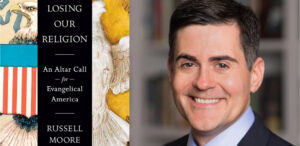
Losing Our Religion-An Altar Call for Evangeical America and author Russell Moore. (Photo by Eric Brown)

The moves by such people as theologian Russell Moore and Bible study teacher Beth Moore suggested deepening cracks between established evangelical leaders and ordinary believers.

But a new study published in the latest issue of Politics and Religion, a quarterly journal, shows there’s no evidence white evangelical clergy are less conservative politically than their congregations.

In fact, the survey found, white evangelical clergy are as conservative, if not more so, as the people in their pews.

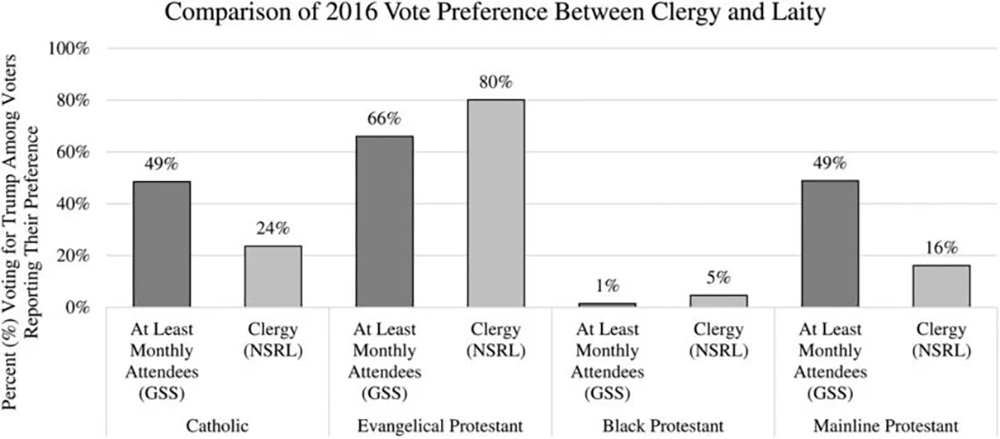
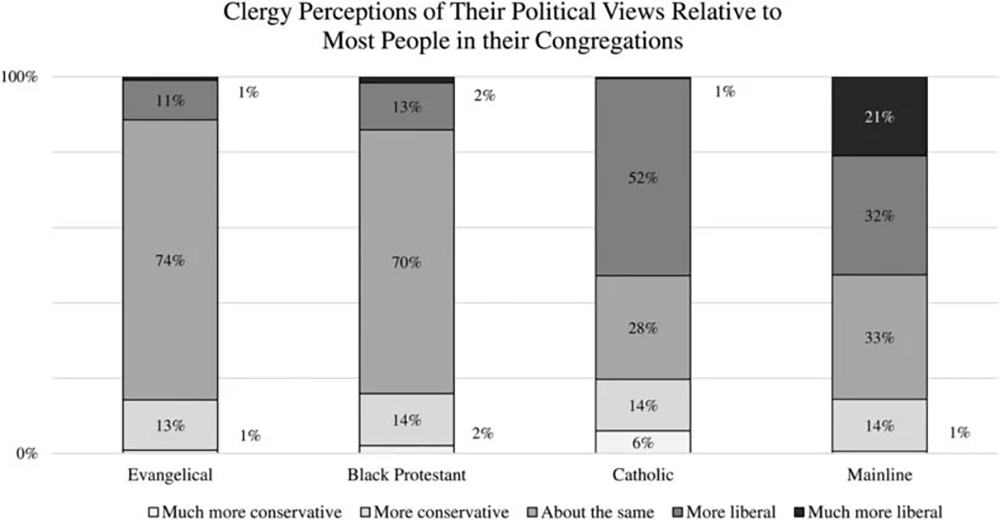
The study, by Duke University sociologist Mark Chaves and postdoctoral research associate Joseph Roso, finds that 74 percent of white evangelicals reported that their political views were about the same as most people in their congregations.

Only 12 percent of white evangelical clergy said they were more liberal than their congregants, and 13 percent said they were more conservative.

“It really counters this idea that there are a lot of evangelical clergy who are more liberal than their people,” said Chaves.

The only other group where clergy and congregants neatly align is Black Protestants; 70 percent of Black clergy said they hold the same views as their congregants. But unlike white evangelicals, Black clergy and churchgoers are far more liberal and tend to vote for Democrats.

Consistent with decades of past data, the new study also shows a deep political gap between the views of clergy in more liberal Protestant denominations, as well as the views of Catholic priests and their parishioners.

More than half (53 percent) of mainline Protestant clergy say they are more liberal or much more liberal than their congregants. Among Catholic priests, 52 percent said they were more liberal than their parishioners.

The study relies on data from the National Survey of Religious Leaders conducted in 2018-2019, and the 2018 General Social Survey. The survey included responses from leaders across many religious traditions, but the study focused on a sample of 846 Christian clergy arranged in four different groups: evangelicals, Black Protestants, mainline Protestants and Catholics.

Those clergy were asked, “How would you compare your own political views to those held by most people in your congregation?” They were then asked who they voted for in the 2016 presidential race between Donald Trump and Hillary Clinton.

Researchers then compared those answers to data from the General Social Survey on how monthly churchgoers in those four Christian groups voted for Trump in 2016.

Chaves pointed out that mainline Protestants have been considerably more liberal than their congregants for a long time—dating back to the Civil Rights Movement of the 1960s when many mainline clergy spoke out in support of justice and equality for Blacks and later publicly opposed the Vietnam War.

What isn’t clear from the study is whether evangelical pastors have long been politically aligned with their congregants or if that’s a more recent phenomenon. Chaves said there is no good national representative surveys to document that.

The survey suggests clergy who are more in sync with their congregants find it easier to mobilize as a political base into a potent constituency. And of course, white evangelicals have become arguably the most influential voting bloc in the Republican Party.

Many evangelical pastors embraced politics

Many evangelical pastors have embraced politics, railing about perceived threats from the secular world and using social media to expand their reach.

“It speaks to why the religious right is more politically effective,” Chaves said. “The more liberal-leaning clergy are in churches where the people aren’t with them.”

The study did not speculate on why white evangelicals were much more likely to be on the same page politically with their church members, but Paul Djupe, a political scientist at Denison University, said there probably were a few reasons.

White evangelical pastors are more likely to lead congregational type churches, where members choose their own ministers. In mainline and Catholic churches, clergy often are chosen by bishops or others in the denominational hierarchy one step removed from the local congregation.

Evangelical pastors also may have less seminary education than mainline or Catholic clergy.

“The very fact of going through higher education to get a master’s or even a doctorate in theology is something that probably makes them more liberal, or gives them an expansive view on a number of issues,” Djupe said of mainline and Catholic clergy.

That education may also lend mainline and Catholic clergy a wider lens on social justice issues from a national or global perspective.

By contrast, Djupe said, “evangelicals are thinking about the community and how to preserve the community, which are traditionally conservative notions.”

But Djupe said it would be a mistake to suggest mainline or Catholic clergy avoid political issues because their congregants are more divided.

“They might be a little bit more careful about how they talk about those issues, but they still talk about more issues than evangelicals do,” Djupe said.

The study did not address the relationship between congregation size and clergy political activism. The larger a church, the more likely it includes a diverse set of participants.

“Based on our analysis, it does not appear that pastors of large congregations differ substantially in their political involvement from pastors of smaller congregations,” Roso said.


Religious violence in India a problem for US politicians

EDITOR’S NOTE: This story contains references to sexual violence against women that may distress some readers. The Baptist World Alliance and Asia Pacific Baptist Federation are calling Baptists worldwide to set aside time in their homes, church services and communities for a time of united prayer for Manipur on Sunday, Aug. 20. To access resources, click here.

WASHINGTON (RNS)—For nine days, Pieter Friedrich starved himself to get his congressman’s attention.

Drawing from his own Christian tradition of prayer and fasting and the Indian political tactic of “satyagraha,” the activist and journalist fasted from July 27 until Aug. 5, aiming to convince Rep. Ro Khanna, D-Calif., to speak on the House floor about violence against Christians.

“He has not just a political responsibility, but a human responsibility to raise these issues,” said Friedrich, after he had abandoned his strike. “I believe the only way he continues to refuse doing so is because he’s continuing to straddle the fence.”

The Christians whose plight Friedrich was demanding Khanna take responsibility for, however, were not Californians, but live more than 7,000 miles away in Manipur, India. The fence he was accusing an American congressman of straddling was U.S. policy toward Indian Prime Minister Narendra Modi and his troubling history of Hindu nationalism.

President Joe Biden (right) meets with Indian Prime Minister Narendra Modi during the Quad leaders summit at Kantei Palace in Japan in this May 24, 2022, file photo. (AP Photo/Evan Vucci, File)

From President Joe Biden to Indian American congressmembers like Khanna, American politicians are under increasing pressure to account for their courtship of Modi, the leader of a strategically important ally and the world’s largest democracy, while ignoring the Indian regime’s oppression of religious minorities.

Modi’s recent visit to Washington, where he met with President Biden, attended a state dinner and addressed Congress, fully rehabilitated a figure who, in 2005, was refused a visa by the U.S. State Department.

At the time, Modi, then chief minister of the state of Gujarat, held a precarious position on the international stage after 1,000 of his constituents, mostly Muslims, died in religious riots.

Since being elected prime minister in 2014, his record has improved, but marginalization of minority groups has continued.

In its 2023 annual report, the U.S. Commission on International Religious Freedom cited India for its “systematic, ongoing and egregious violations of religious freedom.”

Violence in Manipur

In May, violence erupted in the Imphal Valley of Manipur, in northeastern India, after members of the mostly Christian Kuki tribe protested a court order extending benefits to the Meiteis, an ethnic group many Kukis believe the government already favors. After the protest, Kuki were subjected to egregious violence and sexual crimes by Meitei mobs.

Kim Neineng, 43, a tribal Kuki, cries as she narrates the killing of her husband, at a relief camp in Churachandpur, in the northeastern Indian state of Manipur, Tuesday, June 20, 2023. Neineng escaped with her four children to a nearby relief camp when a Meitei mob descended on their village. Her husband was killed by the mob — beaten with iron bars, his legs chopped off and then picked and tossed in the raging fire that had already engulfed his home. The deadly conflict between the two ethnic communities has killed at least 120 people. (AP Photo/Altaf Qadri)

Friedrich, a human rights advocate whose social media account has been banned twice in India for putting pressure on the Modi regime, has also urged American politicians of Indian heritage to speak out against rights violations in India.

“I feel like I’ve been called to be doing what I’m doing,” said Friedrich in an interview with Religion News Service. “These are people from my community, and I believe in the teaching that we are all one body in Christ. And whatever does harm to that body does harm to the whole.”

On July 30, midway through his hunger strike, Friedrich attended a Khanna town hall to confront him. A Kuki-Zomi Christian woman also spoke about her family, who has been victim to the violent clashes.

“I believe that there should be absolutely no violence against any place of worship,” Khanna told the town hall audience. “I will be co-leading a bipartisan delegation in coordination with the State Department that will build on President Biden’s relationship with India, which is critical to American foreign policy interests.”

The co-chair of the Congressional Caucus on India and Indian Americans, Khanna has been working on U.S.-India relations since his election in 2017. He has condemned Hindu nationalism, which many accuse Modi’s government of promoting, but in June, Khanna invited Modi to address the India caucus.

Modi’s opponents say the invitation was a public affirmation. Khanna’s tepid official response to the violence in Manipur was considered another strike against him.

“A lot of people in D.C. have made this calculation that for the sake of a deeper U.S.–India relationship, they need to be nice to Prime Minister Modi,” said Ria Chakrabarty, policy director of Hindus for Human Rights.

On Aug. 7, Hindus for Human Rights, along with the Indian American Muslim Council and India Civil Watch International, met with Khanna ahead of a planned trip to India to discuss their concerns, especially regarding the role of Modi’s Bharatiya Janata Party “in eroding democracy and rights.”

In response, Khanna “expressed his unwavering commitment to upholding democratic values and human rights both within India and the United States,” according to a Hindus for Human Rights press release.

Modi’s U.S. visit did prompt some politicians to speak out. U.S. Rep. Pramila Jayapal of Washington led more than 70 legislators in sending a letter urging President Biden to bring up human rights and democratic values in India.

‘It’s just evil’

But activists have begun to organize to sway the debate and demand action. Two days after the crisis in Manipur began, Florence Lowe, a tech entrepreneur in Dallas, founded the North American Manipur Tribal Association with the goal of bringing justice to the victims. Her 77-year-old mother, her sister-in-law and young nieces and nephews live in Manipur.

“It’s just evil,” said Lowe. “I don’t recognize who these people are.”

In May, Lowe got a harrowing call from her sister telling Lowe that the family had been forced to flee from their home in the town of Paite Veng. They originally were sheltered by a Hindu Meitei neighbor, and have since found refuge with family.

In the continuing violence, houses have been burned and looted by mobs and churches destroyed. The Lowe’s neighborhood church was razed, and along with it the pulpit Lowe’s father had designed.

Aside from the thousands of displaced Kukis, hundreds of others have been physically attacked, raped or killed.

‘Need the body of Christ to speak up’

Lowe is worried that violence in Manipur will soon be forgotten and seen as “one of the many atrocities.”

“Just trying to raise awareness is not working,” she said. “We need the body of Christ to speak up.”

N. Biren Singh, the governor of Manipur, a Meitei Hindu, is a member of the BJP. Singh has referred to the violence as “pre-planned,” adding that a “foreign hand” cannot be ruled out.

The crisis only gained national attention in India when a video of Kuki Christian women being paraded naked in Manipur went viral. Modi called the video “the most shameful,” but many were disappointed that his response came more than two months into the conflict.

Lowe is clear that the U.S. government has the responsibility to address ethnic cleansing of this nature, no matter what the deep-rooted cause of violence is.

“I’ve always been religious, but this has made me so much more of a believer,” said Lowe. “One thing I’ve realized is that for all my education and experience, I don’t know how to solve this problem. I’ve realized that God is the only one who can really do anything.”


Around the State: UMHB students pack meals as part of Love CTX

More than 350 University of Mary Hardin-Baylor students participated in a Love CTX community service project as part of Welcome Week. (UMHB Photo)

More than 350 University of Mary Hardin-Baylor students participated in a Love CTX community service project as part of Welcome Week. Students packed 18,000 meals to support One More Child of Belton, which provides Christ-centered services to vulnerable children and struggling families. The One More Child meals will go to Belton Independent School District’s Project Heartbeat program and will be distributed throughout the school year to help students who lack food at home. UMHB student volunteers also wrote encouraging notes to Belton ISD students.

The East Texas Baptist University women’s soccer team ministered in New Zealand during the 2023 FIFA Women’s World Cup as part of the Tiger Athletic Mission Experience. (ETBU Photo)

The East Texas Baptist University women’s soccer team ministered in New Zealand during the 2023 FIFA Women’s World Cup as part of the Tiger Athletic Mission Experience. The Tigers volunteered at the South Auckland Christian Food Bank, packing and delivering boxes of groceries for families. The ETBU student-athletes served at Papatoetoe High School, meeting with the high school girls’ soccer team, visiting with students in classrooms, and competing with the faculty and staff in soccer games. They also walked the streets of downtown Auckland around the FIFA World Cup FanZone, praying with individuals they met. “God opened doors for our team to minister and share the gospel throughout the trip,” ETBU Head Women’s Soccer Coach Kristin Cox said. “These 12 days on the ground in New Zealand have left everlasting memories, not only in the lives of people we encountered, but in the lives of our ETBU students. It was amazing to see the women on our team gain confidence and become bold about sharing their faith throughout the experience.”

Parramore Field at Shelton Stadium

Hardin-Simmons University will dedicate three refurbished facilities in the near future. Abilene Hall, the renovated home of HSU’s new engineering program, will be dedicated at 11 a.m. on Aug. 29. Texas Land Commissioner Dawn Buckingham and U.S. Rep. Jodey Arrington will speak at the dedication. The refurbished Parramore Field at Shelton Stadium will be dedicated at 6:30 p.m. on Sept. 1, prior to the 7 p.m. kickoff of a gridiron matchup between the HSU Cowboys and the Albright College Lions. The newly remodeled and expanded Moody Center Dining Hall will be dedicated at 11:30 a.m. on Sept. 7.

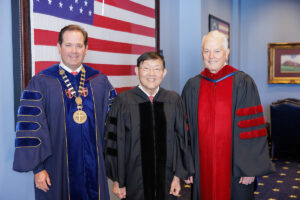
Dallas Baptist University President Adam Wright (left) and DBU Chancellor Gary Cook (right) congratulate Richard Chang, who was awarded an honorary doctorate from DBU. (DBU Photo)

Dallas Baptist University awarded an honorary Doctor of Humanities degree to Richard Chang, a licensed engineer and leader in the global semiconductor industry for more than four decades. Chang worked at Texas Instruments more than 20 years, establishing and managing multiple semiconductor research and development facilities all over the world. In 1997, he founded WSMC in Taiwan, and three years later, he extended his business mission to Shanghai. He founded Semiconductor Manufacturing International Corporation, which became the largest semiconductor foundry in China. After retiring from SMIC, he established companies devoted to providing new energy solutions. Since 2021, Chang has overseen the start of several semiconductor-related companies and continues to serve as a consultant in the development of the semiconductor industry.

Dallas Jenkins

Dallas Jenkins, creator of “The Chosen” series, will be the keynote speaker at Houston Christian University’s 2023 Spirit of Excellence Gala. The event, which benefits student scholarships, will be held at 7 p.m. on Oct. 28 on the HCU campus. Deborah Duncan, host of the “Great Day Houston” program on KHOU-TV, will emcee the gala, where President Robert Sloan will present its Spirit of Excellence Award to three couples—Dan and Cindy Wiliford, Benny and Nichole Agosto, and Randall and Alex Sorrels—for their support of the university. Gloria and Wiley Biles will be named the posthumous recipients of the President’s Award. For more information or to secure tickets, click here.

Ordination

Alberto Aguirre to the gospel ministry at Mission Bautista El Calvario in Kress.


Randel Everett made global impact at 21Wilberforce

Randel Everett—who recently told the board of 21Wilberforce he plans to retire at the end of the year as the organization’s president—recalled the reaction nine years ago when he stepped down as pastor of First Baptist Church in Midland.

The congregation was “pretty shocked” when he resigned as pastor to launch a nonprofit human rights organization focused on international religious freedom, Everett said.

“But within a few weeks, they began to own this,” Everett said, regarding the birth of what originally was known as the 21st Century Wilberforce Initiative and now as 21Wilberforce. “They realized this was an extension of their church. Midland has been at the center of religious freedom movements for a couple of decades.”

He noted Deborah Fikes, a member of First Baptist in Midland, led the Midland Ministerial Alliance to lobby President George W. Bush to promote peace and human rights in Sudan. She served several years as the World Evangelical Alliance’s representative to the United Nations, advocating for international religious freedom and peace initiatives.

Everett also was inspired by Bob Fu, founder of Midland-based ChinaAid, a Christian nonprofit organization that provides legal aid and support for persecuted religious dissidents and other prisoners of conscience in China.

“I don’t think 21Wilberforce could have started any place other than Midland, Texas, and at First Baptist in Midland,” Everett said.

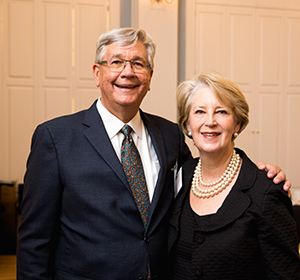
Randel and Sheila Everett (Courtesy of 21Wilberforce)

Darrell Dunton was among the members of First Baptist in Midland who embraced the 21Wilberforce vision. Dunton was chairman of deacons when Everett was pastor there, and he has served on the 21Wilberforce board since its inception.

“God convicted Randel and [his wife] Sheila to leave what truly could have been a comfortable retirement destination in Midland to a place of unknown possibilities,” he said.

Dunton characterized Everett as “a man of great vision, resolve and conviction” who “always thinks big and surrounds himself with individuals who can help make those dreams and visions happen by giving them the freedom to exercise the gifts God has given to them.”

Everett, a former executive director of the Baptist General Convention of Texas, said he long had “a heart for social justice” and passion for religious liberty rooted in Baptist heritage.

“A lot of times we are prophetic in speaking about injustices that affect us personally, but we often are not on the cutting edge of speaking on behalf of those who have no one to speak for them—the most vulnerable,” Everett said.

Conversations shaped 21Wilberforce

Long-term involvement with the Baptist World Alliance particularly raised his awareness about Christian brothers and sisters globally who suffer from religious repression.

Conversations with Michael Horowitz, a Jewish lawyer from the Religious Liberty Project at the Hudson Institute, and former Congressman Frank Wolf, a Presbyterian layman, led directly to the creation of 21Wilberforce.

During a trip to Midland, Horowitz noted Jews around the globe rally around persecuted Jews, and he asked why Christians fail to do the same when the basic human rights of those who share their faith are denied.

Wolf raised a question about religious persecution in a phone call that haunted Everett: “What is it going to take to wake up the church in America?”

Discussions between Horowitz, Wolf and Everett helped shape 21Wilberforce. When Wolf retired from Congress in 2015, he began several years of service as a senior fellow with the human rights organization.

Wolf praised Everett as “a great man, a good friend and a visionary” leader who made a tremendous impact as founding president of 21Wilberforce.

Everett’s experience as pastor of Columbia Baptist Church in Falls Church, Va., a congregation filled with members who have political connections and experience in the nation’s capital, made him “uniquely qualified” to lead 21Wilberforce, Wolf said.

“Randel has a pastor’s heart, and he also understands how Washington works,” he said. “He bridges both worlds.”

Former Congressman Frank Wolf (center) and Randel Everett (right) journeyed to Iraq to document the persecution of religious minorities. (Photo courtesy of 21Wilberforce)

Early on, Wolf suggested a trip to Iraq to gain a firsthand perspective on the plight of religious minorities in the ISIS-occupied Nineveh Plain.

“Within a month after we opened our offices, four or five of us literally were standing behind sandbags with Kurdish generals a mile and a half from ISIS,” Everett recalled.

When Everett talks about “standing” near the front lines, he means it literally, Wolf noted. Wolf recalled his concern that at 6-foot, 4-inches tall, Everett offered an all-too-inviting target for ISIS snipers.

The visiting 21Wilberforce team interviewed hundreds of people and documented widespread persecution of Christians and Yazidis in Iraq.

21Wilberforce produced a report, “Edge of Extinction: The Eradication of Religious and Ethnic Minorities in Iraq,” asserting actions by ISIS in Iraq against Yazidis and Christians met the legal definition of genocide.

The Parliament of the United Kingdom cited the 21Wilberforce report when it declared ISIS in Iraq guilty of genocide. On March 17, 2016, U.S. Secretary of State John Kerry similarly declared ISIS guilty of genocide.

Working in neglected areas

21Wilberforce also devoted significant time and resources to document religious persecution and human rights atrocities in Nigeria at a time when international media paid little attention.

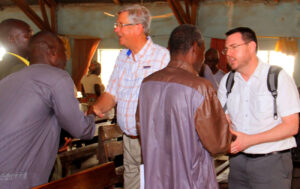
Randel Everett (center) talks to the inhabitants of a camp for internally placed people in Nigeria. (Photo courtesy of 21Wilberforce)

“We went all over the Middle Belt of northern Nigeria. We went places where they had not seen their own military—places where our State Department had never been,” Everett said. “We went past dozens of villages that were burned to the ground. We heard horrific stories.”

The 21Wilberforce team produced a report on their findings, “Nigeria: Fractured and Forgotten—Discrimination and Violence Along Religious Fault Lines.”

“Over seven years ago, my religious advocacy work on behalf of the persecuted Christians in Nigeria and the Lake Chad region brought me in contact with 21Wilberforce, which has a powerful model to engage government and nongovernmental agencies in the area of religious freedom,” said Stephen Enada executive president of the International Committee on Nigeria.

21Wilberforce provided ICON “a platform to engage U.S. policy and civil society space,” Enada said.

He praised Everett as “a skilled coalition-builder” and “a mobilizer” who has helped facilitate dialogue involving religious leaders and international victims of violence.

21Wilberforce has gained a solid reputation among key officials in Washington, D.C., and in the international community as the “go-to resource” about international religious freedom, Dunton said.

“Today, legislators on the Hill, other NGOs and the White House respect and seek input from 21Wilberforce in the arena of the persecuted church and religious freedom,” Dutton said.

Partners with the Baptist World Alliance

Randel Everett (center) and Elijah Brown (right) meet with local leaders in Nigeria while on a trip to document religious persecution and human rights violations. (Photo courtesy of 21Wilberforce)

BWA General Secretary Elijah Brown participated in the fact-finding missions to Iraq and Nigeria—along with other locations—when he served as executive vice president of 21Wilberforce.

“To stand in places of ongoing persecution, looking into the eyes of those who have held fast to their faith and hearing them speak words of joy and blessing over you is a transformative experience that leaves you humbled,” Brown said.

In addition to the major initiatives 21Wilberforce has launched in the past nine years, Brown also pointed to its “quiet impact” through projects such as helping to meet the educational needs of children in Nigeria who fled from Boko Haram.

He praised Everett as a “visionary leader with prophetic navigation” and as a “theologian in action,” as well as a “friend and mentor.” Brown also expressed appreciation for the ongoing collaborative partnership between BWA and 21Wilberfoce.

Three years ago, 21Wilberforce entered into a formal relationship with BWA that provides the organization “eyes and ears in over 130 countries around the world,” Everett said.

Rushad Hussain, ambassador-at-large for international religious freedom with the U.S. Department of State, and Randel Everett, founding President of 21Wilberforce, waited at Dallas-Fort Worth International Airport to welcome members of the persecuted Mayflower Church to the United States. (Courtesy Photo)

“Baptists aren’t our destination in these other countries. Baptists are our gateway. We want Baptists to introduce us not only to other Christians who are there, but also to other faith groups.

… We believe religious liberty must be for people of all faiths and people of no faith. Faith cannot be coerced. It’s got to be a decision made voluntarily.”

Through its Global Freedom Network, 21Wilberforce is seeking to inform and engage churches in international religious liberty issues, Everett added.

21Wilberforce also is working in partnership with the Baptist General Convention of Texas to involve congregations in 30 days of prayer for persecuted people of faith in November.

Linking churches in the West with persecuted Christians in other parts of the world will benefit both, he emphasized. In particular, Christians in the West can gain biblical insights from brothers and sisters who suffer for their faith, he asserted.

“The Bible was written by persecuted people for persecuted people,” he said. “It makes sense to them. … They understand it.”

Everett expressed joy about international religious freedom victories, such as the safe resettlement of the Chinese Mayflower Church to East Texas, working in partnership with ChinaAid and Freedom Seekers International.

However, he voiced concern about continued religious repression and persecution in places such as Nigeria, Myanmar, China, Nicaragua and India.

“There is much that still needs to be done,” Everett said. “I think 21Wilberforce is just finishing its first chapter. There are several more chapters to write.

“I’ll continue to be an ambassador for religious freedom and will look for ways to encourage participation in 21Wilberforce and other partners who are on the front lines dealing with this.”


On the Move: Humphries, Spruill

Amos Humphries to First Baptist Church in Madison, Ala., as lead pastor from Park Lake Drive Baptist Church in Waco, where he was senior pastor.

Scott Spruill to First Baptist Church in Rotan as pastor from First Baptist Church in Anson, where he was associate pastor of students and worship.


Protestant pastors say fear prevalent in pews

BRENTWOOD, Tenn.—“Fear not” is a frequent command in the Bible, but most pastors feel churchgoers aren’t getting the message.

A Lifeway Research study finds about 7 in 10 U.S. Protestant pastors (69 percent) believe there is a growing sense of fear within their congregations about the future of the nation and world.

Additionally, more than 3 in 5 (63 percent) say their churches have a similar increasing dread specifically about the future of Christianity in the United States and around the world.

“The Bible tells followers of Jesus Christ to expect trials, tribulations and suffering,” said Scott McConnell, executive director of Lifeway Research.

“However, Scripture doesn’t prescribe fear as the response to adversity. Instead, it frequently encourages rejoicing and faithfulness as anxieties are cast upon God.”

Pastors are more than twice as likely to agree than disagree that their congregations are fearful about the future of the nation and world. Seven in 10 (69 percent) agree, including 25 percent who strongly agree, while 29 percent disagree.

White (71 percent) and Hispanic pastors (62 percent) are the most likely to say they see fear for the future in their congregations. African American pastors are the least likely to agree (42 percent) and the most likely to disagree (55 percent).

Pastors at nondenominational (75 percent), Methodist (74 percent), Baptist (72 percent) and Lutheran (72 percent) churches are more likely than Pentecostal pastors (53 percent) to spot fear among their congregants.

Those leading the smallest churches, with fewer than 50 in attendance at weekend worship services, are among the most likely to say their congregations have a growing fear about the future of the country and world (72 percent).

Changes over time

Despite so many Protestant pastors saying their churches are fearful, the percentage is down compared to previous studies.

In 2010, 76 percent said there was a growing sense of fear within their congregations about the future of the nation and world. In 2011, 73 percent said the same. The percentage remained similar (74 percent) in 2014, before falling to 69 percent today.

Over the same period, the percentage of pastors who disagree and don’t feel their churches have a growing fear about the future has increased to 29 percent today after 21 percent in 2010, 26 percent in 2011 and 24 percent in 2014.

“Compared to a decade ago, a few more churches today are avoiding the impulse to fear changes and adversity around them,” McConnell said. “But a large majority of pastors see their congregations moving toward fear rather than away from it.”

While 69 percent of pastors say their congregations have a growing sense of fear about the future of the country and world, slightly less, but a still significant majority (63 percent), say their churches have a growing sense of fear about the future of Christianity specifically. Around 1 in 5 (21 percent) strongly agree, with 36 percent disagreeing.

“The number of people in America embracing the Christian faith is on a downward trajectory. So, it isn’t surprising congregations are afraid of this trendline,” McConnell said. “Unfortunately, the growth of Christianity in other parts of the world is not bringing American Christians much comfort.”

Denominational and demographic differences

Mainline pastors (40 percent) are more likely than evangelical pastors (33 percent) to disagree that a growing fear about the future of Christianity exists in their churches.

Among those more likely to spot fear in their pews, white pastors (64 percent) are more likely than African American pastors (47 percent). Pastors in the Midwest (67 percent) are also more likely than those in the West (54 percent).

Denominationally, non-denominational (76 percent), Baptist (68 percent) and Methodist (66 percent) pastors are more likely than Presbyterian/Reformed pastors (49 percent) to see a rising concern for the future of Christianity.

The phone survey of Protestant pastors was conducted Sept. 6-30, 2022. Responses were weighted by region and church size to reflect the population more accurately. The completed sample is 1,000 surveys, providing 95 percent confidence the sampling error does not exceed plus or minus 3.2 percent. Margins of error are higher in sub-groups.


Discipleship Collective trains church leaders to equip others

The goal of the Discipleship Collective is not small.

“The big picture is to train Texas,” said David Adams, director of discipleship for Texas Baptists.

To do it, Texas Baptists are taking training on the road.

The Discipleship Collective is an effort to provide training and resources for church leaders “to equip (Christ’s) people for works of service” (Ephesians 4:12).

Aimed at small-group leaders and Sunday school teachers, Discipleship Collective features at least one training conference in each of Texas’ nine regions every year, with the additional goal of moving around within the regions from year to year.

The conferences include adult, student and children’s ministry tracks with a breakout for pastors, as well. The conferences are held in the fall, mostly on Saturday mornings.

David Adams

“We want to help leaders focus on teaching toward living out God’s word, and not just knowing it,” Adams said.

The equipment isn’t new, but the proactive approach of bringing it to each region began in 2022.

“We would like to be within a relatively easy drive of most of our churches in an area every three years or so,” Adams said. “Pre-pandemic, our primary strategy was to be as responsive to training requests as we could be. If someone said, ‘Would you come do some training?’ We’d do it, and we still do that as much as possible.

“But we realized there were parts of the state we just weren’t getting to, and we wanted to be a lot more intentional about getting to those areas.”

In 2022, the first year of Discipleship Collective, Texas Baptists held 13 training events with 519 leaders from 107 churches participating.

For 2023, Discipleship Collective will run from August to October and feature 10 conferences spread throughout Texas. More events may be added.

Experienced leaders share their expertise

In addition to Adams and other members of the Texas Baptists’ discipleship ministry team, Discipleship Collective features regional church leaders with expertise in various areas of ministry, including children, students and adult ministry.

Robby Barrett, minister of education at First Baptist Church of Amarillo, who helps lead Discipleship Collective in the Panhandle region, participated in two conferences in 2022. He was so encouraged by the initial events, he said, he “would recommend it for every teacher we have.”

“It’s well worth it,” Barrett said. “When somebody leaves that conference, they have had kind of a fresh look at what teaching is and what they’re teaching. I feel like they have a new appreciation for the calling of being a teacher, and a freshness of encouragement.

“I think they’re more excited about teaching than when they arrived.”

Adams said the goal is to train leaders “to focus on discipleship more than just information transfer.” But recognizing the content of discipleship is of utmost importance, participants in the 2023 regional conferences will be given a copy of the book A Light Unto My Path: A Practical Guide to Studying the Bible by Jim Denison.

As churches rebound from the pandemic, one issue has been finding new leaders—and the reality many of these new leaders are inexperienced. So, Discipleship Collective is “trying to concentrate on the basics,” Adams said.

Bible study“The content is Scripture,” he said. “We want to make sure they handle God’s word correctly. So, this is hopefully a step toward that.”
Barrett was encouraged to see churches who brought a group of leaders. He said the conferences can help build community as a church’s leaders catch a common vision and see their shared purpose.

An added bonus, he said, is the camaraderie and encouragement that comes with trading ideas and sharing challenges with leaders from other churches who are teaching in the same ministry track.

“There’s some really good fellowship,” he said. “You’ve got adult workers in one room, youth workers in one room, children’s workers in one room—so, there’s good fellowship from folk from different churches.”

For more information about the Discipleship Collective, including free training material and resources, click here.


Anne Graham Lotz and daughter discuss life and death

WASHINGTON (RNS)—Like mother, like daughter: Anne Graham Lotz and Rachel-Ruth Lotz Wright—the daughter and granddaughter of the late evangelist Billy Graham—both are Bible teachers who have both endured serious medical conditions.

Lotz and Wright even share the same social media posts. Each recently forwarded a video, recorded on an airplane, of a young evangelist declaring to his fellow passengers, “Jesus is coming back really soon.”

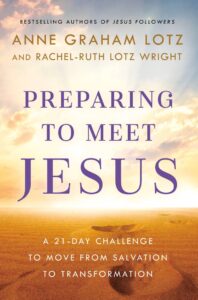
With their seemingly melded minds, it’s no wonder they would collaborate on writing projects together. The second book they wrote together, Preparing to Meet Jesus: A 21-Day Challenge to Move from Salvation to Transformation, goes on sale this week.

Lotz, 75, wrote the introduction and the epilogue and rounded off each of the 21 chapters with a prayer. Her daughter, 48, wrote about the book’s main focus, the character of the soon-to-be-bride Rebekah, found in Genesis.

Lotz started AnGeL Ministries in 1988, creating Bible studies and daily devotions. Wright leads one of those Bible studies, which grew in the wake of the COVID-19 pandemic, to reach thousands of people online.

Earlier this year, the two traveled with 115 women on AnGeL Ministries’ tour of Israel, where Wright taught on Mount Carmel about the prophet Elijah, and Lotz spoke from aboard a boat on the Sea of Galilee.

Lotz, a member of a Calvary Chapel church, and Wright, a member of a Southern Baptist congregation, talked with Religion News Service about end times, illness and whether there’s a succession plan in place for Lotz’s ministry.

The interview was edited for length and clarity.

Anne, someone just seeing the title “Preparing to Meet Jesus” might think it refers to your feeling you could be nearing the end of your life. Would that be correct or not?

Lotz: That would be right—I’m 75—but I think it applies to Rachel-Ruth, who has had two back-to-back heart attacks. You never know when you’re going to step into eternity, and I also believe Jesus is soon to come back. So, it could be through my death, or it could be through the rapture, but I’m going to see him.

You mention in a recent interview that you’ve made a shift by preaching about end times. How has your traditional audience responded to that emphasis in your message?

Lotz: I think people are fascinated right now with prophecy—what the Bible says about what’s going on today and where we’re headed. When I first felt like he (God) gave me the freedom to do that, it was about 10 years ago. One of the messages he’s laid on my heart now, and I put it at the end of this book, is Matthew 25, which is the story of the 10 young women—five of them were ready and five were not. We’re living at the end of history as we know it. And it’s time for us to get ready.

Why did the two of you choose the Genesis story of Rebekah, who is selected as the wife of Isaac, as a model for today’s Christians?

Wright: I was teaching Genesis in my Bible study, and I just love that chapter. And shortly after, I was invited to come speak at a bridal shower. I’d pulled out all these characteristics, just to share with the bride and then, we were thinking about the next book.

I thought there were so many lessons we could see in Rebekah. It’s not like Rebekah is perfect. I felt like the Lord just downloaded each chapter each day, with the characteristics that we could just look inside of ourselves and see if we can do it better than we are.

You both have had medical challenges in recent years with Anne’s breast cancer diagnosis and Rachel-Ruth’s heart attacks.

Lotz: When I looked at my breast cancer—when I was first diagnosed—I felt very strongly that God had given me that as a platform for a broader testimony in ministry. Looking back, that’s exactly what he did. So, I thank him for taking me through. I never want to go through chemotherapy again, but he brought me through and has been faithful.

And Rachel-Ruth is sitting here. To be honest, it’s a miracle that she’s here, because I stood beside her in the hospital. And I knew she was going. I mean, fast. And she was dying in front of my eyes. And God brought her back.

And I have my fifth-year checkup, by the way, in September, so I’m hoping I’ll get a clean bill of health.

Wright: I had, a year and a half ago, two heart attacks called spontaneous coronary artery dissections. For four days, I had this chest pain and then went into the hospital and they said, “Oh, you’re having a heart attack.” And I had no idea. I was healthy, exercised. I thought it was acid reflux or something, but it was intense.

I had the first heart attack that Sunday morning, and they left me in the hospital, which was a miracle, because if I had gone home, I would have died for sure. But the next day the second one was a massive heart attack where one of my arteries shredded from top to bottom, and I was dying.

My last prayer was: “Lord, just take care of my girls.” And God, I felt like he put his finger on my heart literally and all of a sudden, the blood came back and I could feel again and I could move and they rushed me to the OR, and I’ve got massive stents in my heart now.

Continuing influence of Billy Graham

Rachel-Ruth, you mentioned the influence of your grandfather Billy Graham in addressing your personal times of anxiety. Is that something that continues to this day?

Wright: I was having horrible chest pain again. I was, like, “Not again,” and the Lord brought a (Bible) verse to my mind. And so I was thinking about that verse and had just chosen to go to bed that night because I was just going to claim the verse that the Lord was going to take care of me. The next morning, I got up and read a verse out of Isaiah.

Then a friend of mine sent me a video of my grandfather in which he quoted those two verses. And I was so blown away because God used even the words of my grandfather, after he’d gone to heaven, to still minister to me, and that is the power of God’s word.

Anne, in a video Bible study based on your previous book, “Jesus Followers,” there was footage of the home where you grew up with your famous parents. Is that empty now?

Lotz: It is totally empty. I don’t think there’s even a folding chair. Maybe in the kitchen, there might be a folding chair. But there’s nothing in it. I love to use that as the basis for that Bible study. My father didn’t believe in possessions or material things. That’s not his legacy. His legacy is the legacy of faith and legacy of the gospel.

Rachel-Ruth serves on the board and chairs a weekly prayer team at AnGeL Ministries. Is there a succession process where Rachel-Ruth will one day be in charge of AnGeL Ministries?

Lotz: I’m going to leave that to the Lord. We’ve certainly talked about it. And the board of AnGeL Ministries is 150 percent behind Rachel-Ruth. The staff loves her. And so, if that time comes, then it’ll come. But right now she’s doing more and more.

Rachel-Ruth, is there an advantage of a mother and daughter in ministry together?

Wright: Well, it’s really like Paul and Timothy, where my mom has discipled me all these years. What she’s taught me and fed into me, is now coming out, as I speak. And I just, I feel like, with what you were talking about earlier, I have no aspirations to be somebody, to be the next person in ministry. I don’t care. And I probably get this from watching Mom. I just want to do what the Lord wants me to do and say what he wants me to say. I feel like he’s using a very weak vessel in me, but I know he’s called me, and it’s just a privilege to serve him.