Location of Chinese human rights lawyer in question

The exact whereabouts of human rights lawyer Lu Siwei, who was arrested in Laos in July, appear uncertain.

In mid-September, the Associated Press reported Lu’s attorney said he had been deported to China, along with two busloads of other Chinese citizens.

However, in a Sept. 23 email to the Baptist Standard, Bob Fu, executive director of Midland-based ChinaAid described Lu’s situation as “very fluid.”

“On the one hand his lawyer claimed the Lao Ministry of Public Security told her Lu was deported back to China,” he wrote. “But the Lao Ministry of Foreign Affairs kept telling diplomats he was still held in Laos.

“We are still trying to figure out what’s going on. This early morning, I learned he was transferred to the Chinese security agents from the Lao prison. … We certainly need prayers for mercy upon him.”

In July, Laotian police took Lu into custody when he was boarding a train bound for Thailand, where he planned to catch a flight to join his wife and daughter in the United States. Lu was accused of illegal border crossing, even though he possessed a Chinese passport, a Laotian visa and a U.S. visa.

Last month, 68 human rights and civil liberties groups issued a joint statement protesting the arrest of Lu, who was stripped of his license to practice law in China two years ago when he defended a pro-democracy activist who tried to flee to Taiwan.

Tyler-based Freedom Seekers International posted on social media: “The situation seems hopeless, but we ask you to join us in praying for a miracle. Pray that he survives this difficult situation and is released to be reunited with his family.”

Prayers appreciated

In a text message to the Baptist Standard in early August, Lu’s wife Zhang Chunxiao expressed appreciation for the prayers Texas Baptists and other Christians offered on behalf of her husband and her family.

“My husband and I are not Christians, but there were many Christians who helped us tremendously during this crisis and made us feel God’s strength,” she wrote. “This strength is the main reason why I have been able to persevere until today.”

She asked concerned Christians to “continue to pray for my husband until he comes to America safely.”

Freedom Seekers International CEO Deana Brown, a former Southern Baptist missionary, traveled to Laos in August to participate in a silent demonstration outside the detention center and pray for Lu’s release.

Brown remained in close contact with Lu’s wife, who sent her this message after her husband’s deportation: “I haven’t been baptized yet, and neither has my husband, but we are both on the journey to the Lord. … I pray every day and ask for the Lord’s grace.”

After expressing thanks for all who had been praying for her husband, she concluded: “I hope he can turn the danger into safety, survive this disaster, and be reunited with us. He and I are willing to spend the rest of our lives serving the Lord, dedicating ourselves, and helping those in need.”


Obituary: Dorothy Bernice “Bea” Cromer

Dorothy Bernice “Bea” Cromer, a former missionary and Baptist Standard employee, died Aug. 12 in Murfreesboro, Tenn. She was 96. She was born Oct. 17, 1926, in Underwood, Ind. She met her husband of 76 years, Ted Cromer, at church in Muskogee, Okla., and they married on Christmas Eve 1942. While he served in the U.S. Navy during WWII, she served on the home front in a Rosie the Riveter-type role. After the war, they both graduated from Oklahoma Baptist University and Southwestern Baptist Theological Seminary in Fort Worth. They served in several small churches before being appointed as Southern Baptist missionaries to Liberia, West Africa, where they served 17 years. After leaving Africa, they continued their ministry in Texas. She worked for the Baptist Standard before retirement to Tennessee, where she was a member of Northside Baptist Church in Murfreesboro. In her later years, she loved to bowl, play cards with her family, and cheer for her favorite team, the Dallas Cowboys. At age 92, Bea received silver and bronze medals in bowling at the National Senior Olympics in Albuquerque, N.M. She was preceded in death by her husband Ted and daughter Tedi. She is survived by her son Dehru and his wife Muezetta, daughter Janis Sauls and her husband Chet, seven grandchildren, 12 great-grandchildren and five great-great-grandchildren.


Growing SBC churches most likely found in New England

BRENTWOOD, Tenn.—Looking for a Southern Baptist church? You’re most likely to find one in the South. But if you want to find a growing Southern Baptist church, try the Northeast.

Lifeway Research’s analysis of the Annual Church Profile completed by Southern Baptist churches revealed the Southern Baptist Convention is made up of mostly smaller churches dotting the southern United States.

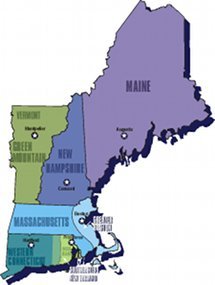
Still, more than 1 in 5 churches are outside of the South. And the only region where Southern Baptist churches are growing numerically is in New England. Additionally, churches started since 2000 are the most likely to be currently growing.

Scott McConnell, executive director of Lifeway Research, noted the SBC is growing in the least Protestant region of the U.S.

“While it’s easiest to achieve high percentage growth in areas with fewer Southern Baptists to begin with, the growth is a sharp contrast to numerical declines throughout much of the country,” he said.

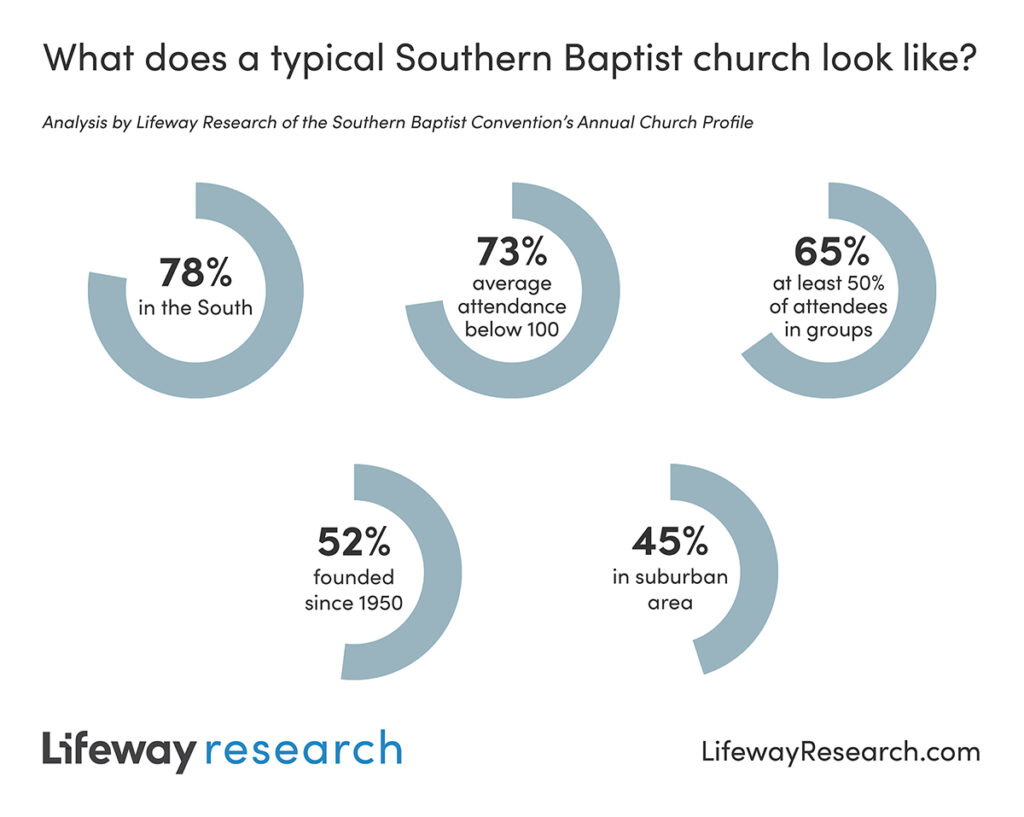
The Southern Baptist Convention mostly reflects its name, as 78 percent of its churches are in the South. Far fewer are in the Midwest (10 percent), West (9 percent), Northeast (3 percent) or U.S. territories (less than 1 percent).

Not quite half (45 percent) of churches are in suburban areas with a population of at least 2,500 but less than 50,000. The remaining percentage are split between urban areas (28 percent) with at least 50,000 in population and rural places (27 percent) with less than 2,500.

Churches in the Northeast and West are more likely than those in the other regions to be in urban areas, while churches in the Midwest and South are mostly in rural and suburban places.

Most Southern Baptist churches (52 percent) were founded since 1950, including 23 percent started since 2000. Another 21 percent began between 1900 and 1949, while 27 percent trace their founding to before the 20th century.

The newest group of churches, those founded since 2000, make up an increasingly larger percentage of all Southern Baptist churches, climbing from 19 percent of churches in 2017 to 23 percent in 2022.

“Southern Baptists are the most prolific starter of new churches, but older churches continue to close at a slightly faster pace,” said McConnell.

Almost 3 in 4 churches (73 percent) have an average worship service attendance below 100, including 46 percent who have fewer than 50 for a typical service. One in 5 (19 percent) are between 100 and 249, while 5 percent average between 250 and 499. And 3 percent usually have at least 500 for their weekend worship service.

Churches in the Northeast (53 percent), Midwest (55 percent) and West (53 percent) are more likely than those in the South (43 percent) to have an average worship service of fewer than 50 attendees.

The SBC increasingly is comprised of the smallest churches. From 2017 to 2022, the percentage of Southern Baptist churches that were below 50 in worship attendance grew from 36 percent to 45 percent of the convention.

For most Southern Baptist churches, most of their worship attendees are also in a Sunday school class or small group Bible study. Still, 35 percent of churches have fewer than 50 percent of those who gather for worship also participating in a small group.

Almost 2 in 5 churches say their participation rate runs between 50 percent to 74 percent. Slightly less than 1 in 5 (18 percent) report 75 percent to less than 100 percent are involved in a small group. Around 1 in 10 (9 percent) have 100 percent or more involvement.

The smallest churches, those with fewer than 50 in attendance for a worship service, are the most likely to have 25 percent or less of their congregation involved in small groups (21 percent). They are also among the most likely to have at least 100 percent participating (10 percent).

An increasing number of Southern Baptist churches have few small group participants. From 2017 to 2022, the percentage of churches that had fewer than 25 percent of their worship service attendees involved in a small group jumped from 5 percent to 16 percent, a 219 percent increase.

A 2022 Lifeway Research study found the average U.S. Protestant church had 44 percent of attendees involved in a small group, down from 50 percent in 2008.

 “Declines in Sunday School and small group participation is not a short-term problem. It also does not bode well for the future,” McConnell said. “Having a higher percentage of your attendees attending small groups each week is one of four measures that predict higher worship attendance five years down the road.”

The most recent Annual Church Profile of the SBC highlighted continued membership decline since 2006, falling to 13,223,122, the lowest number since 1978. The analysis comparing 2017 and 2022 indicates declines in most types of churches with occasional areas of membership and attendance growth.

Membership in Connecticut, Maine, Massachusetts, New Hampshire, Rhode Island and Vermont churches together grew by 1 percent from 2017 to 2022. Every other area saw a numerical decline for Southern Baptist churches.

The regions with the smallest declines were the Mid-Atlantic—New Jersey, New York and Pennsylvania—which fell 5 percent, and the East South Central—Alabama, Kentucky, Mississippi and Tennessee—which dropped 7 percent.

Every other area had a double-digit percentage decrease over the past five years, with the largest decline happening in the Pacific region—Alaska, California, Hawaii, Oregon and Washington—which fell 22 percent.

“The West has the most churches with declining membership. And the Pacific portion of the West has the most dramatic declines among reporting churches,” McConnell said. “California churches had particularly low reporting on the ACP in 2022, making their numbers less reliable.”

8 of 10 SBC churches plateaued or declining

Grouping churches according to their percentage change in membership since 2017 gives a picture of which types of churches are most likely to be growing and which must overcome the trends surrounding them.

Those who saw an increase in total membership of 10 percent or more are classified as growing, a decrease of 10 percent or more are considered declining and those in between are plateaued.

Overall, 18.5 percent of Southern Baptist churches are growing, 42.5 percent are plateaued and 39 percent are declining.

Newer Southern Baptist churches are more than twice as likely to have grown than churches started before the 21st century. More than 2 in 5 of those founded since 2000 are growing churches (42 percent).

The younger the grouping a church falls into, the less likely they are to be plateaued, ranging from 52 percent of those founded before 1900 to 22 percent of those founded since 2000. Churches founded in the 20th century are the most likely to be declining—45 percent of those started between 1950 and 1999 and 39 percent of those that began between 1900 and 1949.

Specific analysis was conducted on churches started within the past five years. At least two-thirds of Southern Baptist churches founded in those years are either plateaued or growing.

Within the 2017-2021 time frame, the longer a church has existed, the more likely it is to be a growing congregation. For those founded in 2021, 33 percent experienced at least 10 percent growth by 2022, while 2 in 3 churches planted in 2017 (67 percent) are currently growing.

The largest churches are the most likely to have grown. More than a quarter of churches with an average attendance of 500 or more (26 percent) report a membership increase of more than 10 percent in the past five years. Those churches are also among the least likely to have declined (35 percent).

Churches in larger population areas do not automatically equal growth. Southern Baptist churches in urban areas are the most likely to have grown since 2017 (22 percent), but those churches are also the most likely to have declined (46 percent).

In fact, the likelihood of a church growing and declining increases moving from a smaller population grouping to a larger one. While rural churches are the least likely to have grown (16 percent), they are also the least likely to have declined (35 percent).

Similar extremes are also found in the regions of the country. Southern Baptist churches in the Northeast (36 percent) and the West (29 percent) are the most likely to have grown, but they are also the most likely to have declined (46 percent and 47 percent respectively). Churches in the South (45 percent) and Midwest (40 percent) are the most likely to have plateaued.

 “It is increasingly difficult for a church to see growth today,” McConnell said. “Southern Baptists have never had more declining churches and fewer growing churches than we see today. As the majority of churches decline, they have fewer resources to invest in ministry. But the God who gave past growth is no less capable today.”

This analysis was based on data reported on the Annual Church Profile in 2022 and 2017. The ACP is an annual statistical census of Southern Baptist congregations conducted cooperatively by local associations, state conventions, and Lifeway Christian Resources. Around 7 in 10 Southern Baptist churches (69 percent) reported at least one item on the 2022 ACP. 


Jerry Falwell legal battle with Liberty University escalates

WASHINGTON (RNS)—The ongoing legal battle between Liberty University and Jerry Falwell Jr. has taken yet another twist, as the school’s former president has alleged misconduct by its board of directors and attempted to ban the university from using images of his late father.

In an amended complaint filed in federal court last week, Falwell Jr., who resigned from his post in August 2020 in the wake of multiple scandals, alleged several board members, including former interim Liberty President Jerry Prevo and former Southern Baptist Convention President Jerry Vines, diverted university funds to their private causes.

“During his lifetime, Dr. Falwell earned a reputation as a major proponent of financial integrity in religious and educational institutions and led the way in restoring public trust and confidence in such institutions after financial scandals associated with other, unrelated church leaders rocked the evangelical community in the 1980s,” Falwell Jr.’s lawyer argued in the amended complaint, filed Sept. 13.

The reference to “Dr. Falwell” is to Jerry Falwell Sr. “The JERRY FALWELL brand will not be associated with such conduct,” the amended complaint stated.

Falwell Jr. also alleges the board overlooked sexual misconduct by former leaders, including an unnamed former president, only to turn on Falwell Jr. when his life fell apart. Falwell Jr. also alleges the board exploited a near-fatal lung condition he suffered and harassed him by not paying him retirement benefits.

“The JERRY FALWELL brand does not stand for such abhorrent treatment, which is antithetical to the reputation by which it is known,” the complaint alleges.

The complaint lays much of the blame at the feet of Prevo, who the complaint alleges diverted school funds to his personal foundation and used the school’s corporate jet to fly to his homes in Alaska and Arizona—$35,000 per trip and $20,000 per trip, respectively, according to the amended complaint.

Falwell also alleges Prevo made many of his decisions after consulting with evangelical leader Franklin Graham.

“Upon information and belief, Franklin Graham is Prevo’s closest advisor; during the limited times Prevo appeared on campus to fulfill his duties as interim president, he would speak with Graham virtually every day by phone before making any decisions,” the complaint alleges.

Liberty calls allegations ‘improper and unsupported’

Asked about the complaint, a Liberty University spokesperson sent Religion News Service a statement.

“In response to Liberty’s compelling motion to dismiss his complaint, Jerry Falwell, Jr. filed an amended complaint containing improper and unsupported allegations designed to diminish former colleagues, family, and friends and to discredit the university where he formerly served,” the statement read.

“These personal attacks have no place in a legal dispute over the use of a person’s name, image, and likeness. Liberty will file the appropriate response to these claims in due time and defend its legal right to continue the use of Dr. Jerry Falwell’s name.

“Furthermore, we stand by our initial statement that Liberty University and its Board of Trustees have only sought to honor the visionary leadership of Dr. Jerry Falwell and the mission of training Champions for Christ.”

In addition to the complaint, RNS obtained from multiple sources an email sent by Falwell Jr. to Liberty board members discussing the latest legal filing. In the email, Falwell accuses David Corry, Liberty’s general counsel, of waging a three-year “campaign” to “use millions of dollars of Liberty student tuition money to make me look as bad as possible in public and to the Board of Trustees.”

Falwell also accused Corry of malpractice and incompetence and suggested some members of Liberty’s executive committee want to “gain control of Liberty, benefit personally from Liberty” and “determine who will be Liberty’s future leaders.”

Later in the email, Falwell claimed he had intended to end the legal battle but “had no choice but to strike back this Spring to protect my family’s reputation and future after forgiving 7 times 70,” apparently referencing a biblical quote from Jesus about how many times to forgive enemies.

The back-and-forth touches primarily on one of two lawsuits making their way through federal court. In March, the former Liberty president sued the university and the executive committee of the school’s board, alleging they have failed to pay him $8.5 million in retirement benefits.

Those benefits, the suit alleges, could only be withheld if he were fired for cause or if he engaged in “any Competitive Activity,” according to the complaint filed in U.S. District Court for the Western District of Virginia.

Board says retirement benefits should be forfeited

The board alleges the retirement benefits should be forfeited because Falwell deceived them regarding his own personal failings and his and his wife’s fiscal and alleged immoral behavior with a young man named Giancarlo Granda.

“Most damaging of all, perhaps, was Falwell’s post-contractual revelation of his overall and disqualifying departure from Liberty’s core Christian values at the time he was in the process of being Liberty’s long-term spiritual leader,” the school’s lawyers argued in a filing this month asking a federal judge to dismiss the case.

Jerry Falwell Sr. was pastor of Thomas Road Baptist Church. (File Photo)

In July, Falwell sued the school again for using his father’s name, image and portrait—all trademarked—without permission of the Dr. Jerry L. Falwell Family Trust, which owns the trademark.

The lawsuit pits the Falwell brothers against each other. Jerry Falwell Jr. alleges his brother, Jonathan Falwell, betrayed the family trust by siding with the university against him in regard to the trademark and is doing so for personal gain—and asserts Jonathan Falwell convinced their sister to have Jerry Falwell removed as a co-trustee of the family trust.

He also says the school rescued Thomas Road Baptist Church—where Jonathan Falwell succeeded their father as pastor—from financial ruin and asserts his brother hides how much money he gets from the school.

“Upon information and belief, Liberty and Jonathan have colluded to avoid publicly reporting additional income that Jonathan receives from Liberty, whether directly or indirectly, in the form of contributions to TRBC,” the complaint alleges.

The elder Jerry Falwell, a controversial leader of the religious right, founded Liberty in the 1970s and spent a decade promoting the school. When he died in 2007, the school received $29 million in life insurance benefits, which rescued the school from debt.

Falwell Jr. alleged in his July complaint the school no longer had permission to use his father’s image.

The school contested, filing a motion in late August to have the suit dismissed, arguing, among other things, that Falwell Jr. did not have authority to sue on behalf of the family trust, as his brother and co-trustee—who is also Liberty’s chancellor—did not consent.

The initial trademark lawsuit consisted primarily of a list of examples of how the school was using Jerry Falwell Sr.’s name and image.

After the school filed its motion to dismiss the case, Falwell Jr.’s attorneys filed an amended complaint, making a series of allegations about misconduct by school leaders, including “through a series of questionable self-dealing transactions that have the appearance of kickbacks” and overlooking sexual misconduct by former leaders.


North Carolina children’s home president misused funds

THOMASVILLE, N.C.—Michael C. Blackwell, longtime president and CEO of the Baptist Children’s Homes of North Carolina, retired from his post effective immediately following an independent financial review revealed multiple instances of misuse of the organization’s funds.

An announcement from the children’s home Sept. 19 said its board of trustees reached an agreement with Blackwell earlier in the day for him to retire. Blackwell has been on a leave of absence since May 26.

“Both parties have agreed that moving in the direction of new leadership is in the best interest of the organization and its mission of ‘sharing hope … changing lives,’” the announcement said.

“While the outcome of this review was disappointing, the action taken by the trustees clearly prioritizes that the integrity of the BCH mission and, most importantly, our commitment to the children and families we serve comes first,” Gayla Freeman, chair of the BCH executive committee, said.

“It is our hope that this is the first step in rebuilding trust with our supporters, partners and N.C. Baptists who have faithfully stood with us to minister to the needs of the most vulnerable while showing them God’s unconditional love.”

Freeman added that the misuse of funds was “not systemic” but was “isolated to the former President/CEO.”

Children’s home officials also released a detailed summary of the financial review, conducted by the Schell Bray law practice.

The review involved a forensic accountant’s assessment of specific organizational expenditures by Blackwell and “the findings substantiated multiple instances of misuse directly conflicting with both BCH policies and Blackwell’s fiduciary duties.”

Among the findings were Blackwell’s use of a specific accounting code for personal expenses. Over the past 14 years, Blackwell directed more than $300,000 in donor funds to that account. Investigators also found he used his corporate American Express card for personal expenses, including stays at a luxury resort, and that he asked a donor to purchase a brand-new Nissan Altima for his wife in 2022.

“Dr. Blackwell directed [Donor Redacted] gifts away from their purpose of supporting BCH’s general operations to benefit himself, and he was not fully transparent with donors,” the Schell Bray summary states.

In an email statement sent to some Baptist State Convention of North Carolina leaders as well as the Biblical Recorder about three hours after the children’s home announcement was made public, Blackwell said that he “had never deliberately done anything to bring harm to this ministry that is so deeply personal to me.”

Blackwell said he shared that sentiment with members of the board of trustees when he was invited to meet with them during a special called meeting held in closed session on Sept. 13.

In his statement, Blackwell acknowledged the existence of a “special Discretionary Fund” and said he “never stepped outside the original, established parameters and purpose of the Fund.”

‘No deliberate misuse of funds’

Blackwell added that at some point he “did determine that some charges were, indeed, personal. I made note of those and reimbursed BCH for those charges.”

“There was no intentional misuse of funds,” he added.

In a follow-up interview with the Biblical Recorder, Blackwell reiterated the claims he made in his statement.

“There were some misunderstandings, [but] there certainly was no deliberate misuse of anything, ever on my part,” Blackwell said. “I love BCH, and I always will.”

Blackwell also said the decision to retire was his.

“I retired on my own,” Blackwell said. “That was my decision.”

Under terms of the separation, Blackwell has agreed to reimburse the children’s home in full for the funds that were identified. Additionally, he will pay the appropriate amount of applicable taxes.

Blackwell’s final compensation will consist only of that which is required by law and organizational policy regarding accrued vacation and sick time, the statement said.

The review also determined the children’s home bylaws, as currently written, give the president/CEO position too wide a margin of financial authority.

Freeman said the children’s home board is in the process of developing a plan for updating and strengthening governing structures to establish the degree of oversight that is essential for an organization of the children’s home size and scope.

The announcement also said a search committee would be formed “in the coming weeks” to identify a new executive leader for the organization.

Chief Operating Officer Keith Henry and Executive Vice President for Development Brenda Gray, who have shared presidential responsibilities since Blackwell’s leave began in May, will continue to lead the organization in the interim.

Blackwell, 81, is the longest-tenured president in Baptist Children’s Homes history, having led the organization for nearly 40 years. A native of Gastonia, N.C., Blackwell became the eighth president of Baptist Children’s Homes July 1, 1983.

‘Disheartening and appalling’

In a statement to the Biblical Recorder, N.C. Baptist Executive Director-Treasurer Todd Unzicker praised trustees for commissioning the financial review and commended them for “taking swift action upon receiving the audit’s results.”

“It was disheartening and appalling to read a summary of actions that occurred under Dr. Blackwell’s leadership,” Unzicker said. “Transparency is the currency of trust for N.C. Baptist churches, and this report clearly demonstrates that the actions of Dr. Blackwell not only represent a lack of transparency, but also a misappropriation of cherished missions dollars.

“As heartbreaking as these actions are, it encourages me to see BCH trustees move toward a change in executive leadership and seek full restitution.”

Unzicker pledged assistance to the Baptist Children’s Homes in the days ahead and called on N.C. Baptists to join him in praying for the its ongoing ministry.

“N.C. Baptists stand ready to assist BCH in the days ahead as they work to change their policies and set a new direction,” Unzicker said. “Please join me in praying for wisdom for them in the days ahead.”

The Baptist Children’s Homes of North Carolina was established in 1885 as a single orphanage in Thomasville. BCH has grown from its inaugural location into one of the southeast’s largest child care organizations, located in 35 communities in North Carolina, South Carolina and Guatemala.

The nonprofit organization, which is fueled by charitable funding provided by churches and donors, offers help and hope to children, families, single mothers, expectant mothers, adoptive families, college students, intellectually and developmentally disabled adults and aging adults.

Baptist Press contributed to this report.


Governor seeks clergy support for school vouchers

Gov. Greg Abbott publicly confirmed he plans to call a special session on school vouchers in October, and he called on ministers to voice support for “school choice” from the pulpit during the session.

A Sept.19 press release from the governor’s office announced Abbott’s call for churches to participate in “School Choice Sunday” on Oct. 15, which he first issued in a “town hall”-style teleconference with clergy.

 “I believe that every parent can do a better job of raising their children if they are given the power to choose the school that is best for their child. If they are given that power, that child will go down a pathway to better educational success, personal success, and relationship success,” Abbott stated.

“Collectively, we can make Texas even better when we all go to work to make sure we get across the finish line this urgent need to provide parents the ability to choose the school that’s best for their child.”

The news release quotes Robert Jeffress, pastor of First Baptist Church in Dallas, as lending support.

“I am a product of the Texas public school system, but it’s time for a choice,” Jeffress stated. “We are going to do everything we can at First Baptist Dallas to support Governor Abbott and his courageous call for school choice.”

‘Commandeer the church for political ends’

John Litzler

John Litzler, public policy director for Texas Baptists’ Christian Life Commission, noted messengers to the 2022 Baptist General Convention of Texas annual meeting approved a resolution affirming the historic Baptist commitments to religious liberty and the separation of church and state.

The resolution states Texas Baptists “will not seek to use government to coerce the worship of Christ” and “will not support any attempt by government to commandeer the church for political ends or any attempt by government to favor one religion over another.”

“Texas Baptists have a strong history of resisting attempts by the government to co-opt religion for political purposes,” Litzler said. “The Christian Life Commission encourages all Texas Baptist churches to continue to focus on the gospel and worship of Christ alone any and every Sunday morning.”

Pastors for Texas Children criticized both the governor’s call for a special session and his call for “pastors to use God’s pulpit to push his private school voucher program.”

Charles Foster Johnson

“The people of Texas know an eternal truth that seems to escape Gov. Abbott, that all genuine faith is voluntary and cannot properly be endorsed or supported by the authority of the state,” said Charles Foster Johnson, executive director of Pastors for Texas Children. “The use of public tax dollars to subsidize religious instruction is a sin against God.”

Pastors for Texas Children noted it is “very intentional in its message to keep politics out of our pulpits,” and individual ministers participate in the organization “outside formal times of religious gatherings.”

In the Texas House of Representatives, a coalition of rural Republicans and urban Democrats consistently has rejected any form of school vouchers. Abbott indicated if the House refuses to pass a bill to use public funds to provide tuition assistance for private schools, he will continue calling special sessions until they capitulate.

“This crass bullying is particularly odious,” Johnson said. “The truth of the matter is that the House of Representatives of the state of Texas opposes private school vouchers, as they have for over two decades. That will not change, no matter how many special legislative sessions the governor calls.”

Litzler urged the governor and lawmakers to focus on fully funding public education in Texas.

“Ensuring adequate and equitable funding for public education in Texas remains a public policy priority for the Christian Life Commission. We were disappointed that, despite a historic surplus in funds, legislation to increase student funding and raise the pay of educators did not pass during the regular session,” he said.

“We are advocating that Gov. Abbott’s call for a third special session of the Texas legislature be broad enough to allow legislators another opportunity to increase public school funding. The scope of the special session should not be limited to bills which would divert public funds to private institutions.

“All Texas children are constitutionally entitled to a fully-funded public education system. A properly funded public education system ensures that even the most vulnerable children in Texas have as much opportunity for a bright future as their peers.”


Baylor settles lawsuit with sexual abuse survivors

Baylor University settled a federal lawsuit with 15 women who asserted they were sexually assaulted on or near the campus.

The lawsuit, initially filed in June 2016 by three plaintiffs and later joined by 12 others, accused Baylor of a “deliberately indifferent response” to accusations of sexual assault and subsequent harassment. The suit alleged the university violated Title IX and the Clery Act, permitting “a campus condition rife with sexual assault.”

Terms of the lawsuit’s settlement were not disclosed.

“We are deeply sorry for anyone connected with the Baylor community who has been harmed by sexual violence,” a public statement from Baylor University said.

“While we can never erase the reprehensible acts of the past, we pray that this agreement will allow these 15 survivors to move forward in a supportive manner.”

The suit was one of several filed in 2015 and 2016 alleging Baylor failed to protect students who were sexually assaulted. The suits followed a scandal that rocked the athletic department and eventually led to the departure of then-President Ken Starr.

In fall 2015, Baylor University regents hired Pepper Hamilton, a Philadelphia law firm, to investigate the university’s response to reports of sexual violence.

After receiving an oral report from Pepper Hamilton in May 2016, regents subsequently removed Starr as president, fired Head Football Coach Art Briles and sanctioned Athletic Director Ian McCaw, who later resigned.

Pepper Hamilton offered 105 recommendations to the university regarding Title IX compliance and a proper response to sexual abuse allegations. In May 2017, regents announced the “foundational implementation” of all the recommendations.


Around the State: HSU reaches $5.6 million goal for science center

Construction is underway to renovate and revitalize the entire Newman-Richardson Science Center at Hardin-Simmons University. Already, the building’s HVAC systems have been updated and multiple lab spaces have been renovated. (HSU Photo)

Hardin-Simmons University reached its $5.6 million goal to cover initial construction costs on its Newman-Richardson Science Center. The fundraising goal was reached after receiving a $600,000 grant from the Mabee Foundation. Construction is underway to renovate and revitalize the entire Newman-Richardson building. Already, the building’s HVAC systems have been updated and multiple lab spaces have been renovated. After meeting initial construction costs, HSU’s next goal is to create a building endowment for the Newman-Richardson Science Center to help solve future expansion and capital renewal needs.

Wayland Baptist University presented Bibles to 225 freshmen at the university’s Plainview campus, with another 275 to be distributed to freshmen at Wayland’s external campuses. (Wayland Baptist University Photo)

Wayland Baptist University presented Bibles to 225 freshmen at its Plainview campus and made plans to distribute another 275 to freshmen at the university’s external campuses. Each Bible is a gift from a former student, faculty, staff member, administrator or friend of Wayland. This is the second year the university has raised funds to ensure each freshmen student starts their journey through higher education with a copy of the Scriptures.

East Texas Baptist University senior humanities major Sarah Resendez was crowned the 67th Miss ETBU. (ETBU Photo)

East Texas Baptist University crowned senior humanities major Sarah Resendez from Shreveport, La., as the 67th Miss ETBU on Sept. 16. The Miss ETBU Pageant, sponsored by ETBU’s Student Government Association, is a long-standing tradition that showcases the exceptional qualities of female students and their commitment to Christian values, poise and scholarship. Resendez has served as a resident assistant, student worker for the School of Christian Studies and Humanities, and Thrive peer mentor. She also is involved in the university’s Honors Program. She attends First Baptist Church in Marshall and spends her summers working for the international nonprofit Hope 4 El Salvador, founded by her parents Erik and Susan Resendez.

High school juniors and seniors attended Howard Payne University’s first annual Health Science Enrichment Workshop. Pictured were (back row from left) Kailey Patterson and Emma Ewen from Early High School; Colton Stewart, Sidney Windham and Desteny Mendoza from Brownwood High School; (front row from left) Bethany Blair from Zephyr High School, Kierston Taylor from Early High School, Jazzmyn Sanchez from Brownwood High School and Harmonie Pittman from Early High School. (HPU Photo)

Howard Payne University hosted its inaugural Health Science Enrichment Workshop this summer. The two-day program was sponsored by the Joint Admission Medical Program and provided participating high school juniors and seniors hands-on learning opportunities on the HPU campus and onsite at Hendrick Medical Center Brownwood. Through health care simulations, participants received instruction in suture/staple removal, basic EKG interpretation and emergency resuscitation. Through science labs, they performed DNA extraction and anatomy dissections. Students also earned their “Stop the Bleed” certification, presented by Laci Sutton, dean of HPU’s School of Nursing.

Anniversary

175th at First Baptist Church in Round Rock. Dustin Slaton is pastor.

140th at First Baptist Church in Bandera. Chris McLain is pastor.


Obituary: Wilbert H. Long

Wilbert Henry Long of San Antonio, longtime Texas Baptist pastor, died Sept. 6. He was 93. He was born in Chatom, Ala., on Oct. 15, 1929, to Henry and Marvelle Long. After he graduated from Wayland Baptist College, he served two years in the U.S. Army. He earned his master’s degree from Southwestern Baptist Theological Seminary while serving churches in Denton. He held pastorates in Dallas and Groesbeck before being called to Northeast Baptist Church in San Antonio in 1964. He served there 30 years, retiring in 1994. When he retired, he joined the staff of San Antonio Baptist Association, where he served in many capacities. He also was senior adult camp director for Alto Frio Baptist Encampment. He was a trustee of the Baptist Memorial System nine years and served on the Baptist General Convention of Texas Executive Board. He helped build churches in Alaska and San Antonio, and he participated in evangelistic crusades in Australia, Korea, Japan, Brazil and Canada. During his final years at Waterford Senior Living, he began a Bible study and a hymn sing for the residents. In 2000, he was chosen to receive the Winfred Moore Award for Lifetime Achievement in Ministry from Baylor University. He was preceded in death by his wife of 60 years Patricia Ann Colwell Long and by his sister Phyllis June Francies. He is survived by son Mark A. Long, daughter Leigh Ann Whisler and her husband Chris, daughter Laura L. Roach and her husband John, 10 grandchildren and 10 great-grandchildren.


SBC Executive Committee remains leaderless

NASHVILLE, Tenn. (RNS)—The Southern Baptist Convention’s Executive Committee lost another leader before he could even get started.

Meeting in Nashville, trustees from the Executive Committee had hoped to approve retired Kentucky pastor Dan Summerlin as interim president and CEO. But during an executive session Sept. 19, trustees learned Summerlin had withdrawn as a candidate.

 Louisiana pastor Philip Robertson said Summerlin had come to the conclusion that “at this particular time, this job just might be a little bit more than he could handle.”

During a news conference, Robertson read a statement from Summerlin.

“Upon further reflection it has become evident that what is best for the convention and for my family is to withdraw my name from consideration at this time,” Summerlin said in the statement.

Summerlin would have been the committee’s sixth leader in the past five years and his withdrawal marks the second time this year that a nomination for leader of the Executive Committee has fallen apart.

In May, a search committee had nominated Texas pastor Jared Wellman, a former committee chair, as the permanent president. But a vote on Wellman failed the same month.

The committee has been without a permanent leader for two years, ever since former Arkansas megachurch pastor Ronnie Floyd resigned as CEO and president after a fierce battle over how to conduct an investigation into the SBC’s handling of sexual abuse.

Willie McLaurin had been serving as interim CEO but resigned last month after admitting he had falsified his resume. The fraud was discovered while McLaurin was being vetted as a candidate for the permanent role.

No planned legal action against McLaurin

Robertson, chair of the committee, reported after an internal investigation, trustees had decided to take no legal action against McLaurin at this time.

Willie McLaurin resigned as interim president and CEO of the SBC Executive Committee after confessing he lied about his educational background on his resume. (BP File Photo)

“Based on the findings from the internal investigation, while it is clear that Willie McLaurin engaged in both academic and professional fraud during his tenure with the Executive Committee, no evidence was found of financial wrongdoing or direct harm to the Executive Committee,” according to a committee statement.

The committee also reached a confidential separation agreement with McLaurin. Robertson declined to discuss any details of the agreement, including possible financial compensation, citing human resources concerns. He did say that in general, separation agreements can be helpful in cases like this.

Robertson also told trustees the officers had adopted a new vetting process for leaders, including verifying academic credentials, past employment and military service, and any professional licenses.

Oklahoma church ousted for racist conduct by pastor

After an extended executive session, Robertson also announced Matoaka Baptist Church, Ochelata, Okla., had been “deemed not in friendly cooperation with the convention based on a lack of intent to cooperate in resolving concerns regarding discriminatory behavior on the basis of ethnicity.”

Earlier this year, photos of the pastor of Matoaka Baptist Church in blackface and impersonating the late Ray Charles reportedly surfaced, prompting outrage. According to television station KTUL, the pastor defended the photos and was unapologetic.

The SBC removed a Georgia Baptist church for similar reasons in 2018.

Despite the troubles of the Executive Committee—and the uncertainty over its leadership—the tone of the meeting was markedly different from earlier meetings that had been characterized by tension and sometimes open conflict.

Unified in spite of challenges

Both Robertson and SBC President Bart Barber said at the news conference the trustees seemed united in their desire to work together and address their current challenges. Barber called it the “most unified meeting in some time.”

Barber added that many Southern Baptists have experienced complicated leadership transitions at their local churches—and that affects how they view the Executive Committee.

“Sometimes you go through difficult times,” he said. “Sometimes you have more problems than you have in a usual period of time. It doesn’t mean that you quit.”

In other business, trustees declined a request that they explore the possibility of holding the denomination’s 2028 annual meeting on the island of Maui. The request, made by a local church messenger during the 2023 annual meeting to loud applause, was deemed impractical.

Instead, plans call for the meeting to be held that year in Indianapolis.

They also discussed the possibility of selling the committee’s office building at 901 Commerce Street in Nashville. That area of the city is undergoing a major redevelopment—with construction traffic currently making it difficult for the trustees to meet at that location.

Adam Wyatt, the Mississippi pastor who chairs the finance committee, said selling the building is being discussed and the committee is working with a listing agent. But selling off the building doesn’t solve the committee’s fiscal problems, he said.

“It’s the only asset we have,” Wyatt said. “And getting rid of the only asset we have when we still have long-term challenges that we can’t quite quantify is something that we also have to consider.”

Any proceeds from a sale would also have to be split with other SBC entities, who own a stake in the building.

Trustees also approved a new code of conduct for the committee, prompted in part by public conflict among trustees in recent years over how to respond to the denomination’s abuse crisis.

The code of conduct required members to be a “role model in judgment, dignity, respect, speech, and Christian living” and to “maintain a biblical lifestyle at all times.” The code also requires members to refrain from criticizing the committee on social media—although trustees struck a clause that would have barred them from criticizing committee leaders on social media.


Johnny Hunt lawsuit claims pastor’s sin is a private matter

NASHVILLE, Tenn. (RNS)—In mid-2010, not long after his term as Southern Baptist Convention president ended, Johnny Hunt took time off for his annual vacation.

He planned to return to the pulpit at First Baptist Church in Woodstock, Ga., in early August. But just before his first Sunday back, Hunt announced he was taking a leave of absence, citing his health and a sense of exhaustion.

What no one knew at the time was that Hunt had another reason for his leave.

On July 25, 2010, while vacationing in Florida, Hunt had kissed and fondled another pastor’s wife in what his attorneys would later call a “brief, consensual extramarital encounter.”

Then Hunt spent more than a decade covering the incident up.

Without telling his congregation—or the millions of Southern Baptists he had represented as their president—Hunt went through a secret restoration process that included counseling sessions with the woman he had fondled and her husband. He then returned to the pulpit.

For a dozen years, no one was the wiser. Hunt retired from First Baptist Church in 2019 and took on a new role as a senior vice president for the SBC’s North American Mission Board. He continued his busy and often lucrative career as a preacher and public speaker.

Then, in 2022, an investigation into how SBC leaders dealt with the issue of abuse was released, and his name was included in the report.

Over the course of their inquiry, investigators from Guidepost Solutions, the firm hired by the SBC, had heard about Hunt’s misconduct and learned the woman involved in the incident—who has not been named publicly—described it as a sexual assault and as not consensual.

“We include this sexual assault allegation in the report because our investigators found the pastor and his wife to be credible; their report was corroborated in part by a counseling minister and three other credible witnesses; and our investigators did not find Dr. Hunt’s statements related to the sexual assault allegation to be credible,” investigators from Guidepost concluded.

‘Marital infidelity was nobody else’s business’

When the report became public, Hunt first denied it and claimed the incident was consensual. He resigned from NAMB, went through another restoration process, then made a defiant return to the pulpit earlier this year.

This past spring, Hunt filed suit against the Southern Baptist Convention’s Executive Committee and Guidepost, claiming they had ruined his life by revealing his misconduct and including him in an abuse report.

The heart of Hunt’s claim of invasion of privacy and defamation was summed up in a recent filing by his attorneys. Hunt’s sins, they wrote, were a private moral failing that should have been kept confidential.

“Pastor Johnny was not the president of the SBC or a member of the Executive Committee at the time of the incident,” they wrote in a memorandum, opposing the denomination’s attempts to have the case dismissed. “He was merely a private citizen whose marital fidelity was nobody else’s business.”

That claim raises a series of questions.

Can a pastor’s sins ever really be private? Can a pastor who has made a living urging others to follow a morality code then claim his own failings are no one else’s business? And was the harm done to Hunt’s reputation primarily due to his own acts—both the misconduct and the subsequent coverup?

George Freeman, executive director of the Media Law Resource Center and a former assistant general counsel for The New York Times, said Hunt’s claim to privacy will likely go nowhere in court.

Hunt is undoubtedly angry and embarrassed that his personal failings have been publicized, which is understandable, Freeman said. But as a religious leader who was outspoken about family values and ethical living, his wrongdoings are a matter of public concern, especially in the wake of the #MeToo movement.

“That’s life,” Freeman said. “That’s not a lawsuit.”

Claims it was a moral failing, not a crime

In their court filings, Hunt’s attorneys also claim Hunt’s inclusion in a report about abuse could have led readers to think he had committed a crime rather than a moral failing.

“By using this incorrect term and then featuring the information about Pastor Johnny in their public report that otherwise focused on criminal conduct, the Defendants created the false impression that Pastor Johnny is an accused sex criminal, even though Defendants now concede—as they must—that the allegations against him do not fit the definition of a crime,” they wrote in opposing a motion to dismiss the suit.

 Lawyers for the SBC argued the Guidepost report did not accuse Hunt of a crime, saying nothing in the report stated that the incident involved a minor.

“The Guidepost Report simply reported its investigation into a report of sexual assault against Plaintiff, who was the immediate past president of the SBC at the time, brought to the Guidepost investigators by an SBC pastor and his wife,” attorneys for the SBC wrote.

The former SBC president’s defamation claim could have some merit if the allegations against him are proven false.

But even then, Freeman said, Hunt, a prominent evangelical leader and speaker, would likely qualify as a public figure—making the defamation claim harder. Especially since he had long made public statements about morality, including his signature on the Nashville Statement, a 2017 statement by evangelical leaders that rejects both same-sex marriage and any extramarital sexual activity as sinful.

Hunt would also have to prove the Executive Committee and Guidepost knew the allegations were likely false and still published them. That’s a harder argument to make, given that the woman involved in the incident, who has not been named, insists it was not consensual.

“You have to prove that there was actual malice,” Freeman said. “And that will be hard to do.”

Hunt’s attorneys did not respond to requests for comment. A spokesman for Guidepost Solutions also declined to comment.

“Because litigation is ongoing, we have no further comment beyond our filings,” Scarlett Nokes, special counsel for the Executive Committee, told RNS in an email.

‘You can’t have it both ways’

Christine Bartholomew, a law professor at the University at Buffalo School, said Hunt’s public statements about morality undermine his claim of invasion of privacy.

“You can’t have it both ways,” she said. “You can’t publicly take a position on something and then say, ‘If it applies to me— hold up, it’s completely private.’”

Bartholomew said Hunt seems to be claiming a kind of personal version of clergy-penitent privilege in this case. Confessions made to priests or other clergy are considered confidential—and confidentiality at times has led church leaders not to report abuse or misconduct.

“Just because you’re going to have to answer to your Maker doesn’t mean you’re absolved from any public discussion of your misconduct,” she said.

If Hunt’s argument were to prevail, Bartholomew said, no church or religious group would be able to publicize misconduct by leaders. And even if Hunt did not break criminal law, his conduct may have broken civil laws.

Hunt’s defamation claim will depend on the facts and whether he can prove the claims made in the Guidepost report are false. Even then, he will have to prove that those allegedly false statements—and not his own misconduct—caused him harm, she said.

Robert Callahan, a Texas attorney who has represented survivors of clergy misconduct and abuse, also said Hunt’s claim of invasion of privacy likely will fail. He said the defamation claim may survive attempts to dismiss the case.

But Hunt’s legal filings likely undermine the defamation claim as well.

“He had to admit that he had participated in disqualifying behavior,” Callahan said.

The outcome of Hunt’s lawsuit could also impact future attempts to address clergy misconduct and abuse. For years, fear of lawsuits kept Southern Baptist leaders from taking any steps to address abuse, and churches had long avoided making public statements about clergy misconduct for fear of being sued.

Legal worries have also slowed the SBC’s “Ministry Check” website, a database of abusive clergy. Southern Baptists approved the development of the site in June of 2022, but more than a year later, no names of abusive pastors currently appear on the site, not even those who were convicted of crimes.

The Executive Committee has also faced fiscal woes due to the ongoing legal costs related to the sexual abuse crisis and investigation. In February, the SBC leaders announced the committee’s financial situation was unsustainable after using $6 million in reserves to pay legal bills. Last week, the committee laid off five full-time staffers and two contractors due to fiscal challenges.



Barber urges SBC to remember and learn from history

NASHVILLE, Tenn. (RNS)—The fall meeting of the Southern Baptist Convention’s Executive Committee began with prayer, some hard news and calls for unity after years of turmoil and change.

Those attending also got a history lesson about how the denomination overcame a crisis a century ago, with the hope that lessons from the past could inspire unity in the present.

“When all the dozens of reasons to throw in the towel and abandon our one sacred effort were easy to find, we chose instead to search hard for reasons to lean in and cooperate harder,” SBC President Bart Barber told the Executive Committee trustees.

Meeting in a hotel ballroom a few miles from the committee’s offices, about 80 trustees—the body that oversees the day-to-day governance of the SBC—gathered for the first time in person since the committee’s leader resigned after admitting he had faked his resume.

Willie McLaurin, who was serving as the Executive Committee’s interim president and CEO, resigned Aug. 17 after a committee vetting him as a candidate for the permanent position discovered the fraud. McLaurin was the fourth person to lead the Executive Committee since 2018, and the third to step down amid controversy.

His departure was followed by news last week that five staffers and two contractors had been laid off due to the committee’s troubled finances.

‘A cost to doing the right thing’

Jonathan Howe, who has filled in as temporary interim leader since McLaurin’s departure, told trustees the committee’s reserves had dropped from nearly $14 million two years ago to about $4 million today. The committee will need to draw on additional reserves to balance its budget this year.

Committee members also learned this week retired Kentucky pastor Dan Summerlin had been nominated to replace Howe as interim president and CEO, but he withdrew his name from consideration.

The search for a permanent leader—now nearly 2 years old—continues, with the search committee hoping to identify a candidate by February 2024. The committee is also expected to discuss an internal investigation into McLaurin’s tenure, likely in executive session.

Since 2019, the SBC has been reckoning with political divides, fights over doctrine, leadership failures and a sexual abuse crisis.

Members of the committee have been divided over how to respond to the ongoing crisis, with some warning a transparent investigation into SBC leaders’ management of sexual abuse might lead to financial ruin and others quitting in protest.

Howe gave a nod to some of the challenges the committee has faced in his report and to the recent layoffs.

“There is a cost to doing the right thing,” Howe said.

Howe also called for trustees to band together to act with humility to fulfill their mission, reminding them they serve the denomination’s churches, from the smallest rural congregation to the largest megachurch.

“We serve the Southern Baptist Convention,” he said. “It does not serve us.”

Update on Ministry Check database of abusers

Oklahoma pastor Mike Keahbone gave an update from a task force charged with implementing a number of reforms meant to address sexual abuse in the denomination. Chief among those reforms is setting up a “Ministry Check” database of abusive pastors.

Work on that database continues, but no names have been added to it so far. Keahbone said no date had been set yet for when names would be added but added he hoped it would be soon. He also said the volunteer task force is committed to making SBC churches safer for everyone.

Along with the work on the database, Keahbone said the task force has partnered with state conventions on abuse prevention tools. They are also searching for an entity that can oversee abuse prevention on a permanent basis.

“We will not retreat from this fight,” he said.

Looking back a century

Barber, pastor of First Baptist Church in Farmersville, closed the evening with a call for Southern Baptists to rise above their current troubles. He began his report by promising not to preach. Instead, he gave a history lesson to trustees, reminding them of the denomination’s troubles in the 1920s and 1930s.

At that time, he said, Southern Baptists faced financial crisis, doctrinal divides and failed leadership, including a pair of leaders who embezzled more than a million dollars from the convention’s two missionary boards.

Southern Baptists, he said, also faced a political crisis. After winning the battle to ban alcohol with the passage of the 18th Amendment in 1919, they faced a backlash against Prohibition, only to see the Democratic Party, which they then supported, nominate New York Gov. Al Smith, who was both Catholic and “an imbiber,” Barber said.

In the 1930s, the Great Depression derailed a major campaign to fund missions and one of the SBC’s prominent seminaries was set to close when a last-minute infusion of cash saved it, said Barber, who called the era “the moment of our deepest despair.”

When all seemed lost, Baptists created what is now known as the Cooperative Program, a shared mission funding program, and the statement of faith, known as the Baptist Faith and Mission, to bind them together.

Today, with Baptists once again facing division, financial woes, political turmoil, doctrinal divides and a crisis of leadership, Barber called on his fellow SBC leaders to once again overcome those challenges with a common mission.

“We do not lack money. We do not lack planning. We do not lack opportunity,” Barber said. “God help us, what we lack is inspiration.”

 Barber, who recently appointed a “cooperation group” to help the SBC move forward, asked his fellow trustees to stop following those who want to tear things down and instead work together.

“The dream of cooperation carried us through the 1920s and 1930s, and it will carry us through the 2020s too,” he said.