Maui pastors look past their own loss to serve others

LAHAINA, Maui (BP)—Lahaina faces an uncertain future following the Aug. 8 wildfire that consumed the town.

As survivors continue reckoning with the series of chaotic events that generated one of the deadliest wildfires in U.S. history, local pastors and residents are asking what it will take to persevere through the tragedy.

The latest official death count reached 114, but with roughly 850 people unaccounted for, the toll may climb to multiple hundreds.

“From our house in Lahaina, we came out in the evening, and normally there’s a sunset,” said Richard Murray, pastor of Kaanapali Beach Ministry in Lahaina. “And I could see this dark, black, what we thought was a cloud just over the town facing the water.”

Murray at first thought there was a major storm brewing before a friend pointed out it was smoke from a fire. Lahaina was burning.

A combination of drought-parched land and gale-force winds turned the wildfire into what Murray described as a gigantic blow torch.

“About 20 minutes later, the police were coming around the corner saying: ‘Evacuate. The fire is headed this way.’ So, we had to grab my wife’s two therapy dogs,” Murray said. “We jumped in the car, and we evacuated.”

The Murrays thought this would be like similar wildfire evacuations they’ve experienced in their 30 years of living on the island. They expected eventually to get the “all clear” signal and return safely to their home.

Instead, the fire reduced their home to ash.

Ministry in the midst of loss

Barry Campbell is serving as the transitional pastor of Lahaina Baptist Church. Campbell and his wife, Marci, had moved out of an apartment complex in Lahaina Town just a few months earlier. That entire complex was destroyed.

“All but two of our families (in their church) have lost their homes and everything they had,” Marci said. “So, we’re just working with our families, trying to meet immediate needs and trying to get them places to stay.”

The Campbells cooked and provided meals for their neighbors after the fire went out. They tracked down their church members and helped them find missing loved ones, and they opened their home for some who had been displaced by the fire.

Erik Naylor, a Send Network church planter, arrived on Maui last December to be sent out from Lahaina Baptist Church to help a core group grow into a new congregation. He and his family were renting a home in Lahaina, and their dwelling and most of their belongings were lost.

Erik Naylor, his wife Danni and their five children arrived on Maui last December to be sent out from Lahaina Baptist Church to help begin a new congregation. Their home and most of their belongings were lost in the Aug. 8 wildfire that killed 114 people and destroyed most of the town. (Send Relief photo)

“In the early afternoon, our cell phone service went out. The wi-fi went out, so we didn’t have any communication,” Naylor said. “Probably around 2 or 3, all of Front Street is burning down, but we didn’t know it. We were walking distance from Front Street. We just didn’t realize it was that bad.”

Right before they left, they walked across a field toward Lahaina Baptist Church and saw the massive cloud of smoke. His neighbor and fellow church member, Todd, went over and prayed for the church building, which miraculously survived the fire.

The Naylors said God has provided them temporary housing through a believer on the island opening their home for the next few weeks. Now, as they help their own family of seven get back on its feet and into school, Naylor and his wife Danni have continued ministering to their community by engaging others and sharing the gospel.

“We have seen God show up through churches (from the mainland) and agencies like Send Relief just showing up to be there for us, support us, encourage us, pray for us,” Campbell said. “People praying for us has just been huge. We’re so thankful for the Hawaii Pacific Baptist Convention and local churches contacting us.”

Long road to recovery

Several churches that were outside the burn zone have been meeting needs and supporting the survivors who had been displaced by the fire. Send Relief has helped to undergird some of those efforts financially in cooperation with the Hawaii Pacific Baptist Convention.

Texas Baptist Men has provided support to Waiehu Church, a congregation planted by Kahului Baptist Church five years ago. The church met immediate needs by providing generators, water, food and other necessities. Members opened their homes to families who were displaced by the fire, with one family hosting 28 guests.

Send Relief sent a shipment of fire recovery supplies to Maui to assist Southern Baptist disaster relief teams as they serve families who have lost everything. This shipment left Send Relief’s warehouse in Ashland, Ky., and was packed with protective gear including Tyvek suits, N-95 masks, goggles and more.

“Traveling around the island this past weekend speaking with pastors and residents in Maui, you can’t help but grieve with them over the tremendous loss of life,” said Bryant Wright, president of Send Relief, following a visit to the island.

“There is a long road of recovery ahead, and we at Send Relief want to help connect churches from the mainland to the needs in Hawaii.”


Prosperity gospel beliefs on the rise among churchgoers

BRENTWOOD, Tenn.—Many Americans believe financial prosperity is God’s plan for them, but they need to give more to ensure that blessing.

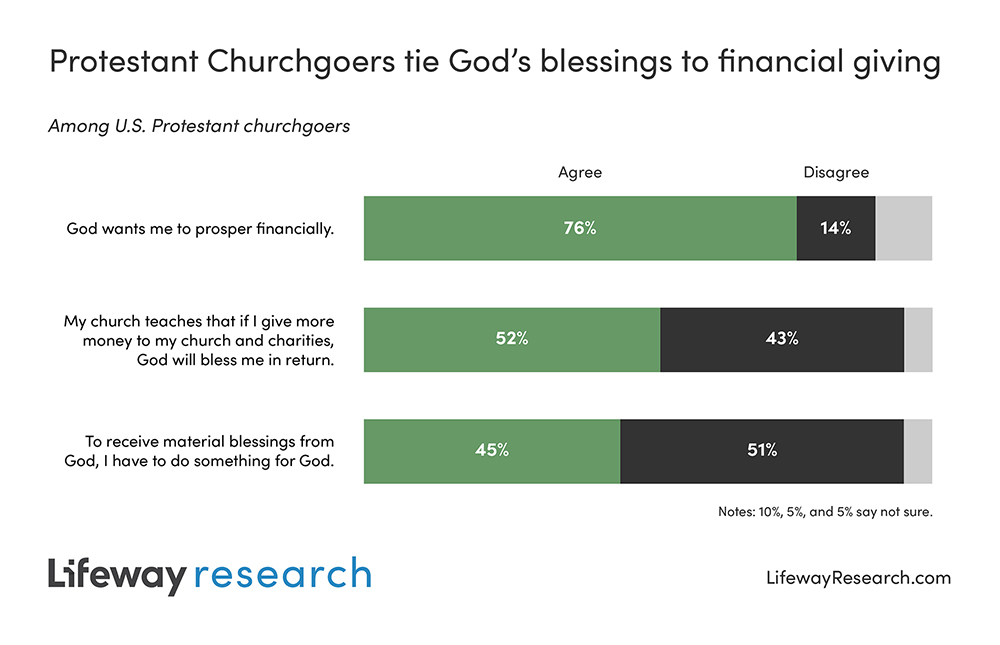
According to a Lifeway Research study, 52 percent of American Protestant churchgoers say their church teaches God will bless them if they give more money to their church and charities, with 24 percent strongly agreeing. This is up from 38 percent of churchgoers who agreed in a 2017 Lifeway Research study.

Additionally, churchgoers are more likely today than in 2017 to believe God wants them to prosper financially (76 percent, compared to 69 percent) and that they have to do something for God in order to receive material blessings from him (45 percent, compared to 26 percent).

Today, 3 in 4 churchgoers (76 percent) believe God wants them to prosper financially, including 43 percent who strongly agree. A little less than half (45 percent) believe they have to do something for him in order to receive material blessings from God, with 21 percent strongly agreeing.

“In the last five years, far more churchgoers are reflecting prosperity gospel teachings, including the heretical belief that material blessings are earned from God,” said Scott McConnell, executive director of Lifeway Research.

“It is possible the financial hits people have taken from inflation and the pandemic have triggered feelings of guilt for not serving God more. But Scripture does not teach that kind of direct connection.”

Most churchgoers believe God wants them to prosper financially—a belief especially prevalent among both the youngest and least educated churchgoers. Churchgoers ages 18 to 34 (81 percent) and 35 to 49 (85 percent) are among the most likely to say God wants them to prosper financially.

Furthermore, those who are high school graduates or less (81 percent) or have some college education (80 percent) are more likely to hold this belief than those with a bachelor’s degree (67 percent) or graduate degree (65 percent).

Belief that God wants people to prosper financially also is more common in some religious settings than others. Methodist (93 percent) and Restorationist movement (88 percent) churchgoers are among the most likely to hold this belief. And those with evangelical beliefs are more likely than those without such beliefs to agree (80 percent vs. 74 percent).

“Pursuing holiness was never designed by God to be a plan for financial riches,” McConnell said. “The size of one’s finances is not the measure of anyone’s service to God nor relationship with Him.”

As more churchgoers affirm prosperity gospel beliefs, younger churchgoers—those 18 to 34 (63 percent) and 35 to 49 (66 percent)—are more likely than older churchgoers—those 50 to 64 (53 percent) and over 65 (31 percent)—to affirm their church teaches that if they give more money to the church and charities, God will bless them.

“This research does not rule out the possibility that biblical teachings were poorly heard by more young adults, but they definitely have experienced a lack of clear biblical teaching on the reason for generosity,” McConnell said.

Denominational and demographic differences

African American churchgoers are the most likely to say their church teaches that if they give more money to the church and charities, God will bless them in return (71 percent). And those who attend worship services one to three times a month are more likely to say the same than those who attend at least four times a month (57 percent vs. 49 percent).

Churchgoers without evangelical beliefs are more likely than those with such beliefs to say their church teaches that if they give more money, God will bless them (55 percent vs. 48 percent). The opposite was true five years ago when 41 percent of evangelicals and 35 percent of non-evangelicals agreed.

Denominationally, Methodist (85 percent) and Restorationist movement (71 percent) churchgoers are among the most likely to agree their church teaches God will bless them if they give more money.

Of the three beliefs surveyed, churchgoers are least likely to believe they have to do something for God in order to receive material blessings from him. Still, like the others, this belief is most prevalent among younger churchgoers.

Those 18 to 34 (65 percent) and 35 to 49 (58 percent) are more likely than those 50 to 64 (43 percent) and over 65 (22 percent) to hold this belief. In 2017, churchgoers ages 35 to 49 were the least likely age group to agree (19 percent).

“Large numbers of young adults attending church regularly still believe their good deeds can tilt God’s gifts in their direction,” McConnell said.

Those who are high school graduates or less (50 percent) or have some college education (48 percent) are more likely than those with a bachelor’s degree (38 percent) or a graduate degree (30 percent) to agree. And African Americans are the most likely to agree (65 percent).

Among regular church attenders, those who attend a worship service least often (one to three times a month) are more likely than those who attend at least four times a month to say they have to do something for God in order to receive material blessings from him (49 percent vs. 42 percent).

Methodist (85 percent) and Restorationist movement (68 percent) churchgoers are once again the most likely to hold this belief. And those without evangelical beliefs are more likely than those with such beliefs to agree (50 percent vs. 37 percent).

The online survey of American Protestant churchgoers was conducted Sept. 19-29, 2022, using a national pre-recruited panel. Quotas and slight weights were used to balance gender, age, region, ethnicity, education and religion to reflect the population more accurately. The completed sample is 1,002 surveys, providing 95 percent confidence the sampling error does not exceed plus or minus 3.3 percent. Margins of error are higher in sub-groups.


Texas chaplains urge school boards to reject program

More than 100 Texas chaplains—including at least 34 Baptists—signed an open letter to all school board members in the state, urging them to reject government-approved chaplains in public schools.

“Because of our training and experience, we know that chaplains are not a replacement for school counselors or safety measures in our public schools, and we urge you to reject this flawed public policy,” the letter states. “It is harmful to our public schools and the students and families they serve.”

SB763—approved by Texas lawmakers in May and signed by Gov. Greg Abbott in June—calls on school districts to vote on whether to create a paid or volunteer chaplain program. The law goes into effect Sept. 1.

About 10 percent of the chaplains who signed the letter are affiliated with the Baptist General Convention of Texas, said Eric Whitmore, associate endorser for Texas Baptists. Fourteen of the chaplains identified with the Cooperative Baptist Fellowship.

‘Spiritual malpractice’

In part, the chaplains registered opposition to the public school chaplain program on religious liberty grounds.

“As trained chaplains, we strongly caution against the government assertion of authority for the spiritual development and formation of our public school children,” the letter states. “We would never provide spiritual care to someone without their consent. And when children are involved, parental consent is necessary.

“Not only are chaplains serving in public schools likely to bring about conflict with the religious beliefs of parents, but chaplains serving in public schools would also amount to spiritual malpractice by the chaplains.”

The letter asserts government-sanctioned chaplains “make sense in some settings”—such as the military, prisons or hospitals, where individuals cannot otherwise access religious services—but “not in our public schools.”

“Public school children simply do not face the barriers to religious exercise that service members, prisoners, and patients face. Parents or guardians must have the right to choose the religious leaders who will influence their children’s spiritual journey,” the letter states. “Public schools should not interfere or alter parental decisions in the realm of religious exercise or spiritual care.”

Education and expertise required

The letter notes SB763 does not require any specific training or qualifications for public school chaplains. It also does not demand chaplains refrain from proselytizing in schools or require them to serve students from different religious backgrounds.

“SB763 allows a school district to give any employee or volunteer who can pass a background check the title of ‘chaplain.’ This is simply not enough,” the letter states.

The letter points out professional chaplains “have specific education and expertise to fulfill our role in helping others engage their own religious practices and traditions.”

Normally, chaplains are required to have a graduate theological degree and be endorsed by an approved religious organization or denominational body. In some settings, chaplains must have one to two years of full-time experience as a spiritual leader, and often they are ordained ministers.

The letter points out the law provides for chaplains’ salaries to be drawn from funds dedicated “to improve school safety and security.”

“Those funds are directed at—but not limited to—the roles of restorative discipline and justice practices, mental and behavioral health support, and suicide prevention, intervention and postvention. We are deeply concerned about using chaplains in these roles to provide these services, particularly as the law does not require any specific training or qualifications,” the letter states.

The chaplains who endorsed the letter noted they work in cooperation with mental health counselors, not in competition with them. For example, therapists and police investigators receive specialized training to interview juveniles about sensitive matters, but many chaplains do not have that expertise.

Furthermore, chaplains typically are not trained in active-shooter situations or in how to be public safety professionals, the letter notes.

The letter to school board members concludes: “We urge you to support religious freedom and parental rights by rejecting this harmful program to have government-approved chaplains in our public schools. We believe that a strong public school system is one in which the limited funding for safety and security of students is used to hire the most skilled professionals for those roles. We believe that families, not the government, are entrusted with their children’s spiritual development.”

‘Misguided effort’ that will inject division

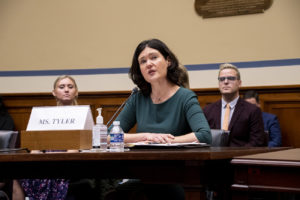
Amanda Tyler of the Baptist Joint Committee for Religious Liberty testified on the link between Christian nationalism and white supremacy in a hearing before the U.S. House Oversight Subcommittee on Civil Rights and Civil Liberties. (Photo courtesy of BJC)

The Baptist Joint Committee for Religious Liberty, the Interfaith Alliance and Texas Impact organized and released the letter.

“Public schools are not the place for religious instruction. That is best left to houses of worship, religious institutions and families,” BJC Executive Director Amanda Tyler said.

Tyler expressed concern about “growing Christian nationalism” in Texas.

“Christian nationalism conflates religious and political authority, and our public schools should not be endorsing religion. They should continue to leave that up to the students and their families,” she said.

“School districts should reject this misguided effort to inject more religion and division in our schools.”


Nancy Ellard kicks into higher gear in retirement

RED OAK—The first thing anyone notices about Nancy Ellard is her energy.

She talks fast, using her hands and every muscle in her face to convey what she’s thinking. She laughs easily. She works, moving from one task to the next—always on the move.

Ellard retired last year and became a Texas Baptist Men disaster relief volunteer. In June, she helped clean a family’s fire-devastated home in Grand Prairie. A week later, she headed to Perryton after a tornado hit the Panhandle town.

Nancy Ellard

Last month, she went to Corsicana with the TBM Ellis County chainsaw team and participated as a victim in a “mass casualty” police training exercise.

Recently, she went to New Hampshire with teams from Collin County and the Amarillo area to assist with the aftermath of the extreme flooding.

Next, she plans to help remove and replace a fence for a women’s ministry.

 “I am bold for the Lord,” she said. “I love people, if they’ll put up with me. … I’m a motormouth. … I don’t like to sit still. I like to go.”

And TBM “gave me an opportunity to do that, and do that while I tell others about Jesus.”

On the move

Ellard has been on the move in one fashion or another throughout her life. She’s a native of Santa Fe, N.M., who moved to Texas after she married, raising two daughters as native Texans.

She turned her energy into activity, working as a paralegal, investment banker, warehouse manager and chef, among other things. D Magazine featured Ellard in 1986 when she started “Texas’ first breakfast in bed service, where I went to your home and prepared and served a four-course gourmet breakfast.”

On the side, “a long time ago,” Ellard participated in dirt bike riding.

“That was great fun,” she said. “Mostly, it was just getting to hang out with the guys and jumping off of ledges and stuff like that.”

In February, someone at her church, First Red Oak Baptist, encouraged people to attend a TBM disaster relief training event. Told that the initials stand for Texas Baptist Men, she asked if women could be involved. Ellard was told 43 percent of volunteers are women. So, she signed up.

“I didn’t yet know what it was all about, but all my life I had wanted to be a missionary. The Lord told me, ‘Nancy, you need to quit praying to be used and start praying to become usable.’ Which hurt my feelings, but he was right.”

God ‘gave me my mission field’

TBM training involves general certification and then specialty training, often in a one-weekend setting. Ellard received her certification then went to a feeding class and then to a box unit class. She walked out of the box class thinking she “didn’t need to spend three hours learning how to carry a box to a door.”

She headed to a mud-out class, but never made it because she felt drawn back to the box class.

“I went back to the class and said: ‘I’m sorry. I really do want to sit here and do this.’ And then I found out what a box unit really did.”

Ellard began to choke up as she shared the memory. “As I was watching the film … it struck me that you’re not taking boxes to people. You are taking Jesus to people.”

At that point, Ellard felt God then told her she was finally ready.

“And he gave me my mission field. He gave me the desire of my heart in his always perfect time and will,” she said. “I started crying, and people were trying to talk to me as I was leaving, and they were saying, ‘What’s wrong with that woman?’ I was overwhelmed and excited.”

‘It has enriched my life’

The volunteer work since her training “has been nothing but a joy.” She spoke of the disaster victims she has met while serving and of opportunities to share the gospel with them.

When Nancy Ellard of Red Oak retired last year, she became a TBM disaster relief volunteer. (TBM Photo)

“They just come and hold you, and hug you, and cry on you, and all you can do is cry with them and offer help, hope and healing,” she said.

“It has just enriched my life. It has given purpose to getting out of bed in the morning. I am deliriously happy to be a part of TBM.”

“I haven’t met a person in this organization—man or woman—who isn’t just filled with the love of God. It just exudes from them in everything they say or do. They never are out of character. They’re humbly thinking about the Lord and giving him glory and working hard. That’s so awesome to me.”

And she’s always ready to go on the next TBM assignment.

“I actually have a room where I keep everything ready,” Ellard said. “The minute I come home from a deployment, I wash everything, I repack it. … Everything’s there and ready to go. Within five minutes, I can grab my cot and my very comfortable mattress, and I’m ready to go out the door.

“I’m not married. I don’t have children nearby. I don’t even have pets, except a feral cat, and he looks really sad when I say: ‘Here’s your water and food for a week. See you around.’ And I’m gone.

“And I love it. It’s exciting and rewarding. It’s like a kid waiting to go to a sleepover—with Jesus.”


Outlawed Islamist group accused of inciting Pakistan riots

JARANWALA, Pakistan (BP)—An outlawed Islamist group has been charged with inciting destructive riots in Pakistan after two Christian brothers were accused of blasphemy there.

Tehreek-e-Labaik Pakistan clerics shouted inflammatory slogans from mosque loudspeakers after the brothers were accused of defacing a Quran, Reuters reported Aug. 21, citing police and community members as sources.

Rioters burned 20 churches, vandalized 80 homes, burned belongings and desecrated a Christian cemetery, many news outlets reported. No deaths were reported.

“Better to die if you don’t care about Islam,” police quoted one cleric as saying, global news agency Agence France-Presse reported Aug. 19.

“That cleric should have understood that when you gather people in such a charged environment … in a country in which people were already very sensitive about (blasphemy) it is like adding fuel to fire,” the news agency quoted police.

“He’s not saying go and burn their houses. But when the mob gathers, it’s really impossible to control that.”

Tehreek-e-Labaik Pakistan clerics denied the accusations, police said, and joined peace efforts after the riot in attempts to dupe police.

Blasphemy accusations trigger riots

The Tehreek-e-Labaik Pakistan—with its rallying cry of “death to blasphemers”—focuses mainly on protecting Pakistan’s harsh blasphemy laws. The group has been active in electoral politics since the 2016 execution of Mumtaz Qadri, a police guard who received the death penalty for assassinating Punjab Gov. Salman Taseer in 2011. Taseer had sought to reform Pakistan’s blasphemy laws.

While approximately 130 Muslims were arrested after the riots, the two Christian brothers were also arrested for blasphemy.

The case began after Muslims in Jaranwala accused 24-year-old Umar Saleem, known as Rocky, of tearing pages from the Quran and writing defamations on the pages in red, Morning Star News reported. Rocky’s brother Raja, 21, was also charged.

Reportedly, the defaced pages were found in the street with Rocky’s and Raja’s names, addresses and national identities attached. The two men, members of a Full Gospel Assemblies church, surrendered to police. Charges against them are punishable by life imprisonment and death.

A court ordered the two men be held in police custody seven days for questioning, Reuters reported Aug. 21. Their release date would be this week, but there are no reports of the charges being dropped.

False charges of blasphemy are a common method of persecution of Christians in Pakistan, but Pakistani officials acknowledged the mob attacks were a “planned conspiracy,” Morning Star reported.

Punjab Caretaker Chief Minister Mohsin Naqvi told Christian leaders the government would restore the churches and homes damaged or destroyed in the incident.

“Whatever damages took place, as a government, Muslims and humans, we will restore them,” Morning Starquoted Naqvi.

Another leader quoted in Morning Star News, Pakistan Ulema Council Chairman Hafiz Tahir Ashrafi, apologized for the violence and said he was committed to protecting “our Christian brothers.”

“We are ashamed,” he said.


Obituary: Dean Nolan Finley

Dean Nolan Finley, a national Southern Baptist leader in youth evangelism more than three decades, died July 27 after an extended battle with Parkinson’s. He was 71. He was born June 28, 1952, in Springfield, Mo., to George and Opal Finley. He received his Master of Religious Education Degree, Master of Divinity degree and Ph.D. from Southern Baptist Theological Seminary in Louisville, Ky. He served 19 years as youth evangelism consultant at the Southern Baptist Convention’s North American Mission Board and more than seven years at the Missouri Baptist Convention. He was one of the primary drivers for programs such as DiscipleNow, True Love Waits and See You at the Pole. With Richard Ross, he co-chaired YouthLink 2000, an event where more than 9,000 students expressed a willingness to missionary service if God called them, 4,985 committed to full-time Christian ministry, and 1,492 made professions of faith in Christ. Finley taught as visiting professor at each of the six Southern Baptist seminaries, as well as Rockbridge Seminary and Canadian Baptist Theological Seminary. He also taught at Missouri State University, Bryant University, Campbellsville University, Ozark Technical College, Crowder College and Regent University, and he mentored doctoral students at the University of Phoenix. He wrote more than 200 youth evangelism articles, videos and audio programs and contributed to many more. He served more than 10 years on the Christian Educators Association board. He traveled to all 50 states and more than 25 countries, making friends and sharing the gospel everywhere he went. He was preceded in death by his parents and three siblings. He is survived by daughters Abigail Dawn Anderson and Rebecca DeAnn Mays; their mother Beverly Finley; multiple grandchildren; and a brother, David Finley. A celebration of life is scheduled at 10:30 a.m. on Sept. 2 at First Baptist Church of Springfield, Mo. In lieu of flowers, the family requests donations be made in Dean Finley’s memory to the Missouri Baptist Student Union Alumni Association or the Michael J. Fox Foundation for Parkinson’s Research.


Russia charges former Baptist leader with criminal slander

The former president of the Russian Union of Evangelical Christians-Baptists—a critic of Russia’s war against Ukraine—recently fled his homeland when authorities pressed criminal charges against him.

Russian officials charged Yuri Sipko, a former vice president of the Baptist World Alliance, with slandering the Russian military and posting “fake news” online about Russian armed forces involved in the invasion of Ukraine.

“I am unquestionably innocent of the charges against me,” Sipko stated in an email to the Baptist Standard.

‘Speak the truth and call for peace’

Sipko, who served as pastor of churches in the Omsk and Tyumen regions before his retirement, asserts the criminal defamation charges are retaliation because he condemned Russian aggression against Ukraine.

“As a Christian, I cannot justify the aggressive military actions that the authorities of my country are waging,” he wrote. “Because I am a Christian, I must speak the truth and call for peace.

“The state conducts brutal repression against people who condemn the war, subjecting such people to persecution, condemning them to long prison terms.”

In late February, Sipko participated in an online prayer forum sponsored by Mission Eurasia marking the one-year anniversary of Russia’s invasion of Ukraine.

 “We continue to pray constantly for the Lord to stop this bloodbath. We pray for God to protect Ukraine and the Ukrainian people,” Sipko said during the online event.

During the event, Sipko prayed: “We call upon you, the God of love, from this suffering earth. Lord, please stop this horrible, hateful operation. … With the hand of your angels, please stop the tanks, stop the rockets and cannons so that not a single more human life is being taken.”

Placed on ‘wanted list’

In his email to the Standard, Sipko stated he believes his posts on Facebook, in which he objected to the actions of Russian authorities and honestly answered questions, prompted officials to bring criminal charges against him.

When Sipko was charged with criminal defamation, he recognized it carried the presumption of guilt in the eyes of government authorities and the likelihood of a lengthy prison sentence and other mistreatment.

“I left Russia as soon as I was informed of the initiation of a criminal case and warned that the court had already issued a search warrant. Usually a search is accompanied by detention and arrest,” he wrote.

“Therefore, I chose to avoid violence and imprisonment, since the term on the charge can be set up to 10 years. Since I was not at home, I was put on the wanted list.”

He and his wife fled to an undisclosed location in another country.

“My apartment was searched in my absence. Searchers never state what they are looking for. They just turn everything upside down. If there are people in the apartment, they are laid on the floor, creating fear and horror,” he wrote.

Familiar with persecution

The criminal charges against Sipko mark his first experience with prosecution, but he is well acquainted with persecution.

“I have experienced persecution of varying degrees of severity all my life,” he wrote. “I was persecuted as a child. My father, a minister, was repressed and sentenced to 5 years of hard labor.”

Contrary to what government officials may say, “there is currently no religious freedom in Russia,” Sipko asserted. He cited restrictions on missionary activity, bans on meetings held outside of church buildings, and prohibitions placed on land acquisition and the construction of buildings for religious assemblies.

Pointing to increased promotion of the Russian Orthodox Church as the state church, Sipko also noted propaganda portrays Baptists as “a religious group alien and hostile to Russia.”

While Sipko and his wife live away from their homeland, the couple’s children and their families still live in Russia. They are maintaining some contact through email and social media.

“My wife and I are very concerned about their safety,” he wrote. “Being in exile, we can do nothing to help them. But we pray to the Lord and believe he will do everything for the good of us and our children.”


SBC Executive Committee names new interim CEO

(RNS)—Officers of the Southern Baptist Convention’s Executive Committee have named Jonathan Howe to serve as the group’s interim leader.

The Executive Committee’s vice president for communications, Howe will serve in that role at least until the committee’s next scheduled meeting in mid-September. Executive Committee Chairman Philip Robertson said the group’s bylaws require a vice president to serve as interim, pending approval of the full board.

“For as long as I’ve been in denominational life, my chief desire has been to serve Southern Baptists. I appreciate the trust the board officers have placed in me,” Howe told RNS.

“I look forward to working with our state and entity partners, along with our Executive Committee members and staff as we continue to steward the resources Southern Baptists have generously entrusted to us,” he added.

Ongoing leadership turnover

Howe is the Executive Committee’s fourth leader in the past five years. He succeeds Willie McLaurin, who had been interim president since 2022. McLaurin had been in the running for a permanent role but resigned Aug. 17 after a search committee found he had falsified his resume.

“In its effort to verify McLaurin’s educational credentials, the team learned from the schools listed that he either never attended or never completed a course of study. McLaurin also submitted at least two diplomas that were found to be fraudulent,” according to Baptist Press, an SBC official publication.

McLaurin did not respond to requests for comment. He did admit to claiming to hold degrees he did not have, according to excerpts from his resignation letter published by Baptist Press.

The previous permanent president, Arkansas preacher Ronnie Floyd, resigned in 2021 due to controversy over the SBC’s sex abuse crisis. His predecessor, Frank Page, resigned in 2018 due to misconduct.

The committee also has experienced significant conflict in recent years, in particular over how to respond to the SBC’s sexual abuse crisis. Floyd and a number of committee members resigned in 2021 after losing a series of debates over a sexual abuse investigation.

Howe will work closely with the Executive Committee’s officers, Robertson said in a statement.

At their mid-September meeting, trustees will elect “a continuing interim president/CEO,” Robertson said. He also said trustees will hear a report from the presidential search committee at that meeting.

Searching for a permanent leader for the Executive Committee, which manages the day-to-day operations of the nation’s largest Protestant denomination, has proved complicated.

In May, the trustees of the Executive Committee rejected a previous search committee candidate—Jared Wellman, pastor of Tate Springs Baptist Church in Arlington and a former Executive Committee chair. Wellman’s candidacy failed in part because he had participated in search committee meetings in his role as chair. After the failed vote on Wellman, a new search committee was formed.

Deep disappointment

Some Southern Baptist leaders wondered at the time why McLaurin, who by most accounts had done a good job as interim, was not named to the permanent role. In July, citing “many endorsements from pastors, state convention leaders, and national entity heads,” leaders of a new search committee said they were considering McLaurin for the role.

Problems with his resume emerged in the vetting process.

“In a recent resume that I submitted, it included schools that I did not attend or complete the course of study,” McLaurin reportedly said in his resignation letter.

Details about McLaurin’s past remain unclear.

Before coming to the Executive Committee in 2019, McLaurin had been a staff member of the Tennessee Mission Board for 15 years. According to a spokesman for the Mission Board, McLaurin’s 2005 resume only listed North Carolina Central University. The spokesman said McLaurin’s references were vetted but not his academic background.

His Facebook page states he studied at North Carolina Central University. His personal website makes no mention of his academic background. Neither does a biography on a blog that is linked to his website.

However, a 2019 news story announcing his hiring as a vice president of the Executive Committee reported McLaurin claimed a bachelor’s degree from North Carolina Central and a Master of Divinity from Duke Divinity School. He also claimed a pair of honorary doctorates.

The Executive Committee did not respond to questions about McLaurin’s resume.

Randy Davis, president of the Tennessee Baptist Mission Board, told the Baptist & Reflector, a state Baptist newspaper, he was profoundly saddened by McLaurin’s actions. The two had been friends and colleagues for years.

“Unfortunately, the situation in which we now find ourselves is beyond belief, and I am simply trying to process all that has happened, and the enormous damage inflicted by the fraud perpetrated on his resume regarding his educational background,” Davis said.

EDITOR’S NOTE: Baptist Press reported Aug. 21 Jonathan Howe’s access to the Baptist Press website was restricted to provide separation between the administrative leadership of the SBC Executive Committee and Baptist Press. “Jonathan Howe has willingly surrendered his ability to edit Baptist Press stories or add new stories to the website,” said Brandon Porter, who is serving as interim vice president of communications.


BGCT executive director candidate selected

DALLAS–The Texas Baptists Executive Director Search Committee has chosen a candidate to present for consideration to the BGCT Executive Board at its regularly scheduled meeting Sept. 18-19 in Dallas.

In an update released by the committee and posted to the Executive Director Search Committee webpage, the committee said final interviews with four candidates took place at the end of July and the beginning of August.

“Each candidate proved an effective and significant leader with impeccable character and a heart of service to the Lord and to the mission of Texas Baptists,” the committee said.

The committee thanked members of the Texas Baptist family for their prayer support and called for continued prayers as the process moves forward.

“We deeply appreciate the monumental prayers offered over the past year for this Committee and its work,” the committee said. “Please continue in your faithfulness to pray for the candidate who will be presented, for the Executive Board, and for the exciting days ahead.”

Prior to the announcement, the committee last provided an update during its report to messengers and visitors at the Family Gathering July 16-18 in McAllen. In that report, the committee shared the candidate pool had been “considerably narrowed,” and the committee was “in an extensive, comprehensive process with a small handful of candidates.”

In acknowledging the caliber of candidates considered, the committee noted “all nominees considered from the beginning of our search have shown themselves to be equally gifted and well-qualified Servant Leaders.”

Additional announcements from the committee related to the candidate and process will be published to the committee webpage.

The Executive Director Search Committee is chaired by Wendell Wright, member of Park Cities Baptist Church in Dallas, and co-chaired by Suzanne Liner, member of First Baptist Church in Lubbock. David Mahfouz, pastor of First Baptist Church in Warren, preceded Wright as the search committee chair.

The committee was formed in July 2022 following executive director David Hardage’s retirement announcement earlier that month. Hardage held Texas Baptists’ top post more than 10 years.


TBM Honduran Vision Quest focused on discipleship

GRACIAS, Honduras—Five Texas college students engaged in a cross-cultural experience this summer designed to help them understand more clearly God’s calling on their lives.

Texas Baptist Men’s Vision Quest discipleship experience exposed them to firsthand missions, Bible study and spiritual decision-making.

“With each passing day, I found myself delving deeper into God’s word, and it felt like his voice was resonating within my very soul,” Yamileth Guzman, a Baptist University of the Américas student wrote in the Baptist Standard.“The Scriptures came alive in ways I never had experienced before, as if God was speaking directly to my heart.”

Preston Cave, TBM discipleship and missions coordinator, began shaping Vision Quest in 2008.

“The idea came to me when my wife and I would talk about her Mormon upbringing and how they had a missionary program for all high school students,” Cave said. “Through those conversations, God would give me ideas. I would write notes and tweak them. I continued to read books and thought more about it.”

When Cave joined the TBM staff, the idea became a reality. In June 2021, he took the first group to Honduras and then returned with groups last year and this year.

These groups were open to anyone, but TBM also is planning Vision Quest events to other sites for specific church and ministry groups that would like for their staff or students to have a group discipleship and missions experience together.

“My hope is that we eventually could have multiple camps and or church residency programs use Vision Quest in a similar way,” Cave said. “Then we would only need to have somebody from TBM go on a trip with their group and facilitate the Vision Quest process.”

There is also the possibility of TBM hosting what will be called VQ Local at churches.

“My hope is for camps, churches and other Christian organizations to look at Vision Quest trips as a great way to invest in the spiritual development of their leadership teams,” Cave said. “TBM can customize a Vision Quest specific to the needs of the group, even providing facilitators and the general content of the trips.”

Everything about Vision Quest is driven by a discipleship purpose.

“If Jesus is to be the king of our lives, we should give him an opportunity to speak into our future,” Cave said. “Vision Quest allows this to take place in an environment of missions and discipleship.”

‘Turn our attention toward Jesus’

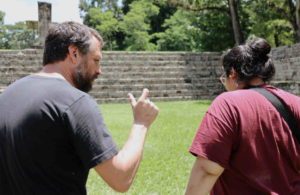
During a Vision Quest in Honduras, Shannon Hopkins (left), a missionary with 61 Isaiah, talks to Diana Lazo, a senior at Texas Woman’s University. (TBM Photo)

This is why Cave and the five students headed to Honduras. Cave had the discipleship training plan to teach, and TBM partnered with 61 Isaiah Ministries to provide the missions experience.

“Vision Quest is designed to turn our attention towards Jesus in a way that brings clarity to our life,” Cave said. “God has wired each of us in different ways for various reasons. Through the local missionaries, as well as a TBM life-mapping process, Vision Quest helps participants develop an individual life plan based on our unique gifts and talents.

“Students who go on a Vision Quest encounter inspirational teaching from local missionaries, as well as discover how they are uniquely wired for life and ministry.”

Each student participating in the July Vision Quest was from a large Texas city, “so going to Honduras was a retreat from life,” said Faith Dawood, a Dallas Baptist University student who participated. “God allowed our hearts to slow down. We could pray for one another, ponder about life and God’s call, learn from trusted people working in ministry and serve the community.”

Every morning started with a teaching session about important aspects of a Christian young adult’s walk with God. This included how to observe Sabbath and how to maintain good mental, spiritual, emotional and physical health to enable a believer to serve Christ fully. Additionally, the students talked about how important it is to know God’s heart, so they can know how to serve.

After teaching and sharing sessions ended, students went out into the city with 61 Isaiah Ministries and participated in hands-on ministry. They visited a local village and played sports with kids who didn’t have toys. They visited Ruben House, which helps injured people who do not have the financial means to secure medical equipment and treatment.

Vision Quest students also shared their testimonies via a Honduran Christian radio station. Students later learned from 61 Isaiah Ministries leaders about people who accepted Christ because of the testimonies they presented on the station.

With the small group size, the team bonded with one another quickly, Dawood said.

“The design of the trip allows students to speak into one another’s lives,” she said. “Often, you don’t see the qualities and gifts God has given you until you are told by others. This is where the Lord spoke through participants the most, and we learned about one another’s lives.”

Cave called Vision Quest “a Mary trip, not a Martha trip,” referring to the two sisters in the New Testament—one of whom was content to sit at Jesus’ feet and learn, while the other needed to be busy.

“If you decide to go on a Vision Quest, allow yourself to rest and learn with the Lord,” he said.

The Vision Quest focus has been on college students, but “Vision Quest is for every person,” Cave said.

“If you are a believer in Christ, then you are called to do something. If you want to seek the Lord in what to do and how you are wired, then Vision Quest is for you,” he said. “My hope is that every Christian in Texas will one day have an opportunity to go on their own personal Vision Quest.”


McLaurin lies on resume, resigns from SBC executive post

NASHVILLE—Willie McLaurin has resigned as interim president and CEO of the SBC Executive Committee, after confessing he lied about his educational background on his resume.

In an email to members of the Executive Committee, Chairman Phil Robertson stated the presidential search committee that was considering McLaurin for the permanent post discovered “disqualifying information during their process of vetting and due diligence.”

McLaurin wrote in his resignation letter that “in a recent resumé that I submitted, it included schools that I did not attend or complete the course of study.”

He confessed the deception to Robertson and Neal Hughes, chair of the presidential search committee, on Aug. 17.

Baptist Press reported McLaurin’s resume listed degrees from North Carolina Central University, Duke University Divinity School and Hood Theological Seminary.

Hughes said three search committee members spent four weeks individually investigating the validity of the degrees. Each school confirmed McLaurin never graduated from that institution.

“To the Southern Baptists who have placed their confidence in me and have encouraged me to pursue the role of President & CEO of the SBC Executive Committee, including pastors, state partners, entity servants, colleagues, and SBC African American friends, I offer my deepest apologies,” McLaurin said in a resignation letter submitted to Executive Committee officers. “Please forgive me for the harm or hurt that this has caused.”

Philip Robertson, chairman of the SBC Executive Committee, noted that in a “commitment to transparency” the EC will be issuing “further updates related to next steps to the presidential search team and SBC Executive Committee’s staff leadership in the near future.”

Robertson added, “I want to express my deep appreciation for your prayers for the SBC Executive Committee’s members and staff as well the presidential search team. The need for God’s wisdom and direction is paramount at each and every point in the process of searching and selecting the next president and CEO of the SBC Executive Committee. Please keep the EC staff and the McLaurin family in your prayers.”

The Executive Committee is scheduled to meet Sept. 18-19.

McLaurin served as interim since Feb. 1, 2022. Prior to that role, he served as vice president for Great Commission relations and mobilization at the Executive Committee for two years, coming to the role in January 2020.

He served with the Tennessee Baptist Mission Board from 2005 until going to the Executive Committee. Prior to that role, McLaurin was executive pastor at Greater Missionary Baptist Church in Clarksville, Tenn., and senior pastor at Greater Hope Baptist Church in Union City, Tenn.

He has also served as an interim pastor for numerous Southern Baptist churches.

McLaurin previously served on the SBC Resolutions Committee in 2018 and as president of the Black Southern Baptist Denominational Servants Network in 2011–12.

He also was on the executive board of the Tennessee Baptist Convention from 2003 to 2005 and was the inaugural president of the African American Fellowship of the Tennessee Baptist Convention.

McLaurin is a member of Simeon Baptist Church in Antioch, Tenn. He and his wife, Antonia, have two daughters, Sienna and SiChanna.

He is the first African American to have led an SBC entity and followed Ronnie Floyd, who resigned as Executive Committee president and CEO in October 2021. Floyd served in the role for less than 30 months before leaving the post.

Compiled from reports by The Baptist Paper and Baptist Press.


TBM responding to support church efforts in Maui

WAILUKU, Hawaii—The danger from fires and the challenge of ministry in a disaster zone have not passed on the island of Maui.

 Pastor Rocky Komatsu of Waiehu Community Church told Texas Baptist Men Aug. 16 the fires are still burning and not fully contained.

Churches in Hawaii have converted sanctuaries into distribution centers for emergency supplies to help meet neighbors’ needs. (Photo courtesy of TBM)

TBM is partnering with Waiehu Church—a congregation planted by Kahului Baptist Church five years ago—to meet the influx of needs by passing along tens of thousands of dollars given by TBM supporters in recent days, said Rand Jenkins, senior director of advancement.

Jenkins spoke to Komatsu Wednesday afternoon to determine the best way to help.

“The church has been addressing immediate needs by providing generators, water, fuel and other necessities,” Jenkins said.

“Now they are shifting their focus, with church members housing those who lost their homes. One family is hosting 28 additional people. Think what that does to your water, electricity, food and other bills.”

The church has even reached out to some of their friends who are nonbelievers to host people in their homes on behalf of the church.

“What we need now are funds,” Komatsu said. “Yesterday, I became nervous about having to penny pinch, because items are so expensive, and the need is so great.”

TBM committed to send more funds to meet the crisis, Jenkins said. He noted TBM stays in ongoing contact with funded entities to track how funds are used.

“It’s important that we provide general oversight on all funds that TBM disburses,” he said.

Years of rebuilding ahead

The process of removing ash from the burned-out houses has not yet begun, Komatsu said. It’s not safe now for people to come in and help.

“We are going to need years of support for rebuilding,” the pastor said. “We need funding now. But in months ahead, we will need years of rebuilding assistance.”

Komatsu noted the situation is not just a matter of destroyed homes. Many other homes have suffered severe wind damage to roofs, windows and walls.

After speaking with the pastor Jenkins said simply: “It’s big. It’s not over.”

John Hall, TBM director of communications, said: “The response from the TBM family already has been incredible. We are already making an impact in Hawaii, and we’re just at the start of this.

“We are still very early in the relief process. Lahaina is the city we’re all seeing most often on the news, but the devastation is much broader.”

By communicating closely with partners on the ground in Maui, TBM is in a position to support residents in the best way possible and provide service connected with a Christian witness, Hall said.

Fire recovery and rebuilding efforts will not begin for weeks. TBM leaders are optimistic TBM volunteers will be serving in Maui during that process.

“Our many volunteers are always ready to help,” Hall said. “Right now, we simply have to wait to see exactly what the needs are and how we might be able to work with local officials, churches and residents.

“This will be a long recovery process for Maui.”