Barber urges SBC to remember and learn from history

NASHVILLE, Tenn. (RNS)—The fall meeting of the Southern Baptist Convention’s Executive Committee began with prayer, some hard news and calls for unity after years of turmoil and change.

Those attending also got a history lesson about how the denomination overcame a crisis a century ago, with the hope that lessons from the past could inspire unity in the present.

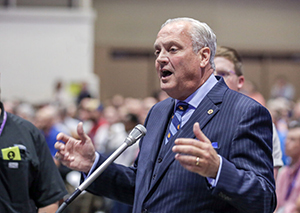
“When all the dozens of reasons to throw in the towel and abandon our one sacred effort were easy to find, we chose instead to search hard for reasons to lean in and cooperate harder,” SBC President Bart Barber told the Executive Committee trustees.

Meeting in a hotel ballroom a few miles from the committee’s offices, about 80 trustees—the body that oversees the day-to-day governance of the SBC—gathered for the first time in person since the committee’s leader resigned after admitting he had faked his resume.

Willie McLaurin, who was serving as the Executive Committee’s interim president and CEO, resigned Aug. 17 after a committee vetting him as a candidate for the permanent position discovered the fraud. McLaurin was the fourth person to lead the Executive Committee since 2018, and the third to step down amid controversy.

His departure was followed by news last week that five staffers and two contractors had been laid off due to the committee’s troubled finances.

‘A cost to doing the right thing’

Jonathan Howe, who has filled in as temporary interim leader since McLaurin’s departure, told trustees the committee’s reserves had dropped from nearly $14 million two years ago to about $4 million today. The committee will need to draw on additional reserves to balance its budget this year.

Committee members also learned this week retired Kentucky pastor Dan Summerlin had been nominated to replace Howe as interim president and CEO, but he withdrew his name from consideration.

The search for a permanent leader—now nearly 2 years old—continues, with the search committee hoping to identify a candidate by February 2024. The committee is also expected to discuss an internal investigation into McLaurin’s tenure, likely in executive session.

Since 2019, the SBC has been reckoning with political divides, fights over doctrine, leadership failures and a sexual abuse crisis.

Members of the committee have been divided over how to respond to the ongoing crisis, with some warning a transparent investigation into SBC leaders’ management of sexual abuse might lead to financial ruin and others quitting in protest.

Howe gave a nod to some of the challenges the committee has faced in his report and to the recent layoffs.

“There is a cost to doing the right thing,” Howe said.

Howe also called for trustees to band together to act with humility to fulfill their mission, reminding them they serve the denomination’s churches, from the smallest rural congregation to the largest megachurch.

“We serve the Southern Baptist Convention,” he said. “It does not serve us.”

Update on Ministry Check database of abusers

Oklahoma pastor Mike Keahbone gave an update from a task force charged with implementing a number of reforms meant to address sexual abuse in the denomination. Chief among those reforms is setting up a “Ministry Check” database of abusive pastors.

Work on that database continues, but no names have been added to it so far. Keahbone said no date had been set yet for when names would be added but added he hoped it would be soon. He also said the volunteer task force is committed to making SBC churches safer for everyone.

Along with the work on the database, Keahbone said the task force has partnered with state conventions on abuse prevention tools. They are also searching for an entity that can oversee abuse prevention on a permanent basis.

“We will not retreat from this fight,” he said.

Looking back a century

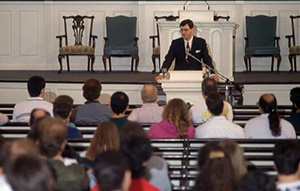
Barber, pastor of First Baptist Church in Farmersville, closed the evening with a call for Southern Baptists to rise above their current troubles. He began his report by promising not to preach. Instead, he gave a history lesson to trustees, reminding them of the denomination’s troubles in the 1920s and 1930s.

At that time, he said, Southern Baptists faced financial crisis, doctrinal divides and failed leadership, including a pair of leaders who embezzled more than a million dollars from the convention’s two missionary boards.

Southern Baptists, he said, also faced a political crisis. After winning the battle to ban alcohol with the passage of the 18th Amendment in 1919, they faced a backlash against Prohibition, only to see the Democratic Party, which they then supported, nominate New York Gov. Al Smith, who was both Catholic and “an imbiber,” Barber said.

In the 1930s, the Great Depression derailed a major campaign to fund missions and one of the SBC’s prominent seminaries was set to close when a last-minute infusion of cash saved it, said Barber, who called the era “the moment of our deepest despair.”

When all seemed lost, Baptists created what is now known as the Cooperative Program, a shared mission funding program, and the statement of faith, known as the Baptist Faith and Mission, to bind them together.

Today, with Baptists once again facing division, financial woes, political turmoil, doctrinal divides and a crisis of leadership, Barber called on his fellow SBC leaders to once again overcome those challenges with a common mission.

“We do not lack money. We do not lack planning. We do not lack opportunity,” Barber said. “God help us, what we lack is inspiration.”

 Barber, who recently appointed a “cooperation group” to help the SBC move forward, asked his fellow trustees to stop following those who want to tear things down and instead work together.

“The dream of cooperation carried us through the 1920s and 1930s, and it will carry us through the 2020s too,” he said.



Guarneri elegido como director del BGCT

Guarneri Elegido como Director del BGCT

La Cámara Ejecutiva de la Convención General Bautista de Texas en su reunión del 18 y 19 de septiembre en Dallaseligió a Julio Guarneri, pastor de la Iglesia Bautista Calvary en McAllen, como director ejecutivo.

Guarneri, quien fue elegido para un segundo mandato como presidente de BGCT en la Reunión Familiar de los Bautistas de Texas en Julio, es el primer individuo hispano en servir como director ejecutivo de BGCT.

A diferencia del precedente establecido, la junta delibero una sesión ejecutiva a puerta cerrada de una hora de duración para un turno de preguntas y respuestas con Guarneri.

Después de regresar a la sesión abierta, la junta votó por papeleta la elección de Guarneri. Recibió 55 votos a favor y 12 en contra.

A la luz de la elección de Guarneri como director ejecutivo y su renuncia como presidente del BGCT, el directorio aprobó una resolución afirmando la sucesión de oficiales de la BGCT de acuerdo a la Constitución de la BGCT.

El Primer vicepresidente Ronny Marriott, pastor de la Primera Iglesia Bautista en Burleson, es declarado presidente de la BGCT, y la Segunda Vicepresidenta Debbie Potter, ministra para niños de la Iglesia Bautista Trinity en San Antonio, es declarada a ser primer vicio presidenta.

Wendell Wright de Iglesia Park Cities en Dallas, silla del comité de búsqueda, se dirigió a la junta la noche antes de la elección de Guarneri como director ejecutivo, elogiándolo como “un hombre de humildad y paz”.

“Su capacidad a escuchar pensativamente, y todavía dirigir decisivamente con visión y convicción, servirá a los bautistas de Texas inmediatamente y en el futuro en esta cultura que cambia rápidamente”, dijo Wright.

En comentarios hacia la junta, Guarneri habló del llamando de Dios en su vida y la influencia de los bautistas de Texas en su ministerio.

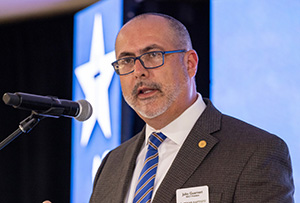
Julio Guarneri es el recién elegido director ejecutivo de la Convención General Bautista de Texas. (Foto BGCT)

“He buscado servir a las iglesias donde Dios me ha llamado, llevándolas a ser iglesias de la Gran Comisión y a ser iglesias misionales”, dijo Guarneri.

“Al estar frente a ustedes, quiero decir que soy un producto de BGCT. Mi llamado al ministerio fue en un evento de BGCT. Fui asesorado por el personal de BGCT. Me animaron en mi educación doctoral en una escuela de BGCT.Mi llamar y El enfoque del BGCT en la Gran Comisión y el Gran Mandamiento son uno en lo mismo”.

Julio Guarneri es el recién elegido director ejecutivo de la Convención General Bautista de Texas.

Guarneri agradeció a Texas Baptists por su restante enfoque en la misión que Dios ha dado.

“Como dije en la reunión familiar en McAllen a principios de este año, estoy muy agradecido que BGCT es no una convención impulsada por problemas pero a impulsada por una misión, afirmó”, dijo. “Es por eso que estoy tan entusiasmado con la oportunidad de desempeñar este cargo. Somos una gran y diversa familia de todo Texas … todos unidos para el objetivo de proclamando Cristo”.

Él admitió “excelente desafíos adelante” para Texas Baptists.

“Hay quienes quisieran sembrar división. Hay quienes quisieran que tuviéramos una carpa más pequeña”, dijo Guarneri.

“Al mismo tiempo, tenemos un estado en crecimiento con una población en crecimiento. No existe una mayoría étnica en nuestro estado, aunque los hispanos son el grupo étnico más grande. El mundo ha llegado a Texas.

“Nuestras iglesias están haciendo un gran trabajo. Nuestras instituciones están haciendo un gran trabajo. Nuestro personal de BGCT está haciendo un gran trabajo. Pero las necesidades son mayores”.

Cumplir la Gran Comisión exige más que seguir como de costumbre, enfatizó. Los bautistas de Texas no pueden hacerlo solos, pero pueden desempeñar un papel estratégico en asociación con otros.

“Nuestra agenda debería ser la agenda de Jesús”, dijo, citando los comentarios de Jesús en la sinagoga de Nazaret registrados en Lucas 4:18-19.

“Nuestra agenda debe ser proclamar las Buenas Nuevas a todas las personas de nuestro estado: ser un pueblo del reino, ser un pueblo de Jesús”.

Guarneri ha servido en la Iglesia Bautista Calvary en McAllen, una congregación multicultural en el Valle del Río Grande, desde 2010. Anteriormente, fue pastor de la Iglesia Bautista Getsemani en Fort Worth.

También sirvió en el personal de la Segunda Iglesia Bautista en Corpus Christi, fue fundador pastor de la Misión Bautista Shalom en Corpus Christi, y fue pastor de la Primera Iglesia Bautista en Taft.

Él nació en México y fue graduado de la preparatoria en el sur Texas y obtuvo una licenciatura de la Universidad Texas A&I en Kingsville. También tiene una Maestría en Educación Religiosa del Seminario Teológico Bautista Southwestern y un Ph.D. en estudios de liderazgo con concentración en ministerio de la Universidad Bautista de Dallas.

Guarneri ha presidido la junta directiva de Buckner International y ha formado parte de otros comités y juntas denominacionales.

Él y su esposa Mónica tienen cuatro hijos Josh, Rachel, Mia y Stevan y dos nietos: Daniel y Antares.

Junta aprueba 2024 presupuesto

Además de elegir a Guarneri como director ejecutivo, la junta también aprobó un presupuesto total de Texas de $35,294,994 para 2024, ligeramente por debajo del presupuesto de $35.46 millones para 2023.

Mientras que los mensajeros a la reunión anual de BGCT normalmente aprueban el presupuesto, la Junta Ejecutiva está autorizada a aprobar el presupuesto en los años en que la reunión anual se lleva a cabo como parte de la ReuniónFamiliar de los Bautistas de Texas en el verano.

El presupuesto total incluye un presupuesto neto de los Bautistas de Texas de $33.79 millones que depende de $27.117 millones en donaciones del Programa Cooperativo de Texas de las iglesias y un monto anticipado de $6.675 millones en ingresos por inversiones. También proyecta alrededor de $1.5 millones en ingresos adicionales por tarifas de conferencias y tarifas de stand, ventas de productos y otras fuentes.

Los ingresos no designados de las iglesias afiliadas seguirán dividiéndose en un 79 por ciento para la BGCT y un 21 por ciento para causas mundiales.

Se anticipan $1.1 millones en iniciativas y colaboraciones de misiones en todo el mundo y serán asignadas en lamisma manera como el año anterior: $340,000 para misiones de movilización, $200,000 para River Ministry yMisiones en México, $100,000 para Colaboraciones en Texas, $55,000 para la Alianza Mundial Bautista, $5,000 para la Fraternidad Bautista de América del Norte, $50,000 para intercultural internacional iniciativas, $200,000 paraMisiones Go Now, $100,000 para iniciativas de GC2, $20,000 para el Grupo de Trabajo de Educación Hispana y $30,000 para la capellanía.

La junta votó a favor de contratar a la firma Batts, Morrison, Wales y Lee para realizar la auditoría financiera.

Otro Ejecutivo Junta negocio

Por recomendación del Comité de Relaciones Institucionales, la junta autorizó a Valley Baptist Missions Education Center a aumentar su endeudamiento más allá del límite de 20 por ciento de total neto activo auditado.

Por recomendación del Comité de Nominaciones para Juntas Directivas de Afiliadas ministerios, la junta aprobó a Elizabeth Dixon de First Baptist Church en Universal City a la junta directiva de la Baptist Health Foundation de San Antonio.

La junta aprobó una recomendación para revisar la constitución de Singing Men of Texas y Singing Women of Texas para reestructurar su junta asesora, junto con una revisión de la poliza de igualdad de oportunidades de empleo de BGCT para estipular que la convención puede discriminar por motivos de religión.

Rellenos vacantes

En otros asuntos, la junta cubrió múltiples vacantes en consejos y comisiones:

  • Eric Anthony Brown de la New Jerusalem Baptist Church en Greenville al Affinity Ministries Council.
  • Malcom Barrington de Fallbrook Baptist Church en Houston, David Kirk de First Baptist Church en San Antonio, David Edmonds de South Tulsa Baptist Church en Tulsa, Okla., y Kristen Curtis Heritage Baptist Church en Farmville, Va., al Consejo de Respaldo de Capellanía.
  • Abigail Rojas de la Iglesia Bautista Azle Avenue en Fort Worth, Brandon Skaggs de First Baptist Church en Belton, Raymond Sánchez de First Baptist Church en Weslaco y Ryan Buck de Immanuel Baptist Church en San Angelo a la Comisión de Vida Cristiana.
  • Olga Harris de First Baptist Church en Pharr, Rebecca Retta de First Baptist Church en Temple, Gilma Juarez de First Baptist Church en Kaufman, Sergio Ramos de Getsemaní Baptist Church en Fort Worth, Jordan Villanueva de First Baptist Church en Blanket y Nathan Escamilla de la Iglesia Cristiana El Buen Pastor en Fort Worth al Consejo de Iniciativa de Educación Hispana.
  • Daniel Whitehurst de First Baptist Church en Longview al Consejo de Auditoría Institucional.
  • Jackie Faughn de First McKinney Baptist Church en McKinney, Norberto Palmitano de Shiloh Terrace Baptist Church en Dallas, Rand Jenkins de Bethlehem Baptist Church en Mansfield y Wendell Wright de Park Cities Baptist Church en Dallas, al Consejo Coordinador de Compromiso Misional.
  • Nancy Jackson de First Baptist Church en Woodway, Chad Mason de First Baptist Church en Boerne, Chad Bertrand de South Park Baptist Church en Alvin, Bryan Pinson de First Baptist Church en Midland y Edgardo Martínez deFirst Baptist Church en El Paso, al Consejo de Financiamiento de Misiones.
  • Wes Brown de Cowboy Church del condado de Collin en Princeton, Werth Mayes de Cowboy Church del condado de Erath en Stephenville y Jay Johnson de San Angelo Cowboy Church, al Western Heritage council.
  • Ann Bradshaw de Tallowood Baptist Church en Houston, Ken Box de First Baptist Church en Waxahachie, Don Allen de Sugar Creek Baptist Church en Sugar Land, Grady Tyroch de First Baptist Church en Temple, JamesWestbrook y Roberto Power de First Baptist Church en Richardson, Sam Jones de First Baptist Church en Arlingtony Merritt Johnston de First Baptist Church en Brenham, al Consejo de la Fundación de Misiones Bautistas de Texas.
  • Stephanie Beazley de Second Baptist Church en Corpus Christi, Jeff Smith de Park Cities Baptist Church enDallas y Betty Booth de First Baptist Church en Tyler, al Consejo Bautista de Historia y Distintivos.
  • Jason Atchley de Hunters Glen Baptist Church en Plano y Karen Bullock de la Lake Side Baptist Church en Granbury al Consejo de Educación Teológica.


Guarneri elected as BGCT executive director

The Baptist General Convention of Texas Executive Board at its Sept. 18-19 meeting in Dallas elected Julio Guarneri, pastor of Calvary Baptist Church in McAllen, as executive director.

Guarneri, who was elected to a second term as BGCT president at Texas Baptists’ Family Gathering in July, is the first Hispanic individual to serve as BGCT executive director.

In a departure from established precedent, the board went into an hourlong closed-door executive session for a question-and-answer time with Guarneri.

After returning to open session, the board voted by ballot on Guarneri’s election. He received 55 votes in favor and 12 opposed.

In light of Guarneri’s election as executive director and resignation as BGCT president, the board approved a resolution affirming the succession of convention officers according to the BGCT Constitution.

First Vice President Ronny Marriott, pastor of First Baptist Church in Burleson, is declared president of the BGCT, and Second Vice President Debbie Potter, minister to children at Trinity Baptist Church in San Antonio, is declared to be first vice president.

Wendell Wright of Park Cities Baptist Church in Dallas, chair of the search committee, addressed the board the evening before Guarneri’s election as executive director, praising him as “a man of humility and peace.”

“His ability to listen thoughtfully, yet lead decisively with vision and conviction, will serve Texas Baptists immediately and in the future in this rapidly changing culture,” Wright said.

In remarks to the board, Guarneri talked about God’s calling on his life and Texas Baptists’ influence on his ministry.

“I have sought to serve the churches where God has called me, leading them to be Great Commission churches and to be missional churches,” Guarneri said.

“As I stand before you, I want to say I am a product of the BGCT. My call to ministry was at a BGCT event. I was mentored by BGCT staff. I was encouraged in my doctoral education at a BGCT school. My call and the focus of the BGCT on the Great Commission and the Great Commandment are one in the same.”

Julio Guarneri is the newly elected executive director of the Baptist General Convention of Texas. (BGCT Photo)

Guarneri thanked Texas Baptists for remaining focused on the mission God has given.

“As I said at the Family Gathering back in McAllen earlier this year, I am so thankful the BGCT is not an issue-driven convention but a mission-driven convention,” he said. “That’s why I am so excited about the opportunity to serve in this role. We are a great, diverse family from all over Texas … all united for the purpose of proclaiming Christ.”

He acknowledged “great challenges ahead” for Texas Baptists.

“There are those who would like to sow division. There are those who would like us to have a smaller tent,” Guarneri said.

“At the same time, we have a growing state with a growing population. There is no ethnic majority in our state, although Hispanics are the largest ethnic group. The world has come to Texas.

“Our churches are doing great work. Our institutions are doing great work. Our BGCT staff is doing great work. But the needs are greater.”

Fulfilling the Great Commission demands more than “business as usual,” he stressed. Texas Baptists cannot do it alone, but they can play a strategic role in partnership with others.

“Our agenda ought to be Jesus’ agenda,” he said, quoting from Jesus’ remarks at the synagogue in Nazareth as recorded in Luke 4:18-19.

“Our agenda should be to proclaim the good news to all people in our state—to be a kingdom people, to be a Jesus people.”

Guarneri has served Calvary Baptist Church in McAllen—a multicultural congregation in the Rio Grande Valley—since 2010. Previously, he was pastor of Iglesia Bautista Getsemani in Fort Worth.

He also served on staff at Segunda Iglesia Bautista in Corpus Christi, was founding pastor of Shalom Baptist Mission in Corpus Christi, and was pastor of Primera Iglesia Bautista in Taft.

He was born in Mexico and graduated from high school in South Texas and earned an undergraduate degree from Texas A&I University in Kingsville. He also holds a Master of Arts in Religious Education degree from Southwestern Baptist Theological Seminary and a Ph.D. in leadership studies with a ministry concentration from Dallas Baptist University.

Guarneri has chaired the board of Buckner International and served on other denominational committees and boards.

He and his wife Monica have four children—Josh, Rachel, Mia and Stevan—and two grandchildren—Daniel and Antares.

Board approves 2024 budget

In addition to electing Guarneri as executive director, the board also approved a $35,294,994 total Texas budget for 2024, down slightly from the $35.46 million budget for 2023.

While messengers to the BGCT annual meeting normally approve the budget, the Executive Board is authorized to approve the budget on years when the annual meeting is held as part of Texas Baptists’ Family Gathering in the summer.

The total budget includes a $33.79 million net Texas Baptist budget that depends on $27.117 million in Texas Cooperative Program giving from churches and an anticipated $6.675 million in investment income. It also projects about $1.5 million in additional revenue from conference and booth fees, product sales and other sources.

Undesignated receipts from affiliated churches will continue to be divided 79 percent for the BGCT and 21 percent for worldwide causes.

An anticipated $1.1 million in worldwide missions initiatives and partnerships will be allocated in the same manner as the previous year: $340,000 for missions mobilization, $200,000 for River Ministry and Mexico missions, $100,000 for Texas Partnerships, $55,000 for the Baptist World Alliance, $5,000 for the North American Baptist Fellowship, $50,000 for intercultural international initiatives, $200,000 for Go Now Missions, $100,000 for GC2 initiatives, $20,000 for the Hispanic Education Task Force and $30,000 for chaplaincy.

The board voted to enlist the Batts, Morrison, Wales and Lee firm to conduct the financial audit.

Other Executive Board business

At the recommendation of the Institutional Relations Committee, the board authorized Valley Baptist Missions Education Center to increase its indebtedness beyond the threshold of 20 percent of total audited net assets.

At the recommendation of the Committee on Nominations for Boards of Affiliated Ministries, the board approved Elizabeth Dixon from First Baptist Church in Universal City to the Baptist Health Foundation of San Antonio board of trustees.

The board approved a recommendation to revise the constitution for Singing Men of Texas and Singing Women of Texas to restructure their advisory board, along with a revision to the BGCT equal employment opportunity policy to stipulate the convention can discriminate on the basis of religion.

Filling vacancies

In other business, the board filled multiple vacancies on councils and commissions:

  • Eric Anthony Brown from New Jerusalem Baptist Church in Greenville to the Affinity Ministries Council.
  • Malcom Barrington from Fallbrook Baptist Church in Houston, David Kirk from First Baptist Church in San Antonio, David Edmonds from South Tulsa Baptist Church in Tulsa, Okla., and Kristen Curtis from Heritage Baptist Church in Farmville, Va., to the Chaplaincy Endorsement Council.
  • Abigail Rojas from Azle Avenue Baptist Church in Fort Worth, Brandon Skaggs from First Baptist Church in Belton, Raymond Sanchez from First Baptist Church in Weslaco and Ryan Buck from Immanuel Baptist Church in San Angelo to the Christian Life Commission.
  • Olga Harris from First Baptist Church in Pharr, Rebecca Retta from First Baptist Church in Temple, Gilma Juarez from First Baptist Church in Kaufman, Sergio Ramos from Getsemani Baptist Church in Fort Worth, Jordan Villanueva from First Baptist Church in Blanket and Nathan Escamilla from El Buen Pastor Christian Church in Fort Worth to the Hispanic Education Initiative Council.
  • Daniel Whitehurst from First Baptist Church in Longview to the Institution Audits Council.
  • Jackie Faughn from First McKinney Baptist Church in McKinney, Norberto Palmitano from Shiloh Terrace Baptist Church in Dallas, Rand Jenkins from Bethlehem Baptist Church in Mansfield and Wendell Wright from Park Cities Baptist Church in Dallas to the Missional Engagement Coordinating Council.
  • Nancy Jackson from First Baptist Church in Woodway, Chad Mason from First Baptist Church in Boerne, Chad Bertrand from South Park Baptist Church in Alvin, Bryan Pinson from First Baptist Church in Midland and Edgardo Martinez from First Baptist Church in El Paso to the Missions Funding Council.
  • Wes Brown from the Cowboy Church of Collin County in Princeton, Werth Mayes from the Cowboy Church of Erath County in Stephenville and Jay Johnson from the San Angelo Cowboy Church to the Western Heritage Council.
  • Ann Bradshaw from Tallowood Baptist Church in Houston, Ken Box from First Baptist Church in Waxahachie, Don Allen from Sugar Creek Baptist Church in Sugar Land, Grady Tyroch from First Baptist Church in Temple, James Westbrook and Robert Power from First Baptist Church in Richardson, Sam Jones from First Baptist Church in Arlington and Merritt Johnston from First Baptist Church in Brenham to the Texas Baptist Missions Foundation Council.
  • Stephanie Beazley from Second Baptist Church in Corpus Christi, Jeff Smith from Park Cities Baptist Church in Dallas and Betty Booth from First Baptist Church in Tyler to the Baptist History and Distinctives Council.
  • Jason Atchley from Hunters Glen Baptist Church in Plano and Karen Bullock from Lake Side Baptist Church in Granbury to the Theological Education Council.


Commission identifies 95 countries with blasphemy laws

A new report from the U.S. Commission for International Religious Freedom identifies 95 countries with some form of blasphemy law in effect, including five countries that impose the death penalty as the maximum sanction.

A separate report from the commission records the text of the 95 laws criminalizing expressions that insult or offend religious feelings or show disrespect toward religious figures or symbols.

The reports show blasphemy laws are not exclusive to any single region. They document blasphemy laws in 13 countries in the Americas, 28 countries in the Asia-Pacific region, 16 European nations, 18 countries in the Middle East and North Africa, and 20 countries in Sub-Saharan Africa.

Five countries—Iran, Pakistan, Saudi Arabia, Mauritania and Brunei Darussalam—can impose capital punishment on individuals convicted of blasphemy.

“Blasphemy laws are inconsistent with international human right law,” the report states.

Holly Hollman

Holly Hollman, general counsel and associate executive director of the Baptist Joint Committee for Religious Liberty, affirmed the commission’s report.\

“We appreciate this latest report, highlighting the significant number of dangerous blasphemy laws around the world that undermine human rights, not only for religious minorities but for all people,” Hollman said.

“Religious beliefs should never be dictated by government. In addition to threatening violence against religious and political minorities, blasphemy laws tend to exacerbate intolerance that can cause harm across any given population.”

Human rights concerns highlighted

The commission report notes four specific human rights concerns:

  • “Blasphemy laws violate the right to freedom of religion of belief.” Article 18 of the Universal Declaration of Human Rights stipulates individuals have the right to freedom of thought, conscience and religion.
  • “Blasphemy laws violate the right to freedom of opinion or expression.” Individuals have the right to express their beliefs—even if some others find those expressions offensive.
  • “Blasphemy laws promote government intolerance and discrimination toward minorities and minority viewpoints.” The report points to specific examples in Bangladesh, Nigeria, Pakistan, Russia and Turkey.
  • “Blasphemy laws encourage individuals and non-state actors to seek retribution against alleged blasphemers.” The report cites incidents in Nigeria and Sri Lanka, along with multiple examples in Pakistan.

Last month, Muslim mobs burned churches and damaged the homes of Christian families in Pakistan’s Punjab State after two Christian young people were accused of desecrating the Quran.

“While it is legitimate for individuals to speak out against blasphemy, legislation criminalizing blasphemy violates the right to freedom of religion or belief and the right to freedom of opinion and expression,” the commission report states.

“International human rights law protects the rights of individuals; it does not protect religious feelings, figures, or symbols from behavior or speech considered blasphemous. USCIRF urges all countries to repeal their blasphemy laws and free those detained for or convicted of blasphemy.”


Nonbelievers adhere to some Bible-based values

PHILADELPHIA (BP)—Biblical values, especially those regarding pro-social behavior, influence the lifestyles of nonbelievers, researchers said in the latest release from the 2023 State of the Bible from the American Bible Society.

Nonbelievers scored higher than nonpracticing Christians in most Bible-based behaviors studied, researchers found.

Kay Bennett, executive director of Baptist Friendship House, receives a hug from one of the participants at the ministry center’s weekly Bible study. Bennett noted that the Friendship House mission statement simply states, “Meeting needs through love, action and truth.” (WMU photo by Pam Henderson)

“Our research shows that even those Americans who are most hostile toward the Bible value biblical behaviors like loving your neighbor, caring for creation and welcoming the stranger,” said John Farquhar Plake, American Bible Society chief ministry insights officer.

Plake promotes the findings as helpful for churches engaging in community outreach.

“This shared passion for neighborly behavior is a new avenue for ministry leaders to start conversations about the values Americans share,” he said. “And their ultimate source in Jesus and his word.”

In the sixth chapter of the report released Sept. 14, the American Bible Society explored the conjunction of Scripture, Christianity and behavior in such practices as welcoming immigrants, befriending people of other races and other religions, and advocating for the oppressed.

The study considered behavior such as living a healthy lifestyle, caring for one’s mental health and practicing wise money management. How important is it to engage in the community, being aware of civic and government issues, personally participating in civic and government issues, and submitting to government leaders?

In addition, researchers specifically asked whether participants considered it important to be a good neighbor, to care for those in prison and to care for the environment.

“We know that when people engage with the Bible’s message, it transforms their hearts,” Plake said. “And, by looking more closely at pro-social behaviors that are directly inspired by the Bible’s teachings, we can see how Scripture influences the way we live our lives.”

Among the top findings regarding nonbelievers or non-Christians:

  • 51 percent advocate for the oppressed, compared to 46 percent of practicing Christians and 25 percent of nonpracticing Christians.
  • 50 percent befriend other races, compared to 54 percent of practicing Christians and 31 percent of nonpracticing Christians.
  • 46 percent welcome immigrants, compared to 40 percent of practicing Christians and 22 percent of nonpracticing Christians.
  • 43 percent befriend people of other religions, compared to 45 percent of practicing Christians and 30 percent of nonpracticing Christians.

Researchers looked at Scripture including the story of God’s creation in Genesis 1, the command to care for those in prison in Hebrews 13:3, the Parable of the Sheep and the Goats in Matthew 25, and commandments to love your neighbor in Leviticus 19:18 and Matthew 22:39.

Researchers found:

  • 66 percent of nonbelievers think it’s important to care for the environment, compared to 54 percent of practicing Christians and 44 percent of non-practicing Christians.
  • In a category that all respondents scored high, 75 percent of practicing Christians think it’s important to be a good neighbor, compared to 63 percent of nonbelievers and 54 percent of nonpracticing Christians.
  • In a less favorable category, 36 percent of practicing Christians think it’s important to care for those in prison, 25 percent of non-Christians think so, and 13 percent of nonpracticing Christians hold the belief.

The State of the Bible annually looks at the Bible, faith and the church in America. The American Bible Society collaborated with the University of Chicago’s National Opinion Research Center in designing the study conducted online and via telephone.

The 18-minute survey, conducted Jan. 5-30, produced 2,761 responses from a representative sample of adults 18 and older within the 50 states and D.C.


Support urged for persecuted people in Myanmar

The founding president of the 21Wilberforce human rights organization is urging Texas Baptists to sign a letter calling on Congress to provide support for persecuted people in Myanmar, historically known as Burma.

Randel Everett

Randel Everett, a former executive director of the Baptist General Convention of Texas, sent an email Sept. 15 asking Texas Baptist leaders to sign a letter online to Rep. Kay Granger, R-Fort Worth, chair of the House Appropriations Committee, urging full funding for the Burma Act.

“As many of you know, the people of Burma, including many of our Baptist brothers and sisters in the country, have faced a brutal campaign by the military junta that has taken thousands of lives, forced millions to flee, and destroyed many church buildings in their campaign to control and suppress the people’s democratic rights and religious freedoms in the country,” Everett wrote.

Everett noted the importance of contacting Granger and other members of Congress immediately to influence the decision-making process for funding.

“The funding will provide vital aid that will help the communities affected by the violence to rebuild, promote a federal democracy, and hold accountable those responsible for the ruthless abuses of human rights and religious liberty,” he wrote.

The letter to Granger states: “We write you as Baptist leaders in Texas with the request that in reconciliation you support the adoption of the language of the Senate Appropriations bill with regards to the funding provisions for implementing the Burma Act.”

The letter notes attacks by the Burmese military on villages and towns have forced 1.3 million people to flee to neighboring countries and 1.9 million to hide in the jungles of Myanmar.

“We urge you to support them in their effort to reclaim democracy, restore their security and freedoms—including the right to freely follow one’s faith—and redress the injustices perpetrated by this unlawful regime,” the letter states.

‘Campaign of terror and violence’

Since the Burmese military—known as the Tatmadaw—seized control of Myanmar’s government on Feb. 1, 2021, human rights monitors have verified about 3,000 civilian deaths, as well as the destruction of many houses of worship and homes. Considering military action in remote ethnic areas, the actual death toll likely is much higher.

On Sept. 18, 2021, Burmese military shot dead a Baptist pastor in the Chin State. Pastor Cung Biak Hum was shot while he was attempting to help a church member extinguish a fire after the man’s home was set ablaze during military attacks.

The Baptist World Alliance general council at its July 2022 meeting in Birmingham, Ala., approved a resolution condemning the coup in Myanmar and singling out the Burmese military for waging “a campaign of terror and violence, particularly against minority religions.”

Since the coup, Burmese authorities have arrested more than 17,000 people, and at least 13,700 remain imprisoned. Hkalam Samson, past president and former general secretary of the Kachin Baptist Convention, is among the religious leaders who remain imprisoned in Myanmar. Samson was seized last December before he could board a flight to Bangkok, Thailand, for medical treatment.


Trauma deepens for Ukraine war widows and orphans

KYIV, Ukraine (BP)—Sofiya hasn’t spoken since officials found the 6-year-old wandering in a field of debris days after Russia bombed her village near Kharkiv.

Officials haven’t been able to locate Sofiya’s mother.

Sofiya, shown with minister Anara Grace, hasn’t spoken since officials found her wandering among the ruins of Kharhiv after Russia attacked the city. (Submitted photo)

Anara Grace, a Kazakhstan native and member of the prayer ministry of First Baptist Church of Orlando, Fla., saw Sofiya this summer while visiting hard-hit Kyiv.

“She couldn’t speak because of shock she experienced,” Grace said. “There are so many people I met … in different places in Kyiv. They’re traumatized, and they need emotional healing.”

Grace, who founded Voice of the Silent, a ministry to women and children, in 2019, sees the pain of widows and orphans traumatized by Russia’s war on Ukraine.

Grace is building a home for orphans and widows near Mykulychi, a village outside devastated Bucha.

Lada Smell, a Voice of the Silent partner and an adoptive and foster parent of 21 children, is caring for Sofiya. Grace is concerned for the growing number of orphans and widows she said are struggling daily as the war nears another winter.

Grace saw widows and orphans in hospitals and heard their stories of suffering during a one-month trip to Ukraine in July and August.

“In front of their eyes, families were killed, in front of people,” Grace said. “They’re just heartbreaking stories, even very difficult to hear, and I can’t imagine to watch it.

“You can feel the hurt, what they experienced. You can feel it.”

She provided emotional support, visited churches, and donated necessities including food, clothing, blankets and school supplies. The cost of living has skyrocketed during the war, and there are few social programs to help.

Help subsiding as war continues

Through local partners in Ukraine and Europe, Voice for the Silent is among many humanitarian outreach initiatives to the war-torn area. But as the war lingers, Grace senses help is subsiding.

“They still need so much help,” she said. They need trauma care. Many are questioning God. Grace encourages churches in the United States to continue to help.

While visiting Ukraine might be out of reach for many, Grace points to ministry to Ukrainian refugees in Poland and other places in Europe as more achievable.

Ukraine has not issued an official number of the war dead, but U.S. officials estimate nearly 500,000 Ukrainian and Russian soldiers have died in the war. Confirmed civilian casualties in Ukraine alone numbered 9,614 deaths and 17,535 injuries through Sept. 11, the Office of the U.N. High Commissioner for Human Rights reported.

Grace’s outreach to Ukraine predates by a decade or more the official founding of her ministry after Russia’s 2014 invasion of Donetsk and annexation of Crimea. She lived for a year in Ukraine in 2009 and describes a vibrant Christian community in the former Soviet country.

She is looking for ministry partners in the U.S. and abroad. Completion of the widows and orphan home near Bucha will take another $40,000, she said.

“This time, God gave me a very clear vision. We still need to work and help them,” she said. “We are family. We are God’s children, all of us. And we need to help them because who knows what in the future we will experience.”


As Mohler reshaped seminary, he shaped a generation

LOUISVILLE, Ky. (RNS)—Not long after he was named president of Southern Baptist Theological Seminary, Al Mohler stood in front of the student body in the school’s chapel to take questions.

Al Mohler speaks to a forum as the newly selected president of Southern Baptist Theological Seminary in Louisville, Ky, in 1993. (Photo courtesy of SBTS via RNS)

The room was tense. More than a few students, not least the women who had come to the seminary to train to be pastors, were unhappy the board of trustees had elected Mohler. The 33-year-old editor of a Georgia Baptist paper had no experience running any educational institution, never mind a school with nearly 2,000 students.

During the question-and-answer session, one of the students asked how Mohler would supervise faculty members who were much older—and presumably wiser—than he was.

“I intend to age,” he said, provoking laughter and cutting some of the tension.

Thirty years later, Mohler has kept his promise.

“That’s one of the most faithfully fulfilled pledges ever made by a human being,” said Mohler, 63, in a recent interview.

Influence extends far beyond seminary campus

For three decades, Mohler has been one of the most influential leaders among Southern Baptists and the broader evangelical movement, explaining their theology to the outside world and promoting conservative values often at odds with societal trends.

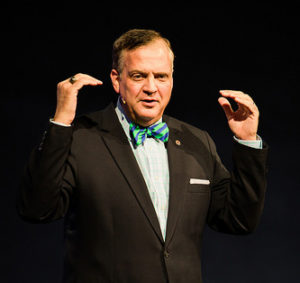
Al Mohler said the Southern Baptist Convention is within its rights to remove Fern Creek and Saddleback because it “has the sole responsibility to establish its own membership and to define what it means to be a cooperative Southern Baptist church.” (BP Photo by Sonya Singh)

Mohler runs an op-ed section at the World Magazine website, helping to shape evangelical views on morals, faith and—above all—politics. A never-Trumper in 2016, he supported Donald Trump four years later.

When Rick Warren, founder of Saddleback Church in California and a legend among Southern Baptist Convention megachurch pastors, challenged the denomination’s ban against women pastors at this summer’s annual meeting in New Orleans, Mohler was selected to go toe-to-toe with Warren.

Yet Mohler’s outspoken views and penchant for controversy can overshadow another truth about the longtime leader. His seminary is thriving at a time when Christian higher education is in turmoil and many other seminaries are selling off their campuses or consolidating and the number of students pursuing Master of Divinity degrees plummets.

“He is one of the most-omnicompetent people I know,” said longtime friend Danny Akin, president of Southeastern Baptist Theological Seminary.

Akin, who worked at Southern in the early years of Mohler’s tenure, attributes his former boss’s staying power to a combination of a relentless work ethic and a very thick skin. Mohler has also proved himself capable, Akin said, of digesting theological tomes while managing the often complex finances and egos of a major educational institution.

Long tenure for a seminary president

Those skills, rather than the mere passage of time, have made Mohler the second-longest-serving president in Southern’s history, outdone only by Duke K. McCall, who led Southern from 1951 to 1982—a record Mohler plans to surpass.

Al Mohler (Photo/Amber Dion)

Mohler also is one of the longest-serving seminary presidents in the country, according to 2020 data from the Association of Theological Schools. Only 2 percent of seminary leaders have been in their roles for more than 20 years, while half have been in their roles for less than five years.

Mohler’s longevity is “highly unusual,” said Chris Meinzer, a senior director and chief operating officer for ATS.

Southern had 3,348 students in the fall of 2022, making it the second largest in the country, according to ATS, after Liberty University’s John W. Rawlings School of Divinity.

In the mid-1990s, things were not so rosy. Mohler had been one of the lieutenants of the so-called Conservative Resurgence, a theological and political revolt in the SBC that wrested control of the denomination from its formerly moderate leadership.

That included installing conservative leaders in the SBC’s institutions, including Southern Seminary, which before Mohler’s tenure had championed women pastors and allowed space for professors to question some conservative interpretations of Scripture.

Changed his mind on women in ministry

As a student in the 1980s, Mohler supported women pastors, and in 1984, he and other students placed a full-page ad in the local newspaper claiming that God was “an equal opportunity employer.”

But a meeting with legendary Christianity Today editor Carl Henry led Mohler to change his mind, he later recalled. At that meeting, Henry told Mohler that he’d regret his support for women in ministry, which sent Mohler off to the seminary library to research the issues.

“I ended up staying up until I could figure this out,” he said during a 2010 chapel service. “Somewhere between Carl Henry saying what he said to me and the dawn of the next day, my position had completely changed.”

But his change of heart toward women pastors cost him students. Three years after he became president, attendance had dropped by some 700 students and took nearly a decade to recover.

Mohler said when he took office, he expected pushback. The school, he said, had strayed from its theological foundations and was out of touch with what most Southern Baptists believed.

“We are talking about the reorientation of an institution that was already, you know, more than 100 years old,” he said. “It was not a small course correction.”

Continually narrowing room for differences

bill leonard350
Bill Leonard was founding dean of the Wake Forest University School of Divinity.

If Southern has regained its momentum under Mohler, the politics have not necessarily gotten easier. Historian Bill Leonard, the founding dean of Wake Forest Divinity School and a former professor at Southern, said that the conservative takeover narrowed the room for differing opinions in the denomination. Then, once the more moderate Southern Baptists left, the conservatives turned on each other.

“There may come a time when there are only two Southern Baptists left, and each will think the other one is a liberal,” Leonard said.

Making Leonard’s point, Mohler played a role in the high-profile departure of Warren this summer and, two years ago, in the exit of the prominent Bible study teacher Beth Moore, who dissented from the SBC’s support of Trump.

Yet Mohler has come under fire himself in recent years from the denomination’s extreme right, whose members claim Southern promotes “woke ideology” by talking about issues of race.

Leonard, who has known Mohler since the 1980s, when the future seminary president was his student, said Mohler’s conversion to the conservative viewpoint was genuine, but it was also a pragmatic decision.

“When he got nominated for the presidency, it appears he decided which way the wind was blowing for him,” Leonard said.

But the real key to Mohler is his personal ethical streak, Leonard said, which has made him equal parts a reformer and a company man.

“He’s not a flamethrower,” Leonard said. “He believes in institutions.”

Leonard said Mohler’s personal ethics have helped him to persevere when many other Southern Baptist leaders have fallen in recent years.

An unapologetic institutionalist

During a recent interview, Mohler agreed with that assessment, saying he was an unapologetic institutionalist. As if to illustrate the point, he said while he and Leonard have very different understandings of what it means to be a Baptist and even of how to interpret the Bible, he called his former professor one of the “best classroom teachers” he ever met.

“I still respect and appreciate those who taught me, even when we disagree,” he said.

Mohler also paid tribute to his predecessors, including McCall and Roy Honeycutt, whom he succeeded. Honeycutt, he said, disapproved of the direction Mohler planned to take the seminary, but he was gracious to Mohler during the handover.

“He was unfailingly a man of character and graciousness, and I am thankful for that,” Mohler said.

Despite his longevity, Mohler said he knows both the denomination and the seminary face challenges as organized religion declines and institutions fall out of favor.

“It’s a humbling moment for the Southern Baptist Convention and for evangelicalism,” he said. “A denomination that found an awful lot of confidence in constantly growing is now going to have to explain what faithfulness looks like when we are not.”

Mohler said he has no plans to retire in the short term.

“I want to continue to be useful to the kingdom and to this institution,” he said. “And I want to be at some point a cheerleader for whoever follows me.”


Obituary: Gil A. Stricklin

Gil A. Stricklin, founder of Marketplace Ministries and former military chaplain, died Sept. 10 at his home in Dallas. He was 88. Gilford Arthur Stricklin was born Sept. 11, 1934, in Sadler to Lessie Caroline Watson and Gilford Lane Stricklin. He accepted Christ as his Lord and Savior at age 12. At Baylor University, he was president of the freshman class, was a yell leader and served in the ROTC. He met Ann March in the fall semester in 1954, and they dated throughout their years at Baylor. They married May 23, 1958, in Waco. He graduated from Baylor with a business degree and a commission in the U.S. Air Force. As a commissioned officer, he was stationed at Donaldson Air Force Base in South Carolina. After three years on active duty in the Air Force, including a tour to Antarctica, the family moved back to Fort Worth where he attended Texas Christian University, receiving a degree in journalism while working for the Fort Worth Press and the Fort Worth Star-Telegram. He also earned a degree from Southwestern Baptist Theological Seminary. In 1965, he was invited to join the Billy Graham Evangelistic Association to serve in preparation for the upcoming World Congress on Evangelism and as a special assistant to Graham. For the following six years, he traveled the world, setting up press conferences for the evangelist and working with the media. In 1970, the family moved to Dallas when he went to work for the Baptist General Convention of Texas, where he pioneered the Super Summer Youth Evangelism program, which continues today. At the same time he was serving his 15 years with the BGCT, he also went to flight school and achieved both his instrument and multi-engine rating pilot licenses. He transitioned from the Air Force to the U.S. Army, serving as a chaplain during Operation Desert Storm and Desert Shield. He graduated from the U.S. Army Command and General Staff College in 1973. In 1983, he graduated from the U.S. Army War College, as only the seventh chaplain to do so. Three years later, he graduated from the National Defense University in Washington, D.C. During his active-duty military service, he officiated nearly 100 funerals at Arlington National Cemetery. In 1994, he retired from the U.S. Army as a colonel after serving his country 37 years—15 years in the Air Force and 22 years in the Army. In 1983, he founded Marketplace Ministries, which offers chaplain care to business employees. The organization now serves more than 1,000 companies with 1.2 million employees being helped. Stricklin was a member and deacon at First Baptist Church in Dallas more than five decades. He was a Distinguished Alumnus at Baylor University, where he was a devoted fan of all sports. He was preceded in death by three brothers, Don, Jerry and Jimmy Stricklin. He is survived by his wife of 65 years, Ann March Stricklin; sons Art and his wife Belinda of Dallas and Cliff and his wife Christy of Denver, Colo.; four grandchildren; and a brother, Charles Stricklin of Newport, Calif. Services will be at 2 p.m. Sept. 19 at First Baptist Church in downtown Dallas. In lieu of flowers, donations may be made to Marketplace Chaplains—Founder’s Endowment, 2001 West Plano Pkwy, Ste 3200, Plano TX 75075.




SBC Executive Committee eliminates staff positions

NASHVILLE (BP)—The SBC Executive Committee eliminated five staff positions and two contractor positions Sept. 13.

“Over the past few weeks, our current leadership and officers met at length to determine various ways to most effectively steward the resources provided to us by Southern Baptist churches,” said Jonathan Howe, interim president.

“As a result, our financial realities have led to an organizational restructuring and the reduction of staff and operational expenses.”

Executive Committee staff were informed of the changes Wednesday morning. The restructuring leaves 21 full-time employees at the Executive Committee.

“We are thankful for the service those affected have given to Southern Baptists and the SBC Executive Committee. The continuing staff are fully committed to accomplishing the messenger-approved ministry assignments,” Howe said in the statement.

The board is set to vote on the approval of an Executive Committee budget and the SBC operating budget at its regularly scheduled meeting in Nashville, Sept. 18-19.

In February, Executive Committee members learned the organization realized a significant net loss of more than $6 million in assets during the 2021-2022 fiscal year.

The Executive Committee “has incurred significant expenses from investigations and legal fees,” said Mike Bianchi, interim chief financial officer, in written comments for Baptist Press.

“This has led to a substantial erosion of EC reserves, necessitating considerable expense reductions to avoid entirely depleting cash reserves,” Bianchi stated.

“The adjustments are an important stopgap to extend the life of the cash reserves, but despite the expense reductions, the EC will still have to draw from reserves to cover ongoing investigation and legal expenses in the 2023-2024 budget.”


SBC president names members of cooperation group

A North Texas associational missionary and the pastor of a church dually aligned with the Baptist General Convention of Texas and the Southern Baptists of Texas Convention are among the members of a newly named group exploring what it means for a church to be in “friendly cooperation” with the Southern Baptist Convention.

SBC President Bart Barber, pastor of First Baptist Church in Farmersville, named Matt Henslee of Collin Baptist Association and Jason Paredes, pastor of Fielder Church in Arlington, a dually aligned congregation, to the 20-member cooperation group.

In addition to chairman Jared Wellman, pastor of Tate Springs Baptist Church in Arlington, the group also includes the pastor of another SBTC congregation, Juan Sanchez from High Pointe Baptist Church in Austin, and Jim Richards, executive director emeritus of the SBTC.

Other members are:

  • Victor Chayasirisobhon, executive and co-lead pastor of First Southern Baptist Church in Anaheim, Calif.
  • Jerome Coleman, pastor of First Baptist Church Crestmont in Willow Grove, Pa.
  • Tara Dew, speaker and wife of Jamie Dew, president of New Orleans Baptist Theological Seminary.
  • Donna Gaines, a speaker, author and Bible teacher, wife of Steve Gaines, pastor of Bellevue Baptist Church in Cordova, Tenn.
  • Travis Kerns, associational mission strategist at Three Rivers Baptist Association in Taylors, S.C.
  • Richard Land, former president of the SBC Ethics & Religious Liberty Commission.
  • Jonathan Leeman, editorial director at 9Marks and elder at Cheverly Baptist Church in Bladensburg, Md.
  • Gregory Perkins, lead pastor of The View Church in Menifee, Calif., and current president of the National African American Fellowship.
  • Andrew Walker, ethics and public theology professor at Southern Baptist Theological Seminary.
  • Trevin Wax, author and vice president of research and resource development at the North American Mission Board.
  • Tony Wolfe, executive director-treasurer of the South Carolina Baptist Convention.

Serving in ex officio roles are Barber, SBC Second Vice President Kason Branch, SBC Registration Secretary Don Currence and SBC Recording Secretary Nathan Finn.

Either reassert or redefine cooperation

Addressing “things we have never done before” in the history of the Southern Baptist Convention will permeate the group’s discussions, Barber said.

The group will present a report to the SBC annual meeting next June that could reassert or redefine what constitutes a church to be in friendly cooperation with the SBC.

“These declarations that churches are not in friendly cooperation and these appeals in response to those declarations represent a change in the fundamental processes by which we cooperate with one another,” he said.

The 20-member cooperation group was created in response to a motion at the 2023 SBC annual meeting in New Orleans.

“Cooperation, at its heart, is an agreement between churches who provide support and believers who stand on the front lines of our shared mission,” Barber said, alluding to missionaries, professors and other denominational workers.

“This grand agreement, some of it written and some of it unwritten, consists of the specific terms by which churches are comfortable providing support and workers are comfortable providing their service to those churches.

“Within our convention exists a widespread sentiment that the terms of the agreement have changed, as evidenced by the unprecedented things that we are doing.”

Those “unprecedented things” include hearing the appeals of three churches declared by the SBC Executive Committee to not be in friendly cooperation, a declaration messengers upheld in June. Two of those churches were so deemed due to their placing women in pastoral roles.

 In addition, an amendment to the Baptist Faith and Message, related to the same issue, was introduced on the convention floor “without taking any time to conduct an in-depth study” on those changes beforehand, Barber added.

It will not be the role of the cooperation group “to rule in any way on the constitutional amendment proposed by Mike Law and amended by Juan Sanchez,” Barber said.

Law, pastor of Arlington (Va.) Baptist Church, agreed to the amendment by Sanchez, who is part of the Cooperation Group.

That proposed amendment to the SBC Constitution “is in the hands of the messenger body,” Barber said.

“They and they alone can determine the outcome of that motion. I have labored hard to demonstrate in New Orleans my unwavering commitment to processes for our meeting that follow our rules of order and are accessible and fair to everyone,” he added.

‘Spirit-given wisdom’ sought

Wellman said the group’s first meeting will take place soon after its formation. Those gatherings will occur primarily online, with at least one two-day in-person meeting expected before the end of the year and another early in 2024.

“Spirit-given wisdom” must be sought in reviewing the nature of cooperation, Barber said, with Southern Baptists being “careful, prayerful and deliberate” on any changes affecting it.

The cooperation group needs to address what it means for autonomous, independent churches to work in cooperation in the SBC, he added.

Barber said the the group will seek to answer: Are recent steps in the SBC in line with how cooperation always has been understood? Is there a need to clarify how the fundamental nature of that agreement has changed?

“Either way, with so much uncertainty and with the potential for so much division around these questions, the cooperation group needs to articulate our vision for cooperation in a way that brings clarity to any open questions and inspires Southern Baptists to redouble our enthusiasm for and commitment to the one sacred effort that brought us together long ago,” Barber said.

Based on reporting by Scott Barkley of Baptist Press, with additional reporting by Managing Editor Ken Camp.


Around the World: UN experts concerned about India’s response in Manipur

Dozens of houses lay vandalized and burnt during ethnic clashes and rioting in Sugnu, in Manipur, India, June 21, 2023. For three months, Indian Prime Minister Narendra Modi has been largely silent on ethnic violence that has killed over 150 people in the remote state in India’s northeast. That’s sparked a no-confidence motion against his government in Parliament, where his party and allies hold a clear majority. (AP Photo/Altaf Qadri, File)

Nineteen United Nations human rights experts recently raised concerns about the “apparent slow and inadequate response” by India’s government to violence in the northeastern state of Manipur, where more than 250 houses of worship have been destroyed or damaged. They particularly noted reported sexual violence, extrajudicial killings, forced displacement and torture. They called on the Indian government to increase humanitarian relief to the region, investigate acts of violence and hold perpetrators accountable. Conflict between the Kuki, a predominantly Christian ethnic group, and the Meitei, who are mostly Hindu, began as a political dispute over land rights. Rioting began in May in response to peaceful protests, and violence continued to escalate. The U.N. experts stated an estimated 160 people were killed by mid-August—mostly from the Kuki community—and more than 300 were injured.

Katie Choy-Wong

Katie Choy-Wong, author of Building Bridges: A Handbook for Cross-cultural Ministry and a leader of the Alliance of Asian American Baptist Churches, will be the keynote speaker at the North American Baptist Fellowship’s annual meeting, Oct. 30-31 at the First Baptist Church of the City of Washington, D.C. She has served as a trainer for American Baptist Home Mission Societies and as senior pastor of New Life Christian Fellowship in Castro Valley, Calif. For more information and registration, click here.

Delegations from the European Baptist Federation and the Communion of Protestant Churches in Europe met recently to evaluate the results of previous theological dialogue and next steps toward cooperation. On the basis of doctrinal dialogue in 2002 and 2004, the communion and the federation agreed in 2010 to become “mutually cooperating bodies.” At the recent meeting at Elstal Theological College, representatives agreed to recommend doctrinal dialogue be resumed and cooperation continue.

More than 22,000 youth and young adults from across Nigeria attended the 2023 Arise Congress Sept. 6-9 at the Baptist International Conference Center in Ogun State, Nigeria. The event was the first joint congress of the Nigerian Baptist Convention Youth, Baptist Student Fellowship and missions auxiliary organizations for youth.

Albert Reyes

Buckner International recently marked its 15th anniversary of ministry in Mexico by opening its second Family Hope Center there. The grand opening of the Buckner Family Hope Center at San Agustín Etla, located in the central Mexican state of Oaxaca, included a public ribbon cutting ceremony, lunch and a shoe distribution. “We want this Family Hope Center to be a light of hope for the families that are with us today, but also for many other people who still don’t know about Buckner Mexico,” said Albert Reyes, president and CEO of Buckner. “Our goal is to reach those who need it most.” The Family Hope Center works as an intervention model, providing services within a family-strengthening framework to prepare families to overcome adversity. Families in San Agustín Etla will have access to free classes, counseling and activities.

Compiled from reports by regional affiliates of the Baptist World Alliance and other sources.