Ridge Cullum to Cedar Cross Country Church in Alvarado as bivocational pastor. Cullum, who has served more than 40 years as the pastor of churches in Texas, Illinois, Tennessee and Virginia, works as a special education paraprofessional at Lone Star Elementary School in Keller.
Documentary records rescue of North Korean defectors
December 13, 2023
WASHINGTON (RNS)—For Pastor Seungeun Kim, accompanying North Korean defectors as they trek toward freedom through the jungle between Vietnam and Laos is, as he put it, “just going to work.”
A jungle scene from the documentary “Beyond Utopia.” (Photo courtesy Beyond Utopia)
“People are shocked about this rescue mission, but for me that’s part of my breakfast, lunch and dinner, morning, day and night,” Kim said in an interview conducted in Korean via a translator. “It’s just regular life for me.”
Over the last 24 years, Kim estimates his organization, Caleb Mission, has helped rescue more than 1,000 defectors from North Korea. In fact, he told RNS, he was in the jungle assisting defectors just days ago.
But for many viewers of the new documentary, Beyond Utopia, now streaming on platforms including Amazon Prime and Apple TV, the footage of Kim’s rescue missions is extraordinary.
There’s the video of the Roh family huddled in a shack on China’s Changbai Mountain, begging Kim to provide resources for their escape. There’s the footage of the family scrambling through the jungle on foot, at night, led by brokers demanding more money. There’s the interview with the family in a safehouse, still recovering from years of North Korean propaganda, praising Kim Jong Un even while fleeing his government.
‘People who we’ve ignored for such a long time’
For director Madeleine Gavin—whose last project, City of Joy, documented women leaders in the Democratic Republic of the Congo—acknowledging the people of North Korea and hearing their stories is long overdue.
“I had to do it in a way that is up close and personal that really forces us to acknowledge people who we’ve ignored for such a long time,” said Gavin, who does not consider herself religious.
During a trip to South Korea in 2019 to scope out ideas for a film on North Korea, Gavin met Kim, who said he eventually agreed to the documentary “in order to help the people who are suffering from human rights abuses.”
That group includes the Roh family, who, around the time filming started in 2019, were informed they would be banished to an unlivable territory in North Korea for having relatives who had recently defected. The family of five fled across a river into China, where, through a series of chance encounters, they learned of Kim.
The pastor mobilized his underground network and met the family in Vietnam, along with Gavin and a small film crew that captured the group’s escape through Vietnam, Laos and to the border of Thailand.
“I think, for all of us, we felt that what we were doing was so important and potentially meaningful in terms of getting the voices of North Koreans finally out to the world, that there was no turning back,” Gavin said.
“As scared as everybody was at certain points, we felt we had to plow through and push through the fear because we really felt this was a necessary film.”
‘He’s always in pain’
Coordinating these missions is a matter of faith for Kim, a Presbyterian pastor who first helped his wife, a former North Korean army commander, escape from North Korea more than two decades ago.
“I like to follow the Bible, which says we need to help the people who are in need, the orphans and widows. This led me to do these missions,” he said.
Pastor Seungeun Kim is pictured in a scene from the documentary “Beyond Utopia.” (Photo courtesy Beyond Utopia)
Gavin added that Kim’s commitment to God motivates him to not just oversee the missions, but to join defectors along the way wherever possible.
“He’s got many pieces of metal in his neck. He’s fallen off a cliff in Laos. You wouldn’t know it, but he’s always in pain,” Gavin said. “And yet he treks through the jungles. He goes on the boat across the Mekong when a group makes it that far. He has been shot at, in the past, on that boat.”
Kim is never shown proselytizing or forcing his faith on anyone, though he does pray openly and hopes the defectors experience God when prayers are answered. In a pivotal scene of the documentary, Kim prefaces a meal at a safe house in Laos with a prayer thanking Jesus for safety. At the end, he invites the Roh family to say, “Amen.”
“That was the first time they heard the words, ‘In Jesus’ name,’ because they were fresh from defecting,” Kim said. “That was the first prayer we did together, before the meal, even though they’d never heard about Jesus … Even though it was a simple, humble meal, to me that was the best meal, a meal from heaven. It made me forget all the hard time we went through.”
As recent defectors, the Rohs didn’t immediately understand what a documentary was, and Gavin felt she couldn’t ask them for consent to be in the film until they had time to “really get their heads around what’s happened,” she said.
Finding the courage to say, ‘yes’
The film’s other subject, Soyeon Lee, didn’t know at the start of filming what would happen to her teenage son, who was attempting to flee North Korea. Gavin and her team decided to wait as long as possible to get consent to use the footage.
Lee’s decision to be in the film was fraught. Between 2019 and 2023, Gavin’s team captured Lee’s optimism at the hope of being reunited with her son after more than a decade, her fear after losing contact with him, her despair at learning he’d been caught and returned to North Korea, her desperation to organize another escape attempt and, finally, her unspeakable sorrow at learning he’d been sent to a political prison.
“I needed a lot of courage to even say, ‘yes,’” Lee told RNS in an interview conducted in Korean with the assistance of a translator. “When I thought through it, my son is in a political prison in North Korea, the worst place in the world to be in. There’s nowhere he can go worse than where he is currently in.
“What can I do to help my son? I thought: ‘If I say ‘yes’ to this film, his story will go around the world. That way I can get international support and find any way to help my son.’”
When she saw the film for the first time at the Sundance Film Festival this year, where Beyond Utopia won the Audience Award for U.S. Documentary, Lee wasn’t moved by the images of life in North Korea or the footage of the escape. As a defector herself, none of that was surprising.
“When I think about Beyond Utopia, I just think of the vivid image of my son’s picture on the big screen at Sundance,” Lee said. “Even now, I’m always thinking about trying to talk to brokers, if there’s any way possible to help him. This is always my thought.”
As the film becomes available to view on streaming platforms, Kim hopes it might inspire viewers to support Caleb Mission’s goal of aiding as many defectors as possible.
Recently, he told RNS, China increased the penalty for being caught helping a North Korean defector, and since COVID, the cost brokers charge to transport defectors has skyrocketed to $20,000 a person.
In October, Human Rights Watch reported, Chinese authorities forcibly deported at least 500 refugees—mostly women—back to North Korea, where they are at risk of imprisonment, torture and execution. Kim said he currently knows of 200 people waiting in China for Caleb Mission to rescue them.
Gavin hopes the film humanizes the plight of the 26 million North Koreans cut off from the rest of the world.
“Every news organization, every person in every country, when we talk about North Korea, every single time we have to talk about the people. We can’t just talk about the missiles or the parades,” Gavin said. “I believe, and this is a form of spirituality, too, that there will be a ripple effect. Change is possible.”
Accused of withholding abuse reports from congregation
December 13, 2023
LITTLE ROCK, Ark. (BP)—Facing accusations its leaders withheld information about reports of sexual abuse, Pastor Steven Smith of Immanuel Baptist Church in Little Rock issued a statement saying, “Nothing is more important than keeping our members and children safe.”
In recent days the Arkansas Democrat-Gazette has reported on the case of Patrick Stephen Miller, an intern at the church who later joined the staff as assistant director of children’s ministry.
Accusations from an elementary-age victim led to a charge of second-degree sexual assault against Miller, leading to a plea deal in January 2022 to misdemeanor harassment. Miller also received a one-year suspended sentence with 19 days credit for time served and was not required to register as a sex offender.
In July, Miller filed a motion to seal his court records. A motion in opposition was filed on behalf of his initial victim, as well as a second child who later came forward.
Attorney Joseph Gates—identified by the Democrat-Gazette as a Sunday School teacher at Immanuel with three young daughters—represents the two children in the opposing motion. He said both were in the third or fourth grade at the time Miller abused them.
Criticized for lack of transparency
Gates criticized Smith over a lack of transparency regarding the case, saying the pastor did not inform the congregation when Miller was arrested, charged, convicted or sentenced.
Smith, who began as pastor at the church in January 2017, said Miller had been hired to assist with the children’s ministry on May 19, 2014. A criminal background check at the time revealed no criminal convictions.
“Sometime over the next two years, he committed child sex abuse,” Smith said. “No one in any church should have to suffer such abuse. It’s a sin and a crime.
“His last day working for the church was Jan. 6, 2016. When he left, no church leader knew about his abuse.”
Church leaders learned of the initial abuse accusation two months later from the victim’s parents. A subsequent report from the church to authorities came “within minutes,” Smith said.
“During the law enforcement investigation, church leaders did not publicly discuss the matter. There’s a very real concern that doing so could have undermined or negatively affected the ability of prosecutors to make their case and obtain a conviction,” he stated.
“Later, another family told us about allegations of abuse by this man. These allegations arose from the same time period—before anyone in our church knew about the abuse. Of course, we immediately reported those allegations. In all cases, public discussions of criminal matters can undermine the ability of the prosecution to bring an offender to justice.”
‘Wish we would have told you … sooner’
In a letter to deacons, ministers, finance and personnel teams and Sunday School leaders, Gates claimed the lack of disclosure prevented other potential victims from coming forward, the Democrat-Gazette reported.
According to court filings, Miller was responsible for teaching children when adults were gathered elsewhere in the church. During those Sunday and Wednesday evening services, a game of hide-and-seek with his class would place Miller in a darkened, locked closet with one of his students where he would “tickle, grope and molest the young adolescents,” according to the court filing.
On Dec. 10, Smith asked guests at Immanuel to leave prior to holding a “family meeting” with church members to apologize for aspects of the church’s handling of the case.
“I wish we would have told you about these crimes sooner,” he said in a recording given to the Democrat-Gazetteby church members, adding that a Caring Well team has been formed alongside a Caring Well coordinator.
“We can always do better, and we’re working with national experts to create even more safeguards to protect the people in our church,” Smith said in the statement to Baptist Press.
Lawsuits challenge abortion access in changing landscape
December 13, 2023
AUSTIN (BP)—Current lawsuits by expectant mothers in Texas and Kentucky highlight the complex legal landscape of abortion across the nation. A mother’s address sometimes impacts whether an unborn child is carried to term.
In Texas, where abortions are banned at six weeks, a district court judge granted Kate Cox a temporary restraining order Dec. 7 allowing an abortion under a medical exception. When the Texas Supreme Court stayed the ruling, Cox traveled to another state for the procedure.
In Kentucky, a mother identified as Jane Doe is seeking class action status in a lawsuit filed in December, expressing her personal desire for an abortion, the Associated Press reported Dec. 8.
Her unborn baby has since died, AP reported Dec. 12, but her attorneys, including the American Civil Liberties Union, continue to pursue a class action lawsuit.
In Texas, Cox sought a medical exemption because her child’s condition of Trisomy 18, her doctors said, coupled with Cox’s history of cesarean section deliveries jeopardizes her life, according to her lawsuit.
“Ms. Cox is currently 20 weeks pregnant, and she has been to three different emergency rooms in the last month due to severe cramping and unidentifiable fluid leaks,” CNN quotes the lawsuit. “Because Ms. Cox has had two prior cesarean surgeries (‘C-sections’), continuing the pregnancy puts her at high risk for severe complications threatening her life and future fertility, including uterine rupture and hysterectomy.”
A ‘true culture of life’
Brent Leatherwood is president of the Southern Baptist Convention’s Ethics & Religious Liberty Commission. (BP Photo)
While Southern Baptists consistently have advocated for life for more than half a century, Ethics & Religious Liberty Commission President Brent Leatherwood points out the delicacy of the case.
“Even as we have pushed for the defense of innocent lives, we also know that there are rare times where a doctor must intervene in order to save a mother’s life, as has been stated in multiple SBC resolutions,” Leatherwood said. “But what is the extent of that? That is the question being raised here. It should be answered within a framework that seeks to preserve life.
“And in those grievous cases involving life-threatening pregnancies, it is right to ask whether we have come far enough in establishing a true culture of life in policy and practice that wraps care and support around these mothers and families.”
Cox expressed her concerns in an editorial in the Dallas Morning News.
“I do not want to continue the pain and suffering that has plagued this pregnancy or continue to put my body or my mental health through the risks of continuing this pregnancy,” Cox wrote. “I do not want my baby to arrive in this world only to watch her suffer.”
The Texas case is believed to be the first challenge to the state’s narrow medical exemption window since the reversal of Roe v. Wade, and does not pursue a class action as in Kentucky. There, the case seems to hinge solely on the mother’s personal desire.
“I am a proud Kentuckian, and I love the life my family and I have here, but I’m angry that now that I’m pregnant and do not want to be,” the plaintiff said in a statement the ACLU released. “The government is interfering in my private matters and blocking me from having an abortion. This is my decision, not the government or any other person’s.”
Laws vary from state to state
Depending on where a pregnant woman resides, legal protections for her unburn child begin at six weeks of gestation, 20 weeks, 24 weeks, the child’s viability or at birth.
The child’s life might or might not be protected if the mother were a victim of rape or incest, or if the pregnancy compromises a mother’s mental health. The mother’s health might or might not trump the health of the child.
When disputed in court, decisions can be made by democratically elected judges that have declared allegiance to a particular political party, or by judges appointed by a U.S. president representing partisan politics.
The June 2022 reversal of Roe v. Wade saved the lives of an estimated 32,000 unborn babies in the United States in the first half of 2023, according to the pro-choice Guttmacher Institute’s Monthly Abortion Provision Study.
In some cases, pregnant women have traveled across state lines to get abortions when the procedure is no longer allowed in their home state. Nearly 20 percent of U.S. abortions were conducted out-of-state in the first six months of 2023, compared to 10 percent over the same time span in 2020, Guttmacher said Dec. 7.
Abortions are banned or restricted in 22 states, according to tracking sites, and largely protected in 28 states and the District of Columbia.
Evangelical Immigration Table appeals to Congress
December 13, 2023
Leaders of the Evangelical Immigration Table urged Congress to be guided by two principles as they consider immigration reform: “ensuring secure borders” and “respecting the God-given dignity of each person.”
In a Dec. 11 letter to Congress, Evangelical Immigration Table leaders asked Congress to “oppose proposals that would either make our borders less secure or would erode existing legal protections for those vulnerable to persecution, human trafficking or other significant harm.”
“Our federal government has a responsibility to know who is entering the United States, to do whatever is reasonably possible to prevent the entry of anyone seeking to do harm, and to enforce laws governing who is and is not allowed to enter the United States,” the letter stated.
“Equally important, we believe that God has made every human being in his image with inherent dignity. This means that human life is worth protecting, regardless of one’s nationality, ethnicity, religion, gender or any other factor.”
In particular, the evangelical leaders asked lawmakers to ensure due process for asylum seekers who demonstrate “a real fear of persecution.”
“As your negotiations continue, we ask that you make certain all asylum seekers are treated with the dignity they are owed as image-bearers, preserve a clear and orderly due process for asylum, and facilitate more efficient processing to ensure that those who qualify for asylum are able to access permanent protections more quickly and those who do not qualify are not incentivized to present a marginal claim by a legal process that often takes many years to complete,” the letter stated.
The evangelical leaders also appealed to Congress to make certain “extra caution” is taken to protect the well-being of unaccompanied children.
Member organizations of the Evangelical Immigration Table are the Southern Baptist Convention’s Ethics & Religious Liberty Commission, the National Association of Evangelicals, Bethany Christian Services, the Council for Christian Colleges and Universities, the National Latino Evangelical Coalition, World Relief and World Vision.
Recommendations to consider
The Evangelical Immigration Table offered four ideas for lawmakers to consider:
Increase opportunities for legal migration “that are accessible without the need to reach the U.S. border to seek asylum.” These include expanding refugee resettlement and employer-sponsored visas.
Expand personnel and technology at ports of entry. Fully staffed and equipped ports of entry will help ensure “asylum requests can be adjudicated without returning individuals to dangerous conditions” in northern Mexico. They also will help to “halt the trafficking of fentanyl and other dangerous drugs” through those ports of entry, evangelical leaders noted.
Appropriate funds to staff and equip Border Patrol. Provide resources, technology and training to enable Border Patrol to “intercept individuals seeking to enter the United States without inspection.”
Invest in and partner with international NGOs. Work with nongovernmental organizations in Mexico, Central America and elsewhere “that are doing effective work to address the root causes of poverty, violence, environmental changes and corruption that lead many to feel they have no option but to leave their homeland and seek a new life in the United States,” evangelical leaders urged.
“While the border challenges are significant and require congressional response, we also urge you not to neglect other urgent immigration priorities, such as ensuring opportunities for Dreamers, Afghan and other humanitarian parolees, and long-term beneficiaries of Temporary Protected Status to pursue legal status,” the letter stated.
Politicians ‘weaponize’ the immigration issue
J. Blair Blackburn, president of East Texas Baptist University, participated in a recent panel discussion in Houston sponsored by the National Immigration Forum about how Temporary Protected Status, DACA and similar programs present both opportunities and challenges.
ETBU and many other Christian higher education institutions have “embraced the opportunity to welcome” Dreamers, refugees and undocumented immigrants as part of their campus communities, Blackburn said.
However, those students face challenges due to the lack of federal and state financial aid, he noted.
“We’ve been intentional at our institution in raising scholarship funds to enable these students to come to ETBU,” Blackburn said.
Those students contribute both to the university and to the community, he added, pointing to a program in which first-year students volunteer at a nearby elementary school.
“So, we have Dreamers, we have refugees, we have undocumented immigrants among our campus population that are ministering to and serving the children of Dreamers in our schools and undocumented immigrants,” he said.
Elected officials need to seek real immigration reform and genuine solutions rather than “weaponize” the immigration issue to raise funds and mobilize voters, Blackburn insisted.
“I think for too long we have allowed political pundits, policymakers and politicians—our elected officials—to politicize rather than revolutionize immigration,” he said.
“It appears we have this perpetual decision among lawmakers to not make a decision because it fuels their campaigns.”
Voters should demand from elected officials a bipartisan “American solution” that provides pathways to legal status, he asserted.
Convención receives leadership education grant
December 13, 2023
Convención Bautista Hispana de Texas received a grant from Leadership Education at Duke Divinity to support its “Bienestar: A Collaborative Helping Hispanic Pastors Thrive” project.
The goal of Bienestar is to discover how collaboration could increase the quantity and quality of resources available to Hispanic pastors to enable them to thrive in ministry.
The cohort grant brings together four Thriving in Ministry Grant recipients serving Hispanic pastors in the United States:
Convención Bautista Hispana de Texas, founded in 1910, serves 1,070 Hispanic Baptist churches in Texas. Convención’s Thriving in Ministry programs include the ConexiónPastor peer-group initiative and the newly formed Conexión Esposas, serving the wives of Hispanic pastors in Texas.
Esperanza is the largest Hispanic faith-based community development corporation in the United States. Founded in 1987 by Luis Cortés Jr. and the Hispanic Clergy of Philadelphia and Vicinity, its purpose is to strengthen the Hispanic community locally and nationwide by raising awareness and identifying resources through a network of more than 14,000 participating Hispanic faith groups, churches and leaders in 42 states, representing 27 countries of origin.
Urban Strategies, headquartered in Washington, D.C., exists to equip, resource and connect faith- and community-based organizations engaged in community transformation to help families reach their fullest potential. Urban Strategies supports a pastor peer group opportunity, Caminando Juntos.
MMBB—the Ministers and Missionaries Benefit Board—headquartered in New York, has provided financial wellness to clergy, churches and faith-based organizations for more than 100 years.
The grant will allow these groups over the course of one year to explore strategic efforts, work on vocational exercises and engage in an Envisioning Experience to explore collaborations that will serve Hispanic pastors better across the country.
The year culminates in a summit where the cohort’s experiences will be juxtaposed in a forum with program training facilitators, evaluators and pastors.
The cohort expects to strengthen their project staff, reinvigorate their current programs, increase educational experiences for Hispanic pastors and explore a collaborative affinity network.
Jesse Rincones
“We are excited to work side by side with other experienced and trusted organizations with the hope that together we can do much more than we could apart, resulting in connecting Hispanic pastors with each other and with resources to help them thrive,” said Jesse Rincones, executive director of Convención.
Alaina Kleinbeck, associate executive director for coordination at Leadership Education at Duke Divinity, said: “The Cohort Formation Grant Program at Leadership Education at Duke Divinity is an important opportunity for organizations in the Thriving in Ministry Initiative to engage one another in focused conversations that strengthen the capacities and networks that support pastoral leaders.
“These affinity-based cohorts have brought together unique and diverse conversation partners that we hope will catalyze new imagination and collaborations for the good of Christ’s church.”
Leadership Education at Duke Divinity aims to create lasting change in U.S. congregations by supporting Christian leaders and the institutions they serve. The program seeks to “design educational services, develop intellectual resources, and facilitate networks of institutions that cultivate a coherent vision of Christian institutional leadership and form Christian leaders.”
Leadership Education is a non-degree-granting initiative of Duke Divinity School, funded by Lilly Endowment Inc. and based in Durham, N.C.
TBM chainsaw crews come to homeowner’s rescue
December 13, 2023
DeSOTO—Texas Baptist Men chainsaw teams came to the aid of a disabled homeowner in DeSoto after an insurance company told the homeowner he had to remove all limbs over his roof by the end of November or his insurance would be canceled.
“There were probably eight red oak trees around the house,” said Dan Sell, coordinator of Ellis County’s TBM disaster relief team. “After 50 some years, the limbs were high above the roof line, but an aerial view almost hid the roof.
“We are a new chainsaw unit,” Sell continued. “We have the ability to do ground work, but we needed a manlift and climbers. So, I contacted Wendell Romans with Collin County asking for their manlift,”
Romans, who is also statewide TBM chainsaw coordinator, “not only said ‘yes,’ but also volunteered to personally help with the lift,” Sell said. “Of course, I said ‘yes’ and ‘thank you.’“
Sell then contacted David Meyers, state coordinator for climbers, and he put out an email request for climbers. Three volunteers responded within 12 hours.
A small group from Ellis County started the work Nov. 24, Sell said. Then a large group worked Nov. 27 for “a good 8 hours,” and a smaller crew wrapped up things Nov. 28—in time to save the homeowner’s insurance.
Mission accomplished in three workdays, Sell said. The team presented a Bible to the homeowner, his son and daughter. They also shared the good news with two neighbors.
“So much thanks to the many hands and feet of our Lord Jesus Christ,” Sell said.
And, in a note, he added a prayer request: “We still have a need for our own manlift, keep praying!”
“The bottom line is, it was a real TBM team effort. That’s the real story,” Sell said.
Challenge preaching to polarized congregations
December 13, 2023
WASHINGTON (RNS)—American Baptist pastor Susan Sparks, who is both a minister and a professional comedian, uses humor in her sermons to help her New York City congregation consider ways to approach those with whom they disagree.
Pastor Joel Rainey, who leads a West Virginia evangelical church, hosts a “special edition” of his preaching podcast to answer questions he’s received from his politically diverse congregation about hot-button issues.
Rabbi Rachel Schmelkin recently preached about anger, realizing it was an emotion felt by congregants of her Reform synagogue in Washington, no matter their stance on the Israel-Hamas war.
Fueled by their work in comedy, psychology and theology, some clergy say reducing polarization is both a spiritual necessity for them and an ever-increasing part of their job description.
Susan Sparks regularly uses comedy both in the preaching and signage at Madison Avenue Baptist Church in New York City. (Courtesy photos)
Sparks, who has been on the Laugh in Peace comedy tour with a rabbi and a Muslim comic, said she can see shoulders relax and smiles appear on faces when she starts a sermon in a joking matter—such as the battle over what topping is appropriate on a sweet potato casserole. Then she can move into tougher subjects as she addresses her multiethnic congregation.
“I did a piece on how cancer does not discriminate between Republicans and Democrats,” said Sparks, a cancer survivor, referencing another sermon. “There’s things that we all experience, and we can start there and find that place, enjoy a little moment where we can share something and take tiny baby steps off that to move into harder territory.”
Preaching is one means, she and others say, that clergy can attempt to help congregants get along better with each other and, by extension, their families and friends.
Andrew Hanauer, president and CEO of One America Movement (Courtesy photo)
“We used to have congregations where people would be shaped by Scripture and by their faith leader and then they would listen to the news and say, well, that does or doesn’t fit in with my faith,” said Andrew Hanauer, president and CEO of One America Movement, a Maryland-based organization founded in 2017 that supports leaders of congregations, from Southern Baptists to mainline Protestants to Muslims.
Now, as people often align first with a viewpoint they’ve heard on cable news or read in social media, he said clergy have to answer new questions: “How do you preach in a way that moves people out of complacency about the world in general, but also lets them know this is not a Democratic church or a Republican church—it’s a church for all God’s people?”
In recent years—especially since 2020—as clashes over race, politics and health have escalated into what Hanauer calls “toxic polarization,” clergy can feel like they are walking a knife’s edge in their sermons, as they preach to divided—and sometimes hostile—congregations.
Pastors seek ideas on how to heal division
One America Movement, along with the Colossian Forum and other clergy resource groups, has found pastors are seeking ideas for how to preach in ways that heal, rather than further widen, the social and political divides within their congregations.
In the last year and a half, Hanauer’s organization has worked with more than 100 clergy as they consider sermons or other messaging related to polarization.
Hanauer, a lay member of a nondenominational evangelical church, said his organization offers training to congregations or their leaders on how to manage difficult conversations, as well as listening sessions with clergy who are suffering from burnout and exhaustion. Its work has ranged from training rabbinical students—who went on to preach sermons against polarization—to a multi-faith initiative to address the opioid crisis in West Virginia.
“It’s not about going from red to blue to purple,” he said. “It’s about going above the partisan divisions and having a compelling vision for the world that is more hopeful and more positive.”
Schmelkin, a former staffer at One America Movement, has used what she learned from the organization’s listening sessions and trainings to find nuanced ways to address polarization in her sermons as an associate rabbi at Washington Hebrew Congregation.
She chose to preach on anger on the first Friday night in December, knowing the congregants, representing diverse views, likely were all feeling some level of rage amid the Israel-Hamas war.
Schmelkin talked to them about how God is described in the Torah as “slow to anger,” or “erech apayim.” She recommended drawing “a deep, intentional breath before reacting” as “the first step we can take to better manage our anger, to be a little more like God.”
In an interview, Schmelkin said she has had one-on-one discussions with people in her community who are grappling with divisions over the war—from parents whose college-age children hold different views from theirs to Jewish millennials who have discovered via Facebook some of their close friends do not share their perspectives on the conflict.
In November, she led a “healthy conversations” workshop for young adults coping with those differences and provided a script they could use that had been developed by the One America Movement and Over Zero, a group that uses communication to reduce division and violence.
One participant told Schmelkin afterward she used the script with a friend with whom she had major disagreements about the war, “and she felt like it saved her friendship.”
How people believe others perceive them
Pastor Joel Rainey (Courtesy Photo)
Rainey said he has learned terminology like “metaperception”—how people believe others perceive them—from One America Movement, which he first connected with when he joined other faith leaders in responding to the opioid crisis. He brought the concept into the pulpit by encouraging congregants to have “one conversation” with an individual instead of talking to others about that person.
“You don’t have to wonder what they think about you. You’re going to know,” said the pastor of Covenant Church, a predominantly white congregation in Shepherdstown, W.Va., where about 600 attend Sunday services. “Having one conversation is my way of saying, Don’t ever say anything about somebody that you wouldn’t say directly to them.’”
Rainey, who has been involved in interfaith activities, including a musical concert with Jews and Muslims at his church, said he has used his special-edition podcasts to address issues like Christian nationalism and Israel, issues on which his congregants have conflicting opinions.
“When Psalm 122 says, ‘Pray for the peace of Jerusalem,’ it’s not just the Jews,” he told listeners. “It’s everybody living in that space.”
Develop a ‘vision for conflict transformation’
The Colossian Forum, a Michigan-based organization founded in 2011, originally held issue-specific workshops on topics such as human sexuality and politics but since 2022 has broadened its focus through two-day “WayFinder” trainings.
More than 600 leaders from Christian organizations have gone through the training, seeking help with divisions over anything from “leadership changes to sanctuary carpet color,” according to the group’s website.
People attend the One America Movement summit in May 2023. (Courtesy photo)
During the in-person training, Jess Shults and other staffers encourage participants to develop “a vision for conflict transformation,” she said. Using spiritual and leadership practices, they try to help participants see that divisions are not always a negative. They can be an opportunity to “reflect Christ in the midst of conflict.”
Shults said preaching alone is not sufficient to address polarization in a congregation.
“In an ideal setup, one would be pairing a sermon with, then, some kind of post-sermon conversation during an adult-ed hour,” said the former Reformed Church in America pastor, “so that one is recognizing the place of power they have when delivering a sermon and the community could be brought in.”
Shults also suggests clergy bounce their ideas off other church leaders as they prepare their sermons, to ensure the message reflects “the voice of the Spirit” and Scripture rather than their burnout or exhaustion.
Raymond Kemp, who teaches theology at Georgetown University and preaches regularly at a Catholic church in Potomac, Md., said a lengthy tenure in a pulpit can earn you the trust to address hot-button issues like race or immigration. Ordained in 1967, he has been preaching for over 30 years at Our Lady of Mercy Catholic Church.
“You can’t rent a preacher and have somebody come in and talk about polarization, I don’t think, without creating polarization,” he said. “They got to know the preacher, and they got to know that the preacher enjoys his craft or her craft and has built up enough trust in a community.”
In their book Preaching to a Divided Nation, Matthew D. Kim and Paul A. Hoffman argue it is imperative for clergy to address polarization and seek unity—not just for the sake of the congregation but as a peaceful example for the world beyond it.
“It’s not good enough for members of the family of God to make it through a worship service without engaging in physical or verbal warfare with a neighbor in the pew,” they write in the 2022 book. “There is a greater purpose for the church.”
Though it is hard to measure the level of impact preachers might be having on polarization within their congregations, many remain interested in getting tips and training for their sermons.
The Colossian Forum, whose name is based on the verse in the New Testament book of Colossians that says, “all things hold together in Christ,” reports an average increase of 20 percent in a leader’s confidence in helping a community dealing with conflict after taking its WayFinder training.
It also has seen an increase in calls from churches, seminaries and other Christian nonprofits as the 2024 election season approaches.
“We barely survived 2020, and nobody wants to repeat that,” Shults said their leaders have said. “And so, we need to be doing work now to help us be equipped to live into the next presidential election differently.”
This story was supported by the Solutions Journalism Network, a nonprofit organization dedicated to rigorous and compelling reporting about responses to social problems.
Soldiers profess faith in Christ at Living Christmas Tree
December 13, 2023
LAWTON, Okla. (BP)—When First Baptist Church in Lawton, Okla., sensed God’s leading to add a second weekend to its Living Christmas Tree, Senior Pastor Mike Keahbone didn’t realize what was in store.
“To ask for a church to do it two weekends back-to-back was a difficult, difficult ask,” Keahbone said, citing the long hours and labor required in the production. “But it just felt like the Lord was in it.”
First Baptist Church in Lawton, Okla., has presented a Living Christmas Tree concert for 42 years. (Courtesy Photo)
The additional weekend accommodated an exclusive performance for Fort Sill soldiers that drew 116 professions of faith among 700 attendees. Keahbone had been working to invite the soldiers to the 42nd annual event that at one time drew heavy attendance from the large Army base adjacent to Lawton.
“They were not going to be able to (attend), except for the fact that they found out we were doing an alternate date,” Keahbone said. “Had we stuck to just doing it next weekend when we normally do it, they wouldn’t have been able to come.”
First Baptist in Lawton began the evening with a dinner of grilled burgers and hotdogs in advance of the service.
“We obviously shared the gospel that night,” Keahbone said. “And it turns out we had 116 professions of faith, several others that want to know more, and then a whole bunch that already knew the Lord … indicated that the living Christmas tree sort of brought them back home and kind of got them back on the right track.
“What excites me about this is that it has opened the door in a significant way for us to possibly do more things with our post here at Fort Sill. This was a bridgebuilding opportunity with them.”
Soldiers recorded their professions of faith and other spiritual decisions on cards, and First Lawton gave copies to Fort Sill for follow up counseling. Several chaplains attended the event.
Chaplains will follow up on faith commitments
Col. Robert Glazener, Fort Sill’s senior chaplain, said the decision cards will be given to chaplains assigned to respective soldiers for follow-up.
“Our chaplains spend a lot of time with soldiers. They probably spend six to eight hours a day visiting with soldiers with a variety of needs,” Glazener said. “I know that they will be diligent about doing this.”
Such outreach events as the Living Christmas Tree are important to the ministry military chaplains provide.
“One of the important things about being a chaplain is to ensure that soldiers have an opportunity to practice their faith in a manner that they feel comfortable with,” said Glazener, commissioned by the North American Mission Board 25 years ago.
“And particularly during high holy days like Christmas, those Christians who want to do something extra, we set up the condition so that they’re able to go if they want to.
The Living Christmas Tree is among several holiday events Fort Sill offers annually, Glazener said, including Christmas and Hanukkah observances.
“Part of the job of a chaplain is to ensure religious freedom is practiced,” he said. “All of our religious freedom is interconnected.”
A dress rehearsal of the Living Christmas Tree accommodated a small group of assisted living community residents, some of whom Keahbone said also accepted Christ, and some of whom were military veterans. Local news media publicized upcoming weekend performances extending through Dec. 10.
“I love the tradition of (the living tree) with our community. And I love it as a pastor (because) we’re sharing the gospel with our community,” Keahbone said.
“For those thousands who come to take in the show, we’re sharing the gospel every single time. We see people saved, that’s obviously the best reason. And then the other part is just watching our church rally to serve our community.”
In addition to the 50 vocalists, an orchestra and a 30-member cast performing in the accompanying Christmas drama, the event requires extensive work behind the scenes and additional hospitality outreach during the production.
Crews assemble and disassemble the tree hardware each year, parking lot attendants direct traffic, volunteers prepare and serve refreshments, and others hold ventilation ducts under the tree to prevent singers from overheating from the lighting.
Each solider from Fort Sill who attended the Living Christmas Tree performance received a commemorative challenge coin and a New Testament. (Courtesy Photo)
The church gave soldiers a commemorative challenge coin the congregation commissioned with the logos of all six U.S. military branches on one side, and the living Christmas tree logo on the flipside. Gideon Christian Fellowship provided New Testaments with the Psalms.
The challenge coins, measuring 1.75 inches in diameter, were a special encouragement to soldiers and also military veterans who attended during the dress rehearsal.
“A challenge coin, typically earned, can also commemorate being a part of something,” Keahbone said. “We wanted all of our soldiers here to know that they’re a part of our family, and that they can always count on First Baptist Lawton to pray for them, and support them and to have their family’s back.”
Myanmar Baptist fellowship sends missionaries
December 13, 2023
RICHMOND, Va. (BP)—As new International Mission Board missionaries gathered for a commissioning service near Richmond on Dec. 7, six representatives of the Myanmar Baptist Churches USA fellowship traveled from Maryland to support one couple who represents a historic milestone for the Southern Baptist Convention.
The latest group of newly trained IMB missionaries includes 108 adults and 41 children ready to take the gospel to people in 37 countries. Among this group are the first Southern Baptist missionaries sent through IMB by the new Myanmar Baptist Churches USA fellowship. The fellowship conducted its first meeting at the 2023 Southern Baptist Convention annual meeting in New Orleans in June.
In one sense, this Burmese American missionary couple represents Southern Baptist missions “coming full circle,” said IMB President Paul Chitwood. He referenced one of the first Baptist missionaries from America, Adoniram Judson, who journeyed to Burma—modern-day Myanmar—with his wife Ann in 1812.
Representing the cross-cultural heart of the Myanmar fellowship, the missionary couple commissioned Dec. 7 will serve in North Africa. They are being sent by Falam Christian Church of Indianapolis, where Hre Mang serves as senior pastor. Mang also is the executive director of Myanmar Baptist Churches USA.
“Today takes on a new significance as it marks a milestone,” Chitwood said, noting it marked the first time Burmese Southern Baptist churches in the United States were sending missionaries overseas through the IMB.
Chitwood read words of Adonirum Judson, as recorded in the book To the Golden Shore. Judson said the people of Burma were “entirely destitute of those consolations and joys which constitute our happiness,” but he and his wife were willing to “part with a few fleeting, inconsiderable comforts, for the sake of making them sharers with us in joys exalted as heaven, durable as eternity.”
“We cannot expect to do much, in such a rough, uncultivated field,” Judson stated. “Yet, if we may be instrumental in removing some of the rubbish, and preparing the way for others, it will be a sufficient reward. I have been accustomed to view this field of labor, with dread and terror; but I now feel perfectly willing to make it my home the rest of my life.”
“Judson and his family answered God’s call and did the work God called them to do,” Chitwood said.
“Because Judson and others went to the Golden Shore to share the gospel, believers today, in a round-about way, go from the Golden Shore to take the gospel to others so they, too, can be ‘sharers with us in joys exalted as heaven, durable as eternity!’ So today, we celebrate this ‘full circle’ of Baptist missions.”
Before the service, the new missionary couple welcomed supporters from the Myanmar fellowship who made the journey south to Virginia as a show of support for the new Burmese American missionaries and to learn more about how they also can send cross-cultural missionaries through the IMB.
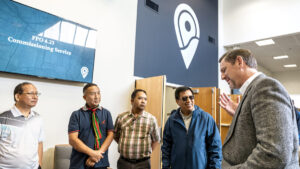
IMB President Paul Chitwood (right) welcomes several members of the Myanmar Baptist Churches USA fellowship to IMB’s missionary commissioning service near Richmond, Va.
The group included pastors Cin Do Thawng, George Cin Za Mang and Thuam Cin Khai, as well as Khai Cin Pau, Thawng Hauzelal and Mang Lamh Huam-Khai.
“It is an honor to be here, and very important,” said Cin Do Thwang, pastor of Sizang Burmese Mission Church in Catonsville, Md. “God has been working in this way for over 200 years. And God is still doing great things through Burmese people.
“We have a heart for missions. The American missionary had a heart for Burmese people, and now Burmese people need to send others to the nations, too.”
Pastor Thuam Cin Khai, pastor of Siyin Chin Baptist Church in Laurel, Md., encourages other Burmese American Baptists to connect with the IMB to learn more about how to partner and send missionaries to the nations, building on Judson’s legacy. In addition to his senior pastor role, Khai is president of the Myanmar Baptist Churches USA, and president of Judson Bible College.
“We need to connect with our Baptist heritage,” Khai said. “The lessons Adoniram Judson left us are living among us, and we would like to share that with other people. The next generation of Burmese Baptists needs to understand the Great Commission—and they need to respond to the Great Commission. We don’t want the Burmese Baptist heritage to end with us. We want the next generation to carry it.”
For IMB’s first Burmese American Southern Baptist missionaries, the on-site support from the Maryland churches was a welcome surprise on their commissioning day. The couple noted Myanmar—their family’s homeland—once was an unreached nation until Judson and others took the gospel there.
“Now we have a chance to go to an unreached nation,” they said. “We will carry on that vision.”
Podcaster sees Jewish conspiracy in red-nosed reindeer
December 13, 2023
WASHINGTON (RNS)—Christian nationalist commentator Andrew Torba turned on the radio a few weeks ago and discovered a secret war on Christmas.
Not the one fought on the sides of Starbucks cups or in city buses’ destination displays reading “Happy Holidays,” but by Rudolph, Frosty and a few mostly deceased Jewish songwriters.
In a Nov. 21 episode of his “Parallel Christian Society Podcast,” Torba, founder of the alt-right social media platform Gab and co-author of Christian Nationalism: A Biblical Guide For Taking Dominion and Discipling Nations, expressed his dismay at learning many popular Christmas songs were written by American Jews.
Drawing mainly from a review of A Kosher Christmas in the Israeli newspaper Haaretz dating to 2012, Torba recounted how many of the season’s most popular songs—“White Christmas,” “Rudolph the Red-Nosed Reindeer,” “Let it Snow” and “A Holly Jolly Christmas,” to name a few—were written by Jews.
Those songs, Torba claimed, were part of a conspiracy to kick Christ out of Christmas that turned a celebration of the birth of Jesus into a winter holiday with room for Jews.
“Knowing this, how could you allow your household to be filled with this music?” Torba asked his listeners.
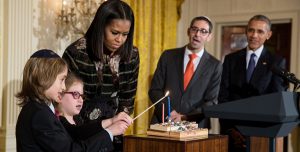
President Barack Obama, First Lady Michelle Obama and Rabbi Steven Exler watch Elijah and Shira Wiesel light the menorah during a Hanukkah reception in the East Room of the White House, Dec. 14. Two days later, the president signed into law the Frank Wolf International Religious Freedom Act of 2016. (Official White House Photo by Chuck Kennedy)
Torba’s suspicions were also raised when he found Jews in America, along with ruining Christmas, celebrate Hanukkah and that American presidents have acknowledged that Jewish holiday.
“Wow, incredible, incredible, how this happened,” he said. “In a Christian nation, it takes this relatively minor Jewish holiday and turns it into this prominent holiday that is celebrated in our White House. Isn’t that something?”
Asked about his podcast, Torba cited the Haaretz article, which quoted the late American novelist Philip Roth describing “White Christmas” as a song that took Christ out of Christmas.
“People who hate and reject Jesus Christ, and whose faith and identity centers around that rejection, wrote subversive songs to ‘de-Christ’ Christmas,” he said in an email.
“This is a problem, and Christians deserve to know about it so they can adjust their listening habits during the Christmas season accordingly.”
Puritans opposed Christmas
Jonathan Sarna, professor of American Jewish history at Brandeis University, suggested Christian nationalists such as Torba might want to do a little reading about American history. First, he pointed out, Christmas was not really a part of America’s founding.
“The Puritans were opposed to Christmas,” Sarna said.
In 1659, leaders of the Massachusetts Bay Colony approved the “Penalty for Keeping Christmas,” which imposed fines on those who feasted or refused to work on the holiday. It wasn’t until German immigrants brought Santa Claus, Christmas trees and songs like “Silent Night” with them that Americans took up Christmas with gusto. Christmas Day did not become a federal holiday until 1870.
Sarna said the songs written by Jewish songwriters fit into the American tradition of celebrating Christmas as a seasonal celebration, rather than a religious one.
“They are more in the tradition of Dickens’ ‘A Christmas Carol’ than in the tradition of ‘Silent Night,’” he said.
Jonathan Karp, who teaches history and Jewish studies at Binghamton University, said there’s no conspiracy involved with the success of Jewish writers of Christmas carols. Jewish songsmiths such as Irving Berlin wrote Christmas songs thinking Americans’ popular performers wanted them.
Karp said many Jews worked in Tin Pan Alley, the collection of songwriters and publishers that flourished in midtown Manhattan from the late 1800s to the mid-1990s, as well as in the theaters and venues where live music was performed.
Before records came into fashion, those songwriters made their money from sales of sheet music, Karp said. One way to sell sheet music was to get popular entertainers to sing them. When the holidays rolled around, those entertainers needed Christmas songs to sing. So, Jewish Tin Pan Alley songwriters wrote them.
Karp also suggested that songs like “White Christmas” were a way for Jewish songwriters to participate in Christmas—even though the religious holiday is not their own.
“I would even go as far as saying it’s about feeling the spirit of Christmas,” he said.
Finding a way to belong in America
Writing Christmas carols isn’t the only way Jewish Americans played a role in holiday tradition. Albert Sadacca, whose Jewish family emigrated from Turkey, helped develop electric Christmas lights and helped found one of the largest Christmas light manufacturers in America.
Devin Naar, associate professor of Jewish studies at the University of Washington in Seattle, who has studied Sadacca’s part in popularizing Christmas lights, said Christmas has become an icon of America almost as much as Uncle Sam or the Stars and Stripes. Even if they don’t celebrate Christmas, Jews have helped write this chapter of the American story.
Naar pointed to a Sephardic proverb found in the Ladino dialect spoken by Jewish immigrants from the Muslim world (like Sadacca), which translates, “Let me enter, and I’ll make a place for myself.”
Whether writing Christmas songs or creating Christmas tree lights, Jews found a way to show that they belonged in America, at a time when their fellow Americans viewed them with suspicion.
In a 2022 essay for The Washington Post, Naar pointed out Calvin Coolidge—the president who presided over the first lighting of the national Christmas tree—favored harsh immigration reforms.
“America must be kept American,” Coolidge said in his first address to the nation, a few weeks before that tree lighting. By American, Coolidge meant “white Christian people, preferably Protestants,” Naar said.
The following year, Coolidge signed legislation that barred Jews and non-Europeans from immigrating to the United States.
In the following decades, Americans became more open to those who had once been outsiders, Naar said. The Christmas carols written by Jews helped make that happen.
Even so, American Jews remain ambivalent about holiday traditions such as Christmas trees.
After all, there’s no way to take Christianity out of the holiday.
“At the end of the day, the name of the holiday is still Christmas,” Naar said.
Antisemitism and Christian nationalism linked
If Torba’s defense of Christmas is neither particularly American nor particularly religious, his antisemitism is in keeping with the ideology he espouses: Christian nationalism, research shows.
Data from a 2020 national survey found a relationship between Christian nationalism—the idea America belongs to Christians and Christians should run the country—and antisemitism.
The more that Americans believed in Christian nationalism, the more they supported antisemitic claims that Jews have too much power in America and around the world.
“It’s a function of what psychologists call a social dominance orientation,” said Paul Djupe, associate professor of political science at Denison University. “They think that there’s a rightful order of things and that Christians should be on top.”
Despite the anger of Christian nationalism, Sarna doubted many people know the religion of Christmas carol writers—or care what they believe. Most people who sing Christmas carols, he said, just want to sing their favorites.
“‘White Christmas’ remains one of the most popular Christmas carols,” he said. “People think it comes from the time of Jesus—not from Irving Berlin.”
Growing number of Americans ‘spiritual but not religious’
December 13, 2023
WASHINGTON (RNS)—Americans have been abandoning organized religion in droves, and while some have walked away from religion altogether, a distinct group of Americans now call themselves “spiritual but not religious.”
A new Pew Research study puts their numbers at 22 percent of Americans and attempts to describe them in greater detail.
The study places people in the group according to their responses to this definition: “They think of themselves as spiritual or they consider spirituality very important in their lives, but they neither think of themselves as religious nor say religion is very important in their lives.”
The study of 11,201 U.S. adults found Americans broadly consider themselves spiritual—70 percent say they are spiritual in some way. And while the spiritual but not religious share many of the same spiritual beliefs as religious Americans, there are some key distinctions.
Like most Americans, the spiritual but not religious believe people have a soul or spirit in addition to a physical body. They say there is something spiritual beyond the natural world. And they believe there are some things science cannot explain.
But only 20 percent of the spiritual but not religious believe in God as described in the Bible. They are much less likely than religious Americans to say they believe in heaven (54 percent vs. 93 percent) or hell (40 percent vs. 83 percent).
And perhaps critically, only 11 percent of the spiritual but not religious are involved in a religious community (compared with 62 percent of religious adults).
Negative views toward organized religion
They may still affiliate with religion—45 percent of the spiritual but not religious say they are religiously affiliated, with one-fifth identifying as Protestant and 12 percent identifying as Catholic. But they have negative views of organized religion.
Among the spiritual but not religious, 38 percent say religion does more harm than good, while just 7 percent of religious Americans share this view.
“That label ‘spiritual but not religious’ really describes a kind of negative identity more than it describes a particular positive identity,” said Nancy Ammerman, a retired professor of sociology at Boston University who served as an adviser for the Pew study.
“It describes people who are turned off by organized religion. The ‘not religious’ part of the identity is the real key to the identity.”
These Americans feel they don’t fit in a religious setting, Ammerman said.
But as the study also found, the group has largely not replaced congregational belonging with some other form of spiritual gathering.
While 18 percent of religious Americans belong to a nonreligious “spiritual community” that helps them find a connection with something bigger than themselves, only 13 percent of the spiritual but not religious belong to a spiritual community.
Demographically, the spiritual but not religious are more likely to be women; 57 percent are women, 42 percent are male.
Ryan Cragun, a professor of sociology at The University of Tampa who studies the nonreligious, said the higher female ratio among the spiritual but not religious makes sense. Historically, men have more societal permission to say they’re atheist or agnostic.
“Women suffer a lot of discrimination generally, and so they’re less likely to be willing to stake out a position that could subject them to more discrimination. So, they say, ‘I may not be religious but I’m spiritual,’” Cragun said. “And that softens the blow very quickly.”
Politically, the spiritual but not religious identify as Democrats rather than Republicans by a ratio of 2-to-1. Sixty percent say they identify or lean Democratic; 34 percent identify or lean Republican. (Among religious Americans only 39 percent identify or lean Democratic.)
The study, the first of its kind, was fielded in early August. Pew has not previously asked specific questions about spiritual beliefs and practices, so the study cannot address decline or growth in spiritual attitudes.
The margin of error for the full sample of 11,201 respondents was plus or minus 1.4 percentage points.


 “I needed a lot of courage to even say, ‘yes,’” Lee told RNS in an interview conducted in Korean with the assistance of a translator. “When I thought through it, my son is in a political prison in North Korea, the worst place in the world to be in. There’s nowhere he can go worse than where he is currently in.
 In a Dec. 11
  In particular, the evangelical leaders asked lawmakers to ensure due process for asylum seekers who demonstrate “a real fear of persecution.”