DeSOTO—Texas Baptist Men chainsaw teams came to the aid of a disabled homeowner in DeSoto after an insurance company told the homeowner he had to remove all limbs over his roof by the end of November or his insurance would be canceled.
“There were probably eight red oak trees around the house,” said Dan Sell, coordinator of Ellis County’s TBM disaster relief team. “After 50 some years, the limbs were high above the roof line, but an aerial view almost hid the roof.
“We are a new chainsaw unit,” Sell continued. “We have the ability to do ground work, but we needed a manlift and climbers. So, I contacted Wendell Romans with Collin County asking for their manlift,”
Romans, who is also statewide TBM chainsaw coordinator, “not only said ‘yes,’ but also volunteered to personally help with the lift,” Sell said. “Of course, I said ‘yes’ and ‘thank you.’“
Sell then contacted David Meyers, state coordinator for climbers, and he put out an email request for climbers. Three volunteers responded within 12 hours.
A small group from Ellis County started the work Nov. 24, Sell said. Then a large group worked Nov. 27 for “a good 8 hours,” and a smaller crew wrapped up things Nov. 28—in time to save the homeowner’s insurance.
Mission accomplished in three workdays, Sell said. The team presented a Bible to the homeowner, his son and daughter. They also shared the good news with two neighbors.
“So much thanks to the many hands and feet of our Lord Jesus Christ,” Sell said.
And, in a note, he added a prayer request: “We still have a need for our own manlift, keep praying!”
“The bottom line is, it was a real TBM team effort. That’s the real story,” Sell said.
Challenge preaching to polarized congregations
December 11, 2023
WASHINGTON (RNS)—American Baptist pastor Susan Sparks, who is both a minister and a professional comedian, uses humor in her sermons to help her New York City congregation consider ways to approach those with whom they disagree.
Pastor Joel Rainey, who leads a West Virginia evangelical church, hosts a “special edition” of his preaching podcast to answer questions he’s received from his politically diverse congregation about hot-button issues.
Rabbi Rachel Schmelkin recently preached about anger, realizing it was an emotion felt by congregants of her Reform synagogue in Washington, no matter their stance on the Israel-Hamas war.
Fueled by their work in comedy, psychology and theology, some clergy say reducing polarization is both a spiritual necessity for them and an ever-increasing part of their job description.
Susan Sparks regularly uses comedy both in the preaching and signage at Madison Avenue Baptist Church in New York City. (Courtesy photos)
Sparks, who has been on the Laugh in Peace comedy tour with a rabbi and a Muslim comic, said she can see shoulders relax and smiles appear on faces when she starts a sermon in a joking matter—such as the battle over what topping is appropriate on a sweet potato casserole. Then she can move into tougher subjects as she addresses her multiethnic congregation.
“I did a piece on how cancer does not discriminate between Republicans and Democrats,” said Sparks, a cancer survivor, referencing another sermon. “There’s things that we all experience, and we can start there and find that place, enjoy a little moment where we can share something and take tiny baby steps off that to move into harder territory.”
Preaching is one means, she and others say, that clergy can attempt to help congregants get along better with each other and, by extension, their families and friends.
Andrew Hanauer, president and CEO of One America Movement (Courtesy photo)
“We used to have congregations where people would be shaped by Scripture and by their faith leader and then they would listen to the news and say, well, that does or doesn’t fit in with my faith,” said Andrew Hanauer, president and CEO of One America Movement, a Maryland-based organization founded in 2017 that supports leaders of congregations, from Southern Baptists to mainline Protestants to Muslims.
Now, as people often align first with a viewpoint they’ve heard on cable news or read in social media, he said clergy have to answer new questions: “How do you preach in a way that moves people out of complacency about the world in general, but also lets them know this is not a Democratic church or a Republican church—it’s a church for all God’s people?”
In recent years—especially since 2020—as clashes over race, politics and health have escalated into what Hanauer calls “toxic polarization,” clergy can feel like they are walking a knife’s edge in their sermons, as they preach to divided—and sometimes hostile—congregations.
Pastors seek ideas on how to heal division
One America Movement, along with the Colossian Forum and other clergy resource groups, has found pastors are seeking ideas for how to preach in ways that heal, rather than further widen, the social and political divides within their congregations.
In the last year and a half, Hanauer’s organization has worked with more than 100 clergy as they consider sermons or other messaging related to polarization.
Hanauer, a lay member of a nondenominational evangelical church, said his organization offers training to congregations or their leaders on how to manage difficult conversations, as well as listening sessions with clergy who are suffering from burnout and exhaustion. Its work has ranged from training rabbinical students—who went on to preach sermons against polarization—to a multi-faith initiative to address the opioid crisis in West Virginia.
“It’s not about going from red to blue to purple,” he said. “It’s about going above the partisan divisions and having a compelling vision for the world that is more hopeful and more positive.”
Schmelkin, a former staffer at One America Movement, has used what she learned from the organization’s listening sessions and trainings to find nuanced ways to address polarization in her sermons as an associate rabbi at Washington Hebrew Congregation.
She chose to preach on anger on the first Friday night in December, knowing the congregants, representing diverse views, likely were all feeling some level of rage amid the Israel-Hamas war.
Schmelkin talked to them about how God is described in the Torah as “slow to anger,” or “erech apayim.” She recommended drawing “a deep, intentional breath before reacting” as “the first step we can take to better manage our anger, to be a little more like God.”
In an interview, Schmelkin said she has had one-on-one discussions with people in her community who are grappling with divisions over the war—from parents whose college-age children hold different views from theirs to Jewish millennials who have discovered via Facebook some of their close friends do not share their perspectives on the conflict.
In November, she led a “healthy conversations” workshop for young adults coping with those differences and provided a script they could use that had been developed by the One America Movement and Over Zero, a group that uses communication to reduce division and violence.
One participant told Schmelkin afterward she used the script with a friend with whom she had major disagreements about the war, “and she felt like it saved her friendship.”
How people believe others perceive them
Pastor Joel Rainey (Courtesy Photo)
Rainey said he has learned terminology like “metaperception”—how people believe others perceive them—from One America Movement, which he first connected with when he joined other faith leaders in responding to the opioid crisis. He brought the concept into the pulpit by encouraging congregants to have “one conversation” with an individual instead of talking to others about that person.
“You don’t have to wonder what they think about you. You’re going to know,” said the pastor of Covenant Church, a predominantly white congregation in Shepherdstown, W.Va., where about 600 attend Sunday services. “Having one conversation is my way of saying, Don’t ever say anything about somebody that you wouldn’t say directly to them.’”
Rainey, who has been involved in interfaith activities, including a musical concert with Jews and Muslims at his church, said he has used his special-edition podcasts to address issues like Christian nationalism and Israel, issues on which his congregants have conflicting opinions.
“When Psalm 122 says, ‘Pray for the peace of Jerusalem,’ it’s not just the Jews,” he told listeners. “It’s everybody living in that space.”
Develop a ‘vision for conflict transformation’
The Colossian Forum, a Michigan-based organization founded in 2011, originally held issue-specific workshops on topics such as human sexuality and politics but since 2022 has broadened its focus through two-day “WayFinder” trainings.
More than 600 leaders from Christian organizations have gone through the training, seeking help with divisions over anything from “leadership changes to sanctuary carpet color,” according to the group’s website.
People attend the One America Movement summit in May 2023. (Courtesy photo)
During the in-person training, Jess Shults and other staffers encourage participants to develop “a vision for conflict transformation,” she said. Using spiritual and leadership practices, they try to help participants see that divisions are not always a negative. They can be an opportunity to “reflect Christ in the midst of conflict.”
Shults said preaching alone is not sufficient to address polarization in a congregation.
“In an ideal setup, one would be pairing a sermon with, then, some kind of post-sermon conversation during an adult-ed hour,” said the former Reformed Church in America pastor, “so that one is recognizing the place of power they have when delivering a sermon and the community could be brought in.”
Shults also suggests clergy bounce their ideas off other church leaders as they prepare their sermons, to ensure the message reflects “the voice of the Spirit” and Scripture rather than their burnout or exhaustion.
Raymond Kemp, who teaches theology at Georgetown University and preaches regularly at a Catholic church in Potomac, Md., said a lengthy tenure in a pulpit can earn you the trust to address hot-button issues like race or immigration. Ordained in 1967, he has been preaching for over 30 years at Our Lady of Mercy Catholic Church.
“You can’t rent a preacher and have somebody come in and talk about polarization, I don’t think, without creating polarization,” he said. “They got to know the preacher, and they got to know that the preacher enjoys his craft or her craft and has built up enough trust in a community.”
In their book Preaching to a Divided Nation, Matthew D. Kim and Paul A. Hoffman argue it is imperative for clergy to address polarization and seek unity—not just for the sake of the congregation but as a peaceful example for the world beyond it.
“It’s not good enough for members of the family of God to make it through a worship service without engaging in physical or verbal warfare with a neighbor in the pew,” they write in the 2022 book. “There is a greater purpose for the church.”
Though it is hard to measure the level of impact preachers might be having on polarization within their congregations, many remain interested in getting tips and training for their sermons.
The Colossian Forum, whose name is based on the verse in the New Testament book of Colossians that says, “all things hold together in Christ,” reports an average increase of 20 percent in a leader’s confidence in helping a community dealing with conflict after taking its WayFinder training.
It also has seen an increase in calls from churches, seminaries and other Christian nonprofits as the 2024 election season approaches.
“We barely survived 2020, and nobody wants to repeat that,” Shults said their leaders have said. “And so, we need to be doing work now to help us be equipped to live into the next presidential election differently.”
This story was supported by the Solutions Journalism Network, a nonprofit organization dedicated to rigorous and compelling reporting about responses to social problems.
Soldiers profess faith in Christ at Living Christmas Tree
December 11, 2023
LAWTON, Okla. (BP)—When First Baptist Church in Lawton, Okla., sensed God’s leading to add a second weekend to its Living Christmas Tree, Senior Pastor Mike Keahbone didn’t realize what was in store.
“To ask for a church to do it two weekends back-to-back was a difficult, difficult ask,” Keahbone said, citing the long hours and labor required in the production. “But it just felt like the Lord was in it.”
First Baptist Church in Lawton, Okla., has presented a Living Christmas Tree concert for 42 years. (Courtesy Photo)
The additional weekend accommodated an exclusive performance for Fort Sill soldiers that drew 116 professions of faith among 700 attendees. Keahbone had been working to invite the soldiers to the 42nd annual event that at one time drew heavy attendance from the large Army base adjacent to Lawton.
“They were not going to be able to (attend), except for the fact that they found out we were doing an alternate date,” Keahbone said. “Had we stuck to just doing it next weekend when we normally do it, they wouldn’t have been able to come.”
First Baptist in Lawton began the evening with a dinner of grilled burgers and hotdogs in advance of the service.
“We obviously shared the gospel that night,” Keahbone said. “And it turns out we had 116 professions of faith, several others that want to know more, and then a whole bunch that already knew the Lord … indicated that the living Christmas tree sort of brought them back home and kind of got them back on the right track.
“What excites me about this is that it has opened the door in a significant way for us to possibly do more things with our post here at Fort Sill. This was a bridgebuilding opportunity with them.”
Soldiers recorded their professions of faith and other spiritual decisions on cards, and First Lawton gave copies to Fort Sill for follow up counseling. Several chaplains attended the event.
Chaplains will follow up on faith commitments
Col. Robert Glazener, Fort Sill’s senior chaplain, said the decision cards will be given to chaplains assigned to respective soldiers for follow-up.
“Our chaplains spend a lot of time with soldiers. They probably spend six to eight hours a day visiting with soldiers with a variety of needs,” Glazener said. “I know that they will be diligent about doing this.”
Such outreach events as the Living Christmas Tree are important to the ministry military chaplains provide.
“One of the important things about being a chaplain is to ensure that soldiers have an opportunity to practice their faith in a manner that they feel comfortable with,” said Glazener, commissioned by the North American Mission Board 25 years ago.
“And particularly during high holy days like Christmas, those Christians who want to do something extra, we set up the condition so that they’re able to go if they want to.
The Living Christmas Tree is among several holiday events Fort Sill offers annually, Glazener said, including Christmas and Hanukkah observances.
“Part of the job of a chaplain is to ensure religious freedom is practiced,” he said. “All of our religious freedom is interconnected.”
A dress rehearsal of the Living Christmas Tree accommodated a small group of assisted living community residents, some of whom Keahbone said also accepted Christ, and some of whom were military veterans. Local news media publicized upcoming weekend performances extending through Dec. 10.
“I love the tradition of (the living tree) with our community. And I love it as a pastor (because) we’re sharing the gospel with our community,” Keahbone said.
“For those thousands who come to take in the show, we’re sharing the gospel every single time. We see people saved, that’s obviously the best reason. And then the other part is just watching our church rally to serve our community.”
In addition to the 50 vocalists, an orchestra and a 30-member cast performing in the accompanying Christmas drama, the event requires extensive work behind the scenes and additional hospitality outreach during the production.
Crews assemble and disassemble the tree hardware each year, parking lot attendants direct traffic, volunteers prepare and serve refreshments, and others hold ventilation ducts under the tree to prevent singers from overheating from the lighting.
Each solider from Fort Sill who attended the Living Christmas Tree performance received a commemorative challenge coin and a New Testament. (Courtesy Photo)
The church gave soldiers a commemorative challenge coin the congregation commissioned with the logos of all six U.S. military branches on one side, and the living Christmas tree logo on the flipside. Gideon Christian Fellowship provided New Testaments with the Psalms.
The challenge coins, measuring 1.75 inches in diameter, were a special encouragement to soldiers and also military veterans who attended during the dress rehearsal.
“A challenge coin, typically earned, can also commemorate being a part of something,” Keahbone said. “We wanted all of our soldiers here to know that they’re a part of our family, and that they can always count on First Baptist Lawton to pray for them, and support them and to have their family’s back.”
Myanmar Baptist fellowship sends missionaries
December 11, 2023
RICHMOND, Va. (BP)—As new International Mission Board missionaries gathered for a commissioning service near Richmond on Dec. 7, six representatives of the Myanmar Baptist Churches USA fellowship traveled from Maryland to support one couple who represents a historic milestone for the Southern Baptist Convention.
The latest group of newly trained IMB missionaries includes 108 adults and 41 children ready to take the gospel to people in 37 countries. Among this group are the first Southern Baptist missionaries sent through IMB by the new Myanmar Baptist Churches USA fellowship. The fellowship conducted its first meeting at the 2023 Southern Baptist Convention annual meeting in New Orleans in June.
In one sense, this Burmese American missionary couple represents Southern Baptist missions “coming full circle,” said IMB President Paul Chitwood. He referenced one of the first Baptist missionaries from America, Adoniram Judson, who journeyed to Burma—modern-day Myanmar—with his wife Ann in 1812.
Representing the cross-cultural heart of the Myanmar fellowship, the missionary couple commissioned Dec. 7 will serve in North Africa. They are being sent by Falam Christian Church of Indianapolis, where Hre Mang serves as senior pastor. Mang also is the executive director of Myanmar Baptist Churches USA.
“Today takes on a new significance as it marks a milestone,” Chitwood said, noting it marked the first time Burmese Southern Baptist churches in the United States were sending missionaries overseas through the IMB.
Chitwood read words of Adonirum Judson, as recorded in the book To the Golden Shore. Judson said the people of Burma were “entirely destitute of those consolations and joys which constitute our happiness,” but he and his wife were willing to “part with a few fleeting, inconsiderable comforts, for the sake of making them sharers with us in joys exalted as heaven, durable as eternity.”
“We cannot expect to do much, in such a rough, uncultivated field,” Judson stated. “Yet, if we may be instrumental in removing some of the rubbish, and preparing the way for others, it will be a sufficient reward. I have been accustomed to view this field of labor, with dread and terror; but I now feel perfectly willing to make it my home the rest of my life.”
“Judson and his family answered God’s call and did the work God called them to do,” Chitwood said.
“Because Judson and others went to the Golden Shore to share the gospel, believers today, in a round-about way, go from the Golden Shore to take the gospel to others so they, too, can be ‘sharers with us in joys exalted as heaven, durable as eternity!’ So today, we celebrate this ‘full circle’ of Baptist missions.”
Before the service, the new missionary couple welcomed supporters from the Myanmar fellowship who made the journey south to Virginia as a show of support for the new Burmese American missionaries and to learn more about how they also can send cross-cultural missionaries through the IMB.
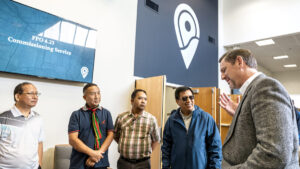
IMB President Paul Chitwood (right) welcomes several members of the Myanmar Baptist Churches USA fellowship to IMB’s missionary commissioning service near Richmond, Va.
The group included pastors Cin Do Thawng, George Cin Za Mang and Thuam Cin Khai, as well as Khai Cin Pau, Thawng Hauzelal and Mang Lamh Huam-Khai.
“It is an honor to be here, and very important,” said Cin Do Thwang, pastor of Sizang Burmese Mission Church in Catonsville, Md. “God has been working in this way for over 200 years. And God is still doing great things through Burmese people.
“We have a heart for missions. The American missionary had a heart for Burmese people, and now Burmese people need to send others to the nations, too.”
Pastor Thuam Cin Khai, pastor of Siyin Chin Baptist Church in Laurel, Md., encourages other Burmese American Baptists to connect with the IMB to learn more about how to partner and send missionaries to the nations, building on Judson’s legacy. In addition to his senior pastor role, Khai is president of the Myanmar Baptist Churches USA, and president of Judson Bible College.
“We need to connect with our Baptist heritage,” Khai said. “The lessons Adoniram Judson left us are living among us, and we would like to share that with other people. The next generation of Burmese Baptists needs to understand the Great Commission—and they need to respond to the Great Commission. We don’t want the Burmese Baptist heritage to end with us. We want the next generation to carry it.”
For IMB’s first Burmese American Southern Baptist missionaries, the on-site support from the Maryland churches was a welcome surprise on their commissioning day. The couple noted Myanmar—their family’s homeland—once was an unreached nation until Judson and others took the gospel there.
“Now we have a chance to go to an unreached nation,” they said. “We will carry on that vision.”
Podcaster sees Jewish conspiracy in red-nosed reindeer
December 11, 2023
WASHINGTON (RNS)—Christian nationalist commentator Andrew Torba turned on the radio a few weeks ago and discovered a secret war on Christmas.
Not the one fought on the sides of Starbucks cups or in city buses’ destination displays reading “Happy Holidays,” but by Rudolph, Frosty and a few mostly deceased Jewish songwriters.
In a Nov. 21 episode of his “Parallel Christian Society Podcast,” Torba, founder of the alt-right social media platform Gab and co-author of Christian Nationalism: A Biblical Guide For Taking Dominion and Discipling Nations, expressed his dismay at learning many popular Christmas songs were written by American Jews.
Drawing mainly from a review of A Kosher Christmas in the Israeli newspaper Haaretz dating to 2012, Torba recounted how many of the season’s most popular songs—“White Christmas,” “Rudolph the Red-Nosed Reindeer,” “Let it Snow” and “A Holly Jolly Christmas,” to name a few—were written by Jews.
Those songs, Torba claimed, were part of a conspiracy to kick Christ out of Christmas that turned a celebration of the birth of Jesus into a winter holiday with room for Jews.
“Knowing this, how could you allow your household to be filled with this music?” Torba asked his listeners.
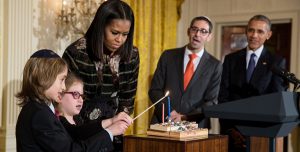
President Barack Obama, First Lady Michelle Obama and Rabbi Steven Exler watch Elijah and Shira Wiesel light the menorah during a Hanukkah reception in the East Room of the White House, Dec. 14. Two days later, the president signed into law the Frank Wolf International Religious Freedom Act of 2016. (Official White House Photo by Chuck Kennedy)
Torba’s suspicions were also raised when he found Jews in America, along with ruining Christmas, celebrate Hanukkah and that American presidents have acknowledged that Jewish holiday.
“Wow, incredible, incredible, how this happened,” he said. “In a Christian nation, it takes this relatively minor Jewish holiday and turns it into this prominent holiday that is celebrated in our White House. Isn’t that something?”
Asked about his podcast, Torba cited the Haaretz article, which quoted the late American novelist Philip Roth describing “White Christmas” as a song that took Christ out of Christmas.
“People who hate and reject Jesus Christ, and whose faith and identity centers around that rejection, wrote subversive songs to ‘de-Christ’ Christmas,” he said in an email.
“This is a problem, and Christians deserve to know about it so they can adjust their listening habits during the Christmas season accordingly.”
Puritans opposed Christmas
Jonathan Sarna, professor of American Jewish history at Brandeis University, suggested Christian nationalists such as Torba might want to do a little reading about American history. First, he pointed out, Christmas was not really a part of America’s founding.
“The Puritans were opposed to Christmas,” Sarna said.
In 1659, leaders of the Massachusetts Bay Colony approved the “Penalty for Keeping Christmas,” which imposed fines on those who feasted or refused to work on the holiday. It wasn’t until German immigrants brought Santa Claus, Christmas trees and songs like “Silent Night” with them that Americans took up Christmas with gusto. Christmas Day did not become a federal holiday until 1870.
Sarna said the songs written by Jewish songwriters fit into the American tradition of celebrating Christmas as a seasonal celebration, rather than a religious one.
“They are more in the tradition of Dickens’ ‘A Christmas Carol’ than in the tradition of ‘Silent Night,’” he said.
Jonathan Karp, who teaches history and Jewish studies at Binghamton University, said there’s no conspiracy involved with the success of Jewish writers of Christmas carols. Jewish songsmiths such as Irving Berlin wrote Christmas songs thinking Americans’ popular performers wanted them.
Karp said many Jews worked in Tin Pan Alley, the collection of songwriters and publishers that flourished in midtown Manhattan from the late 1800s to the mid-1990s, as well as in the theaters and venues where live music was performed.
Before records came into fashion, those songwriters made their money from sales of sheet music, Karp said. One way to sell sheet music was to get popular entertainers to sing them. When the holidays rolled around, those entertainers needed Christmas songs to sing. So, Jewish Tin Pan Alley songwriters wrote them.
Karp also suggested that songs like “White Christmas” were a way for Jewish songwriters to participate in Christmas—even though the religious holiday is not their own.
“I would even go as far as saying it’s about feeling the spirit of Christmas,” he said.
Finding a way to belong in America
Writing Christmas carols isn’t the only way Jewish Americans played a role in holiday tradition. Albert Sadacca, whose Jewish family emigrated from Turkey, helped develop electric Christmas lights and helped found one of the largest Christmas light manufacturers in America.
Devin Naar, associate professor of Jewish studies at the University of Washington in Seattle, who has studied Sadacca’s part in popularizing Christmas lights, said Christmas has become an icon of America almost as much as Uncle Sam or the Stars and Stripes. Even if they don’t celebrate Christmas, Jews have helped write this chapter of the American story.
Naar pointed to a Sephardic proverb found in the Ladino dialect spoken by Jewish immigrants from the Muslim world (like Sadacca), which translates, “Let me enter, and I’ll make a place for myself.”
Whether writing Christmas songs or creating Christmas tree lights, Jews found a way to show that they belonged in America, at a time when their fellow Americans viewed them with suspicion.
In a 2022 essay for The Washington Post, Naar pointed out Calvin Coolidge—the president who presided over the first lighting of the national Christmas tree—favored harsh immigration reforms.
“America must be kept American,” Coolidge said in his first address to the nation, a few weeks before that tree lighting. By American, Coolidge meant “white Christian people, preferably Protestants,” Naar said.
The following year, Coolidge signed legislation that barred Jews and non-Europeans from immigrating to the United States.
In the following decades, Americans became more open to those who had once been outsiders, Naar said. The Christmas carols written by Jews helped make that happen.
Even so, American Jews remain ambivalent about holiday traditions such as Christmas trees.
After all, there’s no way to take Christianity out of the holiday.
“At the end of the day, the name of the holiday is still Christmas,” Naar said.
Antisemitism and Christian nationalism linked
If Torba’s defense of Christmas is neither particularly American nor particularly religious, his antisemitism is in keeping with the ideology he espouses: Christian nationalism, research shows.
Data from a 2020 national survey found a relationship between Christian nationalism—the idea America belongs to Christians and Christians should run the country—and antisemitism.
The more that Americans believed in Christian nationalism, the more they supported antisemitic claims that Jews have too much power in America and around the world.
“It’s a function of what psychologists call a social dominance orientation,” said Paul Djupe, associate professor of political science at Denison University. “They think that there’s a rightful order of things and that Christians should be on top.”
Despite the anger of Christian nationalism, Sarna doubted many people know the religion of Christmas carol writers—or care what they believe. Most people who sing Christmas carols, he said, just want to sing their favorites.
“‘White Christmas’ remains one of the most popular Christmas carols,” he said. “People think it comes from the time of Jesus—not from Irving Berlin.”
Growing number of Americans ‘spiritual but not religious’
December 11, 2023
WASHINGTON (RNS)—Americans have been abandoning organized religion in droves, and while some have walked away from religion altogether, a distinct group of Americans now call themselves “spiritual but not religious.”
A new Pew Research study puts their numbers at 22 percent of Americans and attempts to describe them in greater detail.
The study places people in the group according to their responses to this definition: “They think of themselves as spiritual or they consider spirituality very important in their lives, but they neither think of themselves as religious nor say religion is very important in their lives.”
The study of 11,201 U.S. adults found Americans broadly consider themselves spiritual—70 percent say they are spiritual in some way. And while the spiritual but not religious share many of the same spiritual beliefs as religious Americans, there are some key distinctions.
Like most Americans, the spiritual but not religious believe people have a soul or spirit in addition to a physical body. They say there is something spiritual beyond the natural world. And they believe there are some things science cannot explain.
But only 20 percent of the spiritual but not religious believe in God as described in the Bible. They are much less likely than religious Americans to say they believe in heaven (54 percent vs. 93 percent) or hell (40 percent vs. 83 percent).
And perhaps critically, only 11 percent of the spiritual but not religious are involved in a religious community (compared with 62 percent of religious adults).
Negative views toward organized religion
They may still affiliate with religion—45 percent of the spiritual but not religious say they are religiously affiliated, with one-fifth identifying as Protestant and 12 percent identifying as Catholic. But they have negative views of organized religion.
Among the spiritual but not religious, 38 percent say religion does more harm than good, while just 7 percent of religious Americans share this view.
“That label ‘spiritual but not religious’ really describes a kind of negative identity more than it describes a particular positive identity,” said Nancy Ammerman, a retired professor of sociology at Boston University who served as an adviser for the Pew study.
“It describes people who are turned off by organized religion. The ‘not religious’ part of the identity is the real key to the identity.”
These Americans feel they don’t fit in a religious setting, Ammerman said.
But as the study also found, the group has largely not replaced congregational belonging with some other form of spiritual gathering.
While 18 percent of religious Americans belong to a nonreligious “spiritual community” that helps them find a connection with something bigger than themselves, only 13 percent of the spiritual but not religious belong to a spiritual community.
Demographically, the spiritual but not religious are more likely to be women; 57 percent are women, 42 percent are male.
Ryan Cragun, a professor of sociology at The University of Tampa who studies the nonreligious, said the higher female ratio among the spiritual but not religious makes sense. Historically, men have more societal permission to say they’re atheist or agnostic.
“Women suffer a lot of discrimination generally, and so they’re less likely to be willing to stake out a position that could subject them to more discrimination. So, they say, ‘I may not be religious but I’m spiritual,’” Cragun said. “And that softens the blow very quickly.”
Politically, the spiritual but not religious identify as Democrats rather than Republicans by a ratio of 2-to-1. Sixty percent say they identify or lean Democratic; 34 percent identify or lean Republican. (Among religious Americans only 39 percent identify or lean Democratic.)
The study, the first of its kind, was fielded in early August. Pew has not previously asked specific questions about spiritual beliefs and practices, so the study cannot address decline or growth in spiritual attitudes.
The margin of error for the full sample of 11,201 respondents was plus or minus 1.4 percentage points.
Pastor puts beard on the line for Peru mission project
December 11, 2023
HEMPSTEAD—What began as a joke made in front of a rural Texas congregation ended with a gift of more than $26,000 contributed to enable Texas Baptist Men and their ministry partners to drill new water wells in Peru.
Tim Smith presents the weekly announcements during worship services at First Baptist Church in Hempstead, northwest of Houston.
One Sunday in October, he told the congregation Pastor John Brandt might shave off his beard if the church gave a certain amount of money for this year’s annual statewide Royal Ambassadors mission project—drilling water wells in Peru.
Good-hearted pressure began to build on the pastor to set an amount.
Pastor John Brandt agreed to shave off his beard if First Baptist Church raised at least $20,000 for a mission project in Peru. The church gave $26,000—more than enough to drill two water wells. (Courtesy Photo)
Brandt said he decided to play along by setting a price for the shaving of his beard—one he thought would be too high to reach. The price for his shave was $20,000.
The church had never known their pastor without a beard. Brandt started as worship pastor in 2015 and became pastor in 2017. His children had not seen him without a beard for nine years.
Smith said he checked with Brandt’s wife, Amanda, about the challenge, as well.
“She was good natured about it, too,” Smith said.
Children in the church started raising money for the mission project associated with the annual RA Campout and Missions Mania event, which was Nov. 10-12 this year.
All the church’s children participated
First Baptist in Hempstead has both an RA chapter and a Girls in Action group, so all children involved in missions programs at the church were involved in the fund-raising project, Brandt said.
The children began the fundraising effort by using empty water bottles to collect coins, Smith said. Then they brought bottles to the Wednesday night and Sunday morning services so adults could contribute.
The total slowly climbed in the hundreds.
“By the end, we had about 10 bottles sitting there, some completely full,” Smith said. “One couple came in with rolls of pennies.”
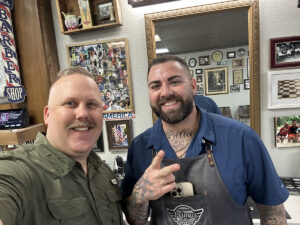
Barber Adam Gessner (right) helped Pastor John Brandt fulfill his pledge to shave his beard if his church gave at least $20,000 to a mission project. (Courtesy Photo)
But still people gave, and Smith, the chair of deacons, and others kept the rising total under wraps.
As the RA boys were “getting in the van to go to Missions Mania,” a church member “pulled up and wanted to make sure his gift got in” on time, Smith said.
They did not announce the total of more than $26,000 until the Sunday after returning from Missions Mania.
“We came back and announced the total,” Smith said. “John had a surprised look on his face. … You never thought it was going to be as big as it was, but then it was.”
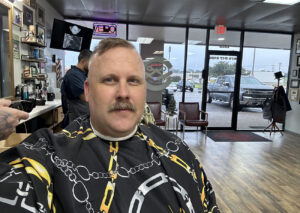
Brandt went to his barber Nov. 28 and said goodbye to all of his facial hair except a mustache.
“I noticed as soon as they finished shaving that my face was colder,” the pastor said. “Now I’m shocked every time I look in the mirror.”
Smith said the church “just thought this would be a fun thing to do. It became sort of a running joke for about a month. … We had a lot of great people step up.”
The beard cutting made the effort fun for the congregation, but the pastor said it really wasn’t about facial hair.
“Everybody in our church knows about water wells in Peru now,” Brandt said.
Stressing the importance of Christian mission
First Baptist in Hempstead emphasizes awareness about the importance of Christian mission, the pastor said. He used the singular “mission” to stress that all Christians are to be on mission.
“We’ve continued to press into RAs and GAs, to emphasize the importance of raising our children to be on mission. … We are constantly pushing mission with our kids.”
The congregation is now getting its first look at their pastor without a beard, but it’s not a new look for Brandt. Before arriving in Hempstead, he served 11 years in the U.S. Army Honor Guard.
“Every Monday we got a fresh haircut, … no mustaches.” He was “clean shaven all the time.”
But Brandt grew up in a house with a dad who had a beard. So, he grew his own beard after leaving the Army.
The beard-cutting promoted awareness about the needs in Peru and pointed toward a specific way to address it through TBM. The $26,000 will cover more than the cost of drilling two wells.
There is still some debate in the church as to whether the mustache was exempted from the shave. Smith laughed and said they are reviewing business meeting minutes to see if the pastor has fully complied.
There is already talk of an additional $5,000 bounty on the mustache, Smith said.
The pastor is not sure of the timing, but he said the beard will return.
As for the church, Brandt said, being on mission is still the key.
“Now we’re looking for what we’re going to do next,” he said. “Who knows?”
On the Move: Bock, King and Sumrall
December 11, 2023
Adam Bock to First Baptist Church in Magnolia as senior pastor from Trinity Baptist Church in Lake Charles, La., where he was teaching pastor at the church’s north venue.
Josh King to First Baptist Church in Lewisville as senior pastor from Second Baptist Church in Conway, Ark.
Matthew Sumrall to First Baptist Church in Rockport as minister of worship beginning in January 2024 from First Baptist Church in Hamilton, where he was minister of music.
Around the State: Abilene church opens Hope Center
December 11, 2023
Conceptual drawing of the Hope Center at First Baptist Church in Abilene.
First Baptist Church in Abilene marked the opening of its Hope Center on Dec. 5. The facility is home to City Light Community Ministries, which seeks to meet physical, emotional, social and spiritual needs in downtown Abilene; GLO (God’s Little Ones), a licensed day care center for children ages 6 weeks to 5 years that serves families on a sliding scale based on income; and the church’s ministry of counseling and enrichment, which offers affordable individual counseling and marriage and family counseling. The Hope Center project began five years ago when First Baptist purchased property previously belonging to First Christian Church. Under the leadership of former pastor Phil Christopher, First Baptist Church subsequently raised the funds necessary to complete a $10 million renovation of the building. Brandon Hudson is senior pastor.
Jonathan Cooper, chair of the biology department at DBU, was the keynote speaker at the Herb Robbins Research Symposium. (DBU Photo)
Dallas Baptist University recently hosted its annual Herb Robbins Research Symposium, featuring student and alumni presentations of scientific research. The two-day event is named in memory of Herbert Robbins, who was dean of the College of Natural Sciences and Mathematics at DBU from 1979 to 1994, and sponsored in partnership with the Beta Beta Beta Biological Society. Keynote speaker Jonathan Cooper, chair of the biology department, discussed the importance of scientific research in general and his own research about exploiting intracellular communication for cancer treatment. Cooper completed his undergraduate degree at DBU before earning his Ph.D. in cancer biology from UT Southwestern Medical Center in 2016. Student presenters this year included Grace Hayworth, Caroline Hudson and Yun Chen.
Curtis Reynolds
Curtis Reynolds, vice president for business affairs at the University of Florida, will join Baylor University as vice president of business and finance and as chief financial officer, effective March 1, 2024. Reynolds will oversee all budgeting, business development, financial management, procurement, real estate operations, enrollment management, facilities, information technology and the office of investments. He also will spearhead the development, communication and implementation of innovative initiatives intended to grow institutional revenue in an ever-evolving higher education landscape. “I am thrilled to welcome Curtis Reynolds to Baylor University and our leadership team,” President Linda Livingstone said. “I am confident Curtis will bring a new entrepreneurial spirit and energy and sound financial principles to this crucial university function. He is a man of faith with a deep understanding of academia at the highest levels, and his leadership and contributions will only serve to deepen our position as a preeminent Christian research university.” Reynolds holds Bachelor of Science and Master of Science degrees in electrical engineering from the University of Alabama at Birmingham. He earned a Master of Business Administration degree from the University of Alabama and is a member of the National Association of College and University Business Officers, the U.S. Green Building Council and the Association of Higher Education Officers. Reynolds and his wife Keisha have a blended family of eight children and 13 grandchildren.
Jonathan Luna
Jonathan Luna was named Wayland Baptist University’s Title V project director, taking the lead on Wayland’s $3 million U.S. Department of Education grant funding for the “Pioneering Greater Access for Hispanic Students through Enhanced Student Support” program. The program is designed to improve support for Hispanic students, expand information systems, improve student success, increase fall-to-fall retention, and improve four-year graduation rates. As a bilingual higher education professional, Luna said he hopes to create strategic initiatives that specifically target the Hispanic community and provide in Spanish the proper resources and information needed for students to be successful in the college process. “One of the reoccurring issues across the nation is the continued dropout rate of Hispanic students after their first year in college,” Luna said. “For the students that attend our campus, I would love to create an environment and community that provides an opportunity for them to stay plugged in and want to continue because they feel involved and cared for.” Luna holds three degrees from Wayland—a Bachelor of Science in fitness management, a Master of Education in sports administration and management, and a Master of Education in secondary education certification. He served as an admissions assistant at Wayland from 2016 to 2019 before becoming an enrollment coach. In January 2023, he became the university’s Title V La Familia outreach specialist, one of several student support positions included in the grant.
Greg Tomlin
The B.H. Carroll Theological Seminary board of governors named Greg Tomlin as director of the seminary’s Ph.D. program. At the same time, Tomlin was promoted to professor of church history. Tomlin’s appointment as director follows the retirement of Karen Bullock, who led the Ph.D. program since 2007. Tomlin has served the past four years as Carroll Fellow for Faith and Heritage and as director of the seminary’s institutional effectiveness program. Previously, he held positions in administration at Southwestern Baptist Theological Seminary, Liberty University’s Rawlings School of Divinity and the University of North Texas at Dallas. He earned an undergraduate degree from the University of Arkansas at Little Rock, and he completed his master’s degree and his Ph.D. at Southwestern Seminary. He also studied at Baylor University and at Boston University’s Institute on Culture, Religion and World Affairs.
The University of Mary Hardin-Baylor awarded degrees to about 460 students ranging in age from 19 to 72, including 132 graduate students, at fall commencement. (UMHB Photo)
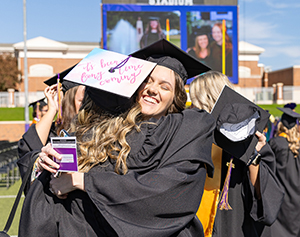
The University of Mary Hardin-Baylor awarded degrees to about 460 students ranging in age from 19 to 72, including 132 graduate students, at fall commencement. UMHB President Randy O’Rear noted 64 students were the first members of their families to graduate from college. Catherine Burk of Sunnyvale received the President’s Award, presented to a graduating senior who has provided meritorious service to the university. Two students—Caden Steubing of Groveton and Ange Rugira of Fort Worth—received the Loyalty Cup, awarded to students deemed most representative of the university’s ideals, traditions and spirit. UMHB presented the Provost Medal for highest overall grade-point-average to eight students who each graduated with a perfect 4.0 GPA—Olivia Grace Byle of Round Rock, Melody Grace Carl of Garland, Katherine Elizabeth Snyder of Temple, Jacob Warren Svare of Killeen, Rylie Nicole Torres of Mathis, Jon-Avery Solon Welch of Waller, Kelsey Maree White of Keller and Mackenzie Lois Worthy of North Richland Hills. One graduate, Alexia Brown, was commissioned as an officer in the military.
Houston Christian University freshmen have been donating nonperishable food items to the Husky Storehouse, the university’s on-campus food pantry, as a service-learning activity in their Freshman Year Seminar classes. The campus-wide project addresses student food insecurity and the challenges related to concentration, academic performance and overall mental health that frequently accompany food insecurity. The generosity of these first-year students will help provide for the basic needs of others throughout the spring semester.
Ordination
Ryan Crowe ordained to the gospel ministry by First Baptist Church in Floydada, where he is worship leader.
IMB Project 3000 explorers seek unreached people groups
December 11, 2023
International Mission Board missionaries are going the extra mile—quite often literally—to find unreached people groups.
A village leader navigates his boat up a tributary of the Amazon River to his village in the Ecuadorian jungle. Project 3000 will travel to remote villages like this one. (IMB Photo)
They travel by planes, trains, buses, motorcycles, cars and boats to get as close as possible before setting off on foot seeking hidden people groups.
“We’re going to the deepest part of lostness—the place where nobody is looking for these folks—to be able to make sure they have the opportunity to hear the life-giving good news that Jesus saves and can move us from perishing to life everlasting,” said IMB Vice President John Brady.
It will take a lot of research, but the IMB is committed to finding and engaging people so far off the map that not much is known about them and their exposure to the gospel.
Earlier this year, the IMB launched a new initiative, Project 3000, to engage 3,072 unengaged and unreached people groups.
New missionary explorers will journey into the unknown to find out where they live, learn about their culture, discern their literacy, develop ministry strategies and find people to partner with in the task.
Ray Henry Holiday is in the pioneering group of Project 3000 explorers. The Tennessean travels with a national partner to remote areas in South Asia for six weeks at a time to live among one of his 10 people groups. Once they arrive in the general area, they find transportation and accommodation.
Holiday compared his job to how Jesus sent out the 72 in Luke chapter 10. He’ll go with minimal supplies—“carrying my home on my back,” he said.
He collects as much demographic information as he can and builds relationships. While he uses a translator, he also takes time to study the people’s language.
During his university years, Holiday served in Central Asia with the IMB Hands On program. He thought he’d return to the Central Asian country, but when he heard the Project 3000 job description, it was an echo of a burden and prayer God placed on his heart three years ago.
As a high school student, Holiday prayed from Isaiah 6:8, “Here I am, send me.” The verse was shared at an IMB job conference when the Project 3000 job was presented. It further confirmed his calling.
“It’s a hard job, and that is part of the reason why I felt called to it. I feel like I have the gifting and ability,” Holiday said. “There is a great need. There is no one going to these folks.”
Churches planning multiple events for Christmas
December 11, 2023
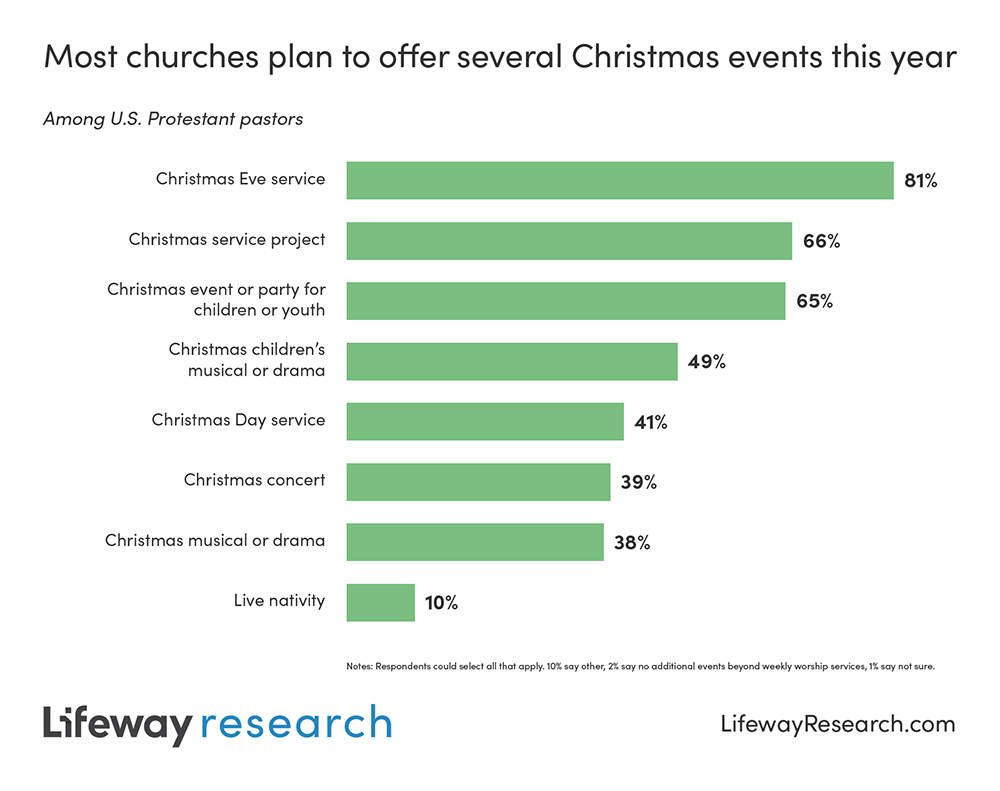
BRENTWOOD, Tenn.—Churches this year are planning an average of four extra events or activities to help members and guests celebrate Christmas this year, Lifeway Research discovered.
A Christmas Eve service tops the list, with 4 in 5 pastors (81 percent) saying their churches plan to offer such a service this year in addition to weekly worship services.
Most churches also are planning to offer a Christmas service project (66 percent) and a Christmas event or party for children or youth (65 percent).
Half of pastors said their congregation plans to have a Christmas children’s musical or drama (49 percent). Around 2 in 5 plan on having a Christmas Day service (41 percent), Christmas concert (39 percent) or Christmas musical or drama (38 percent).
Another 1 in 10 say they are planning to offer a live nativity (10 percent) or planning something else (10 percent).
Few say they do not plan to have any additional events beyond weekly worship services (2 percent) or aren’t sure (1 percent).
“In recent years many churches have trimmed the number of programs they have during the week. But Christmas celebrations still fill the calendar for the typical church,” said Scott McConnell, executive director of Lifeway Research.
“Most churches plan Christmas events for all ages and create experiences that go beyond worship services.”
What do churchgoers want for Christmas?
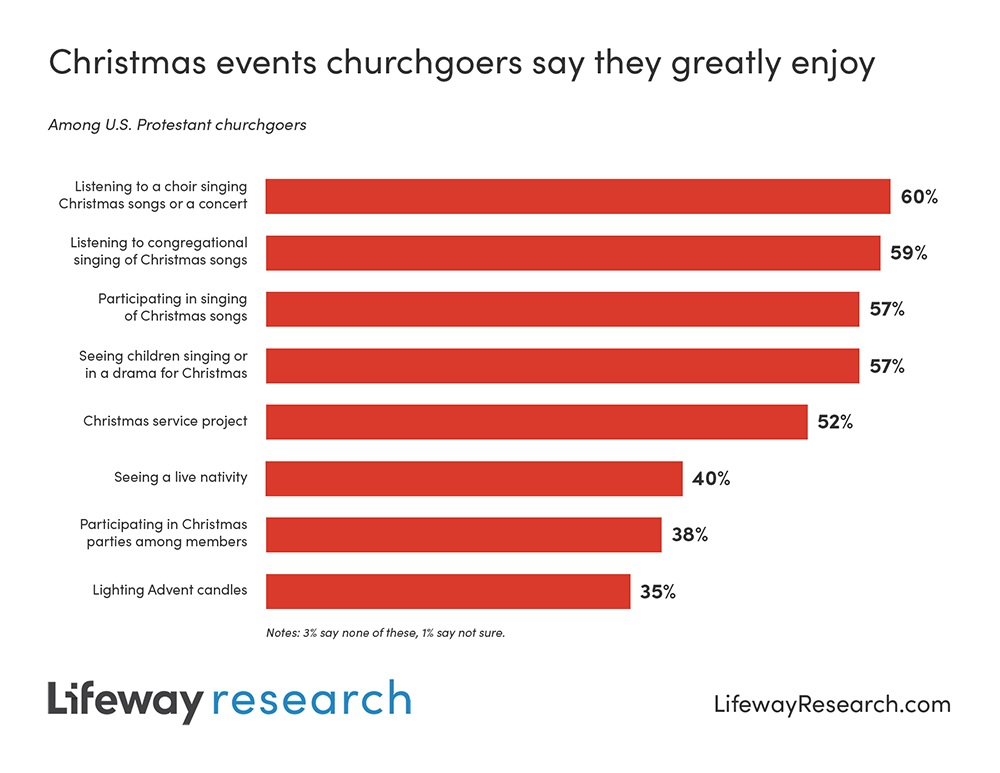
Churchgoers say they enjoy going to an average of four church-led Christmas events from a list of potential events. Most say they greatly enjoy listening to a choir singing Christmas songs or a concert (60 percent), listening to congregational singing of Christmas songs (59 percent), participating in singing Christmas songs (57 percent), seeing children singing or in a drama for Christmas (57 percent) or participating in a Christmas service project (52 percent).
Two in 5 churchgoers say they greatly enjoy seeing a live nativity (40 percent) and participating in Christmas parties among members (38 percent).
Another 35 percent say they enjoy lighting Advent candles, while 3 percent don’t greatly enjoy any of these things, and 1 percent aren’t sure.
“Some churchgoers may attend a church that doesn’t offer Christmas events they have enjoyed a lot in the past,” McConnell said. “So, they may participate in activities at neighboring churches as they celebrate Christmas.”
Demographic differences noted
The smallest churches, those with fewer than 50 in attendance, are least likely to say they are offering a Christmas concert (27 percent), a musical or drama (28 percent), a children’s musical or drama (31 percent), a Christmas event or party for youth or children (46 percent) or a Christmas service project (56 percent).
Churches established prior to 1900 are more likely than the newest churches, those started between 2000 and 2023, to have a Christmas concert (42 percent v. 29 percent). Churches started before 1900 (74 percent) and between 1900 and 1949 (68 percent) are more likely than those at the newest churches (53 percent) to offer a Christmas service project. Churches birthed prior to 1990 also are most likely to plan a Christmas Eve service (89 percent).
The oldest pastors, those 65 and older, are the least likely to say their church is planning a Christmas event or party for children or youth (55 percent) or a Christmas Eve service (74 percent).
“The smallest churches are much less likely to offer Christmas activities that require a lot of people to produce because they just don’t have those people,” McConnell said. “But small churches are just as likely as larger ones to offer a Christmas Eve or Christmas Day service.”
Denominationally, Methodist pastors are the most likely to say they are planning a Christmas concert (53 percent). Lutheran pastors are the most likely to say they will offer a children’s musical or drama (70 percent) and a Christmas Day service (71 percent). Restorationist movement churches are the least likely to offer a Christmas Eve service (52 percent).
While Hispanic pastors are among the most likely to say their church will offer a live nativity (21 percent), African American pastors are the least likely to say they will be having a Christmas Eve service (46 percent). And mainline pastors are more likely than evangelical pastors to say they are having a Christmas Day service (48 percent v. 41 percent).
Females are more likely than male churchgoers to say they enjoy singing Christmas songs (61 percent vs. 52 percent), listening to a choir singing Christmas songs or a concert (64 percent vs. 55 percent), seeing children singing or in a drama for Christmas (62 percent vs. 51 percent), lighting Advent candles (37 percent vs. 31 percent), participating in a Christmas service project (59 percent vs. 43 percent) and seeing a live nativity (46 percent vs. 32 percent).
Age matters
Churchgoers aged 50 to 64 (62 percent) and 65 and older (66 percent) are more likely than those 18 to 34 (45 percent) and 35 to 49 (43 percent) to say they greatly enjoy singing Christmas songs.
Similarly, the oldest churchgoers are the most likely and the youngest churchgoers are the least likely to say they enjoy listening to congregational Christmas singing (71 percent and 38 percent).
Churchgoers aged 50 to 64 (63 percent) and 65 and older (67 percent) are more likely than those 18 to 34 (50 percent) and 35 to 49 (50 percent) to say they greatly enjoy listening to a choir or concert.
And churchgoers aged 50 to 64 (63 percent) and 65 and older (61 percent) are more likely than those 18 to 34 (50 percent) and 35 to 49 (47 percent) to say they greatly enjoy seeing children singing or in a drama for Christmas.
However, the youngest adult churchgoers, those ages 18 to 34, are more likely than the oldest, those 65 and older, to enjoy participating in Christmas parties among members (45 percent vs. 33 percent).
“Much like some radio stations, many churches spend several weeks each year singing Christmas songs. But the enjoyment of these songs in churches is not uniform, with far fewer young adults enjoying this custom,” McConnell said.
Churchgoers who attend worship services at least four times a month are more likely than those who attend one to three times a month to say they greatly enjoy singing Christmas songs (62 percent vs. 50 percent) and listening to congregational singing of Christmas songs (63 percent vs. 54 percent).
Additionally, churchgoers with evangelical beliefs are more likely than those without to enjoy singing Christmas songs (62 percent vs. 51 percent), listening to congregational singing (65 percent vs. 53 percent), seeing children sing or perform a Christmas drama (63 percent vs. 51 percent), participating in service projects (56 percent vs. 47 percent) and seeing a live nativity (44 percent vs. 35 percent).
Meanwhile, those in the largest churches, 250 to 499 (59 percent) and 500 or more (59 percent) are more likely than those in the smallest churches, fewer than 50 (46 percent) and 50 to 99 (48 percent), to say they greatly enjoy participating in Christmas service projects.
Similarly, those attending churches with worship attendance of 250 to 499 (49 percent) are more likely than those with fewer than 50 (38 percent), 50 to 99 (37 percent) or 100 to 249 (39 percent) to say they enjoy live nativities.
The online survey of American Protestant churchgoers was conducted Sept. 19-29. Analysts used quotas and slight weights to balance gender, age, region, ethnicity, education and religion to reflect the population more accurately. The completed sample is 1,008 surveys, providing 95 percent confidence the sampling error from the panel does not exceed plus or minus 3.2 percent.
The phone survey of American Protestant pastors was conducted Aug. 29-Sept. 20. Responses were weighted by region and church size to reflect the population more accurately. The completed sample is 1,004 surveys, providing 95 percent confidence the sampling error from the panel does not exceed plus or minus 3.2 percent.
Mission Arlington clinic benefits from Texas Rangers gift
December 11, 2023
Even before the Texas Rangers clinched a World Series championship, the team and its charitable foundation scored a huge victory for children and families in need as far as Tillie Burgin, founding executive director of Mission Arlington, was concerned.
The Texas Rangers and Major League Baseball selected Mission Arlington as a World Series Legacy Gift recipient. The Legacy Gift program is an MLB initiative to support worthy causes in communities that host its premiere events each season—the mid-summer All-Star Game and the World Series fall classic.
Mission Arlington will apply the gift toward the expansion of its medical clinic, which offers health care at no cost to more than 12,000 patients each year.
“We don’t turn people away. It’s a place of refuge and love that the Lord has put together,” said Burgin, who founded Mission Arlington in 1986.
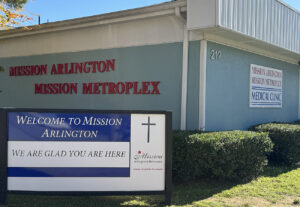
Mission Arlington will apply the World Series Legacy Gift toward the expansion of its medical clinic, which offers health care at no cost to more than 12,000 patients each year. (Photo / Ken Camp)
Mission Arlington plans to add seven examining rooms and a triage room to its clinic. One pediatric examining room will be decorated in Texas Rangers team colors and markings.
“People line up for the clinic at 3:00 or 4:00 in the morning, Monday through Friday,” said Clark Burgin, operations manager at Mission Arlington and Tillie Burgin’s grandson.
The number of patients served by the clinic grew 11 percent from 2021 to 2022, and it increased another 17 percent in the past year, with a 75 percent rise in pediatric cases, he noted.
‘One life at a time’
The numbers served by Mission Arlington’s clinic and its multiple other ministries—as well as its outreach Bible studies and mission congregations at 360 apartments and other locations throughout Arlington, Grand Prairie and Fort Worth—are impressive. But Tillie Burgin prefers to focus on individuals, not statistics.
“It’s one life at a time, ministering to the people God brings us who allow us to get involved in their lives,” she said. “People with no hope find Christ here.”
The Texas Rangers are longtime supporters of Mission Arlington, providing toys for children at Christmas, volunteers to deliver meals at Thanksgiving and funds to meet urgent needs in times of distress.
“They are about more than just baseball. They are people who really care about other people and this community,” said Jim Burgin, communications director at Mission Arlington and Tillie Burgin’s son.
A significant number of Christians work with the Rangers organization, Tillie Burgin added. “So, we speak the same language.”
At this point, Mission Arlington doesn’t yet know the exact amount of the World Series Legacy gift or precisely how much it will increase the clinic’s capacity to serve patients. But Tillie Burgin is trusting in God’s provision.
“It will be exactly as God planned it to be, so there’s no need for speculation,” she said. “I’m sure people will fill those rooms, and we’ll need more as God continues to allow us to be his hands and feet.
“We want them to know when they come to this place, they’ve been in his presence.”