Around the State: ETBU students host fall festivals

East Texas Baptist University students volunteered at Marshal elementary school fall festivals. (ETBU Photo)

East Texas Baptist University’s Learning and Leading classes hosted fall festivals for Marshall’s David Crockett Elementary, Sam Houston Elementary, William B. Travis Elementary, Price T. Young Elementary schools and the Marshall Early Childhood Center on Oct. 2. ETBU students served nearly 1,000 elementary students and their families. ETBU’s fall festival events have become a tradition for the university’s students and the elementary students and families of the Marshall Independent School District, with more than 350 ETBU freshmen planning and organizing the event during their Learning and Leading courses and the freshman Honors Program. “Our students get to take what they have learned in class about Christian servant leadership and apply that knowledge by collaborating with each other to plan, build, and host booths at the fall festivals,” said Vanessa Johnston, ETBU Learning and Leading coordinator. “Hosting the fall festivals for the families in Marshall ISD allows them to see the impact they can make in the community in a tangible way. We hope this experience positively affects not only the families of Marshall, but also our students who will see the importance of loving and serving our neighbors as Christ has called us to do.”

Wayland Baptist University has launched the search for the school’s 14th president, creating a webpage with updates about the search, said Tyler Topper, chair of Wayland’s presidential search committee. President Bobby Hallannounced in September plans to retire effective June 30, 2024. The search committee and consultants “have developed a job ad and position profile describing the key institutional needs and priorities, as well as a related set of desired characteristics for our next president,” Topper said in a letter sent to Wayland students, faculty and staff. The search committee welcomes the suggestion of candidates who could serve effectively as the next president or the names of persons who might recommend potential candidates, he added. “When nominating, please complete the confidential online nomination form on the website or forward the name(s) and contact information, including email address, to our consultants at WBUPresident@academicsearch.org,” Topper said. The search committee plans to begin reviewing applications in late October with the goal of identifying a small group of candidates. Semifinalist interviews are expected in late-November, with finalists being interviewed in early January.

Dallas Baptist University students learn about missions opportunities during an outdoor missions fair. (DBU Photo)

Lance Shumake, president of iGo Global, spoke in chapel at Dallas Baptist University at the beginning of Missions Week. Shumake’s Rockwall-based organization partners with churches to help train and mobilize the next generation to spread the gospel internationally. Shumake challenged students to think beyond self-interested hopes and focus instead on God’s will. He urged them to be on mission with God as instruments of blessing, sharing the hope of God’s love. In addition to iGo Global, representatives from Greater Europe Mission, Cafe 1040, Africa Inland Mission and other organizations participated in an outdoor mission fair, introducing students to missions opportunities. In another chapel service during DBU Missions Week, Izabella McMillon of Samaritan’s Purse told how—as a 13-year-old girl in Romania—she received an Operation Christmas Child gift box that changed her life.

The board of directors of the Baptist Joint Committee for Religious Liberty elected Anyra Cano of Fort Worth as chair. She is the first Latina to serve in that role. Cano is director of programs and outreach for Fellowship Southwest. She previously was coordinator of Texas Baptist Women in Ministry and served 12 years as youth minister at Iglesia Bautista Victoria en Cristo in Fort Worth.

Members at Ventana, a Buckner senior living community in Dallas, volunteered recently at the Buckner Center for Humanitarian Aid. (Buckner Photo)

Members at Ventana, a Buckner senior living community in Dallas, volunteered recently at the Buckner Center for Humanitarian Aid. They spent the afternoon sorting shoes and stuffing them with encouraging notes to support Buckner’s Shoes for Orphan Souls program. “This is our first outing of this type,” said Holly Yates, director of lifestyle services at Ventana. “But members have been involved in volunteering with Buckner through Pajamas for Seniors and by providing supplies to families in the Buckner Family Hope Center or Buckner Family Pathways programs.”


TBM preparing meals for displaced people in Israel

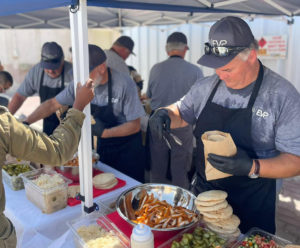
Specially trained Texas Baptist Men disaster relief volunteers are at a secure site in Israel, preparing about 2,000 meals a day for civilians displaced by bombing.

The TBM crew—all of whom trained in Israel to learn how to cook culturally appropriate meals for religiously observant citizens of the region—arrived in two waves.

When the team’s initial flight was cancelled, the 19-member TBM crew had to split into two groups. After some circuitous travel, the first group arrived in Jordan on Oct. 10 and walked across the border into Israel. Next, they were transported by bus to the same facility where they had trained with Israel’s Emergency Volunteers Project. The second group of TBM volunteers arrived the next day.

 “We had to go through multiple military checkpoints at the border,” said Gary Finley, Israel volunteer coordinator for TBM.

TBM volunteers are working alongside EVP personnel at their base of operations to cook meals and prepare them for delivery.

“The meals are being distributed by EVP volunteers, who are going into hot spots where there are displaced people,” Finley said. “Those are areas where homes have been damaged or destroyed and are prone to missile attacks. No TBM volunteers are placed in harm’s way.”

Dealing with a ‘very fluid’ situation

Even so, Finley acknowledged the stress inherent in entering a country at war and dealing with a variety of contingencies.

“It’s one thing to sit in a Sunday school class and say, ‘I want to be in the center of God’s will, and I’m trusting in him.’ It’s another to make the decision to go into a war zone,” he said.

Still, Finley said, he left Texas for Israel with his family’s blessings.

“They said, ‘We know this is what you’ve been training for.’ My kids and grandkids understand. We’re all standing on God’s promises,” he said.

Finley described the situation as “very fluid,” and he said the team is prepared to move to another location where they can serve displaced citizens, particularly if the violence escalates. The volunteer team in place now expects to serve two weeks.

“We’re playing it by ear,” he said. “Pray for whatever God has in store. … Pray for patience, because we don’t know from one day to the next what that day will bring.”

In addition to requesting prayer for peace and for the safety of the TBM team, he also asked Texas Baptists to pray God will grant the volunteers the energy and endurance they need.

“Our cooking capacity is limited here,” Finley said. “So, we may end up running 24 hours a day to keep up. Pray that we will be up to the task.”

An Oct. 11 email to TBM disaster relief volunteers noted the possible need for a significantly larger number of workers “if the conflict intensifies” in Israel.

“We are making contingency plans to send as many as 150 more volunteers,” the email stated.

Advance completion of training for Israel feeding is not required, but previous disaster relief training and experience is essential. Credentialed disaster relief volunteers in good health who have current passports and are capable of working long hours in challenging conditions can apply here.


TBM sends disaster recovery teams to Maui

A 13-member Texas Baptist Men volunteer team left Texas traveling to Maui Oct. 7 to help with recovery in the aftermath of the wildfires that occurred in early August.

Baptists in Hawaii responded to immediate needs in the aftermath of fires that destroyed more than 2,000 acres in Maui. A 13-member Texas Baptist Men volunteer team left Texas traveling to Maui Oct. 7 to help with recovery in the aftermath of the wildfires that occurred in early August. (TBM Photo)

Considered the deadliest U.S. fire in more than a century, the fires in Maui destroyed more than 2,000 acres of land and killed 97 people. Most of the structures burned in the fire were residential.

Homeowners only recently returned to their homes and saw for the first time the damage to their property. As they sift through ash and other debris to try to regain possessions, the TBM team will be there to help in any way needed.

The experience will be “quite emotional,” said Curt Neal, team leader for the TBM team.

“For the first few days, we might be working more in a chaplaincy role,” he said. “It’s not just possessions. They’ve lost neighbors. It’s going to take some time to reflect on what their loss has been, and we’re going to be there for them. We will provide emotional support and be there to do whatever they want.”

It probably won’t be a typical TBM ash-out effort, Neal said. The teams will work slowly and evaluate the needs of the homeowners. They will be flexible and work with what the homeowners need.

Some may need emotional support. Others may need help sifting through ash to find possessions. For those whose homes did not burn, they may need help moving furniture and other items from their home.

“We are coming in with open ears and open arms,” Neal said. “We don’t really know what to expect, but the team is willing and ready to serve.”

The team will be on Maui several weeks.

“Recovery of this magnitude takes time,” said David Wells, director of TBM disaster relief. “We are so thankful for everyone who is praying and those who have donated to this effort. You are helping to deliver help, hope and healing to Hawaiians during this difficult time.”


Guarneri wants BGCT to stay focused on mission

The Baptist General Convention of Texas’ executive director-elect believes the greatest challenge facing Texas Baptists and their greatest opportunity are closely related.

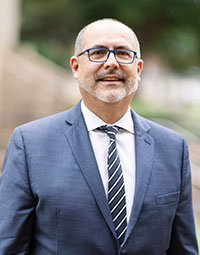
Julio Guarneri

Presenting the gospel to a burgeoning Texas population in the midst of “complex demographic shifts that are happening in our state will require a concerted and strategic effort,” Julio Guarneri said.

Guarneri, who assumes his duties as BGCT executive director in late November, talked about the mission that unites Texas Baptists during an Oct. 10 Zoom interview with the Baptist Standard.

“Reaching Texas for Christ” and mobilizing Texas Baptists to be engaged in worldwide missions in the current context will require “concerted effort” and focus, he noted.

“I’m convinced that business as usual is not going to get it done,” he said. “I think we are doing some great things, but I think there is so much more to do. The risk is to get complacent or to major on controversies.”

Resist being pulled to extremes

Staying focused on mission means resisting forces that would seek to pull Texas Baptists toward extremes, he noted.

He recognizes a challenge in “dealing with those who would want us to move from our historic centric focus.”

“I think we live in times where society seems to thrive on extremism, and it’s difficult to stay the course to our historical, biblical and missional commitment when forces try to pull us to the extremes,” Guarneri said.

Currently, the Southern Baptist Convention is embroiled in debate over the role of women in ministry—particularly whether a church can employ a woman on its ministerial staff as a “pastor” and still be in “friendly cooperation” with the SBC.

When it comes to women serving in pastoral roles, Guarneri believes Texas Baptists properly emphasize local church autonomy and the priesthood of all believers.

Messengers to BGCT annual meetings “have consistently spoken” and declared “that this is a local church autonomy issue,” he said.

“While we believe God calls and equips women for ministry in the local church, the mission field and parachurch ministries, the specific titles for both men and women in church are for the local church to decide, not for us to dictate,” he said.

“And for me, more important than particular titles for church staff is the recognition that we champion the priesthood of all believers, and all believers are called to obey the Great Commission.”

By keeping the emphasis on local church autonomy, “we can continue to have room for respectful dialogue where there are differences” and to encourage and provide resources to local churches “whatever position they take” on women in ministry, he said, expressing his desire to be “an executive director for all Texas Baptists.”

“While there are differences in our Texas Baptist churches in this regard, I believe that most churches and leaders don’t desire to make this an issue of fellowship,” he said. “To me that’s important, that we don’t alienate churches or ministers on either side of the issue.”

Work with those ‘who are willing to work with us’

Guarneri noted Texas Baptist churches continue to contribute more than $22 million annually to SBC missions and ministries.

“I believe that the BGCT needs to work with those denominational bodies that are committed to the Great Commission, that are committed to the importance of cooperation for the sake of the kingdom, bodies with whom we have general agreement regarding faith and practice, and who are willing to work with us and our churches,” he said.

Guarneri expressed appreciation for the vision of those who drafted the BGCT Constitution, particularly in regard to the breadth of its mission statement: “The object of this convention shall be to awaken and stimulate among the churches the greatest possible activity in evangelism, missions, Christian education and benevolent work and enterprises; to cultivate a closer cooperation among the churches and promote harmony of feeling and concert of action in advancing all of the interests of the Redeemer’s Kingdom.”

He also voiced support for the more succinct defining mission of Texas Baptists as “a movement of God’s people to share Christ and show love by strengthening churches and ministers, engaging culture and connecting the nations to Jesus.”

Texas Baptists can unite around Christ’s Great Commission, his Great Commandment and “churches working along with institutions in advancing kingdom initiatives—in doing things no one church could do by itself,” he said.

‘What a good servant leader does’

Guarneri, who earned a doctorate in leadership studies with a ministry concentration from Dallas Baptist University, said he aspires to be “a servant leader.”

“My goal—my desire—is to model for others what it means to follow Jesus, what it means to serve others, what it means to be about his agenda,” he said.

“And I think that includes being an encourager, being a listener, valuing working as a team, and in that process discovering vision together, casting the vision and then inspiring and empowering others to live out God’s calling on their lives. That’s what a good servant leader does.”

As executive director, Guarneri said he wants to listen to church and associational leaders, as well as institutional leaders, to hear their “dreams and hopes” and discover a shared vision for Texas Baptists.

In his new role, he acknowledged the need to balance being accessible and being strategic in how he spends his time and energy.

“I look forward to working with leaders across Texas to discover what our future looks like and how we strategize and partner for the sake of the Great Commission and the Great Commandment,” he said.

Listening to all Texas Baptists and reaching every facet of the Texas population  with the gospel requires church leaders to develop “cross-cultural competencies” and learn how to minister in varied contexts, he noted.

“It’s not rocket science,” Guarneri said. “Sometimes it’s just the awareness and the willingness to have conversations and the self-awareness to understand that not everybody looks at the world the way I do. And they can love Jesus and be about the same agenda, even when they think and process differently and when they prioritize certain things I may take for granted or assume.”

‘Hard to imagine’ not being a pastor

Guarneri grew up in a Christian home and made what he called a “clear and sincere” profession of faith in Christ at an early age, and he recommitted his life to Christ as a teenager. At age 16, while attending Hispanic Baptist Youth Congreso in Houston, he was inspired by the challenge to be part of a generation that could fulfill Christ’s Great Commission.

“That really was compelling to me,” he said. “As I was thinking about that, I felt God’s Spirit really tugging at my heart, and I felt God was calling me to surrender to ministry.”

After 13 years as pastor of Calvary Baptist Church in McAllen—and previously 17 years as pastor at Iglesia Bautista Getsemani in Fort Worth—Guarneri confessed it is “hard to imagine” not serving in a pastorate.

“I’m confident my wife and I are going to find a good spiritual family when we move to the Dallas area, but it will be strange to look for a church,” he acknowledged. “We haven’t had to do that in decades.”

When asked what he would like Texas Baptists to know about the next BGCT executive director, Guarneri responded: “I want them to know I am very honored and humbled to get the opportunity to serve in this role. I want them to know that I love the Lord, that I am committed to the Scriptures and to the local church.

“I love Texas Baptists and the work of the BGCT. And I am committed to find ways to work together so that we can move forward in finishing the task.

“I hope that when history writes about the BGCT in this next era that they would say Texas Baptists were faithful to the Great Commission and invested in ‘all the interests of the Redeemer’s Kingdom’ to the glory of God.”


Half of pastors say economy is hurting their churches

BRENTWOOD, Tenn.—As churches continue to navigate economic challenges in the United States, half of surveyed pastors say the economy is harming their churches as giving fails to keep up with inflation.

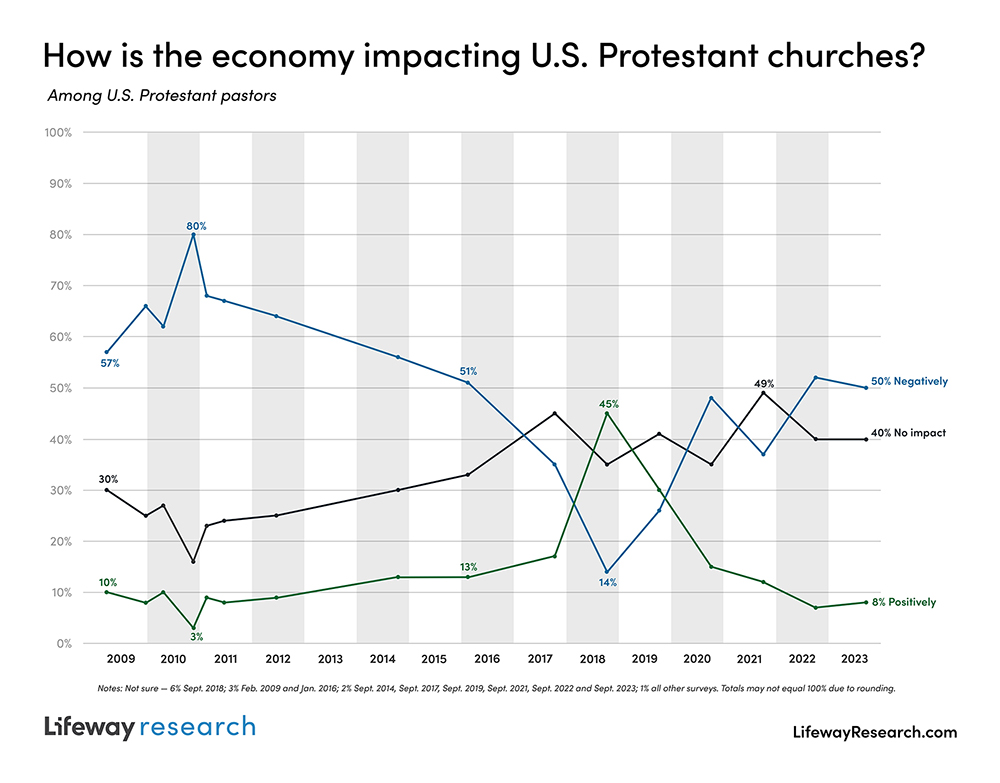
A Lifeway Research study of U.S. Protestant pastors found 50 percent say the current economy is negatively impacting their churches. Meanwhile, 40 percent say the economic circumstances aren’t having an effect. Fewer than 1 in 10—8 percent—say the current economy is a positive factor for their churches.

Last year was the first time since 2016 more than half of pastors felt the economy was impacting their churches negatively and the first time since 2012 fewer than 10 percent of pastors expressed belief the economy was positively impacting their churches.

Only twice in the study’s 15-year history—in 2018 and 2019—were pastors more likely to say the economy was having a positive impact than a negative one.

“The good news is the economy is not negatively impacting more churches than last year, despite persistent inflation and slower economic growth,” said Scott McConnell, executive director of Lifeway Research. “The bad news is that most churches continue to feel pain and discomfort from current economic realities.”

Although pastors continue to report a negative economic impact, churches have maintained stable levels of giving near their planned budgets and comparable to last year’s giving. But in most churches, increases in giving have not kept up with inflation in 2023.

Around 7 in 10 U.S. Protestant pastors say since the beginning of 2023, giving at their church is at or exceeding budget, with 46 percent saying giving has been about what was budgeted and 22 percent saying it’s higher. Three in 10 say giving is below their 2023 budget.

Tough time to set a budget

“This was not an easy year to set a budget, as many predicted a softening in the nation’s economic well-being,” McConnell said. “Whether churches lowered expectations or not, most are meeting or exceeding their budget.”

Compared to last year’s actual receipts, 7 in 10 pastors say giving at their churches is at or above 2022 levels, including 38 percent who say it’s the same as last year, and 33 percent saying it’s above. Fewer than 1 in 4 (23 percent) say offerings are below 2022.

When asked by what percentage their churches’ offerings have increased or decreased, more pastors say giving is the same as 2022 or above. More than 2 in 5 (44 percent) say it has remained the same. Twelve percent of pastors say giving has increased less than 10 percent. Thirteen percent say it has increased 10 percent to 24 percent. Four percent say it has increased by 25 percent or more since 2022.

Around 1 in 5 report a decrease in giving, including 4 percent who say offerings are down by  less than 10 percent. Twelve percent say they are down 10 percent to 24 percent. Four percent say they have declined by 25 percent or more.

When the income experiences of churches are combined, the average church saw an increase of 0.79 percent in offerings from 2022 to 2023.

“Finances are not just difficult for those churches in which giving is down,” McConnell said. “Most churches are not seeing growth in offerings that keep pace with inflation (currently 3.7 percent annually according to the Consumer Price Index). So, many churches are still cutting spending and giving raises that are smaller than their pastors and staff need.”

Size matters

Although the economy’s impact on churches has remained stable compared to last year, small churches are still the most likely to face financial struggles. Small churches were some of the first to recover pre-pandemic levels of attendance after COVID-19, but many have struggled to face the economic challenges in the years since. Large churches are less likely to be struggling in the current economy.

Pastors at the largest churches—those with 250 or more in attendance—are the least likely to say the economy has somewhat or very negatively impacted their churches this year (34 percent). They are also the most likely to report that giving levels are above those in 2022 (57 percent).

Meanwhile, pastors of churches with attendance less than 100 are among the most likely to say offerings have been lower than budgeted this year and below 2022’s offerings.

“In a smaller church, if economic factors hurt even a couple of families, chances are the church feels it,” McConnell said. “There is no looking around expecting someone else to step up to cover it. It just hurts.”

The phone survey of 1,004 Protestant pastors was conducted Aug. 29 to Sept. 20. The calling list was a stratified random sample, drawn from a list of all Protestant churches. Each interview was conducted with the senior pastor, minister or priest at the church. Analysts weighted responses by region and church size to reflect the population more accurately. The completed sample is 1,004 surveys, providing 95 percent confidence the sampling error does not exceed plus or minus 3.2 percent. Margins of error are higher in sub-groups.


Baptists in Israel urge prayer for safety, peace

ASHKELON, Israel (BP)—On Friday night, longtime Kentucky Baptist pastor and former Kentucky Baptist Convention staff member Alan Dodson walked on the beach in Ashkelon, Israel, as he met with U.S. ministry leaders planning future trips to the Holy Land.

Just a few hours later, a devastating barrage of 100 Hamas-launched rockets hit the city, beginning what many Middle East experts are calling the most serious conflict in the region since the Yom Kippur War 50 years ago this month.

Dodson now serves as the vice president for North American relations at an Israeli company specializing in Christian tours to Israel. Dodson and the people he was with are safe and unharmed, he said.

“Pray for the peace of Jerusalem,” Dodson said. “Pray that hostilities would end quickly. Many Israelis are lost and need to know the hope of the Gospel. The other side is in pervasive darkness. Pray for them as well.”

Dodson is among at least a half dozen groups of Baptists who were in Israel as the Palestinian terrorist group, Hamas, launched a surprise attack on Israel this weekend. In the attack, Hamas sent thousands of rockets and armed forces into Israel.

Ric Worshill, the executive director of the Southern Baptist Messianic Fellowship, noted the attack came on the last day of Sukkot, one of the holiest of days on the Jewish calendar. Sukkot, also known as the Feast of Tabernacles, is an eight-day festival that celebrates the harvest.

“It’s horrible,” Worshill said. “It’s just heartbreaking because this year has been the highest in anti-Semitism throughout the world since the Holocaust, and it’s really sad that they would pick the last day of a Jewish holiday to do all this barbaric stuff.”

Worshill asked Southern Baptists to unite in prayer for those involved in this conflict.

“We need to be one,” Worshill said. “We need to be one about everything. We need to be one about the Lord. We need to be one about politics. And we need to be one about being against the attacks of Satan in prayer. That’s the biggest thing I can say. There should be no division in the body of Christ. We, Southern Baptists, need to stick together.”

For such a time as this

Over the past five years, Texas Baptist Men has set up several feeding units in Israel, preparing for situations just like the one that is now unfolding.

Texas Baptist Men volunteers traveled to Israel in 2022 to learn how to prepare and serve kosher food. TBM is involved in a partnership with the Emergency Volunteers Program in Israel. (TBM File Photo)

John Hall, a spokesperson for TBM, said the ministry has been preparing for this moment since 2018 when it began a partnership in Israel. The group has multiple mobile kitchens in Israel, built specifically for situations like this. Volunteers are on the way to Israel to deliver food to people in need.

 “We know that there are two situations that create great need right now,” Hall said. “There are the communities that have been hit directly by the rockets and have lost their homes or cannot cook for themselves. But there are also entire communities that have spent much of their time inside, sheltering in bunkers. For safety’s sake, they don’t have access to a lot of food. They can’t really cook safely. So, we’re going to prepare meals for them and deliver them to them.”

Volunteers with Israel’s Emergency Volunteer Project prepare meals Monday, Oct. 9, for people suffering in the aftermath of the Hamas attack on Israel. The EVP volunteers are using food trailers designed and purchased by Texas Baptist Men. (Courtesy Photo)

Hall asked Christians to provide a “blanket of prayer” as TBM volunteers prepare to serve the hungry and displaced caused by the conflict in Israel.

“Pray for safety as we serve, as well as the safety of those that we’re serving,” Hall said. “Pray for peace. Pray for it to come swiftly and miraculously. Pray that needs are met, and we minister well.”

‘This is home for them’

Zach Terry, pastor of First Baptist Church of Fernandina Beach, Fla., arrived in Israel last week to lead a team of 54 people on a tour of Israel. Besides members of his church, he also has members of several other Southern Baptist churches in Florida and Georgia with him on the trip.

So far, Terry said the trip has stayed close to schedule despite the conflict. They’ve been able to see sites in Galilee, along with sites in Bethlehem, the Dead Sea, Masada and Jerusalem.

“When it first started, we were up near the Lebanon border, north of Galilee, right in the top areas,” Terry said. “We could throw a rock and hit Lebanon from some of the places we were at. Then, when we got word that it started, we started to kind of move away from Lebanon, move toward Jerusalem to see how it would develop and what the danger was.”

Jerusalem, he said, seemed like the safest location because their tour company owned a hotel there where they could stay if the situation worsened. He said Jerusalem has been fairly normal and quiet since they arrived.

Earlier on Oct. 9, Terry said the group heard one of the rockets got through Israel’s “Iron Dome,” and landed in Jerusalem. The Iron Dome is an Israeli air defense system. The group, he added, can also hear fighting in Gaza and see smoke on the horizon.

The plan was for the group to return to the states on Thursday, but they’ve been told it’s unlikely right now. They are trying to get at least some of the women back to the United States, but that has proved difficult.

Terry also urged Christians to pray.

“First, pray for the end of the conflict, that it would end peaceably, and quickly,” Terry said. “As far as our group is concerned, just pray that God uses our time here, that we’re able to be good representatives of the Lord.

“We’re trying to get out of here, but some of these other brothers aren’t able to. This is home for them. We’re very aware of that. We have a lot of brothers/sisters here in Israel. We’ve got brothers and sisters in Gaza. So, we just need to lift them up. And for everybody that’s involved, we don’t want any loss of life.”

Awakened by sirens

Just hours after Pastor Brent McDougal and his team from First Baptist Church of Knoxville, Tenn., arrived in Israel on Friday evening, they awoke to sounds of sirens in Tel Aviv. A missile struck a few miles from their hotel.

The team, McDougal said, was on a pilgrimage to Israel to see some of the biblical sites in the country. They plan to leave on Oct. 20, but they currently can’t leave out of the airport in Tel Aviv. They are looking into backup plans for departing if the fighting continues to escalate and they need a quick escape.

“We are so thankful that Southern Baptists are a people of prayer,” McDougal said. “We’re grateful that people can be praying for us, not only for safety, but also for wisdom and making good decisions about continuing or finding the best way home.

“We would also ask that Southern Baptists would pray for those who are suffering in Israel on both sides. We are deeply saddened by the violence that we have heard about and grief that families are experiencing. It’s been eye-opening to be in the center of this conflict that has been going on for so many thousands of years.”

McDougal asked Southern Baptists, as they watch the events unfold in Israel, to renew their efforts to be peacemakers at home.

“The conflict here has been a great contrast to the ways in which we can be so divided in the United States,” McDougal said. “We believe that God’s people are called to be not only people of truth, but also people of peace. So, we hope that Southern Baptists can be renewed in their fervent prayers, and in their discipleship of the one who was called the Prince of Peace.”

Shades Mountain Baptist Church in Birmingham, Ala., also has a team visiting Israel at this time. Everyone on the trip is safe according to an email from the church.

First Baptist Church of Loganville, Ga., has a team of 40 people in Israel right now.

Nine members of a Dallas Baptist University group on a Holy Land tour remained in Israel as of Oct. 9. The three students, three alumni and three DBU administrators were part of a larger group of 18 who originally were scheduled to end their fall break trip to the Holy Land on Oct. 7.


TBM deploys specially trained team to meet needs in Israel

Trained Texas Baptist Men volunteers headed to Israel Oct. 8 after the nation erupted into warfare the day before, preparing to provide meals both for Israelis and Palestinians.

Hamas surprised Israel with a barrage of at least 2,200 rockets Oct. 7, as well as ground troops invading southern Israel. Israel responded by shooting missiles into Gaza, where Hamas is based.

TBM volunteers, working in a secure location, will cook meals for Palestinians and Israelis in affected neighborhoods.

“Our volunteers have been training for five years to serve food in Israel in the event of any type of humanitarian crisis,” said Mickey Lenamon, executive director/CEO of TBM.

“Everyone on that team feels called to serve. So, now we are all called to meet needs in rocket-ravaged neighborhoods.“

Texas Baptist Men volunteers traveled to Israel in 2022 to learn how to prepare and serve kosher food. TBM is involved in a partnership with the Emergency Volunteers Program in Israel. (TBM File Photo)

John-Travis Smith, who coordinates TBM ministry in Israel, said: “People caught in the middle of this conflict are hurting. They’re scared. And they’re hungry. TBM is seeking to meet their physical needs and provide a reminder that God loves them.”

The deployment is the latest in a growing partnership with Israel’s Emergency Volunteers Project. Since 2018, TBM and EVP have trained volunteers to provide meals during crises and disasters. TBM volunteers previously served Ukrainian refugees in Israel shortly after Russia invaded their home country.

“This is an incredibly difficult situation,” Smith said. “Please pray for peace. Pray for the safety of families living in the middle of a war. Pray for TBM volunteers who are deployed to help those in need.”

TBM is working in Israel at the request of EVP, because the Israel-based group learned about TBM expertise in disaster feeding responses. EVP has trained TBM volunteers in food preparation consistent with cultural expectations within Israel. All of the volunteers now headed to Israel have already been to Israel for food preparation training.


Nine from DBU still waiting to return from Israel

EDITOR’S NOTE:  This article originally was posted Oct. 9. All members of the Dallas Baptist University group returned home safely from Israel on Oct. 11.

Nine members of a Dallas Baptist University group on a Holy Land tour remain in Israel, waiting to return home after the surprise attack by Hamas.

The multipronged attack on Southern Israel was far from where the group was located, but it disrupted their travel plans when airlines suspended all flights in and out of Israel.

The three students, three alumni and three DBU administrators were part of a larger group of 18 who originally were scheduled to end their fall break trip to the Holy Land on Oct. 7.

The group made alternative travel plans in response to airline cancellations over the weekend. Nine safely departed Israel, and the remaining nine expect to leave on Oct. 10 and arrive in Dallas the next day.

“All members of the group that are still in Israel are safe and accounted for,” the university announced.

Group leaders and DBU administrators are in communication with local contacts and U.S. government officials, and they are monitoring flight statuses.

“The leaders of the group continue to work tirelessly to ensure all individuals make it back to Dallas as quickly and safely as possible,” the university stated.

Jay Harley, DBU vice president for student affairs, is one of the three administrators still in Israel. In spite of the circumstances, he described the Holy Land trip as “transformative” for participants.

“Our group commented regularly that the visit to biblical and historical sites helped them more fully understand the background of the Bible,” Harley said. “Although we are certainly tired and ready to be home, our group is remaining in good spirits and are currently at a secure hotel.”

In addition to Harley, other administrators still in Israel are Brent Thomason, dean of the DBU Graduate School of Ministry, and Blake Killingsworth, dean of the Cook School of Leadership.

“Our thoughts and prayers have remained with our group and for this evolving conflict in Israel,” DBU President Adam Wright said. “We are praying our team home and have remained in constant contact with appropriate officials within the United States government regarding the safe return of our group.”


Interfaith friendships advance peace and religious freedom

DALLAS—Interfaith friendships promote peacemaking and provide the foundation for faith freedom to flourish, longtime Texas Baptist pastor Bob Roberts told participants at a 21Wilberforce event.

Roberts, who led Northwood Church in Keller three decades as its founding pastor, received the 2023 Frank Wolf International Religious Freedom Award from 21Wilberforce for his work as cofounder of the Multi-Faith Neighbors Network.

The award is named for the former congressman from Virginia who authored the International Religious Freedom Act and was co-chair of the bipartisan congressional Human Rights Commission. Previous recipients include Bob Fu, president of ChinaAid; Sam Brownback, U.S. ambassador-at-large for international religious freedom; and Anglican Archbishop Benjamin Kwashi and his wife Gloria of Nigeria.

Randel Everett, founding president of 21Wilberforce, praised Bob Roberts for his work in bringing together people of diverse religious backgrounds. (Photo / Ken Camp)

“Without compromising his own faith, God has used him to bring together people of diverse religious backgrounds,” Randel Everett, founding president of 21Wilberforce, said of Roberts.

John Gongwer, executive director of 21Wilberforce, pointed to Roberts as a person who exemplifies Christ’s Great Commandment and the Golden Rule.

“Bob has put himself in other people’s shoes and stood inside their circle of suffering,” Gongwer told the gathering at Dallas Baptist University.

Roberts characterized himself as an unlikely peacemaker and advocate for building friendships across religious lines. Growing up as a Southern Baptist “preacher’s kid” in “deep East Texas,” he said, his early ministry focused on a narrow view of evangelism.

“I wanted to be Billy Graham, preaching crusades and revivals. That’s what mattered—nothing else,” he said.

‘The power of relationships’

But as he came into contact with non-Christians from other faith backgrounds—and as he looked  to the Gospels and at the early church in the New Testament book of Acts—Roberts said he grew to understand “the power of relationships.”

“I think we know what it means to love nations and to love people groups. We know very little about what it means to love persons—to be in relationships,” he said.

Beginning with an exchange student from Vietnam who introduced him to high-ranking communist officials in her home country and continuing with Islamist warlords in Afghanistan, Roberts gained a new understanding of how to make an impact in the world by building unlikely friendships.

“The most significant work that you do will not be the work that you do in public where people see you, say things about you and recognize you,” Roberts said. “It will be what happens when no one else is looking—behind the scenes, building relationships with someone who can get you in a lot of trouble.”

Through relationships Northwood Church developed in Vietnam and Afghanistan, Roberts said, he learned about how Christians could make a difference by building schools and health care clinics in places otherwise closed to missionaries.

In the process, as Northwood Church made a long-term commitment to building relationships with people of other faith backgrounds, Roberts gained an expanded understanding of missions.

“A light went off in my mind. I realized missions is not a vocation for a handful of professional preachers like me. Missions is the call to every single person in the body of Christ,” he said. “You were born into a missions family. … It’s part of the family business.”

‘The right to own your own mind’

Bob Roberts, longtime Texas Baptist pastor and co-founder of the Multi-Faith Neighbors Network, discussed the links between interfaith friendships, peacemaking and religious freedom at an awards banquet sponsored by 21Wilberforce. (Photo / Ken Camp)

Through missions involvement in unlikely places, Roberts—recently named president of the Institute for Global Engagement—developed deep friendships with people from non-Christian religions who were serious about their own faith.

“I’m an exclusivist. Let me make that clear. I really believe Jesus is the way, the truth and the life. There’s no other way except through him,” he said.

“Having said that, why do we have to be mean about it? If we believe that, we ought to be the most loving people on the face of the earth. We’re not to compromise what we believe in the least, but be kind about it. Be loving about it.”

Roberts described religious freedom as “the public right to own your own mind.”

“I am not afraid of other religions,” he said, noting he spends 80 percent of his time now with non-Christians.

Muslim clerics who are good friends earnestly have tried to persuade him to accept their religion as true because they care about him, just as he has shared his faith with them, he said.

“Religious freedom is the first human right to protect the public. Without that human right to own your own mind, the other rights make no sense,” Roberts said.

See the image of God in others

Christians should advocate for the human rights and religious freedom of people from other faiths in places where they are minorities, he said.

When they do, it helps to protect the religious freedom of Christians in places where members of those faith groups are in the majority, he added.

“I came to believe a long time ago that the value of any faith is not just what it does for the adherents who follow it. The value of faith is measured best in the world by what value I bring to those who are outside my faith,” Roberts said.

“I want to be a blessing to Muslims, Jews, Buddhists, atheists, Hindus—I don’t care who they are. I don’t have to agree with them. I want them to know: ‘That guy loved me. That guy cared for me.’”

“You don’t have to compromise your faith. You just have to love people of other faiths,” Roberts concluded.

“We may be depraved, but there’s goodness in all of us if we are willing to see the image of God in someone. That’s my goal. May it be yours.”


Hunger offering aids Sierra Leone economic development

Sixty families in rural northern Sierra Leone are reaping the benefits of a new cash crop, thanks to a ministry led by a Baylor University graduate and supported by the Texas Baptist Hunger Offering.

Sixty families in rural northern Sierra Leone —who traditionally were subsistence farmers, growing just enough food for household consumption—are harvesting peanuts as a cash crop. Agraverse, a Christ-centered economic development ministry, is working with the families, with support from the Texas Baptist Hunger Offering. (Photo courtesy. of Agraverse via the Christian Life Commission)

The families in the Tonko Limbo Chiefdom of Sierra Leone’s Kambia District are involved in a pilot project launched by Agraverse, an agricultural economic development program founded by Paul Conteh.

“We currently are working in one village. By next year, we hope to involve at least three of the nine villages in Tonko Limbo Chiefdom,” Conteh said.

The families—who traditionally were subsistence farmers, growing just enough food for household consumption—are harvesting peanuts as a cash crop.

Peanuts were selected for the pilot project because their value in Sierra Leone has “increased drastically” in the past year, and the soil in Tonko Limbo Chiefdom is particularly “welcoming” for peanut production, Conteh noted.

“The hunger offering gave us the funds for us to purchase seeds,” Conteh said, adding the offering also helped with logistics.

Agraverse focuses on working with families rather than individuals.

“We don’t want our intervention to disturb or distort the unique family bonds in the communities,” he explained.

Putting community development principles to work

Agraverse applies principles of community development Conteh learned as a Master of Social Work student at Baylor University’s Diana R. Garland School of Social Work.

While attending the Evangelical College of Theology in Sierra Leone, Conteh became acquainted with Restore Hope, an international ministry directed by Cindy Wiles of First Baptist Church in Arlington.

From Restore Hope personnel, he learned about Baylor University and its School of Social Work. Conteh said he recognized the graduate program at Baylor would help him develop the “skills, knowledge and networks” that would enable him to return to Sierra Leone where he could minister to his own people.

“I got back home during the time when the Ebola crisis was almost coming to an end,” he recalled. “So, I was actively involved in the post-Ebola recovery process.”

Conteh worked with Restore Hope in Sierra Leone and then with the Princess Promise Foundation, a McKinney-based organization that offers Christ-centered care for vulnerable girls in Sierra Leone, before he founded Agraverse.

About 75 percent of arable land in Sierra Leone remains uncultivated, and the country imports the vast majority of the food it consumes. Agraverse is helping farm families learn to grow and sell cash crops, as well as grow food for their own household consumption. (Photo courtesy of Agraverse via the Christian Life Commission)

“During my time with Restore Hope, I also was teaching a course at the University of Sierra Leone on social research,” Conteh said. “These two platforms gave me the opportunity to spend more time in rural Sierra Leone. I was quite amazed at the vast unused land in terms of agricultural productivity.”

About 75 percent of arable land in Sierra Leone remains uncultivated, and the country imports the vast majority of the food it consumes.

Conteh began talking with people in farming communities to learn more about why so much fertile land was not being used to its full potential.

He discovered the villagers knew plenty about farming, but they needed help in economic development—marketing and selling their crops in other parts of the country.

“The irony is that they are educating us,” he said. “We went in with a learning mentality.”

Families in the area had been farming for generations, and they already knew the best techniques for growing crops on the available land. They needed help in obtaining seeds and then in transporting and marketing what they grew to other parts of the country, he explained.

Economically and environmentally sustainable

Agraverse emphasizes both economically sustainable and environmentally sustainable models.

“It’s 100 percent organic farming,” he said.

An economic development model that emphasizes cash crops to provide family income offers an attractive alternative to villagers who otherwise might engage in illegal logging, he noted.

As Agraverse began the pilot project in Tonko Limbo Chiefdom, Conteh soon determined the necessity of working not only with Baptists, but also other evangelical Christians in the area. The pilot program works in partnership with Baptist, Wesleyan and United Methodist churches.

“We went in with the mindset saying: ‘It’s OK. Let’s unify the body of Christ for the good of the community,’” he said. “We are at least breaking down some denominational lines.”

Agraverse relied on local churches to recommend specific families to participate in the pilot project.

Local churches, community leaders and program participants have exercised “creative freedom” in regard to how they shaped the program to make it their own, with limited intervention from Agraverse, Conteh noted.

Food and farming as a mission vehicle

While the region is predominantly Muslim, along with some Christians and a few traditional Animists, Agraverse received no resistance, he noted.

“We communicated our faith clearly,” Conteh said. “It was not a problem for us to practice our faith in the meetings and help recipients understand these gifts were given by the body of Christ.”

Conteh described the initial harvest as “bountiful,” and he looks forward to expanding the project next year not only to include additional villages, but also to experiment with other crops.

He also hopes to continue his own education. At some point, he hopes to return to Baylor to enroll in Truett Theological Seminary’s Master of Arts in Theology, Ecology and Food Justice degree program.

 “I want to ensure I have the tools, knowledge and skillset to pour into these farmers,” Conteh said.

He wants to lead Agraverse not only to improve the economic conditions of farm families and allow them to grow quality crops that compete in the national market, but also be able to equip churches in Sierra Leone for ministries focused on agricultural and economic development.

“I want to see Agraverse teaching churches how to use food and farming as a mission vehicle,” he said. “Above all, I want Agraverse to help bring people to the saving grace of Christ Jesus.”


Few religious Americans see climate change as a crisis

WASHINGTON (RNS)—On the same day Pope Francis issued a new call for climate change action, a group of mostly mainline Protestant and Jewish leaders launched a seven-year campaign to advocate for meaningful climate solutions.

“One Home One Future” is the latest multifaith effort intended to engage congregations in caring for the Earth.

But a new survey released by the Public Religion Research Institute suggests that work won’t be easy.

Beliefs on the severity of climate change have not shifted much among religious traditions over the past decade and few religious Americans view climate change as a crisis, according to the PRRI study published Oct. 4.

Overall, 27 percent of Americans say climate change is a crisis, just a few percentage points up from 23 percent in 2014. Among the nation’s religious groups, beliefs on the severity of climate change have not shifted significantly. In fact, among white evangelicals the view that the Earth is in crisis actually dropped—from 13 percent in 2014 to 8 percent today.

No religious group topped one-third of respondents agreeing climate change is a crisis. American Jews were the most likely to say so at 32 percent, followed by 31 percent of Hispanic Catholics, 22 percent of white mainline Protestants, 20 percent of white Catholics, 19 percent of Black Protestants and 16 percent of Hispanic Protestants who say there’s a climate crisis.

The survey of 5,192 adults in all 50 states, conducted online June 8-28, 2023, shows that despite growing climate calamities, American opinions have not moved dramatically.

“The fact that it remained unchanged was pretty remarkable to me,” said Melissa Deckman, CEO of PRRI. “It’s just really concerning,”

So far in 2023, the United States has had 23 separate weather and climate disasters that cost more than $1 billion each in damage, The New York Times reported. Those include Hurricane Idalia in Florida and the wildfires in Hawaii, which are believed to have killed 97 people. August 2023 was the planet’s hottest month in the National Oceanic and Atmospheric Administration’s 174-year record.

About half of evangelicals see climate change as natural pattern

While religious Americans mostly agree that climate change is caused by human activity, such as burning fossil fuels, here too there are exceptions. Nearly half of white evangelicals—49 percent—believe climate change is caused by natural patterns in the environment.

To a great extent, these unyielding views of the climate crisis may be shaped by politics. Evangelicals and Latter-day Saints, who overall don’t see climate change as a crisis, are stalwart Republicans, a party that has resisted acknowledging climate change.

Former President Donald Trump, the Republican Party’s presumptive nominee in 2024, has called the settled science of climate change a “hoax.”

“I’m not at all surprised to find that white evangelicals and Latter-day Saints tend to be the least likely to think that climate change is caused by humans or see any sort of policy to address it, because we know that the Republican Party’s official position has often denied climate change, and it’s certainly not advocating for policies that mitigate climate change effects,” Deckman said.

The survey found that fewer than 3 in 10 Republicans (28 percent) believe climate change is caused by human activity. Fully half of Republicans believe climate change is caused by natural changes in the environment and an additional 20 percent think there’s no solid evidence for climate change. By comparison, 83 percent of Democrats and 64 percent of independents believe climate change is caused by human activity.

In stark contrast to religious Americans, the religiously unaffiliated increasingly view the Earth as being in crisis. Among this group, often referred to as “nones,” that view grew 10 percentage points, from 33 percent in 2014 to 43 percent in 2023.

At the same time, the theological notion that God has called Christians to exercise dominion over all areas of society appears to be waning. Fewer than half of white evangelicals subscribe to this belief and far lower numbers of other religious groups do.

Religious groups are now more likely to believe that individuals are required by God to take care of or be good stewards of the Earth, the survey found.

Pope Francis issued a stark reminder about the effects of climate change. He warned that “the world in which we live is collapsing and may be nearing the breaking point.”

In an update to “Laudato Si’,” the pope’s pioneering 2015 encyclical that rang a clear alarm bell about the climate, Pope Francis asserted that “despite all attempts to deny, conceal, gloss over or relativize the issue, the signs of climate change are here and increasingly evident.”

And he took direct aim at the United States, for “irresponsible lifestyle(s)” causing irreparable harm to the planet.”

The PRRI survey had a margin of error of plus or minus 1.6 percentage points.


Around the State: Baylor site of Collegiate Day of Prayer

Baylor University will serve as the originating site for the 2024 Collegiate Day of Prayer broadcast. The Collegiate Day of Prayer is an evening worship and prayer service focused on college-aged students, traditionally held on a university campus and live-streamed around the world. The broadcast will air at 7 p.m. Feb. 29 from the Baylor campus and will be arranged in cooperation with local churches and college ministry leaders. The Collegiate Day of Prayer organization operates as a coalition of collegiate ministries and church networks and is led by a representative steering team of these partner organizations. “Baylor University is humbled to serve as a conduit for Christians from around the state, nation and world to connect in prayer as a part of the 2024 Collegiate Day of Prayer, and we look forward to showcasing the beautiful diversity of the kingdom of God in this global moment,” said Baylor President Linda A. Livingstone. “We believe college-aged students near and far will be strengthened and encouraged during this season of prayer.” In addition to the evening broadcast, which will be primarily focused on Baylor students, Waco-area churches and college ministries have committed to praying together in advance of the broadcast as well. Churches and college ministries will join “Last Thursdays,” a Collegiate Day of Prayer tradition in which believers gather on the same day each month to intercede for the nation’s college-aged students. Also, Waco-area congregations will work though the Collegiate Day of Prayer’s 40-day prayer guide, which is available in digital formats. Baylor also will offer ways for members of the Baylor Family to get involved, such as organizing prayer sessions, promoting the evening broadcast and including the Collegiate Day of Prayer in the university’s longstanding Parents in Prayer program.

Timothy Pierce

Wayland Baptist University named Timothy Pierce as dean of its School of Christian Studies. He assumes his new role in January. Currently, Pierce is associate professor of Christian studies at East Texas Baptist University and bivocational pastor of Port Caddo Baptist Church in Marshall. He earned his undergraduate degree in religion from Wayland and his Master of Theology and Doctor of Philosophy degrees from Southwestern Baptist Theological Seminary. He and his wife Kristy have three children—Lauren, Will and Jonathan.

Howard Payne University appointed Michael Rosato as dean of the university’s School of Education and professor of education. Rosato returned to HPU prior to the beginning of the fall 2023 semester, having served at the university from 2006 to 2015 before going to Houston Baptist University. At HBU—now Houston Christian University—he served as provost and vice president for academic affairs, as well as professor of education. Rosato holds a Bachelor of Arts degree from Carson-Newman University, a Master of Education degree from Texas Wesleyan University and a Doctor of Education degree from Indiana University.

Jerry and Jack Cargill awarded a special scholarship to ETBU junior nursing major Joseph Maique in honor of former nurse and a longtime friend of the Cargill Family, the late Patty Smith. (ETBU Photo)

Students in East Texas Baptist University’s Teague School of Nursing recently received the Polly Cargill Nursing Scholarship, awarded by brothers Jerry and Jack Cargill in partnership with ETBU. Students Alison Carrion, Brittany Denton, Ta’Lena Johnson, Meleni Luviano, Bailey Munch, Noah Pecory, Abigail Powell, Meredith Salazar, Angela Sanchez, Kennedy Tucker and Brianna Younger each were awarded a Polly Cargill Nursing Scholarship. Jerry and Jack Cargill awarded a special scholarship this year to ETBU junior nursing major Joseph Maique in honor of former nurse and a longtime friend of the Cargill family, the late Patty Smith.

Student government organizations at Baylor University and Texas Christian University formalized their decades-long rivalry. Baylor’s Student Senate and TCU’s House of Student Representatives unanimously passed a joint resolution to recognize the rivalry. In creating the resolution, both student government organizations agreed on the importance of longevity, tradition and sportsmanship. Baylor and TCU first met on the football field in 1899. The Nov. 18 Baylor-TCU game will mark the 119th matchup between the schools, making it the most-played college football rivalry series in the state. The joint resolution outlines each student body’s desire to recognize the annual football game as a protected rivalry game, to commit to playing one another, and to commemorate it with honor. Lily Davis, Baylor student body external vice president, called the formalizing of the rivalry “an endeavor that honors the past, shapes the future and celebrates the present.”

Howard Payne University junior Emily Moran of Coleman is the second HPU student to be accepted into the Joint Admission Medical Program. Moran came to HPU to study biomedical science in preparation for medical school, with the ultimate goal of becoming a surgeon. The Joint Admission Medical Program helps undergraduate students who want to enter the medical field by preparing them for medical school. The state-funded program provides Texas students with academic and financial support through scholarships, summer internship experiences, dedicated mentoring and comprehensive preparation for the Medical College Admission Test. Moran recently finished a summer internship at the University of Houston Tilman J. Fertitta Family College of Medicine.

East Texas Baptist University hosted a luncheon celebrating the achievements of 17 paraprofessionals from Marshall Independent School District enrolled in the MavPATH program. MavPATH is an initiative that paves the way for these individuals to pursue a Bachelor of Science degree in education from ETBU with a focus in elementary education. The MavPATH program serves as a bridge, allowing district paraprofessionals to gain job-embedded classroom experience as they work toward their college degree through ETBU, all while pursuing teacher certification. The school district covers tuition and course fees for each student in the program. Paraprofessionals commit to full-time educational service during their college enrollment and as teachers in the district upon completion of their undergraduate degree in education. “With this revolutionary teacher training model established and effectively working, we are thankful for the support of the school district board and administrative leadership and excited about the program’s success,” ETBU President J. Blair Blackburn said.

Anniversary

150th for First Baptist Church in Schulenburg. David Thompson is pastor.

120th for Oplin Baptist Church in Clyde. Joe Boney is pastor.