Hispanic faith leaders urge Abbott to veto immigration bills
November 7, 2023
Hispanic Texas Baptists are among the evangelical Christians urging Gov. Greg Abbott to veto two immigration bills introduced in the special session of the Texas Legislature.
Hundreds of Hispanic evangelicals signed a letter sent to Abbott Nov. 6 encouraging him to veto SB 4 and SB 11.
They also invited the governor to meet with evangelical faith leaders to “jointly craft just and equitable legislation, fostering the growth and well-being of our communities.”
SB 4, sponsored by Sen. Pete Flores, R-Pleasanton, would expand the state’s criminal human smuggling laws by increasing the penalty from two years to 10 years.
SB 11, sponsored by Sen. Brian Birdwell, R-Granbury, would create a new state crime for entering Texas from Mexico illegally and would authorize state police to arrest violators.
Endorsing the call to veto SB 4 and SB 11 are Jesse Rincones, executive director of the Convención Bautista Hispana de Texas; Rolando Rodriguez, director of Texas Baptists en Español; Anyra Cano, director of programs and outreach for Fellowship Southwest; and Victor Marte, Hispanic church consultant at Union Baptist Association.
Pastors who signed the letter include Johnny Tec at Agape Baptist Church in San Antonio, Oscar Rojas at Iglesia Bautista Getsemani in Conroe, Pablo Juarez at Kaufman’s First Baptist Church en Español, Jesus David Sanchez at Iglesia Bautista Southmost in Brownsville, Robert Muñoz at Iglesia Bautista Calvario in Corsicana, Oscar Toledo at Primera Iglesia Bautista de Alvin and Fernando Rojas of Azle Avenue Baptist Church in Fort Worth.
“We believe that these bills, if enacted, will adversely affect our communities and churches and deviate from the principles of love and compassion towards the most vulnerable among us,” the letter to Abbott stated.
“The passage of these bills will inadvertently foster fear and create unwarranted obstacles for the crucial care provided by our church immigrant and refugee ministries. This legislation appears to erect barriers that hinder churches in fulfilling their sacred mission of welcoming and caring for our neighbors.”
The letter encouraged Abbott to “revisit these public policies and collaborate with us to develop alternative solutions that promote the safety and prosperity of our communities.”
“Unifying our voices, we affirm that advocating for Hispanics in Texas is rooted in our interpretation of biblical values, which call us to extend hospitality to the stranger, care for immigrants and children, and love our neighbors as ourselves,” the letter stated. “We believe these values align harmoniously with the foundational principles of our great nation.”
Many teens think sex too pervasive on TV, study finds
November 7, 2023
LOS ANGELES (BP)—A plurality of adolescents think sex and romance are overused in television shows and would like to see more platonic friendships portrayed, an annual University of California at Los Angeles study of 10- to 24-year-olds found.
Particularly, 47.5 percent of adolescents ages 13 to 24 think sex is unnecessary for most television plots, 44.3 percent think romance is overused in media, and 51.5 percent want to see more content focused on friendships and platonic relationships, UCLA found in its 2023 Teens and Screens Report released in October.
The numbers should signal Hollywood to stop marketing “explicit sexual content to teens,” the Parents Television Council said in response to the findings.
“These survey results prove that teens are tired of being saturated with sexual content,” Parents Television Council Vice President Melissa Henson said. “It’s time for a new playbook, Hollywood, and it would be a monumental and welcome change.”
Sex and romance ranked 13th among the top 19 storylines teens said they want to view, with hopeful, uplifting content about people beating the odds topping the chart, and stories featuring nonbinary and LGBTQ and related identities at the bottom of the list.
The Parents Television Council called out Hollywood for such shows as HBO’s “Euphoria,” which spotlights high school students navigating life in a world of drugs, sex, trauma and social media; Disney-owned Hulu’s “PEN15,” a comedy with foul language that features middle school teens exploring topics including sex and drug use; and Netflix’s “Sex Education,” with teenagers exploring sexuality in a way that Movieguide has critiqued as “near pornographic.”
The survey results show teenagers want to view a fuller spectrum of relationships, and also support other recent studies showing teens are less driven by sex than were their parents and grandparents, study co-author and UCLA adjunct professor Yalda T. Uhls said.
“We know that young people are suffering an epidemic of loneliness and they’re seeking modeling in the art they consume,” Uhls said. “While some storytellers use sex and romance as a shortcut to character connection, it’s important for Hollywood to recognize that adolescents want stories that reflect the full spectrum of relationships.”
Quarantines during the COVID-19 pandemic likely contributed to views expressed in the study, the Parents Television Council believes.
Teens “were deprived of real-life time to learn about relationships during lockdowns, and now they need to see and understand how all kinds of relationships work, not just portrayals of romantic or solely sexual relationships,” Henson said.
UCLA’s 2023 report, conducted by the Center for Scholars & Storytellers, surveyed 1,500 people ages 10 to 24 in August, including 100 young people from each participating age bracket, and reflecting 2020 U.S. Census findings in race and gender.
Aunt of Gaza Baptist Church’s former pastor killed in war
November 7, 2023
GAZA CITY, GAZA STRIP (BP)—Palestinian Christian and former Gaza Baptist Church pastor Hanna Massad first heard the gospel as a teenager when his aunt Elaine Trazy took him to the church founded in 1954 by Southern Baptist missionaries.
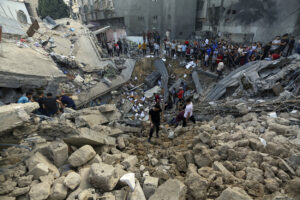
Palestinians inspect the site where there was a Greek Orthodox church, destroyed following Israeli airstrikes on Gaza City, Friday, Oct. 20, 2023. (AP Photo/Abed Khaled)
Massad confesses he “really doesn’t have the words” to describe his grief upon learning that Trazy was killed Oct. 19 at age 80 when St. Porphyrios Greek Orthodox Church was damaged during an airstrike in the Israel-Hamas war.
“She’s very dear to us, and it’s very sad,” Massad told Baptist Press.
Trazy, a retired schoolteacher and headmaster, was among 18 Christians and two others killed in the airstrike as hundreds sheltered at St. Porphyrios and the Holy Family Roman Catholic Church for safety.
“The ceiling of (a building on the church compound) fell on the people while they slept. And some were not able to run. Even though Israel sent a warning with a small missile,” Massad said, “I’ve been told they just had about five minutes or so.”
Families mourned the 18 in one service, Massad said, including three siblings all under the age of 13.
“Almost half of the population in Gaza are children—all of them created in the image of God,” he said.
‘There is no safe place in Gaza’
Despite Israel’s warning to flee Gaza in advance of the current ground attack, “here is there to go?” Massad posed. “There’s no safe place in Gaza.
“Even in the church compound, this is what happened to them. This is what makes you feel so sad deep inside, when you have 8,000 to 9,000 now or so (civilian fatalities in Gaza). And they tell you 40 percent of the people who have been killed are children and women. And they continue.
“I think there’s a better way than this.”
Massad was last in Gaza in mid-September, two weeks before Hamas struck Israel by surprise, killing an estimated 1,400 civilians and soldiers and taking at least 240 hostages, by latest U.S. estimates, including some Americans.
“What happened to Israel is horrible, and it shouldn’t have happened,” Massad said. “I love the Jewish people.”
A month into the war, Israel completely surrounds Gaza City, essentially separating Gaza into northern and southern regions, The New York Times reported Nov. 6.
More than 10,000 people have died in Gaza, including 4,100 children and 2,600 women, the Hamas-run Health Ministry reported Nov. 6. More than 2,000 others are missing and perhaps buried under rubble, the ministry said.
It has not been reported whether Americans are among the dead in Gaza, but at least 31 Americans were killed in Hamas’ Oct. 6 attack on Israel, the White House has reported.
More than 300 Americans and their family members have managed to leave Gaza, Jonathan Finer, U.S. deputy natural security adviser, said Nov. 5 on “Face the Nation,” but others remain. About 400 Americans and their family members—about 1,000 people in all—were trying previously to leave the war zone, U.S. Secretary of State Anthony Blinken said Nov. 2.
Former pastor leads Christian Mission to Gaza
Massad was the first local minister to pastor Gaza Baptist Church. He led the congregation 12 years, moving to Jordan in 2007 as persecution of Christians in Gaza grew under the hands of Hamas.
Today, he visits Gaza and Jordan three times a year as founding president of the Christian Mission to Gaza, an evangelistic and humanitarian outreach to Christians, refugees, orphans and widows.
About 900 Christians remain in Gaza after many fled Christian persecution when Hamas kidnapped and killed a Gaza Baptist youth pastor in 2007 as Hamas battled Fatah for control of the West Bank.
Massad continues weekly Sunday Zoom worship with Palestinian Christians and others in the region, although Christians in Gaza have not been able to log in during the war. Last Sunday, Massad said, about 30 Christians long displaced from the region logged in.
“I have almost daily communication with the Christian community and the leaders in the church,” he said, as he continues to minister to the church of about 60 with a team of about five ministers. Gaza Baptist has been without a pastor a few years.
“I usually share with my brothers and sisters in Christ (that) I love the Jewish people, but I hope and pray also there will be a place in your heart to love the Palestinians as well, because all of us are created in the image of God, and we see God in each other as we look to one another,” he said.
Massad views the war from a historical perspective dating to the 1917 Balfour Declaration of World War I, when Britain pledged to establish in Palestine a permanent home for the Jewish people.
At that time, the population of the region was about 5 percent to 10 percent Jewish, Massad said, but more Jewish people relocated to Palestine after World War I.
Conflicts escalated between the two ethnic groups, sparking the 1947 Arab-Israeli War and the 1948 establishment of the Israeli state.
“I’m 63 years old now. I grew up in Gaza and my father went through the occupation,” he said. “And I experienced humiliation during the Israeli occupation.”
The establishment of the Israeli state resulted in 700,000 Palestinian refugees, Massad said, including about 55,000 Christians. Massad said he has documents to prove his extended family, who were Orthodox Christians, lost about 67,000 square meters of land in the conflict.
“The reason I’m sharing this is for people to see the whole picture, for people to see the other side of the coin, because things are not always black and white,” he said.
“Some people say God gave the land to the Jewish people, and get over it. I believe the Scripture and all of that, but in the same time the question is really how far back in history do you want to go to solve this conflict?”
Christians should consider their ultimate example of Jesus in finding an intelligent response to the war that doesn’t include continually killing civilians, Massad believes. He favors a two-state solution.
Living as God has called Christians to live is most important to Massad.
“We have a higher call,” he said. “The higher call is not a piece of land. The higher call is to implement God’s call in our lives.”
Report names worst religious persecutors globally
November 7, 2023
Nigeria—a nation the U.S. Department of State has failed to designate as a Country of Particular Concern—is among the worst persecutors of Christians, an international religious freedom watchdog group reported.
“Nigeria is arguably the most dangerous place to be a Christian in the world today,” International Christian Concern stated in its 88-page 2023 “Persecutors of the Year” report.
The report points to terrorist groups in Nigeria such as Boko Haram that has been responsible for more than 38,000 deaths in the past 12 years and the enforcement of Sharia law in 12 northern states as sources of persecution.
ICC documents 55 attacks in Nigeria resulting in the deaths of 549 Christians from March 4 to July 6, the burning of a Catholic seminary and killing of a seminarian in Kaduna State, and the overnight murder of more than 20 people in a Plateau State village by radical Fulani militants in August.
“Whether the world acknowledges the plight of Nigerian Christians or not, the country has become a burial ground for Christians,” the report stated.
“Nigeria is a country torn by violence. From large, organized terror groups to small, disconnected communal militias, the violence in Nigeria is endemic.”
Other countries on ICC’s top 10 list of oppressive nations are:
North Korea. An estimated 400,000 Christians practice their religion secretly in North Korea, ICC reported. People of faith and political prisoners who are deemed disloyal to Kim Jong Un as Supreme Leader are sentenced to prison camps where they are forced to perform hard labor.
India. A surge in Hindu nationalism—supported by Prime Minister Narendra Modi—has resulted in the targeting of Christian and Muslim communities. The government has used blasphemy laws and anti-conversion laws to oppress non-Hindus. “In 2023, violence against Christians has continued at a record pace, on track to meet or exceed 2022 when about 600 incidents took place,” the report stated.
Iran. Ali Khamenei, the Grand Ayatollah and Supreme Leader of Iran, operates an Islamic republic, “harshly eliminating political and religious resistance to its hardline adherence to Islam,” the report stated. Christians and others who are imprisoned for violating Sharia law are subject to imprisonment and torture.
China. Over the past two years, the Chinese government has closed more than 7,000 churches, ICC reported. “The Chinese government aggressively suppresses religious expression, seeing it as a threat to the Chinese Communist Party’s control and national security,” the report stated. Under President Xi Jinping, the government is seeking to align state-sanctioned religion with communist principles and Chinese culture while persecuting members of house churches.
Pakistan. While the United States has identified Pakistan as a “Country of Particular Concern,” Pakistan’s state endorsement of Islam and its blasphemy laws have continued to contribute to intolerance and persecution. “Authorities use blasphemy laws to legitimize persecution and force conversions across society to suppress Christians and other religious minorities,” the ICC report stated. “Pakistan is one of only a handful of countries around the world with the death penalty for speaking against Islam.”
Eritrea. A 2022 government decree that required all religious groups to register led to the closing of all houses of worship except for Islam, the Eritrean Orthodox Church, the Eritrean Evangelical Lutheran Church and the Roman Catholic Church. “In Eritrea, those wishing to worship outside the narrow confines established by the government face severe penalties including torture, imprisonment and death,” the report stated.
Algeria. The government closed dozens of congregations affiliated with the Protestant Church of Algeria, and the nation continues to have blasphemy laws in its penal code, ICC reported.
Indonesia. Islamist extremists target religious minorities in Indonesia, using blasphemy laws to intimidate and suppress non-Muslim religious practice, the ICC report stated.
Azerbaijan. Viewing Armenian culture and Christianity as synonymous, Azerbaijan officials have destroyed historical churches. “Azerbaijan’s end game is clear: to rid its borders of Christianity—either by forcing the Armenian people and their faith out of Azerbaijan or destroying the people and historical sites,” the report stated.
In addition to countries persecuting Christians, ICC also named six entities it identified as the world’s worst in terms of oppressing religious freedom and religious minorities.
They are: Allied Democratic Forces, an Islamic State-affiliated group operating in Uganda and the Democratic Republic of Congo; Al-Shabab, an al-Qaida-affiliated jihadist group in Somalia and northeastern Kenya; Fulani militants, killing Christians in the Middle Belt of Nigeria; Sahel terror groups, conducting jihadist attacks in Africa’s semi-arid Sahel region; the Taliban in Afghanistan; and the Tatmadaw Burmese military in Myanmar.
ICC singled out five individual actors as among the worst persecutors globally. In addition to Kim Jong Un in North Korea and Xi Jinping in China, they are Yogi Adityanath, chief minister of India’s Uttar Pradesh State; Isaias Afwerki, president of Eritrea; and Recep Tayyip Erdoğan, president of the Republic of Turkey.
First TBM volunteers return from Israel
November 7, 2023
The first two teams of Texas Baptist Men volunteers in Israel are returning home after providing more than 30,000 meals since the Israel-Hamas war began.
However, it isn’t the war that dominates their conversation. They talk about the faith that motivated them and the people they encountered.
“Being a witness was the main focus for us going there,” said Genia Macon of First Baptist Church in Lewisville. “Christians coming from halfway around the world is a huge witness for Jesus Christ. … It’s not our words. It’s our actions. We feel like we’re the hands and feet of Jesus Christ.”
Suzanne Shumock, a TBM volunteer from Mississippi, said people in Israel were “encouraged because we were there … that we were willing to come and help.”
Twenty-nine TBM volunteers have worked in Israel thus far. Most are from Texas, plus two from Mississippi, two Church Forward volunteers from Missouri and one Baptists on Mission volunteer from North Carolina.
‘Flexibility is key’
The situation unfolded differently than expected, because the war did not progress as expected, said Gary Finley, who is TBM’s volunteer coordinator in Israel and spent much of October there.
During a recent trip to Israel, TBM Executive Director Mickey Lenamon (center) assists volunteers Mason Willis (left) and Sid Riley. (TBM Photo)
Still, TBM has been feeding at least 2,000 people each day, topping 3,000 Thursday.
“We may not have gone over to do exactly what we planned to do. But … the mission of TBM is to share the love of Christ, and feeding is just an avenue for that,” Finley said.
A third TBM volunteer team will go to Israel, but first TBM’s in-country partner—Emergency Volunteers Project—will focus on capacity building and making it possible for a field kitchen to increase the number of meals provided each day, TBM Executive Director Mickey Lenamon noted.
“In disaster situations, TBM has learned flexibility is key in ministering well. It’s even more important when serving in the middle of a war,” Lenamon wrote in a Nov. 1 email to TBM disaster relief volunteers.
“With that in mind, we have decided to postpone what would be our third team in Israel for a short time. Local Israeli volunteers will continue to serve as they expand the capacity to deliver meals. It’s going to take a little time and investment before sending in the next Texas team.”
‘Showing the love of Christ through our actions’
In October, TBM volunteers generally prepared the meals, working with Israeli relief workers and volunteers, who delivered most of the food, Finley said.
“We’re building relationships … showing the love of Christ through our actions,” he said. “And they are receiving it very well … and inviting us into their homes.”
People in Israel do not have much contact with Christians, and “most Israelis don’t have the best opinion of Christians,” Finley said. The volunteers’ presence in Israel is “breaking through the stereotypes.”
TBM has trained more than 100 volunteers specifically for Israel, Finley said. “We are trying to get them there first” and then “fill gaps with some that have not been trained” in Israel, he explained.
The 29 volunteers who have served thus far were busy preparing food for the people in Israel. That’s the work, but the witness is the purpose.
‘We are here because Jesus Christ has sent us’
Jackie Grey, of 121 Church in Grapevine, said the Israel experience “made me realize that people from other cultures and religions don’t understand that Christians want to share Christ’s love by serving them.
“The people we served alongside and who dealt with us … could not comprehend that we were there to help without being Jewish or Israeli,” Grey said.
Macon found it interesting speaking with Israelis. She said someone told her: “I thought Christians were bad. You’re not bad. You’re here.”
“We want people to know we are Christians, and we are there because our Lord Jesus Christ has sent us,” Macon said.
Jodie Liford, of First Baptist Church in Forney, said, “All those little conversations we have with people, they matter.”
Andy Stern of First Methodist Church in Richardson said, “We were able to make a lot of food, and we know it got distributed to people in need.” But having the “chance to grow relationships with our Israel friends and volunteers” is what impacted Stern most.
Even as they began the journey home, Stern said, he had a “phenomenal discussion” with several Jordanians.
“It was a special experience of people getting to know each other,” he said. “We’re children of a God who loves us.”
‘God’s hand was over us’
Stern went to Israel “because God called me to go.” Proverbs 3:5-6 became important to him as he prepared and began the trip. The verses speak of trusting the Lord and leaning not on your own understanding.
The effects of war brought the TBM volunteers to Israel, but the volunteers saw little of it directly.
“One time we saw contrails of missiles,” Shumock said. “I was never afraid. … That goes back to that prayer thing. God’s hand was over us.”
Macon noted it was a “little scary” considering going to Israel. “I had to think about it and pray about going. … Once there, I felt safe and secure.”
Some TBM Israel training has been canceled, and other week-long offerings are now filling up, Finley said. Visit the Volunteer in Israel web page at tbmtx.org/israel to apply for training. There is a separate Israel Volunteer Sign Up web page at tbmtx.org/israel-volunteer-sign-up for those who are not yet trained in Israel but would like to serve if possible.
Baptist praises process followed in Catholic Synod
November 7, 2023
Some observers criticized the recent Roman Catholic Church’s Synod on Synodality for failing to take bold positions on controversial issues. But a Baptist participant at the Synod believes other Christians could learn from the process Catholics followed.
“Synodality is an unfamiliar word, not only amongst Protestants, but also—I quickly discovered—amongst many Catholics, as well. It means ‘walking together’ or also ‘accompaniment.’ There was a strong focus on listening to one another and seeking to discern together—in contrast to only debating,” Baptist theologian Elizabeth Newman said.
Elizabeth Newman (Photo / https://scholars.duke.edu/)
Newman from the United States and Valérie Duval-Poujol from France served as Baptist World Alliance fraternal delegates to the Synod on Synodality.
The summit of 464 Catholic bishops, priest and laity—including women—gathered to discuss a range of issues, based on two years of conversations in Catholic parishes around the world.
As chair of the BWA Commission on Baptist Doctrine and Christian Unity, Newman is a veteran of Baptist-Catholic dialogues. She participated in conversations between the BWA and Pontifical Council for Promoting Christian Unity, a long-term initiative.
“I believe this kind of ecumenical initiative is important because, as the Baptist World Alliance acknowledges, while for Baptists the local church is wholly church, it is not the whole church,” she said.
“God gathers us in local congregations of discipleship, gatherings that are at the same time part of a larger reality—the church universal. Ecumenism is the active reminder of this truth.
“There is, of course, division and even discord. God calls Baptists and all Christians, however, to seek unity,” she continued, citing John 17:20. “Unity is a way of sharing in God’s mission.”
Religion News Service reported 364 voting participants in the monthlong summit produced a 42-page document, Synthesis Document for a Synodal Church in Mission. RNS noted most of the 20 points in the document passed with overwhelming majorities, but no single paragraph received full consensus.
At the Synod, participants were divided into groups of 12 and “invited to address specific questions that arose out of earlier synodal discussions from the seven continents,” Newman explained.
“Each group considered shared convergences, divergences amongst themselves and ongoing questions that the group had,” she said. “The groups had facilitators, and all members were allowed equal time to speak.”
Prayer and contemplation practiced
Newman praised the Synod’s emphasis on prayer and sensitivity to the Spirit’s leadership.
“In addition to prayer at the opening and closing of each session, there were periods of silence, two to four minutes, usually following about 30 minutes of listening,” she said.
“As I experienced it, the Synod is seeking to form its participants to see synodality as a contemplative way of being. I think Baptists and all Christians could learn from this way of being with one another in contrast to the temptation to be reactive.
“At the same time, synodality is not only listening. The focus is discerning together in light of Scripture and tradition.”
She expressed hope the “contemplative process of synodality” and emphasis on prayer not only will shape congregational discussions, but also future ecumenical dialogue.
Synodality also includes “a strong emphasis on the poor, the migrants, those on the periphery or those who feel excluded from the church,” she added.
“How might fuller attention to those on the margins shape and build up our understanding of being church together?” she asked.
Role of women explored
As expected, the role of women in the church figured prominently in Synod discussions. The Women’s Ordination Conference officially said it was “dismayed by the failure of the Synod to take seriously the overwhelming calls to open all ordained ministries to women.” Even so, it applauded the Vatican for allowing 54 women to vote alongside male bishops for the first time at the summit.
The Synod gave serious attention to asking how to acknowledge fully women’s gifts and roles in the church, Newman said.
“It was quite moving to hear women from different parts of the world speak to the need for their presence and gifts to be more fully received in the life of the Catholic church,” she said. “For me, this discussion related to discussion about authority, which some emphasized, was not simply power as in the secular sphere. Authority is service to assist growth, promoting others and not oneself, and is rooted in the grace of God.”
Newman noted the Synod opened the possibility of ordaining women to the diaconate, if not the priesthood. She pointed out Lottie Moon—the revered 18th century Baptist missionary to China—supported a revival of the order of deaconesses, whom she called “holy handmaids of the Lord.”
“While Baptists and Catholics have differences in understanding the role of ‘deacon,’ it would be fruitful ground to explore as a shared possibility for women,” she said.
Challenge of secularization examined
The Synod devoted particular attention to Christian witness in the midst of secularization, particularly in the Western Hemisphere, Newman noted.
“This secularization included the loss or weakening of faith across the generations,” she said. “This would be a shared concern for Baptists and other Protestants, as well.”
Discussion focused on how to include young people in various church roles, listen to their concerns and strengthen their spiritual formation, with special attention to communicating in a digital context, she observed.
“I talked with one sister who has a huge following on TikTok, where she responds to questions that young folks send in,” she said.
Signs of common ground?
Despite distinct theological differences between Catholics and Baptists, Newman saw evidence of common ground in the discussions at the Synod.
“I think many Baptists would have been surprised to hear Catholics emphasizing a personal relationship or encounter with Jesus. This emphasis was in response to reflecting on co-responsibility and a shared understanding of all participating in the mission of the church,” she said.
“Baptists have long emphasized lay involvement in mission. At the same time, Baptists and Catholics can continue to learn from one another how our mission to the faith is to be lived out.”
In small-group discussions at the Synod, Newman noted “a strong emphasis on the witness of holiness or the idea that you’re sharing your own person as well as the good news. Holiness and transformation are part of the gospel.”
Baptists and other Protestants—who accept the priesthood of believers as a central doctrine—could learn from continued ecumenical dialogue with Catholics, she noted.
“The priesthood of all believers is no solo flight, but a communion that radiates,” she said.
McRaney files appeal with Fifth Circuit in NAMB suit
November 7, 2023
NEW ORLEANS (BP)—Calling the August court decision to dismiss his case against the North American Mission Board “wrong in almost every material aspect,” Will McRaney filed an appeal with the Fifth Circuit Court of Appeals on Oct. 31.
NAMB’s motion for dismissal was granted based on Judge Glen Davidson’s interpretation of the First Amendment and ecclesiastical abstention doctrine, which states that courts cannot get involved in ecclesiastical matters.
The court “finds that it cannot adjudicate the Plaintiff’s claims in this case without impermissibly delving into church matters in violation of the ecclesiastical abstention doctrine,” Davidson said in his Aug. 15 memorandum.
That viewpoint, said McRaney in the Oct. 31 filing, “misapprehends the facts and the law, while itself threatening religious liberty and raising Establishment Clause concerns.”
The district court’s conclusion contained “significant” errors, the filing continued, namely by “purporting to grant” summary judgment after it had determined that it lacked subject matter jurisdiction. This requires the case to be remanded to state court, the document said, something the district court did not do.
“This appeal presents important procedural and substantive issues, and Dr. McRaney respectfully submits that oral argument will significantly aid the Court’s adjudication of this case,” it said.
In its response to the filing, NAMB also argued its case on religious liberty grounds.
“The District Court’s latest dismissal of the plaintiff’s claims rightly protects religious liberty for all churches and religious ministries as secured by the First Amendment of the U.S. Constitution—freedoms that would be narrowed if he prevails in this new appeal,” a NAMB spokesperson said.
“The latest dismissal in no way threatens Southern Baptist polity, voluntary cooperation, or autonomy, each of which NAMB has consistently and correctly reflected in its court filings. To the contrary, the decision dismissing the plaintiff’s case protects autonomy and religious liberty. We look forward to filing our response to the plaintiff’s appeal as we continue to defend our ministry against his unfounded claims and to defend every church and ministry’s religious liberty.”
McRaney and his wife Sandy addressed the case in a video posted Oct. 24 where he also talked about financial support for the case collected through a GoFundMe account. An unnamed state Baptist convention and not just its leader, he specified, is among those who have contributed.
Other state conventions, he added, have placed funds to try and “speak the truth to the courts.”
McRaney originally filed his case in April 2017, claiming NAMB and President Kevin Ezell influenced the Baptist Convention of Maryland/Delaware to fire him as executive director. Davidson originally dismissed the case in April 2019.
McRaney appealed that decision the following year with the Fifth Circuit, which overturned the dismissal and brought a petition by NAMB to the Supreme Court in February 2021 claiming First Amendment protections. That petition was denied, with the case remanded back to the district court before it summarily was dismissed.
On the Move: Brazzel and Griebling
November 7, 2023
Steve Brazzel to Leon Baptist Association as part-time director of missions. He also is the part-time director of missions for Unity Baptist Association.
Jeff Griebling to First Baptist Church in Gilmer as minister to children and families, starting Nov. 6.
Around the State: Orr Chair in Medical Humanities and Christian Faith endowed at Baylor
November 7, 2023
Baylor University announced a $2 million gift from Scott and Susan Orr of The Woodlands establishing the Orr Family Endowed Chair in Medical Humanities and Christian Faith. The gift supports teaching, mentorship and research in the medical humanities program within the College of Arts and Sciences. The Medical Humanities Program is intended to pair foundational science curriculum with courses in history, literature, Christian philosophy and other disciplines to inspire discussion and critical thinking. “We are truly grateful for Scott and Susan Orr and for their family’s generous support of the faculty of Baylor University,” said Baylor President Linda Livingstone. “The Orr Chair provides significant resources with which to support our faculty within the department of medical humanities and to foster strategic growth within the department. We are truly grateful for this family’s commitment to Baylor’s Christian mission and vision, and we are grateful for the support this provides to our faculty, who invest of their time and talents in our students through transformational teaching and mentoring.”
Billy and Winkey Foote of Longview join East Texas Baptist University President J. Blair Blackburn and ETBU First Lady Michelle Blackburn to celebrate the opening of Foote Hall at Tiger Yard and the ETBU Tiger Ballpark. (ETBU Photo)
East Texas Baptist University welcomed donors and friends of the institution to celebrate the opening of the newly constructed Billy and Winky Foote Hall at Tiger Yard and ETBU Tiger Ballpark on Oct. 13. Foote Hall at Tiger Yard is a multi-purpose facility that houses loft-style student residences, the ETBU baseball clubhouse and the Blue Bengal Grocery Company, ETBU’s branded micro-market grocery store. The newly renovated ETBU Tiger Ballpark features 535 permanent seatbacks and holds up to 1,500 fans with standing-room areas. A new press box, two radio booths and two suites were added to the stadium. “Billy and Winky Foote met each other on this Hill, and it’s amazing what God sewed together and continues to bless,” ETBU President J. Blair Blackburn said. “The Footes have committed their lives to Jesus Christ, their ministry, their family and their alma mater. … We are so grateful for their ministry, their love for the institution, their love for the Lord Jesus and the contributions to the kingdom they have made through their Christian spiritual leadership.”
The Center for the Foundation of Ethics at Houston Christian University is sponsoring a yearlong interdisciplinary “Foundations of Morality” faculty lecture series. Randy Hatchett, professor of theology in HCU’s School of Christian Thought, will present a lecture about “Theological Foundations for Morality: Reflections Concerning the Need for Revelation” at 3:30 p.m. on Nov. 14 in Hinton 125 on the HCU campus. Presentations already have been offered on “The Nature of Literature and Ethics” with Matthew Boyleston, “How the New Testament Redirected the Foundations of Morality” with Robert Gagnon and “The Ethical Conflict Between Worldview Communities within the Field of Psychotherapy/Counseling” with Eric Johnson. Nine additional lectures, spanning the full range of academic disciplines taught at HCU, are planned, and the collected lectures are slated for publication.
East Texas Baptist University recognized recipients of the 2023 Alumni Awards. (ETBU Photo)
As part of 2023 homecoming at East Texas Baptist University, the university recognized alumni for their contributions. Frances Aguilar Salazar, a 1951 graduate of what was then East Texas Baptist College, received the Golden Lightkeeper Award, a recognition reserved for alumni who graduated over half a century ago and have continued to excel in their vocations, contributions to their church and outstanding service to their communities. In addition to her career as an educator, she supported her late husband Epifanio in his pastoral ministry, and she served as a leader in Woman’s Missionary Union. Orlando Salazar accepted the Golden Lightkeeper Award on behalf of his mother, who is 96. Recipients of the 2023 Alumni Awards included Larry Hemenes, the J. Wesley Smith Achievement Award; Bill and Anita Runnels, the W.T. Tardy Service Award; Alton Holt, the Alumni Achievement Award; Sadé Stewart, the Unsung Hero Award; and Katie Balfe; the Young Alumna Award. Since inception of the Golden Blazer program in 2010, ETBU has honored more than 100 alumni for their financial support and countless volunteer hours to ETBU. The 2023 Golden Blazers are Laura Coursey, Glenn Hambrick, Robin Rudd and Michael Tandy.
After 250 years, ‘Amazing Grace’ holds enduring power
November 7, 2023
WASHINGTON (RNS)—James Walvin, a former Church of England choirboy and professor of history at the University of York, doesn’t remember encountering “Amazing Grace,” in song or in his hymnal.
It wasn’t until he traveled to the United States to research the history of slavery that he came upon the hymn introduced by John Newton, a former slave trader, in 1773.
Since then, Walvin, the author of the new book Amazing Grace: A Cultural History of the Beloved Hymn, has submerged himself in the hymn, which turns 250 this year and has become a staple of Sunday services that has been adapted and adopted by preachers, performers and presidents.
“I wasn’t too keen on Elvis’ version,” Walvin said after a recent visit to the Library of Congress’ “Amazing Grace” collection, which includes more than 3,000 recordings of the song—the only one of Newton’s hundreds of hymns that gained such international stature.
“I certainly was not keen on (1960s orchestra leader) Mantovani’s version,” he added. “I was amazed to listen to Janis Joplin’s version. I mean, who’d think of Janis Joplin and ‘Amazing Grace?’”
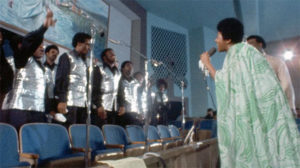
Aretha Franklin interacts with James Cleveland’s Southern California Community Choir while recording her “Amazing Grace” album at a Los Angeles Baptist church in 1972. (Photo courtesy of NEON via RNS)
Among the thousands of versions, Walvin is especially fond of bass-baritone Paul Robeson’s but gives a nod to “Queen of Soul” Aretha Franklin as well as “a choir from Soweto, an extraordinarilyhaunting version of it,” saying they are all “effective in their own different, very distinctive ways.”
Walvin, 81, a longtime non-Christian, spoke to Religion News Service about the hymn, its composer and the “electrifying event” when President Barack Obama drew on its power.
The interview was edited for length and clarity.
Why has “Amazing Grace” endured for 250 years?
“Amazing Grace” survived, particularly in the United States and especially in African American communities, because its words speak to a human condition of suffering, and people coming out of suffering, and its music has a kind of haunting refrain that soothes. It has a unique combination of important phraseology—words, verses—and the beguiling music.
How do you explain the fact that John Newton, a former slave trader, wrote a hymn that’s treasured by enslaved people and their descendants?
I think young people find it very hard to get their heads around the fact that here is a hymn of great Christian significance written by a man who’s stained by the brutality and violence of slavery. It’s a historical paradox, really.
But it extends beyond that hymn. There are millions of people at the time, on both sides of the Atlantic, ensnared in slavery, one way or another, who are deep Christians, God-fearing men and women who see no contradiction in their faith and their behavior toward Africans. And that’s one of the extraordinary, difficult things to understand.
You write that Newton spent years trying to become a Church of England priest before he was able to lead a parish and share his hymns. So, this song might never have reached the international stage?
Yes, it speaks to John Newton’s perseverance. To become a minister, you had to have gone to one of the two main universities, Oxford or Cambridge, and he hadn’t been close to either of them. He was not formally educated. Yet he was a deeply learned man, and a deeply religious man. He had to fight against the institutions and against the church to let him in.
Though most of the words are 250 years old, the tune we know best today is newer. How did that come about?
The music that we associate with “Amazing Grace” today is not what people sang for 60 years after Newton wrote it in (December) 1772. We know from the Lomax family—a father and son who recorded folk songs in the United States in the backwoods—that people sang the words through an extraordinary variety of songs. But it’s the music that we now know came together with the words in the 1830s that actually creates that combination that is so potent and so durable.
You trace the hymn’s growing stature as the radio and recording industries grew. Is there an apex? Maybe President Obama’s singing it in 2015, in his eulogy for Mother Emanuel African Methodist Episcopal Church’s Rev. Clementa Pinckney?
I think what Obama did was to tap into the familiarity and popularity of the hymn in the United States. Obama knew if he sang it on that particularly very emotive moment that he would secure the backing of this largely African American audience in Charleston.
When he begins to sing, it looks as if it’s spontaneous, and no one would claim that President Obama has a good singing voice. But it is an astonishing moment. And if you look at the way the clerics behind him rise to the occasion, and the background musicians—they’re scrambling to get their instruments lined up and working with the president.
He knew the congregation would follow him, and he knew that, by 2015, “Amazing Grace” had become effectively a second national anthem. Very few people don’t know it, don’t know of it or don’t recognize it.
You note that advertisers have used “Amazing Grace.” Can you name some examples?
People sell candies. They sell doughnuts. They sell funeral plans with “Amazing Grace” in the background. Sometimes people don’t notice but it’s that subconscious music that somehow or other lulls people into a sense of appreciation for what’s being promoted.
“Amazing Grace” was part of the soundtrack of the civil rights movement. What role did it play in the life of the Rev. Martin Luther King Jr. in particular?
At the end of those long, grueling days, when he’s exhausted, threatened by all kinds of horrible violence, as he was trying to unwind and relax in the evening, Mahalia Jackson would sing “Amazing Grace” to him on the telephone. If that isn’t an extraordinary insight into both those people, Jackson and King, I don’t know what is. Here is one of America’s great gospel singers and one of America’s great leaders, united in “Amazing Grace.”
While there are many performances of “Amazing Grace” that you praise, you call the use of a few of its lines by Jan. 6 insurrectionists “a shameless hijacking of a much-loved American song.”
It is interesting that a small section of the crowd tried to use the hymn, but they ran out of steam. No one knew the words after the first verse.
How have you celebrated the 250th anniversary?
The anniversary was launched in Olney in Buckinghamshire, which is where it was written and first performed on New Year’s Day in 1773. I was there. I talked about the hymn in this little village where this lovely church still exists—where Newton was the rector.
I’m going to speak at the end of this year’s celebrations. (Earlier this month) I spoke at a care home in York to only 12 people—old people mostly not really very alert for all the obvious reasons, but they wanted to hear me talk about “Amazing Grace.”
Ukraine Baptist says ban not a threat to religious freedom
November 7, 2023
KYIV, Ukraine (BP)—A bill allowing Ukraine’s courts to outlaw Orthodox churches that maintain ties with Russia does not threaten religious freedom in Ukraine, a key Ukrainian Baptist leader asserted.
Rather, the law would provide a system for Ukraine’s government, as well as lay members of Orthodox churches, to learn whether any church leaders covertly are supporting Russia’s war efforts, said Igor Bandura, vice president of the All-Ukrainian Union of Associations of Evangelical Christian-Baptist.
Elijah Brown (left), general secretary of the Baptist World Alliance, and Igor Bandura, vice president of the Baptist Union of Ukraine, stand behind a pulpit made from a missile shot down over Ukraine. (Photo from Twitter)
“It’s not a question of religious freedom, but it is a question of national security, and here (on matters of national security) the state can react,” Bandura told Baptist Press. “We are not talking about the danger of religious persecution in Ukraine, because for us, religious freedom is very important.
“As Baptists, we still witness that Ukraine has religious freedom. We carefully are following (the proposed law’s) development.”
At issue is a bill that would allow Ukraine to forbid any religious organization that maintains its spiritual or administrative center in a country of aggression, in this case Russia. The bill passed Oct. 19 is the first of two required procedural votes in Ukraine’s lower house of parliament, and it is subject to a second draft, which must also pass Parliament and be signed by Ukrainian President Volodymyr Zelensky before becoming law.
At that point, the state would have the authority to investigate churches, monasteries or seminaries on suspicion of supporting Russia’s war effort. Bandura said any action against a church or other religious organization would be subject to the courts and the appeal process culminating in Ukraine’s Supreme Court.
Brent Leatherwood, president of the Southern Baptist Ethics & Religious Liberty Commission, lays the blame on Russia for any attack on religious liberty in Ukraine the war has wrought.
“Under the Ukrainian constitution, citizens are guaranteed a right to freedom of religion. That should always be the standard, regardless of circumstances. Individuals have a right to order their lives according to their religious convictions,” Leatherwood said.
“Russia ending its attempt at conquest and respecting the territorial sovereignty of Ukraine would be a good way to ensure all Ukrainians have that freedom.”
Two Orthodox churches in Ukraine
The bill under consideration exists because Ukraine has two Orthodox churches—the Orthodox Church of Ukraine-Moscow Patriarchate and the Orthodox Church of Ukraine. The latter, historically affiliated with Constantinople, is autonomous.
Both are called the Orthodox Church of Ukraine, but importantly have different affiliations. Some Moscow Patriarchate churches do not include that designation in their names, Bandura said, making it difficult to distinguish them from autonomous Orthodox Church of Ukraine congregations.
“In their documents, and this is what they (Moscow Patriarchate churches) insist, they cut any relationship with Russia, and they are self-governing—which most Ukrainians don’t believe,” Bandura said.
Bandura cautioned Southern Baptists and other Americans not to believe “Russian propaganda” painting Ukraine as a persecutor of religious groups.
“We should be aware that Russia tries to use this to speak against Ukraine and to paint Ukraine and the Ukrainian president specifically to the United States as the enemies of religious freedom and initiators for religious persecution,” Bandura told Baptist Press.
“From our perspective, we say, ‘No, we have religious freedom for all churches and religious organizations, except this one, because they are playing this big game and still stay connected to Moscow, which is unacceptable to most Ukrainians, because Russia started the war against us, and their basic idea is to (commit) genocide (against) us as a nation.”
Some priests from the Moscow Patriarchate openly supported Russia in the war, and some were arrested before fleeing to Russia.
“Since the beginning of the war, a group of priests from Ukrainian Orthodox Church of Moscow Patriarchate was arrested for spreading their Russian propaganda,” Bandura said. “And later on, many of them were recognized as those who have Russian citizenship also.”
Russian Orthodox Patriarch Kirill in the Christ the Saviour Cathedral in Moscow, on Jan. 7, 2021. (AP Photo/Alexander Zemlianichenko)
Leatherwood points specifically to Patriarch Kirill of the Russian Orthodox Church based in Moscow.
“Since this illegal and ghastly campaign of terror by Russia began, thousands of innocent lives have been lost and hundreds of religious sites have been destroyed by the Russian military,” Leatherwood lamented.
“As we have seen in the Ukrainian regions currently under Russian control, religious freedom has been largely extinguished, particularly for evangelicals in those areas. And these actions have been supported by Patriarch Kirill of the Russian Orthodox Church, which is nothing short of morally reprehensible.”
Not all Moscow Patriarchate churches are believed to support Russia’s war efforts. There are more than 10,000 Moscow Patriarchate churches in Ukraine, and some of their members are Ukrainian soldiers, Bandura said.
Moscow Patriarchate churches are included in the 25-year-old All Ukrainian Council of Churches and Religious Organizations, as are the autonomous Orthodox Church of Ukraine, the All-Ukrainian Baptist union, and Jewish, Muslim and other religious groups.
“We have a very open, sincere and trusted relationship. And all together, we have been dealing with this issue,” Bandura said of the diverse churches. Ukraine’s Parliament consulted the council about two years ago for the churches’ reaction to such a bill before it was submitted.
“Our position was very clear. We are standing against any religious persecution and any limitation in Ukraine,” Bandura said. “But in government, (it) would concern and include cases which are not religious freedom issues, but national security issues.”
The All-Ukrainian Union of Associations of Evangelical Christian-Baptist represents about 2,200 churches and is a member of the Baptist World Alliance, and Bandura is a member of the BWA General Council.
Rangers standout rookie Carter proclaims, ‘Jesus Won’
November 7, 2023
ELIZABETHTON, Tenn. (BP)—Jason Holly, the youth minister at First Baptist Church in Elizabethton, Tenn., remembers when Texas Rangers rookie outfielder Evan Carter was a boy playing in the local Grasscutter football league for 6-8-year-olds.
Holly had a tiny Superman logo printed specifically for Carter.
“I stuck it on the back of his helmet, and only his,” Holly said. “And I said, ‘You’re Superman.’ He was just that good.”
Rangers fans are starting to agree with that assessment. Carter, who started the 2023 season in the minor leagues with Texas’ Double-A squad, is finishing it in the World Series. The 21-year-old became the youngest player since Mickey Mantle to bat third in a World Series lineup in Friday’s opening game.
He made an immediate impact for Texas, doubling off the wall in the first inning to drive in the game’s first run. Texas went on to win 6-5 on an 11th inning homer by Adolis Garcia. Through Game 3 of the World Series, Carter reached base safely in 15 consecutive games in this year’s postseason.
“It’s a dream come true,” Carter told Derek Jeter in a postgame interview about playing in the World Series. “You always want to be ready to go in the minor leagues. To think that I’d have been in the World Series this time, this is unreal.”
Holly coached Carter in youth football and baseball until Carter’s middle school years. He remembers joking with Carter’s dad that the kid would be going a long way in baseball.
“He was just that talented, at a very young age,” Holly recalled. “When he was in little league, I remember throwing the ball to him as hard as I could, and he was about 9, and he just would hit it right back at you. He was a phenomenal athlete.”
‘With his faith, he’s always stayed steady’
Carter’s family is part of Central Community Christian Church, a nondenominational congregation outside of Elizabethton. But he regularly attended programs and events at First Baptist Church during his childhood and teenage years.
“Evan and his family are very grounded people,” Holly said. “They’re very humble. They’re very gracious. Evan has always been this even-keeled kid. With his faith, he’s always stayed steady.”
Evan Carter wore a “Jesus Won” T-shirt in an interview in the dugout prior to his Major League debut. (Screen capture from Rangers Today podcast)
That’s why Holly wasn’t surprised when, after Carter was called up to the Rangers in September, he took his first batting practice wearing a blue T-shirt with the message “Jesus Won” prominently displayed across his chest.
“I always felt like Evan was grounded on the Lord, and he had his eyes, his ears and his heart the right way,” Holly said.
In an interview in the dugout prior to his Major League debut, Carter wore that “Jesus Won” shirt while speaking to the media about being a part of the Rangers team.
“It’s unbelievable,” Carter said to start the interview. “I’m grateful, and I thank God for the opportunity.”
That shirt has become practically ubiquitous in Elizabethton, as Carter’s performance and profile have continued to skyrocket since his arrival with the Rangers. Fellowship of Christian Athletes sells a Carter edition of the shirt, with “EC” and Carter’s number 32 on the sleeve.
Give back to the community
Carter and his wife Kaylen shared on social media that they want to use their platform in baseball to give back to their community in Carter County, Tenn.
Proceeds from sales of the shirt benefit Central Cares, a program from their home church that helps provide for children in impoverished situations, and to help provide an environment for young baseball players in their community to succeed.
Holly said Carter and Kaylen have been together since sixth grade.
“You can just tell how they treat each other that the Lord is front and center for both of them,” he said.
Holly, who also teaches at Elizabethton High School, said the “Jesus Won” shirt has given him the opportunity to engage a lot of students who wear it with the message. That’s just one way he says Carter has made an impact on his community and how he is a role model to others.
“Evan’s a very humble, quiet person,” Holly said. “The thing he tells a lot of people is, ‘You can be great without being loud, and you can be great without causing problems, and you can be great without being flamboyant.’”
In that sense, Holly said, Carter is similar to Elizabethton’s other star athlete, former Dallas Cowboys tight end Jason Witten.
“Both of those guys kind of have the same character,” Holly said. “They’re quiet, family people. They just show kids that you can be the right person and be awesome.”
Tim Ellsworth is associate vice president for university communications at Union University in Jackson, Tenn.
EDITOR’S NOTE:The Texas Rangers won their first World Series on Nov. 1, defeating the Arizona Diamondbacks. Evan Carter hit his 9th double of the postseason in the 7th inning of Game 5, setting a new Major League Baseball postseason record.
 “Nigeria is arguably the most dangerous place to be a Christian in the world today,” International Christian Concern stated in its 88-page 2023 “