Sudanese Christians in Sahel may face Sharia law

KHARTOUM, Sudan (BP)—A return to Sharia law might be in store for Sudan as civil war nears its 10th month there, the U.S. Commission on International Religious Freedom said in its latest fact sheet on the Sahel Region of Africa.

The Sudanese Armed Forces under the country’s transitional leadership of General Abdel Fattah al-Burhan has recruited thousands who worked as intelligence operatives of former pro-Islamic President Omar al-Bashir, the commission said, raising concerns among Christians that al-Burhan has hopes of establishing Sharia law.

A man cleans debris of a house hit in recent fighting in Khartoum, Sudan, Tuesday, April 25, 2023. Khartoum, a city of some 5 million people, has been transformed into a front line in the grinding conflict between Gen. Abdel Fattah Burhan, the commander of Sudan’s military, and Gen. Mohammed Hamdan Dagalo, who leads the powerful paramilitary group known as the Rapid Support Forces. The outbreak of violence has dashed once-euphoric hopes for a democratic transition in Sudan after a popular uprising helped oust former dictator Omar al-Bashir. (AP Photo/Marwan Ali, File)

Christian persecution eased when al-Bashir was overthrown in 2019. However, a transitional government aimed at establishing democracy has been in jeopardy since civil war began in April between the Sudanese Armed Forces and the Rapid Support Forces paramilitary group under the leadership of General Mohamed Hamdan Dagalo.

“After the fall of the Bashir government, the transitional government granted Muslim and Christian groups some important freedoms, earning praise and support from the U.S. government,” the commission stated.

“However, the outbreak of new conflict in April 2023 within the state security apparatus has severely diminished any possibility of safe, open religious practice in Sudan.”

Sudan’s deterioration is part of a recent political trend across the Sahel, including Mali, and Niger, where armed forces attacked an already weak national government and established a military coup.

The new under-resourced state is supported by external forces, including the Russian-backed Wagner Group, to confront “extremist elements.”

While cracking down on violent extremists, the new government uses accusations of extremism as a pretext for suppressing religious minorities, the fact sheet stated.

“The state then begins to perpetrate religious freedom violations in the campaign against violent extremist groups,” the commission stated.

“At the same time, competing ethnic and religious groups which historically distrusted one another may take sides for or against the new government, change alliances, or form armed auxiliary units to survive. This posturing may result in further effects on individuals’ freedom of religion or belief.”

Eric Patterson, president of the Religious Freedom Institute, said the trend shows the connection between international religious freedom and U.S. international governmental relations.

“For those who say that issues of religious freedom and human rights are somehow tertiary, or fourth- or fifth- or sixth-tier things, what we see in this region (is) how closely intertwined (are) issues of religious identity, issues of religious political systems, and how closely these are tied to national security imperatives, both for the people on the ground and for our United States allies,” Patterson said.

Patterson was a panelist in a conversation the U.S. Commission on International Religious Freedom hosted Nov. 9 on religious freedom in the Sahel.

Across the Sahel, “the presence of insurgent groups, ethnic and religious conflict, and the continual intervention of military actors in politics have a direct impact on religious communities,” the commission said.

During al-Bashir’s regime which spanned 20 years, the commission considered Sudan a Country of Particular Concern for religious freedom violations, denoting “systemic, ongoing and egregious” violations. USCIRF downgraded Sudan to its Special Watch List of countries to be monitored in 2019, and removed the country altogether from its list of religious freedom violators in 2020.

 But the overthrow of the transitional government in April represents “grave threats to religious freedom” there, USCIRF Vice Chairman Frederick A. Davie said in a Nov. 9 conversation.

Sudan suffered decades of civil wars that began in the mid-20th century before the country split in 2011, establishing Sudan as a majority Muslim north and a majority (60.5 percent) Christian South Sudan. Christians comprise about 5.4 percent of Sudan’s 48 million people.


Boston churches sharing the gospel as holidays approach

BOSTON (BP)—In the nearly four centuries since its founding as America’s first park, Boston Common has witnessed some of the most important news events of American history—from public hangings during Colonial days to celebrating American independence in 1776 to Union soldier recruitment in the 1860s.

Earlier this month, Boston Common witnessed the sharing of history’s greatest news—the gift of salvation God offers in Jesus Christ.

Jaime Owens, lead pastor of the historic Tremont Temple Baptist Church just a few blocks from Boston Common, led 15 congregants to the park to give away copies of the Gospel of John and sandwiches and to share their faith.

While at the park, the group initiated conversations through a sign saying, “Ask a pastor anything.” A number of interesting questions came Owens’ way, including one from a Muslim who wondered how Christians could believe in a God who died on the cross.

Another nonreligious man asked what the world would be like if everyone lived like the Good Samaritan.

In each case, Owens shared the gospel. He also teamed other experienced personal evangelists with less experienced ones to strike up conversations, hand out food and talk about Jesus.

‘Encouraging because we can do it together’

It marked the first week of what Owens hopes will be at least a monthly time of personal evangelism for church members.

“In my preaching, I’ve always emphasized sharing the gospel personally with those God has placed in our lives—neighbors, coworkers, unsaved family,” Owens said.

“But we had never considered going downtown together to openly share the gospel. This is a new direction for us. It’s one way we can carry out the mission, and it’s encouraging because we can do it together.”

Tremont Temple dates back to 1839. Abraham Lincoln once spoke at the church, and Charles Dickens first read “A Christmas Carol” on American soil there. Today, the congregation is affiliated jointly with both American Baptist Churches and the Southern Baptist Convention.

Carl Bradford, an associate professor of evangelism and missions at Southwestern Baptist Theological Seminary, said the timing couldn’t be better for churches like Tremont Temple to get more involved in personal evangelism.

Bradford believes people are more open to the gospel during the holiday season than other times of the year. He notes research has shown more people are searching for churches online during Christmas and Easter than at any other time of the year. The same studies, he says, show Christmas and Easter are the highest attendance Sundays of the year in many churches.

“Though not everyone in the world understands the gospel message, many do embrace the spirit of giving behind Christmas,” Bradford said. “The season’s emphasis on generosity and goodwill can make people more open to hearing the gospel.”

Bradford also notes many people struggle through the holidays because of all the cultural pressures attached to the holidays. Often, those people are open to hearing about what Jesus has done for them.

‘A whole lot of seeds being sown’

At Lincoln Avenue Baptist Church in Jacksonville, Ill., the holiday season comes during the middle of a fresh evangelistic push. While the church is in a transition period between lead pastors, interim pastor Eric Reed has been encouraging the church to focus on evangelism.

“There was a real sense of: ‘We’re going to be OK. We’re good.’” said David Higgs, the worship pastor at Lincoln Avenue. “But [Pastor Reed] brought this to our attention. We knew we were good, but we couldn’t just settle there. We don’t want to settle. The way he put it is, ‘When the sheep catch their breath and get comfortable, they tend to nibble, and they nibble on each other.”

The holiday season brings a fresh evangelistic push at Lincoln Avenue Baptist Church, including events like Fall on the Farm. (Courtesy photo via BP)

So, the church decided to go all in on an initiative they call “Engage J-Ville,” which is all about personal connections and community connections. Leveraging an evangelistic prayer app through their state Baptist convention, church members began praying for and sharing the gospel with friends and neighbors who didn’t have a relationship with Jesus.

The church also had several events scheduled throughout the fall and into the holiday season, including a Fall on the Farm outreach and a Christmas concert.

To create a visual reminder of their commitment to sharing the Good News, the church has a display of ping-pong balls. Each represents a person who heard the gospel through someone in the church.

“We’ve not, to my knowledge, heard of any immediate people coming to Christ yet,” Higgs said. “But there are a whole lot of seeds being sown. We’re hearing that, so we’re just going to watch those be planted and trust the Lord will work.”


Progress noted in search for Executive Committee chief

NASHVILLE (BP)—The team searching for the next leader of the Southern Baptist Convention Executive Committee said it has moved into what it calls an investigation phase, according to a public statement from the group.

Neal Hughes, chairman of the SBC Executive Committee president/CEO search team, said the group is “following the vetting process for EC personnel as outlined by our attorneys and approved by the trustees in the recent September meeting.”

The investigative process includes a checklist of numerous references, background checks and psychological evaluations.

At the September Executive Committee meeting, Hughes outlined the search team’s four-phase process: the invitation phase, the interview phase, the investigation phase and the introduction phase.

Hughes said the team is “united and prayerful as we press forward with the hopeful goal of presenting a candidate in February.”

The Executive Committee is scheduled to meet Feb. 20-21 in Nashville.

The permanent position has been open since the resignation of Ronnie Floyd in mid-October 2021.

In August, interim president and CEO Willie McLaurin abruptly resigned after confessing his education credentials were forgeries.

Hughes said the team will release another update in early January.

“We ask you to continue to join us in seeking God’s good and perfect will for the next leader of our SBC Executive Committee. Pray for patience, wisdom, discernment and continued unity in the journey,” he said.


Four Christian leaders oppose state-funded Catholic school

WASHINGTON (RNS)—Four Christian leaders and education advocates are seeking the Oklahoma Supreme Court’s permission to join a lawsuit filed by the state’s attorney general that aims to prevent the opening of an online Catholic charter school.

The plaintiffs—Melissa Abdo, Bruce Prescott, Mitch Randall and Lori Walke—contend the Oklahoma Statewide Virtual Charter School Board’s decision to sponsor the St. Isidore of Seville Catholic Virtual School undermines religious freedom in the state and will lead to discrimination against nonreligious students.

“The separation of church and state is not the sole responsibility of the state. The church has to do its part to hold that line and continue to honor that separation,” Walke said.

St. Isidore of Seville Catholic Virtual School would be the country’s first publicly funded religious charter school.

Attorney General Gentner Drummond has argued in his own filings the decision violates Oklahoma’s Constitution. He has said he is ready to take the case to the U.S. Supreme Court if needed.

The Oklahoma faith leaders are represented in their effort to sway the case by Americans United for the Separation of Church and State, the American Civil Liberties Union, the Education Law Center and the Freedom From Religion Foundation. They previously filed a separate lawsuit in a district court this summer.

The board is represented by the conservative Christian legal group Alliance Defending Freedom.

Accountable to taxpayers

When she learned about the board’s decision to allocate public funds to St. Isidore, Abdo, a Catholic resident of Tulsa County, immediately felt the need to counter assumptions that the lawsuit was an anti-Catholic effort.

“I’m Catholic. This happens to be a Catholic school effort. But I would never expect people of another faith to pay for educating children in the Catholic faith,” she said.

A longtime public education advocate, Abdo sits on the public school board in Jenks, Okla., a suburb of Tulsa, and the Oklahoma State School Boards Association board of directors.

Besides her misgivings about religious freedom, she also expressed concerns about whether St. Isidore will be able to comply with all obligations imposed on public schools, such as holding open meetings and keeping records open.

“It’s a very big responsibility when we are accountable to the taxpayers because they’re paying for school,” she said.

The senior minister of Mayflower Congregational Church in Oklahoma City for the past 15 years, Walke said her advocacy for the separation of state and church stemmed from her Southern Baptist upbringing.

Her church, which is aligned with the United Church of Christ, counts many queer parishioners, and Walke said she is worried St. Isidore will discriminate against LGBTQ+ students.

“They explicitly state that they are going to be part of the evangelizing mission of the church. … Of course, they mean their particular flavor and brand of Christianity, which does happen to be homophobic, not to mention misogynist,” she said.

She said she also fears that support for St. Isidore will siphon funds from Oklahoma public schools.

St. Isidore arises from a joint effort of the Oklahoma City and Tulsa archdioceses. The board rejected the school’s application in April before approving it in June. In October, it issued a formal contract of sponsorship. The application is now in the charter agreement phase.

‘Open-door enrollment policy’

Brett A. Farley, executive director of the Catholic Conference of Oklahoma, said claims that St. Isidore will discriminate against certain students are unfounded.

“Catholic schools have always maintained an open-door enrollment policy, so claims of alleged discrimination are politically motivated and untrue,” he said in an email.

He estimated the student bodies of the Catholic schools in the state are 25 percent non-Catholic on average.

On its website, St. Isidore said it will offer “the best of the Catholic intellectual tradition” and comply with the Congregation for Catholic Education’s recommendations. This 1997 document promotes a religious education, respectful of parents’ inputs, and directed “toward the whole person—body, mind, soul and spirit.”

St. Isidore plans to open for the 2024-25 school year and aims to serve 1,500 students after five years of operation.

Farley noted that other Oklahoma religious schools are already receiving public funds through “the Lindsey Nicole Henry scholarship program, the Equal Opportunity Scholarship program, and the newly-created Parental Choice Tax Credit.”

St. Isidore’s right to exist is backed by the state’s superintendent of public instruction, Ryan Walters, who said the lawsuit “discriminates against some Oklahomans due to their faith.”

In February, Oklahoma Gov. Kevin Stitt also voiced his support for the Catholic charter school. “Am I supportive of the Catholics going out and setting up a Catholic charter school? 100 percent. I think that’s great,” he said at a news conference, adding, “Just like I don’t shy away from my faith, I don’t expect anybody to shy away from their faith, either.”

Discrimination ‘funded by government money’

Mitch Randall

Like Walke, Randall said he was inspired by his own Southern Baptist education. A Baptist minister and CEO of Good Faith Media, Randall is also a citizen of the Muscogee (Creek) Nation, a Native American tribe located in Okmulgee, Okla.

“When I hear about public funding of religious education, it really concerns me not only as a Christian but also as an Indigenous person, that discrimination will be funded by government money,” he said.

Randall’s grandmother attended Chilocco’s Indian school, a missionary boarding school for Native Americans that operated from 1884 to 1980. At Chilocco, students endured forced assimilation and were encouraged to cut their hair, exchange their clothes and abandon their native tongue, Randall said.

“I know from the stories of my grandmother and her relatives what happens when the church is given federal dollars to assimilate a large swath of people towards their belief,” said Randall.

bruce prescott130
Bruce Prescott

Prescott, a retired Baptist minister, is primarily concerned that St. Isidore will be unable to welcome students with special needs. During the 1960s, Prescott worked as an educator in a private religious school in Houston and said the institution struggled to meet disabled students’ needs.

He said public schools are better positioned to welcome these students and should receive the entirety of public funding.

“Religion and religious education need to be paid for by their constituents. Voluntary contribution is how we’ve always done it,” he said.


Rosalynn Carter, former first lady, dies at 96

Rosalynn Carter, the first lady who prioritized humanitarian causes in the United States and abroad, died Nov. 19 at the age of 96.

According to a release from the Carter Center, she died peacefully, with family by her side.

Her husband, Jimmy Carter, served as president of the United States from 1977 to 1981. Much of the Carters’ 77-year marriage found them working together.

After her husband’s term as president, the Carters moved back to their hometown of Plains, Ga., where they were active at Maranatha Baptist Church. The former president taught a popular Sunday school class, and Rosalynn served as a deacon.

In 1982, they established The Carter Center to address health crises, ensure fair elections and resolve conflict around the world. Rosalynn created and led the center’s Mental Health Task Force, having advocated for mental health reform during her husband’s time as Georgia’s governor and as president.

She also established the Rosalynn Carter Institute for Caregivers to advocate for the unique needs of people providing care for children and adults.

Helping others

The Carters spent decades volunteering with Habitat for Humanity and established an annual building project to provide affordable housing in the United States and internationally.

In 1999, Rosalynn was awarded the Presidential Medal of Freedom alongside her husband. She was inducted into the National Women’s Hall of Fame in 2001.

The first lady authored her autobiography, First Lady from Plains, and co-wrote Everything to Gain: Making the Most of the Rest of Your Life with her husband. She is also the coauthor of three books on mental health.

Rosalynn Carter is survived by her husband, four children and numerous grandchildren and great-grandchildren.


Evangelicals seek to change the immigration narrative

Evangelicals agree all people—including immigrants—should be treated with respect and mercy, but they hold divergent views on how that translates into public policy, an official with the National Association of Evangelicals said.

“The reason we have people lining up at the border is that we don’t have a functional legal system that admits a reasonable number of immigrants both for work and for family,” Galen Carey, vice president of government relations with the National Association of Evangelicals, told participants at the Evangelical Convening on Immigration. The Evangelical Immigration Table sponsored the Nov. 17 event in Houston.

Carey participated in a panel along with Phillip Connor, senior demographer at FWD.us, an advocacy group focused on immigration and criminal justice reform; Hannah Daniel, policy manager with the Southern Baptist Convention’s Ethics and Religious Liberty Commission; and Kathryn Freeman, Texas advocacy strategist for World Relief Texas. Eric Black, editor and publisher of the Baptist Standard, moderated the discussion.

Expand public officials’ ‘field of vision’

Kathryn Freeman

Freeman, former public policy director for Texas Baptists’ Christian Life Commission, encouraged Christians to help elected officials expand their “field of vision” in regard to what their evangelical constituents really believe about immigration.

“I think there’s a narrative of who the voters are that gets stuck in their head and in their imagination, and so, they think they’re in step with their constituents,” she said.

She pointed to a Lifeway Research study showing significantly larger percentages of Americans who are “evangelical by belief,” as opposed to “self-identified evangelicals,” support immigration policies that promote family unity and provide immigrants a pathway to citizenship.

Daniel noted messengers to the Southern Baptist Convention 2023 annual meeting in New Orleans approved a resolution urging government leaders to “provide robust avenues for asylum claimants” and to “create legal pathways for permanent status for immigrants who are in our communities by no fault of their own, prioritizing the unity of families.” The resolution condemned “any form of nativism, mistreatment or exploitation” as “inconsistent with the gospel.”

Several panelists encouraged evangelicals to encourage lawmakers to support the bipartisan Dignity Act of 2023, HR 3599.

The Dignity Act seeks to strengthen border security, while also providing undocumented individuals—particularly DACA recipients and Temporary Protected Status holders—a path to pursue legal status.

Michael DeBruhl, a retired Border Patrol official who now directs the Casa del Sagrado Corazon shelter in El Paso, noted the border security system was created to process Mexican nationals entering the United States illegally, and it was “woefully unprepared” for a massive influx of refugees and asylum seekers from other countries.

Mexican nationals who entered the United States without documentation and who were apprehended by Border Patrol 20 years ago largely went unseen by the general public, he noted. Today, those who are seeking refugee status, asylum or humanitarian parole are in the public eye.

“Now we see that population. They are visible to us,” he said.

DeBruhl participated in a panel along with Julie Mirlicourtois, executive producer of the Maybe God podcast and ACROSS, a documentary film series about asylum seekers; and Yonathan Moya, founding executive director of Border Perspectives.

“Nations from all over the world are coming to the southern border” of the United States, Moya said.


Texas House defeats school vouchers again

Rural Republicans in the Texas House of Representatives joined Democrats in defeating a plan to use tax dollars to support private education, including religious schools.

In the fourth special session of the Texas Legislature this year, the House voted 84-63 to approve an amendment by Rep. John Raney, R-College Station, that stripped educational savings accounts—essentially school vouchers—from HB1. The $7 billion omnibus education bill included funding for public schools and more money for teachers.

House members debated the amendment about three hours before voting—once again—to reject any effort to divert public funds to private schools. The Texas House repeatedly has rejected school voucher-type programs for more than two decades.

Religious liberty concerns voiced

John Litzler

“It was encouraging to hear, on more than one occasion, that legislators shared the concerns of many about how a proposed education savings account might affect religious liberty and what may happen if the state government began to involve itself in the affairs of private religious schools,” said John Litzler, public policy director for Texas Baptists’ Christian Life Commission.

A bipartisan coalition that included 21 Republicans along with all the House Democrats voted to strip the education savings accounts from the bill, in spite of seven months of lobbying by Gov. Greg Abbott to pass legislation granting parents “school choice.”

“I will continue advancing school choice in the Texas Legislature and at the ballot box, and will maintain the fight for parent empowerment until all parents can choose the best education path for their child. I am in it to win it,” Abbott posted on X, the social media platform formerly known as Twitter.

‘Morally centered bipartisan coalition’

Charles Foster Johnson, executive director of Pastors for Texas Children, particularly praised the Republicans in the House who stood against vouchers, even after the governor pledged to support the primary opponents of any representatives who opposed the education savings accounts proposal.

Charles Foster Johnson

“A strong, clear, morally centered bipartisan coalition of urban Democrats and rural Republicans once again saved Texas public education by staving off a voucher program—as they have done so many times before,” Johnson said. “But, the heroes are our Republican friends in the House who are paying a heavy political price for their courageous stand for our children.”

Johnson also commended several Texas Baptist pastors who “made critical calls at a strategic time” to encourage their representatives to stand firm in their opposition to vouchers.

Texas lawmakers still have the opportunity to provide much-needed funds for public education, Litzler observed.

“The fourth special session is not over. It continues through Dec. 7. There is still time for our elected officials to pass legislation that would increase school funding, provide retention bonuses for teachers, revise the A-F rating and STAAR accountability system, and create a school security grant that would fund security officers on campus, security cameras, fencing and more,” he said.

“The Texas Baptists Christian Life Commission will continue to advocate for the Texas legislature to fully fund public education in our state throughout the remainder of the special session.”


Evangelicals see Israel-Hamas war in light of End Times

DALLAS (RNS)—The End Times are not a topic Robert Jeffress needs much prompting to talk about.

When war broke out between Israel and Hamas on Oct. 7, the senior pastor at First Baptist Church in Dallas, quickly prepared a sermon series on the Apocalypse, which would be accompanied by a forthcoming book on the subject.

On Nov. 5, as the last notes of “Redemption Draweth Nigh,” a hymn about Jesus’ return, resonated in First Baptist’s 3,000-seat sanctuary, Jeffress asked his audience, “Are we actually living in what the Bible calls the End Times?”

The war in Gaza is not the only sign Jeffress submitted as evidence that the period presaging Jesus’ Second Coming, detailed in the Bible’s Book of Revelation and other Scriptures, is coming closer.

He noted, too, rising crime rates, the proliferation of nuclear weapons and natural disasters before announcing, “We are on the verge of the beginning of the End Times.”

“Things are falling into place for this great world battle, fought by the super powers of the world, as the Bible said. They will be armed with nuclear weapons,” Jeffress said.

Looking at current events as fulfillment of prophecy

Other prominent evangelicals have taken up the theme in their sermons. The day following Hamas’ attack, in which Israeli cities were barraged and some 1,200 people were massacred, Greg Laurie, senior pastor at the Harvest Riverside Fellowship in California, framed the violence in terms of End Times prophecy.

“The Bible tells us in the End Times that Israel will be scattered and regathered,” Laurie said. “The Bible predicted hundreds of thousands of years ago that a large force from the North of Israel will attack her after she (Israel) was regathered and one of the allies with modern Russia, or Magog, will be Iran or Persia.”

Before calling the church to pray for peace in Jerusalem, Laurie added, “If you get up in the morning and read this headline “Russia Attacks Israel,” fasten your seatbelt, because you’re seeing Bible prophecy fulfilled in your lifetime.”

While apocalyptic theology is threaded throughout the Bible and came to America with the Puritans, End Time prophecy has gone through cycles of popular acceptance among Christians. It has different strands, but in its most widely known version, known as dispensationalism, Israel is a linchpin to the events of the last days, when, after the Rapture, a coterie of 144,000 Jews are to be converted to Christ before eternity begins.

Israel’s supporters ‘on the right side of God’

Evangelical Christian pastors such as Jeffress have long prompted the United States to be an actor in these events. In his second sermon in the End Times series, on Nov. 12, Jeffress quoted the speech he gave at the ceremony dedicating the new U.S. embassy in Jerusalem in 2018: “For America to be on the right side of Israel is the same as being on the right side of history, and the right side of God.”

The embassy’s move from Tel Aviv to Jerusalem was the fulfillment of a promise Donald Trump made in 2016 as he ran for president for the first time, one applauded by pro-Israel evangelicals. In August 2020, as he ran for reelection, then-President Trump told a campaign rally in Wisconsin: “We moved the capital of Israel to Jerusalem. That’s for the evangelicals.”

Also present the day Jeffress spoke in Jerusalem was the televangelist John Hagee, who in 2006 founded Christians United for Israel, now the largest pro-Israel organization in the United States. On Oct. 22, Christians United hosted a “Night to Honor Israel” rally at Hagee’s Cornerstone Church in San Antonio, with Israeli public figures on hand, as well as U.S. Senators Ted Cruz and Tom Cotton.

Pastor John Hagee, Christians United For Israel founder and chairman, speaks during a CUFI Night to Honor Israel event, during the CUFI Summit 2023, Monday, July 17, 2023, in Arlington, Va., at the Crystal Gateway Marriott. (AP Photo/Jacquelyn Martin)

Hagee was also a speaker at the giant pro-Israel rally held Nov. 14 in Washington, where he reaffirmed his commitment to Israel.

“There is only one nation whose flag will fly over the ancient walls of the sacred city of Jerusalem. That nation is Israel, now and forever,” he said, greeted by cheers.

Claiming some 10 million members, Hagee’s organization has become powerful politically, according to Daniel Hummel, author of Covenant Brothers: Evangelicals, Jews and U.S.-Israeli Relations.

“It is quite a large group, but it’s even more significant that they are organized and have demonstrated over the years that they can actually focus their energy on a local level and a national level to advocate their position,” Hummel said.

The group’s gatherings have become an obligatory stop for GOP presidential hopefuls wishing to articulate their support for Israel in front of Christian Zionists.

“Most of them don’t get into the prophecy stuff,” said Hummel. “They’ll talk more about the national interests that the U.S. has in supporting Israel and about the cultural values that Israel and the U.S. share.”

But Hagee often speaks about the prophecies that drive his support for Israel. A week after Hamas’ attacks, Hagee’s Sunday sermon detailed the unfolding of the End Times, while a timeline illustrating every step from Jesus’ resurrection to the renovation of Earth by fire was displayed in the background.

The recent Hamas attacks draw us closer to the church’s Rapture, he claimed.

“The Bible blessed the Jewish people directly and through the Jewish people blesses us, the Gentile people,” he said.

Hagee added: “Israel is God’s prophetic clock; when the Jewish people are in Israel, the clock is running. When the Jewish people are out of Israel, the clock stops.”

Some view Christian Zionism as insensitive

This logic scandalizes some scholars as well as Jews, who see evangelical support for Israel as compromised by its cosmic hope for their conversion.

“They (Christian Zionists) believe a tiny minority of living Jews will, in the End Times, convert to Christianity, and the rest will be damned to hell for their disbelief,” wrote Steven Gardiner, research director at the Political Research Associates, in a 2020 essay titled, End Times Antisemitism.

In a 2005 sermon, Hagee himself claimed God sent Adolf Hitler to perpetrate the Holocaust to push European Jews toward Israel. He later made clear he didn’t view either Hitler or the Holocaust as positive.

But End Times theology need not be raw to come across as insensitive to the violence suffered by both sides in the long-running Israeli-Palestinian conflict.

On Nov. 12, Jeffress began his sermon by asking the congregation if they knew what could explain the numerous attacks against Israel.

“Spiritual reasons,” he said.


Around the State: Wayland recognizes international students

On International Students Day, Nov. 17, Wayland Baptist University recognized the 77 international students enrolled at Wayland Baptist University—and noted the challenges many had to overcome to pursue their education. “It takes tremendous courage and faith to be an international student,” said Debbie Stennett, coordinator of international student affairs at Wayland. “I’m still amazed that 17- to 19-year-old kids fly across the globe alone or drive down from Canada or up from Central America without knowing anybody here except maybe a coach and the person on the other end of their emails. Wayland currently serves 54 undergraduate and 23 graduate students from 39 countries. Sixty-three international students attend classes on the Plainview campus, while 14 are served at one of Wayland’s external centers.

Howard Payne University students Ryan Robertson (left) and Layton Pratt (right) were invited to present a paper at the International Conference on Electrical, Computer, Communications and Mechatronics Engineering in Tenerife, Spain.

Howard Payne University students Layton Pratt and Ryan Robertson spent two years designing and developing what would become AuroraGuard, a wearable device for antiviral and antibacterial disinfection, as part of a project-based design course in engineering design. Pratt and Robertson presented their paper on the design project at the International Conference on Electrical, Computer, Communications and Mechatronics Engineering in Tenerife, Spain. The conference was sponsored by the Institute of Electrical and Electronics Engineers. Pratt is a junior from Spicewood majoring in engineering science and the Guy D. Newman Honors Academy, and Robertson is a senior from Euless majoring in engineering science.

East Texas Baptist University honored 91 graduating seniors with the presentation of their official ETBU class ring during at a Ring Blessing ceremony Nov. 15. (ETBU Photo)

East Texas Baptist University honored 91 graduating seniors with the presentation of their official ETBU class ring during a Ring Blessing ceremony Nov. 15. Each ETBU class ring features the university seal, surrounded by the cornerstones of ETBU—Veritas, Mores and Scientia, Latin for truth, character and knowledge. Images inscribed on the ring—historic Marshall Hall, the Light on the Hill, Max Greiner’s Divine Servant statue and the Bible—are meant to remind alumni of God’s work in their lives and their transformational experience at ETBU.


Executive Committee forms legal strategy study group

NASHVILLE (BP)—In a special called online executive session Nov. 16, the Southern Baptist Convention Executive Committee took steps to create a work study group to review its “long-term legal strategy.”

The decision follows the disclosure of the filing of an amicus brief in an abuse related case being argued in the Kentucky Supreme Court through a story in the Louisville Courier-Journal Oct. 25.

The work study group is being asked to review:

  • Biblical justice and due process doctrine as it relates to our current legal system, including statutes of limitations.
  • A broader, long-term legal strategy for the Executive Committee and SBC moving forward.
  • The process by which the Executive Committee and the SBC approve significant legal decisions.

The Executive Committee also encouraged the group “to seek input from leading biblical scholars, trauma informed consultants, and legal experts.”

Each of the seven current Executive Committee officers will appoint one Executive Committee member to serve on the study group. Each trustee who is a practicing or retired attorney will be asked to serve on the group.

Executive Committee Chairman Philip Robertson will serve as an ex-officio member and will appoint the group’s chair.

The group was instructed to report back to the full Executive Committee at the next in-person meeting following the completion of their work.

The committee also approved Jonathan Howe to serve as the interim president/CEO for the duration of the Executive Committee presidential search process. Howe began serving in the role temporarily following the August resignation of Willie McLaurin.

At the September meeting, Search Committee President Neal Hughes said the team is hoping to bring a candidate at the February 2024 meeting.


TBM sees open door for the gospel in Uganda

Texas Baptist Men leaders know from experience God sometimes opens doors of opportunity. In Uganda, they believe God has blown the door clear off its hinges as he seeks to transform thousands of lives through TBM Water Impact.

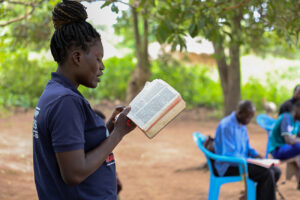
Already this year, TBM has drilled more than 30 wells in northern Uganda, each with a Bible study connected to it. More than 500 people have made professions of faith in Christ and been baptized as Ugandans share the gospel with their friends and neighbors. (TBM Photo / John Hall)

The TBM water ministry is seeking to provide more than 33,000 people in three districts of Northern Uganda with access to clean water. That means drilling and installing wells that serve 200 people within every 1.5 kilometers of their homes by the end of 2025.

But the effort involves more than water. Through a community-led approach, TBM is starting more Bible studies and drilling sustainable water wells faster than ever before.

Already this year, TBM has drilled more than 30 wells, each with a Bible study connected to it. More than 500 people have made professions of faith in Christ and been baptized as Ugandans share the gospel with their friends and neighbors.

TBM Water Impact Director Mitch Chapman has spent at least two weeks a month in Uganda since July guiding the effort. He has preached in Bible studies, prayed with people in villages and celebrated baptisms during church services. God is working in a powerful way.

“This is a door God has opened wider than any other I’ve ever seen in more than 20 years of ministry,” Chapman said. “God is meeting physical needs, radically changing lives spiritually and transforming entire communities. It’s incredible. I’m honored God has chosen TBM as his instrument to use at this time.”

Water as an ‘access route for the gospel’

Sam Ojok, who leads the effort in Uganda, emphasized TBM uses water as “an access route for the gospel.”

Sam Ojok, who leads the effort in Uganda, emphasized TBM uses water as “an access route for the gospel.” (TBM Photo / John Hall)

“Water is just the beginning. I see people come to Christ. But not just come to Christ, but get baptized. And they commit to a weekly Bible study. This is transforming the community and making Christ known,” Ojok said.

The ministry addresses a significant need in remote Ugandan villages, where stomach illnesses are common if not constant. In many cases, the diseases are fatal, particularly among young children.

“I’ve seen many, many children die of common, preventable diseases,” Ojok said. “This week alone, our program was interrupted by three different deaths. This can be prevented. Our programs can prevent it. I don’t want any more children to die. If we can do something to reduce these incidents, that is what we need to do.

“This is our opportunity for real impact—if we’re really concerned and we really want to help people.”

Impact requires significant investments of time into each village. The effort begins with starting a Bible study, which brings the community together. Members study the Scripture and are transformed by it. The Bible study becomes the backbone of the village and the catalyst for improving life for everyone.

After a TBM representative arrives in a village and identifies a “person of peace” who has the respect of his or her neighbors, together they start a Bible study. (TBM Photo / John Hall)

After months of Bible study, TBM helps the community learn basic hygiene. As a result, latrines are constructed in villages where open defecation had been practiced, and hand-washing stations are set up in front of all homes.

Then, TBM drills a well supported by the entire community. Residents donate money for ongoing maintenance of the well, allowing it to serve for generations into the future.

Each community project starts when a Ugandan TBM representative arrives. He identifies a “person of peace” in the village, who typically is a respected area resident with some influence. Together, they start a Bible study that unites the community and shares the gospel.

Three months later, with an established Bible study, TBM shares basic hygiene principles. The village also forms a water committee to build infrastructure for supporting a water well by building latrines and hand-washing stations at homes.

‘Transformed by the gospel’

Six months from the beginning, TBM drills a water well. At the dedication, a Ugandan leader shares the gospel with the community.

About 18 months later, TBM leaders walk alongside village leaders to ensure the well is working properly and train a maintenance technician for every 10 wells.

TBM also introduces microfinance into a village, which creates a small local group similar to a savings and loan. With this tool, the community can help its residents start businesses.

“The goal is that in five years the TBM well will be effectively providing needed drinking water, and the village is united,” Chapman said. “We will pray and work toward the goal of economic development being in full swing.

“We envision multiple neighboring villages seeing the changes and working to get their own wells and Bible studies. The region, we are confident, will be transformed by the gospel.”


Research: Practicing Christians more generous than others

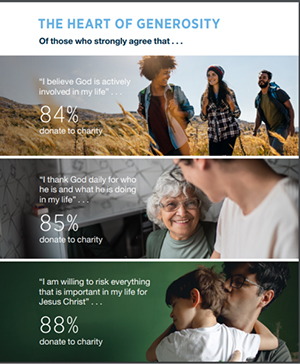
NASHVILLE (BP)—Practicing Christians outpaced non-practicing Christians and nonbelievers in giving to charities including churches in 2022, the American Bible Society said in the latest release from its 2023 State of the Bible report.

The vast majority of practicing Christians (95 percent) gave to charities in 2022, compared to 68 percent of non-practicing Christians and 51 percent of nonbelievers. The American Bible Society defines practicing Christians as those who identify as such, attend church at least monthly and consider their faith very important in their lives.

“When people practice a meaningful Christian faith, they give, and they give more,” the American Bible Society said in the report’s eighth chapter, focused on generosity. “Again and again we see people transformed by God’s Word, with hearts pried open by God’s love, people of faith moved to share what they have with others—even if they don’t have much to spare.”

Churches, ministries and other houses of worship were the top recipients of charitable gifts for the year, with religion one of the few sectors realizing an increase in receipts, the report stated. But when accounting for inflation, the estimated $143.57 billion in religious contributions—a 5.2 percent increase over 2021—represented a 2.6 percent decline.

“Religious organizations—including local churches, parishes, or temples as well as local and international ministries—receive the greatest portion of charitable giving,” the report stated. “Our data confirm what other researchers have found.”

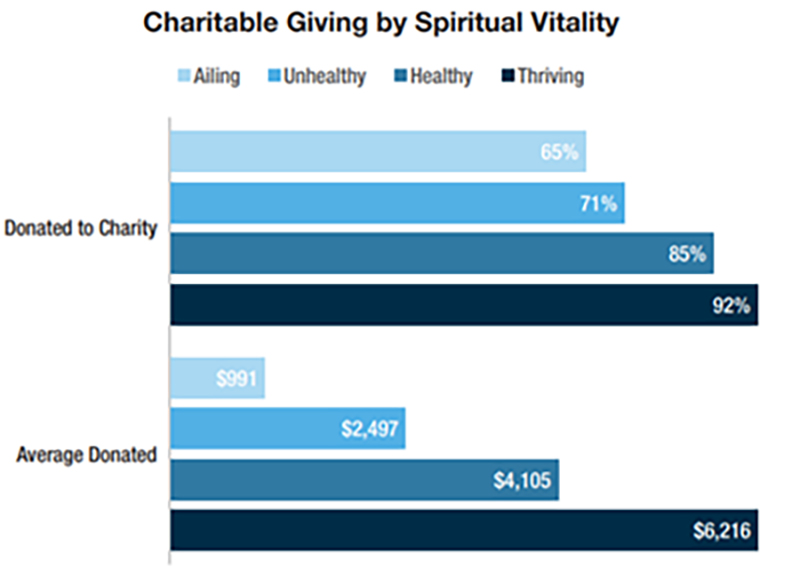
The American Bible Society also gauged giving by spiritual vitality, with 92 percent of those thriving spiritually giving to charities, compared to 85 percent of those with healthy spiritual vitalities, 71 percent of those with unhealthy spiritual vitalities, and 65 percent of those ailing spiritually.

Those thriving averaged $6,216 in annual giving, compared to the $991 in giving by those ailing spiritually. The American Bible Society spiritual vitality gauge, used for the first time in the 2023 study and asked only of professing Christians, rates spiritual health based on answers to nine concise questions focusing on belief, spiritual practices and faith in action.

Other findings on generosity include:

  • Regardless of faith, 68 percent of American households donated to charity in 2022, a rebound from the 62 percent who gave in 2021.
  • Elders, those age 78 and above, are by far the most generous age group, with 83 percent giving to charity and nearly half of those giving at least $1,800 a year.
  • People give to causes they consider important, regardless of their income or expenses.
  • People who volunteer, whether in the church or the community, are also more generous financially.
  • Percentage wise, families earning $30,000 or less a year give more money than those earning $100,000 or more, although larger income earners give larger numerical amounts.

 “While people who make more money give more money, the percentage of income donated by those who give runs much higher among lower income groups. When someone is earning an annual income of $30,000 or less, a contribution of $1,800 or more is a substantial portion (at minimum, 6 percent),” the American Bible Society said, comparing the giving to the story of the widow’s mite recorded in Mark 12 and Luke 21.

“The one-fifth of low earners who contribute at that level are digging deep, giving sacrificially.”

The State of the Bible annually looks at the Bible, faith and the church in America. The American Bible Society collaborated with the University of Chicago’s National Opinion Research Center in designing the study conducted online and via telephone. The survey, conducted Jan. 5-30, produced 2,761 responses from a representative sample of adults 18 and older within the 50 states and the District of Columbia.