Texas CLC and ERLC partner to equip pregnancy center

The Texas Baptist Christian Life Commission and the Southern Baptist Convention’s Ethics and Religious Liberty Commission are partnering through the Psalm 139 Project to provide a new ultrasound machine at the Legacy Pregnancy Resource Center in Hobbs, N.M., four miles from the Texas border.

Although abortion essentially was banned in Texas following Roe v. Wade’s reversal and subsequent anti-abortion laws, New Mexico remains an option for women seeking abortions, said Katie Frugé, director of Texas Baptists’ Center for Cultural Engagement and the Christian Life Commission.

Katie Frugé, director of Texas Baptists’ Center for Cultural Engagement and the Christian Life Commission.

“We know several abortion-vulnerable women are now traveling out of state to seek services, and we want to help support the crisis pregnancy center in Hobbs as they experience an influx of women in need of support and services,” Frugé explained.

Texas Baptists “affirm the sanctity and dignity of all human life,” she added.

“This partnership with the ERLC is the result of our shared commitment to continuing to work to grow a culture of life in a post-Roe world,” she said.

The abortion industry has targeted Hobbs because of its location and already sees many clients from Texas, the ERLC noted. With a junior college and a four-year university in the city, Legacy has recently seen an increase in client appointments, averaging about 70 per month.

“At the ERLC, we are overjoyed when we can partner with state conventions as we stand for life together. This placement in Hobbs, N.M., in partnership with the BGCT, is unique since the state convention is reaching beyond its borders and giving with a missional mindset to serve their neighbors in an abortion-permissible state,” said Rachel Wiles, director of ERLC’s Psalm 139 Project.

Psalm 139 Project exists to make people aware of the life-saving potential of ultrasound technology in unplanned pregnancy situations and to help pregnancy centers minister to abortion-vulnerable women by providing ultrasound equipment for them to use.

The Legacy Pregnancy Resource Center was established in 2012 to provide “help, hope and healing to all persons facing unplanned pregnancies in and around the communities of Lea County.”

The center serves the community through free and confidential pregnancy tests, peer counseling, options counseling and the Earn While You Learn program. Its underlying goal is to share the love and hope of Jesus Christ with clients.

With the surge in clientele after the Supreme Court’s decision in Dobbs v. Jackson Women’s Health, the center is preparing to transition into a medical pregnancy care center.

First Baptist Church of Hobbs provided Legacy with a new building to house its operation permanently and allow for the growth and expansion of services. Ten churches currently support the organization.

Working to ‘change hearts’

When Legacy’s director, Janet Waldrop, requested an ultrasound machine for the facility to serve abortion-vulnerable clients better, the Psalm 139 project was encouraged. Texas Baptists ministry staff had been in communication with First Baptist Church in Hobbs about the pregnancy center’s need, and CLC leaders were honored to be able to support the effort at Legacy.

“The ERLC helped facilitate the purchase and placement of the machine, and Texas Baptists paid the cost of the machine and the training for the staff to use it,” Frugé explained.

 “Since the overturning of Roe v. Wade, we have seen a variety of responses across the United States.”

One recent study released toward the end of 2023 found since the Dobbs decision in 2022, the number of abortions in the United States actually have increased, she noted.

 “We must work to change hearts, not just laws, as we support life going forward,” she said. “Ultrasound technology offers a unique window into a life that previous generations could never have imagined, and we are thrilled to be able to help pregnancy centers utilize this relatively new technology as a meaningful affirmation of our historic Baptist position.”

Frugé said the CLC emphasis on the sanctity of human life is based on Genesis 1:27, which notes all people are created in God’s image and that every human life has intrinsic value and worth.

“Christians have historically been champions for causes that support a culture of life,” she said. “The gospel itself is the good news of Jesus Christ, who tells us he is life in John 14:6.”
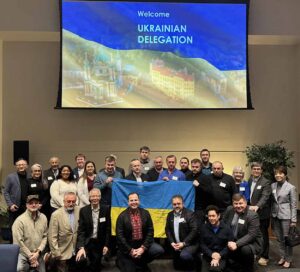



Baptists from Ukraine seek strategic partners in U.S.

PLANO—The future of religious freedom in Eastern Europe depends on Ukraine’s ability to engage the support of “strategic partners” in the West—both in churches and in government, leaders of the Evangelical Baptist Union of Ukraine told a North Texas audience.

President Valery Antonyuk and Vice President Igor Bandura addressed a group Feb. 5 at the Hope Center in Plano—headquarters for multiple Christian nonprofit organizations—to seek support for their nation and its churches.

Speaking through an interpreter, Atonyuk described Russia’s assault on Ukraine as an “evil project” to destroy freedom, including religious liberty.

“We are looking for ideas, projects and partnerships with our fellow Christians in the United States, because together we can stop this evil project,” he said. “Our Lord Jesus Christ will prevail. We are praying for this, and we are looking for partners who will stand with us.”

Several Ukrainian Baptist leaders were part of a larger delegation from Ukraine who visited Texas. (Photo / Ken Camp)

The faith leaders who addressed the assembly in Plano were part of a larger delegation of Ukrainian public officials and business leaders visiting the United States.

When the group began making plans in September for the trip to the United States, they hoped to look ahead and focus on ways “strategic partners” in the United States could help Ukraine rebuild after the end of armed conflict, including church-to-church partnerships, Bandura said.

“We’re all looking for a better future for Ukraine. … Of course, we dreamed that the war would be coming to an end,” he said. “Unfortunately, that is not the case. The war is still going on. We cannot see how, when and where it will be finished.”

The Ukrainian Baptist leaders spoke in North Texas less than 24 hours after the U.S. Senate announced a bill linking appropriations to Ukraine and Israel with border security, but Speaker Mike Johnson—a Southern Baptist—declared the measure “dead on arrival” in the House of Representatives.

“Honestly, we are confused by the delays in the American Congress in deciding to provide financial support for Ukraine,” Bandura said. “It is very painful, in fact, because it is not just about the money. It causes many deaths.”

‘No religious freedom’ in long-occupied areas

The experience of Christians in areas occupied by Russia—such as the Russian Federation’s invasion and annexation of the Crimean Peninsula in 2014—reveal what could happen in all parts of Ukraine if Russia prevails, he warned.

Igor Bandura, vice president of the Evangelical Baptist Union of Ukraine, tells a North Texas crowd: “We need your help. We need your prayers.” (Photo / Ken Camp)

“There is no religious freedom. Pastors are kidnapped, tortured and interrogated. People are frightened, and they leave as soon as they can,” he said.

If Russia succeeds in taking over Ukraine, it will mean “the end for Baptist churches, the end for evangelical churches” in the country, Bandura said.

In turn, it will have an impact on all of Eastern Europe, because Ukrainian Christians historically have been a missionary-sending people, he added.

“After the collapse of the Soviet Union, the Ukrainian churches sent at least 500 missionaries to Russia,” he said. “We wanted to be a blessing to this country. And in turn, Russia comes to destroy us and take away our freedom.”

Bandura appealed for the support of Christians in the United States.

“We need your help. We need your prayers. We need your support,” he said.

Many predicted Ukraine would fall to Russia in two or three days after the invasion began in February 2022, Bandura observed. Instead, two years later, Ukraine continues to resist, he said.

“The God who has brought us this far will not abandon us,” Bandura said. “God has something special in mind for Ukraine.”

Pavlo Unguryan, an evangelical leader and former member of the Ukrainian Parliament, said Christians both in the United States and Ukraine are “living in historic times.”

If Ukraine can prevail against Russian aggression and protect its freedom, Christians will have both the responsibility and opportunity to rebuild the nation and shape its future direction, said Unguryan, the son of a Baptist pastor.

“Right now, we really need help. The Evil One wants to destroy Ukraine,” he said.


How did sports betting spread in spite of faith leaders?

WASHINGTON—On Sunday, millions of Americans will gather with friends to eat snacks, laugh at the latest TV commercials and watch a little football as the Kansas City Chiefs take on the San Francisco 49ers in Super Bowl LVIII.

More than a few will place bets, often on their cellphones.

Americans are expected to bet $1.3 billion on the big game, according to online gaming industry news site Legal Sports Report, thanks to the explosive growth of legalized sports gambling, which has spread to nearly 40 states.

But not to Alabama or Texas, who are among the holdouts, and where faith leaders in particular have been working to keep legal sports betting out.

For Greg Davis, a Baptist pastor and president of the Alabama Citizens Action Program, that has meant opposing any changes to the state’s constitution, which bans lotteries and most forms of gambling. Davis said he knows that people bet informally on sports in Alabama.

But those wagers are relatively low-stakes, he said, compared to industrial-strength sports gambling. Davis said he and other faith leaders in Alabama believe sports gambling is harmful and addictive. They object to the idea of the state profiting off the gambling losses of Alabama’s citizens.

“We don’t think the state government should be in business with corporate gaming to prey on its own people,” he said.

Some of the nation’s largest faith groups have long considered gambling immoral, or a “menace to society,” as the United Methodist Church social principles put it.

Fighting against the odds

But faith leaders like Davis are likely fighting an uphill battle, said longtime Boston College professor and Jesuit priest Richard McGowan.

McGowan, who has been nicknamed “the Odds Father” because of his research on gambling, said faith leaders were caught flatfooted by how fast legalized sports gambling became commonplace.

After New Hampshire started the first state-run lottery in 1964, he said, it took nearly 60 years for 40 other states to follow suit. Legalized sports betting took five years to get that popular—after the Supreme Court struck down a 1992 federal law limiting legal sports betting to Nevada.

Instead of having to jet off to Las Vegas to place a legal bet, in most states, people can pull out their phones and use an app to place bets on the outcomes of games along with almost anything else that happens in a game.

The ease of legalized betting coincided with what McGowan called “the ethics of tolerance.”

“The ethical theory a lot of people go by is you should be able to do what you want as long as you don’t harm somebody else,” he said. That makes it hard to argue against activities like gambling, which many people see as harmless entertainment but can have harmful side effects when people become addicted.

The states that have legalized gambling, he said, also see gambling as a pain-free source of revenue, which is then used for popular social causes like funding college scholarships. That also makes it hard to raise ethical questions about gambling.

“People have been doing it for years and years and years illegally, and now the government is basically saying, all right, it’s fine to do it legally, and by the way, we’ll make lots of money,” said McGowan.

Sports books also have an added advantage, McGowan said, in that they allow people to combine two things they like to do—gambling and cheering for their teams.

“When they bet,” he said, “people think they’re supporting the team that they’re betting on.”

Sports leagues cozy with gaming industry

Public approval of gambling has grown steadily in recent decades. In 2009, Gallup, which has measured public views on gambling and other moral issues since 2003, found that 58 percent of Americans said gambling was morally acceptable. In 2023, 70 percent of those surveyed said it was moral to gamble.

Legal sports gambling has become a lucrative business, according to a recent report from the American Gaming Association. Commercial sports betting companies took in $9.2 billion in revenue on more than $106 billion in bets from January to November of 2023.

Laura Everett, executive director of the Massachusetts Council of Churches, said faith leaders who raise questions about the downsides of legalized gambling can feel like they are facing overwhelming odds. She worries that sports leagues have become too cozy with the gambling industry.

“The sports leagues—not only didn’t oppose this—they rolled over and said, ‘Scratch my belly,’” she said.

Still, she said faith groups that don’t agree on all kinds of other issues can find common ground in raising concerns about the ubiquity of sports gambling. And they still can have a voice, she said.

For example, Massachusetts is looking at allowing bars to install sports-betting kiosks, and faith leaders like Everett have been asked to give public feedback about their concerns.

High human cost of gambling expansion

She worries the human cost of expanding gambling is too high.

“Every time you expand gambling, there is a percentage of the population whose lives will be destroyed,” she said.

The National Council on Problem Gambling estimates that about 2 million Americans—or 1 percent of the population—have a severe gambling problem, with between 4 and 6 million having moderate or mild gambling problems.

John Litzler, director of public policy of the Christian Life Commission for the Baptist General Convention of Texas, said those with gambling addictions often show up at the door of churches or other faith groups when their lives fall apart.

John Litzler

Texas Baptists oppose making sports betting legal in their state—which, with California, remain the two largest untapped markets for the gaming industry. Legal Sports Report estimated that those states could generate half a billion dollars in bets on the Super Bowl alone.

Litzler agrees opponents of expanded sports betting face a perception problem. Many people believe sports betting is a harmless pastime, while a series of recent commercials from the gaming industry portray gambling as a way to give games more meaning and excitement.

When he talks to churches or legislators about gambling, Litzler stresses the potential for harm, especially in the use of betting apps. When people had to go to a casino to gamble, they had to be more intentional about what they were doing. And if they lost money, they would have time on the ride home to cool off.

That’s not the case when a bet is a click away, he said.

“What you have to do is say, ‘I know it doesn’t seem like it’s harming you, but here’s how it’s harming your neighbor,’” Litzler said.

In Alabama, where the issue of gambling is about to come up in the next session of the state Legislature, Davis, of Alabama Citizens Action Program, said he also talks about gambling as a threat to the integrity of sports.

He pointed to the recent case of Brad Bohannon, the former coach of the University of Alabama baseball team who was fired last year in a betting scandal. This week, the NCAA ruled Bohannon had told a bettor the team’s starting pitcher was injured and would miss a game. That led the bettor to try to place a $100,000 bet on the game, according to ESPN.com.

According to the sanction imposed by the NCAA, any team that hires Bohannon as a coach must suspend him for “100 percent of the baseball regular season for the first five seasons of his employment.”

Davis said that scandal was a sign of things to come.

“It is going to ruin sports,” he said.


Midland church opens its doors to persecuted Chinese

A persecuted church from China now worships in the facilities of First Baptist Church in Midland.

Pastor Pan Yongguang and members of the Shenzhen Holy Reformed Church—nicknamed the “Mayflower Church” for their pursuit of religious freedom—relocated to the Permian Basin about a month ago.

On Feb. 4, they met the first time for worship and fellowship in the youth center at First Baptist Church. The Midland congregation is making its facilities available to the Mayflower Church three times a week.

“It’s a real blessing for us,” Pastor Darin Wood of First Baptist Church said. “Our church has a heart for missions. … This is a further reflection of that.”

The Mayflower Church fled persecution and harassment in China more than three years ago. After being denied asylum in South Korea, they relocated to Thailand on tourist visas.

When those visas expired, the Thai government refused to renew them unless members of the Mayflower Church reported to the Chinese Embassy. After a deportation hearing, church members were fined and detained six days in Thailand.

Several Christian human rights organizations—particularly Freedom Seekers International, ChinaAid and 21Wilberforce—worked with the U.S. Department of State and other officials to secure their release and resettlement in the United States. Members of the Mayflower Church arrived at Dallas-Fort Worth International Airport on Good Friday last year.

With the help of Tyler-based Freedom Seekers International, the Mayflower Church initially resettled in East Texasand began English-as-a-Second-Language classes.

Permian Basin churches work together to help

Bob Fu

In early fall 2023, Bob Fu—founder of Midland-based China Aid—was traveling with Pastor Pan as his translator. He learned some Christians in the Midland-Odessa area were willing to make available a 300-acre ranch where many families from the Mayflower Church could live. An Odessa church agreed to secure housing for the remaining church members.

After the Mayflower Church relocated to the Permian Basin soon after Christmas, Fu and Pastor Pan began seeking a facility where members of the relocated church could worship. So, they contacted leaders at First Baptist in Midland.

“Our youth worship center was not being used on Sundays,” Wood said. He showed the available space to Pastor Pan and others from the Mayflower Church.

“When they saw it, they broke down and cried. They said they had never had a building to worship in before,” he recalled. “They had always been a house church.”

After working through logistical details, including the desire of the Chinese church to meet together for extended hours several times a week, First Baptist voted to extend an invitation to the Mayflower Church.

The Mayflower Church’s Sunday worship services “ran most of the day” on Feb. 4, and members shared a meal together, he said.

On Wednesdays, when the First Baptist youth use the center, the Mayflower Church will gather in the Midland congregation’s chapel. Then on Friday evenings, they will return to the youth center for another worship service.

“We’re not the only church helping,” Wood said. Midland Bible Church, Mission Messiah in Odessa, Mid-Cities Church in Odessa and other congregations have helped provide housing, transportation and food for Mayflower Church families.

“There are a lot of children to feed, and the churches here have come together to provide assistance,” Wood said.

Members of First Baptist are “humbled” and “inspired” by the courage the Mayflower Church members demonstrated in leaving their homeland to escape religious persecution and practice their faith freely, he noted.

Long-term, after members of the Mayflower Church receive work permits, fully settle in the area and become self-sustaining, Christians in the area will help the Chinese church find a permanent place where they can worship, he added.

For now, members of First Baptist and members of the Mayflower Church acknowledge differences in culture, language and denomination, but they also recognize what unites them. Wood points to the heavenly vision recorded in Revelation 4 and 5.

“You don’t see denominational barriers there,” he said.


On the Move: Googe, Hawk, Herbert, Johnston, Lewis and Owen

Gary Googe to First Baptist Church in Hillsboro as youth minister.

Ray Hawk to North End Baptist Church in Beaumont as youth minister.

Rick Herbert to Cedar Valley Baptist Church in Elgin as youth minister.

Terry Johnston to Waco Regional Baptist Association as director from the pastorate of First Baptist Church in McGregor.

Greg Lewis to First Baptist Church in Colorado City as pastor from First Baptist Church in Goldthwaite, where he was lead pastor.

Harold Owen to Cedar Valley Baptist Church in Elgin as music minister. Prior to retirement, he was the worship leader at First Baptist Church in Smithville.


CVS employee fired for refusing to sell birth control sues

WASHINGTON (RNS)—A former CVS Health employee filed a federal lawsuit in Florida against the company after she was fired for refusing to prescribe contraceptives due to her religious beliefs.

The employee, nurse practitioner Gunna Kristofersdottir, joins three other former CVS workers who sued the company for religious discrimination after being fired for similar reasons.

Gunna Kristofersdottir (First Liberty Photo via RNS)

Kristofersdottir is being represented by the Plano-based religious freedom-oriented legal group First Liberty Institute.

Its lawyers argue that the company’s refusal to exempt religious employees from filling contraceptive prescriptions constitutes religion-based discrimination and a Title VII violation.

The Title VII law of the 1964 Civil Rights Act protects employees and job applicants from discrimination based on race, color, religion, sex and national origin.

“It’s important that nurse practitioners are able to serve their patients in a way that doesn’t require them to violate their religious beliefs,” said Stephanie Taub, senior counsel at First Liberty Institute.

A Roman Catholic, Kristofersdottir believes “the procreative potential of intercourse” shouldn’t be “subverted by the device or procedure,” according to the complaint filed by First Liberty. The court document quotes portions of the Catechism of the Catholic Church, which summarizes the Catholic Church’s doctrine.

Religious accommodation revoked

During her eight years at various Florida CVS clinics, Kristofersdottir benefited from a religious accommodation. After informing her managers of her wishes and filling out a form, she was excused from prescribing hormonal contraceptives and abortion drugs. When clients asked Kristofersdottir for guidance on contraceptive products, she referred them to another employee.

But three years ago, her religious accommodation was revoked as part of a broader change in the company’s policy on religious exemptions.

In August 2021, CVS’ chief nursing officer, Angela Patterson, announced all employees would be required to perform functions deemed essential, including all services related to sexual health.

When Kristofersdottir learned about the new policy, she said, she asked to be sent to another CVS Health facility. Her demand was denied, and she was fired in March 2022.

Taub argued that the company had legal obligations to explore alternatives to accommodate Kristofersdottir.

In an email statement, Mike DeAngelis, CVS Health’s director of communications, wrote that the company still has a specific policy to grant “reasonable” religious accommodations “unless it poses an undue hardship on the business and our ability to provide convenient, accessible care to our patient.”

“We continue to enhance our MinuteClinic services, growing from providing urgent care to offering more holistic care,” wrote DeAngelis.

Other employees file suit

First Liberty Institute specializes in cases related to religious freedom and regularly raises funds to finance its defense of clients in similar situations. Earlier, the firm filed a suit on behalf of Robyn Strader, a Baptist nurse practitioner from Texas who was fired from CVS for similar reasons.

In an article published on the First Liberty Institute website, Jorge Gomez wrote that CVS’ refusal to grant religious exemptions sends a message “that religious health care workers are not welcome and need not apply” and that “instead of following the law, CVS preferred to join the ranks of the ‘woke’ corporations rendering religious employees second class citizens.”

Since CVS enacted the new policy, two other nurse practitioners also sued the company, alleging religious discrimination. In September 2022, Page Casey, a former CVS employee from Virginia, sued after she was fired for refusing to prescribe contraceptives. She is represented by Alliance Defending Freedom, a Christian conservative legal group.

In October 2022, Suzanne Schuler, a former CVS employee from Kansas, sued the company after her religious accommodation was revoked. In October 2023, both parties settled.

In January, CVS and Walgreens announced they would be selling the mifepristone abortion pill after the Food and Drug Administration dropped a 20-year rule that prevented drugstores from doing so. The pill, available on the market since 2000, can be used through the 10th week of pregnancy.

Since November 2022, the Alliance for Hippocratic Medicine, an anti-abortion group, has been challenging the FDA’s approval of the drug at the Supreme Court. The group includes religious organizations such as the Catholic Medical Association, the Christian Medical & Dental Associations and the Coptic Medical Association of North America.


Alistair Begg won’t back down on trans wedding advice

WASHINGTON (RNS)—For the past few weeks, Alistair Begg, pastor of Parkside Church in Chagrin Falls, Ohio, and host of the Truth for Life radio program, has been caught in what he calls “a storm in a teacup” over advice he gave about attending a transgender wedding.

That advice, he said in a recent sermon, was based on Jesus’ command for Christians to love even those they disagree with or disapprove of.

“Jesus said you are supposed to love your enemies,” said Begg, drawing on a series of Bible texts to claim Christians should show compassion—and not condemnation—for those who have gone astray.

The sermon was a response to a controversy over comments Begg made during a promotional interview for a book last fall, which recently went viral on social media.

During the interview, Begg recounted talking to a woman whose grandchild was getting married to someone who was transgender. Begg, who opposes same-sex weddings, suggested she go to the wedding and bring a gift. By doing so, she would show her love for her grandchild—even though she did not approve of the wedding.

“Your love for them may catch them off guard, but your absence will simply reinforce the fact that they said, ‘These people are what I always thought: judgmental, critical, unprepared to countenance anything,’” the evangelical pastor said. He added Christians have to take risks in order to show love to those around them.

Begg’s comments set off a firestorm among some of his fans and supporters—in particular those in conservative Calvinist and other evangelical communities. White evangelicals remain one of the least likely of all U.S. religious groups to support same-sex marriage, according to the Public Religion Research Institute.

Thirty-eight percent of white evangelicals say they support same-sex marriage, according to PRRI. By contrast, 87 percent of nones, 81 percent of Jews, 77 percent of Buddhists, 77 percent of white mainline Protestants and about three-quarters of Catholics approve of same-sex marriage.

Radio network drops program

American Family Radio, an evangelical broadcasting network, dropped Truth for Life, a program based on Begg’s sermons, last week after his advice resurfaced and went viral.

It also led to a series of articles by other Christian leaders, saying Christians should not attend LGBTQ weddings.

“After all, attendance so as to show ‘love’ or avoid giving offense is a form of blessing, just without the name,” wrote Carl Trueman, professor of biblical and religious studies at Grove City College, for the Catholic publication First Things.

Tim Wildmon, president of the American Family Association, hosted a special broadcast explaining why the group parted ways with Begg. Wildmon said the ministry got calls complaining about the broadcast and reached out to Begg, whose radio program had appeared on AFR for more than a decade.

“The goal of the call was reconciliation, but reconciliation with truth,” said Walker Wildmon, an AFA vice president. He added Begg refused to back down from his comments, which Walker Wildmon compared to a dad offering to drive his alcoholic child to a bar.

A staffer from Parkside Church told Religion News Service Begg has no comment about being dropped from American Family Radio.

Begg, a native of Scotland who has lived in the United States for four decades, said he has long taught that sex outside of a marriage between a man and a woman is wrong, and so he was surprised at the controversy over his comments and the accusations that he had abandoned Christian teaching.

“Now, we can disagree over whether I gave that grandmother good advice. Or not,” he said. “Not everybody on the pastoral team thinks I gave very good advice.”

‘On the side of compassion’

During the sermon, he drew from the New Testament parable of the prodigal son—which emphasizes forgiveness over judgment—and the parable of the good Samaritan, which emphasizes compassion over claims of holiness. Both stories, he said, showed the power of God’s grace.

He also drew from a story Jesus told of a shepherd who had 100 sheep and lost one of them—and left the 99 behind to find the one that was lost.

“I tell you that in the same way there will be more rejoicing in heaven over one sinner who repents than over ninety-nine righteous persons who do not need to repent,” Jesus says in Luke 15.

Begg warned his congregation about Christians who seem unwilling to show grace or forgiveness to others, telling his congregation to be wary of pastors who are eager to loudly condemn sinners. Begg said he was thinking with his “grandfatherly hat” when he gave that advice, hoping to help that grandmother show God’s love

“All I was thinking about was how can I help this grandmother,” Begg said, adding that he didn’t want her to lose her grandchild.

To a different person in different circumstances, he said, he might have given different advice. But he has no plan to repent of his advice, no matter what happens on social media.

Begg also said he was glad his advice to this grandmother—rather than his other sermons about sexuality—had gone viral.

“Because If I’ve got to go down on the side of one or the other, I’ll go down on this side,” he said. “I’ll go down on the side of compassion.”


GuideStone releases its latest Ministers’ Tax Guide

DALLAS—GuideStone Financial Resources has released its 2024 Ministers’ Tax Guide for 2023 Returns.

The tax guide is prepared by Richard Hammar, CPA, attorney and widely published author who specializes in legal and tax issues for ministers.

The tax guide includes tax highlights for 2023 along with step-by-step filing instructions for ministers’ personal taxes and comprehensive examples and sample forms.

Additionally, GuideStone ministry partners and church administrators have access to the annual Federal Reporting Requirements for Churches. This publication is included in the full tax guide or as a separate electronic copy.

GuideStone members can receive both free resources by visiting GuideStone.org/TaxGuide or can request a free printed copy of the tax guide by calling (888) 98-GUIDE (888-984-8433). A limited number of printed copies are available.

“One of the joys of serving at GuideStone is coming alongside our members to help in our mission to enhance financial security and resilience for all who serve the Lord,” GuideStone President Hance Dilbeck said.

“Ministerial taxes come with their own unique issues and challenges. We trust this annual guide provides the information to help ministers as they prepare to file.”


Volunteers arrived when flood victim needed them

On her knees in the midst of the dirt and debris left behind in her flooded home, Saphina Khalfan cried out to God for help.

Within a minute, she heard voices outside. They were Texas Baptist Men volunteers coming to help.

TBM volunteers arrived in Conroe tto remove water-soaked furnishings, rip out ruined sheetrock and carpet, and get homes ready to be rebuilt. (Ferrell Foster Photo)

TBM has responded to flooding downstream from Lake Conroe north of Houston. Heavy rain in the area forced authorities to open floodgates on the lake.

Khalfan received a text message informing her the gates were about to be opened and to get to higher ground. About 100 homes were flooded, and TBM came to the aid of homeowners in the area.

Trained volunteers came to the area from throughout the state, and other local volunteers pitched in from churches, including Fellowship of Montgomery, First Baptist Church of Conroe, West Conroe Baptist Church, Kingsland Baptist Church in Katy and the Church at Alden Bridge in The Woodlands.

As of the end of day Thursday, TBM had recorded 1,439 volunteer hours working in the area.

Saphina Khalan was at a low point after her home flooded. She cried out to God for help, and TBM volunteers arrived. (Ferrell Foster Photo)

Several days after the flood, Khalfan spoke through tears about what she experienced after returning home.

“I was so down—broken, confused, lost, sad, hopeless, helpless,” she said slowly. “When I was at that bottom, face down in the floor. … I was on my knees. Right there, I knew there was nothing I could do. But one thing I knew, I can pray. So, I started praying.

“In that blink of a second, … I heard voices coming to my house.”

TBM volunteers were walking to her front door. She heard them talking as they approached.

‘God gave me a hundred fathers’

Khalfan, a Muslim who is originally from Tanzania, said: “When they greeted me and told me what they’re here for, I held them for like 30 minutes, maybe one hour. I cried out loud for the longest time. … I couldn’t cry when [the flood] happened, because I was trying to put on the straight face and walk through this.

“I just broke down and cried and kept telling them, ‘Thank you.’ I hugged them all. They hugged me back,” she said. “I could tell they feel my pain. They might not cry, but they held me so tight. I still feel it.”

Khalfan’s father died in February 2016. “To my dad, I was always a little girl. My dad passed, and I never felt his presence until this disaster came.”

Through the TBM volunteers, “God gave me a hundred fathers,” she said.

“They hugged me the same way my dad would. They talked to me the way my dad would,” she said. “I feel they’re loving me the way my dad loved me.”

Kay Robinson, minister of missions at West Conroe Baptist Church, spent the lunch hour visiting with Khalfan about her faith.

More than 60 TBM volunteers arrived in Conroe this week to remove water-soaked furnishings, rip out ruined sheetrock and carpet, and get homes ready to be rebuilt. They came from local churches and from elsewhere in the state. They worked in eight homes.

Tim Hurt first arrived at Saphina Khalfan’s home in his role as an insurance claims adjustor. He returned as a TBM volunteer. (Ferrell Foster Photo)

One of the volunteers actually had been the first to visit Khalfan’s flooded home when he came as part of his job as an insurance claims adjuster. When Tim Hirt, a member of the Fellowship of Montgomery church, volunteered, he did not know he would be going back to Khalfan’s place.

As a claims adjuster, Hirt has seen many structures damaged by floods and other storms. He said Khalfan’s home had about nine inches of water in it, and he pointed out the residue left behind.

“Every claim is different, and every claim is as important as the other one” for the homeowner, Hirt said. “It’s their property. It’s their investment. It’s their sanctuary. No one wants to have their sanctuary messed up, and that’s what floodwater does, regardless if it’s a few inches or few feet of water. It’s an emotional toll on a lot of people.”

Fortunately, Khalfan had flood insurance that will help her rebuild. Those funds, however, will only go so far. The TBM volunteers provide their services at no charge, so the homeowners helped in Conroe did not have to hire contractors to do what is called mud out.

“You can find a contractor to do it—only if you can afford to find a contractor to do it. That’s No. 1, the financial part of it. If it is a contractor, it is a contract,” he said.

They “do the job” and “get out of here,” he added.

Because of the TBM volunteers, Khalfan now is connected with local churches and church members. And she also has the memory of those “hundred fathers” who “hugged me the same way my dad would.”


Ellen Di Giosia named CBF Texas coordinator

The governing board of the Cooperative Baptist Fellowship in Texas approved the selection of Ellen Di Giosia as the next coordinator of CBF Texas.

Di Giosia, a former associate pastor at Woodland Baptist Church in San Antonio and a founding member of Texas Baptist Women in Ministry, succeeds longtime CBF Texas leader Rick McClatchy, who is retiring. McClatchy has served in that role since 2003 after previously serving as coordinator of CBF Oklahoma.

The CBF Texas governing board unanimously approved Di Giosia, as recommended by the coordinator search committee.

“I congratulate the search committee on this remarkable selection following an incredibly thorough search process,” said Paul Baxley, executive coordinator of national CBF.

“I want you to know that I am incredibly grateful that Ellen has agreed to accept this important calling and look forward to working with her and many of you to find the most faithful and transforming ways to serve the needs of congregations and their leaders so that we all flourish in faithfulness to Christ and participation in God’s mission in our communities and around the world.”

CBF Texas is one of 15 state and regional groups that relate to the national CBF. One of those regional groups, Fellowship Southwest, announced Di Giosia’s new position in its weekly email newsletter, calling her “a gifted collaborator and compassionate pastoral leader.”

“Fellowship Southwest and CBF Texas have worked closely together since FSW’s founding in 2017 and look forward to the ways in which our two organizations will continue to relate to one another under Rev. Di Giosia’s leadership,” Fellowship Southwest stated.

Di Giosia earned her undergraduate degree in music from Mississippi College and a Master of Divinity degree from Baylor University’s Truett Theological Seminary. She is pursuing a Doctor of Ministry degree from the Perkins School of Theology at Southern Methodist University.

She currently serves as pastor of two congregations in Grainger County, Tenn.—Mary’s Chapel United Methodist Church and Rutledge United Methodist Church. Previously, she was pastor of First Baptist Chuch in Jefferson City, Tenn.

Di Giosia has served as chair of the CBF ministries council and was project manager for Equally Called, a resource CBF developed in partnership with Baptist Women in Ministry.


Biden speaks of praying, working for peace

WASHINGTON (RNS)—President Joe Biden vowed to keep working and praying for resolutions to global conflicts as he addressed the National Prayer Breakfast.

He also urged congressional leaders not to treat those with whom they disagree as enemies.

“My prayer, my hope, is we continue to believe our best days are ahead of us, that as a nation we continue to believe in honesty, decency, dignity and respect,” he said Feb. 1 in Statuary Hall in the U.S. Capitol. “We see each other not as enemies but as fellow human beings, each made in the image of God, each precious in his sight.”

The event, sponsored by the National Prayer Breakfast Foundation for the second year on Capitol Hill, follows a tradition that dates to the Eisenhower administration when U.S. presidents began attending the annual event long held on the first Thursday of February.

“We’re all blessed to live in a nation where we can practice our many faiths and practice them freely and where we can come together and lift up our nation and each other—each other—in our own prayers, especially in tough times,” Biden said in remarks carried by C-SPAN2 and CBN News.

As other presidents have, he used the occasion to give thanks for others’ prayers for him, even as he described the subject of his own petitions.

Biden said his prayers are with the families of three U.S. service members killed in an attack in Jordan at a military base near the Syrian border.

“Not only do we pray for peace, we are actively working for peace, security, dignity for the Israeli people and the Palestinian people,” he said.

“I’m engaged in this day and night, working as many of you in this room are, to find the means to bring our hostages home, to ease the humanitarian crisis and to bring peace to Gaza and Israel—an enduring peace with two states for two peoples—just as we worked for peace, security and dignity for the Ukrainian people as they show incredible resolve and resilience against Putin’s aggression. We must continue to help them.”

Biden also described standing against hate—including antisemitism, Islamophobia and discrimination against Arab Americans and South Asian Americans—as a “calling.”

“We’ve never as a nation fully lived up to that and we’ve never walked away from it either,” he said. “It’s a covenant we have with one another to hold this nation together.”

One of two prayer events

The refashioned National Prayer Breakfast is a scaled-down version of an event that has drawn thousands to the Washington Hilton and previously was hosted by a group often known as “The Family,” but that called itself the International Foundation.

Since last year, there have been two events, one sponsored by the new National Prayer Breakfast Foundation, after years of controversy following the 2018 breakfast and accusations the gathering of national and international political and religious leaders had become vulnerable to espionage.

The second event, dubbed the NPB Gathering, and held again this year at the Hilton, drew about 2,000 people from more than 125 countries, including heads of state, and featured a livestream of Biden’s remarks, said A. Larry Ross, media representative for the International Foundation.

Rwandan President Paul Kagame was the keynote speaker at that event, and former Reps. Jim Slattery, D-Kan., and Zach Wamp, R-Tenn., were the co-emcees.

The first event, however, had a shift of location, and there are proposals for it to have another.

Last year, it was held at the Capitol Visitor Center. This year, it was held in Statuary Hall, which is just south of the Rotunda.

Rep. Tracey Mann, R-Kan., introduced a resolution in November to authorize use of the Rotunda for the event. It has been referred to the House Committee on House Administration.

Mann and Rep. Frank Mrvan, D-Ind., were honorary co-chairs of the 2024 breakfast, where they jointly read a prayer and members of Congress from both parties read Scripture and prayed for the president. House Chaplain Margaret Grun Kibben said the closing prayer and Senate Chaplain Barry Black was the keynote speaker.

Black described how people working on Capitol Hill turn to fasting and prayer, especially in times of crisis, including the Russian invasion of Ukraine, the Hamas-Israel war and the last two U.S presidential elections.

“I’m talking about representatives, senators, chiefs of staff, waiters, waitresses, janitors were fasting and praying,” he said. “Hundreds of us have been doing that.”

Some criticize prayer breakfast

The existence of the breakfast on Capitol Hill—and at all—has been opposed by some church-state separationists.

“Using the U.S. Capitol as the venue would incontrovertibly give the distasteful appearance that this private, Christian-dominated event is an official governmental function of Congress,” said Annie Laurie Gaylor, co-president of the Freedom from Religion Foundation, in a statement ahead of the events.

“Conducting a ‘National Prayer Breakfast’ at the conspicuous seat of federal government is what would be expected in a theocracy, not a republic predicated on a secular Constitution.”

On X, formerly Twitter, Rachel Laser, president and CEO of Americans United for Separation of Church and State, said: “As the Senator Chaplain opens the National Prayer Breakfast w/a sermon, American flags as his backdrop, I ask again: Why do we have chaplains in Congress? Why do we have a National Prayer Breakfast? Church-state separation protects religion as much as taxpayers’ religious freedom.”


Are the Five Love Languages helpful?

WASHINGTON (RNS)—When Katie Frugé and her husband, Lafayette, decided to get married in 2007, they were 21 and did not know what they did not know.

Katie Frugé

“We were too young to get married and too young really to care,” said Frugé, who is now director of the Christian Life Commission and the Center for Cultural Engagement at the Baptist General Convention of Texas.

For guidance, the young couple turned to The Five Love Languages, a popular book by North Carolina author and pastor Gary Chapman. First published in 1992, the book explores different ways people express love—words of affirmation, physical touch, quality time, acts of service and giving gifts—in hopes of helping couples find happiness.

The book claims understanding each other’s love language can help create healthy marriages. Frugé recalls thinking the book held the key to a bright future.

“We thought: ‘We’ll just learn each other’s love languages, and everything’s going be hunky-dory. We’re not going to ever have any fights, and we’re both going to feel fully satisfied all the time,’” she said.

Married life proved more complicated.

Frugé said she and her husband are still happily married 17 years later, but there were a lot of bumps, including several health crises.

“We had the sickness and health part,” she said. And they needed more love along the way than a formula could provide.

“When I’m diagnosed with cancer, I don’t need my husband to go out and buy me a gift at that moment,” she said.

Pop culture phenomenon

Once popular mostly in evangelical Christian circles, the Five Love Languages have exploded into a pop culture phenomenon. The dating app Bumble offers a Five Love Languages quiz, the concept has been featured on The Bachelorette and in major media outlets, while the Five Love Languages channel on TikTok has attracted tens of millions of views.
Chapman has sold more than 20 million copies of his books and launched a cottage industry of conferences, related books and an online quiz taken tens of millions of times.

All of that attention has led researchers such as Emily Impett, a psychology professor and director of the Relationships and Well-Being Laboratory at the University of Toronto Mississauga, to ask if the claims of the Five Love Languages stand up to scientific scrutiny, and perhaps nearly as important: What can scholars learn from the popularity of Chapman’s work?

Does Chapman’s theory hold up to scrutiny?

Emily Impute

A new paper in Current Directions in Psychological Science suggests Chapman’s theory about how love works doesn’t quite add up. For the paper, Impett and a pair of colleagues looked at a series of studies that tried to test three key ideas about the Five Love Languages: that people have a primary love language, that five love languages exist and that people are happier with a partner who speaks their primary love language.

The studies, said Impett and her colleagues, don’t support that theory.

For example, people will choose a preferred language if forced to in a quiz. However, researchers found that if asked about all five love languages on an individual basis—people rate all of them highly.

The researchers also found some important ideas, such as supporting a partner’s or spouse’s goals, don’t fit in the Five Love Language model, and people who have the same love languages aren’t happier than other couples.

“Love is not akin to a language one needs to learn to speak but can be more appropriately understood as a balanced diet in which people need a full range of essential nutrients to cultivate lasting love,” Impett and her colleagues wrote.

They did suggest Chapman’s book has filled a need for couples in that “it provides partners an opportunity to reflect on, discuss, and respond to one another’s needs.”

Impett said reading the love languages book—which includes examples of how to practice showing love in different ways—is much more helpful than using the online quiz. That’s in part because the focus on finding a partner’s primary love language can be too restrictive and ends up putting people into a box.

Instead, she told Religion News Service, “All of the behaviors Chapman identified are important.”

“We are not suggesting that people necessarily are multilingual (skilled at all five behaviors) but that they should learn to be since the five behaviors that Chapman identifies are really important things people can do to maintain their relationships.”

All the love languages matter

Gary Chapman

On that point, Chapman agrees.

The 86-year-old author, who recently stepped down after 50 years on the staff of Calvary Baptist Church in Winston-Salem, N.C., said all of the love languages matter.

“There is absolutely no question that what makes one person feel loved doesn’t necessarily make another person feel loved,” he said in an interview. “But I don’t want to communicate that you only speak the person’s primary love language.”

Chapman, who still travels and speaks at marriage conferences and other events, said he was surprised by some of the paper’s findings but appreciates researchers taking his work seriously. The more research, he said, the better.

He said he continues to be surprised at how popular the idea of love languages has been. Chapman developed the idea for the book while counseling troubled couples at his church. Those couples, he said, were often at their wit’s ends, because each partner thought they were acting in loving ways, but the other partner felt unloved.

A master storyteller, Chapman recalled one husband saying he cooked dinner most nights, shared in the housework and lawn work, and did all he could to support the family. But his wife felt distant because he was so busy helping out at home that they never had time to talk.

Looking over his counseling notes, Chapman began to look for patterns and eventually came up with the five love languages.

“It’s a simple concept,” he said. “But I knew from my counseling and working with couples—it would help people if they could get that concept. In all of my writing, I’ve tried to put the cookies on the bottom shelf, so people can understand it easily.”

Valuable to identify needs and communicate

That approach is something researchers say they can learn from.

In their paper about the love languages, they said Chapman’s book has connected with people because it uses “intuitive metaphors, which may resonate with people and convey an easily digestible message free of scientific jargon.”

Impett also said the focus on finding a primary love language can overshadow the reason why so many people find Chapman’s book helpful. The book, she said in an email, “gets people to identify any currently unmet needs (areas of improvement) in their relationship and opens up lines of communication to address those needs.”

Chapman, who has been married 62 years, said that’s the point. He said love begins with emotion but is sustained by having the right attitude and by acting in ways that put your spouse or romantic partner first.

That right attitude, he said, can be summed up this way: “I want to do anything and everything I can do to help you become the person that you want to be. I want to do everything that would be good for you.”

Meleah Smith of Chattanooga, Tenn., who coaches “brands and bands” on marketing, said the idea of five love languages never really connected with her. She knows the book has worked for other people, but for her, it’s too simplistic, said the 40-something, who described herself as “single as a Pringle.”

Smith said she has plenty of love in her life, with friends, her church and her family—she helps manage her brother’s band—but no romantic relationship. She said the love languages can be too easy at times—tempting people to avoid the hard work of getting to know someone and paying attention to them.

“If I have to give you a list of things you have to do for me, maybe we are not a good match,” she said.

After 17 years of marriage, Frugé had some advice for those using the five love languages. Remember that people need all kinds of love, not just one kind. Pay attention to them—rather than running to a book for all the answers.

Sometimes the answers you need are right in front of you.

“Thriving relationships occur when you have a partner who understands and knows you, sees what your need is and meets you in that moment.”