New animated series encourages kids to watch the Bible

WASHINGTON (RNS)—The Christian production company Revelation Media will unveil its new animated Bible project on Easter, with the first segment aiming to depict the stories of the Book of Genesis in a child-friendly way.

Steve Cleary

Watching the iBible will appeal to digital natives more than reading Scripture, said Steve Cleary, executive director and producer of the series.

“We want kids to read their Bible, but if we don’t reach them in a visual manner, we’re seeing the result. They don’t. They’re not reading their Bible,” he said.

He believes short attention spans and a growing aversion to reading are making it impossible for kids to get interested in the Bible. Churches are late to the party when it comes to finding creative ways to interest internet-savvy kids in biblical texts, Cleary said.

His solution is to reach young kids where they are—on screens. From the creation story to the death of Joseph, the 42 episodes will tell stories from the Old Testament in hopes of increasing a younger generation’s biblical literacy.

This animated Bible translation, the first of its kind, he said, strives to be a “legitimate Bible translation.” All scripts of the seven-minute episodes are approved by the Summer Institute of Linguistics, an evangelical nonprofit that rates the accuracy of Bible translations.

‘You’ll never forget what you see’

The episodes, which are planned to depict the Hebrew Bible and the New Testament, were also reviewed by Anglican, Presbyterian, Baptist, Pentecostal and Methodist clergy members. The entire project is expected to take years to complete.

In the meantime, an episode titled “The Real Story of Jesus” is already available for users who want to skip to the Gospels. Each episode is also followed by a discussion prompt for kids to consider.

With a background in animation—Cleary co-produced the animated “The Pilgrim’s Progress” in 2019—he said he’s seen the power of visual learning for Generation Z and Generation Alpha.

 “You can read something dramatic and easily forget it. But you’ll never forget what you see,” said Cleary, who has recruited around 50 people to work on the project now.

The 500,000 viewers who watched “Pilgrim’s Progress” during the COVID-19 lockdown were also the first to hear about the iBible project via email, and their monetary donations supported the project’s early days. According to a Revelation Media press release, the entire iBible project will require $25 million in funding.

Touching on taboo topics

Cleary said translating the Bible in short animation clips allows pastors and parents to touch on taboo topics with kids.

A scene from “The Great Flood (Part 1),” part of the animated Bible series produced by iBible. (Image courtesy of Revelation Media)

For a long time, the iBible team was torn on how to tell stories of violence and abuse appropriately for kids. The first feedback from parents on the episode depicting the rape of Dinah, the daughter of Leah and Jacob, convinced the project team that showing these parts of the Scriptures was essential. It also forces churches to have tough but essential discussions with kids.

“If we’re going to do the whole story, we can’t shy away from that,” said Cleary, before adding, “The hard stories ended up being the biggest benefit, honestly, to getting churches involved.”

The first episodes will be available in English, Swahili, Hindi, Spanish, Farsi and Bulgarian. Cleary hopes it will be translated into more languages soon and distributed in hundreds of countries.

Translators from all over the globe joined the project. The Ukrainian team working from Lviv since 2022, before the war with Russia broke out, said it has pursued its efforts despite being psychologically impacted by the war.

“Our mission transcends the challenges we face,” said the team’s manager, according to a Revelation media press release.


Can American churches learn to embrace the uncoupled?

WASHINGTON (RNS)—Laura Hepker, a 50-year-old single IT manager, has felt like a unicorn in the evangelical Christian churches that she knew from a young age.

“The structures of the church are very much designed for family,” she said.

Data suggests Hepker is anything but a unicorn. Almost half of American adults are now single (including the widowed and divorced), and a Pew Research Center study a few years ago suggested the majority of unmarried men and women aren’t looking to date—and if they are, it’s complicated.

Meanwhile, many churches suffering a decline in attendance tend to focus on traditional families. Studies have shown parents choose churches with their children’s Christian formation in mind, and many pastors are charged with providing ministries that attract these parents to help their congregations survive in an increasingly secular culture.

Why marginalize a large group?

The emphasis on family ministry, however, is stuck in the demographics of mid-century America, when houses of worship were thriving.

“The church model that worked in 1960 doesn’t work anymore,” said Peter McGraw, a professor of marketing and psychology at the University of Colorado at Boulder and author of the recently published Solo.

In an environment where churches are hoping to attract and retain members, McGraw argues, “Why do anything that marginalizes a large group of your congregation?”

McGraw advises churches to look closely at their demographic. Singles, he said, are more prone to be involved in their communities.

“If your goal is to build community, recognize the ways that singles are involved in building community,” McGraw said. “It’s not a dramatic shift, but it requires a shift for people to feel like they belong.”

That includes, he suggests, not only creating inclusive congregational groups, but details like making sure that promotional materials such as emails and newsletters target everyone.

Invite singles into ‘normal spaces’

Evangelical churches seem to be the most dedicated to pursuing families as members—or creating families out of their unpaired members.

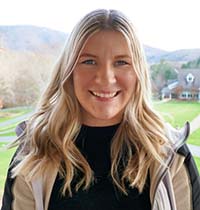
Katelyn Lettich, a 28-year-old director of the evangelical Christian organization Young Life, said it seems as if the best the churches she has attended can offer young single members is dating opportunities.

Katelyn Lettich

She advocates putting more unmarried people on church boards and planning committees to make sure singles’ voice are heard, but also to signal they are as welcome as marrieds.

“Invite single people into normal spaces,” Lettich said.

Younger singles aren’t the only ones looking to be included. Lindy Dimeo, 68, a retired crisis pregnancy center director, is a member of Blue Ridge Community Church, a small evangelical church near Charlottesville, Va. Dimeo and her husband played in the worship band together, but after he died, she took a few months off.

“At the time it was hard living a single life in a family-oriented culture,” she said.

But she added it’s possible to grow into a churchgoer in one’s own right. Almost 20 years after her husband’s death, Dimeo said: “It would be nice to have somebody special, but it doesn’t impact my life at church anymore. My church is a very close community.”

Christian communities playing catch-up

Mainline Protestant churches, while perhaps less focused on the theology of family, also have room for improvement, said Pastor Jennifer Schultz of Bethlehem Lutheran Church in Los Alamitos, Calif.

Schultz is divorced and said her congregation, largely retired adults, has never known her as anything but single. It has never been an issue, she said.

“We provide a space for single people, but don’t dwell on it, and don’t make them feel any different,” Schultz said.

But she believes Christian communities are playing catch-up when it comes to welcoming singles, whether young adults, widowed or divorced.

“One of the gifts of the church is that it has the potential to be a community for a variety of people. But I do think maybe we’re kind of behind the ball on that,” she said.

McGraw suggests congregations reevaluate their tactics and to redefine “family” to include broader feelings of community.

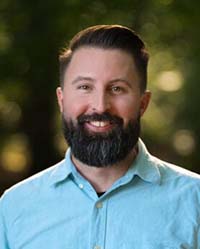
Kenny Champagne

Until moving to a new church a few months ago, Kenny Champagne, 39, ran a large young adult ministry at a multicampus congregation in northern Virginia. Most of his charges, who ranged in age from early 20s to upper 30s, were single, he said, but he added, “I don’t think any of them got involved in the ministry with the idea of looking for a significant other.”

One of the primary aims of the group was nurturing friendships and a sense of community, he said, instead of trying to pair them up.

There are signs that some churches are intentionally forming with all types of members in mind. Recently, Hepker found The Table, an Episcopal congregation in Indianapolis that she described as “one of the more relaxed and accepting churches I have ever attended.”

‘Just accepted for being a person’

At The Table, a multigenerational congregation, “you’re just accepted for being a person, and not for your marital or relationship status,” she said.

Nathan Baker, 33, another evangelical who found his way to The Table after a period of “deconstructing” his faith, said he grew up with the expectation that a full life would involve marriage and a “godly family.”

Now on the vestry at The Table, he said single people are part of the fabric of the social and discipleship groups.

“While God intended us to be in relationship with other people,” Baker said, “the pinnacle experience of that isn’t marriage, it’s vulnerable community life together.”

Lettich said more than being OK, singlehood ought to be seen as “a gift.”

“There is something very cool about this time of life,” she added. “I can truly invest in God and the people around me. I’m actually content. I’m not just pining for my next relationship.”

While many people don’t take her at her word, she said: “I think the church is coming around to the idea that single people hold value. They’re not just waiting for marriage, and they don’t have to be waiting for marriage to be a pillar in the church or to be treated as an equal partner, in ministry or in life.”

For those concerned Christians who ask uncoupled friends why they are still single, Lettich has a pithy riposte: “The Bible says not one thing about dating.”


Racial justice rooted in Scripture, evangelical leader says

WACO—Racism permeates human history, but racial justice finds its roots in biblical truth, a national evangelical leader told a conference at Baylor University’s Truett Theological Seminary.

Walter Kim, president of the National Association of Evangelicals, offered the closing keynote address at a conference on Racism in the World Church. (Photo / Ken Camp)

The teaching in Genesis that “every single individual carries the dignity of God’s image” not only is a foundational ethical principle, but also offered a prophetic challenge to a culture that believed only the king bore the divine image, said Walter Kim, president of the National Association of Evangelicals.

“By democratizing the image of God, by removing it from the power structure of the king and the royal propaganda of the king, this is not just a bland theological proposition. This was a revolutionary statement—a prophetic challenge to society,” he said. “It is a rebalancing of what I would call image inequality.”

Kim offered the closing keynote address at a conference on Racism in the World Church. Truett Seminary sponsored the Feb. 15-17 event, supported financially by the John and Eula Mae Baugh Foundation.

Racism—the failure to recognize the inherent dignity of each person as made in God’s image—is not just a personal failing, but also a systemic problem, he asserted.

‘A matter of cultures and systems’

“It’s not just a matter of individual image inequality. It’s a matter of cultures and systems,” Kim said. “There’s a concentration of power and imbalance of image in our personal dynamics, but also in the ways we organize culture.”

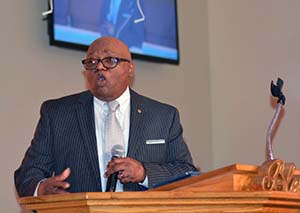
Because racism is rooted in human depravity and deeply entrenched in society, Christians who seek to counter racism must commit to “long obedience in the same direction,” National Association of Evangelicals President Walter Kim said. (Photo / Ken Camp)

The story of the tower of Babel in Genesis is both an indictment of human pride and of cultural imperialism as seen in ancient Babylon, he asserted.

“It is the habitual sinful expressions of individuals when they get the upper hand and of dominant cultures to set the terms of what it means to be normal,” Kim said.

Because racism is rooted in human depravity and deeply entrenched in society, Christians who seek to counter racism must commit to “long obedience in the same direction,” he said, borrowing a phrase from Eugene Peterson.

God’s plan always has involved multiple races, ethnic groups and nations, he noted. The people God delivered from Egyptian slavery was “a mixed multitude” that was not limited only to Israelites.

“They had to deal with the challenges of multi-ethnicity right from the get-go,” Kim said.

When God reversed Babel at Pentecost, it involved people representing multiple ethnic and racial groups, he noted. Paul wrote many of the epistles in the New Testament “to address cultural tensions” in churches, he added.

Five factors to keep in mind

As Christians commit to the good work of combating racism, Kim offered five elements to keep in mind:

  • Transformation. Changing the human heart is a “supernatural work” of the Holy Spirit. Those who want to see hearts changed about matters of race need to “humbly depend on God.”
  • Trust. Shared experiences foster relationships and build trust he said. “You cannot move forward faster than the speed of trust,” Kim said.
  • Time. Changing hearts and minds is a slow process that requires persistence.
  • Temperature. “Know when the system is overheating and you need to slow down or when it is cooling too much and you need to speed up. That takes extraordinary wisdom,” he said. Recognize collaborative work involves all sorts of people with a variety of gifts and dispositions.
  • Trajectory. “We will put into long-term plans what we think is truly important.”

Hearts can change, and lives can be transformed, Kim said, telling the story of a former Ku Klux Klan leader and neo-Nazi who developed a relationship with a Black Holiness preacher that led to his Christian conversion.

“Tell the stories of redemption,” Kim said. “And I suspect that all of eternity will not wear out our wonder at the glorious work of redemption that we—in our small way—can be part of.”

‘A comprehensive ethic’

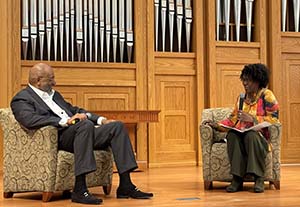
In a dialogue with Todd Still, dean of Truett Seminary, Kim described the “compelling apologetic” of transformative relationships that bear witness to the truthfulness of the Christian faith.

Christians can persist in the work of confronting racial injustice even when they do not see immediate results if they redefine success in terms of faithfulness, he asserted.

Deuteronomy 6:4-9 offers a good model for “comprehensive discipleship” that begins with whole-hearted love for God that is expressed in love for one’s neighbor, as commanded in Leviticus 19:17-18. Discipleship has both individual and social dimensions, he asserted.

“There is no bifurcation,” Kim said. “Discipleship is never just individual. … It is a comprehensive ethic.”


White Christians can learn lessons from the Black church

WACO—White Christians can learn lessons about repentance, grace and worship from the Black church, Pastor Ralph Douglas West told a conference at Baylor University’s Truett Theological Seminary.

When West was growing up in Houston, his parents divorced when he was a child, and his mother had to move 14 times in 13 years.

“But there was one address that never changed, and that was the church. It represented stability,” said West, pastor of The Church Without Walls in Houston. “For a community that is constantly in flux, the Black church provides stability.”

He delivered a keynote address at a conference on Racism in the World Church. Truett Seminary sponsored the Feb. 15-17 event, supported financially by the John and Eula Mae Baugh Foundation.

West cited three New Testament stories­—two from Luke’s Gospel and one from the book of Acts—to illustrate characteristics of the Black church at its best.

Call to repentance

In Luke 13:1-5, some Jews told Jesus about an atrocity that occurred in the temple—soldiers acting on Pontius Pilate’s orders murdered a group of Galileans while they were offering their sacrifices. Jesus responded to those who brought the news by calling them to repentance.

Similarly, Black preachers call on their congregations to view any atrocity as an occasion to repent—to engage in self-examination, both at the individual and the societal level, West said.

He recounted acts of injustice that captured the attention of Black churches—the 1955 lynching of Emmett Till in Mississippi; the 1963 bombing of 16th Street Baptist Church in Birmingham, Ala.; the 2015 mass shooting at Mother Emanuel AME Church in Charleston, S.C.; and the 2020 killing of George Floyd by a white policeman in Minneapolis, Minn.

“Regardless of circumstances, all events can lead us to repentance,” West said.

Invitation extended to the welcome table

In Luke 14:16-24, Jesus told a parable about a man who prepared a great banquet and invited all of his friends, who declined his invitation. So, the man “enlarged the invitation list,” West said, sending his servants into the streets to invite the poor and the disabled.

When there was still room at his table, the man once more sent his servants into “the highways and hedges” and extended the invitation “to all of broken and fractured humanity.”

“Everyone is invited to the same table,” West said.

White churches may “throw people away” when they stumble, but in the Black church, “We’re not getting rid of ours,” West said.

Those who have experienced exclusion firsthand are most likely to be graciously inclusive, he noted.

“We know what grace is about. … Grace in the Black church is not theory; it is practice. There’s a little bit of everybody in the Black church,” he said. “It’s an open invitation to all of God’s children to come to the table.”

Allow nothing to rob God’s people of joy

In Acts 16:16-40, Paul and Silas were unjustly imprisoned. At midnight, when they prayed and sang praises to God, an earthquake shook the prison and the chains that bound the prisoners were loosed. A jailer was about to take his own life, but Paul intervened, and both the jailer and everyone in his house received God’s gift of salvation.

When the prison officials sent messengers to urge Paul and Silas to leave their city quietly, Paul refused. After having been falsely accused and unjustly imprisoned in a public fashion, he insisted the city officials needed to come personally to pronounce them innocent and free to go.

In similar fashion, West said, the Black church understands the power of “praising God in the face of injustice,” and it sees “no separation between personal salvation and social justice.”

The Black church recognizes the presence of Christ even in the midst of unjust circumstances, and it finds joy in knowing God loves justice, West observed.

“When Jesus is there, justice is there. When justice is there, joy is there,” he said.

Both personal salvation and social justice

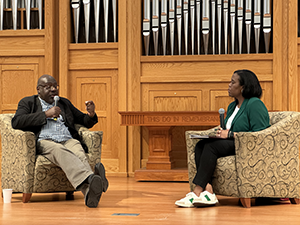
In a public dialogue with Stephanie Boddie, associate professor of church and community ministries at Baylor, West expanded on the Black church’s ability to embrace both a gospel of personal salvation and social justice.

Pastor Ralph West of Houston responds to questions raised by Stephanie Boddie of Baylor University. (Photo / Ken Camp)

At his church, he noted, when anyone responds to a public invitation to join the church, they are expected to complete a voter registration card. Similarly, every ministry of the church is expected to be involved in at least one social justice activity.

The Black church meets urgent human needs, stands against violence, promotes education and speaks out against injustice because it cares about the whole person, West insisted.

“These things are not just social issues. They are sin. When there is injustice, that is not how God intended it to be,” he said.

The celebrative nature of worship in the Black church is not simply entertainment, emotionalism or escapism, he asserted.

Rather, it is “an authentic expression” of worshippers’ response to what God has done and is doing in their lives, he said. And it is their faith-filled expression of what they expect God to do in the future.

“It is an attitude and disposition that says, ‘I will not allow circumstances to prevent me from rejoicing,’” West said.


Slay the ‘two-headed monster of racism and patriarchy’

WACO—Stories of God’s love toward marginalized women can help the church slay “the two-headed monster of racism and patriarchy” in its midst, a historical theologian and women’s advocate told a conference at Baylor University’s Truett Theological Seminary.

Jesus offered “an intentional welcome of outsiders” and treated women with a dignity society denied them, said Mimi Haddad, president and CEO of Christians for Biblical Equality International.

Haddad was a keynote speaker at the second day of a conference on Racism in the World Church, sponsored by Truett Seminary, with financial support provided by the Eula Mae and John Baugh Family Foundation and others.

From the Old Testament stories of Rahab and Ruth to the stories in the Gospels about Jesus’ encounters with women, the Bible presents pictures of God’s affirmation of women—including women from different ethnic groups, she noted.

‘Proximal to her suffering’

Jesus’ longest recorded conversation in the Gospels was with a Samaritan woman, and he praised the tested faith of a Syrophoenician woman who sought healing for her daughter.

While on the way to restore life to the daughter of a leader of a Jewish synagogue, Jesus’ healing ministry extended to an “unseen woman” with vaginal bleeding who dared to touch the hem of his garment, she observed.

“Two daughters were healed that day. The one without privilege was healed first,” Haddad said.

In each instance where he healed a woman, “Jesus was proximal to her suffering,” she added,

At Pentecost, “the Spirit birthed a new creation” marked not by circumcision but by baptism, Haddad observed.

“Baptism welcomes women. Circumcision excludes women,” she said.

Haddad pointed to the discovery of ancient baptismal fonts—made to resemble wombs as a synmbol of new birth—inscribed with the egalitarian words of Galatians 3;28: “There is no longer Jew or Greek, there is no longer slave or free, there is no longer male and female; for all of you are one in Christ Jesus.”

She also cited historical examples of Christian women who stood for oppressed and exploited girls—victims of trafficking, slavery and violence.

Need to confront ‘flawed theology’

Today, she challenged the church to confront “flawed theology” that “prioritizes one ethnic group over another” and reinforces patriarchy “that demeans girls and women.”

She particularly cited the “scandal of dispensational theology that fosters significant injustice” by valuing the lives of Jewish women and children above those of Palestinian women and children.

Haddad called on the church to lament its complicity in patriarchal and racist systems.

“Without collective lament, we speak peace where there is no peace,” she said.

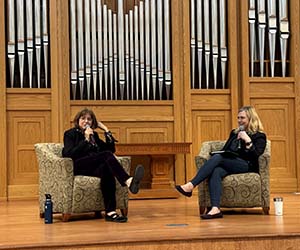
Mimi Haddad of CBE International (left) and Baylor historian Beth Allison Barr participate in a public conversation, (Photo by Ken Camp)

In a public conversation with Baylor historian Beth Allison Barr, author of The Making of Biblical Womanhood, Haddad spoke about the importance of “recovering history”—particularly the stories of women of color from non-Western cultures.

The church benefits from “broadening the conversation” and learning the stories of fellow Christians outside their own traditions, countries, ethnic groups and cultures, she noted.

Haddad confessed she is “weary” of a view of Christianity that is focused exclusively on the United States and “white people obsessed with other white people.”


Theologian decries ‘normalization of white supremacy’

WACO—The “normalization of white supremacy” has “distorted the very fabric of Christianity,” Black theologian Anthony Reddie told an international online audience and a group assembled at Baylor University’s Truett Theological Seminary.

White supremacy is normalized by “the failure to call into account” attitudes of “superiority, entitlement and privilege,” said Reddie, director of the Oxford Centre for Religion and Culture and the first professor of Black theology in the history of Regent’s Park College at the University of Oxford.

He delivered the keynote address Feb. 15 on the first day of a conference on Racism in the World Church. The event is sponsored by Truett Seminary, with financial support provided by the Eula Mae and John Baugh Family Foundation and others.

‘Pilate represents white supemacy’

Reddie pointed to the story of Jesus and Pontius Pilate as recorded in John 18:28-40 as a picture of how marginalized and oppressed people are treated by colonizers who wield political power.

In the 21st century context, he said, “Pilate represents white supremacy.” Pilate’s primary interest was holding onto the power he possessed. He saw colonized Jews as inherently “inferior.” And he considered their lives expendable if they presented a threat to the empire.

“The cross was an instrument of state-sponsored terrorism” carried out against people whom those in power considered a threat, he said.

Reddie pointed to Black liberation theologian James Cone’s linking of the cross and the lynching tree.

“To hold power and to subjugate the marginalized and the oppressed, you need lots of Pontius Pilates,” he said.

“What we need is anti-racism, where we are implacably against Pontius Pilate. We are implacably against the forces of power and self-interest. We are implacably on the side of those who are marginalized and oppressed.”

‘Populism always needs a scapegoat’

Black theologian Anthony Reddie participates in a public conversation with Torie Johnson, associate vice president at Baylor University, regarding the normalization of white supremacy. (Photo / Ken Camp)

In a conversation with Torie Johnson, associate vice president at Baylor, Reddie expanded on some of the themes he mentioned in his keynote address.

He noted the link between the power of empire—as represented by Pilate—and those who appeal to populism—as exemplified by the crowds that called for Jesus to be crucified.

Reddie pointed to politicians in the United Kingdom who exploit poor, disenfranchised whites by demonizing immigrants. They appeal to “a politics of nostalgia” by painting an idealized picture of “an imaginary past that never existed,” he said.

“Populism always needs a scapegoat. It always needs someone you can blame,” he said.

Reddie closed by offering a vision of hope for the global church, if it is willing to surrender privilege, deny self and stand with the oppressed and marginalized.

“There is always the possibility of working together and doing things better,” he said. “I am always infused with hope. What keeps me hopeful is because God is God, and because Christian hope doesn’t negate struggle. Change happens through struggle.”


Burma-born minister serves internationals in San Antonio

SAN ANTONIO—When Tera Kouba was growing up in Burma, her mother hoped and prayed God would call her to the ministry.

As a youngster, she had other plans. But today, Kouba is the newly ordained minister of international/Asian ministries at First Baptist Church in San Antonio.

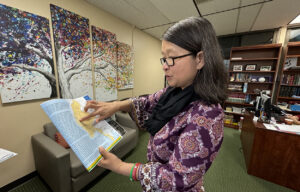
Tera Kouba, who was born in Burma and grew up there, point to a map of her homeland. (Photo by Ken Camp)

Kouba was born in Burma—now also known as Myanmar—where her father served 50 years as a Karen pastor and Baptist denominational leader. Her sister also is a minister, teaching at a Bible school in Myanmar.

As a young woman, Kouba worked 10 years at the YMCA in Mandalay.

“I see now how God used that time to teach me how to work with people of different backgrounds,” she said. “God shaped me and trained me through that experience.”

When she left her homeland, she first moved to Japan. In 2008, she relocated to the United States, initially settling in Boerne, about 30 miles northwest of San Antonio.

While going through a time of deep personal loss and heartache, she said, “My heart was pulling me in this direction” to San Antonio.

‘God was teaching me’

She learned First Baptist Church in San Antonio had launched a ministry to Karen refugees from Burma in October 2007. At that time, the congregation already sponsored a Lao/Thai ministry led by Pastor Boun Phommachanh, and the first Karen people to arrive were from refugee camps in Thailand.

In less than a year, the church’s ministry grew from about 30 refugees to more than 200, and by the end of 2009, the church was ministering to 400 people.

Kouba found a place where she felt at home and welcomed.

“God was teaching me: ‘You are not walking alone. Be strong. You have a church family,’” she said.

In 2014, Kouba began working as an administrative assistant—initially with Pastor Boun and then with Wayne Williams, who had served part time with internationals at First Baptist and joined the church staff full time to lead the ministry when Boun retired in 2015.

As minister for international/Asian ministries, Williams not only worked with multiple ethnic and language groups at the church, but also organized mission trips, including six trips to Myanmar until the military coup in February 2021 made continued journeys there unsafe.

Recognizing leadership potential

Williams recognized Kouba’s devotion to ministry and her leadership skills. As he mentored her, he increasingly gave her additional responsibilities, including arranging two mission trips to Myanmar.

She has worked with multiple ethnic and language groups, including Burmese, Karen, Karenni, Zomi, Congolese, Lao and Thai.

 “I’m very blessed to have a church family and leaders that trusted me in my walk with the Lord, allowing me to grow and supporting me,” she said.

Mark Heavener with Texas Baptists’ Intercultural Ministries also became acquainted with Kouba and saw her potential as a leader.

He introduced her to Wally Goodman, who directed Hardin-Simmons University’s Logsdon Seminary programs in San Antonio.

“I told Dr. Goodman I wanted more information, and before I knew it, I had filled out an application. A few weeks later, I received my letter of acceptance,” Kouba recalled.

She noted her mother, now 82 years old and still living in Myanmar, had encouraged her to attend seminary years earlier.

“She hoped I would follow in my father’s footsteps,” Kouba said.

Kouba balanced a busy schedule—serving in the international/Asian ministries office at First Baptist and taking seminary classes, while also working as an interpreter and translator.

She became director of international/Asian ministries when Williams retired at the end of March 2022, and she graduated with a Master of Divinity degree in December that same year.

Subsequently, leaders of First Baptist Church approached her about being ordained to the ministry, to affirm their recognition of her calling and giftedness. She was ordained Jan. 28, and her job title was changed from director to minister.

“I am grateful for the love and support I have received from First Baptist Church,” she said.

‘Reflection of Jesus in her heart’

Last year, Heavener tapped her to serve on Texas Baptists’ Intercultural Advisory Committee.

“Tera is a part of our ministry to assist churches,” Heavener said. “She has a real reflection of Jesus in her heart. She mirrors him not only in her leadership, but also in her deep compassion for her own people group and the other people groups to whom she is a blessing.”

Heavener encouraged her to participate in the Baptist World Alliance meetings the past two years in Alabama and Norway.

“It opened my eyes in terms of learning how we can pray for and support each other,” she said. “We are brothers and sisters in Christ who speak different languages and come from different cultures. We are different, but we are all one in Christ.”

Each year, the international/Asian ministries at First Baptist Church observe Judson Day, honoring the memory of Adoniram and Ann Judson, the first Baptist missionaries to Burma more than 200 years ago.

“I want young people to remember their legacy,” Kouba said. “Burma has a rich Baptist heritage.”

She voiced hope that some of the rising generation may one day be able to return to Myanmar as Christian witnesses “when the situation is better there.”

 “I don’t want them to forget where they came from,” she said. “Don’t forget who they are. Don’t be ashamed of who they are.”


Caregivers for dementia patients learn unconditional love

GRIFFIN, Ga. (BP)—“Therapeutic lying” was a new concept for Grady Caldwell Jr.

As the primary caregiver for his wife Kathleen in the latter stages of Alzheimer’s, he couldn’t imagine allowing her to believe her mother Lois, deceased for years, just visited them at home.

Grady Caldwell Jr., senior pastor of New Mercy Baptist Church in Griffin, Ga., is the primary caregiver for his wife Kathleen in the latter stages of Alzheimer’s disease. (Courtesy photo)

Caldwell, senior pastor of New Mercy Baptist Church in Griffin, Ga., tried telling Kathleen the truth when she talked of speaking with her brother, who died 20 years earlier.

“And she fell into a state of depression that was unbelievable. And that’s what got me to begin to walk in the truth of that term, that there is such a thing as, ‘It’s better to just lie and go along with them than to try to get them to see the truth,’” Caldwell said.

“It’s better to live in her reality than to try to bring her into the reality of what’s actually going on.”

Former Southern Baptist Convention President Jim Henry, caregiver to his wife Jeanette who died of Alzheimer’s in 2019, can relate to Caldwell.

Henry recalls the time—more than 50 years into their marriage—when he and Jeanette were driving to North Carolina for summer vacation early in her battle with the disease.

“And she said, ‘You can’t spend the night with me.’”

Why? “Well, we’re not married.”

Henry tried to convince her they’d been married decades, showing her his wedding ring.

“You can buy one of those anywhere,” Jeanette insisted, but she forgot the entire conversation by the time they reached their vacation home.

Caldwell, 74, is among 11 million Americans who serve as caregivers to Alzheimer’s and dementia patients. The Alzheimer’s Association reports the disease afflicts an estimated 6.7 million adults in the United States. Symptoms are progressive, with no known cure. By 2050, nearly 13 million Americans are projected to have the disease.

Kathleen, 73, was diagnosed five years ago, after Caldwell began to notice changes in his childhood sweetheart and wife of 55 years. He was accustomed to her being a studious, frugal and trustworthy multitasker.

Usually meticulous in keeping financial records for the church, she’d begun to slip. Bills were paid late or not at all, which was nothing like the Kathleen he had loved since eighth grade. She couldn’t recall names. Sentences no longer were cohesive.

A better understanding of God’s love

Grady and Kathleen Caldwell, seated, with their children, standing from left, Carmen Caldwell, Grady Caldwell III, Daphne Caldwell Rackley and Yolanda Graham. (Courtesy photo)

He cares for Kathleen while serving full time as pastor, utilizing a home office that allows him to keep her safe while leading the church of about 100 worshipers. His daughter Carmen, who serves on New Mercy’s staff, lives on the top floor of the Caldwell home, and a caregiver comes in twice a week.

But for all the love the couple has shared, he said, nothing has led him to understand God’s love as clearly as caring for Kathleen in these latter days.

“Through this, God has really given me a greater sense of his love for the church,” Caldwell said. “And he compels me to love her as he loves the church. But also, he shows me as much as I do, how short I still come. And that’s amazing to me, how much God loves us.”

Caldwell shared Kathleen’s diagnosis with his congregation five years ago, preparing them for his eventual retirement. But he continues to serve the church through the tremendous changes the disease has wrought, even as his responsibilities at home continue to increase.

“Through it all, God’s grace has kept us. I can see his hand throughout this entire process,” he said.

Caldwell believes his daughter Carmen’s return home years before Kathleen’s diagnosis was providential. Most days, Carmen gets Kathleen dressed in the morning, and Caldwell cares for her the remainder of the day. But on days when Carmen’s schedule doesn’t allow the usual routine, grooming duties are Caldwell’s responsibility.

“The days that (Carmen) can’t, I do everything,” Caldwell said. “And I’m still not good on doing hair. So the days when I have to do it all, she has on a cap that day. My wife has always been particular about her dress.”

The Southern Baptist Convention recognized the complexity of caring for Alzheimer’s and dementia patients in 2016, passing the resolution “On Alzheimer’s Disease and Dementia, Caregiving, and the Church.”

Churches can support caregiving family members

Family members often are the predominant caregivers, messengers said. Recognizing the stress, depression, anxiety, isolation and interruption of church worship caregivers endure, messengers encouraged churches to learn about Alzheimer’s and dementia, assist caregivers with care and expand ministries to include outreaches to those suffering from the diseases.

Henry, who co-wrote with Deb Terry a 2019 book for Alzheimer’s caregivers and family members, said the church can play a crucial role in ministering to caregivers and Alzheimer’s patients.

“The churches, I think, need to reach out and start being very conscious of how many people are affected by it,” Henry told Baptist Press.

Before his first wife’s diagnosis, when Henry was pastor of First Baptist Church of Orlando, Fla., a couple of church members asked Henry for permission to start an Alzheimer’s support group.

“I said ‘sure,’ not knowing that sometime later, my daughter would be going to those meetings and telling me what was happening, and reporting back to me, because this group became so helpful,” Henry recalled.

Many people inside and outside the church benefitted from the support group, Henry said. First Orlando has helped other churches in Florida and other states launch similar groups.

“Starting a support group for people who are caregivers and family, and even people who are going through dementia, is a powerful thing,” Henry said. “What happens is it becomes a ministry not only to people in the church, but … it becomes an outreach.”

Caldwell said his journey has taught him how much he must die to self in caring for his wife, just as Jesus died to save the world.

“(God) compels me to love her as Christ loves the church, where he was willing to die for the church,” Caldwell said. “And he’s showing me through this, how much I have to die to myself, and what I want to do, how I want to do it, to make sure she’s cared for.”


Around the State: Baylor named a Fulbright Top Producing Institution

The U.S. Department of State’s Bureau of Educational and Cultural Affairs recognized Baylor University as one of the colleges and universities with the highest number of students selected for the Fulbright U.S. Student Program. Baylor earned the Fulbright Top Producing Institutions honor for the second consecutive year, which recognizes the university for valuing global connection and supporting members of the Baylor community to pursue international opportunities. Twelve Baylor students were selected for Fulbright awards for the academic year 2023-2024, recognizing Baylor as one of only 56 doctoral institutions with having 10 or more graduates or students selected as Fulbright U.S. recipients. “Baylor University’s commitment to a truly transformational education includes rich opportunities for students across the disciplines to maximize their education through the Fulbright U.S. Student Program and other major fellowships, awards and internships,” President Linda A. Livingstone said. “We are so proud of our Fulbright recipients, each of whom are studying, conducting research or teaching in nations around the world while enhancing mutual understanding as cultural ambassadors.” The university will celebrate Baylor Fulbright Day at 3:30 p.m. on Feb. 27 in the Cashion Academic Center. The event, sponsored by the Baylor Office of Engaged Learning, the Center for Global Engagement and the provost’s office will feature information about the Fulbright program, including how to apply.

East Texas Baptist University President J. Blair Blackburn (third from left) met Feb. 6 with school superintendents from across Harrison County to announce a new initiative aimed at empowering local students. Blackburn introduced the Harrison County Promise Scholarship, an endeavor designed for Harrison County’s top students to receive a Christ-centered higher education at ETBU. (ETBU Photo)

East Texas Baptist University President J. Blair Blackburn met Feb. 6 with school superintendents from across Harrison County to announce a new initiative aimed at empowering local students. Blackburn introduced the Harrison County Promise Scholarship, an endeavor designed for Harrison County’s top students to receive a Christ-centered higher education at ETBU. The Harrison County Promise Scholarship is valued at $20,000 per academic year. “By investing in local students through initiatives like the Harrison County Promise Scholarship, we are not just shaping individuals. We are shaping the future of our region’s workforce and economic development,” Blackburn said. “This scholarship encourages our high-performing scholars and servant leaders to pursue their higher education here in our community.” While enrolled full-time at ETBU, recipients of the scholarship must maintain a cumulative GPA of 3.2, live in on-campus housing, participate in at least one on-campus student organization, engage in local community service through ETBU’s Great Commission Center, and serve as an ambassador for ETBU.

Robert Blackaby

Robert Blackaby, president of Canadian Baptist Theological Seminary in Cochrane, Alberta, will deliver the annual Willson Lectures March 5-6 at Wayland Baptist University. Following a private dinner lecture for local Baptist pastors and Wayland faculty and staff on March 5, Blackaby will speak in chapel at 11 a.m. March 6 in Harral Memorial Auditorium. “Strength for Today; Hope for Tomorrow,” based on 1 Thessalonians 1:1-18, is the title of the chapel lecture, which is free and open to the public. A question-and-answer session with Blackaby is scheduled for 12:30 p.m. on March 6, in McClung University Student Center. Blackaby also will be speak in select classes during the day. A pastor and church planter for many years, Blackaby was an associational strategy consultant for the North American Mission Board of the Southern Baptist Convention from 1999 to 2004. He served as president of the Canadian National Baptist Convention from 2003 to 2006. He earned his undergraduate degree in English and history from the University of British Columbia and both a Master of Divinity degree and a Doctor of Philosophy degree in Christian ethics from Southwestern Baptist Theological Seminary.

Texas Baptists’ Counseling Center is offering an in-person Mental Health First Aid course March 19 in Dallas for ministers to children and ministers to students serving in Texas Baptist churches. Mental Health First Aid is a national skills-based training and certification course that teaches participants how to identify, understand and respond to mental health and substance abuse issues. Cost is $15, a discounted rate made possible by Texas Baptists’ Missions Foundation. To register, click here.

Hardin-Simmons University will host the Polar Plunge for Special Olympics at 5:30 on Feb. 29. The event, held at the Brand Swimming Pool on the HSU campus, will benefit Abilene-area Special Olympics athletes. Money raised will provide sports training, competition and inclusion programs for individuals with intellectual and developmental disabilities.

Tish Harrison Warren, author and former Christianity Today columnist, will present a lecture and engage in a public conversation with Jim Denison, founding CEO of the Denison Forum, at 7 p.m. on March 19 at Dallas Baptist University. Warren, an Austin-based Anglican Church in North America priest and senior fellow with the Trinity Forum, will speak as part of the Veritas Lecture Series, sponsored by DBU’s Institute for Global Engagement. She will discuss her book, Liturgy for the Ordinary: Sacred Practices for Everyday Life. Cost for individual tickets is $5. To register, click here.

Lesley Wise

Lesley Wyse will be the keynote speaker at the Howard Payne University Women’s Club’s Yellow Rose Luncheon on April 25. The event is sponsored by area businesses and friends of HPU and will be held in the Mabee University Center. Wyse retired from Fort Bend Christian Academy as superintendent in 2009. She served on HPU’s board of trustees from 2014 to 2023. She is a member at First Baptist Church in Boerne, where she is an adult growth group teacher, a ladies’ Bible study teacher and facilitator, and a member of the prayer team. Also at the luncheon, the HPU Women’s Club will honor its 2024 Yellow Rose Award winner and the 2024 Yellow Rose Scholarship recipients.

The Baylor University Wind Ensemble under the direction of J. Eric Wilson, professor of conducting and director of bands at Baylor, presented a concert at the Texas Music Educators Convention in San Antonio. (Photo / Ken Camp)

The Baylor University Wind Ensemble under the direction of J. Eric Wilson, professor of conducting and director of bands at Baylor, presented a concert at the Texas Music Educators Convention in San Antonio on Feb. 8. Guest artist and clinician Julian Bliss performed Morton Gould’s “Derivations for Clarinet and Band” with the ensemble. He also joined the wind ensemble for Karl King’s “The Melody Shop,” featuring students Hunter Bellows and Matthew Davis on euphonium.

Wayland Baptist University will sponsor a Pioneer Preview for high school juniors and seniors from 9:30 a.m. to 3 p.m. on Feb. 23 at Wayland’s Plainview campus. The event includes Pioneer Showcase, where Wayland displays all academic options and opportunities. Students who want to learn more about life on campus can participate in dorm tours. Future Pioneer and Flying Queen athletes get an opportunity to meet some coaches and athletes. For more information or to register for Pioneer Preview, click here.

Dallas Baptist University and Baylor University have formed a partnership to enable students in DBU’s Associate of Engineering degree program to transition to the School of Engineering and Computer Science at Baylor. Students will complete foundational coursework in mathematics, physics, chemistry and liberal arts at DBU before they transfer to Baylor for their junior and senior years.

The Texas Historical Commission has recognized Gause Baptist Church in Milam County with a historical marker. A dedication ceremony is scheduled at 2 p.m. on March 10 at the church. Speakers include representatives of the Milam County Historical Commission, along with current and former church members, and historical memorabilia will be displayed. Ryan Karl is pastor.


Editors create Breathe Life Bible with George Floyd in mind

WASHINGTON (RNS)—Michele Clark Jenkins and Stephanie Perry Moore have known each other almost three decades and have worked together on two specialty editions of the Bible. But more than friends and colleagues, they say, they hold each other spiritually accountable.

People raise their fists during a June 5, 2020, rally in Las Vegas against police brutality sparked by the death of George Floyd, a black man who died after being restrained by Minneapolis police officers. (AP Photo/John Locher).

After the death of George Floyd, a Black man killed in 2020 by a white Minneapolis police officer, the duo say they felt compelled to do something new that combined their faith and their desire to advance racial and social justice.

The result is The Breathe Life Bible, the title echoing Floyd’s repeated insistence, “I can’t breathe,” as he was restrained with the officer’s knee on his neck.

The tome introduces each biblical book with a “Breathe It In” segment and features “#Oxygen” tidbits that point to what they consider promises in the scriptural verses.

The Bible includes devotions written by Christian leaders, including Bernice A. King, daughter of Martin Luther King Jr. and CEO of the Atlanta peacemaking center named for him; NAACP CEO Derrick Johnson; and Thelma T. Daley, president of the National Council of Negro Women.

Michele Clark Jenkins and Stephanie Perry Moore are editors of “The Breathe Life Bible.” (Courtesy Photo)

Each of these contributors expands on different imperatives summed up in the acronym BREATHE: believe, reconcile, exalt, act, trust, hope, elevate.

“You can be a part of groups that are doing things for change,” said Moore, 54, in a joint interview with Clark Jenkins. “You can also have an inward and a personal relationship with God for him to guide you on your own heart and mind on what you should do.”

Clark Jenkins, 69, wrote 49 “We Speak” segments that give brief first-person introductions to Bible characters and short interpretations of their role.

“It has been taught that the curse of Ham is on Black people and that’s why we were enslaved,” she said in the interview. “And that’s why we are on the lower rung of society and why we’ve been oppressed all these years. And that’s just incorrect. And so, we wanted to make sure that when I’m talking about who people are, that we dispel rumors.”

They talked to Religion News Service about their reaction to Floyd’s killing and their hopes for their new Bible. The interview was edited for length and clarity.

Why did you decide to co-edit The Breathe Life Bible and why now?

Clark Jenkins: The summer that George Floyd was assassinated was a very contemplative time, and so Stephanie and I started talking, and really the question before us was: There’s so much happening, there’s injustice, we’re feeling oppressed. What are we supposed to do as Christians? Are we supposed to go into our prayer closets and not come out? Throw Molotov cocktails through Macy’s window? That’s what caused us to want to do this project, to talk about how we as faithful people are supposed to respond, no matter what’s thrown at us.

Stephanie, you wrote in the acknowledgments that this Bible is “a road map of how we can allow the Father to lift the weight of this world off the oppressed.” How do you think a Bible might do that?

Moore: When you think about faith in action, there’s no other way to walk with the Lord than to have the Bible, every piece of it—your favorite Scripture, what your pastor might say from the pulpit in taking a passage from the word. It’s a lamp unto our feet and a light unto our path.

Michele, there are sidebars labeled “Inhale” and “Exhale” and verses that you label “Oxygen.” Are you hoping that this Bible will be a tool for physical as well as spiritual exercises?

MCJ: The stresses of life affect us spiritually, mentally and physically. And so, to that extent, yeah, we want the burdens of your life to be lifted, we want people to have joy. We want people to be able to breathe. We wanted people to have guidance and to feel comfortable with how they were taking action in their life because it was biblically based.

The King James Version has long been a favorite translation for African Americans. Is that why you choose to use the New King James Version for this Bible?

SPM: You’re right on. We’ve got about 30 different contributors. We have some women, some men, pastors, presidents of (seminaries), gospel singers, rocket scientists. But when we polled a lot of them, the New King James Version of the Bible was one that was always pretty much on the top.

You contrast this Bible with the Slave Bible, the 19th-century American edition that omitted passages about freedom and God’s delivery of the oppressed. Does your Bible pay special attention to those very passages?

MCJ: Not purposely. Places that we really highlighted were those that really talk about how we demonstrate our faith through our actions. So, it focuses on when the Bible talks about fighting injustice and oppression and our responsibility to do that.

George Floyd comes up a number of times in the commentary. Are you seeking to reach those who have been involved in the Black Lives Matter movement or the protests that followed his death?

SPM: Personally, it affected me. And that was one of the reasons why I was called, with Michele, to figure out what we could do. If not us, then who? To be able to work together with folks who were hurting, to be able to change that with other people that are stakeholders and faith leaders. To be able to put together a comprehensive piece that hopefully could be hope in the midst of a lot of pain.

MCJ: This Bible is geared towards anybody, by the way. Although we write it from an African American perspective, it’s not just for African Americans. It’s for anybody who wants to put their faith in action.

We know that faith without works is dead. Now that you have faith, the question is, what do you do with your life? How do you live your life? How do you go through your life—the good, the bad and the ugly? And so, this is for anybody who struggles with those questions.


Peace pilgrimage sees war in Gaza as civil rights issue

WASHINGTON (RNS)—When Pastor Stephen Green began planning a march from Independence Hall in Philadelphia to the White House to urge an end to the war in Gaza, he settled on what he hoped was an auspicious start date: Wednesday, Feb. 14, Douglass Day.

The day, honoring the life and legacy of famed 19th-century abolitionist and orator Frederick Douglass, seemed an appropriate occasion to make a moral case to President Joe Biden and his administration to stop supporting Israel’s ongoing assault in Gaza that has killed 28,000 Palestinians.
The Peace Pilgrimage, an eight-day march, expanded to include a host of sponsors, including the National Council of Churches and other interfaith groups. But at its core, it is an effort led by the organization Green founded four years ago, Faith for Black Lives.

For many Black Americans, the Palestinian cause has emerged as a central plank in the ongoing struggle for civil rights. In November, more than 1,000 Black pastors representing hundreds of thousands of congregants bought a full-page ad in The New York Times calling for a cease-fire and the release of Israeli hostages in Gaza.

Black writers, athletes, celebrities and elected officials have spoken in support of Palestinians. Some have even likened the renewed energy in support of Palestinians to the fervor of the Black Lives Matter movement that came in 2020 after the killing of George Floyd.

Stephen A. Green (Photo / National Council of Churches)

“We’re carrying this message to remind America of the values that she was birthed in and to be a leader in this moment to provide a moral vision for the world,” said Green, pastor of St. Luke AME Church in New York City’s Harlem.

The 25 or so supporting organizations that will march on average 10 miles a day include a few groups with Muslim members—the Maryland chapter of the Council on American-Islamic Relations and the U.S. Campaign for Palestinian Rights.

It also includes a host of Jewish-led organizations and synagogues, all on the far left of the U.S. Jewish scene. Conspicuously absent are mainstream Jewish organizations that have resisted calls for cease-fire, believing Israel’s war on Gaza is just.

Tense relationship between Black and Jewish progressives

While U.S. Jews and Black Americans often see themselves as like-minded progressives, they historically have had a fraught and often tense relationship, and they part ways when it comes to Israel.

Martin Luther King Jr. enjoyed good relations with American Jews and famously was flanked by Rabbi Abraham Joshua Heschel in his 1965 Selma to Montgomery march. In 1964, two Jewish civil rights workers and a Black man were murdered trying to register Blacks to vote in Mississippi.

But that period of civil rights alignment between Blacks and Jews was short-lived.

The Black Power movement of the 1960s backed Palestinians over Israelis, creating tensions with U.S. Jews. Malcolm X visited Gaza in 1964 and expressed anti-Zionist views soon after.

The Student Nonviolent Coordinating Committee and the Black Panther Movement were solidly pro-Palestinian, said Michael Fischbach, a historian who wrote Black Power and Palestine: Transnational Countries of Color.

“They understood that there was a worldwide uprising of what today we call people of color,” said Fischbach. “They were rising up, they wanted revolution, they wanted independence and freedom on their own terms.”

That meant siding with stateless Palestinians who either fled or were violently displaced during Israel’s War of Independence in 1948. Later, many more Palestinians became an occupied people when Israel captured the West Bank and Gaza in 1967.

Group links Palestinian and African American experiences

Today, many Black Americans who support the Palestinian cause are not doing so out of the revolutionary fervor of the 1960s. The group Faith for Black Lives defines itself as “grounded in the principles of Kingian nonviolence.” They view the Palestinian cause in the context of the African American experience of oppression and subjugation.

“This is a spirit journey for us to call the nation into consciousness as it relates to poverty, war and racism,” said Green, the group’s founder.

Numerous polls show that African Americans—and more generally people of color—are more likely than whites to side with Palestinians. A Gallup poll from November showed 64 percent of American people of color (including Black, Hispanic, Asian, Pacific Islander and Native American adults) disapproved of Israel’s actions in Gaza, compared with 36 percent of white Americans.

For Lisa Sharon Harper, a prominent evangelical activist, the war in Gaza spurred her to action. Since the start of the war, she has kept a commitment to post something about the war to Instagram every single day—now more than 120 posts.

She also joined multiple campaigns, including the global Gaza Ceasefire Pilgrimage, a Lenten walk now planned in 85 cities in 12 countries.

“When I look at what’s happening right now in Gaza, what I see is a war against the image of God on earth. And so, of course, I will stand and defend it,” she said.

Harper sees Palestinians as dispossessed people living behind walls and security fences, unable to vote or travel, and now homeless and starving. And she is furious that the U.S. administration is supporting this attack on a minority group.

“When we look at what’s happening in Gaza and we see our country saying, ‘that’s OK,’ well, that means that we’re not that far from our country saying, ‘that’s OK,’ if it happens to us,” she said, speaking of Black Americans.

“Dr. King said injustice anywhere is a threat to justice everywhere. This is an existential threat for people of African descent in the West.”

The United States earmarked $3.3 billion in assistance to Israel in 2022. It has given Israel more aid than any other nation since World War II, about $260 billion. On Feb. 13, the Senate passed a foreign aid package that includes $14.1 billion for Israel’s war in Gaza. It’s not clear if it will pass in the House.

‘Pulls on the threads of the Civil Rights Movement’

A growing, but still minor, group of American Jews will march in the Peace Pilgrimage from Philadelphia to Washington, believing like African Americans and others that a cease-fire is imperative.

“This pilgrimage pulls on the threads of the Civil Rights Movement,” said Rabbi Alissa Wise, founder of Rabbis for Ceasefire. “It updates the Black Jewish alliance but also expands it further.”

The Jewish contingent includes Rabbi Alana Alpert of Congregation T’chiyah in Ferndale, Mich., north of Detroit. The congregation meets in a United Methodist Church and recently posted a banner outside the church building that reads “Jews and Christians praying for ceasefire now.”

Alpert said she was joining the march to be with like-minded people of different faiths in prayer and protest in favor of cease-fire and against the funding of U.S. tax dollars to Israel’s military.

“I have so few colleagues who are on the same page or who are even having the same conversation,” said Alpert, speaking of fellow rabbis in Michigan. “I know it will feel grounding and nourishing to have this time with other colleagues. The situation is so heartbreaking that I’m saying ‘yes’ to any opportunity that I can.”


Aaron Ivey accused of indecent texts with men

AUSTIN (RNS)—The Austin Stone Church, a multicampus church in Austin, announced Feb. 11 it had dismissed its head worship pastor after discovering he had engaged in “inappropriate and explicit ongoing text messages with an adult male,” according to a statement from the church’s elders.

Aaron Ivey, the pastor of worship and creativity and an elder at the megachurch, was fired Feb. 5 for what the statement called a “disqualifying situation,” which the elders said they became aware of the previous day.

“Several elders were made aware of this situation on the evening of Sunday, February 4th and after reviewing the explicit nature of these messages, it was clear that termination of Aaron’s eldership and employment was necessary in accordance with the clear biblical standards outlined in 1 Timothy 3:1-7 and 1 Timothy 5:19-20,” according to the statement.

The first passage, from the Apostle Paul’s Letter to Timothy, urges church leaders to be faithful in marriage; the second says church elders “who are sinning” should be reproved before everyone.

‘Pattern of predatory manipulation’

After firing Ivey, the elders said, they then discovered Ivey—the husband of bestselling author and popular podcaster Jamie Ivey—had a history of texting with men, including one who had been underage at the time of the explicit texts, according to the statement.

“Since then, we have uncovered multiple similar instances with different individuals dating back to 2011 that show a very clear pattern of predatory manipulation, sexual exploitation, and abuse of influence,” the statement said.

The elders detailed a timeline of texts they had discovered, alleging they began in 2011 with the exchanges with a minor, which they said they had reported to the “appropriate authorities.”

“The first known instance, which took place with a teenage male victim and continued over time, involved inappropriate and explicit communications, indecent exposure, and the use of alcohol and illegal substances,” read the statement.

A spokesperson for the church, which has been affiliated with the Southern Baptist Convention and Southern Baptists of Texas Convention, declined to offer additional comment on the allegations and Ivey’s termination.

The elder statement said MinistrySafe, which trains the church’s staff to prevent child abuse, has been alerted about the situation.

“As elders, we are heartbroken for the victims and their families. Knowing the Lord’s sheep are worth our protection and our love, we are committed to loving this body and rooting out evil. We know this may affect your trust because we know it certainly has rattled ours,” read the statement.

‘Devastating news’

Jamie Ivey, host of the popular podcast “The Happy Hour,” appeared on “Good Morning America” on Friday to promote her new book, Why Can’t I Get It Together? Afterward, she posted on her Instagram that she was “off to China Town with my man for some epic Chinese food for lunch!” It’s unclear whether she knew at the time of her husband’s firing.

Late Sunday, a post on her Instagram said that in the wake of receiving “devastating news while on book tour,” Jamie Ivey was pausing all public appearances. The post, signed by her team, requested prayer and support “for everyone involved who are hurting.”

In 2021, the Iveys wrote Complement, a book and accompanying Bible study about marriage. The couple subscribed to a complementarian theology of marriage, which emphasizes male leadership, and spoke on it often.

Aaron Ivey appeared on a 2019 panel hosted by the SBC’s Ethics & Religious Liberty Commission, titled “Faithful Husband, Strong Father: Embracing God’s Design for Manhood in Marriage,” that focused on the role of biblical manhood in marriage.

The couple, who have four children, including three adopted Black children, have also publicly talked about the challenges of living as a multiracial family in a majority white community and church.

Aaron Ivey did not respond to requests for comment.