Gen. David Petraeus, U.S. Army (Ret.), offered leadership insights from his 37-year military career and his time as director of the Central Intelligence Agency when he spoke at Dallas Baptist University in December. DBU’s Institute for Global Engagement and the World Affairs Council of Dallas/Fort Worth jointly sponsored the event. Global economist Meredith M. Walker moderated the discussion, in which Petraeus offered his first-hand perspectives on commanding the U.S. campaign in Iraq and Afghanistan, as well as his thoughts about the ongoing war in Ukraine and the conflict in Israel. He is co-author, with historian Andrew Roberts, of Conflict: The Evolution of Warfare from 1945 to Ukraine.
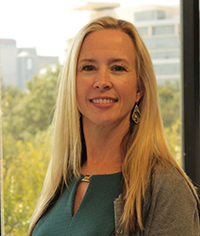
Kathryn A. Osteen
Baylor University named Kathryn A. Osteen as associate dean for the pre-licensure program and clinical associate professor in the Louise Herrington School of Nursing. She will serve alongside Lisa Jones, also an associate dean for the pre-licensure program, over all three bachelor’s degree tracks—Traditional, Distance Accelerated Bachelor of Science in Nursing and FastBacc, a 12-month accelerated program for students who hold an undergraduate degree in a non-nursing discipline. Osteen worked 28 years in an adult cardiac intensive care unit. She joined the School of Nursing in 2002. After earning both her Bachelor of Science in Nursing and Master of Science in Nursing degrees from Baylor University, she received her Ph.D. from the University of Texas at Arlington.
Students and teachers from Cross Classical Academy in Brownwood joined in a belated observance of Texas Arbor Day in December at Howard Payne University. (HPU Photo)
Students and teachers from Cross Classical Academy in Brownwood joined in a belated observance of Texas Arbor Day in December at Howard Payne University. Third, fourth, fifth and sixth grade students participated in the planting of a Shumard red oak tree near the Thompson Academic Complex and the English building on the HPU campus. Aaron Diaz, HPU’s grounds supervisor, organized and led the event.
Faith Howard
Faith Howard, age 16, of Retama Park Baptist Church in Kingsville has been named to the 2024 National Acteens Panel. She will serve along with Sarah Elizabeth Shelton from First Baptist Church in Columbiana, Ala., and Gracie Stamey of Mount Zion Baptist Church in Hudson, N.C. They will participate in the Woman’s Missionary Union Missions Celebration and annual meeting in Indianapolis in June, prior to the Southern Baptist Convention annual meeting. The panelists also will blog for wmu.com/students and be given leadership and speaking opportunities throughout the year. Faith has served with a rodeo ministry in Wyoming, with church planters in Ohio and with a migrant ministry in Brownsville. She also volunteers at a local pregnancy resource center. Her sister, Hannah, who was named a National Acteens Panelist in 2020, helped lead her to faith in Christ as a child.
Retirement
Elton Musick from Grace Baptist Church in Lufkin after 21 years as pastor there and four decades in the gospel ministry. A retirement celebration is scheduled Jan. 14.
Attorney general opinion sought on gambling issues
January 10, 2024
Texas Attorney General Ken Paxton’s office will respond in less than six months to a request for an opinion regarding the legality of poker house operations.
However, the attorney general’s office declined to render a requested opinion on whether certain gaming machines are illegal gambling devices.
Austin Kinghorn, chair of the opinion committee in the state attorney general’s office, responded recently to requests for clarification on the two gambling-related issues.
Sen. Brandon Creighton, R-Conroe, requested an opinion on “whether a gambling establishment that charges a membership or entrance fee but does not take a percentage of the value gambled violates the gambling provisions in the Penal Code.”
In a Dec. 21 letter to Creighton, Kinghorn acknowledged receipt of the request for an opinion and set June 12 as the deadline for issuing an opinion.
“However, we note that you have requested an expedited opinion. We will therefore make every effort to respond to your request as promptly as possible,” the letter stated.
Texas law allows limited social gambling if it occurs in a private place, if no party receives any economic benefit other than personal winnings, and if the risks are the same for all participants.
An establishment that receives a “rake”—typically a percentage of the value at risk in gambling—is not permitted under Texas law. However, some lawmakers have questioned the legality of poker clubs that charge fees.
Creighton’s request marks the second time a lawmaker has sought an attorney general opinion regarding the legality of poker house operations.
In 2018, Paxton’s office declined to offer an opinion on the legal status of poker enterprises that charge a fee from gamblers, requested by Rep. Genie Morrison, R-Victoria, citing pending litigation. At the time, a poker club in Austin had sued another poker club in San Antonio, alleging unfair competition.
Kinghorn’s letter to Creighton was copied to representatives of Texans Against Gambling, Catholic Charities and the Texas District and County Attorneys Association. In the letter, he invited briefings on Creighton’s question by Jan. 29 from anyone “with special interest or expertise in the subject matter.”
“At Texans Against Gambling, we believe these poker clubs aren’t clubs at all. They’re commercial gambling businesses with poker as the means to gamble,” said Russ Coleman, chair of Texans Against Gambling.
“We believe these businesses’ attempts to circumvent long-standing Texas law are contrivances on several levels, and fail, and we hope the Texas attorney general also holds these views.”
Request for opinion denied
Kinghorn also responded to a separate request from Cooke County Attorney Edmund J. Zielinski for an opinion about whether equipment qualifies as a prohibited gambling device under the Penal Code if “its play involves a fixed or finite sweepstakes system.”
“After review of your request, it has become apparent that providing an answer to your question would require us to investigate and resolve factual matters,” Kinghorn wrote in a Jan. 8 letter to Zielinski.
Kinghorn noted the purpose of an attorney general opinion is “to advise authorized requestors on the current state of the law,” not to “resolve disputed issues of fact.”
“Accordingly, when presented with opinion requests that require the resolution of fact questions, this office has consistently concluded that such questions are outside the purview of the opinion process,” Kinghorn wrote.
He added, “In this case, even if your request contained additional factual information, we would decline to opine as this office does not offer conclusions as a matter of law on the legality of a particular amusement device.”
On the Move: Henslee and Parks
January 10, 2024
Matt Henslee to Plymouth Park Baptist Church in Irving as senior pastor effective Feb. 1 from Collin Baptist Association, where he is associational missionary.
Stephen Parks to Grace Baptist Church in Lufkin as pastor.
TikTok account spotlights dangers of Christian nationalism
January 10, 2024
WASHINGTON (RNS)—Standing outside the U.S. Capitol on Jan. 6, 2023, Georgia McKee witnessed two very different responses on the second anniversary of the infamous mob attack.
Circled together and holding candles, one group of faith leaders condemned Christian nationalism, calling it a “poisonous ideology” and “gross distortion of our Christian faith.”
The other group marched in front of the Supreme Court building, shouting into megaphones, wearing MAGA hats, waving American flags and holding signs saying, “One Nation Under God.”
McKee took some videos on her phone, spliced them together to contrast the two gatherings and showed the final video to her co-workers at the Baptist Joint Committee for Religious Liberty, a coalition of Baptist denominations that advocates for the separation of church and state.
Next, she created a TikTok account and posted the video. In the year since, it’s had more than half a million views.
“That made us realize, oh, people like this content,” said McKee, digital communications associate at BJC. “We got lots of messages saying: ‘Thank you so much for showing this video. We need more of a Christian witness that is faithful to the message of Jesus.’”
Affiliated with BJC campaign
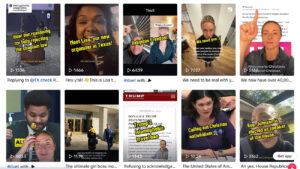
TikTok videos from the @EndChristianNationalism account. (Screen grab)
The @EndChristianNationalism TikTok account has gained more than 40,000 followers and earned 600,000-plus likes in the past year. The account is affiliated with BJC’s Christians Against Christian Nationalism campaign, a grassroots movement that provides training and resources for combating Christian nationalism.
“It’s not just about going viral for us,” said McKee, who runs the account.
Raised in Texas, McKee grew up attending a Southern Baptist church where an American flag flanking the pulpit was commonplace. But in college at Belmont University in Nashville, Tenn., McKee began to reckon with what she saw as exclusionary elements of her faith.
She deconstructed, became spiritual but not religious and then joined an Episcopal church for a season. Today, McKee is a seminarian at Wake Forest University School of Divinity, where she’s studying to become a Baptist minister in a more progressive Baptist tradition, like Cooperative Baptist Fellowship and Alliance of Baptists, “or whatever comes next,” she told Religion News Service.
After a year of making videos where she leans into her now-trademark tiny clip-on mic and gives play-by-plays of Christian nationalism in action, McKee can spout off a definition for the topic without hesitation.
“Christian nationalism is a political ideology and cultural framework that abuses the name of Jesus for a very specific American goal,” McKee said. “Christian nationalism is not Christianity.”
Designed to educate viewers
Many of her TikToks are intended to educate viewers on the topic. She’ll highlight the Christian nationalism of figures such as Sean Feucht, Lauren Boebert and Marjorie Taylor Greene, while also celebrating Christians, such as Shane Claiborne and BJC Executive Director Amanda Tyler, who oppose the ideology. McKee also uses the platform to connect people to resources for addressing Christian nationalism in churches and in local politics.
“We’ve really seen the impact of online to offline organizing with TikTok,” McKee said. “We multiple times have helped people develop their public comment that they’re going to go and share that evening at their local school board or city council meeting.”
After stumbling across the @EndChristianNationalism account, Megan Fanning, who lives in Mansfield, began connecting with McKee this spring after Texas lawmakers passed a bill allowing chaplains in public schools.
“We’ve communicated about the chaplain policy ever since the bill was signed, because the school boards had six months to vote for or against it,” Fanning said. “She offered resources, a chaplain toolkit, fact sheets, educational PDFs.”
The resources led Fanning to email her school board members referencing facts and information provided in the Christians Against Christian Nationalism toolkit.
Field organizer working in North Texas
Christians Against Christian Nationalism also hired its first field organizer, Lisa Jacob, to lead opposition to Christian nationalism in North Texas. Jacob delivered a rousing public comment condemning the chaplain bill at a Mansfield school board meeting in December, shortly before the board voted against implementing the chaplaincy bill in the school district.
“To have a field organizer from Christians Against Christian Nationalism come and speak at our school board meeting on behalf of our community against this chaplain policy meant so much,” Fanning said. “I like to think that community feedback might have made a difference in them voting against and rejecting the policy.”
Not just a ‘progressive’ issue
While the account certainly attracts mainline Christians, McKee said, it’s not just theologically progressive Christians who are engaged. McKee is intentional about avoiding theological or political debates that aren’t centered on Christian nationalism, an approach she says helps appeal to a broad audience.
“We’re seeing that even in the evangelical camp, even conservative Christians that I might not agree with on any other topic, are able to still say Christian nationalism is a topic that has to be talked about, that it has to be something that’s combated in all local churches, not just progressive churches,” said McKee.
“Fighting Christian nationalism, for it to truly end, it cannot be a progressive issue. It has to be a Christian issue.”
In addition to attracting a range of Christians, and even many non-Christians, the account engages people of a variety of ages, especially millennials in their 30s and 40s. Having a space explicitly dedicated to opposing Christian nationalism on TikTok is crucial, McKee asserted.
It’s especially true, given the influence of conservative Christian celebrities such as Allie Beth Stuckey and Sadie Robertson Huff, who, McKee said, have been influenced by Christian nationalism.
“We’re seeing like this old school fundamentalism almost become trendy and cute,” said McKee.
Tim Whitaker, creator of the nonprofit The New Evangelicals who runs the organization’s hugely popular TikTok account, said part of @EndChristianNationalism’s success on the platform can be attributed to its focus on giving people verifiable facts.
“What I like about their account is that they’re giving a lot of just data. You know, hey, here’s what this person said, here’s what this person did,” Whitaker said.
Simply reporting instances of Christian nationalism is critical in a time when the average American is likely unaware of the extent to which Christian nationalism is fueling national politics, he added.
“I think it’s really important, going into 2024 more than ever, that there are Christians who are loud about resisting such an ideology and movement for the sake of all their neighbors,” Whitaker said.
At church, Biden denounces ‘poison’ of white supremacy
January 10, 2024
CHARLESTON, S.C. (RNS)—President Joe Biden denounced the white supremacy he said led to deadly violence at Mother Emanuel African Methodist Episcopal Church almost nine years ago.
“The word of God was pierced by bullets and hate and rage, propelled by not just gunpowder, but by a poison, a poison that has for too long haunted this nation,” he said in an address Jan. 8 at the historically Black church. In 2015, nine people died there at the hands of a gun-carrying white supremacist church members had welcomed to their Bible study.
“What is that poison? White supremacy. All it is is a poison. Throughout our history, it’s ripped this nation apart. This has no place in America. Not today, tomorrow or ever.”
In his campaign appearance that mixed Scripture with election rhetoric, Biden spoke about his record of affirming African Americans and Black history. He cited his nomination of Supreme Court Justice Ketanji Brown Jackson and other Black women to federal courts, and his establishment of the Juneteenth holiday and a national monument that honors lynching victim Emmett Till and his mother, Mamie Till.
Without calling Donald Trump by name, Biden called his Republican opponent a “loser” and, after offering his sympathies and prayers about a recent school shooting in Iowa, criticized Trump for saying, “We have to get over it.”
Biden crossed himself after repeating his opponent’s words and then offered his views.
“My response is: We have to stop it,” he said, drawing applause, “so your children, your family, your friends—you can leave your home, walk the streets, go to stores, go to the grocery store and go to church, to be safe from gun violence. There’s no excuse for this carnage. We have to ban assault weapons. I did it once before, and I’m going to come back again and do it.”
Biden’s remarks were interrupted by pro-Palestinian protesters shouting for a cease-fire in the Israel-Hamas war. In return, people in the pews started calling out “Four More Years.”
“I understand their passion,” Biden responded. “And I’ve been quietly working, been quietly working with the Israeli government to get them to reduce and significantly get out of Gaza, using all that I can to do.”
South Carolina primary upcoming
As he looks ahead to the Democratic primary to be held in South Carolina, Biden credited people in the state—including those at Mother Emanuel and the support of Rep. James Clyburn, D-S.C.—with his 2020 election.
“Your voice was heard in shaping your destiny. That’s democracy. I’m proud to have led the effort to make sure your voice, the South Carolina voice, will always be heard. Because now you’re first in the primary,” he said, drawing more applause.
South Carolina’s Feb. 3 Democratic primary will be the first official 2024 ballot with Biden’s name on it, a change recommended by Biden and other Democrats who wanted the first primary to be held in a more diverse state.
While New Hampshire is still having primaries sooner, Biden’s name will not be on the ballot as the state’s leaders did not opt to follow the national party’s directive to delay their primary until after South Carolina’s. Instead, Democrats in New Hampshire launched a write-in campaign for Biden, Politico reported.
As he concluded his speech, in which he lauded the patriotism of the Black church, Biden drew on a song popularized by gospel artist James Cleveland—“I Don’t Feel No Ways Tired”—to round out themes about truth, democracy and faith.
“This is a time of choosing. So, let us choose the truth. Let us choose America,” he said. “I know we can do it together and, as the gospel song sings, ‘We’ve come too far from where we started. Nobody told me the road would be easy. I don’t believe he brought me this far to leave me.’
“My fellow Americans, I don’t think the good Lord brought us this far to leave us behind.”
Two days before Biden’s address at Mother Emanuel, Vice President Kamala Harris also visited South Carolina and spoke in a different African Methodist Episcopal setting.
Sounding similar themes as the president, Harris spoke at the annual retreat of the AME Church’s Seventh Episcopal District’s Women’s Missionary Society.
“In moments such as this, when we as a nation witness so much hate, conflict and attempts to divide, it is our faith that often guides us forward,” she said, “faith in what we cannot see yet know to be true; faith in the promise of our nation—freedom, liberty and equality—not for some, but for all.”
Search team has SBC Executive Committee CEO candidate
January 10, 2024
NASHVILLE (BP)—The SBC Executive Committee presidential search team plans to announce its candidate to the public Feb. 18.
The team announced Jan. 8 it will present the candidate to the Feb. 19 Executive Committee meeting in Nashville.
“The search team arrived at this candidate after following the four-phase process [Neal] Hughes outlined in the EC’s September 2023 meeting: the invitation phase, the interview phase, the investigation phase and the introduction phase,” a news release from the group stated.
The release says the team “interviewed 30 candidates via questionnaire, Zoom, and in person.”
Related to the candidate, Hughes, the search team’s chairman, said, “In doing due diligence, we gathered references from over 60 people from every walk of SBC life, including a full review of primary, secondary, and tertiary references.”
Hughes is the director of missions and executive director of Montgomery Baptist Association and MBA Community Ministries.
“In accordance with the Executive Committee’s newly adopted hiring guidelines, we completed an extensive list of checks and tests. The search team evaluated the person during numerous meetings, reviewing his vision and having our questions answered,” he said in the statement.
The position was made vacant when Ronnie Floyd resigned in October 2021. An initial search team presented Jared Wellman, pastor of Tate Springs Baptist Church in Arlington and former Executive Committee chair, in May 2023, but a majority of the Executive Committee declined the team’s recommendation.
Willie McLaurin, an Executive Committee vice president, became the front-runner for the post this past summer but withdrew his name. McLaurin resigned from the Executive Committee after confessing to falsifying information related to his academic background.
Obituary: Chad James Selph
January 10, 2024
Chad James Selph, pastor of First Baptist Church in Allen, died Dec. 16 following a three-year battle with neuroendocrine tumor cancer. He was 62. He was born Oct. 8, 1961, to Bill and Edith Selph in Victoria. He made his profession of faith in Christ at age 8 and was baptized at Northside Baptist Church in Victoria. After graduating from Victoria High School, he attended Victoria College before transferring to Hardin-Simmons University, where he met his future wife Rhonda. They married in 1985 while he was working on a Master of Divinity degree at Southwestern Baptist Theological Seminary. He took his first full-time ministry position as associate pastor at Bowles Memorial Baptist Church in Grand Prairie and after graduating from seminary, he first became associate pastor at Pioneer Drive Baptist Church in Abilene and later was called as senior pastor of First Baptist Church in Stamford. He became senior pastor of First Baptist Church in Allen in 1997, where he served until his death. During his years of service in Allen, he completed dozens of mission trips around the world, led the church through three building campaigns, and served church members in all stages of life. Even in the later stages of his cancer, he continued to preach, serve and minister to his congregation. During his final days of life, he continued to say the one thing he was most grateful for was the hope that can be found in Jesus. He is survived by his wife of 37 years Rhonda; son Austin Selph and his wife Kathryn of Plano; daughter Lauren Selph of Amarillo; granddaughter Jillian of Plano; parents Bill and Edith Selph of Hot Springs, Ark.; and sister Gail Daigle of Aiken, S.C. A celebration of life is scheduled at 2 p.m. Jan. 13 at First Baptist Church in Allen.
Addressing abuse requires churches to be prepared
January 10, 2024
NASHVILLE (BP)—A church’s response to an allegation of abuse begins with a call to Child Protective Services. From there, it’s important not only to have an active partnership with civil authorities in addressing the case, but also to set up long-term care for survivors, experts say.
“Becoming a Church that Cares Well for the Abused,” a handbook developed through the Caring Well initiative by Southern Baptists, includes contributions from those involved in addressing cases of abuse.
Andrea Munford, deputy chief of community support at the Michigan State University of Police and Public Safety, is quoted in the handbook:
Andrea Munford (https://msu.edu)
“Ministry leaders should recognize that after CPS has been notified, it is important to continue support to a victim and their caretaker by ensuring that the victim still feels welcomed by the church community.
“Though leaders will need to limit the number of people who know about a situation, it’s helpful to prepare church leaders who can give similar support and messaging, care ministry, children’s ministry, and security teams, for example, so that a child feels supported and safe at the church,” she said.
Munford, who was the lead investigator in the Larry Nassar abuse case, acknowledged that “sometimes information does get spread through a church, which could negatively impact the child’s social environment, sometimes even manipulated by the offender. Church leaders need to be aware that this could happen and have a plan to address it.”
Various elements of a case can determine, per CPS guidance, the pace at which details are revealed. The chapter “Ministry Tension” talks about how cooperation with civil authorities can, in fact, delay some aspects of ministry involvement.
“Church leaders can be frustrated when an attorney advises silence about the allegations until after a trial, when waiting on a series of hearings, or when a restraining order interferes with communication,” it said.
Public disclosure of a case of abuse where the offender is a church staff member or volunteer, for instance, or it occurred on church grounds or at a church-sanctioned event, can include many variables.
Guide offers action steps
“Becoming a Church that Cares Well for the Abused” provides action steps in the chapter “Response to Abuse by a Church Leader.”
“Communicate with the congregation verbally and in writing informing them of the name of the abusive leader and the basic allegations,” it says. “This should be done specifically in consultation with law enforcement and knowledgeable experts. Ineffective communication could potentially harm the victim as well as the investigation.
“Although helpful communication can be tricky, leaders may need to inform the congregation of basic facts in order to encourage any additional victims to come forward.”
A document from the SBC’s abuse reform implementation task force “is forthcoming,” task force member Brad Eubank said. The document will help guide churches on best practices for publicly addressing cases of abuse.
“There is already an excellent resource that churches can use right now to respond well found at www.churchcares.com,” he said. “It is an incredible resource with videos and experts in the field to help guide a church’s response. The (task force) document will only enhance and expand on what is shared in Church Cares.
“We want to continue to help churches be ready to respond and handle things the right way,” said Eubank, senior pastor of First Baptist Church in Petal, Miss., and a part of Mississippi Baptists’ sexual abuse response team.
The presentation by the task force at the 2024 Southern Baptist Convention annual meeting in June will introduce video-based training for churches, designed primarily for smaller congregations led by bivocational staff but helpful for churches of all sizes.
“We want to put as many tools as we can in their hands for what we pray will be a significant generational change,” Eubank said.
If you are/have been a victim of sexual abuse or suspect sexual abuse by a pastor, staff member or member of a Southern Baptist church or entity, please reach out for help at 202-864-5578 or SBChotline@guidepostsolutions.com. All calls are confidential.
Muslim couple’s lawsuit against school district dismissed
January 10, 2024
WASHINGTON (RNS)—A federal judge in Illinois ruled a state school district is not responsible for the actions of a teacher who allegedly proselytized students in a public school classroom, leading a Muslim student to convert to Christianity.
Judge Iain D. Johnston of the U.S. District Court for the Northern District of Illinois, Eastern Division, ruled officials of Community Unit School District 300 were not responsible for the teacher’s actions, as he was disciplined and later resigned after being confronted by those public school officials.
Harry D. Jacobs High School in Algonquin, Ill. (Image courtesy of Google Maps via RNS)
The ruling is the latest twist in a long-running legal dispute over religion at Jacobs High School in Algonquin, Ill.—a northwest suburb of Chicago—and, in particular, the conversion of a teenage Muslim student.
Yosuf Chaudhry and Amena Alvi, who are Muslim, sued Community Unit School District 300 in 2020 after learning their then-teenage daughter converted to Christianity as a student at Jacobs.
While at the school, their daughter, referred to in a complaint as “B.D.,” allegedly met with a teacher named Pierre Thorsen, who taught world history and world religions and also sponsored a student Christian group called Uprising.
Thorsen, a popular teacher who was named Educator of the Year for Kane County, Ill., in 2015, also was named in the complaint.
Teacher allegedly criticized non-Christian faiths
According to the complaint, Thorsen, who taught classes in apologetics at local churches, allegedly promoted Christianity during Uprising meetings and criticized other religions.
“Thorsen would repeatedly engage in conversations with students before, during, and after school where he would advocate for his faith and cast doubt, belittle, or discount other faiths,” the complaint alleged.
After the couple’s daughter converted, Thorsen allegedly also introduced her to members of his church who offered to take her in if her family disowned her because of her change in religion. She also received a Bible from her teacher, according to a revised version of the couple’s complaint, filed in 2023.
The couple alleged the district should have been aware Thorsen had promoted Christianity for years and used his classroom to allegedly proselytize students.
In his answer to the lawsuit filed by Chaudhry and Alvi, Thorsen acknowledged giving lectures in churches but denied using his role as a teacher to try to convert students. He also denied that he criticized non-Christian faiths but did acknowledge giving the couple’s daughter a Bible after she requested one.
Thorsen said she had used a borrowed Bible during Uprising meetings. He acknowledged putting the daughter in touch with people outside the school who could help her if her parents were angered by the conversion.
“The goal was reconciliation and not legal emancipation,” according to an answer to the parents’ complaint. “The Bible and contact information were provided after B.D. already professed conversion to Christianity, and after B.D. read the Bible on her cell phone provided by her parents.”
Thorsen defended discussions of religion in a public school and said he did not try to persuade B.D. to convert but instead suggested she speak to other Muslims about her faith questions.
After Chaudhry and Alvi told their story to the Daily Herald, a suburban Chicago newspaper, Thorsen sued the couple for defamation.
School officials disciplined teacher
School officials argued that they confronted Thorsen about his actions after Chaudhry and Alvi complained and that he was disciplined and resigned soon afterward.
Johnston agreed. He said the couple repeatedly failed to make a case that the district was responsible. Johnston also said no other teachers appeared to have promoted religion, making it unlikely the district approved of such conduct.
“The fact remains that when the Parents informed the District of their concerns about Thorsen, he was investigated, disciplined, and transferred to another school—a sequence that hardly raises the reasonable inference that the District had previously known of and ratified Thorsen’s conduct,” Johnston wrote in his order, dismissing the case against the district.
The couple’s lawsuit against Thorsen remains active.
Zubair Khan, an attorney for the couple, was disappointed in the judge’s ruling.
“We disagree with this decision, and we will appeal it,” he said. That appeal will have to wait, he added, until the case against Thorsen is decided.
The place of religion in public schools long has been contentious and often led to drawn-out legal battles. While student-led religious groups are allowed at schools, and outside groups can run religious activities on weekends or after school, teachers and other school officials are barred from promoting their faith to students.
Last fall, Joe Kennedy, an assistant football coach in Washington state, returned to the sidelines after the Supreme Court ruled his postgame prayers on the field were allowed under the U.S. Constitution. Kennedy, who had fought a long legal battle to regain his job as a coach, resigned soon after his brief return to the sidelines.
Thorsen has also sued the school district, alleging school officials discriminated against his Christian faith and saying they misled him into thinking he would be fired if he did not resign. In his lawsuit against the district, Thorsen claims any discussion of religion took place in a “legitimate pedagogical way” and that he was pressured to quit because talking about Christianity made people uncomfortable.
More than 4,000 people signed a Change.org petition in support of Thorsen after he resigned.
Thorsen’s attorney declined to comment.
Johnston previously had dismissed some of Thorsen’s claims against the school district, but an amended complaint in the case was filed in late December.
That complaint alleges school officials restricted Thorsen’s ability to talk about religion with his students. According to a letter filed as an exhibit in his lawsuit against the district, Thorsen was told not to give preferential treatment to any particular religion in his classes and told not to sponsor or participate in student religious clubs. He was also told to end a Bible study that met in his classroom.
“Defendant otherwise created a hostile environment, intolerable conditions, and undue restrictions against Christianity,” Thorsen’s attorneys alleged in their recent complaint.
Neither Nigeria nor India cited for serious violations
January 10, 2024
In spite of a Christmas Eve massacre of about 200 Nigerians in predominantly Christian areas and evidence of India’s growing transnational repression of religious minorities, neither nation was designated as a Country of Particular Concern by the U.S. Department of State or placed on its Special Watch List.
In response to the omissions, the U.S. Commission on International Religious Freedom called for a congressional hearing, noting the State Department’s own reported evidence of religious freedom violations in both countries.
U.S. Secretary of State Antony Blinken announced Jan. 4 the State Department redesignated a dozen nations as Countries of Particular Concern—a category reserved for nations that engage in or tolerate “systemic, ongoing and egregious violations” of religious freedom.
The State Department-designated CPCs are Burma (also known as Myanmar), China, Cuba, Eritrea, Iran, Nicaragua, North Korea, Pakistan, Russia, Saudi Arabia, Tajikistan and Turkmenistan.
Kim Neineng, 43, a tribal Kuki, cries as she narrates the killing of her husband, at a relief camp in Churachandpur, in the northeastern Indian state of Manipur, Tuesday, June 20, 2023. Neineng escaped with her four children to a nearby relief camp when a Meitei mob descended on their village. Her husband was killed by the mob (AP Photo/Altaf Qadri)
“There is no justification as to why the State Department did not designate Nigeria or India as a Country of Particular Concern, despite its own reporting and statements. USCIRF calls on Congress to convene a public hearing on the failure of the State Department to follow our recommendations,” U.S. Commission on International Religious Freedom Chair Abraham Cooper and Vice Chair Frederick A. Davie said in a joint statement.
The USCIRF in its 2023 annual report recommended all 12 countries be redesignated as CPCs without any waivers on sanctions and also recommended the CPC designation for India, Nigeria, Afghanistan, Syria and Vietnam.
“We met with the State Department on many occasions to sound the alarm about these countries, but not all of our recommendations have been followed. We will not be deterred and will continue our role as a congressionally mandated watchdog to ensure the U.S. government prioritizes religious freedom as a key component of U.S. foreign policy.”.
Cooper and Davie pointed to the Christmas Eve attacks on Christians as “just the latest example of deadly violence against religious communities in Nigeria that even the State Department has condemned.”
In regard to India, they noted not only “egregious religious freedom violations” and religious violence internally, but also increased transnational repression targeting religious minorities.
Others echo concerns about omissions
21Wilberforce, a human rights organization focused on religious freedom, echoed the concerns raised by the bipartisan commission.
“21Wilberiforce joins the chorus of those in government and civil society who are very disappointed that Nigeria and India are missing from the State Department’s latest religious freedom violations country list. Both countries clearly meet the legal standards for designation as CPCs,” said Lou Ann Sabatier, spokesperson for 21Wilberforce.
“Violence and atrocities in Nigeria continue to rapidly increase with the most recent incident reported two weeks ago on Christmas Eve. And growing incitement of religious violence against religious minorities in India, whose government turns a blind eye, is deeply troubling.”
ADF International, the global arm of Alliance Defending Freedom, particularly condemned the Biden administration for failing to acknowledge “egregious violations of religious freedom” in Nigeria and urged congressional action.
“The United States should increase pressure on Nigeria for the blatant violations of religious freedom occurring in the country. More Christians are being killed in Nigeria for their faith than in all other countries combined,” said Sean Nelson, legal counsel on global religious freedom for ADF International.
“The U.S. government should do everything within its power to support ending the persecution and bringing about the peaceful coexistence of faith communities in Nigeria. Since it is clear that the State Department will not take significant action over the terrible religious freedom conditions in Nigeria, it is vital that Congress makes its voice heard.”
In addition to the CPC designations, the State Department placed Algeria, Azerbaijan, the Central African Republic, Comoros and Vietnam on its Special Watch List—a second-tier designation for countries where there is evidence of religious freedom violations.
Contrary to USCIRF recommendations, the State Department issued waivers on sanctions for Pakistan, Saudi Arabia, Tajikstan and Turkmenistan.
“USCIRF formally requests a detailed justification by the State Department as to why our policy recommendations were not fully implemented, including the waivers,” Cooper and Davie stated.
Blinken acknowledged “significant violations of religious freedom also occur in countries that are not designated,” but he did not cite specific nations.
“Governments must end abuses such as attacks on members of religious minority communities and their places of worship, communal violence and lengthy imprisonment for peaceful expression, transnational repression, and calls to violence against religious communities, among other violations that occur in too many places around the world,” Blinken said.
“The challenges to religious freedom across the globe are structural, systemic, and deeply entrenched. But with thoughtful, sustained commitment from those who are unwilling to accept hatred, intolerance and persecution as the status quo, we will one day see a world where all people live with dignity and equality.”
Blinken also announced the State Department named al-Shabab, Boko Haram, Hayat Tahrir al-Sham, the Houthis, ISIS-Sahel, ISIS-West Africa, al-Qa’ida affiliate Jamaat Nasr al-Islam wal-Muslimin, and the Taliban as Entities of Particular Concern.
COVID boosted resilience, hurt finances of Black churches
January 10, 2024
WASHINGTON (RNS)—Predominantly Black congregations, known for their high levels of community outreach during the COVID-19 pandemic, have remained the most stable in combined attendance—in person and online—compared with multiracial and white majority congregations.
But they are also facing the greatest monetary struggles, with 34 percent reporting their financial health is worse in 2023 than in 2018, compared with 29 percent of majority white congregations and 28 percent of multiracial congregations.
A new report highlights the challenges faced by Black and multiracial congregations, as well as their resilience, in the wake of a pandemic that prompted significant changes in worship and community service.
People line up for COVID-19 vaccinations outside Ebenezer Baptist Church in Oklahoma City, on Jan. 26. (Photo by J. Wiggins for Concepts Productions/Courtesy Ebenezer Baptist Church via RNS)
“As far as opening up as vaccine sites, to actually put in place mitigation measures—so whether that’s shutting down, encouraging masks—majority Black congregations and multiracial congregations led those efforts,” said B. Clarvon Watts, author of Understanding the Pandemic Impact on Black and Multiracial Congregations.
Watts is a sociologist and postdoctoral research fellow at the Hartford Institute for Religion Research, which released the report Jan. 4.
Black congregations—affiliated with mainline, evangelical and historically Black denominations—often were significantly more involved in some responses to COVID-19.
Nearly all those surveyed—99 percent—encouraged vaccinations, compared with 53 percent of majority white congregations and 49 percent of multiracial congregations, defined in the report as those where no one racial group comprises more than 80 percent of the congregation.
Watts said many congregations featuring nonwhites embraced hybrid services as they adapted to the pandemic.
While majority white congregations were the most likely to offer a virtual worship opportunity at least once a week (82 percent), Black majority congregations were the most likely to offer multiple online worship opportunities throughout the week (27 percent), compared with 23 percent of multiracial congregations and 15 percent of white majority congregations.
The community involvement during the pandemic was an extension of the “octopus legs” of Black churches, Watts explained. Historically, these congregations often operated as hubs for providing education, legal and health opportunities for African Americans, who often were unable to access those resources elsewhere due to discrimination and segregation.
“You’re trying to meet multiple, multiple needs,” she said of the pandemic-influenced hybridity, “trying to provide in person and virtual worship, virtual programming, whether that’s education or it’s gathering to pray or gathering to do Communion.”
Likewise, multiracial congregations often sought to use the hybrid model for the range of families in their congregations, from working parents to immunocompromised congregants, she said.
Congregations reported a decrease in their local community activities from before the pandemic to 2023. While majority white congregations said their rate of involvement remained constant, the percentage of majority Black and multiracial congregations agreeing or strongly agreeing they were civically engaged decreased 21 percent and 12 percent respectively.
Congregations of all racial groups saw a significant decline of volunteers by summer 2021. Black congregations, by 2023, reported a return to the pre-pandemic level of about 30 percent of their congregation serving as regular volunteers. However, multiracial and majority white congregations, whose volunteers were near 40 percent before the pandemic, reported just 35 percent in 2023.
Report examined ministerial well-being
The report, which contrasted congregational life today with that pre-pandemic, also looked at clergy well-being over a two-year period.
Watts, who also runs a Black church’s nonprofit in Connecticut, said the pandemic exacerbated the already extensive roles of clergy who marry, counsel and bury congregants.
“I think it’s too big for any one person or any one institution,” she said, suggesting the need for greater partnerships in congregations and the community to support clergy.
In fact, the report notes clergy across the board, regardless of their congregation’s racial makeup, were more likely to have thoughts about exiting their congregations in 2023 than in 2021.
“The decreased well-being among clergy and increased consideration of leaving ministry or one’s faith community is a shared burden among all clergy, yet slightly less dire for Black Christian congregational leaders,” Watts stated in the report.
“Black clergy’s commitment to their call and subsequent congregations’ resilience throughout the pandemic has been and continues to be unwavering.”
The findings are based on data from the Faith Communities Today and the Exploring the Pandemic Impact on Congregations study. Sample sizes for Black majority congregations range from 140 in an EPIC study to 774 in a FACT study; for multiracial congregations, from 841 in EPIC to 2,623 in FACT; for white majority congregations, 2,802 in EPIC to 10,073 in FACT.
The estimate for the margin of error is plus or minus 4 percentage points.
TBM-built facility in Turkey drawing crowds
January 10, 2024
“If you build it, they will come.” The catchphrase made popular by Field of Dreams could be used now for a Texas Baptist Men project but in the past tense: “You built it, and they came.”
Since construction, the Christian group meeting there is “bursting at the seams, with in excess of 60 folks in attendance,” said Rupert Robbins, associate director of TBM Disaster Relief.
The building was needed after widespread destruction in Antakya caused by the January 2023 earthquake.
Two TBM Rebuild teams worked last year in the city of 400,000 people. The first TBM team built temporary homes in April 2023. The September 2023 team built the community center.
The center is a modular building, “built in two components, with the intention of eventually being moved to a new location,” Robbins explained.
Since construction, “the local response has been overwhelming, with standing-room-only crowds,” Robbins said.
“The impact of that facility has led the local believers to purchase property in the nearby neighborhood where the structure will be relocated and plans for expansion have already begun,” he said.
“It is amazing to see how God works when his people are given a place to worship and minister. It changes a whole community.”


 Chad James Selph, pastor of First Baptist Church in Allen, died Dec. 16 following a three-year battle with neuroendocrine tumor cancer. He was 62. He was born Oct. 8, 1961, to Bill and Edith Selph in Victoria. He made his profession of faith in Christ at age 8 and was baptized at Northside Baptist Church in Victoria. After graduating from Victoria High School, he attended Victoria College before transferring to Hardin-Simmons University, where he met his future wife Rhonda. They married in 1985 while he was working on a Master of Divinity degree at Southwestern Baptist Theological Seminary. He took his first full-time ministry position as associate pastor at Bowles Memorial Baptist Church in Grand Prairie and after graduating from seminary, he first became associate pastor at Pioneer Drive Baptist Church in Abilene and later was called as senior pastor of First Baptist Church in Stamford. He became senior pastor of First Baptist Church in Allen in 1997, where he served until his death. During his years of service in Allen, he completed dozens of mission trips around the world, led the church through three building campaigns, and served church members in all stages of life. Even in the later stages of his cancer, he continued to preach, serve and minister to his congregation. During his final days of life, he continued to say the one thing he was most grateful for was the hope that can be found in Jesus. He is survived by his wife of 37 years Rhonda; son Austin Selph and his wife Kathryn of Plano; daughter Lauren Selph of Amarillo; granddaughter Jillian of Plano; parents Bill and Edith Selph of Hot Springs, Ark.; and sister Gail Daigle of Aiken, S.C. A celebration of life is scheduled at 2 p.m. Jan. 13 at First Baptist Church in Allen.
 “Communicate with the congregation verbally and in writing informing them of the name of the abusive leader and the basic allegations,” it says. “This should be done specifically in consultation with law enforcement and knowledgeable experts. Ineffective communication could potentially harm the victim as well as the investigation.

