Survey finds pockets of support for Christian nationalism
March 1, 2024
(RNS)—A new report released Feb. 28 found roughly 3 in 10 Americans express some sympathy for Christian nationalism, with its greatest popularity concentrated in the Southeast and Upper Midwest.
The findings appear in a study from the Public Religion Research Institute, which probed public support for Christian nationalism as part of a broader survey of more than 22,000 adults.
To assess feelings about Christian nationalism, respondents were asked whether they completely agree, mostly agree, mostly disagree or completely disagree with five statements, including “the U.S. government should declare America a Christian nation” and “U.S. laws should be based on Christian values.”
PRRI broke out four categories depending on how people responded to the questions. Those most supportive of the ideology—10 percent of the country—were dubbed Adherents, followed by Sympathizers, who represent 20 percent of the country. Those who disagreed with the statements were classified as Skeptics (37 percent) or Rejecters (30 percent).
Christian nationalism by state
Mississippi and North Dakota showed the highest levels of support for Christian nationalism, with Adherents and Sympathizers making up 50 percent of those states. They are followed by Alabama (47 percent), West Virginia (47 percent), Louisiana (46 percent), Tennessee (45 percent), Kentucky (45 percent), Nebraska (45 percent) and Wyoming (45 percent).
States exhibiting the least support for Christian nationalism were Oregon (17 percent), Massachusetts (18 percent), Maryland (19 percent), New York (19 percent), New Jersey (20 percent) and Washington (20 percent).
Adherents make up 12 percent and Sympathizers make up 22 percent of Texas. Skeptics are the largest group in Texas at 39 percent, followed by Rejecters at 24 percent.
Voting patterns reflected the presence of Christian nationalist ideas as well. “Residents of red states are significantly more likely than those in blue states to hold Christian nationalist beliefs,” the report reads. Researchers later note, overall, nearly 4 in 10 residents of red states express support for Christian nationalism.
Christian nationalism by party
The survey also noted a strong correlation between support for Christian nationalism and support for the Republican Party, as well as for former President Donald Trump, who long has made appeals to Christian nationalists on the stump.
Last week, in addressing the annual gathering of National Religious Broadcasters, a disproportionately evangelical Christian group, Trump promised the crowd: “If I get in, you’re going to be using that power at a level that you’ve never used before.” He later added: “With your help and God’s grace, the great revival of America begins on Nov. 5.”
In PRRI’s survey, among those who hold favorable views of Trump, 55 percent qualify as Christian nationalists (21 percent Adherents and 34 percent Sympathizers). Only 15 percent (4 percent Adherents and 11 percent Sympathizers) of those who hold favorable views of President Joe Biden were identified as Christian nationalists.
“As the proportion of Christian nationalists in a state increases, the percentage of residents who voted for Trump in 2020 also increases,” the report reads. “If the analysis is restricted to white Americans only, the relationship between state-level support for Christian nationalism and votes for Trump in 2020 becomes even stronger.”
Christian nationalism by faith
The survey found support for Christian nationalism concentrated in two religious groups: white evangelical Protestants (66 percent) and Hispanic Protestants (55 percent).
Christians who ascribe to beliefs often associated with Pentecostals and charismatic Christianity—such as modern-day prophecy, spiritual healing and the prosperity gospel—were particularly drawn to the ideology.
Trump supporters—some holding Bibles and religious banners— gather outside the Capitol, Wednesday, Jan. 6, 2021, in Washington. (AP Photo/John Minchillo)
According to PRRI’s survey, there’s reason to suspect that association is not a coincidence: Christian nationalists are about twice as likely as other Americans to believe political violence may be justified, with 38 percent of Adherents and 33 percent of Sympathizers agreeing “because things have gotten so far off track, true American patriots may have to resort to violence to save the country.”
The survey also offered a potential preview of how Christian nationalism—and the political coalitions associated with it—could end up shaping this year’s presidential election. Asked about immigration and access to guns, about 50 percent of Adherents said they would vote only for a candidate who shared their views on the issues.
But the most ardent Christian nationalists hardly will be the most powerful force come November. Asked about abortion, half of Rejectors—who alone nearly outnumber Adherents—said they were unwilling to support a candidate who differs from them on their mostly liberal abortion views.
This story was reported with support from the Stiefel Freethought Foundation.With additional reporting by Editor Eric Black.
David Allen to be nominated for SBC president
March 1, 2024
NASHVILLE (BP)—Well-known academic leader and preaching coach David Allen will be nominated for Southern Baptist Convention president at the 2024 SBC annual meeting this summer. Texas pastor Danny Forshee says he plans to nominate Allen in Indianapolis.
“He is a leader in the SBC having served our Lord faithfully as a local church pastor, professor of preaching, and mentor to literally thousands of pastors all over the world,” Forshee told Baptist Press in written comments.
He pastored two churches in Texas before joining the Southwestern Baptist Theological Seminary faculty. He has served as interim pastor of 13 churches, the statement said.
Allen served on the SWBTS trustee board for 12 years, including a stint as chairman of the board.
He became dean of the School of Theology at Southwestern Baptist Theological Seminary in 2004, serving until 2016.
Allen then became the first dean of the seminary’s School of Preaching in 2016, serving as the distinguished professor of preaching, the director of the Center for Expository Preaching and the George W. Truett Chair of Pastoral Ministry.
In 2022, he left SWBTS to lead the Adrian Rogers Center for Biblical Preaching at Mid-America Baptist Theological Seminary in Memphis, Tenn.
Allen, who still resides in Texas, is a member of First Baptist Church in Sunnyvale, according to the release. Last year, the church reported an average Sunday attendance of 430, 14 baptisms and $21,366 (1.2 percent) given through the Cooperative Program, out of $1,736,305 in undesignated receipts. The church also gave $36,103 to the Lottie Moon Christmas Offering and $18,500 to the Annie Armstrong Easter Offering.
“I know that Dr. Allen will lead our convention to be unified and laser focused on reaching the world with the Gospel of Jesus Christ,” Forshee said.
Allen earned a bachelor’s degree from Criswell College, holds a master’s degree from SWBTS and earned a Ph.D. in linguistics from the University of Texas at Arlington, according to Mid-America’s website.
He is the author of multiple books and the founder of preachingcoach.com, “a ministry dedicated to equipping pastors and ministry leaders to communicate with clarity, competence, and confidence.”
Allen has participated in “more than 450 preaching workshops, conferences, revivals, and other events in the US and in more than a dozen countries abroad,” the release said.
He has four children and nine grandchildren. He and his wife Kate have been married since October 2016. His first wife, Sherri, died of cancer in 2015.
“Dr. Allen is a dedicated follower of Jesus, husband, father, and grandfather,” Forshee said.
The 2024 SBC annual meeting is scheduled for June 11-12 at the Indiana Convention Center in Indianapolis.
DBU leadership conference challenged to lead like Jesus
March 1, 2024
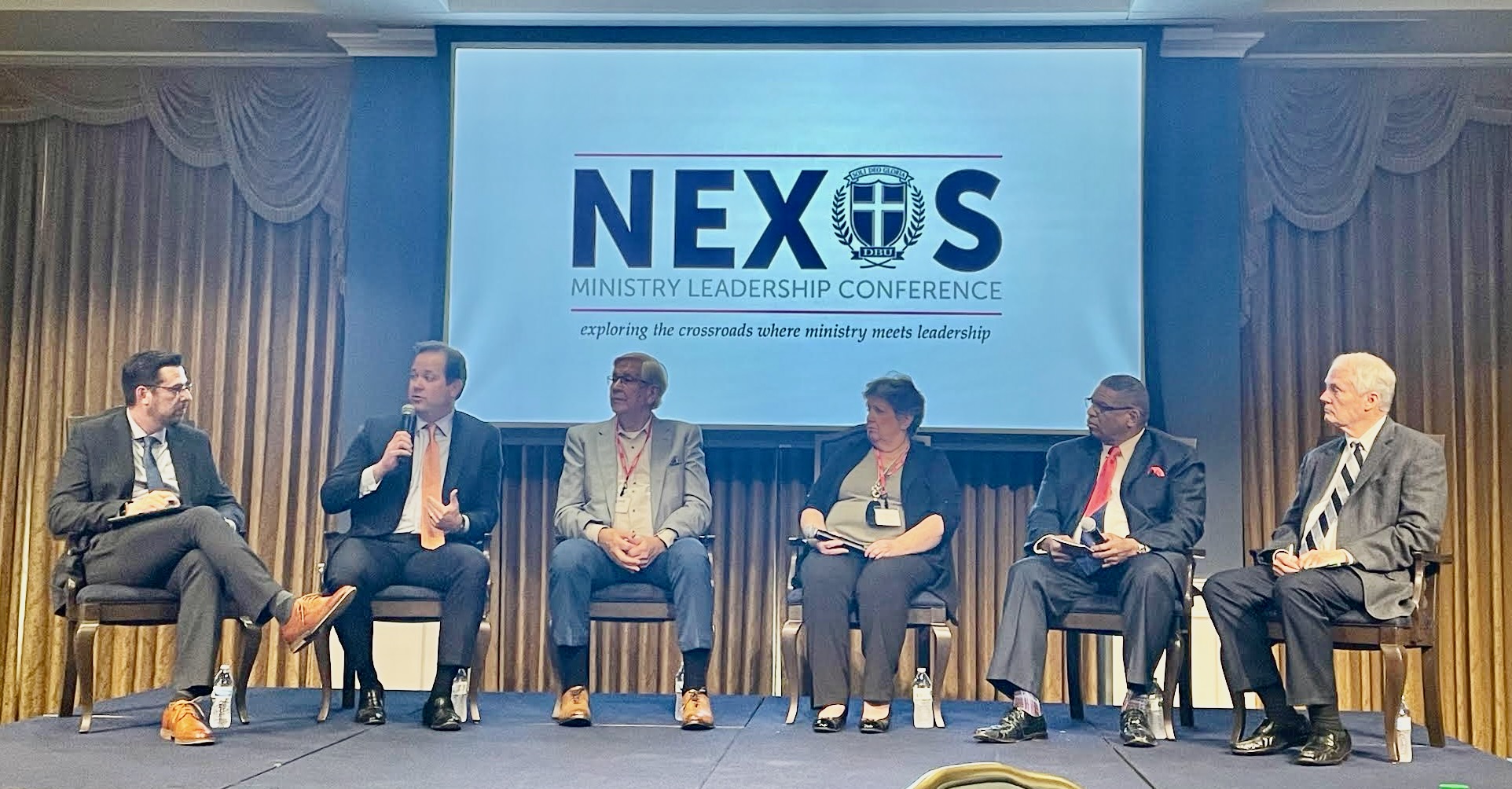
(DALLAS)—To lead like Jesus, we must look like Jesus—see and perceive people and situations the way Jesus sees them; smell like sheep—be close enough to the people we work with to know their needs; and serve like the Savior—submitting to the Holy Spirit and serving until it hurts, Brent Thomason, dean of the Dallas Baptist University Graduate School of Ministry, told attendees of DBU’s Nexus Ministry Leadership Conference Feb. 26.
There is a “dearth of godly leadership in church today,” Thomason said. From scandals to sexual abuse cases to narcissistic pastors, “the church is simply hurting from bad leadership and hungry for godly leadership.”
Leading with Jesus’ heart
Starting from the unexpected point of benediction, “May you always be covered by the dust of your rabbi,” David Coffey, past president of Baptist World Alliance and conference keynote speaker, said, taking his cue from Luke 4:14-30.
Ancient rabbis were followed through dirt streets. Their followers, eager to hear what the rabbis had to say, kept so close the dust stirred up by the rabbi’s sandals covered their clothes, Coffey said.
Noting Jesus is our rabbi, Coffey’s prayer was that “the dust of his teachings would fall on” and cover conference attendees.
Coffey called on the church to face the world, because God had good news in Jesus for all the “hopeless cases” during his ministry and to all the hopeless cases still around today.
“Jesus is the cure for spiritual blindness. In a world of conspiracy theories, Jesus said, ‘I am the way,’” Coffey said.
Referring to Jesus’ quote of Isaiah 61, Coffey said the congregation listening to Jesus would have loved a verse on vengeance Jesus chose to leave out.
Instead of vengeance for Zion, Jesus spoke of Elijah saving oneGentile woman and Elisha cleansing oneGentile leper, making the crowd so angry they sought to throw Jesus off a cliff.
“Do you really share God’s heart?” Coffey asked.
Coffey said the church should display godly courage. “If you can find a place where Jesus played it safe in Scripture,” let me know, he said.
“If God asks you to take courage, don’t worry about the consequences. The greatest advances in the church are always carried out by a few,” Coffey said.
Luke’s story of Jesus’ reception in Nazareth doesn’t end when he’s chased out of town, but rather “at the contrast of his reception in Capernaum and what happens when he got to where people did receive him,” Coffey said.
In his second keynote, Coffey considered the story of Lazarus’ death in John 11.
When Jesus got to Bethany, he did not run past Mary and Martha but gave each time, Coffey noted. Pastors should follow Jesus’ lead, and give God time, not running into a crisis too quickly, he added.
Models of leadership
Blake Killingsworth, dean of DBU’s Gary Cook School of Leadership, moderates panel discussion of Baptist leaders (Calli Keener photo)
A moderated panel discussion followed the keynote.
Panel members included: Adam Wright, DBU president; Randall Everett, past executive director of the Baptist General Convention of Texas and 21Wilberforce founding president; Raquel Contreras, director of Editorial Mundo Hispano (Baptist Spanish Publishing House) and past president of Baptist Union of Churches in Chile; Oscar Epps, founding pastor of Community Missionary Baptist Church in DeSoto and BGCT past president; and Gary Cook, DBU chancellor.
“If we don’t trust God in all the little things and big things, then we are just a company, [versus a ministry],” Contreras said.
DBU faculty and staff and other denominational leaders led breakout session during the conference. These sessions included crisis leadership, leading diverse generations, leadership and mentoring, leading change, and leading in transitional times.
DBU will host a Christian Leadership Summit, April 18-19, geared toward corporate leadership as well as ministry.
TBM volunteers providing relief during Panhandle fire
March 1, 2024
The Texas Panhandle is burning, and TBM: Texans on Mission is rushing volunteers and water to the scene.
Texans on Mission volunteers prepare for relief efforts in the Texas Panhandle, Feb. 29, 2024. (TBM photo)
“This is devastating. Our volunteers live all over Texas, and those in the Panhandle quickly responded,” said David Wells, Texans on Mission Disaster Relief Director. “They were in Fritch Tuesday night as the city evacuated and about 100 homes were damaged or destroyed.”
Texans on Mission volunteers beyond the Panhandle are now heading to the scene. A mobile Command Center and staff are en route, as well as two shower/laundry units and assessors.
“This is the first wave,” Wells said. “The Command Center provides a communications hub for our volunteers so we can put them in the best position to serve. The assessors are in the field gathering specific information for our volunteer teams, and the shower/laundry units will serve Texas Task Force 1 and others over a multi-day deployment.”
Baptist association affected
“It is now Day Three in what is called the Smokehouse Creek Fire, the second largest fire in Texas History,” Les Griffin, Caprook Plains Baptist Association director of missions, wrote in an email to his association.
“As of Thursday morning, [reports] are saying it is still only 3 percent contained. … Towns such as Stinnett, Canadian, Fritch, Borger and yes to western Oklahoma have been ravaged,” Griffin added.
By Thursday afternoon, Associated Press reported the Smokehouse Creek Fire had grown to the largest in Texas history, having merged with another fire and covering nearly 1,700 square miles.
More help on the way
Texans on Mission volunteers prepare for relief efforts in the Texas Panhandle, Feb. 29, 2024. (TBM photo)
Additional Texans on Mission units are on standby and expected to be deployed soon – fire/flood recovery, feeding, chaplain, heavy equipment, chainsaw, asset protection, electronic support, box and others.
Thursday morning, pallets of bottled water left Texans on Mission’s Dallas headquarters headed to the Panhandle.
Mickey Lenamon, executive director/CEO, asked Texans to pray for the people living and suffering through this disaster. And he asked people to also pray for TBM volunteers.
“This is a dangerous situation,” Lenamon said. “The days ahead will require long hours of service in a sensitive situation. People have lost everything they own. They’re looking for help. But they’re also looking for hope for the days ahead.”
“Please pray that Texans on Mission volunteers can provide the practical help people need and can point people to Christ, who brings hope and healing. Whether you are on a team serving or are praying from your home, each of us has a role when Texans on Mission responds after a disaster” said Lenamon.
To support Texans on Mission’s response financially, visit tbmtx.org/panhandle.
With additional reporting by Baptist Standard News Writer Calli Keener.
Tennessee pastor to be nominated for SBC president
March 1, 2024
NASHVILLE (BP)—Oklahoma pastor Dusty Deevers is planning to nominate Tennessee pastor Jared Moore for Southern Baptist Convention president at the 2024 SBC annual meeting. Moore is the senior pastor of Homesteads Baptist Church in Crossville, Tenn.
“Jared faithfully represents salt-of-the-earth Southern Baptists,” Deever told Baptist Press in written comments. “He is a faithful husband, father and pastor who serves the Lord dutifully at his local church without the need for fanfare or attention.
“He loves Christ and, therefore, loves Christ’s Word unashamedly.”
Moore served as SBC second vice president in 2014. He has served as senior pastor at Homesteads Church since 2016. He previously served as senior pastor of New Salem Baptist Church in Hustonville, Ky., according to his LinkedIn profile.
Moore “has a sharp mind,” Deevers said, and is “gifted by the Lord with wisdom to understand what the church faces and needs in our day and how Scripture directs us to address it.”
Moore holds a bachelor’s degree from Trinity Bible College, a master’s degree from Liberty Baptist Theological Seminary and a master’s degree and Ph.D. from Southern Baptist Theological Seminary, according the church’s website.
Deevers said he’s motivated to nominate Moore because “the world and our own nation need a thriving and faithful SBC to proclaim the Gospel without embarrassment.
“Sadly, though, our prophetic voice has been stifled in recent years because of infighting, self-dealing and worldly compromise. God’s Kingdom will go on with or without the SBC, but we know the Devil would love nothing more than to destroy our long and faithful cooperative mission.
“On the flip side, our adversary fears a convention that is united around God’s truth. You have a man in Jared Moore who loves Christ, His Church and the SBC and wants to see the SBC using all of its tremendous resources to accomplish the Great Commission faithfully.”
According to SBC Workspace, Homesteads Church baptized three people in 2023 and averaged a weekly worship service attendance of 113. The church received $342,611 in total receipts and gave $19,266 (5.6 percent) through the Cooperative Program. It also gave $4,679 to the Lottie Moon Christmas Offering and $1,995 to the Annie Armstrong Easter Offering.
The 2024 SBC annual meeting is set for June 11-12 at the Indiana Convention Center in Indianapolis.
Christians disagree about Alabama embryo ruling
March 1, 2024
(RNS)—When Alabama Supreme Court Chief Justice Tom Parker issued his concurring opinion earlier this month in the court’s controversial ruling declaring frozen embryos children, he did so with an unapologetically religious flair.
The Feb. 16 ruling—which has resulted in all but halting in vitro fertilization procedures, which can use frozen embryos to help people become pregnant, in the state—drew on anti-abortion language in the Alabama Constitution to conclude embryos created during IVF have the same rights as children.
Alabama Supreme Court Justice Tom Parker speaks on the steps of the state judicial building on April 5, 2006, in Montgomery, Ala. When the court ruled this month that frozen embryos are children, Parker, now the chief justice, made explicit use of Christian theology to justify the court’s decision in his concurrence, where his language echoed the broader anti-abortion movement. (AP Photo/Jamie Martin, File)
Parker, amid references to theologians and the Bible, concluded that by declaring frozen embryos children, Alabama was modeling a “theologically based view of the sanctity of life” that insists “human life cannot be wrongfully destroyed without incurring the wrath of a holy God.”
Parker may have presented his policy position as rooted in an authoritative Christian view, but he may be in the minority when it comes to his fellow religious Americans—including Christians.
Religious views on fertility treatments
While personal views on IVF are harder to assess, there seems to be broad familiarity with the practice among religious groups.
When Pew Research asked adult respondents last year whether they have used fertility treatments to have children or know anyone who has, white Catholics were the mostly likely to say yes (55 percent), followed by white mainline Protestants (48 percent), white evangelicals (44 percent)—all higher percentages than those who identified as atheist or claimed no particular religion (40 percent).
Hispanic Catholics (29 percent) and Black Protestants (26 percent) were the least likely to say they used fertility treatments or know someone who has, although Pew researchers told Religion News Service that finding “appears to be driven more by differences across race and ethnicity than religion.”
In addition, the researchers elsewhere noted wealthier people are more likely to say they’ve used fertility treatments or know someone who has, an “unsurprising” finding given the high cost of IVF, which can range from $15,000 to $20,000.
Some of the outspoken opinions on IVF fall along predictable lines, mirroring that of the abortion debate. Religious advocates for abortion rights support IVF, and the Catholic leadership opposes it.
Denominational views on IVF
But IVF is arguably a narrower issue: Even among religious groups that seek to ban abortion, many do not agree the destruction of frozen embryos is the same as taking a life. Some mainline denominations do not even have an official position on IVF, such as the Evangelical Lutheran Church in America.
Other groups openly have praised the practice, particularly more liberal-leaning mainline denominations.
The Episcopal Church has endorsed IVF since 1982, and the United Church of Christ passed a resolution at its 1989 General Assembly that referenced IVF before declaring the denomination “supports the rights of families to make decisions regarding their use of the reproductive technologies.”
“A lot has changed in the field of reproductive technologies since 1989, but our values have been consistent in this regard,” Rev. Shari Prestemon, the UCC’s current acting associate general minister, told RNS in a statement.
“We support the rights of individuals and families to make these very private decisions for themselves, and urge care and compassion for these families along what can often be such a painful and challenging journey,” Prestemon wrote.
Even denominations that have expressed ambivalence about abortion have nonetheless voiced openness to IVF.
Although the United Methodist Church has issued statements saying it is “reluctant to approve abortion” and declared in 2016 that people “should not create embryos with the sole intention of destroying them,” it grants an exception for IVF.
A UMC denominational resolution stated that “obtaining and fertilizing multiple ova may be justified” even if embryos are lost, because it helps “avoid the necessity of multiple attempts to obtain ova.”
Religious reactions to Alabama ruling
Religious advocates for abortion rights were among the first to voice outrage over the Alabama court’s ruling, arguing it furthers a disputed theological claim about when life begins—one not shared by all religious Americans.
Rev. Katey Zeh (Courtesy photo)
“I don’t think anyone could make a biblical claim about this because the technology of IVF is very modern,” said Rev. Katey Zeh, the head of the Religious Coalition for Reproductive Choice, a group that advocates for abortion rights.
“There’s a huge spectrum of theological opinion about when life begins or when personhood begins,” she told RNS in an interview. “There’s no consensus here, so there’s a lot of hubris in claiming—especially in the legal standing—that this is the theological viewpoint of an entire religious tradition. That’s certainly not true.”
Zeh argued opposition to IVF often is fueled by broader faith-based campaigns against abortion, with some religious leaders and activists insisting the destruction of unused frozen embryos is tantamount to an abortion.
Some religious institutions, such as the Catholic Church, have enveloped opposition to IVF into their larger anti-abortion stance.
A 1998 document promoted by the U.S. Conference of Catholic Bishops deemed the discarding of unused embryos in IVF is “a terrible offense against human life,” arguing that while a baby may still be born, “other lives are usually snuffed out in the process.”
Evangelical support for IVF
Meanwhile, Southern Baptists such as Andrew T. Walker, a professor at Southern Baptist Theological Seminary, have called on the denomination to adopt an official resolution addressing IVF at its next convention later this year.
“When you consider the moral goods that Scripture holds as inseverable for where conception ought to occur, IVF is ruled out,” Walker posted on X earlier this month.
But there is even some evidence evangelicals support IVF, at least according to Republican officials.
In the wake of the Alabama ruling, the National Republican Senatorial Committee sent out a memo discouraging candidates from voicing agreement with the decision. According to Politico, the memo cited a survey conducted in October by a consulting firm associated with Kellyanne Conway, former President Donald Trump’s onetime senior counselor, that found 83 percent of evangelicals support IVF.
Attempts to reach the polling firm associated with Conway, The Polling Co., were unsuccessful.
For advocates such as Zeh, the Alabama Supreme Court’s ruling, which already has ground IVF procedures to a halt in many parts of Alabama, crosses a moral line by putting infertility treatments even further out of reach.
“It just feels so similar to rulings about abortion—the lack of regard to the people whose lives are actually impacted,” she said. “As a person of faith, that’s what feels so immoral to me.”
Around the State: Baylor groundbreaking for Memorial to Enslaved Persons
March 1, 2024
The Baylor Board of Regents concluded its regular quarterly meeting, February 23, with a ceremonial groundbreaking of the Memorial to Enslaved Persons that will recognize the enslaved men, women and children who were instrumental in building Baylor’s original campus in Independence. Designed by Suzuki architectural firm, with input from campus teams and student representatives, key features of the memorial will be a cascading water feature made of the same limestone used to build the original Independence campus and foundational scriptures meant to remind visitors of the freedom all men and women have in Christ now and should have experienced when Baylor was founded in 1845. Additional historical context will also be placed around the existing Judge R.E.B. Baylor statue. “When Baylor was founded in 1845, chattel slavery was deeply woven into the cultural and economic fabric of the state of Texas. Our three primary founders—including our namesake, Judge Baylor—were both religious leaders and slaveholders,” Baylor President Linda A. Livingstone said. “We believe the incompatibility of Baylor’s Christian mission and its roots in chattel slavery requires a collective reckoning with this legacy, and the additional context around Judge Baylor’s statue will connect his story to the enslaved persons being recognized through the memorial.”
Ana Paula Mumy (center), director and associate professor of speech-language pathology, has been honored with the Burtis-Vogel-Elkins Community Service Award. (Photo courtesy of ETBU)
East Texas Baptist University recognized Ana Paula Mumy, director and associate professor of speech-language pathology, who has been honored with the Burtis-Vogel-Elkins Community Service Award, bestowed by the Texas Speech-Language-Hearing Foundation in acknowledgment of Mumy’s exceptional leadership and service contributions through Spero Stuttering, a nonprofit organization. The Burtis-Vogel-Elkins Community Service Award recognizes individuals whose dedication and service activities have significantly advanced the field of speech-language pathology and positively impacted the stuttering community. “This award is so meaningful to me because it not only allows me to continue this important work that directly advances the field of speech-language pathology, but it also brings awareness to the needs in the stuttering community and elevates the voices of people who stutter,” Mumy said.
Houston Christian University’s Black Student Union organized a recent outdoor praise and worship service for students, faculty and families in celebration of Black History Month. Led by BSU’s Outbreak of the Gospel Choir, the event provided students of all cultural backgrounds an opportunity to participate in praise and worship from the Black church tradition. The goal and purpose of the choir is “to provide a unique gospel feel and enhance the worship experience,” said BSU President Chloe Spiller. The service also included a message on the theme “Restore and Replenish,” which allowed students to respond to a call for spiritual renewal.
The University of Mary Hardin-Baylor will celebrate the opening of the highly anticipated Marek-Smith Center for Teacher Preparation with a special dedication ceremony and ribbon cutting on Fri., March 1. The event begins at 1 p.m. and is open to the public. Visitors can tour the new state-of-the-art special education training and instructional facility following the ribbon cutting. UMHB is the only known university in the country with a special needs lab where undergraduate education majors work directly with children with disabilities. The Marek-Smith Center will lead the way for training and educating special education instructors. With cutting-edge technology, resources, equipment and tools, the 11,000-square-foot facility will offer spaces such as an immersion room, a multisensory room, a high-impact zone, a STEM lab and an outdoor exploration zone. The facility’s name honors the meaningful relationship between Logan Marek, a 2017 Belton High School graduate with autism, and Evan Smith, a 2013 Belton High School graduate and 2017 graduate of Texas A&M University. Before Evan’s death in 2018, he had a passion for young people with disabilities. He dedicated his time to volunteering with Young Life Capernaum, a ministry organization where teens and young adults with disabilities can meet Jesus and grow in their faith. Evan enjoyed working with teenagers with disabilities in Belton and College Station and serving as a personal care provider for Logan.
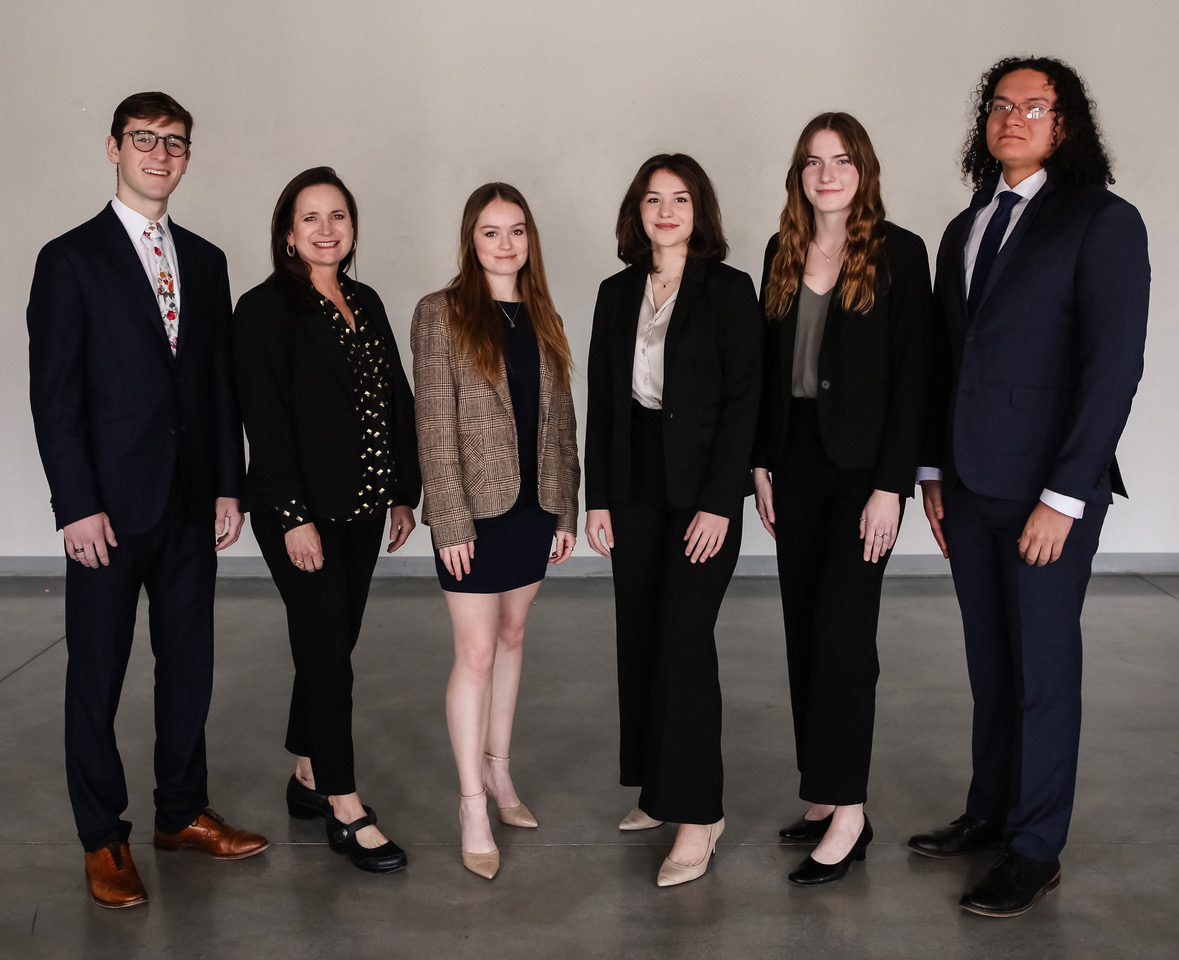
HPU’s Student Speaker Bureau speech and debate team earned debate sweepstakes at the Texas TIFA Spring Championship. The team members are pictured from left to right: Landon Chenault, Julie Welker, Katelyn Sims, Adrielle Sloan, Cora Raub and Matthew Campos. (HPU photo)
Howard Payne University’s Student Speaker Bureau speech and debate team clinched the debate sweepstakes at the Texas Intercollegiate Forensics Association Spring Championship held at Texas State University. Senior Landon Chenault, Guy D. Newman Honors Academy and jurisprudence major from Denton, won the International Public Debate Association championship, was one of four seniors statewide named to the prestigious Texas All-State Forensics Squad, and was the top debate speaker at the tournament. Sophomore Katelyn Sims, Guy D. Newman Honors Academy and global studies major from Cleburne, was an advancing quarterfinalist and third place IPDA speaker. Both Chenault and Sims had perfect prelims records, and Chenault finished the tournament undefeated. Julie Welker, professor of communication and chair of the Department of Communication, coaches the team. “Landon is our team captain and the only senior on the team, so this was a gratifying win for him,” said Welker. “He dominated at the tournament, and I am so proud of this accomplishment for him. Landon puts a lot of effort into coaching the team as well, and the team’s overall performance reflects his leadership.” HPU had four of the top nine IPDA debate speakers. In addition to Chenault and Sims, sophomore Cora Raub, Guy D. Newman Honors Academy and nursing major from Celina, was named fourth-place speaker, and sophomore Adrielle Sloan, Guy D. Newman Honors Academy and strategic communication major from Blue Oak, was the ninth-place speaker. The team will compete in a large online tournament the first weekend of March, followed by a trip to the IPDA national tournament, held at Mississippi State University in Starkville, Miss.
Don Ashley has been named Wayland Baptist University’s first executive director of global initiatives. Ashley will work with various aspects of the university in successfully implementing Wayland’s new programs around the globe. He also will look continually for new opportunities for the university to pursue in an international context. Since 2023, Ashley has served as executive director of Wayland’s Anchorage and Fairbanks campuses in Alaska. For the past three years, he also has worked closely with the Wayland President Bobby Hall to explore potential international partnerships, including two new graduate programs that will enroll their first students from India at Wayland’s San Antonio campus in March. “Dr. Ashley has served effectively for several years in a part-time capacity as director of global projects in addition to his leadership role in Alaska, and it is now time to establish this office as a standalone entity,” Hall said. From 1995 to 1997, Ashley served as an academic adviser at Wayland’s Anchorage campus, where he returned in 2001 as a professor. He served as the Kenya program director from 2018 to 2021, before taking the helm of the Anchorage and Fairbanks campuses in 2023.
First Philippine Baptist Church in Missouri City is hosting “Defend Home,” a human trafficking awareness seminar on Sat., March 9, from 10 a.m. to noon. The event is free and open to the public for those who R.S.V.P. here. Guest speakers are Texas Alcoholic Beverage Commission Agent Kevin Wilkinson Jr. and Joe Madison, CEO and founder of Demand Disruption, a nonprofit that “fights the demand for sex trafficking by eliminating buyer motivation and reducing access to the exploited.”
Oilfield waste ponds approved next to Baptist camp
March 1, 2024
EDITOR’S NOTE: This article has been edited for length. You can read the complete article at The Texas Tribune.
Texas regulators recently authorized a company to operate ponds to store and recycle millions of gallons of oilfield wastewater laced with toxic chemicals next to a Baptist camp in the Permian Basin.
The Richards Recycling Facility will store, treat and recycle produced water, a byproduct of oil and gas drilling, after obtaining a state permit on Jan. 30. Staff and board members at the Circle 6 Baptist Camp worry the facility will jeopardize their well water and expose campers to hazardous air pollution.
“I would be very alarmed if I was working at that Baptist Center,” said Dominic DiGiulio, a geoscientist who retired after a 25-year career at the Environmental Protection Agency and now consults for nongovernmental organizations. “It’s a kind of chemical stew that’s going into these ponds.”
The company says the facility is necessary as drillers seek to reuse the wastewater instead of injecting it underground.
Lawyers for Circle 6 Baptist Camp submitted this image as evidence when they argued to support their argument that emissions from the Martin Water facility could impact the camp’s residents and visitors.
Researchers have found produced water in the Permian Basin contains radionuclides, volatile organic compounds like benzene, ethylbenzene, toluene and xylene—also referred to as BETX—and extremely high salt content. The open ponds of produced water would be just 500 feet from the camp.
These chemicals can cause headaches after brief exposure, and more prolonged exposure has been linked to neurological damage and cancer.
DiGiulio explained that these VOCs will vaporize into gas.
“And then these VOCs … are going to be moving downwind,” he said.
Failure to notify
While produced water ponds have been linked to groundwater contamination in Texas, Pennsylvania and California, regulations in Texas lag behind other states. Facilities automatically receive air quality permits from Texas regulators if they fit certain criteria, though neighbors often complain about harmful air pollutants once pits are operating.
State rules require companies to notify the Railroad Commission before beginning construction on stationary recycling facilities. Martin Water didn’t notify the Commission when construction began.
The Railroad Commission still issued Martin Water’s operating permit, even as the agency prepares to adopt stricter rules for oil and gas waste facilities for the first time in decades. The draft rules include setbacks that would require commercial recycling facilities to be at least 1,000 feet from residences.
Martin Water, based in Midland, did not respond to multiple requests for comment.
Railroad Commission spokesperson Patty Ramon said the permit application fulfilled the agency’s requirements for groundwater protection and protecting the public from hydrogen sulfide exposure, but she did not address the company’s failure to notify the Commission when construction began on the facility, as required in State Rule 4.289.
Lawyers for Circle 6 Baptist Camp declined to comment.
Circle 6 challenges decision
Most produced water in Texas is injected back underground in disposal wells. But since these wells have been linked to earthquakes, the Railroad Commission has restricted where oil and gas companies can inject produced water. The race is on to recycle more of it.
Martin Water Midstream is one of a growing cohort of companies that transport, store and recycle produced water. In 2022, the company broke ground at Richards Ranch next to Circle 6 Baptist Camp in Martin County.
The recycling facility will receive produced water via pipeline, treat it for reuse and then return it to drillers. The pits were dug and lined in 2022, but Martin Water has not yet transported produced water to the facility.
At a July 2023 hearing before an administrative law judge, Martin Water Midstream CEO Stephen Johnson testified they began construction in April or May 2022, because that’s when contractors who could do the work were available. He acknowledged they were “taking a risk” in building without an operating permit.
By the summer, Circle 6 Camp Executive Director Brian Colbath was well aware of the construction next door, which stirred up dust that blew over the camp. Colbath, his wife and their four children live full time at Circle 6.
Circle 6 Baptist Camp moved to its current location in 1959 and hosts conferences and retreats, along with hundreds of youth campers each summer. (Photo by Julian Mancha for The Texas Tribune / Inside Climate News)
The camp hosts conferences and retreats year-round and welcomes hundreds of youth campers during the summer. Circle 6 has served Baptist churches in the Permian Basin for seven decades and moved to its current location in 1959.
“This summer, we received multiple complaints from our groups and churches about the dirt pollution coming through camp,” Colbath wrote in an email to a representative of Martin Water in summer 2022, according to testimony at a later hearing.
“I appreciate the efforts to recycle water and save the environment but not sure why it has come at the cost of the kids and the senior adults that use our facilities,” he continued.
With the ponds already constructed, Martin Water submitted an application for an operating permit to the Railroad Commission on July 20, 2022. According to agency records, a Railroad Commission inspector visited the site the previous day and found it to be in compliance. The agency spokesperson did not respond to questions about what prompted this inspection.
Colbath and other camp staff and board members wrote letters to the Railroad Commission to formally protest the application and retained lawyers. The letters acknowledged the importance of local oil and gas drilling but questioned why the facility was located so close to a kids’ camp.
“We have so many concerns with this recycling facility dealing with ‘non-hazardous’ produced water,” Colbath wrote. “That sounds like an oxymoron considering all the information in the material safety data sheets we have pulled up.”
These data sheets list occupation safety and health concerns for chemicals and products.
The Railroad Commission granted Circle 6 standing to protest the application and scheduled the hearing for July 2023.
Safety of produced water pits debated
Circle 6 and Martin Water each presented their case during the hearing in Austin on July 24 and 25, before Railroad Commission Administrative Law Judge Alissa Zachary.
Lawyers for Circle 6 Baptist Camp submitted this image as evidence when they argued to a judge that the double liner system at the Martin Water facility would not adequately protect the groundwater of the Ogallala Aquifer.
Circle 6’s lawyers argued the pit design would not adequately prevent contamination of the underlying Ogallala Aquifer, and residents and campers could be exposed to air pollution, including hydrogen sulfide gas, which can be fatal.
While other chemicals are present in produced water, the Railroad Commission has a specific rule requiring safeguards, including training, signage and detection equipment at facilities where people could be exposed to hydrogen sulfide gas.
Circle 6 lawyers called West Texas A&M University environmental scientist and oil and gas remediation expert William Rogers as a witness.
“In my 40-some years, this is probably the worst siting that I’ve ever seen, as far as being [in] close proximity to a camp, proximity to the groundwater, the potential risk and the unknowns,” Rogers testified. “I, quite frankly, was shocked at seeing the proximity of the camp to the facility.”
Martin Water said it will not accept produced water at the facility with detectable amounts of hydrogen sulfide. But Rogers countered that bacteria in the ponds would generate hydrogen sulfide gas. He said under the right conditions—cold temperatures, low winds—that gas could travel to the camp.
“I have heard testimony there will be absolutely no hydrogen sulfide. That’s virtually impossible,” Rogers said.
Martin Water’s attorneys argued its precautions, including having employees wear hydrogen sulfide monitors, were sufficient.
Circle 6 Baptist Camp relies on water wells that tap into the Ogallala Aquifer, which is the largest in the nation. The Ogallala provides more water for Texas users, including farmers, towns and cities—than any other aquifer in the state, according to the Texas Water Development Board.
Martin Water testified its double liner system would be sufficient to prevent contamination of the groundwater, and they will drill several monitoring wells.
Circle 6’s lawyers argued building the pits on top of porous soil with no natural barrier between the lined pits and the groundwater could lead to contamination.
Wastewater gets go-ahead
Zachary ultimately recommended the agency issue the permit, stating the agency does not have jurisdiction over air quality and the design was “sufficient” to prevent water pollution.
Circle 6’s lawyers expressed disappointment. They wrote that agency staff “take Martin Water’s word” on disputed aspects of the application and have not conducted any independent investigation.
After Zachary’s ruling, the final decision rested with the agency’s three commissioners at the Railroad Commission open meeting on Jan. 30.
Martin County Commissioner Koy Blocker traveled some 300 miles to Austin to speak at the meeting. Blocker, who is also a volunteer firefighter, said the permit is based on the assumption all rules will be followed.
“However, our fire department, our ambulances and our sheriff’s department are called out on a regular basis, because someone did not follow procedure or proper safety protocols,” he warned.
Blocker also said the facility’s air pollution and odors could drive Circle 6 out of business. “I do not believe that it is prudent practice to allow the new facilities to cause existing businesses or camps to go out of business as a result of the air quality,” he said.
Days earlier, an 11-year-old camper submitted a letter to the Railroad Commission, writing that Circle 6 “is a very important place” he hopes “will be there for many years to come.”
After Blocker’s comments, the three commissioners approved the permit without qualifications.
Before the vote, Commissioner Jim Wright, an oil and gas waste disposal businessman himself, added what he called “a public request” that Martin Water move the proposed pits as far as possible from the camp, “in the interest of being a good neighbor.” Commissioner Wayne Christian echoed that request.
Virginia Palacios, executive director of Commission Shift, a nonprofit focused on reforming the Railroad Commission, said in a public comment shortly after that she was “concerned” by Wright’s comments.
“You can do more as commissioners to go back in these cases and require specific things of these companies,” she said. “You’re not taking advantage of your opportunity to do that, especially when it comes to children’s health.”
Wright’s spokesperson did not respond to questions about the commissioner’s remarks.
Waste pit rules under review
While the Martin Water facility moves forward, a larger debate is unfolding in Texas about the future of oil and gas waste facilities. The Railroad Commission is reviewing and updating its waste pit rules for the first time in decades. After informal public comments last year, the draft is now going through review before a formal comment period this year. The final version of the rule changes is expected later this year.
Palacios said the Railroad Commission’s proposed rule changes include some improvements. Reserve pits, which drillers use to store waste at the well pad, will have to be registered for the first time. And under the current draft rules for commercial recycling, which includes the Martin Water site, facilities would have to be more than 1,000 feet from permanent residences.
Circle 6’s lawyers argued if this rule were on the books today, the Martin Water permit would not be approved. They say this shows the location of the ponds is “completely unacceptable.”
In addition, the proposed rule changes for Texas only include setbacks from residential dwellings for recycling facilities—not landfills or pits used to store produced water.
Air pollution generated by produced water pits remains beyond the scope of the Railroad Commission rules. Most waste ponds qualify for a “permit by rule” from the Texas Commission on Environmental Quality, which enforces air pollution laws in Texas.
The company must fulfill certain requirements and register the site with the TCEQ, but as long as those criteria are met, the TCEQ has no additional role in permitting. Under this system, any problems with air emissions are only investigated once the facility is already operating.
A TCEQ spokesperson recommended individuals impacted by air pollution from waste pits file a complaint with the agency.
Palacios said this split jurisdiction between the two agencies stymies effective regulation of waste pits.
“If there are any problems with air quality and public health, that gets punted to the TCEQ,” Palacios said.
The Texas Tribune is a nonprofit, nonpartisan media organization that informs Texans—and engages with them—about public policy, politics, government and statewide issues. This story was published by The Texas Tribune in partnership with Inside Climate News, a nonprofit, independent news organization that covers climate, energy and the environment. This article has been edited for length and is republished by permission.
Baylor panel wrestles with issues of war and peace
March 1, 2024
Religion, borders and the plight of individuals dominated a Feb. 22 panel discussion at Baylor University on “Seeking Peace in Times of war: Hope or Hopelessness?”
In the wide-ranging discussion—hosted by the Keston Center for Religion, Politics and Society—panelists not only talked about the Russian invasion of Ukraine, but also war in the Middle East and armed conflict in several African nations.
‘Heresy’ of Holy Russia
(Screen capture image)
Fulbright Scholar Vladimer Narsia, a professor of theology and director of the Canon Law Centre at Ilia State University in Georgia, pointed to the “decisive role” the Georgian Orthodox Church plays in his country and the “pressure” it feels from the Russian Orthodox Church.
He particularly noted what he called “the heresy” of the Holy Russia ideology of the Russian Orthodox Church’s hierarchy that fuels nationalism and militarism.
“Religion must be freed from politics. In that sense, religion can say something important to promote peace,” he said.
(Screen capture image)
Russian expert Xenia Dennen, chair of the Keston Institute in the United Kingdom, said she is “deeply shocked” at the “Russian world” rhetoric of Patriarch Kirill of Moscow, the primate of the Russian Orthodox Church.
“It is a total travesty of the Christian faith,” she said.
However, she praised those Orthodox clergy who are promoting peace and courageously “are refusing to pray the prayer for Russian victory.” For example, a church court ruled Aleksiy Uminsky should be defrocked for refusing to recite publicly a prayer asking God to give Russia victory over Ukraine.
“There are a lot of people who are not supporting this war,” she said. “Kirill the patriarch does not represent the whole body of Orthodox believers.”
Many Protestants in Russia are “keeping their heads low,” being careful in their statements regarding the war, given the history of persecution they have endured, he noted.
However, Dennen commended Yuri Sipko, president of the Union of Evangelical Christians-Baptists in Russia from 2002 to 2010, for his courage in criticizing Russian aggression against Ukraine.
(Screen capture image)
Governments sometimes use fear as a “useful tool” to maintain power and to mobilize citizens in opposition to an enemy or perceived enemy, said Joanne Held Cummings, a retired Foreign Service officer from the U.S. Department of State.
“The problem is that once it is done by a government, that fear tends to be self-perpetuating,” Cummings said. “It is very difficult to undo.”
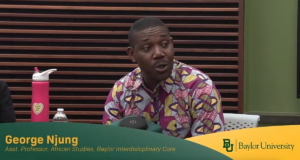
George Njung, professor of African studies at Baylor, noted more than 100 million people around the globe have been displaced, and most were driven from their homes by violent conflict.
War as ‘fallout of state-making processes’
(Screen capture image)
While it has not always been the case historically, today Africa and the Middle East lead the world in the number of displaced people, he reported.
Civil war, military coups and the continuing effects of centuries of colonial rule all contribute to destabilization and displacement, he noted.
“I think that the wars we have in the 21st century are a fallout of state-making processes and the issue of nationalism, which tends to be exclusive rather than inclusive,” Njung said.
Moderator David Smith, lecturer in the history department at Baylor, raised questions regarding nationalism, how borders are drawn and what their impact may be on bringing about conflict.
Njung expressed his belief that borders and the ways they have been created have “exacerbated” conflict.
“Borders create imaginary difference and issues,” he said.
Cummings noted colonial powers often drew borders with an eye toward creating weak national entities that would not present a challenge. However, she rejected the idea of natural borders.
“Except for countries that end at the edge of the sea, there are no natural borders. There just are none,” Cummings observed. “Borders are where people stop fighting, historically.”
Neither the Middle East nor Africa inherently is more warlike than Europe, said Cummings, director of Middle East Studies at Baylor. She pointed to centuries when war raged in Europe.
“We need to avoid looking at now as the only pattern that is,” she said.
Consider people ‘on the ground’
Smith mentioned the challenge of thinking about war holistically. He pointed to the difference in looking at armed conflict from the viewpoint of the state and from the viewpoint of people whose lives are affected directly by it.
“One can sort of approach war from either the state’s perspective or from the human perspective, and I don’t know anyone who is really fluent in doing both of those things,” Smith observed.
“There’s this notion that you can analyze war as something that states do in history. … Or you can step back and just look at the human cost and think: ‘These are not states that are bleeding and dying. These are human beings.’”
Rather than looking at issues of war and peace strictly in geopolitical terms, Cummings asked program participants to consider war and peace from the viewpoint of individuals.
“What do people feel on the ground? There are people who feel themselves to be at war when their countries are not. There are people who feel themselves to be at peace or relatively secure when their countries are at war,” Cummings said.
Consider the experiences of people, rather than focusing exclusively on the policies of states, she urged.
“On the ground, nothing is sustainable unless people feel their fears have been comprehended and have been mitigated,” Cummings said. “As long as people remain afraid, any sort of political resolution or military resolution is going to—in the long run—be unsuccessful.”
SBC mission boards will not fund abuse reform nonprofit
March 1, 2024
NASHVILLE, Tenn. (RNS)—Leaders of the two major Southern Baptist mission boards said Send Relief money will not be used to help fund a proposed independent nonprofit meant to implement the denomination’s abuse reforms.
Plans for the nonprofit were announced Feb. 19 during a meeting of the Southern Baptist Convention’s Executive Committee.
Leaders of the SBC’s Abuse Reform Implementation Task Force said the new nonprofit is needed to make those reforms a reality.
“Given the current legal and financial challenges facing the SBC and the Executive Committee, the formation of a new, independent organization is the only viable path that will allow progress toward abuse reform to continue unencumbered and without delay,” Josh Wester, the North Carolina pastor who chairs the task force, told members of the SBC’s Executive Committee. “To do this, we have to do this together.”
Wester said he hoped leaders of the SBC’s entities, including its North American Mission Board, International Mission Board and seminaries, along with SBC President Bart Barber, would help find funding for the proposed nonprofit, known as the Abuse Response Commission.
Currently, the work of the Abuse Reform Implementation Task Force has been paid for out of $3 million set aside by Send Relief, a humanitarian effort run by the two mission boards, to get abuse reforms off the ground.
Send Relief officials said those funds cannot be used for the new nonprofit.
“While Send Relief has been privileged to make funds available to the ARITF to help care for survivors and assist churches in efforts to prevent abuse, those funds have never been committed to help form a separate organization outside the SBC, such as the proposed Abuse Response Commission,” Send Relief President Bryant Wright, IMB President Paul Chitwood and NAMB President Kevin Ezell said in a statement Feb. 21.
The three leaders said many questions remain about the structure and leadership of the proposed nonprofit. They did say the Send Relief funds can still be used by the task force.
“Though Send Relief funds are not available for a non-SBC organization, they do remain available to the ARITF for its assigned work within the SBC,” they wrote.
‘Original intent’ of the granted funds
In a follow-up response, a spokesperson for the IMB said the statement addressed the original intent of the Send Relief funds.
“The statement today represents the original intent of the granted funds and the reaffirmed commitment to that intent to fund work within the SBC, not outside the SBC,” the spokesman told Religion News Service.
Abuse reforms in the SBC have stalled over the past two years, largely due to legal and financial constraints, as well as the limits of a volunteer task force. That’s raised questions of whether those reforms—passed in 2022 during the SBC’s annual meeting—ever will be fully implemented.
During that meeting, local church messengers approved plans for a Ministry Check website that would include the names of pastors who have been convicted of abuse, had a civil judgment against them for abuse or been “credibly accused” of abuse. That website was launched last year but no names of abusive pastors have been listed.
The messengers also approved more training and resources to help churches prevent abuse and to respond appropriately when it happens. The task force, in a news conference Feb. 20, said new training materials will be available in time for the SBC’s annual meeting in June.
Wester said messengers at the SBC annual meeting in 2022 asked the task force to collaborate with SBC entity heads to find funding for reforms.
“We have been and remain committed to this directive as we work toward a long-term solution for sexual abuse reform. We are grateful for Send Relief’s investment in this cause, and we are hopeful that the SBC’s national leaders will help the ARITF determine the best path forward in financing future reform efforts,” he said.
A past proposal to fund abuse reforms from the Cooperative Program unified budget was shot down in 2022. That led Send Relief to set aside $3 million for the SBC’s response to sexual abuse and another million to pay for abuse survivor care.
No funds for the Abuse Response Commission were included in a proposed Cooperative Program budget passed during the most recent Executive Committee meeting, as the denomination’s rules require those funds to go to SBC entities. No rules would prohibit entities from donating to the work of an outside group.
Brent Leatherwood, president of the SBC’s Ethics and Religious Liberty Commission, said he would ask trustees of the ERLC to contribute to the start-up costs of the Abuse Reform Commission.
UMHB students learn about Forgiving Day tradition
March 1, 2024
BELTON—Students quarrel. Feelings get hurt. Relationships break. It happens every day on every college campus—even a Christian one.
Almost 150 years ago at the University of Mary Hardin-Baylor, Anne Luther, the president’s wife, devised a plan to help end the festering feuds and help heal broken relationships among the all-woman student body. Thus began a since-forgotten tradition she called “Forgiving Day.”
The idea came to Luther just before Thanksgiving in 1878. Determined to promote peace before their holiday feast, she and student Elli Moore Townsend tasked faculty and staff to mediate between squabbling students to get them to bury their differences and start anew.
They believed one couldn’t truly be thankful during Thanksgiving without first reconciling their grievances, said Beth Norvell, associate director of museum and alumni engagement.
Then, on Thanksgiving Day, as a symbol of reconciliation, each girl had to present a “token of forgiveness” in the form of a hug, handshake, note or word of kindness to any other students with whom she had a grievance. They did this with Luther as witness.
Many girls saw this tradition as challenging and uncomfortable, but as one student said, “We would do anything for Mrs. Luther.”
UMHB Associate Director of Museum and Alumni Engagement Beth Norvell shares an excerpt from one of Elli Moore Townsend’s Thanksgiving letters to the Cottage Home girls. (Photo by Hannah Van Veusekom / University of Mary Hardin-Baylor)
Perhaps the Forgiving Day idea formed from Luther’s own grievances from a life filled with ups and downs. But even in bad times, the lessons she learned are a testament of a woman of great faith and forgiveness, which Norvell believes contributed to Luther putting so much stock in teaching the virtues of forgiveness to her students.
One such instance happened after the death of Luther’s first child—the first of four who died during her lifetime. According to her memoirs, she went into a heavy depression.
“She gave the Lord a timeline and said, ‘Lord, I will lean into this, and I will trust you even though I don’t feel like it,’” Norvell recounted from the memoir.
Luther gave God a specific amount of time to heal her grief and by the end of that time, her heart was still broken, and she was devastated.
“Soon after, however, Anne’s heart was flooded with peace and joy, and she never gave the Lord a timeline on healing after that,” Norvell said. “It was pivotal for her.”
Forgiveness and Thanksgiving
Norvell saw the season before Thanksgiving last year as an opportune time to create an exhibit at UMHB to share the history of the tradition with students.
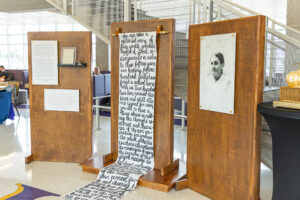
A “Forgiving Day” exhibit was set up at the Bawcom Student Union at the University of Mary Hardin-Baylor to mark a forgotten campus tradition. (Photo by Hannah Van Veusekom / University of Mary Hardin-Baylor)
When Danielle Kenne spotted Elli Moore Townsend’s letter in the display, she was intrigued.
“I was very curious as to what the story behind the forgotten tradition was and was touched by its contents,” said Kenne, a senior health science pre-occupational therapy major. “I love UMHB history and traditions. So, I was super excited to learn about an old tradition I’d never heard of before. It’s such a touching tradition.”
Forgiving others is essential, she said, and learning about the forgotten day caused her to think about Thanksgiving in a new light.
“I love the concept of intentionally forgiving people right before Thanksgiving, so you can be thankful with a grateful and unburdened heart,” Kenne said. “I never really considered how forgiving others could affect my ability to be truly thankful, and it made me want to spend time in prayer about forgiveness before Thanksgiving.”
Like most everyone, Kenne said she sometimes struggles with forgiveness but tries to remind herself that we are supposed to forgive because the Lord first forgave us.
“I’ve slowly learned that forgiving others is necessary for my own heart, so that I can be in a steadfast relationship with the Lord.”
Every day is a good day to practice forgiveness
She said she would love to see the old tradition revived at UMHB one day: “It’s often forgotten by most college students, especially with the chaos of the end of the semester.”
For the Christian, UMHB Chaplain Jason Palmer describes forgiveness as “a response to the love Jesus demonstrated in which he willingly set aside his right to prioritize justice for the wrongs we had done and, instead, decided to relentlessly pursue relationship with us.”
Anne Luther’s Forgiving Day tradition continued off and on for years but slowly faded into obscurity after students began going home for Thanksgiving.
But, as Palmer points out, “Every day is a good day to practice forgiveness.”
“Focusing on forgiveness helps us keep our perspective fixed on things of eternal significance while setting conditions for the mending of hearts—both ours and those of others. Colossians 3:13 is a favorite verse of mine regarding forgiveness because I’m reminded that the Lord has already set the example that he is asking me to follow.”
Nightmare scenario fueled pastor’s commitment
March 1, 2024
A child shows up in a hypothetical situation but represents a real possibility—so real, it moved one South Carolina pastor deeply enough to embrace a seemingly impossible task and expend time, energy and money urging others to come alongside him.
Pastor Marshall Blalock joins a group of founding members already committed to the effort—a group that knew he needed to be included and extended the invitation.
Marshall Blalock
Blalock of First Baptist Church in Charleston and the other five Abuse Response Commission incorporators are serving or have served on the Southern Baptist Convention’s Abuse Reform Implementation Task Force.
“My conviction about this has grown more and more over the course of time,” Blalock said. “Serving on this task force was not an easy job by any stretch. It takes a lot of extra time and hard work, but as each day passes, I’m more convinced of the necessity of getting this right. Every ounce of energy that has been spent on this has been worth it.”
Finding a path forward with the Abuse Response Commission involves costs and time, he added.
“But it’s worth it for leadership to have the best information and resources—and to have the opportunity for churches to become the safest places on earth to hear the gospel. It’s an overarching goal, but our churches deserve that from us,” he said.
‘A little girl out there somewhere’
For Blalock personally, remembering that child—a little girl—keeps him energized and focused.
“Over a year ago now, I had this dream—in some ways a nightmare—about a 12-year-old girl at a Baptist church. The little girl said, ‘If you had just gotten this done sooner, it wouldn’t have happened to me.’
“All this time later, my eyes still well up with tears when I think of or tell someone about the dream,” he said.
“Why did I say ‘yes’ to the invitation (to help launch the Abuse Response Commission)? I did this for her,” he said.
“There’s a little girl out there somewhere. And if we get this right, and her church looks at this database and decides they can’t hire a person they are considering because the name shows up, then that little girl is not abused. And it is worth every minute of my time and every cent of my money.”
Blalock expressed appreciation for the diligence of those in the SBC who already worked on its initial Sexual Abuse Task Force and the Abuse Reform Implementation Task Force.
“While the task forces have not always known what to do and how to do it, they have kept working,” he said. “My personal goal is to serve that little girl, to protect her. She matters to me.
“When people hear and understand what’s actually being suggested and understand there are still some things that are yet to be worked out, I believe they will see that this plan accomplishes the goal.”
Blalock confirmed an independent institution in this case is “not to be free of the SBC.”
“The point is to serve the churches of our convention while not creating liability for the SBC.”
The plan is not fully developed and many unanswered questions remain. Asking those questions is appropriate and the team is working hard to answer them, he said.








 The idea came to Luther just before Thanksgiving in 1878. Determined to promote peace before their holiday feast, she and student Elli Moore Townsend tasked faculty and staff to mediate between squabbling students to get them to bury their differences and start anew.