Baylor panel wrestles with issues of war and peace

Religion, borders and the plight of individuals dominated a Feb. 22 panel discussion at Baylor University on “Seeking Peace in Times of war: Hope or Hopelessness?”

In the wide-ranging discussion—hosted by the Keston Center for Religion, Politics and Society—panelists not only talked about the Russian invasion of Ukraine, but also war in the Middle East and armed conflict in several African nations.

‘Heresy’ of Holy Russia

(Screen capture image)

Fulbright Scholar Vladimer Narsia, a professor of theology and director of the Canon Law Centre at Ilia State University in Georgia, pointed to the “decisive role” the Georgian Orthodox Church plays in his country and the “pressure” it feels from the Russian Orthodox Church.

He particularly noted what he called “the heresy” of the Holy Russia ideology of the Russian Orthodox Church’s hierarchy that fuels nationalism and militarism.

“Religion must be freed from politics. In that sense, religion can say something important to promote peace,” he said.

(Screen capture image)

Russian expert Xenia Dennen, chair of the Keston Institute in the United Kingdom, said she is “deeply shocked” at the “Russian world” rhetoric of Patriarch Kirill of Moscow, the primate of the Russian Orthodox Church.

“It is a total travesty of the Christian faith,” she said.

However, she praised those Orthodox clergy who are promoting peace and courageously “are refusing to pray the prayer for Russian victory.” For example, a church court ruled Aleksiy Uminsky should be defrocked for refusing to recite publicly a prayer asking God to give Russia victory over Ukraine.

“There are a lot of people who are not supporting this war,” she said. “Kirill the patriarch does not represent the whole body of Orthodox believers.”

Many Protestants in Russia are “keeping their heads low,” being careful in their statements regarding the war, given the history of persecution they have endured, he noted.

However, Dennen commended Yuri Sipko, president of the Union of Evangelical Christians-Baptists in Russia from 2002 to 2010, for his courage in criticizing Russian aggression against Ukraine.
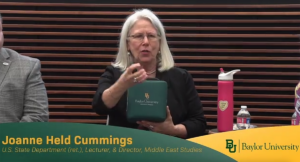
(Screen capture image)

Governments sometimes use fear as a “useful tool” to maintain power and to mobilize citizens in opposition to an enemy or perceived enemy, said Joanne Held Cummings, a retired Foreign Service officer from the U.S. Department of State.

“The problem is that once it is done by a government, that fear tends to be self-perpetuating,” Cummings said. “It is very difficult to undo.”

George Njung, professor of African studies at Baylor, noted more than 100 million people around the globe have been displaced, and most were driven from their homes by violent conflict.

War as ‘fallout of state-making processes’
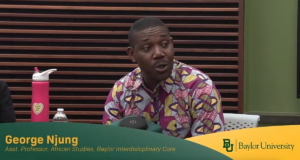
(Screen capture image)

While it has not always been the case historically, today Africa and the Middle East lead the world in the number of displaced people, he reported.

Civil war, military coups and the continuing effects of centuries of colonial rule all contribute to destabilization and displacement, he noted.

“I think that the wars we have in the 21st century are a fallout of state-making processes and the issue of nationalism, which tends to be exclusive rather than inclusive,” Njung said.

Moderator David Smith, lecturer in the history department at Baylor, raised questions regarding nationalism, how borders are drawn and what their impact may be on bringing about conflict.

Njung expressed his belief that borders and the ways they have been created have “exacerbated” conflict.

“Borders create imaginary difference and issues,” he said.

Cummings noted colonial powers often drew borders with an eye toward creating weak national entities that would not present a challenge. However, she rejected the idea of natural borders.

“Except for countries that end at the edge of the sea, there are no natural borders. There just are none,” Cummings observed. “Borders are where people stop fighting, historically.”

Neither the Middle East nor Africa inherently is more warlike than Europe, said Cummings, director of Middle East Studies at Baylor. She pointed to centuries when war raged in Europe.

“We need to avoid looking at now as the only pattern that is,” she said.

Consider people ‘on the ground’

Smith mentioned the challenge of thinking about war holistically. He pointed to the difference in looking at armed conflict from the viewpoint of the state and from the viewpoint of people whose lives are affected directly by it.

“One can sort of approach war from either the state’s perspective or from the human perspective, and I don’t know anyone who is really fluent in doing both of those things,” Smith observed.

“There’s this notion that you can analyze war as something that states do in history. … Or you can step back and just look at the human cost and think: ‘These are not states that are bleeding and dying. These are human beings.’”

Rather than looking at issues of war and peace strictly in geopolitical terms, Cummings asked program participants to consider war and peace from the viewpoint of individuals.

“What do people feel on the ground? There are people who feel themselves to be at war when their countries are not. There are people who feel themselves to be at peace or relatively secure when their countries are at war,” Cummings said.

Consider the experiences of people, rather than focusing exclusively on the policies of states, she urged.

“On the ground, nothing is sustainable unless people feel their fears have been comprehended and have been mitigated,” Cummings said. “As long as people remain afraid, any sort of political resolution or military resolution is going to—in the long run—be unsuccessful.”



SBC mission boards will not fund abuse reform nonprofit

NASHVILLE, Tenn. (RNS)—Leaders of the two major Southern Baptist mission boards said Send Relief money will not be used to help fund a proposed independent nonprofit meant to implement the denomination’s abuse reforms.

Plans for the nonprofit were announced Feb. 19 during a meeting of the Southern Baptist Convention’s Executive Committee.

Leaders of the SBC’s Abuse Reform Implementation Task Force said the new nonprofit is needed to make those reforms a reality.

“Given the current legal and financial challenges facing the SBC and the Executive Committee, the formation of a new, independent organization is the only viable path that will allow progress toward abuse reform to continue unencumbered and without delay,” Josh Wester, the North Carolina pastor who chairs the task force, told members of the SBC’s Executive Committee. “To do this, we have to do this together.”

Wester said he hoped leaders of the SBC’s entities, including its North American Mission Board, International Mission Board and seminaries, along with SBC President Bart Barber, would help find funding for the proposed nonprofit, known as the Abuse Response Commission.

Currently, the work of the Abuse Reform Implementation Task Force has been paid for out of $3 million set aside by Send Relief, a humanitarian effort run by the two mission boards, to get abuse reforms off the ground.

Send Relief officials said those funds cannot be used for the new nonprofit.

“While Send Relief has been privileged to make funds available to the ARITF to help care for survivors and assist churches in efforts to prevent abuse, those funds have never been committed to help form a separate organization outside the SBC, such as the proposed Abuse Response Commission,” Send Relief President Bryant Wright, IMB President Paul Chitwood and NAMB President Kevin Ezell said in a statement Feb. 21.

The three leaders said many questions remain about the structure and leadership of the proposed nonprofit. They did say the Send Relief funds can still be used by the task force.

“Though Send Relief funds are not available for a non-SBC organization, they do remain available to the ARITF for its assigned work within the SBC,” they wrote.

‘Original intent’ of the granted funds

In a follow-up response, a spokesperson for the IMB said the statement addressed the original intent of the Send Relief funds.

“The statement today represents the original intent of the granted funds and the reaffirmed commitment to that intent to fund work within the SBC, not outside the SBC,” the spokesman told Religion News Service.

Abuse reforms in the SBC have stalled over the past two years, largely due to legal and financial constraints, as well as the limits of a volunteer task force. That’s raised questions of whether those reforms—passed in 2022 during the SBC’s annual meeting—ever will be fully implemented.

During that meeting, local church messengers approved plans for a Ministry Check website that would include the names of pastors who have been convicted of abuse, had a civil judgment against them for abuse or been “credibly accused” of abuse. That website was launched last year but no names of abusive pastors have been listed.

The messengers also approved more training and resources to help churches prevent abuse and to respond appropriately when it happens. The task force, in a news conference Feb. 20, said new training materials will be available in time for the SBC’s annual meeting in June.

Wester said messengers at the SBC annual meeting in 2022 asked the task force to collaborate with SBC entity heads to find funding for reforms.

“We have been and remain committed to this directive as we work toward a long-term solution for sexual abuse reform. We are grateful for Send Relief’s investment in this cause, and we are hopeful that the SBC’s national leaders will help the ARITF determine the best path forward in financing future reform efforts,” he said.

A past proposal to fund abuse reforms from the Cooperative Program unified budget was shot down in 2022. That led Send Relief to set aside $3 million for the SBC’s response to sexual abuse and another million to pay for abuse survivor care.

No funds for the Abuse Response Commission were included in a proposed Cooperative Program budget passed during the most recent Executive Committee meeting, as the denomination’s rules require those funds to go to SBC entities. No rules would prohibit entities from donating to the work of an outside group.

Brent Leatherwood, president of the SBC’s Ethics and Religious Liberty Commission, said he would ask trustees of the ERLC to contribute to the start-up costs of the Abuse Reform Commission.


UMHB students learn about Forgiving Day tradition

BELTON—Students quarrel. Feelings get hurt. Relationships break. It happens every day on every college campus—even a Christian one.

Almost 150 years ago at the University of Mary Hardin-Baylor, Anne Luther, the president’s wife, devised a plan to help end the festering feuds and help heal broken relationships among the all-woman student body. Thus began a since-forgotten tradition she called “Forgiving Day.”

The idea came to Luther just before Thanksgiving in 1878. Determined to promote peace before their holiday feast, she and student Elli Moore Townsend tasked faculty and staff to mediate between squab­bling students to get them to bury their differences and start anew.
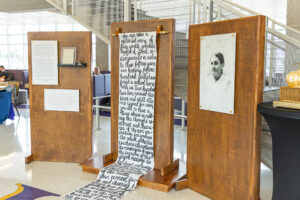
They believed one couldn’t truly be thankful during Thanksgiving without first reconciling their grievances, said Beth Norvell, associate direc­tor of museum and alumni engagement.

Then, on Thanksgiving Day, as a symbol of recon­ciliation, each girl had to present a “token of forgive­ness” in the form of a hug, handshake, note or word of kindness to any other students with whom she had a grievance. They did this with Luther as witness.

Many girls saw this tradition as challenging and uncomfortable, but as one student said, “We would do anything for Mrs. Luther.”

UMHB Associate Director of Museum and Alumni Engagement Beth Norvell shares an excerpt from one of Elli Moore Townsend’s Thanksgiving letters to the Cottage Home girls. (Photo by Hannah Van Veusekom / University of Mary Hardin-Baylor)

Perhaps the Forgiving Day idea formed from Luther’s own grievances from a life filled with ups and downs. But even in bad times, the lessons she learned are a testament of a woman of great faith and forgive­ness, which Norvell believes contributed to Luther putting so much stock in teaching the virtues of forgiveness to her students.

One such instance happened after the death of Luther’s first child—the first of four who died during her lifetime. According to her memoirs, she went into a heavy depression.

 “She gave the Lord a timeline and said, ‘Lord, I will lean into this, and I will trust you even though I don’t feel like it,’” Norvell recounted from the memoir.

Luther gave God a specific amount of time to heal her grief and by the end of that time, her heart was still broken, and she was devastated.

“Soon after, however, Anne’s heart was flooded with peace and joy, and she never gave the Lord a timeline on healing after that,” Norvell said. “It was pivotal for her.”

Forgiveness and Thanksgiving

Norvell saw the season before Thanksgiving last year as an opportune time to create an exhibit at UMHB to share the history of the tradition with students.

A “Forgiving Day” exhibit was set up at the Bawcom Student Union at the University of Mary Hardin-Baylor to mark a forgotten campus tradition. (Photo by Hannah Van Veusekom / University of Mary Hardin-Baylor)

When Danielle Kenne spotted Elli Moore Townsend’s letter in the display, she was intrigued.

 “I was very curious as to what the story behind the forgotten tradition was and was touched by its contents,” said Kenne, a senior health science pre-occupational therapy major. “I love UMHB history and traditions. So, I was su­per excited to learn about an old tradition I’d never heard of before. It’s such a touching tradition.”

Forgiving others is essential, she said, and learning about the forgotten day caused her to think about Thanksgiving in a new light.

 “I love the concept of intentionally forgiving people right before Thanksgiving, so you can be thankful with a grateful and unburdened heart,” Kenne said. “I never really considered how forgiving others could affect my ability to be truly thankful, and it made me want to spend time in prayer about forgiveness before Thanksgiving.”

Like most everyone, Kenne said she sometimes struggles with forgiveness but tries to remind herself that we are supposed to forgive because the Lord first forgave us.

“I’ve slowly learned that forgiving others is neces­sary for my own heart, so that I can be in a steadfast relationship with the Lord.”

Every day is a good day to practice forgiveness

She said she would love to see the old tra­dition revived at UMHB one day: “It’s often forgotten by most college students, especially with the chaos of the end of the semester.”

For the Christian, UMHB Chaplain Jason Palmer describes forgiveness as “a response to the love Jesus demonstrated in which he will­ingly set aside his right to prioritize justice for the wrongs we had done and, instead, decided to relentlessly pursue relationship with us.”

Anne Luther’s Forgiving Day tradition contin­ued off and on for years but slowly faded into obscuri­ty after students began going home for Thanksgiving.

But, as Palmer points out, “Every day is a good day to practice forgiveness.”

“Focusing on forgiveness helps us keep our perspective fixed on things of eternal significance while setting condi­tions for the mending of hearts—both ours and those of others. Colossians 3:13 is a favorite verse of mine regarding forgiveness because I’m reminded that the Lord has already set the example that he is asking me to follow.”


Nightmare scenario fueled pastor’s commitment

A child shows up in a hypothetical situation but represents a real possibility—so real, it moved one South Carolina pastor deeply enough to embrace a seemingly impossible task and expend time, energy and money urging others to come alongside him.

Pastor Marshall Blalock joins a group of founding members already committed to the effort—a group that knew he needed to be included and extended the invitation.

Marshall Blalock

Blalock of First Baptist Church in Charleston and the other five Abuse Response Commission incorporators are serving or have served on the Southern Baptist Convention’s Abuse Reform Implementation Task Force.

“My conviction about this has grown more and more over the course of time,” Blalock said. “Serving on this task force was not an easy job by any stretch. It takes a lot of extra time and hard work, but as each day passes, I’m more convinced of the necessity of getting this right. Every ounce of energy that has been spent on this has been worth it.”

Finding a path forward with the Abuse Response Commission involves costs and time, he added.

“But it’s worth it for leadership to have the best information and resources—and to have the opportunity for churches to become the safest places on earth to hear the gospel. It’s an overarching goal, but our churches deserve that from us,” he said.

‘A little girl out there somewhere’

For Blalock personally, remembering that child—a little girl—keeps him energized and focused.

 “Over a year ago now, I had this dream—in some ways a nightmare—about a 12-year-old girl at a Baptist church. The little girl said, ‘If you had just gotten this done sooner, it wouldn’t have happened to me.’

“All this time later, my eyes still well up with tears when I think of or tell someone about the dream,” he said.

“Why did I say ‘yes’ to the invitation (to help launch the Abuse Response Commission)? I did this for her,” he said.

“There’s a little girl out there somewhere. And if we get this right, and her church looks at this database and decides they can’t hire a person they are considering because the name shows up, then that little girl is not abused. And it is worth every minute of my time and every cent of my money.”

Blalock expressed appreciation for the diligence of those in the SBC who already worked on its initial Sexual Abuse Task Force and the Abuse Reform Implementation Task Force.

“While the task forces have not always known what to do and how to do it, they have kept working,” he said. “My personal goal is to serve that little girl, to protect her. She matters to me.

“When people hear and understand what’s actually being suggested and understand there are still some things that are yet to be worked out, I believe they will see that this plan accomplishes the goal.”

Blalock confirmed an independent institution in this case is “not to be free of the SBC.”

“The point is to serve the churches of our convention while not creating liability for the SBC.”

The plan is not fully developed and many unanswered questions remain. Asking those questions is appropriate and the team is working hard to answer them, he said.


Trump promises televangelists revival of Christian power

NASHVILLE (RNS)—In an evening filled with apocalyptic rhetoric, patriotic songs and campaign promises, former President Donald Trump promised religious broadcasters he would make a triumphant return to the White House next year and restore Christian preachers to power in American culture.

“If I get in, you’re going to be using that power at a level that you’ve never used before,” Trump told the annual gathering of National Religious Broadcasters at Nashville’s Gaylord Opryland Resort and Convention Center on Feb. 22.

Speaking to a packed ballroom of radio and television preachers and other Christian communicators, Trump described himself as a friend and fellow believer and someone ready to restore God to his rightful place in American culture.

“With your help and God’s grace, the great revival of America begins on November 5th,” he said.

Pledge to root out ‘anti-Christian bias’

In a speech that lasted more than an hour, Trump portrayed evangelical Christians as a persecuted group under President Joe Biden’s administration, a status he told them he shared in his 2020 election loss, which he said had been “rigged.”

He told the religious broadcasters one of his first acts in a second term would be to set up a task force to root out “anti-Christian bias.”

Trump said he also would come to the aid of “political prisoners,” referring to those imprisoned for their actions at the U.S. Capitol on Jan. 6, 2021. Some of those convicts were heard in a recorded rendition of the Star-Spangled Banner by the self-described J6 Prison Choir as Trump was being introduced.

Trump appealed to the religious audience with Bible verses and promises of world peace.

“The Bible says blessed are the peacemakers,” said Trump, quoting from Jesus’ Sermon on the Mount. “I will be a peacemaker, and I will be the only president who can say—and I say this with great conviction—I will prevent World War III.”

Though he admitted he wasn’t a very good Christian and didn’t know much about the Bible, Trump told broadcasters he shared their faith and always would stand up for God—lines that brought thunderous applause.

But Trump’s biggest applause lines came when he promised to promote school vouchers, seal the U.S. southern border and prevent transgender men from participating in women’s sports. With him as president, he vowed America would have only two genders—male and female.

‘Make America Pray Again’

Conference attendees stood in long lines as they waited to be screened by the Secret Service and security personnel before being admitted to the ballroom. Kelley Paine, from Rockport, who wore a “Make America Pray Again” baseball cap, said Trump had been a great president and could be one again.

“He’s a businessman, and that is what our country needs,” she said.

While a representative of Pray.com touted the slogan on Paine’s hat, on the whole, the NRB gathering was less tricked out in MAGA gear than normally can be found at a Trump campaign event, and the coarser messages that have popped up among Trump supporters in recent years were not in evidence.

One vendor in the NRB exhibition hall turned a MAGA chant of “Let’s Go Brandon”—meant to send an obscene message to President Biden—into “Let’s Go Jesus” flags, hats and shirts.

Analia Anderson, who said she has sold T-shirts at MAGA-themed “Reawaken America” events, is a fan of President Trump, but she said some rhetoric at those events went too far.

“It’s not very Christian,” she said.

Trump’s arrival at the Opryland resort was delayed for more than an hour, and a Southern gospel group, Ernie Hass & Signature Sound, was pressed into an impromptu concert of gospel songs, at one point leading the crowd in an a cappella rendition of “God Bless America.”

Just as attendees had begun to drift out of the room, Trump arrived and was greeted with a standing ovation.

NRB President Troy Miller began the evening session, labeled a president forum, by saying the group had reached out to all presidential candidates, inviting them to speak. He also said, because the NRB is a nonprofit, the group did not endorse candidates—and any comments made by speakers were not official statements of the NRB.

Talk show hosts praise Trump

Conservative talk show host Hugh Hewitt and Kevin Roberts, president of the Heritage Foundation, also spoke before Trump took the stage, praising the former president and warning that the country and conservatives face grave perils from their political foes.

Hewitt called Trump the “best interview in America.”

“I have no idea what he is going to say—nobody does,” he said, a line that drew thunderous applause.

Hewitt took aim at the term Christian nationalism, a movement that promotes the belief that the United States should be run by and for the benefit of Christians. Hewitt called the term a “slander on the church and on Christians who want to be involved in politics.”

Roberts dismissed concerns expressed by Trump’s foes about corruption and authoritarianism if the former president returns to office. But Roberts alleged Democrats act in corrupt and authoritarian ways themselves.

“They want to fundamentally transform America, because they don’t like this country,” he said. “The establishment does not hate Donald Trump, because he’s a threat to America. They hate him, because he is a threat to them.”

‘I’m being indicted for you’

Trump made similar comments, saying the greatest threat to the United States came from inside the country, not from external enemies. Those enemies, he said, had let the country fall apart since he left office.

He referred repeatedly to “Marxist” district attorneys who were suing him, framing his legal troubles as a form of political attacks against him.

“I have been indicted more than any times than the great gangster Al Capone,” he told the religious broadcasters.

He also claimed he was being indicted for standing up on behalf of Christians and conservatives.

“I am being indicted for you,” he said.

He claimed “bad things” were being done to Christian crosses, another thing that would stop if he became president again. And he would work to reverse the decline of organized religion and church-going in America.

“We have to bring back our religion,” he said. “We have to bring back Christianity.”


Eclipse offers opportunities to be a light in the darkness

KERRVILLE—Communities along the path of the April 8 total solar eclipse are gearing up for the influx of eclipse chasers expected to descend upon the area. But will churches along the path be ready?

Robert Wheat, director of missions for Hill Country Baptist Association, said the annular eclipse of October 2023 offered area churches and local officials a trial run. They distributed eclipse-watching glasses to visitors and offered their facilities as staging areas for first responders.

While the crowds were not as great as some anticipated last October, the upcoming total eclipse is a different matter. Hotels in communities along the path of the total eclipse already are booked to capacity.

“A total eclipse is much more spectacular. A total eclipse is unbelievable,” explained Jeff Stone, an eclipse enthusiast and former NASA employee who attends Trinity Baptist Kerrville, known locally as “the eclipse guy.”

Stone traveled to Mexico for nearly seven minutes of totality in 1991 and to Missouri in 2017 for a bit over two minutes of totality.

He and his wife built their house where they did to be in the path of totality—the path where the moon’s disk completely blocks the sun—for this eclipse. They will be hosting eclipse chasing friends from as far away as Sweden on April 8.

“During totality, which here in Kerrville is going to be 4 minutes and 26 seconds at my house, the sky is going to be so dark, like night,” Stone said.

“You’ll be able to see stars. Granted, you won’t see all the stars that you normally do, but you’ll be able to see the bright stars. And, in the case of this one… you’ll also be able to see all the naked-eye planets, and I think that is going to be crazy cool.”

Stone described experiencing totality as having a visceral effect, referencing the darkness at Jesus’s crucifixion, when the people were shaken to their soul by the darkness in the daytime. He believes totality in an eclipse has the same effect.

In 2017, the last total eclipse that could be seen in the United States gave around 150 million Americans in the path of totality that visceral, awe-inspiring experience.

Crowds coming to Texas

If even 1 percent of that number was as enthusiastic about the experience as Stone and his fellow eclipse chasers have been by totality, then 1.5 million visitors could be heading to the path of totality in April.

An article from Forbes estimates anywhere from 270,000 to 1 million eclipse-chasing visitors will make the trip to join the 13 million Texans who live in the path of totality.

Hotel and campground bookings bear this estimate out, with Booking.com showing no available reservations in any of the towns in Texas along the path of totality attempted. Texas State Parks campgrounds along the path have been booked up for months.

The Hill Country of Texas is one of the best locations in the country for eclipse chasers to go for a shot at experiencing totality. The Old Farmer’s Almanac suggests a greater risk of cloudy skies in locations further north and east along the path on April 8.

Junction and Brady offer the best chance of clear skies, but the duration of totality there will be over a minute less than in Kerrville, which also has a good chance of clear skies, according to an Eclipsophile post on the April eclipse.

‘Blowing my mind to think about it’

The pull of totality should not be compared to the pull of the annular eclipse in October, Stone noted. The annulus is impressive in its own right, but not like having enough darkness to drop temperatures as much as 10 degrees.

To have skies dark enough to see stars in daytime hours during totality, “is still blowing my mind to even think about it” Stone said.

With so many extra people in the area, mobility will be an issue. Wheat said Hill Country churches are encouraging their senior members to plan ahead.

First responders in the Hill Country worry about the impact traffic may have on patrol capabilities. Churches and members have offered locations around town as staging areas to decentralize CERT (Community Emergency Response Team), where they can access outlying areas more quickly if called.

The concern topping the list for “the eclipse guy?” Restrooms.

The City of Kerrville already has reserved all the portable restrooms available anywhere around, but Stone thinks the lack of public facilities for that many extra people will turn out to be the story of the 2024 eclipse.

And it could offer churches an opportunity to extend hospitality to visitors by making their facilities available.

Eclipse chasers are coming to Texas. Churches in the path of totality might want to think beyond Easter to welcoming these guests and strategize with local officials on how to help visitors in the name of Jesus, Stone noted.

Resurrection Sunday the week before will focus us on God’s power, even over the natural world and death. And the total solar eclipse will offer Texas Baptists in its path a once-in-a-lifetime opportunity to be a light to thousands of people chasing the dark.

While it may be too late to organize an “Eclipse at the Crosses” watch party like the one Coryell Community Church in Gatesville has planned, it is not too late to do something.

So, enjoy the eclipse, Stone said. Because, as he did at the crucifixion, “God is going to show us his power again.”


Killeen pastor honored for church’s heart for community

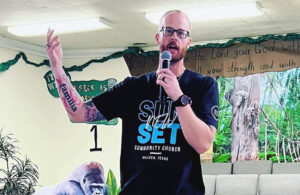
Neighbors in North Killeen recognize Pastor Les Williams of New Sunset Community Church not so much for the sermons he preaches as for the sermons he lives out in humble service to their community.

Killeen Councilwoman Jessica Gonzalez (left) and Mayor Debbie Nash-King (right) present the Killeen Star Award to
Pastor Les Williams of New Sunset Community Church. (Submitted Photo)

Williams recently received the Killeen Star Award for community service—particularly the block parties, special events and other charitable work his church provides.

The city awards the Killeen Star Award to citizens who go “above and beyond in their volunteering and caring for the community,” he explained.

“Now, the award has my name on it, because I guess they give it to individuals. But ultimately, it’s an award for the church,” Williams said. “I was given the award because of all the things the church is doing. I couldn’t possibly do it all by myself.”

Killeen Councilwoman Jessica Gonzalez, who presented the award to Williams, said she believes his service has impacted the community significantly.

“Consistency is key,” Gonzalez said, praising Williams and his church members for their willingness to “to show up and be present no matter what is going on.”

“He isn’t just a pastor that is up there preaching on Sunday. He is actually doing the good work for his community,” she said.

Williams became pastor of New Sunset Community Church—a Texas Baptist congregation in North Killeen—in August 2021.

Children in North Killeen line up for cool treats on a sunny day at a block party sponsored by New Sunset Community Church. (Sponsored Photo)

Since then, Williams has led the church to host 17 block parties for their neighbors. Staffed by the church’s members and volunteers from surrounding churches, the block parties offer food, giveaways, face-painting and a variety of fun activities for children and youth. Attendance at these events ranges from 100 to 500 people.

Williams and his wife Melissa have been married eight-and-a-half years, and they have twin 5-year-old boys. He is the parent co-chair of the School Health Advisory Council for the Killeen Independent School District and serves on the board of Bell Baptist Association.

 “Where the church sits in Killeen, there is high crime, high poverty, low education and broken homes,” Williams said, describing the predominantly Hispanic and Black neighborhood in north Killeen.

 “We use the land that our church sits on to throw these block parties, to meet the neighborhood.”

The church also hosts other events throughout the year to help the community.

“Every July, we do a back-to-school shoe giveaway,” Williams said. “There’s an organization in the area called First Blessing. We utilize them to help us give away shoes. We gave away 115 pairs of shoes last July.

“At our August block party, we give away backpacks with school supplies inside. This year, we gave away around 60 backpacks.”

The 4-1-1 on ‘The Four-One’

Neighbors in North Killeen recognize Pastor Les Williams of New Sunset Community Church not so much for the sermons he preaches as for the sermons he lives out in humble service to their community. (Submitted Photo)

At the community outreach events, the church invites guests to Sunday and Wednesday worship services and to programs for children and youth. The church offers breakfast on Sundays and dinner on Wednesday nights.

New Sunset also provides transportation to help people get to doctors’ appointment and run errands.

The church’s stated mission is to “make disciples that make disciples so that the Four-One is noticeably better.”

“Killeen has five ZIP codes,” Williams explained. “The Four-One—the 76541 ZIP code—is the roughest part of Killeen. Over the last 13 to 14 years, there has been a mass exodus of businesses, churches and organizations that were in downtown Killeen move out of downtown Killeen.”

“We are for the Four-One. We do all these events to make disciples of Jesus. Because we believe when that happens, we will see people’s lives and communities become noticeably better, because they are following Jesus.”

New life for New Sunset

Williams noted it hasn’t always been easy for the church to thrive.

“The church has been around since 1956, but it’s always kind of been a struggling church and small,” Williams said. “When I became pastor in 2021, the church had officially voted to go through revitalization. The church didn’t have enough money in the bank to pay the bills every month, and somehow the bills got paid.”

At the end of 2021, the average church attendance of New Sunset Community Church was 42 people. In 2022, the average grew to 68. Currently, the average is 72. On Sundays and Wednesdays, the average of students in kindergarten through high school who attend is 35.

“We no longer use the word revitalization, because people are giving,” Williams said. “We have five other churches or organizations that give. So, we have more than enough money in the bank now to pay all our monthly bills and be able to actually do ministry.

He pointed to noticeable behavioral changes in the students. “You guys are so welcoming” is the No. 1 thing his congregation hears, he said.

“We’re seeing people actually return to church and read their Bibles,” Williams said. “They want to know Jesus. They’re asking questions and joining discipleship groups. That has been a spiritual growth.”

 “The church went from being an almost-dead church, to a very-much-alive church in the last 28 months.”

Emily Hughitt, a student at Howard Payne University, is serving as an intern with the Baptist Standard this semester.


Paxton sues to shut down faith-based migrant shelters

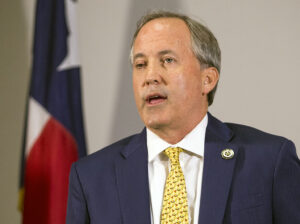
AUSTIN (RNS)—Texas Attorney General Ken Paxton has sued a volunteer-run network of Catholic migrant shelters based in El Paso, aiming to revoke the organization’s nonprofit registration.

The lawsuit comes after Annunciation House moved to delay handing over documents about its clients to the attorney general.

In this May 1, 2018, file photo, Texas Attorney General Ken Paxton speaks at a news conference in Austin. (Nick Wagner/Austin American-Statesman via AP, File)

Paxton’s office said it had demanded Annunciation House records because of the organization’s “potential efforts to facilitate illegal immigration.”

“The Office of the Attorney General (“OAG”) reviewed significant public record information strongly suggesting Annunciation House is engaged in legal violations such as facilitating illegal entry to the United States, alien harboring, human smuggling, and operating a stash house,” the office wrote in a Feb. 20 press release.

If Paxton is successful, Annunciation House—which was founded in 1976—could be required to cease sheltering migrants entering Texas. The lawsuit “seeks to revoke Annunciation House’s authorization to do business in Texas and asks the court to appoint a receiver to liquidate their assets,” Paxton’s office wrote.

On its website, Annunciation House says it has hosted more than 500,000 migrants fleeing death squads, civil wars, human rights abuses and poverty.

“The Attorney General’s illegal, immoral and anti-faith position to shut down Annunciation House is unfounded,” Annunciation House said in its own press release. Paxton’s office “has stated that it considers it a crime for a Catholic organization to provide shelter to refugees,” the organization said.

According to reporting from the Texas Tribune, the attorney general’s administrative subpoena sent to Annunciation House demanded it turn over records from January 2022 onward. Those records included identifying information about Annunciation House’s clients, referrals the nonprofit had made to legal services and their applications for federal funding for organizations that address hunger and homelessness.

One day to submit records

Annunciation House said the attorney general told the nonprofit on Feb. 7 it had one day to turn over records. After the state denied Annunciation House an extension, the organization responded by requesting that a U.S. district court rule on what documents it was required to turn over, and that it receive a restraining order granting more time to comply with Paxton’s demands.

The statement from Paxton’s office described the attempt to shut down Annunciation House as a “consequence” of the organization’s legal actions and delays.

Paxton’s legal action appears to be part of a broader Republican push to make immigration a key 2024 election campaign issue. In December 2022, four House Republicans, including two from Texas, sent a letter to Catholic Charities USA, a network of diocesan charity organizations, accusing it of “fueling” illegal immigration and violating federal law by providing necessities to migrants.

That same month, Texas Gov. Greg Abbott, a Catholic, called on Paxton to investigate El Paso nonprofits because they “may have assisted with illegal border crossings near El Paso.”

Since then, Texas has escalated its anti-migrant actions. In January, its National Guard got into a standoff with federal agents in Eagle Pass after guard members and state troopers blocked the agents’ access to the U.S. border. The same month, the U.S. Supreme Court ordered Texas to remove concertina wire from along the river erected to stop migrants from crossing.


Lubbock pastor Pardue nominee for BGCT 2nd VP

Adam Pardue, pastor of Highland Baptist Church in Lubbock, will be nominated for second vice president of the Baptist General Convention of Texas.

Pastor Jason Burden of First Baptist Church in Nederland, a past president of the BGCT, will nominate Pardue at Texas Baptists’ annual meeting Nov. 10-12 in Waco.

Pardue served as associate pastor at First Baptist in Nederland alongside Burden before accepting the pastorate of Highland Baptist in March 2012.

“He has an awesome family. His character is unimpeachable. And he is a person of good cheer and vision who will be of great service to our state convention,” Burden said.

Burden characterized Pardue as “a product of BGCT investment” in higher education.

After completing his undergraduate degree in music from Lamar University, Pardue earned a master’s degree in Christian ministry from Wayland Baptist University and a Doctor of Ministry degree from Hardin-Simmons University’s Logsdon Seminary.

He also earned a Master of Divinity degree from B.H. Carroll Seminary, which is slated to merge with East Texas Baptist University.

Burden also characterized Pardue as “a great contributor to Texas Baptists” through his involvement as a church health coach, helping other congregations work through the Pave church revitalization strategy.

“I want to see church health emphasized,” Pardue said, noting his desire to see Texas Baptists help churches that have plateaued or suffered decline. “I have a heart for it.”

Wants to ‘have a voice’ in the process

Given events at the national level in Baptist life, he sees this as a key time for Texas Baptists to discern their direction moving forward.

“I would like to have a voice in shaping that direction and to be a part of that process,” he said.

Having chaired the BGCT Committee to Nominate Executive Board Members and the Committee on the Annual Meeting, Pardue said, he even enjoys Texas Baptist committee work.

“I love Texas Baptists. Serving on convention committees, you’re dealing with people who have the same love you do and who believe in the work that is going on,” he said.  “I love to be around other Christian brothers and sisters.”

In addition to his BGCT service, Pardue also has served on the board of Lubbock Area Baptist Association.

Ten years before he became senior pastor at Highland Baptist Church in Lubbock, he served four years as youth pastor at that same congregation.

Pardue served in staff roles at other Texas Baptist churches—minister of music and youth at Fellowship Baptist Church in Bridge City and at Proctor Baptist Church in Port Arthur, youth pastor at First Baptist Church in Port Neches and associate pastor at First Baptist in Nederland.

He and his wife Angie have been married 26 years. They have two daughters, Avery Ashford and Abbey Pardue, both Christian ministry majors at Hardin-Simmons University, and a son-in-law, Blake Ashford.


On the Move: Ray

Kevin Ray to Community North Baptist Church in McKinney as associate pastor of senior adults, business and administration, and community outreach. He was the interim administrator at First Baptist Church in Farmers Branch.


Around the State: Baylor BSM building campaign progressing

The building campaign to raise the initial $3 million toward a new Baptist Student Ministry center on the Baylor University campus has passed the halfway mark, Texas Baptist Missions Foundation President Jerry Carlisle reported to the Baptist General Convention of Texas Executive Board. So far, more than $1.7 million has been given or pledged toward the project. Once the foundation has received gifts and pledges totaling $3 million, Baylor University will legally convey property at the corner of 4th Street and Daughtrey Avenue in Waco to Texas Baptists. After the initial goal is met, the foundation will continue to raise the additional $4 million needed to complete construction of the facility. For more information, click here.

Dallas Baptist University appointed Jeremiah J. Johnston as senior fellow for Christian origins in its Institute for Global Engagement. Johnston is president of the international Christian Thinkers Society, the author of 15 books and host of a podcast. He completed his doctoral residency in Oxford in collaboration with Oxford Centre for Missions Studies and received his Ph.D. from Middlesex University in the United Kingdom. He also earned advanced degrees in theology from Acadia University and Midwestern Baptist Theological Seminary. His role at DBU will include editing an upcoming academic journal housed within the Institute for Global Engagement, expanding the reach of the university and engaging with students through speaking at chapel, lecturing and teaching courses.

Houston Christian University announced plans to launch a Master of Science in Leadership program in fall 2024, pending approval by the Southern Association of Colleges and Schools Commission on Colleges. Offered through HCU’s online division, the new advanced degree is designed to teach leadership skills in alignment with Christian values and prepare individuals for effective leadership in a diverse range of industries and organizations. The 30-credit hour program helps students develop strategic thinking, influential communication, organizational behavior, ethical judgment and a global mindset. “The challenges that the students will face are many, but we hope that by being principled and taught strong Christian leadership values, their leadership will shine in the marketplace,” said Mike Rome, dean of the Archie W. Dunham College of Business at HCU.

Students pray for the recipients of hygiene kits they prepared during a Congreso Experience at East Texas Baptist University. (ETBU Photo)

Baptist University of the Américas will host a Congreso Experience on March 2 in partnership with Texas Baptists. Other recent Congreso Experiences at Wayland Baptist University and East Texas Baptist University offered opportunities for local Hispanic youth to meet current university students, tour the campus and engage with each other through discussions, worship and community service. During the event at ETBU, for example, students assembled hygiene kits Texas Baptists’ River Ministry will distribute along the Texas-Mexico border.

The Howard Payne University Alumni Association Virtual 5K is scheduled March 23. Individuals can participate by running or walking from anywhere. Last year, more than 100 individuals participated from 25 cities and four states. Brownwood-area residents are invited to the HPU campus to participate in person. Registration for the 5K is $40 per adult and $10 per student. A portion of the registration will be used to support HPU student-focused events and scholarships. Registration is open until March 6. Each participant will receive a race packet, which includes a t-shirt and race bib. Participants are encouraged to submit their race times to the alumni relations office March 23, and the top three finishing times will receive prizes. To register for the Virtual 5K or sign up as a sponsor, visit hputx.edu/alumni/hpu-virtual-5k/ or contact the HPU alumni relations office at alumni@hputx.edu or (325) 649-8007.

(File Photo/Baylor Marketing and Communications)

Baylor University will host the 2024 Collegiate Day of Prayer at 7 p.m. on Feb. 29. The Collegiate Day of Prayer is an evening worship and prayer service focused on college-aged students. The event—promoted internationally—will originate from Waco Hall on the Baylor campus. The livestream will be available on the Baylor Facebook page, its YouTube channel and the Collegiate Day of Prayer website.

First Baptist Church in China Spring will host a First Blessing event from 9 a.m. to 11 a.m. on March 23. First Blessingis a ministry that enables churches to provide shoes for schoolchildren. Church volunteers interact with families seeking shoes, escorting the parents through the process as their children are properly fitted for shoes and allowed to select a pair of their choosing.


SBC Executive Committee cuts ties with four churches

NASHVILLE (RNS)—The Southern Baptist Convention Executive Board voted to cut ties with four churches on Feb. 20.

One hired a woman pastor. Two allegedly mismanaged sexual abuse. The other failed to give to SBC missions causes.

All four were designated as “being out of friendly cooperation” with the nation’s largest Protestant denomination after its credentials committee recommended they be removed.

Immanuel Baptist Church, in Paducah, Ky., was deemed “not in friendly cooperation” for having a woman who serves as senior minister.

The SBC statement of faith—the 2000 Baptist Faith and Message—says that the office of pastor, also known as an overseer or elder, is limited to men.

The SBC is considering a constitutional amendment that would bar churches that allow women to hold the title of pastor, no matter what their role at the church.

Last February, the Executive Committee expelled five churches, including Saddleback Church in Southern California, one of the nation’s largest churches, for giving a woman, the wife of its new senior pastor, the title of preaching pastor.

The Executive Committee determined Grove Road Baptist Church in Greenville, S.C., had shown “a lack of intent to cooperate in resolving a concern regarding the pastor’s mishandling of an allegation of sexual abuse.”

The committee also decided West Hendersonville Baptist Church, in Hendersonville, N.C., had broken denominational rules on dealing with abuse by retaining a pastor who was “biblically disqualified.”

Trustees also decided that the SBC’s relationship with New Hope Baptist Church, of Gastonia, N.C., had been “discontinued” because the church, according to the Executive Committee, had not given to SBC causes for five years.

A question about the faith and practice of New Hope had also been raised, and the church had a “lack of intent to cooperate” in resolving that question.

Southern Baptist churches are required to donate to the SBC’s Cooperative Program unified budget or to a denominational entity, such as a seminary or a mission board.

Historically, churches are rarely removed for not giving. After joining via a state convention or by filling out a simple online form and making an initial donation, a church will remain on the SBC rolls unless someone takes action to have it removed.

Donations are checked when a church registers messengers for the SBC annual meeting but are not monitored otherwise. Currently, fewer than 60 percent of churches give to the Cooperative Program, its joint missions fund, down from about 75 percent in the mid-1980s.

At their regularly scheduled meeting this week, Executive Committee members approved a budget for fiscal year 2023-2024, which will be presented at the SBC meeting in June.

They learned the Executive Committee’s assets declined by more than $2 million last year, part of an ongoing fiscal crunch.

They also heard an update from the search committee looking for a new permanent Executive Committee leader. That committee hopes to name a candidate next month. The Executive Committee has been without a permanent president since 2022 and has had a pair of interim leaders.