Around the State: UMHB awards Wallace E. Davis an Honorary Doctorate

At its May 4 commencement, the University of Mary Hardin-Baylor awarded Wallace E. Davis an Honorary Doctorate of Humanities degree for his many contributions to the university. Davis then delivered the commencement address to the graduating class of 2024. Davis earned his bachelor’s and master’s degrees at Baylor University and a Doctor of Philosophy degree from the University of Texas. After serving in the U.S. Army in Korea, he taught elementary school and served the Corpus Christi Independent School District in several other roles. In 1973, he became one of the first four educators employed by the newly founded Corpus Christi State University—now Texas A&M University-Corpus Christi. In 1991, Davis became president of Wayland Baptist University, where he served more than nine years before being named the university’s first chancellor. Upon his retirement in 2002, he was named chancellor emeritus of the Wayland Baptist University System. After moving to Salado, Davis and his late wife, Patsy Lewis Mayfield, connected with UMHB. He has been a faithful donor to UMHB for the past 17 years. This was the university’s 168th graduating class, with 485 students awarded degrees—366 baccalaureate degrees, 107 masters’ degrees and 12 doctoral degrees.
East Texas Baptist University presented 186 graduates with degrees during its commencement ceremony, May 10. (Photo/ETBU)

East Texas Baptist University presented 186 graduates with degrees during its commencement ceremony, May 10. ETBU President J. Blair Blackburn presided over the ceremony, during which 165 students received undergraduate degrees and 21 received graduate degrees. During the first ceremony, Sam Moseley was presented with an honorary doctorate. Moseley’s legal career included serving as assistant city attorney for Marshall, co-founding the firm Moseley and Moseley, and working in the administrations of Presidents Reagan and Bush from 1985-1993. Congress appointed him to the Millennial Housing Commission in 2000. Blackburn presented Steve and Penny Carlile with honorary doctorates during the second ceremony. The Carliles have been connected to East Texas Baptist University for many years. After graduating from Baylor University, they returned to their hometown of Marshall, where they have supported local organizations and initiatives, including Mission Marshall, the Boys and Girls Club of the Big Pines, Marshall Independent School District, Marshall downtown revitalization and Marshall City Park. Steve and Penny Carlile Hall is named in honor of them for their generous investment through institutional service, campus building initiatives, and encouragement to expand and increase the impact of East Texas Baptist University.

Freshman Shadia Herrera, pictured with Andrade, was awarded the Dr. Juan Andrade Scholarship for Young Hispanic Leaders at this year’s USHLI National Conference in Chicago. (Photo/HPU)

Howard Payne University freshman Shadia Herrera of Azle recently was named a recipient of the Dr. Juan Andrade Scholarship for Young Hispanic Leaders, presented at the United States Hispanic Leadership Institute National Conference in Chicago. Herrera was one of 23 recipients of the scholarship. The institute has awarded more than $1.6 million in scholarships and internships to Hispanic college students throughout the United States. The annual national conference drew 4,650 students from 63 high schools and 115 colleges and universities in 24 states. Herrera first met Juan Andrade, a 1970 graduate of HPU, at the university’s Hispanic Alumni Fellowship in the fall, and she briefly spoke about her plans upon graduation. Andrade encouraged her to apply for the scholarship. She soon was notified of her acceptance, as well as a trip to Chicago and admission to the conference. “I hand-picked Shadia because, when she shared her plans, she mentioned what she wanted to be, but then went on to speak about what she wanted to do and why, and that clinched it for me,” Andrade said. “Knowing what you want to do and why adds tremendous meaning and value to whatever you want to be.” Herrera is majoring in biomedical science and plans to become a physician’s assistant after she graduates. Her goal is to become a missionary and bring medicine and the gospel to remote places in the world.

Denim and Diamonds Scholarship Gala honorees, the Murdocks, and family. (Photo/Wayland)

Wayland Baptist University raised more than $25,000 for the Mark and Linda Murdock Endowed Scholarship during its Denim and Diamonds Scholarship Gala. President Emeritus Paul Armes introduced longtime Wayland supporters and civic leaders Mark and Linda Murdock. An Air National Guard and Air Force veteran, Mark enjoyed a 36-year career with Crossmark, a sales and marketing company for the food industry. He retired in 1999 after serving as Crossmark’s president for more than 16 years. He serves as a deacon at Southcrest Baptist Church, where he and Linda currently attend. The couple were members of Oakwood Baptist Church for more than 40 years. It was noted the couple is committed to ensuring future generations of students can receive a quality education in a Christian atmosphere.

East Texas Baptist University has received a grant of $475,000 from the United States Department of Commerce’s Economic Development Administration. (ETBU Photo/Michael A. Tims)

East Texas Baptist University received a $475,000 grant from the U.S. Department of Commerce’s Economic Development Administration. The funds will enable ETBU to address economic challenges in Marshall and the surrounding region by developing and implementing long-term economic revitalization strategies to serve the local economy. The award will enhance the ability of ETBU’s Synergy Park to serve the economic development needs of Marshall and Harrison County. With this funding, ETBU now may implement new, market-driven programs to serve both local business owners and workforce participants while expanding the array of services already offered at Synergy Park. Since opening in April 2023, Synergy Park has become a major driver of economic revitalization in downtown Marshall. At 48,000 square feet, the former East Texas home of Capital One now serves as the headquarters for 12 local corporations, five of which are nonprofits. “ETBU’s vision for Synergy Park was to create an innovative center for educational and professional activity within downtown Marshall, catalyzing further economic development,” said ETBU President J. Blair Blackburn.

Yongli Luo has been named HCU Piper Professor. (Photo/HCU)

Yongli Luo has been named the 2023-2024 Houston Christian University Piper Professor. Luo is an associate professor of finance and serves as program coordinator for the Finance and Bachelor of Business Administration degree programs and coordinator of the Archie W. Dunham College of Business online programs. Given by the Minnie Stevens Piper Foundation, the Piper Professor Award recognizes outstanding achievement in teaching in colleges and universities throughout Texas. The foundation gives 10 awards annually to teachers who are devoted to their professions and have made a special impact on their students and their community. A single nominee is selected each fall to represent HCU as the university’s nominee to the Minnie Stevens Piper Foundation. Luo earned a Bachelor of Science in International Business from Chongqing University in China, a Master of Science in Management from the University of Science and Technology of China and his Ph.D. in Business Administration from the University of Texas-Pan American. He has taught a range of courses from corporate finance to international business to risk management. He was a 2014-2015 Minnie Stevens Piper Professor nominee at the School of Business of Wayland Baptist University. His research interests focus on corporate financial management and global financial markets and institutions.
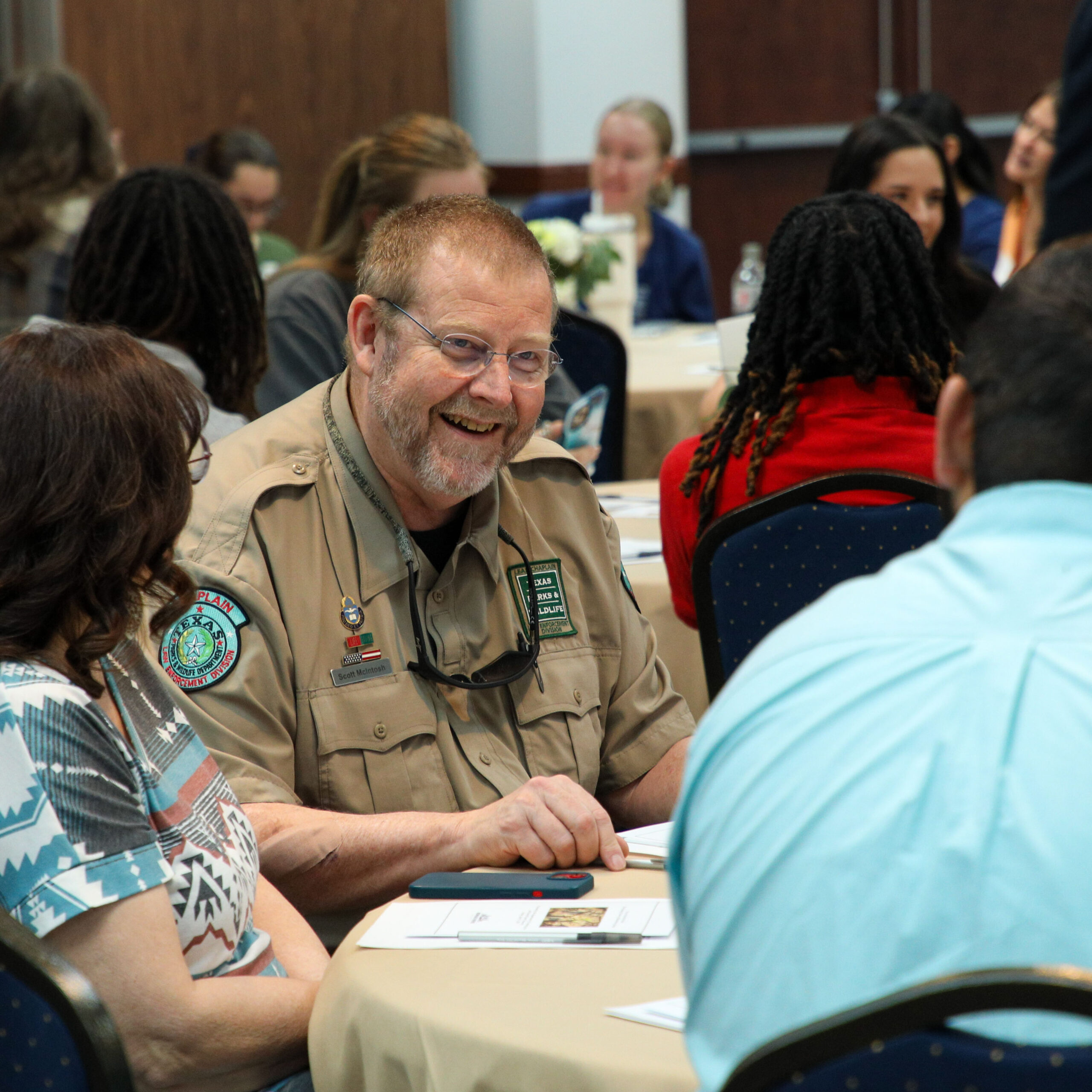
Scott McIntosh, guest speaker at HPU’s restorative justice seminar, talks with students. (Photo/HPU)

Howard Payne University’s Department of Criminal Justice recently hosted Voices from the Field, a seminar on restorative justice. The event was open to all HPU students, but focused on students majoring in social service fields, including criminal justice, social work, psychology, Christian studies and nursing. Four guest speakers presented on topics related to their respective fields. Texas Baptists’ Christian Life Commission sponsored the event as part of a larger restorative justice grant awarded to the HPU Department of Criminal Justice. Gina N. Gibbs, chair of the Department of Criminal Justice and assistant professor of criminal justice said: “Restorative justice is an approach that embraces the core values of forgiveness and accountability found in Christianity and influences several career paths. It is vital that students going into ‘people helping’ fields hear directly from practitioners and know how what is taught in the classroom may be used in future careers.” The guest speakers were Tomi Grover, presenting “Restorative Justice: Healing Community, and Accountability,” Scott McIntosh presenting “The Victim’s Side of Restorative Justice,” Lisa Medlin presenting “Restorative Justice in Action: Being Trauma Informed in Fostering and Adoption” and Michelle Salzman presenting “Handle With Care: Trauma and the Crime Victim.” Lynn Humeniuk, assistant professor emeritus of sociology and adjunct faculty in criminal justice and sociology, spoke on the history of the restorative justice emphasis offered at HPU.
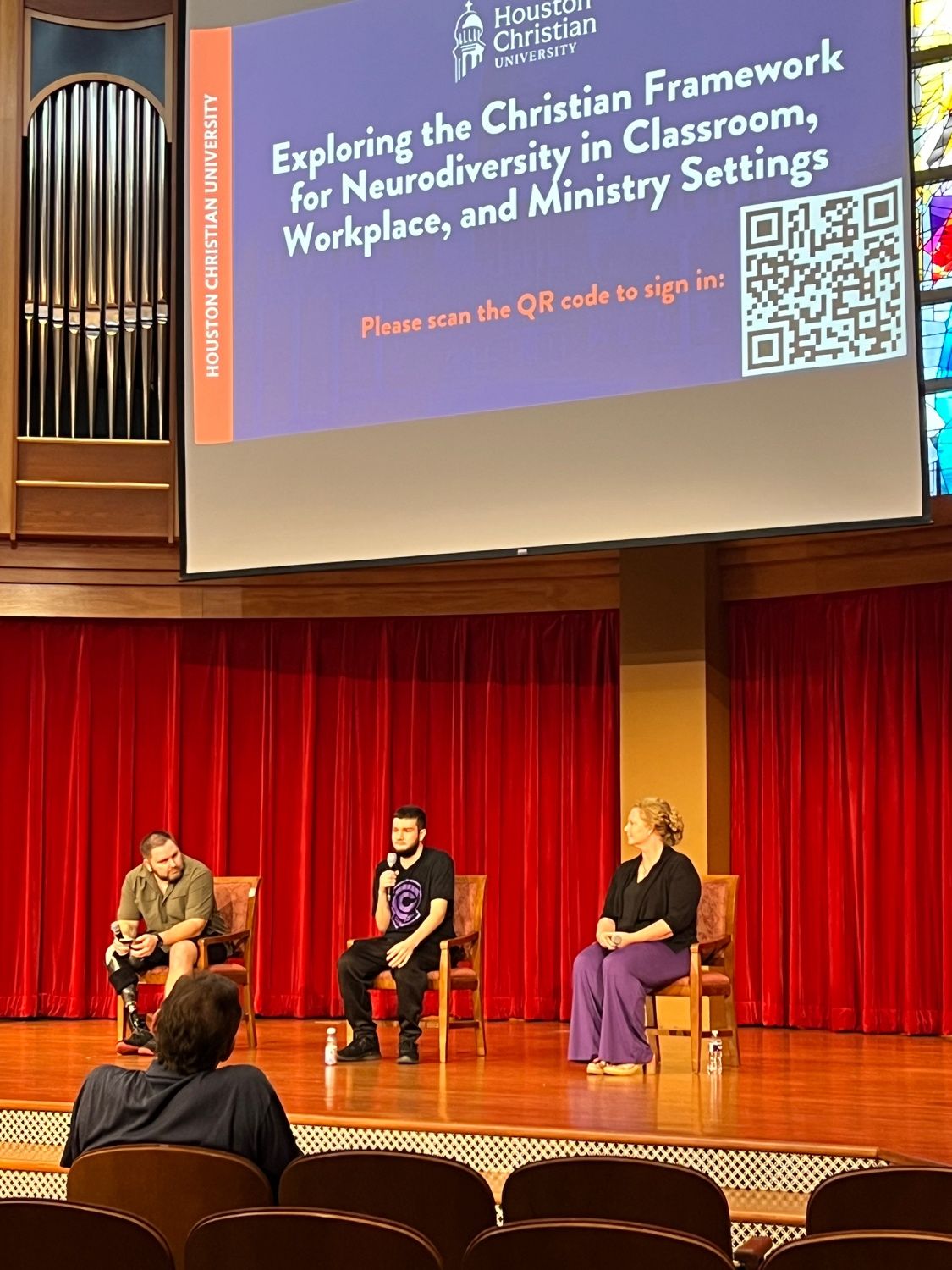
Neurodiversity panel. (Photo/HCU)

Houston Christian University hosted a half-day conference on May 7 for faculty, staff and members of the community on “Exploring the Christian Framework on Neurodiversity in Classroom, Church, and Workplace Settings.” The conference sought to offer an informed awareness of a variety of physio-psychological conditions that impact how individuals engage in educational, social and spiritual settings. It was designed to provide practical guidance about how to honor the dignity of people with neurodiversities as image-bearers of God and the unique strengths and perspectives they bring to churches and campuses. Participants heard presentations from Angie Maxey, a local expert on educational access and accommodations, from Lacey Madeley, who helps to lead Young Life’s Capernaum ministry in Houston, and from a panel of HCU alumni with neurodiversities who shared about their own experiences as students and the ways in which faculty and staff were able to support their flourishing as whole people. 

HPU’s Summer Research Symposium is scheduled for July 1 through August 5. (Photo/HPU)

Howard Payne University’s School of Science and Mathematics invites high school students to apply for admission to the second annual Summer Research Symposium, scheduled for July 1 through Aug. 5. Applications are now open and will be accepted until May 17. The symposium provides students with a paid laboratory experience prior to their attending university. This program lasts for four weeks, during which each student will partner with another applicant as well as an HPU student researching a current topic in STEM—science, technology, engineering and mathematics. At the conclusion of the research, students will present their results to their family and friends. “Participants will be able to perform one of three proposed research topics,” said Dennis Gibson, associate professor of chemistry and department chair of physical sciences. “These topics include developing an alternative to inhibit the growth of bacteria in preservative-free eye drops, extracting and testing novel fluorescent probes for understanding the formation of microplastics, and optimizing a new extraction technique of a common biopolymer.” Interested students may apply at www.hputx.edu/summerresearch.

Dan Stiver has been named president of Jesse C. Fletcher Seminary. Fletcher Seminary is an online- and San Antonio-based seminary. Established after the closure of Logsdon Seminary, Fletcher is intentionally inclusive and multidenominational. Stiver taught at Logsdon and has been teaching at Fletcher Seminary since it began. He succeeds founding president Donald Williford.

Anniversary

Literacy Connexus marked 20 years of ministry May 1. Literacy Connexus was established by Texas Baptists in 2004 to help churches help people with literacy needs. They collaborate with churches of all denominations in Texas and beyond—aspiring to give voice to the millions who struggle with speaking, reading and writing English—mobilizing churches to meet those needs. Lester Meriwether serves as executive director.



Texas Baptists provide funds for Mission Arlington clinic

ARLINGTON—Texas Baptists Executive Director Julio Guarneri recently presented $125,000 to Mission Arlington to assist with the expansion of the Bob Mann Medical Clinic.

 The growing clinic provides quality healthcare and medical education at no cost to low-income residents of the greater Arlington area. Last year, the clinic saw 4,243 patients and provided medical services to more than 12,600 people.

For many in the community who cannot afford insurance or out-of-pocket medical care, the clinic is one of few options for treatment.

Doing ‘what Jesus would do’

“Watching the doctors, nurses and volunteers come together to take care physically and spiritually of all the patients—it is what Jesus would do,” said Tillie Burgin, founder and director of Mission Arlington.

Through the years, Burgin has seen those served by the clinic receive hearing aids, wheelchairs and crutches, and other expensive medical supplies they may not otherwise have been able to obtain. Patients return reusable medical supplies to the clinic so others also may benefit from their use.

“Everything we provide is free. We charge for nothing,” Burgin said. “One of the things we say is, ‘God gave, you give, we give.’”

(Photo/Texas Baptists Communications)

Mission Arlington was founded in 1986 after Burgin and her family returned home from a decade as international missionaries. Mission Arlington began as a collaborative effort between Texas Baptists, the North American Mission Board, First Baptist Church Arlington and the Burgins.

“God put this on our hearts. After spending 10 years in South Korea, God was speaking to me, ‘Why can’t I do [missions] in Arlington?’ This would not have happened had these entities not come together,” Burgin said.

“With the support of churches, too, it became a mission that looked a whole lot like the New Testament church. … No one man could put this together. The resources being given to help us continue to grow is a statement to the community that Christ founded this place.”

A key ministry partner in community care outreach

In addition to the medical clinic, Mission Arlington has dozens of other ministries, including a dental clinic, counseling, the Christmas store, Bible studies, after-school programs, summer camps, youth rallies, school supply donations and more.

Texas Baptists long have maintained relationships with key ministry partners that engage in hunger and community care outreach, like Mission Arlington. Support for these ministry partners often has come from Hunger Offering funds and Cooperative Program-supported Community Care grants.

Last year, 100 churches supported more than 350 Mission Arlington congregations, and more than 7,000 volunteers served the community through the organization. Mission Arlington estimates more than 416,000 ministry touches and recorded more than 1,400 spiritual decisions in 2023.

A gift to ‘encourage generosity’ in others

“This gift allows Texas Baptists an opportunity to again partner with a ministry that has made a huge difference in Arlington meeting human needs, sharing the gospel in word and deed and allowing God’s kingdom to be established,” Guarneri said.

“My prayer is that it would be multiplied, that it would encourage generosity by others and that it would meet the needs of the people who need access to this clinic. May they sense the love of God as they receive medical care.”

Donations for the medical clinic expansion will provide additional non-reusable medical equipment, medicine and added personnel to accept more new patients and reduce patient wait times.

This one-time gift from Texas Baptists was drawn from non-Cooperative Program earnings on undesignated investments. More information about the clinic and ways to support it may be found online.

“We are so thankful for this gift because it expands the vision. The more of us that can partner together for the gospel, the more people will be saved. That is the one reason we do everything,” Burgin said.


Minister Connection helps match churches and pastors

Once Scott Patz and his wife Angela agreed God was leading them to move to Texas from Orlando, Fla., the long-time pastor began the usual process of putting out resumes and seeking open positions.

In early 2023, the couple settled in College Station to be near family. While his wife quickly found work at a Christian school nearby, Scott encountered a little more difficulty.

“I was sending out my resumes, but I really didn’t know too many people in Texas and no one in College Station,” Patz said. “I started working at a Christian bookstore while I was looking.”

While at work one day, Patz met a local pastor who mentioned he found his current church through Texas Baptists’ Minister Connection and explained the process. Patz reached out to Texas Baptists’ Center for Ministerial Health for assistance.

“He set me up on Minister Connection in May 2023, and in two months’ time, I had talked to a few churches and even preached at one,” he said. “While that one turned out not to be a good fit, I wanted to help them out, so I kept preaching while we both looked. I tried to set up the next pastor and prepare the church for them as well.”

The right fit

In July, Patz first heard from First Baptist Church in Van Vleck, a town of about 2,000 located 90 miles west of Houston. While he admits the church was not originally on his radar since it is two and a half hours from his home in College Station, the Patzes decided to check it out.

“We went through an interview on Zoom, and they had questions for me. In September, they called me to preach, and I accepted the position in October,” Patz said. “Really, it was about two months from getting connected on Minister Connection that it happened.”

His time at First Baptist Van Vleck has been a whirlwind, Patz said. He came on board just before the busy holiday season, followed by winter activities and, most recently, his first Easter Sunday there.

Running around 40 to 50 members when he arrived, the church has grown a bit to about 65.

Patz said he enjoys the sweet congregation and being able to build long-term relationships in the small community. He is excited to plug in and make even more connections toward ministry. He credits the ease and efficiency of Minister Connection with allowing him to find this ministry opportunity.

“I was getting the word out there, but it wasn’t until the Minister Connection that it really came through. I view it all in God’s timing,” he said. “I appreciate the program very much, and I’ve been very blessed through it. I would recommend it to anyone. It definitely gets the word out quicker.”

The church agrees

The church feels much the same. Ross Eidlebach, chair of the pastor search committee that called Patz, said the church successfully used Minister Connection a few years earlier and went there first when they found their pulpit vacant again in September 2022.

“It was very instrumental in our process,” noted Ross, who said Colorado Baptist Association first told them of the website. “I got on there and started looking at resumes and downloading some. We looked at a lot of resumes and weeded through them, contacted several and even had one come out.

“When we found Scott’s resume, we thought he might be good. One thing led to another, and it worked out great. God led us to the perfect person for our church.”

A program of the Texas Baptists Center for Ministerial Health, Minister Connection is a web platform that allows both churches seeking ministers and ministers seeking churches to share information through listings. Ministerial Health staff review, screen and password-protect approved listings. Submissions take between five days and two weeks to approve, then access to the web platform is granted.


Obituary: Vassar Compton ‘Skip’ Holman

Vassar Compton “Skip” Holman of San Antonio, former Texas Baptist minister and missions volunteer, died April 29. He was 73. He was born Aug. 19, 1950 in San Antonio. He was taken to Nixon by his adoptive parents, Florine Goodman Holman and Vassar Compton Holman Jr. He later moved to Pasadena until his mother remarried and the family moved to LaPorte, where he graduated from high school. He attended Houston Baptist University for a short time before transferring to Baylor University, where he graduated with a Bachelor of Arts degree in religion. He married Marilyn Browning on Dec. 21, 1973, in the chapel of Tidwell Bible Building on the Baylor campus. The couple moved to Leominster, Mass., as US-2 missionaries working in church starts. After completing their time as US-2 missionaries, they moved to Nederland, where he became minister of youth and activities at Hillcrest Baptist Church. While serving there, the Holmans adopted their first son, Curtis Compton Holman in 1977. The family then moved to Houston, where Holman served as a staff member of several churches including Jersey Village Baptist, Memorial Baptist and Tallowood Baptist. Holman served 22 years as pastor of First Baptist Church in Boling. While serving in Boling, Holman became active in Texas Baptist Men disaster relief, and the family adopted sons John Gary Holman and Don Yoo. He was involved in community activities such as Lion’s Club and served as a substitute teacher. He also was reunited with his birth mother Peggy Walker Drobinski and her husband Richard Drobinski, and he was blessed to become acquainted with three brothers, Larry, Chuck and Jimmy Drobinski, and three sisters, Suzanne Leritz, Julie Brookman and Sharon Schultz. After suffering a near-fatal automobile accident that left him unable to walk for three years, Holman became the Americans with Disabilities Act coordinator for Wharton County. After retiring from the church in Boling, he worked part-time as the minister of discipleship at Northeast Baptist Church in San Antonio. Holman also handled discipleship resources for Blackaby Ministries including staffing book tables at conferences and providing Bibles and materials for many people through his nonprofit Barnabas Bibles and Books. When his health made it necessary to enter long-term care, he participated in his Sunday school class by phone. This, along with his Baylor football and basketball game watch parties with Marilyn, were the highlight of his last days. He is survived by his wife of 50 years, Marilyn Browning Holman; sons Curtis Compton Holman, John Gary Holman and Don Yoo; and two granddaughters, Jasmine and Hannah Holman. Services are scheduled at 10 a.m. on May 18 at Grace Bible Chapel, 18911 Redland Road in San Antonio. Memorial donations may be made to TBM-Texans on Mission disaster relief or Gideons International.

Haitian aid workers worry donors could worsen crisis

WASHINGTON (RNS)—As the security crisis in Haiti continues, the humanitarian aid group Haiti Family Care Network is urging U.S. Christian donors to refrain from worsening the situation by donating to orphanages and to redirect their efforts instead toward initiatives helping parents support their children.

“There are actually better ways to care for the needs of children than building and supporting orphanages,” said Heather Nozea, chair of the network.

In 2021, five humanitarian organizations created Haiti Family Care Network to change how relief for children works in the impoverished, often chaotically led nation.

In 2011, the year after a 7.1 magnitude earthquake killed some 300,000, mostly around the capital, Port-au-Prince, orphanages proliferated from about 300 to 754, despite their failures to provide appropriate care for children.

“Everyone assumed that the best way to respond was by building and supporting new orphanages, and it became a solution to problems without actually addressing the real problem,” said Nozea, who has worked in Haiti for eight years for Rapha International, an organization that fights human trafficking.

Many children in orphanages have families

In many cases, parents placed their children in orphanages to guarantee they would receive consistent meals, health care and education. In some instances, children have been separated from their families simply to fill voids in orphanages, ensuring that the orphanage industry would continue to grow.

“More than 80 percent of them, they have families they can be connected to, so we prefer to call them residential care centers,” said Frédérique Jean-Baptiste, a child protection program manager for Catholic Relief Services based in Port-au-Prince.

The creation of these privately-run agencies was made possible in large part by international donations, mostly from American Christians. According to a Lumos report, Americans donated $1.4 billion in the months after the earthquake, the bulk of it from faith-based groups. American Catholics alone were responsible for some $85 million of the total.

A 2017 report by IBESR, the Haitian adoption authority, revealed that only 30 of the 754 orphanages in Port-au-Prince met minimum standards of care. The report said the vast majority presented a risk for children and recommended their immediate closure.

Reported abuse in orphanages

Jean-Baptiste said cases of physical and verbal abuse are frequent in the orphanages. The Lumos report also draws attention to the suffering endured by children with disabilities.

A childhood in an orphanage has long-lasting effects on young people’s development, Nozea said. With many rules and daily structure, children are not given a chance to develop independence, she noted.

Sometimes residents’ cognitive and personal development is slowed, Nozea said. Once they leave the orphanages to pursue life on their own, many of the young adults who grew up in orphanages show a lack of emotional, social and life skills.

Nozea said she has seen young adults unable to look after themselves and manage money.

“The biggest populations that I’ve seen struggle in Haiti are young adults coming out of orphanages, who haven’t learned the life skills that a child naturally learns as they grow up in a family,” she said.

Crisis continues in Haiti

Armed gangs now control 80 percent of the capital through acts of terror, regularly resorting to physical and sexual violence and to kidnappings. Since January, 35,000 people have been displaced due to gang violence, and 1,500 have died.

National Police patrol an intersection amid gang violence in Port-au-Prince, Haiti, Monday, April 8, 2024. (AP Photo/Odelyn Joseph)

This crisis has put additional strain on families’ capacities to provide for their children, and humanitarian workers share renewed fears that the 2010 scenario will repeat itself and more children will end up in orphanages.

In this context, the network has made efforts to convince Christian donors to shift away from funding for orphanages to focus on family-strengthening initiatives.

But since many congregations and other donors have strong ties with the agencies they support, diverting the flow of cash is difficult. Many churches regularly bring donor congregations’ representatives to visit the orphanages and meet with the children, cementing the bonds between donors and orphanages.

“When you start to learn and realize that maybe it’s not what’s best for kids, that can be a really hard thing to come to terms with. So we get that, and we’re really empathetic to that. We don’t judge people,” Nozea said.

Direct discussions with pastors and individual donors have proved to be the most efficient in these situations.

“We want to make sure that in this current crisis that Haiti is going through again, that welfare organizations or good folks who want to help do not repeat the mistakes of the past,” Jean-Baptiste said.


Amid campus protests, chaplains find reason for hope

(RNS)—Ask a college chaplain, and you’ll hear a story behind the pro-Palestinian protests on American college campuses that is more complicated—and in some ways less dire—than what you’re seeing on television or in your news app.

Media accounts of the pro-Palestinian protests and counterprotests have focused on unwelcome encampments, fights between rival groups and arrests by police.

But the conflict in Israel and Gaza and the profound issues it raises—some campus spiritual leaders say—have done what colleges and universities are meant to do: prompted them to reflect on what it means to be moral agents and to assess their own diverse faiths.

Whether students participated in encampments, prayer vigils, Shabbat rituals or supporting other students, they were growing spiritually and learning how to claim their own place in history, the chaplains said.

Janet Cooper Nelson, a United Church of Christ minister who has long headed Brown University’s chaplaincy team, said the students at the university—where encampments ended after officials agreed to vote on student demands this fall—represented a wide spectrum of beliefs.

Student events often ‘very moving’

Usama Malik is a chaplain at the Austin community-building organization Muslim Space. (Courtesy Photo via RNS)

At the large public campus of the University of Texas at Austin, Muslim students told Usama Malik, a chaplain with Austin community-building organization Muslim Space, their trust in university administrators and public officials has been damaged by aggressive attempts to clear the encampments—even as solidarity among students of different religions has increased in past weeks, often with support from local pastors, faculty and even parents.

Having seen art-making workshops, a teach-in, a Shabbat service and an interfaith prayer vigil in recent days, Malik said, “You’re really seeing a variety of things that often get missed in the way the news media has been covering the story.” The events, often student-led, are “diverse, eclectic and very moving.”

At Brown, said Cooper Nelson, students have become more involved in campus politics and their own faith issues. Those she has encountered “are prayerful, spiritually formed on the inside,” she said.

“You see the students weighing the ideas and their decisions about engaging those ideas or moving them forward, very much based on how they understand what it is to live a life that’s grounded spiritually.”

Jenn Schaaf, a Dominican sister and assistant chaplain at Yale University’s St. Thomas More Chapel & Center, said the war for many students is by no means an abstraction.

“Like the conflict between Ukraine and Russia, we have students who have relatives in Israel and Palestine. They are worried about people they know,” she wrote in an email.

“I’m grateful that our students are engaged in the religious and political sphere,” she added. “I’m also grateful that they are safe.”

Overall, the chaplains who spoke to RNS seem united in admiration for their students’ capacity to form their own opinions, make moral judgments and embrace the moment, as turbulent as it is.

‘It is my job to listen’

Janet Cooper Nelson is a United Church of Christ minister who heads the chaplaincy team at Brown University. Rabbi Jason Klein is Nelson’s chaplaincy colleague at Brown. (Courtesy Photos via RNS)

Indeed, Cooper Nelson’s colleague at Brown, Reconstructionist Rabbi Jason Klein, said while Jewish students have welcomed the chance to connect the protests to Jewish values, spirituality and practice, they don’t want to be told by outsiders what to believe about the issues at the heart of the protests.

Cooper Nelson doesn’t consider it the chaplain’s role to teach as much as facilitate students’ takeaways.

“It’s not my job to tell them what to do. It is my job to listen carefully and to try and hold up a mirror of what I hear them weighing and measuring, what they are putting out there as the ideas that seem most important to them. I think we’re acting as friends, non-judgmental sounding boards.”

Roger Landry, a chaplain at Columbia’s Thomas Merton Institute for Catholic Life, said he has attempted to focus students on helping one another.

“There’s a temptation to think that a campus demonstration on a New York campus is going to have a major impact on a 76-year-old, seemingly intractable dispute in the Middle East.

“I’ve urged them to be far more practical by doing what we Catholics do, turning to prayer and to personal care,” he wrote in an email, adding this “includes reaching out to Jewish and Palestinian friends to ask how they can support them.”

The majority of Catholics at Columbia are hardworking students who prioritize sanctifying their studies, and despite their many concerns over what has happened in the Middle East before, on and after Oct. 7, aren’t happy that the toxins of that region have been brought onto their campus,” he added.

Personal impact of chaplains at smaller schools

At smaller institutions, the war has also had an outsize effect, and the role of the chaplain has sometimes been more personal than at larger urban schools.

At Eastern Mennonite University in Harrisonburg, Va., students and faculty held a teach-in and a prayer vigil last fall and called for a cease-fire, prompted by students who had gone to Israel and the West Bank over the summer.

After more student-led action this spring, the university administration joined them in urging the U.S. government to work for a cease-fire.

Brian Martin Burkholder, the Mennonite chaplain, said he has tried to be present with the students who were on the trip who “felt compelled to speak out for those who were losing their voice and homes and land due to Israeli attacks and control,” he said.

“I’ve checked in on occasion to see how they are doing and offer a space for reflection on their experiences. I wanted them to know they were seen, supported and valued.”

“Our Anabaptist Mennonite faith tradition informs supporting one another in community as well as giving and receiving counsel,” said Burkholder.

At Indiana’s Earlham College—historically Quaker but now very diverse ethnically, economically and across faith traditions—students have focused on how they can support each other, rather than being combative, said the coordinator of Quaker and religious life, Mimi Holland. As at Yale and many other institutions, there are students who have family members both in Israel and in Gaza she said.

“I think there is something about the culture that is rooted in the Quaker way that promotes more thoughtful responses. The message of justice, bridge building, how we are all interconnected—not just as human beings but as the entire world and environment we live in … that’s very much part of our culture.

“Our students are amazing. I see young people really putting the best part of their faith forward and acting on what their faith causes them to do in kind, loving, peaceful, justice-seeking ways,” said Holland.

“I’m just gobsmacked by how caring and thoughtful they are.”


Texans on Mission volunteers keep hope afloat

RISING STAR—Homes were under water, but the hands of Texans on Mission volunteers kept hope afloat in Rising Star, a small town north of Brownwood.

Resident David Grissom experienced the heaviness of the effects of a May 3 flood as water began to fill his home. Grissom said he was in shock at the amount of water surrounding the house.

“We experienced about knee-deep water on the front porch and 8 inches of water in the house,” he said. “This has never happened before, and I’ve been here 20 years.”

A record 9 inches of rain impacted 90 percent of Rising Star’s downtown, flooding businesses, causing road damage and making parts of the town impassable.

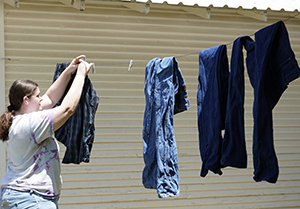
Alexis Grissom of Rising Start hangs wet clothing on a line to dry. (Photo / Taryn Johnson)

Grissom’s wife Alexis recounted the events from that night and expressed the same shock.

“The kids’ room got the worst of it,” she said. “Water was pouring in from the corners. It was tearing all of it up.”

As the water engulfed their home, David Grissom fought to get his family to safety and preserve what he could of their belongings.

“I thought I’d have to kick the window out to get out. I couldn’t get the front door to open,” he said. “I made about five or six trips into the house getting stuff out. Last trip, I didn’t think I was going to make it back out.”

The flood ruined most of their possessions. They salvaged some furniture but had to throw away much of their clothing, furniture and family keepsakes.

Texans on Mission minister to ‘stressed’ couple

The couple used one word to describe the feeling of the aftermath as they stood in the middle of their bedroom: “Stressed.”

Texans on Mission volunteers swiftly responded to the community, offering disaster relief the day after the flood.

Volunteers from Greenwood Baptist Church in Weatherford, and Wylie Baptist and Beltway Park Baptist churches in Abilene worked to replace damaged areas of the home, while the Grissoms removed items lost to the flood.

While they felt the grief of the situation, uncovering items lost one by one, Alexis Grissom said efforts from volunteers did not go unnoticed.

“We really appreciate it. I know it doesn’t seem like it, because I’m stressed out, but we really do appreciate it very much,” she said.

Helping people in Christ’s name

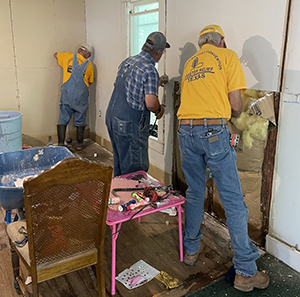
Nine pairs of helping hands carried ruined items to a trash site outside the Grissom home and removed soaked drywall and carpeting for replacement.

Texans on Mission disaster relief volunteers remove damaged drywall from a home in Rising Star. (Texans on Mission Photo / Russ Dilday)

Alan Broxon, a member of Beltway Park Baptist Church, explained the scope of their work.

“They had water damage two to four feet up the wall,” said Broxon. “We’re cutting sheetrock out, removing the insulation, and then we’re going to spray for mold. It’s in every room. It’s in the living room. It’s in the dining room. It’s in the kitchen.

“If they had a contractor come in and do it, then that would cost them a lot more than they might be able to afford.

“But it’s just helping people. And Texans enjoy helping Texans.”

After canvassing the town the day after the flood, Texans on Mission volunteers already had 15 work requests from affected families.

Clyde McMinn, Texans on Mission team leader for the Rising Star relief effort, expects volunteers to remain in the area for another week-and-a-half, providing aid to those impacted. He said an Amarillo-area Texans on Mission relief team will join the current team May 13.

Randy Stovall, a member of Wylie Baptist Church, reflected on the opportunity to bring hope to the families affected by the flood. He said doing the hard work translates into a sense of belief for citizens that things will be OK.

“When I help, I’ve always felt like you’re giving somebody some hope,” Stovall said. “Yeah, you’re doing physical stuff. You’re cutting, you’re cleaning, you’re doing all of that, but really, you’re giving them hope. And that’s what they really need.”

Guy White, another member of Wylie Baptist Church, said responding to disasters is a calling, one that requires compassion to help families persevere.

“People that come out and do this have such a good heart, and I love working with a group of men that have the same heart,” White said. “We love on [the families] and help them get through their tragedy.”


Windstorm damage leads to flooding in San Marcos church

SAN MARCOS—When damaging storms swept through San Marcos on May 9, hail and high winds caused major damage across the city, including to the roof of First Baptist Church.

Clint Followell, the church’s minister of students, reported the damage to the building in a social media post.

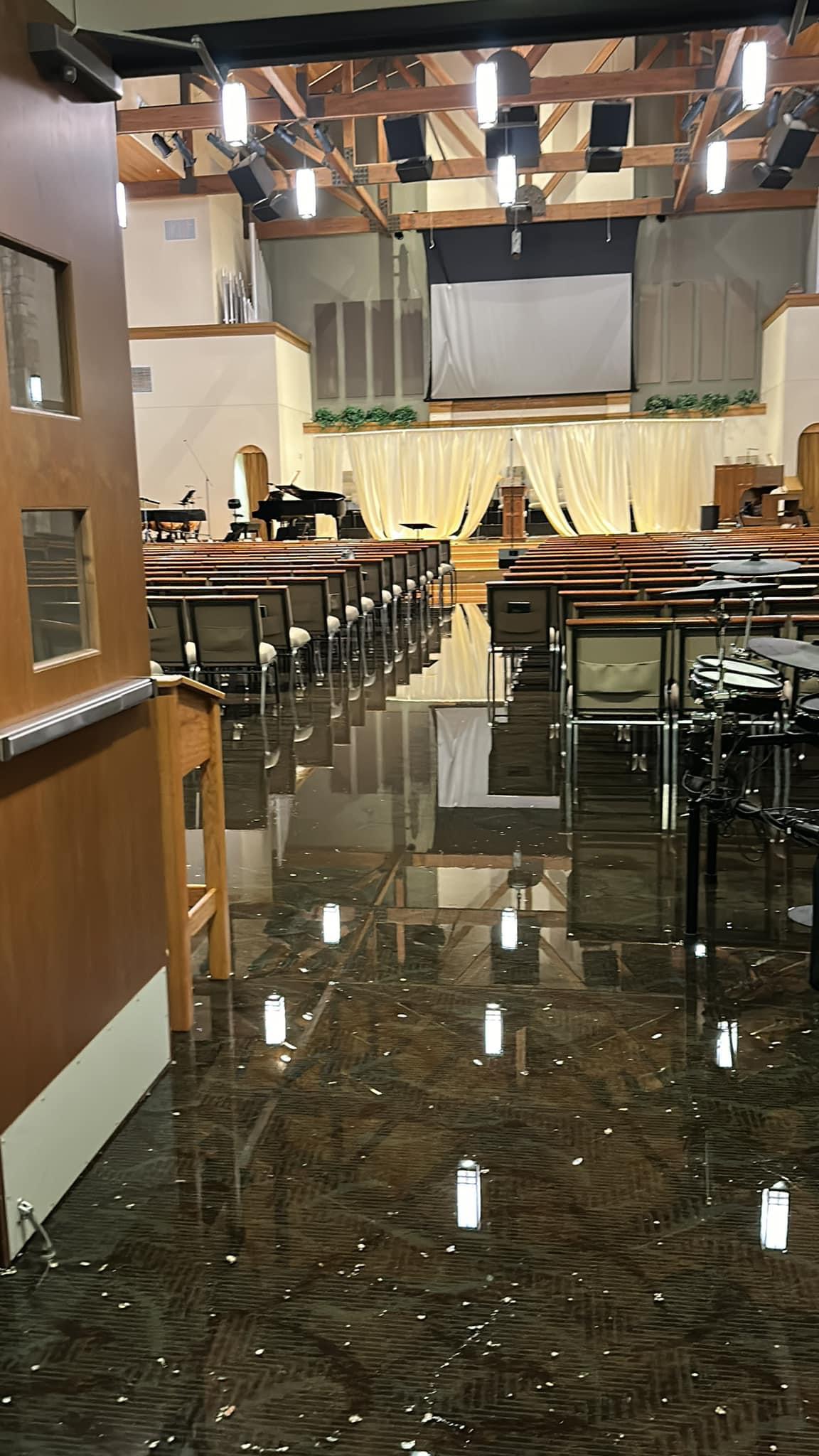
First Baptist Church San Marcos sanctuary, flooded by May 9 storms. (Courtesy photo)

Followell explained either straight-line winds or a tornado ripped off a portion of the roof, causing damage to the fire suppression system, which resulted in widespread flooding on one end of the building.

Pastor Chad Chaddick said they considered their prompt awareness of the damage as “kind of a God thing.”

He explained the church offers space to several community groups. One of these groups, a local band, was practicing on the other side of the building in the education wing. As they were leaving around 8:30 p.m., the director of the band heard the sound of rushing water coming from the sanctuary and immediately set about notifying church leaders of the damage.

Having sustained damage at his own home, Chaddick was about to get ready for bed, when he saw the calls and texts about damage to the building and headed up to church instead.

By 9:15 p.m. he had arrived at the building and had the water turned off.

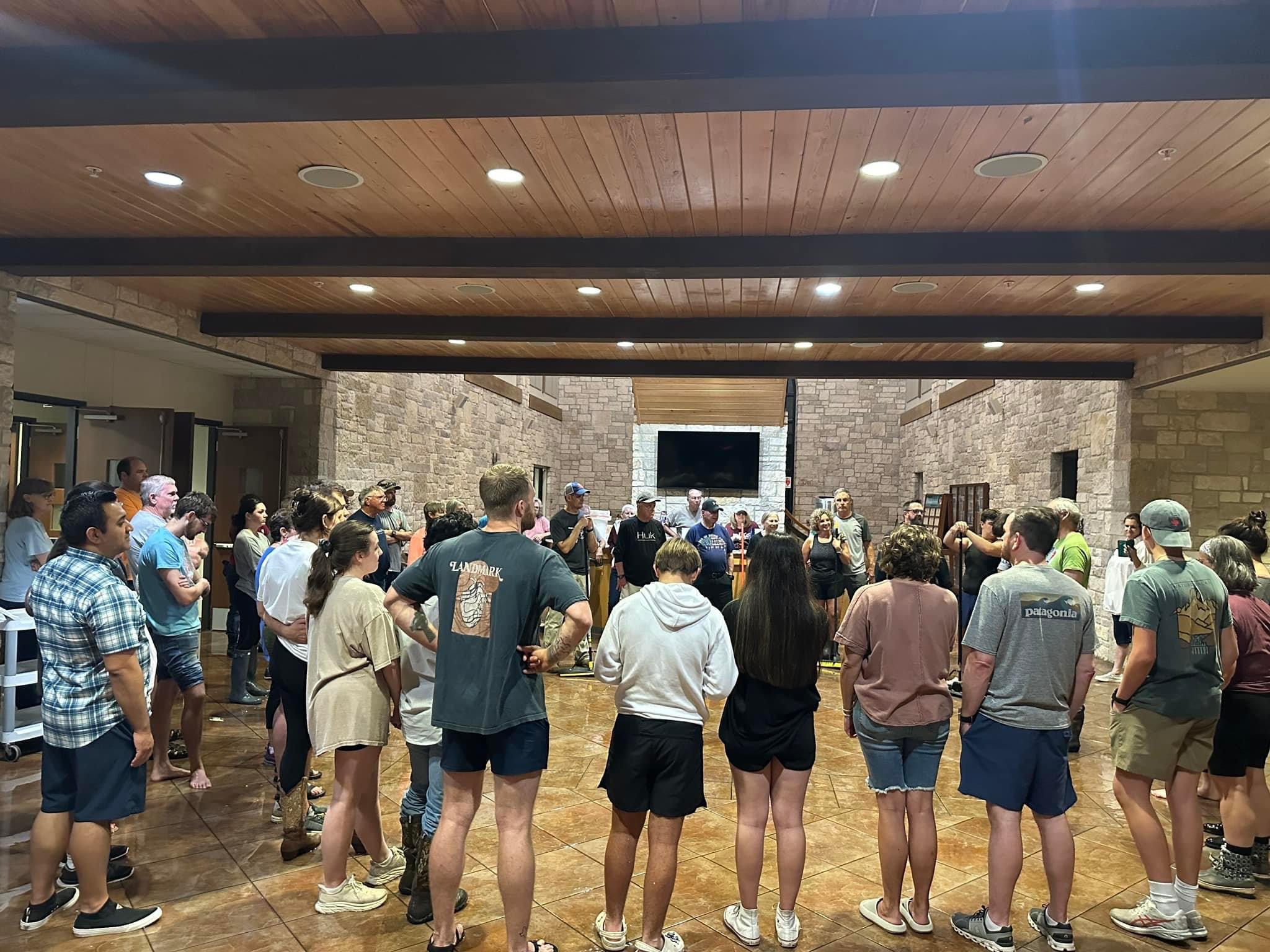
Church members sprang into action, with approximately 70 showing up to help over the course of the next hour, using push brooms or squeegees to sweep the several-inches-deep flood water out of the building, while fire alarm signals and warnings blared overhead.

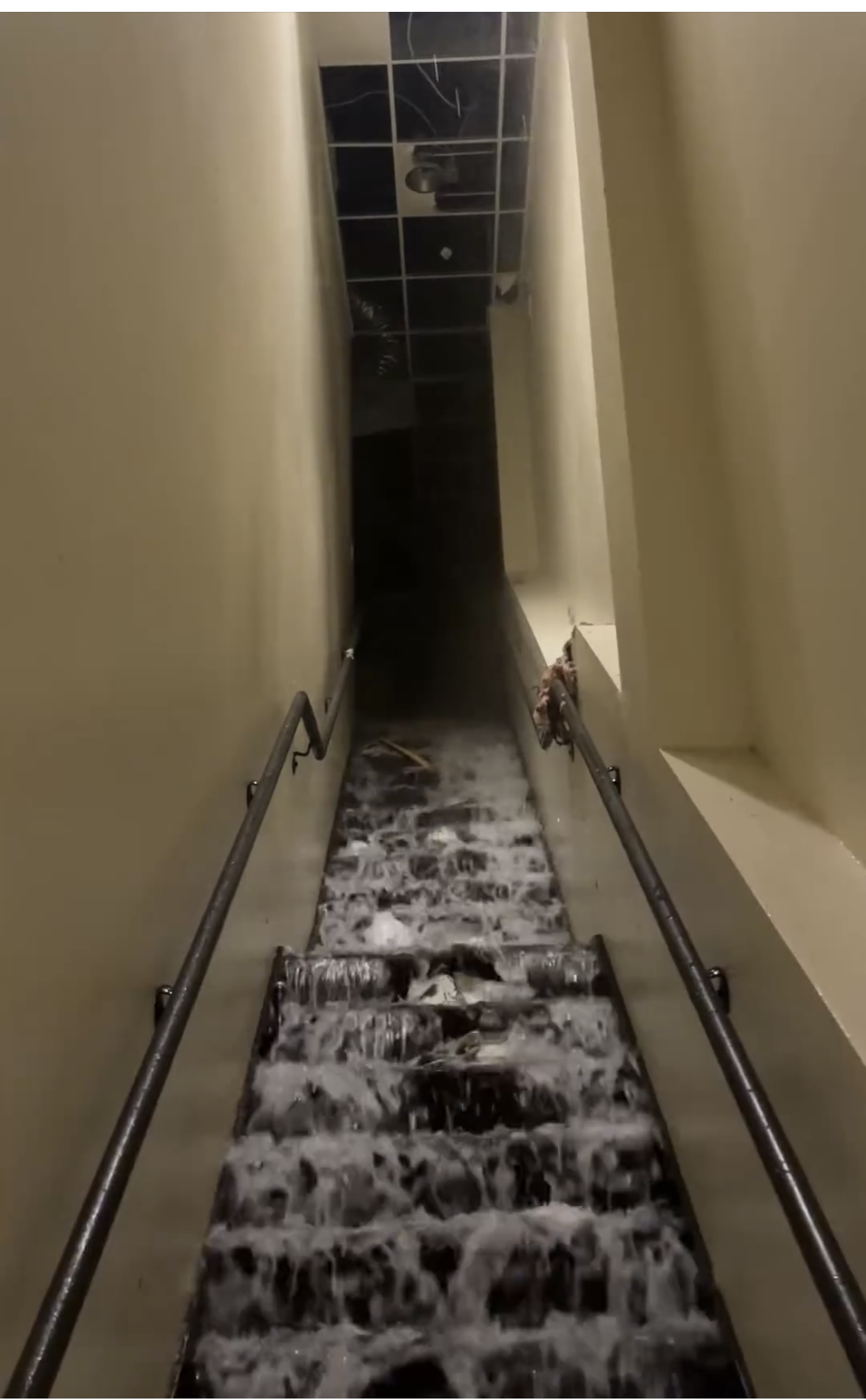
Water poured down the stairs like a waterfall, with the sanctuary, administrative offices and foyer sustaining flood damage.

Flooding staircase at First Baptist Church in San Marcos. (Social media screenshot)

Servpro was on scene by 10:30 p.m. to begin professional water removal and drying services. Chaddick personally remained at the building until around midnight, while three truckloads of Servpro crews continued working into the early morning hours of May 10.

When Servpro arrived and the First Baptist crew needed to get out of the way, Chaddick said they “circled up and reminded ourselves that it’s all just stuff. Nobody’s been hurt and the church isn’t damaged because the church is the people.”

Chaddick said it was a sweet time and may have been one of the greater times of worship, coming together to serve God alongside one another.

Only a little while before the storm came through, at 6:30 p.m., a private school in the area had been holding their end of the year concert and program in the sanctuary. Chaddick said they were grateful that by the time the storm hit, that wing of the church was empty.

While daylight was still visible the next morning through the portion of the sanctuary roof that was ripped off, Chaddick was working to get a temporary roof in place and seal off that side with plastic.

Servpro assured him they would have everything dried out enough by Sunday for services to take place, but Chaddick said they “haven’t really settled on plan B yet,” if that doesn’t work out.

Friends in the area offered to assist Followell and the church in any way they could.

First Baptist Church San Marcos flood clean-up volunteers. (Courtesy photo)

Followell said it was “going to be a long road of recovery, but Chad Chaddick’s words echo in my heart tonight: ‘It’s only stuff, only a building, and the church is not the building. We are the church.

 “‘And even in this, we praise the Lord.’”


Most Americans see no moral, spiritual good in AI

PHILADELPHIA (BP)—Most surveyed Americans don’t see a moral or spiritual benefit to artificial intelligence, new research from the American Bible Society revealed.

More than two-thirds (68 percent) don’t believe AI could be used to enhance their spiritual practices and thus promote spiritual health, the American Bible Society stated May 9 in the latest release from its 2024 State of the Biblereport.

About 6 out of 10 (58 percent) don’t believe the technology could aid in their moral reasoning, and 57 percent don’t believe AI can produce a sermon as well-written as a pastor’s original work.

Thirty-seven percent of responders even would view unfavorably a pastor who uses AI to prepare sermons, researchers found.

Scripture-engaged Christians—as categorized by the American Bible Society—expressed even more pessimism over the technology, including the digitally savvy Gen Z.

‘More fearful than hopeful’

More than half of respondents, 51 percent, believe the use of AI will increase unemployment, with Gen Z and Boomer generations expressing the belief in equal measure.

“Americans are more fearful than hopeful about Artificial Intelligence, but our survey also shows a great deal of uncertainty,” John Farquhar Plake, ABS chief program officer and State of the Bible editor-in-chief, said of the findings.

“People just don’t know how AI will change the culture, but they’re mildly uneasy about it. And how do people of faith feel? The same way—uncertain, uneasy—but more so.”

AI’s possible connection to Christian faith should be more thoroughly explored, researchers said, referencing the critique given by Carey Nieuwhof and Kenny Jahng in their December 2023 book, The Ultimate Guide to AI, Pastors, and the Church.

“The question for church leaders becomes not whether the church will embrace AI, but how the church will embrace AI,” Nieuwhof and Jahng write. “History would tell us that ignoring technological revolutions probably isn’t the wisest choice and AI is no exception. Leaders who ignore the future have a hard time doing ministry in the future.

“But embracing AI fully without thinking through the theological, ethical and existential questions of AI poses difficulties too.”

The findings are included in the 2024 State of the Bible’s second chapter, titled “Faith and Technology.”

Examining online worship

In addition to AI, the chapter focuses on how online church worship is embraced and how it impacts Christians.

The chapter references Lifeway Research from 2020, that showed 97 percent of U.S. churches were putting their services online. At that time, 67 percent were livestreaming and others were providing access to videos for later viewing.

Past the pandemic, in-person worship is rebounding, ABS said, with 75 percent of respondents primarily attending worship in person in 2023, 14 percent worshiping primarily online, and 12 percent using both formats equally.

The findings contrast to 2020, when 38 percent primarily worshiped in person, 45 percent primarily online, and 17 percent used both formats equally.

Gen X and Gen Z are more likely to attend in person, with Millennials and the Boomers-plus generations choosing online worship more often.

Still, a majority of all age groups primarily attend worship in person, including 82 percent of Gen X, 78 percent of Gen Z, 71 percent of Millennials and 70 percent of Boomers-plus.

In-person worship is also more popular among those who attend service weekly and among white Americans, researchers found.

Echoing findings from 2023, researchers said online worshipers are more Scripture-engaged than those who attend in person. Most (81 percent) of online worshipers are more likely to read the Bible on their own, researchers said, compared to about two-thirds of those who primarily worship in person.

State of the Bible is based on a nationally representative survey conducted for the American Bible Society by NORC—previously the National Opinion Research Center—at the University of Chicago, using the AmeriSpeak panel. Findings are based on 2,506 online interviews conducted in January 2024 with adults in all 50 states and the District of Columbia.


Waco church works alongside local agencies to meet needs

Some children go without meals, sleep on the floor and have nobody to read to them. Meadowbrook Baptist Church in Waco is working to change that.

“Meadowbrook has always had a heart for missions since its beginning in 1959,” Pastor Cary

Killough said.

One of the larger missions the church is involved with is Sleep in Heavenly Peace of Waco, a nonprofit organization that provides wood and tools to build beds for children, ages 3 to 17.

 “Here in McClennan County, we have over 4,000 children who do not sleep in a bed at night,” said Amy Castello, missions and family pastor at Meadowbrook Baptist Church.

“Sleep in Heavenly Peace started because they realized that for a child to do well in school, they need to be well-rested. That’s hard to do if you’re sleeping on a couch, floor, or in a bed with two or three other siblings.”

‘Walk alongside other ministries’

The church became involved with Sleep in Heavenly Peace Waco a few years ago when the organization started its Waco chapter.

“I felt strongly when I felt called to be a mission’s pastor, that our main job is to walk alongside other ministries and agencies that are doing things well,” Castello said. “We don’t necessarily have to create our own thing but to collaborate with other people.”

In September 2023, Meadowbrook sponsored a bed build event for the organization in which local volunteers built 30 beds and provided bedding for them.

At the end of the bed build event, Meadowbrook offered to let Sleep in Heavenly Peace use their church in another way. The church’s youth group had moved from an old wing of the church to another facility, leaving that building empty.

Volunteers work at a community bed build event Meadowbrook Baptist Church in Waco hosted for Sleep in Heavenly Peace. (Courtesy Photo)

“So, Sleep in Heavenly Peace asked if they could use it, and we said, ‘yes,’” Castello said.

Sleep in Heavenly Peace of Waco uses the building to house its tools, and the group holds a community build event there once a month.

Christopher Taylor, chapter co-president at Sleep in Heavenly Peace of Waco, said working for the organization has been a blessing in many ways.

“To me, the best thing in the world is to go and deliver the beds,” Taylor said. “To go in there and see the kids’ smiles on their faces when they get a bed, to know what this means to them, it is a true blessing to do that.

“In addition to that, I love getting to do what I believe God has called us to do, and to be able to partner with many other like-minded people that just want to serve him and serve others.”

‘Part of the passion and calling of God’

Meadowbrook Baptist Church also partners with other local ministries, such as Shepherd’s Heart Food Pantry of Waco. On the second Friday of every month, the church hosts a mobile food distribution in their parking lot.

At least twice a year, the church hosts Meadowbrook Loves. The event helps the ministries and agencies the congregation supports by sending them volunteers to finish projects.

Church volunteers also work with a local elementary school to feed kids when school is not in session, along with supporting Christian Women’s Job Corps, Beloved and Beyond Camp, and other local ministries.

“We believe missions are part of the passion and calling of God for our church—or any church, for that matter,” Killough said. “Our family here at Meadowbrook loves to give to—and be involved in—missions.”

Emily Hughitt, a student at Howard Payne University, served during the spring semester as an intern with theBaptist Standard.


Christian presence quickly dwindling in Gaza

GAZA CITY, Gaza Strip (BP)—At Easter, Gaza Baptist Church leader Shady Al-Najjar described those sheltered in the church’s remnants as “too tired to suffer,” living “very difficult” and “useless” days.

Since then, Al-Najjar has fled to Egypt, and the Israel Defense Forces set up shop in what remains of the church compound damaged in the war, former church pastor Hanna Massad told Baptist Press May 8.

Al-Najjar is among many Christians who are fleeing Gaza with a renewed vigilance, International Christian Concern said as the Israel-Hamas War enters its eighth month, speculating whether any Christians would remain.

 “They are faced with the dilemma of staying and helping others rebuild or leaving to join relatives abroad and start a new life elsewhere,” ICC said in a May 6 press release. “For now, many are deciding to leave.”

The organization estimated 25 percent to half of the 900 to 1,000 Christians who lived in Gaza before the war have fled, and an additional 25 percent are applying to leave.

Israel’s occupation of the Rafah border crossing threatens safe passage to Egypt. Thousands of displaced Palestinians are fleeing Rafah for Deir el-Balah about 12 miles north, Al-Jazeera reported, and were straining a scant supply of fresh water.

Few Baptists left in Gaza even before the war

Gaza Baptist Church, established by Southern Baptist missionaries in 1954, was rebuilt in 2006 to include a six-floor compound across the street from a Gaza police station in Gaza City. (File Photo)

Only a handful of Baptists lived in Gaza City before the war, Massad said, as most Christians there fled when Hamas violently seized control of Gaza and the West Bank in 2006-2007.

While 50 typically would attend services at the church when he visited before the war, Massad said, many of them were not church members. Most Christians there are either Orthodox or Catholic.

Massad estimates 200 Christians already have fled, and perhaps just as many are rushing to get permits to leave.

“It’s really hard to know,” Massad said, as those who leave usually give short notice to others in the community. “Many people in the Christian community expressed they want to stay in Gaza,” he said, referencing an update from a Catholic church leader in Jerusalem.

With their homes and livelihoods stolen by the war, Christians had found refuge in the Greek Orthodox Church of Saint Porphyrius and in The Holy Family Church, a Catholic congregation. Gaza Baptist Church, located across the street from a police station that IDF likely would target, had remained a last resort.

But deteriorating conditions in Gaza, including famine in the north and increasing food insecurity elsewhere, are making it more difficult to remain in the area.

More than 34,000 have died in Gaza in the war and more than 78,000 have been wounded, the Hamas-run health ministry said May 7.

The death toll in Israel, first set at nearly 1,400 from Hamas’ Oct. 7 attack that launched the war, was officially set at around 1,200 in February, based on Israel’s tabulation. More than 8,700 were wounded. Of the 132 hostages Hamas continues to hold, 38 are believed dead, the international i24 News reported May 8.

Massad, founder and president of Christian Mission to Gaza, sends monetary support to Christians sheltered there—coordinating the distribution of goods through shop owners—and provides hot meals when able.

He’s hopeful a Christian presence will remain in Gaza. There are no other Baptist churches there, but several Catholic and Orthodox congregations are on the West Bank and in Bethlehem City.

“It’s hard to know,” he said. “I suspect at least a few hundred will be there.”


On the Move: Rhodes

Scott Rhodes to Golinda Baptist Church in Lorena as pastor.