On the Move: Covey
James Covey to First Baptist Church in Helotes as pastor, June 1. Covey, a lieutenant colonel, will retire from 22 years of service as an army chaplain in June.
James Covey to First Baptist Church in Helotes as pastor, June 1. Covey, a lieutenant colonel, will retire from 22 years of service as an army chaplain in June.
WASHINGTON (RNS)—Two sociologists wrote a book in 2000 about the fraught efforts of white evangelicals to diversify their congregations to better address racial discrimination in the church.
Now, one of those authors, Michael Emerson, has teamed up with another sociologist, Glenn Bracey, for an update. And their conclusions are grim.
The Religion of Whiteness: How Racism Distorts Christian Faith suggests as many as two-thirds of white Christians in the U.S. have elevated whiteness to a religion itself, one that rivals Christianity.
It’s a controversial claim but one the authors support through interviews with Christian church leaders, many of them Black, about the state of race in the church, as well as national surveys they conducted over the past few years.
Emerson and Bracey depict a Christianity that effectively worships the white race with a white Jesus at its center and a set of sacred symbols, including the flag (both the U.S. flag and sometimes the Confederate flag), the cross and, increasingly, guns.
Though their churches may be slightly more racially diverse, this religion of whiteness strives to maintain whites at the top of the racial hierarchy as part of God’s ordained order.
Religion News Service spoke to Emerson, a fellow in religion and public policy at Rice University, and Bracey, an assistant professor of sociology at Villanova University, about their bold conclusions. The interview has been edited for length and clarity.
You’re not using the word “religion” metaphorically in this book. You’re actually saying there is a religion of whiteness. Explain how you mean it.
Emerson: This is hard for people to understand, but we’re saying we cannot make progress in our country on race until we understand the depth of what it all means.
It is wrapped literally in a religion that has all the markers of the way we define religion. It’s a unified system of beliefs and practices that worships or sacralizes, not some God in this sense, but whiteness. Whiteness is the god. It declares that everything else that isn’t supporting whiteness is profane; it’s wrong; it needs to be shunned.
Bracey: And when we say whiteness, we’re talking about the dominance that white people enjoy over people of color. So, it’s not as though someone is saying, “I attend the Church of Whiteness.” It’s that they find themselves caught up in the worship of the dominance that white people enjoy.
As you say, this religion doesn’t call itself a Church of Whiteness. Why not?
Emerson: There’s a couple of rhetorical moves that are made so you never have to actually name it. One of them is that Jesus is white, and Jesus by definition is supposed to be for everybody.
So, Jesus is universal. So, as long as Jesus is white and Jesus is universal, then whiteness is universal. And once you do that, you no longer have to name it, because that is truth. Anything else, is an argument against truth.
You also point out that churches across the country are becoming more diverse. You mention that 20 percent of Christian churches are racially diverse, up from 6 percent in 2000. Doesn’t that argue against a religion of whiteness?
Bracey: So, that’s a very good question. It’s important to note that 80 percent of the churches are still homogeneous. The difficulty is, the whiteness of the church can remain, even when the church is not entirely white.
White evangelical churches in particular have race tests to either exclude people of color or make sure that people of color will support whiteness in the way that the church wants it supported.
So, those tests, I call utility-based tests, to tolerate and support these performances of white dominance. Those race tests are working. They’re doing a good job of filtering out people who would disturb the worship of whiteness in those churches.
Describe how these tests work.
Bracey: I went to seven churches across four different states, all majority white and evangelical. In one church, I was asked on my first visit to go up on stage and sing, even though I have no history of singing in churches.
In another church, I was asked if I wanted to adopt a biracial baby, because this child had a biracial family and the father who was white had left, and they were looking for someone to step in and be a father.
Other times, there were exclusionary tests and the exclusionary tests are really obvious and painful. I went to a Bible study, segregated by sex. So, I was in the men’s group, the men’s group was about eight people including six white men and a Latino man and me. It was his first time as well. They introduced themselves by saying what their names were and what their favorite gun was, and how recently they had shot it. So, they established a gun culture, dominance and a sense of threat.
And at one point, the host of the Bible study stands up and says: “I don’t know what the name of my favorite gun is. I just know when I shoot it, it goes chink, chink, chink. So, I call it my China gun.”
So, without saying anything overtly, there was a performance that let you know the space was dangerous for people of color. It was racially stereotypical and hostile. If you were going to stay, you had to be willing to put up with the kinds of behaviors that established this space as a very white dominant space.
You also did some surveys to better define the belief systems of churches that practice the religion of whiteness. How did you get at whiteness in those surveys?
Bracey: We have a set of survey questions that ask people, do you think the Bible should be followed under all circumstances? The people who say “always” are the only people that we then ask follow-up questions.
The Bible says not to speak unwholesome words. And so, it’s wrong to curse. The majority say you should not curse. But then when we ask things that are racially inflected—how to treat immigrants, how to treat racial minorities within the church—then they abandon their Christian commitment to the Bible and show a commitment to something else. And that something else is whiteness.
Some Blacks have embraced this religion of whiteness. How do you understand that?
Bracey: A lot of people get involved with the religion of whiteness, not because they’re attracted to whiteness, but because they’re attracted to the authentic or the real. Because whiteness is considered real, they come to think that real Christianity is what white folks say it is.
People are attached to dominant things. There’s a lot of psychological benefit, in addition to monetary benefit, from being a person of color in the religion of whiteness. People are constantly telling you you’ve done the right thing, you’ve broken from what they would say is the Democratic plantation, you are serious about faith, you put God before race. Frankly, that is enough to sustain a lot of people.
How is there a monetary benefit?
Bracey: I’ll give you an example. (Earlier in my life) a pastor took me to meet one of the Republican members, a Black Republican in our county and recruited me to run for office. And he said plainly, if you want to be a Black Democrat, there’s a million of those. But if you want to be a Black Republican, we’ll give you a lot of money and attention and air time. So, there was a material offer put there.
How did you two scholars find each other?
Emerson: My earlier book, Divided by Faith, focused on white evangelicals. At that time, evangelicals were considered to be making a big change, bringing race into the conversation, advocating racial reconciliation.
In the book, I show there are particular ways of understanding the religion that actually makes matters worse. I argue these churches have three main religious cultural tools that they use: individualism, personal relationships and an antistructuralism that does not allow them to understand issues of race and racial inequality and what the solutions would be.
When we met, Glenn asked me, “Did you ever wonder if maybe it isn’t by chance that white evangelicals have these three cultural tools that just happened to not allow them to see what race really is?” I thought, “OK, I’ve got to work with this man.”
What’s been the response to your findings?
Emerson: I get two extreme reactions. I literally can hear crying in the audience, usually people of color, sometimes clapping, cheering and then some really serious questions: What is my motive? Am I a Christian? What has happened to me? These are coming mostly from white folks really who are very, very angry.
Bracey: If I am attending a church that’s practicing the religion of whiteness, they’ll obfuscate in the way that Michael described. There’s a “not me” syndrome happening. I would just invite people to think a little longer and see where their attachment to white Jesus is. How strong is it? Where would they find themselves in the book?
Howard Payne University recently received $25,000 in scholarship funds from TexasBank through the James and Dorothy Doss Foundation. The contribution was provided as a part of the Doss Foundation, TexasBank Scholars—Heart of Texas Scholarship Fund, established to help area students attend HPU. This year’s scholarship recipients are Bailee Bachtel, Addie Carroll, Chase Churchwell, Zachary Ellis, Brady Furry, Austin Gray, Zachary Hallman, Travis Holleman and Jaxon Hermesmeyer. To be considered for this scholarship, students must have graduated from a high school in one of the following counties: Brown, Callahan, Coleman, Comanche, Eastland, McCulloch, Mills or San Saba. Students should be juniors or seniors pursuing a degree in HPU’s School of Business and specializing in finance or accounting. More details on criteria are available from HPU’s Office of Financial Aid. Admission applications are still being accepted for the fall 2024 semester at Howard Payne University.

Cicely S. Jefferson has been named dean of the College of Business at Dallas Baptist University. Prior to serving at DBU as assistant dean of the College of Business and assistant professor in business law, Jefferson was an attorney for the Department of Homeland Security and the Social Security Administration for more than 15 years. Jefferson litigated employment law cases before the Equal Employment Opportunity Commission, Merit Systems Protection Board and Federal Court. As an assistant regional counsel for the Social Security Administration, she litigated social security disability and employment law cases and successfully argued cases before the Eighth Circuit Court of Appeals. Jefferson also handled Title IX cases as an investigator, representative and deputy Title IX coordinator. Jefferson earned a Master of Business Administration degree and a Doctor of Jurisprudence from Texas Tech University. She then completed her doctoral degree in Philosophy of Leadership Studies at DBU. She was ordained to the ministry by Concord Church, serving full-time on staff as connections pastor for seven years, and regularly serves as a resource to others by mentoring student-athletes and young women, providing pro bono legal services to those in need and volunteering in her church.
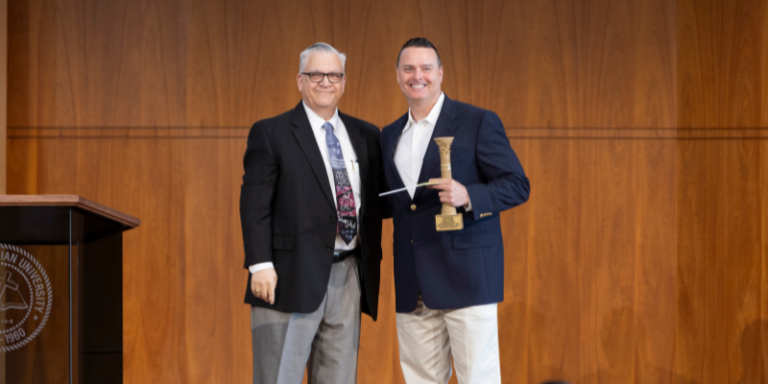
Houston Christian University has named Mark D. Gaus as the 2023-2024 Opal Goolsby Outstanding Professor of the Year. Gaus is a professor of kinesiology in the Linda Dunham School of Nursing and chair for the department of kinesiology at HCU. Named in honor of Opal Goolsby, a faculty member who taught English and French at Houston Baptist College, the award recognizes the best teaching on the HCU campus. Goolsby was a member of the college’s original faculty in 1963. A selection committee with representatives from the Student Government Association, the faculty professional development committee and the provost’s office examined the record of accomplishment for each nominee and selected the faculty member who best represented the ideals of outstanding teaching.

Four Howard Payne University students were selected as Sumners Scholars by the Sumners Foundation: Madeline Duncan, Kellen McKee, Addison Roden and Adrielle Sloan. Sumners Scholars receive a $7,500-per-semester scholarship from the Sumners Foundation for tuition, fees, books or room and board, alongside unique opportunities to hear from congressional and civic leaders at various events and seminars. Duncan, of Abilene, is majoring in psychology. McKee is from Azle and majors in biomedical science. Roden, a Magnolia native, is majoring in finance. Sloan, from Blue Ridge, majors in strategic communication. All four students are in the Guy D. Newman Honors Academy. Each year, the Sumners Foundation selects students who best represent the foundation’s mission and legacy to participate in the program. The foundation’s purpose is to “encourage the study, teaching, and research into the science and art of self-government, to the end that the American people may understand the fundamental principles of democracy and be guided thereby in shaping governmental policies.” For more information about the Sumners Foundation, visit www.sumnersfoundation.org.
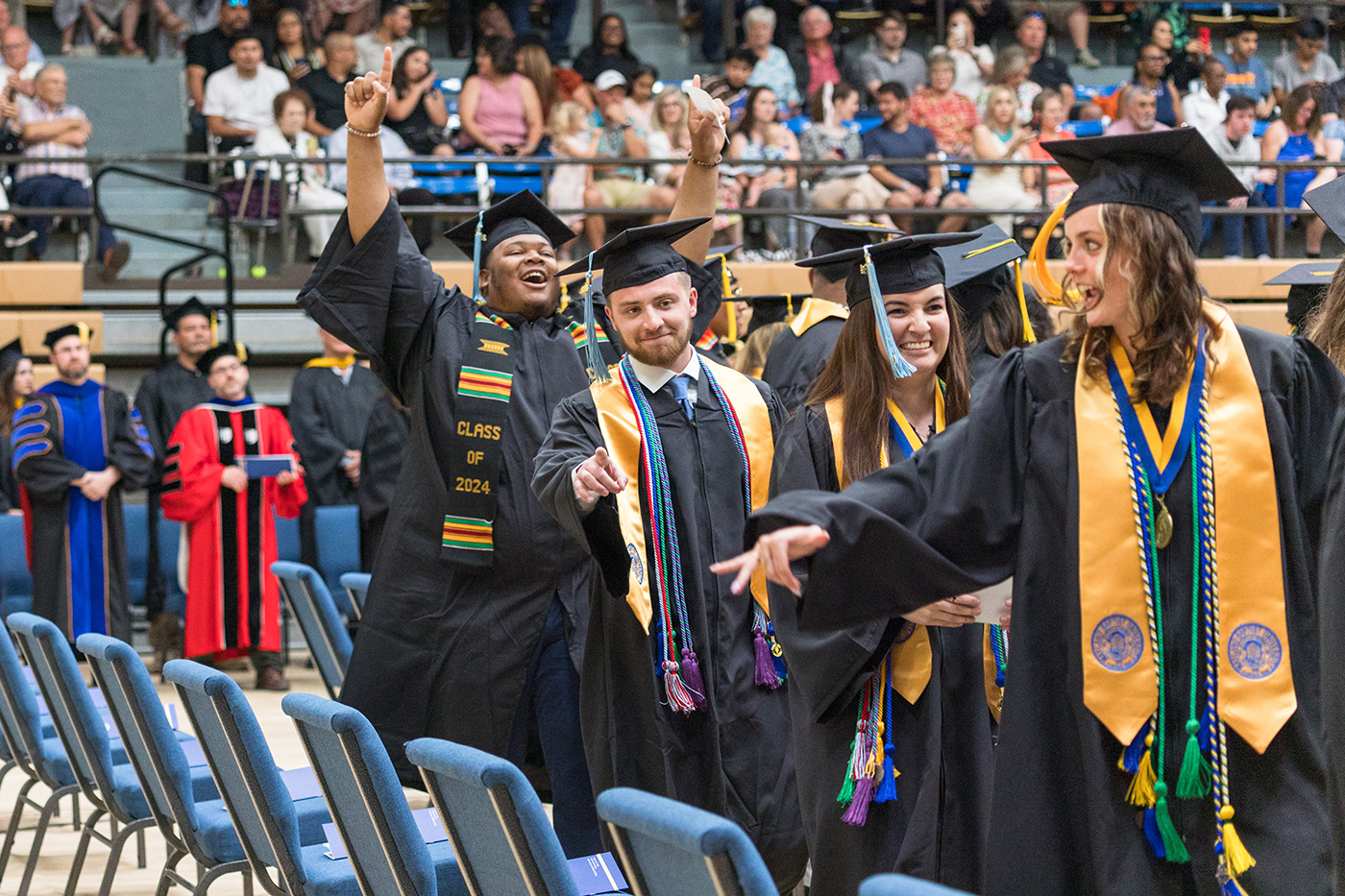
Ninety-eight Wayland Baptist University students participated in commencement ceremonies May 18 on the university’s Plainview campus. Cindy McClenagan, vice president for academic affairs, presented the candidates for degrees to President Bobby Hall, who conferred degrees, assisted by Mark Jones, chair of Wayland’s board of trustees. Luke J. Brockway, a graduating senior from Kilgore, gave the student address, and Dylan Lee Jerden, a graduating senior from New Deal, read Philippians 1:6. Paten Czarina Denton, a graduating senior from Conway, Ark., led prayer, and Aubrey Jaramillo, a graduating senior from Clarendon, gave the benediction. Seven students received doctoral degrees, 17 students received master’s degrees and 74 students received bachelor’s degrees. There were 66 candidates for graduation from Texas, including 12 from Plainview.

Howard Payne University recently celebrated its most recent graduates with commencement ceremonies on May 11. HPU President Cory Hines and other university representatives conferred the degrees. An honorary Doctor of Divinity degree was presented to Ray Still, senior pastor at Oakwood Baptist Church in New Braunfels and former HPU trustee. Draco A. Miller, who serves on the Brownwood City Council, presented the charge to the graduates. Commencement was preceded on May 10 by the Chime Out ceremony, an HPU tradition in which graduating seniors pass a chain of ivy to underclassmen, symbolizing the passing of authority, responsibility and privileges to those students who remain on campus to carry on the traditions of the university.
Jessalyn Brown was awarded one of four Addie Davis Scholarships by Baptist Women in Ministry. Brown is a preacher and poet from Lexington, Ky. She is a graduate of Georgetown College where she received a Bachelor of Arts Degree in American Studies and Theatre & Film Studies. She is heading into her final year at Baylor University’s Truett Theological Seminary, where she is pursuing a Master of Divinity degree. She also serves as a resident chaplain for undergraduate students in Heritage House, a fine arts residential community at Baylor. Learn more about the scholarship here.
During their recent graduation ceremony, Scott Jones, pastor of First Baptist Church Rockport and Baptist Standard board member, was honored as Faculty of the Year by Stark College & Seminary for his role as both pastor and Stark adjunct faculty member.
Cory Hines, president of Howard Payne University, was recently recognized for five years of service.
Isaiah Baba to the gospel ministry by Emmanuel Baptist Church in Waco on May 12. Pastor Marcelo Oliveira and Emmanuel Baptist Church held an ordination council for Baba, a new Truett Theological Seminary graduate. Baba originally is from Ghana. Through Zoom, his father, Pastor Elijah Baba, was able to participate from Ghana in the ordination process for his son.
.
WASHINGTON (RNS)—A former Southern Baptist seminary professor and interim provost has been indicted on a charge of obstructing justice in a sexual misconduct case, the Department of Justice announced May 21.

Matt Queen, who was previously an administrator and professor at Southwestern Baptist Theological Seminary, allegedly gave the FBI falsified notes during an ongoing investigation into alleged sexual misconduct at the Fort Worth seminary. He was arraigned Tuesday, according to the DOJ.
“As alleged, Matthew Queen attempted to interfere with a federal grand jury investigation by creating false notes in an attempt to corroborate his own lies,” said U.S. Attorney Damian Williams of the Southern District of New York in a statement.
“The criminal obstruction charge announced today should exemplify the seriousness of attempts by any individual to manipulate or interfere with a federal investigation.”
Queen, who was named pastor of Friendly Avenue Baptist Church in Greensboro, N.C., earlier this year, could not be reached for comment.
The indictment is the first official acknowledgment by the DOJ of an investigation into the Southern Baptist Convention and its entities. Southern Baptist leaders announced in 2022 that they had been subpoenaed by the Department of Justice and promised to cooperate.
News of the DOJ investigation followed the release of a report from Guidepost Solutions showing SBC leaders had mistreated abuse survivors for years, denied responsibility for the actions of local churches and downplayed the number of sexual abuse cases in the nation’s largest Protestant denomination.
Earlier this year, the SBC’s Executive Committee announced the DOJ’s investigation into the committee was ended, leading to confusion. The Executive Committee later issued a statement saying the DOJ’s investigation into the SBC and its entities remained open.
In a statement Tuesday, the DOJ gave more details about the investigation.
“Since approximately 2022, the U.S. Attorney’s Office for the Southern District of New York (‘U.S. Attorney’s Office’) and the FBI have been investigating allegations of sexual abuse and misconduct related to a national religious denomination (the ‘Denomination’) and its affiliated entities, and the alleged cover-up of such allegations by individuals and entities associated with the Denomination,” according to a statement.

As part of that investigation, Southwestern was required to give any documents about abuse to the FBI. However, according to the DOJ, a seminary official received a report of alleged sexual abuse by a student in the fall of 2022. That alleged abuse was reported to the school’s campus police, though not to the FBI, but no other action was taken.
A Southwestern staffer, referred to as “Employee-1” by the DOJ, later was told by a Southwestern leader (Employee-2) to destroy a document about the incident and the seminary’s inaction, according to the DOJ.
Queen was allegedly in the room with Employee-1 when this happened, but allegedly told the FBI in an interview that he had not heard Employee-2 say to destroy the report.
He subsequently produced a set of fake notes from the meeting, the DOJ alleges, which he presented to the FBI in June 2023—but he gave conflicting stories about when the notes were written, later admitting the notes were fake.
“On June 21, 2023, Matthew Queen testified under oath that he had in fact heard Employee-2 direct Employee-1 to make the Document ‘go away,’” according to the DOJ.
The 49-year-old Queen could face up to 20 years in prison after being charged with one count of falsification of records.
“Matthew Queen, an interim provost, allegedly failed to inform the FBI of a conspiracy to destroy evidence related to the ongoing investigation of sexual misconduct and instead produced falsified notes to investigators. Queen’s alleged actions deliberately violated a court order and delayed justice for the sexual abuse victims,” said FBI Assistant Director in Charge James Smith.
“The FBI will never tolerate those who intentionally lie and mislead our investigation in an attempt to conceal their malicious behavior.”
Southwestern said the student involved in the alleged abuse was suspended and later withdrew from the school. The seminary also stated it reported the matter to the DOJ as it was required to do.
The school said the alleged actions described in the indictment were “antithetical to the values of the seminary.”
“After the seminary learned of Queen’s actions in June 2023, he was immediately placed on administrative leave and resigned as interim provost,” the school stated. “All employees alleged to have acted improperly in this matter are no longer employed by the seminary.”
Southwestern, once one of the nation’s largest seminaries, has fallen on hard times in recent years. Last year a report from the school’s leaders detailed years of financial mismanagement, including overspending its budget by $140 million over 20 years. The school’s former president, who left in the fall of 2022, is suing the school for defamation.
The school also settled a lawsuit in 2023 with a victim of Paul Pressler, a leader of the “conservative resurgence” in the SBC, and in 2021, sued to regain control of a Texas foundation that had been taken over by former staffers, who allegedly tried to divert money away from the seminary.
With an eye toward potential fallout from the Southern Baptist Convention 2024 annual meeting, the Baptist General Convention of Texas Executive Board affirmed the creation of a study group concerning out-of-state churches that want to affiliate with Texas Baptists’ GC2 network.
The Executive Board approved by 87 percent the recommendation regarding GC2 from its senior staff leaders and Executive Committee.
The board convened May 20-21 in a hybrid-format meeting—held both online and in-person, originating from the campus of the University of Mary Hardin-Baylor in Belton.
The Executive Board affirmed the creation of “an Executive Director’s GC2 Study Group including a new staff position to assist in exploring the issues involved in giving further structure to this ministry.”
“We need to be ready to welcome churches who want to be a part of what God is doing through Texas Baptists,” Executive Director Julio Guarneri said.
Guarneri emphasized the goal is not to compete with the Southern Baptist Convention or create another national convention or missionary-sending agency.
Rather, the GC2 network seeks to “complement” what the SBC is doing, to affirm “displaced churches” and to “walk alongside” women in ministry who “feel vulnerable and hurt,” he said.
The BGCT needs to be able to “provide clarity” about how and if GC2 churches are represented in decision-making, how they are served by Texas Baptists’ staff, and whether their students qualify for ministerial financial assistance at BGCT-affiliated schools, Guarneri said.
Messengers to the 2024 SBC annual meeting in Indianapolis next month will vote on final passage of the Law Amendment, which essentially would declare churches with women serving as a pastor in any role to be outside the bounds of friendly cooperation with the national convention.
The GC2 network predated by several years any discussion about the SBC constitutional amendment. Former Executive Director David Hardage, who retired in December 2022, launched the GC2 initiative, focused on the Great Commission and the Great Commandment.
In part, GC2 provided an avenue for churches beyond Texas to partner in Texas Baptists’ efforts to “share Christ” and “show love.”
To date, about 70 churches outside the state affiliate with the BGCT—some identifying as Texas Baptists and many identifying as GC2 congregations.
Guarneri reported inquiries regarding GC2 have “increased significantly” in recent months, prompting the need for greater clarity about the purpose and organizational structure of the GC2 network.
He asked the board to “bless” a task force that already has been at work to explore and articulate a strategic vision for Texas Baptists.

Currently, convention officers and pastors working with the group are BGCT President Ronny Marriott of Burleson, BGCT First Vice President Debbie Potter of San Antonio, Executive Board Chair Bobby Contreras of San Antonio, African American Fellowship President Henry Batson III of Faith Fellowship in Red Oak, Darin Wood of First Baptist Church in Midland, Jeff Warren of Park Cities Baptist Church in Dallas and Joe Barber of St. Luke Baptist Church in San Antonio.
BGCT staff serving with the group are Craig Christina, associate executive director; Ward Hayes, treasurer and chief financial officer; Joshua Minatrea, director of communications; Katie Frugé, director of the Center for Cultural Engagement and the Christian Life Commission; David Miranda, director of the Ministers Development and Missional Network; and Guarneri.
A related advisory team includes Sergio Ramos, president of the Hispanic Baptist Convention of Texas; Steve Bezner, pastor of Houston Northwest Church; and Michael Evans, pastor of Bethlehem Baptist Church in Mansfield, along with a possible representative from BGCT intercultural ministries.
Texas Baptists need to be able to present a “clear, comprehensive and compelling” vision consistent with Jesus’ agenda as presented in the Gospels, Guarneri said in his report to the board.
“We want every Texas Baptist church, every institution that relates to us, every partner that we work with, and everyone who is considering whether they want to be part of what we’re doing to have a clear sense of who we are and what we are about,” he said.
Texas Baptists have “spent too much energy and effort” focusing on churches that have chosen to cut their ties to the BGCT, he asserted.
“I think it’s time for us to get our eyes on Jesus and his mission and then let people who want to be part of that join us,” Guarneri said.
In a changing culture, a shifting denominational landscape and a period of rapid technological advancement, Texas Baptists remain steady in their commitment to Scripture, submission to the lordship of Jesus Christ, faithfulness to historic roots, a focus on the Great Commission and willingness to stand on biblical ethics, he said.
When some groups gravitate toward extremes, Texas Baptists have maintained true to historic Christian beliefs and practice, he noted.
“We are orthodox. The basic doctrines of the Christian faith are the ones we hold to,” Guarneri said. “We are centrists.”
Texas Baptists value local church autonomy and voluntary cooperation, he added.
“That means for us that statements of faith are supposed to be expressions of what we hold in common and not creedal statements that are imposed on the churches or on any convention or association,” Guarneri said.
“Doctrine is important. To agree on the basics is important. But our purpose is not doctrinal uniformity. It is to obey God’s mission in the world today.”
Guarneri noted churches increasingly are forming networks to accomplish God’s mission.
“We can sit and watch that from a distance, or we can join in and lead,” he said.
Guarneri also frankly acknowledged if the Law Amendment passes at the SBC annual meeting, churches with women on staff who carry the title “pastor” will face decisions to “either change their titles, change their positions or change their affiliation.”
He also reported the North American Mission Board no longer will fund any church starts in Texas that are uniquely aligned with the BGCT, because the state convention has not officially adopted the 2000 Baptist Faith & Message.
Guarneri pointed out the discontinued funding will occur even though BGCT-affiliated churches last year contributed $3.3 million to the Annie Armstrong Easter Offering for North American Missions and $2.2 million to NAMB through the Cooperative Program.
Texas Baptists “stand fast” in support of local church autonomy, specifically regarding the role of women in ministry, Guarneri said.
The BGCT includes churches that hold to a complementarian position that reserves the role of pastor to men alone, while other churches hold a fully egalitarian belief that both men and women can serve in any ministerial role, he noted.
“Local church autonomy in this matter means complementarian churches do not impose their view on other churches. It also means egalitarian churches do not impose their view on other churches,” he said.
“It implies that we respect each other and that we work together. We don’t believe that the topic of women in ministry is a matter of scriptural authority. We believe it is a matter of scriptural interpretation.”
Guarneri took issue with those who criticize the BGCT as “tolerating error” out of a desire to remain neutral.
“We are not neutral. We are pro-church,” he said.
EDITOR’S NOTE: The vote total in the second paragraph was edited May 24 based on additional information from BGCT CFO Ward Hayes. The 76 percent affirmative vote originally reported included only those who voted via Zoom and not those who registered their votes in person.
The Baptist General Convention of Texas Executive Board voted in favor of Executive Committee recommendations on women in ministry in Texas. The measure was approved by three-fourths (75 percent) of the board.
Executive Board Chair Bobby Contreras presented three recommendations to the board May 20:
Ward Hayes, BGCT treasurer and chief financial officer, spoke to a question on funding these recommendations. For the remainder of this year, there is room in the budget for the recommendations, and building the 2025 budget currently is in progress, he said.
The plan is to have a current staff person take on this exploratory work, though that person has not yet been pinpointed.
In response to a question about whether cooperative giving resources will be used to act on a matter that is an issue of local church autonomy, Hayes responded, “We don’t believe these recommendations violate local church autonomy at all.”
Cooperative Program dollars will be used in this exploration, he explained, but “it is, we think, in meeting all the needs of our churches as we do this.”
In response to a motion from last year’s Texas Baptists’ Family Gathering in McAllen, the Executive Board has “taken a posture of listening” over the past several months, hosting listening sessions to help grasp the current experience of women serving in Texas Baptist life, said Katie Frugé, director of the Center for Cultural Engagement and the Christian Life Commission.
With the goal of “capturing with clarity the voice of women in ministry in Texas,” these sessions were led by Frugé, who reported her impressions to the board.
The sessions included BGCT staff women, women serving in BGCT-affiliated institutions, women serving on staff in Texas Baptist churches, and women serving in volunteer positions that strengthen their local church and convention.
The listening sessions found some common themes.
“Every single woman in attendance expressed a desire to be a positive influence that celebrates and uplifts one another,” Frugé said.
Participants shared candidly about weariness in serving in ministry, across areas of service. Many women in ministry in Texas are weary and feel invisible. Serving in ministry can be spiritually, emotionally and physically exhausting, which does create a unique weariness, Frugé said.
“Bearing one another’s burdens is difficult, if we do not see each other’s load,” one participant in a listening session said.
The listening sessions showcased a need for relational and educational resources.
“Relationally, we heard a deep desire for mentoring of women in ministry in Texas. There is a yawning gap in the lack of professional mentors for women serving in various ways to build the kingdom of God,” Frugé said.
While some churches offer mentoring, the demand continues to outpace the supply. Women are hungry for biblically grounded and accomplished mentors in their unique professional spheres, she continued.
Session participants expressed a desire to build ministry relationships with other women serving across the Texas Baptist landscape. Frugé suggested expanding network capacity and relationship building is the antidote for some of the weariness participants expressed.
Participants desired networking opportunities, while expressing the difficulties of building such networks given the day-to-day grind of the never-ending daily demands of ministry.
Other fields provide ongoing professional development, but “we need more training and professional development available for women after seminary or college graduation in their field,” Frugé said.
Some educational opportunities for women who are professional ministers exist currently, but it may be necessary to streamline and refocus to make them more accessible to the most people, she continued.
“Women we heard from faithfully served their local church and ministry assignment with dignity and integrity. They are often the first to arrive and the last to leave. They volunteer, they do the work, and they have no agenda beyond serving the kingdom of heaven.” Frugé said.
Women emphatically did not want a focused campaign highlighting only women. Instead, they communicated a desire to be seen in the natural and diverse makeup in the fabric of the convention.
Frugé urged continued action on addressing the needs of Texas Baptist women in ministry, “as we work to fulfill our convention constitutional objective—to awaken and stimulate among the churches the greatest possible activity in evangelism, missions, Christian education and benevolent work and enterprises to cultivate a closer cooperation among the churches and promote harmony of feeling and concert of action in advancing all the interests of the Redeemer’s kingdom.”
At the 2023 Family Gathering, Meredith Stone, executive director of Baptist Women in Ministry and messenger from Calvary Baptist Church in Waco, presented a motion: “I move that the Baptist General Convention of Texas Executive Board be instructed to have staff create programs, resources, and initiatives to assist churches in affirming, appointing, and employing women in ministerial and pastoral roles.”
Dustin Slaton, pastor of First Baptist Church in Round Rock, brought an amendment to Stone’s motion: “I move that we request the BGCT Executive Board to resource BGCT staff to continue developing more strategies, resources, and advocacy initiatives to assist churches in affirming, appointing, and employing women in ministerial and leadership roles.
Messengers at the 2023 Family Gathering passed the amended motion.
EDITOR’S NOTE: The vote total in the first paragraph was edited May 24 based on additional information from BGCT CFO Ward Hayes. The 70 percent affirmative vote originally reported included only those who voted via Zoom and not those who registered their votes in person.
Texas Baptists’ Theological Education Council and Institutional Relations Committee endorsed nine master’s degree programs, a doctor of ministry degree and three Ph.D. degree programs that will be offered by B.H. Carroll Theological Seminary at East Texas Baptist University.
Contingent on a merger between the seminary and ETBU being approved by accrediting agencies in June and by the boards of the two institutions in July, students pursuing the degrees will qualify for ministerial financial assistance through the Baptist General Convention of Texas.
Pending final approval of the merger, B.H. Carroll students will be eligible to receive the grants if they are pursuing the Master of Divinity degree, any of eight ministry-related Master of Arts degrees, the Doctor of Ministry degree or the Doctor of Philosophy degree in Scripture and witness, in faith and heritage, or in ministry and formation.
The BGCT Executive Board learned about the May 20 action by the Theological Education Council and Institutional Relations Committee during its hybrid-format meeting, conducted online and in-person on the campus of the University of Mary Hardin-Baylor.
ETBU President J. Blair Blackburn expressed appreciation for the “dedication and support” of the Theological Education Council and the Institutional Relations Committee.
“The BGCT’s approval, enabling B.H. Carroll ministry students to receive support from the Texas Baptists’ Ministerial Financial Assistance program, is crucial for supporting graduate theological education students,” Blackburn said.
“We are committed to educating the next generation of Christian servant leaders, men and women trained and equipped for the transformational ministry they have been divinely called to serve and lead.”
Gene Wilkes, president of B.H. Carroll Theological Seminary, similarly expressed his gratitude.
“Our students have not had access to financial aid like this before. This, another gracious gift from the Lord, will expand the reach of B.H. Carroll as it seeks to fulfill its mission for Christ and his church,” Wilkes said.
He also expressed appreciation to Blackburn, ETBU Provost Tommy Sanders and Dean Sandy Hoover of the ETBU School of Christian Studies and Humanities “for their help in the merger process and this opportunity to help our students.”
The Theological Education Council and the Institutional Relations Committee also endorsed the Master of Arts in chaplaincy and pastoral care degree program at Dallas Baptist University, and they reaffirmed the Master of Ministry degree program at Stark College and Seminary.
Stephen Stookey, director of theological education for Texas Baptists, reported 937 students—506 pursuing undergraduate degrees, 369 pursuing master’s degrees and 62 seeking doctoral degrees—received $1.48 million in ministerial financial assistance during the 2022-2023 academic year.
Currently, B.H. Carroll Theological Seminary has 124 students enrolled in degree programs, including 37 seeking doctoral degrees, Stookey noted.
WASHINGTON (RNS)—Once taboo in the corporate world, religion is gaining traction in Fortune 500 diversity efforts, according to a new report from the Religious Freedom and Business Foundation.
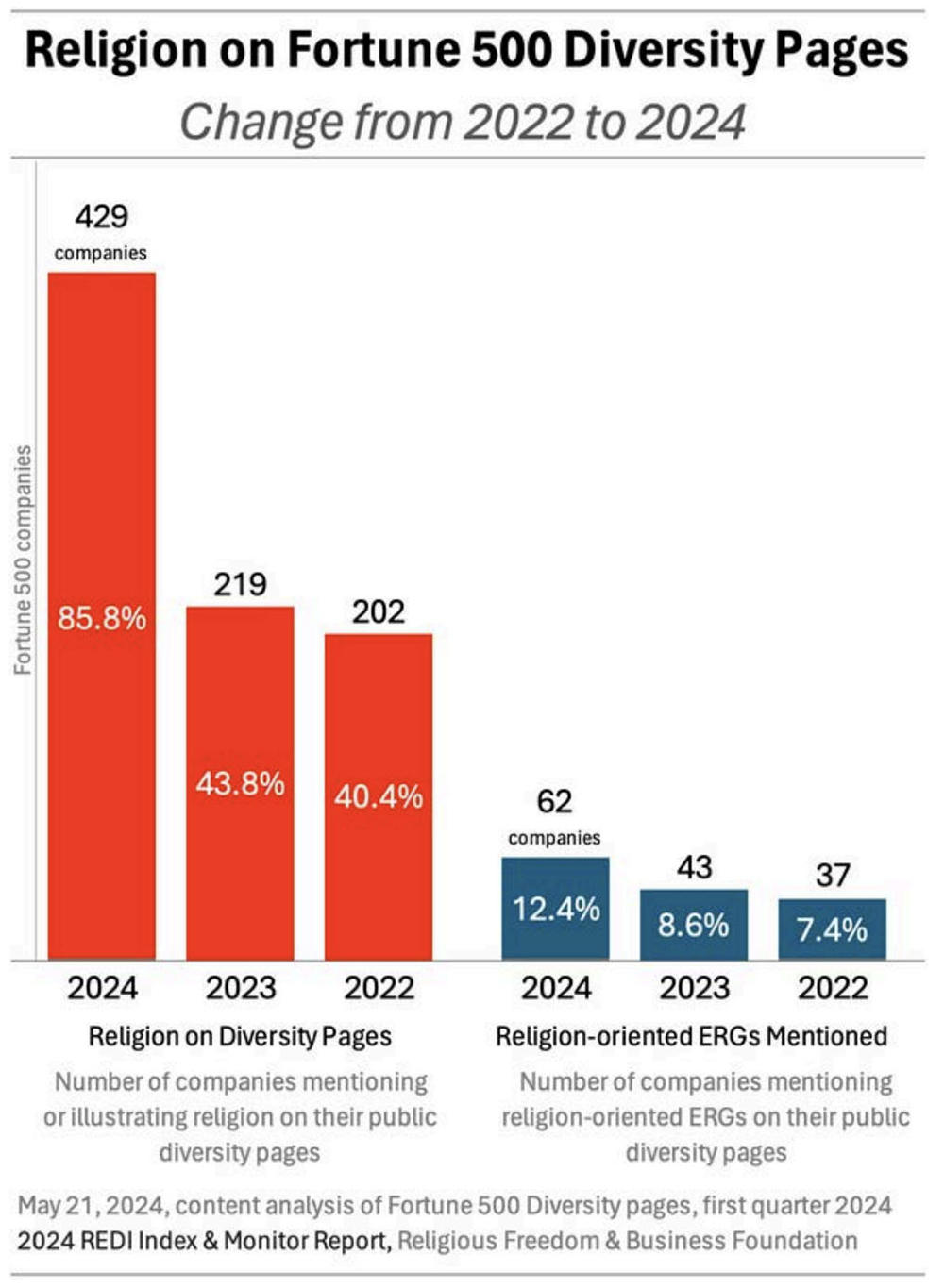
More than 85 percent of Fortune 500 companies (429 companies total) now include religion in their commitment to diversity, more than twice the number that did in 2022, according to the 2024 Corporate Religious Equity, Diversity & Inclusion Index and Monitor.
And 62 Fortune 500 companies (12.4 percent) now showcase faith-based employee business resource groups, up from 7.4 percent in 2022.
These numbers represent a “tipping point,” said Religious Freedom and Business Foundation President Brian Grim, in the number of companies embracing religion as a core component of diversity.
This year, he added, companies especially were attentive to how people of faith responded to global news, including the Israel-Hamas war.
“That has meant paying a little bit more attention than they did in the past to faith identities,” he said. “A number of companies have reached out and relied on their faith employee resource groups to help in the navigation of these types of issues.”
The organization released its 2024 benchmark assessment of corporate America’s religious diversity efforts May 20. This year, Accenture and American Airlines tied as the most faith-friendly Fortune 500 companies, both earning perfect scores on the index, which assessed more than 30 faith-friendly companies via an opt-in survey.
The survey evaluated companies in 11 categories, including their religious accommodations, spiritual care/chaplaincy services and procedures for reporting discrimination. Equinix, Dell Technologies, Intel Corporation, Salesforce and Tyson Foods all followed close behind the top scorers.
Grim said Accenture stood out for proactively creating a corporate culture hospitable to religious identity.
American Airlines, which also topped the REDI Index in 2022, brings great global sensitivity to its religious diversity efforts thanks to its international reach, Grim added.
“At American Airlines, our purpose is to care for people on life’s journey, including our customers and our 130,000 team members,” said Cedric Rockamore, the vice president of global people operations at American Airlines. “Our team members, across all faiths and beliefs, help us better understand and serve our customers around the world.”
Among the 32 top companies assessed via the REDI Index, 100 percent reportedly celebrate their employees’ holy days in an equitable manner, according to the report.
Seventy-two percent match employee donations to religious charities, and 87 percent provide chaplains or other forms of spiritual care for their employees.
Companies that didn’t take the survey were ranked separately on their religious diversity efforts via the REDI Monitor, which was based on publicly available information.
Grim said companies’ approach to religious diversity is often counter-cultural. Businesses that might otherwise be in competition are quick to share best practices for religious inclusion and collaborate on events.
The Christian and Black employee resources groups at Intel and Microsoft, for example, recently teamed up to host a Martin Luther King Jr. Day celebration, he said.
On May 22, Dell Technologies’ interfaith employee resource group is working with Merck, CVS Health and three local faith groups to host a hands-on food packaging event in Washington, D.C.
“I think that’s a very hopeful trend in these polarizing times,” Grim said.
The interest in corporate religious diversity is also spreading globally, Grim added. He noted the Religious Freedom and Business Foundation held an international conference in India in December and released REDI Index and Monitor findings for companies in the United Kingdom in March.
On May 21, the foundation’s annual “Dare to Overcome” conference will bring hundreds of leaders from Fortune 500 companies to Washington, D.C., to discuss topics like workplace chaplaincy, research on faith and faith accommodations in the workplace.
With the current count standing at six nominees for president of the Southern Baptist Convention, here is a bullet-point guide to where the nominees stand on some key issues.
Information is compiled from Baptist Press interviews and articles, Baptist Standard articles about the nominees—Clint Pressley, Mike Keahbone, Jared Moore, David Allen, Bruce Frank, and Dan Spencer—and a brief email interview with one of the later nominees.
Nominations may continue up to the vote, but no new nominations have been put forward since April. Nominees are listed in order of announcement.

Clint Pressley— Pastor of Hickory Grove Baptist Church in Charlotte, N.C. (2,632 average attendance). Met his wife at Southwestern Baptist Theological Seminary, but moved to New Orleans Baptist Theological Seminary to complete his Master of Divinity degree.

Mike Keahbone—Pastor of First Baptist Church in Lawton, Okla. (Average weekly attendance of 623). Native American of Cherokee, Comanche and Kiowa descent. No published Texas connection. Served on the Sexual Abuse Task Force and as vice chair of the Abuse Reform Implementation Task Force.

Jared Moore—Pastor of Homesteads Baptist Church in Crossville, Tenn. (150-170 average attendance). No published Texas connections.

David Allen—Professor and dean at Mid-America Baptist Theological Seminary in Cordova, Tenn. Studied at Southwestern Baptist Theological Seminary and was a charter member and first staff person hired at Prestonwood Baptist Church in Plano. Pastored churches in Texas and taught at Southwestern Baptist Theological Seminary for almost 20 years.

Bruce Frank— pastor of Biltmore Baptist Church in Asheville, N.C. (7,331 members across eight multisite locations). Served as chair of the Sexual Abuse Task force in 2021-22, overseeing the independent investigation of the SBC Executive Committee’s handling of abuse reports.
Holds a bachelor’s degree from Texas Tech University and an M.Div. degree from Southwestern Baptist Theological Seminary. Previously pastored in Texas.
Frank’s responses came from an email. He did not participate in an online forum with some other candidates, as it took place before his nomination, and he had no individual interview published in Baptist Press at the time of writing.

Dan Spencer—pastor of First Baptist Church, Sevierville, Tenn. (Church website reports membership of over 4,000 and Sunday small group attendance of 1,200). The church is a leader in baptisms and CP giving. Spencer is the great-great nephew of M.E. Dodd, the “father of the Cooperative Program.” No published connection to Texas.
WASHINGTON (RNS)—About 10 years ago, when Pennsylvania passed a law requiring a background check for anyone who worked with children, Megan Benninger volunteered to help her church comply.
At the time, Benninger and her husband were members of a small Southern Baptist church, where the nursery was run by volunteers and things were a bit disorganized.
“Everything was loosey-goosey,” she said. “I don’t know if we even had a schedule for the nursery.”
Before they got started organizing the background checks, Benninger said a church leader pulled her aside and told her not to include the church’s pastors. None of them worked with kids. Besides, they were pastors and so above reproach.
“They said, ‘Don’t even think about the pastors,’” she said. “So I didn’t.”
Years later Benninger learned that one of the pastors, a former Christian school principal, had been convicted of abusing a minor—a revelation that tore their little church apart.
Benninger left that church and now runs BaptistAccountability.org, a website that posts links to news stories about abusive pastors. She says churches never can be too careful.
“I never trust anyone anymore,” Benninger said. “You just never know.”
Since the Catholic sex abuse scandal of the early 2000s, many congregations have moved to make their churches safer for kids, passing new policies and procedures designed to screen out abusers and to report any abuse to authorities. But few denominations check to see if churches follow those procedures or track those who do.
A recent report on Southern Baptist churches from Lifeway Research found that about 58 percent of those congregations said they do background checks on staff who work with kids, with small congregations—those with fewer than 50 people—least likely (35 percent) to do those checks. Large churches, those with 250 people or more, are much more likely (94 percent).
The Lifeway data was limited—only 29 of the Southern Baptist Convention’s 41 state conventions collected data on abuse prevention in churches—and churches were not required to answer those questions.
Dealing with abuse has been difficult for the SBC, as all of its congregations are autonomous and there is no hierarchy to require them to follow safety policies for children.
But even denominations with hierarchical structures—like the Episcopal Church or the Evangelical Lutheran Church in America—don’t track what happens on the local level.
Instead, that is left to the local congregation or diocese.
A spokesperson from the ELCA provided a link to suggested policy for congregations but said the denomination does not know what local churches are doing.
A spokesperson from the Episcopal Church also provided a link to a General Convention decision to produce safe church training materials but said “decisions on implementation are local.”
Evangelical denominations take a similar approach to how churches deal with child safety.
“Assemblies of God has a well-established history in creating resources on this topic and urging urging all churches to adopt best practices to protect the vulnerable,” said a spokesperson for the Assemblies of God.
“Assemblies of God churches are autonomous and the General Council of the Assemblies of God does not have the ability to create policy for local churches.”
Darrell Morgan, the pastor of CrossWinds Community Church in Stillwater, Minn., part of the Converge denomination, said his congregation background-checks all volunteers who work with kids. A church member who is a former investigator helps coordinate those background checks, he said.
A former therapist with experience in social work, Morgan said those background checks are just a first step. The church also does not let volunteers be alone with children and tries to be selective about who gets to volunteer.
“We want a safe environment that is accountable and protects everyone,” he said.
Emily Garcia, assistant rector at Church of Our Redeemer in Lexington, Mass., has worked with children’s ministries about 15 years, starting before she entered the ministry. She said the local Episcopal diocese requires them to report details of its safe church programs on an annual basis.
Volunteers who work with children must pass a background check, Garcia said, and be an active part of the church for at least six months before starting the screening process.
“Someone came in on their first Sunday and said, ‘I want to work with the children,’” she said. “And we said, ‘OK, talk to us in six months.’ Stick around for a while.”
Garcia said potential volunteers also spend time observing with experienced volunteers—and then the more experienced volunteers give their feedback—just to make sure they feel OK with how the volunteer interacted with kids. Volunteers also are required to do a series of trainings.
She said the church has developed a culture that cares about the spiritual formation and safety of children. Having set policies and doing background checks helps maintain that culture, she said.
“The sense is that no one is above a background check,” she said.
Among Southern Baptists, Lifeway found that churches in the Northeast were most likely to do training on how to report abuse and that churches in the Northeast and the West are most likely to do training on how to care for victims of abuse. Churches in the South were least likely.
Lifeway also found that some Baptist state conventions, like the Baptist General Convention of Texas, the Pennsylvania-South Jersey convention and the Minnesota-Wisconsin convention, had the highest levels of doing background checks and abuse training.

Starting in 2015, leaders in the Baptist General Convention of Texas decided they wanted to tackle the issue of abuse prevention head-on, said Ward Hayes, Texas Baptists’ treasurer and CFO. That led to a greater emphasis on background checks and training.
“We have made progress,” he said. “We still need to remain diligent and vigilant.”
Hayes said more data is needed to know how much progress has been made and how much work still needs to be done. The state convention only knows how churches are doing with abuse prevention if they report those programs.
There are some signs that congregations nationwide are addressing abuse and prevention.
The 2020 Faith Communities Today Survey found that 96 percent of Catholic and Orthodox congregations do background checks, and 94 percent do training for those who work with children.
Seventy-one percent of Mainline congregations and 70 percent of evangelical churches in the study said they did background checks, while 65 percent of Mainline congregations and 68 percent of evangelical churches did training for those who work with children.
Stephanie Nelson, pastor of the Covenant Church of Thomaston, Conn., said all volunteers with kids are background-checked.
“On my second day on the job, I filled out a background check,” she said.
But she said that is just a first step. She worries some churches may think a background check is enough to make a ministry safe.
It’s not, she said.
“All they tell you is that someone has not been convicted,” she said.
She said volunteers at Thomaston Covenant have to be part of a church for a year before they work with kids. She also said two adults are required in every church classroom, and the doors to classrooms are always kept open.
Nelson, who worked with children and youth at several churches before becoming a senior pastor, said the church stressed safety is part of caring for the spiritual formation of kids.
“We are here to serve them,” she said. “And our primary goal is to keep them safe.”
Baylor University’s board of regents approved revising the university’s motto, which has been unchanged for more than a century and a half.
At its May meeting, regents voted to expand Baylor’s longstanding motto—Pro Ecclesia, Pro Texana (For the Church, For Texas)—by adding Pro Mundo (For the World).
The historic motto is part of the Baylor University seal, which appears on class rings, the medallion the Baylor president wears at commencement services, and at various places throughout the campus.
The updated motto will begin appearing on new campus installations beginning this summer.
“Now that Baylor has risen to a Christian Research 1 university, we have an opportunity to shine God’s light around the world and serve others in even more significant ways,” President Linda Livingstone said.
“Our world is becoming increasingly complex and challenging, and we must lead in emerging fields and remain competitive in academics and athletics. Baylor brings an important Christian perspective to help solve grand challenges, particularly at the intersection of health and engineering.
“Our students will always remain our top priority, and we must prepare them to lead now and into the future in an ever-changing global environment.”
While not directly criticizing the action, former regent Ella Prichard commented on Facebook: “My first reaction: Will they jack-hammer the terrazzo floor in Pat Neff to remove the old motto?”
The change predictably brought criticism from some Baylor alumni and supporters on social media.
“Regents are getting in really bad habit of changing things just to change them,” one person on Sic’Em365 posted.
“The only thing more dangerous than not being able to adapt and change is change for the sake of change. If it ain’t broke, don’t fix it,” another individual posted on the same online forum.
However, the change received implied support from one person who commented, “Maybe it had something to do with John 3:16.”
About the same time reactions to the regents’ action prompted the online discussion, Baylor also briefly had to weather a different social media firestorm outside its control.
A parody post on X—formerly Twitter—by @derrico_henrio falsely reported 22 Baylor football players were indicted for illegal gambling on Baylor gridiron games during the 2023 season.
While the bio for the TCU graduate identified it as a parody account, the display name and image included the CBS Sports logo. The satirical post quickly went viral on social media and was picked up by 24/7Sports.
The X platform subsequently posted a notice the parody account was “temporarily suspended” due to “some unusual activity.”
Based in part on reporting from the Baylor Office of Marketing and Communications.
Thanks to the creativity of a Mississippi layman and a gift from California Baptists, Texans on Mission provided an expanded service to Southeast Texas families affected by recent flooding.

Not long ago, the California Southern Baptist Convention offered Texans on Mission—formerly Texas Baptist Men—a seldom-used high-capacity mobile laundry unit that needed minor repairs.
After securing the unit in Sacramento and transporting it to Dallas, volunteers began looking for paperwork related to the equipment in it and discovered a business card for Ken Morris.
A Texans on Mission representative called the number on the card, hoping Morris might have some information about the repair and maintenance of the six washing machines and six commercial dryers on the unit.
“He didn’t just know about the equipment. He was the person who designed and built the unit,” said Texans on Mission volunteer Phil Elery of Athens.
Morris had created the laundry unit at his own expense and had maintained the equipment when he lived in California, but he never had the opportunity to serve with it in a disaster. He subsequently had moved to Mississippi.

Texans on Mission brought Morris to Dallas, where he familiarized volunteers with the unit, which the organization dedicated in his honor.
When the laundry unit was deployed to West Conroe Baptist Church as part of a flood recovery mission, Texans on Mission not only used it to wash and dry the clothes of volunteers. They also let families affected by the floods know the free laundry service was available to the public.
When volunteer flood-recovery teams worked on homes—removing wet carpet and flooring, damaged drywall and saturated insulation—volunteer chaplains informed homeowners laundry unit volunteers were available to wash and dry flood-soaked clothing and linens.
Three families quickly responded to the offer.
“One pickup truckload had 35 bags of laundry,” Elery said.
The next day, the crew received another 14 bags of laundry.
“We washed and dried 71 loads of laundry,” Elery said. “And it was swamp laundry—with critters in it. It was a full day’s worth of work.”

In fact, the plastic bags filled with wet laundry had so many roaches in them, the crew had to set off a “bug bomb” fogger overnight to kill them all.
Texans on Mission volunteers washed, dried and folded all the laundry, placing it in clean, dry plastic bags for the families.
Chainsaw crews and mud-out teams often are able to interact with people in the field, Elery noted.
“On the laundry unit, we normally serve in a support role for them,” Elery said. “But by doing public laundry, now we have that opportunity. It’s another opportunity for a personal contact with people in need.”