Prayer must undergird compassion, missionary doctor insists

GARLAND—Whether in the streets of Bangalore, India, or northeastern Dallas County, the sight of people in need compels Christians to respond in compassion, veteran medical missionary Rebekah Naylor said.

“God is a compassionate God. When Jesus saw the multitudes, he was moved with compassion. The New Testament epistles tell us we are to be clothed in compassion,” said Naylor, who served 35 years as a Southern Baptist medical missionary in India.

Rebekah Naylor served 35 years as a Southern Baptist medical missionary in India.

Naylor spoke to a May 1 prayer breakfast sponsored by Hope Clinic , a Christian health care provider serving the uninsured and underserved working poor in Garland.

Compassion spurs Christians to action, Naylor said. But every response needs to be bathed in prayer, she insisted.

“Our efforts must be preceded and supported by prayer,” she said. “Pray believing that God answers prayer.”

Naylor described the crushing poverty and spiritual darkness she encountered in India, and she challenged Christians in Texas to recognize the less obvious but no-less-urgent needs close to home.

“We need to focus on the needs of people around us—to look outward and not at ourselves,” she said.

The United States faces a health care crisis, said Steve Arze, head of the emergency department at Baylor Medical Center at Garland and medical director of Hope Clinic.

For example, two hospitals in nearby communities closed in recent years, creating an increasing burden for the Garland hospital—and an increasing opportunity for Christian ministries such as Hope Clinic, he noted.

Faith-based free clinics not only can relieve suffering and promote physical well- being, but also can provide spiritual comfort and the hope of everlasting life, said Arze, a member of Lake Pointe Church in Rockwall.

Barbara Burton, executive director of Hope Clinic, reported more than 200 people professed faith in Jesus Christ last year as a result of their contact with the clinic, and several home Bible studies have grown out of the ministry.

“When people are treated with dignity and respect, so many of them are receptive and willing to listen to the good news of Jesus,” she said.


Baylor nursing students meet life-and-death needs in Africa

The six-hour journey from a remote Ethiopian village was not easy for a woman pregnant with twins and going into labor. Making matters more difficult was her mode of transportation—being carried by several men.

The woman arrived at the medical clinic frightened and bleeding, but she was assisted by a group of students from Baylor University’s Louise Herrington School of Nursing who were ready to help.

Patients wait to be seen at a tent clinic served by a team from Baylor University’s Louise Herrington School of Nursing. (Baylor Photos)

The first twin to arrive was born healthy. However, the second twin was born with several life-threatening complications. The team of Baylor nurses worked through the night providing medical care to make sure the baby survived.

“I really view it as a child who was able to survive due to the Baylor team that assisted the mother,” said Lori Spies, a lecturer in nursing at Baylor who coordinated the mission trip.

“It was a matter of life or death, and the students used what they had learned to save the baby.”

The women who helped save the life of the child were five Baylor nursing students on a month-long medical mission trip to Ethiopia and Uganda.

Ethiopia and Uganda

The trip was created to increase the capacity of nurses as health care providers and designed to enhance their education while serving the health needs in a developing country.

The trip began in Addis Abbaba in Ethiopia, where Spies and her students worked along side Kim Scheel, a graduate of Baylor’s family nurse practitioner program.

Michelle Sanders, a Baylor University alum, teaches a group of children from an orphanage in Uganda the “Sic ’Em Bears” cheer.

The students worked in an established medical clinic in a predominantly Muslim area and treated a wide variety of tropical diseases like anthrax, trachoma, malaria, intestinal worms and amoebic infections. The students also provided prenatal care and assisted in labor and delivery, a first for the annual trip.

Inspiration for the trip

After leaving Ethiopia, the group traveled to Uganda, where they toured the International Hospital and its associated nursing school. Rose Nanyonga, the hospital’s nursing director, is a former student of Spies at Baylor who traveled with the group several years ago. Nanyonga was the inspiration for starting the annual trip to Uganda, Spies said.

“Rose could have held a powerful position in the hospital system in this country, yet she felt called by Christ to return to Uganda and work for the benefit of her people. I have tremendous respect for that,” Spies said.

The Baylor students also worked in an orphanage in Uganda, providing medical care and health education to nearly 500 children, primarily orphaned because of the AIDS epidemic. They provided each child with one-on-one counseling and guidance on topics ranging from hand washing to staying in school.

“By returning each year we are working to create a sustainable outreach to improve the lives of some of the neediest people in God’s kingdom,” Spies said. “It is a blessing to serve the needs of some of the poorest people in the world. This trip just fits perfectly into Baylor’s mission.”


Ethics and evangelism focus of Howard Payne lecture

BROWNWOOD—Evangelism and ethics both grow out of a vibrant relationship with the God who is love, speakers told participants at the inaugural Currie-Strickland Distinguished Lectures in Christian Ethics at Howard Payne University.

People cannot fully come to know God apart from the Bible, but they cannot really know the Bible apart from God, said David Sapp, pastor of Second-Ponce de Leon Baptist Church in Atlanta, Ga.

“If God breathed it, how can we possibly understand it apart from knowing him?” Sapp asked.

Proper understanding of Scripture and application of its teachings in daily life require disciples to seek the mind of God, he said. Sapp suggested three themes that help Christians interpret Scripture—love, covenant and conquest of fear.

Love is the key

“Love is key to understanding the mind and heart of God,” he said.

But determining the most loving thing to do in the midst of any circumstance proves difficult, he acknowledged. Consequently, many Christians retreat to a rule-based ethic and treat the Bible as a “moral and ethical encyclopedia” from which they pluck isolated verses—usually ones that reinforce their own opinions and prejudices, he added.

God demonstrated his love through covenant relationships, and covenant serves as an interpretive key for reading Scripture, Sapp noted.

“Without commitment, there is no covenant,” he said. “Covenant commitment is an obligation not just of contract but of relationship.”

Covenant finds its expression in community, Sapp noted. In the Old Testament, God established covenant with Israel as a people, not strictly with individuals. While the New Covenant has more individual expression, he observed, it still offers invitation to enter into a larger community as part of the kingdom of God.

“Sin is social and not just personal,” he said.

The defeat of fear

Much sin grows out of fear, and “defeat of fear is part of the agenda of God,” Sapp said. “Much of our sin has its genesis in fear. Fear is fertile soil for evil.”

Both ethics and evangelism express God’s love, said Richard Jackson, director of the Jackson Center for Evangelism and Encouragement and pastor emeritus of North Phoenix Baptist Church in Phoenix, Ariz.

“Evangelism is born in the heart of a God of love,” Jackson said. From the earliest passage in Genesis and throughout the Bible, Scriptures testify to God’s loving pursuit of spiritually lost men and women.

“Jesus Christ didn’t come to heal the sick, or he would have healed them all. He didn’t come to feed the hungry, or he would have fed them all,” Jackson said. “He came to seek and save the lost. He healed the sick and fed the hungry because of who he is.”

Likewise, Christians today evangelize because Christ gave them that assignment, he said. Christians meet needs and seek justice because of who they are.

“Because Jesus lives in me, I will reach out to help those who are hurting,” he said.

Evangelism and ethics

Evangelism and ethics—“winning people to Jesus and wanting people to act like it”—bring Baptists together, noted Jimmy Allen, former denominational executive and recent coordinator of the New Baptist Covenant celebration in Atlanta.

Allen recalled his experiences as pastor of First Baptist Church in San Antonio, leading a church with a historic commitment to missions and evangelism to recognize ethical challenges and injustices in their own community.

At the downtown San Antonio church, Allen noted, people already possessed the necessary desire. They just needed to be challenged.

“A church will follow the vision of its pastor if the pastor has a passion for it,” he said.

But in some churches, he added, members must be shaken from their complacency and challenged to look beyond the four walls of the church building to see community needs.

“The moribund church never looks outside its windows except to see if the grass is mowed,” he said.

Gary and Molli Elliston of Park Cities Baptist Church in Dallas established the Currie-Strickland lectures in honor of David Currie, executive director of Texas Baptists Committed, and in memory of Phil Strickland, longtime director of the Baptist General Convention of Texas’ Christian Life Commission.


Cancer survivor, age 4, throws out first pitch

Payton Chumbley, age 4, threw out the ceremonial first pitch at a recent Howard Payne University and University of Mary Hardin-Baylor baseball game. (Photo by Jessica Melendrez/Howard Payne University)

Payton Chumbley, age 4, threw out the ceremonial first pitch at a recent Howard Payne University and University of Mary Hardin-Baylor baseball game.

Howard Payne Head Coach Stephen Lynn said his team wanted to help Payton and his family celebrate the news that his cancer is in remission.

Payton was diagnosed with Ewing’s Sarcoma in February 2007 while his parents, Terry and Robin Chumbley were serving as missionaries in Prague, Czech Republic with WorldVenture. When doctors discovered his condition, the Chumbley family moved back to the United States for his chemotherapy treatments.

Lynn read about Payton’s condition in an e-mail several months ago, and he shared the story with the baseball team. Payton’s father, a 1991 graduate of Howard Payne, had been a member of the baseball team. 

The players signed five baseballs, as well as a team picture, for Payton and his four brothers.


Texas WMU celebrates Jesus during annual meeting

WACO—Woman’s Missionary Union of Texas gathered to “Celebrate Jesus” during its annual meeting April 18-19.

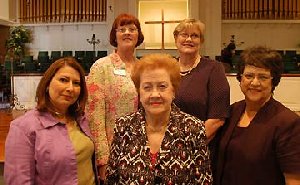
Newly elected officers of Woman’s Missionary Union of Texas are (front row) First Vice President Suzy Wall (left) of Frio Baptist Church in Hereford and President Paula Jeser of First Baptist Church in El Paso, (back row, left to right) Recording Secretary Anna Zimmer of Kingwood Baptist Church in Kingwood, Second Vice President Jo Lee of First Baptist Church in San Antonio and Third Vice President Margery Flowers of Fellowship Baptist Church in Marble Falls.

In a meeting that featured seminars encouraging people to share their faith and be involved in mission work, testimonies from missionaries and sessions on prayer, leaders encouraged Texas Baptist women to celebrate Christ’s work around the globe.

Author Jennifer Kennedy Dean reminded annual meeting participants God is working through them. If Christians allow him, God’s presence will influence everything they do. God is wherever they go, she said.

“Jesus lives in you and can so clearly communicate with you, it’s like a direct deposit from his mind to yours,” she said.

When that happens, Dean said, people’s perspectives change. Chance encounters become divine appointments. People are able to see God working in every moment. Events throughout the day become opportunities to share God’s love.

“When we begin to act with faith in the Promiser, the world looks completely different,” she said.

Texas WMU President Nelda Taylor said the missions organization can rejoice in knowing that it has faced challenges head-on and looks forward to a bright future of helping Texas Baptists spread the gospel. Among other challenges, Texas WMU Executive Director-Treasurer Carolyn Porterfield resigned last October.

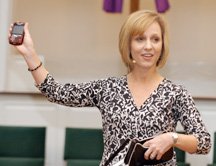
Cheryl Segura Gochis, former national and state Acteens panelist, uses a cell phone as a teaching tool during the Texas WMU annual meeting.

During one of the plenary sessions, Texas WMU rolled out a team of volunteers who will serve as “mission connectors”—people across the state who will encourage and facilitate mission activity.

While change continues to be the rule in Western culture, God is a constant, Taylor said. He continues to be the answer for humanity’s struggles.

“It is the time for us to reach, preach and teach the nations with the good news of Jesus Christ,” she said.

In addition to the time of celebration, Texas WMU elected a new slate of officers. Conference participants elected Paula Jeser of First Baptist Church in El Paso as president; Suzy Wall of Frio Baptist Church in Hereford as first vice president; Jo Lee of First Baptist Church in San Antonio as second vice president; Margery Flowers of Fellowship Baptist Church in Marble Falls as third vice president; and Anna Zimmer of Kingwood Baptist Church in Kingwood as recording secretary.


Evangelical leaders endorse racial reconciliation

WASHINGTON (RNS)—Several prominent evangelical leaders have endorsed a “Reconciliation Referendum” that says Sen. Barack Obama’s recent address on race did not go far enough and pushes church leaders to speak up more about the need to address racism.

“Opinion leaders in the national media praised the speech as courageous, but the notion that simply more talk is needed will no longer suffice,” the statement said.

“While politicians like Barack Obama and the national media wring their hands over a problem that has persisted in this country nearly 400 years, they offer no solutions to the problem.”

The statement was presented to Christian leaders at a recent meeting in Montgomery, Ala., hosted by “The Call,” a multidenominational movement focused on reconciliation and revival.

More than 350 people have endorsed the statement, which aims to achieve racial reconciliation within the next decade.

Among the signers are Chuck Colson, founder of Prison Fellowship; Richard Cizik, vice president of the National Association of Evangelicals; Harry Jackson, founder of the High Impact Leadership Coalition; Tony Perkins, president of the Family Research Council; and Alveda King, an anti-abortion activist and niece of Martin Luther King Jr.

The statement said the controversy about remarks by Obama’s former pastor, Jeremiah Wright, demonstrates the church needs to do more to address race relations—including prayer, interracial evangelism and addressing poverty.

“The failure of good Christian people to provide a clear and convincing example of racial unity within the church has contributed to the divide between the races in the nation and it only appears to be widening,” the statement says.

“We must recognize that racism is not just a social problem in America; it is also a spiritual problem.”


On the Move

Martin Akins to First Church in Bedford as pastor from First Church in Hobbs, N.M.

Dan Baker to First Church in Amarillo as minister of music from First Church in Saginaw.

Patrick Berg to First Church in Breckenridge as youth minister.

Jamey Burrus has resigned as pastor of West Texas Cowboy Church in Midland.

Oscar Contreras has resigned as pastor of Iglesia La Hermosa in Skidmore.

Major Dalton to Living Proof Church in Grandview as pastor.

Red Frye has resigned as administrator of Big Country Assembly in Lueders.

Sam Griffin to First Church in Levelland as minister to students.

Bob Hendricks has resigned as pastor of First Church in Pettus.

Truman Johnson to Bacon Heights Church in Lubbock as pastor of senior adults from First Church in Baird, where he was pastor.

Paul Kipgen to Pilgrim’s Way Church in Sanger as pastor.

Brian Lambert to First Church in Breckenridge as pastor.

Todd Pebbles to Lebanon Church in Cleburne as pastor.

Curtis Pierce to Cross Pointe Church in Texarkana as minister of youth.

Greg Robinson to Bluff Dale Church in Bluff Dale as pastor from Sunnyside Church in Wichita Falls.

Larry Searcy to Big Country Assembly as administrator.

Larry Soape has resigned as minister of education and administration at First Church in New Braunfels.

Tank Tankersley has completed an interim pastorate at College View Church in Abilene and moved to San Antonio.

Mike Tisdal to Deermeadows Church in Jacksonville, Fla., as minister of education from First Church in El Paso.

Robert Webb has resigned as pastor of Highland Terrace Church in Greenville.

Doyle White to Eylau Hills Church in Texarkana as minister of music.


Missouri Baptist groups agree to peace committee

JEFFERSON CITY, Mo. (ABP)—Seven members of rival groups in the Missouri Baptist Convention will go to mediation in an effort to bring about peace within the battle-torn statewide group.

The Missouri Baptist Convention Executive Board voted to create a peace committee that will submit to Christian mediation.

The committee makeup and its methodology were proposed by board member Jody Shelenhamer, a layman from First Baptist Church of Bolivar, Mo., according to convention President Gerald Davidson.

Shelenhamer proposed four members who have been associated with the Missouri Baptist Laymen’s Association. Three others represented a group called Save Our Convention, which has criticized what it calls an inordinate amount of control in convention life by a small group of Laymen’s Association adherents.

The Laymen’s Association led a successful effort in the late 1990s to wrest control of the convention from the moderates that had dominated its leadership.

At odds with former allies

However, Save Our Convention supporters—many of whom were foot soldiers in the association’s battle against moderates—have taken issue with their former allies on a handful of issues in the past year.

Save Our Convention successfully swept officer elections during last fall’s Missouri Baptist Convention annual meeting. That is proof, they say, that rank-and-file Missouri Baptists have grown weary of intraconservative dissension and of what they say is a tightening of trustee representation on boards and agencies.

All seven members of the committee are men.

The four closely identified with the Laymen’s Association leadership include Roger Moran, the organization’s founder and research director; Jay Scribner, retired pastor of First Baptist Church of Branson, Mo; Jeff White, pastor of South Creek Church in Springfield, Mo.; and Jeff Purvis, pastor of First Baptist Church of Herculaneum-Peveley, Mo.

The Save Our Convention representatives are John Marshall, pastor of Second Baptist Church of Springfield and the current Missouri Baptist Convention second vice president; Bruce McCoy, pastor of Canaan Baptist Church in St. Louis and current first vice president; and Wesley Hammond, pastor of First Baptist Church of Paris, Mo.

Two weeks prior to the board meeting, Laymen’s Association supporter Kent Cochran, a member of Calvary Baptist Church in Republic, Mo., proposed a similar committee, modeled after the 1985 Southern Baptist Convention Peace Committee.

Peace proposal

Cochran’s proposal, mailed to every member of the Executive Board, called for a committee to “research the perceptions, activities, expectations, history, present and future of Missouri Baptists focusing particularly on … issues of theology, methodology, political activity and any related matters that involve Missouri Baptist life.”

“I’m hopeful that it will work,” Davidson said. But the effort will have to be more successful than the SBC Peace Committee, which resulted in one side winning and the other withdrawing from the SBC, he said.

Davidson, retired pastor of First Baptist Church of Arnold, Mo., was himself once a supporter of the Laymen’s Association’s efforts to drive moderates out of Missouri Baptist Convention leadership.

However, he became one of Save Our Convention’s organizers last year, and he said he believes the solution to the impasse between Missouri conservatives is not complex.

“We don’t have any big differences except in turning loose and letting Missouri Baptists make Missouri Baptist decisions they think are under the leadership of the Holy Spirit,” Davidson said.

“People have to say: ‘Hey, we’re going to have to quit fighting. I’m tired of all the bickering, fussing and fighting.’”

But, he added, “I am strongly opposed to a handful … taking control” of the convention.

There is no timetable for completion of the committee’s work, he said.


Mission Lubbock fights hunger, delivers hope

LUBBOCK—When people think of Lubbock, they think of unending cotton fields, hearty dust storms, flat plains and Texas Tech football. Few think of people like Cheryl Tannery.

Tannery, who raised three boys as a single mom, is just one of thousands of people in the Lubbock area who have been stricken by poverty and experienced hunger firsthand. But Mission Lubbock has stepped in to help rebuild the lives of people in need by providing food, clothing and furniture and showing hope that only can come from Christ.

Cheryl Tannery checks a list as she makes a food box for a family seeking assistance at Mission Lubbock. Tannery, who has received assistance from Mission Lubbock herself, chose to give back to the mission by volunteering two days a week since last October. (Photo/Kaitlin Chapman)

“People just need to understand that there are people going to bed at night without food,” said Judy Cooper, director of Mission Lubbock and multihousing coordinator for the Lubbock Area Baptist Association.

“There are children who are leaving school on Friday and not having another meal until Monday when they get back to school. We are trying to help make a difference in that.”  

When Cooper started Mission Lubbock two years ago, her focus was to provide clothing and other household items. Soon she found there was a greater need—food.

“We realized that so many of the people we were trying to minister to had nothing,” Cooper said. “We had to meet the need that they had before they would ever listen to what we had to share about Jesus and how God has worked in our lives.”

That is exactly how Mission Lubbock helped Tannery, who came to the ministry in October looking for food. Meeting Tannery’s immediate needs provided Cooper and the other volunteers an open door to love, encourage and pray for her.

“I came in, and I asked if they were hiring,” Tannery said. “They said ‘no,’ but they needed volunteers. I said I’ll be back, and I’ve been working with them ever since. They have been real good to me. They are some good people.”

Tannery, who cleans homes for a living, said the volunteers and ministry of Mission Lubbock made such an impact on her life that she now volunteers her time the two days a week the ministry is open.

“They are like my second family,” Tannery said. They are about “helping the people and doing God’s work. It has changed my life a whole lot.”

In the last year, Mission Lubbock distributed 556 food boxes and assisted more than 1,000 families.

“I feel certain that we will surpass that this year with still being open just two days a week,” Cooper said. “We would like to extend our hours, but we have got to find some funding.”  

Cooper said nearly 60 percent of children in the Lubbock Independent School District are considered impoverished and are on the free- or reduced- lunch program.

“Lubbock does have quite a bit of poverty,” Cooper said. “The deal is they are the working poor. They have jobs. They just don’t get paid enough to make ends meet.”

For 2008, Mission Lubbock was chosen to receive funds from the Texas Baptist Offering for World Hunger. These funds, as well as donations from individuals and churches, will allow Mission Lubbock to provide food boxes to people in need.

“We just don’t have near enough donations,” said Billie Downing, one of the volunteers who helps run the ministry. “To know we have a fund there—it’s something you can rely on. It’s so nice when people have a need to be able to do more than say, ‘I’ll pray for you.’ And that’s a wonderful thing in God’s economy.”

The Texas Baptist Offering for World Hunger supports about 100 ministries around the world by supplying temporary relief for people in need, addressing the causes of hunger and poverty and providing hunger relief and development to children.

For more information, visit www.bgct.org/worldhunger.


Court dismisses Baptist church-state case

WASHINGTON (RNS)—A federal court has dismissed a 10-year-old legal challenge brought by Kentucky taxpayers who questioned government funding of a Baptist social service agency.

The case involving Sunrise Children’s Services, formerly known as Kentucky Baptist Homes for Children, initially centered on the dismissal of Alicia Pedreira, who the agency learned was a lesbian. In 2001, a federal judge in Louisville, Ky., dismissed her claims of religious discrimination.

Pedreira and other taxpayers continued the suit, claiming that public funds were used for services “infused with the teachings of the Baptist faith.”

Citing a recent Supreme Court decision, the same judge again ruled in favor of the agency, saying taxpayers did not demonstrate standing, or their right to sue the government.

In Hein v. Freedom From Religion Foundation, the Supreme Court ruled taxpayers affiliated with an atheist group did not have standing to challenge President Bush’s faith-based initiative.

“We find that the claim of the taxpayers in this case is comparable to that in Hein,” wrote U.S. District Court Judge Charles R. Simpson III in a recent opinion.

Americans United for Separation of Church and State and the American Civil Liberties Union had represented the taxpayers in the case.

Barry Lynn, executive director of Americans United for Separation of Church and State, called the decision “a very sweeping reading of what I thought was a narrow ruling by the Supreme Court last year.”


Faith Digest: Bible tops America’s bookshelf

The Bible is the favorite book of all time for American adults, regardless of demographic group, according to a new 2008 Harris Interactive Poll. Researchers said it’s rare to find such consensus among Americans, regardless of gender, education level, geographic location, race, ethnicity or age. Yet, more than 2,500 Americans who responded to an online poll agreed the Bible is their No. 1 favorite book. The poll also found political affiliation did not affect reading preference. Republicans, Democrats and Independents alike agreed on the Bible and Margaret Mitchell’s Gone With the Wind as their top two favorite books. Other top five choices were Lord of the Rings by J.R.R. Tolkien, the Harry Potter series by J.K. Rowling and The Stand by Stephen King. Rounding out the top ten were The Da Vinci Code by Dan Brown, To Kill a Mockingbird by Harper Lee, Angels and Demons by Dan Brown, Atlas Shrugged by Ayn Rand and Catcher in the Rye by J.D. Salinger.

Former bishop elected Paraguay president. A former Roman Catholic bishop was elected president of Paraguay after being criticized by his church for running for the office. Fernando Lugo, 56, defeated the Colorado Party, which had reigned in the country 62 years. The Vatican opposes clergy members holding political office and had demanded that Lugo halt his political pursuits. Lugo said he resigned from the church and no longer must follow its laws. His five-year term begins Aug. 15.

Judge torches pot smoker’s religious claim. Robert George Henry told a Pennsylvania judge smoking marijuana is vital to his efforts to connect with God. But 10 seconds after Henry finished testifying, Judge Edgar B. Bayley dismissed a motion Henry filed seeking to avoid prosecution on drunken driving and drug possession charges on religious grounds, claiming the U.S. Constitution’s protection of the free exercise of religion includes drug use. Henry joined the Hawaii Cannabis Ministry, which promotes marijuana use for religious enlightenment, and was ordained as a minister of the Universal Life Church after his arrest. He argued that if children can drink wine during Holy Communion, he should be able to smoke pot in his search for God.

National observance includes fly-over prayers. On the National Day of Prayer, petitions to God will be made from the ground and from the air. Plans for the annual observance, on May 1, include private pilots who intend to fly and pray over all 50 state capitols. Tens of thousands of events, organized through a Colorado-based task force, will be held in churches, on courthouse steps and in parks. Organizers range from military members to teenagers. For the first time, the event will be marked at a memorial chapel in Shanksville, Pa., which commemorates the 9/11 crash site of United Flight 93. Christian scholar Ravi Zacharias is the 2008 honorary chairman. He will address observances on Capitol Hill and at the Pentagon. The National Day of Prayer was established by Congress in 1952 and is observed on the first Thursday of May.


Calvinism: Tiptoe through the TULIP

Can Calvinist and non-Calvinist Baptists work together?

…Something Baptist find increasingly difficult

It depends, some advocates of Reformed theology say, on whether Christians on both sides are willing to tiptoe through the TULIP–the acrostic for five doctrinal points that set apart Calvinists.

TULIP stands for total depravity, unconditional election, limited atonement, irresistible grace and perseverance of the saints. Those five doctrines, delineated by the Synod of Dort in the 17th century, summarize distinctive elements of the theological system taught by John Calvin—particularly as distinguished from the teachings of James Jacobus Arminius.

Proponents of what often is called “five-point Calvinism” emphasize the sovereignty of God and the doctrine of predestination—the teaching that God ordains specific human beings to be saved on the basis of his good pleasure, not on the basis of his advance knowledge of their repentance and belief.

Historically, some prominent Baptists identified themselves as Calvinists, including 19th century British pulpiteer Charles Haddon Spurgeon and James P. Boyce, founding president of Southern Baptist Theological Seminary. On the other hand, the first Baptists in England—John Smyth and Thomas Helwys—rejected Calvinism.

Calvin’s cool on campus

Calvinism is gaining in popularity in some Baptist circles today. A study by the Southern Baptist North American Mission Board and LifeWay Christian Resources showed about 30 percent of recent Southern Baptist seminary graduates identify themselves as Calvinists, compared to 10 percent of Southern Baptist pastors in general.

John Calvin

Renewed interest in Reformed theology—what Calvinists refer to as “the doctrines of grace”—also is evident among university students, some Baptist college professors have noted. In part, observers attribute the growth of Calvinism on college campuses to the popular Passion conferences, featuring Louie Giglio and Reformed pastor-theologian John Piper.

The Passion movement and related One Day events serve as gateways into Calvinism, said Roger Olson, professor of theology at Baylor University’s Truett Theological Seminary.

“My experience is that many young Christians swept up by this wave know little about the details of this kind of Calvinism,” Olson said. “Many of them are simply shocked to find out that it entails belief in limited atonement. However, after awhile, many of them gradually accept it lock, stock and barrel because they don’t know any alternative. Southern Baptists—and offshoots—have not been very good at offering young people sound theology.”

Hunger for theology that is “rigorously biblical and satisfies the desire to hear from God in his word” accounts for much of Calvinism’s popularity among students, said Thomas Ascol, executive director of Founders Ministries, an organization that promotes Reformed theology in Southern Baptist life.

“The rising generation is looking for authenticity,” Ascol said. Students read biblical stories about faithful people who suffered martyrdom, and they hunger for “the radicalness of biblical Christianity,” he noted.

“Then they look at the slick and oftentimes superficial Christianity that dominates American evangelicalism, and they wonder why there is a difference. What did those early believers see we don’t see? Part of the answer is they saw the majestic supremacy of God over every sphere of life.”

Dancing to Piper’s tune?

Ascol believes Piper “has been used of God to help cast a vision of radically biblical Christianity to a younger generation of believers.”

“There is no fluff in Piper’s ministry. It is rock-solid Bible teaching that does not shy away from the hard sayings and clear calls of discipleship,” he said. “It is authentic in its devotion to the text of Scripture. That resonates with many in the younger generation who are hungry for truth.”

Critics of resurgent Calvinism, on the other hand, see it as appealing to the desire for clear-cut, black-and-white answers.
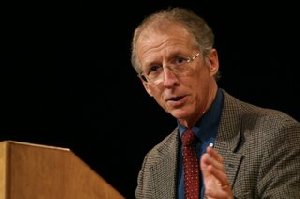
John Piper

“The present, new Calvinists claim to know way, way too much about the mind of God,” Olson claimed.

He draws a distinction between the gentle and nuanced Calvinism held by many Christians in Reformed churches and the aggressive new form of Calvinism.

“My experience is that this new wave of Reformed theology—inspired by John Piper who is inspired by Jonathan Edwards—appeals mostly to young men who want to avoid any hint of ambiguity in their theology,” he said.

Divided by doctrine

In part because its adherents hold to its teachings so tenaciously, Calvinism has divided some congregations—particularly when Calvinist pastors have asserted their beliefs in historically non-Calvinist churches. To some degree, division may be inevitable, some Calvinists have asserted.

“Any given doctrine will divide. The gospel itself is a doctrine that divides,” said Jonathan Leeman, director of communications for 9Marks, a ministry founded by Reformed Baptist pastor Mark Dever.

“There has been a renewed emphasis on the doctrines of grace, and that could lead to some level of divisiveness. That’s almost necessarily so, in the same way that an emphasis on inerrancy led to division within the Southern Baptist Convention.”

But other Calvinists believe they have been unjustly tarred with the brush of divisiveness.
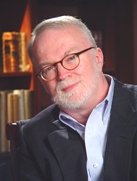
Timothy George

“What I have discovered is that Calvinism is blamed far more often for dividing churches or associations than is actually the case,” Ascol said. “Closer investigation has often revealed that Calvinism is often the tail on which the donkey is pinned. I know of more cases where the real issue behind a controversy is biblical Christianity—what is a Christian and how does a person become one—not Calvinism.”

Missions and evangelism

Ascol also believes Calvinists often have been unfairly stereotyped as anti-missionary.

“Look at who has been going as career missionaries over the last few years. A significant percentage would classify themselves as Reformed,” he said.

Olson acknowledged the current wave of Calvinism—which he calls “Piperism”—is characterized by fervent missionary spirit.

“However, I think those who follow it out to its logical conclusion may eventually decide that there is no point in evangelism or missions,” he said.

“If you are told that your evangelism and missionary work is nothing more than a ‘foreordained means to a foreordained end,’ and it cannot alter what God has already decided, you might conclude that there is no urgency.”

Leeman frames the impetus for sharing faith in terms familiar to most evangelicals, whether Calvinist or non-Calvinist—love and obedience.
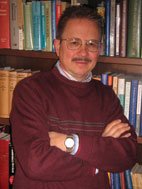
Roger Olson

“Being that Christ is my greatest love, I will want to share him with others,” he said, adding that Jesus commanded his followers to share the gospel. “The call to repentance and obedience is not optional.”

But concern about Calvinism’s impact on fulfilling Christ’s Great Commission is a valid concern, even if it’s not well founded, Leeman added.

“The primary cause of division over the issue (of Calvinism) is concern on the part of the non-Reformed crowd that it will hurt evangelism and missions, and those of us who are Reformed need to be entirely sympathetic to that concern,” he said.

“At the same time, instead of debating issues with us, I would like to see the non-Reformed crowd give us the benefit of the doubt. Accept that a Reformed congregation means what it says when it affirms evangelism and missions.”

Show some grace

Ironically, the debate over the doctrines of grace often has been characterized by a lack of grace by proponents on both sides, and much of the division caused by Calvinism could be avoided if Christians treated each other a bit more graciously, some Calvinists and non-Calvinists agreed.

“I love my Calvinist friends and students,” Olson said. “I have no quarrel with them; it is only with their theology I have a quarrel. And I do not attempt to convert my Calvinist students to non-Calvinism. I only ask them to study all the options and make sure they are thinking biblically and logically.”

Shared belief about Jesus Christ and biblical authority should be sufficient ground for Calvinists and non-Calvinists to share the same pews peacefully, Ascol said.

“Our church has Calvinists and non-Calvinists joyfully laboring together for the gospel, and I know of many other churches that do, too,” he said.

“We do that by focusing on the gospel—who Jesus is, what he has done and why that matters. We may not agree on every detail of how the gospel works—such as election, predestination, effectual calling and particular redemption—but we are all committed to the Lordship of Jesus Christ and his supremacy over all of life.”

Leeman acknowledged some Calvinists are so adamant about their position that they have failed to show “pastoral wisdom” in making distinctive Reformed doctrines a test of fellowship.

“A wiser course is to avoid the language of theology and use the language of the Bible instead,” he suggested. “It’s not so much about Calvinism. It’s not so much about the doctrines of grace. Just preach the Bible.