Calvinism: Tiptoe through the TULIP

Can Calvinist and non-Calvinist Baptists work together?

…Something Baptist find increasingly difficult

It depends, some advocates of Reformed theology say, on whether Christians on both sides are willing to tiptoe through the TULIP–the acrostic for five doctrinal points that set apart Calvinists.

TULIP stands for total depravity, unconditional election, limited atonement, irresistible grace and perseverance of the saints. Those five doctrines, delineated by the Synod of Dort in the 17th century, summarize distinctive elements of the theological system taught by John Calvin—particularly as distinguished from the teachings of James Jacobus Arminius.

Proponents of what often is called “five-point Calvinism” emphasize the sovereignty of God and the doctrine of predestination—the teaching that God ordains specific human beings to be saved on the basis of his good pleasure, not on the basis of his advance knowledge of their repentance and belief.

Historically, some prominent Baptists identified themselves as Calvinists, including 19th century British pulpiteer Charles Haddon Spurgeon and James P. Boyce, founding president of Southern Baptist Theological Seminary. On the other hand, the first Baptists in England—John Smyth and Thomas Helwys—rejected Calvinism.

Calvin’s cool on campus

Calvinism is gaining in popularity in some Baptist circles today. A study by the Southern Baptist North American Mission Board and LifeWay Christian Resources showed about 30 percent of recent Southern Baptist seminary graduates identify themselves as Calvinists, compared to 10 percent of Southern Baptist pastors in general.

John Calvin

Renewed interest in Reformed theology—what Calvinists refer to as “the doctrines of grace”—also is evident among university students, some Baptist college professors have noted. In part, observers attribute the growth of Calvinism on college campuses to the popular Passion conferences, featuring Louie Giglio and Reformed pastor-theologian John Piper.

The Passion movement and related One Day events serve as gateways into Calvinism, said Roger Olson, professor of theology at Baylor University’s Truett Theological Seminary.

“My experience is that many young Christians swept up by this wave know little about the details of this kind of Calvinism,” Olson said. “Many of them are simply shocked to find out that it entails belief in limited atonement. However, after awhile, many of them gradually accept it lock, stock and barrel because they don’t know any alternative. Southern Baptists—and offshoots—have not been very good at offering young people sound theology.”

Hunger for theology that is “rigorously biblical and satisfies the desire to hear from God in his word” accounts for much of Calvinism’s popularity among students, said Thomas Ascol, executive director of Founders Ministries, an organization that promotes Reformed theology in Southern Baptist life.

“The rising generation is looking for authenticity,” Ascol said. Students read biblical stories about faithful people who suffered martyrdom, and they hunger for “the radicalness of biblical Christianity,” he noted.

“Then they look at the slick and oftentimes superficial Christianity that dominates American evangelicalism, and they wonder why there is a difference. What did those early believers see we don’t see? Part of the answer is they saw the majestic supremacy of God over every sphere of life.”

Dancing to Piper’s tune?

Ascol believes Piper “has been used of God to help cast a vision of radically biblical Christianity to a younger generation of believers.”

“There is no fluff in Piper’s ministry. It is rock-solid Bible teaching that does not shy away from the hard sayings and clear calls of discipleship,” he said. “It is authentic in its devotion to the text of Scripture. That resonates with many in the younger generation who are hungry for truth.”

Critics of resurgent Calvinism, on the other hand, see it as appealing to the desire for clear-cut, black-and-white answers.
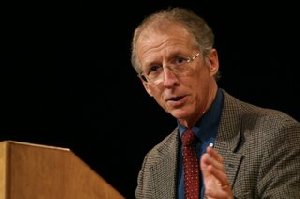
John Piper

“The present, new Calvinists claim to know way, way too much about the mind of God,” Olson claimed.

He draws a distinction between the gentle and nuanced Calvinism held by many Christians in Reformed churches and the aggressive new form of Calvinism.

“My experience is that this new wave of Reformed theology—inspired by John Piper who is inspired by Jonathan Edwards—appeals mostly to young men who want to avoid any hint of ambiguity in their theology,” he said.

Divided by doctrine

In part because its adherents hold to its teachings so tenaciously, Calvinism has divided some congregations—particularly when Calvinist pastors have asserted their beliefs in historically non-Calvinist churches. To some degree, division may be inevitable, some Calvinists have asserted.

“Any given doctrine will divide. The gospel itself is a doctrine that divides,” said Jonathan Leeman, director of communications for 9Marks, a ministry founded by Reformed Baptist pastor Mark Dever.

“There has been a renewed emphasis on the doctrines of grace, and that could lead to some level of divisiveness. That’s almost necessarily so, in the same way that an emphasis on inerrancy led to division within the Southern Baptist Convention.”

But other Calvinists believe they have been unjustly tarred with the brush of divisiveness.
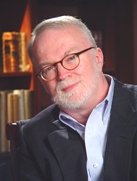
Timothy George

“What I have discovered is that Calvinism is blamed far more often for dividing churches or associations than is actually the case,” Ascol said. “Closer investigation has often revealed that Calvinism is often the tail on which the donkey is pinned. I know of more cases where the real issue behind a controversy is biblical Christianity—what is a Christian and how does a person become one—not Calvinism.”

Missions and evangelism

Ascol also believes Calvinists often have been unfairly stereotyped as anti-missionary.

“Look at who has been going as career missionaries over the last few years. A significant percentage would classify themselves as Reformed,” he said.

Olson acknowledged the current wave of Calvinism—which he calls “Piperism”—is characterized by fervent missionary spirit.

“However, I think those who follow it out to its logical conclusion may eventually decide that there is no point in evangelism or missions,” he said.

“If you are told that your evangelism and missionary work is nothing more than a ‘foreordained means to a foreordained end,’ and it cannot alter what God has already decided, you might conclude that there is no urgency.”

Leeman frames the impetus for sharing faith in terms familiar to most evangelicals, whether Calvinist or non-Calvinist—love and obedience.
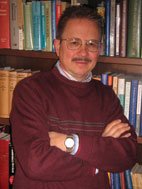
Roger Olson

“Being that Christ is my greatest love, I will want to share him with others,” he said, adding that Jesus commanded his followers to share the gospel. “The call to repentance and obedience is not optional.”

But concern about Calvinism’s impact on fulfilling Christ’s Great Commission is a valid concern, even if it’s not well founded, Leeman added.

“The primary cause of division over the issue (of Calvinism) is concern on the part of the non-Reformed crowd that it will hurt evangelism and missions, and those of us who are Reformed need to be entirely sympathetic to that concern,” he said.

“At the same time, instead of debating issues with us, I would like to see the non-Reformed crowd give us the benefit of the doubt. Accept that a Reformed congregation means what it says when it affirms evangelism and missions.”

Show some grace

Ironically, the debate over the doctrines of grace often has been characterized by a lack of grace by proponents on both sides, and much of the division caused by Calvinism could be avoided if Christians treated each other a bit more graciously, some Calvinists and non-Calvinists agreed.

“I love my Calvinist friends and students,” Olson said. “I have no quarrel with them; it is only with their theology I have a quarrel. And I do not attempt to convert my Calvinist students to non-Calvinism. I only ask them to study all the options and make sure they are thinking biblically and logically.”

Shared belief about Jesus Christ and biblical authority should be sufficient ground for Calvinists and non-Calvinists to share the same pews peacefully, Ascol said.

“Our church has Calvinists and non-Calvinists joyfully laboring together for the gospel, and I know of many other churches that do, too,” he said.

“We do that by focusing on the gospel—who Jesus is, what he has done and why that matters. We may not agree on every detail of how the gospel works—such as election, predestination, effectual calling and particular redemption—but we are all committed to the Lordship of Jesus Christ and his supremacy over all of life.”

Leeman acknowledged some Calvinists are so adamant about their position that they have failed to show “pastoral wisdom” in making distinctive Reformed doctrines a test of fellowship.

“A wiser course is to avoid the language of theology and use the language of the Bible instead,” he suggested. “It’s not so much about Calvinism. It’s not so much about the doctrines of grace. Just preach the Bible.



TULIP: The Doctrines held by Calvinists

Theologians past and present have used a bouquet of initials and analogies to describe Calvinist doctrine.

…Something Baptists find increasingly difficult

Historically, the Reformed Synod of Dort in the Netherlands delineated the differences between Calvinism and the teachings of James Jacobus Arminius. For the sake of simplicity—and playing on an association with the best-known Dutch flower—those teachings have been summarized through the TULIP acrostic.

Total depravity. Human beings are dead in their sins, and they stand justly condemned before God, unable to do anything to save themselves.

Unconditional election. From eternity, God in his sovereignty chose specific human beings to be saved. That salvation was determined entirely by God, not simply God’s foreknowledge of who would respond to his offer of grace.

Limited atonement. Also known as “particular redemption,” the doctrine teaches the death of Jesus Christ was intended for the remission of the sins of elect human beings only; in other words, the intention of the atonement and its effects are the same.

Irresistible grace. Many Calvinists prefer the term “effectual calling” to express this idea—God’s call to salvation will not fail to bring about the repentance and faith of the elect.

Perseverance of the saints. This doctrine teaches all true believers in Christ will be saved because God grants them faith to persist to the end of life, and God will keep them safe.

Timothy George, founding dean of Samford University’s Beeson Divinity School, has proposed an alternative floral acrostic. George, a Reformed theologian, recommended a change in terminology from TULIP to ROSES—radical depravity, overcoming grace, sovereign election, eternal life and singular redemption.

James Leo Garrett, emeritus distinguished professor of theology at Southwestern Baptist Theological Seminary, has noted Dortian Calvinists and early Arminians may not have differed on total depravity. Rather, he said, the key difference may have been whether faith and repentance were gifts from God—as the Calvinists taught—or human duties—as the Arminians insisted.

“That would call for FULIP (for faith) or RULIP (for repentance), not TULIP,” Garret said.

Without benefit of floral reminder, Garrett also has delineated the five points of Hyper-Calvinism:

Supralapsarianism. God’s decree to elect some human beings for salvation and to damn others eternally is logically the first of God’s eternal decrees.

Covenant of redemption. An eternal covenant exists among God the Father, Son and Holy Spirit for the redemption of elect humans through the Son.

Eternal justification. The elect are justified in eternity without their demonstration of requisite faith in history.

No offers of grace. Preachers should be discouraged from offering grace indiscriminately to their hearers, who presumably would include both the elect and the damned.

Antinomianism. Christians are not obligated to obey the moral laws of the Old Testament.


Baby Boomer Baptist theologians tilt toward Calvinism

BROWNWOOD—Among Baptist Baby Boomer theologians, at least half of the major authors are committed to Calvinism, an influential Baptist theologian of an earlier generation has noted.

Jonathan Edwards

James Leo Garrett Jr., emeritus distinguished professor of theology at Southwestern Baptist Theological Seminary, examined 10 Baptist theologians of the Baby Boomer generation during a plenary address at Howard Payne University’s Christian doctrines colloquy in Brownwood.

Garrett identified three as “pronounced Calvinists”—John Piper, Thomas J. Nettles and Timothy George. He listed two—Donald A. Carson and Wayne Grudem—as “moderate Calvinists” and one—David Dockery—as “Calminian,” an amalgam of Calvinist and Arminian theology.

Of the remaining theologians Garrett examined, he said three did not position themselves about Calvinism in their writing—Paul Fiddes, Stanley Grenz and Nigel G. Wright. One, Roger Olson, he identified as “the principal Baptist advocate of Arminianism.”

In his presentation at Howard Payne—a condensed version of a chapter from an upcoming book—he dealt most thoroughly with Piper and Nettles.

Jonathan Edwards' Influence

Jonathan Edwards—the 18th century pastor-theologian perhaps best known for his “Sinners in the Hands of an Angry God” hellfire sermon—profoundly shaped Piper’s theology—particularly regarding the doctrine of God, Garrett noted.

“There is a sense in which Piper’s theology consists of only one doctrine—the doctrine of God,” he said. “It’s the supremacy and the glory of God, even more than his sovereignty, that is central to Piper’s theology.”

Garrett noted with interest the controversy that arose in 2005 when Piper advocated that his congregation, Bethlehem Baptist Church in Minneapolis, Minn., adopt a policy of open baptism—granting membership to Christians who gave evidence of conversion but who were sprinkled as infants.

“John Piper, who has expanding and far-reaching influence as a pastor-theologian in the God-glorifying school of Edwards, has increasingly demonstrated that he is first evangelical and Reformed and second Baptist,” Garrett said.

Nettles—professor of historical theology at Southern Baptist Theological Seminary in Louisville, Ky.—simultaneously advanced the causes of inerrancy and Calvinism in Southern Baptist ranks, beginning in the early 1980s, Garrett noted.

Nettles blamed Mullins, Scarborough

“Nettles laid the blame for the demise of Dortian Calvinism among Southern Baptists on E.Y. Mullins for his theological methodology in which experience overshadowed the Scriptures and on L.R. Scarborough for his evangelistic methodology centering on what Nettles called ‘decisional regeneration,’” Garrett said.

Mullins was president of Southern Baptist Theological Seminary, and Scarborough was president of Southwestern Baptist Theological Seminary, both in the early 20th century.

“Nettles seems to embrace the domino theory,” Garrett observed. “That is, if the doctrines of Dortian Calvinism should be rejected and not be allowed to be the fountainhead of all theology, then theological crises, nonevangelical positions and process theology would be the result.”


Baptist Briefs: ABP honors BGCT

Directors of Associated Baptist Press honored the Baptist General Convention of Texas and announced a $100,000 matching-funds challenge from a Texas Baptist family during a meeting in San Antonio. The BGCT has long been one of the major financial supporters of the independent Baptist news service. Executive Editor Greg Warner announced a $100,000 matching-funds challenge from the Eula Mae and John Baugh Foundation. The foundation has promised to match all individual donations to the news service, up to $100,000, until the end of 2008. John and Eula Mae Baugh’s granddaughter, Jackie Moore of San Antonio, serves as an ABP director and on the Baugh Foundation board.

Scholarship application deadline soon. The Baptist History & Heritage Society is offering a $1,000 scholarship to a university or seminary student doing research in Baptist studies. Any student interested in applying for the scholarship must submit an application packet postmarked by May 1. It should include the student’s name, address, phone number and e-mail address; the name of the school, course and professor in which the student is engaged in research in Baptist historical studies; and a 250-word description of the research project. The student also must commit to prepare and submit to the Baptist History & Heritage Society, within one year of completing the research, a 3,500-word article for consideration for publication in the society’s journal, Baptist History and Heritage, and/or for placement on the society’s website. The student’s application also must include an endorsement letter from the student’s professor supporting both the student and the research project being conducted by the student.

Richmond seminary announces layoffs. Four full-time professors and at least three administrative staff members at Baptist Theological Seminary in Richmond will be cut in an effort to reduce costs, said seminary President Ron Crawford, who was elected to his position about a year ago. Though he did not release the names of the professors to be dismissed, Crawford said he has communicated with each one, and the school is offering severance packages that exceed a full year’s salary and full personnel benefits. The 19-year old seminary is burdened with a $6 million debt and faces a significant deficit in its budget this year—about $450,000 out of a $3.6 million budget.

Criswell trustees squelch rumor. Criswell College trustees put to rest a rumor that the college—started by First Baptist Church of Dallas in 1975—would become part of Southwestern Baptist Theological Seminary’s undergraduate program. Trustees voted without dissent that the college would not become part of the seminary. Paige Patterson, president of Southwestern Seminary, served 17 years as president of Criswell College.

Mercer trustees approve strategic plan. Mercer University ’s trustees approved a 10-year strategic plan for the university that calls for more than $1.2 billion in new investments in the institution’s endowment, faculty and staff, facilities and technology, and academic and co-curricular programs over the next decade. The plan will be funded through aggressive expansion of Mercer’s endowment from approximately $200 million today to more than $1 billion by 2018, and by developing new academic programs and other initiatives that generate additional revenue for the institution.

Dickson named dean of Mercer music school. John Dickson of Texas Tech has been appointed dean of Mercer University’s Townsend School of Music. Dickson served previously as professor of conducting and associate dean for doctoral studies at Southern Baptist Theological Seminary’s School of Church Music. He is former minister of music and worship at Second Baptist Church in Lubbock

New England Baptists seek expatriates. The Baptist Convention of New England is celebrating 50 years of Southern Baptist work in New England and 25 years as a constituted state convention. The celebration will culminate at the convention’s annual meeting Nov. 13-15 in Marlboro, Mass. As part of the anniversary observance, New England Baptists want to get in touch with Texans who served there in the past. Texas Baptists who served in New England are encouraged to send contact information to bcne25@bcne.net. For more information, visit www.bcne.net.


Youth ranch accepts 75 children from FLDS compound

LULING—Seventy-five children removed from the Fundamentalist Church of Jesus Christ of Latter Day Saints ranch by the Texas Department of Child Protective Services have been placed with Baptist Children’s Home Youth Ranch near Luling.

This will allow for large groups of siblings to remain together at the facility which has been adapted to house FLDS children exclusively, administrators explained.

Baptist Child & Family Services staff cared for women and children from the Fundamentalist Latter-Day Saints ranch for three weeks in San Angelo. (BCFS Photos)

By court order, 462 children removed from the FLDS compound near Eldorado are being moved to children’s homes all across the state.

Baptist Children’s Home is a division of Baptist Child & Family Services, a BGCT-affiliated agency based in San Antonio.

BCFS Health and Human Services, another division of BCFS that provides emergency management and incident management, has been in charge of the San Angelo unified command of state and local government, as well as other nonprofit responding organizations since April 5. At the peak, more than 1,000 responders were involved in the San Angelo operation.

“The children are being treated with the utmost consideration, care and respect like all people we care for and we will continue to protect their privacy,” BCFS President Kevin Dinnin said. “Special attention is being paid to ensuring their special dietary and religious needs are honored and met. The children’s education needs are also being met.”

The San Angelo shelters kept more than 50 BCFS incident management team members and more than $1 million of BCFS assets in San Angelo three weeks, including two mobile medical units and the mobile feeding unit supported by Texas Baptist Men.

The transfer of children was expected to be completed April 25. More than 1,000 people from numerous state and nonprofit organizations were slated to participate in a critical stress management process as part of the demobilization plan.

“Though there are significant differences, there is a common denominator between what we are doing in this situation and what we did for Hurricane Katrina evacuees and victims of the Sri Lanka tsunami and what we’re doing to help fight the international sex trafficking in Moldova,” Dinnin said. “We didn’t create the situation but are working to meet the needs of those affected.”


Autistic children enjoy art event hosted by UMHB

BELTON—For several hours on a recent Saturday, a University of Mary Hardin-Baylor gymnasium was transformed into an artists’ paradise.

Vivica Villa, age 7 of Kempner, works on a painting at the Autism in Action art day held at the University of Mary Hardin-Baylor. (Photos by Sarah-Jane Sanders/UMHB)

From pencils and paint to canvas and cardboard puzzle pieces, children with autism expressed themselves through original artwork during an Autism in Action event, sponsored by the Student Government Association of Texas State Technical College in Waco.

As part of UMHB’s biannual Reaching Out community service program, several students joined in the day’s activities. Kelli Hearn and Allison Hulcy greeted children and distributed oversized puzzle pieces for family and friends to paint as well.

“We enjoy working with kids, loving on them,” Hearn said. “I love seeing them interact with their families. It’s a real sweet ministry.”

One child in 150 children will be diagnosed with autism, said Sarah-Jane Sanders, marketing and communications coordinator at Texas State Technical College.

“Often times, if you have an autistic kid in public, all the public sees is a rowdy kid,” Sanders said. “They operate differently than other people do. They can do so much more than people think they can, and we’d like to show the community that.”

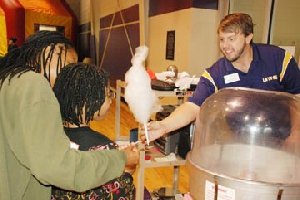
Jeff Sutton, assistant director of campus activities at the University of Mary Hardin-Baylor gives Teahla Logan, age 11 of Copperas Cove, cotton candy at the university’s Autism in Action art day.

Broderick Wilson, Student Government Association parliamentarian at the Waco school, said his autistic stepson inspired the idea behind the Autism in Action event.

“We knew that he was really interested in painting,” Wilson said. “He concentrates much more on painting than anything else.”

“Once an autistic child finds their niche, they stick with it,” he said. “It can really boost their self-esteem.”

Fourteen-year-old Ryan Padron found that niche nearly four years ago.

“My only favorite thing to do is draw,” Ryan said. “I feel great by drawing, like I’m a new person or famous.”

Ryan finds his inspirations in a small animation book featuring Naruto figures.

“It gives him the opportunity to show what he’s capable of,” said Mary Padron, Ryan’s mother.

“It just proves that even a child with a disability is capable of everything a normal child can do.

“These programs are great for kids. Every child will find their talent.”

All original artwork will be auctioned in April to help raise money to benefit the local and national autism organizations and to provide scholarships to graduating students transitioning to college.


Vision–not just geography–unite associations

FORT WORTH—Want to know what an association looks like? Don’t use a still camera, because the image and functions are constantly changing as associations try to be what the churches they serve need them to be, said Tarrant Baptist Association Director of Missions Tom Law. And to fit all the churches into the same window will take a wide-angle lens—a very wide-angle lens.

“I think the association we have been familiar with is going to change drastically over the next few years,” Law said. But change is nothing new for associations, he explained.

“When the first associations formed in the early 1600s, most were started for theological reasons,” Law said. “The associations helped them maintain theological integrity.”

From about 1925 until the late 20th century, the association served primarily as the communications mechanism for state and national conventions, he said. That’s still true to some extent, but fellowship also has become a major part of associations’ reason for being.

“I think we are seeing the churches change how they relate to one another and the conventions, and the associations are likewise going to have to change to remain relevant,” Law said. “That’s one of the things we’re struggling with. What is the association of the 21st century going to look like?”

Resourcer and orchestrator

As Law ponders the question, he starts with what he sees Tarrant Baptist Association as today—a resourcer and orchestrator.

“Really, we’re talking about knowing where the resources—the money, time and talents of people and organizations—are and pointing churches in the right direction,” he exlained.

“We’re trying to help churches know where the best sources are and how to pull those together to accomplish the things they see as their mission as a church.”

All of which has led to a new phenomenon, he noted.

“Associations are becoming galvanized around vision and around direction rather than geography,” Law said.

While most associations still maintain a geographical cohesion, Tarrant is one of several associations that is expanding. In addition to churches in Tarrant County, the association also counts as member churches Iglesia Eliacim in Matamoros, Mexico, International Baptist Church in Sofia, Bulgaria, and International Christian Fellowship in Portimao, Portugal.

Communication advancements have made the world a smaller place, Law said. When a click can send a message around the world instantaneously, geography becomes far less a factor.

Relationships

While there is not a geographic relationship, there is a more traditional kind of relationship that engendered the link with the association.

“All three are built on relationships with the pastor, but they have bought in to where they see us going as an association,” Law said.

While they may be farther away than the other churches that partner with the association, not much else is different in the way they interact.

“Our relationship with these churches is not much different than with the others. It’s built on communication, and that ebbs and flows depending on the leadership at the time,” Law said.

While that communication is largely through e-mail, leaders from the Matamoros church have come to Tarrant County the last three years to participate in Vacation Bible School and other leadership training.

Law regularly communicates with the two European churches about ways they and the Texas churches can partner together.

“They help us to think beyond ourselves, beyond the borders of Tarrant County,” he said. “We are helping our churches to broaden their perspective of what their role in the kingdom is, and having these churches involved helps our local churches to remember their responsibilities extend to the ends of the earth.”

The churches outside the United States also are members in their local associations as well. “We’re not trying to take, we’re trying to add to their relationships and add another layer of connectedism,” Law said.

Whether the church is in Fort Worth, Arlington, Bedford or Sofia, Bulgaria, Law, said the association faces the same task.

“Our purpose is to help our churches as they are fulfilling the Great Commission. Our role is to let them know where the resources are to make that happen, challenge them with opportunities around the world for reaching the lost and encouraging them to be the churches God has called them to be,” he said.


Around the State: Three Texas missionaries appointed


Roark Scholars presented overviews of academic papers as part of the Christian Doctrines Colloquy at Howard Payne University. Pictured are Kirk House of Gurden, Ark.; Rebekah Mullins of Wylie; Marisha Tyler of Farmington, N.M.; Jay Smith, assistant professor of Christian studies at Howard Payne; Wallace Roark, who taught Christian doctrine 23 years at Howard Payne; James Leo Garrett, emeritus distinguished professor of theology at Southwestern Seminary; Miranda Cole of Borger; Jami Lee Oliver of Buffalo; and Megan Donnelly of Saginaw.

East Texas Baptist University will hold its annual writers’ conference June 6-7. Twenty-six topics will be covered during the conference. The cost of attending the Saturday conference is $70, with a $20 discount for high school and college students. Attendance at the preconference sessions on Friday costs an additional $25. Friday’s events begin at 3:30 p.m. and Saturday begins at 8:30 a.m. The registration deadline is May 30. A writing contest also will be held, with cash prizes to be awarded for short stories and personal essays. Deadline for entries is May 16. For more information, call (903) 923-2083.

David Sams


Kimi Sams


Karla Turner


Three people with Texas ties were among the 92 missionaries appointed by the International Mission Board in an April 9 ceremony at First Church in Sunnyvale. Appointees with Texas ties included David and Kimi Sams who will work in university ministry in South America. They previously served as missionaries in Puerto Rico. At the time of his appointment, Sams was administrative pastor at First Church in El Paso. They have two children—Jessika, 13, and Joshua, 6. Karla Turner will serve as a church planter in South America. A native of Freeport, she is a member of First Church in Houston.

Sarah Moye and Betty Henry will become the first two women to receive leadership certificates in women’s ministry from the seminary extension department housed at Sabine Neches Baptist Area in a graduation ceremony May 6.

Lauren Teel, a freshman a Howard Payne University, has been named the Lincoln-Douglas debate national champion in the novice category. She is the school’s first national champion debater. HPU also was named the third-place team overall in its division.

Wallace Daniel Jr., professor of history at Baylor University, has been presented the Cornelia Marschall Smith Professor of the Year award. Daniel received $20,000, and will present a public lecture on an academic topic of his choosing this fall.

Sheila Griffith, a teaching fellow at B.H. Carroll Theological Institute, will teach Greek at Kenya Baptist Theological College in Limuru, Kenya, during the May term.

Contact teams are available to come to churches in preparation for the 20th anniversary season of “The Promise.” The Glen Rose musical advance teams will do as little as make a costumed announcement during services or as much as an entire service. Pastors wanting a team to come to their church should call (214) 364-5010.

Anniversaries

Fellowship Missionary Church in Sherman, 15th, March 9. Gahlen Warren is pastor.

Bobby Hawkins, 10th, as pastor of Mount Carmel Church in Tioga, April 26.

Pilot Grove Church in Whitewright, 150th, May 4. A meal will follow the homecoming service held that morning. The Homegrown and Heaven Bound band also will perform. Don Hollister is pastor.

First Church in Snyder, 125th, May 4-7. Sunday morning’s guest will be Paige Patterson, president of Southwestern Seminary, and a meal will follow. Steve Hardin, executive pastor of The Village Church, will preach that evening. Frank Page, president of the Southern Baptist Convention, will speak Monday evening. Jim Richards, president of the Southern Baptists of Texas, is the guest speaker for Tuesday. Chris Osborne, pastor of Central Church in Bryan, will preach Wednesday night. Music will be led by Rich Smith, and Luke Garrett also will perform. Russell Johnson is pastor.

First Church in Tuleta, 60th, May 18. A coffee fellowship will begin at 9:45 a.m., with the service beginning at 10:30 a.m. Lunch will follow. People planning to attend the lunch are asked to call (361) 375-2949. Jack Allen is pastor.

Retiring

Ray Vickrey, as pastor of Royal Lane Church in Dallas, May 31. He has served his present church 26 years and has been in ministry more than 50. He is a member of the Baylor University Athletic Hall of Fame for his track and field exploits, which include being a member of the 1956 440-yard relay team that equalled the then-world record and two years as Southwest Conference champion in the long jump. He was ordained to ministry by Memorial Church in Temple. In 1962, he began working at Baylor in student ministry, and in 1966, he became assistant director of the Baylor Alumni Association. Three years later, he was named executive director. During that time, he also served churches in McGregor and Troy as interim pastor. In 1978, he became minister of single adults at First Church in Richardson, and in 1981, moved to Royal Lane as pastor. He has served on the Executive Board of the Baptist General Convention of Texas and was vice president for Christian unity and interfaith relations of the Greater Dallas Community of Churches. He is a past-president of the Dallas Pastors’ Association. A retirement dinner is set for May 30, and the service on June 1 also will pay tribute to his contributions to the church. For more information, call (214) 361-2809.

Deaths

Andrew Seago, 89, Feb. 21 in Tacoma, Wash. A native of Big Sandy and a 1948 graduate of East Texas Baptist College, he was pastor of several churches in East and North Texas before spending the last 45 years as a Southern Baptist pastor in Washington. He and his wife, Doris, were foreign mission volunteers upon graduation from Southwestern Seminary but were rejected because Seago had a serious hearing problem. In response, the Seagos decided to find their own mission field and moved their belongings and five children to the Northwest. He served many churches in Washington and was pastor of North Auburn Church in Auburn, Wash., when he retired. He was preceded in death by his sister, Charlotte Long; and brothers, Alvin and Leslie. He is survived by his wife of 60 years, Doris; sons, David, Howie and Billy; daughters, Dawn Seymour and Suzanne Benfield; and nine grandchildren.

Bob Cullum, 75, Feb. 28 in San Antonio. He was a chaplain at San Antonio State Hospital 33 years. He was preceded in death by his daughter, Christi Johnson. He is survived by his wife of 50 years, Shirley; daughters, Pam Condra and Barbara Masters; sisters, Beverly and Sally; and six grandchildren.


Amazon people groups remain unreached

RICHMOND, Va. (BP) —Weary travelers stand alongside a river somewhere in South America’s Amazon Basin.

After three hours of trying to maneuver upstream by motorboat to a remote village, Southern Baptist International Mission Board missionaries grudgingly accept the realization that the day’s journey has ended.

A metal boat carrying Southern Baptist missionaries cruises up river to a remote village in the Amazon Basin. (Photo/IMB)

Shallow waters, exposed rocks, tree limbs and a rough current that nearly capsized the boat won’t allow them to go any farther.

Score a victory for the Amazon.

Thousands of miles of dense jungle create a daunting wall for Christians who want to take the gospel to this area. For some of the people groups in remote areas, their only hope to hear about Jesus is through faithful Christians praying the gospel message will reach them.

More than 400 people groups—roughly 26 million people—live in the Amazon Basin. Of that number, 270 people groups are less than 2 percent evangelical, with no IMB missionaries living among them.

About 85 of the people groups survive completely isolated, deep in the jungle. Some groups have been spotted only by satellite.

Two key factors keep these groups unreached by the gospel. The government prohibits missionaries from having access to them. And most of these groups live in areas considered too dangerous for outsiders.

Dangers include guerilla fighters, hostile tribes, poor flying conditions, crumbling or nonexistent roads and unpredictable waters.

Over the years, many missionaries have lost their lives attempting to take the gospel to these isolated peoples.

One of the most well-known incidents occurred in 1956—recounted in the 2006 movie, The End of the Spear—when a group of Huaorani Indians in eastern Ecuador killed Jim Elliot, Ed McCully, Roger Youderian, Pete Fleming and their missionary jungle pilot, Nate Saint.

But not all was lost among the Huaorani.

“When (those five missionaries) died, it really raised up a host of prayer warriors (who) began to pray for the Huaorani,” said Russ Bare, an IMB missionary and Texas native who leads work among indigenous people in Ecuador.

“Today, we have many Huaorani believers. There is power when God’s people pray.”

Many Southern Baptists are joining other Christians globally in prayer and fasting for world evangelization on Pentecost Sunday, May 11.


Duo encounters bugs, mud, ‘mixed-up beliefs’ in Amazon Basin

RICHMOND, Va. (BP)—Pat Townsend admits she’s living outside her comfort zone.

Between the bugs, mud and freezing showers, Townsend, a missionary with the Southern Baptist International Mission Board’s Masters Program, admits it could take her awhile to adjust to life in and around the Amazon Basin of South America.

A boy peers around the corner of his house in the Amazon Basin. Some children live in isolated areas where outsiders cannot reach them. Their only hope to hear about Jesus is through the prayers of faithful Christians for the gospel to reach their villages. (Photo/IMB)

“The bugs haven’t been as bad as I anticipated,” Townsend, 56, said. “I’ve asked people to pray for me about the bugs.”

Townsend and her husband, Mike, 59, left the comforts of retirement and their home in Mississippi to work among the southern Shuar people for two to three years. Fewer than 2 percent of these 15,000 people are evangelical Christians.

Religion for many southern Shuar blends worshipping spirits with Catholicism. Some Christian workers say that’s an all-too-common practice among indigenous people groups of South America.

“They will take some of the classic religion (Catholicism) and then mix it with their own (animistic) beliefs,” said Russ Bare, who leads indigenous work in Ecuador. “And then you just get a hodgepodge of mixed-up beliefs.”

Couples like the Townsends are a godsend to Bare.

“I think it’s great that people with good health, in this part of their lives, would make themselves available to go to someplace like the Amazon Basin to reach a people like the southern Shuar with the gospel of Jesus Christ.”

During their first days among the Shuar, the Townsends explored the territory. They took boat rides up and down the river to nearby villages and they hiked up to one of the waterfalls.

For the Shuar, waterfalls have an unusual purpose.

Evaristo, president of several Shuar villages, noted many of his people go to waterfalls to take hallucinogenic drugs to see visions they believe will reveal more about their god or gods.

Fortunately, the southern Shuar live in areas where missionaries like the Townsends can reveal the God of the Bible to them.

Mike Townsend, however, admits it will take more than a missionary presence to change the hearts of the southern Shuar.

“For anybody to be successful with the Shuar, God will have to work” among them, he said. “The Holy Spirit will have to do some things for them to see and understand he is the true and one God. I trust he will do that.”


Younger leaving Broadway

FORT WORTH (ABP)—Brett Younger, pastor of Broadway Baptist Church in Fort Worth, survived a vote to fire him last month but is leaving the church anyway—to become associate professor of preaching at Mercer University’s McAfee School of Theology in Atlanta.

Broadway Baptist Church has been embroiled for months in a public controversy over homosexuality and other issues. The congregation approved a compromise Feb. 24 intended to end controversy over whether gay couples in the church should be pictured alongside other families in a new church directory. Some members objected to having those photos included, saying that would move from simply welcoming homosexual individuals— which Broadway has done quietly for years—to affirming their lifestyle.

Although the membership approved the compromise, which eliminated family and individual photos, the controversy ballooned into a dispute over Younger’s overall leadership. A group of disgruntled Broadway members later submitted a petition to force a vote declaring the church’s pulpit vacant.

Survived a vote

Younger asked church leaders to schedule the vote, and members voted 499-237 against firing their pastor of nearly seven years.

The two-thirds favorable vote was not enough to quell the controversy, however, and some members have left the church.

McAfee announced Younger’s appointment April 17, effective July 1. He holds master’s and doctoral degrees from Southern Baptist Theological Seminary and has been an instructor or visiting professor at Southern Seminary, Midwestern Baptist Seminary, Manhattan Christian College, and McAfee. He has been a pastor in Texas, Kentucky, Indiana and Kansas.

New ministry

“I am honored by the invitation to join the McAfee School of Theology and I’m delighted to join such an outstanding faculty,” Younger said. “I feel like the Spirit is leading me to this new ministry.

“I’m also sad at leaving Broadway, the church has taught me so much about following Christ, and it is one of my hopes in this new ministry I can teach young people to lead their congregations to be as faithful as Broadway has been.”


‘Future Focus Committee’ named

DALLAS—A committee has been formed to study the long-range future of the Baptist General Convention of Texas.

Stephen Hatfield, pastor of First Baptist Church in Lewisville, and Andy Pittman, pastor of First Baptist Church in Lufkin, will jointly chair the committee.

The Future Focus Committee, created as a result of a motion during the BGCT annual meeting, will look at the convention’s resources and relationships in an effort “to sharpen our focus to see what we do well and improve upon it,” Hatfield said.

Pittman added the committee is comprised of people who represent the diversity of Texas Baptist life.

New paradigm 

“What I want to do is cast a vision for a new paradigm for state conventions not only in Texas but all over the nation,” Pittman said. “If we live in a post-denominational age, we can’t continue to base our future on a model that we’ve based our state and national convention on for the past 80 years.”

The committee grew out of a motion introduced at the BGCT annual meeting in Amarillo by Ed Jackson, a layman from First Baptist Church in Garland called on the BGCT president and Executive Board chairman to appoint a committee to consider a “shared vision” for the BGCT for 2020.

His initial motion called on the committee to bring interim reports to the Executive Board at its February, May and September meetings and bring a final report to the 2008 BGCT annual meeting. It also charged the committee to address the relationship between the BGCT and its institutions, set priorities, study changing missions strategies and analyze “the impact of innovation on our ministries and the sustainability of all programs.”

Philip Wise of Lubbock, chair of the committee on convention business, brought a substitute motion that was approved by messengers to the annual meeting.

Final report in 2009

The substitute motion stated: “I move that the officers of the BGCT and the officers of the Executive Board appoint a study committee of no more than 25 member to consider the shared vision of the BGCT. The committee would meet after the new executive director has been selected and make reports to the Executive Board at their regularly scheduled meetings. A final report will be made no later than the 2009 annual meeting.

“The committee will study, analyze and project income for the BGCT and address relationships between the BGCT and its institutions. The purpose of the committee is to determine the best use of resources to win Texas and the world to Jesus Christ and to encourage and support the ministries to which God has called us.”

Jackson was named to the committee. Other members are:

• Paul Armes, president of Wayland Baptist University

• Randy Babin, Soda Lake Baptist Association director of missions

• JoAnna Berry, vice president of South Texas Children’s Home Family Ministry and International Childcare

• Russell Dilday, chancellor of the B.H. Carroll Theological Institute and longtime Texas Baptist leader

• Michael Evans, pastor of Bethlehem Baptist Church in Mansfield

• Elizabeth Hanna, chair of the BGCT Executive Board’s finance subcommittee

• Jeff Harris, pastor of GracePoint Church in San Antonio

• Frankie Harvey of Nacogdoches Bible Fellowship in Nacogdoches

• Jeane Law of First Baptist Church in Lubbock

• Peter Leong, pastor of Southwest Chinese Baptist Church in Stafford

• David Lowrie, pastor of First Baptist Church in Canyon

• Tom Lyles of Green Acres Baptist Church in Tyler

• Rene Maciel, president of Baptist University of the Americas

• Gary Morgan, pastor of Cowboy Church of Ellis County in Waxahachie

• Joseph Parker, pastor of David Chapel Missionary Baptist Church in Austin

• Fred Roach of The Heights Baptist Church in Richardson

• Taylor Sandlin, pastor of Southland Baptist Church in San Angelo

• Bob Schmeltekopf, retired director of missions

• Noe Trevino, BGCT church starter

• Steve Vernon, pastor of First Baptist Church in Levelland

• Mark Wingfield, associate pastor of Wilshire Baptist Church in Dallas

With additional reporting by Managing Editor Ken Camp