‘Future Focus Committee’ named

DALLAS—A committee has been formed to study the long-range future of the Baptist General Convention of Texas.

Stephen Hatfield, pastor of First Baptist Church in Lewisville, and Andy Pittman, pastor of First Baptist Church in Lufkin, will jointly chair the committee.

The Future Focus Committee, created as a result of a motion during the BGCT annual meeting, will look at the convention’s resources and relationships in an effort “to sharpen our focus to see what we do well and improve upon it,” Hatfield said.

Pittman added the committee is comprised of people who represent the diversity of Texas Baptist life.

New paradigm 

“What I want to do is cast a vision for a new paradigm for state conventions not only in Texas but all over the nation,” Pittman said. “If we live in a post-denominational age, we can’t continue to base our future on a model that we’ve based our state and national convention on for the past 80 years.”

The committee grew out of a motion introduced at the BGCT annual meeting in Amarillo by Ed Jackson, a layman from First Baptist Church in Garland called on the BGCT president and Executive Board chairman to appoint a committee to consider a “shared vision” for the BGCT for 2020.

His initial motion called on the committee to bring interim reports to the Executive Board at its February, May and September meetings and bring a final report to the 2008 BGCT annual meeting. It also charged the committee to address the relationship between the BGCT and its institutions, set priorities, study changing missions strategies and analyze “the impact of innovation on our ministries and the sustainability of all programs.”

Philip Wise of Lubbock, chair of the committee on convention business, brought a substitute motion that was approved by messengers to the annual meeting.

Final report in 2009

The substitute motion stated: “I move that the officers of the BGCT and the officers of the Executive Board appoint a study committee of no more than 25 member to consider the shared vision of the BGCT. The committee would meet after the new executive director has been selected and make reports to the Executive Board at their regularly scheduled meetings. A final report will be made no later than the 2009 annual meeting.

“The committee will study, analyze and project income for the BGCT and address relationships between the BGCT and its institutions. The purpose of the committee is to determine the best use of resources to win Texas and the world to Jesus Christ and to encourage and support the ministries to which God has called us.”

Jackson was named to the committee. Other members are:

• Paul Armes, president of Wayland Baptist University

• Randy Babin, Soda Lake Baptist Association director of missions

• JoAnna Berry, vice president of South Texas Children’s Home Family Ministry and International Childcare

• Russell Dilday, chancellor of the B.H. Carroll Theological Institute and longtime Texas Baptist leader

• Michael Evans, pastor of Bethlehem Baptist Church in Mansfield

• Elizabeth Hanna, chair of the BGCT Executive Board’s finance subcommittee

• Jeff Harris, pastor of GracePoint Church in San Antonio

• Frankie Harvey of Nacogdoches Bible Fellowship in Nacogdoches

• Jeane Law of First Baptist Church in Lubbock

• Peter Leong, pastor of Southwest Chinese Baptist Church in Stafford

• David Lowrie, pastor of First Baptist Church in Canyon

• Tom Lyles of Green Acres Baptist Church in Tyler

• Rene Maciel, president of Baptist University of the Americas

• Gary Morgan, pastor of Cowboy Church of Ellis County in Waxahachie

• Joseph Parker, pastor of David Chapel Missionary Baptist Church in Austin

• Fred Roach of The Heights Baptist Church in Richardson

• Taylor Sandlin, pastor of Southland Baptist Church in San Angelo

• Bob Schmeltekopf, retired director of missions

• Noe Trevino, BGCT church starter

• Steve Vernon, pastor of First Baptist Church in Levelland

• Mark Wingfield, associate pastor of Wilshire Baptist Church in Dallas

With additional reporting by Managing Editor Ken Camp


Hispanic gathering stresses unity

SAN ANTONIO—Unity and equipping Christians for evangelism and discipleship took the spotlight at a regional Hispanic Baptist Convocation of the Laity gathering in San Antonio.

Baldemar Borrego, president of the Hispanic Baptist Convention of Texas, stressed the importance of promoting unity among Hispanic Baptists.

A mariachi group from South San Filadelphia Baptist Church in San Antonio lead in worship at a regional gathering of the Hispanic Baptist Convocation of the Laity. (Photos by Carrie Joynton)

“We are one brotherhood,” Borrego said. He emphasized depending on God for the individual, inner change necessary to “make a difference in the city.”

Growth in evangelism and discipleship has been a primary focus of the Hispanic Baptist Convocation of the Laity, said Rolando Lopez, associate director of missions for San Antonio Baptist Association.

Lopez urged participants at the San Antonio meeting to be effective missionaries and penetrate their communities with the gospel. He stressed the Hispanic Baptist Convocation of the Laity’s central goal is to enhance the equipping ministry of church leaders.

Leadership

“We want to make men aware that they are leaders in their congregations…and to take leadership in their churches,” Lopez said.

Baldemar Borrego (left), president of the Hispanic Baptist Convention of Texas, and Rolando Lopez, associate director of missions for San Antonio Baptist Association were among the key speakers at a regional meeting of the Hispanic Baptist Convocation of the Laity in San Antonio.

The Hispanic Convocation of the Laity grew out of Hispanic Texas Baptist Men, but the small-group workshops on church leadership and unit offered at a regional meeting in San Antonio included one geared toward women—evidence of a growing women’s ministry movement.

September meeting

The Hispanic Baptist Convocation of the Laity’s statewide meeting in September will focus on helping “pastors and churches help train the laity,” said Noah Rodríguez, local coordinator and church administrator at Primera Iglesia Bautista in San Antonio.

“One of the best things about these convocations is in the area of forming unity and communications,” he said.


Richmond seminary budget shortfall leads to faculty layoffs

RICHMOND, Va. (ABP)—Faced with “worrisome” financial challenges, Baptist Theological Seminary at Richmond will downsize its faculty and staff, the school’s president announced.

Four full-time professors and at least three administrative staff members will be let go in an effort to reduce costs, said seminary President Ron Crawford, who was elected to his position about a year ago. Though he did not release the names of the professors to be dismissed, Crawford said he has communicated with each one, and the school is offering severance packages that exceed a full year’s salary and full personnel benefits.

The 19-year old seminary is burdened with a $6 million debt and faces a significant deficit in its budget this year—about $450,000 out of an overall budget of $3.6 million, Crawford said in a statement distributed to the school’s alumni and supporters.

“Our immediate fiscal challenge is related to the capital campaign that was completed last summer as I became BTSR’s president,” he said. “The campaign included the purchase of two buildings along with two unanticipated financial challenges: significant debt and a payroll that overreaches annual revenues.”

BTSR, which enrolls about 160 students, currently employs 15 full-time professors and about 16 administrative staff, including the president and dean of the faculty. About 14 visiting and adjunct faculty members also teach classes.

The school’s campus is adjacent to Union Theological Seminary, a Presbyterian institution, and the seminary owns buildings that once housed Union’s Presbyterian School of Christian Education.

At a meeting in mid-March, BTSR’s board of trustees asked Crawford to devise a downsizing plan and present it at a called trustee meeting in late April. The president informed the seminary community of the developments at a March 28 meeting of faculty, staff and students.

“Once the downsizing is complete we will be left with a tenured faculty member in each of the disciplines we have traditionally covered, with the exception of one, where a visiting professor will be employed,” said Crawford. “With nine full-time faculty members, at least three visiting professors and other adjunct faculty members, we will continue to have a profoundly strong faculty.”

Crawford also said that the reduced faculty will have less impact on BTSR than it would on most seminaries. The school is part of the Richmond Theological Consortium, which includes Union Seminary and its School of Christian Education, as well as the school of theology at nearby Virginia Union University, a historically African-American Baptist institution. Students in the consortium’s schools may take courses at any of the institutions for no additional cost.

“On the administrative side, we are losing three and a half positions,” Crawford said. “Our idea is to replace full-time support staff with part-time students. We’ll train the students on the business inner-workings of a nonprofit, church environment. It should be a win-win.”

Founded in 1989, BTSR was one of the first institutions established by moderates who began leaving the Southern Baptist Convention in the 1980s and 90s. Though a number of other moderate seminaries and divinity schools have sprouted since then, many former Southern Baptists still retain passion for the first one, and Crawford is counting on that to get BTSR through the financial strain.

“I continue to say, ‘The future of BTSR is very bright, the short-term is worrisome,’” he noted. “BTSR will survive and, eventually, thrive. We fully anticipate going through a few very lean years. We will use the time to restructure and refocus our efforts on responding to the challenge of providing theological education in a 21st century world.”


Showing God’s love to Mexican orphans

A college girl approached two young boys fighting over a soccer ball in the Mexico orphanage she was visiting, asking why they weren’t sharing.

“I don’t want to share because he doesn’t ever give me anything,” one answered.

The other looked down at his hands. “That’s because I don’t have anything.”

University of North Texas students from the Baptist Student Ministry used spring break as an opportunity to go on a mission trip to Reynosa, Mexico. The 27 students and adults worked alongside Borderland Calvary Chapel in San Benito and the orphanage Refugio Internacional de los Ninos. The team led a series of Vacation Bible Schools and distributed rice and beans to impoverished neighborhoods.

Chris Newby said that such a trip was a welcome alternative to the standard college vacation hot spots. “I wanted to do something new with my spring break,” Newby said.

This was the second time for the North Texas BSM to serve in this part of Reynosa with Pastor Eduardo Hernandez of Borderland Calvary Chapel.

“Last year, the trip was so fulfilling and memorable for students,” BSM Director James Quesenberry said. “It was almost natural to go back and do the same thing this year.”

Quesenberry said that the group hopes to continue serving in the same area in order to build relationships with the communities and churches over time.

“The idea behind it is, we want [our students] to be able to see what it’s like to partner with other Christians and other churches,” Quesenberry said. “Hopefully, [we will] be able to see growth and change in areas and build momentum trip after trip.”

For some of the students, like NT sophomore Yandira Tenorio, it was their first encounter on the mission field. “Even though I had no experience, I just knew that He called me and said, ‘You need to be my messenger,’” Tenorio said. “Sure I had fears and doubts of my abilities, but I had to remind myself that it’s not me – God works in and through me.”

Conversely, NT sophomore Brandon Falk, had been on previous mission trips and was left unimpressed – until this opportunity.

“I wasn’t planning on going on another mission trip but when I found out that we were passing out rice and beans and going to an orphanage, I decided to go,” Falk said, “It was actually doing what Jesus said – showing people love – feeding the hungry and visiting orphans. God wants us to provide for His children and we’re God’s hands – the extension of God to this world.”

Monday and Tuesday mornings and afternoons the group was at Refugio Internacional de los Ninos, where students led a VBS and sang songs in Spanish, in an effort to show the children Christ’s love.

Six fluent Spanish-speaking students helped ease the language barrier, however many of the other NT students could speak limited to no Spanish. For this reason, the majority of the communication was outside of translators and communication was shown simply through loving the kids with play, hugs, and smiles.

“Many of them were too young to understand,” Tenorio, one of the fluent translators said. “So we had to show them Christ’s love.” And within those shared interactions, Tenorio was able to see more than simple smiles from a child, but the beauty of the Creator as well.

“In the orphanage, just being with those kids, God put a huge love in my heart for them,” Tenorio said. “By seeing their smiles and their eyes sparkle so beautifully, I could just see Christ’s love and God’s beauty in them.”

According to Falk, the unveiling of beauty has been a typical reaction to service in his experience. “Everything around you becomes more beautiful when you’re doing God’s will,” he said. “You appreciate people more when you’re ministering to them and the people you’re ministering with are more beautiful. They shine, but in a very literal way.”

Upon the group’s arrival at the orphanage, BSM intern Stephanie Gates said she did notice some remnants of their trip last year through the call of recollected names and knowing gazes. “Those kids remembered us and that’s huge,” Gates said. “It’s so important to invest in those kids and let them know that we come back because they are important to us.”

A couple hours each day was reserved to pass out bags of rice and beans in different destitute neighborhoods. Each Spanish-speaker led a small group that went door to door with a slightly different goal than last year’s distribution, said NT senior Liand Cotto – “more quality than quantity.”

“Last year we tried to help more families by giving out more rice and beans,” Cotto said. “This year the rice and beans were more of a gift to give the families after we had really talked and invested in their lives.”

One such investment occurred when NT freshman Brittney Bell was able to share a life-story that related to a Hispanic woman dealing with a difficult situation. “I was able to take something that was so American and make it so Mexican,” Bell said. “I was able to see how Christ is multicultural – He knows no boundaries, no borders, language, love or location.”

Tenorio, as a translator, said she also had an opportunity to see God overcome language barriers when going door to door. “The first day was hard because I usually don’t speak Spanish every day,” Tenorio said. “But I noticed how God reassured me that it was going to be ok. Even though no people were saved right on the spot, I planted a seed and God was glorified through that.”

For encouragement, Tenorio said she held fast to Galatians 6:9. “I would repeat it to myself constantly,” she said. “‘Let us not become weary for at His proper time we will reap a harvest if we do not give up.’ So I never felt like any day was a failure because I wasn’t giving up.”

Gates said a ministry such as passing out rice and beans gave the group an opportunity to be the “hands, feet and mouth” of the undersized neighboring church with which they were serving, Borderland Calvary Chapel in Reynosa.

“With such a small congregation, they were unable to meet the physical needs of the community,” Gates said. “So through us knocking on doors, saying hello, and passing out food we were able to open up opportunities for Pastor Ed to fulfill spiritual needs and strengthen his ministry in Reynosa. That’s a great picture of the body of Christ. Christ met physical needs, emotional needs, and spiritual needs.”

Wednesday and Thursday evenings the team held a VBS at Borderland Calvary for the local children in Reynosa. Through interaction with the children, Newby said he found a new means of communication that did not require any Spanish knowledge – and it came in the form of his newfound nickname ‘caballito’ (little horse).

“The last night of VBS I really wanted to focus on one kid – a little girl named Leslie,” Newby said. “And all she wanted to do was get on my shoulders and ride around.” However, he said that through countless horse-back rides he was able to communicate something a bit more profound.

“Through translation I found out that Leslie really cared that I was there,” Newby said. “She really loved me and appreciated that I helping and focusing on her. I wanted her to realize how much Christ loved her.” After two days with Leslie, Newby said that he was just picking up and leaving without a second thought was not an option.

“At that point I realized that I can’t just stop there, talking to her just in Mexico,” he said, “but also keeping in constant communication through letters and pictures from the week. I want to show her how to pursue something more than what she has there in Mexico.” It’s this kind of personal ministry that Newby said he finds most effective.

“First you get to know them and then get a chance to talk to them about God,” he said. “He’s more like just a storybook character to them than a Savior at that age. But if they realize how much I love Christ, and what he’s done for me, hopefully in some way I’ve planted a seed and they realize how much Christ loves them.”

Instead of the construction of homes, the goal for this trip was instead, the construction of hearts that know the Father – a type of ministry that relies heavily on faith, Gates said. “On many mission trips, you go, build a house, and see the progress. When you’re done you see the finished project,” Gates said. “But this trip was not like that at all.”

While a trip such as this may not have the structure of a building, it has the benefits of dealing with God’s people and investing in lives in a different way than lumber and nails.

“Each conversation is a chance for God to move in someone’s life, but we never get to see the end result,” she said. “The gospel tells us to go out and preach the good news and then to trust that God is in control of that. At the end of the day, without particularly seeing any progress, we are able to glorify God by being faithful to the call He has placed on our lives.”

Now as the group has returned to the University of North Texas, the real question is not only how their ministry this spring break changed the people they came into contact with, but also how it has changed the students themselves.

“I find that spending time with the kids and seeing the devastation with poverty has really changed my life,” Newby said. “Now I realize that as a poor, broke, college student I have it pretty good compared to people I’ve seen in Mexico this week.”

According to Tenorio, the root intention for this mission trip, and all of the life lessons learned there from, can be traced back to those first two boys fighting over the soccer ball at the orphanage.

“It broke my heart but I know that I was put there during that situation so that I could reassure that little boy that he has Christ’s love,” Tenorio said. “He may not have material possessions but he has the greatest gift. None of those material possessions put together could surpass Christ’s love.”
Beach Reach volunteers make positive impact on South Padre


SOUTH PADRE ISLAND—During Spring Break, more than 50,000 college students from across the nation travel to South Padre Island to party, drink incredible amounts of alcohol, have sex and indulge in worldly passions. 

But this spring break, 375 Christian students came from universities and colleges from Texas, Arizona, Arkansas, Minnesota, and Missouri to bring the light of the gospel into that darkness.

The students hoped to share their faith with spring break vacationers through servant evangelism. They served free pancakes each morning at Island Baptist Church and every night in front of a bar, gave fee van rides around the island every night, spent time with students on the beach every afternoon, handed out free sunscreen and prayed in the all-night prayer room during a weeklong Beach Reach event.

“If you watch TV or the media, you would think this generation is utterly lost,” said Buddy Young, coordinator for Beach Reach and director of Baptist Student Ministries at West Texas A&M University. “And I would agree, except for a remnant of students who want to see their generation reached for Christ.” 

The Beach Reach ministry consisted of five teams that ran 40 vans in five different shifts each night.  Texas Baptist Men volunteers prepared the pancake meals.

The efforts were rewarded as Beach Reach volunteers gave 8,414 van rides, provided 6,500 people with pancakes and saw 68 people accept Christ as Savior. Overall, Beach Reachers were able to serve 21,063 people.

“The goal of this week wasn’t to convert people, but to further the kingdom of God and to let God’s glory shine through people,” said Stella Almblade, a senior at the University of Arizona.

Almblade went on to say that she had many opportunities to share the reason for this ministry through the free van rides. 

“Many people were grateful just to have a free ride,” Almblade said.  “When they said that, I would tell them why we were here. It was such an easy way to bridge the conversation to other spiritual beliefs and who they thought Jesus was and what they thought about the Bible.”

To prepare to share their faith boldly, students met five weeks prior to Beach Reach to train in personal evangelism and pray for God’s blessings.

“I just wanted to see him do something ridiculous, to see him do something bigger, and he did,” said Richard Benavides, a senior at Texas A&M University in Kingsville.

In one instance, Benavides shared the gospel and led a prayer for salvation in Spanish. 

“I don’t really know enough Spanish to do that,” Benavides said. “I believe God’s Spirit came down like in Acts chapter two. It was tripped out.”

Late in the week, Benavides met a girl from New York on the beach and had a conversation with her about Christ. 

“She was worried we were going to become the Bible-thumpers, but we got to show her love instead of judgment,” Benavides said. “A lot of what we are doing is breaking down walls built by generations of legalism and judgment.” 

Seeing “how much God himself loves each one of those very drunk partiers, how much God wants to do in them” broke Benavides heart, he testified.

“It opened my eyes to how each one of them is important, just as important as those of us wearing Beach Reach shirts.”

 On the last day of Beach Reach, all 375 of the Beach Reach workers gathered on the island’s main beach. They rushed into the waves of the Gulf of Mexico to attract attention to the baptism service for those who had accepted Christ that week. Twenty-three students were baptized.

One of the prayers of the leaders involved in Beach Reach is that the students who participate will catch a vision to reach their peers and verbally share the gospel when they return to their campuses. 

“We have a generation of students who are not sharing their faith verbally,” Young said. “They share their faith through music or t-shirts, but not verbally. It’s always been our goal at Beach Reach to train, mobilize and empower students to verbally share their faith.”   

Because Beach Reach is based on students reaching students from their own campuses, it is necessary for other universities and students to become involved with this ministry, Young continued.

Many Spring Breakers at South Padre are from universities in Oklahoma or are African-American or Hispanic.  The best way to reach these groups would be to have more African American or Hispanic believers and college ministries from Oklahoma coming to share the gospel, he said.

Since the beginning of Beach Reach in 1980, more than 5,000 Christian students have been trained in personal evangelism, and at least 3,000 people have accepted Christ.

CUTLINES

Buddy Young (left), Baptist Student Ministries director at West Texas A&M University, baptizes a new Christian in the Gulf of Mexico during Beach Reach. (Photos by John Hall/BGCT)

 A Beach Reach volunteer from the Baptist Student Ministries at Texas Tech works the phones during the evangelistic outreach on South Padre Island.

A Beach Reach volunteer prays for God’s blessing on the servant evangelism efforts of fellow students.


Capacity crowd at Congreso called to “higher life”

A record number of people packed Congreso, a BGCT-sponsored event for Hispanic youth and singles. More than 200 people made spiritual decisions during the event. (Photo/Ferrell Foster/BGCT)

BELTON—Nearly 3,000 teens and young adults gathered on the University of Mary Hardin-Baylor campus Easter weekend, setting record attendance for Congreso, a gathering of Hispanic Texas Baptists.

“This is the biggest Congreso we have ever had,” said Angie Tello, Baptist General Convention of Texas Hispanic evangelism events coordinator. “I’m a little surprised that so many teenagers spent their Easter vacation here, but it shows just how dedicated today’s youth are to the Lord.”

They came on charter buses, passenger vans, and caravans of trucks and cars, packing the university’s Mayborn Campus Center. During the three-day event, every breakout session was filled to capacity. At one point, 300 students from 22 congregations committed to an afternoon of missions projects in the area.

For BGCT Hispanic Evangelism Director Frank Palos, it was evident from the start this would be a Congreso for the record books.

“On the first night, we ran out of decision cards,” Palos said. “The hallways were filled, and I couldn’t even get into the building.” 

More than 200 spiritual decisions

By the end of the weekend, more than 200 students made spiritual decisions, including at least 48 young people who made first-time professions of faith in Christ. Many of those who made spiritual decisions described a need for healing in their lives and families. They spoke of craving God.

“I think we are in the midst of a spiritual awakening among our youth,” Palos said. “In the schools—that is where God is moving.” 

Many students present had to raise funds to attend the event, Palos noted, pointing out the average Hispanic Texas Baptist church has 50 members with 15 to 20 young people in attendance.

“Those small churches don’t have the funds to send all their kids to Congreso. The best many of them can do is provide a van or some sort of transportation,” he said.

Even so, it didn’t hold the youth back from giving when the offering baskets were passed. During the event, nearly $6,000 was raised for scholarships.

“Students are very generous,” Palos said. “I’m not surprised that they gave so willingly. They look at other students at Congreso and in their community as family. And we help family when they need it.”

Bands, including Obtain Paradise, Blind 1:11, The Grace Project, The Cockrell Hill Band and Sand Stone, provided the event with a ready-made soundtrack, pumping up the crowd for the 45 seminars geared toward teens from seventh grade and beyond. All were combined to drive home the message of this year’s Congreso—to live an elevated existence.

To the next level

“This year, we were challenged as a staff to move to the next level, and that is what we wanted to pass along to the students,” Palos said. “We want them to live a higher life for Christ.”        

Dallas evangelist Cesar Oviedo drove home that message. On the last day, he reminded the teens to walk differently than when they first arrived.

“You will always be surrounded by people, but we as Christians have to be different,” he said. “When you leave this place, you will be walking at a higher level than you have ever walked before. That’s powerful.” 

At one point, Wayne Shuffield, director of the BGCT Missions, Evangelism and Ministry Team, urged participants to walk with power in Jesus.

“Let’s go show people who Jesus is by the way we talk, live and act,” he said. “Every day is filled with choices. Make the choice to be one of God’s soldiers.” 


Lubbock teen, 69-year-old woman connected through service

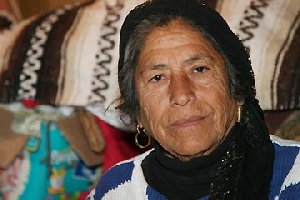
VADO, N.M.—Antonia Ocón’s living room has a foot-wide hole in it. Spider webs cling to the room’s corners. The floor would break if anyone jumped. And the windows are peep holes covered by plastic.

Antonia Ocón sits in a room in her home in Valdo, New Mexico. Ocón said she's suffered from skin cancer and is very grateful for the help the Buckner children are offering.

“I spent my life picking chile, planting onions and gathering herbs for a living,” she said, stretching out sand-paper-rough hands as proof. “It was enough to help feed 10 children, but the sun gave me cancer.”

But the idea of death doesn’t seem to faze Ocón, age 69. Her mind is habitually on others—such as the volunteers she hears hammering on her roof.

“God bless them,” she said about the teenagers climbing ladders to paint the outside of her home. “I hope they don’t fall.”

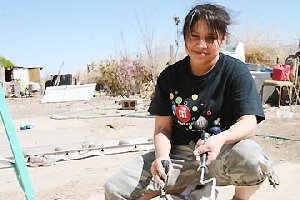
Outside, Alexis Vasquez, 13, clasps a ladder with one hand and strokes a dripping paintbrush along the side of Ocón’s roof. She smiles while she works, but not when she remembers.

“My father got sick and died when I was 9,” Vasquez said. “And my mother’s problems with drugs and alcohol got worse. She told her boss she’d burn down the house when my siblings and I were sleeping in it. So, they took us out.”

Alexis Vasquez, 13, works outside the home of Antonia Ocón during her spring break. Vasquez said she discovered her love of service through Buckner.

Vasquez, who’s been living at the Buckner Children’s Home in Lubbock for a little over a year, said she finds comfort in helping people and showing them someone cares. She said she discovered a love of service through Buckner.

Alexis Vasquez and Antonia Ocón don’t know each other, and they aren’t likely to remember each other’s names. But they are connected in the ways they bless each other. And they are connected through Buckner.

Vasquez is part of a group of seven children from the children’s home in Lubbock, and an eighth child from Midland, who traveled with Buckner staff to Las Cruces, N.M., to help paint and restore the homes of two families living along the Mexican border. This was the first Buckner mission trip to New Mexico.

Each child on the trip has a story of how they ended up in Buckner care. Vasquez pulled hers out and laid it on my note pad.

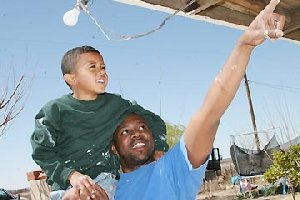
Patrick Harris, intake coordinator at the Buckner Children's Home in Lubbock, holds up Mathew Simpson.  "You missed a spot right there," Harris tells him.

When Vasquez moved in with Buckner, she learned that she could be a solution to other people’s problems, she said. And if she studied to be a surgeon, she might even be able to save the life of someone like her father, who died four years ago.

“If I’m a surgeon, I can tell the people I do surgery on about God so they won’t be scared,” Vasquez said. “And if I don’t become a surgeon, I still want to help people by doing hospital ministry so I can talk to them about God.”

Fifteen-year-old Stephanie Montiel said she sees herself spending part of her life doing missions.

“If I hadn’t ended up at Buckner, I never would have been interested in mission work,” Montiel said. When she was visiting her mother, “I told her about God and church, and she said that if I get to move home again, we can go to church together.”

As the teenagers worked outside, Ocón worked inside her house. She lives in a trailer home with room additions made of mismatched pieces of wood, brick and concrete. Her husband built the home over the years, but he died from lung cancer, she said. Now, she shares the house with her son, her daughter-in-law and their newborn baby.

Kimberly Johnson, 17, paints a wall outside the home of Ocón.

“We lived a happy life here,” she said, remembering 15 years spent in the home. “My husband and I raised 10 kids and saw them grow up and get married.”

As Ocón walked in and out of her house doing chores, she covered her head and neck with a black cloth and wore five layers of shirts and sweaters to protect her from the sun’s rays.

“It stings my back,” she said. “I try to get up several hours before the sun so I can do dishes outside and other chores because my sink doesn’t have water.”

But water is on the way. The Buckner group from Lubbock teamed up with a small group from Mesilla Park Community Church in Las Cruces to make life easier for Ocón and her family.

The Mesilla Park group connected with Buckner through Jerry and Ratha McClelland, who have worked for seven years with the Buckner children during their mission trips to El Paso before they moved to New Mexico.

“We had been afraid that once we moved out here, we wouldn’t be able to work with Buckner any more,” Jerry McClelland said. “But then we learned that Buckner wanted to start working in New Mexico. It worked out great.”

And the Mesilla Park small group is also getting ready to re-roof the house and hire an electrician to do some work.

Ocón said she is grateful for the help she’s getting, and she is happy with the way she has lived her life.

“God has blessed me,” she said.


Buckner makes history in Peru

{loadposition rotator}
Buckner International made history in Peru when officials from the Ministry of Women and Social Work and the Texas-based agency placed eight Peruvian children into the country’s first foster families.

It was the first step of many in an ongoing pilot foster care program. Organizers hope to place 60 orphans and at-risk children into families by the end of the year.

Nine-year-old Elvis greets his new foster parents Vilma and Adolfo Gomez for the first time. (Photo/ANDINA/Carlos Lezama)

“We interviewed 43 families to choose these first seven,” said Buckner Peru Director Claudia León Vergara. “All the families are well adjusted and stable, with a lot of love to give. They are eager to help these great kids.”

León and her staff have faced overwhelming difficulties to bring the term “foster care” to life in their country. The term didn’t exist until they gave it a name: acojimiento familiar, which literally means “to admit into your house as a guest” or “to offer protection.”

“People frequently think that this concept is similar to adoption,” she said. “In that sense, it has been hard work to make them understand and accept foster care as a possibility.

“Ultimately, we hope to develop this program into public policy. We hope to persuade the government to consider foster care as an alternative to placing children into orphanages when they are in a crisis situation.”

In addition to foster care, Buckner Peru also is providing transitional services for 27 young women and mothers who have been raised in the orphanage system.

Junior, 8, hugs his new foster parent Pablo Vargas as his wife Maria Guadalupe looks on. Junior is one of the first eight children to be placed into foster care in Peru.
Photo/ANDINA/Carlos Lezama)

Two homes have been purchased—in Lima and Cusco—where these young women will live and study for their careers, which includes anything from baking to business administration to fashion design. Another home for teenage mothers will be supported at Reina de la Paz orphanage, near Lima.

“All the girls who take part in the transitional programs come from families living in extreme poverty conditions,” León said. “They have been victims of abuse, abandonment and sexual violence. For them, violence was a normal part of life. These homes will allow them to live in a calm environment and focus on their future careers.

“They will also be reinforced on issues like responsibility, Christian values and self sufficiency in order to encourage them to face the real world and its daily challenges.”

For more information about Buckner ministries in Peru, contact Leslie Chace at lchace@buckner.org .


Ministering at the “Mardis Gras of the North”


A missions team from the BSM at Texas A&M University disembark from a plane in Alaska where they worked at the Iditarod.

NOME, Ala.—Each spring, racers pack their sleds and hook up teams of dogs to challenge the Alaskan landscape as they race more than 1,150 miles for the Iditarod championship.
This year, a little bit of Texas hospitality was waiting for them at the finish line.

 See Related articles here.

A team of 14 from the Texas A&M University Baptist Student Ministries  volunteered as part of a larger group to support the race, specifically helping visitors in Nome, Ala., where the race ended. During the day the group provided free hot chocolate, coffee and Bibles to people throughout the town.
At nigh

Katherine Jaynes, Elizabeth Sobol and Jeff Turner work on the concessions team during a Texas A&M BSM mission trip to Alaska.

t, they helped keep the streets safe in the “Mardis Gras of the North,” where bars stay open until 5 a.m. The volunteers provided vouchers for free cab rides and helped people make it home safely.
“We averaged about four hours a sleep a night, we were so busy,” said Chris Boule, an intern at the Texas A&M BSM.
The Texas A&M team also staffed a concession stand for a basketball tournament for Alaska natives, with all the profit going to help a local women’s shelter. Before the tournament was through, the group had raised $10,000, which was going to be matched by a grant.
God honored the team’s servant attitude and allowed them to enter into spiritual conversations with people, Boule said. In all, 45 people professed faith in Christ.
“Alaska is not like the lower 48,” Boule said. “It’s a totally different world. But the people are amazing and so gracious. You just fall in love with it immediately.”