Locke says Easter Bible burning a sign of attack

MT. JULIET, Tenn. (RNS)—A Tennessee pastor known for burning books, casting out demons and creating outrage says someone burned 200 Bibles outside his church on Easter Sunday.s

Greg Locke, pastor of Global Vision Bible Church in Mt. Juliet, Tenn., said the church’s security cameras recorded a “polite crook” stopping their vehicle in the middle of an intersection by the entrance to the church, turning on hazard lights, then dousing a trailer full of Bibles with gas and setting it on fire.

“You got to be kidding me,” Locke said during the Easter revival service, according to a video posted on the Global Vision website. “How many churches in America have a trailer full of Bibles getting burned to block the parking lot?”

The fire is currently under investigation by the Wilson County Sheriff’s Department.

According to a press release from the sheriff’s office, the Mt. Juliet Fire Department responded to the fire at about 6 a.m. on Sunday morning and quickly extinguished the fire.

“The trailer, containing Bibles, had been dropped off in the middle of the intersection and then intentionally set on fire,” according to the sheriff’s department. “To uphold the integrity of the ongoing investigation, other specific details cannot be provided at this time. However, we assure the community that further updates will be shared at the appropriate juncture.”

At first, Locke joked about the fire, saying he had asked law enforcement to give the charred pages of the Bibles to the church—so the church could hand them out as a reminder of the need for prayer.

Then he called the fire another sign that Christianity was being threatened in America and that the return of Jesus and the End Times were imminent.

“If you think that Christianity is not (under) attack more than ever before in the United States of America, you have not been paying attention,” he told his church. “Quit being lukewarm. Quit being so passive aggressive and namby-pamby and spiritually sissified. OK? I’m telling you, they’re attacking churches in America.”

Locke then told his congregation he had just returned from a trip to Israel, which he said was the safest place in the world, and he insisted news reports about the war in Gaza were media lies.

Linking to End Times prophecy

He then went into a long monologue about the so-called Red Heifer prophecy—the belief a red cow has to be sacrificed on the Temple Mount in Jerusalem to usher in the return of Jesus and the end of the world.

The Temple Mount is currently the site of the Dome of the Rock, one of the holiest places in Islam. Locke told his congregation the mosque on the Temple Mount would soon be “brought to rubble” and a red heifer would soon be sacrificed, which would allow first the Antichrist and then Jesus Christ to arrive.

“We are watching the word of God be fulfilled before our very eyes,” he said.

Locke was once a relatively obscure Tennessee preacher, known mostly for publicity stunts like backpacking hundreds of miles to raise money for missions and staying up all night on a cherry picker to raise awareness about homelessness.

He became a social media influencer after a 2016 video of him condemning the inclusive bathroom policies at Target went viral. Locke has since used his online influence to promote Donald Trump and Christian nationalism—as well as to declare himself an exorcist, capable of casting out demons.

Locke has also claimed witches infiltrated his church in an attempt to bring his ministry down and has clashed with his neighbors and local officials after erecting an enormous tent on the grounds of his church during the COVID-19 pandemic.

That tent, Locke has claimed, is needed to accommodate the crowds of new people attracted by his support for Trump and his newfound career casting out demons.


Survey links religious practice to life satisfaction

(RNS)—Announcing the results of a new Global Flourishing Study, a consortium of scholars and pollsters led by Gallup said they found links between religiosity and people’s satisfaction with their lives.

The study, a joint project of Harvard and Baylor universities, Gallup and the Center for Open Science, aims to uncover what influences “human flourishing,” which is defined by measures of happiness, character and virtue and social relationships, among other values.

According to the group’s research, attending a religious service regularly positively affects flourishing.

“We’re not shocked at that because there’s a lot of other research that indicates that faith is important to human flourishing, but it may come as a surprise to people that religion would be an important thing,” said Byron R. Johnson, director of Baylor University’s Institute for Studies of Religion.

Earlier studies have shown religion could help young people struggling with mental health issues and being involved in a congregation could influence the level of happiness.

For this study, Gallup interviewed 200,000 individuals in more than 20 countries, including Mexico, Japan, Nigeria, Indonesia and Israel. 

Participants were asked questions about the six domains the Center for Open Science has identified as the core indicators of human flourishing. Physical and mental health, purpose and financial stability were among the topics discussed.

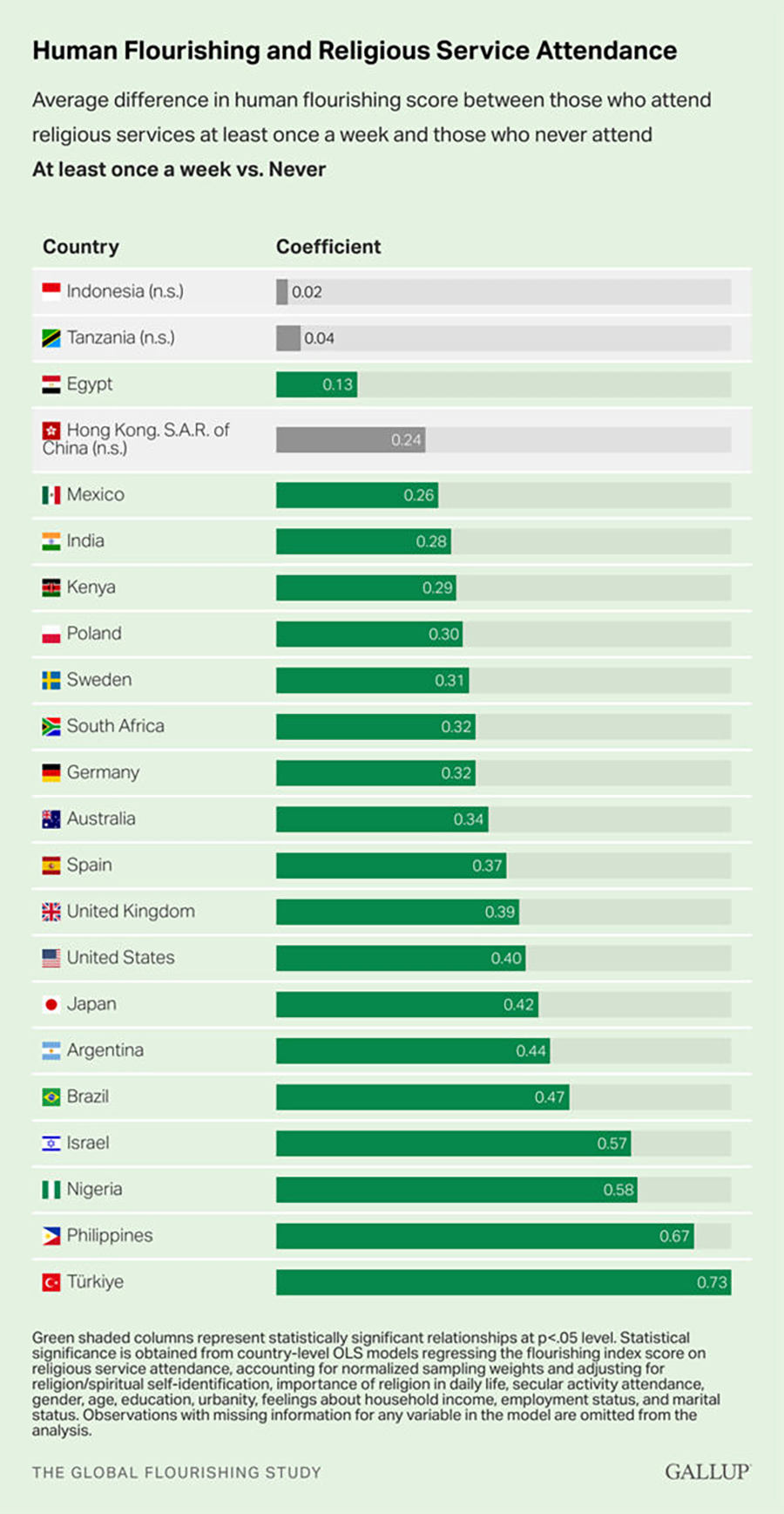
(Graphic courtesy of Gallup)

Their responses were collected during short in-person interviews and used to create a “human flourishing index” ranging from 0 to 10, with 10 being the highest level of satisfaction.

Results lead to further research

Respondents who said “religion is an important part of daily life” score 0.23 points higher on average than those who didn’t. 

Those who attend a religious service at least once a week scored 0.41 points higher than those who never do. 

Attendance one to three times a month correlated with a 0.22 point higher score, while those who go a few times a year scored 0.18 points higher on average.

The study also revealed that gaps in human flourishing scores are largest among people in Turkey, with 0.73 points of difference between Turks who attend religious services weekly and those who never do—in the Philippines (0.67 points of difference), and in Nigeria (0.58 points of difference).

In an article commenting on these results, Gallup noted context is important to understand the data, as other factors related to financial stability, such as being employed and living comfortably, also play a role.

Now that the first results have been published, the team of 50 researchers deployed by the four institutions to work on the study is conducting separate analyses to study the level of flourishing within each religious group and compare religions together. 

These further analyses might give them clues on which religious groups tend to have higher flourishing scores.

“Some people will just be looking at Jewish samples, for example, and some will just be looking at samples of those that follow Islam, and some will be doing all of it,” said Johnson.

The main focus for the next four years is to keep the same sample population so researchers can track the participants’ level of flourishing and understand what influences potential changes.

Johnson said the idea of creating a longitudinal study—one that follows people over time—came after a conference on human flourishing at Harvard in November 2018.

Johnson said the study could also help make headway in understanding the global religious landscape, as the study collected data about religious groups in every country.

The next round of interviews already has started, with results likely available by mid-February 2025. In the meantime, all data collected in the first edition of the survey are available in open access for researchers.


Scientist uses resurrection to lead the curious to Christ

HOUSTON (BP)—In an unassuming office on the campus of Rice University, you can often find professor James Tour on a Zoom call.

Is he chatting with other scientists around the world about his groundbreaking research in nanotechnology? Maybe.

But more often than not, he’s talking with a stranger about the resurrection of Christ.

Whenever he has the opportunity—on his website, at a lecture or at the end of one of his many YouTube videos—Tour invites anyone who doesn’t believe in the resurrection to talk with him about it. Seekers connect with him from all over.

The only stipulation to receive an hour of one-on-one time with one of the world’s leading scientists? You must be curious about the resurrection.

“You need a quiet location, a Wi-Fi connection and a camera turned on,” he tells them. “When they agree to that, I meet with them.”

Tour, who calls himself a Messianic Jew, teaches chemistry, computer science and nanoengineering at Rice. He has received his share of accolades, such as being named “Scientist of the Year” by R&D Magazine in 2013 and being inducted into the Royal Society of Chemistry in 2020, just to name two.

He holds more than 200 patents. But he’s a lot quicker to mention another number—the 107 people who received Christ last year after spending an hour with him.

Tour has a “burning desire to see people saved,” he said. “As Rachel cried out, ‘Give me children or I die.’ Lord, give me children, or I die,” he said, quoting Genesis chapter 30.

Not all of Tour’s resurrection conversations are on Zoom. Many are at his home on Sundays.

For 25 years, he has taught a Sunday School class at West University Baptist Church near the Rice campus. He and his wife invite the class—which can number upwards of 80 people—to their home for lunch after church. Many seekers accept the invitation, where they hear Tour share the gospel by way of the resurrection.

Resurrection and lordship come first

Tour often begins by using the illustration of a bridge—man on one side, God on the other, a chasm of sin in between.

“But I always funnel it right into the resurrection of Jesus Christ,” he said. “The last verse that I share is Romans 10:9. ‘If you confess with your mouth that Jesus is Lord, and believe in your heart that he’s risen from the dead, you shall be saved.’ This is exactly where the Scriptures lead us to. It is not Jim Tour’s prescription. It is exactly where the Scriptures lead us to.”

The resurrection forms the foundation for the other crucial doctrines of the Christian faith, he believes.

“We do not have to convince them of the Trinity,” he said. “We do not have to convince them of the virgin birth. We do not have to convince them of the Noah’s Ark story. None of that. That’s never on the table for me.

“It is those two things—the lordship of Jesus and the resurrection of Jesus Christ. And I go right after the resurrection, because once the resurrection is established, the lordship is clear.”

Presenting compelling evidence

He lays out all the evidence for Jesus’ literal death and bodily resurrection. Roman soldiers were skilled in the practice of crucifixion. So, there was no way Jesus was still alive when he was placed in the tomb.

Thomas was able to feel and see the wounds in Jesus’ hands and side. Jesus appeared to more than 500 people after the resurrection, and he even ate with them. Secular historians of the time affirm Christ’s followers were willing to die rather than deny the resurrection.

“I would die for what I believe,” Tour said. “But these men and these women were not dying for what they believed to be true. They were dying for what they knew to be true. Because they saw it with their own eyes. They saw Jesus risen from the dead. And nobody dies for what they know to be a lie.”

Tour goes through this narrative with different people each week. Most of them are highly educated, he said. The conversation takes 30 to 40 minutes.

“I see people go from not believing in the physical resurrection of Jesus Christ to believing in the physical resurrection of Jesus Christ based upon this 30-minute conversation,” he said.

“I think why they come to believe, to embrace the resurrection is truth, is because the truth of the resurrection was already written on their hearts. It’s already there. I’m just bringing them to a point to confess to what’s already there.”

Tour then leads the person in a prayer patterned after Romans 10:9.

“Once they have prayed that prayer, it’s like a seed that’s sitting here in your heart. That seed opens,” he said. “Now, when you pray that prayer, now something is going to start growing.”

‘Lord, I believe. Help my unbelief’

Tour reassures each new convert that their faith doesn’t have to be very big.

“I don’t have a hundred percent assurance of anything in this life,” he tells them. “I don’t believe anything a hundred percent. For all I know, we are living in a matrix.”

He then tells the story from Mark 9 about the man who asks Jesus to heal his son. Heal my son “if you can,” the man asks.

“And Jesus says to him: ‘If you can? All things are possible to him who believes.’

“And the man says something very profound,” Tour said. The man says: “‘Lord, I believe. Help my unbelief’

“Jesus didn’t say: ‘Well, you go away. When you’re a hundred percent, come back, I’ll heal your son.’ Jesus immediately healed his son.

“I don’t know what percentage belief you have in the resurrection. Maybe it’s only 20 percent. That’s good enough. The Lord’s going to help your unbelief.”

Tour then assigns homework to each person who prays to receive Christ—15 minutes of Bible study and meditation each morning. He has them start in John 1. He tells them to be prepared for a change in their life and behavior.

Paul asserts in 1 Corinthians the resurrection is the most important thing, Tour said. That’s why he believes it should be ground zero for any conversation about the gospel.

“This is God’s prescription for salvation,” he said. “Why wouldn’t you use it?”


Louisiana Reach Haiti celebrates safe return of staff

CAP HAITIEN, Haiti(BP)—Four weeks after they became trapped in Port-au-Prince, two staff members of Louisiana Reach Haiti arrived safely at the ministry’s Children’s Village in Cap Haitien.

Darrin Badon, president of Louisiana Reach Haiti, said the women left on a bus from the capital city early March 26 and took the eight-hour bus ride for a long-awaited reunion with the children and staff at the Children’s Village.

They had been living in a relative’s home since March 4, when gang activity forced them to remain inside the house.

Badon expressed gratitude for the many prayers on behalf of the women and the children and other staff of Louisiana Reach Haiti, a partnership between the Louisiana Baptist Convention, Haiti Baptist Convention, Louisiana Baptist churches and the Louisiana Baptist Children’s Home & Family Ministries.

“God protected them while they were there with family,” Badon said. “By his grace, we got them out of there today. The kids and staff were elated to see them. Lots of hugs were exchanged and we are so grateful they were brought back.

“I can’t help to think a year ago Antonio was kidnapped, and God released him on Good Friday,” continued Badon, referencing the safe return of Children’s Village Director Antonio Auguste in March 2023 after he was kidnapped by gang members in Port-Au-Prince three weeks earlier. “My prayer was on Good Friday they would be home and spend Good Friday at the church in Cap Haitien.”

Since Feb. 29, gangs in Haiti have burned police stations, attacked the country’s main airport and raided two of the nation’s largest prisons, releasing more than 4,000 inmates, the Associated Press reported.

Additionally, more than 33,000 Haitians have left Port-au-Prince. And, more than 340 U.S. citizens have been evacuated out of the country since March 17.

Continuing the share Christ’s love

While the violence continues, Badon said, Louisiana Reach Haiti continues to share the love of Christ with the children. He asked for continued prayers as they press forward.

“Thank you for your faithfulness in praying for our children and staff,” Badon said. “Most of all, we thank our Lord and Savior for his grace, mercy and refuge in a time of need. Those ladies and many in Haiti have been in a desperate time of need.

“We are looking to hear from the Lord on how to continue making a difference in Haiti in the lives of our children and staff. And we are eager for other ways to serve.

“Despite all the hardships in Haiti, we know God has a purpose for us. We still are working to be in his will and serve the people of Haiti who face one adversity after another.”


Gaza Baptists ‘no longer have the energy to suffer’

GAZA CITY, Gaza Strip (BP)—Baptists sheltered in the remnants of Gaza Baptist Church are so worn out they “no longer have the energy to suffer,” a leader there told the Christian Mission to Gaza.

“We are very tired,” the mission quoted Shady Al-Najjar, a Gaza church leader, in its March 27 newsletter. “Our days are useless, our children are collapsing in fear, without education, and life has become very difficult.

“We no longer have the energy to express or explain what is happening in our country,” Al-Najjar said. “We are surprised by the silence of the world, but we are optimistic about God’s mercy and love.”

Israel Defense Forces have decreased their attacks on Gaza, where IDF leaders have “dismantled” but not destroyed 20 of Hamas’ original 24 battalions, IDF officials told the Washington Post.

Rather, despite the United Nations Security Council’s call for an immediate cease-fire, Israel is eyeing Rafah, where Hamas’ four remaining battalions are housed. Israel’s military believes, according to the Washington Post, thousands of Hamas fighters and sought-after commanders are stationed in tunnels alongside perhaps 100 remaining hostages.

Also in Rafah are 1.4 million displaced Palestinian civilians, whose lives would be most vulnerable in any Israeli attack there. The United States and others have worked to provide humanitarian aid to the refugees living in tents along the Egyptian border.

Christian Mission to Gaza continues to serve

CM2G, led by former Gaza Baptist Church Pastor Hanna Massad, has continued to deliver food and hot meals to Baptists and other Christians still in Gaza five months into the war. Christians numbered only 1,000 in Gaza before the war begin in October, a scant minority in the city of mostly Sunni Muslims.

“We continue to hold the people of Gaza in our prayers, asking for God’s peace, mercy, and comfort to prevail in their lives,” Massad wrote in the newsletter. “We remain committed to serving them in whatever way we can and continue to provide hot meals.”

Famine is imminent, the Integrated Food Security Phase Classification system said in its monthly report through March 15. At least 70 percent of the people in Gaza City and North Gaza—210,000 people—are facing catastrophic hunger, with the 2.2 million people in the Gaza Strip facing high levels of food insecurity.

Continued war, including an assault on Rafah, would leave half of Gaza’s population suffering catastrophic hunger, the IPC’s most severe classification.

“There are many, many words that I cannot express about our psychological and spiritual situation,” Al-Najjar told the mission. “Food is at ridiculous prices, even if it is available in the market, and a lot of food has run out from the market.”

Gaza Baptist Church, the only Baptist congregation in Gaza City, has been heavily damaged in the war, as has St. Porphyrios Greek Orthodox Church. Nearly 20 Christians died when the IDP attacked the Greek Orthodox church in October. The three congregations are the only Christian churches in the city.

The International Court of Justice and the UN Office for the Coordination of Humanitarian Affairs are among those calling on Israel to stop blocking the land delivery of food and other humanitarian aid to Gaza, with food air drops inefficient and costly.

The death toll to date includes more than 32,000 Palestinians, with nearly 75,000 injured, the Hamas-run Health Ministry said March 28. But the death toll is suspected to be much higher than numbers publicized, The Washington Institute, a think tank on U.S. Middle Eastern policy, reported March 26. The Health Ministry, the institute said, no longer has a reliable mechanism to tabulate a death toll since hospitals have shut down.

More than 1,139 Israeli residents and others died in Hama’s Oct. 7 attack on Israel that launched the current war.


Katy church sees rapid growth in baptisms

KATY—Bear Creek Baptist Church is seeing growth—the kind of growth many churches dream of. With 60 baptisms since the beginning of 2024, the church is baptizing new believers about every week. 

Is this revival, or is there a secret recipe? Some of both, according to Tim Hill, executive pastor of Bear Creek. 

Bear Creek’s campus is located in an area of high visibility, Hill said. People pass by it regularly—many people. 

In a video on the church website, Lead Pastor David Welch said the neighborhood within five miles of Bear Creek has grown by more than 15,000 households. 

“That’s over 35,000 people in just the last three years. And it is projected to grow by another 15,000 households in the next five-seven years,” he said.

Bear Creek invests in reaching out to those new arrivals, Hill said.

Building a reputation

Bear Creek Church (Courtesy Photo)

“Our church is really great about reaching out and inviting people,” Hill explained. “We also really try to have a strong presence in our community. We partner with two local elementary schools through our school district.” 

Weekly worship services include clear presentations of the gospel, Hill said. 

“Our vision statement is that we are a gospel-centered, disciple-making community. … It’s not a light sharing of the gospel,” Hill said, noting the church clearly talks about sin, the need to turn from sin, and the gift of salvation. 

“We share the gospel clearly, and people are responding,” he continued.

Hill credits the congregation’s work in the community, their visibility and their systems in helping to make Bear Creek become a place where seekers go. 

Over time, they’ve developed a reputation for being a church where people feel like they belong, Hill said. Their membership process even is called “Belong.” 

As prospective members move through this process, “they really find a home,” Hill explained. “And I think it’s kind of like momentum. Once you get that rolling and moving and you create that culture in your church, it just occurs organically [that people will come to your church].”

Vacation Bible School always has been a really big thing at Bear Creek, Hill said. They even carry it up through middle school age, which they call VBX. 

Bear Creek is intentional about having invitation strategies. They are intentional about putting resources into the hands of their people to use in inviting.

And their staff is very goal-driven, which creates focus, Hill said. They set fall, spring and summer goals, which may be adjusted as needed. Each set of seasonal goals has three areas of focus. One current goal is focused on attendance.  

 “So then, you look at what drives attendance,” Hill said. “Invitation strategy, creating excellent experiences for people when they come to church—it’s making sure that when they come, we lead people to encounter Christ, grow in their faith and take next steps.”

Hill said they want to connect people to the church, not just see them make one-time decisions. Baptism is an important next step that is emphasized.

So, they set goals. “But then you have all the work to reach the goal. When someone visits our church, they go into a system where they are followed up with in specific ways in week one, week two,” Hill explained.

The system management falls to staff. And it is a part of every staff meeting every week.

Setting smart goals, which they check with a scorecard, they “track where every person is in the system so that to the very best of their ability, they don’t drop anyone through the cracks.”

They utilize the church community builder database in Pushpay, for systems management.

Hill said in order for laypeople to handle systems management, “you would have to have high-capacity volunteers who almost serve your church like it is their job. And there are some of those out there, but they are rare.”

Trusting the Holy Spirit, too

“I think every church leader would recognize, we do all the work we can and we pray, and we seek the Lord and we work really hard. But in the end, we also just have to depend on the work of the Holy Spirit,” Hill said.

For the last two years Bear Creek has been recognized as one of the 100 fastest growing churches in the United States by Lifeway and Outreach magazine. Presently, “attendance is 13 to14 percent over last year’s attendance at this time,” Hill said. 

More than half the 60 baptisms so far this year were of adults, from both the Spanish- and English-speaking services.

Danny Quintanilla, discipleship and missions director for Bear Creek, spoke about one Spanish-speaking man who recently joined Bear Creek and requested to join a life group. 

When Quintanilla asked the man what brought him to Bear Creek, the man reported he regularly passed a large sign—written in Spanish—in front of the church, advertising the Spanish language service. He felt like he needed to come to church, and then decided to try this church. 

Quintanilla and Hill spoke of other recent baptisms. One young woman is from a Muslim background. Her conversion to Christianity led to rejection from her family.

A church member offered her a safe place to stay and other members gave generously to secure a car for her to continue working. 

Her family would allow her to come home if she renounced Jesus. But her commitment to Christ has not been shaken. She remains estranged from them, while praying for God to work in her family situation.

Carl Mayer is another who was recently baptized, at 75 years old. He said his Nigerian caregiver invited him to Bear Creek last year. 

Many others had invited him to other churches through the years, but his past experiences in church and in life were negative. 

He went to a couple of “holy roller” services with his grandparents in Kentucky as a child, he said, but “they scared him to death” and he had to go outside the tent and wait. 

Then he tried a Baptist church where he came from, but the minister wanted more than $300 to baptize him. 

“So, my mom threw that minister out of the house, and that was the end of that.” 

Mayer said he “never thought about church again until recently.”

His caregiver saw what he was dealing with, he said—sadness, anger, hurt from a troubled life and trauma he endured in childhood that has “stayed with him.” So, she invited him to come with her to Bear Creek. This time, when a friend asked, he went. 

It was Easter Sunday last year, and he was “blown away” by the minister. He visited several times, always thanking the preacher for the message that was so touching, but not giving his name. He was too “shy,” he said, due to all the hardships he faced in childhood. 

But he decided he was ready to take the next steps and be baptized. He thought he was going to drown when his legs, which don’t work as well anymore, came up. But, he said, now he “feels entirely different.”

He feels calmer since trusting Jesus. 

“I’m even singing now,” he said, quietly laughing. 


Time to let the sun set on the Texas Lottery?

Representatives of Texas Baptists’ Christian Life Commission and Texans Against Gambling recently called on members of the Sunset Advisory Commission to take a hard look at the Texas Lottery Commission.

Katie Frugé and John Litzler of the CLC submitted a detailed 10-page letter—along with 47 pages of supporting documentation—to the Sunset Advisory Commission in advance of its upcoming review of the Texas Lottery Commission.

Litzler and Rob Kohler, longtime consultant with the CLC on gambling issues, also met with Sunset Advisory Commission staff to discuss their concerns privately. Public hearings will be scheduled later.

‘Blatantly deceptive act’

In their letter, CLC leaders pointed to a series of actions that “call into question the integrity, security, honesty and fairness of the Texas Lottery” and its executive leadership.

“The CLC has great concern and believes Sunset staff should carefully review recent rulemaking activities of the Texas Lottery,” the letter states.

In 2005 and 2009, the Texas Lottery proposed changes to instant scratch games rules that would have opened the door to an electronic version of the lottery. The proposed changes were rejected in rulemaking proceedings due to public opposition both times.

However, in what CLC leaders termed “a blatantly deceptive act,” the Texas Lottery approved similar changes during a June 11, 2020, meeting conducted by Zoom “during the height of COVID.”

“As a direct result of these changes, the CLC has recently learned that Lotto.com is now selling multiple $100, electronic instant Texas Lottery scratch tickets,” the letter states.

During the June 2020 Zoom meeting, the Texas Lottery Commission changed its rules to allow lottery ticket sales by phone via the internet using third-party companies, rather than appearing in person at a licensed retailer for a face-to-face transaction.

“The CLC in the strongest of terms objects to these actions by the Texas Lottery and hope the Sunset staff will look for meaningful solutions to prevent such fraudulent action against the citizens of this State in the future.”

Response from the Texas Lottery

When contacted by the Baptist Standard for comment, Steve Helm, media relations division director for the Texas Lottery Commissions responded: “The Sunset Advisory Commission Staff Report on the Texas Lottery Commission is anticipated to be issued in the near future. At that appropriate time and as part of the Sunset review process the agency will provide responses to the Staff Report and will participate in the Sunset Advisory Commission’s public hearings.

“Feedback provided to the Sunset Advisory Commission by the public is confidential and will not be shared with the agency. However, the rulemaking proposed in June 2020 did not substantively change the requirement that all elements of a sale of a lottery ticket must take place in person at the retailer location.”

In its letter to the Sunset Advisory Commission, the CLC asserts the Texas Lottery skirts that requirement by distinguishing between actually playing the lottery by directly purchasing a ticket from a licensed retailer and “placing a play” with a lottery courier gambling company.

The letter quotes testimony by the executive director of the Texas Lottery at a House committee hearing describing the role of lottery couriers as “the Uber Eats of the lottery industry.”

‘Indefensible’ abdication of responsibility

CLC leaders assert the Texas Lottery is permitting internet gambling companies—some of which operate offshore—to sell Texas Lottery tickets from licensed retailers via phone apps and computers. The Texas Lottery also has allowed the internet companies to promote sales using its trademarked game logos on their platforms.

The Texas Lottery has claimed these “lottery couriers” operate outside their jurisdiction, and “they are helpless to stop internet gambling companies,” the letter states. However, the CLC insisted Texas is the only state lottery that has taken such a position.

“The Texas Lottery has been silent while these companies have been advertising on radio, social media platforms and in newspapers, and misleading Texans to believe that purchasing Texas Lottery tickets over telephones and computers via the internet is legal,” the letter states.

CLC leaders also pointed to the Texas Lottery’s legal obligation to adopt rules that prohibit the sale of lottery tickets to minors—a responsibility it cannot fulfill when tickets are sold by third-party companies by phone.

“The Texas Lottery’s abdication of the enforcement of this statutory requirement to unregulated ‘third party’ offshore and internet gambling companies is indefensible,” the letter from CLC leaders states.

Sunsetting Texas Lottery would be ‘a net gain’

Russ Coleman, chair of Texans Against Gambling, likewise wrote to the Sunset Advisory Commission. He called the Texas Lottery rule changes “disingenuous—and sly is not too strong a word.”

“The Texas Lottery Commission should be sunsetted,” Coleman states.

While the Texas Lottery was promoted to Texas voters in 1991 as a way to fund public education, he noted net revenue from lottery ticket sales defray the cost of only five days of the 180-day Texas public school year.

“The lottery preys on poor and vulnerable Texans. The first obligation of the state is to provide for Texans protection and well-being.  The lottery, through its myriad indirect social costs and blight, does the opposite,” Coleman’s letter states.

“The lottery’s net revenue contributed to the state treasury is estimated to be one-third to one-fifth of the costs to Texans through resultant increased crime, increased law enforcement needs, and many other social services costs. … Sunsetting the Texas Lottery would be a net gain to the state treasury and Texans’ well-being.”


Trump endorses ‘God Bless the USA Bible’

WASHINGTON (RNS)—During Holy Week, Donald Trump released a video promoting sales of the “God Bless the USA Bible.”

“We must make America pray again,” the former president said in a YouTube and social media promotional video for the Bible, named after country singer Lee Greenwood’s 1984 hit song.

Along with a King James Version translation of the Christian Scriptures, the “God Bless the USA Bible” also features the text of the U.S. Constitution, the Declaration of Independence, the Pledge of Allegiance and the chorus to Greenwood’s song—all for $59.99.

In the promo, Trump, who is seeking a return to the White House, laments the decline of organized religion in the United States.

A new poll from Gallup found more than half of Americans rarely or never go to church, while projections from Pew Research indicate that by 2070, fewer than half of Americans may be Christians. Most Americans believe religion is on the decline but are split on whether that is a good or bad thing.

“Religion and Christianity are the biggest things missing from this country,” said Trump in the promotional video. “And I truly believe that we need to bring them back. And we have to bring them back fast.”

Every American, says Trump, needs a Bible in their home. In the video, he is flanked by American flags and calls Greenwood a good friend.

Trump, who promised Christian broadcasters a revival of Christian power during an appearance in Nashville, Tenn., last month, has played Greenwood’s anthem during campaign events.

Paid endorsement?

While Trump claims in the promo the Bible is his favorite book, saying he owns many copies, his endorsement is likely a paid one—the promo video points viewers to godblesstheusabible.com, where they can order a copy.

The Associated Press reported a spokesman for Trump and the ‘God Bless the USA Bible’ did not respond to questions about how much Trump was paid for the licensing deal or how much he could profit from book sales.

The site includes a disclaimer that the Bible has no ties to the Trump campaign and funds from the Bible don’t go to the campaign. However, Trump was compensated for the endorsement.

GodBlessTheUSABible.com uses Donald J. Trump’s name, likeness and image under paid license from CIC Ventures LLC, which license may be terminated or revoked according to its terms,” an FAQ on the site reads. The Washington Post reported CIC Ventures LLC is owned by Trump.

Appealing to nostalgia

Endorsing the “God Bless the USA Bible” was likely a smart move for Trump, said Warren Throckmorton, a retired Grove City College professor who has studied the work of David Barton, a popular Christian speaker who has his own patriotic version of the Scriptures known as The Founders Bible.

That Bible and the one Trump endorses appeal to a sense of nostalgia about America’s past, based on efforts in the 1940s to market the United States as a Christian nation. The idea of the United States as a Christian country is commonly held, Throckmorton said, while not historically accurate.

“I think that’s the fallback position for many people, even if they’re not personally Christian themselves,” he said.

Throckmorton predicted the endorsement would pay off for Greenwood and Trump.

“It will sell Greenwood a profitable amount of Bibles, and it will solidify Trump’s image as a champion of morality to his fans,” he told Religion News Service. “Trump needs to shore up his base and this kind of Christian nationalist baby food will do the trick.”

Promoting Christian nationalism

Ruth Braunstein, associate professor of sociology at the University of Connecticut and director of the Meanings of Democracy Lab, said that the “God Bless the USA Bible” appeals to “God and country” religion. But it can be used to promote more radical forms of Christian nationalism—the idea that America belongs to Christians and that Christians have the right to run the country, she said.

“It’s one thing to say (or sing along to) ‘God Bless the USA’ and quite another to say (as Trump did in his announcement video), that ‘All Americans need a Bible in their home,,” she said in an email.

“This is not just promoting religion in general, which would perhaps draw criticism but still be considered within the pale. He is using his position as the former President to endorse a specific form of religiosity, to sell a Christian Bible.”

University of Oklahoma professor Samuel Perry, who has published two books on Christian nationalism, said Trump’s ad reflected the ideology’s penchant for framing Christianity as under siege. He pointed to the former president’s argument that the U.S. is not only tied to Christianity at its founding, but that the nation’s religious heritage is under attack.

“It’s not enough to say ‘We’re a Christian nation and we should honor that.’ What really needs to be communicated is that ‘We were a Christian nation, but not anymore, because of those people,’” Perry said in an email. “In other words, at the core of the political strategy of Christian nationalism is constantly evoking the felt sense of loss and future threat.”

Trump, he added, “can’t convincingly sell himself as an exemplar of Christian piety,” but can “sell himself as the defender of Christians against the attacks of leftists, socialists, Muslims, and immigrants.”

Put together by Greenwood with the help of a Nashville marketing firm, the “God Bless the USA Bible” has been controversial in the past. Plans for an edition using the New International Version of the Bible under agreement with the Christian publishing giant Zondervan were derailed after Christian authors with ties to Zondervan protested.

The project was resurrected using the King James Version, which is in the public domain.

A spokesperson for Greenwood did not respond to requests for comment.


Study: Unaffiliated the only growing religious group in U.S.

WASHINGTON (RNS)—Religious churn has been a key fixture of U.S. religion for a long time, but a new surveyof changes in American religion finds that motion is not so much a swirling but a one-way stream heading out.

A new PRRI survey shows religiously unaffiliated Americans are the only group that has seen steady growth over the past decade—from 21 percent of all Americans in 2013 to 26 percent in 2023.

These unaffiliated Americans—many of whom abandoned their childhood faith—are not looking for a spiritual home. Only 9 percent of people in this group said they were “looking for a religion that’s right for me.”

Most may be unaffiliated for life. Only 3 percent of Americans who grew up without a religious identity said they joined a religion.

Even those who remain religious—the vast majority of Americans, about 67 percent of whom are Christian—say religion is less important in their lives.

Only 53 percent of Americans say religion is the most important or one among many important things in their lives in 2023, compared to 72 percent in 2013.

“The level of religiosity among Americans, even among people that identify with the religious tradition, has really dropped pretty precipitously in the past decade,” said Melissa Deckman, PRRI’s CEO.

“A quarter of Americans say religion isn’t important at all in their lives. Another 19 percent say it’s not really that important, maybe has a little bit of importance.”

Researchers surveyed 5,600 adults across the United States in November and December last year. Those results were compared with studies PRRI did in 2016 and 2013.

The Catholic Church saw the largest decline in religious affiliation of any religious group in 2023. Some 30 percent of Americans said they grew up as Catholics—18 percent white Catholics and 12 percent Hispanic Catholics.

But only 20 percent continue to identify that way today—12 percent white Catholics and 8 percent Hispanic Catholics. A 2016 survey showed similar losses for Catholics.

Study’s groupings challenged

Tom Gaunt, executive director of the Center for Applied Research in the Apostolate at Georgetown University, took issue with the study’s groupings of religions.

He said it was unfair to compare general categories for white evangelicals—for example, a mashup that might include high-church Anglicans alongside Southern Baptists—and compare those to Catholics.

Each one of the denominations in the big general category may have lower retention rates than Catholics. Plus it doesn’t capture switching from one denomination to the next.

He also said the survey doesn’t reflect “reverts”—those who left the church as teens but returned later in life when they had children. In the Catholic Church no one would require those returning Catholics to recommit to the faith.

“The presentation of the data is unclear,” Gaunt said.

According to the data, white mainline Protestants also lost more members than they replaced, about 4 percent. Black Protestants and white evangelical Protestants had the best retention rates—76 percent of those reared as white evangelical Protestants in childhood remained so and 82 percent of Black Protestants.

Among those who left the religious identity they grew up with, 67 percent said they stopped believing their faith’s teachings, up 7 percentage points over 2016.

LGBTQ treatment drives faith departures

But the biggest change came among those who said they quit their religious upbringing because of its treatment or teachings of LGBTQ people.

In 2016, 29 percent cited negative teachings about LGBTQ Christians as a reason they quit their religious affiliation. In 2023, 47 percent said that was a reason they quit.

The younger the unaffiliated were, the more they cited LGBTQ teachings as a reason for leaving. Sixty percent of unaffiliated adults aged 30 or under cited LGBTQ teachings as a reason for quitting.

Compared with 51 percent of unaffiliated in the 30-49 age group and 37 percent of unaffiliated in the 50-64 age group cited LGBTQ teachings as a reason for quitting.

Nearly half of LGBTQ unaffiliated respondents (48 percent) said they no longer identify with their childhood faith because it was bad for their mental health.

“I think treatment of LGBTQ Americans, clearly for younger people, is an issue that is driving them to leave religion altogether,” Deckman said.

Unaffiliated respondents also cited the clergy sexual abuse crisis as a reason for leaving church. Overall, 31 percent of Americans cited clergy sexual abuse. But among former Catholics who no longer identify with their childhood religion, 45 percent cited the clergy sexual abuse crisis.

About 65 percent of unaffiliated Americans are white. They are more likely to identify as Democrats and independents.

Unaffiliated Americans are twice as likely to identify as LGBTQ, 19 percent vs. 9 percent.

The findings confirm a 2020 study in the Journal for the Scientific Study of Religion that found same-sex attraction, behavior and queer identity strongly associated with a decision to step away from organized religion, attend church less frequently or stop going altogether.

The PRRI study had a plus or minus margin of error of 1.7 percentage points.


Author Leah Payne details the rise and fall of CCM

(RNS)—God gave rock ’n’ roll to everyone, as the British rock band Argent once sang.

And everyone includes the religious-right powerhouse James Dobson, as well as the legendary rock band Kiss, both of whom tried to reach the souls of teenagers through the power of rock ’n’ roll.

Both Kiss and Dobson get a mention in God Gave Rock & Roll to You, a new history of the cultural power of contemporary Christian music from religious historian Leah Payne. 

The book traces the rise of CCM. Payne describes its rise as “part business, part devotional activity, part religious instruction,” from its humble beginnings to its 1990s heyday—when Amy Grant’s “Baby Baby” was a monster hit—and then to the current dominance of a handful of megachurches.

The power of “Becky”

She also looks at how Christian leaders like Dobson, Billy Graham and concerned evangelical moms known as “Beckys” sought to harness the power of rock music to keep their kids Christian and to shape the broader culture.

“The story of CCM is the story of how white evangelicals looked to the marketplace for signs of God’s work in the world,” she writes.

Payne draws on interviews with artists, fans and record executives as well as her own training as a religious historian to trace the rise and fall of CCM. 

The book is filled with sharp insights and small details about the role Pentecostalism and Nazarene holiness codes played in shaping Christian music for decades. Rather than being built on generic evangelical beliefs, she argues, Christian music was influenced by both the ecstasy and the strict boundaries of those traditions.

Early on, Payne details how Pentecostalism inspired “Great Balls of Fire,” an early rock ’n’ roll hit by Jerry Lee Lewis, cousin to televangelist Jimmy Swaggart. 

That term was used by Southern Pentecostals to talk about the Holy Spirit—a reference to the book of Acts, where the Spirit descends on early Christians in the form of fire.

For Pentecostals, being filled with the spirit often comes with a sense of euphoria, often displayed through singing. Rockers like Lewis took advantage of that connection, said Payne.

“You can imagine how scandalizing it would be for Pentecostals when Jerry Lee Lewis uses that expression as a very thinly veiled reference to sex,” Payne said in a recent interview. “They felt that it was desecrating their holy practices.”

Payne said the purity codes of groups like the Nazarenes also played a role in Christian music, which was seen as a more wholesome version of rock music. Leaders like James Dobson, who grew up in the Church of the Nazarene—a holiness tradition—used music to spread ideas about chastity and modesty for women.

“Women who were holiness preachers were super modest, but that made them spiritual bosses,” Payne said. “They were out there exorcising demons and telling men what to do from the pulpit.”

Folks like Dobson, Payne argues, kept the modesty part of holiness codes, but they domesticated it—spreading the idea women should be submissive at home rather than powerful.

But women also played a major role in shaping Christian music. The genre’s biggest stars were women—like Grant—and women were its biggest customers. Especially a woman known as “Becky”—an industry term for the suburban evangelical moms who bought the majority of Christian music.

The name “Becky,” said Payne, was used by marketing executives and record producers to determine what songs got recorded and often determined which artists became stars. 

Payne points to the example of Carmelo Domenic Licciardello—better known as Carman—who became a star in the 1990s. She said record company executives were not big fans of Carman, whom she described as a Christian version of Liberace.

But the Beckys loved him and made him a star, Payne said.

“Beckys were really powerful,” Payne said. “They were the ultimate gatekeepers. There was great respect—and, in many cases, fear—of Becky because these suburban, conservative white women were very powerful if they were upset.”

Those women—as well as religious leaders like Dobson and Billy Graham—were hoping to use the power of mass media to shape the spiritual lives of their kids, Payne said. 

At the time, Payne said in the interview, Christian parents were being told their children were in serious danger of being corrupted by the outside world. Buying the right kind of music could help keep them safe.

 That kind of concern sometimes crossed political lines as Christian rock began its rise. 

In the 1980s, Tipper Gore, wife of then-Democratic Senator Al Gore, led a campaign to get warning labels placed on music with offensive lyrics. That same kind of concern from moms helped drive the success of CCM.

But Beckys became older and fewer in number. And as the country became more diverse and more polarized, their buying power shrank. The dependence on that audience made it harder for Christian music to reach a changing nation.

“A lot of the collapse of the industry is explained by the fact that they doubled down on this person who did not replace themselves, demographically speaking,” Payne said.

Several factors contributed to decline

The fracturing of the music business in general also hurt Christian music. Much of the genre’s success, said Payne, depended on creating a Christian alternative to mainstream pop stars like Madonna or George Michael. 

As the larger music scene splintered and top 40 music no longer was a “coherent category,” that became harder to do. How do you create an alternative to the mainstream when there is no musical mainstream?

Payne said Christian music had an impossible task in trying to harness music and “coolness” for religious purposes. Coolness, she said, depends on authenticity and a sense of rebellion against social norms—both of which were problems for religious leaders.

“Christian rock was an uneasy effort to solve those problems,” she said. “And it didn’t work long term.”

The decline of churchgoing in America—and the consolidation of many Christians into megachurches—also hurt the Christian music industry. 

Many Christian bands got their start by playing concerts in medium-sized churches, said Payne, which have largely disappeared. And megachurches have their own bands and sometimes even music labels. So, they don’t need the music industry in the same way anymore.

“CCM depended on those groups to provide gatherings and revenue—and they just don’t exist anymore,” she said.

The CCM market was also affected by larger changes in the American religious landscape—such as the rise of charismatic megachurches like Hillsong and Bethel, whose songs dominate the worship music sung in churches. 

Other groups, like Southern Baptists or Christian music companies, tried to use music in service of their mission, said Payne. But those charismatic churches have made music their mission, said Payne, and no longer need the institutions that supported CCM.

“Among evangelicals, the group that had the most institutional heft was the Southern Baptist Convention,” she said. “And they have faded. 

“CCM has faded. And what has arisen are the nondenominational charismatics. The music showed us that that was coming.”


Around the State: Health science workshop set at HPU

High school students can apply now for Howard Payne University’s second annual Health Science Enrichment Workshop, scheduled June 19-21. The workshop is designed to help prepare juniors and seniors who are interested in health professions, while showcasing health-related programs at HPU. The event, sponsored by the joint admission medical program, will take place on the HPU campus, with visits to Hendrick Medical Center in Brownwood. The workshop is organized by HPU’s School of Nursing and School of Science and Mathematics and will give students the chance to engage in science lab activities and clinical skills exercises. Each student also will have the opportunity to shadow a healthcare professional who works in the student’s area of interest and attend a roundtable discussion. The deadline for application is May 1, and the workshop fee is $100. Some scholarships are available. Students must be 16 or older to apply. For more information or to apply, click here. 

East Texas Baptist University honored academic excellence and Christian scholarship at the Presidential Scholars Society and Honors Program dinner on March 19. (ETBU Photo)

East Texas Baptist University honored academic excellence and Christian scholarship at the Presidential Scholars Society and Honors Program dinner on March 19. The event recognized students who have achieved success in their educational pursuits throughout their time at ETBU, as well as students who are members of ETBU’s Honors Program. Alan Noble, associate professor of English at Oklahoma Baptist University, delivered the keynote address. Noble challenged students to cultivate four virtues in order to participate prophetically, truthfully and persuasively in a contemporary world: humility, desiring the good of others, prudence and fortitude. “We desperately need Christians who embody these virtues to participate in culture in a manner that brings glory to God and edifies our neighbor,” Noble said. “These virtues demand much of us. They are costly in time and in social capital—but our world desperately needs them”. Eleven senior Presidential Scholars received awards in recognition of maintaining a perfect 4.0 GPA after more than 90 completed credit hours: Avery Abshier, Erin Berry, Karis Crenshaw, Mary Frances Ellis, Elijah Gage, Hannah Hobson, Kendall Little, Madison O’Neal, Sarah Resendez, Holli Richards and Hallie Sadler.

The University of Mary Hardin-Baylor will host its 85th annual Easter Pageant on March 27. Performances are scheduled at 12:30 p.m., 3 p.m. and 5:30 p.m. All performances will be free and open to the public. The pageant may be viewed live online on the UMHB Facebook page and at www.umhb.edu/live. The student-led production features a cast of hundreds of students and children and grandchildren of university students, faculty and staff. 

Houston Christian University Alpha Epsilon Delta National Convention attendees (HCU Photo)

Last week, 45 students from Houston Christian University participated in the Alpha Epsilon Delta Biennial National Convention in Dallas. Alpha Epsilon Delta is an honor society for students who have an interest in pursuing a career in the health professions. HCU students traveled to Dallas accompanied by biology professor Lisa Ellis and Amy Raimondo, the professional experience office director for health professions at HCU. At the conclusion of the conference, Raimondo assumed office as president of the national executive board of Alpha Epsilon Delta. One of the convention’s keynote speakers was HCU alum David Fray, and the graduate student panel featured two recent HCU graduates, Stephen Iype and Kevin Doan. HCU received awards for convention attendance, the large chapter activities report award and a convention chapter presentation award.

Micheal Summers (Courtesy Photo)

The biannual conference of Texas Baptist Ministry Assistants is scheduled April 25-27 in Granbury. Aimee McGinnis, TBMA president and Concho Valley Baptist Association ministry assistant, said ministry assistants will get training and inspiration, while enjoying fun, fellowship and worship. The conference theme is “Rooted in Christ,” based on Jeremiah 17:7-8. Micheal Summers, vice president of the New Mexico Baptist Foundation, will serve as conference pastor. Registration is $130, plus membership dues. Registration information can be found at TBMA.net

Anniversary

90th for Shiloh Church in Garland on March 17. Ronald Session is pastor.


Beach Reach marked new high in professions of faith

Ten days of intensive ministry to college students on South Padre Island yielded the highest number of professions of faith in Christ for any Beach Reach event in recent memory.

Beach Reach volunteers offered free pancake breakfast to students on spring break—and prayed for those who allowed them to do so. (Photo / Texas Baptists)

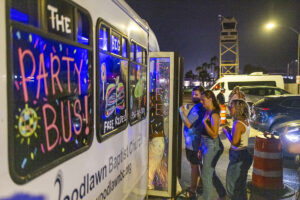
Through Beach Reach, a spring break outreach ministry organized by Texas Baptists, 1,256 volunteers provided van rides, served pancakes and prayed for the spiritually lost. As a result, 276 individuals accepted Jesus.

The number of gospel conversations and shared prayers also increased over the previous year, said Joe Osteen, Beach Reach coordinator and Baptist Student Ministry regional director for East Texas.

Osteen attributed the increases to the Spirit of God and preparations made.

“We just really saw God move and students be available and ready and willing,” Osteen said.

“We’ve been working to grow and establish an evangelistic culture statewide. We’ve been working to have some shared tools and language, prioritizing personal evangelism.

“I think that was on display at Beach Reach this year with how prepared our BSM students were.”

Forty-four groups consisting of BSM students and leaders, churches from across Texas and beyond, and ministry partners like Texans on Mission—formerly Texas Baptist Men—converged on the island to support the two-week effort.

‘Shine the light of Jesus in a dark place’

Osteen noted students gather on the island each spring for various reasons, including to relax, blow off steam and party. He described the environment in which Beach Reach volunteers minister as dark.

More than 1,200 Beach Reach volunteers offered free van rides to spring break partiers on South Padre Island, and used those rides as occasions to start spiritual conversations. (Photo / Texas Baptists)

“We serve pancakes right outside one of the biggest clubs on the island. We get to meet them where they are and shine the light of Jesus in a dark place,” he said.

“Meeting them where they are provides such great opportunities to share the gospel.”

Undergirding the entire Beach Reach effort is an intentional student-led prayer ministry held in the sanctuary of Island Baptist Church. The South Padre Island congregation has provided facilities and supported Beach Reach for years.

As volunteers give van rides and serve pancakes, navigators in those vans share prayer requests through social media accounts. Students in the church’s prayer room read those requests and lift them in prayer from 8 p.m. to 3 a.m. each day.

Osteen said the Beach Reach training stresses the importance of prayer.

“We see in Scripture the tremendous priority Jesus places on prayer,” Osteen said. “What we have found at Beach Reach is the more we can pray while others are going, how powerful that is.”

Prayer and worship undergirded Beach Reach on South Padre Island. (Photo / Texas Baptists)

Across the two weeks, Beach Reach participants prayed with 9,198 people.

Volunteers provided 16,027 safe van rides, served 15,362 pancakes, held 11,795 gospel conversations and reported 94 recommitments. Island Baptist Church and Beach Reach leaders also baptized 79 individuals on the beach.

Osteen, who first led a BSM team to Beach Reach in 2013, was grateful to see the highest volunteer turnout since he began providing coordination for the spring break outreach four years ago.

“It’s a really beautiful picture of God meeting people where they are by sending his people to go and meet them,” he said.

“We get to communicate our Father’s heart to these people. We get to see people and love them well, get them home safe. For many, it’s a conversation about a different life, about hope in Jesus.”