Cancer survivor finds angels at Vickery

DALLAS—Eric Virrueta leaned down and stroked his mother’s head to wake her, but as his little hand went through her hair, he was left with a fist full of it.

“My son didn’t understand what was happening to me,” Consuelo Virrueta said. “He would ask me, ‘Are you going to die?’ I’d say, ‘No, I’m not going to die, because God wants me here with you.’”

Virrueta attends the Mothers of Preschoolers program at the Buckner Vickery Wellness Center , a ministry designed to help mothers of young children through relationships established in local groups.
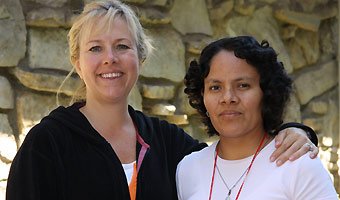
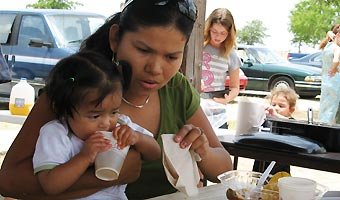
Sindy Smith and Consuelo Virrueta don’t let a language barrier get in the way of their friendship. Smith drives Virrueta to see her doctor when she doesn't have a ride. (Photos by Analiz Gonzalez/Buckner)

When she learned she had cancer, Virrueta said she was sure she would die. But her greatest worries centered on her children, Daniela, 3, and Eric, 10.

“Daniela would kiss my cheeks when my hair fell out,” she said. “And it would encourage me. But my children are so young.”

Virrueta was diagnosed with breast cancer in November 2006 at age 33. MOPS members at Vickery began praying for her as soon as she received the troubling diagnosis.

Viurueta said her sickness helped draw her nearer to her family and especially to God.

“Sometimes I’d say, ‘God, if I have to die, let me die, but let me always be close to You,’” she said. “We need to put ourselves in God’s hands and let Him do His work.”

Sindy Smith, a member Park Cities Baptist Church in Dallas, started driving Virrueta to doctors’ appointments when she lacked a ride and has provided babysitting for Daniela when Virrueta underwent treatment.

Smith is one of several women from Park Cities who is involved in MOPS at Vickery.

“I’d pick her up from treatment, and she would fall asleep on the ride back,” Smith said. “Sometimes, I’d have to carpool for the kids, and she would still sleep through everything. She was that tired.”
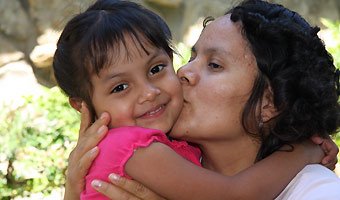
Consuelo Virrueta and her daughter, Daniela, take a picture during the monthly Mother of Preschoolers Program at Buckner Vickery Wellness Center in Dallas. Virrueta's hair has grown back since she stopped her chemotherapy treatments.

Park Cities MOPS members often brought Virrueta dinner so she wouldn’t have to cook, but she insists that the emotional support she received from them was the biggest blessing.

“Her illness helped the ladies bond by coming together to support and encourage her,” said Maria Pacheco, coordinator of the Vickery Family Wellness Center. “Some of the women helped her with her children and with daily chores. The women dropped their pretenses and were real with one another.”

“From the very first meeting all the women, including MOPS volunteers, were very open. And this created a very real connection between the women,” Pacheco said. “Many people in this community are isolated, and this group was a way of bringing them together.

“I have seen (Virrueta) change a lot in the last year,” she added. “And I believe God is raising leaders within the community to help change that community.”

At a recent MOPS meeting, Virrueta shared her testimony and smiled when the MOPS members complimented her head full of curly, black hair. She is no longer undergoing chemotherapy and now just goes for regular checkups.

“It’s my relationship with God that kept me going,” she said. “Without him, I am nothing. The peace that he gave me couldn’t come from anywhere else.

“And I am so grateful for the MOPS ladies. They are a part of my family. God put angels in my path.”


Volunteers’ generosity spawns new request at Breckenridge: ‘Let’s go fishing’

TYLER—For developmentally challenged adults, hanging out a “gone fishing” sign isn’t always easy, even when a pond outside their door has been stocked with perch and catfish. The pier needs safety rails, the slope of the bank needs to be gentle and the water needs to be fenced off.

But because a Baptist layman noticed a need he could meet and a men’s Sunday school class from another Baptist church pitched in, Breckenridge Village of Tyler residents can now enjoy a pastime many people for granted.

Breckenridge Village, a ministry of Baptist Child and Family Services, is a residential community in Tyler for adults with mild to moderate cognitive/developmental disorders.

Volunteers from Tyler-area Baptist churches stocked the campus pond at Breckenridge Village, made it safe for residents’ use and even donated fishing poles. It immediately became one of the most popular activities for the developmentally disabled adults who live there. (Photo by Linda Taylor/BCFS)

Due to the generosity of community volunteers, residents now are able to fish in a fully stocked pond, surrounded by a safety fence, as well as relax near the pond in a covered rest area.

Linda Taylor, director of development for Breckenridge, said the project began after a visit from Charles Powell who wanted to stock a pond on the community grounds.

Powell, a member of Colonial Hills Baptist Church in Tyler, said the project grew out of a conversation with a Breckenridge resident at a Christmas banquet. The resident told Powell how much enjoyed fishing at a summer camp, but he said he couldn’t fish at Breckenridge.

“We went around asking residents what they would like to have, and several said they really like fishing. So, that’s what motivated me to get a pond stocked,” he said.

Powell provided Breckenridge with catfish, perch and minnows to get the pond started.

“He bought the fish himself,” Taylor said. “He has such a heart for Breckenridge.”

After a pond was stocked, volunteers from Sammy Rhodes’s Sunday school class at Green Acres Baptist Church in Tyler decided to take the project a step further.

“We found out a pond was stocked, and we knew there was no way our residents could fish safely,” said Arthur Kennedy, a member of the class and the parent of a Breckenridge resident. “So, we came up with the idea to put a fence around it for the kids, so the kids could fish over it.”

The class, consisting mostly of retirees, built the fence as well as a covered rest area for residents to enjoy.

“We wanted them to be safe and enjoy the same sport Jesus did—fishing,” Kennedy said.

Another Breckenridge parent, Rex Schroeder, provided fishing poles.

“This is the first time we’ve been able to fish right here without having to go somewhere else,” said Taylor.

Breckenridge plans to schedule a fish-fry later this summer for their residents and to celebrate the fully equipped fishing pond, she added.

“It’s always been a resource,” Taylor said. “We just needed people to come in and help.”


Daniel Vestal counters BP column that said CBF not ‘truly Christian’

ATLANTA (ABP) — Why would some Baptist writers go out of their way to create the impression that the Cooperative Baptist Fellowship is not even Christian?

CBF Executive Coordinator Daniel Vestal said he is trying to answer that question after the Southern Baptist Convention’s news agency published a column claiming the Fellowship was neither Baptist nor Christian at all.

“It pained me that people have been offended and hurt by this confusion about what CBF believes. I want to make clear that CBF is Christ-centered and trinitarian in its theology,” asserted Vestal. “CBF is clear in its affirmation of the core commitment to the triune God. Our commitment to Christ as the savior for the whole world stems from our trinitarian faith.”

Vestal responded to the column by James Smith, editor of the Florida Baptist Witness, which Baptist Press published nationwide June 25.

“Here's the bottom line,” Smith wrote. “It's long past time to declare the Cooperative Baptist Fellowship is no longer truly Christian, let alone Baptist.”

Promotion of "heresy"

Smith conceded that some — perhaps even most — individuals in the CBF are Christians. But he contended they are ill informed about what he called CBF’s promotion of “heresy.”

Smith’s words were apparently inspired by comments made at CBF’s recent annual meeting by John Killinger. The Presbyterian pastor and author led three of about 60 breakout sessions at the meeting.

According to multiple reports, in one session Killinger said: “Now we are re-evaluating and we’re approaching everything with a humbler perspective and seeing God’s hand working in Christ, but not necessarily as the incarnate God in our midst. Now, that may be hard for you to hear depending on where you are coming from, but we can talk more about it.”

Some of Killinger’s comments were first reported by BP, which sent reporters to cover the CBF general assembly in Memphis, Tenn.

Killinger is currently executive minister and theologian-in-residence at Marble Collegiate Church in New York — the pulpit from which the late Norman Vincent Peale rose to fame.

"Jesus is Lord" only confession of early Christians

Vestal denounced the theology Killinger expressed. “The only confession of the [early] Christian church was ‘Jesus is Lord,’” he said. “To make that confession cost many people their lives because of its radical claim. To say and believe that Jesus is Lord was to say and believe that Jesus of Nazareth is God. It was a clear affirmation of the deity of Jesus. And the Incarnation of God in the man Jesus is the cornerstone of the Christian faith.

“And so for somebody in one of our workshops to question the Incarnation is simply very painful for me,” Vestal continued. “I have known John Killinger to be a popular Presbyterian preacher. He was a professor at Samford University. … But we had no idea that his views on Christ were what he declared in this breakout session. His perspective is deeply troubling to me.”

Vestal’s own views on the lordship of Christ are made clear in his book, Being the Presence of Christ, just published by the Upper Room. The book’s premise, according to Vestal, is “that all the gospels were written from the perspective of the Resurrection, and the living Christ is none other than the incarnate Christ that was proclaimed in the pages of Scripture.”

Regrets giving Killinger a platform

Vestal said he regretted allowing Killinger to challenge such christological views at a CBF event. “I feel like that we gave him a platform at the general assembly,” he said. “We do allow freedom of exchange and ideas that people disagree on. But if we had known then what we know now about his christology, he would not have been invited.”

Vestal conceded, however, that CBF planners should have paid more attention to Killinger’s theological shifts. “I accept the responsibility for that. Obviously the staff and I had heard him speak. We knew him to be a popular preacher, but we did not know of his christological views. Should we have known that? Yes, we probably should have, and we will do more due diligence in the future.”

He continued, “We try to invite people who have different perspectives on a lot of issues, but the issue of the Incarnation is foundational. That’s central. That’s core gospel.”

But Vestal strongly objected to Smith’s characterization of the CBF as non-Christian.

“This is very personal for me and also very personal for Cooperative Baptist Fellowship,” he said. “… For some editors to write and insinuate that we are not Christians is very painful for me.”

Vestal questioned BP’s motives in regularly investing thousands of dollars in denominational resources to send reporters to cover the annual meeting of CBF, a group that is dwarfed in size by the SBC.

He said he believes they attend “to find things in our assembly, either in a breakout session or in a line that someone makes, that they can use then to somehow paint everybody in the CBF in a certain way.”

BP: "No comment"

Will Hall, executive editor of Baptist Press and the SBC’s chief public-relations officer, said his only reaction to Vestal was, “I really don’t have any comment. We’re a news service.”

The SBC agency sends reporters to the event annually. In the past, they have frequently produced stories highlighting general assembly speakers, workshop leaders or exhibitor organizations who may hold beliefs that some conservative Southern Baptists would find questionable.

In 2000, many general assembly attendees accused BP writer Russell Moore of inaccuracies and blatant fabrications in several stories — most notably a report where he claimed that a former missionary attending the meeting physically assaulted him. Moore is now a dean at Southern Baptist Theological Seminary.

Vestal said  BP missed a great opportunity at this year’s assembly to celebrate a fellow Baptist group’s successes in kingdom work.

“This was one of the best gatherings we have had. It was just a wonderful, wonderful meeting. Wednesday night we had a special commissioning service. We appointed 18 new missionaries that are going to some of the most difficult, dangerous places in the world.”

According to Vestal, the meeting was “a high and holy moment” that included inspiring worship, corporate prayer and discernment about the organization’s future, and affirmation of CBF’s commitment to the Millennium Development Goals and the Micah Challenge.

Jim White is editor of the Religious Herald. Robert Marus contributed to this story.

Read more:

James Smith BP column attacking CBF


Baptist student missionary killed in Peru bus accident

ST. LOUIS (ABP) — Southern Baptist student missionary Gregory Gomez IV died July 5 in a bus crash in Peru.

The 22-year-old Gomez was serving as a short-term field worker with the Southern Baptist Convention’s International Mission Board.

According to Baptist Press, the SBC’s news outlet, Gomez was traveling with a Peruvian translator when the accident occurred near the town of Abancay. The translator received minor injuries.

Gomez graduated in May from the University of Mississippi with a degree in mechanical engineering. He was an active member of the Baptist Student Union, Phi Kappa Psi fraternity and served as president of the American Society of Mechanical Engineers.

Gomez was a member of Bethel Baptist Church in Troy, Ill., near St. Louis.

"Greg was on what they call an Extreme Team, and they were going to some of the most rural, rugged areas of Peru, finding what they call micro-people groups," Bethel Baptist Pastor Tim Lewis told KSDK-TV, the St. Louis NBC affiliate in nearby St. Louis. "They were finding out where those communities are, the kinds of language they speak and then preparing the way for other missionaries who try to come in and plant churches."

Mo Baker, director of the Baptist Student Union at the University of Mississippi, told the school paper, the Daily Mississippian, that he remembers Gomez as an inspiring person with great character and enthusiasm about God.

"His smile would brighten up a room the moment he stepped in," Baker said. "He influenced people by being an encourager. He led by serving others."

Gomez is survived by his parents, Elida and Gregory Gomez III, of Glen Carbon, Ill., and two sisters.


Del Rio students learning to make right choices

DEL RIO—Students at Del Rio Middle School are learning the importance of making wise decisions about abstaining from drugs, alcohol and premarital sex, thanks to the Baptist Child & Family Services Right Choices for Life program.

Nineteen students in grades 7 and 8 are taking their commitment to abstinence to a new level by raising funds to attend the annual National Abstinence Clearinghouse Association conference in Orlando, Fla., July 21-27.

Del Rio’s Right Choices for Life program holds family fun days as a venue for students to make positive decisions and abstain from at-risk behavior. (BCFS photo)

“I want to participate in the conference to meet other students who have the same goals as me and will encourage me to stay away from drugs and alcohol,” Jazmin Blancarte said.

At the conference, the youth will have the opportunity to meet students across the nation making the same commitment to abstinence.

Program organizers see it as a great opportunity for the students to establish themselves as leaders in positive decision-making as they enter the 9th grade, where no program exists currently.

“We only have a short window of time to influence these students,” said program director Aliyah McKinney. “This conference is a great opportunity to give them vision and goals for the future.”

For many of the youth raising funds to attend the conference, it will be their first time on an airplane— or even outside of Del Rio.

“I’m looking forward to meeting other people in Orlando who also want the best out of life,” Valeria Rivera said.

Raising money to attend 

Students have been working to raise enough money to attend the conference by washing cars, sponsoring a bake sale and writing request letters to local businesses.

The fundraising provides an opportunity for the youth to practice community service and for the Del Rio community to support for the students as they commit to abstinence.

“I would like to thank everyone who has contributed to help us raise money for the trip,” said Luis R. Banuelous. “Right Choices for Life has made a huge impact on me and taught my friends and me how to hold each other accountable.”

Right Choices for Life, offered at Del Rio Middle School for 12 weeks every semester, encourages students to practice abstinence from at-risk behavior including drug and alcohol abuse and premarital sex.

As part of the program, Baptist Child & Family Services also offers monthly family fun activities as a venue for the students to make healthy decisions, while offering parents and teachers training to help promote abstinence.

With the help of the Del Rio community, 90 percent of the students in grades 7 and 8 participated in the program this past school year.

“Our goal is to teach these students integrity through abstaining from at-risk activities in order to keep our youth and community safe,” McKinney explained.


Helms, ultra-conservative icon, steeped in moderate Baptist life

RALEIGH, N.C. (ABP) — Jesse Helms, the Baptist former senator who battled communist oppression but backed right-wing dictators and opposed abortion while appealing to racist sentiment, was a polarizing figure who was lionized by some conservatives and vilified by many liberals.

The Republican, who died July 4 at age 86, may also be a remembered as an example of the vast diversity still found in mainstream Baptist life.

Helms represented his native North Carolina for three decades in the Senate before retiring in 2003. His body lay in repose in the sanctuary at Hayes Barton Baptist Church in Raleigh July 7, and his funeral was held at the church July 8.

Ultra-conservative member of moderate church

Jesse Helms

The ultra-conservative senator’s long-time membership in the moderate congregation — affiliated with both the Cooperative Baptist Fellowship and the Southern Baptist Convention — may surprise some observers. Baptist historian Bill Leonard said July 8 that he knew Helms was a Hayes Barton member, but was “floored” to learn that the late senator had been a deacon at the church, which employs a female associate pastor.

“I think that’s part of the irony and complexity of Baptist local autonomy,” said Leonard, who is the dean of the Wake Forest University Divinity School in Winston-Salem, N.C.

Helms “was a man of consistent conviction to conservative ideals and courage to faithfully serve God and country based on principle, not popularity or politics,” said Billy Graham, in a statement released shortly after Helms’ death was announced. The long-time evangelist had been friends with his fellow North Carolinian for years.

Richard Land, head of the SBC’s Ethics and Religious Liberty Commission, said it was appropriate that Helms died on Independence Day. “He was a patriot. … He was a very strong pro-life, very strong pro-family and very strong anti-communist advocate,” he noted, according to an article from Baptist Press, the SBC’s news agency.

But moderates, liberals and some conservatives noted several of the dark spots on his record, most notably Helms’ strenuous opposition to virtually all civil-rights legislation that came before Congress during his tenure.

Stains on his record

He first rose to prominence in North Carolina as a television journalist in the 1960s. As an executive of the company that owned Raleigh’s WRAL-TV, a CBS affiliate, he became famous for delivering five-minute nightly commentaries during the station’s evening news broadcast. In them, he frequently railed against “the so-called civil-rights movement,” big government, taxes and those he viewed as cultural elitists. He once infamously referred to the University of North Carolina in nearby Chapel Hill as “the university of negroes and communists.”

After Helms was elected to the Senate in 1972, he opposed civil-rights legislation and backed the racist apartheid regime in South Africa. In 1983, he led an unsuccessful filibuster to prevent the creation of the federal Martin Luther King Jr., holiday, claiming that historians had not adequately explored King’s and other civil-rights leaders’ alleged ties to communists.

Helms never apologized for any of his views on civil rights and in later years defended himself, saying he opposed the movement not on racial grounds, but on states’-rights principles. He — and his defenders, such as Land and former Kansas senator Bob Dole — pointed to his personal friendships with African-Americans, including some who worked on his Senate staff. One of them was James Meredith, the black man who integrated the University of Mississippi.

But his fellow conservative David Broder, writing a column about Helms’ retirement from the Senate in 2001, called him “the last prominent unabashed white racist politician in this country — a title that one hopes will now be permanently retired.”

He faced similar criticism for his foreign-policy views. After Helms was elected to the Senate in 1972, he used his perch as chairman of the Senate Foreign Relations Committee to battle the threat of communism in the Third World, and particularly Latin America. He gained a reputation as a supporter of many right-wing military dictatorships, most notoriously that of former Chilean president Augusto Pinochet.

"Blind spots"

Helms also had a close association with right-wing El Salvadorian leader Roberto d’Aubuisson. He was identified by the State Department as the man who ordered the murder of San Salvador Archbishop Oscar Romero — done while the anti-poverty activist presided over the cathedral altar at a communion service.

Helms also came under heavy criticism for his staunch opposition to funding for AIDS research and relief, once saying that responsibility for every instance of the disease could be traced, ultimately, to “sodomy.” Late in his career, Helms changed his mind on AIDS relief — thanks to the efforts of rock musician and global activist Bono — and supported $500 million in funding to help fight the global scourge.

The SBC’s Land acknowledged that Helms had “blind spots,” noting the late senator’s staunch support of the tobacco industry. “And, while there was ample evidence that he was not personally a racist, when he opposed the Martin Luther King Holiday as vigorously as he did, it was not one of his finer moments,” he said in the BP article.

But Helms was reportedly well regarded at his Raleigh church, where he served as a deacon and in other roles. The congregation has long been active in moderate Baptist life, with many members serving in leadership roles with CBF and other organizations that resisted the SBC’s rightward movement in the 1980s.

Helms also donated his personal papers and endowment funds to Wingate University, one of two moderate Baptist schools (along with Wake Forest) he attended. They are now housed at the Jesse Helms Center on the university’s campus in Wingate, N.C.

Wake Forest’s Leonard said that Helms’ long-time support of a church and a school that many of his political allies would regard as liberal or even heretical is illustrative of “the complexity of Southern religious life, particularly with regard to the Southern Baptist Convention.”

Mentioning Helms alongside fellow Baptist Jimmy Carter, Leonard said, both “have, apparently, maintained deep ties to what I would call a kind of traditional pre-controversy Southern Baptist identity.”

One way to explain that, the Wake Forest University Divinity School dean said, is that, “Just as all politics is local, all … Baptistness is local. And apparently Jesse Helms invested his life in a congregation and decided to stay in that congregation even though he had differences with … the direction of that congregation in the [SBC] controversy.”


Baylor provost named president at Carson-Newman

WACO—Veteran Baylor University professor and administrator Randall O’Brien has been named as the 22nd president of Carson-Newman College, a Baptist school in Jefferson City, Tenn.

O’Brien has served at Baylor 17 years, including the last three as executive vice president and provost, posts he will leave effective Aug. 1. He will assume a transitional role at the Tennessee college in August and formally begin his service as president Jan. 1, 2009.

Randall O'Brien

In his capacity as Baylor’s chief academic officer, O’Brien has worked closely with Baylor President John Lilley.
 
“Randall has served Baylor admirably in a variety of positions over a period of nearly two decades,” Lilley said.

“I have deeply appreciated the important role he has played as executive vice president and provost, overseeing our academic programs and helping to lead the university as we’ve confronted a variety of opportunities and challenges. Baylor has benefited enormously from Randall’s talent and dedication over a number of years, and the university has prospered as a result of his efforts.”

Lilley is consulting with officers of the board of regents, his executive council, the dean’s council and the executive committee of the Baylor Faculty Senate regarding an interim appointment to succeed O’Brien. He is expected to make an announcement within the week, according to a Baylor University news release.

Lilley also will be name a search committee to help with the selection of a new executive vice president and provost, and he will launch a national search immediately.

A popular choice of students, O’Brien’s courses often were oversubscribed, and students have honored him with numerous teaching awards. He also has written four books and more than 70 scholarly articles.

He also has filled the pulpit in many Texas Baptist churches, and he currently serves as interim pastor of Trinity Baptist Church in San Antonio.
 
“Baylor University has been good to us,” O’Brien said. “For 17 wonderful years, Baylor has been home. Our children have grown up here. We have loved Baylor and Baylor has loved us. We have been a part of each other—family you might say, and in a very real sense we always will be.
 
“Furthermore, Texas has been home. We have served 15 Texas Baptist churches as interim pastor. Some of our dearest friends are in those churches and in the Baylor family.”

O’Brien expressed appreciation to the administrators and colleagues with whom he served at Baylor, and he pointed to the move to Carson-Newman as the next step in God’s calling on his life.

“The only thing harder than saying goodbye to family and friends is saying ‘no’ to God, a sure recipe for misery,” he said. “Thirty-two years ago, as Kay and I stood at our marriage altar, we clearly understood ours to be an ‘Abrahamic Call,’ wherein like Abraham and Sarah in Scripture, we were called to serve God wherever that call might lead us. Over these 32 years … we have followed God’s leading to six cities in five states, for service in missions, in churches and in universities. The journey has been rich, deeply fulfilling and meaningful.
 
“Someone has said that God’s other name is ‘Surprise!’ Well, God has, indeed, surprised us once again, this time with a call to become the 22nd president of Carson-Newman College. … We have prayerfully accepted God’s call upon our lives and Carson-Newman’s call to become president of the college.”


Target-shooting small group aims to make disciples

Members of the shooting small-group ministry of Colonial Hill Baptist Church in Snyder who participated on a recent Tuesday evening included (left to right) Daniel Winterholter, Johnny Irons, Dusty Ashby, Mike Post, Tyler Westerman, Henry Holley, Ernie Armstrong, David Speegle, Miller Robinson, Mac Ashby, Clay Giddens and Roy McClendon. Not pictured were John Billings (a former Texas Ranger), Tommy Wright and Troy Lilly. (Photo by Barbara Ashby)

SNYDER—Toting a gun in one hand and a Bible in the other, a group of men gather on a ranch right outside of town. The pistol-packing group meets for fellowship and spiritual growth—with a little target practice in between.

The men, part of the small group initiative at Colonial Hill Baptist Church of Snyder, meets every other week to practice their gun-handling skills, participate in competitive team-shooting, fellowship with Christians, be challenged by Scripture and eat freshly baked cobbler.

“One of the things we wanted to do is to have a place where men can come and build relationships with other men,” said Clay Giddens, minister of education at Colonial Hill Baptist Church.

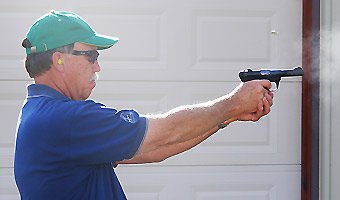
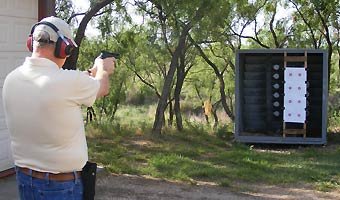
Mike Post shoots into “the box”—where paper targets are hung and metal targets are mounted. Post, a welder, made the target- shooting box for the small-group ministry of Colonial Hill Baptist Church in Snyder.

When Giddens introduced the small-group initiative to the church a year ago, he looked for natural connections to form groups focused on encouragement and spiritual growth. Since then, the church started five small groups.

“When I came here in August 2007, I met Mac and Barbara Ashby, a deacon and his wife, at the church who were involved in competitive pistol shooting,” Giddens said. “He invited me to come out and shoot at his homemade gun range. Others began to join us, and we incorporated that small-group concept to our shooting group.”

Mac Ashby presents gun-safety tips to a small-group Bible study sponsored by Colonial Hill Baptist Church in Snyder.

The group began meeting in March. It draws about 15 men of all ages, including some church staff, a former pastor, a retired Texas Ranger and college students working in the area. Most of the men have been members of the church for years but desire deeper fellowship. They also use this group as an outreach to other men in the community.

“There are people from other churches and our church,” said Mac Ashby, group member and owner of the shooting range. “We invited people who we think might be interested. We show them a good time. … It opens up the opportunity for building relationships outside of the conventional church environment.”

After the group spends an hour or two in target practice and competitive shooting, the men sit down to talk about life and their walk with God. During the last 13 weeks, the men took turns leading discussions and lessons on relationships.

The casual atmosphere allows men to be themselves, showing their personalities while deepening their relationships with each other.

“Normally the environment is such that they open up pretty quickly,” Ashby said. “There is a lot of good-natured harassment.”

After taking part in the group, the men have something interesting to discuss when they see each other in town or at church or at work, Ashby said.

Since the men meet on Tuesday nights, it allows church staff and leaders who are typically serving in other capacities on Sundays to participate.

Ernie Armstrong, a district judge and chairman of the deacons at Colonial Hill Baptist Church in Snyder, demonstrates his target- shooting ability during a small-group meeting at a ranch on the outskirts of town.

The group “helps me have contact with other folks,” said John Billings, a small-group member. “Since I am a Sunday school director, I haven’t been apart of a class in years because I have to do the paperwork.”

Since the beginning of the small-group initiative, Giddens has encouraged church members to discover the activities they enjoy. Then he said to use them to start a discipleship group.

“Any outreach and discipleship tool is trickle-down enthusiasm,” Giddens said. “I’ve really been excited about Mac’s excitement—the fact that he can take something he enjoys and use it to grow the kingdom.”


Love in action enables church’s unconditional welcome

SAN MARCOS—The sign in front of Redwood Baptist Church’s tiny building reads, “Jesus, a Savior for all people.”

Sunday mornings at the church prove that vision a reality. Addicts, ex-convicts, the homeless and the hungry gather to worship God as Pastor Jim Lanning and his co-pastors Robert Rodriguez and Michael Johnson share duties to make Redwood Baptist Church welcoming to anyone with physical or spiritual needs.

“Boy, we really bear down on that ‘all,’” Lanning said of the church’s vision statement.

Emma Johnson, holding Jasmine Fisher, celebrates with Marisol Gonzales (right) after Gonzales’ baptism during the morning service at Redwood Baptist Church. (Photos by Carrie Joynton)

Redwood Baptist Church leaders consistently promote multicultural ministry, and the church’s diverse congregation testifies to those efforts. Combined, the Hispanics, African- Americans, and people with special needs at Redwood Baptist Church equal the number of Anglos in the congregation, which is a healthy proportion, Lanning noted.

Rodriguez translates sermons into Spanish to make them accessible to the Hispanic congregation.

The church’s diversity is a result of active outreach, Lanning said.

“Church growth and church planters won’t succeed with homogeneous groups,” he said.

Ethnic diversity “has to be intentional.”

At a Redwood Baptist Church service, “no one watches the clock; no one’s worried about what time they get home,” Lanning said. Members announce birthdays and various anniversaries—often of “clean” periods from drugs or alcohol—during the first part of the service, and they celebrate together with a song.

Later in the service, open “journey time” gives people a chance to share their testimonies with the rest of the congregation. Lanning wanders the center aisle with a wireless microphone, inviting church members to tell their stories and recent victories.

Christian and Irvin Vasquez enjoy fellowship with Eddie during a Sunday meal after worship services at Redwood Baptist Church in San Marcos.

When Buckner International President Ken Hall visited Redwood Baptist Church earlier this year, the testimonies rendered him speechless.

“We had journey time that lasted an hour and 45 minutes,” Hall remembered.

“We had a prostitute who hadn’t turned a trick in several weeks and didn’t want to, but she was hungry and she came to church because she wanted to eat” and knew lunch was provided.

“It just was … real,” Hall said. “When I got up to preach I was so filled with emotion, I told them I didn’t know what I could preach. … In my 15 years of visiting churches with Buckner, it was the most genuine worship experience I’ve ever had.”

Despite financial challenges, Redwood Baptist Church ministers to its members and community in tangible ways. Every Sunday, about 50 church families receive food donated by fellow members. One family provides lunch for the congregation every week after the service, and many who lack transportation are given free rides to and from Sunday worship in the church van.

A mother and child enjoy a Sunday noon meal at Redwood Baptist Church in San Marcos.

The multicultural ministry at Redwood Baptist Church has had a profound effect on church member Emma Johnson, sister of Pastor Michael Johnson.

“I think it’s a foretaste of heaven, where you’re going to mix with people of different races, creeds, nationalities,” she said.

“The only thing that binds us together is love, and it’s love in action.”

As the Baptist General Convention of Texas promotes Texas Hope 2010, which challenges Christians to give every Texan the opportunity to respond to the gospel in his or her own cultural context by Easter 2010, Redwood Baptist Church’s community outreach programs advance that goal.

Throughout June, the church provided lunch and Vacation Bible School activities for neighborhood children of the area through a program called Project Good Neighbors. The church also makes monthly visits to the Baptist Children’s Home in San Antonio. They minister to minors from countries other than Mexico who are illegally in the United States and awaiting deportation to their home country.

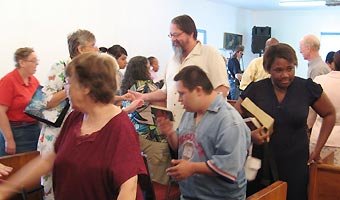
Members of Redwood Baptist Church in San Marcos head outside for a meal after the Sunday morning service.

Church leader Wanda Pittman said Redwood Baptist Church’s community ministry is one of its greatest strengths.

“You need to cater to the area you are ministering to,” Pittman said.

“I think that’s really important. You are meeting a need, a need that a lot of churches don’t consider.”

Although Redwood Baptist Church members’ needs may be more obvious than those of wealthier churches, Hall considered the church’s unconditional welcome a sign of Christian vitality.

“Too often … the person who is coming to church feels like they have to be a certain person before they can come, and we design our buildings and our programs to literally make it hard for people living on the edge of society to come to church,” Hall said.

Lanning invited Hall to preach at his church after reading Hall’s book, Inside Outside: The church in social ministry. He told Hall he’d built his ministry out of Hall’s description of an invitational church, marking these words: “People … will want to give their hearts to Christ and become part of the local church … (when they have) the awareness that they have been seen in their need and have been extended an acceptance of grace … that they are welcome, no matter who they are or where they have been or what they have done.”

Realizing that vision at Redwood Baptist Church hasn’t been easy, but for Lanning, it’s been worth the effort.

“Each one of these groups (at the church) has to yield to the others. It’s a great challenge; it’s a wonderful challenge,” Lanning said.

While writing his description of an unconditionally welcoming church, Hall never dreamed he’d see it embodied, he confessed.

“As much as I was trying to be truthful and honest in writing that book, I did not envision Redwood Baptist Church,” Hall said.

Lanning “did it far better than any preacher could ever say the words; he did it. He touched my life.”


TBM disaster relief volunteers bound for Iowa

DALLAS – A Texas Baptist Men disaster relief team left home July 5 to serve in the wake of flooding in Iowa. More volunteers will join them soon, and additional manpower may be needed.
 
By the end of the week, TBM Clean Out Coordinator Ernie Rice expects to have at least four teams of volunteers from across Texas cleaning out mud-caked homes.
 
A six-member team from Buna left July 5. A group of volunteers from Woodville will leave July 10. Additional teams from South Texas will leave this weekend. More volunteer teams likely will be needed in the future.
 
“It looks like we’re going to go down the river with it,” Rice said. “As long as we keep getting the calls and keep having people, we’re going to continue having a presence.”
 
In the wake of flooding in Iowa, 83 of the state’s 99 counties have been declared disaster areas. Nearly 4,000 homes in Cedar Rapids, Iowa, were submerged. Flooding caused an estimated $1.5 billion in damage in Cedar Rapids alone.
 
To support TBM disaster relief work, visit www.texasbaptistmen.org or send checks designated “disaster relief” to 5351 Catron, Dallas 75227.
 To support TBM by giving through the Baptist General Convention of Texas, send checks designated “disaster relief” to 333 N. Washington Ave., Dallas 75246. For information about serving as a volunteer with TBM, call (888) 826-0123.


Valley church is hands and feet of Jesus

PROGRESO– In the midst of the picturesque fields and flocks of sheep that surround this valley town struggling for survival, Iglesia Bautista Sublime Gracia, is offering hope and help to more than 1,600 people a month through the church's food pantry.

Rather than being discouraged by unemployment and poverty, the church is imitating the actions of the early church in Acts, according to the Pastor, Ismael Gaspar. The congregation lives by an active faith that gives sacrificially and trusts God will provide all of its needs. 

Pastor Ismael Gaspar, who started 15 other churches, had a dream four years ago to start a second Baptist church in Progreso. Watch his video testimony here. Watch a video clip of Gaspar's testimony.

"My vision and my purpose are to be more direct in presenting the Lord Jesus as their Savior," Gaspar said. "If I can help them in that way, that is the best way. And then I can help them with some kind of food each week or when it is necessary." 

Each month, the 150-member church supplies food and basic necessities to 1,600 people in the community. The Baptist General Convention of Texas is partnering in this ministry with a monthly grant through the Texas Baptist Offering for World Hunger, and BGCT Local Transformational Missions provided a refrigerator and freezer. 

The majority of food comes through offerings and donations that church members sacrificially give. Ladies in the church sort the food and distribute it Wednesday and Friday nights.

"If anyone has a need, he should put it in the hands of God," said Laura Mireles, a member of the church and leader of the women 's ministry. "If you feel like He will never answer, He knows when to answer. Just have faith in the end He will keep you." 

For the past two years since she, her husband and 10 children joined the church, Mireles said the congregation has encouraged her and helped her family after their house burned down.

"We had only the clothing we had on, but the church here at Progreso gave us clothing, " Mireles said.  "They gave us love and food. They have never left us alone, and they have always cared for us. This is proof that God lives, that Christ lives."

After the Mireles' house burned, a mission team from Austin helped repair a small house so the family would have a place to live. When they lived in their original home, many people in the community would come to visit. Now that they have a smaller house, only the pastor comes to visit, Mireles said. 

"We cried over that house for one night," Mireles said. "Then we held hands and said we are not going to cry anymore because God is in our hearts. And those are just two-by-fours. It 's just lumber. And since that very day, I serve my God day and night."

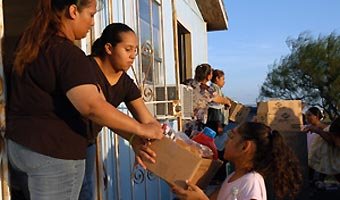
Iglesia Bautista Sublime Gracia in Progreso helps more than 1,600 people a month through the church's food pantry.

The BGCT is in the early stages of Texas Hope 2010, an evangelistic effort to provide every non-believer in Texas the opportunity to respond to the gospel in his or her own language and cultural context. 

Iglesia Bautista Sublime Gracia is an example of what the BGCT hopes to see happen across the state. Since the beginning of the church, Gaspar and the members have been active in meeting the physical needs and sharing the gospel with those around them. 

Although the church is currently growing, it has not always been this way. Growth and fruit in the congregation took much time and effort.

Gaspar, who started 15 other churches, had a dream four years ago to start a second Baptist church in Progreso, one that would be the hands and feet of Jesus to the people there. Going door-to-door on his horse, Gaspar invited his neighbors to come to the church and offered children a ride to church. Later, Gaspar sold the horse to purchase property for the church building.

"At the very first service, I only had one person in the congregation," Gaspar said. "Little by little, people started attending the services and people were getting saved. Then we began to baptize people."

Building a sanctuary has been a long journey of a couple of years. Church members began holding services and opened a food pantry in a small building on the property while plans were made for a new sanctuary. They prepared the foundation for the new sanctuary and prayed that God would send a way to finish the rest of the building. 

"Vashti Baptist Church in Bellevue sent the money for the rebar, bricks and cement needed to build the 10-foot walls," said Domingo Quintanilla, ministry associate for the Rio Grande Valley Baptist Association. "Cheyenne Solis with Buckner was able to get another church to come down and build the roof on the church."

Now, the sanctuary is finished and filled with pews donated by Trinity Baptist Church in San Antonio. Outside the sanctuary, children play on a playground given by the Buckner International Colonia Program. 

Growing the church came at a sacrifice, with the pastor working nights at the school district to provide for his needs and the needs of the church. 

"We are working bivocationally, but God has met our needs," Gaspar said. "I work with the school district here in Progreso and I also work as a nurse. My employment with the school district has really been a blessing. All the students see me there, and they know I am a pastor here."

The members also continue to expand the ministry, praying for direction on how to better reach the spiritual and physical needs of the people in their community. Gaspar is also praying for a way to obtain a warehouse for the food pantry so that they will have space to meet more of the needs in the community.


CBF worker furthers education for children in Ethiopian town

ATLANTA (ABP) — Dee Donalson grasped a tiny hand and helped an Ethiopian kindergartener trace over stones lined in the shape of the numeral 2.

The Cooperative Baptist Fellowship field worker, whose front porch serves as a makeshift classroom, teaches nine students about letters, numbers and shapes. She uses whatever educational tools she can find locally — including stones, wheat straw and juice boxes — to instruct the students and two teacher trainees.

Before Donalson arrived in Hossana, Ethiopia, last year, most of the village’s young children did not attend kindergarten, because the closest one was too far away. Nationwide, Donalson said, only 20 percent of Ethiopia’s children attend any sort of school, because the government does not have the financial resources to provide enough classrooms or teachers.

Dee Donaldson teaches children on the front porch of her home in Hossana, Ethiopia. CBF photo

Donalson is working to build a kindergarten at Ethiopian Kale Heywet Church Ministry Training College in Hossana. She expects the school, with six classrooms, running water and furnishings, will cost about $100,000.

“Kindergarten taught in a developmentally appropriate way gives them a foundation to build the rest of their education,” she said. “It also teaches them to problem-solve, investigate, explore, examine and experiment.”

Donalson, 65, of Sanibel Island and Ft. Myers, Fla., spent her career establishing schools for young children and training teachers in the United States. In 2004, she felt called to serve in Ethiopia. From 2004-07 she served as a teacher trainer and director of a kindergarten in Butajira, Ethiopia. But then she felt the Lord was calling her to do more.

“I had a definite message from God that I was to train many more teachers in Ethiopia to teach the thousands of children who were school age, but didn’t have a space in the classroom,” Donalson said.

Soon, she knew God was calling her to the Bible college in Hossana. The school is one of seven Bible colleges in Ethiopia run by the Kale Heywet Church, the country’s largest evangelical denomination, with about 3.5 million members and 6,000 churches. Kale Heywet, which translates as “word of life,” sends missionaries worldwide, including some countries where American missionaries are not welcomed, she said.

“I love the idea that [CBF Global Missions Coordinator] Rob Nash put forth when he said that ‘the church is God’s missionary to the world,’” Donalson said. “And I feel that there are many opportunities to bridge with other organizations like the Kale Heywet Church in Ethiopia.”

In addition to her kindergarten work, Donalson has taught English at the college. Learning English is a critical tool for indigenous missionaries, she said, since it is the most commonly used language both in Ethiopia and abroad.

She also is helping the community improve its access to water, plant vegetable gardens and learn good health practices. When Donalson learned the campus had no running water, she contacted David Harding, a CBF field worker who brings clean water to Ethiopian communities.

Harding’s team evaluated the college’s well and recommended a submersible pump. CBF donated the pump, a holding tank and a platform. Donalson’s home church, Sanibel Community Church, is raising funds to pay for pump installation and pipes.

When the pump begins operating, more financial support will be needed to cover additional electricity costs and to pay a guard to oversee the well.

Once the school is constructed, about $1,080 a year will be needed to provide salaries for two kindergarten teachers. Donalson hopes to add a grade level each year after the kindergarten is established.

She often reminds herself of Acts 17:28, “It is in Him that I live and move and have my being.” That verse helps her focus on being the presence of Christ.

“I hope that as I am in His presence I will be totally submissive in allowing the Holy Spirit to manifest itself through me to help fulfill the Great Commission,” she said.