Wayland students learn life lessons in the Balkans

PLAINVIEW—A half-dozen Wayland Baptist University students traveled to the Balkans hoping to teach lessons about God’s love to the people there. In the process, they learned lessons to last a lifetime.

Rick Shaw, director of Wayland Baptist University’s Mission Center, traveled with six Wayland students— Melanie Vasquez, Taylor Phillips, Khrystyne Eckerd, Micah Evans, Amber Hamilton and Kevin Burrow—to the Balkans recently, where the missions volunteers prayed, sang, taught and shared their faith with the people of Macedonia and Kosovo.

Wayland Baptist University students Micah Evans (left) and Melanie Vasquez (center) pose with a Macedonian student. The Wayland students helped teach English as a Second Language while on a mission trip to the Balkans.

Their journey began in Konjare e Mesme near Skopje, the capital city, where Shaw and his wife, Martha, spent many years as missionaries. While there, the Wayland group not only preached and shared their Christian testimonies, but also helped teach English as a Second Language classes, build the local library, deal with public health issues and run a sports camp for children.

Hamilton particularly touched the hearts of locals with hymns played on her flute, Shaw noted.

“Empowered by the pressure to perform, she delicately meandered through hymns, spirituals and praise choruses, bringing applause and tears,” Shaw said in an e-mail.

Hamilton also preached her first sermon at a church in Rahovec, and she was pleased with how the congregation responded.

A mission group from Wayland Baptist University helped dig trenches for the foundation of a local library while in Macedonia.

“Overall, I was surprised at the hospitality of the Balkan people and their openness in loving others,” Hamilton said. “Many people in the United States are reserved with their love, being very skeptical of new people, not showing their love for others. In the Balkans, however, we were welcomed with open arms.

“So many times we, shelter ourselves from one another and are afraid to get too close to others. As Christians, we are to be transparent. We could learn a few things from these people.”

Eckerd echoed Hamilton’s sentiment.

“I left these people a different person,” she said. “God used them to change me. They showed me the true meaning of loving others.”


Out of the Blue: Rare syndrome affects Pleasanton youth minister’s daughters

PLEASANTON—Looking at Katelyn and Zoe Bachman, it would be hard to tell they hold a distinction shared by no one in else in Texas, and are two of less than 50 in the United States and of less than 200 in the entire world. They are beautiful little girls with a golden glow. But that golden glow sometimes extends to the whites of their eyes, and there is the first hint of what sets them apart.

They are the only two children in Texas to be diagnosed with Crigler-Najjar Syndrome —an inherited metabolic disorder caused by a liver enzyme deficiency that prevents the usual breakdown of bilirubin, a normal by-product in the body’s disposal of worn-out red blood cells.

A rare disease is causing the Bachman family to lean more on God, and helping Jeff Bachman be a better youth minister.

Children with CNS are unable to eliminate bilirubin from their bodies and must undergo daily exposure to special blue lights just to survive. Without daily treatments, a child would suffer brain damage, muscle and nerve damage and ultimately death due to bilirubin toxicity.

Neither Jeff Bachman, minister of youth and evangelism at First Baptist Church in Pleasanton , nor his wife, Tammy, a first-grade teacher, knew they were carriers of the disease. In addition to Katelyn, 6, and Zoe, 3 months, the Bachmans also are the proud parents of Shannon, 8, and Caleb, Katelyn’s twin brother.

Sleeping under the lights 

Katelyn and Zoe sleep under special blue lights eight to 10 hours each night to help their bodies breakdown the bilirubin.

For the lights to do their jobs, clothing and blankets can’t get in the way. Because Katelyn can’t wear pajamas or even have a blanket or sheet to cover her, heaters must be brought in during the winter to help keep her warm—an inconvenience to her siblings who share the same room.

The girls also get as much sunlight as possible, but the sunlight is less effective than the artificial blue light because it is less intense.

To the casual observer, they seem to healthy little girls—which they are, apart from their livers not performing an essential function.

“But it’s hard for them spend the night with grandparents, Katelyn can’t go to sleepovers, and we can’t take a week of vacation and go somewhere, because it’s a lot of work to disassemble the lights, pack them up—they are big even taken apart—and then to put them back together again,” Jeff Bachman said.

And the danger of not putting them under the lights each day is just too great.

The Bachmans are exploring ways to help the girls live a more normal life.

Zoe spends up to 10 hours a day under special blue lights that allow her body to process bilirubin, a job normally done by the liver.

A family in Australia has reported some success with a special lighted bed, much like a tanning bed, that because of its close proximity and brightness, they say has cut down on the amount of time needed under the blue lights to as little as a couple of hours each day.

The family has bought a tanning bed, but they need to change the lights in it out to bili-blue bulbs. Most bili-blue bulbs are two-feet long, but the bulbs for the tanning bed need to be six feet long and cost $25 each. Since 32 bulbs are needed, with shipping, the price to change out the bulbs will be about $1,000.

Discussing a liver transplant 

The Bachmans also are talking to doctor in Pittsburgh, Penn., about a liver transplant Katelyn, possibly as early as this fall.

“If she gets a new liver, she’s cured,” Bachman said. “We had thought about waiting until she was a little older, maybe a teenager, but the doctor has told us that the recovery period from a liver transplant can be as much as a year. And it’s much easier to take a year out of a 6-year-old’s life than it is a 16-year-old’s.”

Both plans will take additional funds, and the community of Pleasanton is coming together to help with that through a fundraising event July 12 at Pleasanton River Park.

A local high school journalism class heard about the girls, and those students did the initial planning. But as more people became involved, the scope has grown to include a barbecue dinner, dance, raffle, silent auction, karaoke, inflatable games, bake sale, face painting and more.

“We want it to not just be a benefit for our family, but a good family time for everyone involved,” Bachman said.

The congregation at First Baptist Church in Pleasanton always has been supportive, but that has been especially true since Zoe’s birth, he noted.

“A lot of people in our church, when they hear about Katelyn’s condition, they say, ‘Oh, she still has that.’ I guess a lot of them thought it was something she outgrew because we don’t make a big deal about it, we just deal with it. But now that Zoe has been diagnosed with the same thing, they are becoming much more aware,” he explained.

The Bachmans also have learned much more about the disease. Since Zoe and Katelyn are the only two in Texas, often the Bachmans are experts when something comes up.

“A lot of times, the doctors ask us questions,” he said.

The girls have their blood checked to determine their bilirubin levels, but their parents have gotten pretty good at looking at them and seeing a potential problem in the making.

Pre-empting hospital trips 

Katelyn had to be hospitalized several times during winter months when she caught a virus and developed a fever. The Bachmans now have learned to pre-empt those hospital times by putting her under the bili-blue lights continuously when she begins to look puny.

While the girls have a different set of “opportunities” than other children, the Bachmans said they know God is with them as they seek to be the best parents they can be to all four of their children.

“There are some things we are called to that we don’t get a choice about, and we just get to deal with them. God has given us two special little girls and that’s what we’re called to do—love and take care of them to the very best of our abilities,” Bachman said.

“It’s caused me to rely on God for so many things and really has helped my prayer life. The Bible tells us he will not give us more than what we can handle, and through all this he has helped me grow.”

It has even helped him be a better youth minister, Bachman believes.

“Anything that happens in my life is reflected in my ministry. It’s one of the ways I’m able to help students relate to the struggles in their own lives. I’m able to better minister to them because of this, he said.”

And even in hard things, God’s blessings are there, Bachman explained.

“It was hard when we found out Zoe had it, but Katelyn was happy—she smiled from ear to ear because she had someone like her, and to me that was a big deal. As they get older, they will be tied together as more than just sisters.”


Hispanic Baptists challenged to rely on God’s power

WICHITA FALLS—Hispanic Texas Baptist church leaders should overcome negativity by relying on what God is calling them to do, President Baldemar Borrego told messengers to the Hispanic Baptist Convention of Texas .

God works through people to accomplish what they cannot do under their own power, Borrego told participants at the annual meeting in Wichita Falls.

Messengers pray during the Hispanic Baptist Convencion in Wichita Falls.

Preaching from the Old Testament passage in Numbers 13 where Moses sent 12 men to scout the land God promised Israel, Borrego said people can look at the world two ways—through their eyes or God’s wider vision.

Ten men came back from the scouting trip pointing out the obstacles to taking the land. Two saw the land as God saw it, he noted.

“Some people look to their own strength,” Borrego said. “Others say through Christ all can be done.”

Each must respond to God's call 

Isaac Rodriguez, pastor of Iglesia Bautista Broadway in Tyler, noted that it’s up to each person to respond to the call of God. Christians must choose whether they are going to follow God in what he is asking them to do, relying on him to show the way to accomplish his will.

Julio Guarneri, pastor of Iglesia Bautista Getsemani in Fort Worth , echoed Rodriguez, noting Hispanic Texas Baptists could be a major missions force if they respond to God’s calling. They could reach people for Christ throughout Texas and around the globe, he said.
God “expects a response” when he calls, Rodriguez said. “He wants to hear your voice.”

Ellis Orozco, pastor of Calvary Baptist Church in McAllen , said Hispanic Texas Baptists have something that can have a powerful impact on society.

“Here’s what you have to offer the world—and I would argue it’s the only thing—the hope of Christ that lives in you,” he said.

Borrego re-elected president 

In the business session, Borrego was re-elected president of the convention over challenger Angel Vella, pastor of Iglesia Bautista Westway in El Paso. 

Messengers elected Antonio Gamiochipi, director of missions of the Latin American Baptist Association, for first vice president over Manuel Rios, pastor of Iglesia Bautista Monte Calvario in San Antonio.

Jesse Rincones, pastor of Alliance Baptist Church in Lubbock , was elected to the second vice president’s post over Jose Gamez. Irma Alvarado of First Baptist Church in Donna was elected third vice president by acclamation.

Alex Camacho, pastor of Iglesia Bautista Cristiana in McKinney, was elected secretary over Ruben Chairez, pastor of Primera Iglesia Bautista in Del Rio.

In other activities, the Hispanic Baptist Convention of Texas, Baptist General Convention of Texas and Buckner International signed a partnership to encourage education among Hispanic Texas Baptists. The BGCT and Buckner agreed to split the funding of a position that would lead this effort.

Nestor Menjivar, pastor of Iglesia Bautista Principe de Paz in Austin, hopes that through this partnership, Texas Baptists “can change the direction of education for our youth for the glory of God.”

Sen. Cornyn: Stand up for traditional marriage 

Sen. John Cornyn also made an appearance during the meeting, encouraging Hispanic Texas Baptists to stand up for their beliefs, especially regarding traditional marriage.

He also mentioned immigration as an important issue. Cornyn is on record in opposition to a guest worker program and in favor of tighter controls on the border.

Hispanic Baptist Convention representatives have visited the White House repeatedly in an effort to influence the debate on immigration reform. They have urged lawmakers to support legislation that would allow people to become permanent residents without having to leave the United States and supported the Dream Act , which would allow young people to apply for legal status under the condition of obtaining higher education, joining the military or doing a set amount of community service.


Defending minorities is very Baptist, Wright-Riggins tells BJC banquet

MEMPHIS, Tenn. (ABP) — Baptists, of all people, should defend the rights of minorities against the majority, an American Baptist leader told supporters of the Baptist Joint Committee for Religious Liberty June 20.

“To live with the minority experience is to live with the fear of being forgotten and excluded. It is the feeling of foreignness, of not belonging. It is to live in the reality of what Ralph Ellison called the ‘Invisible Man’ — to be present, but not counted; speaking, but not being heard,” said Aidsand Wright-Riggins, executive director of the American Baptist Churches USA’s National Ministries. He spoke to about 425 guests at the annual luncheon meeting of the Religious Liberty Council, the BJC’s organization for individual donors. The luncheon was held during the Cooperative Baptist Fellowship General Assembly in Memphis, Tenn.

The road to somebody-ness

Wright-Riggins said identification with the minority experience should be at the center of Baptist and Christian identity. “The road to somebody-ness is always about resolve and resistance. And Baptists, my brothers and sisters, have always pulled alongside those who were dedicated to resolve and resistance on the road to somebody-ness,” he noted.

“Baptists respect human nature and human dignity. Baptists fight for the rights of others to speak their own mind and live their own truths. … We believe in a free state — but we also believe in a free church, where the god of the majority is never forced upon the consciences of the minority.”

Wright-Riggins, who is African-American, said the question of race had reared its familiar head in this presidential election for all Americans — but it was hitting home for him especially.

He noted that his organization runs Judson Press, American Baptists’ publishing arm. Judson has published several books by Jeremiah Wright, the controversial former pastor to Democratic presidential candidate Barack Obama, and Wright-Riggins said he has gotten letters he described as “vicious” and “vitriolic.”

Asked to denounce Wright

They asked him to denounce Wright. But Wright-Riggins responded, “Let the church be Baptist and affirm the right of all of us to speak.”

He read a passage from Joshua 22 that detailed the experience of the ancient Israelite tribes that lived across the Jordan from the rest of their kinsmen — and eventually became regarded as something less than true Israelites.

The other Israelites dismissed them, the passage says, telling them, “You have no part in God.” In defiance, the Reubenites, Gadites and the half-tribe of Manasseh built an altar to Yahweh in their territory to assert their Jewishness.

“In an attempt to affirm their own somebody-ness, somebody told them, ‘Let’s build an altar, to say that we count too….’ Isn’t it interesting how the Bible itself can be used as a tool — as a divisive instrument and a ‘thingification’ tool?”

Permanent building plans

In other business, BJC supporters heard an update on the group’s capital campaign to establish a permanent building for the BJC, called the Center for Religious Liberty, on Capitol Hill. Reginald McDonough, the campaign chairman, said BJC has received commitments for about half of the $5 million goal. Of that, $2 million is already in the bank, allowing the organization to move ahead with picking out a property.

“The good news is: We’re halfway there.” McDonough said. “The challenge is: We’re halfway there.”

Religious Liberty Council supporters also re-elected their officers and approved four new board members to serve three-year terms.

Hal Bass, a professor at Ouachita Baptist University in Arkadelphia, Ark., and a member of First Baptist Church there, was re-elected co-chair, along with Cynthia Holmes, a St. Louis attorney and member of Overland Baptist Church. Henry Green, pastor of Heritage Baptist Church in Annapolis, Md., was re-elected the group’s secretary.

Supporters affirmed the board appointments of Terri Phelps, a member of Highland Baptist Church in Louisville, Ky.; Joey Kennedy, a member of Southside Baptist Church in Birmingham, Ala.; Mitch Randall, a member of NorthHaven Church in Norman, Okla.; and Beverly McNally, a member of Christ Congregation in Princeton, N.J.


Young CBFers, responding to Sherman, call for end to bitter anti-SBC rhetoric

ATLANTA (ABP) — In response to controversial comments at the recent Cooperative Baptist Fellowship General Assembly, a group of younger CBF supporters has called for an end to “old rhetoric” and for renewed attention to the world’s needs.

Seven leaders issued an open letter June 24 to Cecil Sherman, one of CBF’s founders and its first coordinator, over comments he made at the June 19-20 meeting in Memphis, Tenn.

During the June 19 morning business session, Sherman made remarks after accepting author copies of his new book, By My Own Reckoning, a personal recounting of the CBF’s history. In asking listeners to use the lessons of the past to help chart the future, he made a reference to the Holocaust.

“Every once in a while, I meet someone of the younger generation who says, ‘Don't talk about that anymore,’” Sherman said. “Why don't you tell a Jew not to talk about the Holocaust anymore? You need to remember the events that called us into being and be guided by them as you wisely chart your future.”
 
Sherman was among moderate Baptists who fought the fundamentalists’ takeover of the Southern Baptist Convention beginning nearly 30 years ago. He has often been the target of intense criticism by conservatives.

Reference to Holocaust “misguided”

While acknowledging Sherman’s leadership and contribution to the CBF movement, the open letter’s seven signers called his reference to the Holocaust “misguided.”

 “…[Y]ou juxtaposed our relatively small amount of pain — where no one was injured or killed — to the 6 million killed in the Holocaust. In our opinion and the opinions of many others, your analogy was misguided,” the letter said.

David Burroughs, president of Passport Inc., CBF’s partner for youth and children’s camps and conferences, was among the seven signers. “We all have high respect for Cecil Sherman…but there are some of us who are ready to lay that [the pain of the SBC takeover] down and move forward,” he said by phone June 25. “We felt the need to say that out loud.”

Burroughs noted that younger leaders within the CBF movement do not wish to discount the organization’s history, but believe in “using the lessons of the past.”

“We do want to remember the past…. There are plenty of forums, including Baptist history [courses] at the seminaries and breakout sessions at the General Assembly,” he said. The 45-and-under leaders “want to give proper respect for the past, but don’t want to be defined by it.”

Fuel for some people's fire

The problem with repeated references to the past, Burroughs added, is that CBF’s critics can use them against the entity. “When we keep referencing the past … it just gives fuel for some people’s fire. [They can say], ‘They keep defining themselves by what they did.’”

Younger CBFers, Burroughs continued. “are not defined by what happened and have grown tired of hearing about it.”

In the letter, the leaders called for a focus on the future.

“Of course, remembering what happened [in the past] will help us avoid repeating mistakes. But we will no longer wish for this conversation to have center stage — nor be the focus of who we are and what we do,” they wrote.

“Young Baptist leaders are ready to embrace new opportunities for ministry and discipleship. Remembering the past but not dwelling on it, many Baptists are excited and enthusiastic about ministering with the most neglected people around the world….”

They invited Sherman and, by implication, other leaders from that era to “lay down the pain of the past and join us as we focus on a future, bright with possibility.”

In addition to Burroughs, other signers included R. Scott Ford, CBF of Georgia associate coordinator for missions; Nikki Hardeman, CBF of Georgia associate coordinator for congregational life; Jeremy Lewis, manager of Together for Hope, CBF’s program to assist the 20 poorest counties in the United States; Brent McDougal, coordinator of Alabama CBF; Christina Whitehouse-Suggs, CBF of South Carolina associate coordinator for congregational life; and Mike Young, Tennessee CBF associate coordinator for missions.


Doctor heals, gives hope in Middle East

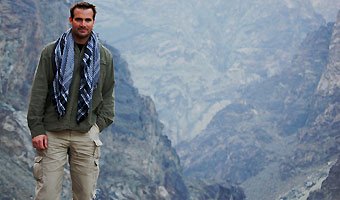
KABUL, Afghanistan—Plastic surgeon Keith Rose does more than reconstruct bones and tissue. He changes lives every time he returns to a hospital in Kabul, Afghanistan.

With a focus on curable conditions, Rose—a Baylor University alumnus—works with faith-based organization Cure International in a fusion of medical and spiritual ministry to “make all things new” for residents of developing countries.

Plastic surgeon Keith Rose, a Baylor University alumnus, returns to Kabul, Afghanistan, several times a year from his home in Corpus Christi to treat patients with congenital defects clubfoot, or cleft lip or palate, as well as burn victims. (Photos courtesy of Keith Rose)

When mentor and former Baylor football coach Grant Teaff heard about Rose’s career overseas, he wasn’t surprised.

“He was always encouraging his teammates, on the field specifically. I can’t ever remember him doing anything in a negative way,” said Teaff. “You could tell … he had a depth. You didn’t know where it would lead.”

Rose’s life-giving attitude led to his work in international medicine, inspired by mission trips abroad with his father, pastor of a nondenominational church in Kingsland and formerly pastor of a Baptist church in New York.

As a surgeon with Cure International, Rose uses his medical training to offer hope and restoration through affordable specialized surgery.

Rose returns to Kabul several times a year from his home in Corpus Christi to treat primarily those patients with congenital defects clubfoot, or cleft lip or palate. He also treats burn victims.

Curing children with birth defects quite literally offers them new life, even when the defect isn’t debilitating, Rose said.

“Essentially, if you have a cleft lip or palate and live in Afghanistan, you have to go to Pakistan to get it taken care of,” Rose explained.

“The girls can’t get married, the boys can’t go to school—the kids can be pretty brutal towards one another and just don’t accept deformity. It’s just a big need with a lot of work to do.”

Rose’s work with Cure International represents part of the organization’s broad mission to treat the 125 million children in developing countries who can be cured completely. The organization offers treatment for “hydrocephalus (fluid in brain cavities) … spina bifida and other spinal deformities, and crippling orthopedic conditions,” according to their website at helpcurenow.com.

For Rose, curing clubfoot holds personal significance.

“One of my twins was born with clubfoot, and at the appropriate time, we had the surgery done. He’s walking around normally now,” Rose said.

“I don’t understand what it would be like to have a child with a deformity that they never even know can be fixed … But there are people in their 40s and 50s who’ve never had it treated.”

Since Cure International founder Scott Harrison recognized healing involves more than just physical restoration, the organization takes a “50/50 medical-spiritual” approach.

“The spiritual dimension of healing and the medical/physical dimension are parts of the same process,” Harrison said.

As a surgeon with Cure International, Baylor University alumnus Keith Rose of Corpus Christi uses his medical training to offer hope and restoration in Afghanistan through affordable specialized surgery.

“We have an executive director, a spiritual director, and a medical director at each hospital. We want to make sure people know we’re more than just a medical organization,” Cure communications director Lisa Wolf said.

“Our spiritual ministry is equally as important as our medical ministry.”

Even though Cure is the largest provider of specialized surgery in the Third World, in many countries, it’s often the only provider.

“It’s faint praise to us that we’re the largest provider of this kind of service in the developing world—no one else is really out there doing it,” Harrison said.

One of the biggest obstacles for Cure is simple advertisement of their services, Harrison explained.

“The family just can’t believe there’s someone there to care for them. Just getting the word out is important.”

Several parents even delay naming their children for fear they won’t survive, Rose said.

Despite the daunting need, Cure has made an enormous impact in ministry to the disabled, having seen more than 700,000 patients and performed about 47,000 surgeries in 12 different countries in the past ten years. Wolf told of a man in Uganda who discovered a different kind of compassion with Cure, saying, “No white man has ever wanted to touch my baby.”

Even though cultural sensitivity prevents some kinds of evangelism in certain countries—like Afghanistan—Cure doctors generously offer care and love to patients who rarely experience that attention, Wolf noted.

Besides giving direct medical treatment, Cure also equips Third World doctors with advanced medical training so they can continue the work themselves. Rose teaches his surgeons and doctors participating in the obstetrics and gynecology fellowship how to use modern medical technique and instruments.

He’s just living out some advice from another Baylor mentor, former physiology professor Ray Wilson.

“I had a wonderful teacher (Wilson) who really inspired me to travel. He always told me, ‘Everything you learn, you have responsibility to give back,’” Rose said.

In his work with Cure, as he teaches and heals, Rose has been able to fulfill that responsibility—and beyond.

“When (Rose) leaves our hospital in Afghanistan, the level of confidence in our doctors has always been increased,” said Harrison. “He’s a superb teacher.”


OBU trustees name social science school for longtime supporter

ARKADELPHIA, Ark. (ABP) — In appreciation for “consistent and generous support” for Ouachita Baptist University , trustees named the Arkansas school’s social-science division for Buddy Sutton, a prominent Little Rock attorney.

Trustees voted June 12 to honor Sutton, a long-time Ouachita supporter and Arkansas Baptist lay leader. Adopting a resolution noting that Sutton “readily lent his name, reputation and influence to strengthen the standing of the university,” board members named the division the W.H. Sutton School of Social Sciences “with sincere appreciation for the life and service of their dear friend and colleague.”

Sutton, who served 10 years as chairman of Ouachita’s trustee board, is a former president of the Arkansas Baptist State Convention .  He served in private practice for more than 45 years with the Little Rock law firm of Friday, Eldredge & Clark until his retirement in 2005. He is a longtime member of Immanuel Baptist Church in Little Rock, where he has served for decades as a deacon and Sunday school teacher.

“Buddy is a rare individual who brings a blessing to whatever he touches and whatever he is part of,” Ouachita President Rex Horne said. Horne was Sutton’s pastor at Immanuel prior to his Ouachita post.

Horne said the trustees’ decision to link Sutton’s name with the School of Social Sciences will allow Ouachita “to continue to benefit from the influence and character Buddy has now and for generations to come.”

Hal Bass, dean of the Sutton School, enthusiastically affirmed the board’s decision.

“What we want to do in the social sciences is emphasize learning beyond the classroom; the world is our lab,” Bass, who also is the Cooperative Baptist Fellowship’s moderator-elect , explained. “The Sutton name will give us entrees for various settings beyond the classroom into the broader world.”

Sutton said he is deeply committed to Ouachita’s mission of providing students “a solid and excellent education in the Christian environment that is so important to family life and Christian life.”

The School of Social Sciences, which includes the departments of history, political science, psychology and sociology, “is a very important bridge to service in the Christian life,” he said.

In addition to honoring Sutton’s life and work, Horne said the school’s new name will “help strengthen a fine school in our university.” He is working with Sutton and Terry Peeples, Ouachita’s vice president for development, to enhance endowed scholarship funds for the school.

-30-


Richmond seminary names Israel Galindo as dean

RICHMOND, Va. (ABP) — Trustees of Baptist Theological Seminary at Richmond have elected Israel Galindo as the 19-year-old school’s new dean.

Galindo, a Christian education professor at the Virginia seminary, was elected June 17. He replaces Mike Harton, who has served as interim dean for the past two years.

Galindo also serves as the principal of a consulting firm. Born in Cuba and reared in New York, he joined the seminary staff in 1999 after several years as a local-church educator and principal for private schools.  

He holds a doctorate in education from New Orleans Baptist Theological Seminary.

A popular seminar and workshop leader, Galindo has expertise in Bowen Family Systems theory as applied to parenting, congregational life and leadership development. He has written widely and has several books in print, including an Alban Institute bestseller, The Hidden Lives of Congregations.

As dean, he will lead faculty in curriculum development and evaluation, in instructional development, and will serve on the seminary’s administrative team.

“Dr. Galindo’s academic expertise and extensive experience in local congregational ministry will provide great dividends to BTSR and her students,” seminary President Ron Crawford said about the new dean. “He understands the challenges of the 21st century on local church ministry and will strengthen our efforts to prepare women and men for ministry around the world.”


Sri Lanka partnership bearing fruit years after tsunami

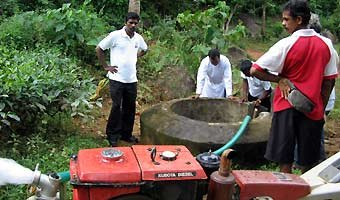
Aid brought to Sri Lanka by Texas Baptist Men after the tsunami is still having an effect years later. (Gospel for Asia Photos)

COLOMBO, Sri Lanka–Over the past several days, Gospel for Asia’s Compassion Services teams have been providing clean water to Sri Lanka’s flood victims by decontaminating wells with the equipment and knowledge they received from Texas Baptist Men during the post-Tsunami relief efforts in 2005.

In all, the GFA relief teams have brought aid to more than 1,000 families on the flood-swept island nation. Many villages are stranded without food and clean water. Flooding and landslides swept away crops and contaminated the water with sand and debris. It took more than nine days for the standing water to go down in some villages.

A GFA team cleans a well using equipment provided by Texas Baptist Men.

Because the water is contaminated, waterborne illnesses have developed. A severe strain of malaria is spreading in some villages, claiming additional lives. Without the training they received from the Texas Baptist Men, the teams would not be able to provide such specialized and necessary relief efforts.

“I would like to thank the Texas Baptist Men who trained our people during the post Tsunami relief work,” shared Lal Vanderwall, Gospel for Asia’s leader in Sri Lanka. “They gave us equipment and tractors for the work, and their partnership with us continues to make a difference in our country nearly four years later.”

The Sri Lankan government has sent several letters of appreciation to the GFAS teams. And because of their training and effectiveness, it has requested more help from GFA to clean wells in specific cities.

Traveling in vans filled with supplies, GFA missionaries and volunteers continue to distribute staple foods such as rice, dahl, sugar, dried and canned fish, salt and tea—along with clean, dry clothing—to families affected by the floods.

A crowd gathers to receive distribution of aid from Gospel for Asia teams. Training and equipment they received from Texas Baptist Men is still being put to use.

In the wake of the devastating floods, the teams come across hundreds of people who were stranded—such as a group of 25 families who were left with no hope until the GFA vans drove by. Their homes had been washed away by the floods.

Complete recovery from the floods is expected to take another year, and GFA’s Compassion Services teams will continue meeting victim’s physical and spiritual needs for as long as it takes.

Gospel for Asia, an evangelical mission organization based in Carrollton, Texas, is a Kingdom Partner with Tarrant Baptist Association and has an ongoing partnership with the Texas Baptist Men.


Baptist pastor arrested in Azerbaijan

WASHINGTON (BWA)—Hamid Shabanov, a Baptist pastor in Aliabad, Azerbaijan, was arrested June 20, the Baptist World Alliance reported.
 
Elnur Jabiyev, General Secretary of the Baptist Union of Azerbaijan, said the “police claim to have found an illegal weapon in his home.” He denied the allegations against Shabanov and suggested the weapon was planted to incriminate the pastor.

Jabiyev called the arrest “a provocation by the police” and characterized it as “a deliberately targeted action.”

Map of Azerbaijan

“The police’s aim is to halt Baptist activity and close the church in Aliabad,” he asserted.
 
Shabanov’s arrest follows on that of Zaur Balaev in May of last year, who also is pastor of a Baptist church in Aliabad. Balaev was convicted and sentenced to two years in prison in August 2007, but he was released in March after protests from the Baptist World Alliance and the European Baptist Federation.
 
Both Balaev and Shabanov lead house churches with memberships of between 50 and 60 members each.
 
BWA President David Coffey stated, “The BWA will do all we can to publicize among the world family what has happened in Aliabad” and said  “the global family” of Baptists will pray for the Shabanov family.
 
General Secretary Neville Callam expressed his disappointment at the arrest.

“We are registering our grave disappointment at the denial of religious freedom that is evident in Azerbaijan,” Callum said.

“Our Baptist brothers and sisters in Azerbaijan should be completely assured of the BWA commitment to pray for them as they struggle in the context of oppression, and, as an expression of our historic commitment to personal liberty, freedom and justice, to make representation on their behalf.”
 
European Baptist Federation General Secretary Tony Peck said, “The EBF is shocked and dismayed to learn that another pastor, Pastor Hamid Shabanov, has been arrested in Aliabad, Azerbaijan, by the police on what clearly seem to be false charges.”

Peck, who is also BWA regional secretary for Europe, appealed to Baptists on the continent to “contact the Azerbaijani Embassy in your own country if there is one, and protest this latest violation of religious freedom.”
 
He also called “on all the member unions and conventions of the EBF to pray for this situation, that Pastor Hamid might be freed quickly.”

He urged Baptists “to pray that the Azerbaijani’s declared commitment to religious freedom might translate into an ending of the harassment and persecution of Baptists and other minority churches in their country.”


Church tells the story of Jesus to Sudanese

DALLAS—It’s the stories people remember. Dad’s most embarrassing high school moment, a favorite birthday memory—tales that weave a rich past of personal and relational histories. With each retelling, moments come alive once again.

Tim Ahlen, pastor of Forest Meadow Baptist Church in Dallas, enjoys time with children in Sudan. (Photos courtesy of Forest Meadow Baptist Church, Dallas)

In largely illiterate cultures, like many in Southern Sudan, storytelling preserves hundreds of years of history for people groups dependent on oral records. It also gives missionaries a gateway to share the gospel.

“When I was young, everything was in stories,” Sudanese pastor Edwin Makola recalled.

“The International Mission Board … and the larger evangelical community … discovered that orality was a good idea, to go back to Jesus’ day. He taught in parables. … It’s the right thing to do in Southern Sudan.”

Makola arrived in the States 13 years ago from Africa as a refugee from Sudan. He now serves as pastor to a Sudanese congregation in Dallas with Forest Meadow Baptist Church, which houses four different ethnic congregations—Anglo, Hispanic, Sudanese and Zambian.

Three Sudanese young men professed their faith in Jesus Christ when they were stranded under a tent with a group of missionaries. The missionaries shared their faith, and the young men made their commitment to Christ.

Forest Meadow Pastor Tim Ahlen has taken groups to Southern Sudan for four years to evangelize, but he uses a different kind of preaching than in a typical Texas Baptist church.

“Expository preaching is meaningless to (the Sudanese). They walk away with the stories and the illustrations—what they understand,” Ahlen said.

As Texas Great Commission Initiative coordinator, Ahlen works to create awareness among missionaries about how worldview affects a person’s reception of the gospel. The Texas Great Commission Initiative—a collaborative effort involving Austin, Dallas, San Antonio, Tarrant and Union Baptist associations—exists to equip church leaders for effective mission work.

“Storying”—Ahlen’s chosen method for reaching illiterate people groups—incorporates as many as 50 Bible stories told in chronological order to create a holistic picture of God and his faithfulness.

Church member Lori Hoxie liked the storying method when she went to Sudan with Forest Meadow.

A young Sudanese girl helps her family and village by pounding grain.

“We picked the ones we thought were the most appropriate for the culture. We did it at different times during the day, whenever they were available. You tell the stories, and then you ask questions about it to see if they got the facts straight, to see if they know what’s going on,” Hoxie explained.

“It’s a totally oral culture, so telling stories, that’s how they learn.”

Foreign missionaries have been using storying for years, Ahlen clarified, but he wants to see it used in the Western world as well. He currently works with Makola to apply it in ministry with Forest Meadow’s Sudanese congregation.

Makola arrived from Africa trained in expository preaching. But to become a better minister to Sudanese in the Dallas area, he attended Southwestern Baptist Theological Seminary for a few weeks to learn storying.

The alternate method helps Makola communicate the gospel more effectively to people from his own culture, Ahlen said.

“The culture is a storying culture. When Makola got brave enough to start telling stories, people would tell him they had never heard preaching with such power,” Ahlen insisted.

But why would Makola have to come to the United States before learning culturally appropriate teaching styles?

The reason stems in part from a long history of Western colonization in Africa, Ahlen said. Many Sudanese Christians think expository preaching is the only correct way to spread the gospel, which speaks to widespread association in Sudan of Christianity with Western tradition.

Visitors from Texas encounter a busy marketplace in Rumbek, Sudan.

This bias creates negativity towards other, more local methods of evangelism—like storying. Many Sudanese pastors in America are ridiculed by their congregations for using storying, and Sudanese missionaries often opt against using the storying method in their own country.

“They don’t want to go back to Southern Sudan to tell stories; they want to go back to preach,” Makola said.

It’s a struggle to convince Sudanese people, once in the United States, to return for ministry in Sudan because of the tough conditions they would face there, Makola said.

Having just left “a mess … of poverty and torture,” most would rather stay in the United States, he speculates.

“One of the most difficult jobs in the world is to be a pastor to the Sudanese,” Makola said.

Pastors do not receive payment in Southern Sudan, where most people hold the mentality, “‘we don’t take care of our leaders; they take care of us,’” Ahlen quoted.

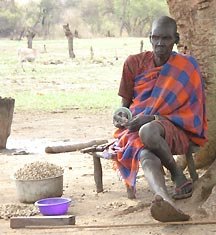
An elderly Sudanese woman rests by a tree.

“(The Sudanese in the United States) say they care deeply, but they won’t give a dime to go help. They expect the American church to do it for them.”

Navigating cultural mores in-transition also complicates ministry to Sudanese in the United States.

“The Sudanese people in particular—they feel they have left that Third World background there. They are trying to cross over to the world they call civilized and leave behind the old systems, to shake them off,” Makola said.

Acculturation presents problems, Ahlen said, when values systems clash, especially with first-generation Sudanese Americans. Children often grieve parents as they embrace American culture at the expense of their parents’ traditions, he said.

But despite frustration, Forest Meadow’s Sudanese ministry—focused on evangelism and church planting—has been fruitful.

Around 90 attend regular Sunday services, Makola said. Special occasions, like Christmas, attract as many as 800.

Besides services at Forest Meadow, Makola and other willing church members hold house-to-house services, or “prayers.” They attend to people under stress by praying, singing, and studying the Bible together in their homes.

“When you come together and put your hands on your brother, the weight becomes less. We leave you with a happiness,” Makola said.

Regarding evangelism in Southern Sudan, Makola said he’s optimistic.

“It’s like water upon the sand. … You don’t see it at first, but slowly the sand becomes soaked. That’s how the gospel works in people’s lives. Time will come—you will see a change.”


Name connects East Texas church with Middle Eastern Christians

PALESTINE—For the members of First Baptist Church in Palestine, sharing names with a Middle Eastern territory has led to a connection with Christians on the West Bank.

Pastor Jay Abernathy said a BBC news team taking a Sunday detour from President Bush’s ranch in Crawford gave him the idea to capitalize on the shared name.

Members of First Baptist Church in Palestine commission a missions team for service in the Middle East. (Photos courtesy of First Baptist Church in Palestine)

“We invited (the BBC team) to our church that Sunday while they were out at the President’s ranch,” Abernathy said. The team asked him if the people in Palestine, Texas, ever associated themselves with Middle Eastern Palestinians. Abernathy said he had never really thought about the name connection.

“That was kind of a catalyst,” missions committee Chairman Breck Quarles said of the BBC visit.

In 2005, a church member alerted Abernathy and Quarles that a Palestinian minister was traveling in Texas and wanted to know if he could speak at their church. After a brief meeting, church leaders at First Baptist agreed.

That Sunday, Munir Kakish spoke to First Baptist in Palestine about needs among his ministries overseas. Kakish lived eight years in an orphanage in Ramallah, located ten miles north of Jerusalem, following his father’s death. After traveling to the United States for college in 1967, he returned to the Holy Land and began ministry there with his wife, Sharon, in 1978.

Kakish now serves as pastor for two Palestinian churches—one in Ramallah, the other in Ramla—and as founder and director of Home of New Life, a boys’ home in Ramallah, on the West Bank.

First Baptist Church showed Kakish overwhelming support.

Six Palestinian young men are 2008 graduates of Home of New Life, a boys’ home in Ramallah, on the West Bank.


“We brought in that morning several thousand dollars to get kids enrolled in school. It was a confirmation from us that the church was behind what they were doing,” Quarles said.

Quarles and Abernathy visited the West Bank in May 2006. Upon their return, the Texas church confirmed a mutually supportive relationship with Christians in Palestine “in a number of different areas … with commitments to pray,” Quarles said.

Even though ties between the Middle Eastern territory and the Texas town simply began by matching names, the link wasn’t insignificant.

“It was kind of a fun connection for so many of us. … It wasn’t coincidence. We felt a sense of kinship with them,” Abernathy said.

Despite small numbers and a low budget, First Baptist in Palestine consistently finds resources to support Palestinian Christian ministries through donations and regular visits.

Linda Love from First Baptist Church in Palestine enjoys time with the children in Ramallah during a trip to the West Bank.

“I’m kind of amazed at how much gets done with a church this size. We don’t really have any money. God gets it done,” Abernathy said. “We’re just kind of your average Baptist church in Texas.”

In May, Abernathy and church member Steve Jenkins traveled to the West Bank with a team from Buckner International to explore possibilities of working with at-risk children there. Representatives from First Baptist in Palestine have returned overseas three times since the first visit in May 2006.

First Baptist member Linda Love said the experience changed her life.

“It was such an incredible eye-opener,” Love said. “It’s taken a year for me to really digest and take in many feelings.”

Four college-age young women are among the members of the church in Ramallah.

Love ventured to the West Bank in 2007 with Quarles and fellow church member Cameron Cline. Interacting with Palestinian evangelicals gave her “a new perspective on life,” Love said. Instead of the often-negative stereotypes of Palestinians, Love said she encountered a people “so delightful and so generous.”

“It just gave me a totally different picture,” she said.

Increasing awareness and understanding among American evangelicals of the Palestinian Christian community motivates Abernathy to spread the word about ministry activity in the Middle East.

“A lot of folks just aren’t really aware of how many Arab-evangelical Christians are out there,” Abernathy noted. “We met a very vibrant group of evangelical Baptist Christians (in the Middle East), but they felt kind forgotten.”

Pastor Jay Abernathy (right, standing) and Missions Committee Chairman Breck Quarles (right, kneeling), both from First Baptist Church in Palestine, join Palestinian Baptist Pastor Munir Kakish in meeting with a college Bible study group in Ramallah.

“They need our prayers. They need our support. We serve the same Lord; we serve the same Savior,” Quarles said.

As an unexpected result of their partnership with Christians in Palestine, First Baptist in Palestine has attracted the attention of Arab exchange students in local Texas schools.

“There’s a number of (Middle Eastern) exchange students—all of them Muslim—who feel totally comfortable coming to First Baptist. They come because they’re either staying at a church member’s home, or they get invited at school,” Quarles said. “They’ll stay, and they feel at home. They sense something there.”

The exchange of culture and Christian fellowship between these two otherwise foreign communities has forged a bond that shapes their members’ lives and worldviews. It’s an opportunity sent by God, Quarles said.

Rami is a resident of the Home of New Life, a boys’ home in Ramallah, on the West Bank.

“I’m just amazed that God opened up the door for us to do that. I’m blessed to go to a church that is open to what God’s doing, and is willing to take a step of faith. We’ve prayed about it, and we believe that’s what God has called us to do.”

First Baptist’s partnership in the Middle East has spurred missions activities in the church overall, affecting “local, global, and statewide” arenas, Quarles said.

For Love, that “step of faith” has given her a greater vision of the world and its people.

“I think one of the main things is that we are to treat all people equally and fairly, as the Lord would. That’s an awakening for anyone,” Love said. “God calls us to seek the spirit, seek the soul of every person.”