A Prayer for China: The legacy of Bishop Ting

As the world watches the Olympics in Beijing, a shift has taken place that is unheralded in the press, but could be of earthshaking significance for the millions of Christian believers in China, according to Philip Wickeri.

"There was an important national meeting in January that ushered in a new leadership for the China Christian Council. A switch has been made to a younger generation of leaders." This was the 8th National Christian Conference, the decision making body for Protestant churches in China that meets every six years or so, he said.

Philip Wickeri

Wickeri, professor of evangelism and mission at San Francisco Theological Seminary, returned last month from one of his many trips to China. He worked for more than 20 years with the Amity Foundation in China and with the China Christian Council (CCC), the officially recognized church entity. He is the author of Reconstructing Christianity in China – K. H. Ting and the Chinese Church, a biography of the former Anglican bishop published by Orbis Books.

"I'm very hopeful" about the prospects of Christians in China, he said in a phone conversation. Assessing the general state of the church in China, he added,"There are a lot of changes ahead. There's tremendous growth with the church in China. They have a great deal of work to do. I think in general the outlook has never been better."

And the human rights crackdown in Beijing– could that foreshadow bad news for the churches?

"We read a lot in the press about the difficulties of Christians in China. A house church leader was arrested in Beijing. The Olympics have been a high security event for China. The picture is not a perfect one. But the tendency in the western media is to accentuate the problems. The house church leader who was detained was on his way to a church in Beijing. There are charges that the people attending that church are all government agents. But I know that church. They're there to worship Jesus Christ."

"There are places in China, particularly in inland China, where the local government leaders are not following the national policies, so there are abuses of religious freedom."

The CCC continues to tell the government they want to help the authorities implement this policy throughout the country, he said.

Problem of leadership 

The biggest problem for Chinese Christians is a question of leadership, Wickeri said.

"By recent estimates, five to seven new churches are opening every day– all kinds of churches. How do you educate new Christians in understanding what the gospel demands? That is a huge problem. The CCC is not a national church, not a state- approved church. It is an officially recognized church structure that assists the churches at many levels– working with groups overseas, with partnerships, with printing literature.

"Amity Press has printed more than 50 million Bibles. Ninety percent of these have been distributed all over China. They just installed a new enlarged press. That is absolutely extraordinary. China is set to become the largest printer of Bibles in the world.

Even so, there are not enough Bibles. "We need more, of course."

Bishop K. H. Ting

"The Bible is not sold in public book stores–a policy I don't believe is helpful. But it's available in churches and in private book stores."

Wickeri's biography of Bishop Ting–who is now retired and in frail health in a nursing home–extolls him as the right man at the right time for the church in China.

"Bishop Ting presided over the most extraordinary time in the Chinese church in the 20th century. He helped recreate institutions, developed theological education, printed Bibles and religious literature. He did so by cooperation, not confrontation."

Wickeri dismissed charges by China Aid Association and other covert ministries that Ting and his fellow leaders work with the police to shut down house churches and water down the gospel.

"China Aid and others think the only way the church can exist in China is to confront the government. That's not Ting's position. How do you build up a church that went through the Cultural Revolution? Dramatic moves may make for good copy, but they're not going to serve the day-to-day needs of average Christians.

"Bishop Ting is one of the greatest church leaders of the 20th century. He had an enormous impact on the life of the church."

Number of Christians hard to gauge 

The size of the church in China is another question without a definitive answer.

"You always see these numbers thrown around–150 million Christians? The way to ask that question is, 'Where are they, which provinces have the most and how do you count them?'"

Amity Press

Workers at Amity Press prepare Bibles as they come off the presses. (Baptist Press Photo)

The official figure, Wickeri said, is 17 million to 18 million, "based on provincial figures. But these figures are typically underestimated and include church attendance rolls and other things. A reasonable number for Protestants in China is 30 million to 40 million. I can't see much more than that."

He noted that Henan Province presents one of the most confusing Protestant pictures in China.

"I understand that there is a very large network of Christians not affiliated with the CCC. They would not be listed in the official figures. And there are other groups. Many observers would give you the total number of Christians as 30 million to 40 million, as I have. The largest number I have heard from credible sources is 60 million to 70 million."

"There are all kinds of shades of grey here rather than black and white," he said."This is true of the church in all situations all over the world."

Comparison with the situation in the former Soviet Union "is very tenuous," he added. "After the 1917 Revolution, the Russian government saw the church as one of its main enemies. The Orthodox church had extensive land holdings, etc. In China, Christians never had such a huge presence.

"Christianity in China was not then and is not now as highly institutionalized as in Russia. The clearest case for reconciliation (such as that happening between the disparate Baptist groups in Russia) is among the Chinese Catholics. The Vatican has treaded very lightly on this. That will resolve itself, once China and the Vatican normalize relations."

"But it's much more important to get back to the question of leadership. The new generation has the potential to do something their elders didn't have opportunity to do. They have a long-term view.

"And you must remember, they've risked a lot by just becoming affiliated with the church at all."


Commentary: A prayer for China’s Church

China's Olympic Games began in Beijing in venues choked by smog and under the shadow of a crackdown on human rights and religious freedom.

The Chinese dazzled the world with an impressive and often intimidating opening night display of pageantry and technical flash.

Olympic logoNow millions of concerned Christians around the world are focused on China because of the Games and want to support believers there. But like the smog that cloaks the Beijing skyline, layers of cultural misperceptions, political biases and contradictory information conceal the actual status of the Chinese church from our view.

What's really going on with the church in China? 

It's hard to tell what's real. At least that's been my experience. Maybe you'll do better at sorting it all out than I have. (The discovery that much of the Olympics fireworks display on opening night was computer-generated is perhaps emblematic of the problem).

The main issues first surfaced this year in the controversy over evangelizing at the Games.

I guess we should be glad times have changed. For the first few centuries of the church, the only Christian witness at a stadium consisted of the cries of the victims as they were being torn apart by wild beasts because of their faith.

Christian history

But spectacles are hard to resist, even for the pious.

St. Augustine tells the story in his Confessions of how a Christian friend, Alypius, came to be obsessed with Roman gladiatorial combats. Alypius at first refused to attend the violent spectacles. But, cajoled by his colleagues, he gave in, with the proviso that he would keep his eyes shut. If he could only have closed his ears too, laments Augustine, for when the crowd roared, he was thrilled so deeply that he couldn't contain his curiosity. He opened his eyes, took in the spectacle, and became enthralled.

Like Augustine's friend, I'm afraid I won't be able to look away as the spectacle unfolds in Beijing.

Throughout history, Christians have had mixed feelings about athletic competition in general. In A.D. 394 the Roman emperor Theodosius I, a Christian who considered the Games a pagan festival, ordered them stopped. The most famous Christian Olympic testimony was by Chariots of Fire character Eric Liddell, who witnessed mightily at the 1924 Games …by his absence.

Some claim we shouldn't entangle Christianity with sports in the first place, because it unduly glorifies "success," while most of Christ's early followers were losers in life pursuits, in personal character, in relationships, in just about everything. Losers, Jesus said, are closer to the kingdom of God than the winners.

Whatever their attitude toward competition, Christian missionary agencies and ministries during previous Olympics always took advantage of the unique opportunity to share the gospel with athletes and visitors from around the world. This year all that is banned. Only Chinese Christian chaplains and ministers are allowed to conduct services and counsel with athletes in the Olympic Village. (Update: Athletes are complaining that these arrangements are inadequate.)

Run-up to the Games

A few months before the Games, evangelist Franklin Graham announced he wouldn't support any illegal Olympics evangelism. At the same time, the media reported an increasing crackdown by authorities on unregistered Christian house churches and their leaders in a pre-Games "security" sweep. China Aid Association's leader Bob Fu met with President Bush just before he left for China to ask him to attend worship at an unregistered church in Beijing to support the persecuted Christians there. Instead, Bush worshipped at the registered Kuanjie Church. China Aid claims this led to the arrest of Hua Huiqi, a renowned Christian social activist in the city.
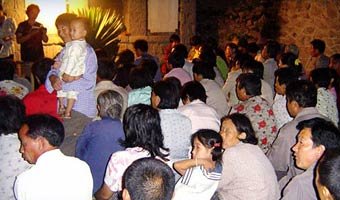
Chinese House Church meeting. (Photo by WorldServe)

All this emphasizes a sticking point in understanding China's Christians –the split between the registered and unregistered or "underground" churches.

American Christians want to support the good guys. We want to disparage the bad guys. And we don't welcome facts that muddy that black-and-white clarity. Especially with an emotionally charged issue like this .

As I delved into reports from all sides, this disagreement over recognition by the government reminded me of something– the re-emergence of an ancient conundrum among early church leaders about what to do with delators.

Bear with me here.

The cult of martyrdom

In the early centuries of the Church, martyrdom was extolled to the point that Christians with an extremist bent virtually taunted the authorities, challenging them to put them to death for their faith. In some ways similar to the Islamic jihadist martyrs of today– but without the element of the murder of innocents– they gladly forsook present comforts and life for an eternal reward they believed would be enhanced by their manner of death.

martyrNot everyone agreed. To balance this cult of martyrdom, St. Gregory of Nazianzus stated the now generally accepted view of orthodoxy: "It is mere rashness to seek death, but it is cowardly to refuse it "(Orat. xlii, 5, 6).

On the other extreme, some believers succumbed to the pressure of persecution and would either make a sacrifice to the gods, pay off the officials to get a paper acknowledging they had made such a sacrifice, or in the worst cases, betray their friends to the authorities to save their own lives, even appearing in court to testify against them. Some were given the property of the accused as a reward.

These turncoats were called delators–Latin for "common informers" or traitors. And once the persecutions were over, some surviving delators, having repented of their misdeeds, would often petition to be reinstated in the congregation. In some areas there were hundreds of them.

Does Christian love extend so far? A few bishops embraced the wavering and weak along with the treacherous and the self-aggrandizing. Other bishops imposed severe penances to weed out the insincere. Still others remanded all delators to perpetual excommunication and thus damnation.

But I wonder– who can judge besides God?

The Russian example

In the Soviet Union before the fall of communism, and in China today, a division between registered and unregistered churches has resurrected the delator question in a new context. But what defines betrayal in these circumstance? And who has betrayed whom?

For our part, watching from the outside, it's always hard to know how best to support these believers who labor under conditions that range from uneasy tolerance, to harassment, to imprisonment and death.

I interviewed Georgi Vins, a leader of the unregistered Baptist church in Russia, a couple of times after he was was exiled in exchange for Soviet spies in 1979. I had followed his ministry for years, and also talked to Alexei Bichkov, leader of the registered All Union Council and his colleague Michael Zhidkov, pastor of the registered Baptist church in Moscow, on their trips to meet with officials in the West in the 1980s.

They represented two very different paths for dealing with an oppressive regime.

As I recall, the All Union Council representatives and some of their supporters in the West saw Vins as just stirring up trouble and in effect betraying the whole enterprise by causing increased suffering for all believers in his country by his stubborn refusal to compromise. Vins, who had served many years in prison camps, claimed the All Union Council was working directly with the KGB. I viewed Vins with respect and Bichkov and Zhidkov with suspicion. It was all pretty black and white.

The question for supporters in the West back then was whether to criticize or mollify the authorities. The researchers at Keston College in England, (recently moved to Baylor University) who carefully documented all this for decades, said Christians in the West should base their responses on what the persecuted Christians are telling us. If they want us to put outside pressure on their government and protest their treatment, then that's what we should do, even if it increases trouble for them.

With the hindsite of history, that tactic seems to have made a difference in the Soviet Union.

Slowly, a reconciliation

How did the newly freed Russian Baptists deal with the question of delators after communism fell apart?

At first there was continuing, even increasing, bitterness. But in recent years, much has happened to heal the intra-Baptist wounds stemming from those Communist-era divisions.

Walter Sawatsky, professor of history at Associated Mennonite Biblical Seminary in Elkhart, Indiana, reported in the spring of 2007 that the different groups of Evangelical Christian Baptists in Russia responded positively to a request to pray for their rivals. "To pray for the other, publicly, as a post-Soviet evangelical church, is therefore an important step on what must still be a long road toward reconciliation, given the many, many negatives that have circulated," Sawatsky told the Christian Century.

vins

Michael Zhidkov, Gennady Kryuchkov, Georgi Vins

More recently, Pastor Valentin Vasilizhenko of Moscow, secretary of the Russian Baptist Public Council, an umbrella organization committed to dialogue with all groups of Russian Baptists and formed after the All Union Council dissolved, reported that he frequently conversed with Pastor Gennadi Kryuchkov, the leader of the unregistered churches, until Kryuchkov's death in the summer of 2007.

Kryuchkov –who evaded the KGB for decades while running a whole clandestine denomination out of a small hidden attic room– had been the most severe critic of the All Union Council leadership. But even he agreed for his International Council church to enjoy observer status within the Public Council.

Since his death, "a new leadership has been selected," Vasilizhenko said, "and we believe we will be able to find contact with one another and continue our dialogue."

It's not a completely cozy arrangement, perhaps. But, by way of contrast, those two groups now have more interaction than the Southern Baptist Convention currently has with the Baptist World Alliance.

There may be a practical reason that helped push this reconciliation. A provision in the Russian religion law enacted in 1997 said only churches officially recognized 15 years previously (i.e., recognized under the Soviet Union) could achieve the highest status of legality. That may have made a relationship with the Public Council more attractive to the unregistered churches, which had no such standing. A common threat has also arisen in the growing dominance of the Russian Orthodox Church over all religious matters.

But not everyone is on board with reconciliation, and some unregistered churches are still being hassled by local government authorities. Nothing is as simple as it seems. Still, mutual trust is slowly being restored between the two groups.

The Three Self Movement

In China a similar split still continues, but under completely different conditions.

K. K. Yeo, professor of New Testament at Garrett-Evangelical Theological Seminary, explained the differences in a 2006 article in Christian Century.

"No great theological chasm exists between registered churches and unregistered churches. Many Chinese Christians attend both.

"However, there is a difference between registered and unregistered churches in political attitude. Most of the churches aligned with the TSPM and the CCC adhere to the theology of Romans 13:1, 4 ("Let every person be subject to the governing authorities . . . [they are] God’s servant for your good") and 1 Peter 2:13 ("For the Lord’s sake accept the authority of every human institution"). They hope to be God’s agent of salvation within the political reality. In response to the communist view of religion — and the TSPM has no illusions about communism’s atheist views — the TSPM has been accommodating, finding ways to cooperate with the state’s mission.

"The political attitude of the unregistered churches reflects the theology of the Book of Revelation. They assume that the Chinese government, being communist in ideology, is pagan and satanic. Most unregistered churches do not believe that Christianity should collaborate with a government that does not love or honor God."

Bishop K. H. Ting

Back in the 1980s, Bishop K. H. Ting, the leader of China's registered church council, seemed pleasant enough when I spoke to him on one of his trips to America. He avoided some of my more pointed questions then, but I didn't really press him because of limited time. I really just wanted to meet him.

Today on reflection I find I can empathize, though not sympathize, with the idea of registration and cooperation in the complicated situation in China.

The play A Man for All Seasons portrays Sir Thomas More as someone of principle who nevertheless considers carefully the details of the King's Act of Succession to see if he can abide by it without violating his conscience.

That sort of combination of practicality with conscience could explain the difficult, lifelong, high-wire act of someone like Bishop Ting. And it doesn't guarantee survival. Thomas More lost his head. And during the Cultural Revolution, the government-sanctioned Christian leaders were imprisoned, spat upon and tortured alongside those who chose to worship outside the government restrictions. In fact, Ting's home was taken over by Red Guards and he and his wife were reported to have joined millions of other intellectuals and professionals sent to work in labour camps, at least for a time.

A hunger for scripture

But since then, a lot has changed in China. The Chinese government and the recognized church organizations have worked hard to eliminate objections to compromise and cooperation. More than 12,000 places of Protestant worship and 17 centers of theological training have been legally established. Ting helped found the Amity Foundation 20 years ago that has printed 50 million Bibles– printed by Chinese Christians for Chinese Christians. No need to smuggle them in, they insist. (These Chinese Bibles are even being distributed at the Games).

That's a lot of Bibles. But if estimates of up to 150 million Christians in China are correct, of which only 18 million belong to registered churches, then that's too few Bibles. And in fact, the Amity Foundation, which prints the Bibles, is sort of a monopoly. Earlier this year a certain Pastor Wang Zaiqing tried printing his own Bibles and was arrested.

Christians will risk just about anything to obtain a Bible.

This Bible survived the upheavals of the Cultural Revolution. (Photo by WorldServe)

I saw this on a trip to Romania in 1981. My wife and son and I traveled with a Bible-smuggling group to deliver hundreds of pounds of scriptures and teaching supplies to several remote churches. The materials, hidden inside the van we were traveling in, escaped the notice of inquisitive border guards. It was a scary week of trying to look like normal tourists, not talking for fear of bugged hotel rooms and wondering if my son's crying would attract police attention. What started as an objective journalistic endeavor ended with me frantically helping to unscrew the panels that contained the precious cargo. When the Bibles were eventually delivered in the dead of night, the people were beaming and wouldn't let us leave, despite the danger.

(The organization– Mission Possible based in Denton, Texas– is still operating in Eastern Europe, now openly ministering there).

Reflections of a China hand

Britt Towery, a retired longtime Southern Baptist missionary to Taiwan and frequent traveller and teacher in China whose reputation is sterling, insists that many of the most lurid stories of Chinese persecution are exaggerated, that Christians have no need to go "underground" and that many times they are only making things worse.

Britt Towery

From what he describes, it's sort of a Catch-22 that works like this: The recognized churches have agreed not to invite foreign missionaries in or receive western assistance. The unregistered churches do accept this help, and then are arrested and charged as foreign agents because of it. Their persecution is publicized outside of China, which leads to more western assistance, which results in more persecution.

Towery, who taught in the Protestant seminary in Nanjing as recently as 1989, says the majority of unregistered house churches usually are willing to work with the churches of the registered Three Self Patriotic Movement's China Christian Council (CCC), and vise versa.

"With Bible printing and devotional and theological books coming off the presses, China's Christians are in the most hopeful and open society they have known in centuries. They have limited freedoms, but are doing much more with their adjusted freedoms than many other places are."

The "three self" part of the official name refers to the principles of self-governance, self-support and self-propagation first introduced for Chinese churches by missionaries in the 1800s to encourage indigenous leadership and limit foreign influences.

Towery, now retired and living in San Angelo, had a falling out with his Southern Baptist sponsors over this in the late 1980s. Most mainline western denominations were working only with the recognized churches in China. But Southern Baptists "chose to ignore local and national leadership and began covert work," he explained in an e-mail interview.

"So they and some others chose 'cloak and dagger,' secret Christian witness in China. Which is absolutely unnecessary. Christianity is one of five officially recognized religions in China."

The Three Self Movement Zhejiang Church. (Photo courtesy of Britt Towery)

I've seen enough fund-raising scams and exaggerated healing claims to be skeptical of any press release from an organization with an ax to grind. But can all the stories of Chinese persecution be false?

More probably, no single viewpoint can explain everything that's going on in a country with over 1.3 billion people.

The bitterness of betrayal

Towery agrees. But he says the way the Southern Baptist Convention (SBC) changed its direction hurt all those involved.

"Where the SBC (Foreign Mission Board) failed was early on in 1984 when they promised to work with the CCC and be there to help in any way they could," Towery explained. When the SBC started to see so many independents "doing their own thing" in China, the mission board's leadership "went that way without informing me. I was viewed as too close to the CCC national leadership and not trusted as a covert agent."

"K. H. [Bishop Ting] told me what they were doing … and asked me to do something. Our leadership was surprised that K.H. knew and were not happy with me."

So Towery and his wife took early retirement. "They wanted us to go and we did. I see it as another element of the fundamentalist takeover of the SBC," he said. He admitted he had to repent of some bitterness over the affair. (See a longer interview with Towery here ).

Towery says he agrees with this assessment by E. Luther Copeland, retired Professor of Missions and World Religions at Southeastern Baptist Theological Seminary, on the use of covert ministry in closed societies:

"I am told that those sent to 'unreached peoples,' particularly to countries where missionaries are not admitted or not welcomed, sometimes misrepresent themselves as specialists who have no relation to mission boards, though in fact they have been sent and are supported by mission boards.

"This is the kind of dishonesty which cannot be squared with Christian ethics. Similar problems obtain with regard to nonresidential missionaries, missionaries who live outside the country or region to which they are assigned and make periodic visits. They may misrepresent themselves to have access to Christian groups within a given country.

"Such practices cannot be condoned. To assume that one has to forsake truth to have access to people where missionaries are not admitted is not only shoddy ethics but also poor theology."

The SBC and other groups that use a covert approach in closed societies report it is highly effective and reaps great spiritual rewards. It's an old question, one discussed all through the period of covert ministries to Iron Curtain countries during the Cold War. It's still being argued about, and apparently will never be definitively settled. There are plenty of scriptures to support both sides of the debate.

The truth is out there

As you can see, the religious situation in China poses confusing problems for the western observer.

Some things we know.

The observation of early church father Tertullian that “the blood of the martyrs is the seed of the Church” has apparently proved true in China. The persecution of Christians proceeded in varying degrees from the beginning of Communist rule, peaking during the Cultural Revolution from 1966-1977 with an uptick in the mid-'90s and again in the last few years. Just since the Cultural Revolution, the church in China has increased from less than a million practicing Christians to a total of anywhere from 30 million to 70 million… with some estimates as high as 150 million.

Some things we've forgotten.

Chinese suspicion of foreign influence (which figures prominently in the thinking behind the Three Self Movement) dates from the colonial schemes of European empires and their subjugation of China after the Opium Wars. And surprisingly, Christianity is blamed for one of the bloodiest chapters of all human history– the Taiping Rebellion.

Hong Xiuquan, a 23-year-old new Christian convert– inspired by a Christian pamphlet– was convinced by a dream or vision that he was the younger brother of Jesus. Spurred by this experience, he began a movement to bring in a Christian heaven on earth and drive out foreign influences. In an uprising that lasted from 1850 to 1864, he almost succeeded, but an astonishing 30 million people died in the process.

 

The Shanxi Church associated with the Three Self Movement. (Photo courtesy of Britt Towery)

Although Mao Tse Tung looked on the Taiping Uprising as a precurser to the Communist revolution because of its anti-foreign aspect, Chinese governments have been wary of Christianity's tendency to breed sectarianism and heretical offshoots that might destabilize society, and they always cite the rebellion as a reason for the need for keeping tight control of religious movements.

Some things we never hear about.

Although China's human rights record is abysmal to say the least, China's constitution guarantees freedom to worship. All China watchers agree that in practical terms local bureaucrats enforce the laws at their whim. Some unregistered churches operate completely in the open. Some registered churches become subject to oppressive measures for perceived slip-ups and are punished.

As Scott Kennedy, director of the Research Center for Chinese Politics & Business at Indiana University, told the Indianapolis Star: "In such a vast and populous country, the tolerance for religious practice varies greatly," with some local officials looking the other way or even participating in the churches. "But you can never count on that being permanent. It's a cat-and-mouse game, and it's dangerous."

Towery insists that some "persecution" is tantamount to zoning disputes in which unregistered churches make their neighbors mad simply because of loud singing at odd hours, and the neighbors call the police on them, which can start a cascade of legal troubles. Sometimes local officials pressure congregations because they refuse to pay a bribe.

Many Christians worship at both registered and unregistered churches. In an interesting development, one registered church pastor recently left that umbrella to set up an unregistered church openly in an urban nightclub in an attempt to forge a third path for a new generation of believers.

Around 18 million Christians worship in registered churches in China. That's a lot of people. Who are they, and what is their spiritual condition? Are they delators? Or faithful followers of Christ?

Puppets or a fulcrum for change?

Bob Fu

Bob Fu of China Aid at the U.N. Human Rights Commission plenary session in Geneva, Switzerland, in 2005 demonstrating a torture device he says is used on Christian prisoners in China.

Bob Fu of China Aid, in testimony to the U.S. Commission on International Religious Freedom in 2000, said house church believers consider the Three Self Patriotic Movement (TSPM) as "an agent of the government. House church leaders do not regard the TSPM and the China Christian Council (CCC) as authentic representatives of the Chinese church. Hence, it is hard for them to be reconciled with their betrayers who are still betraying them."

They also feel the officially recognized church is simply too liberal in its theology.

On its web site, the China Aid Association makes these charges:

"The TSPM recently asked the Public Security Bureau to shut down all house church meetings and arrest house church leaders and traveling evangelists."

"Bishop Ding also started a theological reconstruction campaign among the official seminaries. The purpose is to change the focus of teaching from justification by faith alone in Jesus Christ to justification by love in doing good deeds. Under the guidance of TSPM and the State Administration of Religious Affairs (SARA), religious messages are to be made 'compatible with socialism.' Pastors are discouraged from preaching about Jesus’ divinity, miracles or resurrection, so that believers and non-believers can be united together to build a prosperous Socialist China."

I asked Towery about these charges. He categorically denies they are true.

"All of it is lies. K.H. is not that kind of man," he responded.

Towery remembers Ting writing letters to the Chinese government during the Tiananmen Square student standoff in 1989, "pleading for the government to spare the students and not do anything rash."

That speaks well for him, but ill for the authorities, and for the argument that registered Christian leaders have some pull with the powers that be. Troops brutally crushed the demonstration anyway.

Bishop Ting, now in his 90s, retired in 1997 and is living in a rest home in frail health. He and his successors walk a path of patience and frustration that is no doubt mentally and spiritually exhausting. But unregistered Christians have chosen a path that often takes a higher physical toll and requires a different, more visceral kind of courage.

bike

Unregistered Pastor Bike Zhang, recently expelled from his home in Beijing.

Recently, Beijing pastor Bike Zhang and his wife were booted out of their home and hounded by police to keep them from finding anywhere to live. They're currently sleeping on the street.

When the human rights watchdog agency China Aid Society asked why they were being hounded, one official replied: “Because Bike Zhang met the Americans and destroyed the harmony of the Beijing Olympic Games.” Many more have been imprisoned in the last few months.

It's easy to understand how unregistered Christians may see people like Bishop Ting as delators, in the same way Georgi Vins once viewed Bichkov and Zhidkov.

But could it be that God is somehow using both?

According to some observers at the time, the emergence of a robust unregistered Russian church movement in the 1960s gave the registered churches the leverage to gain concessions from the government, such as a correspondence course for ministers, which was the first formal training allowed since 1929. The existence of a government-recognized church organization allowed foreign visitors and international interchange to be part of the push-pull that, combined with samizdat underground reports of persecution and western pressure, led to the eventual fall of communism and an opening for full religious freedom. Some observers see the same thing happening in China.

Yes… and no 

Michael Bourdeaux, Templeton Prize winner and founder of the Keston Institute in England, spearheaded a laborious, often lonely struggle to examine and explain the systematic destruction of religion in Iron Curtain nations during the Cold War.  His work is being continued at the Keston Center for Religion, Politics and Society at Baylor University.

Michael  Bourdeaux

Michael Bourdeaux

In response to our e-mail request, he found some parallels between the church's response to oppression in the Soviet Union and China, though he cautions that he's "far from being an expert on China."

"Bishop Ting (now a very old man) went along with the 'Three-Self Policy' in China when Mao first promoted it in the late 1950s.  The only alternative was prison (which others honourably chose), probably leading to martyrdom. We who have never faced such a choice should never stand in judgment over those caught in this vice. 

"The worst was yet to come: the Cultural Revolution swept aside those who compromised, just as it did those who refused to compromise.  The parallel with Stalin and the Russian Orthodox Church in 1929 is uncanny.  So, ever so slowly, the Three-Self Movement and the new unregistered churches emerged in the late 1970s.  It was the latter who now showed unbelievable fortitude in the face of continuing persecution, the number of new converts justifying the stand they had taken.  But the Three-Self Churches made progress, too, less spectacular, perhaps, but progress nevertheless."

"The position with the Roman Catholic Church is more clear-cut.  The government-controlled church which has had to cut its ties with the Vatican does not have the moral authority found with the persecuted church, whose bishops the Vatican appoints.  Cardinal Zen in Hong Kong stands firmly behind the latter – a thorn in the flesh for the Beijing authorities."

Philip Wickeri, on the other hand, doesn't really like my Russia/China analogy.

He's professor of evangelism and mission at San Francisco Theological Seminary. He worked for more than 20 years with the Amity Foundation in China and with the China Christian Council and recently wrote Reconstructing Christianity in China – K. H. Ting and the Chinese Church.

 

Philip Wickeri

"Comparison with former Soviet Union is very tenuous. After the 1917 Revolution, the Russian government saw the church as one of its main enemies. The Orthodox church had extensive land holdings, etc. In China, Christians never had such a huge presence. Christianity in China was not then and is not now as highly institutionalized as in Russia."

In China today "the picture is not a perfect one," he admits. "There are places in China, particulary in inland China, where the local government leaders are not following the national policies, so there are abuses of religious freedom. But the tendency in the western media is to accentuate the problems. China Aid and others think the only way the church can exist in China is to confront the government."

Just back from China last month, Wickeri views Ting not as a misguided quisling but rather as one of the major figures in 20th century Christendom.

"Bishop Ting presided over the most extraordinary time in the Chinese church in the 20th century. He helped recreate institutions, developed theological education, printed Bibles and religious literature. He did so by cooperation, not confrontation." (See a longer interview with Wickeri here ).

Disturbing contradictions

As a whole, my sympathies still lie with the "underground" church. But some parts of this whole debate, as it plays out in the West, particularly disturb me.

River baptism by an unregistered congregation (Photo by WorldServe)

–Unregistered churches criticize their registered brethren for mixing politics and religion. But their supporters in the West are many times the loudest proponents of that strange brew.

–Many of the people who publicize the most lurid details of Chinese persecution are the same ones who claim Christians in America are being "persecuted" by the media and secular government, thereby draining the term "persecution" of any meaning.

–It's just too easy for the media and the ministries to put the facts and the statements coming out of China into their own pigeonholes. It may be unavoidable. I'm doing it as I write this story. And my own categories aren't quite fitting– apparently neither the delators illustration nor the comparison with Soviet Baptists sheds much light on what's going on or what will happen in China. Preconceived images merely tempt us to idolatry.

Finally, a careful look at scripture shows that zeal is hard to define. It can lead to the martyrdom of an Isaiah, who, tradition says, continued to preach even as they sawed him in half; or to the silence of Jesus before Herod; or to the carefully reasoned debates by Paul before Roman authorities; or to that same apostle's escape-by-basket at Damascus.

As Aslan told Lucy in the film Prince Caspian, "Things never happen in the same way twice."

But American Christians, who so often bitterly slander and castigate one another over doctrinal disputes, can hardly offer suggestions to their Chinese brethren that are not tinged with hypocrisy and arrogance.

Thankfully, as the Olympic Games focus the world's attention on China, we can actually do something effective to clear the smog–we can pray for them all.

"For He Himself knows our frame; He is mindful that we are but dust." –Psalm 103:14

More information:

• Watch a recent PBS Frontline documentary about the Church in China, and read a critique of the film by China specialist Adam Minter.

[Photos provided by WorldServe, a mission to persecuted Christians with an office in Frisco, Texas.]


African-American Fellowship celebrates diversity, stresses evangelism

TYLER—African-American Baptists from across the state gathered to celebrate the diversity of their churches during the recent African-American Fellowship annual conference.

The event featured a different preacher representing a different style each night, a break from past conferences that featured one preacher. Featured speakers came from Texas, Louisiana and New Jersey.

Bernadette Glover-Williams, executive pastor of Cathedral International in Perth Amboy, N.J., addressed the Texas African-American Fellowship annual conference.

“I’m always concerned about being inclusive because Jesus was radically inclusive,” said Charlie Singleton, director of BGCT African-American Ministries. “There are a lot of small and mid-sized churches here. There are people from across the state. We’ve come together to celebrate the richness of our diversity and heritage.”

Fellowship President John Ogletree, pastor of First Metropolitan Baptist Church in Houston, encouraged conference participants to increase community outreach.

Many African-American churches already have multi-faceted ministries in communities, but more needs to be done, he insisted. People are hurting and in need. They are looking for hope.

By increasing outreach, African-American congregations can help people to find what they are looking for in Jesus, Ogletree said.

Building on Ogletree’s message, Bernadette Glover-Williams, executive pastor of Cathedral International in Perth Amboy, N.J. said a church’s spiritual health can be determined by examining how it interacts with its community.

A healthy congregation meets people physical and spiritual needs, said Glover-Williams, the first female preacher to address the conference. People are drawn to it and transformed by the gospe, she said.

“Our outside witness makes a commentary on our inside influence,” Glover-Williams said.

praise

Worship and song was part of the African-American Fellowship annual conference.

During the James Culp Banquet, held in conjunction with the fellowship meeting, Solomon Ishola, general secretary of the Nigerian Baptist Convention, encouraged African-American Baptists to have churches shaped by God’s heart. That kind of congregation sacrifices in order to restore people’s lives in the name of Christ, he said.

“The church after God’s heart seeks the soul, one by one,” he said.

If churches follow God’s heart, they also will rejoice in God’s work in front of them, Ihola insisted. Referencing Texas Hope 2010—a Baptist General Convention of Texas initiative to share the gospel with every non-Christian in Texas by Easter 2010 and meet urgent human needs—Ishola said he hopes to see many people come to Christ soon.

“We should eat and dance because so many have come home,” he said. “Before 2010, cannot we have more celebrations?”

The fellowship re-elected all of its officers. Ogletree was elected president, Michael Bell, pastor of Greater St. Stephen First Baptist Church in Fort Worth, as vice president; Michael Evans, pastor of Bethlehem Baptist Church in Mansfield, as secretary; Marvin Delaney, pastor of South Park Baptist Church in Houston, as treasurer Steven Young, pastor of New Generation Baptist Church in Tyler, as assistant secretary; and Elmo Johnson, pastor of Rose of Sharon Baptist Church in Houston, as assistant treasurer.


Texarkana Friendship Center shares compassion, gospel

TEXARKANA—In the New Testament, Jesus looked at the crowd that gathered to listen to him teach and took compassion on them, instructing his disciples to distribute the few loaves of bread and fish they had to feed the masses.

Two thousand years later in East Texas, crowds still gather and volunteers at the Texarkana Friendship Center International continue spreading Christ’s teachings and caring for the needy around them.

Many of the people who find assistance at the center come back to help others.

View a video of the ministry below.

The outreach center, begun as a ministry of several area churches, provides food for about 1,000 people a week. Donated food and free warm meals create an avenue to connect with people and meet their deeper needs, said Bryan Bixler, Texarkana Friendship Center International executive director.

One-on-one relationships enable the center to help people with job skills and placement. The ministry helps people become nurse’s assistants and teaches auto-repair skills.

“I believe we’re building relationships,” he said. “We’re showing them we care. Then when a crisis comes about—when they have an electric bill that needs to be paid—they can come to us. That’s when we really get to talk to them one on one.”

The Friendship Center, supported by Texas Baptist through the Baptist General Convention of Texas Cooperative Program, exemplifies the goals of Texas Hope 2010, an initiative that encourages Texas Baptists give every Texan an opportunity to respond to the hope of Christ by Easter 2010 and to ensure nobody in Texas goes hungry.

Change comes in small steps, Bixler said. Sometimes it’s a person admitting they he or she lied on an application for aid. Other times, a person gets a job or a home, he explained.

For some, change comes from the inside, he added. They begin attending weekly chapel services and God works in their lives, changing their behavior.

{google}-4478748780869488463{/google}

“Feeding is core because it gets them here,” Bixler said of the center’s ministry. “But we want to do more. We want to offer more than that for their soul and their relationship with the Lord.”

Many of the people who find assistance at the center come back to help others. Raymond Rudd receives food from the ministry, but also volunteers some of his time. He enjoys visiting with the people, relishing the selflessness of the people related to the outreach.

“It’s love,” Rudd said. “It’s real love. They will help you if there’s a way they can help you. If you’re starving or anything, come down here. They can help. If you need a place to stay, come talk to them.”


Criswell College president resigns after public spat with Dallas pastor

DALLAS (ABP)—Criswell College President Jerry Johnson resigned Aug. 5, after a public clash with the pastor of First Baptist Church in Dallas over the institution’s future.

His resignation, accepted during a called session of the college trustees’ executive committee, “was due to philosophical differences the president had with the chancellor and trustee leadership about the future of Criswell College,” board members said in a statement released Aug. 6. The resignation takes effect Aug. 15.

Jerry Johnson

Jerry Johnson

An interim president is expected to be named quickly, trustee chair Michael Deahl said by telephone Aug. 7.

“Our plan and expectation is to have someone named and to be in place as close to that (Aug. 15) date as possible so there will be no gap in leadership,” Deahl said.

Possibility of selling the assets

He also confirmed that controversy over the possibility of selling the college’s assets “played a part” in Johnson’s decision to step down.

Johnson and at least one Criswell trustee recently accused First Baptist Church of Dallas and its pastor, Robert Jeffress, of planning to sell the institution’s assets. The proceeds, they contended, would go to fund a massive new proposed sanctuary for the historic church.

First Baptist, under the guidance of its legendary then-pastor, W.A. Criswell, established Criswell College in 1971. The church must approve appointment of the college’s trustees, over half of whom must be First Baptist members, and the church’s pastor serves as the school’s chancellor. Criswell College is affiliated with the fundamentalist Southern Baptists of Texas Convention.

“For six months, the chancellor has been trying to cannibalize Criswell College to fund his building program at the church, which will cost $170 to $240 million,” Johnson told the Dallas Morning News a week prior to his resignation.

The president also accused Jeffress of planning to stack the board with trustees who would agree to sell the Dallas-based campus and its radio station, KCBI. The FM station and its two satellite stations broadcast over large portions of Texas and Oklahoma.

Johnson claimed Jeffress said earlier this year that nearby Southwestern Baptist Theological Seminary would absorb Criswell. Southwestern operates its own undergraduate college at its Fort Worth campus.

Criswell College trustee Steve Washburn, pastor of First Baptist Church of Pflugerville, also accused First Baptist of plotting to sell the school’s assets, in a letter released in late July. 

According to news reports, Johnson and some trustees, such as Washburn, have pointed out that the college is meeting financial and enrollment challenges. But Jeffress has advocated for a study to determine whether a need for the institution still exists.

Praise for Johnson

In spite of the disagreement, trustee chairman Michael Deahl praised Johnson’s leadership in the college’s Aug. 6 statement. He expressed gratitude for the “accomplishments that have been achieved at the college and KCBI under Dr. Johnson’s leadership, which are too numerous to mention.

“I firmly believe that, due in no small part to Dr. Johnson’s contributions, the greatest days at Criswell College are yet to come.”

Calls to Johnson and Washburn were not returned by press time.

Johnson was named Criswell’s president and a professor of theology and ethics in 2003. Prior to that date, he was dean and assistant professor of ethics at Boyce College, the undergraduate program at Southern Baptist Theological Seminary in Louisville, Ky.

Johnson is a Criswell alumnus, earning a bachelor of arts degree in biblical studies from the institution in 1986.


Texas Baptist disaster relief shifts to recovery in Valley

After Tropical Storm Edouard proved less dangerous than originally feared, Texas Baptists are shifting to the recovery phase of ministry in the wake of Hurricane Dolly.

Texas Baptist Men teams initially were placed on alert to serve following Tropical Storm Edouard, but were instructed to stand down as it became apparent assistance will not be needed. The move allowed the group to continue focusing on needs in the Rio Grande Valley.

TBM feeding teams wrapped up their service in the wake of Hurricane Dolly Aug. 5 after preparing more than 375,000 meals. Ten recovery teams are helping people sort through and box their items and remove debris and damaged walls.

“The Edouard response preparation did not affect our ministry following Valley,” said Gary Smith, TBM volunteer disaster relief coordinator. “And Edouard was not as ugly his sister Dolly, so we’re not having to respond to his needs. We’re going to continue to respond to the needs of recovery related to Dolly.”

Buckner International also has moved into helping people rebuild in the wake of the hurricane. The group is providing building supplies such as shingles and black tar paper, as well as clothes and canned goods.

As many as 100,000 families in 700 colonias were affected by Hurricane Dolly. Some families lost their homes, while others sustained significant damage to their living quarters.

Baptist General Convention of Texas staff has distributed $15,000 for immediate family assistance. An additional $4,600 went Primera Iglesia Baustista in Santa Maria to help the congregation meet hunger needs in the area.

“Texas Baptists are responding again in significant ways following the onslaught of Hurricanes Dolly,” said Wayne Shuffield, director of the BGCT Missions, Evangelism and Ministry Team.

“Every time disaster strikes, Texas Baptists respond with relief and recovery. Dolly has left hurting people and families in her wake, but Christians in Baptist churches throughout the state continue to demonstrate compassion by offering hope through volunteerism contributions, and prayer. I am filled with gratitude and appreciation for our BGCT family for their generosity and concern.”


Merger revitalizes church’s evangelism approach

BAYTOWN—When Memorial Baptist Church Pastor Brad Hoffman heard Trinity Baptist Church was struggling and looking for help, he knew the solution—merging congregations and renovating the building—would require a big step of faith for Trinity’s members.

But Hoffman never dreamed how much it would transform his own church’s ministry and evangelism.

The north campus of Memorial Baptist Church in Baytown provides Sunday morning worship but with a distinctly modern edge. Fog and lights flood the stage during services of music and prayer.

Only 16 members remained at Trinity Baptist Church fall 2007 after about a decade of steady decline; the church was at its largest in the mid-1990s with 200 members. Trinity Pastor Bill Herrin approached Hoffman in September 2007 about offering Trinity’s facilities as a Memorial Baptist satellite campus. The conversation was timely, Hoffman said.

“About two and a half years ago, we began praying at Memorial about having a second campus and moving into the multi-site concept of doing church,” Hoffman said.

Church leaders at Memorial had set their sights on the northeast side of Baytown to focus new ministry in the fastest-growing part of the city. When Herrin called Hoffman in September about combining efforts, Hoffman realized Herrin’s church, situated in the heart of northeast Baytown, would provide a perfect location.

The remaining members of Trinity Baptist Church faced a dramatic and difficult change, however. Instead of trying to revive Trinity Baptist Church’s ministries, Hoffman determined it was time for a fresh start. The Trinity congregation had to merge with Memorial Baptist Church for healthy ministry to continue.

“Zero plus zero equals zero. You can’t keep something perpetually on life support,” Hoffman said. “Our solution was to shut [the church] down, have them relocate to our original campus and integrate.”

Trinity Baptist Church finally closed the building in December, and for the next few months Memorial and former Trinity Baptist members worked side-by-side to renovate the building and reinvent its purpose for ministry.

“There are some families out there that I could not be more proud of for taking this on as their mission,” Hoffman said. “Our church just pulled together.”

The doors of what was formerly Trinity Baptist Church reopened Easter 2008 to a completely transformed venue for worship and fellowship, known now as Memorial Baptist’s north campus. More than 200 people attended the church’s first service, and for the former Trinity Baptist Church members, seeing the church building filled was a realized dream.

During renovations, Hoffman maintained a vision for reaching out to the immediate community.

“We knew the demographic (of the northeast area). They’re young families out there. We designed something specifically targeting young adults,” Hoffman said.

A coffee bar with 16 kinds of coffee opens 30 minutes before each Sunday worship service.

Memorial’s original campus offers Sunday school classes and other weekly functions for members, representing a more traditional model of church life. In contrast, the north campus only provides Sunday morning worship but with a distinctly modern edge. Fog and lights flood the stage during services of music and prayer. The north campus features a coffee bar with 16 kinds of coffee, which opens 30 minutes before each Sunday worship service.

But the church isn’t just a Christian coffee shop with a lights show. It’s designed to appeal to younger generations as part of an intentional evangelism strategy, Hoffman said.

“It is highly relational,” he explained.

“We are able to work our relationships … to earn the right to share Christ, to witness to authentic, live faith.

“People come before the service just to talk, and stay 30 to 40 minutes after the service just to talk or grab a cup of coffee. Not to say that the traditional model can’t be that, but in essence it’s not driven by the same priorities.”

For smaller, generational churches considering the future, Hoffman expressed hope that donating property to churches with “a vision for multi-site ministry” becomes a viable option. Herrin’s generosity and his congregation’s flexibility enabled a ministry for Memorial Baptist that “seemed impossible,” Hoffman said.

“We call it a God thing in the sense that he gave us an asset that we really weren’t searching for, and he placed it in our laps. As it came together it became very apparent that God was in this in a huge way,” he said.


Future Focus Committee explores dreams, fears for BGCT

DALLAS—Members of the Baptist General Convention of Texas Future Focus Committee voiced both their dreams and their fears for the state convention during their Aug. 5 meeting in Dallas.

Unity, commitment to missions and evangelism, strengthened Cooperative Program giving and engagement of the young generation in BGCT life topped the list of dreams, said Stephen Hatfield, co-chair of the committee and pastor of First Baptist Church in Lewisville.

Empower churches 

Failure to achieve each of those dreams and consequently “slide into irrelevancy” marked the greatest fear noted by committee members, he reported.
“There was a clear consensus that we want to move forward and help the BGCT empower churches to perform their kingdom assignment,” Hatfield said.

The Future Focus Committee grew out of a motion introduced at the 2007 BGCT annual meeting by Ed Jackson, a layman from First Baptist Church in Garland, that called on the BGCT president and executive board chairman to appoint a committee to consider a shared vision for the BGCT for 2020.

Jackson’s motion called on the committee to bring interim reports to the Executive Board at its February, May and September meetings and bring its final report to the 2008 BGCT annual meeting.

Messengers to the annual meeting subsequently approved a substitute motion by Philip Wise of Lubbock, chair of the committee on convention business. The substitute motion called on the committee to meet after the selection of a new executive director and set the 2009 BGCT annual meeting as the deadline for a final report.

Hatfield stressed the committee’s desire to be thorough in its research, deliberations and recommendations.

“We want to produce something that is not just put on a shelf but that is authentic, meaningful and memorable,” Hatfield said.

Next meeting Nov. 3 

The Future Focus Committee will meet again Nov. 3, spending time in subcommittees devoted to studying issues related to finances and resources, institutions and Executive Board staff. The committee also will schedule a two-day retreat in January.

Hatfield chairs the finance subcommittee. Other members of the subcommittee are Elizabeth Hanna of Nederland, chair of the BGCT Executive Board’s administration support committee; Fred Roach of Richardson, chair of the BGCT Executive Board’s finance subcommittee; Russell Dilday, chancellor of the B.H. Carroll Theological Institute and former seminary president; Jeff Harris, pastor of GracePoint Church in San Antonio; Jackson of Garland; Tom Lyles of Green Acres Baptist Church in Tyler; and Gary Morgan, pastor of Cowboy Church of Ellis County in Waxahachie.

Andy Pittman, co-chair of the Future Focus Committee and pastor of First Baptist Church in Lufkin, chairs the subcommittee on institutions. Its other members are Paul Armes, president of Wayland Baptist University; Jeane Law of First Baptist Church in Lubbock; Joanna Berry, vice president of South Texas Children’s Home Family Ministry and International Childcare; David Lowrie, pastor of First Baptist Church in Canyon; Rene Maciel, president of Baptist University of the Americas; Bob Schmeltekopf, retired director of missions; and Mark Wingfield, associate pastor of Wilshire Baptist Church in Dallas.

Steve Vernon, BGCT immediate past president and pastor of First Baptist Church in Levelland, chairs the subcommittee on Executive Board staff. Its other members are Randy Babin, director of missions for Soda Lake Baptist Association; Michael Evans, pastor of Bethlehem Baptist Church in Mansfield; Frankie Harvey of Nacogdoches Bible Fellowship in Nacogdoches; Peter Leong, pastor of Southwest Chinese Baptist Church in Stafford; Joseph Parker, pastor of David Chapel Missionary Baptist Church Austin; Taylor Sandlin, pastor of Southland Baptist Church in San Angelo; Noe Trevino, BGCT church starter; and David Keith, pastor of Carlton Baptist Church in Carlton.


CBF missions blitz helps poverty-stricken Ark. county

HELENA-WEST HELENA, Ark. – His name is Frank, and he hadn't been near the water in more than 40 years. And who can blame him? The last time he got in the water, he was 11 years old and nearly drowned.

But now his grandchildren can swim, and they love it so much that he bought them an above-ground pool — and that's what brought him to the Helena-West Helena, Ark., municipal pool for swimming lessons taught by members of Cooperative Baptist Fellowship partner churches.

Kate Hall, right, teaches a swimming lesson to a Helena-West Helena child during the All Church Challenge July 12-24 in Phillips County, Ark. (CBF Photo)

The CBF supporters had to help Frank walk into the shallow end of the pool. But, by the end of the lesson, as the rest of the adult swimmers and teachers gathered for the closing prayer circle, Frank — so deathly afraid of water — nonetheless made it out of the shallow end.

"When I turned around, I saw Frank in the circle standing in the mid-section of the pool," said Kate Hall, the swim camp director and a member of Hayes Barton Baptist Church in Raleigh, N.C. "He told the volunteer, 'I have to go under this rope and join that prayer circle, because I have to thank God for what he's enabled me to do tonight.'"

The more than 230 children, teens and adults who took to the pool during swim camp were only one part of the All Church Challenge, a two-week missions blitz in Phillips County, Ark., where CBF field personnel Ben and Leonora Newell have served since 2002. The ministry is part of Together for Hope, the Fellowship's rural-poverty initiative in 20 of the poorest counties in the United States. Phillips County, of which Helena-West Helena is the seat, is in the Mississippi Delta region — one of the nation's most poverty-stricken.

More than 250 Fellowship Baptists representing 21 churches traveled to the county to serve during the challenge July 12-24. Many have come before — some year after year.

"As they make a long-term commitment, their ministry deepens," Leonora Newell said.

B.F. Waddell, a member of McGill Baptist Church in Concord, N.C., helps prepare the municipal pool pavilion for its dedication during the All Church Challenge closing celebration July 24. (CBF Photo)

One of those churches is First Baptist Church in Elkin, N.C., which has sent teams for three years. Church member Betty Pittman spent the week traveling on the Stories on Wheels bus to Elaine, Ark., where they held a children's camp that included basketball, games and a Bible story.

"We're planting the seed, believing — even though you can't see — that the seed will sprout," she said.

Individuals keep coming back, too, like Van Jones, a member of St. John's Baptist Church in Raleigh, N.C., who has stayed both weeks for three years.

"I've planted roots in a mission project," he said. "This is worthwhile. I see a lot of change in the community. I might not live here, but I make a lot of friends."

And that's one of the goals of the All Church Challenge — for local residents to get involved in, and energized by, the work.  During the first week, Leonora Newell nearly canceled preschool camp because she didn't have enough workers, but local resident Jean Williams stepped in and said she'd find enough workers from the community. Local residents showed up, and the camp ran as planned.

"God intended local volunteers to get involved," Leonora said.

Fellowship Baptists came from as far away as Virginia and Texas for the blitz. B.F. Waddell, 87, came to help finish a new pavilion at the pool. On the way to Helena and back to North Carolina, where he is a member of McGill Baptist Church in Concord, he stopped to see two friends from his service in World War II. One he hadn't seen in 50 years.  

During both weeks of the All Church Challenge, Fellowship Baptists worshipped with local churches at a community-wide worship service featuring local musicians and communion. (CBF Photo)

Participants like Waddell spent the two weeks "sharing the gospel in all types of ways," Ben Newell said. They catalogued books for the community-center library, hosted a children's camp, worked in the community gardens, taught water aerobics and visited local residents in the nursing home. They also helped with construction like installing new siding at the home of Charley and Winifred Wells, who saved money all year long to buy the materials.

"This means the whole world to me," said Charley Wells. "I am being blessed. We've waited a long time."

At the end of the two weeks, there was time for celebration. Nearly 400 people gathered to see children perform the new songs they learned, to honor the efforts of local leaders, and to see the new pool pavilion dedicated to Hall, who helped launch the annual swim program four years ago, and Earnest Womack, the long-time local pool director.

As Ben Newell looked over the crowd, seeing the smiles and hearing all the laughter and conversation, he knew the last two weeks had made a difference.

"This is when you really realize the impact [the All Church Challenge] has," he said.

Read more

Together for Hope, CBF's rural-poverty initiative


BWA council urges justice for immigrants & refugees

PRAGUE, Czech Republic (BWA)—The Baptist World Alliance General Council approved a resolution declaring solidarity with immigrants, refugees and internally displaced people.

The resolution, approved at the General Council’s meeting in Prague, Czech Republic, stated that “we are all fellow sojourners in this world and that our treatment of the immigrants in our midst is central to authentic scriptural faith.”
 
Council members called on Baptists to “renew their scriptural study, academic understanding and prophetic proclamation of the scriptural mandate to live in love and justice with refugees and immigrants.”
 
Noting there are more than 67 million refugees and internally displaced people in the world, and more than 191 million international migrants, the BWA General Council urged Baptists to “freely share resources with those in need… instill an ethic of love that supersedes ethnic, gender and political boundaries,” and “act as advocates for refugees and migrants.”
 
The resolution came against the background of escalating tensions in parts of the world where refugees and migrants experience increasing levels of discrimination and violence. Paul Msiza, General Secretary of the Baptist Convention of South Africa, apologized to members of the council for the ethnic violence against migrant workers in that country in May.
 
Concern was expressed about the treatment and state of internally displaced people in Myanmar and the Roma people in Italy, for whom a special resolution was also passed. It said the General Council, the highest decision-making body of the BWA outside of the Baptist World Congress “laments that the Italian government, without objection of the European Union, is practicing the involuntary fingerprinting of all Roma people within its borders, including children, which we regard as ethnic profiling.”
 
Council members hoped the BWA will take action to bring the state of refugees and migrants to the world’s attention and to intervene through the United Nations and with individual governments.
 
Members of the council also voted unanimously to establish a BWA Division of Freedom and Justice.


Interim provost named at Baylor University

WACO—Elizabeth Davis has been appointed interim provost at Baylor University, Acting President Harold Cunningham announced.

Davis, who has served the provost’s office as vice provost for financial and academic administration since 2004, will assume the duties of Baylor’s chief academic officer. She fills the post previously held by Randall O’Brien , who has been named president of Carson-Newman College in Jefferson City, Tenn.

Cunningham met with various university groups to solicit their recommendations to fill the position.

“While in the process of discussing this interim appointment, Elizabeth Davis was the consensus choice to provide leadership in our academic area during this period of transition,” Cunningham said. “She is a very talented academician and administrator who will keep us moving on our upward trajectory."

As interim provost, Davis will have responsibility for all of Baylor’s academic enterprises, including 11 schools and colleges and more than two dozen centers and institutes.

“I am honored by this appointment and humbled that friends and colleagues in the Baylor family believe that I can be of service to Baylor as interim provost during this important time,” Davis said.

“Randall O’Brien has built an adept team in the provost’s office, and we are well prepared to provide continued leadership in the academic areas of the university.”

Davis earned her bachelor of business administration degree in accounting cum laude from Baylor in 1984, and joined the Baylor faculty in 1992 after completing her doctorate in accounting at Duke University. In addition to her vice provost duties, Davis is professor of accounting in the Hankamer School of Business. She also has served the business school as associate dean for undergraduate business programs.

The recipient of the Hankamer Teaching Excellence Award in spring 2003, Davis taught managerial accounting, with her research focusing on the effect of accounting information on judgment and decision making. She has published in various journals.

As vice provost for financial and academic administration the past four years, Davis has served as a liaison between the provost’s office and Baylor’s academic units, primarily in the areas of financial matters and enrollment management issues. She also has been responsible for coordinating faculty development opportunities offered by the provost.

Davis is a member of the American Accounting Association and American Institute of Certified Public Accountants. Davis’s husband, Charles, is chair of the department of accounting and business law. They are members of Calvary Baptist Church in Waco.


TBM disaster relief teams on alert, preparing for Edouard

Less than two weeks after responding to Hurricane Dolly in South Texas, Texas Baptist Men disaster relief volunteers were placed on “alert status” Aug. 4 in anticipation of Tropical Storm Edouard growing to near hurricane strength as it made its way toward the Texas Gulf coast.

The tropical storm formed in the Gulf of Mexico Aug. 3, and forecasters expected the storm to produce high winds and several inches of rain in Southeast Texas. Warnings were in effect from Port O’Connor to Beaumont, and storm trackers expected the storm to make landfall south of Houston around 2 a.m. Aug. 5.

The Texas Baptist Men East Texas mobile disaster relief unit from Gregg Baptist Association was staging in Longview, with tentative plans to be deployed to the Conroe area. The South Texas unit in Corpus Christi was prepared to move to Humble.

The mobile disaster relief unit from Bluebonnet Baptist Association also was prepared for deployment to an undetermined location.

Earlier, Texas Baptist Men volunteers prepared more than 287,000 meals for South Texas residents affected by Hurricane Dolly. They also made available shower and laundry services for storm victims, and TBM activated disaster recovery volunteers to help with mud-out and repair services in the Rio Grande Valley.