Pastors need to learn how to deal with difficult people

WACO—Leading difficult church members is a skill almost every pastor will need at some time during his ministry, veteran pastor Jack Ridlehoover said.

“Jesus walked the path before us. Study his life. His life was one of constantly dealing with difficult people,” said Ridlehoover, a retired pastor who led Pioneer Drive Baptist Church in Abilene 29 years, as he spoke to pastors from Waco Regional Baptist Network at Emmanuel Baptist Church.

The reality of a first pastorate can be very difficult for some ministers, he pointed out.

Jack Ridlehoover, who served 29 years as pastor of Pioneer Drive Baptist Church in Abilene, offers suggestions for how pastors can lead difficult church members.

“It’s a shock to many young ministers who come in believing that everyone in the church are kind, loving people,” Ridlehoover said.

While difficult people have always been a part of the church landscape, Ridlehoover said, the problem has gotten worse in the last few decades.

“The primary problem ministers have is a people problem. … And it didn’t use to be this way. These are the most difficult times in the local church. We have not come this way before,” he said.

“Something happened in the late ’60s and early ’70s in our lives that made it change. Part of it was a generation of people who thought more deeply and expressed themselves more vocally. … We became skeptics of anyone in leadership and brought that skepticism to church.”

But the task is not too big to handle, Ridle-hoover insisted.

“In most churches, these people are in a very small minority, but they are there. Because they are there, we must learn to relate to, adjust to, love and lead them to the best of our ability,” he said. “Our call is to lead these folks as much as those who are easy to lead. It’s part of our privilege, challenge and responsibility to face the situation.”

Baptist polity can make it particularly difficult, he acknowledged.

“The democratic structure of a Baptist church lends itself to difficult people having a voice and lends itself to power plays,” Ridlehoover said. That is changing a bit, though, he said, noting, “I think we are moving in the direction of many churches becoming less democratic.”

Difficult people come in a variety of flavors. Some are unresponsive to leadership; some demand more than their share of attention. Others have unreasonable expectations or offer unfair and untruthful criticisms. In short, they have an attitude or posture that hinders the ministry and work of the church.

Not all people who wield power in the church are difficult people, he cautioned.

“There are some powerful people in the church you serve,” Ridlehoover pointed out. “There are controlling people in each church. Blessed are you if they are the same people who are helping you fulfill the Great Commission.”

Most difficult church members don’t see themselves as being difficult, he said. “Many would be shocked if you called them a difficult church member. They see themselves as people with leadership ability and spiritual maturity.”

They also are very vocal, but “sweetly spiritual” in their criticisms. “‘Pastor, I want you to know I love you,’ … and then the cleaver falls,” Ridlehoover said.

One of the first things a pastor needs to do to become better at working with difficult people is to acknowledge it is part of the job. He also needs to prepare himself mentally and spiritually. “God can make you adequate to face this,” he said.

Ridlehoover recommended Marshall Shelley’s book Well-Intentioned Dragons and Surviving Difficult Church Members by Robert Dale. He also suggested staying alert to power plays so they can be dealt with early before they grow into larger problems.

Pastors also should work to develop and follow firm and sound leadership procedures so church members can know and predict the response to whatever circumstance might arise.

At times, confrontation is necessary. “Confront caringly, but confront. If you’re wrong, admit you’re wrong. If you deal with someone one-on-one instead of in front of a group, many times you will find them more reasonable,” he said.

It’s important not to take on the characteristics of the person you are having a problem with, he stressed, suggesting: “Play fair. Don’t return meanness for meanness. Work toward a win-win solution.”

One of the greatest things a pastor can do is keep perspective, Ridlehoover said.

“Do not allow one difficult church member’s attitude and opposition to blind you to all the loving, gracious, supportive Christians you lead,” he counseled. “As a pastor or staff person, you have the greatest job and responsibility in the world without any authority except that which God gives you—until the people give it to you, and I’m convinced they will if you stick with them.”

He also counseled the problem is not always with the people in the pews. “We talk about difficult church members, but pastors can be difficult people, too. About 50 percent of the problems I see are caused by difficult pastors. Let’s make sure we’re not the problem.”


Some conservatives say: ‘A woman VP? Sure. A woman pastor? No way’

WASHINGTON (RNS)—There may never be a female pastor leading Tony Perkins’ Southern Baptist congregation in Louisiana, but there could be a woman taking over the vice president’s mansion in Washington. And as Perkins sees it, there’s no contradiction there whatsoever.

“It’s not a spiritual role,” said Perkins, president of the Family Research Council, who calls Alaska Gov. Sarah Palin a “brilliant pick” for the Republican ticket. “An elected official is not a spiritual leader—and that’s what the Scripture speaks to.”

That view—that female politicians are fine, but female pastors are not—has sparked debate about the role of women inside and outside of the home and the church.

Republican vice presidential nominee Gov. Sarah Palin, seen here in Virginia with running mate Sen. John McCain, has been embraced by many religious conservatives who have no problem with a woman as vice president of the United States but who object to women in pastoral roles in their churches. (RNS photo/Lee Love)

“Even though the Bible reserves final authority in the church for men, this does not apply in the kingdom of this world,” said David Kotter, executive director of the Louisville, Ky.-based Council on Biblical Manhood and Womanhood, which believes men and women have separate and distinct roles in the home and the church, in a column on his organization’s “Gender Blog.”

But some evangelical leaders, including women at the helm of prominent conservative Christian organizations, chafe at such viewpoints, arguing women should be considered for leadership both in and out of the pulpit.

Jane Hansen Hoyt leads Aglow International. Hoyt, an ordained minister in a Pentecostal denomination, is “disappointed” by fellow religious conservatives who affirm women in politics but not in the pulpit.

“I personally believe that from the beginning—and I’m going back to the third chapter of Genesis … the role of the woman was very strong because that’s when God said he would send a help to the man,” Hoyt said. “Well, it wasn’t just a help to cook his meals. It was a help to walk alongside him, even as we see John McCain and Sarah Palin walking side by side.”

These views appear to be a change for some evangelicals. As recently as March 2007, the Pew Research Center found 56 percent of white evangelicals viewed the idea of mothers with young children working outside the home as a “bad thing” rather than a good one.

But Wendy Wright, president of Concerned Women for America, said such polling numbers may be a “rather stark” look at situations that vary from family to family, including Palin’s.

“What people have seen as they’ve watched Gov. Palin is that she has integrated her family and her work,” she said. “There are situations where people are able to bring their children to work.”

Palin—who now attends a nondenominational Bible church—has religious roots in the Assemblies of God, a Pentecostal denomination that ordains women but where female clergy still have difficulty getting prominent pastoral roles, said Margaret Poloma, research professor at the University of Akron.

She calls the views of evangelicals who support women politicians but not women pastors a matter of “selective interpretation” of the Bible.

“The whole thing is contorted, but they really believe that,” she said. “That’s their interpretation.”

The Southern Baptist Conven-tion declares in the 2000 Baptist Faith & Message statement that “the office of pastor is limited to men as qualified by Scripture” and a wife should “submit herself graciously” to her husband’s leadership.

But those beliefs, based on New Testament teachings, do not apply to women in secular leadership, said Richard Land, president of the Southern Baptist Ethics & Religious Liberty Commission.

“Where the New Testament is silent, we’re silent,” he said. “Where the New Testament speaks, we’re under its authority. …

“The only thing that would disqualify Gov. Palin from being governor or vice president, in my opinion, would be if her husband didn’t want her to do it.”

Janice Shaw Crouse, senior fellow at Concerned Women of America’s Beverly LaHaye Institute, said she’s appeared on Christian radio talk shows since Palin’s nomination, and is shocked by callers who complain that the Alaska governor “has no business being in politics.”

Crouse, whose mother is an 85-year-old United Methodist minister, thinks those comments reflect a fear of women not only having a greater role in politics but a greater place in the nation’s pulpits.

“Quite frankly, it is threatening because the more you see Christian women out in the professions and doing things publicly, the more people get adjusted to that idea and the more acceptable it is,” she said.


Four in 10 think clergy should endorse candidates

WASHINGTON (RNS)—Four in 10 Americans believe religious leaders should be permitted to endorse political candidates from the pulpit without risking their organization’s tax-exempt status, a new survey by the First Amendment Center shows.

Twenty-two percent of respondents “strongly” agreed and 18 percent “mildly” agreed that religious leaders should be able to make such endorsements, currently prohibited by IRS regulations. In comparison, 39 percent strongly disagreed, 15 percent mildly disagreed and 6 percent didn’t know or refused to answer.

The finding was based on a new question in the Washington-based center’s annual “State of the First Amendment” national survey.

When asked to name specific rights guaranteed by the First Amendment, just 15 percent mentioned religion—the lowest percentage to recall that topic since 2000.

Asked if Americans have too much or too little religious freedom, 6 percent said they had too much, 28 percent said they had too little and 62 percent said they had about the right amount.

Fifty-five percent strongly or mildly agreed people should be permitted to say things in public that could be offensive to religious groups. Forty-two percent mildly or strongly disagreed.

Asked about freedom of worship, 54 percent said the concept applies to all religious groups regardless of how extreme their beliefs may be. In comparison, 29 percent said it was never meant to apply to religious groups that the majority of people consider to be extreme.

The national telephone survey of 1,005 respondents was conducted this summer has a margin of error of plus or minus 3.5 percentage points.


Porterfield hired for post-Ike post

DALLAS—The Baptist General Convention of Texas has hired Carolyn Porterfield to help connect Texas Baptists with opportunities to serve people affected by Hurricane Ike.

The former executive director-treasurer of Woman’s Missionary Union of Texas will help teams and individuals connect with Southeast Texas churches for short-term missions opportunities and long-term partnerships.

More than 300 BGCT-affiliated congregations have been affected by Hurricane Ike. Numerous congregations have been damaged, some of them seriously.

Porterfield will help Texas Baptists learn about mission possibilities and fill them for the short and long term. Some people have not returned to their homes, leaving smaller-than-usual attendance in worship services. That in turn leads to smaller offerings, creating financial hardships for some ministers.


Texas Tidbits: Fund to help Ike victims

BCFS, TBM benefit from Baptist Health Foundation. Baptist Health Foundation of San Antonio is providing $50,000 to assist victims of Hurricane Ike. A $25,000 grant has been awarded to Baptist Child & Family Services of San Antonio to restock items that have been depleted from their medical special-needs emergency response trailers that have been used to assist more than 2,000 mid- to high-acuity patients. Texas Baptist Men received $25,000 to help fund meals and support units the group has been providing at shelters in San Antonio. The group is working with the Alamo Area Regional Command, FEMA and the state to assist hurricane victims.

Bawcoms endow scholarship at UMHB. President Jerry Bawcom and his wife, Vicky, have endowed a scholarship for students majoring in education at the University of Mary Hardin-Baylor. Bawcom was named president of UMHB in 1991, serving as the school’s 18th president. He has announced plans to retire as president at the end of this academic year to assume the role of chancellor.

Endowed scholarship a birthday surprise. Estelle Owens, dean of the Wayland Baptist University School of Behavioral & Social Sciences, learned an anonymous donor gave money to set up an endowed scholarship in her honor on her 60th birthday. The scholarship will benefit a female social sciences student who demonstrates strong Christian leadership in a local church, academic excellence, dedication to scholarship and willingness to risk. In addition to her duties as dean, Owens is a history professor and university historian. She joined the Wayland faculty in 1974.

Borger couple’s estate endows Wayland scholarship. The Clarence and Mildred Moore estate endowed a scholarship at Wayland Baptist University to benefit students from First Baptist Church in Borger who attend the school. The $100,000 gift was made through the church, where the Moores were longtime members. The Moores both died in 2005.

Correction: The president of San Marcos Baptist Academy was incorrectly identified in a photo that appeared on page 20 of the Baptist Standard’s Sept. 15 issue. The first sentence of the photo cutline should have stated: “Students at San Marcos Baptist Academy get the opportunity to meet the school’s newly installed president, John Garrison, and his wife, Carol, at a reception held at the end of the first school week.”


Strickland to be nominated for BGCT VP

DALLAS—Citing her deep concern for children and passion to promote the Texas Baptist Offering for World Hunger, Pastor George Mason of Wilshire Baptist Church in Dallas has announced his intention to nominate Carolyn Strickland for first vice president of the Baptist General Convention of Texas.

“She is a true-blue Texas Baptist with a longstanding desire to see Texas Baptists grow in their care for ‘the least of these,’” Mason said.

Carolyn Strickland

It was a dream she shared with her late husband, Phil, who served 38 years with the BGCT Christian Life Commission, including nearly a quarter-century as its director, he noted.

“Carolyn’s desire is to carry on Phil’s legacy, in a sense, by bringing attention to causes that were so important to him,” Mason said.

Strickland traced her commitment to the issue of world hunger—and her husband’s dedication to becoming “an advocate for the voiceless in Austin”—to a 1975 missions tour that took them to five African nations, India, Thailand and China.

“We both went through culture shock, having never been exposed to so much misery,” she said. “We came back never wanting to see that kind of existence in our own country.”

Strickland agreed to allow her nomination as BGCT first vice president because it would give her a platform to promote giving to the Texas Baptist Offering for World Hunger as part of Texas Hope 2010.

Focused on a three-fold vision—share, care and prayer—Texas Hope 2010 includes an effort to raise $2 million for the world hunger offering and ensure every child in Texas has enough to eat, she noted.

Strickland wants to help put together a hunger advocacy network across Texas, identifying at least one person in every church who will be an advocate for the offering and for people who live in poverty.

Strickland is a deacon at Wilshire Baptist Church, where she has been a member since 1971. She has been involved in mission trips with her church to Kenya, Macedonia, Morocco and Guatemala, as well as in the KidsHopeUSA mentoring program. She also has been a leader in Companions in Christ discipleship small groups.

She is one of the founders of Mi Escuelita Preschool in Dallas, an early childhood program dedicated to teaching English and developing early learning skills in at-risk children.

She serves on the board of directors for Texans Care for Children and the T.B. Maston Foundation, the Christian Life Commission board of advisers, the Texas Cooperative Baptist Fellowship Coordinating Council and the BGCT Hispanic Education Task Force.


Wrap-up: After Ike, slow recovery process begins

HOUSTON—Hurricane Ike swept through the eastern one-third of Texas, prompting a massive evacuation, leveling much of Galveston and leaving huge areas of Southeast Texas in the dark. But glimmers of hope began to emerge as Texas Baptists aided relief and recovery efforts.

Ike made landfall in Galveston as a Category 2 hurricane, and then the storm cut a swathe through East Texas. About a week and a half later, electricity was starting to return to portions of Southeast Texas, and with it the fuel supply was increasing. Debris was beginning to be cleared, and people were starting to return to their homes in some areas.

Hurricane Ike hit the Texas Gulf Coast as a Category 2 storm, causing millions of dollars in property damage and displacing hundreds of thousands of people. (BGCT PHOTO/John Hall)

More than 320 Gulf-area churches affiliated with the Baptist General Convention of Texas were affected, and many more are included in the 29 counties declared a federal disaster area. Galveston and the Beaumont-Orange area appeared to be the hardest hit areas, said Gary Smith, Texas Baptist Men volunteer disaster relief coordinator. Galveston still had no power or services more than a week and a half after the hurricane made landfall.

Baptist Child & Family Services and Texas Baptist Men continue serving in the wake of the storm. Twenty-one Baptist conventions have sent disaster relief teams to serve in the wake of Ike, working in 38 Texas communities.

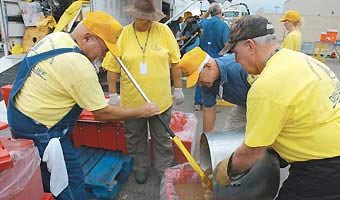
More than 1,500 TBM volunteers have given their time to help those affected by Ike. TBM feeding teams have prepared more than 420,000 meals. The TBM shower and laundry units also allowed people in affected areas to take more than 3,000 showers and wash about 1,600 loads of laundry.

BCFS, in cooperation with its partner churches, provides medical special-needs evacuees with specific dietary requirements, necessary medical attention and basic health and hygiene services during their stay.      

“We have the resources to house these evacuees as long as necessary,” said Marla Rushing, BCFS director of corporate training. “Although we hope they can return home soon, we won’t send them away until we know it’s safe.”

Members of the Texas Baptist Men Disaster Relief team from Gregg Baptist Association prepare meals to help with relief operations after Hurricane Ike hit the eastern one-third of Texas. (BGCT PHOTO/John Hall)

Some evacuees were in no hurry to leave because of the relationships and care given through BCFS and host churches. One Corpus Christi evacuee was so pleased by the care he received through BCFS at Northeast Baptist Church, he plans to move to San Antonio and join the church.

“When Harvey Lopes first arrived at our shelter, we thought he was the bus driver. He was helping everyone off the bus and giving us a brief synopsis of their medical conditions,” shelter manager Skip Holman said. “We were shocked when we realized he was an evacuee.”

Lopes spent his time at the shelter serving meals and ensuring other evacuees had everything they needed. At one point, shelter volunteers even had to restrict Lopes from helping due to his own medical condition.                       

Lopes stayed at Northeast Baptist Church five days with his wife and their four children, one of whom qualified as a medical special-needs evacuee and was their reason for staying at a BCFS shelter.

Joshua and Kristin Loflin, members of Calvary Baptist Church in Beaumont, stand in front of their flooded home in LaBelle. They lost all their furniture, appliances, clothes and the toys of their two children—Michaela, 3, and Malachi, 1. (NAMB PHOTO)

After returning to Corpus Christi, Lopes immediately called the shelter to thank the volunteers once more for their kindness.

“We want to get them back to San Antonio as fast as possible,” said Ann Parsons, assistant shelter manager. “We loved their family, and they loved us.”

In addition to running medical special-needs shelters in San Antonio, the BCFS incident management team continues to provide management for the Texas Department of State Health Services operations for Texas Task Force Ike in Galveston.

Classes resumed Sept. 22 at Houston Baptist University, eight days after Hurricane Ike caused an estimated $8 million to $10 million damage to the campus.

The university’s student center and administrative complex suffered significant wind, water and structural damage during the storm, but student residences were undamaged, and classroom buildings largely were unaffected as well, HBU President Robert Sloan said in a statement posted on the school’s website.

Although the campus was without power for a week, emergency generators provided crucial support for staff and students who weathered the storm on campus, Sloan said. Cool, clear weather allowed cleanup crews to make progress on recovery efforts.

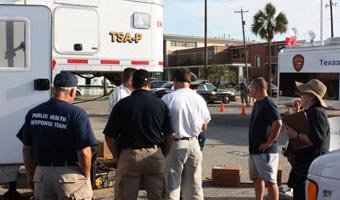
Baptist Child & Family Services personnel join other members of Texas Task Force Ike outside Ball High School on Galveston Island to survey damage and plan relief strategies to help victims most affected by Hurricane Ike. (BCFS Photo)

The university’s computer network returned to service the morning of Sept. 21 after servers were moved to an off-site location where electrical power was available, according to a statement from Charles Fix, interim director of HBU’s information technology services. By that evening, electrical power had been fully restored to the campus, and Sloan announced classes would resume at 10 a.m. the next day.

In the statement posted Sept. 19, Sloan praised students and staff for the patience and good spirit they demonstrated during the chaotic week after the storm struck.

“As we see more images from the storm’s destruction, we realize more and more how many are suffering in our area,” Sloan said. “We know that nothing happens outside the love of Christ, and it is that belief that keeps us strong. We pray for God’s peace for those who have lost loved ones, homes, pets and that sense of normalcy that we all take for granted.

“One of our challenges this week has been that our administrative team is working without access to their offices and files. Today’s wireless technology—cell phones, air cards, laptops—has been invaluable. Our remote access to our website has allowed us to keep our HBU homepage updated with information. Our emergency alert system has served us well and has given us the capability to send phone and text-message campus updates to our faculty, staff and students on a daily basis.

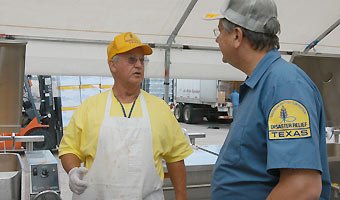
Bob Childres (left) from Immanuel Baptist Church in Paris visits with BGCT Executive Director Randel Everett at the Texas Baptist disaster relief field kitchen at League City. (BGCTPhoto/John Hall)

“Our students who remain on campus and have been here since the storm are in good spirits. There is a definite bond among these young people, built on prayer, friendship and youthful optimism. I met yesterday with our faculty and staff who were able to get to campus. We prayed together, hugged familiar faces and shared our stories. There was a peace to that gathering and a strength that comes from knowing God’s grace and goodness.”

Students who remained on campus helped other storm victims by volunteering for Houston’s End Hunger Network and Neighborhood Centers. The university has established a “Student Success Fund” for donations to help students and their families who suffered losses due to the hurricane.

Less than 24 hours after Hurricane Ike hit Houston, Parkway Place Executive Director Chuck Childress reported power was restored to the Buckner retirement community, and service crews already were making repairs and performing cleanup. The restoration of power also restored air conditioning to the community and halted earlier contingency plans by Buckner Retirement Services to move residents to other retirement facilities because of the heat.

Early reports from observers indicated moderate damage to Buckner Children’s Village and the Calder Woods retirement community.

Residents at Gracewood—a Children at Heart Ministries facilities in Houston for single mothers with children—“rode out the storm, emerging to find evidence of Ike’s fury all around them,” said Don Cramer, vice president and chief operating officer for the Children at Heart Foundation.

“Wood fences and chain- link fences were down, trees had blown over and debris was everywhere. The power of the storm was evident in branches and boards embedded several inches into the ground where they had been hurled by the winds. Even the children’s playscape area was damaged by a falling tree. But God is good, and no one was hurt.”

Personnel at other Chil-dren at Heart facilities helped with relief and recovery. A maintenance team from Texas Baptist Children’s Home in Round Rock provided a generator. Residents from one of the cottages in Round Rock and at Miracle Farm in Brenham helped clear away debris.

Baylor University School of Social Work students under the direction of Jim Ellor visited and comforted 20 evacuees with dementia who were relocated to a Waco nursing home when the storm knocked out utilities at the facility where they live.

The nursing home residents already had been uprooted a short time earlier due to Hurricane Gustav.

“For persons with serious dementia, numerous changes in location and caregivers are particularly stressful,” said Helen Harris, senior lecturer in the Baylor School of Social Work.

The students “calmly and competently visited with persons who needed presence and caring and reassurance,” Harris said. “They were skillful social workers. They were tender ministers. They met ‘the least of these’ and saw the face of Christ. And I saw the face of Christ in them.”

Reporting by Haley Smith, John Hall, Russ Dilday and Mark Kelly, with additional information provided by Diana Garland.


Stay the course when market drops, Hawkins suggests

NASHVILLE, Tenn. (BP)–Even though sharp drops in the stock market have many Southern Baptist pastors worried about their retirement funds, making an emotional decision to get out of the market is unwise, the president of Guidestone Financial Resources told members of the Southern Baptist Convention Executive Committee Sept. 23.

"When I was a pastor in Fort Lauderdale, we had just started a big capital campaign in the late '80s when Black Monday hit and the stock market fell over 22 percent in one day," O.S. Hawkins said. "That would be like the stock market dropping 2,500 points in one day today. But we got through that. We got through the '80s and '90s and the tech bubble and the dot.com issues and 9/11 the volatility in the oil and gold markets that we still see."

Investors who bail out of the stock market after a sharp downturn wind up missing out on the rebound that will help them recover their losses, Hawkins said.

"What happened last Wednesday, when the markets went down 500 points in one day, was people were panicking and a few got all out of the equity markets that afternoon," Hawkins said. "Well, Thursday and Friday the market went back up, and then to get back in, it's like having a double whammy."

A successful retirement savings strategy requires an investor to stay the course even when the stock market becomes volatile, Hawkins said.

Hawkins referred to a recent analysis that showed an investor who had parked his money in an index fund 20 years ago and left it there would have seen an annual increase of more than 12 percent. On the other hand, an investor who got jittery and moved his money every time the market sank, would have seen only a 3.7 percent annual average return because he missed the 50 best days of market performance.

Markets are cyclical, with both down times and up times, but over the long haul, they make money, Hawkins said. A long-term commitment to a diversified investment portfolio, like the ones Guidestone offers Southern Baptist church and denominational employees, limits the impact of a market downturn and allows investors to maximize the benefits of the stock market's money-making ability.

"Guidestone's strength and stability across these 90 years has helped us weather a lot of market storms," Hawkins told the group.

Hawkins encouraged the group to think of retirement planning like running a marathon. A runner needs to get a good start, set a pace and run it, be ready to kick up the pace near the end and then sprint the last few yards to the finish line.

"That's the way it is with retirement planning," Hawkins said. "You've got to get a good start. Then you determine your time horizon and set your pace. Then when your kids get grown and you don't have any more college bills, you got some expendable income, then you put the kick in there and maximize all your 403(b) and use other vehicles to do that. Then when you get near [retirement] you put as much as you can in there for tax purposes and save that way."

A look at the history of the stock market reveals there has never been a 10-year period in which investors who stayed the course failed to make money, Hawkins said. A wise investor plots a strategy that anticipates market turbulence and then lets his strategy work for him.

Many people, however, don't feel they have the investment knowledge to devise a strategy and then manage their investments, he added.

"This is one reason we launched the My Destination date-targeted funds last year," Hawkins said. "They balance your portfolio for you and when you get closer to retirement, when you don't have that time horizon, it makes things a lot more conservative and you're not in the equity markets as much. You just pick the date of your retirement, then let us do the driving for you."


IMB retooling to focus agency on local-church mission work

ATLANTA (ABP)—The Southern Baptist Convention’s International Mission Board will reorganize over the next year to focus more on local churches’ involvement in missions and provide flexibility to reach people groups across geographical lines.

At their September meeting in Atlanta, IMB trustees approved a reorganization of the missionary-sending agency and revised its vision, mission and core-values statements. The process will take about a year to fine tune and complete, according to an IMB news release.

Although details of the reorganization have not yet been publicized, basic changes include grouping current missionary teams into “clusters” and replacing the IMB’s 11 geographically based regions with eight “affinity groups.”

IMB President Jerry Rankin told trustees that sending missionaries, reaching the lost and planting churches would remain the agency’s primary tasks. Reorganization would provide the support to focus on reaching people groups even when they move across national boundaries.

But changes in the agency’s mission statement and core values also emphasize the local church’s role in reaching the world with the message of Christ.

“The revised mission statement … reflects that the Great Commission is the responsibility of the local church and refocuses the efforts of the agency on assisting churches to fulfill that responsibility,” according to the IMB release.

The values statement, the release continued, shifts “the role of the agency from a primary focus on sending missionaries to one that serves the churches in their involvement in the Great Commission and the sending of missionaries.”

The changes simply reflect what some churches already are doing through the current IMB structure and will facilitate involving more congregations, said Ken Winter, IMB’s vice president of church and partner services.

“Churches for years … have been strategically involved in reaching the lost,” he said. “We’ve seen dramatically increasing involvement … and churches desiring to engage people groups.”

For the past few years, congregations have been able to participate in strategic planning and action to reach specific people groups as “engaging churches,” often partnered with an IMB region. The mission board assists with training and resources and provides a coach/mentor for the congregation. Currently, 150 churches partner in some way in IMB’s West Africa region alone.

“We see an awakening taking place,” Winter said. The changes are designed “to unleash the resources God is making available,” and development of affinity groups is “an attempt to do more, effectively.”

Asked if the changes might adversely affect the Cooperative Program, the SBC’s unified budget, Winter said, “I don’t believe so, based on what we’ve seen. In fact, we’ve seen just the opposite. … For the past four to five years, as churches have been more strategically involved …, we see their giving increasing. … I think it’s people connecting with God’s heart for missions.”

In other action, IMB trustees approved a new child-protection policy requiring all personnel to undergo thorough background checks and to disqualify anyone with a history of sexual abuse, a criminal conviction of a sexual nature or with behavior that indicates they pose a risk to children.
The board also approved appointment of 83 new missionaries.


Texas Baptists meet needs as Rio Grande threatens Presidio

PRESIDIO—When a surge in the Rio Grande forced the evacuation of several hundred homes in Presidio and flooded 350 homes across the border in Ojinaga, Texas Baptists responded.

Rains upriver rapidly increased the river’s water level in the area, cracking one of the levees in Ojinaga. While the waters have receded a bit, additional rain was forecasted upriver, creating the possibility of more flooding.

BGCT Executive Director Randel Everett (left) and Robert Cuellar, congregational strategist in West Texas, fill sand bags in Presidio to reinforce the levees that are keeping floodwaters at bay in the community. BGCT PHOTO/Ferrell Foster

The uncertainty has pushed 60 Presidio residents into shelters, and many others moved in with relatives in the area.

“We’re better off than we were. We’re not out of the woods yet,” said Ed Jennings, Big Bend Baptist Association director of missions who is part of the relief efforts as a chaplain to the first responders such as military personnel, firefighters and police officers.

Recently he was able to minister to first responders by helping lead a memorial service for four people who died in a plane crash while scouting the damage along the border. He continues helping them work through their grief.

During the Rio de Esperanza kick off to Texas Hope 2010—an initiative to share the gospel with every Texan by Easter 2010 and to meet human need—Baptist General Convention of Texas Executive Board staff leaders pitched in by filling sandbags for the levees and donating more than 200 pocket radios.

The radios will provide critical help for people in needing warning in case a levee breaks stateside, said Carlos Nieto, chairman of the Persidio School Board. The only source of information in Spanish for Presidio residents is a Mexico radio station.

The BGCT also is providing $2,500 for relief work in Ojinaga.

“Something as simple as a cheap AM/FM radio could save a life here,” Nieto said.

BGCT Executive Director Randel Everett applauded the hard work of the people of Persidio who have come together in a time of crisis.

“Texas Baptists are praying for you, as are other churches across the state,” he said.

Nieto thanked Everett for the prayers and the radios, noting churches will play a key role in the recovery effort.

“When the state and federal agencies leave, I think faith-based organizations are going to have to step it up,” he said.

A video report concerning the flooding can be seen here .


Hurricane Ike damages churches throughout Southeast Texas

As evacuees return to Southeast Texas, early reports indicate a significant number of Texas Baptist churches in the area sustained damage when Hurricane Ike blew through the state.

Most of Southpark Baptist Church in Alvin is unusable after the storm, Pastor Bruce Peterson reported. The hurricane damaged the church’s roof, allowing rain to pour into the sanctuary and children’s building. The fellowship hall sustained limited water damage but is still usable.

First Baptist Church in Galveston was filled with water during the storm. The carpet and pews have been removed from the building.

Several Beaumont churches report significant damage. Amelia Baptist Church, Central City Baptist Church, New Beginnings Church and Westgate Memorial Baptist Church suffered water damage. West End Baptist Church and Dawndale Baptist Church sustained steeple damage.

First Baptist Church in Bridge City suffered major damage from up to five feet of water that filled its facilities. First Baptist Church in Nome sustained some damage to its steeple. Calvary Baptist Church in Nederland had some water and wind damage. First Baptist Church and McDonald Memorial Baptist Church in Orange each were damaged by the hurricane.

Ike blew the roof off Exodus Bible Church in Port Arthur, creating serious damage. Windows were blown out of First Baptist Church in Port Neches and its playground was destroyed. Central Baptist Church in Vidor had some water damage and its playground was destroyed.

At least 20 Baptist General Convention of Texas-affiliated churches in Union Baptist Association reported damage from Hurricane Ike. Among the worst reports is Centro Cristiano Vida y Restauracion in Houston, which saw its facilities destroyed. The roof was pulled off of Club Creek New Life Community Baptist Church in Houston. House of Celebracion in Houston sustained roof damage and is without a place to worship.

BGCT staff members are in the area surveying the damages. BGCT architectural staff will be assist congregations as they look at rebuilding their facilities.

“BGCT church architecture provides church building recovery assistance to our churches in two ways—assessment, helping determine the situation and conditions of their church buildings and two, resources, understanding funding and professional services options,” said Keith Crouch, leader of the BGCT Resources Services team. For more information on BGCT architectural resources, call Crouch at (888) 244-9400.


Hurricane Ike creates need for more volunteers, more disaster relief funds

Texas Baptist groups serving in the wake of Hurricane Ike primarily are in need of two things—volunteers and funds.

The response to Hurricane Dolly, Hurricane Gustav and Hurricane Ike has stretched volunteers across the state. Anecdotal reports indicate volunteers are in increasingly harder to find, especially in specialty areas. Those who are serving are being pushed by long hours with little time to decompress.

Texas Baptist Men has more than 1,400 volunteers working through East Texas in the wake of the storm and attempts to relieve volunteers within two weeks, creating a need for a vast number of trained volunteers.

Baptist Child & Family Services has many medical personnel serving in its San Antonio shelters and is looking for additional volunteers with medical experience.

People who want to volunteer through Texas Baptist groups or institutions can call the Baptist General Convention of Texas, which is serving as a clearinghouse for volunteers and volunteer opportunities, at (888) 244-9400.

“Texas Baptist Men, Baptist Child & Family Services, Texas Baptists across the state who are sheltering hurricane evacuees, and those in Southeast Texas who are spontaneously responding to the needs to those affected by Hurricane Ike are doing a tremendous job,” said Wayne Shuffield, director of the BGCT Missions, Evangelism and Ministry Team. “But with an effort like this, they need help. This is a task God is calling all Texas Baptists to.”

The scale of the devastation left by Hurricane Ike also is stretching accounts. The BGCT’s disaster response fund, which provides family support for people affected by disasters, supports some Texas Baptist Men ministry and aids the BGCT Executive Board staff in connecting needs and resources, is dangerously low, according to Shuffield.

All BGCT disaster relief efforts are funded by designated offerings.

About $150,000 remains in the account, which could seriously hamper Texas Baptist relief efforts in the area. Mobilizing a single feeding unit and its team can cost tens of thousands of dollars, and TBM has activated all of its mobile kitchens.

“Along with direct gifts to Texas Baptist Men disaster relief, the Baptist General Convention of Texas is one of the primary partners of TBM’s ministry in the wake of disasters,” said Leo Smith, TBM executive director. “The destruction left behind by Hurricane Ike is going to require substantial resources. We pray Texas Baptists will be generous in their support of disaster relief ministries as they always have so we can continue sharing the hope of Christ in trying situations.”

In the coming weeks and months, the BGCT will begin to work through local churches to provide financial assistance to Baptists who were affected by Ike.

“The BGCT Disaster Response Fund will directly help ease the troubles and pain of people affected by Hurricane Ike,” Shuffield said. “Texas Baptists are seeking to provide hope and help for people in their time of need.”

All of the money designated through the BGCT for disaster response supports disaster response ministries. To give to the BGCT Disaster Response Fund, visit www.bgct.org/disaster. Checks designated “disaster relief” also can be sent to BGCT, P.O. Box 159007, Dallas 75315-9007.