Veteran recalls ‘divine appointments’ in waning days of WWII

Moody Barker’s transfer from stateside duty to the Pacific in the final days of World War II led to two encounters he considers “divine appointments.” One reunited him with his brother. The other reintroduced him to a boyhood friend who helped usher him into the family of God.

After Barker, who lives at the Christian Care Center retirement facility in Mesquite, told members of his Sunday school class at First Baptist Church in Garland how he saw God at work when he was serving in the military more than 63 years ago, they persuaded him to write about his experience.

As Barker relates the story, he was drafted into the U.S. Army four months before the Japanese attacked Pearl Harbor and the United States entered the war. After he completed basic training in Virginia, he was stationed at Norton’s Point in Seagate, N.Y., at the north end of the Coney Island Boardwalk.

Moody Barker (center and right) was reunited with his brother, Bill (left), in the Pacific during the final days of World War II—one of two key encounters he considers “divine appointments.”

Although he was trained as a gun commander on a 90-millimeter emplaced to defend against aircraft or marine enemy, he discovered his primary duty was to check incoming and departing vessels passing through the New York Harbor submarine net.

“We were known as Coney Island Commandos. Our greatest danger was fighting the crowds on the subways to Times Square,” he recalled.

In contrast, his younger brother, Bill, received his basic training at Camp Beale in California and combat training in Hawaii, and then he participated in an island-hopping series of missions across the Pacific. He finally was sent to Leyte in the Philippines, where he was part of a multinational 12-million-man force that was being trained for an anticipated invasion of Japan.

Moody Barker married Jewett Watts during a Christmas furlough in 1944. When he returned to base, he received his orders to ship out for the Pacific. After stops in Pennsylvania and California, he boarded the Brigadier General Howze—“a faster ship than most, so we went unescorted across the Pacific.”

Not long after Barker arrived in the Philippines, he confirmed that his brother also was stationed somewhere in that area, but as he noted, “There were about 12 million men in the area at the time preparing for the invasion of Japan, so I figured finding Bill might be kind of hard.”

While he was in the process of trying to find out where his brother was serving, Barker saw a banner on a bulletin board at a service club near Gen. Douglas MacArthur’s headquarters. It said, “Bomb equal to 20,000 tons of TNT dropped on Japan.”

When a companion asked Barker what he thought about that, “I told him it had to be more propaganda.”

But that night, Barker’s squad leader woke everyone in earshot at 3 a.m., firing twin Thompson submachine guns and shouting, “The war is over, and we are all going home!”

Moody Barker (3rd from left, standing) spent most of World War II stationed in Seagate, N.Y., checking incoming and departing vessels that passed through New York Harbor with a group who called themselves the “Coney Island Commandos.” Near the end of the war, he was transferred to the Pacific, where he experienced what he considers two “divine appointments.” (Photos/Courtesy of Moody Barker family)

“The next day, I was called to the office and told that I was the first of all the replacements to be assigned to a new unit, and my orders were to fly to Tacloban, Leyte,” Barker said. He was told to report to the 945th Anti-aircraft Automatic Weapons Battalion—on the same island where his brother was stationed. Barker began searching for his brother’s unit, the 155th Combat Engineers. Eventually, he found a phone operator who connected him to the unit.

“I asked if they had a Barker on their roster, and the operator said they sure did, and he was there getting a haircut,” he recalled. The operator summoned Bill Barker, and before long he was on the phone, eager to find out his brother’s location.

“I told him, and he said he would be there in 10 minutes. Sure enough, he showed up in 10 minutes, with half his hair cut—one side neatly trimmed and the other side very bushy, but he sure looked good to me,” Barker recalled.

Later, Bill Barker’s commanding officer asked Moody Barker if he would like to be transferred to the engineers. Barker told the captain he knew nothing about engineering, but the commanding officer asked him if he could drive a nail in a board without bending it. Barker assured him he could.

As Barker remembers it, the captain responded: “You’re a first class engineer. Now go back to your company and write a letter requesting a transfer to 155th Combat Engineers, and I guarantee that if it reaches our headquarters, you will soon be an engineer.”

Five days later he received his transfer orders—not only to the 155th Combat Engineers, but also to Company C, where he ended up sharing a tent with his brother.

Soon after the brothers’ reunion, their unit was relocated to Amori, Japan—the northernmost city on the island of Honshu—where Barker kept his “second divine appointment.”

Walking down the street in a city of 130,000, he heard a familiar voice call his name. He saw Rayford Clinkscales, a boyhood friend from New Gulf, an unincorporated community in Wharton County. He discovered Clinkscales was serving as a chaplain’s assistant.

“We had a nice visit, and during our conversation, he told me about five Protestant chaplains who were having meetings every night and invited me to come,” Barker recalled. “I explained how busy I was with my squad building Quonset huts to help us move out of tents and into warmer quarters.”

But Clinkscales proved persistent, visiting him again the next day and inviting him to another meeting that evening.

“I went and was so touched that I went again the next night. I experienced the love of the Holy Spirit, prayed the sinner’s prayer and asked Jesus to come into my life and be my Lord and Savior,” Barker said. “I had always believed in God and Jesus but never had a personal relationship with him. Everything changed for me that night.”

Barker has no doubts God brought together a series of events within just a few months—his marriage to “a wonderful Christian lady,” a reunion with a brother than demonstrated God’s wonder-working power and his visit with childhood friend who invited him to a place where he could hear the gospel.

“I’ll always thank God for Rayford and his part in my salvation,” Barker said.

“Rayford wrote to Jewett right after that and assured her that I was on the right road. He was right, because my trip down that road has been filled with so many blessings and—after each bump—the road always smoothed out.”


Based on a first-person report by Moody Barker, with additional reporting by Ken Camp


UMHB students help Vidor residents recover from Hurricane Ike

VIDOR—A junior economics student at the University of Mary Hardin-Baylor recently rallied support to help make a difference in a community more than 250 miles away from the Belton campus.

Tommy Wilson, 22, said he felt a strong desire to get involved with relief efforts soon after Hurricane Ike ravaged parts of the Texas coast.

“I felt the call to go,” he said. “I asked God to open some doors.”

Wilson shared his feelings with Shawn Shannon, director of Baptist Student Ministries at UMHB, and Tom Henderson, director of missions for Bell Baptist Association. Shannon forwarded to Wilson an e-mail noting the Baptist General Convention of Texas listed a need in Vidor.

University of Mary Hardin-Baylor students Daniel Bucher, Karilyn Hill and Sierra Huddleston work on a mud-out crew in Vidor, cleaning storm-damaged drywall and insulation from a home. (Photo/UMHB)

Wilson then worked through Nehemiah’s Vision, a nonprofit organization created after Hurricane Rita to help rebuild homes and churches in Southeast Texas.

“I called them and asked, ‘What do y’all need?’” he said.

Once Wilson found out there was a need for laborers to help clean up and repair structures, he got to work contacting university students. Wilson knew that with fall break approaching in mid-October, many students would be available and willing to lend a hand.

After making announcements in classes, during chapel and on a social networking group site, 23 students signed up for service in Vidor.

While the trip wasn’t officially sponsored by the university, UMHB paid fuel costs for the students’ trip.

The students helped complete a mud-out of three houses—shoveling mud out of homes, removing damaged drywall and spraying the interior with disinfectant.

They also patched a roof at the Baptist Student Ministry building near Lamar University in Vidor. Wilson arranged for Cecil Rankin, a roofer from his hometown of Charlotte, about 60 miles south of San Antonio, to travel to Vidor to provide guidance.

“I thought it was amazing,” Wilson said about the trip. “It was really, really fun, but at the same time challenging. Most of us college students have never done that type of work before, but we figured it out and got it done.”


UHMB students ‘Reaching Out’ in service

BELTON—Students from the University of Mary Hardin-Baylor spent a recent Saturday clearing out storage rooms, washing dishes, moving heavy boxes and generally cleaning the facilities of service agencies throughout Bell County as part of the university’s Reaching Out community initiative.

“I think UMHB and the community have a really positive relationship, and a contributing factor is Reaching Out,” Director of Student Organizations Kristy Brischke said. “We do service events three times a year, and these agencies are always anxious to get us back each year, so I think we really have been a positive light to them.”

Planned by the UMHB Student Government Association chaplains, the event scattered groups of students across Bell County for volunteer service.

University of Mary Hardin-Baylor student Erica Jackson cleans windows at the Ronald McDonald House.

“I hope students understand that there is a community in need right outside our doors. I also want them to be touched by the agencies we help and possibly develop a desire to impact them in a greater way in the future,” Brischke said.

Senior English major Christy Schulte, who serves as assistant director for the 2008 Miss Mary Hardin-Baylor pageant, points to Reaching Out as a highlight for pageant contestants.

“Every year, they have the pageant girls come to a community service opportunity as a bonding experience, but also to say: ‘This isn’t about us. We want to reach out to the community and share the love of Jesus with others.’”

Twenty pageant participants and directors worked at the Ronald McDonald House in Temple, organizing Christmas supplies, helping clean the facilities and taking care of other time-consuming tasks.

In Belton, students volunteered at Helping Hands Ministry food pantry. Several workers helped move heavy items to the organization’s new location, while others sorted supplies for distribution.

Junior nursing major Yarickza Shirley, a Student Government Association chaplain who helped organize Reaching Out, said the best thing about volunteering was “leaving at the end of the day and, knowing that even though it was four or five hours, feeling good about yourself.”

At the Central Texas Christian School, a small group of students helped clean the school and pick up trash.

Senior Patrick McDonald said: “I get a great joy out of volunteering because there is no way anything can come back to me physically. I don’t get paid for this. I don’t get anything from this but a great joy from helping people.”


One-time acquaintances are friends for life–literally

MARSHALL—Bob Hogberg and Marc Heath have only met face-to-face once, but they are friends for life—in this case, Hogberg’s life.

Their friendship began with an unselfish gift—bone marrow donated by Heath, who lives in Greensboro, N.C., and received by Hogberg, mechanical maintenance manager at East Texas Baptist University in Marshall.

In June 2004, Hogberg was diagnosed with acute myelogenous leukemia. Doc-tors said his best chance for a complete recovery would be a bone-marrow transplant, but no one in Hogberg’s family was a match.  

East Texas Baptist University mechanical maintenance Manager Bob Hogberg (left), who received a bone marrow transplant in 2006, poses in front of Scarborough Hall with Marc Heath, who donated the marrow, and Heath’s wife, Sara. Hogberg and Heath met for the first time recently. (PHOTO/ETBU/Mike Midkiff)

New cases of AML are diagnosed in more than 11,900 people each year, and the average age of a person with AML is 65. Hogberg, who is now 64, received his bone marrow transplant in January 2006 at M.D. Anderson Cancer Center in Houston.

“My grandfather died of leukemia when I was 8 years old,” said Heath.

“I actually got on the registry because of a bone-marrow drive while I was a student at Liberty University. The main reason I did this was to honor my grandfather, and I did not want someone else’s grandfather to pass away.”

At the time Hogberg was diagnosed, he had five grandchildren; now he has nine.

He and his wife, Judy, are members of Central Baptist Church in Marshall, and they give God all the glory for the gift from Heath.

“Without Marc’s contribution and God’s hand, I would not be here today,” Hogberg said. “The feeling of meeting Marc face to face is indescribable. I am thankful that he was willing to do what he did so I could live.”

“Because I Care,” a recruitment group affiliated with the National Marrow Donor Program, arranged for the meeting between 29-year old Heath and Hogberg at a press conference in Longview.

Earlier this year, Heath and his wife, Sara, found out they would be able to meet the person who received his marrow donation.

“When we found out we could come to Texas and meet Bob, the level of excitement for me was like a child waiting for Christmas morning,” Heath said, as Hogberg led him on a tour of the ETBU campus.

“When I gave, I was told that I would not have any contact with the person. So, I thought that one day I possibly could find out through the FBI who it was,” Heath said, grinning.

The donor and recipient cannot talk to one another for one year after the transplant.

“Meeting Bob and his wife is so overwhelming because I never expected this to happen,” Heath said.

The Hogbergs served as hosts to the Heaths for a weekend during their first visit to Texas. Heath was introduced to all the Hogberg’s children and grandchildren and, he noted, they immediately made him an honorary member of the family.

Hogberg told the Longview News-Journal: “I believe there’s a divine purpose in all our lives, and things work out when we hand them over to God.

“Marc gave of himself in a very real and personal way. I have a Savior in heaven who’s given me eternal life and a buddy here on Earth who’s given me physical life.”


Texas Tidbits: BCFS coffeehouse receives funds for expansion

BCFS coffeehouse receives funds for expansion. Guadalupe Street Coffee, part of the Baptist Child & Family Services community ministries program, will receive nearly $200,000 in economic development funding from San Antonio’s Avenida Guadalupe Association to invest in expansion and improvements to the building that houses the west side coffeehouse. The funds are part of a $610,000 grant awarded to Avenida through the U.S. Department of Health and Human Services, Office of Community Services and a city bond program. Guadalupe Street Coffee provides free computer access to students in an area where only 3 percent of homes have computers.

BCFS awarded foundation grant for emergency response. Baptist Child & Family Services received a $240,000 grant from the Baptist Health Foundation of San Antonio to increase emergency response capacity during disasters. During the next three years, BCFS will use the grant to recruit, train and certify at least 3,000 volunteers and 75 churches to operate medical special-needs shelters during catastrophic events. Funds also will be used to set up a project database and rapid notification system that can reach thousands of volunteers or responders within seconds.

Howard Payne honored for student service. In recognition of the acts of service by students at Howard Payne University, the institution has been named to the President’s Higher Education Community Service Honor Roll for the second consecutive year. Launched in 2006, the Community Service Honor Roll is the highest federal recognition a school can achieve for its commitment to service-learning and civic engagement.

Scholarships endowed at Wayland. Five endowed scholarships have been established at Wayland Baptist University. A scholarship for female ministerial students has been named in honor of Texas Baptist missions leader Amelia Bishop of Austin. She served from 1984 to 1988 as president of Woman’s Missionary Union of Texas. Charles and Mary Abercrombie of Amarillo and other family members established the Barton and Harriett Smith Abercrombie Endowed Scholarship to honor pioneering ancestors. Wayland trustee Tom Brian of Lubbock and his wife, Ann, established a scholarship in memory of their daughter, Kathryn Anne Brian Wiley, who attended Wayland her freshman year. Trustee Max Gabriel of Plainview and his wife, Marcheta, established a scholarship in their name and one in memory of their son, Kyle, and in honor of their daughter, Tiffany Gabriel Wright.

Target gives grant to TBCH Family Care program. The Texas Baptist Children’s Home Family Care program has been awarded a $3,000 grant from Target as part of the retailer’s ongoing efforts to strengthen families and communities. The grant will be applied to operating expenses for the residential program for more than 30 single mothers and their children.

Historical markers approved for Baylor. State historical markers have been approved by the Texas Historical Commission for Carroll Library and the Texas Collection at Baylor University.


TBM, CBF provide hunger relief for North Korea

DALLAS—North Koreans suffering from a food shortage in their nation have received $30,000 worth of food and grain provided by Texas Baptist Men and the Cooperative Baptist Fellowship.

Yoo Yoon of Dallas, the CBF Korean initiative consultant, traveled to North Korea to deliver the relief shipment.


More than 40 tons of food donated by Texas Baptist Men and the Co-operative Baptist Fellowship have been delivered to North Korea this fall. (PHOTO/CBF)

TBM and CBF each gave $15,000 to the hunger-relief effort that purchased 36 tons of flour and 4.2 tons of corn noodles.

While in North Korea, Yoon visited a corn noodle factory, where half the corn used to make noodles was rotten. A bad crop season only amplifies the food shortage, leaving many pleading for more corn and flour to be sent to desperate areas, he noted.

CBF has contributed toward numerous hunger-relief projects in North Korea, including purchasing dried food for an estimated 500,000 people and providing 20 tons of vinyl sheeting to create greenhouses for vegetables.

TBM’s ongoing involvement in hunger relief, humanitarian aid and development projects in North Korea dates back to 1996.


Baptist agency continues ministry to Sri Lanka’s orphans

Four years ago, a monster tsunami decimated the small island of Sri Lanka. About 225,000 died in the storm. Thousands of children became orphans within seconds.

When the orphanages quickly filled up, the Sri Lankan government called on Children’s Emergency Relief International, the overseas division of Baptist Child & Family Services, to establish the country’s first foster care system.

CERI brought in counselors to help begin the healing process. With a few crayons and blank sheets of paper, children began drawing out graphic images of their fear and pain.

“Each had the same memories of massive waves rushing toward them without warning, taking away everything they had ever known,” said Marla Rushing, who set up the foster care system. “It was heartbreaking.”

To learn more about how to support CERI’s efforts by sponsoring a child in Sri Lanka, visit www.CeriKids.org or phone (281) 360-3702.

In the months following the tsunami, CERI found more permanent homes for the children in their care. Some went to family members’ homes, and others went to live with new families. Each household received training in how to care for a child and a small stipend to help with expenses.

“A third of the children still live without electricity, and less than half sleep in a bed. Yet a home is a home, and for the children of Sri Lanka, their CERI case worker is a familiar face that brings comfort in the midst of insecurity,” said Basil Fonseka, national director of CERI in Sri Lanka.

Today, years after the waters receded, a different disaster is gripping Sri Lanka, observers note. A civil war is leaving more children without parents. Daily reports appear of battlefield casualties and bombings. Teenagers disappear, and reports filter back to their villages that they are now part of the “children’s army” involved in fighting government troops.

While the government has asked many nongovernmental organizations to halt operations due to the ever-increasing danger, CERI has committed to stay.

“The CERI staff is at risk in Sri Lanka—just like everyone else. They pray and fast daily for God’s protection so that they may finish the work God has called them to do,” CERI Executive Director Dearing Garner said.

To learn more about how to support CERI’s efforts by sponsoring a child in Sri Lanka, visit www.CeriKids.org or phone (281) 360-3702.


Nontraditional ministry opportunities abound in Europe

KRAKOW, Poland—Central and Eastern Europe offers fertile ground for nontraditional churches to work in partnership with conventional missionaries to share the gos-pel, Pastor Rick White of City View Church in Keller discovered on a recent trip to Poland.

Ed Stetzer, president of LifeWay Research, led a group of pastors to Krakow, Poland, to explore how nontraditional churches can put their faith into action alongside Inter-national Mission Board workers in the region.

“The opportunity for partnering here is great in Krakow and other cities across urban Europe, for churches to engage in God’s global mission through church planting and evangelism,” Stetzer said. “We can reach (people) together … through partnership.”

A Polish university student speaks with Rick White, pastor of City View Church in Keller. White and other pastors from the United States visited Krakow, Poland, to explore how nontraditional churches can put their faith into action in Central and Eastern Europe. (PHOTO/IMB)

Pastors met with missionaries based in Poland, Hun-gary and Czech Republic to learn about ministry strategies and how their stateside churches can be involved.

“We want (American Christians) to meet people where they are and share Christ with them,” said Steve Brown, who serves in the eastern Czech Republic.

“We want people to hang out at pubs … to go to cafes and spend time together.

“That’s what means a lot to Czech people, and that’s where they hang out.”

Many of the missionaries emphasized partners can serve through alternate routes—not just through IMB channels.

“We’re looking for churches that are like-minded, have a heart for missions, and that want to trust God’s plan … to come and work with us,” Brown said.

Trey Shaw, who helps organize ministries in Buda-pest, Hungary, noted the simplicity of stateside churches getting involved.

“Call me, and we’ll work it out,” he said. “Seriously, it’s that easy.”

White accepted the challenge. Europe “is kind-of a forgotten continent” when it comes to missions, he observed.

“I would tell pastors: ‘Get in the game. Stop talking and get involved.’ The first step … is just getting on a plane.”


Five Peruvian villagers stayed, kneeled & prayed

HUANCANÉ, Peru (BP)—Tears welled in Kelly Martinez’s eyes.

Standing in the midst of a bustling market in Huancané, Peru, the 33-year-old missionary watched as a crowd of Aymaran villagers abruptly dissolved during an invitation to receive Christ’s gift of salvation. But her tears weren’t for those who scattered. She wept with joy for the five who didn’t.

Paul Reese, a member of Highland Terrace Baptist Church in Greenville, led the invitation. Reese had come to Huancané as part of a team of Southern Baptist volunteers. Martinez and her husband, Rick, had taken the team to the market for outreach and evangelism.

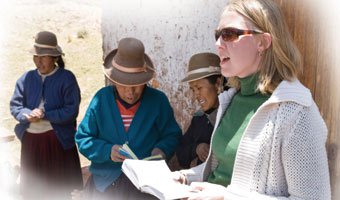
Missionary Rick Martinez (right) shares the gospel with a shop owner in Huancané, Peru. (IMB PHOTO)

While others distributed tracts, Reese preached in the street to anyone within earshot, eventually attracting a group of more than two dozen Aymara. As he concluded his message, Reese used a challenge to sift the sincere from those who were simply curious.

“If you are serious about not just believing in Christ, but you want to follow him and obey him, get down on your knees right now and we’re going to pray,” he said.

As the crowd shrank away, five Aymara remained behind, kneeling with Reese, who guided them through the sinner’s prayer.

Martinez looked on in awe.

Baptist missionary Kelly Martinez worships with Aymaran Christians during a church service at the New Jerusalem Evangelical Baptist Church near Huancané, Peru. (IMB PHOTO)

“Huancané is an easy place to do all the right ministry things, but it is a very difficult place to see results,” she said.

“We get so excited about volunteer teams. Often they come and do things that we haven’t thought to do, or maybe we’re not very good at.

“Somebody who was there that day who kneeled and prayed with that volunteer team might well come to our Bible study one night. And they’re going to say, ‘I was there that day that guy preached.’”


On the Move

Christopher Cook to First Church in North Zulch as pastor.

John Forbes has resigned as minister of music at Ardis Heights Church in Greenville.

Efrain Gonzalez to First Church in Breckenridge as youth/ recreation pastor.

Brian Lambert has resigned as pastor of First Church in Breckenridge.

Kip Salser has resigned as associate pastor of Vansickle Church in Greenville.

Linn Self to Central Church in Italy as interim pastor.


Obama election not the Promised Land, but getting closer, black ministers say

Barack Obama’s election as the first African-American president of the United States does not mean Martin Luther King Jr.’s dream of racial justice has been fully realized—but it’s a lot closer to reality than ever before, some black religious leaders said.

Marvin Griffin, pastor of Ebenezer Baptist Church in Austin, spoke of Obama’s election as “a manifestation of how far we have come.”

“I never dreamed I would live to see this day come to pass,” 85-year-old Griffin said.

As the first African-American graduate of Southwestern Baptist Theological Seminary, he recalled the segregated schools, separate public accommodations and poll taxes of the last century.

President-elect Barack Obama

He pointed to the election of the nation’s first African-American president as evidence of “growth in every quarter—in religion, education, constitutional changes—that contributed toward making this possible.”

He particularly noted the sacrifices of civil rights leaders—some who gave their lives—so people of color in the United States could make their voices heard.

Frederick D. Haynes III, pastor of Friendship-West Baptist Church in Dallas, echoed the same refrain.

“It is a phenomenal sign of the progress we have made, thanks to the sacrifices of others who have gone before,” Haynes said. “Their shed blood fertilized the ground out of which this amazing—even miraculous—accomplishment has grown, and we are reaping the fruit of their labors.”

Griffin described America’s progress in race relations—and human relations—in terms of a journey.

“We have come a long way and taken great strides toward the humanizing of our society,” he said. “We still have a distance to travel, but we have come a long way.”

Obama’s election sends a positive message to young people of all races and backgrounds—but particularly children of color, Griffin added.

“The door is open. We can ascend to reach our highest aspirations,” he said.

Jeff Haggray, executive director of the District of Columbia Baptist Convention, agreed. He described the message Obama’s election teaches his sons, ages 8 and 9, and his 4-year-old daughter.

“It means they can be anything they feel called to be, if they work hard enough,” Haggray said.

Obama’s election marks “a significant milestone in American history,” he said. “Of course, he is not the first person of color to achieve something great, but (his election) transcends every other achievement and surpasses all other milestones.”

Haynes recalled King’s dream of the Beloved Community, and he said the election of an African-American president signified “a huge step, if not a quantum leap, in that direction.”

Aidsand F. Wright-Riggins, executive director of American Baptist National Ministries, offered a more cautious appraisal. He called Obama’s election “a giant step toward the commencement of serious racial dialogue, rather than a graduation from America’s often-racist past.”

King’s vision of “the Beloved Community did not miraculously appear around midnight … as Obama moved past the magic 270 electoral college votes he needed,” Wright-Riggins noted.

“America proved itself capable of electing an African-American, Harvard-educated, Hyde Park resident, best-selling author as its 44th president. That is commendable and a tremendous cultural leap for this country and well worth applauding,” he said.

But he asked, “Is that same America capable of addressing a criminal justice system that incarcerated people of color at rates far out of proportion to their population in this country? That and similar questions remain on the conversational agenda.”

Obama’s freedom to succeed or fail on the basis of his character and vision rather than his race remains an open question, Wright-Riggins said.

Having cleared the hurdle of Election Day, Obama now faces the obstacle of winning over Americans who did not vote for him, Haggray noted.

“His challenge is to convince all those people he is their president, too,” he said.

And white Americans must learn a lesson African-Americans long have had to deal with regarding people in positions of authority—trusting a leader who is different.

“It’s a fundamental act of trust to say that even though he doesn’t look like us or share our personal history, we still trust him to be our president,” Haggray said.

Haynes believes the president-elect possesses the potential to win the allegiance of all Americans. Obama’s success as a campaigner took America far down the road toward racial justice, but his success in office can advance the cause even further, he observed.

“The success of an Obama administration will go a long way toward erasing the fears of those who still are trapped in the negativity of the past,” he said.

Griffin anticipates Obama facing special challenges as president because of his racial background—not only from whites, but also from some African-Americans “who say he’s not black enough.”

Expectations are high for Obama, and the pressures will be great, he noted. But “he is not the Messiah,” and nobody should expect all the nation’s ills—including its racial divisions—to be healed overnight.

“The kingdom has not come in its fullness,” Griffin said.


–With reporting by Bob Allen


Mature couple believes it’s never too late to make room for a child

SAN ANTONIO—When Pat and Thad Siweckis married, they never expected to celebrate their 50th wedding anniversary by adopting a 2-year-old girl, but that’s exactly what happened.

With five grown biological children, one adopted son and grandchildren already in high school, the Siweckises found their house feeling empty.

That’s when they decided to volunteer as foster parents through Baptist Child & Family Services .

Ariel was only 4 months old when she came into the couple’s home with 10 broken bones.

Ariel arrived at the home of Pat and Thad Siweckis when she was 4 months old with 10 broken bones. Now she is a healthy, happy little girl with a stable home. (Photo/BCFS)

“She stole our hearts right away, and we realized pretty quickly that it would be hard to give her up,” Pat Siweckis said. “I prayed God would give us the strength if that was his will.”

Strength—and energy—could be an issue. Pat Siweckis is 65, and her husband is 69. But when Ariel’s parents’ rights were terminated in April, the Siweckises knew they couldn’t let her go. They wanted to adopt her.

“We know that she is a gift from God, and she gives us a reason to get up in the morning,” Siweckis said.

The Siweckises have a huge support system, including their home church, First Baptist of Universal City, as well as family to help them love and care for Ariel.

The couple also had the opportunity to meet Ariel’s biological mother and the grandmother of Ariel’s half sister, who has custody of her sister and brother. Now, Ariel can grow up knowing her siblings.

“We truly believe that Ariel’s mom loves her. She’s just not at a point in her life where she can care for her,” Siweckis said.

The Siweckises believe they have been blessed with a spiritual gift of caring for children, knowing the kingdom of God belongs to little children such as Ariel.

They say their motto is, “There’s always room for one more.”