White evangelicals say election results in God’s plan
(RNS)—White evangelical Christians long have been seen as President Donald Trump’s most loyal supporters. And they often believe everything is part of God’s plan.
It’s little surprise, then, that 7 out of 10 (71 percent) believe God played a role in putting Trump back in the White House after the 2024 election—or that the same number said God’s plan was also for Joe Biden to be president four years earlier.
Few evangelicals, however, believe either candidate’s policies played a role in God’s plans.
Those are among the findings of a new Pew Research Center report about how Americans view the role God plays in elections. The report, released Sept. 9, was based on a May 2025 survey of 8,937 Americans, with a margin of error of plus or minus 1.4 percentage points.
Overall, the report found that when asked about the results of the 2024 election, nearly half of Americans (49 percent) said God does not get involved in U.S. presidential politics, while another 14 percent said they don’t believe in God.
A third (32 percent) said that Trump’s election was part of God’s plan, but that God didn’t necessarily approve of the former real estate mogul and reality TV star-turned-politician’s policies. Only 4 percent say God chose Trump because God approves of Trump’s policies.
These percentages match results from the 2020, 2016 and 2012 elections. A third (34 percent) of Americans said Biden’s election was part of God’s plan in 2020. A previous survey found that 27 percent of Americans said Trump’s election in 2016 was part of God’s plan. And 29 percent said the same about Obama’s election in 2012. 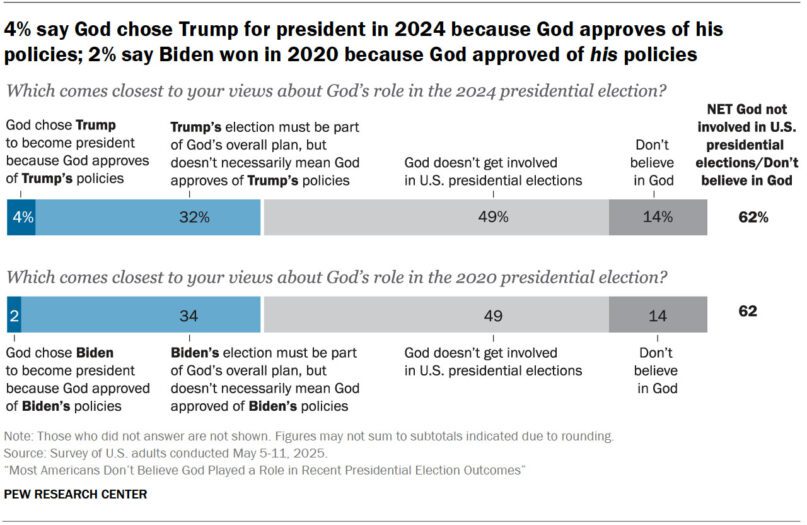
Theological views lead to interesting survey results
Chip Rotolo, a research associate at Pew and author of the report, said that there appears to be some theological consistency in how religious Americans see the outcomes of presidential elections. He also said those theological views may have led to interesting results in the survey.
“It definitely introduces some interesting data points,” he said. “Republicans are twice as likely to say God played a role in Biden’s election than Democrats are.”
The survey found differences in the way religious Americans see God’s role in politics. White evangelicals and Black Protestants were most likely to say that the election results were part of God’s plan. Catholics (67 percent) and nonevangelical white Protestants (66 percent) were more likely to say God doesn’t get involved in presidential elections.
Ninety percent of Americans with no religious affiliation saw no role for God in the recent presidential elections.
“The vast majority of religiously unaffiliated Americans—a group made up of atheists, agnostics and people who say their religion is ‘nothing in particular’—say that God does not get involved in elections (45 percent) or that they don’t believe in God (44 percent),” according to the report.
Party affiliation also revealed differences in how Americans connect faith and political outcomes. Half (52 percent) of Republicans and those who lean Republican said that either it was God’s plan for Trump to become president in 2024 (44 percent) or that God chose Trump based on Trump’s policies (8 percent). Only 25 percent of Democrats saw God’s hand in Trump’s election.
How much does religion affect voting?
Researchers also found differences in how much religion impacts voting and beliefs about whether good Christians should oppose Trump.
“White evangelical Protestants and Republicans are especially likely to say religion shapes how they vote,” according to the report.
White evangelicals are much more likely (51 percent) to say religion shapes how they vote a great deal or quite a bit than are Americans overall (25 percent). So do 37 percent of all Protestants, 31 percent of Black Protestants and 30 percent of Jews. Only 20 percent of nonevangelical white Protestants, 24 percent of Catholics and 6 percent of the religiously unaffiliated say religion shapes their vote.
Researchers also asked Christians whether “good Christians” can disagree about Trump. Overall, 80 percent said good Christians can disagree. Eleven percent said opposing Trump was essential for good Christians, while 7 percent said supporting Trump was essential for good Christians.
“Large majorities of Christians across various religious traditions and political party lines say that good Christians can disagree about Donald Trump, ranging from 76 percent of Hispanic Catholics to 85 percent among White evangelicals,” according to the report.
Ten percent of white evangelicals and Republicans said supporting Trump was essential for good Christians. By contrast, 1 in 4 Democrats (24 percent) said opposing Trump was essential.
“Overall, there’s consensus among most American Christians that ‘good Christians’ do not need to take a particular view on Trump,” the report said.
White evangelicals and Republicans were also most likely to say religion affects how they treat others and how they view morality.
“White evangelicals and Republicans also stand out for the large shares who say religion shapes how they treat other people and think about morality,” according to the report.
“For example, 88 percent of White evangelicals say religion shapes how they treat others a great deal or quite a bit, and 86 percent say the same about religion shaping their morality – among the highest percentages of any religious group analyzed.”
Among the religiously unaffiliated, 17 percent said religion shapes how they view morality or how they treat people.