





WASHINGTON (BP)—Religious freedom advocates lamented the loss of civilian lives in the Israel-Hamas war, antisemitism and Islamophobia on the 25th anniversary of the International Religious Freedom Act.
The bipartisan and multifaith U.S. Commission on International Religious Freedom, created by passage of the act in 1998, commemorated the 25th anniversary of the landmark legislation at an Oct. 23 event on Capitol Hill.
The event included an overview of commission accomplishments under the International Religious Freedom Act, panel discussions, congressional remarks and historical summaries of the act’s passage.
“As a clergy, as a man of faith, I am really disturbed by the loss of civilian life in Israel and Palestine,” said Commissioner Mohamed Magid, co-founder of the Multi-faith Neighbors Network to build bridges between Muslims, Evangelical Christians and Jewish communities.
“And also, I stand against antisemitism and Islamophobia in America, on campuses. Also the loss of many lives as we speak now, of civilians in Gaza, of children, and therefore we have to value all human life,” Magid said. “But I’m really standing with my brothers and sisters in Jewish community, and brothers and sisters in Muslim community.”
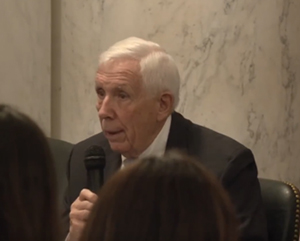
Commissioner Frank Wolf, a former U.S. representative who was instrumental in passage of the International Religious Freedom Act, addressed those attending an event marking the act’s 25th anniversary. Wolf applauded faith communities’ support of the U.S. Commission on International Religious Freedom, and he urged renewed multifaith vitality in the effort.
Frederick A. Davie, vice chair of the commission and senior strategic adviser to the president at Union Theological Seminary, reiterated the commission’s Oct. 11 call for an international prayer service in response to the Israel-Hamas war. Death tolls vary, but thousands have been killed and injured. The United States has confirmed the deaths of at least 33 Americans.
Davie offered the commission’s help in organizing and participating in such a prayer service that would acknowledge “the brutality and the horror and the depravity that is taking place in the region, calling for compassion for human life and innocent lives in the region, and calling for a just and peaceful resolution to the horrors that now exist there.”
‘We cannot be complacent’
No other country has a similar bipartisan and multifaith commission, Chair Abraham Cooper said. Through the commission and the International Religious Freedom Act, religious issues are integrated into U.S. foreign relations more than ever before, he said. Violations are documented and exposed, violators often sanctioned, some prisoners released and repressive governments improving laws and policies.
“Importantly the United States no longer stands alone in recognizing the significance of international freedom of religion or belief … for everyone everywhere,” Cooper said.
He characterized the commission as among the first to decry China’s persecution of Uyghurs as genocide, Russia’s antisemitism and Holocaust distortion, Russia’s invasion of Ukraine, and Hamas’ attack on Israel.
In the five years since the commission marked the International Religious Freedom Act’s 20th anniversary, Davie said, the group has seen robust use of new tools to promote and achieve international religious liberty through the Frank R. Wolf International Religious Freedom Act and the Global Magnitsky Act. But he said much work is needed.
“We cannot be complacent,” Davie said. “State and nonstate actors around the globe continue to perpetrate or tolerate severe religious persecution. In too many countries, individuals and communities are still targeted for their religious beliefs, activity or identity, or for their religious freedom advocacy.”
The U.S. Commission on International Religious Freedom monitors and documents religious freedom violations internationally, advocates for religious liberty, compiles frequent reports on religious freedom in numerous countries, compiles annual reports and designates certain countries as Countries of Particular Concern for their religious freedom violations.
Moving forward, the commission urged Congress to use the CPC designation more effectively and to apply more meaningful consequences against violators.
The U.S. Commission on International Religious Freedom urged more congressional oversight hearings on international religious freedom policy; urged Congress to be more vocal in referencing religious freedom issues in various settings including hearings, floor speeches and congressional delegations abroad; urged Congress to advocate for prisoners of conscience; to permanently reauthorize the commission through bipartisan support and increase its budget to support the body’s original intent.






We seek to connect God’s story and God’s people around the world. To learn more about God’s story, click here.
Send comments and feedback to Eric Black, our editor. For comments to be published, please specify “letter to the editor.” Maximum length for publication is 300 words.