



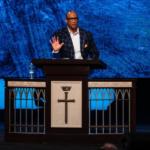
Pablo Juarez, pastor of First Baptist Church Kaufman en Español, reflected on immigration as a pastoral and congregational reality, and the fear, instability, and disruption many immigrant families face within congregations during an interview in Georgia.
The interview was part of the 2026 Joint Annual Conference of the National Association of Baptist Professors of Religion, the Association of Ministry Guidance Professionals, and the Baptist History and Heritage Society held at Smoke Rise Baptist Church in Tucker, Ga.
“Leaving our home country is one of the most painful decisions that we have to make,” Juarez said. “We don’t come here for fun. Most people are running for their lives and their children.”
Juarez recounted growing up in poverty in Nicaragua, being recruited into the Sandinista guerrillas as a teenager, studying in Cuba, and later fighting during the Iran-Contra-era conflict.
After narrowly escaping death amid renewed violence, he and his wife decided to flee Nicaragua to protect their young children.
Though initially skeptical of the United States because of what he had been taught about it, Juarez eventually immigrated to the U.S. undocumented with his family after being detained in Texas and denied asylum.
He described the move as painful and difficult, recalling the challenges of adapting to life in Alabama and North Carolina without knowing English or understanding American systems.
Juarez said a church community ultimately helped him feel accepted, valued, and seen—an experience he said changed his life.
Pastor to immigrants
Juarez shared the effects of detention, deportation, and family separation he has encountered as a pastor.
Sign up for our weekly edition and get all our headlines in your inbox on Thursdays
“Pastor, can you come, please? My husband has been taken by ICE,” Juarez recalled one church member telling him. “We don’t know where he has been taken,” she said. “In 24 hours, he was in Mexico.”
“Every time this happens, we get together. The first thing that we do is pray,” Juarez said. “We have no power at all. There is nothing we can do, humanly speaking. And sadly, we know that there is nobody speaking for us.”
“There were some members of my church who were citizens and were angry about immigrants coming illegally. It was strange to have that happen,” Juarez said.
Juarez emphasized the humanity of immigrants, declaring they are not statistics or numbers, but human beings running for their lives and begging for people to care for them.
He said churches can respond to these realities by strengthening fellowship, compassion, and practical care within congregations and surrounding communities.
Juarez said the pain and uncertainty immigrant families experience have created deeper unity within his congregation.
“The church [FBC Kaufman en Español] started getting more togetherness, and the fellowship, and the compassion toward each other,” he said. “That solidarity, and the love, and the compassion for each other, that’s something that has been an awakening in my church.”
Juarez said members of the congregation have responded to families facing detention or deportation by offering prayer, financial assistance, emotional support, and ongoing care.
“When a family is suffering right now, we have a group of people that immediately start looking for, ‘How can we help this family?’” Juarez said.
Juarez recounted the story of a woman in immigration detention who lost vision in one eye after being denied proper medical treatment while being transferred among detention centers for several months.
“Our church got united with the family, supporting the family,” he said. “Not just praying for them, but financially.”
Juarez urged churches and ministry leaders to prioritize dignity, compassion, and care for the vulnerable.
“Every person bears the inherent image of God,” Juarez said. “And when we see God in people, we don’t have another option but to love, to care, and to protect.”









We seek to connect God’s story and God’s people around the world. To learn more about God’s story, click here.
Send comments and feedback to Eric Black, our editor. For comments to be published, please specify “letter to the editor.” Maximum length for publication is 300 words.