





President Jimmy Carter had Texas on his mind June 25, 1978, when he stepped to the lectern to lead Sunday school at the First Baptist Church of Washington, D.C.
Less than 15 hours earlier, Carter had returned to the White House from a two-day, whirlwind tour of Texas that mixed presidential activities with political.
The official White House Daily Diary documents a jammed schedule starting at 1 p.m. Friday, June 23: a luncheon speech to 5,000 people in Fort Worth; an address to NASA and Air Force personnel in Houston; a pause to greet a centenarian; a short meeting with Hispanic leaders, followed by remarks to 1,200 people at a fundraising dinner. That was just Friday.
Before Carter left Texas Saturday, June 24, he met with Black business and political leaders in Houston; dedicated a post office in Beaumont; and reviewed combat vehicles, weaponry and the troops at Fort Hood (now Fort Cavazos) in Central Texas. He got back to the White House about 7:30 p.m. and had dinner with First Lady Rosalynn Carter.
At 10 a.m. June 25, Carter did what he did on at least 17 Sundays during his presidency. He traveled four minutes by motorcade a mile north to First Baptist Church where he set aside the demands of his day job to teach a Bible lesson. The lesson, drawn from the Genesis, was one of 14 recorded at First Baptist Church of Washington, D.C., and recently transcribed for the first time.
Nobody has to be defined by their worst decisions
On that Sunday 46 years ago this month, Carter used the story of Joseph and his brothers to teach a lesson of humanity and redemption, emphasizing that no one has to be defined by bad decisions, whether those are boasting, selling your brother into slavery or prolonging a war.
Supplementing the biblical text, Carter brought up the legacy of a predecessor, President Lyndon Johnson of Texas.
“Since I’ve been in the White House, I’ve read a lot of biographies, long and short, about my predecessors there,” Carter said. “I could go back down the list of presidents, some of whom are condemned ferociously, some of whom [are] looked on as heroes. …
“Some of them are condemned in retrospect because of one incident in their lives as president, over which they had not too much control.”
Sign up for our weekly edition and get all our headlines in your inbox on Thursdays
Having just returned from Texas, Carter said President Johnson came to mind.
“I don’t think there was ever a president who worked harder or who had a greater, more generous heart, or who cared more and did more for people who were persecuted and deprived and who felt the stigma and the punishment of racial hatred and prejudice and discrimination,” Carter said.
“But when you think about Lyndon Johnson now, you don’t think about freedom. You don’t think about an end to discrimination. [You] don’t think about voting rights acts nearly so much as you think about the Vietnam War. But Johnson was always trying to do things to make a better community, better cities, better highways, better life for people.
“And still, he’s not one of those presidents, at least yet, who’s recognized as big-hearted, great-hearted, concerned about others.”
Carter and Johnson never met, according to a news release issued by the LBJ Foundation in January 2016, when members of the Johnson family traveled to Atlanta to present Carter with the LBJ Liberty & Justice for All Award “in recognition of his leadership in public service and his tireless efforts toward peace and human rights.”
Carter is quoted as returning the compliment: “It is a great personal honor to be given the Liberty & Justice for All Award in the name of Lyndon Johnson, a man who helped shape my life and for whom I have the greatest admiration and appreciation.”
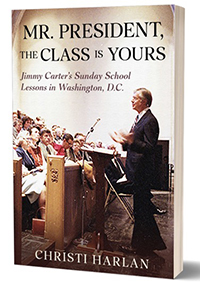
Christi Harlan is a former reporter for The Dallas Morning News and former Washington correspondent for the Austin American-Statesman. She is a trustee of the First Baptist Church of Washington, D.C., where she has been a member more than 30 years. Her new book, Mr. President, The Class Is Yours contains the first-ever transcripts of 14 Sunday School lessons taught by President Jimmy Carter at First Baptist Church in Washington, D.C. The paperback and ebook are available from Amazon and other booksellers.







We seek to connect God’s story and God’s people around the world. To learn more about God’s story, click here.
Send comments and feedback to Eric Black, our editor. For comments to be published, please specify “letter to the editor.” Maximum length for publication is 300 words.