Christian groups quietly advance racial healing
WASHINGTON (RNS)—Three years after the death of George Floyd in Minneapolis brought crowds into the streets for a summer of protests, Christian groups quietly are launching initiatives that address the still-fraught racial divisions among their members and in the wider society.
In New Orleans, leaders of the Southern Baptist Convention—which has been roiled by unrest over critical race theory and other racial issues in recent years—is holding a forum on racial reconciliation.
Meanwhile, representatives of mainline and historic Black Protestant denominations held a three-day meeting in Philadelphia to discuss plans for “eradicating racism.”
SBC needs ‘honest conversations’
“We need to have honest conversations with people who don’t look like us to find out why we have these differences,” said Fred Luter, a former president of the Southern Baptist Convention and the first African American to lead the group.
“We need to talk about it, we need to discuss it and we should be able to discuss it in a Christian-like manner and hopefully come up with simple steps of what we can do to bring about unity among the races in the SBC.”
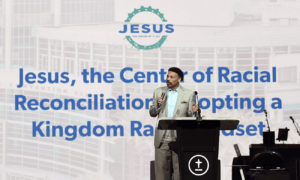
As messengers to the SBC annual meeting gather, Luter said he expects about 300 people at the racial reconciliation event organized by the Unify Project, a campaign Luter founded with another former SBC president, Ed Litton, with the advice of Dallas megachurch pastor Tony Evans.
The Unify Project aims to bring pastors and churches together for meals and to help them speak out and jointly provide community service.
In 2018, in Memphis, Tenn., the SBC’s Ethics and Religious Liberty Commission, then headed by Russell Moore, co-sponsored an event on racism marking the 50th anniversary of the assassination of Martin Luther King Jr. But since then, race has again become a sore point for the SBC.
Luter said he hopes the New Orleans gathering, co-hosted by the ERLC, will turn the SBC to a new direction.
“All we can do is hope,” he said. “That’s my hope, personally.”
Uniting to combat racism
In Philadelphia, the 10 denominations that comprise the 21-year-old Churches Uniting in Christ convened to address how its member groups can work on “a shared mission to combat racism.” It is one part of an eight-point agenda that also includes commitments to promoting unity, celebrating Communion together and continuing theological dialogue.
“Our hope is to set some goals for the next three years that will focus on how we can continue to work on racial equity together and how we can continue to dialogue with each other,” Jean Hawxhurst, a United Methodist ecumenist and vice president of CUIC, said prior to the Philadelphia gathering.
Bishop Jeffrey Leath of the African Methodist Episcopal Church, a member of the CUIC Coordinating Council, said participants wanted to discuss how their work fits with that of other ecumenical groups working on race issues and how their representatives can address a range of forms of biases.
“Black and brown communities should be committed to working on issues of anti-bias as we work along with our white brothers and sisters on anti-racism,” said Leath, who also is the ecumenical officer of the AME Church.
“The African American and various Black and brown communities are plagued with classism, colorism and xenophobia in ways that are just as egregious as racism.”
The meeting also included a prayer walk past some of the city’s historical sites related to slavery.
The inaugural National Unity Weekend, June 10-11, grew out of an event at the National Museum of African American History and Culture last September, when white, Black and Asian American evangelical leaders toured the museum together to raise awareness of systemic racism. The tour was organized by Let’s Talk, founded in 2021 by Bishop Derek Grier, pastor of a nondenominational church in Dumfries, Va.
For the past two years, Let’s Talk has sponsored first monthly and now quarterly Zoom calls for dozens of Asian, African American, Hispanic and white evangelical leaders.
“We began to talk heart to heart. We wanted to listen, as well as be heard,” Grier said. “And as important as conversation was, we recognized nothing changes without action.”
Over the weekend, more than 130 churches and ministries committed to help their communities perform local volunteer service, with some distributing food boxes.
On Sunday, the clergy of many of those same congregations delivered sermons about racial healing based on the same verse from the New Testament’s Letter to the Galatians: “There is neither Jew nor Gentile, neither slave nor free, nor is there male and female, for you are all one in Christ Jesus.”
“It’s vital that we not only preach it and teach it, but we also demonstrate it,” Grier said of the combination of community and worship services focused on racial unity that he hopes will become annual activities.
“Folks will no longer just be informed by CNN or MSNBC or Fox News. They would have heard from their pastor what the Scripture says, what Jesus teaches about these very, very important issues.”