GuideStone, ERLC applaud House passage of Clergy Act

DALLAS—GuideStone Financial Resources and the Ethics & Religious Liberty Commission, Monday, April 27, welcomed passage of the Clergy Act by the U.S. House of Representatives.

The Clergy Act is a bipartisan measure that would provide a temporary, voluntary opportunity for ministers who previously opted out of Social Security to opt back in.

After the House passed the Clergy Act 350-5, the legislation now moves to the U.S. Senate for consideration.

“This is encouraging news for ministers and their families who have long lived with the unintended consequences of a position taken early in their calling, often without fully recognizing the costs,” Hance Dilbeck, president of GuideStone, said. 

“The Clergy Act offers a carefully structured, limited pathway for ministers to reassess that decision and prayerfully determine what is best for their personal and family circumstances.”

The Clergy Act would create a two-year window beginning in 2029 that would allow eligible ministers who have opted out of Social Security to revoke their exemption and begin contributing. Ministers must still meet the standard 10-year contribution requirement to earn full retired-worker benefits, receiving benefits proportional to their contributions. 

The bill would require both the Internal Revenue Service and Social Security Administration to submit a plan to Congress outlining their strategy to inform ministers of their eligibility to re-enroll.

ERLC and GuideStone follow developments

Both the ERLC and GuideStone have closely followed the development of the Clergy Act and have consistently supported the legislation as a thoughtful, minister‑focused solution that respects individual choice while strengthening long‑term financial security options for those who serve. 

GuideStone has worked alongside a coalition of large and historic church benefits boards representing more than one million ministers nationwide to support the legislation.

A similar opt-in period was last offered more than 25 years ago.

Dilbeck and ERLC Interim President Gary Hollingsworth recognized the leadership behind the bill’s advancement.

“We are grateful for Rep. Vince Fong (Calif.‑20) and his perseverance in advancing this legislation,” Dilbeck said. “His efforts reflect a clear understanding of both the unique vocational realities of ministers and the importance of providing timely, responsible options for those affected.”

Ministry brings financial challenges 

Hollingsworth described ministry as an “immense privilege,” while also acknowledging the financial challenges it can bring.

“The Clergy Act is a real opportunity to ensure pastors can prepare well as they approach retirement,” Hollingsworth said. “The ERLC is thrilled the Clergy Act has passed the House and is grateful to Rep. Vince Fong for his work to remedy this issue. We now encourage the Senate to swiftly pass this bill and send it to the White House.”

Dilbeck echoed those sentiments.

“We are praying for a good outcome as the Clergy Act continues through the legislative process,” Dilbeck said. “Our hope is that this measure will soon become law and provide clarity and flexibility for ministers seeking to make well‑informed decisions about their financial futures.”

If enacted, GuideStone will launch a robust communication and education effort to help ministers understand how the legislation works, what opting back into Social Security may mean for them, and how to evaluate the decision in light of their broader retirement, disability, and survivor‑care strategies.

Ministers and church leaders can learn more about the Clergy Act and access updated information at GuideStone.org/clergyact.


Evangelical leaders to be featured during Rededicate 250 event

WASHINGTON—A slate of political, military, and religious leaders is scheduled to participate in a major faith-themed event on the National Mall next month, where members of President Donald Trump’s Cabinet, musical guests, and a list of mostly conservative Christian speakers plan to lead participants in “solemnly rededicating our country as one nation under God.”

The event, titled “Rededicate 250: A National Jubilee Of Prayer, Praise & Thanksgiving,” is part of a series of events and initiatives designed to celebrate the 250th anniversary of the signing of the Declaration of Independence. 

Organized by the group Freedom 250 as part of a public-private partnership with the White House and other government bodies, the gathering roughly coincides with the anniversary of an order sent by then-General George Washington in 1776 seconding the Continental Congress’ call for a day of “fasting, humiliation, and prayer.”

Lineup of speakers 

The speaker lineup for the Rededicate event, which is scheduled for May 17 and expected to last all day, appears to reflect the core of Trump’s base of conservative religious support. Speakers are almost entirely Christian and mostly evangelical, with some notable conservative Catholics.

According to a list provided to Religion News Service, among the major political figures on the lineup are Secretary of State Marco Rubio, a Catholic, who will speak via video; Defense Secretary Pete Hegseth, who worships in churches associated with the Communion of Reformed Evangelical Churches; and House Speaker Mike Johnson, a Southern Baptist. 

Former U.S. Secretary of Housing and Urban Development Ben Carson, a Seventh-day Adventist, will also speak, as will Monica Crowley, the chief of protocol of the U.S., and retired Maj. Gen. Patrick Brady.

Evangelical pastors to speak

An array of evangelical pastors is also on the docket to speak. Some have served as evangelical advisers to Trump, such as Pastor Jack Graham of Prestonwood Baptist Church in Plano; Jentezen Franklin of Free Chapel in Georgia; and Samuel Rodriguez, president of the National Hispanic Christian Leadership Conference.

Other evangelical pastors include Jonathan Falwell, who leads Thomas Road Baptist Church in Virginia and serves as chancellor of Liberty University; Jonathan Pokluda of Harris Creek Baptist Church in Waco; Lorenzo Sewell, who leads 180 Church in Detroit and prayed at Trump’s second inauguration; Gary Hamrick of Cornerstone Chapel in Virginia; and Andy Frank, whom organizers describe as a “national ministry voice.”

Franklin Graham, president and CEO of the Billy Graham Evangelistic Association and Samaritan’s Purse, will also speak via a video message. His daughter, Cissie Graham Lynch, who works at both BGEA and Samaritan’s Purse, will address the crowd.

Conservative commentator Eric Metaxas, an evangelical and staunch Trump ally, is also on the list of people offering remarks, as is Christian Broadcasting Network correspondent Abigail Robertson.

Two Catholic bishops are participating: Bishop Robert Barron, who leads the Diocese of Winona-Rochester, Minn.; and Cardinal Timothy Dolan, who recently retired from his position as bishop of the Archdiocese of New York. Both prelates sit on Trump’s Religious Liberty Commission, but Barron will speak in person, while Dolan is submitting a video message.

Non-Christian faiths mostly absent

The only non-Christian religious leader listed is Rabbi Meir Soloveichik, who leads Congregation Shearith Israel in New York City and serves on Trump’s Religious Liberty Commission.

Notably absent from the lineup are representatives from other non-Christian faiths, such as Islam or Indigenous spiritual traditions, or leaders from mainline Christian or historically Black denominations.

Various musical acts, such as the United States Marine Band and choirs from evangelical Christian schools such as Liberty University and Hillsdale College, will also perform.

At least two people who were initially rumored to be associated with the event—activist and musician Sean Feucht and Pastor Mark Driscoll—are not on the program.

The event has been celebrated by many of Trump’s religious supporters. When he first announced the gathering earlier this year at the National Prayer Breakfast, the crowd erupted into a standing ovation.

“We’re inviting Americans from all across the country to come together on our National Mall to pray, to give thanks,” Trump said. “We are going to do something that everyone said, like, ‘That’s tough.’ We’re going to rededicate America as one nation under God.”

The narrow scope of faith traditions on the program is unlikely to quiet religious critics who have accused the Trump administration and its allies of pushing a vision of the U.S. that centers a conservative form of Christianity.

Some have also accused the administration of forwarding a version of U.S. history they say overlays modern forms of conservative Christianity onto the U.S. founding, sometimes by relying on erroneous historical claims. 

The webpage for the National Mall event features an image of George Washington praying in the snow, a reference to a story historians—including the head of the George Washington Presidential Library at Mount Vernon—have widely dismissed as a fabrication.


House passes bipartisan bill to protect Haitian migrants

(RNS)—The United States House, in a bipartisan effort, passed a bill April 16 to allow Haitian migrants temporary legal protections to live in the U.S. for three years. The vote came as the government is fighting at the U.S. Supreme Court to end Temporary Protected Status for an estimated 330,000 Haitians currently in the country.

The bill now goes to the Senate, and President Donald Trump said he would veto it if it reached his desk.

Introduced last year by Rep. Laura Gillen, D-N.Y., the bill passed 224-204, with the support of 10 Republican lawmakers. The bill’s text had been stuck in the House Committee on Rules and reached the full House after 218 representatives supported a discharge petition—the first time such a rare move enabled an immigration bill to pass.

Pastor Keny Felix, senior pastor at Bethel Evangelical Baptist Church in Miami, Fla., was one of many Haitian pastors who met with House members in Washington, D.C., over the past month to persuade them to support the bill.

Felix said in a statement the vote “affirms the dignity of our Haitian neighbors, whose homeland continues to be marked by unrestrained gang violence, government instability, and a growing humanitarian crisis where more than a million people have been internally displaced.”

The status, granted to Haitians in 2010 after a deadly earthquake, allows those who fled to live and work legally in the U.S. It has been maintained through the years due to gang violence in Port-au-Prince, the country’s capital.

TPS contested

Former Department of Homeland Security Secretary Kristi Noem, fired by Trump in March, announced early last year she would terminate the status because the island’s safety conditions no longer justified it. Noem’s decision, which would have ended TPS in February 2026, has been challenged in multiple lawsuits, including some filed by Haitian faith organizations.

In February, hours before the status was set to expire, a U.S. district judge blocked Noem’s attempt to terminate TPS, saying the secretary’s order overlooked records showing Haiti was still plagued by a “perfect storm of suffering” that had a “staggering humanitarian toll.”

In her February ruling, Judge Ana Reyes said the secretary’s decision seemed motivated, “at least in part,” by racial animus against a group of immigrants from a non-white country.

The government appealed the decision to the Supreme Court. In March, justices agreed to hear arguments in Trump v. Miot on Haitians’ TPS, and Noem v. Doe, on Syrians’ TPS, during the court’s April session. A ruling is expected in June.

Political targeting of Haitians

The Haitian community has been a target of Trump and Vice President JD Vance since their 2024 presidential campaign, when both pushed false claims that Haitians living in Springfield, Ohio, ate their neighbors’ pets.

On April 3, Trump posted a video of a Haitian man beating a woman to death with a hammer in Fort Myers, Fla., on his Truth Social account. In the post caption, the president described the incident as “the most vicious things you will ever see” and brought Haitians’ TPS into question, pointing at the government’s efforts to win termination of the status at the Supreme Court.

The Springfield controversy put the city’s 15,000 Haitians under the spotlight, but also fueled solidarity efforts among its faith community. In recent months, G92, a local coalition of pro-immigrant churches, has led the efforts to defend Haitians’ TPS.

As they awaited the February ruling, the group staged faux immigration arrest scenarios at local churches to teach best practices to faith leaders in the event of raids at houses of worship. The group also sent a delegation to Washington, D.C., in March in support of the bill.

Organized and broad support

Pastor Felix’s D.C. delegation, which attended a lunch briefing for Haitian clergy at the Cannon House Office Building in late March, included a representative of the Fellowship of Haitian Evangelical Pastors in New England and a Haitian faith leader from Indiana.

The meeting, sponsored by Rep. Ayanna Pressley, D-Mass., was coordinated by Faith in Action, a national network that organizes faith communities advocating for immigrants.

“For years, our Haitian siblings have lived with the constant threat of displacement despite contributing to the fabric of our communities,” said Claudette David, of Faith in Action International, in a statement.

“Today, we honor their organized power and resilience and celebrate one important step toward a more just and humane immigration system, one that recognizes that these TPS holders are image bearers of God.”

The bill co-sponsors include Haitian-American Rep. Sheila Cherfilus-McCormick, D-Fla.; Rep. Michael Lawler, R-N.Y.; and Rep. Thomas Suozzi, D-N.Y. Republican lawmakers who supported the bill include Mike Carey and Mike Turner of Ohio, Rich McCormick of Georgia, and Mario Diaz-Balart of Florida.


Lt. Gov. Patrick calls church-state separation a ‘lie’

The leader of President Donald Trump’s Religious Liberty Commission said at the group’s final meeting that church and state separation is a falsehood, drawing criticism from an advocacy group that supports it.

At a Monday, April 13 hearing at the Museum of the Bible in Washington, D.C., Texas Lt. Gov. Dan Patrick, a Republican and the chair of the commission, asked: “Would it not be a good recommendation that every school, every university, every business, has to have that one sheet on the bulletin board about protecting people’s religious liberty, and that the separation of church and state is the biggest lie that’s been told in America since our founding?”

His question was posed to Helen Alvaré, a law professor at George Mason University’s Antonin Scalia Law School, as Patrick compared the notion of such a bulletin board announcement to the federal notices from the Occupational Safety and Health Administration posted in classrooms and other buildings that aim to promote safety and prevent hazards.

Alvaré, a onetime top staffer for the U.S. Conference of Catholic Bishops representing the bishops’ anti-abortion stance and a witness at the hearing, agreed with Patrick’s suggestion.

“It would be an appropriate time to put up some information about these sorts of rights,” she said.

“You’re responding to the signs of the times where this has been misunderstood, and like any other thing, where people are unclear about their rights, this might be a way to clarify them.”

Rachel Laser, the president and CEO of Americans United for Separation of Church and State, rejected Patrick’s stance.

“Church-state separation ensures we are all free to live as ourselves and believe as we choose, as long as we don’t harm others,” Laser said in a statement issued Monday.

“It allows us all to come together as equals to build a stronger democracy. It is an American original, something we should be proud of, fight for, and cherish.”

Religious Liberty Commission

Trump signed an executive order last May at a National Day of Prayer ceremony in the White House Rose Garden that created the commission, saying it would release a report on the “foundations of religious liberty in America,” “current threats to domestic religious liberty,” and “programs to increase awareness of and celebrate America’s peaceful religious pluralism.”

The commission members have included some of Trump’s evangelical allies, Catholic bishops, a rabbi, and TV host Phil McGraw.

In February, Americans United joined Democracy Forward in filing a lawsuit against the commission, challenging its composition that included one non-Christian and stating its “Christian members do not represent the full diversity of the Christian faith.”

The suit was filed on behalf of interfaith, Muslim, Sikh, and Hindu organizations.

Americans United and Democracy Forward have since sought a preliminary injunction to prevent the publication of a commission report while their case is considered by a federal district court.

Members of the commission include Pastor Paula White-Cain, senior adviser to the White House Faith Office; Ben Carson, former secretary of the Department of Housing and Urban Development under Trump; Catholic Bishop Robert Barron, leader of the Diocese of Winona-Rochester in Minnesota; Cardinal Timothy Dolan, retired archbishop of New York; Rabbi Meir Soloveichik of Congregation Shearith Israel in New York; and Franklin Graham, president of Samaritan’s Purse and the Billy Graham Evangelistic Association.

The commission is set to expire on July 4, the 250th anniversary of the Declaration of Independence, according to the executive order, unless the president extends it.


Southern Baptists rebuke Trump over Christlike portrayal

NASHVILLE—A since-deleted social media post by President Trump appearing to compare himself to Jesus has drawn reactions of condemnation from a range of Southern Baptists.

The president shared the AI image to his Truth Social account at 9:49 p.m., April 12.

In it, he stands over an ill man in a hospital bed, the president placing his right hand on the man’s head in a healing gesture. Trump is also wearing a white garment and a red outer garment reminiscent of those portraying Jesus in paintings and other artwork.

No commentary accompanies the image that remained on his account as late as 10:43 a.m., Eastern, Monday morning.

Trump denies christlike portrayal 

When asked about the post at the White House Monday, Trump said: “I did post it, and I thought it was me as a doctor and had to do with Red Cross … which we support, and only the fake news could come up with that one.”

Andrew Walker, ethics and public theology professor at Southern Baptist Theological Seminary and 2025 chair of the Southern Baptist Convention Resolutions Committee, called it “cheesy and kitsch” as well as “rank blasphemy.”

Florida pastor and SBC presidential candidate Willy Rice referred to the image that “pictured [Trump] as a type of Christ figure.”

“I don’t know where it came or why it was posted,” he continued. “It isn’t hard to condemn this outright. Many Christians appreciate the president’s administration and have supported him in meaningful ways, but this is wrong. God alone deserves our worship and highest praise. All human leaders are his servants who will give an account to him, and they are best advised to walk in circumspect humility.

“I continue to be thankful for many things our President has done and pray for him regularly, but this is wrong and should be removed.”

Faith leaders express disapproval

Former SBC President Bart Barber said he normally makes “every effort to avoid criticism and show respect to our president, from whichever party the president may come.” He cited Matthew 12:37, though, to “implore President Trump not to do things like this” in sharing an image of the president’s Truth Social post.

“Forget the politics. Forget the backlash or affirmations it generated,” Barber wrote. “Someday you will stand before God and will have to defend this. It is a terrifying thing to fall into the hands of the living God.”

Florida pastor Tom Ascol noted he prays for President Trump every Sunday asking that “God will reveal Christ saintly to him, give him wisdom, and confound wicked counsel that comes to him, like whatever [whoever] led him to believe posting this was a good idea. Lord, have mercy on him!”

Sunday’s post came a week after a profanity-laced one on Easter, directed at Iran and threatening destruction on the country, and 46 minutes after a long missive against Pope Leo for being weak on crime, restrictions during COVID, and a lack of support for efforts to keep a nuclear device out of Iran’s hands.

Walker noted the timing and messaging of the president’s posts within the Christian calendar.

“Seeing the president break commands 1-3 of the Decalogue during Eastertide is one way to wake up on a Monday,” he wrote.


Removal of Army chaplain raises questions

The historically Black denomination that endorsed U.S. Army Maj. Gen. William Green Jr., who until last week served as the Army’s chief of chaplains, said it had “deep disappointment and serious concern” about his removal by Defense Secretary Pete Hegseth.

Green, who had served in the top military chaplaincy role since 2023, was the third Black Army chief of chaplains. He was dismissed on April 2, during Holy Week and amid the U.S.-Israeli war with Iran.

Leaders react with concern

“The removal of Major General William Green Jr. raises serious and troubling questions that deserve transparency and accountability,” said Rev. Boise Kimber, president of the National Baptist Convention U.S.A. Inc., in a Wednesday, April 8, statement. 

“His decades of faithful service, moral leadership, and historic representation within the Army Chaplain Corps should not be overshadowed by actions that create the appearance of bias, ideological targeting, or radical political interference. Our nation must be careful not to allow partisan agendas to undermine institutions built on merit, sacrifice, and service.”

Rev. Dr. Michael Evans Sr., pastor of Bethlehem Baptist Church in Mansfield, Mansfield mayor, former president of the Baptist General Convention of Texas, and former Navy Reserve chaplain, commented on Green’s removal: 

“[General Green] has the reputation of being a statesman, a man of high moral character. He is a decorated veteran, a man held in high esteem. His promotions were based on merit, not on any political bias. It is a bad look for him to be removed in the manner in which he was removed,” he said.

“I am very disappointed. … I think you should look at a person’s record and note the level of esteem the individual has before you surreptitiously dismiss them. It is dangerous when you toy with the spiritual well-being of the armed forces.” 

Concerns amid policy and leadership changes

Green’s dismissal occurred at the same time Hegseth asked Gen. Randy George, the Army’s chief of staff, to resign and removed Gen. David Hodne, the leader of the service’s Transformation and Training Command, The Washington Post first reported.

Kimber joined others in calling for President Donald Trump and Hegseth to explain the reasons behind Green’s dismissal.

“When leaders of this caliber are removed without public clarity, it creates concern not only about the individual decision, but about the larger climate of interference affecting trusted national institutions,” Kimber stated. “We must remain vigilant against bias and any radical disruption that threatens fairness, integrity, and the progress we have fought to achieve.”

In December 2025, Hegseth announced he was eliminating the Army spiritual fitness guide he said “alienates our war fighters of faith by pushing secular humanism.” In his video announcement on the social media platform X, Hegseth said: “In well over 100 pages, it mentions God one time. That’s it. It mentions feelings 11 times.”

Green was a leader in the Army’s efforts to promote and foster resiliency and connection to support soldiers and their families.

“A resilient soldier isn’t just physically fit,” Green said at a conference on “Holistic Health and the Resilient Soldier” in March 2025, which he noted was the 250th year of the U.S. military chaplaincy. “A resilient soldier is strong in body, mind, and spirit.”

Religion News Service’s request asking the Army and its chaplaincy officials about Green’s departure and whether it was related to the spiritual fitness guide did not receive an immediate response.

Green, a native of Savannah, Ga., first joined the Army as a high school graduate and returned to the service after pursuing ordained ministry.

Endorsed by the National Baptist Convention USA Inc. in 1994, he later supported Operation Iraqi Freedom, was a branch chief at the U.S. Army Chaplain Center and School in Fort Jackson, S.C., and was deputy chief of chaplains at the Pentagon before being appointed as the Army’s chief of chaplains.

Additional reporting by Faith Pratt of Baptist Standard.


Supreme Court sides with Christian counselor

The Supreme Court ruled 8-1 against a law banning “conversion therapy” for LGBTQ+ children in Colorado.

The high court majority ruled in favor of a Christian counselor who argued the law banning talk therapy violates her First Amendment rights.

Kaley Chiles, a Christian therapist, said the Colorado law violated her right to free speech to counsel youth who have same-sex attractions and gender identity conflicts.

More than 20 other states, according to Religion News Service, have their own versions of a conversion-therapy ban.

Supreme Court opinions

Justice Neil Gorsuch said the law “censors speech based on viewpoint,” and the First Amendment, he wrote, “stands as a shield against any effort to enforce orthodoxy in thought or speech in this country.”

Liberal justices Elena Kagan and Sonia Sotomayor jointly supported Gorsuch’s opinion.

“Once again, because the state has suppressed one side of a debate, while aiding the other, the constitutional issue is straightforward,” Kagan wrote. “If the First Amendment prohibits anything,” she later added, “it is the ‘official suppression of ideas.’”

Justice Ketanji Brown Jackson issued the lone dissent, arguing the case is a matter of health, not free speech.

“Many states have now chosen to exercise their police powers to ban ‘conversion therapy’ based on the medical profession’s broad consensus that this medical treatment … is ineffective and harmful,” she said.

Reactions to the ruling

Interim Ethics & Religious Liberty Commission President Gary Hollingsworth called the ruling “a moment worth celebrating,” Baptist Press reported.

“Eight justices decisively rejected Colorado’s blatantly unconstitutional attempt to silence counselors from freely discussing issues of gender and sexuality with patients,” Hollingsworth said in a statement to Baptist Press.

“This is not only the correct constitutional outcome—it reinforces a conviction Southern Baptists have held for decades, that the state cannot coerce individuals to deny biblical truth or compel them to violate their religious beliefs just because it disfavors their viewpoint.”

Timothy Schraeder Rodriguez, a conversion therapy survivor, said in an interview with Religion News Service that conversion therapy continues in some form since the closing of the “ex-gay” organization Exodus International in 2013.

“A lot of people would assume it looks like military-style boot camps, electroshock therapy, or things like that. Most of the time, it’s happening in the church basement around the corner from your house,” Schraeder Rodriguez told RNS.

Chiles, according to the Associated Press, contends her approach is different from conversion practices performed decades ago.

AP reported Colorado disagreed with the ruling, saying its law allows “wide-ranging conversations about gender identity and sexual orientation and exempts religious ministries.” Colorado says the law prohibits therapy that attempts “to ‘convert’ LGBTQ+ people to heterosexuality or traditional gender expectations,” according to AP.

Hollingsworth highlighted the Southern Baptist commitment to God’s creation and design.

“We reject efforts that seek to redefine or alter a person’s God‑given identity,” Hollingsworth said.

“Today’s ruling strengthens the freedom of counselors to speak from their convictions and protects the ability of Christians to minister with integrity and faithfulness.”


Chaplain responds to changes in chaplaincy corps

Defense Secretary Pete Hegseth announced major changes to the U.S. military chaplaincy corps March 24–25. The changes include the consolidation of chaplaincy faith codes and the replacement of rank insignia on uniforms with religious insignia. 

In a video announcing the changes, Hegseth said: “A chaplain is first and foremost a chaplain and an officer second. This change is a visual representation of that fact.” 

Todd Combee, the director of Chaplaincy Relations for Texas Baptists, explained how military chaplains are responding to these changes: 

“The Secretary of War’s latest video about removing rank from the uniform has generated significant conversation among our chaplains. Most are taking a ‘wait-and-see’ approach because of the regulations pertaining to the wear and appearance of uniforms.”

“Until the regulations are updated to reflect these changes, individual chaplains should take no action. That is the advice I am giving our chaplains,” Combee said. 

From the chaplaincy’s institution in 1775 until 1914, chaplains served without rank or insignia. In 1914, they were authorized to wear rank, beginning as Army first lieutenants. The ranks were removed again during World War I and reinstated in 1926 per a War Department policy change. 

Concerns about the future

“As a retired Army Chaplain, I am concerned about how this might affect the future of the Chaplain Corps. I was often referred to simply as the Chaplain, ‘Chaps,’ or ‘Chappie,’ and I was very comfortable with those references; however, I also knew that rank had its place,” Combee said.

“I can’t help but wonder how these changes might eventually affect the chaplain’s influence and voice within the command structure. According to regulations, part of the chaplain’s responsibility is to ‘advise the commander on all matters of religion.’ Will the chaplain’s voice be diminished if rank is removed from their uniform?” he continued.

According to Hegseth, removing insignias will better display military chaplains’ principal role as chaplains: “[Removing rank insignia] speaks to the difficult balance of the duality of a military chaplain. … While they will retain rank as an officer, to those they serve, their rank will not be visible.” 

Reduction in affiliation codes

Additionally, Hegseth announced the reduction of religious affiliation codes, formally referred to as the faith and belief coding system, from over 200 codes to 31. 

“The previous system had ballooned to well over 200 faith codes. … It was impractical, and unusable, and many codes were never used at all. An overwhelming majority of the military population used only 6 codes,” Hegseth said. 

Religious affiliation codes are identifiers used by the Department of Defense to document a service member’s faith background. The new system is intended to give chaplains clear information to better minister to service members based on their faith. 

Despite the uncertainty and discussion these changes have generated among military chaplains, their underlying mission remains the same, Combee said. 

“Our military chaplains have the unique opportunity to go where our churches cannot go and share the love and hope of Christ with members of the armed forces. That has not changed.”


Judge rejects Johnson Amendment settlement

A federal judge rejected a settlement that would have lifted an IRS ban on pastors endorsing candidates, saying the court had no authority to approve an agreement, in a surprising end to a decades-long battle. 

Judge J. Campbell Barker of the U.S. District Court for the Eastern District of Texas also dismissed the lawsuit filed by the National Religious Broadcasters, a Christian communicators group, and two Texas churches, Sand Springs Church in Athens, and First Baptist Church in Waskom, that were at the heart of the anticipated settlement. 

The plaintiffs had argued the ban on endorsements violated their religious liberty. Under the IRS rule, known as the Johnson Amendment, tax-exempt nonprofits are barred from taking sides in political campaigns.

Judge’s legal reasoning

In dismissing the case Tuesday, March 31, Barker said courts are barred from “providing declaratory relief with respect to federal taxes,” and therefore the court could not approve the settlement, as it required the court to make a decision that affected the plaintiffs’ tax status. 

“The Johnson Amendment exempts organizations from taxes if they do not participate or intervene in political campaigns. If credited, then, plaintiffs’ claims would restrain the assessment or collection of a tax based on certain activity,” he wrote. 

Barker also wrote that it is “not obvious that the government will ever assess an income tax against plaintiffs or impose any other tax consequence under the Johnson Amendment.”

He also wrote there was a simple solution for churches wanting to avoid penalization for endorsing candidates: “Put differently, if the plaintiffs here gave up their 501(c)(3) tax-exempt status, none of the harms they allege could occur.”

Plaintiffs push back

Michael Farris, general counsel for the National Religious Broadcasters, said the plaintiffs were surprised by the ruling and planned to appeal the decision. He said the judge’s ruling would require the plaintiffs to violate the law to get their case heard.

“We think that is an error,” he said. “I think the judge was trying to do his very best as he understood the law. But I just disagree.”

Americans United for the Separation of Church and State, which had opposed the settlement and sought unsuccessfully to intervene in the case, cheered the decision. 

“Tax-free giving to charities should fund charitable work, not partisan politics,” said Rachel Laser, Americans United president and CEO, in a statement posted to the group’s website. 

“The proposed settlement agreement to exempt only houses of worship and not secular nonprofits would have been unfair and a violation of church-state separation. It also would have been unhealthy for our democracy because it would allow churches to become unaccountable political action committees.”

Background on legal battle

The IRS rule has banned nonprofits, including houses of worship, from endorsing political candidates and taking sides in campaigns. In 2024, National Religious Broadcasters and the pair of Texas churches filed their lawsuit seeking to overturn the amendment named after President Lyndon B. Johnson, who pushed for the ban when he was a U.S. senator from Texas.

News of a proposed settlement was first made public in the summer of 2025, when it was filed in the U.S. District Court for the Eastern District of Texas. But approving the settlement was delayed, in part because Americans United for the Separation of Church and State tried to intervene in the case to defend the ban.

The decision by Barker is a setback in a decades-long battle by conservative religious legal groups against the Johnson Amendment, which they say restricts the religious freedom of pastors. For years, pastors had mailed sermons with endorsements to the IRS, hoping to prompt a legal battle without success. President Donald Trump long promised to get rid of the Johnson Amendment and signed an executive order limiting its use during his first administration.

While some churches, including First Baptist Church in Dallas, led by Trump supporter Robert Jeffress, have been investigated for violating the Johnson Amendment in the past, only one church has ever lost its tax exemption for endorsing candidates. 

That church, the Church at Pierce Creek in Vestal, N.Y., took out an ad opposing Bill Clinton in 1992, leading the IRS to revoke the church’s tax-exempt status.

Fear of broader church impact

The NRB lawsuit was prompted in part by the rise of nonprofit newspapers. The plaintiffs argued some nonprofit newspapers and magazines endorsed candidates and took sides in campaigns without IRS sanction and argued churches were being treated unfairly.

During a session about the lawsuit at the NRB convention in February, the Rev. Ivy Shelton, pastor of First Baptist Waskom, said his church joined the lawsuit so pastors would not have to fear their congregation would be hurt by the government for what they preach.

“They need to be free and know that it doesn’t matter if the government’s looking over your shoulder,” he said. “You need to preach with boldness, whether your congregation likes it or not.” 

Allen Jackson, pastor of World Outreach Church in Murfreesboro, Tenn., said no topic, including politics, is off-limits for pastors. The Bible, he said, is filled with examples of preachers taking on politicians, from the Hebrew prophets to John the Baptist, who was beheaded for criticizing King Herod.

“John the Baptist could have lived to be a very old man if he’d had no comments about current events,” Jackson said. 


Meta to pay $375 million for endangering children

SANTA FE, New Mexico—Meta knowingly misled consumers about the safety of its online platforms and therefore endangered children, a jury decision rendered March 24. The parent company of Facebook and Instagram will pay $375 million in civil penalties, the maximum amount of $5,000 per violation.

“The jury’s verdict is a historic victory for every child and family who has paid the price for Meta’s choice to put profits over kids’ safety,” New Mexico Attorney General Raúl Torrez said.

“Meta executives knew their products harmed children, disregarded warnings from their own employees, and lied to the public about what they knew. Today the jury joined families, educators, and child safety experts in saying enough is enough.”

The decision comes as a similar lawsuit in Los Angeles covering thousands of cases of social media addiction is in the jury deliberation stage.

The March 24 verdict came after only seven hours of deliberation following a two-year investigation by the New Mexico Department of Justice. Internal documents retrieved during that investigation contained warnings from Meta employees and child safety experts over dangers present to children on the company’s platforms.

In the complaint, Torrez called Facebook and Instagram “breeding ground[s] for predators who target children for human trafficking, the distribution of sexual images, grooming, and solicitation.”

A spokesperson for Meta said the company will appeal the decision.

Evidence of intent

During the trial, evidence demonstrated Meta’s platforms are intentionally designed to addict young people and expose them to dangerous content, such as eating disorders and self-harm. The evidence included Meta internal documents and testimony from former Meta employees, law enforcement officials, and New Mexico educators.

Miles Mullin, executive vice president and chief of staff for the Ethics & Religious Liberty Commission, called the decision “significant,” and not just because of the amount awarded.

“In this trial, a jury made up of everyday Americans said that no matter what other factors are at play, children must be protected from harmful and exploitative sexual material,” he noted.

“This is a win for safeguarding our children’s innocence, aligning with the Bible’s commands to protect the most vulnerable among us. As several similar cases make their way through several state courts, we should hope and pray for similar results.”

More lawsuits against Meta

The New Mexico decision comes nearly one month after a Delaware Superior Court ruled that Meta’s insurers would not be responsible for paying out losses in such lawsuits for the tech company.

“New Mexico is proud to be the first state to hold Meta accountable in court for misleading parents, enabling child exploitation, and harming kids,” Torrez said. “In the next phase of this legal proceeding, we will seek additional financial penalties and court-mandated changes to Meta’s platforms that offer stronger protections for children.

“The substantial damages the jury ordered Meta to pay should send a clear message to big tech executives that no company is beyond the reach of the law. Policymakers and law enforcement officials across the country can help make this verdict a turning point in the fight for children’s safety. This is a watershed moment for every parent concerned about what could happen to their kids when they go online—and this victory belongs to them.”


Over 100 Latino Christians reprove Trump adviser’s reach

More than 100 Latino Christian leaders signed a statement saying the Rev. Samuel Rodriguez, an evangelical adviser to President Donald Trump and a go-to voice for Hispanic evangelical perspectives, and news media have exaggerated the size of Rodriguez’s reach as president of the National Hispanic Christian Leadership Conference. 

In the statement released Tuesday, March 10, the signers said they were prompted to speak out because of the damage the Trump administration’s immigration policies have done to Latino communities.

Rodriguez and the Rev. Tony Suarez, vice president of the NHCLC, are among a handful of Hispanic evangelical pastors advising the president. 

In recent months, they have lamented that the Trump administration’s immigration enforcement has not focused on deporting criminals, and they have continued to advocate for immigration reform through the Dignity Act, a bipartisan immigration bill.

Several signers of the letter, titled “We are not a monolith, we are a multitude,” said while Rodriguez represents some Latino evangelicals, he should not be the sole public representative.

“It’s not just a misrepresentation but how that misrepresentation is impacting the communities we serve,” said the Rev. Gabriel Salguero, president of the National Latino Evangelical Coalition and a letter signer. “Our people are hurting, and our people are not going to stand for apologists for this kind of immigration action.”

Jesse Rincones signed the letter as an individual, not in his role as executive director of the Hispanic Baptist Convention of Texas and pastor of Alliance Baptist Church and One Accord Church in Lubbock. 

He stated concerns that “some Latino voices, especially those on the president’s Faith Advisory Council, have not publicly pressed the president to follow through on what they say were commitments regarding detention practices affecting our communities.”

Op-ed increased tension

Building on years of simmering frustration with Rodriguez among some Latino evangelicals, letter signers interviewed by Religion News Service said the catalyst for the letter was an op-ed by Rodriguez published in Christianity Today late last month. 

In it, he wrote the Latino church “is hemorrhaging” due to immigration enforcement. A week later, Rodriguez posted photos of himself and other pastors praying over Trump.

“Reverend Rodriguez hasn’t had a change of heart,” said the Rev. Carlos Malavé, president of the Latino Christian National Network, of his interpretation of the op-ed. “I believe that the reason he is doing that is because he’s starting to feel a strong pushback.”

Rodriguez’s biography at the bottom of the piece claims that, through the NHCLC, he “represents millions of Christians worldwide.” 

Republican Rep. María Elvira Salazar’s office cited the NHCLC as representing more than 42,000 churches as recently as last fall. However, the Tuesday letter alleges both estimates are inaccurate and implausible given the numbers of Hispanic churches in key denominations. 

“This demonstrates the need for media outlets to verify claims and accurately reflect the diversity and complexity of Latino Christian institutions in the United States,” the letter reads. 

Reached by phone shortly after the letter was released Tuesday afternoon, Rodriguez said his group doesn’t “claim at all” regarding public membership figures and accused the letter writers of “bearing false witness.” 

Though he acknowledged some spokespeople might reference certain numbers, Rodriguez said, “After COVID, there has never been an articulation on our end in order to protect our constituents” from harassment related to policy positions the NHCLC takes.

“We’re not about the number of churches, and we’re not about the number of millions of people. We are about serving our community,” he said.

NHCLC website shows error message

The Internet Archive shows the NHCLC’s website claimed a membership of more than 40,000 churches as late as October 2020, and a press release from last fall said the NHCLC represents “tens of thousands” of Hispanic evangelical churches worldwide.

On Tuesday evening and on Wednesday, the NHCLC’s website showed error messages and was inaccessible. An NHCLC spokesperson did not immediately respond to an RNS question about what caused the website outage.

Asked about letter writers’ claims Christianity Today published an unverified figure, president and CEO Nicole Martin told RNS Rodriguez provided the biography to the publication. She said it had been edited in an identical process used for all opinion writers.

Martin said she checked with Rodriguez about the statement’s accuracy after receiving RNS’ request for comment, and she forwarded two statements from the NHCLC to RNS.

One statement said the biography was accurate. “While it is impossible to know exactly how many Hispanic Evangelicals share our Biblical perspectives, we are confident that we represent the views of most of the 7 to 9 million Hispanic Evangelicals in the United States,” the NHCLC wrote, according to Martin.

Assessing the precise views of Hispanic evangelicals can be difficult, but surveys indicate their political alignment has shifted over time. 

Surveys affirm disagreement over immigration policies

A 2024 polling analysis from PRRI found the share of Hispanic Protestants who identified as Republicans nearly doubled from 2013 to 2024, rising from 17 percent to 31 percent. Meanwhile, the percentage who identify as Democrats declined from 31 percent to 23 percent. 

Even so, Hispanic Protestants have voiced strong disagreement with Trump’s immigration policies. A PRRI survey conducted last August and September found that 64 percent of Hispanic Protestants said they have little or no confidence in Immigration and Customs Enforcement, and 57 percent agreed increases to the agency’s funding have gone too far. 

Similarly, a Pew Research survey conducted around the same time found that 55 percent of adult Latino evangelical Protestants said they strongly or somewhat disagreed with the president’s overall approach to immigration.

The NHCLC sent RNS a statement that read: “The integrity of our representation is thoroughly verified. The number of churches affiliated through our denominational partners, networks, and chapters is formally certified through a rigorous internal process overseen by Mat Staver, Chief Legal Counsel, former Dean of Liberty University School of Law, and President and CEO of Liberty Counsel.” 

A spokesperson did not provide an approximate membership number when asked by RNS on multiple occasions.

The coalition letter criticizing media representation of Rodriguez was signed by Latino leaders across the U.S. and denominational backgrounds, including some from the Assemblies of God, the denomination in which Rodriguez first became a pastor. Other leaders or individual pastors who signed on come from the Reformed Church in America, Evangelical Covenant Church, Church of God of Prophecy, American Baptist Churches USA, Christian Church (Disciples of Christ), the United Methodist Church, nondenominational Pentecostal churches and several seminaries, including Gordon-Conwell Theological Seminary.

Other leaders who signed on come from the Reformed Church in America, Evangelical Covenant Church, Church of God of Prophecy, American Baptist Churches USA, Christian Church (Disciples of Christ), the United Methodist Church, nondenominational Pentecostal churches, and several seminaries, including Gordon-Conwell Theological Seminary.

The group of letter signers also includes some who have longer histories with Rodriguez, like the Rev. Elizabeth Rios, founder of the Passion2Plant Network for church planting. Reviewing her book in 2013, Rodriguez called her “one of the most anointed and gifted leaders in the kingdom today.” 

Rios said she’s asked journalists why they overrepresent his voice, and they say their editors required them to speak with him. “It’s not about him per se,” Rios said. “We’re just tired of people always pivoting to him as the unverified person that’s representing millions of people.”

“We just don’t think that he’s a credible witness,” she added—a feeling that’s been growing over the last decade. “Nobody in the Latino community wanted to call him out because we never want to throw our own under the bus.”

But, she said, “We have to say that journalists are helping to hurt our community by not verifying the sources that they use.”

Rodriguez responds

Rodriguez said he had not read the letter yet on Tuesday afternoon but that criticisms of him were motivated by personal animus and jealousy. “I’ve never claimed to represent the woke evangelical left,” Rodriguez said. “It’s just a family conversation taking place which shouldn’t take place publicly.”

Despite the disagreement, he said he would follow the biblical command to “love and forgive and bless your enemies,” explaining, “If they believe the Nicene Creed, these are my brothers and sisters who I will see in heaven.”

Multiple Latino leaders who signed the letter told RNS they attempted to address their concerns in private with Rodriguez in recent years and that they had asked journalists to broaden their coverage of Hispanic Christians.

Rodriguez also said he supported diverse voices being represented in the media and that meeting with Trump while criticizing his administration’s policies is “a challenge.” 

“I walk into these corridors of office with humility, and I ask God to just give me the right words that will help change hearts and minds—for the political leaders to appreciate this blessed community, the Latino community overall, the Hispanic community, the immigrant community, as a blessing and not a burden,” Rodriguez said.

He said Trump has doubled down on deporting criminals and finding “a solution for the good people,” referring to immigrants. “Even in the past 48, 72 hours, he’s talked about the fact that these people are good people, [and] we need to find a solution,” Rodriguez said of Trump. 

Daniel Montañez, executive director for the Center for Public Theology and Migration and a post-doctoral associate at Boston University, said he’s witnessing “seismic shifts” within U.S. Latinos.

“I hope we’re able to assume our agency and autonomy within larger public narratives about our community,” said Montañez, who signed the letter. “That we’re able to come together in this moment and make a statement like this is something that is very significant.”

RNS National Reporter Jack Jenkins contributed to this report. This story has been updated to remove an incorrect explanation of Pew Research Center data and to clarify that the pastors who signed the letter do not necessarily represent their denominations.

Additional reporting by Faith Pratt of Baptist Standard


Ascent Summit speakers issue call to hope, joy

The second and third days of the Ascent Summit featured keynote speakers declaring the importance of joy and hope in the Lord within ministry and everyday living. Amid a full schedule of plenary sessions, forums, breakout session, and affinity roundtable discussions, Ascent also celebrated and honored ministers.

‘All of God’s people are called’

Ed Stetzer, dean at Biola University’s Talbot School of Theology, gave a four-part missiological framework based on John 20:21—multiplication in the way of Jesus, “declergification” as the people of God, diversification in the vision of Revelation, and mobilization for demonstration and proclamation.

“In the same manner that God has sent Jesus, Jesus has sent us into the world. So, this is the call. This is the mission. This is the moment that we have. In the midst of this unique time of tumult and turbulence, it’s a wonderful time for gospel openness,” Stetzer said.

“Putting down markers that say that all of God’s people are called to the ministry, all of God’s people are sent on mission, makes such a difference. … That’ll shape and frame how you do so many things,” Stetzer said.

The unlikely ones

Charlie Dates, senior pastor of Progressive Baptist Church of Chicago and Salem Baptist Church of Chicago, preaching from Luke 10:25-37, challenged listeners to respond, like the good Samaritan, to the needs of others. Jesus often uses the unlikely ones in our world to make a difference, he said.

“I warn you, that Jesus is a sophisticated storyteller. The delicate nuances of his argument are as sophisticated and exquisite as structural Hebrew narratives will allow. He argues that it may be the most unlikely among us who emerge as the heroes and sheroes that save us,” Dates continued.

“This passage promptly and urgently reminds us it is not the people who did the best in seminary, or the people who win the awards, or even the people who lead our highest and best institutions, that are actually the candidates—that emerge as the most likely to save us—but it’s the unlikely people. It’s the forgotten people. It’s the people who do not earn commendation anywhere else,” Dates said.

Joy cultivated

Mia Chang, founder and lead pastor of NextGen Church in Princeton Junction, N.J., told summit gatherers joy must be cultivated during times of solitude spent with Jesus and being led by the Holy Spirit.

Joy is also found amid adversity, Chang added.

“God is nearer to us at such times, as the psalmist says. He is close to the brokenhearted and saves those who are crushed in spirit. To rejoice always is not an idealistic, optimistic yearning. But it’s a posture, purpose, and pursuit of those whose life is surrendered to Christ Jesus,” Chang continued.

“Our time in the lonely places is to tap into the river of joy below the surface. This is a lonely place that Jesus often visited. Jesus intentionally pulled himself away from the crowd, … but God invites us to be still and simply know that God is God,” she said.

‘We’ over ‘me’

Jorge Acevedo, retired pastor of Grace Church in southwest Florida, emphasized community as part of cultivating joy.

“I’ve discovered in my 48th year of apprenticeship to Jesus that his invitation to formation is almost always in the plural. It’s an invitation to communal spirituality,” Acevedo said.

“Much of what passes for spiritual formation in these days is … a very privatized, individualized experience,” he said.

Raphael Anzenberger, president of France Evangelization, CEO of the Global Evangelists Forum, and general secretary of the French-speaking Baptist Union, said regarding John 4:27-35, the disciples were challenged with Jesus’ break from cultural norms.

After finding Jesus talking to a Samaritan woman, the disciples lost their sense of value, lost their sense of time, and lost their sense of people, Anzenberger said.

When the disciples told Jesus to eat something, Jesus told them his food was “to do the will of him who sent me and to finish his work” (John 4:34). “Which sandwich feeds you—the bread from above, or the sandwich from below?” Anzenberger asked.

Saying there are two stories in John 4—one being Jesus and the Samaritan woman, two being the disciples’ reaction—Anzenberger asked his listeners which story would be theirs.

Scope of Ascent Movement

More than 500 people participated in person or via the livestream in the inaugural Ascent Summit.

Ascent is a collaborative movement to evangelize North America. The Ascent Movement partners with churches, associations and networks of churches, mission agencies, financial ministries, resource and support organizations, seminaries and theological schools, and other ministries from Baptist, Wesleyan, Pentecostal, Anglican, Anabaptist, and other evangelical faith traditions.

Churches and ministries across the 48 contiguous United States, Alaska, Canada, and Cuba partner in Ascent.

Offerings

Two new offerings were introduced during the Ascent Summit. The 2026 Pentecost Offering received April 6 through May 24 will support church planting and pioneering mission in North America. There will also be an Advent offering to support global missions.

Ministry honors

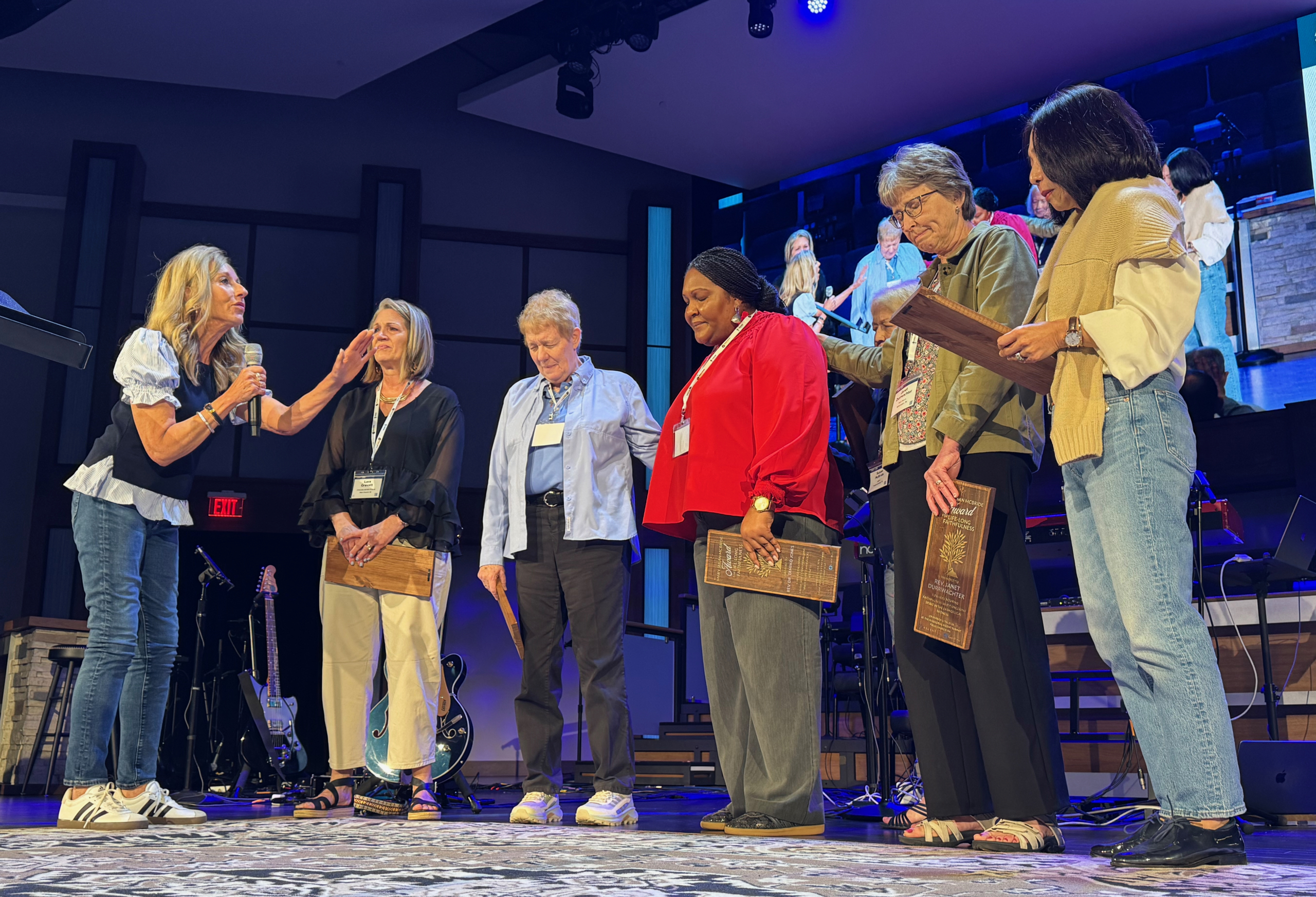
Beth Moore prays over the first recipients of the new Rev. Dr. Mary Susan McBride Scholarship during the inaugural Ascent Summit, March 10-12, 2026, at Columbia Church, Falls Church, Va. (Kendall Lyons photo)

Ascent inaugurated two ministry awards during the Ascent Summit. The Lifetime Fruitfulness Award was given to Rev. Dr. Mary Susan McBride for her four-plus decades of ministry. The Rev. Dr. Mary Susan McBride Scholarship Fund was established in her honor.

Inaugural scholarship recipients are Rev. Dr. Tamiko Jones, Rev. Dr. Patti Duckworth, Rev. Janet Durwachter, Rev. Dr. Mia Chang, and Rev. Lora Gravatt.

Guillermo and Andrea Nuñez received the Perseverance Award for their work in Cuba.

Pastors from three of Ascent’s founding churches, left to right: Robert Turner, St. John Baptist Church, Columbia, Md.; Bruce Webb, The Woodlands First Baptist Church, The Woodlands, Texas; Dennis Wiles, First Baptist Church, Arlington, Texas. (Cindy Wiles photo)

The founding churches of the Ascent Movement were also honored: First Baptist Church in Arlington, Texas; The Woodlands First Baptist Church in The Woodlands, Texas; Saint John Baptist Church in Columbia, Md.; and Columbia Church in Falls Church, Va. Columbia Church hosted the Ascent Summit.

Financial awards

Ascent awarded microgrants to eight recipients and learning stipends to five recipients during the Ascent Summit.

Microgrants of $500 each are awarded “to help churches pilot an idea, launch an initiative, or invest in resources to move toward engagement in Ascent.” Learning stipends of $200 each are awarded “to help individuals participate in training, tools, or leaning experiences through Ascent.

Microgrant recipients are:

  • Haowen Ge, International Student Services Association Inc., Cleveland, Ohio.
  • Ginger Lynch, Living Hope Church, Livingston, Mont.
  • Bobbie Bagley, The Blueprint Ministries, Londonderry, N.H.
  • Deanna Harvey, Columbia Church, Falls Church, Va.
  • Noel Tsoukalas, Sea Change Church, La Jolla, Calif.
  • Kendall Ellis, First Baptist Church, Muncie, Ind.
  • Brian Miller, Florence Carlton Community Church, Florence, Mont.
  • Rachel Jones, First Baptist Church, Plano, Texas.

Learning stipend recipients are:

  • Michael Glazier, First Church Williamsport, Williamsport, Penn.
  • Edmund Lilley, Colonial Beach Baptist Church, Colonial Beach, Va.
  • Anna Machan, Dunwoody Baptist Church, Dunwoody, Ga.
  • Tyler Hartford, Evana Network, Goshen, Ind.
  • Brad McMullen, Timberlake Church, Lynchburg, Va.

In addition, EverBless Foundation—formerly Virginia Baptist Foundation—awarded five scholarships to undergraduate and graduate students. Scholarship recipients are Anna Machan, Peachtree Corners, Ga.; Luke Stehr, Arlington, Texas; Aaron Kilbourn, Sioux Falls, S.D.; Nikisha Diggs, Louisa, Va.; Aaron Miller, Washington, D.C.

CORRECTION: The last paragraph was corrected to clarify scholarships awarded at the Ascent Summit were not limited to students from churches affiliated with BGAV or that are EverBless clients.