Radical Islam presents a physical threat– and a spiritual one, Denison insists
Jim Denison believes radical Islam constitutes the greatest threat the West ever has faced. And while he acknowledges the political and military factors involved, he views the conflict primarily as spiritual.
"Unlike the armies of Nazism or communism, these enemies are fighting a spiritual war. They will not be defeated by killing their leaders or capturing their soldiers and cities. They are convinced that they are fighting and dying for the only true God and that he will reward their sacrifice eternally," Denison writes in his new book, Radical Islam: What You Need to Know.
Denison, president of the Denison Forum on Truth and Culture and theologian-in–residence with the Baptist General Convention of Texas, notes a Gallup survey of Muslims conducted between 2001 and 2007 revealed only 7 percent of the world's Muslims are radicalized.
"When I first read that report several years ago, I was relieved to learn that radical Muslims make up such a small percentage of the larger Muslim world," he writes. "Then I did the math. Seven percent of 1.6 billion people is 112 million people.
"In World War II, Allied armies fought against a combined military of 28 million soldiers; during the Cold War, we faced a Soviet army of some 13 million. A global force of 112 million people who agree with Osama bin Laden that Americans are enemies of Islam who must be killed is a terrifying reality."
Denison identifies two central tenets that set militant Muslims apart from their more mainstream brothers in the faith: "Muslims must take up arms to protect Islam from Western aggression" and "All citizens of the Western world are enemies of Islam."
The West underestimates radical Islam at its own peril, he insists.
"Our enemies will not rest until the entire world submits to their version of Islam. They believe that if they kill us, Allah will sort out believers from infidels in the afterlife. They believe if we kill them, Allah will welcome them to paradise," he writes.
But most Americans fail to understand radical Islam, he laments.
"After 10 years, multiplied thousands of deaths and injuries, and trillions of dollars spent, most Americans still don't know why our enemy hates us," Denison writes.
"The good news is that this is a war we can win. The bad news is that if we don't, 9/11 will have destroyed more than the Twin Towers. Our values and way of life are at stake, more than ever before in our history."
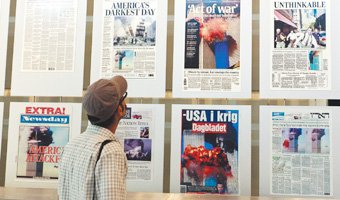
Headlines from around the world recorded the 9/11 attacks on the World Trade Center and Pentagon by Muslim extremists.
|
Denison provides a primer outlining the five pillars of orthodox Islam and a brief explanation of Shari'a, the Muslim code of conduct. He also notes a key principle separating radical Muslims from orthodox Islamic teaching: "For militant Muslims, killing Americans by any means necessary is a defense of Islam mandated by the Quran."
Militant Muslims see the West as aggressors who seek to impose non-Islamic government and values on the Muslim world, Denison explains. And since western democracies are governments, "of the people, by the people and for the people," all the people in a perceived aggressor nation—such as the United States—are threats.
"In my travels throughout the Muslim world, I have met followers of Islam who are among the most hospitable and peace-loving people I have ever known. I have also encountered Muslims in America and abroad who are convinced that aggression against the West is the duty of all Muslims," Denison writes.
Both peaceable and radical Muslims can cite incidents in the life of Muhammad and verses from the Quran to support their position, he concludes. Many Muslims read their holy book progressively—as do many Christians when they interpret the Bible—judging earlier teachings in light of later revelation, he notes.
"But while the Bible moves from military engagement to nonviolent missions and ministry, the Quran moves from nonviolent engagement in Mecca to military action in Medina," Denison writes.
"Muhammad's followers conducted 70 raids against their opponents in the prophet's lifetime; Jesus' followers expanded the kingdom of God through preaching, teaching and healing."
Militant Muslims have a long memory. They equate Christianity with the Crusades, he notes. And they blame the West for the decline of the Muslim Ottoman Empire after World War I and for imposing foreign—Christian or secular—values on the Muslim world, he notes.
"With the decline of the Ottoman Empire and rise of the West, the Muslim world began to interact with a culture it had never confronted before. The discovery of oil on the Arabian Peninsula brought Western governments, companies and finances to their lands. These outsiders introduced Western values such as the autonomy of the individual, the equality of women, and the separation of church and state," Denison writes.
"Their moral values especially alarmed many Muslims as the ethical relativism and deca?dence of the West were exported to their world through books and media."
Furthermore, radical Muslims view the West—particularly the United States—as defenders of Zionism, and they reject Israel's claim to the Holy Land.
"So long as America supports Israel in any way, radical Muslims will claim that we are the enemies of Islam and that they must attack us to defend their faith and people," Denison writes.
Denison sees Sayyid Qutb—an Egyptian-born educator whose experiences in the United States in the mid-20th century convinced him the only answer to Western decadence was Islamic fundamentalism and imposition of Shari'a law—as the godfather of radical Islam and the mind behind the 9/11 attacks.
"If a single book can be blamed for 9/11 and the War on Terror, that book is Sayyid Qutb's Milestones, the book that ignited the radical Islamist movement," Denison writes. "Its call for anti-Western revolution and imposition of strict Shari'a on every nation is frightening. Its continued popularity around the world is even more so."
In terms of political strategies, Denison believes the West should foster democracy and economic progress in the Islamic world and encourage moderate Muslims.
"Since America's military presence in the Middle East is the single greatest catalyst fueling radical Islam, we must act decisively to counteract the allegation that we are invading 'Crusaders' rather than agents of democratic reform," he writes.
The West also should help mediate peace in the Middle East, seeking solutions that protect the security of Israel and the rights of Palestinians, he added.
Christians can draw encouragement from a spiritual movement among Muslims toward Christianity, Denison insists. He urges daily prayer for the conversion of Muslims to faith in Christ, encouragement for ministries to Muslims and support for Muslim-background believers in Christ.
"The most important way Christians can join the War on Terror is on our knees," Denison writes.