


BRENTWOOD, Tenn.—Many Americans believe financial prosperity is God’s plan for them, but they need to give more to ensure that blessing.
According to a Lifeway Research study, 52 percent of American Protestant churchgoers say their church teaches God will bless them if they give more money to their church and charities, with 24 percent strongly agreeing. This is up from 38 percent of churchgoers who agreed in a 2017 Lifeway Research study.
Additionally, churchgoers are more likely today than in 2017 to believe God wants them to prosper financially (76 percent, compared to 69 percent) and that they have to do something for God in order to receive material blessings from him (45 percent, compared to 26 percent).
Today, 3 in 4 churchgoers (76 percent) believe God wants them to prosper financially, including 43 percent who strongly agree. A little less than half (45 percent) believe they have to do something for him in order to receive material blessings from God, with 21 percent strongly agreeing.
“In the last five years, far more churchgoers are reflecting prosperity gospel teachings, including the heretical belief that material blessings are earned from God,” said Scott McConnell, executive director of Lifeway Research.
“It is possible the financial hits people have taken from inflation and the pandemic have triggered feelings of guilt for not serving God more. But Scripture does not teach that kind of direct connection.”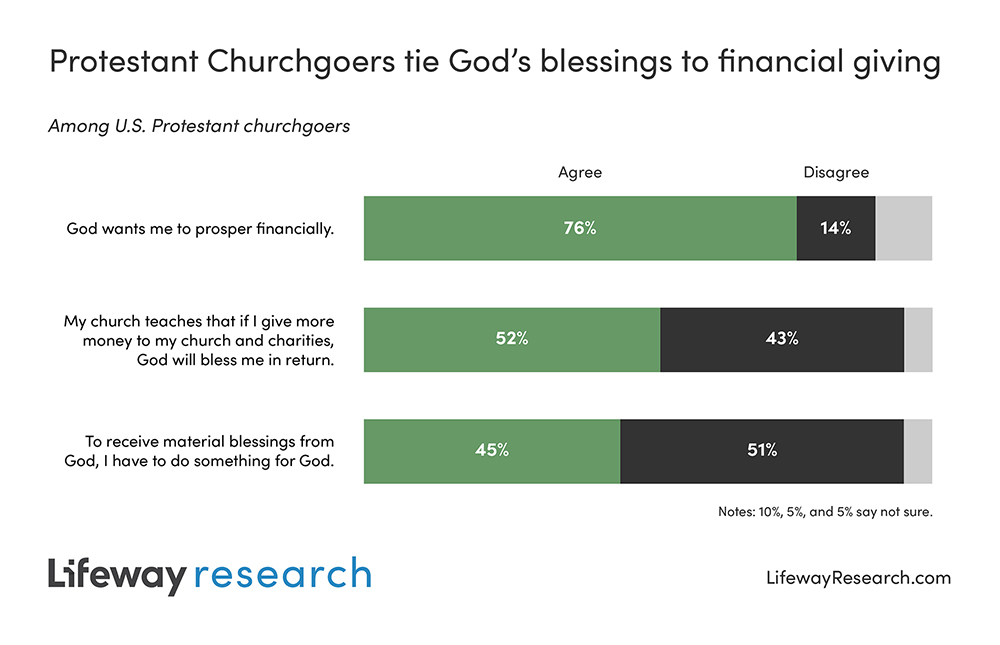
Most churchgoers believe God wants them to prosper financially—a belief especially prevalent among both the youngest and least educated churchgoers. Churchgoers ages 18 to 34 (81 percent) and 35 to 49 (85 percent) are among the most likely to say God wants them to prosper financially.
Furthermore, those who are high school graduates or less (81 percent) or have some college education (80 percent) are more likely to hold this belief than those with a bachelor’s degree (67 percent) or graduate degree (65 percent).
Belief that God wants people to prosper financially also is more common in some religious settings than others. Methodist (93 percent) and Restorationist movement (88 percent) churchgoers are among the most likely to hold this belief. And those with evangelical beliefs are more likely than those without such beliefs to agree (80 percent vs. 74 percent).
Sign up for our weekly edition and get all our headlines in your inbox on Thursdays
“Pursuing holiness was never designed by God to be a plan for financial riches,” McConnell said. “The size of one’s finances is not the measure of anyone’s service to God nor relationship with Him.”
As more churchgoers affirm prosperity gospel beliefs, younger churchgoers—those 18 to 34 (63 percent) and 35 to 49 (66 percent)—are more likely than older churchgoers—those 50 to 64 (53 percent) and over 65 (31 percent)—to affirm their church teaches that if they give more money to the church and charities, God will bless them.
“This research does not rule out the possibility that biblical teachings were poorly heard by more young adults, but they definitely have experienced a lack of clear biblical teaching on the reason for generosity,” McConnell said.
Denominational and demographic differences
African American churchgoers are the most likely to say their church teaches that if they give more money to the church and charities, God will bless them in return (71 percent). And those who attend worship services one to three times a month are more likely to say the same than those who attend at least four times a month (57 percent vs. 49 percent).
Churchgoers without evangelical beliefs are more likely than those with such beliefs to say their church teaches that if they give more money, God will bless them (55 percent vs. 48 percent). The opposite was true five years ago when 41 percent of evangelicals and 35 percent of non-evangelicals agreed.
Denominationally, Methodist (85 percent) and Restorationist movement (71 percent) churchgoers are among the most likely to agree their church teaches God will bless them if they give more money.
Of the three beliefs surveyed, churchgoers are least likely to believe they have to do something for God in order to receive material blessings from him. Still, like the others, this belief is most prevalent among younger churchgoers.
Those 18 to 34 (65 percent) and 35 to 49 (58 percent) are more likely than those 50 to 64 (43 percent) and over 65 (22 percent) to hold this belief. In 2017, churchgoers ages 35 to 49 were the least likely age group to agree (19 percent).
“Large numbers of young adults attending church regularly still believe their good deeds can tilt God’s gifts in their direction,” McConnell said.
Those who are high school graduates or less (50 percent) or have some college education (48 percent) are more likely than those with a bachelor’s degree (38 percent) or a graduate degree (30 percent) to agree. And African Americans are the most likely to agree (65 percent).
Among regular church attenders, those who attend a worship service least often (one to three times a month) are more likely than those who attend at least four times a month to say they have to do something for God in order to receive material blessings from him (49 percent vs. 42 percent).
Methodist (85 percent) and Restorationist movement (68 percent) churchgoers are once again the most likely to hold this belief. And those without evangelical beliefs are more likely than those with such beliefs to agree (50 percent vs. 37 percent).

The online survey of American Protestant churchgoers was conducted Sept. 19-29, 2022, using a national pre-recruited panel. Quotas and slight weights were used to balance gender, age, region, ethnicity, education and religion to reflect the population more accurately. The completed sample is 1,002 surveys, providing 95 percent confidence the sampling error does not exceed plus or minus 3.3 percent. Margins of error are higher in sub-groups.










We seek to connect God’s story and God’s people around the world. To learn more about God’s story, click here.
Send comments and feedback to Eric Black, our editor. For comments to be published, please specify “letter to the editor.” Maximum length for publication is 300 words.